Tag: Claire German

  • Design Centre Chelsea Harbour CEO Claire German on Stunning Design Directions for Autumn and Winter

    Claire German


    Home to an inspiring mix of luxury design houses, independent companies, flagship showrooms and over 600 international brands, Design Centre, Chelsea Harbour is the largest of its kind in Europe. Its unique sense of community, commitment to creative excellence and specialist expertise make it the first port of call for professional designers and architects sourcing for residential and commercial projects, as well as design enthusiasts seeking design and decoration inspiration for their own homes.


    The Design Centre hosts two ‘must-attend’ events each year to celebrate the new showroom collections. London Design Week takes in March to showcases spring/summer launches, and Focus is held every September to unveil the latest autumn/winter showstoppers. This year, Focus/24 sees a new approach when the well-established design and decoration show (16 – 20 September), will be augmented by Focus/24: The Longer View (23 September – 11 October). Aimed to coincide to a time when the vibrant London scene is buzzing with art and design, it will bring refreshed creativity to the Design Centre, with opportunities for visitors to see more inspirational exhibitors for a longer period.

    Adding another layer to the programme is Future Heritage, an installation showcasing work by contemporary craftmakers. With a track record for spotting the next big thing, curator and design journalist Corinne Julius has carefully selected works from makers including Borja Moranta, Tessa Silva, Nicholas Lees, Ane Christensen, Richard McVetis, Elliott Denny and Esna Su. With interior design placing ever greater value on craftmanship, visitors and collectors can also learn how to commission unique pieces for projects, get the inside track at discussions and demonstrations and discover how materials and finishes have been taken in new, imaginative directions.


    Alongside the new launches and a packed programme, visitors look to Focus/24 to keep one step ahead. Following weeks of investigation and sneak peeks of the new fabric, wallpaper, lighting and furniture collections, the Design Centre’s creative director Arabella McNie and wider team identify common threads such as new patterns, motifs, shapes and colour palettes. A voice of authority within the industry, these design directions showcase the latest standout products and the stories behind them, as well as highlight the incredible creativity, expertise and craftsmanship that is fundamental to the Design Centre’s DNA.


    In the following round-up, Claire German, CEO of Design Centre, Chelsea Harbour, outlines the design directions for autumn/winter 2024 for finito readers, sharing the narrative of each one through specifics wallcoverings, fabrics and objets. From classic contemporary to cutting-edge; new maximalism to chic simplicity; urbane sophisticate to rural retreat, whatever style you seek, at Focus/24 visitors can expect a bounty of new designs to inspire.


    To see these pieces in person, visit Focus/24 between Monday 16 – Friday 20 September where all interior design aficionados are welcome. 


    Return for more inspiration during Focus/24: The Longer View from Monday 23 September – Friday 11 October.
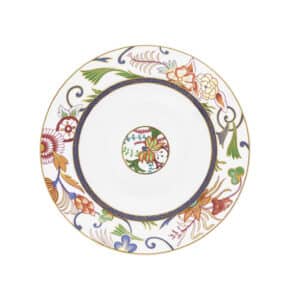


    Pictured: ‘Imari’ plate, Raynaud at SOURCE at Personal Shopping (Second Floor, Design Centre East)


    ‘Vivacious’ Design Direction


    This autumn/winter, design houses are celebrating the artistic, the vibrant and the bold. The aptly titled ‘Vivacious’ design direction is brimming with abstract botanical shapes and lively hues, reminiscent of carnival colours. This is an opportune moment to highlight the ‘Imari’ porcelain plate by Raynaud, available through the Design Centre’s recently launched Source at Personal Shopping service.

    In addition to some 40 china and glass brands, it is a veritable treasure trove for tableware, and showcases exquisite creativity, from traditional, ornate and highly coloured patterns through to sleek and bold modern styles. As well as famous heritage brands, such as Herand, Meissen and Royal Crown Derby, we are also proud to introduce newer names who are making waves in the tableware industry, such as ceramicist Deborah Brett. With its elegant interpretation, the ‘Imari’ plate (pictured here) embodies the ‘Vivacious’ design direction.



    Pictured: ‘Harlequin with Fiddle’ , Luke Edward Hall x Rubell, Rubelli (Ground Floor, Design Centre East)


    ‘Hooked on Classics’ Design Direction


    Another key design direction for this season is ‘Hooked on Classics’. Theatrical in nature, it is rooted in a classical approach, but there is a modern twist throughout. The colour palette is reminiscent of a country house with an abundance of blues, greens, golds, reds, and pinks. We find a play on the past here, with whimsical upgrades on furniture shapes that still allude to tradition. Rubelli’s upcoming collaboration with English artist and designer Luke Edward Hall really symbolises that.

    From the ‘Baroque Fountain’ which depicts a nautical scene with double dolphins and gushing water, to the ‘Harlequin with Fiddle’ wallcovering (pictured here) which shows a circus performer on stage during the improvised theatre of 16th-century Italy. Rubelli, the Venetian family-run company now in its fifth generation, designs and manufactures furnishing fabrics for residential and contract use. Globally distributed, its portfolio includes Rubelli Venezia, Rubelli Casa and Dominique Kieffer by Rubelli.
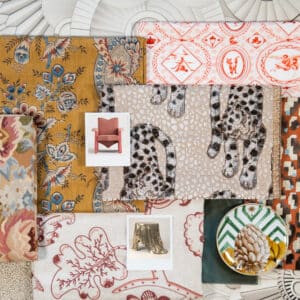


    Pictured: ‘Charlotte’ wallcovering, Claire de Quénetain at August + Co (Second Floor, North Dome)


    ‘Cactus Flower’ Design Direction


    The ‘Cactus Flower’ design direction is aptly named because of its refreshing colour palette, featuring aqua, prickly pear pink, spearmint green and sky blue. Epitomising this perfectly, we have ‘Charlotte’ by Claire de Quénetain at August + Co, available as both a wallcovering and a fabric. Known for her uplifting, stylised patterns, de Quénetain is a French surface designer whose fluid, illustrative aesthetic has seen her work chosen by renowned interior designers such as Laura Gonzalez for collaborations.

    She is a perfect brand for August + Co, whose curated space at the Design Centre converges innovation and artistry. From textile artisans to furniture visionaries, the showroom brings together a carefully chosen collective of British and European craftspeople and makers, shaping a dialogue between form and function, beauty and utility.
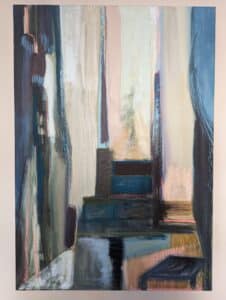


    Pictured: ‘Drawing Room’ painting by Angela Murray at Quote & Curate (First Floor, Design Centre East)


    ‘Brushstroke’ Design Direction

    Artfully inspired, the Design Centre has identified the ‘Brushstroke’ design direction as a dream-like trend featuring ink splots and impressionist dots that evoke misty landscapes. The artist’s palette comfortably mixes dreamy pastels with nighttime tones of teal, indigo and smoke. Here, we must mention the ‘Drawing Room’ painting by artist Angela Murray of Quote & Curate, a new studio, gallery space and art consultancy at the Design Centre. Visitors to Focus/24 will be able to visit Angela’s showroom in Design Centre East, as well as see her work via a pop-up exhibit in the Design Avenue, in situ for the duration of the show.
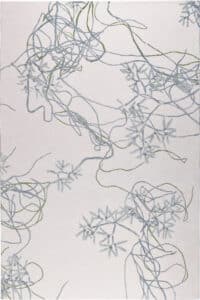


    Pictured: The ‘Avalon’ rug, Jeffrey Alan Marks for The Rug Company (Ground Floor, Design Centre North)


    ‘Sgraffito’ Design Direction


    ‘Sgraffito’ is derived from the Italian word ‘to scratch’, so it should be no surprise that the ‘Sgraffito’ design direction is inspired by the technique that involves scratching a motif or image into clay, often revealing a secondary colour below the surface slip. It is a technique that has been around since classical times, with examples adorning walls, ceramics and paintings in grand houses and palaces around the globe from as far back as the 6th century.

    This direction is angular and spirited, and features zigzags, chevrons and triangles, often in a simple two-tone colour combination. Starting with a base of warm neutrals and layered in earthy colours, the palette reflects the pigments that have been used for centuries to decorate ceramics. A standout piece for this direction is the ‘Avalon’ rug by Jeffrey Alan Marks for The Rug Company, which embodies the scratchy, free-spirited nature of ‘Sgraffito.’ Since its inception in 1997, The Rug Company has collaborated with the world’s leading creatives across fashion, art and architecture, while a talented in-house studio pioneers each design with unparalleled expertise. They can be found in Design Centre North showcasing rugs of expert craftsmanship and innovative design.
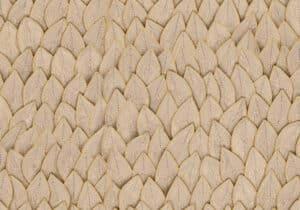


    Pictured: ‘Cordes Sensibles’, Foliage collection, Veronique de Soultrait at Elitis (First Floor, North Dome)


    ‘Elemental’ Design Direction

    When it comes to the ‘Elemental’ design direction, we are being transported to a place full of rugged cliffs, stony beaches and hidden lagoons. This look is all about dry textures that are reminiscent of erosion. We can see patterns that evoke memories of the movement of water on sand and rock. Here, we must spotlight a wallcovering from the Foliage collection by Veronique de Soultrait, in collaboration with Elitis. The showroom offers beautiful fabrics, wallcovering and home accessories, as well as high-end interior brands from around the world.


    The thrill of discovery is something the Design Centre strives to bring to every visitor, helping people discover great design, and supporting those doing it best. Free to register, secure your place at Focus/24 and see the new collections in-person alongside a packed calendar of workshops, masterclasses and talks: www.dcch.co.uk


  • Review: WOW!house at the Design Centre Chelsea Harbour

    Christopher Jackson

    Sometimes your job as a writer is to critique, or nitpick – or at least to recommend improvements. At other times – and this should be done with a sigh after much internal questioning – it is to upbraid.

    Very rarely, your only duty is to praise and recommend – to add footfall and eyeballs if you can. At such times, the role is evangelical: to shout above all the crosswinds of bad news, in order to trumpet the good.

    WOW!house, currently showing at the Design Centre Chelsea Harbour, puts me happily in the third category. I won’t say it’s unmissable – a word whose etymology feels unsound, because it can obviously be missed. But you shouldn’t miss it.

    It turns out to be the work of a restless visionary – a visionary caught up in a pandemic. Claire German, the business’ superb CEO, dreamed up the scheme during lockdown: it starts from the premise that designers are too often snookered into fulfilling a client brief. Instead she has asked the question: What would happen if 18 world-class designers were to give free vent to their inspiration in the same space? Having asked the question nobody else had asked, she then did what nobody else could do: she made it reality.

    Iksel Entrance Foyer by Mark D. Sykes

    Iksel Entrance Foyer by Mark D. Sykes


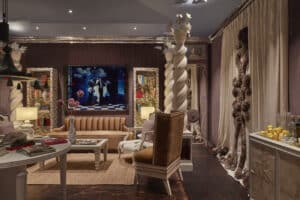
    To discover how it all looks, you have to visit the place itself: the reality is so comprehensively visual that language is inadequate. It turns out to be not so much a house but a sort of Wow!apartment located all on one level of the company’s vast space near Imperial Wharf. (Could the 2024 iteration somehow take us upstairs?). 2023’s version features an entrance foyer, various reception rooms, bedrooms, bathrooms, studios, a kitchen, and much else besides.

    I can imagine Bertie Wooster living here, though he would perhaps be baffled by what he would deem various futuristic touches: the soundscape in each room, the TVs, the modern appliances. It could also house an artistically-minded billionaire like a latter day Sir John Soane, or the 13th Duke of Devonshire on the back of a spree. It is as if all the most tasteful and aesthetically ambitious Rothschilds had convened, decided to pool their resources, and hi-fived all round.

    The Iksel Entrance Foyer sets the tone. This is the work of Mark D. Sikes who is quoted as saying with considerable understatement: “We’re doing something quite different that I think will be a surprise.”

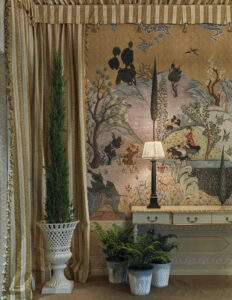
    Living up to this billing, Sikes turns out to be a man of boundless imagination who sets the tone for the installation: the wallpaper, inspired by Chinese scroll painting, took 18 people nine months to paint. Plants and fronds are beautifully spaced, and elegantly tented fabrics flare out at you and overhang you. It’s a beautiful space: the fact that Sikes is now designing a room at the White House makes you tempted to announce your candidacy for the presidency, just on the off chance.

    The next room is by the deservedly famous Nicky Haslam and is called the Legend Room. Haslam says: “This room is a prelude to the many rooms to come. It has no dedicated role, but it needs to have diverse activities…reading, studying, gaming, eating, chatting.” Not for the first time, as it will turn out, I’m struck by how much can be achieved at the level of detail in design when you’ve made sure underlying symmetries are in play: in Haslam’s room, the supporting pillars are cunningly spaced, and even the positioning of the chairs suggests a certain cunning which enables him to meld different eras elsewhere.

    Nicky Haslam, Legend Room

    In fact, it turns out that playing with time is a theme: most of the rooms overlap one era with another, almost always successfully, and always interestingly. In something this vast, I doubt everybody will like every design decision here: but there’s so many to see that only the terminally incurious could come away uninspired.

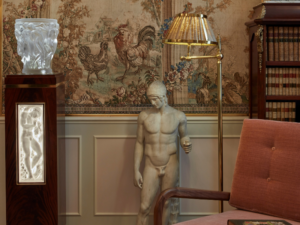
    My favourite rooms are Tim Gosling’s library, full of a light but deeply felt nostalgia, and a French chateau feel. Gosling explains in the Wow! wonderbook: “Libraries are rooms that you amass emotional objects for, creating links to things and people that span thousands of years of human knowledge and skill. It’s the room in your house that you would save if there’s a fire.” It’s a gorgeous achievement, and probably the most unified aesthetic in the house.

    Tim Gosling, Library


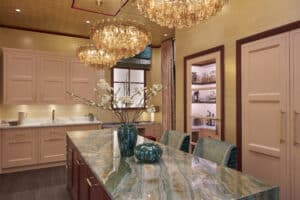
    Another favourite was the kitchen by Henry Prideaux Interior Design. This is a confident space, reminding me of Voltaire’s dictum that great works of art need quiet patches. I loved the stretch of richly coloured marble, and the careful way in which details accumulate – the desk to one side, the interior of the cupboards roofed with gold. ‘A well-imagined interior should make its inhabitants feel good. Your emotions should be satisfied by the space.” Mine were, and I also now know I need a new kitchen. Specifically, this kitchen.


    Kitchen, Henry Prideaux Design

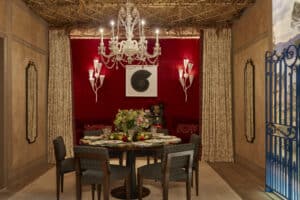
    The room I could most imagine hosting in was Joy Moyler’s dining room, with its little curtain-surrounded nook – a tribute to Christian Dior, who apparently liked to have a niche to withdraw into specifically to gossip. Moyler is another stratospheric achiever whose clients include Leonardo DiCaprio and if you want to know what the view is like from his house, then you can find out by visiting this room. The strong suspicion is that DiCaprio has a nice house – and not least because some of it has been designed by Moyler.

    Joy Moyler


    But does he have a Wow!house? Very possibly: not quite. Only the visitor to the Design Centre Chelsea Harbour has that. In the Wow! Wonderbook, Moyler explains her ethos: “Every room should include people who are wonderful, who you want to spend time with, and comfortable furniture, which will create an environment for people to linger.”

    She’s right of course and it makes you think. We all sometimes play that game of constructing our ideal dinner party: Oscar Wilde tipping his head back in astonished laugher at your latest witticism, while a hand reaches across to enfold yours – a hand which turns out to belong to Marilyn Monroe. Shakespeare comes up and asks if you’re free for his latest leading role; but sadly you’re unavailable because you’ve just agreed to be Roger Federer’s doubles partner at Wimbledon. Leonardo, from a corner, nods approvingly and quietly decides to make you the centrepiece of the picture he’s painting.

    The thing about Wow!house is it makes you feel better about yourself just by being there: you begin to detect possibilities within which, you fondly think, might just make the world go ‘wow!’ yet.

    Wow!house runs at the Design Centre Chelsea Harbour until 6th July 2023 

  • Meet Design Centre Chelsea CEO Claire German


    Christopher Jackson is impressed by the talented and dynamic star of the design industry

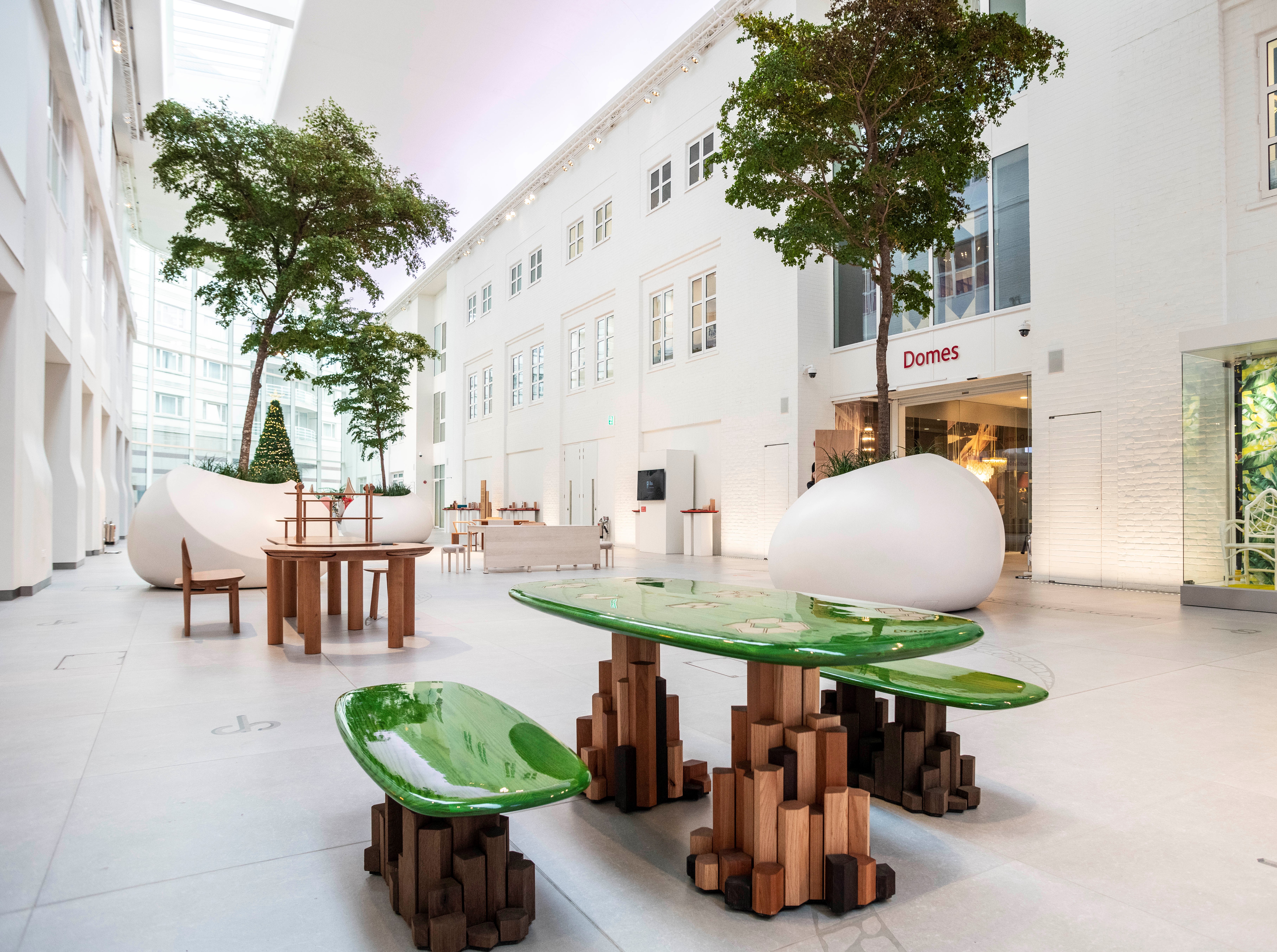
    The space strikes you so forcibly that you’re already planning your next visit as you arrive. The Design Centre Chelsea has a cathedral-like entrance, opening up onto 125,000 square feet of space. It’s remarkably well-lit – the light flooding in from above the riverside at Imperial Wharf – and feels, above all, like a place to explore. The feeling is like Bond Street on an epic scale, but you sense rightaway from the signage and the layout that it’s navigable: you’re going to have a good time here.

    Upstairs, I meet the delightful Claire German in her impressive walnut-panelled executive boardroom. My sense is of someone infectiously kind, and highly impressive. “You have to get up in the morning and feel great, and not dread your work,” she says. “It’s not about money; it’s about enjoyment and getting full satisfaction.”

    She seems so absolutely suited to her position that it’s hard to imagine her anywhere else, which in itself makes me curious to know how she got to where she is. Initially, German worked in publishing, which she obviously loved. “ I graduated in history and politics, and then worked at various publications at The Independent and The Evening Standard, and then I went to Condé Nast, and worked at House and Garden. I found I loved the magazine and the industry: it was that whole aesthetic.”

    After a spell at Brides magazine, German returned to edit House and Garden (“that was like coming home”) and you get the impression talking to her that she could happily have stayed there for the rest of her career.

    But life often has a way of intruding on our peace, and sometimes in good ways. “After ten years, this role came up,” she recalls. “I had met Mark Steinberg and Terence Cole, and had begun producing their biannual magazine. When the MD left, they asked me to take over. I loved where I was, but I decided to consider it. It’s a world I know, and I realised a lot of the things I loved doing with the magazine I’d still get to do here.”

    It’s a tale of how journalism can often lead you to other things. Today she presides over the only design collective of its kind in Europe. “There are 120 permanent showrooms, and within those showrooms there are 600 of the top international brands,” she explains.

    The centre also needs to be distinguished from its equivalents in the US. “What I like to nurture here is a sense of community,” she continues. “For the UK, and even the European industry, we’re seen as the mother ship. If there’s a product launch, or something exciting – an event which brings everyone together – it happens here.”

    You get the sense that German has succeeded due to astonishing attention to detail. “When we have a contemporary craft fair like Artefact in May, when 19 galleries will be exhibiting, they’re still very curated. Everything has to be the best, and sit together well, without any jarring – and that expectation rolls out to everything.”

    But what really sets the place apart is the community ethos. “Most design centres have an ordinary landlord and tenant relationship,” German continues. “They arrive, and they‘re given the keys. The design centres in America will do one or two events a year, maybe. This is different; it’s a labyrinth of support.”

    German gives me an example. “Osborne and Little have been on the King’s Road for 50 years and have decided to uproot and come here. That speaks volumes. They’ve always had their independence there, but now they want to be here, as they want to be in the hub of it.”

    The fact that the place is a hub means that collaboration often happens.  “We’re good at playing Cupid. For example, we’ve got a wonderful outdoor furniture company called Summit, and also Jennifer Manners who’s a great rug designer. Jennifer arrived a couple of years ago and she’s now doing a bespoke range for Summit. The great thing about being here is there’s this opportunity to create, converse and connect on a daily basis. You’re not on a High Street on your own, maybe feeling a bit isolated. There’s a network.”

    This opens up onto another important point: the essential generosity of the creative industries. German explains: “Creative people celebrate other creative people and respect their work. It’s a close-knit, professional and friendly industry – although of course, like all industries, it can also be competitive.”

    This ethos has led to perhaps her greatest achievement to date, the creation of WOW!house. This was something which German had long wanted to do and which she produced, to exceptional industry feedback, for the first time in 2022. The idea was to give interior designers a blank canvas to create the most beautiful room possible “and not have to react to a client’s brief.”

    German recalls the scale of the challenge: “I announced it and didn’t realise I’d taken on such a huge job! I have the most fantastic team so we all worked together and pulled it off. We also produced the occasion together with Centrepoint, and made sure homeless youths could come along and learn about what career opportunities the industry can offer them. I’ve been thrilled with the reception it’s had.”

    So what’s next for The Chelsea Design Centre? “Artefact is coming up on 9th May, and then beyond that we have Wow!House again, which lasts for a month. Formed with Future Heritage is also a very important event for us later in the year where we seek to give young people the platform to launch their careers.”

    But German’s ambitions are far greater than simply fulfilling her demanding calendar year. “Art is an area which we want to develop and expand,” she says, pointing to a potential gap with the demise of Masterpiece London. “I think we can then look at other topics. We could be doing something on kitchens, and something on bathrooms. When we did supplements on these things for the magazine it was always a good circulation driver. We also want to look at the superyacht industry and private aviation.”

    Would she consider expanding internationally? “The idea of Wow!house is to take it to new markets. But I wouldn’t do a Design Centre Paris as it’s too close and it would cannibalise. If the French designers want to do a good comprehensive sourcing, it’s easier to come on the Eurostar than to navigate Paris. They put their staff up at the Chelsea Harbour Hotel and they run around like locusts. I’d also be interested to take Wow!house to Dubai. There’d be a lot of interest there and I think it would be very well received.”

    As you listen to her say those words, you’re left in no doubt that she will: she clearly has the appetite and ability for the task. Her advice to young people is straightforward: “What’s great about this job is the world is your oyster and if you’ve got the strategy and enthusiasm, then just give it a go.”

    She’s right about that – and about a lot of other things. I leave inspired, plotting my return.


    Artefact is at Design Centre Chelsea from 9th May 2023.

    Wow!House runs from 5th June-6th July 2023.