Tag: Christopher Jackson

  • Exclusive: How Stephen Fry went from Comedian to the Nation’s Mentor


    Christopher Jackson


    Growing up is necessarily a provincial experience. It has to be: such a small proportion of the world is presented to us at that time. As a result, something like the following seems to happen: we come into the realisation gradually that our family’s experience of life, while it might be informative in numerous respects, also has to be a sort of red herring: we are not them and are not meant to be. Instead our obligation is to grow in some new direction in order to be ourselves.

    What this all has to do with Stephen Fry I shall come onto in a moment. For now it is enough to say that predicament of youth can engender bafflement, even acute forms of anxiety. It was the novelist Sir Martin Amis who pointed out that nothing is so usual as what your father does for a living. He knew that from rich personal experience, his father being the equally famous novelist Sir Kingsley Amis. But many people have the opposite sense that one’s essential narrative might lie elsewhere. If this is one’s suspicion then what you badly need are clues as to what that might realistically consist of.

    For me, growing up in rural Surrey in a good-natured suburb of lawyers and accountants, the existence of a group of comedians in the 1980s came as thunderbolts. Looking back, I realise they were also signposts. The moment I saw Rowan Atkinson on our TV screens as Mr Bean, and saw my parents crying with laughter, and felt the first true belly laughs I’d known rushing through my being, I felt a new scope rush in.

    This must be a very common experience: here we are in our quotidian home, trying our best and seeking to be good; but out there, on the screen is another kind of life, which seems so hilarious, and so silly – and therefore somehow kind, and decidedly blessed. It is the world of celebrity and laughter. When we are young, it can seem like the most desirable thing in the world – full of high definition colour, and pitch perfect performance, a sort of paradise where outcome is in accordance with aim.

    Of course what happens at that time in our lives is a broad revelation – what Philip Larkin calls ‘the importance of elsewhere’.  It’s only later that you examine its particulars; how the sheer scale of possibilities relates to oneself. When I saw Rowan Atkinson terrified to dive off the top floor of a swimming board, I didn’t, as the world can now see, decide to be a slapstick comedian.

    But I think I did decide around that time not to be an accountant. This decision was further crystallised when I saw John Cleese in Fawlty Towers, the frenetic clockwork pace of that sitcom, causing an escalating delight. It was shored up further by other experiences: French and Saunders, Smith and Jones, and later Harry Enfield.

    But then there was another pair who spoke to me in a different way, and opened up, I now see, far larger possibilities: this was a pair of Cambridge graduates called Stephen Fry and Hugh Laurie. Hugh Laurie seemed to me then – and still does – just about the most gifted person on earth. He is funny. He is a brilliant actor (see especially House). He plays piano, sings, and plays guitar beautifully.

    Almost unnoticed, he is the best comic songwriter of his generation (‘I don’t care if people laugh/I’m in love with Steffi Graff’). His novel The Gun Seller is a delight. He was also responsible for A Bit of Fry and Laurie, my vote for the greatest sketch show of all time.

    It was Laurie who made me pick up guitar and piano, and later write music. But of the two it was Stephen Fry who really interested me, and who pointed a more definite way. In this country, the trajectory is told everywhere from the life of Shakespeare to the novels of Dickens: you’ve got to get from where you are to London. And it’s from London that I write this.

    What was it about Stephen Fry? It was partly because however troubled he was, he was so obviously kind – though over time I would find out that he could be rather hard on himself. But I don’t think it was primarily that. For me, it had all to do with his use of language, which came as the most wonderful and joyous surprise of my life. It seemed astonishing to me that people could speak like this, bequeath you a vocabulary as they made you laugh.

    It was a form of proclaiming of themselves before the world – they could cause laughter in you while making you more intelligent. If you were receptive to it, it had to form you; Fry and Laurie made you want to be them, because it looked like an awful lot of fun. But not just that, it made you feel that if you could enter a little into their world, that you would know some special set of secrets. That way maybe you could build a life – one that was somehow true to a high set of possibilities.

    These sorts of suspicions can only take you so far. Because pretty soon, life happens to you. As Mike Tyson beautifully put it: “Everybody has a plan until someone punches you in the face.” What happens is that life punches you in the face – and anyway, the world our heroes inhabits nowadays has so little to do with the one we end up entering. We specialise in the vanished paradise and the discarded Eden.
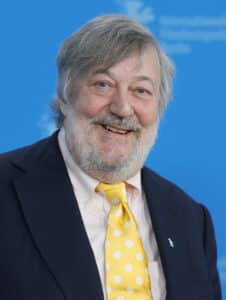
    Nevertheless my preparations for a world which would have gone by the time I got there were unusuall thorough. I think I must have been 11 or 12, when my younger brother Tim – who would have been nine or ten – began learning and performing Fry and Laurie sketches to family and friends and sometimes to perfect strangers in restaurants. One particular sketch which we performed entailed Stephen Fry as a pompous late night talkshow host, talking on and on in the most preposterous way: “Is our language too ironic to sustain Hitlerian styles?

    Would his language simply have run false in our ears?” My younger brother would play a baffled Hugh Laurie, who can’t understand what on earth the Stephen Fry character is saying. Amusingly, as I look back on it now, I had absolutely no idea what the language meant. This created a situation of considerable amusement when I performed before elderly relatives the following:


    Language is my mother, my brother, my father, my whore, my mistress , my niece, my check-out girl. Language is the dew on a fresh apple. Language is a creak on the stair. Language is a ray of light as you pluck from an old bookshelf, a half-forgotten book of erotic memoirs.


    I had no idea what any of it meant but I loved the music of it. It was the idea that language is a kind of music, that we can have fun with it, and play with it – and therefore, I suppose, that it has glorious function. It means that we can burst pomposity in this sketch, but of course, if you accept its use, then you must also admit that it can lead you onto new worlds. It can prise things open.

    As I continued my studies in Stephen Fry, I found in him an educator – indeed, a sort of a remote and unpaid mentor. The power of this mentorship seemed to me no less important simply because he didn’t know who I was, and would almost certainly never know. This didn’t matter one iota so long as I was receptive and so long as Fry continued to build his career around the communication of the things he loved.

    It is this love of things which I think defines Fry; it is a generosity in him which keeps spilling out. As I would go on in life, some people in the public eye would also give me great gifts. Amis, who I mentioned earlier, would give me Saul Bellow and Vladimir Nabokov; Julian Barnes, whose books I could never get on with, offered up Flaubert in almost every interview he gave; Gabriel Garcia Marquez recommended me Virginia Woolf and Juan Rulfo; John Updike showed me Henry Green and so on and so forth.

    It is perhaps the loveliest of all lessons for young people to know that in life, as in literature or art or music, there are a series of invisible threads to be grasped and which lead to pleasures you never could have imagined.

    But Fry, I think, was different to all these people. He loved things loved so much that he had to enact that love. He didn’t just tell you in no uncertain times that he loved PG Wodehouse; he played Jeeves on television. He didn’t just love the novels of Evelyn Waugh, he directed a film of Vile Bodies, replacing it with the far better title Bright Young Things. And then there was Oscar Wilde, who he rather resembles, and who he often seemed to embody in his chat show appearances, and then on film in Wilde, the role which he was born to play, and which he played beautifully.

    The world is a catty place and some would say that Fry has always been in some sense derivative. The argument runs that he has borrowed these personas and that there is accordingly some sort of gap within where the real Stephen Fry ought to be. The somewhat churlish columnist Peter Hitchens has called Fry ‘the stupid person’s idea of an intelligent person’.

    I dislike this remark not just because he repeats it in print regularly with a kind of calculated cruelty, but because it isn’t true. Fry didn’t write The Importance of Being Earnest, it’s true, but he has done more than anyone to proclaim Wilde’s genius at his having done so. I don’t think Fry, clever as he is, has ever made gigantic claims for himself; others have done so, seeing his value. In time, the nation reached something like a consensus around this. They loved to hear him talk – but I think they loved really to hear him talk about his loves.

    These seemed to have no obvious limit: in addition to Wilde, Wodehouse, and Waugh there was cricket, Paddington bear, nature, taxis, Abba, Sherlock Holmes, Ancient Greece, poetry, London, America. Really, we began to realise, he loves, or is capable of loving everything. This spirit, I note, is far closer to the Christian ideal than anything I have seen in the public domain written by Peter Hitchens.
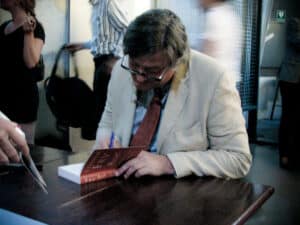
     

    Hitchens’ remark also lacks empathy. We now know what Fry was going through, and that he has suffered all his life with bipolar disorder which can lead him into manic moodswings; he has lived all his life with suicide as a realistic possibility. Here again, he has done more than anyone to raise public awareness about this health condition in his very important documentary The Secret Life of a Manic Depressive which aired in 2016, some four years before the pandemic when mental health really began to top the agenda.

    His condition, which wasn’t widely understood at the time, was most obvious when Fry famously left the cast of the Simon Gray play Cell Mates in 1994. In the days before mobile phones, there was genuine worry about his whereabouts and the fear that something appalling might have happened to him. Gray was upset at the time that his play had been, quite literally, upstaged, and wrote about it at book length in Fat Chance (1995).

    Nowadays, I doubt Fry would get to the end of his street without his whereabouts being broadly known; in those days, when he left the play mid-run, there was a genuine fear among his friends that he had vanished for good. Today, he is one of those people so famous, that he will never again be allowed to go missing.

    If I were to compile a list of Fry’s dislikes, I feel I might reduce it to one thing: cruelty. His friend Christopher Hitchens has sometimes been called the hater par excellence, but I think Fry is a greater purveyor of dismay at human cruelty than Hitchens was, because, on the flipside, I think Fry’s kindness is more active.

    The only kind of successful hate involves consistently pivoting to love, and my sense has always been that Fry is good at this. One early article which influenced me was his great defence of Freddie Mercury which is collected in his 1992 collection of journalism Paperweight, where – I am quoting from memory here since I can’t find the article online – he speaks of Mercury as having entertained with a ‘chutzpah bordering on genius’ and takes to task those who found his lifestyle immoral.

    Its tenor was really ‘judge not less ye be judged’ – and again, one feels that Fry is always actively generous in spirit in way which ties in with the Gospels far more than one might expect from a man who shared the stage in religion debates with Christopher Hitchens.

    His career grew in so many directions that it cannot easily be summarised. It has proceeded along novels (I especially recommend the first two The Liar (1991) and The Hippopotamus (1994), memoir (Moab is My Washpot (1997) may in fact be his best book) broadcasting (his best work here may be his brilliant hosting of the BAFTAS, which he did 12 times, finally giving up in 2018),

    TV shows (Jeeves and Wooster, Kingdom), a marvellous poetry handbook The Ode Less Travelled (2005) which was instrumental in my ever publishing any poetry myself, as well as a host of illuminating TV documentaries, TV interviews, podcasts, blogs, posts, tweets and many other things besides. Fame is difficult to quantify but by any measure Fry is among the most famous people in the UK today.

    My fame however is very easy to quantify: it is nil, and I am currently doing all I can to keep it so. However, just because I have ended up lucky enough to spend a lot of time carrying out interesting journalistic assignments, I must admit that it has involved meeting famous people of many different shapes and sizes all for the purpose of interviewing them. Some of them, from Sting and Andre Agassi to Sir David Attenborough, have been very famous indeed.

    Some like Sir Tom Stoppard, Clive James and Sir Anthony Gormley have a mystique to those who mind about literature or art. Others aren’t famous at all to almost everyone, though they might be revered in their field. Out of all the categories of people I have come to most dread, I would single out those who are just a tiny bit famous as the ones to watch: amid the dim lights of that particular inferno, ego can be at its most pronounced.

    At any rate, as you go through your journalistic career, you realise as you go on in your work that you are starting to meet your heroes. But even then, I never thought I’d meet Stephen Fry.

    What exactly is going on psychologically when we meet our heroes? Dr Paul Hokemeyer, the brilliant author of The Imposter Syndrome, tells me: “Our fascination with and attraction to heroes is primal and hard-wired into our central nervous system. This is because heroes become like celebrities who occupy elevated positions of prestige and power in our society. From an evolutionary standpoint, we are instinctively drawn to people who will take care of us and from whom we can learn vital life lessons to protect us from dangers and advance our station in life. Because this draw is so primal and integrated into our central nervous system it often overrides our critical and rational thinking.”

    In short, when you meet someone well known, we have a tendency to say stupid things. What is happening in the brain at such times? “As this relates to our neuroanatomy, being in the presence of a celebrity floods our central nervous system with a host of intoxicating hormones that override the intellectual reasoning found in our prefrontal cortex. Such disequilibrium causes us to say silly, often nonsensical things which place us further in a subordinate position to the celebrity.”

    And how does this all play out from the point of view of the celebrity. Put simply, it’s not great for them either. “ Too often, however, celebrities become exhausted from the weight of this elevated and never-ending dependency. People become only able to see them as resources to advance their station in life.

    They become like parasites sucking their life force and preventing them from finding any relational nourishment. In this regard, people become a source of danger and cause them a great deal of anxiety. This is one of the reasons why people of wealth, power and celebrity lead such isolated lives. They lack not just a circle of peers but also people who they can look to for nurturance and protection.”
     

    What seems to happen is that a journalist – just by virtue of what he does for a living – comes into in a slightly different position when it comes to the famous. It might be that someone who isn’t battle-hardened when it comes to the sheer oddity of celebrity will meet someone, and the encounter may go badly because they will end up saying something just a bit odd in order to impress, or to draw attention to themselves. They feel the gulf between the famous person’s fame and their own obscurity too keenly and end up drawing attention to it.

    The famous person, who will be by their position, extremely experienced in this sort of mismatched encounter, will sometimes try to amend the awkwardness but at other times they won’t. This might be personal (they’re tired and/or having a bad day) or it may just be that the encounter cannot be rescued. The famous person may then resign themselves to the thought that maybe it’s just easier to spend time with other famous friends. Almost always when someone moans that so-and-so in the public eye isn’t pleasant to meet I suspect that there will be some element of this completely understandable lack of expertise which has intervened on the encounter and spoiled it.

    What’s interesting is that the way to remove the awkwardness of the encounter is not to care at all about fame, but to care about the person in front of you. This is not to say you should pretend they’re not famous as that would be to deny reality, but to treat fame as perhaps the least interesting thing about them.

    Sometimes I have seen, in the middle of an interview with someone known, the person themselves, and there one sees something deeper and truer which has nothing to do with the construct of celebrity, though it will also almost certainly give clues as to why that person was driven to become well-known and also why the public reciprocated that wish. I am not saying that I am a master of this art.

    I would not expect myself to behave with absolute equanimity if Elton John were to knock on my window as I write this, and offer up a private concert in my living-room. But it is what journalism teaches you, and it amounts to something like an inherent lesson of the profession.

    Hokemeyer explains: “What such a person is doing is modelling humanity. By pre-empting the biological calibration that occurs around the power dynamics inherent in a celebrity identity by engaging in your intellect and rational mind, a journalist is levelling the playing field. You pre-empt the hijacking of your intellect by grounding the relationship first in the prefrontal cortex and then allowing your central nervous system to catch up. For most people, the calibration of psyches occurs in reverse. The central nervous system leads. Too often the intellect never catches up and the relationship becomes fuelled by unrealistic fantasies and harmful stereotypes.”

    Quite by chance, on the 27th July 2023, I presented myself at the Oval Cricket Ground at the Micky Stewart Pavilion. I had, to put the matter as politely as possible, more or less had my fill of famous people. I am anxious here not to sound tiresomely world-weary since I have always been mindful of my luck in terms of meeting so many interesting people. However, it would be wrong to omit the fact that the encounter between famous person interviewee and non-famous interviewer is always on some level a sapping one, for the simple reason that by creating fame, and especially televisual fame, we have plainly released a set of completely crazy energies into the world.

    I wave my ticket at the security people, a piece of paper which conveys the unlikely, but true, story that today I happen to be attending the final test of the Ashes courtesy of the Duchy of Cornwall. Instead of the interrogation I half-expect, I am waved through to the Oval, scene of some of the great climaxes in Test Match history. Here in 2005, Kevin Petersen hit his magical 158, with Shane Warne bowling his heart out. It is also a place of significant goodbyes.

    Here it was that Alistair Cook scored 147 during his final innings having been short on form. Here too Don Bradman was famously bowled for a duck, when needing just four runs to end with an average above 4. Unknown to me, in a few days’ time, Stuart Broad will retire from international cricket having hit a six from his last delivery and a wicket with his last ball.

    Inside, all is cricket lore – a lesson in black-and-white pictures and old news clippings about the history of cricket. The Oval is a place where time is prised open a little, and you feel a sense of cricketing history. Perhaps it is more forceful in this respect than Lords, because the so-called Home of Cricket is always cumbrously reminding you of its importance. Here the past seeps in almost casually.

    I walk up the stairs and am asked to find my name on the guest list and sign in. As I scroll down the second page, I glimpse the names on the guest list: Sir John Major; Sir Trevor Macdonald, Chris Tremlett. My name must be on the first page, and there just down from my own, it reads: Stephen Fry.

    I am given a name tag and move through to the bar area. Now, it is important to convey a little about the Micky Stewart Pavilion. As I understand it, one of the most interesting things about becoming the Prince of Wales, and thereby coming into the possessions of the Duchy of Cornwall, is to discover all the things which one suddenly owns. One of these possessions is the Oval Cricket Ground.

    This means that if by some curious chance one is invited to the Micky Stewart Pavilion you are there to some extent because the Prince of Wales doesn’t mind you being there, or hasn’t noticed, or in my case, by a stroke of good fortune. In such places there is curious sense that everybody assumes you have some sort of validity just by being there at all.

    As I walk in Sir John Major walks by and, ever the politician, he reads my name badge and says: “Hello, Chris, it’s good to see you here.” We talk briefly about the great sadness of the weather-affected draw the week before, which certainly have meant we’d be coming into this match with the scores level at 2-2.

    I am always struck by the charm of senior politicians; I wasn’t able to vote in 1997 when Major was last on the ballot, but he has secured my vote retrospectively. We sit down for the opening session, and sit away from the bar in the stands. It only occurs to us once we have sat down that the green seats nearest the bar are for everybody to sit in. We might just as well, had we had the inclination, sat next to Sir John.

    But what is the proximity of an elderly prime minister compared to a good morning’s cricket? Australia chose to put England in, in the justified belief that overcast conditions would make the ball swing. However, England put up a spirited performance, led by a swashbuckling 85 by Harry Brook. As we head inside to the pavilion for lunch, Fry is seated next to the door and smile congenially at us – he looks like someone who, should the moment arise, wouldn’t mind a conversation.

    We head inside and there is a bit of mingling before lunch. Chris Tremlett towers above the company, looking like he could still take a wicket if suddenly summoned down to the pitch. By accident I find myself chatting to Fry, and I mention to him that my grandfather had grown up in the same village as him in Booton, in Norfolk.

    “Booton!” he cries, delightedly. I can see how much he enjoys saying the word – which is, indeed, rather fun to say now I think about it.

    I add that my great-grandfather was the rector of the church there. “Oh, I remember that cold church,” he says. “Were your family the Fishers?”

    I say they were the Jackson.

    “Ah the Jacksons!” he says, cheerfully, though I suspect that he can’t remember them and they may have been before his time.

    After lunch, we head out and find Fry sitting alone on the green seats, and in a moment of curious madness, decide to sit next to him. It is worth saying at the outset that a good place to meet your hero is at the cricket: the rhythm of the match can interweave with your conversation, and it is less adversarial than the typical interview.

    Early in our discussion, we talk a bit about our favourite Australians and I mention Clive James, who Fry knew well, and who I interviewed once towards the end of Clive’s life. I mention that I liked his poetry and that I was due to talk to him about The River In the Sky, one of Clive’s last publications. “Yes, I rather like Clive’s poetry too. He was a very good poet – when he wasn’t reading the whole of Western literature.” I mention that I was invited to Clive’s house for the launch of the book when I had committed to a press trip. Fry sympathetically winces: “That’s unfortunate.”

    We then discuss Sir Tom Stoppard and I mention how kind he had been to me when we interviewed him for this magazine. I say it is often difficult to know how much one should thank someone well-known. “Oh, you always should. Christopher Hitchens always used to say that – thank your heroes.”

    Does he miss Christopher Hitchens? “Hugely.” I ask him if Hitchens would have supported Trump or Clinton in the 2016 General Election. “It’s a well-framed question,” he smiles, “as if there was one thing for sure about Christopher it’s that he absolutely loathed the Clintons. But Trump? I think that would have been a step too far.”

    He then tells me a lovely story about Tom Stoppard at a cricket match which Fry attended. The party were discussing collective nouns – a parliament of birds, a pride of lions and so on – when Harold Pinter and Stoppard walked in. Fry wondered aloud what the collective noun for playwrights would be and Stoppard immediately replied: “A snarl of playwrights.”

    We discuss Leopoldstadt, Stoppard’s most recent play, which Fry has just been to see in New York. He asks if I have seen it and I say I have only read it but that the ending affected me deeply. Fry is wistful, no doubt thinking of the extraordinarily touching end scene, which I shan’t go away here: “Yes, I wonder what it would be like only to have read it.”

    Stoppard, Fry recalls, used to play cricket for Harold Pinter’s XI. “It was called The Gaieties which has to be the worst name for an XI of all time – and not a very Pinteresque name.” I recall to him an essay in Paperweight that he had written an essay on chess and playwrights, and how the story of styles in the 20th century theatre mirrors chess-playing styles around the same period. “Well that’s just the sort of pretentious stuff I would write.”

    I have throughout a sense of Fry which is rather touching. That is, even here, when he doesn’t need to be a performer. One senses the need to be loved, and that he is therefore always moving to make life easy for you in conversation – to make sure you’re at ease.

    Down on the pitch, Stuart Board, I note is trying to anger himself into greater pace, and this prompts a discussion on the importance of anger in fast-bowling. ‘Bob Willis is the great example there – he always bowled better when angry,” says Fry. He also quotes Mike Brearley: “Anger always brings presents.”

    As we talk, Fry explains that he is trying to do more to carve out time for the cricket, and that it was part of his motivation. “I have a lot of difficulty saying no,” he says, “which is why this summer has been so lovely.” It has been a time to pause work and spend some time with friends. “Hugh loves the cricket – he came along for a day,” Fry says.

    Talking of fast-bowling greats turns us inevitably to Shane Warne. I ask him if he’s read Gideon Haigh’s great biography of Warne, and Fry is enthusiastic. Fry has also a kindly way of finishing your sentences for you as a way of making you feel you are being listened to and understand. When I begin to say there have been times when I’ve considered getting a subscription to The Australian only to read Gideon Haigh, I find that Fry has said the last five words on my behalf. Did Fry get to know Warne? “Yes, I did a bit – a lovely man.”

    But of course you realise that however many people you might have met, Fry has known everyone. It comes with his position. Since we are here thanks to the Duchy of Cornwall we briefly discuss the Prince’s disinterest in cricket as opposed to football, Fry frowns in a comic way: “Well, yes, I have known for some time that the Prince is not especially interested in cricket. Prince George though when I saw him last talked of having ‘just been in the nets’ so perhaps things will be somewhat different in the next generation.”

    It is a lovely thing to let the conversation as the cricket changes. At one point, Fry jokes about Todd Murphy, the Australian off-spinner. “Well, he’s got the off break, and then there’s also the off break. And if that doesn’t work, at least he’s got – the off break.”

    At another point, enjoying the batting, I mention John Arlott’s description of Jack Hobbs, as what having made him great was his ‘infallible sympathy with the bowled ball’. Fry repeats it: “Oh Arlott! An infallible sympathy with the bowled ball. Marvellous!”

    There is time also to reminisce. I mention how Fry and Laurie caused me such delight as a young boy, and even tell my story of reciting his work as a boy, and not knowing what the words meant. When he asks which sketches we used to recite, I tell him: “There’s this sketch where you play a pompous interviewee on late night television. “ “Sounds like me,” Fry says swiftly.

    When I recite the sketch for me, I am able after all these years to thank him for it. To my astonishment, I see he is visibly moved to have had this impact. “We didn’t know the effect back then – it was like dropping a coin into a well. Every now and then with Fry and Laurie someone would stop you in the street – but it was very occasional indeed.”

    I had heard a story of Paul McCartney, which I mention to Fry. Apparently, when he seeks to hire someone he always gets his driver to befriend someone lower down in the organisation he wants to hire, so as to be sure that they’re kind to their subordinates. “Did you ever get to know David Tang?” Fry asks and I admit I’ve never heard from him. “I loved him he was an incredibly kind man. But he could be extraordinarily rude to his subordinates. On more than one occasion he was David was so rude to his driver, that I had to get out of the car.”

    As the often continues – and it was one of those rare giddy days in Test match cricket where wickets fall at regular intervals – I also get the opportunity to thank him for The Ode Less Travelled, his poetry handbook, without which I never would have been able to publish my own poetry books. I tell him his, and I also add that the poet Alison Brackenbury is an admirer. He is thrilled by this: “Alison Brackenbury! Well, I love her poetry so that means the world to me.”

    Later I mention this to Alison and she replies: “How wonderful! We never know where our writing goes. I do think Stephen must be fantastically well-read to have found my poems. I have tried hard over the years to scatter them in the most unlikely places, but I doubt if even the amazing Mr Fry ever read the now defunct Tewkesbury Advertiser.”

    I remind Fry that he says he writes poetry in The Ode Less Travelled, and tell him I think he should publish a volume of verse. He says: “Well, I did think during lockdown that I ought to compile that and I began it, but then I stopped.” How long would it be? He smiles: “Well that would depend on triage. Most likely it will probably have to wait for my will and then everybody will say: “What on earth was he thinking?”

    The afternoon drifts on, cricket always intertwining with talk. At one point Fry jokes that we must ‘avoid clichés like the plague.” He talks of his admiration of Rowan Atkinson (‘no one else can convey a line like him’). He spends some time on cricket trivia, reminding me, for instance that Alan Knott wasn’t a wicket keeper at first but a bowler – and that being so good at the latter craft helped him become so brilliant at the former. His beloved Wodehouse gets a mention: “Wodehouse was told that he was most read in hospitals and prisons and first thought it a bad thing but then decided there could be no greater compliment to an author.”

    And now I’m afraid I must go and do a talk in central London. He turns to me and says: “You’ve made an old man very happy.”

    And then he’s off – having made me happy too. But the curious thing is I think he means it – and I wonder about the isolation celebrity must bestow. Hokemeyer tells me: “Occupying a rarefied position in the world is incredibly isolating. There are very few people who can look through the celebrity veneer and see the human being who resides below the power and sparkle that defines a celebrity identity.” Later I think back to the look Fry gave us as we walked past him – it was the look of someone who wanted conversation.

    Do we perhaps all to some extent suffer from Imposter Syndrome? Hokemeyer explains: “Many celebrities, including male celebrities such as Tom Hanks and Ben Affleck have spoken publicly about their struggles with imposter syndrome. This is because attaining the status of celebrity on the scale that they have is akin to winning the lottery. It’s nearly an impossible goal that comes to too few. Being such a rarefied existence, their central nervous system can’t quite integrate it. As such, they live in fear that they will fall from grace and become irrelevant.”

    I don’t think this will happen to Fry, but his charm seemed to be something allied to a sort of need: I don’t think it can be external approval which he is seeking, or external love even, since he has both in such abundance. It is internal, and I think fame and celebrity have a terrible way of wreaking havoc with that. Yet who could be better to watch cricket with? They say don’t meet your heroes. In general, I’d agree with that – unless your hero happens to be Stephen Fry.


    Stephen Fry Education Timeline


    24th August 1957 – Born in Hampstead, but grows up in the village of Booton, Norfolk, having moved at an early age from Chesham, Buckinghamshire, where he had attended Chesham Preparatory School.


    1964 – Attends Uppingham School in Rutland, where he joined Fircroft house and was described as a “near-asthmatic genius”.


    1973 – Expelled from Uppingham half a term into the sixth form, and is moved to Norfolk College of Arts and Technology, where fails his A-Levels, not turning up for his English and French papers.


    1977 – Despite a brief period in Pucklechurch Remand Centre after stealing a credit card from a family friend, he passes the Cambridge entrance exams, and is offered a scholarship to Queens’ College, Cambridge, for matriculation in 1978, briefly teaching at Cundall Manor School.


    1978 – At Cambridge, he joins the Footlights, where he meets Hugh Laurie and Emma Thompson among others.


    1981 – Wins the Edinburgh Perrier Award for the Cambridge Footlights revue Cellar Tapes


    1986 – The BBC commissions a sketch show that was to become A Bit of Fry & Laurie. It runs for 26 episodes across four series between 1989 and 1995. During this time, Fry stars regularly as Melchett in Blackadder.


    1995 – Fry is awarded the honorary degree of Doctor of Laws (LL.D. h.c.) by the University of Dundee.


    1999 – Awarded an Honorary Doctorate in Letters (D.Litt. h.c.) by the University of East Anglia


    2010 – Fry is made an honorary fellow of Cardiff University,[148] and on 28 January 2011, he was made an honorary Doctor of the University(D.Univ. h.c.) by the University of Sussex, in recognition for his work campaigning for people suffering from mental health problems, bipolar disorder and HIV.

    2017 – The bird louse Saepocephalum stephenfryii is named after him, in honour of his contributions to the popularization of science as host of QI.

    2021 – Fry is appointed a Grand Commander of the Order of the Phoenix by Greek president Katerina Sakellaropoulou for his contribution in enhancing knowledge about Greece in the United Kingdom and reinforcing ties between the two countries.


    For more of our cover stories, see these links:


    Exclusive: how Emma Raducanu changed the world of tennis

    Exclusive: how Elon Musk is changing the global economy?

  • Long Read: Insightful Reflections on a Law Career – Why Many Lawyers Aspire to Be Writers?


    Christopher Jackson looks back on his long and chequered experience of the law career and lawyers and gives some advice about the profession


    I remember everything about the occasion. The little meeting room at Stevens and Bolton LLP, the excellent provincial law firm in Guildford where I had trained for two years. I remember the kindly faces of the HR manager, Julie Bowden, and the partner in charge of trainees Beverley Whittaker. I remember being asked if I would like to take on a seat in the family department at the firm.

    This was, to put it mildly, generous of them, since I hadn’t been a particularly good trainee. One reason was that I was just out of university and found it hard then, in ways I wouldn’t now, to relate to the problems clients faced: the need to structure a business, or transact a probate, or litigate a minute point of commercial law. It was hard then, with life just getting going, and owning no businesses and having little money myself, to detect the relevance of it all to my own life.

    But really there was a deeper reason for my misgivings about the law. It was the wish to be a writer. To be young is sometimes not to accept the absurdity of our dreams, and I had decided I wouldn’t let go of mine, just yet. But still as I went into that meeting I hadn’t decided for sure what I would say. Mightn’t it be better, if offered a role, to continue to write in the evenings alongside a well-paid job?

    At Finito, we often encounter these sorts of crossroads where one’s wishes and commercial reality vie with one another for the upper hand.

    I think one often forgets when one looks back that one’s path wasn’t certain – it only seems so retrospectively. In my case, I remember being put the question about whether I’d like to join the firm, and I looked out of the window, vaguely hoping the answer might lie there. I wanted a prompt.

    This almost never works: the answer is more reliably found within than without, a fact which tends to be a bane for the indecisive.

    But that doesn’t mean we shouldn’t pay attention to the external world: though it won’t absolve us of responsibility, it’s always giving us hints, if only because its very existence is a constant challenge to our need to live in it.

    On this occasion, there were some schoolchildren crossing the River Wey towards the Odeon, on their way to the Friary shopping centre. Had I not looked out the window at that point, I might well have not had a sudden sense of what it had meant to be a child, and what it had meant to dream of the life you want for yourself. Children, I have come to learn from having my own, are visionaries compared to adults: they see time stretching ahead and expect to succeed.

    But time has an annoying way of narrowing. John Updike, a writer I would come to admire in my late twenties, called reality ‘a running impoverishment of possibility’. One always vaguely knows this, of course; what is surprising is how quickly crucial choices have to be made when life really gets going after school or university.

    So it was that I found myself saying I would leave the law firm. It followed directly on from this that I had no plan whatsoever about what to do next.

    At such points, the world, which had hitherto seemed to hold two options like a sort of everlastingly balanced paradox, alters forever: one way closes, and the reality of the way chosen crystallises. The road I had decided against had contained: 9-5 hours (or longer); likely financial security, though as shareholders in Credit Suisse know that’s never a certainty; the possibility of being a partner in a good firm, like my father and grandfather before me; and the camaraderie of the law, which I have since seen and sometimes envied.

    But the legal profession had also seemed to me too staid, too predictable – a too-safe choice for someone who longed to do other things and who only had one life in which to do them.

    And the way chosen? It was then unknown, but over time it would mean the writing and publishing of books (a great reward in itself but not exactly the most lucrative of professions); reams of journalism; financial uncertainty; the unexpected need to become entrepreneurial; the chance to meet people from every walk of life; and the feeling, as I write this at the age of 43, that I made the right decision for me.

    Nevertheless, I’ve never stopped being interested in the law. And my professional career has involved encounters with the profession to an extent I wouldn’t have predicted back in Guildford all those years ago.


    *


    Due to the nature of my own story, I’ve often thought about the relationship between law and literature, a topic which I feel is fascinating in itself, and would merit a book one day, if someone – perhaps me – could find the time and inclination to write it.

    It is an untold story about the relationship between two professions, both antagonistic and fruitful, which stretches back millennia.

    In order to tell it, you’d have at your fingertips an impressive cast list. Your opening chapter might discuss Cicero, but would also have to delve into the fact that Virgil’s father had wanted him to be a lawyer, but that Virgil turned to philosophy finding the law uncongenial to his temperament. For every lawyer-writer who has found themselves able to incorporate into their writing, there is someone who found that impossible and sought escape.

    Fast-forwarding into the Middle Ages, Geoffrey Chaucer studied law at the Inner Temple; for him, coming from an upwardly mobile family, it was an aspect of being a courtier, as it can sometimes be today if you happen to end up somewhere in the unsung Government Legal Department. Dante Alighieri, the author of the greatest poem of all The Divine Comedy, was both a lawyer, and had much to say about law – consigning members of the profession variously to Hell, Purgatory, and Paradise.

    This hypothetical work would then have a chapter devoted to William Shakespeare, and try to decide to what extent one might co-opt him to the profession. For many, there is a lot of linguistic evidence within the plays that Shakespeare may have studied law at one time: it was Mark Twain who observed that nothing comes to Shakespeare’s mind so readily as the law, so much so that he decided he was actually the Lord Chancellor Francis Bacon.

    Conversely, the cry issued by a minor character in Henry VI Part III – ‘Kill all the lawyers!’ – has sometimes been taken as a possible indication of Shakespeare’s low view of the profession, perhaps arrived at after acquaintance with its drudgery. As always with Shakespeare, we know so little about him that the desire to speculate is irresistible.

    And as you go through the centuries, the law keeps cropping up as a profession of writers: in the 19th century and early 20th century, Gustave Flaubert and Henry James. By the 20th century, you have John Mortimer. Today lesser known but fascinating writers like The Secret Barrister, Christopher Wakling, Douglas Stewart and Martin Edwards have all done time – sometimes a lot of it – in the legal profession.

    There is also a sort of watershed moment for the species of lawyer-turned-writer around the middle of the 21st century. Before the invention of television when literature was the primary form of entertainment, a writer was more likely to leave the law and establish an income as an author – as Charles Dickens, who would also get a chapter in my book, did.

    Dickens had worked as an articled clerk, and if anyone wants to know how interesting he found that, they should read David Copperfield, paying particular attention to the character of Uriah Heep. What he seems to have loathed about the law was its pace, so at odds with the frenetic pace of Dickens himself. But it also put him in an ideal position to write that great satire Bleak House: he could laugh at the slow progress of Jarndyce v Jarndyce because he’d seen such things first hand.

    Dickens, of course, established a readership in a world when people read books voraciously. That’s not the case today, to put it mildly, making the dream of ‘being a writer’ somewhat heartbreaking, and commercially mad.


    *


    So what do lawyers-turned-writers think today about the overlap between the two?

    For Christopher Wakling, author of six acclaimed novels including On Cape Three Points, Undertow and Towards the Sun, and who worked as a litigator before turning his hand to writing, the relationship between the professions should come as no surprise. “Law is about morality, conflict, evidence, persuasion, point-of-view and precise use of words, all of which applies to story-telling, too … it’s always seemed unsurprising to me that many lawyers also write fiction,” he says.

    Meanwhile, Douglas Stewart, author of superb novels such as Dead Fix and Hard Place, specialised in employment law, and founded the immensely successful Stewarts Law, which still bears his name. In his view, it’s important to make a distinction about the sort of linguistic skills required for the law. “To become a lawyer, one of the first prerequisites is having made the most of a good education with particular emphasis on English Language but, in my view, less on English Literature,” he says.

    But for Stewart, it’s not so much this immersion in language as the immersion in human nature which the law requires, which can be of such benefit to writers. He continues: “In their daily lives, lawyers (and particularly litigators like myself) have seen the best and worst of humanity. We have the advantage of being able to ask questions and assess the honesty and integrity of answers. Even those who do other legal work such as probate may (rarely) encounter fraud and forged Wills. Dealing with a cross-section of the community also gives an insight into the lives of the rich and famous through to those who are in need of Legal Aid.”

    Stewart also cites other benefits to remaining in the law when it comes to wanting to write. “For me, having the financial security of a job as a solicitor also enabled me to devote time to writing. Very few writers starting out are able to survive on their income from book sales.”

    Stewart adds a third reason to juggle law and writing: “Another advantage of being a lawyer is the benefit of travel to broaden horizons,” he explains. “That was certainly true in my case because I have now visited and/or worked in some 80 countries. The benefit of seeing other countries and meeting different nationalities, whether lawyers or not, has been of great advantage to me.”

    All this amounts to a reasonably good refutation of my decision to leave the law, and almost makes me begin to wonder whether I made a mistake. I remember when I sheepishly told a friend of the family that I wanted to write when I was in my early twenties, and he replied somewhat brusquely: “Yes, but to do that you need to have some life experiences.”

    My answer then is the same as my answer at the time: what about Jane Austen? Austen, of course, isn’t someone anyone but a fool would compare themselves to. But even so she’s something of a trailblazer in the idea that life experience is one thing you don’t need when it comes to writing book. What you need is an ability with language and plot and an insight into human nature.

    However, it’s also clear that Stewart has received great benefit from the law. And he isn’t finished yet, telling me: “Finally, and this is particularly so in the case of John Mortimer QC, involvement daily in the High Court and in particular the criminal courts, is a constant source of amusing anecdotes and high drama. Mortimer used it so effectively – bringing out absurdity, pomposity, wit and cunning. I could talk for hours about my own experiences in court up to and including now where I sit as what in England would be called an Employment Judge. Most of my books have not actually involved the daily grind of the law, although my early novels did although all involved litigation.”

    It is all enough to make one question whether there really are that many frustrated writer-lawyers out there. Christopher Wakling is unsure, saying: “I did work with other lawyers who had literary ambitions, yes. So do lots of other types, though: at Curtis Brown Creative I’ve taught many teachers, journalists, doctors, advertisers, analysts, as well as a fair few lawyers.”

    Stewart agrees, adding: “I quite doubt that there are lots of frustrated writers practising law. I cannot give a precise percentage but at a guess, I would think that at least 70 per cent of solicitors never go to court and spend much of their day poring over law books and drafting complex documents. It would drive me mad but they seem to get job satisfaction.

    That large percentage of solicitors probably does not get much opportunity to consider writing as inspired by their work in the law – because so much of it would be boring to a layman. It takes a different type of legal brain to sit everyday dealing with arid conveyancing deeds or drafting Articles of Association – as opposed to living on your wits and using imagination, essential  in litigation – these latter being qualities which will assist fiction writers.”

    Even so the brilliant crime writer Martin Edwards, whose books have won multiple awards, has this to say: “I have met many lawyers who told me they intend to write a book once they retire. I doubt many of them have done so. The key ingredient that may sometimes be missing is a strong creative imagination. Personally I think creative imagination is a great asset for a lawyer but I don’t think it’s essential and in fact I think it is lacking in some perfectly good lawyers.”

    It’s this which I think comes near the matter: the idea that somehow, if you go down the route which isn’t your dream, there won’t be time at the end of it all to make it right.

    I remember writing a story once about someone who has been in the law their whole life: on the day the person is about to leave the firm and retire, he overhears someone saying something disobliging about him in the corridor. This chance overhearing leads to a complete panic attack about the choices he has made, and a terrible sense of having wasted the whole of life. My suspicion when I left the law – and it still holds today – is that that potential feeling of waste is worse than any financial or status uncertainty which might be triggered by ‘following your dream’.


    *


    Even so, according to Stewart and Wakling, I may have acquired a slightly exaggerated sense of the idea of there being numerous frustrated lawyers out there.

    If I ask myself why I might have arrived at this possible fallacy, then I arrive at the figure of my grandfather Neville Jackson (1923-2013) who practised law after the war. A family member might be deemed the opposite of a workable data set: the important figures in our lives loom in outsized fashion, and their example can make us draw a range of generalisations about the world which may be true as to that specific person but insufficiently true about everybody else. In that sense they give a vivid example and a limited clarity, while at the same time distorting our sense of the world.

    In this magazine we have a regular feature called ‘Relatively Speaking’ which touches on the perennial question of how the jobs our relatives do impact on the careers we ourselves attempt. If I were writing my own column of this, I would write about my grandfather and my father Gordon Jackson (1952-), who was also a lawyer for many years, ending up as managing partner of Taylor Wessing.

    Neville died in 2013, and as I approach the tenth anniversary of his death, I find myself thinking of him more and more: he remains a daily reference point against the world. He was, in fact, a very successful lawyer serving as President of the Westminster Law Society, as well as acting as one of the first film lawyers representing Universal Studios. Through this client, he was able to meet some names of astonishing fame, including Charlie Chaplin, Peter Ustinov, and David Niven.

    These people didn’t especially impress him, anymore I suspect than some of my generation would be impressed by representing a boy band. His favourite by far was Marlon Brando, who in my grandfather’s telling couldn’t have been nicer; Niven and Alec Guinness he once had to tell to shut up after he caught them arguing outside his office. Ustinov, meanwhile, ‘thought a bit highly of himself’ – something which, for my grandfather’s generation, was very bad form.

    At the same time, my grandfather also became a leading expert in planning law. In those days you didn’t have to specialise so much as you do today, which made the profession more attractive for a certain kind of mind than it would be today.

    His attitude to it all engendered in me mixed views about the law. In one sense, my grandfather could be Eeyoreish about it, as he was prone to being pessimistic about many things: humorous disavowal of his own achievements was an undeniable streak of his character. Well into eighties he would opine about alternate lives he might have lived given better luck. He would imagine his would-be life as a farmer, or racing car driver, historian or Latin professor – just about anything besides the successful career he had actually had.

    In actual fact, I suspect he had loved his career. “He was certainly much more a lawyer than a farmer,” laughs my father today. “The thing you have to remember about that generation is that, he would have almost certainly done Classics at university, had it not been for the Second World War, so there was that sense of a road not travelled for all those people who had fought and won the Second World War.”

    This in turn makes me recall a copy of Horace’s Odes which was handed down to me after my grandfather’s death: it sits on my shelf now like a set of intentions he never quite got around to. It’s an interesting point to note when we see the widespread discussions in Westminster today surrounding apprenticeships and skills that it has already been tried on my grandfather’s generation.

    And tried, it must be said, with some success. They rebuilt the country, and expertly ‘got on with it’. For the post-War generation, the theatre of battle had been their university and I remember my grandfather being pretty unsentimental about it. Naturally bookish in any case, he never had any trouble educating himself.

    In those days, the interview process was extremely literary, reminding me that law and literature were bound up then in ways which would be gradually ousted in the second half of the 20th century. My grandfather once told me there were only two questions: “Do you like English poetry?” When my grandfather replied: “Yes”, the second question was: “And do you like this modern stuff?”, presumably referencing things ike TS Eliot’s Wasteland. When he shook his head adamantly, replying “Oh no!” he was offered the job.

    It is an image of how rapidly the world has changed and how in those days, it would have been far easier than today to juggle the career of a writer with a daytime job as a lawyer. My grandfather was articled, my father now tells me, to one Sir Samuel Gluckstein, who had a successful career as a lawyer, and an unsuccessful career as a politician, failing three times to win a parliamentary seat in the interwar years. Perhaps it was Sir Samuel who came up with those questions all those years ago.

    Of course, the case was different for that generation. In those days, there was real money to be made in writing, and so there wasn’t quite the same necessity today’s writers experience of needing a ‘day job’ or a ‘paying gig’ alongside what they really want to do. Today’s generation of writers has it harder both ways: there is limited market for books, and the jobs you need to do to earn a living while you write them have also become more specialised and therefore more consuming.

    In post-war London, the life of a lawyer has an undeniably leisurely feel. The day would begin, or so he told me, in post-war Piccadilly, with the opening of one’s physical post – without the constant demands of emails whizzing back and forth. One imagines offices of relatively uncluttered desks – and uncluttered minds.

    Lunchtimes would be spent patrolling the streets of Piccadilly, pursuing his other great love: Persian carpets. The afternoon might involve a client meeting, then a sedate train journey home. No doubt there was work to be done, but how quiet and untroubled it seems compared to what it is today.

    For my father Gordon Jackson’s generation, the Reaganisation of the law had come along, and the profession was no longer the sedate gentleman’s sport it had once seemed to be. It was the era of Wall Street, of Gordon Gecko and big deals – all of which seemed to suit my father, whose energy continues today in his seventies, now diverted away from the law towards his great passion for the Surrey Hills.

    While being a talented photographer, he was able to practice the law without constantly imagining himself in other careers. He rose to be managing partner at Taylor Wessing not once but twice, moving offices as his last hurrah before disappearing into a life animated by passion for a locality he had seen too little of while commuting into London and back for the previous decades.

    There was an element of Walter Mitty in my grandfather’s makeup – a tendency to wonder aloud about other lives, and insodoing to create little moments of escapism for himself. But it was all along an inconstant vein of fantasy which could make him imagine other lives but this streak was never stubborn enough to nudge him into a creative career. I remember his second son Andrew, also a lawyer, when he was dying of cancer in 2008, saying of my grandfather: “Well, he was a born lawyer, actually.”


    *


    The same could not be said of me, in whom its practice caused resentment. I sometimes imagine that the law gets an unusually bad press in English literature partly because it is written by people trying to escape it.

    Yet leaving the law didn’t mean that I got to escape it: in fact it only altered the way in which I enacted with it. Having completed my journalism studies it looks inevitable in hindsight that I turned out to be especially suited to legal journalism, starting out at one of the directory companies which publishes among other industry publications, the Legal 500, which I joined in 2011.

    The job was often very dull – but I found I could do it quickly and ably, and still have time leftover for the writing of books. Open at my desk would always be the Legal 500 document I was working on – a summary of the solicitors working in family law or tax law or for the US Supreme Court – and a book of poems, which I would tinker at all day long, headphones in, surreptitiously determined on things other than the job I was ostensibly there to do.

    That book of poems, which would eventually be called The Gallery, would be published by the University of Salzburg in 2013, about three months before my grandfather’s death. I remember, though he was emaciated and very sick, that when I showed it to him in the hospital, he did a very good look of wild surmise, eyebrows raised with delight. I always think how that book arrived just in time.

    But what I didn’t know is that many of the people I was writing about in the directory chapters would turn out to be people I’d get to know, become friendly with, and learn from as my career proceeded to the deputy editorship of Spear’s magazine, and beyond.

    The private client beat in London turned out to contain a marvellous cast of characters, quite distinct in glamour from the sort of people, much as I liked them all, who I had seen at work in Stevens and Bolton.

    Private client always seems to me, because of its personal nature to attract delightfully wacky individuals. Having got to know the people who work in tax and trusts law, art, divorce and reputation, I can see what a desirable life it is, if you happen to be constructed that way.

    Here we find the always sumptuously dressed Baroness Fiona Shackleton, sweeping into the boardroom, in a blaze of colour, but always giving kindly attention to me as a young person and almost certainly the least important person in her day, though you could tell from her energy that every day was equally busy. Then there was Mark Stephens CBE, who’d always greet you with a ‘Hello, mate’ and always hint at a zone of confidential knowledge which was his and his alone which he was quite unable to share while seeming also to share something of the thrill of it all: a sort of legal Willy Wonka.

    With Mark, possible disclosures seemed to whizz by:  the identity of Banksy, what Rolf Harris had really been like, what it meant to consider litigating the Pope. He’d fascinate you, then leave you standing outside the gates of confidentiality, wondering what he really knew. All this seemed desirable to me in a way that provincial law had never done. In short, I began to be interested in the law at a point when I had moved too far away from it realistically to return.

    True, it wasn’t always enviable. Family law, in particular, perhaps because of the deeply contentious nature of cases, seems to give rise to rivalry which often spills over to animosity. It was a world dominated by the Queen Bees – Fiona, Helen Ward, Sandra Davis, Diana Parker, Frances Hughes – all of whom I grew to like personally, but then became aware that they were often at loggerheads, and in some cases, mortal enemies.

    The men involved – the charming Stephen Foster, the wise and kindly Michael Gouriet – seemed to be sitting to one side, watching all this gladiatorial combat rather wryly, ultra-smart men bemused to have landed somehow in a woman’s world.

    And the money was undeniably attractive. There were the lunches (‘Would it not be criminal if we didn’t begin with a glass of something rather good?’ as one partner put it to me once); there was the tennis with Stephen Foster at the O2 when, having written an entire book about Roger Federer, I finally got to see him play (and win) thanks to Stephen’s exceptional kindness and thoughtfulness; and the general sense that this, and not literature, was the good life. I could never after all the experiences I had quite concur with ‘Kill all the lawyers’ and never any longer imagine Shakespeare had ever agreed with it himself.

    The Legal 500 was also international, meaning I would travel to Japan and Israel, meeting lawyers who had built astonishing lives overseas: young people mulling a legal career should know that it’s hard to think of a career which has such readily available international opportunities as the law.

    My favourite beat was the US trial lawyers and US Supreme Court. It was the French philosopher Jean-Jacques Rousseau who stated in his Confessions that if someone were to peer into the heart of man, he would want to travel down in life and not up: Rousseau was peddling the idea that the successful are necessarily hard-hearted.  He was wrong about that just as, so far as I can tell, he was wrong about more or less everything.

    Certainly, that US beat taught me that the opposite is frequently the case. People do well in life because they’re kind and polite, and therefore people want to work with them – and promote them. I noticed when interviewing the very top lawyers, those who’d argued 40 cases before the Supreme Court, or risen to become name partners of New York or San Francisco firms, and find them delightful. In my experience, it was the person who was toiling as a debt recovery solicitor in Derby who was rude – and there was a strong sense that being rude was why they’d ended up in that position.

    Sometimes, there would be comic moments. I remember one lawyer boasting about his representation of Lance Armstrong one year; by the following year, by which point Armstrong had been disgraced by his cheating scandal, he affected not to remember ever having done so. Young lawyers may not know that one day they’ll be required to ‘go after’ clients. I remember having coffee with Jenny Afia of Schillings several years ago, telling me with steely determination her desire to represent Meghan Markle. She now does, and when I found this out by watching her appear on Netflix documentary about the Sussexes, I remember thinking it was never in serious doubt that she would.


    *


    ‘No genius is required for the law except common sense and relatively clean fingernails,’ as John Mortimer put it. As usual, he was joking.

    Actually, much more is required and I would sometimes glimpse it in these individuals I was privileged to meet. All were immaculately dressed, with the possible exception of Stephens, whose dishevelled look was part of a sort of Columbo-ish charm, making him the exception that proved the rule. I remember Fiona’s brisk manner, the way she filled a room, and how any client would feel that they were buying, alongside legal nous, an tigerish indefatigability allied to kindness.

    I recall how Frances Hughes, meanwhile, had a sort of detached cool which I sensed could easily turn terrifying. And I don’t think I’ve met anyone quite so precise as Helen Ward, someone who seemed to take such care over everything – language, manner. It was as if she took note of what was required in each successive moment and expertly provided it.

    No doubt this form of precision was all along what I was lacking. Creativity, when we are in flow, still has a slight flavour of throwing things at the wall and seeing what sticks. You might subsequently revisit and refine, but creation just isn’t like the law; I think in its essence it’s too impatient. My grandfather had a sort of deliberation about him which meant that when he did finally get around to painting he did it slowly: I could never understand why he wouldn’t work on a canvas every day. But just as it wasn’t in my nature to be a lawyer, it wasn’t in his nature really to be an artist or a writer.

    Similarly, my father whose energy reserves are considerable, has an ability I can hardly fathom to be confronted with a document and laser in on the detail which will prove problematic later, and to engineer the words to tweak that contingency and solve the problem. There’s a bit of clairvoyance about the law; a need to pause in the present, peer round all the things which are likely or even unlikely to happen, and to pin those down to the advantage of the client.

    For writers, getting into a flow in the present is more important than getting too hung up on where the book is going. When Gore Vidal wrote Myra Breckinridge, he had no plan. He simply wrote: “I am Myra Breckenridge whom no man shall ever possess” and went from there. It had the flavour of something to be getting on with.

    Today, I realise that my life then is impossible to imagine without law – it has enriched me and frustrated me in more or less equal measure. But if I could go back to that twentysomething years ago, and be at his shoulder in the room in Stevens and Bolton LLP at the moment I was offered a job in the divorce department, with the opportunity to reverse his decision, I wouldn’t interrupt him.

  • Book Review: Richard Osman’s The Last Devil to Die

    Richard Osman’s Thursday Murder Club series is very popular – don’t underestimate it, writes Christopher Jackson

    In our age, there is an increasing suspicion that reading isn’t really that popular a pursuit at all. If we ask why this might be, we can alight on the Internet and television as explanations – but only partially. It is no coincidence that at the same time that the novel has declined, many newspapers are in thrall to the notion of ‘literary fiction’. This umbrella term, unhelpful as it is, broadly refers to writers who have no interest in story or character but are instead ‘noted for their prose’. Really they’re writing poetry without form or rhyme.

    One might legitimately add that almost all these writers are of the left and therefore coming at the world with a series of preconceived ideas about things: the passivity of their prose feels allied to an inherited world view. Independent thought cedes to long waffly passages of description, where the psychological condition of a character is told not by exposure to event but as one-noted perception.

    We’ve forgotten what’s difficult – to tell a good story and to show how people really go through the world. In certain circles you can be met with gales of hatred if you say you prefer CJ Sansom to Ian McEwan as I do, or Ursula K. Le Guin to Zadie Smith; but I am prepared to take this a step further and announce to an astonished world that I prefer Richard Osman to Salman Rushdie.

    Within the world of books which are actually fun to read, the hardest of all genres is crime fiction. The main reason for this is that you are writing for an audience largely made up of people who have read thousands of such novels before. They’re a tough crowd. In addition to this, you have to work within a formula – in the same way that a formal poet will be caught up in metre and rhyme, the writer of murder mystery must have a victim and a murderer, a series of clues and red herrings, and at least one desirable detective. To do all this successfully is sufficiently rare for readers to want to punch the air when they encounter it.

    Richard Osman’s achievement in The Thursday Murder Club series is to create funny and joyful narratives in a genre which you might think of as staid. Simultaneously he manages to say something definitely true about human nature: you shouldn’t count out the old.

    The Thursday Murder Club series is set in a Kent retirement village and is now into its fourth book. In order of publication, these are: The Thursday Murder Club (2020), The Man Who Died Twice (2021), The Bullet that Missed (2022), and the new book The Last Devil to Die (2023). The inspiration behind the books was delightfully simple. Osman, best known for being the presenter of TV’s Pointless, was visiting his mother at one such place, having lunch with her and her intelligent friends, and he looked around and thought: “This is a perfect place for a murder.” Then came the ensuing thought: “And I bet these old folk would be the ones to solve it.”

    What is good about the conception is that it reminds us that we tend to look through the old when we really shouldn’t. Almost by definition they know more than we do – even if, as one character does in the series, they’re beginning to lose their marbles. Osman knows that dementia is a terrible thing, but it is also a kind of experience and therefore a kind of wisdom.

    In a world where judges retire at 70, and accountants somewhat earlier, these books can be read as a quiet broadside to the way we treat the elderly: in forgetting what they did for us, we also forget what they’re now capable of.

    The Thursday Murder Club itself consists of Elizabeth, a retired spook, who is very much the ring-leader; her best friend the widow Joyce, through whose eyes we see many events in the books; Ibrahim, a gay retired psychotherapist; and Ron, a left-wing divorcee, whose boxer son Jason also features from time to time in the books.

    It is worth sampling Joyce’s voice to get an idea of the comedy of Osman’s world:

    We’ve had the most wonderful New Year’s bash. We drank, we counted down to midnight and watched the fireworks on TV. We sang ‘Auld Lang Syne’, Ron fell over a coffee table, and we all went home.

    The humour is almost always dropped in like this, incidental to the plot – or perhaps bundled in with it. We can see the comedy of Ron falling over, but it rushes past us and doesn’t hold us up: this is what distinguishes the books from those of, say, PG Wodehouse, where we are always building towards set pieces like the Gussy Fink-Nottle prizegiving scene in Right Ho, Jeeves. Wodehouse is pure knockabout comedy; Osman’s laughs are part of the fabric of a world where crime occurs.

    The crimes themselves lead onto another set of characters – specifically Chris and Donna, the likeable detectives whose love lives the Thursday Murder Club quartet also mind about. Chris has been given Osman’s own eating addiction, which the writer has been open about in interview. The image of the police which the books gives is broadly favourable – but then this is to be expected of a writer whose overall view of humanity is generous. In fact, if it comes to that he’s generous also to the criminals. Here is a representative passage about Mitch Maxwell in The Last Devil to Die who is probably Osman’s funniest creation to date:


    Here’s the thing. It’s a great deal easier being interviewed by the police than another criminal. Mitch Maxwell has been interviewed by the police many times, and their resources and opportunities are limited. Everything is on tape, your overpaid solicitor gets to sit next to you shaking her head at the questions, and, by law, they have to make you a cup of tea.

    Sometimes this sort of writing has led critics, who should be enjoying the books, to tut and say that Osman doesn’t in the end take crime very seriously at all. Personally, I think he is just a better writer than the people writing about him. Who’s to say that it’s not slightly annoying to be a book reviewer dealing in prose – and perhaps with an unpublished novel or two sitting in the desk drawer – and to find that a mere TV man can write so well?

    The other magnificent thing about these books is that because we’re dealing with a group of elderly detectives, we get a sense of how much time matters. The action across all four books probably takes place over a mere calendar year. This means that a new set of murders is usually kicking off a matter of weeks after the previous. This creates a sense that the characters are packing lots into their lives, and we feel we might emulate this in ours, even if we’re not solving murders ourselves.

    But this is not to say that Osman turns his attention away from the aging process: without wishing to give spoiler alerts, in The Last Devil to Die, he confronts it head on with great wisdom and tenderness. About the plot itself I shall say little for fear of giving it away. But in this book Elizabeth, the leader of the gang, is undergoing some personal difficulties which mean that Joyce now takes centre stage in solving the murders: the Thursday Murder Club is evolving over time. I was pleased to see we also get to know Ibrahim better in this book too.

    Naturally, we mustn’t go too far. Osman isn’t Shakespeare; the real poetic pleasures aren’t to be found in these books as they might be in those rare literary novels which tell exciting stories. But the joy they give is far better than what we’re all too often faced with in literary fiction today: no joy at all.

  • Time Management: The Key to Success or Failure?

    Christopher Jackson


    Recently, Finito Education held a fascinating mentoring roundtable at a major bank in the City. Around the table for the discussion were 20 or so very bright young things, all the children of clients of the firm, as well as former Universities minister Sam Gyimah. It was an impressive discussion where young people aired their dreams and their doubts.

    Afterwards I was approached by a young man who wasn’t sure whether he wished to do postgraduate studies at Edinburgh or to go straight into employment. It was a very interesting conversation, but I could see also that whatever this person decided to do he would likely be successful: this was because he was asking all the right questions, and ready to hoover up any new information I might be able to offer up.

    Soon the conversation turned to my journalism career and the people I have been lucky enough to interview during its course. Due the nature of the roles I’ve been lucky enough to have I’ve interviewed people from the world of business (Sir Martin Sorrell, Sir Richard Branson, Lord Cruddas), sport (Andre Agassi, Jonathan Agnew), entertainment (Sir David Attenborough, Sting, Simon Callow, Guy Ritchie), literature (Sir Tom Stoppard, William Boyd) and across many other sectors.

    This intelligent young man asked me what he felt it was that had united all these people. Once you stripped away the inessential, the question was a very simple one. What causes success?

    I must admit I’d never given the matter huge thought before that moment – except in the general way in which one is always trying to gauge what excellence is on the off-chance of emulating it in one’s own life. Even so I found myself – almost to my own surprise – offering up the unhesitating reply: time management.

    But these two words tend to be bandied about a bit and are arguably bland; accordingly, I found myself enlarging on the point. All these successful people, in their different sectors, show a constant – even obsessive – awareness of the absolute value of time. All of them, even the wealthy ones, value it more than money.

    This awareness takes many forms, but the impression is always of time as being the medium by which – and through which – success is going to happen, a realisation which in these people generates the utmost care when it comes to organising their days. I remember talking once to the financier Andrew Law about an interview we wished to do with him about the late Ian Taylor. He wondered whether a few lines would be suitable, but when I suggested he write a bit more, he said: “I see, so I’m going to have to devote time to this.” I loved the intonation on the word ‘time’: it told you all you needed to know.

    Sometimes of course, it shows itself as impatience for the interview to be over and done with – something which journalists of every stripe must get used to and accept. I remember interviewing Attenborough during the pandemic, and feeling at the other end of the phone the need to get on to the next thing, which, in his case, in his mid-90s and with a planet to save, one could excuse, though I still wish he had been slightly less rude.

    Often though, a successful person has ordered their lives with such impeccable care that they appear to give you their time almost infinitely once it is secured. One such was William Boyd who I spoke to for some three hours in his Chelsea home. He was so convivial and generous that at one point I wondered aloud whether he didn’t want me out of his hair. “It’s okay, Chris,” he said, “I’ve set aside this time.” Again, I was aware of time as a valuable commodity, and one could easily imagine that the morning taken up with me would cede to a productive afternoon of work.

    Organising our time well can often turn out to be in some sense a moral boon for ourselves and others. It was CS Lewis who observed that a true Christian – in our secular world, we might think instead in terms of a highly successful person – will seem to have more time than other people. It is always an impressive thing to hear of those very busy and important people who make time for others – time which, we might have assumed, they didn’t have.

    In fact, we always have it. As we make our choices in our careers, we may face any number of forks in the road, and sometimes we cannot control those outcomes. But here is something we can control – and the sooner we learn to master it the better.