Tag: Career Choices

  • Dream jobs around the world

    Patrick Crowder

    What’s your dream job? It’s a question asked of most everyone, and often from a very young age. An individual’s goals and aspirations often change over time, so it is always important to keep one’s mind and options open. However, if you have a dream, there is nothing stopping you from finding out if it’s truly the right choice for you. A study from Remitly, which provides financial services for immigrants, has revealed the jobs held in highest regard by people around the world. With almost 1 million Google searches per year, becoming a pilot is the world’s top dream job.

    In most English-speaking countries, the top listed dream career is to become a pilot. By analysing Google search data, Remitly found that people in the UK, the US, Canada, Ireland and Australia are most curious about the difficult, rewarding, and highly regarded professions in the aviation sector. 20 additional countries are also interested in taking to the sky, including Cyprus, Moldova, Papua New Guinea, and Montenegro. High pay and frequent travel are likely factors driving this interest, not to mention the fact that pilots often receive generous pensions and benefits.
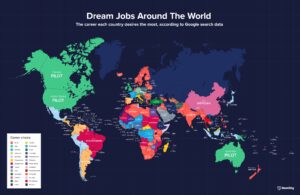
    Dream Job Map

    Image from Remitly

    The second most desired job worldwide is that of a writer. In general, a career in the arts is a popular dream job choice, with dancing and acting also ranking highly on the list. All of the Nordic countries show the most interest in writing for a living, as do Estonia, Latvia, and Lithuania. India, Pakistan, Myanmar, Bhutan, and Bangladesh all list writing as their top dream job, and a number of African countries including Kenya, Tanzania, and South Africa did the same. The freedom which a career in writing offers is unparalleled as it is often a career which can be built from home. Following the pandemic, we have seen an increased emphasis on job enjoyment, flexibility, and creativity, and a career in writing holds the unique position of offering all three.

    In addition to the more traditional creative careers, the new-age offerings of youtuber, influencer, and programmer were also represented. Mexico, Peru, Bolivia, Uruguay, and Chile place YouTube as their top dream career choice, as do Slovakia, Indonesia, and the Czech Republic. Columbia, Venezuela, Argentina, and the Dominican Republic are among the countries who chose the more general career of influencer, reflecting the growing number of non-YouTube platforms rising to prominence, including Twitch and TikTok.

    Jago McKenzie, Business Management Director at Remitly, says that the trends reflected by the study are consistent with his expectations.

    “People are getting used to the idea of changing careers at least once in their lifetime as the flexibility to work online and retrain increases. Some of the main reasons people seek a career move are for better work-life balance, higher pay and a more meaningful and fulfilling career. With that in mind, I wasn’t surprised to see so many people around the world showing clear search intent for a change,” McKenzie says, “We can see a huge range of different professions featuring prominently, including many that can be done solely online, from anywhere in the world. It’s clear that our desire for travel and exploration has not been dimmed by the past couple of years and, despite it being a tough time for the aviation industry, becoming a pilot remains a much sought-after lifestyle.”

    Whatever your dream may be, all is achievable with the right amount of dedication and tenacity. Of course, having a network of people to help you along the way is also a major boon to success, so always be on the lookout for mentors. Finito World wishes you the best of luck on your journey.

  • Pharmacist Liam Beadman on where a pharmacy degree leads

    Liam Beadman

    When I graduated, nearly 20 years ago from Nottingham University with a Master’s degree in Pharmacy there were only really two settings in which to undertake the requisite pre-registration year and launch my career. These choices were between a large teaching hospital and a chemist shop. Whichever was chosen would heavily influence the path of my career as a pharmacist: on the one hand the clinical, hospital-based route; on the other, the more business-focussed, working in community pharmacy approach.

    In the end, I began working at a large, teaching hospital before moving into community pharmacy after a few years, attracted more by business opportunities than patient-focused work. Today, I find myself working for a Clinical Commissioning Group, more by luck than judgement and in a non-pharmacy role.

    For today’s pharmacy graduates, there are now more options for how they can use the extensive knowledge and experience gained from the four year Master’s degree. The majority of pharmacists begin training to become independent prescribers of medication soon after they complete their pre-registration year. The traditional careers in hospital and community pharmacy still exist, but their scope has been broadened and there are now other opportunities to work with patients in the community and also to get involved with the commissioning of health services at a regional or national level.

    Pharmacists, along with other allied health professionals such as physios and dieticians are being recruited in large numbers to join GP teams working in primary care. These roles often involve the pharmacist taking a special interest in a certain disease area (e.g. diabetes, high blood pressure) and being the main healthcare professional who sees this patient group on an ongoing basis; monitoring the progress of their disease and adjusting and optimising their medication over months and years. A primary care pharmacist will also form an integral part of the multi-disciplinary team of the Primary Care Network or PCN – a collaboration of GP practices, within a local neighbourhood who work closely together.

    The role of the high street chemist has changed dramatically over the last 20 years too. Gone are the days when this role would almost solely involve deciphering the hand-writing of the local GP and dispensing medication to patients. Community pharmacists undertake reviews for people on long term medications, advise on inhaler technique & operate weight management clinics. More people with minor ailments such as coughs, colds, eye infections, back pain and more are being directed to their local pharmacist rather than the GP as a quicker and more convenient way of dealing with these types of issues. Community pharmacies have also been administering the annual flu vaccine for over ten years and have been crucial to the continued successful roll out of the Covid-19 vaccines and supply of lateral flow tests.

    There are also roles that straddle hospital and community work and some primary care pharmacists have roles which involve working in chemist shops as well as the local GP. These links between organisations that were once quite separate is helping to drive the government’s vision for the better integration of care via the creation of Integrated Care Systems.

    My opportunity to work for a Clinical Commissioning Group (CCG) came via the post of prescribing adviser. This office-based job retained some clinical elements from my previous roles, including answering specific medicines queries from local GPs, but also brought in more strategic, commissioning tasks such as setting incentives to improve the quality and effectiveness of prescribing at a borough level, undertaking audits of prescribing, and developing local policies that would benefit the local population. Commissioning roles afford the opportunity to make beneficial changes to whole populations of people rather than at an individual level. There is also exposure to how public resources are allocated and how government policy decisions are translated into something workable on the ground. Joining the CCG has given me opportunities to work in primary care more broadly and opened up avenues to move across to NHS England or the Department of Health & Social Care in the future.

    The career of a pharmacist has changed dramatically over the last ten years, with more varied roles within the traditional hospital or community pharmacy based jobs and a greater array of new positions, both clinical, patient-facing ones and more strategic, office-based jobs. In short, there are more roles for pharmacists now, involving a broader scope of tasks that make better use of the breadth of knowledge acquired during the degree.