Tag: Briefings

  • Akosua Bonsu on Character

    Akosua Bonsu on Character

    THE DIRECTOR OF STUDIES AT REGENT GROUP ON CHARACTER

    The trouble with education is that it’s full of buzzwords, and too rarely do we pause to think about practical implications.

    In the Blair years, citizenship education was a prominent preoccupation of schools and colleges in England and Wales – but the term sometimes lacked definition, and in any case, wasn’t citizenship an implication of the Cameron government’s Big Society agenda? Definitions tend to blur.

    With the coalition government – and latterly the single party conservative governments – we have seen a shift in preoccupation, away from citizenship education and towards character education. So how do we avoid falling into generality and making the same mistakes again?

    Fostering character sounds well and good – who could seriously object to it – but what does it mean? Simply, character seeks to cultivate resilience, courage, and personal responsibility. It also has intellectual pedigree, dating all the way back to Aristotle. In his Nicomachean Ethics the philosopher argues that character education creates virtuous individuals who live a good and meaningful life, a life full of happiness, purpose and achievement: this he called Eudemonia.

    What’s interesting is that in character education these individual traits – resilience, grit, courage and so on – do not exist in isolation. They exist together: you cannot be courageous without being resilient, for example. What we seek to do at Regent College is to develop these psychological states so that students learn to better act, overcome obstacles and embrace challenges.

    For Aristotle a person of good character has practical wisdom – phronesis: the ability to act in the right way, with courage, with resilience etc., because they have developed the correct habits. Furthermore, a good character can only be developed by choosing right actions over and over again until that right action becomes a habit. The goal is to repeat certain behaviours associated with the development of a good character, initially under guidance and instruction, until they become embedded as habits.

    So does it work? At Regent College, we have founded a framework for character education to be delivered alongside our core curriculum. The project began in May 2019, and we have called it Thinking Into Character.

    The programme is designed by Dr. Selva Pankaj and aims to give students a solid foundation in character education. Topics covered by the programme include goal setting, habit formation and the principles of personal leadership. Each lesson is designed to encourage students to take responsibility for their results and to develop the confidence to believe that they can achieve dream goals. Among some of the values and attitudes developed by the programme are personal responsibility, a positive mind set, resilience, grit and self-confidence.

    It has had startling results. One example was Abdi Raman Fara, a bus-driver who wants to be a transport manager with his company. He felt he’d been with the company a long time and wasn’t progressing. Under our instruction, he spoke to his manager, who agreed to be his mentor. As a result a career action plan was implemented and he decided to start his own business. ‘My entire life has to be geared towards goals that I am happy to pursue. It’s about achieving your life goals, and not just in the short or medium term,’ he says.

    Another case study was Amelia Giurgiu who had been too nervous to start turning her photography in Provence into painting. She was facing what we would call ‘the terror barrier’. For her character education enabled her to ‘take action and to show courage in the face of previously acknowledged fears’.

    Meanwhile, Ahasan Habib, the founder and CEO of H&K Associates, found that an immersion in the programme ‘helped my business by showing me where I lacked discipline and holding me responsible for all my results.’

    So the effectiveness of this character development programme is measured both objectively and subjectively. The subjective benefits are there for all to see in testimonials like those above. Objectively, we are looking at data such as grade attendance and assignment submission rates as well as external ventures that students have set up following their engagement with the programme. These ventures could be study groups, entrepreneurial businesses or engagement in voluntary programmes.

    We still have a way to go and are at the data compilation phase, but the signs are very encouraging. And we hope that our programme will give others the impetus to think hard about the language we use in education theory, and to turn the theoretical into pragmatic and meaningful steps. Aristotle would be  proud.


  • China Focus: Behind the Red Wall

    China Focus: Behind the Red Wall

    Our Woman in China gives us her take on the nuclear arms race in education between China and the rest of the world

    This is going to be quite a year in China. There’s going to be about eight and a half million graduates in China – and that’s a figure which dwarfs any figure you can imagine in the UK. They’ll be graduating into the toughest job market in living memory.

    It’s worth considering the history. Before 1990, China’s was essentially a planned economy and everybody had roles given by the state. Since then, the economy has grown by around ten percent a year. Unemployment has been incredibly low. Now lots of factors are happening at once. With Covid-19, there’s speculation that you have 100 million unemployed people in China right now.

    Concurrently, you have automation which is happening dramatically in China, with every company becoming leaner. So all these graduates are going to be piling in to this very problematic situation. And there is such faith in education in China. In the 1980s and 90s, if you went abroad and studied, let’s say engineering, and you came back to China, it’s quite likely you’re a millionaire at this point, or senior in the government. Why? Because you brought back information that was incredibly valuable and gave you a massive strategic advantage. Because of that, you now have a generation of parents who believe education is a fast track to employment. That’s heart-breaking as the young today are ill-equipped for the modern world in terms of creativethinking and communication skills.

    It’s an incredibly depressing situation. I speak to a lot of students doing undergraduate degrees and they’re looking at the realities of the economy and thinking, ‘Should I go and get a Masters?’ But even that doesn’t guarantee a job now – when for their parents’ generation, it did.

    That means there’s a major problem for Chinese students studying in the UK: they’re not getting their return on investment. In China, these young people are called ‘sea turtles’: even after having studied in a good, solid university in the UK, they’re unable to get jobs. All this will be detrimental to the higher education system in the UK. There are 900,000 graduates from UK universities in China, and there could be a big shift where Chinese students start to wonder whether it’s worth studying abroad if you don’t get a job at the end of it.

    I don’t think the effects will be felt immediately. Xi Jinping sent his daughter to Harvard. These wealthy people will have better connections, and so they’ll end up with jobs and power, and will end up running the country and the biggest companies. That’s a powerful example; it might take 20 or 30 years for these trends to be felt.

    Working against all this is the fact that China is going to go global at some point. So if a young person understands the UK, they are going to be a natural person to go and work in that London office at some point. The historical trends are clear. In the 50s and 60s, China was all about manufacturing; suddenly in the 70s and 80s, we had Sony and all these other companies booming around the world. But global China is in the future. This year’s graduates will fall through the cracks because none of this will have kicked in yet.

    As someone who has been here for 15 years, I would say the UK doesn’t understand that China is absolutely zero sum. China doesn’t want its students to go to the UK and spend lots of money. It wants to learn as much as it can from the UK, the US and Australia and then it wants to export its own education. You only need to read the state media to understand the undertones of what they’re really thinking and what they’re really plotting right now. The longerterm goal is that they don’t want to send anyone to the UK. That’s not explicit, but I would guarantee you it’s the case if you speak to the highest levels of government in China. Why would they want to give money to the UK?

    I’ve probably become a bit more patriotic since I’ve been here: if I had to back a team, I’d like to back the UK. The UK education system is filled with people for whom education is a vocation. They believe in the system. They’re autonomous, and opinionated: it’s filled with brilliant people. In China, nobody has any autonomy; it is control-based. I don’t want that system to win. China’s version of history is that there is only one version of history. Our discipline of history is that you have analysis and the past is open to interpretation. It’s not a good thing when education is used as a weapon to control a population or to politicise everything. I would love to see the UK compete, but I fear that a lot of UK universities are very slow, siloed and very complacent. China is moving incredibly quickly.

  • Ty Goddard on the direction of Edtech

    Ty Goddard on the direction of Edtech


    Ty Goddard

    It was Charles Dickens who said of the time of the French revolution that ‘it was the best of times, and the worst of times.’ The same might be said of Covid-19 in the education space.

    On the one hand, there was much to celebrate. Some institutions already experienced with digital learning become ‘virtual schools’ within days; others too, prepared for remote learning with mere hours of staff training.

    But throughout there was a sense that our educators responded to the learning needs of their pupils during the pandemic with what was available in their schools and colleges and what they felt able to use. The pandemic also laid bare the fact that you can’t afford to neglect infrastructure, teacher training and the provision of devices for our young people. Too many of our schools did not have the platforms, infrastructure and devices for pupils to maximize their use of remote learning.

    It was good to see that many schools limited the learning loss as they grew in digital confidence. But on the whole the devolved nations did better than England: Wales, Scotland and Northern Ireland all had an array of content at their disposal as the virus broke.

    In England, we had taken too long to publish and get to work on an Edtech strategy – it was only in 2019 due to the determination of Damian Hinds MP when he was serving as Secretary of State for Education, that DfE began to articulate the ‘Edtech Dividend’ for our system.

    The point is that education technology doesn’t replace teachers: it supports them. Technology can consolidate knowledge and maximise learning opportunities for pupils. The introduction of the computing curriculum may have developed some specialised skills in some but has it been at the expense of broader digital skills for many?

    In my view, it is not a failure for expensive reforms to be corrected before they properly flourish. In 2020, we can’t afford to be ambivalent about digital skills, confidence and digital literacy for our young people. The essential Digital Skills Framework for adults also shows us how much of a national challenge we have.

    And as Covid-19 unfolded, these areas of neglect became clearer. I hope this will accelerate the use of Edtech across our education system. I want our government to be a ‘stubborn organiser’ of modern technology infrastructure for our schools, and promote the positives of digital learning. Nor should they shy away from leadership that liberates the talents of and the entrepreneurial flair of our Edtech company founders.

    This is a sector deserving of more than an afterthought on an overlong list of ministerial responsibilities. Education technology is not a ‘mobile phones in school’ scare story or a ‘social media end of days’ nightmare but an imaginative set of tools to support and access learning. For many, it’s easier to lump all technology together in some dystopian playbook.

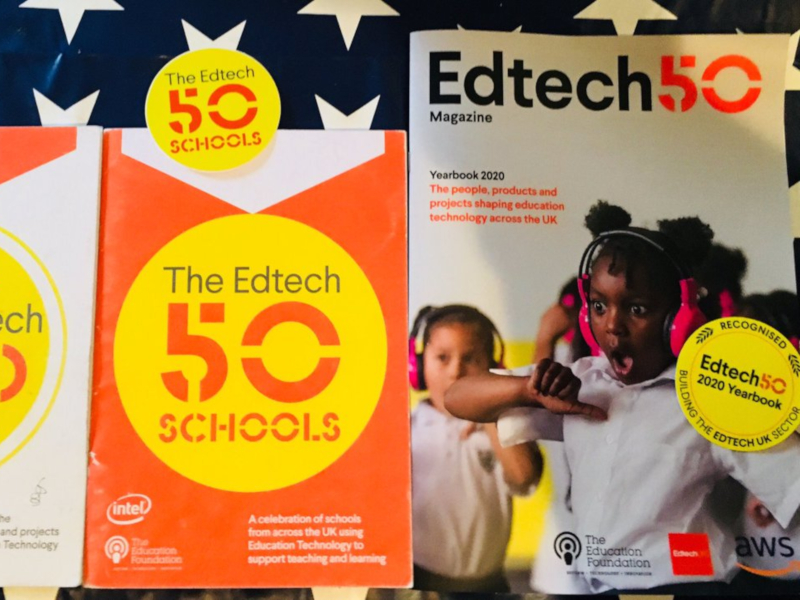
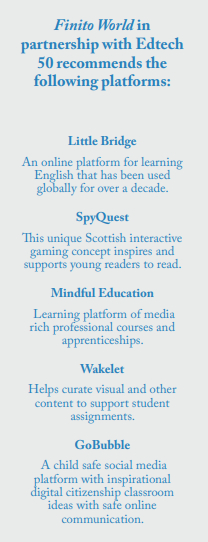
    But this a sector that creates jobs, grows our exports for UK plc and attracts muchneeded investment. Our Edtech sector is vibrant (see panel opposite for some recommendations from the Edtech 50), growing and plays its full part in our ‘New Start’ Industrial Strategy. So what do we need to do? For me there are six easy steps.

    Firstly, we need to build on the success of the rural broadband introduction with a staged approach to rolling out access to super-fast broadband to our schools.

    Secondly, it’s vital that we become more ambitious about devices for pupils. Digital poverty is corrosive and can be ended. Let’s build national delivery of devices for young people – Year 8 is too late.

    In the third place, now is the time for more professional development for teachers. I would argue that peer to peer support like the successful Edtech Demonstrator Programme is a model for national action.

    Fourthly, we need to see the immediate changes to initial teacher education with training in education technology. This is another long overdue addition.

    Fifthly, I believe we need to see priority for Edtech in the Ofsted Inspection Framework. There’s much to share about effective use of technology and much to learn from Wales and Scotland in their approach.

    As a final point, we have to learn to appreciate the complexities of organisational change across our school estate. We need to focus on technology support but also ‘system’ support to introduce and embed changes.

    If we can do all these things then I believe we can have a truly 21st century education system.

  • How to job hunt in a recession

    How to job hunt in a recession

    Guy Fowles found the rug swept from beneath his feet when Covid-19 hit. Here’s how he turned it around. 

    In February this year I was in the fortunate position of weighing up four job offers, all with reputable companies, all in different industries.

    The job market was buoyant, particularly within the performance marketing vertical I specialise in, but despite the many opportunities it had still been a long, arduous journey to get to the point of receiving an offer.

    There were countless applications, many initial phone calls, multiple faceto-face interviews and a number of psychometric tests and presentations over the course of a few months, not to mention the research, prep, travel, logistics and thought process that goes into each and every interaction with a potential new employer. It was exhausting and stressful, particularly as a new parent.

    For one role with an exciting start-up, I’d been through five stages and spent around 40 hours in total preparing, interviewing and presenting to them, only to learn they’d gone for the other candidate after the final stage. I didn’t mind the drawn-out process to decide on the right person, but the lack of constructive feedback afterwards was extremely disappointing given the time I’d invested.

    For another final-round interview I was asked to drive to the north-west to the company’s UK headquarters, a 10-hour round trip, for a 60-minute interview, only to be told over a short phone call a few days later that I’d been unsuccessful. There was no offer to cover any travel costs.

    My experience within the job market earlier this year equipped me for what happened next.

    Within two months of starting a great role at a global events company, who bring people together to create unforgettable experiences, the company made 50 percent of its global workforce redundant, centralising resources back to their HQ in San Francisco. Frustratingly, it was time to climb back into the search saddle.

    This time though, things were different. There were still roles available, but already, in May, the number of applicants for jobs advertised on LinkedIn had gone up from around 100 per role to over 250. During a number of conversations I was then told the positions I’d applied for were suddenly put on hold due to Covid-19.

    The process itself also changed – initial phone calls turned into Zoom video calls, which I think is a positive step, and subsequent interviews obviously had to be done by video too, which, whilst you lose that physical interaction that meeting in person affords, saved on travel time, which made a big difference when also trying to look after a baby.

    Covid-19 changed the location of the jobs I went for. Given the shifting nature of working remotely within a number of industries, I was able to expand my search to outside the confines of the M25. This can only be a good thing for both employers and employees as it enables companies to attract the highest quality workers, unrestricted by geography, and then offer them rewarding benefits such as the ability to work from home or flexible working.

    In June I was lucky to come across my dream role heading up the Marketing and Communications team for the National Literacy Trust. The Trust works to improve the reading, writing, speaking and listening skills in the communities that need support, where one in three people have literacy problems.

    The interview process was clear and concise, held on three consecutive Fridays to allow both sides time to prepare for the next stage. I researched the role, my interviewers and the Trust itself thoroughly, and as I did so I became more and more impassioned about the job and joining the team. I met a cross section of employees over Zoom, and an external partner, and after a presentation and one final meeting I was absolutely thrilled to be offered the position. All in all it had taken about a month from start to finish.

    Searching for a job can be a draining, demoralising process. However, it can also be exhilarating, stimulating and ultimately hugely rewarding. It is most definitely a journey that will propel you through twists and turns, highs and lows, dead ends and suddenly, the right path for you. Treat every conversation as you taking one more step on that journey.

    With this in mind be prepared to put yourself out there, tailor your cover letter for each role, put in the time to look into your interviewers, prepare engaging questions that demonstrate you’ve really thought about the role, show your willingness to learn, develop and grow and, once in the role, prove that you will be a valued member of the team through your actions.

    The National Literacy Trust helps to transform lives through literacy. Whilst my previous role was cut short due to Covid-19, I can’t think of anything else I’d rather be doing than trying to make a difference to the lives of children, young people and families that need it most. I’ve now been in the role for two months and I couldn’t be happier – it’s a fantastic team to be a part of.

    If you have any questions about my job search, or would like advice about your own, please drop me a line at linkedin.com/ in/guyfowles

  • Out of office? Thomas Heatherwick on the future of the workplace

    Out of office? Thomas Heatherwick on the future of the workplace

    By George Achebe

    Will we ever return to our offices? And what will they look like if we do? George Achebe talks to renowned designer Thomas Heatherwick

    Journalists I speak to lately have begun to notice a new presence within their recordings of interviews and Zoom call presentations: birdsong. Lockdown coincided with marvellous weather; our offices became our gardens.

    And the sky on our road in Islington reverberates with the sound of spanner on metal; our friends over in Muswell Hill have replanted their garden since they spend so much time looking at it; my conveyancing lawyer tells me he may, or may not, return to the office. If so, he says, it will be used primarily as a storage space.

    There is, in other words, a unanimity about lockdown: you can be sure that your own experience can be extrapolated into the general. And yet if you ever leave your cosy home and venture to the centre of town, you’ll discover the flipside of all this neighbourliness and quiet domestic improvement.

    Soho strikes me as especially melancholy. There’s the sandwich bar I used to frequent now boarded up; a new kind of silence, not so much contemplative as eerily touristless; and with around one in ten businesses open, you have a sense that this place has insufficient residential activity to last in its current form beyond the end of furlough.

    Will these businesses return? It is dependent on what decision we make about our office arrangements. This varies from business to business of course. For a more in-depth analysis of the landscape see our exclusive employability survey which begins on page 79. But what are the implications for architects?

    Thomas Heatherwick, the famous founder of the Heatherwick Studio, explains that he has seen some positives come out of the coronavirus period: ‘The most interesting thing has been reflecting on what this means and how it’s going to change our lives. I’m wrestling with the sense that [preCovid 19] there was more and more sharing – of cars, workspaces and living spaces. The world was becoming more efficient because people were learning to live together in different ways.’

    In Heatherwick’s eyes, the pandemic represented a ‘retreat’ into the private space – a world of Victorian studies, and stockpiled toilet roll. But Heatherwick, who in person is infectiously optimistic and free-wheeling, is already solving the problem the world has set him: ‘The positive side is that people will be spending more time on their homes, and thinking on how their homes work for any situation.’ In the meantime, he says, businessowners have decisions to make about whether to redesign their office space.

    We are all aware that this is a sort of drawn-out inflection point, where the human behaviour that will dictate what solution we end up with is latent, and yet to be revealed. Furthermore, it will likely differ from country to country; sector to sector; and CEO to CEO.

    When I talk to Alan S – the CEO of a leading boutique creative agency, who also has the sound of birds in his garden – he speaks only on the condition that he remains anonymous. This is because he isn’t quite sure where his business will land and he doesn’t want to give any misleading or worrying information to his workforce.

    ‘As a small business we have always worked from a fixed office in central London and although we have let employees work from home when required we have never all worked remotely at the same time,’ he explains. ‘We did a trial run before lockdown was announced in order to iron out any issues that might possibly arise, so when lockdown happened we were as ready as possible.’ So how did it pan out? ‘The overriding response was that everyone found it productive, but missed the typical office interactions and camaraderie when seeing each other.’

    This will no doubt be a familiar experience for many. What changes has that made to Alan’s view of his existing central London office space? ‘It suddenly became a burden and we were realising that the more we worked from home, the benefits this gave to everyone [would accrue].’ And what are these? ‘Everyone would save on travel expenses and commuting time could be spent with partners and families.’ The perennial bugbear or exorbitant business rates has also been front of mind for the business. ‘The rent, rates and insurance saved by surrendering a central London office will enable us to invest in people, equipment and technology to increase our efficiency and service our clients.’

    So Alan S has to some extent made up his mind, and there are plenty of him.

    But it is by no means a unanimous view. In fact you’ll find some who argue that an imminent vaccine, most likely arriving in 2021, and distributed towards the end of that year or in 2022, will see a return to a world reminiscent of pre-Covid 19 office-centric life.

    Olly Olsen, the CEO of the Office Group, which has over 40 flexible workspaces across the UK, is one of these, although he admits it may be a way off. ‘I spoke to Network Rail, with whom I have a joint venture, and in a number of stations, footfall is down 88 percent. That’s catastrophic,’ he concedes.

    In addition, Olsen, whose livelihood is bound up in office life, also makes some admissions about the benefits of working from home. For him, they’re linked to wellness. ‘In the afternoon, I get tired with too much coffee and a big lunch and so I’ll lie down on the sofa for half an hour which is almost socially unacceptable to do in the office.’ Olsen sees it as a positive future driver of business that we’re now finding ourselves more attuned to what he calls ‘wellness fluctuations’ in each other. Workers with children are another example. ‘It used to be that if someone said “Can I make that meeting 11 instead of 10?’, you’d say: “Deal with your kids another time.” Now when a member of staff says, “I’m not feeling myself ”, I say, “Have a rest, there’s no problem. Speak to you later, speak to you next week”.

    All this is an indicator of how power has moved rapidly away from the employer towards the employee. For Olsen, it’s not that the office model needs to go; it’s that it needs to change and be adapted to reflect our new reality.

    What ramifications will this have for the buildings around us? Thomas Heatherwick agrees with Olsen, but he sees it from an architect’s perspective. For him, there has simply been too much ‘lazy place-making’, and the pre-Covid office was a case of ‘Stockholm syndrome where someone falls in love with their captor. Your employer effectively had you in a headlock.’ The new office space will have to ‘engender real loyalty’ and become a ‘temple of the real values and ethical thrust of an organisation.’

    For Heatherwick, the pre-Covid workspace ‘prioritised how [businesses] communicate to the outside world. So if you go to Canary Wharf ’ – an example perhaps of Heatherwick’s ‘lazy placemaking’ – ‘there’s a grand lobby; huge marble floors; pieces of art looking spectacular; a reception desk with great flowers, and lovely-looking people sitting looking great. But if you go inside the elevator you go up to just an ordinary place of work. The show was for the outside.’

    All this has to change now that power has moved in the direction of the employee. ‘You need to have them coming in and thinking, “Yes. I need to be here.” So the workspace will become less about being a show for the outside world. It’s about finding your voice as an organisation. The employer has to up their game which the brilliant people were starting to do anyway.’

    So how will this look? Heatherwick is a prescient artist who, it could be said, was already beginning to answer some of these questions in his previrus work. His magnificent shopping centre Coal Drop’s Yard in King’s Cross was all about creating a space which people who could internet shop in their bedrooms would still wish to visit.

    ‘Public togetherness is something which motivates me,’ he says with infectious enthusiasm. Heatherwick has always been alive to the fact that change must be built on the back of existing infrastructure: as always, the future will be built on the back of past structures. ‘We’ve got this legacy of Victorian and Georgian warehouses, which are very robust and changeable. Think how many people are living in older industrial buildings. That was the ethos which drove the Google buildings that we’ve worked on.’ Covid-19 might seem to open up onto the future, but it will also be anchored, Heatherwick argues, to what we have already.

    The first project the studio worked on for Google was the company’s offices in California. ‘Next-door to the sites we were working on there was this airship hangar – a NASA airbase,’ he recalls. ‘These are amazing spaces which are super-flexible so you can do anything you want. So our proposal to Google suggested we make really flexible space since we’re not sure whether in a decade people sitting at desks will be what we need. We’ll be manufacturing instead.’

    So in a sense the post-coronavirus requirement of flexibility might be met by the sorts of structures already around us: there shall be that element of continuity even as we change.

    But this isn’t to say Heatherwick lacks a vision of just how extraordinary the shift in architecture shall be. Round the corner from his studio in King’s Cross, Heatherwick is working on Google’s new London base: ‘It’s the biggest use of timber in a central London building. All the façades are wood.’

    What is the ethos of that building? ‘One thing we’ve spent time talking about on that is community,’ says the 50-year-old. ‘The idea that here is just a mercenary organisation doing their thing, and the employees come in eat all their food and drink their drinks, sit at their computers, and get well-paid…’

    Heatherwick trails off, then refinds his thread. ‘Given what we’re saying about really getting a deeper engagement with an organisation and it’s team: How does that really contribute to the community around? On the ground floor, you don’t just want another shop that sells ties.’

    So what would a new communityoriented architecture entail? ‘Close by King’s Cross there’s Somers Town, where there’s great deprivation and low life possibilities in terms of housing and education.’ For Heatherwick the lively pedestrianised ground floor is a way of energising the whole area.

    So while our conversation began with fears of a new individualism, perhaps we might after all find a new communitarianism emerge? Heatherwick agrees: ‘If you’re going into work two days a week you may not need to be based in London.

    Out of this may come some strong community-making away from conventional urban settings. Energy had seeped away from villages but now you could get super-villages. It’s okay to spend two hours on a train journey if you’re only doing that twice a week. I just hope we will use brownfield sites rather than consuming greenfield sites.’

    But again this seems to spell trouble for the City and, though few may lament the fact, the property development sector. Olsen admits: ‘If you ask people where they most prefer working, it’s on their own – it’s at home where it’s quiet. Not an office which is openplan with people talking, and which is smelly and so on.’

    So what’s the purpose of going to an office? Olsen is clear: ‘We’re built to connect. I can’t have guests and clients to my house and I can’t bring a team together to my home. If I do that business will fall – as it’s falling now from lack of human interactions.’

    So what kind of spaces will we see? In answering this, Olsen sounds a lot like Heatherwick: ‘It’s difficult to forecast what will happen next but I think where you choose to work will be driven by who you are and what you believe. Our places of work will become more of an extension of our social lives.

    The overwhelming impression is that we’re in a hiatus – a period of hedging, where people are living in tentative expectation of a vaccine. Olsen agrees (‘we just don’t know) but he has clarity on another point: ‘Before this happened, I would have said that all my buildings were clear, tidy, safe and healthy. Well, they’ll have to be clearer, tidier, safer, and healthier now.’

    So it seems likely we’ll be hearing the birds in the garden for a while yet. And when we get back to them, perhaps we’ll hear them in our offices too.

  • Is this a new era of protest in America?

    Is this a new era of protest in America?

    by Jeffrey Katz

    Protest is nothing new. In the US, there were protests against segregation in the 1950s and 60s, protests against the Vietnam War in the 70s, protests against environmental damage in the 80s and 90s and now there are protests against the racism that murdered a black man in Minnesota and against all that the murder represents.

    In the UK there were protests against nuclear weapons in the 60s, protests against the racist regimes in South Africa and Rhodesia in the 70s and in the same decade protests against the murder of Irishmen during the troubles in the north. There were particularly violent protests against the British poll tax in the 80s and protests against the war in Iraq in 90s.

    What is different now is that, whereas most, if not all, the previous protest movements were in some way parochial, today’s protests are not. While we know that every country in the world has some form of ethnic discrimination to its shame, the pretence that it is historical rather than current is a fiction that can no longer be ignored.

    In the course of my lifetime I have watched white Americans shouting at black children because they were trying to enter a school that had been for whites only. I have seen signs in the windows of English boarding houses that read “No blacks no Irish.” And after 70 years of peace in Western Europe, the British people voted by a narrow majority to leave the organisation that united them with the rest of the Continent.

    I have heard Orthodox Jews say that Palestinians don’t belong in Israel because they believe the Bible says the land belongs to the Jews. I have been told by an Iranian in Canada that it is right that women should be jailed for refusing to wear a headscarf. In the great liberal city of New York there have been recent debates about whether there should be a quota for Asian students in specialist schools because too many of them do well on entrance exams.

    Underlying all those examples is ignorance and the fear it breeds. To be clear, there will be people who strongly disagree with my views who are not ignorant. There are people in America, Britain and elsewhere who honestly believe that social welfare mechanisms are wrong because they somehow inhibit personal liberty. Equally, there are people everywhere who believe that, in a civilised 21st century, a universal health care system should be considered a human right.

    On the surface those are irreconcilable positions. Except things change. What changes them are people and events. Sometimes those people are leaders and sometimes they are ordinary citizens— or even victims. Sometimes they are a Franklin Roosevelt who was considered a traitor to his class for introducing what he called a New Deal, subsidising great infrastructure projects and other government programmes to help Americans through the Great Depression of the 1930s. Or a Nelson Mandela who spent half his life in prison until the power structure of South Africa recognised that it could no longer subjugate its black population.

    But here’s the interesting thing: sometimes changes evolve because of an Adolf Hitler who lies and murders his way into office and starts a war that assassinates six million Jews, kills 20 million Russians and destroys much of Western Europe. No sane person who could change history would bring Hitler back. But Hitler created an almost universal consciousness of what horrors the human race can inflict on itself.

    Of course, it hasn’t stopped. Since the Second World War atrocities have been committed in Cambodia, the former Yugoslavia, Rwanda and Syria. Because of television and the internet we have become more aware of the crimes that are perpetrated in the name of whatever power struggle or prejudice is useful to certain people at a particular time and place.

    But every generation has the opportunity to make things better. Trump exploits social and ethnic divisions rather than addressing them constructively. In the course of his presidency he has demonstrated a contempt for others that has unleashed simmering prejudices. They are now the focus of the anger on the streets. There has never been a greater awareness among young people of our need to get up off the necks of the disadvantaged, to create safety in the world so that everyone can make the best of their lives.

    Maybe we need Trump. Maybe he is the catalyst. Not just for Americans, but for Europeans, Africans, Asians—the whole world. I don’t believe that any of us deserve him, not even the people who voted for him. But we have him. We can debate forever how and why that happened. But as one angry black protester in America recently pointed out, it’s more important to decide where we go from here.

    Jeffrey Katz is Chief Executive of Bishop Group, a London-based corporate investigations business.

  • Definitely Digital: how to improve your online presence

    Definitely Digital: how to improve your online presence

    Clair Marr

    When I was asked to write about this subject back in April, no one had any idea just how big an impact the pandemic would have on our lives.

    Businesses are already looking to redefine digital ways of working as staff continue to work from home. Graduates are naturally concerned that the current circumstances will severely impact career opportunities leading to greater competition in the job market*. How can we help to boost confidence amongst graduates impacted by the loss of opportunity, internships and work placements?

    Effective online reputation management for those starting out on their career path is about building and maintaining trust between you and your potential employer.

    Rachel Botsman, in her Ted talk, explores how the model of trust has changed historically. We began by trusting those in our local communities and that trust could be damaged or built based on our actions and reputation. As settlements grew larger, this model of trust could not scale up; living in a city, it was no longer possible to interact with every single person and our trust evolved into an institution-based model, placing our collective faith in law, government, banks and insurance.

    We now live in a digital age where our lives and decisions are played out online. Institutionalised trust models have become as irrelevant today as local trust models once were. Trust is now atomised, managed and distributed by individuals to a global audience. Wherever we go, we bring our digital presence with us. For some individuals this can be a real asset, while for others it’s a hindrance.

    Covid-19 has given us time to reflect and think about how we can present a trustworthy online profile of ourselves to potential employers. For graduates, this can be an exciting opportunity to develop new online strategies to help ensure that future stakeholders are engaged, impressed and inspired.

    Google Yourself

    The first step is to Google your name. Are you happy with the results that appear on page one? Is there enough information about you? If you have little or no Google presence, you can be vulnerable to commentary from other sources. Google bases its opinion of you from the information fed to it. It is your right to change that perception.


    Put Yourself Out There

    Holding digital assets in the major ranking positions on Google page one improves the likelihood of your personal brand acting as an antidote to any negative commentary. The more positions you hold, the more you consolidate Google’s perception of you.

    Google the names of prominent thought leaders in the industry that you would like to work in. Take a look at what is held in each position; A quick glance at Richard Branson’s Google page one results shows Wikipedia, Virgin website, social media accounts as well as Forbes contributor page. What could you learn from the positioning of a thought leader? Is there an industry publication that you could contribute to? There are many online blogs, websites, magazines and journals that are hungry for content. Boost your visibility by asking them how you can contribute. Build an association with a particular topic area. This indicates to Google the type of information that is relevant about you. Creating content offers you a solid digital footprint and gives you highly relevant or topical information to promote or share on your social media.

    How do I find out what content publishers are looking for?

    When we talk about ‘ranking’ in SEO (search engine optimisation), we refer to the relative position of a website or other web pages in the search engine results pages. For example, a natural rank in position one in Google is most desirable as users are statistically more likely to click on this. Publishers are hungry for content and keen to become the de facto resource for any subject area as high-quality, niche and high-volume output brings consistent traffic to their website. Trending topic areas can help convert new visitors to click on a website which can help to drive revenue for a publisher.

    Keywords and key-phrases refer to the actual words or phrases that you input into Google search.They’re really important as they help Google understand what that content is about. If what it sees is deemed highly relevant and trustworthy then Google will rank it well and often. These keywords should therefore be embedded into the structure of any content you create. Visit the MOZ blog for the beginners guide to SEO. This shows how to integrate these words and phrases into article content to help boost the visibility and relevancy.

    Beware!

    Pay attention to what you feed Google. If this information is not relevant, or shows several student nights out with friends, it can paint a picture of you that does not accurately represent your character. Audit your digital profile and ask those close to you to form a picture of you based on what information they find about you.

    When you think about shaping your narrative, consider whether the information already out there about you is positive, neutral or negative. By developing those positive and neutral points that already exist, Google feels that it is being fed information naturally and organically and will rank those pages favourably. Highlight charity work, host a Just Giving page, create a Facebook event, blog about your volunteering work in the local community. Ensure that there is a clear link between you (this could be for example your name or a link to your LinkedIn profile) and these projects and that it is clearly visible to Google. Tweet or post on LinkedIn, write an article about what you learned from these projects. Show that you have many different facets to your personality.

    Remember, the process of change is a gradual one and authenticity reigns supreme.

    It takes both sustainable effort and time to make an impact. Google can take three months to adequately index content so be patient and build your profile in a natural way. If you are unsure about something you have posted, delete!

    Adopt a joined-up approach across social media and websites. Try not to be everything to everyone. Focus on growing content across multiple related topics and link to each other. Opinions can change quickly on social media so regularly audit your social media presence and remove any content that you do not feel comfortable with. If the information is publicly available, revise content that needs an update in line with evolving conversations.

    Life, as we are now all too well aware, can be unpredictable; make sure that your online profile is as adaptable and flexible as you are.


  • The Finito World guide in How to Zoom

    The Finito World guide in How to Zoom

    How do you get the most out of the new technology? Finito World spoke to business leaders and society etiquette expert Liz Brewer to find out

    If you want to know the essence of an era, look at its new word-coinages. This year, which has been so seismic in every way, saw a wealth of new words enter the vocabulary. These include, of course: Covid-19, corona, lockdown, social distancing and flatten the curve.

    But the word ‘Zoom’ is perhaps the most commonly used of these. Like Covid-19, it is ubiquitous and liable to be used many times a day, as all our meetings accrue. But like social distancing it can be used both as a noun and as a verb: we are ‘on Zoom’ but we also ‘Zoom’.

    Perhaps of all the words in the language it most resembles ‘Google’ in the way a company name has so suddenly entered proverbial usage – and with gratifying results for founder Eric Yuan who has seen his company’s value skyrocket to near the $50 billion mark.

    This new technology isn’t going anywhere. So here in seven easy steps we explain how to make it work for you:

    Get the lighting right

    Liz Brewer is a world-renowned events organiser and expert in social etiquette who has thought long and hard about how to present herself in a call. ‘This is a visual medium so check how you appear on screen and adjust height,’ she says. ‘Position yourself so you’re seen not sitting too close, too far, high or low, with a suitable background.’ This rings true: we’ve all misjudged the lighting once in a while and found ourselves sitting in shadow like James Bond villains – but that’s not a good look for an important meeting or a job interview.

    Don’t be vain or distracted


    Brewer also argues that it’s ‘best to turn off self-view’. Vanity exists in most of us and it’s easy to spend an entire call sneaking views of yourself rather than engaging with the person in front of you. It is best not to give yourself the option of assessing the calamity of your Covid-19 haircut, or that special lockdown exhaustion etched on your features. In the same way, Brewer advocates turning off everything else on your computer: ‘You are on screen and will be observed so it’s important to close or minimise all other distractions, screen windows and silence mobiles,’ she says.

    Embrace the possibilities of the medium…

    Many of us have now seen the interiors of one another’s homes, and thus have a sense of how people live. ‘I enjoy the informality,’ says the MP Robert Halfon, and even encourages the presence of children on a call. For some that can create a sense of camaraderie that can progress an understanding of the person you’re talking with. For many the informality is to be embraced and might even create deeper relationships.

    But realise its limitations…

    When we catch up with the architect Thomas Heatherwick, he argues that the medium is unhelpful in at least one respect: ‘Video conferencing doesn’t create new relationships. You can sustain a connection, but you don’t grow a deep connection.’ And so while it’s important to embrace Zoom now, we should all have an eye to those we connected with during lockdown: make sure you meet face to face with people you felt you had a connection with once it’s safe to do so.

    If you’re a CEO, check in on your team separately

    ‘We’re all so tired with Zoom call after Zoom call,’ says Carol Leonard of the Inzito Partnership, and argues that we need to think beyond Zoom. ‘Think who might be vulnerable in your team. At Inzito, we have little informal social programmes to check in with people, and we do mindfulness virtually twice a week.’ Thomas Heatherwick agrees: ‘It’s amazing how stressful these calls are.’ So don’t think all the company’s HR needs have been taken care of by that one collective Zoom.

    Remember the emotions of your co-Zoomer

    Thomas Heatherwick realised after a while that he was tired of what he calls ‘flat half people’. He adds: ‘If we met people face to face I would never sit facing that person: it would be too confrontational. Instead I’d sit at a slight angle. Even before we’d begun talking, we’d have a sense of each other and the peripheral vision can see how confident a candidate is when they walk in.’ So though it feels like your talking to an avatar, always remember the humanity of the encounter.

    Remember to laugh

    Collective behaviour doesn’t quite happen on Zoom,’ Heatherwick observes. ‘it’s ping pong. You press a button and you’re next in the conversation. You don’t chuckle together or cringe together.’ Brewer says that it is up to the host to make sure this gap is closed. But she also recommends other things like running ‘speed tests to avoid freezing moments’ and ‘bluetooth headphones’ to ensure that the sound quality facilitates the conversation.

    And if all else fails…

    ‘Well then you can always excuse yourself,’ says Brewer. And for many of us that’s the best part of any Zoom call.

  • How will film survive the pandemic?

    How will film survive the pandemic?

    Emily Prescott

    It’s a not uncommon thought during these times: “Is this reality or some awful dream?” As we queue in masked silence, told to keep two metres apart over the tannoys, our lives now feel post-apocalyptic, as if a dystopia fit for the silver screen had migrated somehow into our actual lives.

    But if the pandemic is the stuff of movies, how is it impacting the way films are made and consumed? Finito World has identified the four key hurdles filmmakers are facing over the next few months. Strap yourself into your home cinema seats: it’s going to be a bumpy ride.

    “Just keep swimming”: Keeping the momentum

    Although filming has started again, many productions are still reeling from the psychological and logistical consequences of lockdown.

    Finito World spoke to James Kent whose directing credits include Testament of Youth, starring Kit Harrington, and The Aftermath, starring Keira Knightley.

    If you’re in the middle of a project and it has to be stopped, it’s a pain to remount it,’ he explains. ‘It’s very complicated to get your actors back as many of them will be booked on to other jobs. It’s definitely a bit of a logistical nightmare.”

     But in some ways making movies is always a precarious business, he adds: “Filming is all about momentum. There’s a famous saying in the industry: You’re never sure it’s happening until you’ve got your bacon butty. The bacon butty guarantees the fact that you’re filming and until that moment comes, a film cannot happen.”

    But perhaps it’s not all doom and gloom. Rebecca Johnson, who has directed an array of shows including Call the Midwife as well as her own critically acclaimed feature film, Honeytrap, says viewers might see a rise in indie films since they aren’t so vulnerable to the loss of momentum. “What’s good about indie films is they are usually shot over a short period of time. Usually about four weeks so potentially there will be a rise in these sorts of films. Cost is going to be an issue but if people really did isolate and it was just like a hermetically sealed unit that is fairly safe and easy to maintain.”

    “Houston, we have a problem”: Keeping the crew healthy

    Keeping cast and crew Covid-free presents an ongoing challenge. It was hard not to cringe while watching films in lockdown and noticing how recklessly the characters shake hands and spread their germs all over the set. So, should we expect the latest films to be sanitised and devoid of intimacy?

    Rebecca Johnson says: “For me the most concerning thing is keeping actors apart. I just don’t see how you can do that. It’s too creatively inhibiting. There’s just too much content that you wouldn’t be able to make while keeping actors at a distance.”

    James Kent worries about the costs associated with keeping people safe. He said: “If there’s an outbreak on set then your whole crew is off, there’s a whole issue about insurance and how that’s being covered. If Chris Pratt gets coronavirus when acting in Jurassic Park they won’t be able to shoot.”

    And it looks like productions won’t be getting any financial assistance if coronavirus strikes on set. Kris Barnfather from the creative insurance broker Eggar Forrester Creative is blunt: “Without meaning to sound all doom and gloom, realistically there’s just not a way forward. Insurers are explicitly writing coronavirus cover out of contracts.

    The reality does indeed sound grim. “Some people are worried about being sued if someone catches Covid-19 on set,’ Barnfather continues, ‘so we are suggesting everyone does a coronavirus risk assessment and that they make sure people understand the risks and sign documents to mark this understanding if necessary.”

    Production companies are having to be especially careful. Actor Tyler Perry who owns studios in Atlanta was one of the first people to outline, in great detail, how to start filming amid the Covid-19 outbreak. His 30-page plan titled “Camp Quarantine” reveals the steps individuals should take. It says all luggage has to be disinfected, cast and crew should isolate before filming and they will also be required to take nasal swabs.

    “Well, nobody’s perfect”: Keeping the cast looking good

    Nasal swabs hardly scream movie industry glitz and glamour. Indeed, during lockdown, viewers watched TV presenters’ faces droop from lack of botox and saw their blonde fade to grey. So will coronavirus mark an end of polished stars?

    James Kent explains: “Makeup is a real issue, particularly for period dramas. You can get away with it in a modern drama because you’ve got your own hair but with wigs or anything that involves prosthetics, it’s impossible.”

    Sandra Exelby, who has done makeup on the sets of Doctor Who, Dad’s Army, and Bugsy Malone and now chairs the National Association of Screen Make-up Artists and Hairdressers, has been coming up with solutions to keep the stars looking good.

    She explained: “We are advising all of our artists to wear appropriate PPE. This includes aprons and a visor as well as a mask. Of course, we are saying hand-washing must be regular. We are also suggesting that makeup brushes are left overnight in a UV cabinet.”

    But hairdryers are getting the cut. She explains: “Hairdryers move air around and so they increase the likelihood of infection spreading and therefore we are saying no to hairdryers.”

    “Makeup artists cannot adhere to social distancing. They are essential on set and with the right precautions risk can be minimised,” she says.

    “I’ll be back”: Keeping people in the cinema

    We’ve highlighted the hurdles and shown, for the most part, there are ways to minimise risk. So the shows will go on. But the question is, who will dare to venture to the cinema to watch them?

    Cinemas in the UK have reopened again albeit without singalong screenings and pick’n’mix. Nonetheless, the industry is on track for its worst year since 1996, with box office and advertising revenue set to be down almost £900 million.

    Rebecca Johnson admits: “I’m not sure I’m going to go to the cinema in a hurry, to be honest. Going to the cinema feels like an unnecessary risk. I’m not that scared of getting it but I will avoid it if I can.”

    James Kent is also pessimistic: “The real problem is with film: how does anyone make any money when you can only put half the amount of people in the cinema?”

    “Oscar winning films are generally skewed towards an older demographic and they are going to be the ones least wanting to go back into the cinema. Anybody over 55 is not going to be rushing back to the movie theatre.”

    Which all sounds a bit bleak. So where’s the uplifting riding-off-into-the-sunset ending? Well, University of Exeter film professor James Lyons points out that coronavirus could encourage the film industry to consider its impact on the climate.

    He said: “The film industry is a very resource-intensive enterprise in many respects, and it needs to come to terms much more seriously and urgently with its contribution to climate change.” Looking ahead, Kent is intent on identifying the positives: “This moment is one for us to all reflect on what we have taken for granted, and adapting in the months and years to come must surely involve thinking of more sustainable ways to live and work. The film industry is no exception.”

    So hopefully in the future we will view post-apocalyptic scenes exclusively on the screen.

  • Mentor Q&A: Andy Inman

    Mentor Q&A: Andy Inman

    When one of our students was furloughed from his job, he needed help to make the best use of his day-to-day. So, we brought in one of our mentors, Andy Inman, to show him that time waits for no man. 

    Andy, where did you first learn the importance of making the best use of your time?

    Retiring from a 30-year career in the military, I’d been well trained in making good use of time. From the very early days at Sandhurst – getting out of bed at 04.30 hrs to make my bed – to more recent projects like rapidly developing a workable plan on live operations in Afghanistan and Iraq, I know from first-hand experience that time can work for you as easily as it can work against you.

    What made you want to become a mentor with Finito?

    Now I own a small company that delivers military training to overseas customers, I’ve been able to take the skills acquired throughout my career and use them in a new and closely aligned environment. But having benefited enormously from mentoring before I started my career, and knowing what a huge difference it made for my life, I was delighted to learn of the work done by Finito. It resonated with me, and I realised that my hard-earned skills could be beneficial to an entirely different set of people.

    What was the situation when you first met our student?

    Having already mentored a number of the Finito students, the Covid-19 lockdown period came with its own challenges. Simon, having been furloughed from his job, had altered his daily routine to such an extent that he was getting up in the early afternoon to play games online, message mates and eventually get to sleep at around 05.00 hrs, having achieved little. He would repeat the routine daily, to the extent that he had lost track of the days and was growing despondent with “life going nowhere” and achieving little of substance each day.

    What advice were you able to offer Simon?

    I had already discussed with a number of my students a technique taught by the military to deal with isolation and imprisonment – and let’s face it, for many, Covid-19 lockdown wasn’t far off. By building structure into his day and including four simple elements, together we ensured Simon was feeding his mind, body and soul, and using the time that was forced upon him in useful ways. 

    What was the first step in the process?

    Simon and I discussed a way to bring his body clock more in line with the outside world. By sleeping through the morning, he was experiencing disturbed sleep because of the noise going on outside. So, through short WhatsApp discussions, we were able to get Simon to a point where he was getting up at 08.30 and going to bed at 11.00 pm, which was a significant improvement on where he had been! Once his sleeping pattern was in a better state, we were all set to move on to the next chapter of his journey – introducing the four elements.

    Can you talk us through that? What do you mean by skill-building?

    I wanted to find something that Simon was interested in learning, so he could exercise his brain. He eventually went for an app that taught him French, a subject he had learnt at school but hadn’t worked on for years. As with all of the elements, it was vital that this was not a chore – but something he would enjoy, and saw the point in doing. Plans to holiday in France were all the reason he needed to make it work.

    How did Simon handle the creative element of his day?

    Getting the creative juices flowing is crucial to exercise a different part of the brain. Simon is like me, in that the traditional arts didn’t sit easily with him, and he wasn’t keen to display his writing skills either. We settled on cookery – not necessarily the first thing that springs to mind when looking for a way to express creativity, but by coming up with recipes and cooking some meals, he was able to express himself as well as helping his parents by taking on the chore of feeding the family in the evening. He did admit that some of his creations were less successful than others, but using a variety of resources he became quite adept at creating dinner for the three of them.

    Physical activity is an important one – how did you bring this into Simon’s routine?

    With both sides of the brain busy with skill-building and creativity, the third element was to exercise the body. I explained that this could range from daily yoga to a brisk stroll, but Simon opted for taking the dog for a run, again ticking off a household task while completing the activity.

    Productivity can be really difficult during lockdown. How did you mentor Simon through this?

    The final piece of the daily routine was to “achieve” something, not necessarily completing it in a day, but at least spending the allotted time working towards the completion of a project before moving onto a new one. Once again the breadth and range of possibilities in this element were huge. Simon started off with reorganising his wardrobe and eventually went on to painting a wall and digging a new vegetable bed in his parent’s garden. This created valuable self-esteem, and a sense of accomplishment.

    Was it easy to keep Simon on track?

    With delightful candour and open honesty, Simon would report via short WhatsApp chats every other day between our regular mentoring chats, to let me know how he was doing. Initially he was only able to weave a couple of the elements into each day, but over the following fortnight he got used to ticking off all four, with the weekends being days where he could drop the routine entirely if he wished. Remember this is a young man who – only a couple of weeks before – had not been getting out of bed until after lunchtime. I worked for a few weeks more before moving Simon onto another Finito Mentor who had significant experience in the industry where he wanted to work.

    Andy Inman is a business mentor for Finito, helping students and career change mentoring candidates. Take a look at part one of this short series, to learn more about Andy’s background, and discover how he got Simon on the path to productivity.