Dir: James Mangold | Writers: James Mangold, Jay Cocks | Cast: Timothee Chalamet, Elle Fanning, Monica Barbaro, Edward Norton, Scoot McNairy, Boyd Holbrook | US Docudrama 141’
New York 1961. Against the backdrop of a vibrant music scene and tumultuous cultural upheaval an enigmatic 19-year-old from Hibbing Missouri arrives with his guitar and revolutionary talent destined to change the course of American music, at the same time as the Beatles across the Atlantic in England.
A Complete Unknown is the 13th movie about the American singer Bob Dylan. James Mangold’s docudrama takes its title from a song from the 1965 album ‘Highway 61 Revisited’. It charts Dylan’s meteoric rise to fame embarking on a journey from Minnesota to New York to meet Woody Guthrie and culminating with his ground-breaking 1965 performance at the Newport Folk Festival when he plugged in an electric guitar to pioneer his transition into rock to the dismay of folk fans. Dylan forges intimate relationships with folk icons of Greenwich Village: Joan Baez, Pete Seeger, and Johnny Cash who were all pivotal in his future success, along with his manager Albert Grossman (Dan Folger). Taking the city by storm Dylan cuts a swathe through the music scene beating his own path from folk singer to rock star with a controversial performance that reverberates worldwide.
Timothee Chalamet, now a superstar himself, plays Dylan with same gravelly voice and recalcitrant insouciance in an electrifying performance that rocks from the rafters in James Mangold’s docudrama. Chalamet embodies the vulnerability and subversive unruliness of one of music history’s most iconic singer songwriters, still rocking at 83 and in the midst of his three-year world tour.
According to sources, Dylan was ‘hands-on with the script’ for this rousing epic, and even has an executive producer credit. Edward Norton plays Pete Seeger with empathetic confidence while pioneering his own music as an instrument for social change. Elle Fanning shimmers as Dylan’s stable rock Sylvie Russo (real name Rotolo), a poignant and thoughtful first lover who knows, as a fellow artist, only too well when her time has come to bow out of his life. Monica Barbaro, sparkles as the sultry storied folk singer with an impressive vocal delivery as Joan Baez who shared a tempestuous relationship with Dylan, but also enabled his path to stardom by covering his breakout songs. Boyd Holbrook stirs it all up as Johnny Cash with his assured pizzazz and dashing guitar numbers he believed in Dylan and supported his vision. Mangold’s Johnny Cash biopic Walk The Line won an Oscar. There’s humour too: one scene pictures Dylan and his manager in bed together. This is a film that never takes itself too seriously and one you won’t want to miss, fan or no fan, picturing a celebrated cultural decade, and a living legend with over 40 recorded albums to his 60 year career, and still counting.
In an interview in ‘Rolling Stone’ magazine James Mangold describes his film as ‘more of an ensemble piece rather than only about Dylan’ who granted the director music rights for his film whose focus is “a very specific moment” in time. Mangold and his co-writer Jay Cocks capture the zeitgeist of a memorable time of flux when significant events coalesce and become seared to the collective consciousness: JFK’s 1963 shooting; the Civil Rights Act, and footage of CBSNews Anchorman Walter Cronkite reporting on the Cuban Missile Crisis as it breaks on Bob’s TV while the singer crafts his own musical bombshell.
Chalamet, Norton, Barbaro, Holbrook and others sang every song live on set and their performances were extensively used in the final film. Chalamet remained strictly in character during filming, insisting on being referred to as “Bob Dylan” throughout, and learned to play over 30 Bob Dylan songs fluently. Norton and Barbaro trained for many months to learn the banjo and guitar for the film.
The New Yorker once wrote that Taylor Swift has ‘the pretty, but not aggressively sexy, look of a nineteen-thirties movie siren’. But perhaps most notable is how it has changed over the years: to look at her is to try to gauge what the white skin and essentially kind eyes really do look like when set against all the confusions created by her ubiquity.
To look at her – even on the TV screen – is to look at fame on a scale which is very rarely attained. This is the perennial camouflage of celebrity – all that we think we know about her has come to us second-hand, and it’s misleading because a person is not an aggregation of what has been said about her. A person is an accumulation of raw experience: the camera cannot capture that – it keeps removing us from the lived actual.
On the other hand, Taylor Swift’s success is partly due her ability to communicate through contemporary media. She has become so well-known really due to the authenticity of joy – or at least the authentic search for it. “Happiness isn’t a constant,” she has said. “You get fleeting glimpses. You have to fight for those moments, but they make it all worth it.” The impression one has of Swift is of someone increasingly adept at that search – precisely because she knows that it isn’t only to do with what one attains for oneself but what one can return back into the world.
Swift seems to me to represent some new need – or rather a new way in which an old need has been answered when no other public figure, and especially not our politicians, are able to answer it. At her core is a commitment to kindness, and this, through her songs – but at least as importantly by her deeds – has become catching.
It has created a movement around what some clever people might deride as a cliché. Of course, she swears (“Fuck it, if I can’t have him” she sings on ‘Down Bad’ on her latest album), and issues the occasional diss track – but really her generosity as a performer, as a famous person and as a philanthropist us the leitmotif which runs through all she does.
This anchors her. How many people are actually good at being famous in the way that Taylor Swift is good at it? Very few can accept it with any degree of balance and humility – and it is vanishingly rare to find a sane identity. It was Marilynne Robinson who observed of her friend Barack Obama – one of the few people, along with the tennis-player Roger Federer to seem as comfortable with fame as Swift is – that he showed ‘tremendous alertness as to what the moment may require of him.”
As one watches Swift on her Eras Tour, one senses something similar in play – a hypersensitivity to what her audience needs from her, and a willingness and an ability to supply it. It is a question of an optimistic and accommodating attitude on a scale hard to imagine. “My fans don’t feel like I hold anything back from them. They know whatever I’m going through now, they’ll hear about it on a record someday,” she has explained, but it is more than that – she has embarked on a life which is more relentlessly public than anyone I can think of. Her life is the community she has created through her music.
Consider this quote, in which she shares her experience with her fans: “When I was a little girl I used to read fairy tales. In fairy tales you meet Prince Charming and he’s everything you ever wanted. In fairy tales the bad guy is very easy to spot. The bad guy is always wearing a black cape so you always know who he is. Then you grow up and you realize that Prince Charming is not as easy to find as you thought. You realize the bad guy is not wearing a black cape and he’s not easy to spot; he’s really funny, and he makes you laugh, and he has perfect hair.”
This is a beautifully articulated observation about the distance between fairytale and life, and I think there’s no doubt why she’s making it: it’s because she doesn’t want others to suffer. She cares.
2TE0DBA File – Taylor Swift performs during “The Eras Tour,” Monday, Aug. 7, 2023, at SoFi Stadium in Los Angeles. Megastar Swift dominated popular culture in 2023, going on the first-ever $1 billion tour and getting named Time magazine’s Person of the Year. (AP Photo/Chris Pizzello, File)
Her work can be seen as a working through of this difficulty – even its dramatization. We enter a world which feels at first insufficiently signed, and we must learn to discover what things are like: art is a way of coming into knowledge about this. Taylor Swift’s songs are about this journey, and she has described with a mining obsession. She is one of those writers who isn’t content to skim her topic; she delves.
Even so her fame has made it difficult to discern what drives her as a songwriter. The course convener for the Taylor Swift course at Basel University Dr Andrew Shields says in our Question of Degree in this issue that many people misunderstand the essential genesis of Swift’s work: ”When I stumbled on ‘Blank Space’, I came to understand that she was writing fiction. Even in songs where you think she may have just sat down and versified her biography, even there, there’s still fictionalisation,” he explains.
Shields argues that we have difficulty in placing Swift, since she comes out of the country milieu but has crossed over into pop. Shields compares her to Adele: “Around the time, I first got into Taylor Swift, I also bought my daughters the albums 21 and 25 by Adele. I took them to the gym and everything about those albums is about excellence. The voice is excellent. The framing of the voice in the mix is superb. Her articulation in the mix is superb. Her articulation is fantastic. She also writes harmonically and melodically richer stuff than Swift does.”
I feel a ‘but’ coming and indeed it does come. “But the lyrics sound like they’re just scribbled down stuff. Adele is working in studios with some of the best people in the world, and that is what makes her successful along with her incredible voice, but apparently they don’t need to have decent lyrics. ‘Hello’, for example, is an incoherent text.”
This, says Shields, is what makes Swift so special: “Swift tells stories: she has characters, and she has wit.” For Shields, Folklore, which landed at the start of the pandemic, is the breakthrough album. “Until that album, I’d find listening to more than an album’s worth at a time a little too much, but there’s more room in Folklore.”
Like Dylan’s ‘Murder Most Foul’, Folklore arrived to console us at a time none of us shall forget: it is part of that historical moment.
When one sees Paul McCartney at the Eras tour, we are reminded that he likely wouldn’t be there if he didn’t think the performer on stage were a songwriter: and of all people he should know. McCartney’s attendance was especially interesting since he is one of the few people alive today who know what this kind of fame is like.
As Swift swung through London, emitting minor earthquakes at the biggest venues in the country, her physical presence in one’s general vicinity wasn’t something possible to ignore even if one were inclined to do so.
The evidence is that Swift is capable of getting to more or less anybody capable of being got to. One is Angelina Giovani, who describes for me the scenes in London at Wembley Stadium. What was it that turned her into a Swiftie? “I am not on original, die hard Swiftie, to be honest,” she replies, though her eyes are shining slightly at the mention of Swift’s name. “I first started paying attention to her when she started re-recording her old albums so she could own them. I thought that was very brave and very smart.
But what really brought her into my radar was the Eras tour. I remember last year, early in the tour it rained through many of the early performances, and she carried on singing her entire track list completely unbothered by it. She did the same in the Brazil, where the heat was insufferable and she managed to keep performing, while visibly struggling with her breathing between songs. I was very impressed by the endurance and commitment.”
This is something which one can easily miss: her professionalism, which is such a fait accompli now that one can easily underestimate the effort which went into its acquisition. Up there onstage during the Eras tour, one can see, behind the theatre of it all, the sheer extent of her determination: a work ethic which again is hard to think of having been matched in pop since McCartney.
We see in the marvellous Peter Jackson film Get Back how for every song that each of the other band members were writing, McCartney was writing ten and it ended up being too much for the rest of the band to cope with. Swift is a little like this, issuing earlier this year not the expected album, but a double album in the shape of The Tortured Poets Department: the impression is of hyperactivity, and an energy going in all directions – into her music videos, and indeed into her every move. She is an advert for superior planning – and for doing things for the right reason.
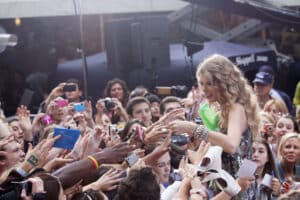
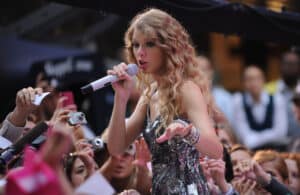
C672PF Taylor Swift on stage for NBC TODAY Show Concert Series with Taylor Swift, Rockefeller Plaza, New York, NY October 26, 2010. Photo By: Rob Kim/Everett Collection
But predominantly, nowadays it is going into her Eras show, which treats each of her albums as an epoch to be explored and re-enacted. It was the late great Tony Bennett who said in relation to Amy Winehouse that no jazz singer likes to see 90,000 people staring back at her. Swift doesn’t seem to mind that at all.
The author of the best book about Swift is The Secret Critic who speaks to me over email in order to retain his or her anonymity. His book Taylor Swift: The Anatomy of Fame is like no other: a tour de force of literary criticism, which addresses the Swift phenomenon in highly original terms.
The author tells me: “Swift can’t sing like Winehouse – which is no shame, as she was a one-off – but the quote is a reminder that large stadiums are a problem to be solved. The only person really to solve it before Swift was Freddie Mercury – and I occasionally see Swift deploying gestures at the piano which remind me a little of him, tipping her whole body back theatrically. Mercury knew that these arena require exaggerated gestures – and Swift knows this too.”
For the Secret Critic, it is also a question of intimacy: “Mercury also understood that the only way to make the space smaller is to connect intimately with the people in it as he did with his famous ‘Day-dos!” So how does Swift do it? “What’s unique is that she does it through respect, humility, and an earned familiarity.
She couldn’t play these venues if she’d ever put a foot wrong in displaying respect towards her audience; the act simply wouldn’t work if she had ever done that. It is this peculiar bond between her and her audience which enables her to handle these enormous audiences. There has never been anything like this – by comparison, Mercury looks remote from his audience. There was no Queen community in quite the same way that there’s a Swift community.”
For me, the Eras show works partly due to its choreography where Swift accepts a central role while also sharing it with others. Again, in compiling the show she is able to borrow from her own hard work in her music videos, which she has always controlled. Some of these are now on display in the V & A Museum. Kate Bailey, Senior Curator, Theatre & Performance, says: “We are delighted to be able to display a range of iconic looks worn by Taylor Swift at the V&A this summer. Each celebrating a chapter in the artist’s musical journey.”
2T41TF4 OCTOBER 27th 2023: Taylor Swift is officially a billionaire according to multiple published reports which now estimate her net worth at roughly $1.1 billion. – File Photo by: zz/Patricia Schlein/STAR MAX/IPx 2019 8/26/19 Taylor Swift at the 2019 MTV Video Music Awards held on August 26, 2019 at the Prudential Center in Newark, New Jersey, USA.
And what is the idea behind the show? “Taylor Swift’s songs like objects tell stories, often drawing from art, history and literature. We hope this theatrical trail across the museum will inspire curious visitors to discover more about the performer, her creativity and V&A objects.”
These outfits, above all, always make one think, for the simple reason that there is never any doubt that a considerable amount of thought has gone into their creation. It is all of a piece with someone who won’t leave anything to chance. The looks that she has produced each speak to a particular mood; her albums represent self-contained aesthetics, which is part of what makes the Eras tour viable at all. Here is Swift, gloriously rainbow-coloured during her Lover era, cabin chic during Folklore, and suitably red during the Red era.
Angelina Giovani explains that even making her way to the concert was an eye-opening experience: “On my way to the concert I saw how most houses on Wembley Hill had put out signs, renting out their driveways to concert goers so they could park. They were all full, going at about £20 for the afternoon.
Swift is playing at Wembley Stadium eight times this summer, during which the average family will make £160 per parking spot. It is not ground-breaking, but it is not nothing. Her fans travel around in thousands to see the concert, they eat, drink and sleep locally and as far as fans go – they’re not football fans. Their most threatening weapon is glitter, so they are made very welcome.”
She is also eloquent about the greatness of Swift as a live performer: “The concert was electric. I have been to many concerts before, primarily rock bands, but this was quite special. I had never seen such a mix of young and old before at Wembley. The youngest concert goer was no more than five years old and the oldest, in their eighties. I found it very heart-warming to find a common source of joy across generations.
There were 84,449 people on her first day at Wembley, and throughout the 46 song track list that she sings she never sang alone. The people who had purchased seated tickets, did not sit down.” Giovanni brilliantly captures the uniquenesss of live concerts: “There’s something about concerts that makes everyone think they can sing, which is endearing. At times it was hard to distinguish Swift’s voice from the crowd. But you can see her relishing in it. She is so tuned it and plugged into the audience. She kept spotting people who needed help in the standing crowd and pointing them out to the first aid crew.”
This is an important point. If one looks at Swift’s predecessors in the 60s, whether it be The Beatles or The Rolling Stones, they had become famous in order to put distance between themselves and others; Bob Dylan, meanwhile, has sometimes shown a kind of lofty contempt for his audience.
The examples of Swift’s good nature are too numerous to have been faked and it is this which causes such widespread happiness: we haven’t been watching a musical phenomenon sweeping through the country so much as a sort of spiritual force. Swift has given huge amounts to charity – and not done it any showy or self-aggrandising way. We can find the friendship bracelets which are handed out at her concerts kitsch if we want, but the moment we think friendship itself is kitsch, we have become cynical, and the joke may have rebounded on us.
Dr Paul Hokemeyer, an extremely successful psychologist, agrees: ”One of the things I find most valuable about Taylor Swift’s uber celebrity is how it transcends the veneer of social media celebrities such as the Kardashians and rejects the meanness of the Real Housewife franchises. In contrast to these other celebrity phenomena, Taylor Swift sends a message of kindness, inclusion, respect and hope. Her music is uplifting. It celebrates the vulnerability inherent in being human and creates connections through communities of joy and the celebration of love and life.”
C672YY Taylor Swift on stage for NBC TODAY Show Concert Series with Taylor Swift, Rockefeller Plaza, New York, NY October 26, 2010. Photo By: Kristin Callahan/Everett Collection
This is well-put. As we look at the world of politics at time of writing, the UK for all its problems seems a sort of curious bright spot. We find an unhappy American election where some think a new civil war may be imminent; in France things seem even worse – and, of course, the Russia-Ukraine and Middle East conflicts continue, as do threats to our Western way of life from China, North Korea and Iran. The opportunities for despair appear to be legion.
But Taylor Swift, whether one likes her music or not, is against all that, says Hokemeyer. “As a mental health professional, I find the hunger for such messages indicative of the pernicious impact our current culture of ideological division, violence, patriarchy and ecological destruction is having on the younger generations of humans. They are looking, like Harry Harlow’s monkeys, for love, nurturance, benevolent leadership and comfort in their lives.
When Taylor takes the stage, or is heard over earbuds on the tube, she touches her fans on a deeply emotional level. She models power through vulnerability rather than malignant narcissism. She speaks to her tribe in a way that nourishes their hearts, minds and bodies. She makes them feel important, seen, understood and, most of all, valued in ways that our political, religious, corporate and even family leaders have failed them.”
Giovanni agrees: “You can love or hate Taylor Swift, it doesn’t really matter in the grand scheme of things. Her music is not everyone’s cup of tea and that’s fair enough. But in the past year, Taylor Swift has done more to help with hunger than governments. Measurably so. In every city she plays, she donates to food banks enough money to keep them running for a whole year. Many roll their eyes, it’s all for show, it’s all to paint a certain picture. But does that matter? Not to the people who are getting regular, hot meals.”
In other words, Swift is now in effect beyond her art – she exists in a realm of willy-nilly cultural significance, exactly as the Beatles did. It was a futile thing to announce that one didn’t much like Sergeant Pepper’s Lonely Hearts Club Band in the 1966, the year of its release. It was what was happening then; it was how the world was. Years, later Sir Martin Amis would write in his 1973 novel The Rachel Papers that: ‘To be against the Beatles is against life.” It is the same with Swift today: she is, whether one likes it or not, part of the life force.
But how exactly has this force come about and what does it say about us? Just as in old footage one sees young girls in a sort of delighted panic at the sight of the Beatles performing ‘She Loves You’, today we see their progeny experiencing similar emotions with Taylor Swift. This is interesting because in the case of The Beatles one assumed that sex might have had something to do with the extent of the obsession; but that doesn’t seem to be the case when it comes to Swift.
2BP33RG NEW YORK, NY, USA – MAY 29, 2009: Taylor Swift Performs on NBC’s “Today” Show Concert Series at Rockefeller Plaza.
So what’s going on here? Hokemeyer tells me: “For time eternal, humans have engaged in celebrity worship and oriented themselves in tribal hierarchies. In the realm of psychology, such patterns of being are known as archetypal. They are accepted as part of the universal human experience and involve behaviours that reoccur consistently over millennia and across cultures.”
In other words, what we are seeing is only the latest manifestation of a tendency as ancient as the hills. Hokemeyer continues: “But while this overall pattern of being remains constant, over time, the objects of our celebrity worship change to reflect the contemporary zeitgeist. In ancient Greece, humans worshiped celebrities such as Aristotle and Socrates. These men provided clarity and comfort in a dangerous and chaotic world through logic, reason and intelligence. Fast forward to modern times when today’s celebrities are human beings who have attained elevated levels of financial success and captured the world’s attention by features of their beings: their talent, their power, their beauty, their wealth.”
So we’ve gone away from celebrating intellect towards worshipping money? It isn’t quite as simple as that, says Hokemeyer: “Today’s celebrities such as Taylor Swift, garner and hold society’s projections of superiority over the banality of human existence while providing transcendental experiences to people longing for connection, joy, comfort. She, through her music and charisma, provides a momentary reprieve from what remains a dangerous and chaotic world while allowing us to organize ourselves like honeybees, under a superior other and in colonies of shared purpose and identity.”
What is remarkable about this is just how universal it appears to be. “What is most interesting about Taylor Swift is how she’s been able to garner uber celebrity amongst a geographically, racially, economically and culturally diverse group of people,” Hokemeyer continues. “In contrast to celebrities of the past whose celebrity has been more limited, Taylor has been able to utilize the power of the internet to unite a humanity suffering from an acute state of division, disconnection, violence and environmental degradation by making her fans feel seen, valued and understood through her music, charisma and the community she’s created.”
When I put all this over email to the Secret Critic, the mystery author agrees but also has more to say: “I would argue that Swift, though she seems to have arrived out of the milieu of pop, and even of American Idol and so on, in fact has more in common with the Sixties songwriters than we sometimes think, and far more than her detractors realise. She isn’t only a live concert experience; there’s a genuine listening experience to be had as well.”
Like Shields, The Secret Critic points to Folklore as a period when her songwriting went to a new level where, notwithstanding some dissent over her new album, it has largely stayed. “From Folklore onwards, you’ll find more complex language – a deeper commitment to character. In my book I have an analysis of the Betty trilogy on Folklore and there are some remarkably telling details and some very clever touches in terms of character: she can do the male character voice, and the two very different female characters.
This is far harder than it looks – and she does it.” These three songs, consisting of ‘Cardigan’, ‘August’ and ‘Betty’ are redolent, says The Secret Critic, of those times. “I think that the pandemic period was an opportunity which she seized in some way. She watched a lot of movies and read a lot of books -and the result was a kind of deepening in her art. I would argue that her best song is ‘Exile’ where there is a depth of feeling about the collaboration with The National which has to do with the odd static urgency of that time. I don’t think we see such depth in her recent collaboration with Post Malone.”
Swift herself is very interesting about her craft. “Throughout all of the changes that have happened in my life, one of the priorities I’ve had is to never change the way I write songs and the reasons I write songs. I write songs to help me understand life a little more. I write songs to get past things that cause me pain. And I write songs because sometimes life makes more sense to me when it’s being sung in a chorus, and when I can write it in a verse.”
Love continues to obsess her – relationships are to her, to paraphrase Larkin, what daffodils were to Wordsworth: “I write a lot of songs about love and I think that’s because to me love seems like this huge complicated thing,” she has said. “But it seems like every once in a while, two people get it figured out, two people get it right.
And so I think the rest of us, we walk around daydreaming about what that might be like. To find that one great love, where all of a sudden everything that seemed to be so complicated, became simple. And everything that used to seem so wrong all of a sudden seemed right because you were with the person who made you feel fearless.”
But does The Secret Critic see The Tortured Poets Department as a weaker album? “I do think it’s a problem which pop stars face, and it’s to do with musical education. Classical composers tend not to become samey because they just have so many musical resources at their disposal.
The same just isn’t the case in popular music – even when you look at McCartney who is just this immensely musical guy. Take ‘All Too Well’ as an example. The chord sequence is essentially, C, A minor, F, G – which is broadly the same chord sequence as ‘Let It Be’. But it’s very simple, and the danger is that when you’re writing according to simple structures, you find there are fewer places to go musically.
As I listen to the latest single ‘Fortnite’ I find myself understanding what The Secret Critic is saying: in ways which are difficult to pinpoint the melody, feels of a piece with Midnights but it lacks the excitement of the inspiration which must have accompanied that album.
Why is this? “I’m not saying it’s a terrible album. But I do think its weakness has been masked somewhat by the ongoing success of the Eras tour. Why does pop music tend to fall off a little? There are a few reasons. One was described by Stephen Sondheim. He pointed out that after a while, muscle memory means that when a composer approaches their instrument their hands, by habit, gravitate back to the same chords.
This habitual element to songwriting can be very damaging and create samey work, as I believe it is beginning to do with Swift. John Updike wrote a famous essay called ‘The Writer in Winter’ where he writes of every sentence ‘bumping up against one you wrote 50 years ago’. Updike lived to a fairly decent age, and his prose was rich. Pop tends to stale quicker as the options for creativity appear to be far fewer.”
But there’s another problem. “The other thing is that pop music is the expression of youth. Now, there are a few exceptions here and there to this – Bob Dylan and Leonard Cohen were still breaking ground into their 80s. But they came from folk music which is a more cerebral form. Swift is interesting because in Folklore and Evermore, she has shown that she’s comfortable with this genre so there are places for her to explore as a songwriter. It’s just that both Midnights – and now The Tortured Poets Department – have shown her moving in a more disco beat direction. I don’t think the quality will be sustainable in that line.”
Angelina Giovani disagrees: “My favourite album is by far the most recent one The Tortured Poets Department. It’s quite a departure from her usual style of writing, but it is an immersive experience that is very emotionally charged. All feelings come through very clearly, whether it’s heartbreak, pain, anger, relief, reassignment or juvenile joy. My favourite song of the album is ‘The Smallest Man Who Ever Lived’. I can absolutely see it turned into another short film.”
The Secret Critic responds: “If you listen to that song, even the melody along the line ‘ever lived’ is too similar to the melody to Bad Blood. There’s no way to avoid the fact that she’s likely going to go into an artistic decline, and that once this tour is over, and all the noise has died down, we might well have seen peak Swift.”
But the Secret Critic also has fascinating things to say about the scale of the Swift phenomenon. In The Anatomy of Fame he cites what he calls The Peyton Predicament, which references a football commentator and Swiftie called Jared Peyton. Peyton found himself as the Kansas City stadium where Swift’s latest boyfriend Travis Kelce was playing. He decided to go and find her and filmed his quest on Twitter.
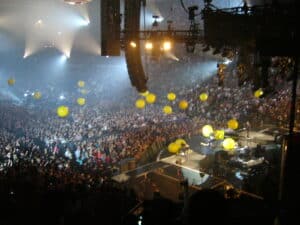
2J7C92H Taylor Swift live on stage – The 1989 World Tour Live – 2015
What followed went briefly viral online. Peyton, using his insider’s knowledge of the geography of the stadium managed to get to the end of a tunnel just as Swift went past. “I was fanboying out!” he said on the video he streamed on Twitter, which in itself earned him a certain fleeting celebrity. “The Peyton Predicament speaks to the huge importance in many people’s lives,” says The Secret Critic. “My book seeks to ask the question: Why does he feel the need to do that? What is it about her and what is it about us that means that it has come to this?”
It would be easy to be cynical about this and to consider Payton little better than insane to place such emphasis on saying hello to a fellow mortal being. But Dr. Paul Hokemeyer takes a somewhat different view: “At the most primal level of our being, we all need to feel seen and validated by a superior other. This need is hard-wired into our central nervous system. We come out of the womb completely dependent on another human being to feed, love and comfort us. Without this love, we, like the monkeys in the famous Harry Harlow study, will suffer from profound states of emotional despair and poor physical health outcomes.”
By this reckoning then Payton’s behaviour, far from being a bit mad, is in fact deeply human: “When Taylor Swift not just saw, but also gracefully acknowledged Payton’s presence, his central nervous system lit up like Harrods on Christmas Eve and flooded him with a host of endogenous opioids such as dopamine, serotonin and oxytocin. He was elevated to a state of being, ecstasy actually, that might defy logic, but which is consistent with our basic human need to be validated by a superior other. In the experience, Payton transcended his human frailties and became intoxicated with the elixir of celebrity.”
In The Anatomy of Fame, The Secret Critic goes into the matter in even greater detail and analyses the constituents of this appeal from the philosophical perspective. “I wanted to write a book where at the beginning we see Payton in one way – but by the end we’re brought round to his way of seeing – or at least to understanding it. If someone said to you: ‘Taylor Swift is over there, you might want to go and see her,’ you’d think one set of thoughts. But if I said: ‘Somebody who embodies beauty, creativity, kindness and power’ is over there, you’d say: ‘Well, you should definitely go and talk to her’. But to Peyton that’s exactly what Swift is.”
The book therefore breaks down Swift’s appeal looking at her songwriting, her beauty, and above all her morality. The effect is very profound. We see how Swift has effectively straddled the songwriting of the 1960s and written songs which are close to being standards, while also becoming the premier live performer of our time. She exhibits beauty but also vulnerability. But above all she joins power with a matter-of-fact kindness which never feels affected.
I decide I want to test The Secret Critic’s theory on Angelina Giovanni, who enthuses: “I find it rather impressive that people who work with and for her and don’t seem to have a bad word to say and are always raving about her generosity. Everyone on her team from truck drivers, to back up singers have received life changing bonuses, totalling a whopping $55 million dollars. That’s why I’m rooting for her to be even bigger. I love the fact that it is someone of my generation that has made it so big, so young and is on track to breaking so many musical records previously held by music’s biggest names.”
Of course, there are limits to her power. As the Netflix film Miss Americana shows, her intervention on an abortion referendum in her home state did nothing to sway the result, and there is a sense too that the way in which politicians, especially the Biden administration, fall over her for her endorsement borders on the absurd.
But her business skills – or her ‘power moves’ as she refers to her own acumen in the song ‘The Man’ – are both considerable, but also very far from being the main reason for her fame. It is a mark of her uniqueness to think that she came up with the line “I swear to be melodramatic and true to my lover”, but also the brilliant savviness of the Taylor’s Versions project, whereby she wrested back control of her back catalogue taking advantage of the fact that she continued to own the copyright of her songs.
When it comes to the management of her career, one suspects the influence – perhaps both genetic and direct – of her financially savvy father: Swift used to tell her contemporaries at school that she would be a stockbroker when she grew up.
But there is no doubt that Swift’s principle achievement is to have created by the power of her music and her example, a change of direction away from selfishness towards kindness. Dylan was always acerbic; the Gallagher brothers were demonstrably offensive and the world is full of rock stars who don’t donate to food banks – and likely never consider it something which they might do.
Taylor Swift does and it is wonderful that she does. It seems to me as though she is an aspect of something which appears to be happening the world over: a realisation that the values of self-interest which arguably date as far back as the Renaissance are insufficient to live by. We vaguely know this – but sometimes it helps if someone sings about it too.
Christopher Jackson reviews the latest Coldplay release
Every now and then I find myself considering the fine margins between major and minor success. I remember, for instance, a gig I attended at the turn of the millennium at the Nottingham Arena performed by the band Travis. In those days, like their rivals Coldplay, they could easily fill a stadium of 10,000 people. We may have turned up with a certain scepticism but ended up shouting out the lyrics to ‘Sing’, our cynical side assuaged by the fun of the evening.
Today, rotating on Apple Music, Travis’ songs have a power of nostalgia which the songs of Oasis lack. ‘Wonderwall’ has never really gone away. Travis, by contrast, have had a quiet few decades: this fact creates the gap in our experience which can make for a genuine revisiting not quite possible with the Gallagher brothers. And Travis’ songs stand up reasonably well. ‘Why Does it Always Rain on Me?’ ‘Sing’. ‘Driftwood’. ‘Flowers in the Window’. I hope they have a comeback.
But had you asked me in the year 2000 which band, Travis or Coldplay, would in 2025 break the record for the most consecutive gigs played at Wembley Stadium, I would have probably plumped for Travis. Coldplay at that time were mainly known for ‘Yellow’, which, lovely as it was, seemed to be a melancholic dead end. Travis’ songs seemed to have more complexity: they even sounded a bit like standards. One could imagine people covering them: there was more to explore.
I was wrong, of course. I’m not sure if Travis can still fill Nottingham Arena, but I know that it would be too small a venue for Coldplay. When A Rush of Blood to the Head came out in 2002, I was on the frontlines of the backlash, feeling that Coldplay represented not something new and lasting, but some form of decline from the greater cleverness of Blur and Pulp, those high spots of Britpop. Coldplay, I felt confident, represented the blandification of the British scene.
Change of Heart
I now see I was wrong in this reasoning – and wrong perhaps precisely because I would have been reasoning and not experiencing the emotion of the music.
All this came back to me recently when Coldplay returned to my life by a series of accidents. Our family’s enjoyment of ‘Something Like This’ in the car on holiday, led me to the Coldplay Essentials playlist on Apple, and via that to a discovery of all that Coldplay had been up to in the intervening decades since I had loftily decided that they would have no future. I note also that I never bothered between the years 2002 to 2024 to check in on whether my predictions had proven false or not.
At least I am not alone. As I read the other reviews of Moon Music, the album recently released to an almost Swiftian excitement, I realise I am not alone in having underestimated Chris Martin and all his works.
Almost any broadsheet review of a Coldplay album will begin with some disclaimer, making it reasonably clear that though the reviewers themselves have not written ‘The Scientist’ – or indeed any song of any description – that they are obviously above the task which has befallen to them: namely to review the latest Coldplay album.
Usually, there will be some sniping at the lyrics, and a general keening about Chris Martin’s perennial failure to be Gerard Manley Hopkins. From here, the reviewer, having restored themselves to intellectual respectability, will then go on to relate what I suspect might be their real feelings: namely, a few carefully caveated points of praise. It turns out that one or two of the songs are actually ‘not bad’ or in fact, in some cases, surprisingly good. It is then sometimes observed that this is true of most and perhaps all Coldplay albums. The eventual rating – usually three stars – seems to conceal a certain embarrassed enthusiasm.
If we take the typical reviewer’s estimation at face value that there are, say, two good songs on each album then it must be pointed out that this still amounts at this point to around 20 songs which even the naysayer would wish to preserve.
What is often forgotten is that this in itself is a high number. If we look at the amount of a celebrated pop act’s catalogue which we actually want to keep it usually turns out to be very small. We would probably be content with rescuing around 10 of Fleetwood Mac’s songs, and Fleetwood Mac is an excellent band. I’ve often thought the Rolling Stones really amounts to around 20 songs (they have released hundreds). It’s only when we get into the major acts, the Beatles and Paul Simon that we top 50 songs – and only in relation to Bob Dylan that we clear 100.
All this is to say that even if we take a negative estimate of Coldplay’s output then the band’s work is to be approached with respect and not derision.
The Ghosts of Modernism
Of course, one shouldn’t have to say this – and one wouldn’t have to say it at all if it weren’t for the peculiar way in which the 20th century turned out in terms of art. Really, it is an inheritance of modernism where people began to feel that things must be complicated, and even incomprehensible, to be good. This view would have surprised many artists and writers who university professors like to exalt, Shakespeare among them, who always took care to have a ghost or a murder – and ideally both – in his plays.
What appears to have happened by 2024 is that we have realised more or less unanimously that we quite dislike modernism, and wish to keep it at a safe arm’s length. We want to enjoy life, and that for most of us, means not reading The Wasteland or listening very much at all to Schoenberg.
This is not to say that Moon Music is full of ageless poetry: if written down, the lyrics can indeed be banal. But then this album never claims to want to be experienced in that way: it claims instead to be joyful – and joy-inducing – music. This has two ramifications at the level of the lyrics which are worth examining.
One is the propensity for simple and grand statements which at the level of language, a child could write. In the third single of this album ‘All My Love’, the lyric reads:
You got all my love Whether it rains or pours, I’m all yours You’ve got all my love Whether it rains, it remains You’ve got all my love
Now, we can certainly surmise that if T.S. Eliot were writing that as poetry that he might not be top of his form, and even having rather an off day. Bob Dylan, a different kind of songwriter to Martin, especially when writing in the 1960s, would if writing this song no doubt cram in additional internal rhymes around ‘pours’ and ‘yours’ with available words being ‘floors’ ‘pause’ and ‘cause’. He would glut the listener with ideas – and with every idea crammed in one can imagine it getting significantly less likely that the song would ever be sung in a stadium. The song would become more intellectual – would become another kind of song.
Martin doesn’t do this, and I think at this stage in his career we must give him the benefit of the doubt that he does it deliberately. To firm ourselves in this concession, let me pick almost at random an interview excerpt to show the intelligence of the man. This is Martin talking to The New Yorker in an article released to promote Moon Music:
“I’m so open it’s ridiculous,” he said. “But, if you’re not afraid of rejection, it’s the most liberating thing in the world.” Well, sure—but who’s not afraid of rejection? “Of course,” Martin said, laughing. “To tell someone you love them, or to release an album, or to write a book, or to make a cake, or to cook your wife a meal—it’s terrifying. But if I tell this person I love them and they don’t love me back, I still gave them the gift of knowing someone loves them.” Martin noticed a slightly stricken look on my face. “I’m giving this advice to myself, too,” he added. “Don’t think I’ve got it mastered.”
Now regardless of the ins and outs of the philosophical point here, I think most will agree this is obviously an intelligent man speaking who is probably in person wise, funny and kind. Furthermore, it seems unlikely that he should become less so when doing the thing he loves to do which is songwriting. In short, there is something forgivable about the lyrics when we consider the man.
So given the deliberate nature of his music, what is it which Martin is trying to do with a song like ‘All My Love’? With this kind of song, everything comes down to the sincerity with which it is sung. Sometimes, reviewers will accuse Martin of issuing song lyrics which are like Instagram self-help posts. This is intended to wound him, and perhaps it does.
Chris Martin by Roger Woolman
However, even if this is admitted to, we have to say that there are two kinds of platitude: that which is meant sincerely and genuinely designed to help people, and that which isn’t really intended to help at all but which is really a kind of show, and therefore a sort of con.
On Sincerity
Having listened to Moon Music for the last few days, I don’t think it is at all the latter. I think Martin is someone who genuinely cares about his fellow human beings, and that his music is, by and large – with admitted peaks and troughs which are entirely human – a fair method of conveying what he feels about life. It was Emmanuel Swedenborg who wrote of insincere feeling that it were as if ‘a liquid were, on the surface, like water, but in its depths putrid from stagnation’. A certain kind of commercialised pop music is like this: it is, in its depths, false.
The impression one has of Coldplay is different. Probably it wouldn’t catch so many people, and cause such widespread delight, if it weren’t.
It was his friend Nick Cave who wrote of Chris Martin’s ‘songwriting brain’. Now that we have admitted that he has one, we can see what Martin is able to do in his songs. The interesting point about this is that the correct measure of true feeling does away with artistic doubt. Moon Music is full of what we might call surmounted cliché.
If I sing that I feel like I’m feeling falling in love, and I have – as one might in adolescence – no real sense of what that feeling means, I will sound rather silly. I will probably not convey that feeling with sufficient experience. Almost certainly, I shall sound immature and insecure, and if the girl is rejecting me, self-pitying.
But if I sing, as Martin does on the second track here ‘feelslikeimfallinginlove’, about falling in love with full consciousness of what that means – the fear as well as the joy, the vulnerability as well as the force of it – then the words, simple as they are, come hitched to meaning. In that scenario, the music has some sort of potential which exists completely independently of what has been written down on the page.
Similarly, if I pray for a better world as in the third track here ‘We Pray’ and with every fibre of my being, I really do wish for peace for my fellow human beings, and feel the genuinely awful corollary of war and all its disasters as I sing it, then I am able to bypass the literary concerns of even a music journalist for The Independent around a line like “Pray that I don’t give up/pray that I do my best’.
That journalist may write at length that I am using cliché, but will be missing the fact that in pop music, if I mean what I sing, and see the glory of peace and the horror of war in my mind’s eye as I sing it, their objections simply don’t carry. In this art form, to mean what one says is a sort of de facto defeat for the naysayer because no matter what The Independent might say, peace is really a very important thing, and praying for it is a very good thing to do.
At a certain point, Martin realised he could do this sort of thing again and again and that people hugely needed it. He is not Dylan or Cohen, and never intended to be. Musically, his chords progressions are extremely simple, and so he is also to be differentiated from the greatest player of stadiums Freddie Mercury. Mercury’s musical vocabulary was borrowed from jazz and classical. A song like ‘All My Love’ with its straightforward chord sequence from Am to D7 to G and Em shares nothing musically with Mercury’s ‘My Melancholy Blues’ with its complex diminished chords. In fact, Mercury’s songs would generally be a bit outside Martin’s ability as a piano-player.
Don’t Panic
But again, in a world of difference, there is no need to fret about any of this if the music can be made to convey good things honestly. It might all be summed up by the presence of an emoji of a rainbow as a track title on Moon Music. A rainbow is a cliché of course – but I know few people who don’t pause and point when they see one in nature. A rainbow then, like peace, or love is not just a cliché. It is also a vital thing which needs to be re-experienced.
There has been a lot made about Martin’s saying that there shall only be 12 Coldplay albums. With this being the 10th, we are therefore approaching the end of the band’s career. We should remember that it’s a career that has caused enormous amounts of pleasure to many people because of a certain fearlessness about finding ways to refresh us in relation to the obvious.
How has he done this? I think he has done it by trusting to the origins of songs. A few years ago, Martin explained that he was going through a hard time dealing with the inheritance of an evangelical upbringing. One’s sense is that like so many in the Western world, his struggle has been with the structures of religion – what we might call its exoteric aspects. In short, many people are vexed by things like churches and prayer-books, and desire to reconnect with the wonder of ‘skies full of stars’ or ‘good feelings’.
Music is one way in which this can be done, and it really means connecting again with the inner self – that is, the esoteric. Coldplay might seem an unlikely messenger of some sort of revolution of the inner self. One begins to say that they don’t take themselves sufficiently seriously for that to be possible – and yet, the moment one thinks in that way, one realises that this is itself what frees people up. In Coldplay, a woman dreams of ‘para-para-paradise’ – and for many this brings paradise itself nearer than a Eucharist or a monk’s chant.
It would be a shame to miss out on all this in the mistaken belief that a song is a poem, and that a pop concert is meant to be an opera. Life isn’t like that, and I think we owe more to Chris Martin than many realise for not only knowing this but for enacting this knowledge.
What do you need to make a musical career? I’d say it comes down to one thing: a talent for immediacy. If you don’t have it, the chances are you’ll lose out to someone who does. I remember when I first listened to ‘The Sound of Silence’ in that wonderful Dustin Hoffman film The Graduate (1967): I was only 15 and as blank a listening canvas as can be imagined. But the effect was immediate: that day I went down to the old record store in Godalming and bought Simon and Garfunkel’s Greatest Hits.
I’ve been listening to Paul Simon on and off ever since, so much so that it is hard to imagine my life without his consoling voice, his cunning lyrics, and his explorations of international rhythm. Now, with Seven Psalms released in 2023, and the two-part documentary In Restless Dreams released the same year – and updates regarding his Beethoven-esque hearing loss in one ear following in 2024 – we have an opportunity to consider the last act of Simon’s career.
Late works are a subject of perennial interest. Something seems to happen when the grave nears: there can be a sharpening of perception, and a sense even of the material veil about to be lifted. In literature, Shakespeare’s The Tempest (1610-11) with its world of fairies and valedictions is perhaps the most notable example of a viewpoint shifting as this world’s impermanence becomes increasingly evident to the writer. In poetry the famous lines by WB Yeats in the poem ‘Sailing to Byzantium’ might be taken as a sort of mantra for the ageing artist:
An aged man is but a paltry thing,
A tattered coat upon a stick, unless
Soul clap its hands and sing, and louder sing
For every tatter in its mortal dress…
That is what Simon is doing in Seven Psalms – singing for every tatter in his mortal dress. In music, the most obvious touchstone is those great late string quartets by Beethoven, where we feel the composer to be inhabiting a sort of ethereality. What appears to happen as mortality rears up is that the artist feels a heightened sense of the beauty of things and the fragility of the life they are about to leave. At the same time, we sometimes find the shape of intuitions about what may or may not come next, and Seven Psalms is a little like this.
The album comes up on Spotify and Apple Music as one long track 33 minutes long, but it also consists of seven interconnected tracks beginning with ‘The Lord’. Every track feels wispy and valedictory – like someone taking a last look around a house which they have just sold and are about to vacate for the last time.
But throughout, a certain confidence underpins it and somehow or other, as shown by the title of the album, this seems to have to do with some sort of faith. This is a little unexpected since it isn’t something which Simon has spoken about much in his highly secular career, and in fact he has stated in interview that he isn’t religious at all.
All one can say to this is that any cursory listen of this album makes you think he’s doing an excellent impression otherwise. In fact, the powerful nature of the testament Simon is giving us here makes one wonder whether it’s possible to be religious without knowing it – indeed perhaps it’s a far more common condition than we realise. Here’s a sample lyric from the opening track ‘The Lord’:
I’ve been thinking about the great migration Noon and night they leave the flock And I imagine their destination Meadow grass, jagged rock
The Lord is my engineer The Lord is the earth I ride on The Lord is the face in the atmosphere The path I slip and I slide on
This is the language of the metaphysical poets, and is as religious as it gets. Even more interestingly, Simon has stated in interview that the idea for the album came to him in a vivid dream, where he received this clear instruction: “You are writing a piece called Seven Psalms”. Simon woke up in the middle of the night and wrote the title down at a time when he claims he didn’t even know what the word ‘psalms’ meant. This is odd since it’s quite a common word which one might expect an educated octogenarian to know about. Not since Paul McCartney woke up humming ‘Yesterday’ has music emanated so definitely from dream like this.
It sometimes feels as though this album therefore has some sort of special validity; it is certainly quite different from all his other albums. In ‘The Lord’ Simon continues:
And the Lord is a virgin forest The Lord is a forest ranger The Lord is a meal for the poorest A welcome door to the stranger
The Covid virus is the Lord The Lord is the ocean rising The Lord is a terrible swift sword A simple truth surviving
This achieves the sort of compression and reach which isn’t usually to be found in Simon’s songs – nor is it to be found generally in pop songs full stop. Here compression is allied to a sort of visionary certainty about the nature of divinity which may indeed have come through Simon, as an inspiration quite separate from the Paul Simon who presumably goes about his daily life.
But there’s more. It turns out that the whole album was written by dream prompts. In the CBC interview he continues:
Maybe three times a week, I would wake up between the hour of 3 a.m. and 5 a.m. with words coming, and I would just write them down…If I used my experience as a songwriter, it didn’t work. And I just went back into this passive state where I said, well, it’s just one of those things where words [were] flowing through me, and I’m just taking dictation. That’s happened to me in the past, but not to this degree.… I’ve dreamed things in the past — I didn’t necessarily think that they were worth noting. That’s why it’s unusual that I got up and wrote that down.
Simon, then, appears to have entered into some process of communication with the psychological process which makes dreams: since this process also occurs in the wider universe and is impossible to divorce from it, we can say that he was also in some form of cosmological engagement which was wholly unusual for him. It was a reckoning of sorts – and one also that was presumably occurring, since people don’t live much longer than 80, fairly near to death. All in all, one cannot help but feel that this album amounted to a new kind of creative opportunity presented to Simon – and without being morbid, a last ditch one at that.
We can further guess that this new sort of creativity may have been linked to some sense of inadequacy at all that he had achieved up until that point in his career. In the quote above he references how his previous songwriting practice felt irrelevant to this new project: I would guess that this is the manifestation of a certain dissatisfaction with the way in which he has gone about his creative life, no matter how successful and laurelled he is.
Perhaps, despite his enormous achievements, there could even be said to be a certain justice about that verdict which, depending on how we view the meaning of dreams, was coming through him, or from him. As odd an admission as it may be for the person who wrote ‘The Boxer’, Simon has sometimes in interview expressed a sense that he is somehow in the second tier. In particular, he has always come in second to Bob Dylan. In 2011, Simon told Rolling Stone:
I usually come in second to Dylan, and I don’t like coming in second. In the beginning, when we were first signed to Columbia, I really admired Dylan’s work. ‘The Sound of Silence’ wouldn’t have been written if it weren’t for Dylan. But I left that feeling around The Graduate and ‘Mrs Robinson’. They [my songs] weren’t folky any more.
And why was Simon always runner-up like this? Simon continues:
One of my deficiencies is my voice sounds sincere. I’ve tried to sound ironic. I don’t. I can’t. Dylan, everything he sings has two meanings. He’s telling you the truth and making fun of you at the same time. I sound sincere every time.
This is worth unpacking. The truth is that Dylan came to songwriting almost weirdly fully formed. There was a specific reason for this: that he was drawing from the past, and often, frankly, copying it. That’s why there’s no juvenilia by Dylan: he comes straight out of the gate with ‘Blowin’ in the Wind’ and ‘Girl from the North Country’. These songs are sponsored by, it can sometimes seem, a great chorus of American experience.
Well, if you’re travelin’ in the north country fair Where the winds hit heavy on the borderline Remember me to one who lives there She once was a true love of mine
‘Winds hit heavy on the borderline’ is excellent, but the song has both a fresh and ancient sound – and Dylan had the voice to convey those ideas simultaneously. The same was never true of Simon’s early work. We might take ‘Homeward Bound’ as an example:
And all my words come back to me
In shades of mediocrity
Blank emptiness and harmony
I need someone to comfort me.
This amounts to an immature complaint about life on the road which Dylan would never have permitted himself. It is part of that unlovely genre: rich rock stars moaning about having to be away from home a bit to make their money. These deficiencies – though they are offset in ‘Homeward Bound’ by some nice chord changes, particularly in the verses – appear to have stayed with Simon throughout his life.
There is a story of Simon playing a gig in Greenwich Village in the early 1960s, and noticing when up on stage that Dylan was sniggering about his performance with his own future biographer Robert Shelton. I’ve never been sure about the truth of that story, although Dylan could undoubtedly be harsh. Is it not more likely that they were laughing about something else?
In fact, whether it happened precisely that way or not, the story touches on Simon’s insecurity in relation to Dylan: what really matters is that he thought Dylan was laughing at him whether he was or not. Why might Simon feel this way? It’s because he knows his inadequacy in relation to Dylan.
Simon states in the Rolling Stone interview that this inferiority has to do with Dylan’s ability to apply layers of meaning not just in his lyrics, but to his vocal delivery. Simon is being hard on himself – as all artists need to be, provided that self-criticism doesn’t stymie creativity. But there is nevertheless truth to his verdict, and it is useful to have Simon articulate so clearly the central mystery of what makes Dylan uniquely compelling.
How does Dylan achieve it? It is very difficult to say but my own sense is that Dylan’s immersion in the past – and really in life generally – has been so deep that he has come out so entirely soaked in art and experience that his singing is never entirely for himself. His experience is multifarious: he is many. His art can at times seem to have almost nothing to do with him. One never feels that there is any stability in the word ‘I’ in Dylan’s songs: nothing can ever be traced reliably back to him.
The same isn’t true of Simon: in his songs, even the very best of them, there’s always a slight air of solipsism amid all the lovely melodies and the beautiful ideas. He is writing in order to unburden himself; Dylan is doing nothing less than carving out, or reimagining, nationhood in song.
There are many ways in which this smaller tendency can illustrate itself in Simon’s career. The principle one is in being too clever. This exists across his canon. It is there in the Joe DiMaggio line in ‘Mrs Robinson’ which is probably too arbitrary; when Dylan namechecks people it is always as a way of going back to some definite idea, emotion, or set of principles, as in his great song ‘Blind Willie McTell’. Furthermore, this is a deficiency which Simon is aware of. There is also video footage in the 1990s of Paul Simon listening back to his magnificent song ‘Graceland’. He is being filmed listening to the words:
And my travelling companions
Are ghosts and empty sockets
I’m looking at ghosts and empties.
Listening back to this, his facial features twist with regret: “Too many words,” he says, genuinely berating himself. “Too many words”.
He is right. And too many words is always a symptom of trying too hard which in turn is to do with lack of self-confidence. By contrast, we might note how the whole magnificent universe of Dylan’s “Mr Tambourine Man” unfolds effortlessly, without any ambition intervening.
Dylan has superior knowledge about the world, which is really another way of saying that he understands himself better. Incidentally, Simon never wrote a line as good as: “I know that evening’s empire has returned into sand,” which shows a true poet’s innate perception of evenings – not to mention of empires and sand. I’m not sure Simon is ever seeing things so clearly as this; his ego, in the shape of his cleverness, keeps coming in between him and the thing he is trying to describe.
This lack of self-confidence in Simon might have to do with an absence of historical roots. This was, to put it mildly, never the case with Dylan who has travelled the world on his Neverending Tour, but always as an American mining his Americanness. Lack of a real centre meant that Simon went journeying, first to South Africa to record his best solo album Graceland (1986) and then to Brazil to record his second best Rhythm of the Saints (1990).
These albums were made in a completely different way – one might say that they have to do with avoidance regarding the core reasons for a restlessness which Simon has always felt. He recorded the rhythm track first and then recorded the melodies over the top. It was a fascinating exploration of another country, and produced some songs which border on being standards: ‘Boy in the Bubble’, ‘Graceland’ itself, ‘Diamonds on the Soles of Their Shoes’, although it might be that ‘You Can Call Me Al’ is marred by some slightly silly lyrics.
But the only real limit on the Graceland album is tied to its core concept: the lyrics feel like journalism, and make one think of Sir Tom Stoppard’s joke in his 1978 play Night and Day, that a foreign correspondent is “someone who flies around from hotel to hotel and thinks the most interesting thing about any story is the fact that he has arrived to cover it.”
Something like this appears to apply to Graceland and Rhythm of the Saints. There is a shallowness to his observations about poverty in South Africa for the very simple reason that Simon doesn’t live there, and can’t really know what’s going on. Damon Albarn faced a similar problem when he came to make his album of Mali Music.
Surrealism in Simon has its limits too. In Dylan’s surrealism – especially in Blonde on Blonde – we experience the excitement of the poet’s discovery of Baudelaire and Rimbaud. It is probably true to say that Dylan doesn’t always make definite sense, but there is something vast and brave about the exploration being undertaken; and very often one senses a large world of meaning bordering the difficulty of the language – a world of dream-like correspondences. But in Simon surreal language too often goes in the direction of archness.
Lyricists mustn’t let the listener know that they’re clever; what needs to be communicated instead is that they love truth, and then that they love language – and in that order. At the highest peaks of the Dylan songbook these two are in the right order – and of course, married to the music. With Simon, something is ever so slightly out of kilter and I think it must have been, despite his huge achievements, a frustrating career in some ways.
I should say that these deficiencies have been minor, and they make very little dent in most people’s enjoyment of Paul Simon. But they have, it seems, made a dent in Paul Simon’s enjoyment of Paul Simon.
For the rest of us we have a body of work which is full of charm, occasional wisdom – and almost always, a beautiful gift for melody which actually surpasses Dylan, and is probably only dwarfed in post-war song by Paul McCartney. Simon has always had the knack of writing a song which you can grasp on first listen but which you want to listen to again. We are extremely lucky to have a lullaby like ‘St Judy’s Comet’, which can still get my son reliably to sleep as he enters his ninth year; that perfect (except for the last verse) gospel song ‘Bridge Over Troubled Water’; ‘Mrs Robinson’ and many others.
But if we take Paul Simon at his own estimate as in some way second tier, it strikes me to be of enormous interest that Seven Psalms came to him in the way it did – as something gifted through dream.
We cannot say how this may have happened – and it is beyond the scope of this article to consider satisfactorily why we dream, and what dreams may mean. All we know is that dreaming is psychologically necessary. There have been experiments where people have been woken up just before REM – the period twice per night when we dream – and though they have slept, they have been denied dream. Such people have very quickly drifted into psychosis. From this we can realise that dreaming is psychologically necessary – a vital sorting of the day’s information.
But there have long been thinkers, including Carl Jung, who have argued that dream is a form of essential communication, and that this isn’t best understood as a purely internal process. For such thinkers, our mind is open when we dream to the stream of external life, and it is this which constitutes the real necessity about dream.
Be that as it may, we can see in Simon that something utterly essential has happened in Seven Psalms: we can see that his career would simply not have made any sense without it – though we noted no particular gap before. This is the wonderful thing about living a long time. A Paul Simon who had for some reason died in his 70s, without having done this, would be a completely different and inferior Paul Simon. Something similar happened to the Australian poet Clive James: he was a completely different creature at 80 to 70 and even 75.
Seven Psalms then is an album which should give us all hope that if we continue to live we will continue to learn – and perhaps something may just land in our laps which we weren’t expecting. This might not be something as big as Seven Psalms – it doesn’t need to be.
In fact, for all of us, in whatever career or task we’re chiefly working at, life is usually giving us little indications which might be seen as microscopic versions of these larger realisations. The lesson from the life of Paul Simon is to stay alert for the big change in direction, the essential shift in the self. It may just come your way – and if it does, you’ll know how much you needed it.
Geniuses never do what we want them to: if they did, they’d be just like us. There’s recompense for the dismay we sometimes feel at the trajectory of our heroes. After the initial confusion comes comprehension, forgiveness, and awe – followed by amnesia about the traversal of that progression. Soon you forget why you ever struggled; they’ve normalised a place you’d never have got to under your own steam.
Such phases – capped with delight – apply to the work of those of high achievement whose output we get to follow in real time. Imagine a fan of the Picasso blue period confronted with the invention of Cubism eight years before the outbreak of the First World War; or the Portrait of the Artist as a Young Man devotee faced in 1922 with the mystifying beauties of Ulysses.
Bob Dylan is the chief perpetrator today of this kind of rewarding bafflement. He’s been outmanoeuvring us for 60 years.
When we were used to Elvis’ platitudes, he gave us poetic song. When we demanded more folk, he smiled and gave us skirling Rimbaud-esque electric guitar; when we asked for more of that, he more or less invented Christian rock. By the mid-1980s we wanted to hear his hits as on his records, so he played them out of time and out of tune for around 30 years.
It didn’t stop there. When we didn’t care whether he painted or sculpted at all, he did both – and well. By the 1960s, when we were advising him to write something comprehensible, he eventually handed down from on high the wild madness of Tarantula (1971). Later, when we didn’t solicit his recollections, he wrote Chronicles Vol. 1 (2004).
Having greatly enjoyed that, we pleaded for a second volume, but he didn’t give us one, despite the logic that a first volume implies and necessitates a second.
In 2016, we gave him a Nobel Prize for Literature, to nudge him along in that endeavour. That didn’t work either. He didn’t accept the prize with any degree of normality, and instead delivered a speech with a backing track which turned out to be the beginning not of anything literary, but instead a prototype for ‘Murder Most Foul’. This 17-minute song (which always seems to me to finish in about four, as if Dylan has bent time) was then released at the start of the pandemic, making sure we paid attention to a completely new kind of song just when we had nowhere to go and couldn’t avoid listening to it.
But back in the late 1990s, when silence had seemed to be the best that could be hoped for, he gave us a masterpiece Time Out of Mind. Even that was complicated: it was produced by Daniel Lanois in a murky swampy sound which meant Dylan had to release a re-recorded version earlier this year, which many fans – this reviewer included – now consider to the be the right one.
By 2023, the strangenesses keep forking across our vision like some sort of improbable laser system. Last year, Dylan gave us The Philosophy of Modern Song (2022), which turned out to have no philosophy in it, and even less modern song. He then matter-of-factly released a new whisky. What will he do next? Become the world’s first 82-year-old ballet-dancer?
But every time you learn to be content, and to want more of what you didn’t need to begin with. Everything’s a phase, a stop, a navigation point. His career is all movement, restlessness, energy – for the listener, it’s a process of constant addled reconciliation to puzzlement.
All of this accounts for the particular note of coverage which attaches itself to everything Dylan does: it is the sort of excitable speculation which would make sense only in anticipation of a thing. Instead, the debate is occurring at the tangible – an album, a book, a painting – which is there in plain sight.
Shadow Kingdom was initially an esoteric streamed film released last year for the cheeky ticket price of $25. It entailed Dylan and some actors performing in a fictional Casablanca-style bar called The Bon Bon Club. The music percolated around the Internet, but here is the official release.
Instead of naming it Bootlegs Vol. 18 as he might have done, Dylan has allowed these nostalgic recordings to stand to one side under this title.
This decision draws additional attention to the title itself. Readers of Richard Thomas’ study Why Dylan Matters – a moreish work which shows definitively how Dylan has lately been drawing on the classical world – may think of Homer’s and Virgil’s underworlds, and embark on the futile process of defining what the direct connotation might be.
It doesn’t matter. What’s clear is that at the peak of cultural achievement at the age of 82, Dylan is reaching into pockets of forgotten time and doing some crucial rearranging, and possibly purifying. Inversions, reflections and opposites: it’s Dylan through a distorting mirror – a negative.
So how does that sound? First up, he has chosen his set list cunningly. Though billed as a release of Dylan’s early hits, none of these – with the possible exceptions of ‘Forever Young’ and ‘It’s All Over Now, Baby Blue’ – is really first-tier Dylan in terms of being well-known. An album of his actual hits would have included ‘Blowin’ in the Wind’, ‘Don’t Think Twice, It’s Alright’, ‘Mr. Tambourine Man’, ‘Like a Rolling Stone’ and ‘Lay, Lady Lay’.
Instead find ourselves in obscure suburbs of the songbook, and perhaps that’s part of the exercise: to remind us of those corners of the greatest oeuvre in post-War music which we might not have been listening to. So we get a balladeering ‘Tombstone Blues’, an almost entirely rewritten ‘To Be Alone With You’, and a deliciously slow ‘Pledging My Time’.
The other way in which the ‘Shadow Kingdom’ effect is achieved is through the absence of drums. The album in fact prompts an interesting thought experiment: what would the history of recent music have been like without drums, and therefore without the centrality of the animalistic and Dionysian figure of the drummer? Without drums we can still have rhythm – as these tracks do. But Dylan appears to be saying that other worlds – other kingdoms – are possible.
The opener is ‘When I Paint My Masterpiece’ which, like the album’s promotional single ‘Watching the River Flow’, was written in 1971. Both songs were first recorded by The Band later that same year, making them twins of a kind. These fine and underrated songs were written during that quiet period when Dylan was predominantly raising children. That ‘domestic happiness’ phase, when child-rearing swerved in to diminish his output, not only proved him mortal but proved him gratifyingly subject to the laws of parenting.
It’s of great interest that he feels the need to return to these two compositions, as if to reconsider the implications of a lost tranquillity. A lyrical change which dates from October 2019 nowadays occurs in the first stanza of ‘When I Paint My Masterpiece’. He’s no longer going back to his Rome hotel room for a date with Botticelli’s niece. Instead he’s:
gonna wash my clothes,
scrape off all the grease
gonna lock my doors
and turn my back on the world for a while
and stay right there ’til I paint my masterpiece.
Which is marvellous. The original line about ‘Botticelli’s niece’ – though a good rhyme, and amusing idea – probably didn’t quite fit, the painter having been a Florentine, and the song is meant to be set in Rome (I’m not sure I particularly like that towards the end it relocates to Brussels). But then Cicero’s niece might have been too remote and improbable a notion – better to think of another rhyme altogether.
There are hundreds of moments like this on Shadow Kingdom. Gore Vidal once wrote a memoir called Palimpsest (1995) a title which might also have suited this album. We are in permanent dialogue here between Dylan’s octogenarian self, and the younger succession of selves who wrote these songs.
This conversation across time takes three forms. Occasionally, we get a lyrical rewrite. Most notably ‘To Be Alone With You’ is almost entirely rewritten and is therefore the most important recording here, essentially amounting to the first new work by Dylan since 2020’s Rough and Rowdy Ways.
It has been noted that late Dylan contains an alarming number of instances of violent language, and there is probably more work to do to understand precisely what he’s doing here. This stanza in the otherwise lovely ‘Soon After Midnight’ from 2012’s The Tempest might be taken as representative:
They chirp and they chatter
What does it matter?
They lie and dine in their blood
Two-timing Slim
Who’s ever heard of him?
I’ll drag his corpse through the mud
We naturally suppose that this stanza isn’t autobiographical unless the next chapter in this storied career is to be The Trial of Bob Dylan. What seems to be happening is that he is admitting the possibility of murder into the consciousness of his characters: right next to all the grand and lyrical feelings of love and romance, we get the strange static of murderous resentment.
This does in fact happen in the human mind – and most particularly, in the jealous human mind – but it is still tremendously bold of Dylan to admit this into the world of popular song. It’s probably the chief development in late Dylan: it would be odd, for instance, if the singer were to start dreaming of murder in the middle of ‘Lay, Lady, Lay’.
All of which makes the rewrite of ‘To Be Alone With You’ – from the same album as ‘Lay, Lady, Lay’ – fascinating. On the 1967 Nashville Skyline recording the final words were relatively anodyne in keeping with that – intentionally? – tame album:
They say that nighttime is the right time
To be with the one you love
Too many thoughts get in the way in the day
But you’re always what I’m thinkin’ of
I wish the night was here
Bringin’ me all of your charms
When only you are near
To hold me in your arms
I’ll always thank the Lord
When my working day is through
I get my sweet reward
To be alone with you
When Dylan wrote that he was trying to put clear water between his latest work and the complex poetry of the great mid-1960s albums which culminated in Blonde on Blonde (1966). Now, in 2023, the whole thing is completely rewritten:
I’m collecting my thoughts in a pattern
Movin’ from place to place
Steppin’ out into the dark night
Steppin’ out into space
What happened to me, darlin’?
What was it you saw?
Did I kill somebody?
Did I escape the law?
Got my heart in my mouth
My eyes are still blue
My mortal bliss
Is to be alone with you
My mortal bliss
Is to be alone with you
The way Dylan sings ‘my mortal bliss’ – especially the second time, full of gravelly yearn – is his great vocal moment on this album. But why are we suddenly talking about killing? We can be sure that if the narrator had killed somebody, he would remember. Assuming therefore that he hasn’t, it seems likely that his love is ignoring him for no clear reason, and he’s asking rhetorically, and half-jokingly: “What, did I kill somebody?” But it expands the emotional range of the song for death, and the whole darker side of life, to be incorporated into what used to be a sweet and straight love song.
More generally in Shadow Kingdom, the words are intact and the real shift is in Dylan’s vocal delivery – now a reliable sandpapery croon. In ‘Watching the River Flow’, there’s a marvellous moment:
What’s the matter with me?
I don’t have much to say.
Dylan rasps the word ‘say’ – and it feels like an old man’s emphasis somehow. This repeats more tellingly on ‘Pledging My Time’, where the word ‘time’ is given repeated aching inflection, making us acutely aware that what time means to a twentysomething, when he wrote the song, is necessarily different to what it feels like to an 82-year-old. It feels like Dylan has walked round the song and seen something else, as a Cubist painter might do.
Finally, some of the songs – as happens day in day out on the Neverending Tour – have very different melodies, and none of them is anyway near identical to what we heard on the original albums. My favourite of these is ‘Forever Young’, which has grown a descending bass line in its introduction, and has an additional gentleness to it in the famous lines: “May you build a ladder to the stars/and climb on every rung’. It’s one of two great songs about parenting which Dylan wrote; the other being ‘Lord Protect My Child’.
That song isn’t on this album. And how many people know it? How many also know ‘Blind Willie McTell’, ‘Angelina’, ‘Lay Down Your Weary Tune’, ‘Girl from the Red River Shore’ and scores of others which were deemed inadequate for album inclusion when they were written. This is the enormity of Dylan: he could record a hundred Shadow Kingdoms and we’d still need to visit them.
I don’t think this is a major album, except in the sense that everything by Dylan, being by him, is part of the gigantic edifice of his work. The slowed down songs feel more successful – especially ‘Tombstone Blues’ and ‘Pledging My Time’. In the former, I can now hear, which I couldn’t on Highway 61 Revisited (1965) that mama’s not looking for food in the alley but for a ‘fuse’. This makes for a nice full rhyme with ‘shoes’ and ‘blues’ which surround it; but I’ll always imagine her looking for a snack of some kind. The sped-up track ‘I’ll Be Your Baby Tonight’ is less successful for me, like someone trying to jumpstart a car which doesn’t want to move.
Dylan’s place in the pantheon has been secure for half a century. But he’s still in the game; who’s he competing with beside himself now? To find his equal among polymaths you have to go back past Picasso, and leapfrog your way over several centuries to Michelangelo.
This isn’t to say Dylan is flawless, or that he has ever done anything as well as Michelangelo sculpts – in fact, he’s probably the most untidy great in the history of culture. This is why there are still legions of people, with no known achievements to their names, prepared to testify solemnly that he’s no good at all. But the Australian critic Clive James was right when he complained that there’s no song where you don’t wish he’d done something differently.
But that’s because there’s never been an energy like this: already moving onto the next thing even while in execution of the present task. We have to take the greatness we get, not the kind we might have authored ourselves. Because we didn’t do it ourselves; Dylan did, and so he gets to decide.
‘Curioser and curioser,’ said Alice.” The lines come from Lewis Carroll’s Alice in Wonderland but might easily have been describing the career of Bob Dylan.
In Dylan’s world nothing is ever what we might expect, and it’s this quality of oddity which has created the obsessiveness of so-called Dylanologists. And now, just as his recording career has settled down into the possible endpoint of 2020’s Rough and Rowdy Ways, and his art career seems also established in a comfortable retrospective – called Retrospectrum – at the Frost Art Museum, we get something altogether different again. Indefatigability is an underrated character of high achievers: Dylan is stubborn and remorseless, able to find an audience while remaining tied to deliberate mystery.
His literary career is brief, and occasional – a fact which alone makes it peculiar to consider that he was awarded the Nobel Prize for Literature in 2016. But his output in books shows in microcosm his essential strangeness. First comes an incomprehensible novel Tarantula, released during the height of 1960s mayhem. Dylan then releases in 2003, a magnificent memoir Chronicles Vol., only to eschew publication of a second. Now we have something altogether different to what we were expecting – except if we had recalibrated our expectations to anticipate the improbable.
Strangeness will not always amount to genius, but it is impossible when reading this latest offering The Philosophy of Modern Song not to remember Schopenhauer’s remark that talent hits a target no other can hit, and genius a target none can see.
There’s never been a book like this. The book consists of 65 essays on songs which have influenced Dylan, mainly by men – as numerous reviewers have pointed out – and predominantly emanating out of the 1950s of his youth. Most of them have essays in the second person. Many feel oddly pertinent. This riff, for instance, on Elvis Presley’s ‘Money Honey’ feels relevant to the inflationary status quo:
This money thing is driving you up the wall, it’s got you dragged out and spooked, it’s a constant concern. The landlord’s at your door and he’s ringing the bell. Lots of space between the rings, and you’re hoping he’ll go away, like there’s nobody home.
Dylan recently sold his back catalogue to Universal for around $300 million, but there is somehow an authentic note to this – a wisdom which has come his way through songs. It was Eddie Izzard who joked that fame tended to injure comedy as you can’t begin a joke with ‘My butler went to the supermarket.’ Dylan doesn’t always get it right; after this book was published, it emerged that copies of this book masquerading as possessing his unique signature had in fact been signed electronically. It was unacceptable, but in this book, the writer gives the impression of being able to get to the core of things, even when looking at the world through the tinted glass of a limousine.
Sometimes, as in the extended riff on ‘Blue Suede Shoes’ – Dylan writes about the Carl Perkins and not the Presley version – the predominant note is comic:
You get on with most people, and you put up with a lot, and you hardly get caught off guard, but your shoes are something else. Minor things may annoy you but you rise above them. Having your teeth kicked in, being pounded senseless, being dumped on and discredited, but you don’t put any weight on that, none of it’s as real to you as your shoes. They’re priceless and beyond monetary worth.
The chapter only grows more absurd until Dylan writes of these shoes: “They neither move nor speak, yet they vibrate with life, and contain the infinite power of the sun.” It’s writing which is a joy in itself but also transforms your listening. Spotify already has several playlists featuring the songs in this book: it is a transformative listen as well as a transformative read.
Another aspect to this book is the curation of its splendid photographs which makes the book a luxury object and also ups the price to £35 at the same time. The collection is prefaced by a fascinating portrait of a young Elvis browsing in a record store; ‘London Calling’ by the Clash is illustrated by a picture of bobbies breaking up a riot; ‘Cheaper to Keep Her’ by Johnnie Taylor, includes an ad for a divorce law firm.
That chapter also contains an intriguing invective against the divorce law profession which, having been through several marriages, is a topic close to Dylan’s heart. It’s not the only passage which feels autobiographical. Dylan’s love of London is brought out when discussing The Clash:
London calling – send food, clothing, airplanes, whatever you could do. But then, calling is immediate, especially to Americans. It wouldn’t be the same as Rome calling or Paris calling or Copenhagen calling or Buenos Aires, or Sydney, or even Moscow. You can pass off all these calls with somebody saying, “Take a message, we’ll call you back.” But not with London calling.
Likewise a dissertation on the little known singer Johnny Paycheck delivers this thought from the man who began life as Robert Zimmerman: “And then there are those who change their own names, either on the run from some unseen demon of heading toward something else.”
It all amounts to a new kind of colloquialised, aestheticized and poeticised music criticism. It’s a homage to all that Dylan has known and loved, and perhaps in that sense has a valedictory feel: but then once you’re 81 everything feels like a goodbye. Yet you’re also reminded that the book is at the same time a hello, and a gift. It reminds you of Dylan’s explanation of his songwriting: “Every song I’ve ever written is saying: ‘Good luck, I hope you make it’.”
Despite a bit of padding here and there, taken in the round the book has the feeling of necessity: Dylan’s long career appears to have taught him to wait on the vital inspiration. His latest records, now spread further and further apart to the extent that one wonders whether to expect another, have the same quality this book has of things which had to be done, since they could only be done by Dylan – and only done by him at the moment when they were carried out. All great artists are opportunists in that then they end up claiming all the prizes going.
Greed is an aspect of Dylan’s life – or perhaps hunger. Because alongside this selectiveness of projects is also the other side to him: profusion, growth, energy, and restlessness. These qualities are all encapsulated by the Neverending Tour which has just swung through the UK during the publication of this book.
There are limits to this book: you can sense that by the last 10 songs or so, the exercise has been largely spent and that some of the tropes have become repetitive. But this sense is more than offset by the enormous impact which the first half has: it feels regenerative, and makes you want to listen again not just to these songs, but to all music.
A great career has its basis ultimately in enthusiasm. What we glimpse here is the power of that early passion for music which the young Dylan had: it was this which propelled him forwards, changing popular culture along the way, and eventually entering the annals of the true greats. The value of this book is that it needn’t necessarily apply to budding musicians: its lessons are transferable across sectors.
We also sense that it is just a tiny corner of a voluminous mind. Artists who Dylan knew well – most notably Leonard Cohen and The Beatles – don’t feature at all. So this books suggests other books which will likely remain unwritten – at least unwritten by Dylan.
This is a book which doesn’t mind who you are or where you are. It only wants to grip you and never let you go until you succeed. In another sense it doesn’t mind what you do, provided you listen to the music.
The Philosophy of Modern Song by Bob Dylan is published by Simon and Schuster (£35)
A look back at Bob Dylan’s 80th birthday in 2021, when Robert Golding looked at the career of the Nobel laureate and asked what his life can teach us about making our way in the world
‘Twenty years of schoolin’ and they put you on the day shift.’ So sang Bob Dylan with typical humour and exasperation in his 1965 classic ‘Subterranean Homesick Blues’. It is a line that may resonate with many young people beginning their working life in the Covid-19 era.
Since arriving on the scene in Greenwich Village in 1962, the Nobel Laureate, who turns 80 today, has attracted continual reassessment. The brilliant opaque words, combined with a sense that in Dylan words matter to an unusual degree, have caused an immense critical literature to grow up. It’s difficult to think of a living figure more discussed.
Commentary has tended to focus on Dylan’s extraordinariness, and one can see why: he has achieved remarkable things, all while retaining his aloofness. When I asked singer-songwriter Emma Swift, who recently recorded an album of Dylan covers Blonde on the Tracks (2020), whether Dylan had been in touch about her album, she said: ‘I’m often asked that. But Dylan is to me a mythical figure. I’d be just as surprised if Samuel Taylor Coleridge called.’
Too often then, Dylan is treated as prophet and sage, and not as someone who hustled his way through the world – as we might do too. Our admiration for him might preclude us from seeing what he can teach.
“Dylan to me is a mythical figure. I’d be just as surprised if Samuel Taylor Coleridge called.”
Emma Swift
Get born, keep warm
It helps to remind ourselves that Dylan’s upbringing was distinctly unpromising – so much so that, even at the time, it seems to have struck him as a cruel joke. Raised in Hibbing, Minnesota – a dead-end mining town – he told Martin Scorsese in the film No Direction Home (2005): ‘I felt like I was born to the wrong parents or something.’ We ought not to draw the conclusion from this that it is wise to be contemptuous of one’s elders; one might instead say that we should have the gumption to imagine our way into the life we want – and be brave enough to take steps to secure it.
The Zimmerman family home in Hibbing, Minnesota. Photo credit: Jonathunder
It remains difficult to imagine Dylan in Hibbing. His life is a powerful example of a refusal to be defined by where you’re born: our knowledge of his subsequent success makes it vexing to imagine him ever having been there at all. Hibbing consisted of the typical Main Street, dreary parades, small businesses and shops, all bound up in strict mores: a life Dylan must have found predominantly redundant. But thanks to the invention of the gramophone, another world was able to seep through to the young Dylan. This was the astonishing revelation of rock and roll.
Like so many who go onto achieve great things, one can sense the constraints that early life placed on him – and also that those constraints were lifted rather arbitrarily. Rerun the movie with slightly different conditions and you’d have another narrative.
Specifically, Dylan’s life would have been different had he never encountered Little Richard. ‘His was the original spirit that moved me to do everything I would do,’ he would write on May 9th 2020 at the singer’s death. Though Dylan is a hero to many, he is also a man adept at having heroes. He admires people – but only as a way of discovering a way to become himself.
Dylan’s childhood hero Little Richard. “I am so grieved,” Dylan wrote upon the singer’s death on 9th May 2020.
Dylan’s first known performance was in 1958 at the Hibbing High School’s Jacket Jamboree Talent Festival. In Volume 1 of Bob Dylan: Performing Artist Paul Williams, Dylan’s finest biographer, explains how in this performance ‘Dylan followed the rock and roll music to a logical conclusion that was in fact quite alien to the music of the day: play as loud as possible. Not just wild. Not just raucous. Not even just loud, but AS LOUD AS POSSIBLE, preferably in a context that will allow for maximum outrage.’
It is an image of the natural iconoclast. At this young age, Dylan was allied to a true energy; he had made a decision that couldn’t be reversed to devote his life to music, and was already seeking to stand out within his chosen sphere. Soon he would graduate from being the loudest musician to other superlatives: most thoughtful, most literary, most enigmatic, most laurelled.
In the process, he was clearing more obstacles than we perhaps realise, now that we inhabit a world where they were so convincingly traversed. One fact is not the less important for being so widely cited: Bob Dylan wasn’t born Bob Dylan but Robert Zimmerman. Interestingly, a letter recently surfaced where Dylan explains that his decision to change his name was based on fears of anti-Semitism. ‘A lot of people are under the impression that Jews are just money lenders and merchants. A lot of people think that all Jews are like that. Well, they used to be cause that’s all that was open to them. That’s all they were allowed to do.’
“Dylan followed the rock and roll music to a logical conclusion that was in fact quite alien to the music of the day: play as loud as possible.”
Paul Williams
Some, including Joni Mitchell with whom Dylan has had (at least from Mitchell’s side) a somewhat abrasive and competitive relationship, have held up the decision to change his name as a mark of inauthenticity. But the decision might equally remind us of the importance of flexibility and finding a way around obstacles.
Try to be a success
Dylan’s early years exhibit a fearlessness which we might do well to emulate. As a young man, having briefly enrolled in Minnesota University in 1960, he again exhibited that same restlessness which would manifest itself eventually in his celebrated Never Ending Tour.
By this time, he had decided that rock and roll wasn’t enough, and that folk music offered a richer philosophical experience. It was the first of many twists and pivots and reinventions.
In time, he would merge the folk and rock genres – going electric in 1965 to what now looks like a rather quaint indignation from the folk establishment.
For now, seized with the urgency of the eternally confident, Dylan took a train to New York, intent on meeting his hero the folk singer Woody Guthrie. Guthrie was already suffering from Huntingdon’s Disease, which would eventually kill him in 1967. No matter, Dylan sought him out at his sick-bed in a New Jersey hospital and played him his homage ‘Song to Woody’ one of only two original compositions on what would become his debut album Bob Dylan (1962). A torch had been passed.
Woody Guthrie. Dylan sought his hero at his sick bed in New Jersey. Image credit: United States Library of Congress
It was a deft negotiation of what has been called ‘the anxiety of influence’. Young people will often underestimate the availability and flesh-and-bloodness of those at the top: fear stymies them from exposure to examples of success. By being in close proximity to our heroes – even if the encounter doesn’t go well, and we betray our nerves – we may usefully humanise them and open up the possibility of the heroic in ourselves.
This trait of Dylan’s finds its corollary in a story told by former President Barack Obama in his memoir A Promised Land (2020). When Dylan played at the White House during the Obama administration, at the end of the performance Dylan simply shook the then president’s hand and left, saying nothing. ‘Even the president of the United States sometimes must have to stand naked,’ as he put it in ‘It’s Alright, Ma (I’m Only Bleeding)’. One suspects that Bob Dylan has never been afraid of anyone.
Bob Dylan shakes President Barack Obama’s hand following his performance at the “In Performance At The White House: A Celebration Of Music From The Civil Rights Movement” concert in the East Room of the White House, Feb. 9, 2010. (Official White House Photo by Pete Souza).
The Guthrie story is a reminder that we tend to get to where we need to be by being out in the world and meeting people; we never achieve in a vacuum but by the dint and say-so of others. Music journalist Tom Moon tells me that today ‘the Bob sphere is weird even in “normal” times’ but at the outset of Dylan’s career, when it mattered, the young singer made all the right moves, charming the crowds in Greenwich Village, signing with Columbia Records, and submitting to the aegis of manager Albert Grossman.
“The Bob sphere is weird even in ‘normal’ times”
Rock critic, Tom Moon
In time he would assemble a band whom he could trust and who were inspired to get better over time. His 1975 tour the Rolling Thunder Revue was, among many things, a celebration of friendship. And it’s thanks to his capacity as a bandleader we now have that highly underrated achievement the Never Ending Tour, which began on June 7th 1988 and ended – or paused – with the advent of the Covid-19 pandemic in the early part of 2020.
In reference to his longevity, Emma Swift says: ‘There’s a counter-narrative in our culture that says that music is for young people – that if you haven’t made it as a musician by 13 you should just stop. Dylan’s career runs counter to that and though he was working very much as a young man, he’s continued that throughout his entire life. He makes a very persuasive argument that the time for art is always now.’
From the vantage-point of today, Dylan’s career might seem to be to do with longevity – but longevity must be teed up when young, and it helps to have made the right decisions from a young age.
Emma Swift has recently recorded an album of Dylan covers. “[Dylan] makes a very persuasive argument that the time for art is always now’. Photo: Michael Coghlan
Dylan has never grown bored; his energy remains astonishing. Richard Thomas concurs that Dylan’s career showcases ‘resilience, energy, adaptability, mystique, humour’ – qualities that would not have been sustainable had his original decision in Hibbing to pursue music not been the right one. ‘I’ll know my song well before I start singing,’ as Dylan sings in ‘A Hard Rain’s a-Gonna Fall’ – yes, and to know that singing is what we should be doing in the first place.
In a March 2020 interview, Gina Gershon confirmed Dylan’s boyish love for what he does: “He read me some lyrics he was writing and he was all excited…,” she recalled. “I was thinking, ‘Oh my God, this is so cool.’ You could see why he still loves doing what he does and why he’s excited…”
“He only ever repeats himself valuably, somehow anew, which is not true of the rest of us”
Christopher Ricks, author of Dylan’s Visions of Sin
When I speak to the great Dylan critic, author of Visions of Sin (2004), and former Professor of Poetry at Oxford University Christopher Ricks, he agrees with Swift: ‘He only ever repeats himself valuably, somehow anew, which is not true of the rest of us.’ This remains true in his touring, where Dylan – famously, and sometimes to fans’ perplexity – will never perform a song in the same way twice.
His Back Pages
Throughout this life of performance, of course, Dylan has been compiling the greatest songbook of any American songwriter in the post-war period. It is a vast corpus, where wisdom sits alongside glorious nonsense – and where solemnity and comedy, yearning and rage, all equally have their home.
It must be said that the idea of plucking contemporary jobs tips from the Dylan oeuvre can seem an exceptionally unpromising avenue of enquiry. Dylan himself has sometimes been self-deprecating about the idea of extracting meaning from his songs. As he wrote in ‘Mr. Tambourine Man’, ‘If you hear vague traces of skipping reels of rhyme/it’s just a ragged clown behind.’ Dylan here appears as something like Charlie Chaplin’s Little Tramp: Don’t pay him any mind.
Few have taken him at his word there. More problematically, the songwriter’s reliance on the folk repertoire means that the economy he is describing in his songs tends to predate ours. One might seek in vain in the Dylan canon for direct advice about how to make it in the professions, or hints about how best to make LinkedIn work for you.
But this leaning so heavily on a rich hinterland of American song, might amount to another lesson. His work shows a remarkable respect for the past – as well as a willingness to question the present. Dylan’s second studio album was called The Freewheelin’ Bob Dylan (1963). Paul Williams once said that Dylan’s songs essentially teach us that when a man learns to be free only then can he be in with a shot of happiness.
Dylan in 1966. Dylan’s oeuvre, according to Paul Williams, teach us that only when a man is free can he begin to be happy. Photo credit: image in the public domain.
But we can only be free in relation to others. As much as he would distance himself from the label ‘protest singer’ over time, Dylan’s repertoire contains songs of high-minded hatred towards the establishment. ‘Masters of War’, ‘Only a Pawn in Their Game’, ‘Pay in Blood’: these songs warn us off a career bereft of a healthy scepticism about the way things are. Dylan’s songs tell us that to question the status quo is a first step towards our finding a place in it.
This freedom is not only something that Dylan exhibits; it is something he bestows on the characters in his songs. Dylan’s is a world of freely moving drifters (‘The Drifter’s Escape’), wronged boxers hurtling unimpeded towards their fates (‘Hurricane’), mafiosi (‘Joey’), and a whole range of po’ boys and girls, who seem almost liberated by their impoverishment. Everything – everyone – is in continual motion: ‘Only one thing I did wrong/stayed in Mississippi a day too long.’ Even William Zantzinger, the murderer in ‘The Lonesome Death of Hattie Carroll’ is defined by his freedom.
“His actual experience is tempered by what the folk tradition, always where much of his songs go back to, dealt with’
Professor Richard F. Thomas
The Harvard professor and author of Why Dylan Matters Professor Richard F. Thomas explains: ‘‘Workingman’s Blues #2’ is in part about working’ but he agrees the middle class doesn’t feature. ‘His actual experience is tempered by what the folk tradition, always where much of his songs go back to, deals with.’
All I Really Want to Do
And yet there are few, if any moments of sloth in Dylan’s life. ‘Lay Down Your Weary Tune’. ‘Watching the River Flow.’ These are songs about pausing, but they are also moments of expression – of activity – for Dylan himself.
While Dylan turns a sceptical eye on ‘the masters of war’ who too often prosper in the present, he teaches an intense respect for the wisdom contained in the folkloric tradition.
This resonates in other professions. Anyone who has spoken to Sir Martin Sorrell will find him as passionate about advertising as it used to be as much as it is now. Likewise, readers of Andrew Marr’s survey of journalism My Trade (2004), will note that secreted in the BBC man adept in a modern medium, is a historian. Success is to do with a sense of how this moment fits into the preceding and those which will come; this can only be achieved by hard study, and utter commitment.
It is apt that while Dylan’s milieu is the past, he has nevertheless managed to prosper within the contemporary moment, and there is no-one alive today whose works seem more assured of a future audience. This fact was especially brought home in late 2020 when Dylan sold his songbook to Universal for a reported figure in the $300 million range.
This respect for tradition is a lesson he bequeaths to his musicians. As Professor Thomas explains: ‘The musicians he has worked with are in awe of him as a teacher of the musical traditions he wants them to be up on.’ So would Dylan have made a good teacher? Thomas says: ‘While I can’t see him in a classroom (“the mongrel dogs who teach” (‘My Back Pages’), though that’s some time ago), I believe he cares deeply about what matters to him, and that is the first ingredient of a good teacher.’
Fleetingly, and perhaps jokingly, Dylan once imagined in an interview with AARP an alternate route for himself: ‘If I had to do it all over again, I’d be a schoolteacher.’ In what subject? ‘Roman history or theology.’
When I Paint My Masterpiece
It might be hard to imagine the Dylan energy contained in a school. In fact, it isn’t even contained within music.
In recent years, Dylan-watchers have become increasingly aware of the scope of their man’s achievement in the visual arts. A recent episode of the HBO drama Billions shows hedge fund billionaire Bobby Axelrod with some of Dylan’s work in his home. During the COVID-19 pandemic – according to insiders at London’s Halcyon Gallery – Dylan was not only commissioned to produce a metalwork sculpture for Ronald Reagan Airport, but delivered some 20 works to the gallery.
Dylan’s brilliant metal sculptures show another side of Dylan’s creativity
The appreciation of Dylan as artist and as sculptor is still in its infancy.
Emma Swift tells me: ‘Dylan has taught me a lot about the interconnectedness of art forms. I used to think about poetry and music and visual art separately. Now I don’t. All the video clips for my Dylan record are animated, so they’re very much a celebration of the visual to go alongside the music.’ Dylan’s career here again emerges as an exercise in creative freedom – both within his own art form and in an interdisciplinary sense.
I head up to central London, for a behind-the-scenes tour of the Halcyon’s Bob Dylan Editions show. In many of the pictures, the influence of Edward Hopper is paramount. This is an America which has to some extent lapsed. We find motels and diners, parking-lots, cinemas and burger-joints. It is an image of everyday America, which isn’t meant to feel contemporary. Like his music, these are artefacts of collective memory; the paintings feel like acts of nostalgic preservation.
Most marvellous of all are the metal-sculptures. Upstairs, Georgia Hughes, an art consultant at the Halcyon, shows me a blown-up picture of Dylan in his California studio. Wiry and tough-looking even in old age, he stares eagle-like on his metals, the materials of his art. Hughes explains how Dylan rescues the metals from the scrapyards around California. I quote back at her the lines of ‘When I Paint My Masterpiece’: ‘Well, the streets of Rome are filled with rubble.’ She replies: ‘Dylan’s art has to do with finding what lies near to hand and transforming it.’
One I particularly like is a wall-hanging (see opposite), where the pieces of metal, the discarded spanners and wrenches feel somehow like a sea-creature peculiarly adapted to its environment.
Dylan’s illustrated lyrics with signature now cost £2,000
Dylan’s art career shows us that his is a porous existence where all options are on the table. Whenever one thinks of the successful, they always seem free of the doubts which seem to constrict others. If their lives often feel peculiarly uncompartmentalised, then perhaps it is because they proceed in freedom.
“He does all kinds of things that are kind of shocking, and I think it opens it up for everybody else”
Emma Swift
Money doesn’t talk, it swears
Of course, if we wanted direct lessons about our lives from Dylan then his business interests are there for all to see. Put simply, Dylan has not been afraid to monetise himself.
Bobdylan.com, in addition to providing information about tour dates and the artist’s songbook, is primarily a shop, hawking everything from key rings and hip flasks, to tote bags and his new Heaven’s Door whiskey. In the past he has let Apple, Chrysler, Cadillac and Pepsi use his songs.
Emma Swift gives her reaction: ‘He does all kinds of things that are kind of shocking, and I think it opens it up for everybody else. You know, if Dylan puts his song in an ad…okay, I guess it’s fine.’ Again, there is fearlessness here – he is prepared to risk being labelled a sell-out and happy to let the songs speak for themselves in whatever context they happen to be used.
When I ask Thomas what lessons Dylan’s life ultimately has to teach, he replies: ‘Read, listen, read, enquire, don’t be presentist!’
If one were to ask oneself why Dylan’s work is richer than that of his contemporaries then it has something to do with the range of reference brought to bear in a setting where one might not normally expect it. This is the case even when his work is compared to that of literary contemporaries such as Paul Simon and Joni Mitchell, though there will always be some – the late Clive James among them – who would prefer the poetry of Leonard Cohen.
And not being ‘presentist’? On the face of it, this might not seem to fit Dylan. Joni Mitchell had this to say about him: ‘Bob is not authentic at all. He’s a plagiarist, and his name and voice are fake. Everything about Bob is a deception.’
Harsh as this is, it is a frustration Paul Simon has also aired: ‘One of my deficiencies is my voice sounds sincere. I’ve tried to sound ironic. I don’t. I can’t. Dylan, everything he sings has two meanings. He’s telling you the truth and making fun of you at the same time. I sound sincere every time.’
But one suspects that Dylan would have no audience at all, if there wasn’t truth at the core of his work. It is rather that he has been true to his nature by being opaque. He hasn’t let his desire to tell the truth get in the way of being mysterious – and vice versa. At the Halcyon exhibition there is a wall of magazine covers devoted to Dylan. It doesn’t matter how much we photograph or try to know him; his eyes won’t let us in entirely.
As Dylan enters his ninth decade, he is among those rare American artists who seems to have fulfilled their talent. Photo credit: By Alberto Cabello from Vitoria Gasteiz – Bob Dylan, CC BY 2.0, https://commons.wikimedia.org/w/index.php?curid=11811170
Forever Young
As Dylan enters his ninth decade, there is much his career has to teach those who are embarking on their own lives. It’s true that there is dispute in literary circles about the extent of his literary achievement. But Dylan has been plausibly compared to William Shakespeare and to John Keats. We know far more about Dylan’s life than we do about the Elizabethan, and Dylan has lived out his talent far more than Keats, who died at 26.
In spite of the singularity of his achievement, Dylan continues to repay study. Besides, the man who wrote ‘Don’t follow leaders./Watch your parking meters’, isn’t so much telling us what to do, as inviting us in. Once we accept his invitation, we find we become richer, wiser. There is a generosity somewhere near the core of his art. Dylan once said: ‘Every song tails off with “Good Luck, – I hope you make it.”
He never said where – but he didn’t have to. As often with Dylan, we sort of know what he means, but we have to fill in the gaps ourselves.