Tag: Biodiversity

  • Opportunities in the Coffee Sector: An Interview with Dr. Claudia Araujo


    Finito World caught up with Dr. Ana Claudia Araujo of the Natural History Museum to ask her about possible careers in the coffee sector


    I was really surprised when I went to the exhibition last year to see what a big climate impact the coffee sector makes. Can you explain to our young readers why we need to take coffee seriously if we’re serious about climate change and biodiversity?

    I believe the starting point is to understand how plants work and how they interact within the ecosystem (or vegetation) to which they belong and have evolved, alongside other organisms. It is also paramount to bear in mind that living organisms are always evolving!

    Plants interact in many ways with other plants, animals, fungi and bacteria. They exchange favours in order to survive. When we extract portions of a natural ecosystem, we are not only putting at risk the future of the species directly affected, we are jeopardizing the system that they have built over millions of years, which works well because it is balanced.

    At first, we won’t notice the difference much because nature is resilient, it tries to reinvent itself, cure itself, forms a scar.  However, in nature everything is linked, like in an engine, and once we remove one key player the rest may fall apart. Imagine if you built a tower of flats and right in the middle someone decides to make an open space in their flat removing an entire wall? If several people decide to do similar thing then at some point the building will collapse.

    Humans clear vast areas of the planet for crops. In doing so it is eliminating the system that regulates the ecological functions of the area. It is not just the ‘green’ that is disappearing, it is everything else that we cannot name because we don’t see or even know it exists or how it functions and affects our ecological ‘engine’.

    We know plants purify the air while producing ‘sugars’ (energy), capturing carbon dioxide and returning oxygen. Plants also breathe and transpire. In performing these processes of photosynthesis, respiration and transpiration, plants bring water from the soil to the air, which accumulates, travels and falls as rain elsewhere. But water is becoming scarce. Forests are a mass of plants, of different sizes and shapes, each producing a network of roots that act like a sponge when it is the rainy season.

    Branches delay the fall of rain to the soil, roots above the ground trap water and roots below ground help the plant to absorb water efficiently and the excess travels to the water table. Saturated with water, plants transpire and the cycle is maintained. But in the dry season the plants have the reserve of a full water table. In this process plants help regulate the weather over the short term and the climate over the long term. Also important is the nutrient level of the soil, which comes from bark, leaves, flowers and fruits falling to the ground and being decomposed by fungi, worms and bacteria.

    Now, coffee like any other crop needs to have natural vegetation cleared to create the space for it to be grown – that is the first issue. Because it is a small tree, like other trees such as avocados and almond, coffee demands large areas of rich soil and regular rainfall. Here the issue gets worse.

    The biodiverse area that previously had many species was supplanted by a crop that demands too much of what the area can no longer provide. To start with the coffee grows well, but the more coffee we plant, the poorer the soil becomes, and the poorer the soil is, the greater the need to advance into areas where remnants of forest still stand, and thus more forest is felled. Eventually there will be nowhere suitable to plant coffee.

    What are the current obstacles to reform of the coffee sector?

    Coffee is the world’s second largest traded commodity by volume after petroleum. But the plant takes about five years to bear its first full crop of beans and will be productive for only fifteen years. Harvest is picking by hand because this is selective. Between collecting and preparing the ground coffee there is a long process: the wet method requires reliable pulping equipment and adequate supply of clean water – that is another issue; the dry method involves freshly harvested fruits being spread on clean drying yards and ridged once every hour, which takes 12–15 days under bright weather conditions – and the weather pattern is changing.

    So, the nature of this crop makes it an expensive one. It needs financial investment in certain areas to protect the industry. But the fear is that for the industry this investment will be wrongly read as ‘losing’ money, instead of investing. The price of producing coffee would be higher and will be sent straight to consumers instead of the increase being shared between producers, the industry and consumers. So, in my view, the major obstacle is changing perceptions within the industry. I might be wrong; I hope I am and find there is someone out there trying to make the necessary changes.

    What does the coffee sector need to do to change?

    Invest in creating and maintaining prime natural vegetation in an untouched state, particularly where the wild species of the genus Coffea (Rubiaceae) are found. Wild varieties can be a source of new cultivars that can produce crops quicker, demanding less resources. I am not advocating that the industry should own natural vegetation for their own advantage but support the maintenance of existent protected areas and advocate for new ones to be created.

    Support local communities alongside local scientists to supervise the collection of surplus seeds from natural vegetation and try to re-create or boost natural vegetation in areas that have long been deprived of it. Again, I am not suggesting planting coffee trees in forest remnants but rather to let the forest retake the areas of crop and try to keep both at bay.

    Invest in scientific research that focuses on alternatives, and plant conservation work such as the Plants Under Pressure program of the Natural History Museum.

    Can you talk about your research, how it came about and how it’s funded and what you hope the end results to be?

    I am a plant scientist that has dedicated most of my professional life to teaching and researching taxonomy (the science of what things are) and systematics (how they are related to one another).  I worked in universities and organizations keeping an herbarium, so for a long period my taxonomic knowledge was invested curating plants specimens. Currently, I apply this knowledge to identify plants at risk of extinction, where they are, what threatens them and what this means to the vegetation where they are found, to the local community and also the effects of climate change on such losses.

    This is to help policy makers know where, how, and when to act. I work on the Plants Under Pressure program, with a team currently comprising 11 people: four members of staff, four volunteers and three Master’s students. This program runs almost entirely on short-term grants, from research-funding bodies or from charities, and three of our four staff members are temporary researchers, including myself.

    Part of my time is dedicated to finding new funding opportunities to keep the research programme active. I am forever grateful to our volunteers that give part of their time to our research for free because they believe in what we are doing. Of course, it would be far better if we were a bigger team able to employ scientists for much longer and have more time to dedicate entirely to the work we are trying to do!

    The long-term aim of our research is to provide the scientific basis of what plants are more at risk of extinction, where and why, and what can be done to help preserve them. This information helps to inform international agreements such as the UN Convention on Biological Diversity which sets targets to achieve not only a reduction in biodiversity loss but also its restoration, something that also helps society to withstand the impact of future climate change.

    What would you advise young people who are interested in going into the coffee sector but also mindful of the environment?

    Get involved! Have an open mind. Do your research. Maintain a healthy scepticism: don’t take everything at face value. The 21st century gives the young mind the privilege of global communication, so use it wisely. Also, you may be in the crop production industry or hospitality sector or be a farmer and became a volunteer for a scientific group like ours or become a ranger in a protected area or national park that you know of.

    Give yourself the opportunity to hear what the ‘other side’ has to say, try to have empathy, listen to a different opinion – you don’t have to accept it but give yourself the opportunity to improve/boost your knowledge on the subject. Knowledge is power. When you know the different sides of the same truth you are closer to finding a reasonable solution. It is all about knowledge and compromise.


    To visit the Natural History website go to:

    https://www.nhm.ac.uk/our-science/our-work/biodiversity/plants-under-pressure.html



  • Exclusive: Sir David Attenborough interview

    Exclusive: Sir David Attenborough interview

    This week Sir David Attenborough’s new series Asia airs. We look back at Robert Golding’s exclusive interview with the great man at the start of the pandemic


    ‘This is a man who answers his phone,’ a mutual friend has told me, and Sir David Attenborough doesn’t disappoint. He picks up after just one ring.

    The voice at the other end of the phone is the one you know. But it’s gravellier and without quite that voiceover theatricality it carries on Blue Planet. Those are performances; this is real life.

    This is Attenborough on down time, conserving energy for the next program. His work schedule might seem unexpected at his great age. But Attenborough, 94, exhibits more energy in his nineties than many of us do in our forties. ‘I’ve been in lockdown, and it does mean I’ve been a bit behind on things. But I keep myself busy.’

    To interview Attenborough is to come pre-armed with a range of pre-conceived images. Part-benevolent sage, part-prophet of doom, is this not the unimpeachable grandfather of the nation? Perhaps only Nelson Mandela towards the end of his life had comparable standing within his own country.

    In 2016, when the Natural Environment Research Council ran a competition to name a research vessel, a very British fiasco ensued whereby the unfunny name Boaty McBoatFace topped the poll. This was plainly unacceptable, and so in time the competition reverted, with an almost wearisome inevitability, to the RRS David Attenborough.

    Which is to say they played it safe and chose the most popular person in the country. One therefore has some trepidation in saying that these assumptions don’t survive an encounter with the man. It is not that he is rude or unpleasant; it’s just that he’s not as one might have expected.

    ‘Yes, this is David. What would you like to ask me?


    Perfectly Busy


    Though he has agreed to talk to us, the tone is adversarial. But there are strong mitigating circumstances to this. This is a man who is aware of his mortality: our conversation has a not-a-moment-to-lose briskness to it. He could also be forgiven for sounding somewhat tired. He can also be especially forgiven for having long since grown weary of his National Treasuredom. Throughout our call, he will refer to the claims on his time, of which I am one of many. ‘I get around 40 to 50 requests a day,’ he explains, adding that he seeks to hand-write a response to each. ‘I have been shielding during lockdown and am just coming out of that.’

     But there’s another reason he’s busy: habit. The stratospherically successful enjoy a pre-established momentum, and continue to achieve just by keeping up with their commitments. So what has he been up to? ‘I decided to take this as a moment to write a book on ecological matters and I continue to make television programs,’ he says, referring to A Life on Our Planet: My Witness Statement, but not in such a way that makes you think he wishes to elaborate on either. He refers to a ‘stressful deadline’ and when I ask for more information about the book, he shuts it down: ‘Just ecological matters.’ There is a hush down the phone where one might have hoped for elaboration.

    Nevertheless, Perfect Planet, one of his upcoming programs, is being filmed in his Richmond garden, and it has been reported that he is recording the show’s voiceovers from a room he made soundproof by taping a duvet to the walls.

    Generation Game


    In his courteous but clipped tone, he asks about Finito World and I explain that it goes out to 100,000 students. ‘I am often heartened when I meet the younger generation,’ he volunteers. ‘Their attitude to the climate crisis is very responsible.’

    This is the paradox of Attenborough: a man of considerable years who has found himself aligned with the young. He’s that rare thing: an elderly revolutionary.

    Perhaps we underestimate the sheer importance of his presence within the landscape. He is the benevolent sage who its bad form to disagree with, and he’s single-handedly made it harder for anyone in power to pitch the climate change question as a quixotic obsession of the young.

    But he’s a revolutionary only in the face of drastic necessity, and refuses to be drawn on the question of our sometimes underwhelming political class. ‘I wouldn’t necessarily say that: we actually have some very good politicians.’ He declines to mention who these might be – but it suggests that Attenborough doesn’t want to ruffle unnecessary feathers.
    Instead, he wants progress.


    What has Sir David Attenborough done


    Transparent Medium


    ‘The thing about David is he prefers animals to humans,’ says another person who has worked with Attenborough for years. I ask him if the coronavirus situation will accelerate change. Again, he is careful: ‘I don’t know about that. On the one hand, I can see that our skies are emptier now and that’s very welcome. I suppose the extent to which the aviation sector will return will depend on the price points the airlines come up with.’

    I suspect that some of his reluctance to be drawn into detailed discussion is that he doesn’t wish to claim undue expertise on areas outside his competence. There’s an admirable discipline at work, alongside a refusal to please

    Bewilderingly honored – Attenborough has a BAFTA fellowship, a knighthood, a Descartes Prize, among many others – he has learned that the only proper response to fame is self-discipline. At his level of celebrity – up there with prime ministers
    and presidents but with a greater dose of the public’s love than is usually accorded to either – he is continually invited for comment, and has learned when to demur.

    ‘I am sometimes asked about the well-known people I’ve come across in this life – the presidents and the royalty.

    I’ve been lucky enough to meet,’ he says. ‘I say, “Look, if you saw my documentary with Barack Obama then you know him as well as I do.” Television is very intimate like that. My job is to create transparency.’

    So instead of what one half-hopes for – backstage anecdotes at the White House or Buckingham Palace – one returns time and again to the climate crisis. This is the prism through which everything is seen, and our failure to follow his example, he says, shall ultimately be to our shame.

    He will not be drawn into negative comment on Boris Johnson or Donald Trump. Instead, he says: ‘Overall, I’m optimistic. All I can say is we have to encourage our political leaders to do something urgently about the climate situation. We have to all work hard to do something about this.’


    The Fruits of Longevity


    For Attenborough everything has been boiled down to raw essentials. And yet his career exhibits flexibility. His success must be attributed to open-mindedness about a young medium which others might have thought it beneath them. It would be too much to call him a visionary. But he was in the vanguard of those who saw TV’s possibilities.

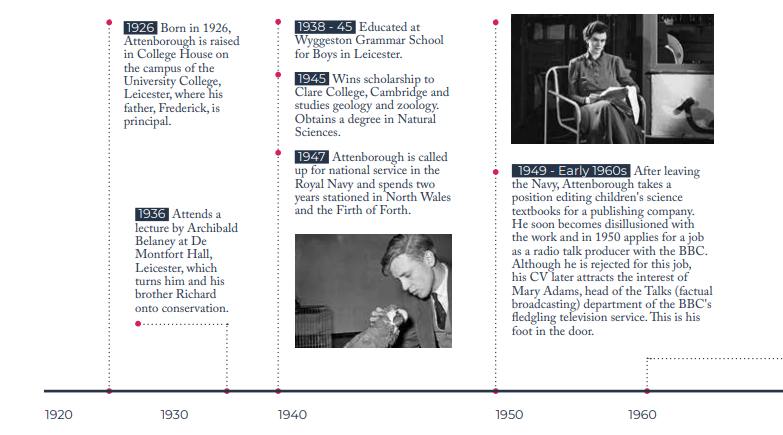
    Fascinated by wildlife as a child, he rose to become controller at BBC Two and director of programming at the BBC in the 1960s and 70s. ‘Television didn’t exist when I was a young man, and I have spent my life in a medium I couldn’t have imagined. It has been a wonderful experience,’ he says.

    The very successful glimpse the shape of the world to come, seize that possibility and enlarge it into something definite, which they then appropriate and live by. What advice does he have for the young starting out? ‘My working life has taken place in television. I don’t know how we will see that change over the coming years as a result of what’s happened. Communication has proliferated into so many forms. It is very difficult to get the single mass audience, which I had something to do with creating, thirty or forty years ago.’

    There is an element of well-deserved pride about this. Attenborough’s original commissions at BBC2 were wide-ranging. The included everything from Match of the Day to Call My Bluff and Monty Python’s Flying Circus. One can almost convince oneself that he was a BBC man first and an ecologist second. ‘The world has become very divided in a way,’ he continues. ‘We prepare for a world when we’re young that’s gone by the time we arrive in it. To that I say, ‘It depends what your life expectancy is!’

    But all along it was nature that thrilled and animated him. Attenborough is one of those high achievers who compound success with longevity. His is a voice that speaks to us out of superior experience – he has seen more of the planet than any of us. He speaks with a rare authority at the very edge of doom – his own personal decline, as well as the planet’s.

    Urgent Warnings

    He says: ‘Whatever young people choose to do with their life they must remember that they’re a part of life on this planet and we have a responsibility to those who will come after us to take care of it.’

    I ask him what we should be doing to amend our lives and again he offers a simple thought: ‘We’ve all got to look to our consciences. Inevitably, some will do more than others.’

    He sounds at such times very close to washing his hands of the human race. But then everyone in their nineties is inevitably about to do just that.

    What Attenborough has achieved seems so considerable that one wishes to ask him how he has managed it. ‘I am sometimes asked about how I manage to do so much, but I don’t particularly think of it like that. I just reply to the requests that come my way: you can accomplish a lot by just doing one thing after the other.’

    Again, the simplicity of the answer has a certain bare poetry to it: Attenborough is reminding us that life is as simple as we want to make it. Interviewing him at this stage in his life is like reading a novel by Muriel Spark: no adjectives, no frills, just the plain truth.

    In his curtness is a lesson: there is no time for him now for delay, but then nor should there be for us. We must do our bit – and not tomorrow, now.

    He is interested in Finito World and very supportive of our new endeavor: ‘This is a time when the circulations of magazines and newspapers appear to be falling. A lot of newspapers are aware of the climate emergency and the way in which we disseminate ideas has diversified.’

    A thought occurs to me that stems from my lockdown time with my son, where we have been in our gardens like never before. Should gardening take its place on the national curriculum? ‘It’s obviously very important,’ he says, although he also adds – as he does frequently during our conversation – that he knows little about the topic. (Opposite, we have looked into the matter for him.)

    Hello, Goodbye

    I will not forget this interview with a man whose voice will always be with us. Part of Attenborough’s power is that he continues to warn us in spite of ourselves. He deems us sufficiently worthwhile to continually renew his energy on our behalf.

    I mention that we watch his program with our four-year-old in preference to the usual cartoons on Netflix when possible.

    At that point, perhaps due to the mention of my young son, he sounds warm: ‘Thank you very much, sir. It does mean a lot when people say that.’

    It’s a mantra in journalism not to meet your heroes. Attenborough in extreme old age is brisk and sometimes even monosyllabic. This in itself tells you something: the world is full of the canonized but in reality saints are rare. Conversely, I have met those whose reputations were fairly low, but who turned out to be generous beyond expectation. We should never be disappointed when the world isn’t as we’d expected. It is an aspect of the richness of experience to meet continually with surprise.

    But age will come to us all. If it finds me in half as fine fettle as David Attenborough I shall be lucky indeed. Furthermore, if it finds me on a habitable planet at all that shall also something I’ll owe in part to him. ‘Good luck,’ he says as he puts the phone down. This isn’t the man I had expected to meet. But I can persuade myself that he means it.

    ‘David prefers animals to humans’. Afterwards, it occurs to me that he saw me not so much as an individual, but a representative of that foolish ape: man. While Attenborough has been acquiring hundreds of millions of viewers, what he really wanted – and urgently required – was listeners.