Christopher Jackson
Vladimir Putin’s Russia launched a special operation against Ukraine on 24th February. This episode had the appalling ramifications which we have been seeing all year: appalling casualties, displaced peoples and incalculable economic damage. But it also had another effect. It made us forget the people of Afghanistan.
Our lives are both cosy and frenetic. These two things can feel interlinked. We note the latest crisis but, too busy with our gym memberships and our latest Netflix addiction, there is the suspicion that we can’t quite enter into the distant misfortunes of others as we should. We are lucky, but luck by definition cannot really comprehend the unfortunate. And so we move swiftly onto the next thing, expressing our heartache for the Ukrainians, but suddenly without room to mind too much about what’s happening in Kabul.
It goes without saying that this isn’t how it should be. But every now and then, things snap back into place and we understand that history is about nothing if it can’t take into account the long haul.
Last year I was meeting with Lord Dennis Stevenson, the former chair of HBOS and now a cross-bencher in the House of Lords, who began telling me about a school in Afghanistan which he had been involved in. The school, he said, was called Marefat. I don’t think I caught the name at the time, and wouldn’t learn the word’s meaning until much later: Marefat roughly translates as ‘knowledge’ or ‘wisdom’. It is a kind of sacred word. This is fitting: this is a sacred story.
To the House of Lords
Stevenson outlined the story for me. The school, he said, had been the most astonishing success and, during the period of American occupation, provided a beacon for Afghan girls when it came to education. I asked about the prospects of the school now that the Americans had left.
Stevenson was surprisingly optimistic. “The coverage in the media is appallingly simplistic,” he told me. “The Taleban is deeply divided and we want to see if something can still be salvaged.”
I asked him if he would wish to talk more deeply about it. “Well, for that you need to talk to Baroness D’Souza. She’s the one who really knows about it.”
That’s why a few months later I find myself entering the miniature airport security of the House of Lords, to be greeted by Frances D’Souza, who served as Speaker of the House of Lords until August 2016.
Armed with rather good parliamentary coffee in the House of Lords canteen, we begin talking about Marefat, and how it came to be. “I’ve had a long love affair with Afghanistan,” D’Souza explains. “It’s a very extraordinary country. If you look at the topography, it’s not possible to think of it being controlled by a central government. That was demonstrated amply by the Russian occupation, when the Soviets in all their mighty power had to fight province by province and valley by valley.”
D’Souza was familiar with the country even before she visited it. She had produced a study in the early 1980s on the threat of famine in Afghanistan. Once the Twin Towers came down on September 11th 2001 – an event which, post-Covid, suddenly seems a long time ago – the country was open to visitors.
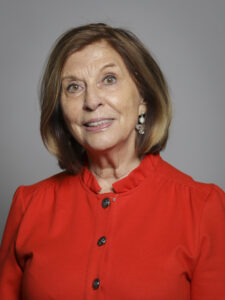
For D’Souza, it wasn’t an opportunity to pass up. Having entered the House of Lords as a Lord Temporal in 2004, she was ideally placed to do so. She recalls: “It was once again considered a safe place to be, and loads of refugees returned from Afghanistan and Iran. I was then a governor of the Westminster Foundation for Democracy, which was an All-Party Parliamentary Group looking at political funding. We went out to Afghanistan to see what we could do.”
This is how the world changes – by fortunate coincidence, yes, but also because good people also tend to be curious. If you fast forward 20 years it is possible to see thousands of girls who have been transformed by this decision.
But if Frances D’Souza had simply gone to Afghanistan, the world would not have been nudged so decisively in the direction it was. Instead, she had the good luck to encounter Aziz Royesh. By their ensuing encounter a generation of girls have found their way into that most valuable thing of all: a first-rate education.
“I was introduced to him in Kabul, in Shahr-e Naw, close to the presidential palace,” D’Souza recalls. I note now a special note in her voice – something encompassing awe, affection and deep respect. I begin to sense I am about to hear about someone I need to hear about – that we all should hear about. “He was an extraordinary man,” D’Souza continues. “About five feet tall but a force of nature. Sometimes you come across people who are born leaders. It was clear to me immediately that he was.”
So what was Royesh’s story? “He and his few friends and brothers had started some sort of school when they lived as refugees in Pakistan, which had the simple aim to teach children to read and write. But before that Aziz’d been a Mujahid during the Soviet occupation. He had arrived back into Afghanistan, essentially into a desert. It looked like Berlin after the war, and it was completely razed to the ground.”
Aziz’s situation was complicated by the fact that he is a Hazara, meaning that he is part of the Shia minority rather than the Sunni majority. In the complex world of the Middle East this created obstacles for Aziz: “The Hazara affinity is predominantly to Iran, which is a Shiite country. The Taleban war in the 1990s – a really vicious war – ran right through the Hazara area.”
A Momentous Meeting
The scene was set for what D’Souza describes as a ‘momentous day’. The pair of them talked all night: “Aziz had taken over one building, and put a tarpaulin over the top in April. It was still very cold, although the snows were beginning to melt. There were no windows and it was a tiny hut divided in two with a sheet.” So how was Aziz structuring the educational process? “He and his colleagues had two classes, and three shifts where they could take 12 students at a time. There was basically no space, no blackboard. But Aziz’s passion in life was to educate girls.”
Aziz couldn’t have met anyone more likely to appreciate his project than D’Souza. “Having come from a development background, I firmly believe that the magic bullet of development is this: if you educate girls you get development,” D’Souza explains. “He started talking to me, and though his English wasn’t that good, we talked all night – about philosophy and feminism. I was very impressed with him. He had girls who were doing weaving in his rundown flat – that was the only income refugees could earn. So he had little seven-year-old girls doing carpet-weaving. Meanwhile, middle-aged women wanted to learn geometry so they could divide up their land.”
This was education in a raw and exciting form. In its urgency and its authenticity, it wasn’t the sort of encounter you could push to one aside.
When D’Souza returned to the UK, she leapt into action. “I thought the best thing I could do was raise money for him – because I trusted him. But I also thought that a lot of money at that time would be the kiss of death so I tried to raise small amounts and see what he did with it. I wrote to 30 friends and colleagues and said: ‘Would you be prepared to give £30 a month for six months?’ People did. Dennis was the only one who came back to me and said, ‘That’s fine, but wouldn’t you like more?’. I said: ‘No’.”
So what did Royesh do with the money? “He selected one of the larger buildings in this bombed-out patch of land and he put a roof on, windows in – and, really importantly, he put a heater in. That meant that by the time autumn came round, and all the firewood had gone, it was the only place for miles around which had heating. And so everyone came. It was an opportunity for Aziz to explain to mothers and fathers what he was trying to do, educating the girls and persuade them that it was safe.”
And the notion of education being unsafe was, of course, an inheritance of the Taleban. “When girls went to school they had been whipped in the street by the Taleban. They needed quite a lot of persuading,” D’Souza says.
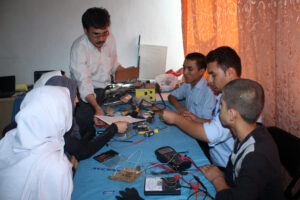
But Royesh, it turns out, was persuasive. “Over the years, it grew,” recalls D’Souza. “I started raising money. We had fundraising events, and Aziz set up a model school where teachers and students got training simultaneously. They also had vocational training. They taught mechanics and engineering and tailoring so that those who left at 14 or 15 could go and have jobs.”
In spite of this, Royesh’s interest remained academic. “Aziz had had a very impoverished background with virtually no education. He’s one of these people who reveres education so he reveres those who have education.” It is a precious insight into how valuable that commodity is. And it was this passion which drove the expansion of Marefat.
Over the years, D’Souza made repeated visits. “I went to Afghanistan with these brown paper bags. He asked me to bring English copies of Bertrand Russell’s books which I did.” Again, the detail is significant. A true passion for education is often irrationally omnivorous – we feel the doors of the world fling open and want to rush in and grab everything we can, often in no particular order.
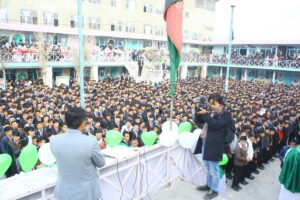
But always it was the girls who Aziz was prioritising. “His focus was on getting the girls into twelfth grade and then onto tertiary education,” says D’Souza. “As an example of what he managed, the school got up to nearly 4,000 students.” As astonishing as this achievement was, what really mattered was the quality of the education. “The Asian University for Women, a renowned university in Bangladesh, offered 15 scholarships every two years and girls applied from India, Bangladesh, Sri Lanka, Pakistan and Nepal. Our girls won 11 of them.”
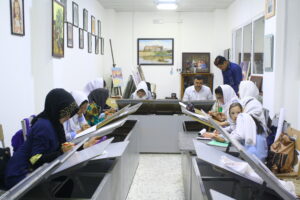
It seemed that nothing could stop their success. Marefat had become an educational phenomenon: “We went on raising, and Aziz eventually built a whole new building, and an auditorium. To this day, I remain so proud he named that after me. The school became the St Paul’s of Kabul.”
I am so swept up in the success of the story that for some reason – though I know what happened in 2021 – I am unprepared for D’Souza’s next sentence: “It was a thriving school, and then August 15th came.”
Force of Nature
Yes, August 15th – the day of the Americans’ botched withdrawal.
Aziz was in a very difficult position. He had dedicated his life to a project which had achieved success beyond his wildest imaginings, and yet he was in undeniable danger. D’Souza outlines the severity of Aziz’s predicament: “Aziz, by virtue of the fact that he’s Hazara and educates girls, was particularly vulnerable to the Taleban and had had brushes with them before. He felt he had to get out: he had a son in California. So we got him to America.”
I realise I need to meet Aziz. A few days later I’m on a Zoom call looking at a kindly man beaming back at me. He explains that it’s his habit to wake at four in the morning – a detail which conveys his separateness from Western rhythms, linking him to the desert somehow. It is a reminder too that you can leave Afghanistan in person but never depart it in spirit.
Of course, Aziz’s story is like D’Souza’s but seen in reverse perspective – it is like an education version of Kurosawa’s Rashomon, where all the participants remember something different about key events.
For instance, Royesh gives his version first meeting with D’Souza, and recalls his views on education as they were communicated to her at that time. This time around you can hear the quiet and authentic adamance which swayed Frances all those years ago: “The core of the problem in Afghanistan was this patrimonial vision that you have – of a male-dominated vision of the community. Just educating the male members of the community cannot change everything: there will be a vacuum as you’re missing the vision of half of that community – the female side.”
Aziz also makes an interesting distinction: “I never felt the need to march on the slogans of woman rights: I just wanted to go with education, because this by itself can bring all these other developments. I think it was that which really sparked Frances’ interest.”
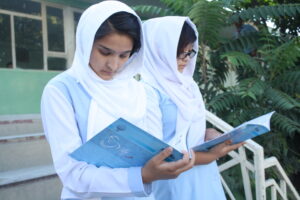
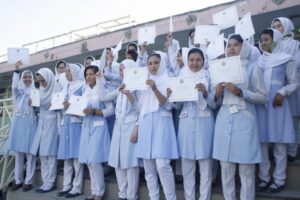
Royesh also recalls Frances D’Souza entering Marefat for the first time – meaning that I get to see her through his eyes. Even at this distance Royesh is moved by the memory of D’Souza’s first entrance into the life of the school: “One of my first impressions of Frances D’Souza is that she was the first to come in. She entered that murky corridor and in the midst of that darkness, she saw these beautiful well-dressed girls that had blue, you know, shirts and they had white scarves. And they stood to greet her and suddenly she ran out and shouted: “How beautiful they are!”
It is a moving image – these girls standing there in all their potential, suddenly confronted by the person who really will help them. Perhaps it even has a dreamlike quality.
Royesh also remembers what it was like when D’Souza’s first money came in – and again there are some telling details: “I received a call from an Afghan friend of mine. This person said that he had come from the UK and he had some gifts for me. I went downtown, and saw that there was an envelope with Frances’ beautiful handwriting. I opened that and there was £2000 which had been raised by her ‘Evening for Marefat’ fundraiser at her home. I remember all those notes, in fives, tens, twenties and hundreds. Next year, she visited again and had brought £6500. She insisted that we should go and buy a plot as she said it would give prestige to the school, and boost its credibility.”
With that money Aziz was able to afford a site in the desert. It wasn’t immediately promising as a location. But then an amazing thing happened: “We went there and started laying the foundations,” Royesh recalls. “We laid the cornerstone and began building the mud walls. This ignited a kind of interest among the community. Suddenly, people came and kept buying the plots around that and building their houses.”
I also hadn’t realised until I spoke with Aziz what heights D’Souza’s fundraising eventually obtained. In 2010 alone, D’Souza raised £253,000. Aziz recalls: “She sent that money and we used it for the building, and we established a very big auditorium that later was named after Frances. When she visited the school in 2016-17 she was known to the students as ‘Auntie d’Souza’. “At the beginning, the families, the students, and especially the girls, were in love with her.”
As it happens I have seen this auditorium in a recording of a Zoom call, which took place earlier this year. It is a large, airy space, and the children are ranged obediently in it. I see kindly teachers compering the call, while D’Souza takes notes in her study, and Aziz stands before a white wall, peering down at his creation – and also in some way at his past.
Sat here in London, it is difficult to imagine how it would look in its architectural context. But I imagine it must soar and be visible for miles around. It ought to fill the heart of every person in that area with hope. But no doubt, it also infuriates the Taleban.
Abroad Thoughts from Home
So what does the astonishing story of Marefat have to tell us about education? Royesh’s methods are, in their essence, simple. This in turn opens up onto the possibility that here in the UK, we have made the simple complicated – to our own detriment. It might be, for instance, that we have prioritised pouring money into the schools system over promoting Marefat-style effective educational methods.
Royesh tells me: “If you want transformational education, you don’t need many facilities. You just need a good way to talk to the people and to help them perceive something and customize that with their own real life. We didn’t wait for the professional faculty. We didn’t wait for the equipment – and we didn’t wait for the infrastructure. We just started.”
And if you get that right, the effects can be catching. “For around five years or six years, we were the only private school in Afghanistan mainly with civic and girls-catered education. In 2021, there were more than 163 private schools just in these three districts of Western Kabul. Education had become a norm and communities were changed. There were hundreds of cultural centres, art centres, sports clubs. People embraced the idea, they stepped forward. The children were 95 per cent illiterate in early 2002. By 2021, 95 per cent of the population had become literate. Violence, especially violence against women had eradicated in the entire Hazara community. Street harassment was not seen in the Dashti Barchi area of western Kabul. Furthermore, not a single member of the clergy talked against democracy, human rights or girls’ education. It seemed that an entire community of seven million people had been transformed.”
This was a mass grassroots movement without parallel. It should give heart to anyone who feels change happens too slowly. Sometimes perhaps we are lobbying for the wrong kind of change, and have forgotten to bring our activism back to first principles, as Aziz did.
And yet, of course, we cannot avoid the tragic aspects of the story. Aziz tells me that the events of 2021 didn’t come out of the blue. In 2009, Marefat experienced the first backlash from the fanatical clergy. Pupils from Marefat had protested publicly against legislation which had violated numerous women’s rights, and their prominence as protestors led to terrifying scenes at the school. These now seem in retrospect like precursors of the still more tragic events of 2021.
Royesh recalls: “The clergy attacked; they sent their mob supporters. We had just sat down to class and they stormed the school. They were shouting, and raising slogans against me as a person, saying that they would execute me as an infidel. They said I was preaching Christianity, or that I was preaching secularism and liberalism. They charged the school with being a centre of espionage and prostitution.”
The school sustained physical damage. “They broke the glass of the school, and they called for its destruction. They called for the execution of the administrators and the faculty and especially myself. That was really a harsh thing.”
Royesh has a way with understatement. It sounds terrifying beyond contemplation – but then we inhabit cosy lives and Aziz is hardened to the sterner realities of life under the Taleban.
But in that awful instance again, an astonishing thing happened: “We had just one gate. So the students came and they made a human chain behind it – and they closed the gate, so the mobs couldn’t enter the yard. Thousands of people gathered around the school, most of them the parents of the students who were worried about their children or those who had shown up just to watch.”
Eventually a special force from the Ministry of Interior relieved them. Royesh continues the story: “The attack was on Wednesday. The school remained closed on Thursday. On Saturday, we reopened the school, just with the hope that if 15 per cent of the students returned it would be a victory for us. But surprisingly, more than 95 per cent of the students returned back hand-in-hand with their parents. That was really a very emotional moment for us. They came, and they showed their support for the school. They were the parents of more than 3,500 students.”
If anybody doubts that education is a spiritual right which people will defend with their lives, then they need to hear this story.
2021 and all that
Sadly, even this superb victory came to have a temporary feel in 2021 when the Americans left, and things really did unravel. D’Souza takes up the story: “It was incredibly difficult for him. If you’re a Hazara and the Taleban are after you…” her voice trails off, as if unable to imagine how that must be.
She continues: “I don’t blame Aziz for going at all. There are individuals at risk and we shouldn’t discount that. The school closed. My immediate concern then was for my daughter [the journalist Christa D’Souza] to try to evacuate the girls. They got over 200 of them out, and got a deal with the Canadian government. They then got another 207 out who have been waiting in Islamabad since October, languishing in a hostel. We’ve raised enough to get them visas through the government.”
And Marefat today? “Dennis and I are interested to see what we can do to enable Marefat and its unique educational experience to continue. We think we can’t do that until we go. Once we’ve got most of our girls out, our priority should be to get the school going again.”
And Aziz? He is currently writing his History of Marefat, and is vague about future plans. D’Souza has her suspicions: “It’s clear to me that Aziz has very high political ambitions, and wants to be the leader of the Hazaras – and maybe of the Afghan people as a previous Hazara man was in times past. He was also extremely close to Ashraf Ghani during the presidential elections, and even wrote Ghani’s manifesto. Ghani, though is a very curious fellow, and once he won the presidency, completely ditched Aziz, he treated him very badly.”
A Royesh presidency? Every presidency is a long shot before it happens – but just to imagine it is to realise that hope remains.
But what about the girls? Here D’Souza is understandably emotional: “The brightest and the best have left the country, which is a huge responsibility which we all feel. The only thing which is a mitigating factor is that it’s quite common with Afghans to return to their country, so I think a lot of them will. One thing one shouldn’t underestimate is that for 20 years we had this flawed but democratic process: a huge number of people became accustomed to it. They’re unlikely to give that up in a hurry.”
If you want a measure of what was achieved at Marefat then you have to hear the girls themselves. Their security is paramount and so we will not be revealing any names or locations. But here are some voices, translated from the Persian by Aziz, of girls talking on a recent Zoom call. This is the authentic sound of education, but also of liberation.
One girl says: “We study. We continue our education. Because we know that interrupting the course of education means our death and I am not ready to die now.”
An optimist might say that a girl who has learned to talk like that can never die: it is the voice of irreversible enlightenment. Here is another: “We understand the Taliban. Most of them have not lived in the city and they are not familiar with the characteristics of urban life. I hope they understand us too. We will continue our education and I am sure that we will eventually introduce the Taliban with the urban life and culture too.”
There is a note of defiance here which is utterly at odds with what we think we know about Afghan women – bowed down by the patriarchy, and almost without agency. It makes us realise that Royesh, D’Souza and Stevenson have created a new kind of educated woman.
A third girl adds: “We call our resistance a ‘constructive resilience’. We not only resist, but also think about the constructive aspect of our resistance. We think that in ten years or twenty years from now, we will make our culture better and more humane, and our politics better and more democratic. This is the purpose of our education.”
This is in fact always the purpose of education – and sometimes it takes someone who knows education’s value to tell you that. That will almost always be someone who until recently was deprived of it.
This, then, is the story of Marefat. There isn’t another story like it, and it’s one we at Finito World will continue to follow. It tells us that education is sacred, and reminds us that it changes lives.