Christopher Jackson
One sometimes hears someone called a ‘black sheep’ of a family as a pejorative term. It needn’t be like that. Most people who look inward in any concerted way find some surprising differences between their own hopes and dreams and their outward circumstances. Knowledge of this difference can open surprising inner capacities and point the way to a fruitful life. In the best cases, it is possible to strike out in a different direction from one’s family, and to feel no sense of alienation whatsoever – but instead to feel a sense of loving journey, which ultimately all members of the family will accept and profit from in understanding.
Something like this appears to be happening to Finito candidate Leah Houston. I ask her about her upbringing: “I’m from very humble beginnings,” she tells me, her accent distinctively Northern Irish. “Education was never pushed for me. It wasn’t the world I was in. I’m the first in my close family to be interested in my studies, and then to want to pursue them, and then to go onto university at the Belfast Bible College in Dunmurry, Belfast.”
Despite this, Houston is aware of many similarities between herself and her family. “On the other hand, working hard was pushed on me – it was a question of financial necessity. I’ve had a part time job since I was 14. After school you went to work: food had to be placed on the table somehow. In hindsight, I wouldn’t have changed a thing at all.”
So what did her parents do for a living? “My Dad is typical Northern Irish. He is a part-time farmer and he sells animal feed from a local agricultural shop. My mum worked in office work all her life – then she had me. She felt that to stay at home was her calling, but then she started looking after other peoples’ kids and soon she had her own childminding business.” This seems to amount to a strong entrepreneurial streak in the family. Houston agrees: “You have your hands and you can do something about it – so go work,” she says, simply.
This innate understanding of business was already becoming apparent in Houston’s choices. “Business makes sense to me,” she explains, “seeing something through from 0 to 100. You’ve got to see what you’re good at and make something of it. I studied Business through to A-Level and initially thought I would study that subject at university as well. But I had a bit of a change of heart.”
This brings in another side of Leah – her religious belief. “I grew up in a strong Christian household,” she recalls. “It wasn’t pushy but it was fostered. So I studied religion and law at university which was a major change.” Throughout our conversation she will talk about her faith in the relaxed, confident way which people do when their beliefs are deeply embedded.
I am interested to know how this degree was structured. She explains: “The main aspect of it was theology, but with world studies, policy and law examined. It was all to do with how one’s faith works out in the public sphere. I was focused predominantly on Christianity but I also did world religion modules.”
This decision garnered a mixed reaction at home. “My extended family – my cousins and so on – weren’t sure. Firstly, because I’m a woman – that didn’t go down well, and led to some opposition. Some also thought I would lose my own faith, and question what I believe.” And has she? “I haven’t. Growing up in a Christian country, Christianity can be ugly because it’s political. There have been civil wars in the name of Christianity in my country. I came out the other end with a wider appreciation of all religions and the part they can play.”
Houston loved her degree, but like most humanities degree, the gain of doing something one loves had a flipside: such courses don’t lead to such clear destinations as vocational courses. “I didn’t want to go into the Church, so in hindsight it was a much harder option. For the first few years I thought it was all amazing, but I’m not philosophical – I’m much more practical. My interest is in thinking how faith values can be implemented. During the three years of my degree, I did some time with a charity at home called the Evangelical Alliance. That organisation tries to bridge the gap between Church and politics. In hindsight, my time there planted the seed for politics and the public sphere.”
This seed came to fruition when Houston began working for Baroness Anne Jenkin in the Houses of Parliament. “When I finished university, I thought: ‘What the heck am I going to do next?’ I came across Christian Action Research Education (CARE) a charity which seeks to facilitate getting a job as a Christian in politics in addition to offering training in thinking about politics. Anne Jenkin is extremely kind and said she’d take me for a year.”
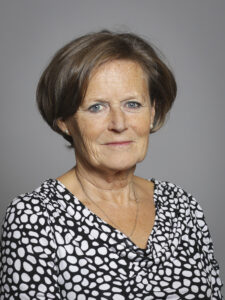
And what were her impressions of the role? “Anne is so hard-working – no two days are the same for Anne,” Houston recalls, laughing perhaps at the remembered bustle of it all. “I was involved in diary management, speeches and organising meetings she would host. It was general ad hoc stuff and I was an extra pair of hands.” Leah brought a very clear sense of purpose to the role. “I was there to serve Anne – to allow her to do her job better. That could be sending letters, or photocopying, or making a cup of tea. I also became immersed in the question of gender ideology, which is one of the key issues for Anne.”
And what was the culture like in Parliament? “As a practising Christian myself, I was interested to discover the APPG, Christians in Parliament, that is a cross-party group of Christians. As long as you were a passholder you could be a part of that: MPs, kitchen staffers, it didn’t matter. It brought a sense of community, with weekly services held in the Chapel of St Mary Undercroft. Politics is so polarised and tends to be all or nothing. It is meaningful to have something that unites: at election time we prayed for whoever was in leadership.”
Through Baroness Jenkin, Leah met Finito Education CEO Ronel who saw Leah’s potential. “Ronel is a great supporter of Anne and he took me under his wing. I was with Finito for half a year and the investment in me was incredible.”
This is good to hear and I ask her what the impact has been. “Besides all the practical things such as the LinkedIn training, the CV writing and the mentoring, I especially value the confidence that the Finito service gives to someone in my circumstances. It was as if I was being seen for the first time. This was so encouraging for me especially given my upbringing, where my wanting to succeed was perhaps sometimes considered a bit weird. My extended family would wonder why I was in London, and why I’m in the job I’m in. This was an organisation which wanted me to succeed.”
This process of building confidence in an individual is integral to the mentoring process. It begins from our first encounter with a new student. Houston recalls: “I remember vividly the first meeting with Ronel where I brought him my CV. When I had been in parliament I had co-founded a network for the protection of gender-critical views. I showed my leaflet to Ronel and it was an incredibly important moment, because someone was looking at my work, and taking an interest in me. It brought me an overwhelming sense of pride.”
Mentoring is to do with becoming reoriented in one’s life by coming into one’s essential self. Houston recalls that her being photographed by in-house photographer Sam Pearce continued this process. “I spent an afternoon with Sam and I noticed that she took the time to make me feel comfortable. She also took time to ask questions between pictures – it was not a transactional photoshoot, it was more an investment in who I was.”
Following on from there, Leah had her LinkedIn training with Amanda Brown (‘incredibly helpful’) and then began work with her lead mentor Tom Pauk. “He was so lovely and I was telling my heart and how I feel things deeply. He said: ‘I think you need to go into the charities sphere’. I said: ‘ I think you’re correct.’ And now I’ve landed a job with a charity which is a start-up. Tom was amazing, and gave me contacts.’
From Pauk’s perspective, Houston made an excellent impression. He recalls: “Leah struck me as a highly intelligent, articulate and values-driven young woman, seeking a position where she can employ her myriad skills to improve the lives of others, especially those of women and children.” Pauk noted early on that her priority was ‘to use her lobbying skills to help bring about changes and social impact,” adding that “she is not driven by earning a high salary, though she’ll need a sustainable one.”
When the job came along it all happened very quickly ‘in the space of a week’. Houston brings me up to speed: “I now work for a charity called Forum which is based in London and has launched in America too now. Its purpose is to serve leaders and influencers from all sectors of society. It tries to link up like-minded people. I’m a data manager and administrator, which is important for Forum, as someone’s name in the database is like gold to the business. I’m also EA to the founder David Stroud, who is married to Baroness Stroud.”
So how does she see the future? “I actually don’t know,” she admits. “My life these past few years has been full of uncertainty, but I can see myself settling here for a good while. It’s a start-up with huge potential for growth and now the whole past five years makes sense.”
At the end of our interview Houston reflects a little on her journey so far. “It’s strange to be in London and not be money-driven. Wealth to me isn’t money. It’s what I had growing up: I had family and friendship and relationships and that to me is wealth. Marriage and education is wealth.” And are her family beginning to understand the nature of her journey now? “My parents have been massively supportive, but we don’t always speak a common language. My cousins have their own convictions and they don’t necessarily agree. But the relationships are there and really there’s so much love and support.”
One is tempted to call this attitude mature except that many people live their whole lives without realising the importance of things which Leah innately understands. She also has an immense capacity for empathy and understanding. Houston is someone whose narrative is not to be judged by the usual metrics of success: money, or position or anything else – though there’s nothing to stop her acquiring these. But she is in such a strong position because she isn’t a materialist. She is someone who will make her own way – and in fact is already doing so.
The help which Finito gave to Leah would have been impossible without the generous help of the Stewarts Foundation. The firm’s managing partner Stuart Dench says: “In a perfect world comprehensive career guidance would be available to all regardless of their background. The Stewarts Foundation is delighted to support the important work of Finito via its bursary scheme.”
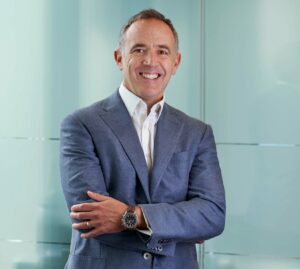
When it comes to someone like Leah, the importance is difficult to measure because it has to do with ineffable things like confidence, connectivity, and the unleashing of possibilities within a person who may not yet know how capable they are. In her case, it is also to do with helping someone to arrive at the realisation that the place they’re born in need not be a limiting factor. Ultimately it’s for us to make our own way – though it is right that we do so with the help of others.