Tag: art careers

  • Interview: Roger Federer’s favourite artist Nadeem Chughtai: “I’m blown away by the positive reaction.”

    Christopher Jackson


    There used to be a dead tree in Ruskin Park in South-East London, which always struck me as somehow sculptural. The other day I saw that it had fallen. I had grown so fond of this particular tree, it’s optimistic reach towards the skies, that I was bereft when I saw it had collapsed.


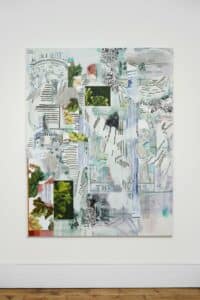
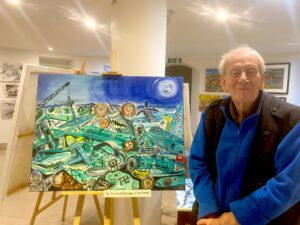
    But this probably minor development in the history of my local parklands makes me all the more delighted that this same tree is still standing in the work of a remarkable artist Nadeem Chughtai. Chughtai’s recent exhibition A Liminal State has people talking in Peckham, which as everybody knows is also the artistic centre of the universe. Chughtai used the tree as a basis for his picture There’s This Place On The Edge of Town (2020).
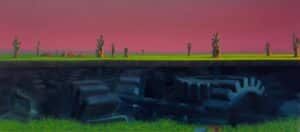
     

    There’s This Place on the Edge of Town


    One of the most basic requirements of an artist is power: Chughtai’s images always have an immediacy which nevertheless lets you know that your first impression is only the first part of your journey with that work of art. In this picture we see how we have become mechanised in ourselves, and how this can only lead to stunted growth. But the beauty of the tree, which looks like it almost wants to be an upwards staircase, suggests potential.


    It’s a brilliant conception, like all Chughtai’s pictures. So was it always art for him, or did he toy with other careers? “It really was art all the way for me,” Chughtai tells me. “Ever since I was very young I’d draw. Encouraged by my mum and influenced by a beautiful framed pencil drawing my dad made of my mum in the 1960’s. However, I did loads of jobs before going full time with an art publishing contract which set me on my way. Before that I always kept myself in the minimum wage positions for fear of committing myself further down other career paths.”


    Chughtai has had some major successes, with some celebrity clients including Roger Federer who chanced upon his work in Wimbledon village one year. Chughtai is particularly well-known for Nowhere Man, his character which he gave up at the start of the pandemic. These pictures, taken together, amount to a vast dystopian opus which tell the viewer unequivocally what we all sense: we are not headed in the right direction as a species.


    We never see Nowhere Man’s face. Sometimes there’s more than one of him. It is also possible to say that Nowhere Man is always in a negative setting, beset by the circumstances of modern life: alarming architecture, the trippiness of drug culture, the terrifying ramifications of contemporary uniformity.

     

    I Dream of a World That the Capitalist Philosophy Will Never Make Possible. Oil on three canvases (2017)

    I also note that they’re always dramatic force in these pictures, and I related this to the career Chughtai had on film sets, with his work including the Bourne series and Love Actually. Did that experience impact the way he paints now? “Yes, I always mention my scenic art days. I call it my apprenticeship. It was absolutely magical to be working on those film sets at Pinewood and Shepperton Studios,” Chughtai recalls. “I originally went there to try and make films after losing my way with drawing and painting after college, but as soon as I saw the huge painted scenery backdrops surrounding the sets I was sucked back in.

    I had hands on experience of painting pictures on giant canvases, off scissor lifts using strings, hooks and chalk to draw our lines. I learnt about so many aspects of painting as well as the cameras eye. The big one was perspective. Learning about that was enlightening for me.”


    I ask Chughtai if he has had any artistic mentors, and his answer also dates to this time: “Well, I always mention Steve Mitchell,  the scenic artist who I assisted over a five year period from 1999- 2004. He’s still doing it at 70 and we’re still in touch. He’s one of the world’s top scenics. I can’t tell you what I learnt over those scenic years and how it got me back into the art of painting.”

    I can tell how passionate Chughtai is about his calling, but the melancholy of these pictures is always there. It seems to cry out for some kind of remedy. Is Chughtai pessimistic about the human race and its future? “I believe we are not only on the path to a dystopian future but within it now. Just look at all the horrific and unnecessary human suffering going on all over the world and right down to our own neighbourhoods. However, I remain an eternal optimist and have every faith that the human race will unite to overcome this and bring about the necessary change required.”


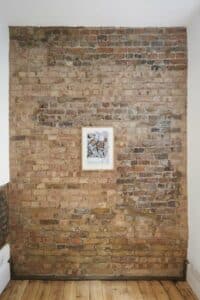
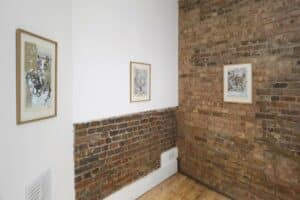
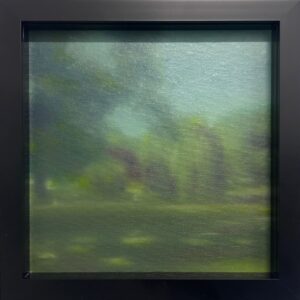
    The new pictures, with their liminal greens, seem to be the start of some new potential. Here we see Green Park as it might be seen in a dream, or in the hypnagogic state between sleep and waking. The journey to the centre of town to make these pictures is perhaps indicative of an interior shift in Chughtai. The new pictures also mark a big change away from character towards some other kind of painting which feels like it is yearning for mysticism – maybe even a metanoia away from despair.


    Was it hard to give up Nowhere Man? Might he ever experiment with another character? “It was very hard to shed the Nowhere Man. I doubt there would ever be another character. For me it represented humanity. If I ever need a central character again I’m pretty sure I’d call him up.”


    Humanity then is for Chughtai somehow passive and faceless – asleep perhaps. This makes the notion of an exploration of the liminal all the more important; it is to do with exploring what Seamus Heaney called ‘the limen world’, that curious borderland of the unconscious. I have a sense that these recent works are a necessary transition period and that it may in time lead to some sort of reconciliation between Chughtai and the damage of the world – a more optimistic vision perhaps.

    How did these new paintings come about? “The works exhibited recently at the Liminal State exhibition are exactly that; Liminal, as in kind of between or on the threshold. For me personally, up until just before lockdown in 2020 I was creating paintings with a central anonymous figure – the Nowhere Man. 16 years through the eyes of this character, so, shedding that to allow the next body of work to arrive has taken these last four years, and counting… The title, A Liminal State can also have numerous interpretations and could additionally refer to many other aspects; mentally,, physically, technically, artistically, societally… liminal.”


    These then are between states, and that means flux – in Chughtai’s art certainly, and therefore, since artists are their art, in his life. I ask Chughtai about his method of composition. Is it evolving? “It’s evolving and continuing its journey. I’ve changed the approach, technique, materials used and so much more since 2020. In fact, almost everything – but still the work has naturally evolved through different states to where it is now.

    It’s a continual fluid journey. I have also been developing an artistic theory and putting that into practice. It involves perspective and the way the eyes see and the brain interprets an image. It’s great testing a science based theory on my artistic practice… and it actually works. My most recent painting entitled, Turn Left. (2024) shows the theory in practice in its most developed stage to date, and I was blown away by the positive reaction it got when exhibited for the first time at the show.
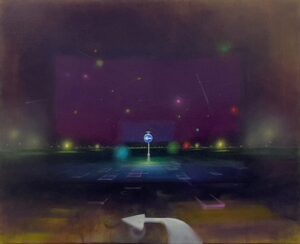
     

    Turn Left, 2024


    This again, seems to me like a dream where the dreamer is sometimes given clear but mysterious indications of what to do – strange snatches of disembodied advice. To look at these pictures after immersing oneself in the Nowhere Man corpus is to see a kind of hope peeping through, because the world seems to be acquiring a kind of charge, groping towards some form of meaning. My sense is that this makes the next few years of decisive importance for Chughtai’s art. If we follow that sign, where does it lead?

    This new work has also sent Chughtai on a rewarding course of study. “Over the last four years I have really delved deep into studying and expanding my artistic learning. Visiting the London galleries on a weekly basis and getting to understand the philosophies of some of the great painters, while also educating myself about the amazing artists from around the world and their histories.”


    So who are his heroes? “I have to mention Van Gogh, I just love. His pencil drawings, they make me wanna scream. I would say that more recently I have been appreciating 20th century Western heavyweights such as Bacon, Klee, and Rothko who’s section 3 of the Seagram murals brought me to tears on more than one occasion. It was during a particularly emotional time for me personally whilst simultaneously looking to move my work along an different path. That painting allowed me to see within it what I wanted to do with my own work.”


    Chughtai has been going strong for a long time. So what are his tips for young artists about the business side? “Well, yes, it is a business – if you do it full time for your living. So if you don’t have the luxury of financial security, you will need to sell your work.

    This predicament will most likely influence the type of work you produce and therefore could involve compromise. That’s the tightrope. It can work in your favour but can also be a hindrance if not deterrent, which is a real shame because then we miss out on hearing and experiencing the voices from within those walks of life. So, believe in what you’re doing, put the time in and keep on making your art.”
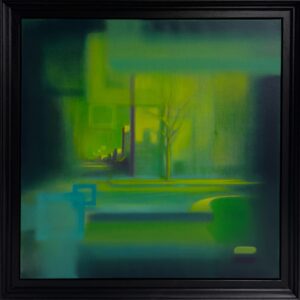
     

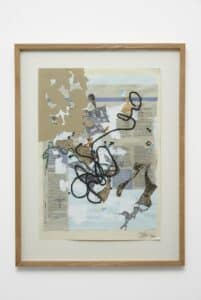
    Maxted Morning, 2024


    And would Chughtai recommend the art fair route? “I love going to art fairs. It’s where it all started for me. Like our society, the art world is very hierarchical, but whether you’re at the bottom rung or at the very top, when all is said and done they’re markets with their stalls out. It’s great because people can stand in front of the work in the flesh, which is how I feel art works are best experienced… and there is so much under one roof. Art fairs are a great way to spend an afternoon… if you can afford the entrance fee, of course.”


    That’s often the problem for young artists at all. Has the conversation around NFTs affected him at all? “I did look into NFT’s a little some years ago but it seems to have gone quiet on that front so am unaware of where it currently stands. The whole digital thing is obviously a direction the art world is going down and there are many possibilities to explore. However, my focus and studies are with oil paint and a canvas because there’s so much more to come from there and that will always be ahead of any artificial intelligence.”


    Chughtai is an artist of rare talent, who is doing something very valuable: he is pursuing his vision where it leads. It takes courage to do that. Every artist can learn from somebody who has chosen his path so decisively then pursued his craft with such passion.


    For more information go to nadeemart.com 
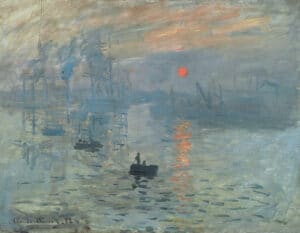
  • Friday art essay: Impressionism at 150

    Christopher Jackson


    If you go to the National Gallery in London and visit, say, Room 32, where Mannerism is represented, there’s a good chance you’ll have it more or less to yourself. The same will likely be true if you walk past all those Renis and Guercinos and into Room 33, where Chardin’s Card-Players typically hangs. Things will likely get a little more crowded as you swing by the great British landscape painters in Room 34 – JMW Turner and John Constable.

    But something will happen as you enter Room 35: that’s because you’ve entered a room full of Impressionism. Come rain or shine, this will be the busiest part of the gallery. You probably won’t have Cézanne’s views of Mont Sainte-Victoire or any of the many Monets to yourself for very long, and you won’t have Vincent Van Gogh’s Sunflowers to yourself at all. Something has happened: you have crossed over.

    Why is Impressionism, which loosely speaking turns 150 this year, such a big deal? None of the painters, with the possible exception of Vincent, had a natural talent to equal Rembrandt. I don’t think any of them create awe in the viewer as Turner does. If you want the oddities of daily life, you’ve got other Dutch painters like Hendrick Avercamp and Johannes Vermeer. For spiritual power, nothing beats Piero Della Francesca. But if the numbers tell the truth, something about these pictures makes us need them more than all of them put together.

    One possible explanation is that they’re closer to us in time. The Impressionist movement was a response to the great essay ‘The Painter of Modern Life’ written by Charles Baudelaire in 1860, and which created a huge impact at a time when reading was the primary mode of entertainment. In this, the poet pleaded with artists to show the distinctive beauty of the modern world. The paintings in the Louvre, he says:


    …represent the past; it is to the painting of modern manners that I wish to address myself today. The past is interesting not only for the beauty extracted from it by those artists for whom it was their present, but also, being past, for its historical value. It is the same with the present. The pleasure we derive from the representation of the present is due not merely to the beauty with which it can be invested but also to its essential quality of being present.


    It is this ‘essential quality of being present’ which I think makes the crowds in the National Gallery flock in such numbers to these pictures.

    Admittedly the modern world meant something rather different in 1874 to what it means today, but still there is a sense in which these essentially secular images of pleasure and leisure chime. Though they might be low on depicting things like computer modems or airports, nevertheless they feel psychologically similar in some way to our own lives: they somehow have a legacy in us. It was the critic Louis Leroy who said after the first Impressionist exhibition in a somewhat derogatory way that the artists in the exhibition seemed intent on creating an ‘impression’ – by which he really meant a sketch:


    Impression I was certain of it. I was just telling myself that, since I was impressed, there had to be some impression in it — and what freedom, what ease of workmanship! A preliminary drawing for a wallpaper pattern is more finished than this seascape.


    This is the authentic note of the misfiring critic, who doesn’t even know that they have missed the main point, and so must satirise in a self-admiring vacuum. What Leroy failed to understand was that the world was now in a state of permanent psychological revolution, and that it would from now on move inexorably in the direction of hurry. We still live like this – dimly aware, even as we dash to the next meeting, that we have not enough time.

    The eye too is in a hurry, never still, blinking continually, and alert to the latest shift. It too makes impressions. It was the Australian critic Clive James who towards the end of his life recalled his early time in Florence and the sight of the Bardi spire rising up over the medieval streets: “Glimpses are all you ever get,” he wrote. Leroy misunderstood that when it came to Impressionism, glimpses were being elevated to the realm of permanent art.

    In doing all this, as Leroy also missed, a new attitude towards light was established and I think this is what really makes these pictures so exciting, and which gives them their addictive charge. Of course, all paintings have something to do with light: whenever you’re painting anything at all, you’re painting that – otherwise you wouldn’t be in the privileged position of being able to see.

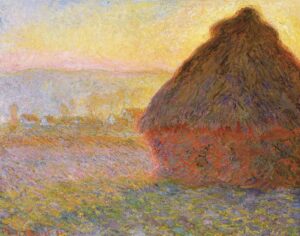
    But Impressionism – and this is especially true of Claude Monet (1840-1926) – seems to mark a new kind of interest in light. Monet looks on water in a way different to the way in which, say, Leonardo da Vinci gave it his intention: in his Water Lilies, he wants to break it down, and consider what constitutes reflection and what amounts to water – and crucially, what that elusive entity light has to do with that relationship.

    It is often said that Impressionism was the natural offshoot of photography. And so it was. But people rarely say how that relationship worked: the invention of the camera made people realise that the act of seeing was a more complicated business than had been supposed. The photographic image felt too clinical. Really, it was a kind of abstraction and this sent artists back to themselves.

    If this amounted to a sort of crisis, it was a very exciting one. The sense of juxtaposition between a photograph’s verdict and the human eye’s experience meant that artists were suddenly compelled to consider the constituents of the world. They were helped in this by the way in which science had developed, especially with John Dalton’s discovery of the electron, and its secret and peculiar mystical vibrations.

    But we tend to view Impressionism through a particular lens: we know that it would lead in time to the further fragmentation of Cubism and Abstraction. This in turn reminds us that Impressionism could easily have been a boring philosophical development – as did in fact happen to its successors. We do not flock to the work of Georges Braque – in fact, if it comes to that, I don’t think we really flock to Picasso. It’s all too intellectual and young artists should note how it is no coincidence that in avoiding this, the Impressionists have endured in a way the others haven’t.

    But critics of the time did notice, with considerable prescience, the philosophical radicalism of Impressionism, if they usually failed to note the extent to which this was an underpinning and never intended to distract from the pleasure given to the viewer. The critic Theodore Duret wrote of Monet that he was “no longer painting merely the immobile and permanent aspect of a landscape but its fleeting appearances which the accidents of atmosphere present”.

    This might have been true but it was a merely incidental truth. A sheer love of looking is what makes Impressionism so popular: it is full of an infectious enthusiasm for the visible world. The Impressionists knew that what they saw, faithfully interacted with, was enough. As Monet put it, with his legendary cantankerousness: “Everyone discusses my art and pretends to understand, as if it were necessary to understand, when it is simply necessary to love.”


    Given all this, what contemporaries noted was that new aspects of life had been incorporated as subject matter by this new movement. Most of the references to classical mythology which had characterised the Impressionists’ great predecessor Jean-Auguste-Dominique Ingres (1780-1867) were gone (though they recur occasionally in canvases like Manet’s ‘Olympia’), so were the grand battles and historical scenes preferred by Eugène Delacroix (1798-1863).

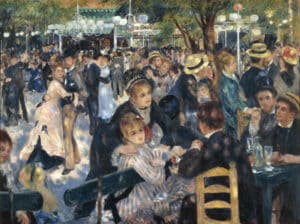
    Instead, the Impressionists depicted life’s intimate unfolding: in time they would give us the look of a haystack (Monet), an afternoon lazing by the Seine (Seurat), women bathing (Dégas), ballet-dancers practising their moves (Dégas again), a pair of boots (Vincent), and of course, a vase of sunflowers (Vincent). The gaze had been shifted temporarily away from the reconstruction of events theological and historical. Viewed in that way, and given what happened next, Impressionism is so valuable as a period in art history as it is a brief interregnum of actually looking at the world, rather than thinking about it in paint. This journey towards intellectual painting is already at its starting point in Cézanne’s cerebral canvases.

    We tend to encounter Impressionism in grand art galleries with the best gilt picture frames round the pictures, and so we forget that these painters had a certain humility about their relationship to nature – though Monet certainly cannot have been called humble towards other people. In the way in which they faithfully set down what they saw, they were everymen – though in many cases everymen who happened to be geniuses. The artist beginning today could do a lot worse than look not towards the next fad but to what really lies outside their window for the inspiration that really counts.

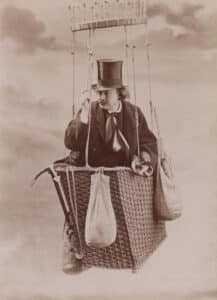
    The other thing we miss – and again it’s because reputation can sometimes intervene between us and what a painter’s real intentions are – is the wonderful oddity of some of the people knocking around Paris in the 1860s and 70s. For instance, the first Impressionists exhibition took place in the studio of a magnificent photographer called Nadar, who deserves an article in his own right.

    He was not just a magnificent and original photographer but also an early enthusiast for ballooning; I think he was probably a fairly peculiar character in the best sense. But all the Impressionists had their unusualness from Monet’s ill temper to Renoir’s flightiness and indecision – not to mention Van Gogh’s occasional tendency, attributable today to bipolar disorder, to hug random people in the street.


    We think of success as somehow preordained once it has happened, but it rarely looks like that at the time: actually it looks improbable for the reason that it’s usually unlikely to happen. Next time you see someone tinkering away at a picture or an invention with a look of concentration on their face, you may not be looking at someone slightly bonkers, but at a historical figure.

    When it comes to Impressionism, the plight of women is another interesting one. The National Gallery of Ireland is this summer celebrating the 150th anniversary of the first Impressionist exhibition with Women Impressionists, a show which lasers in on four women artists integral to Impressionism – Berthe Morisot (1841-1895), Eva Gonzalès (1849-1883), Marie Bracquemond (1860-1914), and Mary Cassatt (1844-1926). All but Eva Gonzalès exhibited at Impressionist exhibitions, of which there were eight over the following 12 years.

    It’s worth going to Dublin for – here are the women who broke free from being painted to doing the actual art. Morisot is easily the best known today – and in fact that was also the case in 1874, in that she was the only female artist to be featured in that first show at Nadar’s studio.

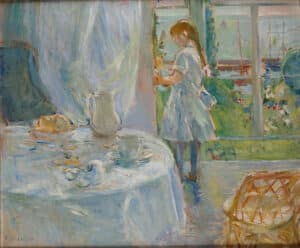
    Throughout the Dublin exhibition we find images of maternal intimacy and gentleness. In Morisot’s work we are shown domesticity as it hasn’t been shown since Vermeer. But while Vermeer’s paintings sometimes point a lesson, or suggest an allegory, these are completely shorn of any morality: here we see, as in Cottage Interior, the quiet of the typical household shorn of explanation. This is just a girl in a beautifully lit interior, with a garden outside, some food on the table: life is like this, it seems to give such few directives. We live amid quiet mystery and many of Morisot’s paintings testify to this.

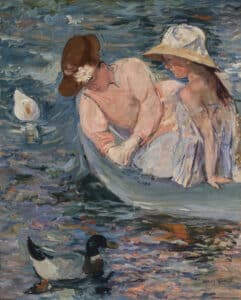
    This sense of a welcoming simplicity repeats in the other female impressionists in the show. In Mary Cassatt’s drawings we can see that the love of Japanese prints wasn’t confined to Vincent Van Gogh – it was as much a fad of that time as primitivism would be at the start of the 20th century. My favourite picture of hers is Summertime where the water seems thicker, gloopier even, than it does in a Monet where we can hardly tell what is water and what is light. And yet on certain summer days, when it’s really hot, we find ourselves more conscious of the shade and the shadows, since we seek them out.

    Summertime, 1894. Oil on canvas, 39 5/8 x 32 in. Daniel J. Terra Collection, 1988.25.


    The Dublin exhibition confirms that Impressionism is still very much alive: it’s not really an aspect of art history at all, but part of our living reality. Today we find young artists falling over themselves to create gimmicks, and sustain an Instagram-driven brand: perhaps there are ways to build a brief career in that line, but it is impossible to create true art without reference to what is before our eyes in the universe itself. Impressionism is so valuable because it provides us with this encouragement. It sometimes seems behind us; really, it’s the way forward.


  • An interview with incredible artist Diana Taylor: “Young artists shouldn’t get caught up in trends”


    Diana Taylor graduated with an M.F.A Painting from the Slade School of Fine Art in 2010. She studied B.A (Hons) Fine Art at Bath Spa University College and graduated in 1999. In 2011 she was awarded the Abbey Scholarship in Painting at the British School at Rome. Residencies in 2011 and 2012 include Centre of Contemporary Arts, Andratx, Mallorca and East London Printmakers. A sense of journey, both physically and through memory, and the relation this has with mass-produced images, which travel our own consciousness, are central to her practice. We caught up with her at her new exhibition ‘Borrowed Time’. at Bobinska Brownlee New River


    I really love the new stuff. How did these paintings come about?


    The new paintings began with Gustav Dore’s illustrations of Dante’s Divine Comedy. The illustrations were made in the 19th century as woodblock prints and the Divine Comedy was written in the 14th century. The book I chose the images from was published in the 1970s and my manipulations from analogue to digital were made this year so there’s oscillation between temporalities within my work. I selected small areas of several illustrations and manipulated them within Photoshop by cropping, enlarging and lowering the resolution.

    I also turned the document into bit map format to screen-print them. I always enlarge the images in screen-printing too so the image is reduced in quality even further. So, what was a woodblock print has gone through a digital process into a mechanical method of screen-printing and that’s how the paintings usually begin. There are varying levels of detail and zooming in for those images.


    So there’s a digital element and then you set to work as a painter?


    I then began painting imagery from my various illustrated books of plants and botanical illustrations some of which were important to Morris’s archive- a 16th-century Gerard’s Herbal. From my PhD research on William Morris I’ve become increasingly interested in the botanical illustrations that he was using, but I also have a real love for early print and that’s why I refer to it often within my work. My love of gardening and my interest in plants as therapeutic and medicinal has steered these new works.

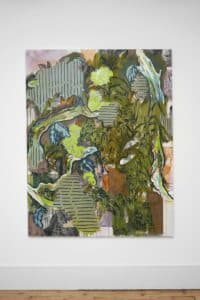
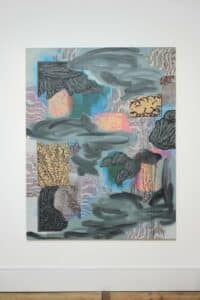
    However, there’s also a more serious concern with climate change, and the idea of plants growing and becoming threatened, or in decline, started mirroring my painting process which is one of building up and breaking down the image. These new paintings in my solo show at Bobinska Brownlee gallery, ‘Borrowed Time’, therefore, are about the things that I am thinking about, looking at and doing in my everyday life- which is what my paintings are generally about anyway. The title refers to concerns in a climate crisis and also to my method of appropriation- borrowing images which already exist, to create new works.


    Has your method of composition been relatively fixed and stable over your career, or is that evolving?


    My method of composition tends to change however over the past 10 years I’d say I’ve been very much focused on using a portrait format and working on a similar size and often it’s because I want to have some kind of composition which involves cascading, a kind of cascade down the painting and alludes to the idea something falling and things falling apart. The composition is not fixed. However, I always use fragments within my work and I’m interested in the composition as appearing unfinished.

    There’s something about the tension between something that’s finished and unfinished, that interests me, so the work oscillates between many dichotomies such as fast and slow painting, graphic and gesture, old and new references, art and craft et cetera yet these binaries are always symbiotic which is why I’ve converged them because they need to be together.


    Was it always art for you? Did you ever consider some other path in life?


    Yes, it was always painting for me. My granny was a painter and I always loved drawing and painting there was never any question that I wanted to do something else, although at one stage I wanted to be an air hostess just because I love travelling so much. But I realised I could travel and do my painting and I could be an artist, and make money from selling my work and teaching, which is something I also enjoy.


    Did you have any mentor in art?


    I had several brilliant art teachers throughout my education who have inspired me and taught me so much.  I think that’s why I love teaching so much because I want to be able to give back what I also experienced in my educational journey.


    Who are your heroes in art history who have helped you on your journey?


    I think my heroes in art history include Bernini whose work blew me away in Rome. But, in modern history, I love Sigma Polke, Robert Rauschenberg, Lee Krasner, Eduardo Paolozzi, and many others. Contemporary painters I love are Amy Sillman, (I love her writing too), as well as Michael Williams, Charlene Von Heyl, Christopher Wool amongst a load of others.


    What are your tips for young artists about the business side?


    I’d say for young artists it’s just important to stay focused on being true to yourself and not getting caught up in any trends. You kind of have to be thick-skinned and resilient as an artist and to stay resolute. I find a strong daily meditation practice has helped me to stay resilient and grounded as it can be so difficult to persevere when it seems at times like not much is happening in your career.


    Galleries seem to take large percentages from artists – is that something you think will change over time?


    I don’t think the 50% commission is likely to change although I’ve no idea really on this aspect of the art world- as long as the Gallery can continue to put on ambitious exhibitions and bring their collectors to the shows then it’s a really good way for an artist to get exposure.


    What’s your experience of art fairs?

    As a visitor to art fairs, I find them quite overwhelming as there’s so much work to see but I do visit some of the bigger fairs such as Frieze so they’re understandably overwhelming but it’s a good way to get an idea of what’s going on globally in the art world. That said it’s an odd way of looking at art because you’re hardly even giving the work any time at all. It’s just a glance and then moving on to the next thing.

    Has the conversation around NFTs affected you at all, or do you think that was just a fad?


    I’m not that interested in NFTs. Although I think they could be good for some artists I have zero interest in turning my work into an NFT. I think something is lost in the reproduction of a painting or work that has a haptic quality like my textiles- it’s the aura that Walter Benjamin spoke of, so an NFT for me is kind of dead and it kills the work of the hand. However, I’m sure there’s some really interesting work out there that I haven’t seen so we’ll see how far it goes.


    Borrowed Time ran from 18th April-5th June at Bobinska Brownlee New River. For more information go to: www.dianataylor.co.uk

  • Paul Joyce: My Brush with Still Life

    Paul Joyce


    Art has always been distinguished by separate genres within its compass, but it was as late as 1669 that these were actually categorised into distinct genres. An art- theoretician called Andre Felibien ranked them in this order of importance: 1) History Painting; (2) Portraiture; (3) Genre painting; (4) Landscapes; (5) Still Lives.


    Of course, the final, casually dismissed category of Still Lives, has formed part of Art’s history from the earliest depictions made by man on the walls of caves, all the way up to the doodlings of David Hockney on his iPad. In the era before Christ, and indeed right up to the Middle Ages, the painting of objects such as fruit, as well as food of other kinds including dead animals, was not just an attempt to arrest the ravages of time. For example, in Egyptian art the placing of depictions of objects in a tomb was considered a practical aid in the journey of the soul towards heaven. It was thought the images would transform into actual nourishment to help the deceased on their travels.

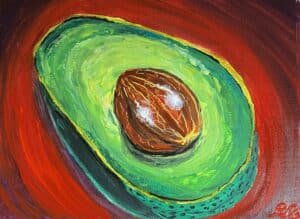
    Paul Joyce, Avocado Study

    Again, in Roman art, large murals in the villas of the rich showing the bounty of nature, along with the inhabitants of those very productive fields, namely birds and small animals, demonstrated the superiority of an upper elite class and their ability to feast of the best. Pliny the Elder wrote of one artist who came to be called “ a painter of vulgar objects” as he depicted shops, animals and food. But he made it clear that the results were extremely popular and far outsold work of artists in other genres.


    Paul Joyce, Avocado No. 2


    The fact that Still Live painting is relatively easy to distinguish and therefore categorise, meant that for centuries it was associated with academic principals of depiction, with styles and subject matter being handed down from generation to generation.  An Academy, after all, is fundamentally an organ of the Establishment, usually conservative and anti-liberal. The Adademie Francaise up until the Nineteenth Century still had strict guidelines distinguishing subject matter in art, with historical, biblical or religious pictures occupying the highest category and with Still Lives (again) relegated to the outer darkness.


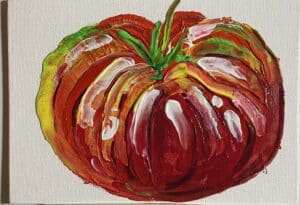
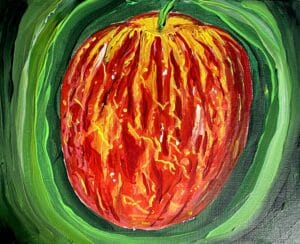
    Paul Joyce, Fruit Study


    However, the arrival of the Impressionists blew all previous assumptions out of the water. They were more concerned with the emotional impact of colour on the viewer and their choice of subject matter was as wide as any previously written hierarchy. The greatest exponent of this rapid emergence of new approaches to ways of seeing the world was undoubtably Van Gogh. His series of Sunflower paintings took the humble Still Life to heights of greatness he himself, dead by the age of 37, could never have imagined.  All of us struggling in his footsteps owe him an immeasurable debt of gratitude.


    So, my current attempts to come to terms with this lowest form of art is part inspired by Vincent, of course, but also very much by the “painter’s painter” Paul Cezanne as well. Cezanne famously stated that he wanted “to astonish Paris with an apple”. Well, mine is to attempt to amaze Brighton with an avocado. The images reproduced here are very much the start of a journey to investigate one of the most influential, successful and popular genres in the history of Art.  Nature can provide us with so much, particularly in terms of structures, forms and especially colours.  It is no accident that most of the best artist’s pigments come directly from actual elements culled from within our natural environment.


    I have come to understand even more than before, as I embark on this voyage of discovery, that the marked differences between the application of paint both by brush and palette knife produce totally different results. Using a conventional cotton canvas, a brush will drag across the dimpled cotton texture, frequently leaving details of the individual bristles. Whereas a knife will glide over the surface, allowing colours to mix together, sometimes in an almost magical way. This together with an attempt to use that sensuality that paint has in its very essence, itself attempts to mirror how tactile and toothsome still lives can be.  If I can literally make some viewer’s mouths water, I will feel that I have at least in part succeeded. But this of course I shall never know, unless some concerned reader tells me so.


    The writer is a celebrated artist and photographer


  • Art interview: West Contemporary founder Liam West

    Christopher Jackson interviews a likeable art dealer with an incredible backstory

    Humility is a wonderful thing.  As soon as you meet Liam West you find yourself mentally revising your idea of the art world. West, the hugely successful founder of West Contemporary, meets me at Kerridge’s Bar and Grill  in the Corinthia Hotel. West is sitting quietly in a corner – with an air of humble diligence – hunched over some paperwork with a team member. You wouldn’t know that all the art on the walls is here because of his acumen and reputation – or that this is one of the leading figures in the UK art world.

    So how did he become involved in the sector? “I was brought up in New Cross in South London – which is part of the Old Kent Road, the cheapest block on the monopoly board,” he recalls, with a smile. “But crucially, I was also born a couple of roads away from Goldsmiths University, where the YBAs (Young British Artists) came from. I just fell in love with that movement.”


    Such is London: you might grow up feeling you have poor life chances but opportunity is always adjacent. And West is referring, of course, to that group of artists Damien Hirst, Sarah Lucas and Tracey Emin, who had nothing much to do with one another, other than being lumped together by the British press. When they came to prominence, they collided with Britpop and the outset of the Blair administration. Briefly, pre-Iraq, anything seemed possible – and it turned out that quite a lot was.

    And especially for West. What was his career journey? “I ended up finishing college not knowing what I wanted to do,” he recalls. “My Dad used to be a bus driver at New Cross garage, but went on to work for the Law Society. He had someone doing CVs, so I went in. My parents never had the funding to do the university route anyhow. But my CV was done.”

    This led to a bit of luck: “The lady that my dad gave my CV to for typing took it home to her husband. As it happened, he ran a fine art print company in Nunhead called Napier Jones. I got a phone call out of the blue saying they were looking for someone to come and do an apprenticeship.”

    Initially, West was unsure about this development: “I wanted to continue my education, but I decided to do three months over the summer. On day one, Damien Hirst walked through the door; they were doing a limited edition litho print for him.”

    That sounds like a good first day – but, as time went on, West was continually impressed by the variety of work. “It just continued. We were working with Agnew’s at Bond Street, White Cube, and all the galleries around St James’s. I fell in love with it.”

    West stayed for five years moving over time to a customer-facing role. He then started his journey in to reprographics and joined a company called Icon near Borough Market in Southwark: “I kind of hit the ground running,” West recalls, “and I ended up being the MD of that company, managing over 50 staff, very quickly by the age of 23.”

    It was an impressive rise. West recalls for me an important incident in the year 2000: “We had a salesman called Nick Duchamps. His great-grandfather had been Monet’s art dealer. He came flying through the door one morning and he said: ‘He’s only done it again’. I said: ‘Who?’ He said: ‘Banksy’. And I said: ‘Who’s Banksy?’”

    We can catch here something of the energy an artist harnesses when they’re about to go global: sudden unanimous fascination among those who mind about the latest thing. From that time onwards, West was hooked by Banksy’s work: “I started blogging about Banksy; it became a hobby.”

    West had discovered street art and its global superstar. He then went on to start a company Beautiful Crime, which in time would become dedicated to the sale of street art. How did he come up with the name? “Those words come from a French artist called Monsieur A who’d been interviewed by a high end magazine and they’d said: “Don’t you know that what you’re doing is vandalism?” He said: “No, it’s not; it’s beautiful crime.”

    West would go on to co-create the world’s first online gallery for street art originals. I can’t help but ask, hoving near a possible scoop, if he knows Banksy and will consider revealing his identity? But West smiles: “I’ve been in the same room as him, but I’ve never spoken to him. I know it’s him, because I’ve been with people who actually worked for him at Pictures on walls . He was often referred to as Dave, which is not his real name. It’s quite remarkable how well he’s been protected over the years. And rightly so. I mean, he’s obviously a global phenomenon now. And pound for pound probably is the most expensive artist in the world.”

    Eventually, having saved up a year’s salary from his day job, West became full time at Beautiful Crime. “Our big break came when we were asked to design the Coca-Cola bottles for the Olympics 2012 using local urban artists. They were so impressed that they asked us to design their HQ for the Olympics on the Southbank ”

    Word spread and soon West could count The Royal Albert Hall, Adidas, Microsoft, All Saints, Levi’s, Peroni, and numerous others as his clients.

    Was it difficult to overcome the perceived gulf between the world of street art and the commercial art sector? “It was tricky at first because street art is seen as a bit of an anarchic movement and a lot of street artists didn’t want to be involved in that world. But when the opportunity actually arose, I don’t think any of them turned it down.”

    By 2013, he’d opened his first gallery in Shoreditch. “Then, in 2015, we won the commission to create a large public sculpture in marble for the Dubai Opera House. That now sits proudly on Dubai Opera House’s Plaza: everyone who goes into Dubai Opera House has to go past it. That was a huge step up but we were advised that our company name wasn’t ideal for the Middle East market. That allowed me to completely rebrand as West Contemporary.”

    By 2018, he was ready for his next move – to Kerridge’s Bar and Grill at the Corinthia. “Tom opened this restaurant in 2018,” West recalls. “He said, ‘I want to build you a gallery.’ I’ve never been one for putting art in restaurants. I’ve always said if you want to buy meat, you’ll go to a butcher. So why would you buy art from a restaurant?”

    What changed his mind? “Amazon shows us we’re all bereft of time. I never thought we’d come to a point where people would be buying art online for thousands but here we are. We did a show in October 2021 where we sold 24 artworks for between £18,000 and £35,000. Not one of them was to the UK. So not one of them had been seen by the purchaser in the flesh. That still astounds me.”

    Meanwhile, the gallery itself has been an astonishing success. “I call it a showroom. Tom completely changed the food world by convincing Michelin that you could have a two Michelin star pub. I put a lot of trust in Tom who said: “Look, we’re going to create something new here. We’re going to call it gastro art’.”

    Just as important as these successes is what West does for the artists themselves. West notes that many artists leave college uncertain about vital aspects of the art world. “They don’t teach you about art management, how to go about marketing, framing, printing, and all that goes with it . My favourite thing is to take an artist from the very beginning of their journey and help them.”

    Who does he represent? West now argues that street art doesn’t really exist anymore (“Banksy is selling in the same auctions as Picasso or Warhol”), and so he’s broadened his roster. “Graffiti artists make up ten to 15 per cent of our roster of artists. But now we work with every sector: neon artists, mixed media, artists that are particularly inspired by sustainability, pencil drawing artists, sketch artists, spray can artists, painters, photographers, the whole lot. It’s a really exciting time.”

    I’m keen to ask West about hot topics in the art world. What does he think of NFTs? “A complete Wild West at the moment, but I do think NFTs and blockchain are going to be game-changing for art authentication.”

    He adds: “The one who’s really nailed the NFT market is Damien Hirst. And it’s quite clever what he does: with his latest collection, you can buy the physical artwork, or you can buy the NFT. But at any point, you can swap the NFT back for the original artwork. The last release he did, the NFTs outsold the actual physical artwork.”

    And does he have any advice for young artists? “To be honest with you, it changes all the time. The problem is getting your name out there. There’s a lot more opportunity today. It used to be a really closed shop. Social media has completely opened that up. Bond Street galleries are signing people up who’ve made it through social media because they’ve built their own market.”

    And how should young artists price their works? West explains: “Tom also had a restaurant in Manchester called the Bull and Bear. We did all the art there, and we created a Fine Art prize. We ended up choosing a young artist called Tom Yates, who’s 26 from the Manchester area. We’re going to nurture him, but we’ll start off at £150. Each costs £50 to create, so there’s a £100 profit in it – and then you build it up.”

    What does the cost of living crisis mean for artists? “The problem I think young artists will have is getting materials when everything has gone through the roof. I think paper’s up 100%, as are inks. Certainly framing, wood, glass –

    everything across the board is up 50-60% When you want to put on a show, the overheads for printing and framing just build up, incredibly so.”

    Which means that many artists, floundering in these currents, need his help. Yet you never feel that for all his success, West is the least bit impressed with himself or arrogant. That’s the thing about success. It’s about hard work, and talent – and West has these things. But to travel so far so quickly and remain kind is the hardest thing of all. And he’s done that too.