There used to be a dead tree in Ruskin Park in South-East London, which always struck me as somehow sculptural. The other day I saw that it had fallen. I had grown so fond of this particular tree, it’s optimistic reach towards the skies, that I was bereft when I saw it had collapsed.
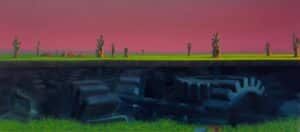
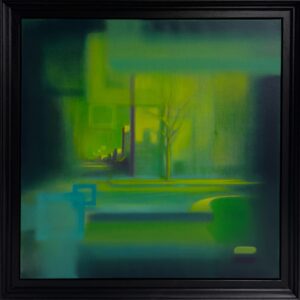
But this probably minor development in the history of my local parklands makes me all the more delighted that this same tree is still standing in the work of a remarkable artist Nadeem Chughtai. Chughtai’s recent exhibition A Liminal Statehas people talking in Peckham, which as everybody knows is also the artistic centre of the universe. Chughtai used the tree as a basis for his picture There’s This Place On The Edge of Town (2020).
There’s This Place on the Edge of Town
One of the most basic requirements of an artist is power: Chughtai’s images always have an immediacy which nevertheless lets you know that your first impression is only the first part of your journey with that work of art. In this picture we see how we have become mechanised in ourselves, and how this can only lead to stunted growth. But the beauty of the tree, which looks like it almost wants to be an upwards staircase, suggests potential.
It’s a brilliant conception, like all Chughtai’s pictures. So was it always art for him, or did he toy with other careers? “It really was art all the way for me,” Chughtai tells me. “Ever since I was very young I’d draw. Encouraged by my mum and influenced by a beautiful framed pencil drawing my dad made of my mum in the 1960’s. However, I did loads of jobs before going full time with an art publishing contract which set me on my way. Before that I always kept myself in the minimum wage positions for fear of committing myself further down other career paths.”
Chughtai has had some major successes, with some celebrity clients including Roger Federer who chanced upon his work in Wimbledon village one year. Chughtai is particularly well-known for Nowhere Man, his character which he gave up at the start of the pandemic. These pictures, taken together, amount to a vast dystopian opus which tell the viewer unequivocally what we all sense: we are not headed in the right direction as a species.
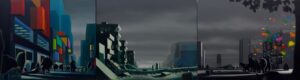
We never see Nowhere Man’s face. Sometimes there’s more than one of him. It is also possible to say that Nowhere Man is always in a negative setting, beset by the circumstances of modern life: alarming architecture, the trippiness of drug culture, the terrifying ramifications of contemporary uniformity.
I Dream of a World That the Capitalist Philosophy Will Never Make Possible. Oil on three canvases (2017)
I also note that they’re always dramatic force in these pictures, and I related this to the career Chughtai had on film sets, with his work including the Bourne series and Love Actually. Did that experience impact the way he paints now? “Yes, I always mention my scenic art days. I call it my apprenticeship. It was absolutely magical to be working on those film sets at Pinewood and Shepperton Studios,” Chughtai recalls. “I originally went there to try and make films after losing my way with drawing and painting after college, but as soon as I saw the huge painted scenery backdrops surrounding the sets I was sucked back in.
I had hands on experience of painting pictures on giant canvases, off scissor lifts using strings, hooks and chalk to draw our lines. I learnt about so many aspects of painting as well as the cameras eye. The big one was perspective. Learning about that was enlightening for me.”
I ask Chughtai if he has had any artistic mentors, and his answer also dates to this time: “Well, I always mention Steve Mitchell, the scenic artist who I assisted over a five year period from 1999- 2004. He’s still doing it at 70 and we’re still in touch. He’s one of the world’s top scenics. I can’t tell you what I learnt over those scenic years and how it got me back into the art of painting.”
I can tell how passionate Chughtai is about his calling, but the melancholy of these pictures is always there. It seems to cry out for some kind of remedy. Is Chughtai pessimistic about the human race and its future? “I believe we are not only on the path to a dystopian future but within it now. Just look at all the horrific and unnecessary human suffering going on all over the world and right down to our own neighbourhoods. However, I remain an eternal optimist and have every faith that the human race will unite to overcome this and bring about the necessary change required.”
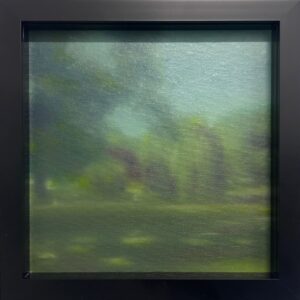
The new pictures, with their liminal greens, seem to be the start of some new potential. Here we see Green Park as it might be seen in a dream, or in the hypnagogic state between sleep and waking. The journey to the centre of town to make these pictures is perhaps indicative of an interior shift in Chughtai. The new pictures also mark a big change away from character towards some other kind of painting which feels like it is yearning for mysticism – maybe even a metanoia away from despair.
Was it hard to give up Nowhere Man? Might he ever experiment with another character? “It was very hard to shed the Nowhere Man. I doubt there would ever be another character. For me it represented humanity. If I ever need a central character again I’m pretty sure I’d call him up.”
Humanity then is for Chughtai somehow passive and faceless – asleep perhaps. This makes the notion of an exploration of the liminal all the more important; it is to do with exploring what Seamus Heaney called ‘the limen world’, that curious borderland of the unconscious. I have a sense that these recent works are a necessary transition period and that it may in time lead to some sort of reconciliation between Chughtai and the damage of the world – a more optimistic vision perhaps.
How did these new paintings come about? “The works exhibited recently at the Liminal State exhibition are exactly that; Liminal, as in kind of between or on the threshold. For me personally, up until just before lockdown in 2020 I was creating paintings with a central anonymous figure – the Nowhere Man. 16 years through the eyes of this character, so, shedding that to allow the next body of work to arrive has taken these last four years, and counting… The title, A Liminal State can also have numerous interpretations and could additionally refer to many other aspects; mentally,, physically, technically, artistically, societally… liminal.”
These then are between states, and that means flux – in Chughtai’s art certainly, and therefore, since artists are their art, in his life. I ask Chughtai about his method of composition. Is it evolving? “It’s evolving and continuing its journey. I’ve changed the approach, technique, materials used and so much more since 2020. In fact, almost everything – but still the work has naturally evolved through different states to where it is now.
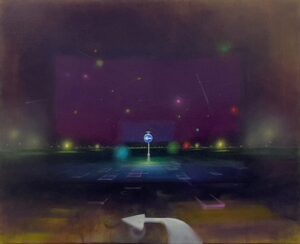
It’s a continual fluid journey. I have also been developing an artistic theory and putting that into practice. It involves perspective and the way the eyes see and the brain interprets an image. It’s great testing a science based theory on my artistic practice… and it actually works. My most recent painting entitled, Turn Left. (2024) shows the theory in practice in its most developed stage to date, and I was blown away by the positive reaction it got when exhibited for the first time at the show.
Turn Left, 2024
This again, seems to me like a dream where the dreamer is sometimes given clear but mysterious indications of what to do – strange snatches of disembodied advice. To look at these pictures after immersing oneself in the Nowhere Man corpus is to see a kind of hope peeping through, because the world seems to be acquiring a kind of charge, groping towards some form of meaning. My sense is that this makes the next few years of decisive importance for Chughtai’s art. If we follow that sign, where does it lead?
This new work has also sent Chughtai on a rewarding course of study. “Over the last four years I have really delved deep into studying and expanding my artistic learning. Visiting the London galleries on a weekly basis and getting to understand the philosophies of some of the great painters, while also educating myself about the amazing artists from around the world and their histories.”
So who are his heroes? “I have to mention Van Gogh, I just love. His pencil drawings, they make me wanna scream. I would say that more recently I have been appreciating 20th century Western heavyweights such as Bacon, Klee, and Rothko who’s section 3 of the Seagram murals brought me to tears on more than one occasion. It was during a particularly emotional time for me personally whilst simultaneously looking to move my work along an different path. That painting allowed me to see within it what I wanted to do with my own work.”
Chughtai has been going strong for a long time. So what are his tips for young artists about the business side? “Well, yes, it is a business – if you do it full time for your living. So if you don’t have the luxury of financial security, you will need to sell your work.
This predicament will most likely influence the type of work you produce and therefore could involve compromise. That’s the tightrope. It can work in your favour but can also be a hindrance if not deterrent, which is a real shame because then we miss out on hearing and experiencing the voices from within those walks of life. So, believe in what you’re doing, put the time in and keep on making your art.”
Maxted Morning, 2024
And would Chughtai recommend the art fair route? “I love going to art fairs. It’s where it all started for me. Like our society, the art world is very hierarchical, but whether you’re at the bottom rung or at the very top, when all is said and done they’re markets with their stalls out. It’s great because people can stand in front of the work in the flesh, which is how I feel art works are best experienced… and there is so much under one roof. Art fairs are a great way to spend an afternoon… if you can afford the entrance fee, of course.”
That’s often the problem for young artists at all. Has the conversation around NFTs affected him at all? “I did look into NFT’s a little some years ago but it seems to have gone quiet on that front so am unaware of where it currently stands. The whole digital thing is obviously a direction the art world is going down and there are many possibilities to explore. However, my focus and studies are with oil paint and a canvas because there’s so much more to come from there and that will always be ahead of any artificial intelligence.”
Chughtai is an artist of rare talent, who is doing something very valuable: he is pursuing his vision where it leads. It takes courage to do that. Every artist can learn from somebody who has chosen his path so decisively then pursued his craft with such passion.
Cézanne is the patron saint of those who don’t find their chosen path in life easy, writes Christopher Jackson
If genius is to do with fluidity and effortlessness then Paul Cézanne wasn’t a genius at all. This isn’t meant to be derogatory to Cézanne. Sometimes in great achievement we can still see the graft that went into it – a sense that things were never straightforward, and that nothing was ever arrived at in a flash.
That kind of achievement deserves a respect distinct from the awe we feel at genius when it has less hindrance attached to it. We can see in Van Gogh and Picasso that mark-making came unusually easily to them: mistakes were simply not in their nature and that there was an unusually easy relationship between world, eye and hand which almost always added up to something worthwhile.
It wasn’t like that for Cézanne. A new show at the Tate shows how long it took for Cézanne to become Cézanne. If you’ve ever thought in your career that you have something to offer, but that it might be a long time coming to fruition, then visit this exhibition and make the artist your patron saint.
The exhibition should be viewed in tandem with reading Alex Danchev’s marvellous Cézanne: A Life (2012), now experiencing a muted 10th anniversary. This book gives vital biographical detail which the placards in the exhibition don’t have time to cover.
So who was Cézanne? Cézanne grew up in Aix-en-Provence where he would eventually die: he is one of those who doesn’t need to travel much because he suspects the substance of what he has to do lies not in travel but in stasis. To broaden the terms of reference of life would be to create an insoluble complexity; but to stay still and really pay attention might just lead you to a coup. That was the Cézanne wager.
But early on in Danchev’s biography you learn that Cézanne was defined by a coincidence: he went to school with the novelist Emile Zola. This relationship – which isn’t paramount in the Tate Modern’s exhibition – is nevertheless the chief biographical fact about him. Many people who are creative or successful are influenced to an extent they might not wish to admit by chance. For the future painter, given to a certain sluggishness, one gets the sense it was important to have the rocket fuel of a close friendship with Zola right at the beginning.
Cézanne had his influences among the dead too: Rubens, Leonardo, Puget, Delacroix. But a great friendship can be an accelerator of development and it appears to have been so in this case. It also reminds us that Cézanne’s talent wasn’t necessarily pictorial in the first instance. In fact, Zola appears to have always harboured a secret sense that Cézanne would have been a better writer than he was. Here is Danchev:
On Zola’s side there was a certain sense of inferiority, perhaps early acknowledged and then long submerged. After leaving school he dreamed of writing a kind of prequel to Jules Michet’s L’Amour (1858): “if I consider it worthy of publication, I’ll dedicate it to you,” he wrote to Cézanne, “who would perhaps do it better, if you were to write it, you whose heart is younger and more affectionate than mine.”
This is a fascinating letter, especially in light of the subsequent difficulties which would later beset their friendship. Danchev makes it clear that on Zola’s side, these feelings of insecurity were a sort of time bomb which would detonate far later with the publication of Zola’s L’Oeuvre. But it is also interesting in that it opens up onto the possibility that Cézanne’s first gift wasn’t painterly at all – instead, in the opinion of his friend, it lay elsewhere. Zola seems to suggest he was made of the sort of stuff that can turn itself to any task.
Was this true? There seems to be something in Zola’s assessment. In Danchev’s biography, we read a fascinating description of Cézanne’s attainments at school. We glimpse a general talent which would find in the end a singular outlet, and not a unique aptitude for the thing for which’d eventually become known. Danchev writes:
He [Cézanne] was a prize-winning pupil. At the ceremony at the end of the first year (when he was fourteen), he won first prize for arithmetic, and gained a first honourable mention for Latin translation and a second honourable mention for history and geography, and for calligraphy. The years rolled by in like fashion. In the fifth grade he won second prize for overall excellence (after Baille), first prize for Latin translation, second prize for Greek translation, a first honorable mention for painting…
The fifteen year old who has a first prize in Latin can be a Latinist as much as a painter later in life, and there’s always the sense in Cézanne’s life that there was something arbitrary and quixotic about his decision to be a painter at all.
But this arbitrariness itself goes into the mix and forms part of his achievement. The sense is that only someone with a certain amount of ground to make up would consider to focus with the kind of ardour which Cézanne did on just a few subjects: his bowls of apples belie a determination to really look at the world which are different somehow from Van Gogh’s ‘Sunflowers’, wrestled with by an artist of genius and then not subsequently returned to.
Paul Joyce, the brilliant photographer and painter, agrees with this assessment, telling me: “I think art came with difficulty to Cézanne and I have the impression he struggled a great deal with perfecting his vision. My guess is that he destroyed more work than he actually exhibited or finished.”
This is certainly the impression one gets in the Tate exhibition. The first rooms see Cézanne groping for an identity as an artist, and while this is always the case with anybody’s early work, it could be argued that the greater the artist’s eventual achievement, the more unlikely it seems at the beginning. An image like The Murder, where Caravaggio-esque lighting and the ghoulishness of El Greco’s figures combines to make an image which teaches us in one fell swoop why Cézanne would never make a drama painter. The murder in this picture doesn’t matter to the painter as an apple or a mountain would later do. Ruction and disaster didn’t appeal to Cézanne as subjects. This isn’t to call him heartless; probably quite the opposite. It might be that he felt the calamity of murder too keenly to produce a valid picture depicting it; certainly he couldn’t look at it in the same way as he would find he could look at a bather. But then, aside from a murderer, who can?
But if The Murder was a failure of sorts, it was a promising one. Crucially, it must have been sufficiently promising to Cézanne, since he kept going. This fact alone is a reminder that perseverance is rarely rational: without it, nothing would ever be achieved. Persistence needs to be innate: if we weren’t wired to dream, few would rationally continue with their first efforts, since in the ordinary scheme of things these tend to be extraordinarily unpromising.
Success, then, is often against the grain. At the Tate Modern, a self-portrait of Cézanne against a pink background dating to 1875 seems to contain this knowledge. The colours of the face are applied with a delicate care which reminds you of the fragility of any human face, composed of little strokes which happen to be together, and which might just as easily rush apart. The eyes, tired as if with too much looking, also seem vulnerable: ambivalent about the tasks ahead, doubtful about the likelihood of self-fulfilment. It’s an arresting intimate image, bringing a fragile ego near. This portrait might give us our own permission to make inroads in our own lives, since we can see that one of the great names in history didn’t always seem confident of his value.
John Updike once wrote a review of a Jackson Pollock show which began very unpromisingly and then transformed itself in round about Room Three, with the advent of the famous drip paintings. “Beauty, how strange to find it here!” Updike exclaimed in that article. One wants to exclaim the same in the Tate exhibition as the exhibition ripens in its last rooms.
By this point, Cézanne has found his subjects: bathers, Mont Saint-Victoire and of course his famous apples. When I ask Paul Joyce what he has learned from these masterworks he replies: “There are really too many lessons to learn from Cézanne to simply list, and as you return to him and his work as your own career as a painter progresses, you realise that what you may barely grasp from him is that the closer you look, the more you see. Colour, balance, fluidity of brush stroke, command of the subject, ability to build “atmosphere” and movement into a still, flat canvas amongst many more things.”
That’s a good summary of what these last rooms offer. One might add that Cézanne, though he looked hard at the world, always looked with a consciousness of the limitations imposed on looking. A humility pervades his work, which is a possible reason for his popularity today. It is the genius as everyman, which makes us wonder if mightn’t we be great too.
His popularity may be set to grow again. Cézanne lived without too much pizzazz, and may therefore be an attractive figure in our own cost of living crisis. Danchev cites some evidence that the painter came to feel that his friend Zola, showered with plaudits in Paris, had come to live too grandly. Cézanne never did that; his was a quiet existence dedicated to work.
Nevertheless, though Zola is less admired today than Cézanne, this work ethic was an example which he had had all along from Zola himself. The novelist wrote to Cézanne when he was 21 that ‘in the artist, there are two men, the poet and the worker. One is born a poet, one becomes a worker.’
To some extent, Zola heeded his own advice: his complete works comprise a formidable number of volumes, most of them fat. He might be one of those writers who makes shelves groan more than he makes readers dream. The friendship between them reminds us that work for its own sake can lead to an inferior achievement: sometimes it can really be volubility. It was once said in relation to Proust that a bore is someone who tells you everything, and perhaps Zola was a bit like that.
In relation to Cézanne, one senses a greater focus – a more coherent and patient mindset about the task which needs to be accomplished. This had also, to an extent, been pre-empted by Zola who wrote to his friend in 1877 regarding his work: “Such strong and true canvases can make the bourgeois smile, nonetheless they show the makings of a very great painter. Come the day when M. Paul Cézanne achieves complete self-mastery, he will produce works of indisputable superiority.’ Though this might have been to damn him with faint praise, something like this prediction did in fact come true.
What was that legacy? Cézanne realised his own way of looking. Too often we tend to think of him as a staging-post in the history of art, but I don’t think this is quite right. All artists worth their salt do something unrepeatably unique. Too often, we compare them to those who came before and after, meaning we don’t properly take the measure of what’s in front of us. Maybe this is especially a problem with Cézanne, not only because he really does have antecedents and a legacy, but because something about his pictures feels hard to rise to. There are those whose opinion one respects, who would say: “Oh God, not another Mont Saint-Victoire”. We feel we cannot match his intensity and so we turn away.
What is his art ultimately about? The great landscapes flaunt the strokes by which they were compiled and yet each individual stroke which seems so apparently simple, adds to the alchemy of the whole. This art then comprises more than just a series of fragmented strategies: they’re shot through instead with honesty about our predicament as creatures dwarfed by the scale and complexity of things. That means that his landscapes and his apples are really unusual kinds of self-portraits because they are as much about the insecure position of the painter – and his integrity to admit that insecurity – as they are about the mountain or fruit which he is ostensibly depicting.
Van Gogh’s condition as a genius likely suffering from bipolar disorder was always impinging on his work. Cézanne was saying something else: that we’re all standing on shifting ground. It’s the kind of thing which, once said, has to be admitted by everyone. This accounts for his influence, and this has carried into the present day. There is some anxiety attached to high achievers: we think we might not be able to outdo them, and feel our own efforts likely to be paltry when set next to theirs. One can easily guess what Cézanne himself would have made of such a defeatist attitude. He would have liked the mantra of Sir Kingsley Amis: KBO (Keep Buggering On).
Paul Joyce tells me: “Artists are always anxious whatever their reputation or state of maturity may be. Each generation is influenced by the previous one and the History of Art is simultaneously one of constant homage and theft. My answer would be “be anxious, be influenced, then set out on your own path, like Cezanne!”
It’s sound advice – and you don’t need to be a budding artist to heed it.
To say it’s Vincent Van Gogh season in London might be to overstate the case: it always is. Every day people come from all over the world to see Sunflowers in the National Gallery – that great tour de force which reinvents the colour yellow for all time.
The artist’s fame would have seemed odd to his contemporaries, especially those who knew his eccentric habits in Arles, in southern France towards the end of his life. There was a time when Vincent Van Gogh couldn’t get anyone to look at his paintings. Today, it’s hard to get in front of one long enough to have a proper look without a tourist straying in to spoil the view.
But great fame is often reductive: in loving his pictures so much, we’ve tended to simplify him. We attribute his current reputation to ‘madness’ – as if Starry Night were primarily an expression of insanity. It’s true that Vincent struggled all his life with what we would probably label today ‘bipolar disorder’, but the truth is that Vincent was always sane when he was painting, and that painting was in fact his best method of staving off episodes which occurred throughout his life. These were frequent and he was heartbreakingly honest about them in letters to his brother Theo: “It appears that I grab dirt from the ground and eat it, although my memories of these bad moments are vague,” he once confided.
It is an arresting image: the great painter literally eating the earth. It might even serve as a metaphor of his achievement: Vincent was always imbibing real life, insisting on it to an unusual extent. His is a world of peasants and down-and-outs: he might be the only great painter in history whom it’s impossible to imagine as a courtier.
If you look at the popular image of the artist, you could almost imagine that Vincent is a completely separate case, someone we can’t expect to learn from at all, because we are not mad and he was. But his greatness cannot in the end be assigned to insanity, but instead to skill, vision and application. This means that we have more to learn from Vincent and his methods than we might think: this is true if we want to work creatively, but true also no matter what we wish to do with our working lives.
The first thing we mustn’t do is think him a uniquely hopeless case as a man in order to consider him a uniquely remarkable artist. As the pandemic has brought into focus, the world is always liberally stocked with mental ill-health. We might be deluding ourselves if we consider ourselves well, and Vincent not. It may even be that the reverse is the case more than we might realise or wish.
Secondly, we mustn’t forget how much hard work underpins Van Gogh’s achievement. The popular caricature of Vincent’s life still seems to invite us to imagine the world binary, divided between the sane and the insane. In actual fact, his life increasingly makes me think that we are instead divided between those who are committed and those who are not.
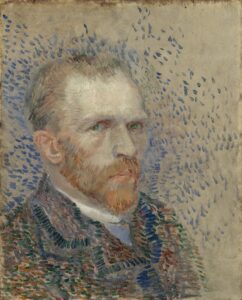
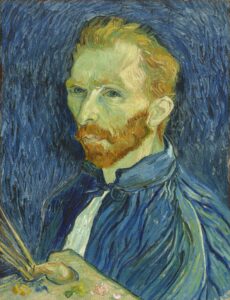
With all this in mind, I have come to the Courtauld Institute to see a remarkable exhibition housing 27 Vincent self-portraits collected together across two rooms. The Institute has spent a fortune renovating itself, and emerged on the other side of £57 million in expenditure looking almost identical to what it looked like before.
Anyone who wishes to get upset about this financially alarming decision however, can seek solace in being restored to one of the great collections of the world. Among them is Vincent’s famous Self-portrait with Bandaged Ear, which he made after the terrible and incomprehensible incident in Arles which most people know about: after experiencing increasing tension in his friendship with Paul Gauguin, he cut off his own ear and delivered it to a prostitute with a cryptic note attached.
The exhibition may be said to build towards this picture as towards a crisis. But there is another way of looking at it: here, spanning over a decade of helter-skelter work, is a celebration of the joy of discovery. We might be disinclined to cut off our own ear, but we should certainly leave open the possibility that there is an activity waiting for us in life which we can grow into over time: a room we might walk into without ceilings or impediments where we might become more and more richly ourselves. By that measure this exhibition is extraordinarily valuable: it shows the sheerness of Van Gogh’s application to the art of painting and might even unlock something within ourselves.
The early pictures, drawn in his native Holland, are sombre affairs compared to what he would later produce. As such, they are a very precise measure of how far he would develop. By the vigour and the colour they lack, these pictures imply both an openness to doing things in a different way and also state an uncompromising desire to make his craft secure before he did branch out. The dominant influence here is Rembrandt. Here again there is a lesson which might apply to other disciplines: seek the best in what you wish to do, learn from it respectfully, and only then stake out new territory.
There’s another lesson, stemming from the fact that so many self-portraits exist. Vincent was a little unnerving as company, partly due to his physical appearance which was by no means prepossessing, and partly because of his unpredictability. As a result, throughout his short life, he found it difficult to find models willing to sit for him. The only model always willing to do so was himself.
This points to his resourcefulness and to his determination. In his letters to Theo – some of the loveliest documents in the history of art – we get a lot of detail about materials Vincent is buying. Here again, he is always sensible with money, frugal with what he’s able to afford, and a fortunate beneficiary of his brother’s generosity. Unfortunately, because Theo’s letters weren’t kept, and Vincent’s were, we rarely get a sense of Theo’s view of Vincent, though what we do know points to fraternal adulation. But this absence further augments the sense of Vincent as a man alone.
The Courtauld exhibition shows that Vincent always left himself free to experiment, without ever losing the intensity of work ethic which always marks out his pictures. He studied his own face from every angle. He told us his every mood. By the end of this exhibition, we feel we know him. It’s this intimacy – together with the perennial simplicity of his signature – which makes us comfortable (think Don Maclean’s song of the same name) enough just to call him ‘Vincent’. We do not call Cezanne ‘Paul’ or still less Monet ‘Claude’. Vincent is touching in a way few great artists are. One of his virtues was always humility. It’s this which has brought him so many posthumous champions. Knowing what it was to be despised, he never despised anyone. He is always in the trenches of life with us. It is difficult to think of another artist who cared so much for the downtrodden and the outcast.
In these self-portraits we see always the same determined mouth, the slightly watery eyes, the hooked and even austere nose, and the receding hairline. But this is where the similarities between each picture end. Given that the same subject recurs throughout, it is an exhibition so various in its mood and techniques as to cause astonishment.
The main reason for this versatility is that Van Gogh had made himself open to the gigantic discovery of the age, Impressionism, and then moved swiftly forward, making out of it a unique and wholly personal achievement.
But here again we must be careful. The truth is that in a pre-Internet age, Vincent never could have discovered Impressionism without having been immersed in the art world through Theo’s work as an art dealer. He couldn’t google Seurat; he had to meet Seurat.
In actual fact, if we might look at the matter objectively Vincent made all the right moves, which makes his achievement no accident at all. In fact, he often foresaw in his letters that his victory would have to be posthumous. There was a worldly, even calculating side to him at odds with the stock image of the freewheeling madman.
Other lessons can be found in his life. He moved away from a career in the priesthood to which he was unsuited, though he took what he had learned there – the importance of the numinous in life – and applied it to his art. Nothing was ever wasted. He then applied himself with rigorous dedication to painting, and connected himself in that world, making sure that he was working not according to some outdated understanding of his craft but to its latest developments.
As he carried out all this he was frugal, careful, and utterly committed. He also had an unfailing instinct for the next subject, and was prepared to subject himself to upheaval in order to pursue those instincts to their logical conclusion. The most famous example of this is his decision to leave Paris and move down to Arles in southern France.
He did so because he craved another light. It was a masterstroke – when what Vincent calls that ‘high yellow note’ has entered his pictures, we feel he has come home somehow. It looks like something which had to happen. But this again is an illusion: he made it happen. Again, because his life ended tragically, we forget that he was possessed of exceptional self-reliance to have got as far as he did.
Of course, a more organised person would have found somewhere less depressing than Arles to settle. It’s true that it had a few places going for it – the old Roman amphitheatre and some decent museums in towns nearby. But one senses that almost anyone else would have pressed on to Italy – or to Tahiti, as Gauguin did and follow their decision to relocate to its logical conclusion and find their way to a more appealing town.
It was his hyperactive fascination with what he saw which made him stay. The fields, the café, his chair, his room: these were enough for him, because he realised that just by going to Arles he had learned to see things in a way which nobody before him had been able to do.
No-one has seen like that since – and it must be that no artist has communicated to so many people with such immediacy. In fact, his work has the immediate comprehensibility of photographs: it is mass art in the way in which magazines are. And yet it stands up.
This is abundantly clear at the blockbuster Vincent Van Gogh: the Immersive Experience now touring the world where huge crowds, including children, experience Vincent ‘interactively’. At times the exhibition – as in its roomful of sunflowers – feels somewhat gimmicky, but sometimes it astonishes.
The centrepiece of the exhibition is a vast, almost cubist cinematic experience, where we see the familiar story of Vincent’s life written in subtitles while music contemporary to Vincent’s life plays and his paintings are shown in detail on large screens. The fascination of the show is that it’s impossible to see all of it at one go, and we’re reminded of what a complicated thing a life is, and especially a creative life like Vincent’s.
But the principal reflection is this: it’s very hard to imagine a show on this scale for any other artist dead or alive. Picasso, perhaps. Hockney, just maybe. But in each case, I doubt that their work and life has the deep appeal of Vincent. Picasso is at heart too grotesque and misogynistic; Hockney’s work is probably not quite good enough, especially in the last 20 years or so.
What accounts for this? It is that Vincent truly loved the world and truly loved all people. In his life, he imagined creating an artists’ colony alongside Gauguin and others where the world would be righted. Sometimes, Vincent had little self-awareness: he had neither the organisational skills, nor the money, nor really the personal magnetism, to make such a thing happen.
But it happens today at any Vincent exhibition where people gather in a kind of loose arrangement of fascination, seeing the world again through his eyes. Of course that arrangement dissolves swifter than Vincent had in mind when he imagined a colony of artists. But it is something – more than something.
And with every passing year we need to understand that Vincent’s popularity isn’t a quirk of madness. It was because his life in its way was exemplary, and there is much we can learn from him.
Van Gogh. Self Portraits runs at the Courtauld Institute until 8th May 2022
The director of the National Gallery on NFTs, opportunities in the art world, and the dignity of work in an interview by Christopher Jackson.
What’s your favourite picture in the National Gallery?
I think my favourite picture changes all the time, and when you when you mentioned favourite pictures, suddenly, what came to my mind was that very beautiful Zurbarán still life of the cup of water on a plate with a rose, which was a picture that was acquired when I was a curator here in the mid 90s. It’s a picture that you feel you’re growing with. It’s a picture that artists have always been very, very interested in actually since it came into the public domain having come into the gallery, and it’s so interesting to see many artists responding to the quietness and the intensity of that painting.
How did you find your passion for art?
I took on a fourth A-level when I went to school, which was art history, and I didn’t know anything about it. I was very fortunate to go to school in Dulwich, where you have the Dulwich Picture Gallery. Our first art history class took place in the gallery in front of the Rembrandt gallery window, and I thought, “this is wonderful!”
At that point, how much did you know about the opportunities in the art world?
I had no idea that there were jobs in museums or that there were jobs in teaching, or even what art history really was, but that first art history class really opened up a whole new horizon. And then I was able to go to university and study art history. I was very committed and very focused, and I’ve been very fortunate to be able to carry on working in the museum profession ever since.
Do you need an MA as well as a BA, or to earn a PhD to find a place at the National Gallery?
Not necessarily. I mean, more people are doing art history at a higher level, so there are many more PhDs in art history than there were when I was a 20-year-old. But I think there are still lots of other areas within museums, whether it’s press or design, or even people who have an interest in art but have a specialisation in human resources, for example. There’s always work to be done in museums and in the cultural sector.
How do you feel about NFTs?
I’m not so sure about the NFT phenomenon, and I don’t really think there’s one that’s for us. I do think the National Gallery has become more and more interested in the intersection between historic art and the kind of vision that contemporary artists have, and I certainly wanted to extend and enrich that relationship.
What role does the National Gallery play in inspiring new artists?
There are a lot of contemporary artists coming to the National Gallery talking about pictures and actually responding to works in the National Gallery in their own work, and I think it’s very exciting that this is a living collection. It’s one that’s throwing up questions about art, about life, about society. In a sense, the whole of life is in the National Gallery, and it’s only natural that contemporary artists should be taking an interest in what’s shown here.
Who do you see as the great artist of work?
I take occasion of the fact that we’re here in the Winslow Homer exhibition, he’s an artist who highlighted work, particularly in the pictures of the fisherfolk women who stay at home while the fishermen go out in their boats to face danger and the risk of not returning. It just gives you a sense of the impressive human qualities of people in the past. There’s this dignity of labour, the dignity of work, and I think that comes across very strongly.
A look back at Bob Dylan’s 80th birthday in 2021, when Robert Golding looked at the career of the Nobel laureate and asked what his life can teach us about making our way in the world
‘Twenty years of schoolin’ and they put you on the day shift.’ So sang Bob Dylan with typical humour and exasperation in his 1965 classic ‘Subterranean Homesick Blues’. It is a line that may resonate with many young people beginning their working life in the Covid-19 era.
Since arriving on the scene in Greenwich Village in 1962, the Nobel Laureate, who turns 80 today, has attracted continual reassessment. The brilliant opaque words, combined with a sense that in Dylan words matter to an unusual degree, have caused an immense critical literature to grow up. It’s difficult to think of a living figure more discussed.
Commentary has tended to focus on Dylan’s extraordinariness, and one can see why: he has achieved remarkable things, all while retaining his aloofness. When I asked singer-songwriter Emma Swift, who recently recorded an album of Dylan covers Blonde on the Tracks (2020), whether Dylan had been in touch about her album, she said: ‘I’m often asked that. But Dylan is to me a mythical figure. I’d be just as surprised if Samuel Taylor Coleridge called.’
Too often then, Dylan is treated as prophet and sage, and not as someone who hustled his way through the world – as we might do too. Our admiration for him might preclude us from seeing what he can teach.
“Dylan to me is a mythical figure. I’d be just as surprised if Samuel Taylor Coleridge called.”
Emma Swift
Get born, keep warm
It helps to remind ourselves that Dylan’s upbringing was distinctly unpromising – so much so that, even at the time, it seems to have struck him as a cruel joke. Raised in Hibbing, Minnesota – a dead-end mining town – he told Martin Scorsese in the film No Direction Home (2005): ‘I felt like I was born to the wrong parents or something.’ We ought not to draw the conclusion from this that it is wise to be contemptuous of one’s elders; one might instead say that we should have the gumption to imagine our way into the life we want – and be brave enough to take steps to secure it.
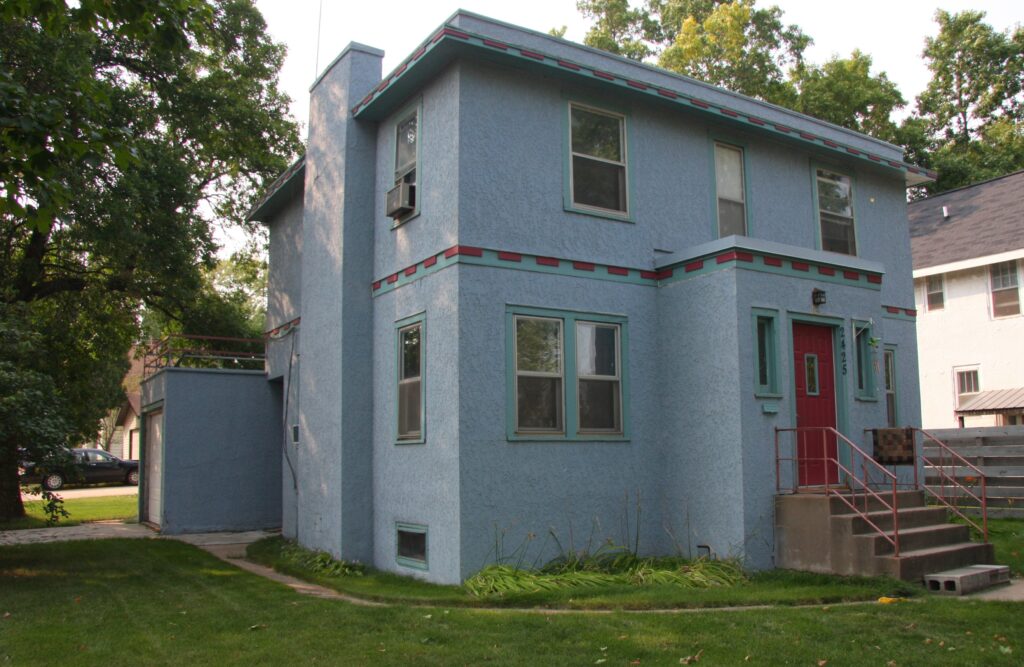
The Zimmerman family home in Hibbing, Minnesota. Photo credit: Jonathunder
It remains difficult to imagine Dylan in Hibbing. His life is a powerful example of a refusal to be defined by where you’re born: our knowledge of his subsequent success makes it vexing to imagine him ever having been there at all. Hibbing consisted of the typical Main Street, dreary parades, small businesses and shops, all bound up in strict mores: a life Dylan must have found predominantly redundant. But thanks to the invention of the gramophone, another world was able to seep through to the young Dylan. This was the astonishing revelation of rock and roll.
Like so many who go onto achieve great things, one can sense the constraints that early life placed on him – and also that those constraints were lifted rather arbitrarily. Rerun the movie with slightly different conditions and you’d have another narrative.
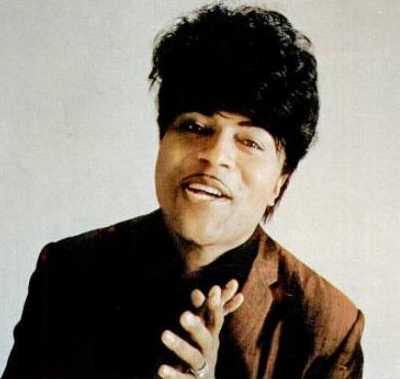
Specifically, Dylan’s life would have been different had he never encountered Little Richard. ‘His was the original spirit that moved me to do everything I would do,’ he would write on May 9th 2020 at the singer’s death. Though Dylan is a hero to many, he is also a man adept at having heroes. He admires people – but only as a way of discovering a way to become himself.
Dylan’s childhood hero Little Richard. “I am so grieved,” Dylan wrote upon the singer’s death on 9th May 2020.
Dylan’s first known performance was in 1958 at the Hibbing High School’s Jacket Jamboree Talent Festival. In Volume 1 of Bob Dylan: Performing Artist Paul Williams, Dylan’s finest biographer, explains how in this performance ‘Dylan followed the rock and roll music to a logical conclusion that was in fact quite alien to the music of the day: play as loud as possible. Not just wild. Not just raucous. Not even just loud, but AS LOUD AS POSSIBLE, preferably in a context that will allow for maximum outrage.’
It is an image of the natural iconoclast. At this young age, Dylan was allied to a true energy; he had made a decision that couldn’t be reversed to devote his life to music, and was already seeking to stand out within his chosen sphere. Soon he would graduate from being the loudest musician to other superlatives: most thoughtful, most literary, most enigmatic, most laurelled.
In the process, he was clearing more obstacles than we perhaps realise, now that we inhabit a world where they were so convincingly traversed. One fact is not the less important for being so widely cited: Bob Dylan wasn’t born Bob Dylan but Robert Zimmerman. Interestingly, a letter recently surfaced where Dylan explains that his decision to change his name was based on fears of anti-Semitism. ‘A lot of people are under the impression that Jews are just money lenders and merchants. A lot of people think that all Jews are like that. Well, they used to be cause that’s all that was open to them. That’s all they were allowed to do.’
“Dylan followed the rock and roll music to a logical conclusion that was in fact quite alien to the music of the day: play as loud as possible.”
Paul Williams
Some, including Joni Mitchell with whom Dylan has had (at least from Mitchell’s side) a somewhat abrasive and competitive relationship, have held up the decision to change his name as a mark of inauthenticity. But the decision might equally remind us of the importance of flexibility and finding a way around obstacles.
Try to be a success
Dylan’s early years exhibit a fearlessness which we might do well to emulate. As a young man, having briefly enrolled in Minnesota University in 1960, he again exhibited that same restlessness which would manifest itself eventually in his celebrated Never Ending Tour.
By this time, he had decided that rock and roll wasn’t enough, and that folk music offered a richer philosophical experience. It was the first of many twists and pivots and reinventions.
In time, he would merge the folk and rock genres – going electric in 1965 to what now looks like a rather quaint indignation from the folk establishment.
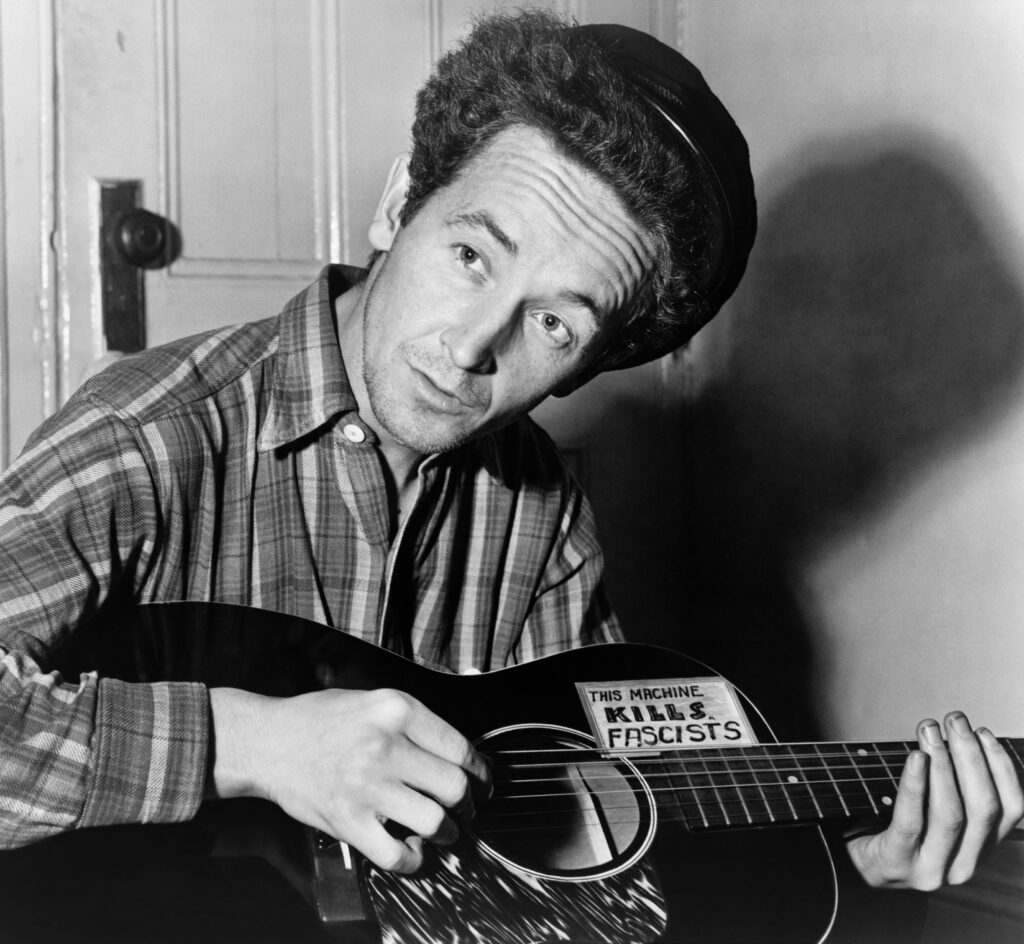
For now, seized with the urgency of the eternally confident, Dylan took a train to New York, intent on meeting his hero the folk singer Woody Guthrie. Guthrie was already suffering from Huntingdon’s Disease, which would eventually kill him in 1967. No matter, Dylan sought him out at his sick-bed in a New Jersey hospital and played him his homage ‘Song to Woody’ one of only two original compositions on what would become his debut album Bob Dylan (1962). A torch had been passed.
Woody Guthrie. Dylan sought his hero at his sick bed in New Jersey. Image credit: United States Library of Congress
It was a deft negotiation of what has been called ‘the anxiety of influence’. Young people will often underestimate the availability and flesh-and-bloodness of those at the top: fear stymies them from exposure to examples of success. By being in close proximity to our heroes – even if the encounter doesn’t go well, and we betray our nerves – we may usefully humanise them and open up the possibility of the heroic in ourselves.
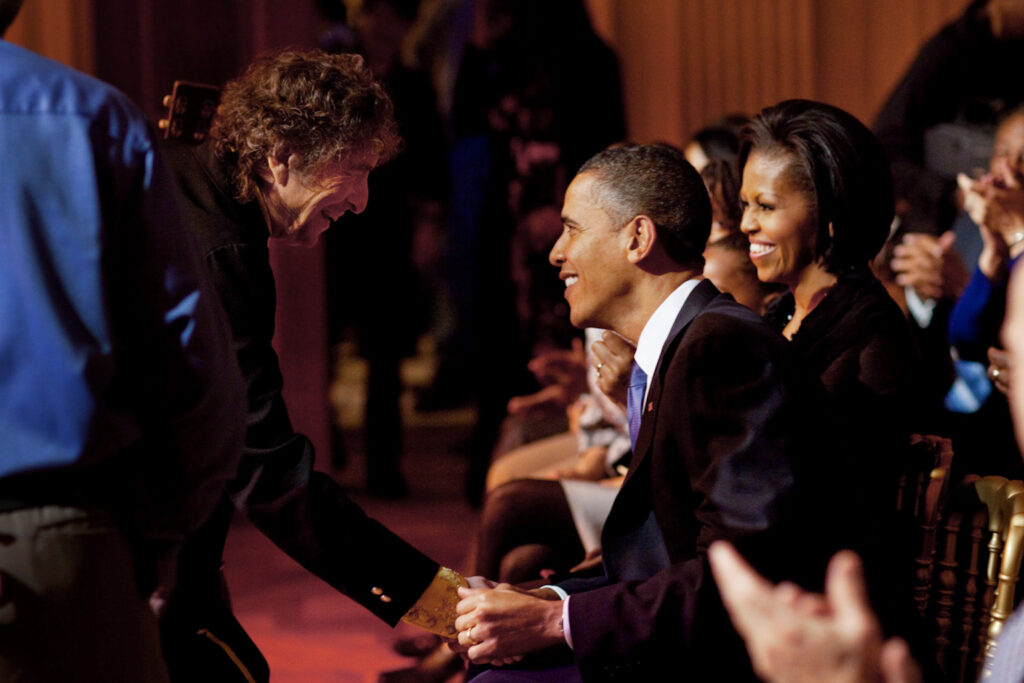
This trait of Dylan’s finds its corollary in a story told by former President Barack Obama in his memoir A Promised Land (2020). When Dylan played at the White House during the Obama administration, at the end of the performance Dylan simply shook the then president’s hand and left, saying nothing. ‘Even the president of the United States sometimes must have to stand naked,’ as he put it in ‘It’s Alright, Ma (I’m Only Bleeding)’. One suspects that Bob Dylan has never been afraid of anyone.
Bob Dylan shakes President Barack Obama’s hand following his performance at the “In Performance At The White House: A Celebration Of Music From The Civil Rights Movement” concert in the East Room of the White House, Feb. 9, 2010. (Official White House Photo by Pete Souza).
The Guthrie story is a reminder that we tend to get to where we need to be by being out in the world and meeting people; we never achieve in a vacuum but by the dint and say-so of others. Music journalist Tom Moon tells me that today ‘the Bob sphere is weird even in “normal” times’ but at the outset of Dylan’s career, when it mattered, the young singer made all the right moves, charming the crowds in Greenwich Village, signing with Columbia Records, and submitting to the aegis of manager Albert Grossman.
“The Bob sphere is weird even in ‘normal’ times”
Rock critic, Tom Moon
In time he would assemble a band whom he could trust and who were inspired to get better over time. His 1975 tour the Rolling Thunder Revue was, among many things, a celebration of friendship. And it’s thanks to his capacity as a bandleader we now have that highly underrated achievement the Never Ending Tour, which began on June 7th 1988 and ended – or paused – with the advent of the Covid-19 pandemic in the early part of 2020.
In reference to his longevity, Emma Swift says: ‘There’s a counter-narrative in our culture that says that music is for young people – that if you haven’t made it as a musician by 13 you should just stop. Dylan’s career runs counter to that and though he was working very much as a young man, he’s continued that throughout his entire life. He makes a very persuasive argument that the time for art is always now.’
From the vantage-point of today, Dylan’s career might seem to be to do with longevity – but longevity must be teed up when young, and it helps to have made the right decisions from a young age.
Emma Swift has recently recorded an album of Dylan covers. “[Dylan] makes a very persuasive argument that the time for art is always now’. Photo: Michael Coghlan
Dylan has never grown bored; his energy remains astonishing. Richard Thomas concurs that Dylan’s career showcases ‘resilience, energy, adaptability, mystique, humour’ – qualities that would not have been sustainable had his original decision in Hibbing to pursue music not been the right one. ‘I’ll know my song well before I start singing,’ as Dylan sings in ‘A Hard Rain’s a-Gonna Fall’ – yes, and to know that singing is what we should be doing in the first place.
In a March 2020 interview, Gina Gershon confirmed Dylan’s boyish love for what he does: “He read me some lyrics he was writing and he was all excited…,” she recalled. “I was thinking, ‘Oh my God, this is so cool.’ You could see why he still loves doing what he does and why he’s excited…”
“He only ever repeats himself valuably, somehow anew, which is not true of the rest of us”
Christopher Ricks, author of Dylan’s Visions of Sin
When I speak to the great Dylan critic, author of Visions of Sin (2004), and former Professor of Poetry at Oxford University Christopher Ricks, he agrees with Swift: ‘He only ever repeats himself valuably, somehow anew, which is not true of the rest of us.’ This remains true in his touring, where Dylan – famously, and sometimes to fans’ perplexity – will never perform a song in the same way twice.
His Back Pages
Throughout this life of performance, of course, Dylan has been compiling the greatest songbook of any American songwriter in the post-war period. It is a vast corpus, where wisdom sits alongside glorious nonsense – and where solemnity and comedy, yearning and rage, all equally have their home.
It must be said that the idea of plucking contemporary jobs tips from the Dylan oeuvre can seem an exceptionally unpromising avenue of enquiry. Dylan himself has sometimes been self-deprecating about the idea of extracting meaning from his songs. As he wrote in ‘Mr. Tambourine Man’, ‘If you hear vague traces of skipping reels of rhyme/it’s just a ragged clown behind.’ Dylan here appears as something like Charlie Chaplin’s Little Tramp: Don’t pay him any mind.
Few have taken him at his word there. More problematically, the songwriter’s reliance on the folk repertoire means that the economy he is describing in his songs tends to predate ours. One might seek in vain in the Dylan canon for direct advice about how to make it in the professions, or hints about how best to make LinkedIn work for you.
But this leaning so heavily on a rich hinterland of American song, might amount to another lesson. His work shows a remarkable respect for the past – as well as a willingness to question the present. Dylan’s second studio album was called The Freewheelin’ Bob Dylan (1963). Paul Williams once said that Dylan’s songs essentially teach us that when a man learns to be free only then can he be in with a shot of happiness.
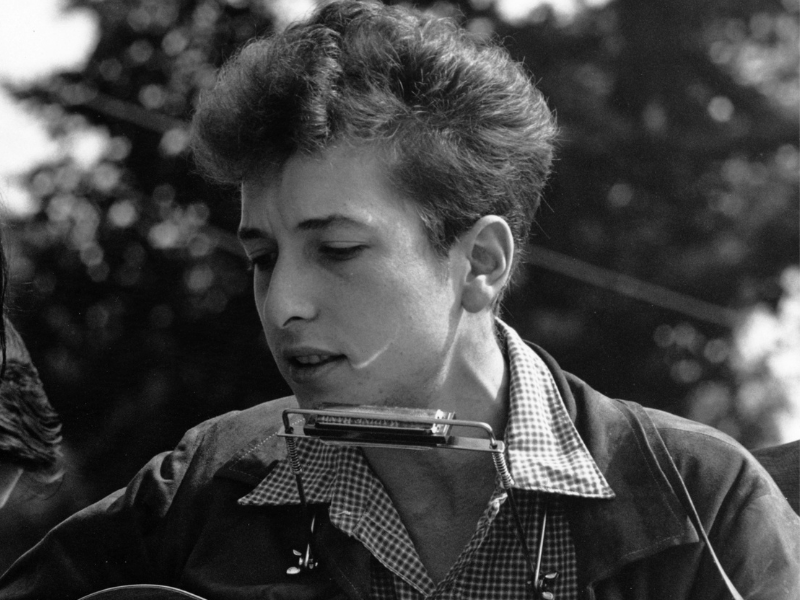
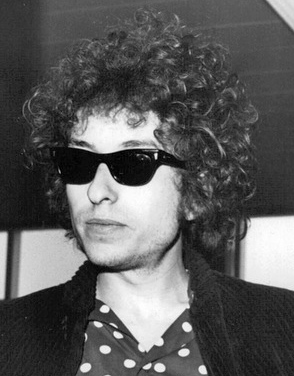
Dylan in 1966. Dylan’s oeuvre, according to Paul Williams, teach us that only when a man is free can he begin to be happy. Photo credit: image in the public domain.
But we can only be free in relation to others. As much as he would distance himself from the label ‘protest singer’ over time, Dylan’s repertoire contains songs of high-minded hatred towards the establishment. ‘Masters of War’, ‘Only a Pawn in Their Game’, ‘Pay in Blood’: these songs warn us off a career bereft of a healthy scepticism about the way things are. Dylan’s songs tell us that to question the status quo is a first step towards our finding a place in it.
This freedom is not only something that Dylan exhibits; it is something he bestows on the characters in his songs. Dylan’s is a world of freely moving drifters (‘The Drifter’s Escape’), wronged boxers hurtling unimpeded towards their fates (‘Hurricane’), mafiosi (‘Joey’), and a whole range of po’ boys and girls, who seem almost liberated by their impoverishment. Everything – everyone – is in continual motion: ‘Only one thing I did wrong/stayed in Mississippi a day too long.’ Even William Zantzinger, the murderer in ‘The Lonesome Death of Hattie Carroll’ is defined by his freedom.
“His actual experience is tempered by what the folk tradition, always where much of his songs go back to, dealt with’
Professor Richard F. Thomas
The Harvard professor and author of Why Dylan Matters Professor Richard F. Thomas explains: ‘‘Workingman’s Blues #2’ is in part about working’ but he agrees the middle class doesn’t feature. ‘His actual experience is tempered by what the folk tradition, always where much of his songs go back to, deals with.’
All I Really Want to Do
And yet there are few, if any moments of sloth in Dylan’s life. ‘Lay Down Your Weary Tune’. ‘Watching the River Flow.’ These are songs about pausing, but they are also moments of expression – of activity – for Dylan himself.
While Dylan turns a sceptical eye on ‘the masters of war’ who too often prosper in the present, he teaches an intense respect for the wisdom contained in the folkloric tradition.
This resonates in other professions. Anyone who has spoken to Sir Martin Sorrell will find him as passionate about advertising as it used to be as much as it is now. Likewise, readers of Andrew Marr’s survey of journalism My Trade (2004), will note that secreted in the BBC man adept in a modern medium, is a historian. Success is to do with a sense of how this moment fits into the preceding and those which will come; this can only be achieved by hard study, and utter commitment.
It is apt that while Dylan’s milieu is the past, he has nevertheless managed to prosper within the contemporary moment, and there is no-one alive today whose works seem more assured of a future audience. This fact was especially brought home in late 2020 when Dylan sold his songbook to Universal for a reported figure in the $300 million range.
This respect for tradition is a lesson he bequeaths to his musicians. As Professor Thomas explains: ‘The musicians he has worked with are in awe of him as a teacher of the musical traditions he wants them to be up on.’ So would Dylan have made a good teacher? Thomas says: ‘While I can’t see him in a classroom (“the mongrel dogs who teach” (‘My Back Pages’), though that’s some time ago), I believe he cares deeply about what matters to him, and that is the first ingredient of a good teacher.’
Fleetingly, and perhaps jokingly, Dylan once imagined in an interview with AARP an alternate route for himself: ‘If I had to do it all over again, I’d be a schoolteacher.’ In what subject? ‘Roman history or theology.’
When I Paint My Masterpiece
It might be hard to imagine the Dylan energy contained in a school. In fact, it isn’t even contained within music.
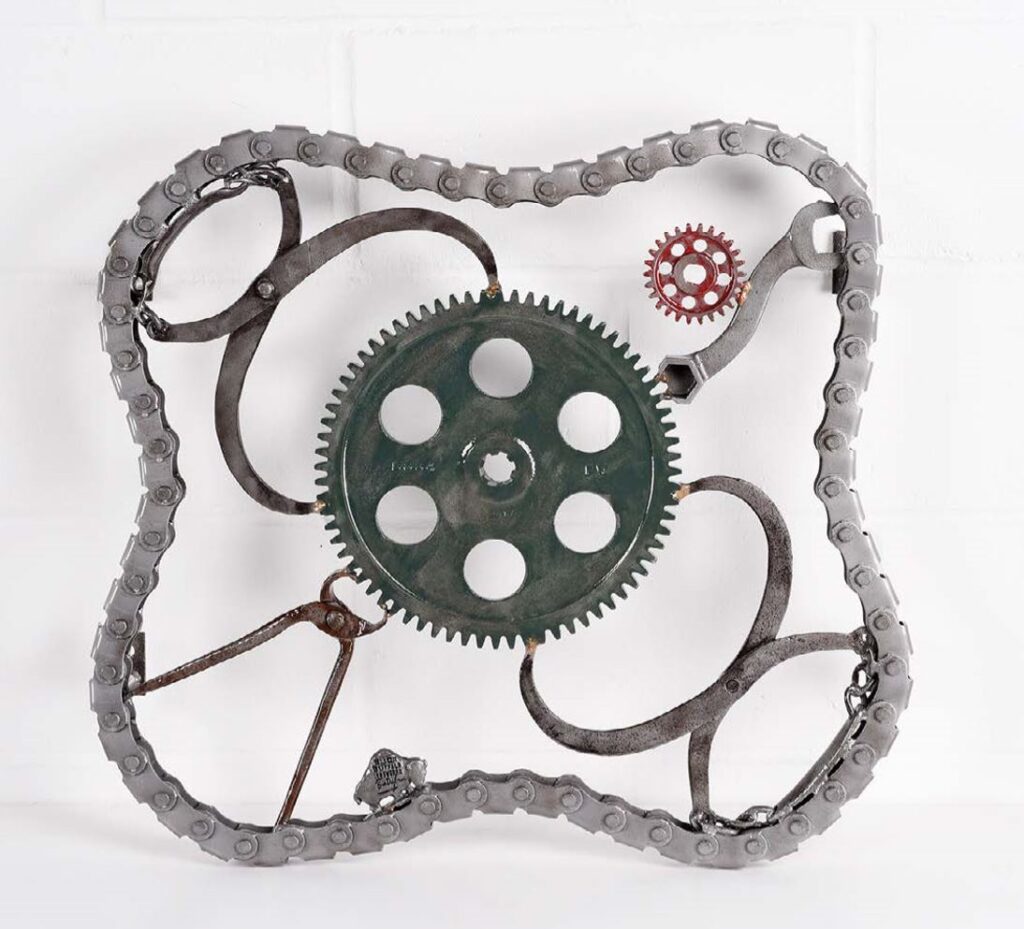
In recent years, Dylan-watchers have become increasingly aware of the scope of their man’s achievement in the visual arts. A recent episode of the HBO drama Billions shows hedge fund billionaire Bobby Axelrod with some of Dylan’s work in his home. During the COVID-19 pandemic – according to insiders at London’s Halcyon Gallery – Dylan was not only commissioned to produce a metalwork sculpture for Ronald Reagan Airport, but delivered some 20 works to the gallery.
Dylan’s brilliant metal sculptures show another side of Dylan’s creativity
The appreciation of Dylan as artist and as sculptor is still in its infancy.
Emma Swift tells me: ‘Dylan has taught me a lot about the interconnectedness of art forms. I used to think about poetry and music and visual art separately. Now I don’t. All the video clips for my Dylan record are animated, so they’re very much a celebration of the visual to go alongside the music.’ Dylan’s career here again emerges as an exercise in creative freedom – both within his own art form and in an interdisciplinary sense.
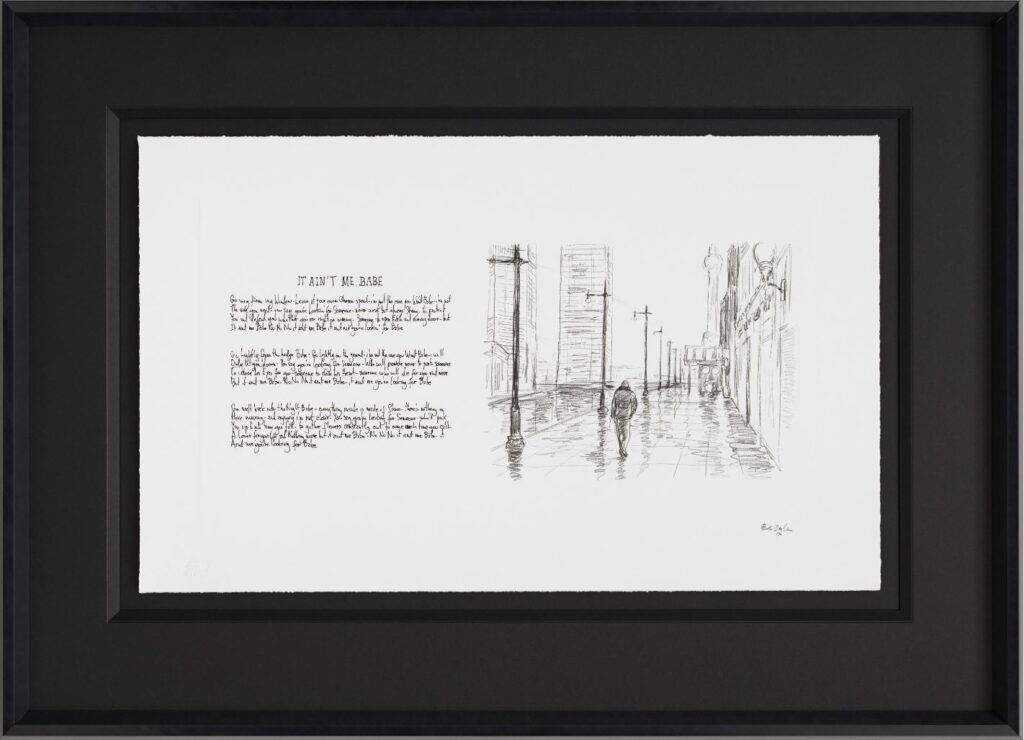
I head up to central London, for a behind-the-scenes tour of the Halcyon’s Bob Dylan Editions show. In many of the pictures, the influence of Edward Hopper is paramount. This is an America which has to some extent lapsed. We find motels and diners, parking-lots, cinemas and burger-joints. It is an image of everyday America, which isn’t meant to feel contemporary. Like his music, these are artefacts of collective memory; the paintings feel like acts of nostalgic preservation.
Most marvellous of all are the metal-sculptures. Upstairs, Georgia Hughes, an art consultant at the Halcyon, shows me a blown-up picture of Dylan in his California studio. Wiry and tough-looking even in old age, he stares eagle-like on his metals, the materials of his art. Hughes explains how Dylan rescues the metals from the scrapyards around California. I quote back at her the lines of ‘When I Paint My Masterpiece’: ‘Well, the streets of Rome are filled with rubble.’ She replies: ‘Dylan’s art has to do with finding what lies near to hand and transforming it.’
One I particularly like is a wall-hanging (see opposite), where the pieces of metal, the discarded spanners and wrenches feel somehow like a sea-creature peculiarly adapted to its environment.
Dylan’s illustrated lyrics with signature now cost £2,000
Dylan’s art career shows us that his is a porous existence where all options are on the table. Whenever one thinks of the successful, they always seem free of the doubts which seem to constrict others. If their lives often feel peculiarly uncompartmentalised, then perhaps it is because they proceed in freedom.
“He does all kinds of things that are kind of shocking, and I think it opens it up for everybody else”
Emma Swift
Money doesn’t talk, it swears
Of course, if we wanted direct lessons about our lives from Dylan then his business interests are there for all to see. Put simply, Dylan has not been afraid to monetise himself.
Bobdylan.com, in addition to providing information about tour dates and the artist’s songbook, is primarily a shop, hawking everything from key rings and hip flasks, to tote bags and his new Heaven’s Door whiskey. In the past he has let Apple, Chrysler, Cadillac and Pepsi use his songs.
Emma Swift gives her reaction: ‘He does all kinds of things that are kind of shocking, and I think it opens it up for everybody else. You know, if Dylan puts his song in an ad…okay, I guess it’s fine.’ Again, there is fearlessness here – he is prepared to risk being labelled a sell-out and happy to let the songs speak for themselves in whatever context they happen to be used.
When I ask Thomas what lessons Dylan’s life ultimately has to teach, he replies: ‘Read, listen, read, enquire, don’t be presentist!’
If one were to ask oneself why Dylan’s work is richer than that of his contemporaries then it has something to do with the range of reference brought to bear in a setting where one might not normally expect it. This is the case even when his work is compared to that of literary contemporaries such as Paul Simon and Joni Mitchell, though there will always be some – the late Clive James among them – who would prefer the poetry of Leonard Cohen.
And not being ‘presentist’? On the face of it, this might not seem to fit Dylan. Joni Mitchell had this to say about him: ‘Bob is not authentic at all. He’s a plagiarist, and his name and voice are fake. Everything about Bob is a deception.’
Harsh as this is, it is a frustration Paul Simon has also aired: ‘One of my deficiencies is my voice sounds sincere. I’ve tried to sound ironic. I don’t. I can’t. Dylan, everything he sings has two meanings. He’s telling you the truth and making fun of you at the same time. I sound sincere every time.’
But one suspects that Dylan would have no audience at all, if there wasn’t truth at the core of his work. It is rather that he has been true to his nature by being opaque. He hasn’t let his desire to tell the truth get in the way of being mysterious – and vice versa. At the Halcyon exhibition there is a wall of magazine covers devoted to Dylan. It doesn’t matter how much we photograph or try to know him; his eyes won’t let us in entirely.
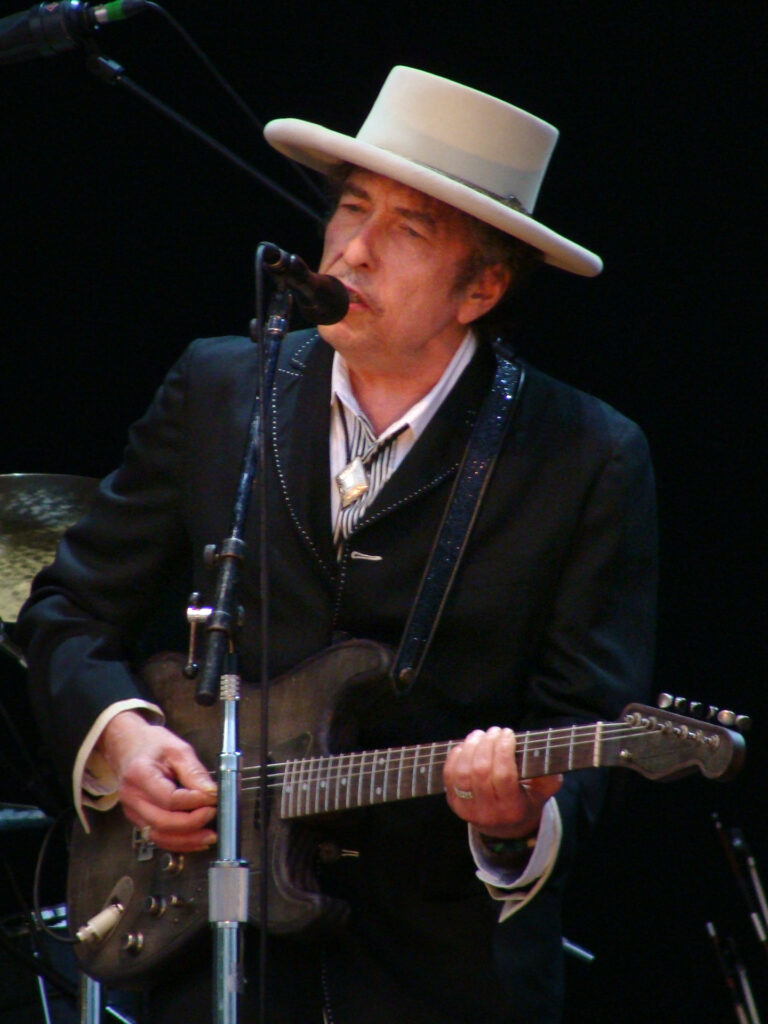
As Dylan enters his ninth decade, he is among those rare American artists who seems to have fulfilled their talent. Photo credit: By Alberto Cabello from Vitoria Gasteiz – Bob Dylan, CC BY 2.0, https://commons.wikimedia.org/w/index.php?curid=11811170
Forever Young
As Dylan enters his ninth decade, there is much his career has to teach those who are embarking on their own lives. It’s true that there is dispute in literary circles about the extent of his literary achievement. But Dylan has been plausibly compared to William Shakespeare and to John Keats. We know far more about Dylan’s life than we do about the Elizabethan, and Dylan has lived out his talent far more than Keats, who died at 26.
In spite of the singularity of his achievement, Dylan continues to repay study. Besides, the man who wrote ‘Don’t follow leaders./Watch your parking meters’, isn’t so much telling us what to do, as inviting us in. Once we accept his invitation, we find we become richer, wiser. There is a generosity somewhere near the core of his art. Dylan once said: ‘Every song tails off with “Good Luck, – I hope you make it.”
He never said where – but he didn’t have to. As often with Dylan, we sort of know what he means, but we have to fill in the gaps ourselves.
As the world comes out of COVID-19, Iris Spark looks for lessons from art created during the Spanish flu pandemic about where we go from here
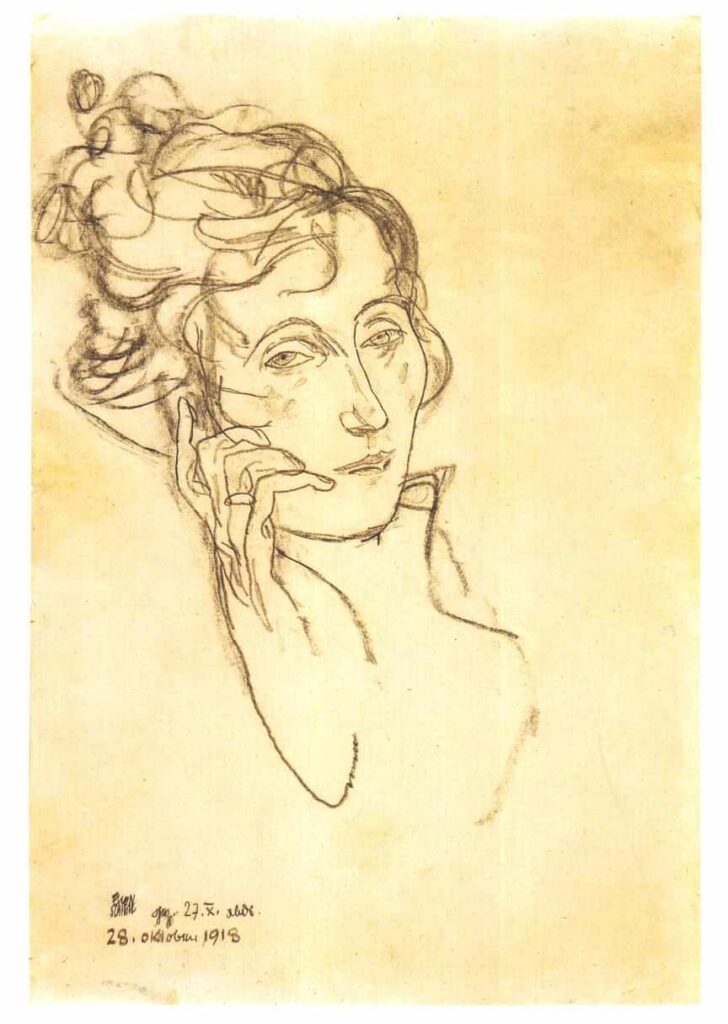
Edith Schiele, Egon Schiele, 1918
Consider this woman above. Unless we were to look closely at her, we might not know that she is set to die tomorrow. It’s true that her gaze is melancholy, but we might miss that her sadness has a leaden weight to it, distinct from the sadness we see in many romantic portraits. The clue to her condition is her gnarled and crooked hand, which tells the rapid encroachment of death more than her face, which still – heartbreakingly – has youth on its side. The more you look, the more signs of the seriousness of her condition are brought home. There are the strokes of discoloration on her cheeks. The lips are thin, a sign of the cyanosis which accompanied a deadly case of influenza.
The woman’s name was Edith Schiele, and she was married to that brief star of the modernist period Egon Schiele, whose works today can fetch as much as $40 million. Egon himself would die three days after drawing this picture. He was 28. It was an unhappy end to a life about to take off. As inauspicious as this story might seem, as we seek to emerge from the other side of the pandemic, it is a useful place to start if we wish to consider what can be learned from a study of the last pandemic about our current direction of travel.
We all know the statistics about the pandemic: the numbers dead or infected; and the jobs lost. But the data does not tell the full story.
Modern Family
Statistics blur over time; what’s left is the poetry and the art which a society creates. If we consider the so-called Spanish flu pandemic, which raged from 1918-1919, and which killed 100 million people, and infecting 500 million, we can see clearly in the era’s painting a trajectory which might well prove relevant for our times as we implement our vaccination programmes.
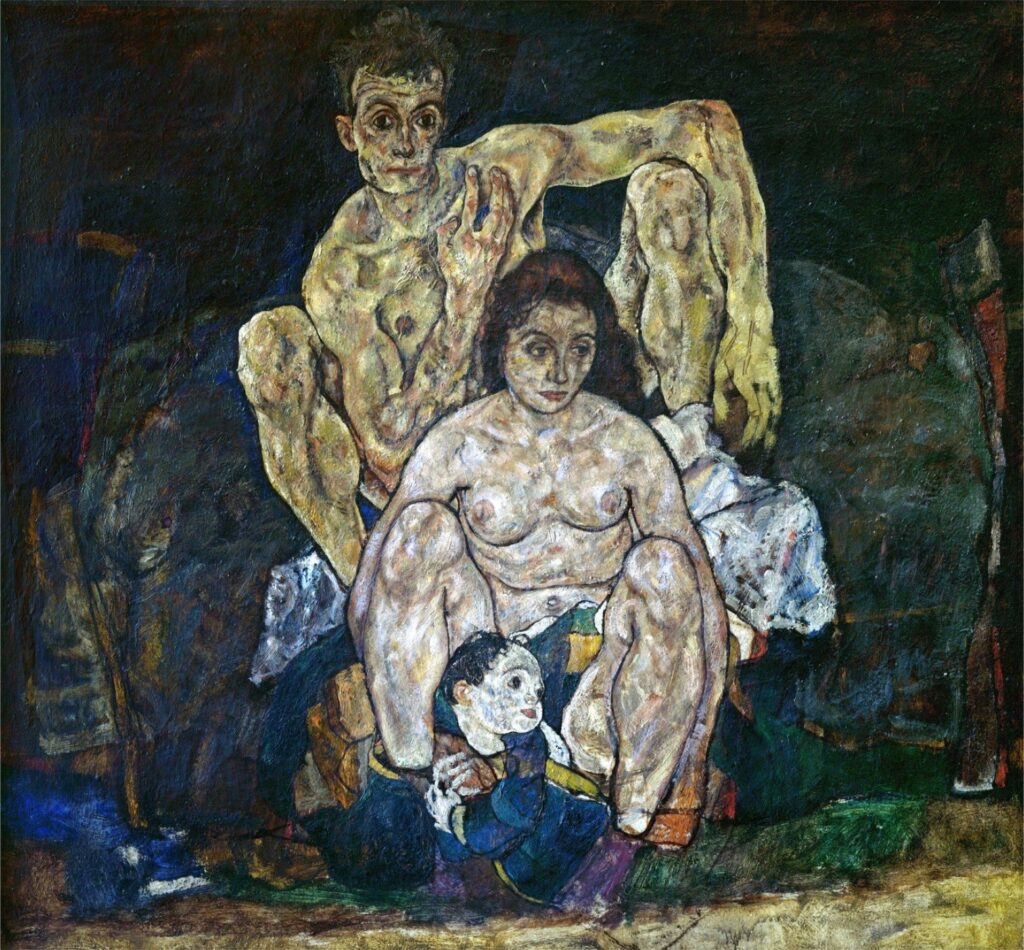
We have to start with an acknowledgement of the enormity of what has happened to us with the pandemic. This was evident too during the Spanish influenza. It can be seen, for instance, in the pictures Schiele made towards the end of his life. One is The Family (1918) – one of his last, and it would remain unfinished. This is a picture which in its mood is capable of placing us back in February 2020. It contains the foreboding of a vitality about to be stymied.
In this picture, two things alert us to the tragic state of affairs about to engulf the family: the first is the artist’s decision to depict his unborn child as if he wished to personify a child who would not survive the womb. The second is his painting of his own expression as blank and melancholy, his skin as jaundiced.
The baby might stand as a symbol for all the unborn projects which are stymied by the arrival of disease. But the definition of the musculature and the solidity of the forms make one feel uncomfortable about calling this an entirely pessimistic picture: there is will to endure here, and we can’t say it is any the less important simply because, in this instance, nobody in the picture survived.
Schiele, The Family
The picture is a reminder that the sheer oddity of what we have come through needs to be reckoned with and assimilated.
Fever Pitch
But surveying the art which arose out of 1918 pandemic, the most noteworthy thing is how difficult it is to depict illness. In pandemics we seem to enter a disjointed dreamscape. Illness isolates us, cuts us off from the solidity of the world. It partakes of the insubstantial, and can only be communicated in kaleidoscopic colours and the pictorial language of dreams.
In 1918, those artists who did experience a brush (or worse) with the Spanish flu, had already begun to intuit life as being at its core somewhat feverish and strange. This means we cannot always see how the influenza affected artists – they were, in some sense, feeling rather fluey about life beforehand.
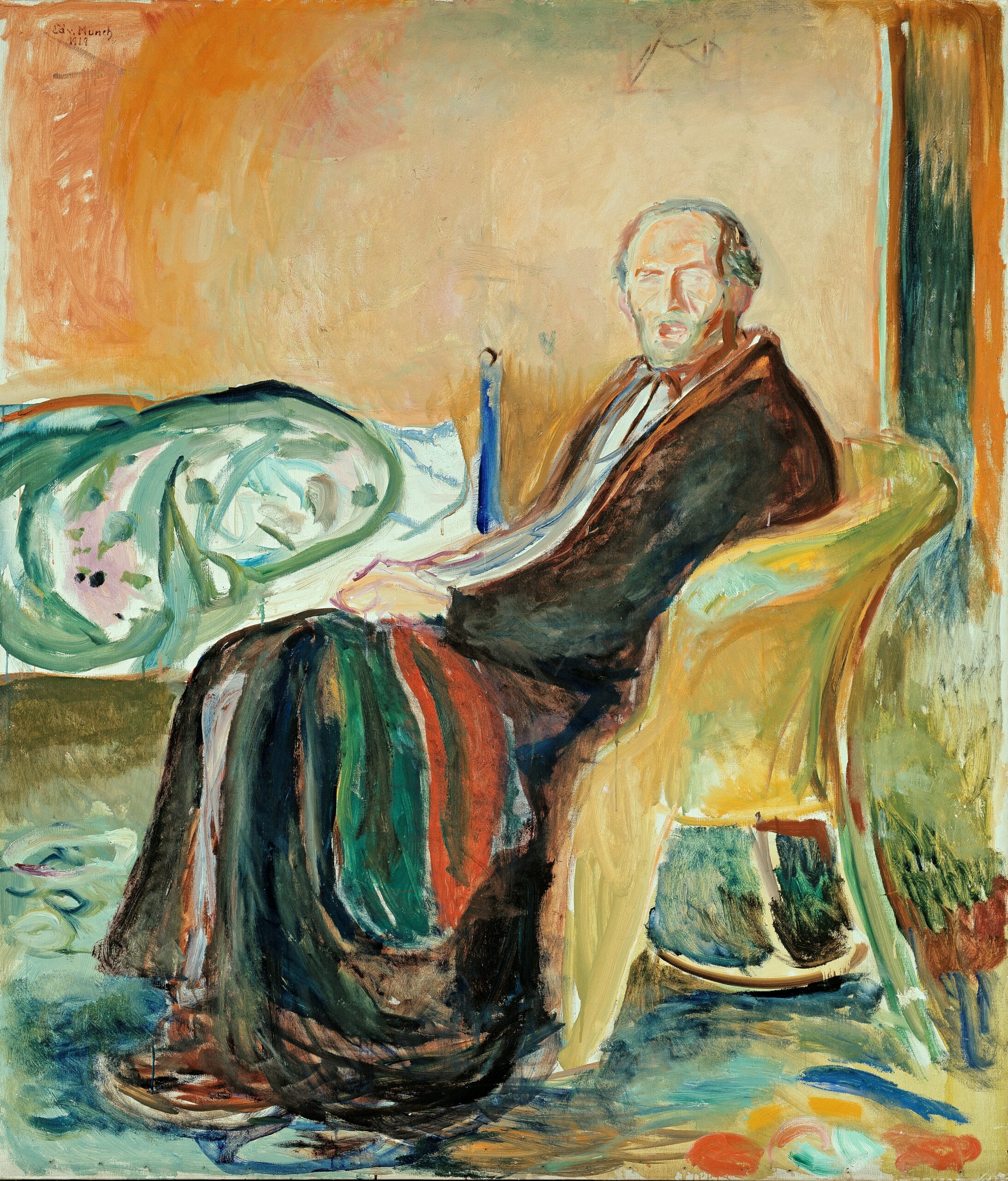
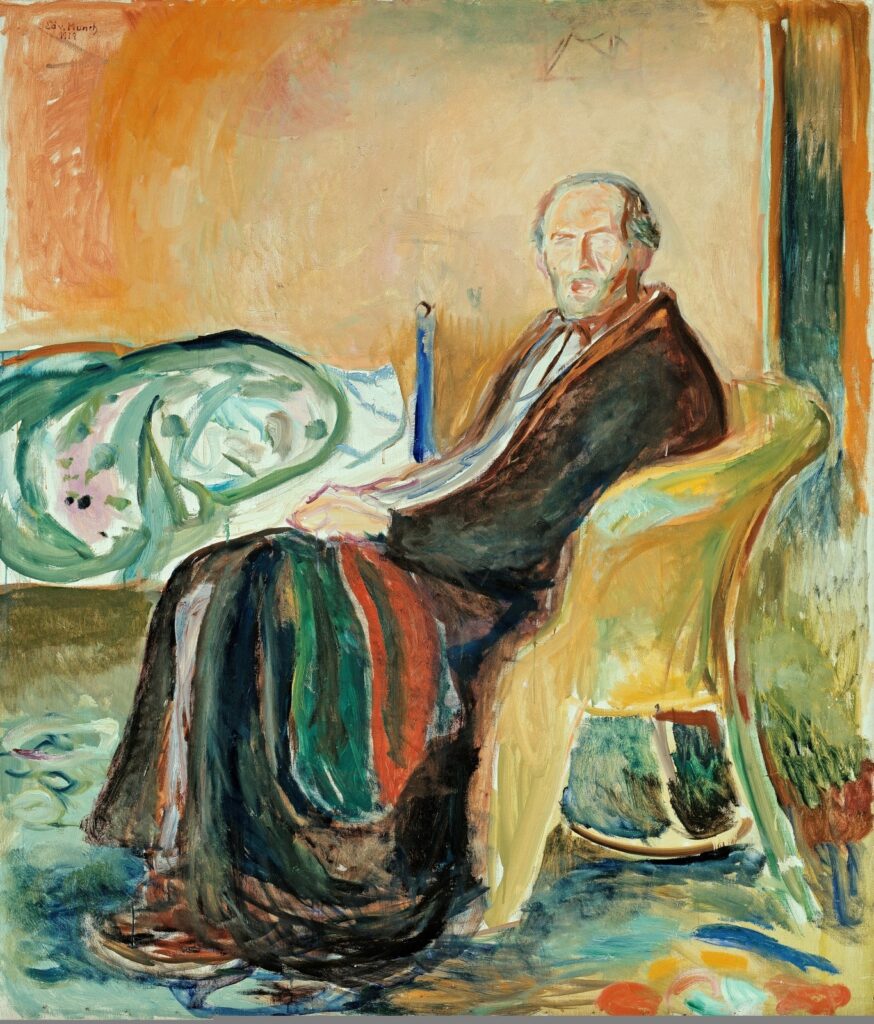
Most notable among these was Edvard Munch (1863-1944) who also contracted the flu and produced two portraits (see opposite) about the experience Self-Portrait with the Spanish Flu and Self-Portrait After the Spanish Flu. In the first, Munch is depicted in a seated position with a blanket over his knees. The sheet beside him seems to be developing into a face, as if artist or sitter is hallucinating. The detail of his face is subservient to a swirl of colour. But how different is this picture philosophically to 1893’s famous picture The Scream?
When I talk to art specialist Angelina Giovanni she explains: ‘It’s very interesting that in the case of Munch – probably because themes of loss and death had already been present in his work – the way he depicts himself is no different in terms of style. Instead, it has a certain linearity within his existing body of work.’
Giovanni explains that it is as if Munch found some sort of confirmation of his prior experience by falling ill. The world had seemed disjointed before; and it continued to feel so when the influenza struck him. Giovanni continues: ‘Munch can so effortlessly depict himself within his predicament that were it not for the historical information that tells us that the work was painted when he had contracted the Spanish Flu, we might not have been able to place it in a particular point in time.’
While pandemics might illustrate our vulnerability vividly, they might not fundamentally change our method of vision. The world is elastic, and will return to its former shapes and structures.
But there is also no doubt that pandemics create an atmosphere of reflection which can be harnessed in future years. When I catch up with Fake or Fortune star Phillip Mould, he says: ‘When you’re locked down, and you remain in your own habitat, it’s a more meditative cultural experience and you think about the outside world in a different way.’ Mould even wonders whether we shall have more full-length portraits in future, now that we are all looking at each from six feet away.
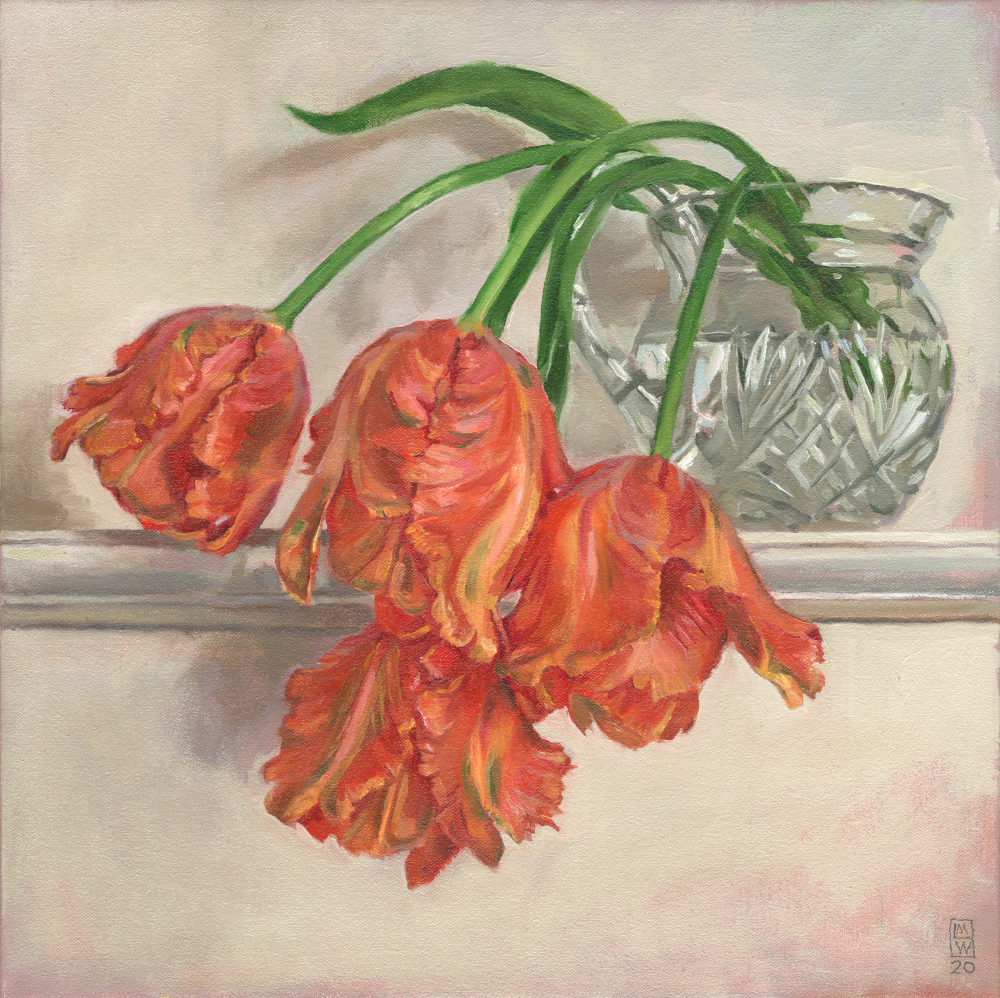
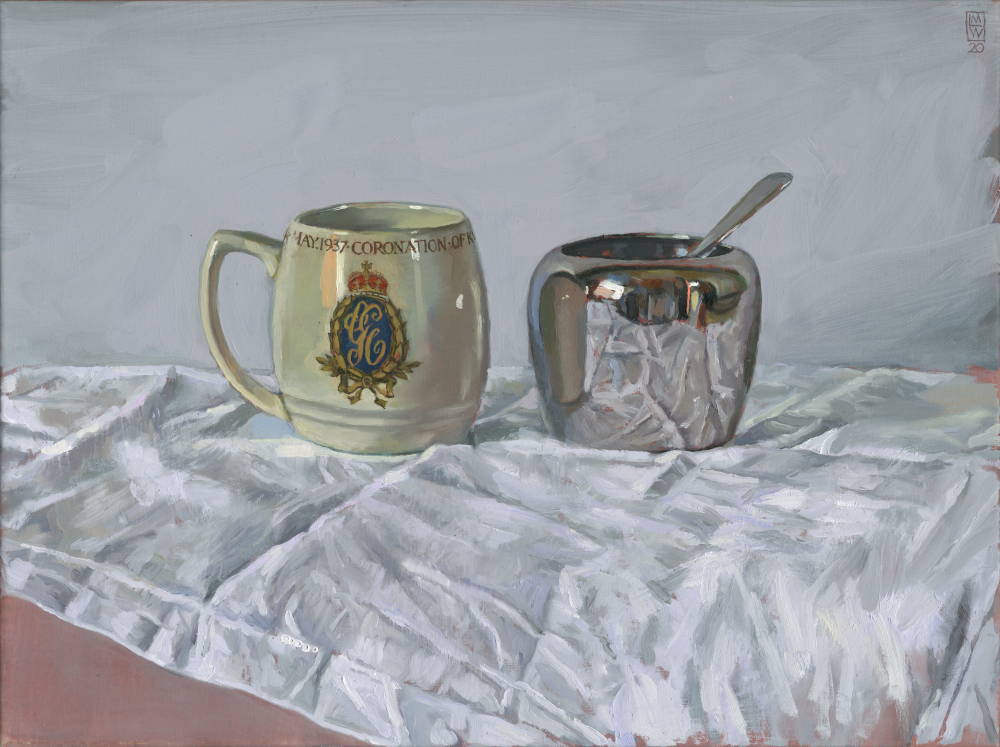
For Mould this meditative spirit is best captured by Lorna May Wadsworth’s superb still lives painted during lockdown, in which mere things – cups and vases – attain a meditative quality which, in his view, supersedes her previous work as a portrait painter.
Edvard Munch, Self-Portrait with the Spanish Flu, 1919.
It was the American novelist Saul Bellow who once wrote that ‘Death is the dark backing a mirror needs if we are to see anything.’ The Spanish flu and COVID-19 pandemics caused a widespread awareness of mortality: what appears to happen is that our relationship to death is placed again under the microscope.
In 1919, the experience of finding oneself so suddenly vulnerable expressed itself visually.
Death Becomes Us
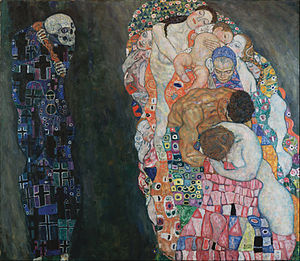
Egon Schiele was not the only major artist to be claimed by the influenza. The other was Gustav Klimt, who suffered a stroke and died as a result of catching the infection. He was famous at the time for his painting Death and Life (1916). Here we have a close approximation of what death meant to the early 20th century mind – albeit through the prism of an individual of genius.
Death hovers to one said of the main grouping, his clothing patterned with crucifixes. These religious symbols act as a reminder that as radical as we think him, Klimt inhabited a world where Christian imagery was more prevalent than it is in our time.
Gustav Klimt, Death and Life
How are we to feel about the figures on the right? Are they detached from death – in a kind of legitimate bliss of colour, and shared bodily warmth? Or are we to feel that they are failing to be awake to the menace of death as shown by the Reaper on the left-hand side of the painting? It’s likely that the picture contains both interpretations.
For Philip Mould the art of this period presents a problem in that ‘it is always hard to be sure what devolves from the First World War and what from the flu pandemic.’ What is clear is that with death more prevalent, something like a medieval acquaintance with death had been transposed into a modern setting. This can connect us with primitive political instincts – as was shown in the 1920s rise of fascism and as may be evident also in the riots in the Capitol, Washington D.C. on January 6th 2020.
Of course, in our own times, death has been depicted somewhat differently. Whereas death is still symbolised in Klimt by the medieval figure of the Grim Reaper, today death is represented with scientific diagrams such as the one opposite. Such images give a different sense of death. Here the virus appears has something spherical but prickly, but undeniably alien: an intruder. The Klimt picture shows death is demonic – which is to say almost human. It is an indicator of how our society has shifted.
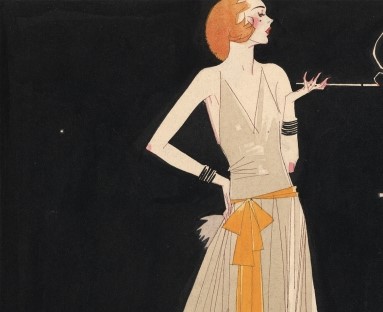
Russell Paterson, Where There’s Smoke There’s Fire
Cocktail Hour
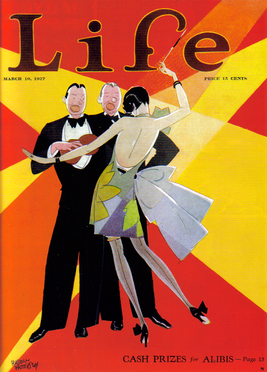
But what happens in the 1920s once society has recovered from a pandemic and we are able to interact confidently again? In the visual arts of the 1920s, we see the return of the line. The Art Deco style, as shown by the superb Russell Patterson illustration ‘Where there’s smoke there’s fire’ couldn’t be further from the blur of the Munch paintings. Society has returned to health. The owner of this body is again confident not just in herself but also in the bodily pleasure of smoking. Likewise, a renewed bodily confidence is again suggested in the cover of Life opposite which shows the joy of dancing – and again, all told in a strong line and healthful colours.
So might we find that once the world returns to normal we shall see the meditative aspects of our art today cede to something more dynamic, more fitting to the partying spirit?
That remains to be seen, of course, but as everyone knows the 1920s are not the end of the story. We find a move towards health and life in the art of the 1920s, but it is a fine line between this development and excess. In literature, the crucial text would be The Great Gatsby, in which F. Scott Fitzgerald’s own ‘crack-up’ is prefigured. His friend Ernest Hemingway would soon find his work affected by the excesses of drink – alcoholism would also lead to suicide.
In the visual arts, it might be said that the artistic world bifurcates along two vectors of greatness: towards Henri Matisse (1869-1954) and Pablo Picasso (1881-1973). Both were active at the time of the Spanish flu, though neither experienced a sufficiently severe case for us to say with certainty how it impacted their creative output.
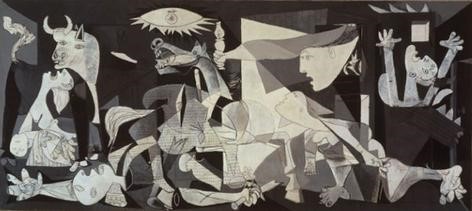
Picasso’s own commitment to the line was always, with the invention of Cubism, synonymous with the notion of fragmentation. He seems in his pictures from 1906 onwards to see round things – to intuit time and meaning at work within the appearance of a given object.
But by the time we reach Guernica (1937), his vast oil painting depicting the Spanish Civil War, we can see how he is no longer depicting the complexity within objects as some fundamental fracture in society. Here, we find the sort of visions which might be intuited in the work of Schiele and Munch with which we began. It is as if we are now confronted with their worst fears enacted.
Pablo Picasso, La Guernica, oil on canvas, 1937
So what had happened in the intervening time? The short answer, of course, is fascism and there will be few who have witnessed developments in America these past years who can be certain that once the deprivations of coronavirus have passed, we might not head in that direction.
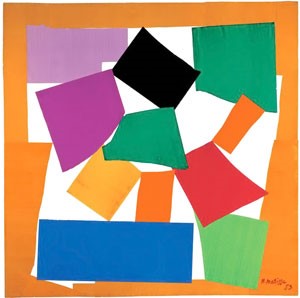
But the art of Henri Matisse shows a more hopeful story. In old age, he became a celebrator of simple colour, simple pattern, and graceful movement. If Picasso’s nightmarish canvas shows the fears of Schiele and Munch more than realised, then we might argue that Matisse’s scissor art in its childlike delight at colour and shape shows what they’d have liked to go on living for – they indicate something of the joy we all feel about the life which we all fear departing one day.
Perhaps all this is encapsulated in his great late cut-out The Snail, which he worked on after his stroke from 1952-3. It is an exercise in chromatic colour but it is the title which might strike us: since there is no sense in which this a realistic depiction of a snail we are liberated into feeling that Matisse is here showing us something of the feeling he gets from looking at one of nature’s humbler creatures.
Henri Matisse, The Snail, 1953, Gouache on Paper
In 2021, we should hope for just such an arrival in ourselves. Locked down in our homes we have seen the world at a slower pace, with more centredness, than we had been used to doing during our frenetic pre-pandemic lives. Matisse reminds us that we must retain what we might call the joy of the sedentary.
Like this, the art of the past has its messages. We must never forget what happened to Schiele, and to Klimt – and pay it appropriate respect and remembrance. But we must realise how superior a life of activity is, as shown by the advent of the Art Deco, while not forgetting that an abundance of energy, especially if it is misdirected, can lead to the horrors that Picasso depicted in La Guernica.
And if we look at Edith Schiele again, it is possible to look at her eyes and imagine that all this is somehow contained in those nearly hooded eyes. She sees us and doesn’t see us – just as we see and do not always recognise ourselves. But this is the help art gives us, as there is one sitting across from her – an artist who happens to be her husband – who gauges her with unusual intensity.
This is the privilege of art – to come from us, and yet somehow to know more than we do. When the art galleries open again post-pandemic there shall be wonderful things to see.
Lily Lewis is marching me off to buy a coffee with her pooch, Betty. It’s the kind of small strutting dog that looks as though it’d be most at home in a designer handbag. It suits Lily, the strikingly beautiful, effortlessly glamorous artist daughter of former Groucho Club chair and hotelier, John. She tells me she rescued the dog from a puppy farm after its owner died during the pandemic. This seems rather typical of Lily too.
For instance, Lily used Safe Spaces, her portrait exhibition which featured mistreated Hollywood stars from the 1930s and ‘40s, as a way to raise charity funds. “I called up Refuge and said, ‘I’m going to help you and there’s nothing you can do about it,’” she tells me in a melodious voice that sounds like cigarettes and money. And so she did. During a private auction of the portraits attended by the likes of singer Ellie Goulding and her art dealer husband Caspar Jopling, Lily raised around £70,000 for the charity. “I have a platform and it would be seriously remiss if I had an opening and just had a drinks party for people I already know, who come from a position of privilege,” she says dutifully.
I attended this private exhibition a few days prior to our interview where I bumped into actor Claire Forlani who had tears in her eyes while viewing the work. Lily tells me she met Claire during a holiday in Italy which was attended by the likes of director Sir Nicholas Hytner, prime minister Boris Johnson and his then wife Marina Wheeler. While everybody was being “unbelievably grown up” the pair bonded over their inappropriately fervent love of truffle.
Lily recalls with a mischievous giggle: “In the evenings we’d have a huge plate of pasta and someone would come around with white truffle and a white glove and expect us to say when. Claire and I got to about four fists of this stuff each and we’d go ‘no, no, keep going’. At the end of the weekend they basically brought a ball between us, and a spoon.”
In my day job as a Diary reporter I encounter a lot of posh, society girls, who regale me with similarly ludicrously luxurious anecdotes but there’s something different about Lily. She is intelligent and talented and I get the impression, although she is part of London’s elite, she feels like an outsider.
As is the case with most interesting people, she didn’t get on with school.“I hated it,” she shudders, “every dog has their day and I’m glad mine wasn’t when I was 16”. She recalls her parents being called into the headmaster’s office as a teacher had started a petition for her and her siblings to be removed from the school.
After school, Lily studied textiles at Central St Martins but left after a few weeks as she hated this too. “I thought it was quite pretentious and there were a lot of people who hadn’t been great artists trying to break you because they had been attempted to be broken themselves. I am not a very likeable person to people in positions of authority. I would be terrible in an undemocratic republic. I would definitely have been burned as a witch,” she cackles. Instead, she attended Kings College London where she studied English Literature and then did a masters in Psychoanalysis.
There’s a cliche that people who study psychology are spurred by an interest in their own atypical brains. Indeed, Lily fulfils the cliche that cliches are often true and tells me about her atypical brain and synaesthesia. “I can sort of see colour and I can smell sound and my senses get mixed up… If someone hits a loud noise I see colour. I am a big fan of opera and that’s one of the reasons why.” She also tells me about the breakdown she suffered in New York. She moved there with a boyfriend and around Halloween time she told him she was popping back to the UK to pick up her stuff, she left and didn’t speak to him until February.
But she doesn’t think any of her emotional struggles have made her a better artist. “I don’t want to perpetuate the image of the artist having to be miserable because I don’t think that’s true. There’s a process of egg laying which is natural and uncomfortable. If there is a project that will end in a product I will get myself into a state where I am deeply uncomfortable in order to be able to produce it. Creative constipation is very different to struggling with mental health,” she insists.
Key to her success, she says, were her parents. Not only did they refuse to apologise for her being different, they also raised her and her three siblings in a hotel. They were all encouraged to be interested and interesting. The hotel was frequented by famous characters such as actors Tim Curry and Gary Oldman. She recalls sitting on Bond star Piers Brosnan’s lap as a little girl with him drawing pictures and telling stories. “Everything is a story. People tend to communicate with children in stories and so I met so many people that everyone had a story for me.”
Through her career as an artist and poet, she has continued to share stories. Perhaps it’s this heightened awareness of narratives that has contributed to her own quirky character. Often she speaks in aphorisms that make her sound like she’s playing a part in an Oscar Wilde play. Though her refusal to reveal her age seems to hold an outward looking awareness of the pressure of narratives rather than a Dorian Gray-esque vanity. “Do you have to put that in there? I don’t want to say,” she squeals when I ask her the question that all journalists have to ask. “I don’t think anyone needs to know it. I often find everyone always asks how old someone is to relativise what they have done in their life. I have never been keen on saying what age I am, it’s just so arbitrary.”
But she does think about getting older and of course, she factors in how she can continue to do good in the world. “I fully intend on training to be an art therapist because I have arthritis in my right hand and I am ambidextrous but there probably will be a time in which I am not able to paint any more or maybe not to the level I want to. I also want to help work in prisons.”
“My aim is to be rich, famous and thin and if I can’t be that I want to help,” she laughs.
There is a story that David Hockney tells often about being a young film enthusiast in Yorkshire, watching black and white Laurel and Hardy movies. Seeing the long shadows, he realised that Los Angeles, where they were filmed, must experience a lot of sunshine. Accordingly, he resolved to go there.
Today, Hockney is still enthralled by light – as you can see in the tree house picture with which this article is illustrated. Here is something like that same light which attracted the young Hockney, still attracting him at the age of 83. But this isn’t Californian light – it’s the light of Normandy, at the house called La Grande Cour, where he has lived in isolation since 2018 with his lucky assistants Jean-Pierre Gonçalves de Lima, known as J-P and Jonathan Wilkinson, together with his dog Ruby.
And, of course, unlike the images of California – such as 1967’s A Bigger Splash, for which he is still most famous – Hockney’s new works are not essays in paint but drawn on the free Brushes app on his iPad. The layered nature of paint has been replaced by marks which bear – perhaps a little too obviously – a digital mark: the dots, the pixelly sky.
“Ratified by time and the art market, David Hockney has never been one to mind what people say about him.”
To move forward but to stay the same – as with his hero Picasso, Hockney’s way of seeing is always his, no matter how much his method might be bound up in new technologies, and advances in his own understanding of what makes art.
Hockney’s A Bigger Splash remains his most famous picture
The eye always remains forensic and supremely confident – ratified by time and the art market, David Hockney has never been one to mind what others say about him. Right now that’s probably a good thing as the art world has rounded on him for his Piccadilly Circus tube sign, drawn with a whimsical humour which looked to struggling artists like cosy facetiousness – the ‘s’ in ‘Circus’ dropped off the end, the gag somewhat too easy, like someone used to having his jokes laughed at by acolytes.
Hockney’s new work has been much derided on the Internet (GLA)
The Royal Academy exhibition The Arrival of Spring hasn’t been particularly well-received either. It’s doubtful that the criticism will affect the supremely confident Yorkshireman. A contrarian spirit seems to replicate itself in many successful people. This is so with Hockney, whose love of life appears to begin in a healthy contempt for all do not share it, and who prefer to conform. ‘Boring old England,’ was his famous reasoning for leaving his home country for LA in the 1960s.
To study Hockney’s life and his art is to get to know the benefits of particular kind of bluff decisiveness. The octogenarian has always known his next move – or found it materialise it before him as a thing to be straightaway acted upon.
In Paris in the 1970s, he realised too many people were visiting him and that he wasn’t getting enough work done – keenly alive to the danger to his productivity, he straightaway upped and left. When he stayed on in England after Christmas in 2002, he realised that he had been missing the seasons of his native Yorkshire, and rearranged his life to take advantage of it.
Here he is describing the move in 2013’s A Bigger Message: “I began to see that that was something you miss in California because you don’t really get spring there. If you know the flowers well, you notice them coming out – but it’s not like northern Europe, where the transition from winter and the arrival of spring is this big dramatic event.”
“I began to see that that was something you miss in California because you don’t really get spring there.”
David Hockney
Then just before lockdown, came another example of the Hockney decisiveness: during a brief visit to Paris, he realised that Normandy attracted him sufficiently to be worth moving to. Here he is telling the story to Martin Gayford in the pair’s excellent collaboration Spring Cannot Be Cancelled: “It happened like this. We travelled to Normandy after the stained-glass window at Westminster Abbey was opened. We went through the Eurotunnel, via Calais. We stayed in this lovely hotel at Honfleur, where we saw this sunset.” In time, J-P was dispatched to an estate agents: “When we came in and saw the higgledy-piggledy building and that it had a tree house in the grounds, I said, ‘Yes, OK – let’s buy it’.”
“This house is for David Hockney and he wants to paint the arrival of spring in 2020, not in 2021!”
Fame had come for Le Grand Cour – destined no doubt to be a tourist attraction to rival Monet’s lily pond at Giverny. Of course, this freedom is partly the freedom of the immensely successful.
In Gayford’s telling of the house purchase, the sense of Hockney’s importance is evident when J-P is quoted as saying impatiently to delaying builders: “This house is for David Hockney and he wants to paint the arrival of spring in 2020, not in 2021!” One senses that he has surrounded himself with the right people; Hockney has the gift for friendship and loyalty. This hasn’t necessarily always been to the good: there are signs in The Arrival of Spring that a certain cosiness may finally have seeped into his work to its detriment.
Certainly the current exhibition which has been widely panned in the media, except by his friend-reviewers such as Jonathan Jones of The Guardian and Martin Gayford at The Spectator.
So are the negative reviews fair? Undoubtedly some of them are written with the pantomimic disdain which journalists sometimes level at people who have become more famous than them. One example would be the overdone headline in City AM: “I hate these paintings in my bones.” If we look at a painting this way, what emotion do we have leftover for atrocities of war?
Besides, in among the sameiness, there are magnificent images here. I was taken particularly by a sequence of images of the sun rising over the slopes that surround Hockney’s new home. Hockney has rightly objected to the idea that you can’t paint a sunrise or a sunset by pointing out that such things ‘are never clichés in nature’. Here we see the old cliché of the yellow orb with tentacles of yellow seeping out of it rejuvenated to some extent: there is a lovely passage where the tree in the foreground takes the red of the sun, and becomes aflame with red, like something Moses might have seen.
There are other such moments – especially where Hockney reminds us that the iPad is especially good at handling complexity of space. One such example is No. 340 (see below) which directly recalls – and in recalling, competes with – Monet.
It’s worth restating that Hockney is an intensely competitive artist – his career is a reminder that there is nothing wrong with that. Once we have decided what to do, we may as well attempt to do it as well as anyone has ever done it before. The attempt may fall short, but will likely provide us with the energy we need to do our best.
An exhibition I attended at the Dulwich Picture Gallery in 2014 called David Hockney, Printmaker, showed him wholly able to assimilate Japanese pictures – Hokusai is another hero of his – and he remains an essentially competitive artist: the 2012 exhibition A Bigger Picture– also at the Royal Academy, was a direct challenge across the centuries to Paul Cezanne.
Besides, in this instance, Hockney doesn’t fall short. The entire picture is sumptuous, an act of deep and respectful noticing – to hate this in one’s bones would be in the regrettable position of hating life to one’s bones. Especially good are the dots in the bottom left, where three or four kinds of reflection are rendered alongside water and things which might be bobbing on the surface. This is done all at once with great joy and even bravery.
Nobody with any sense would claim that Hockney can’t draw a face…it’s just that here he’s chosen not to
There are other virtues to this exhibition. The iPad – as Hockney has pointed out – is very good for immediacy. There is no need to set up materials, instead you can simply get drawing – as in No. 370 beneath. This picture has its literary antecedent in Philip Larkin’s poem ‘Sad Steps’:
Groping back to bed after a piss I part thick curtains, and am startled by The rapid clouds, the moon’s cleanliness.
Here Hockney, doing the same, is equally startled – and again, what’s good is the journey of the moonlight through the clouds onto the edges of the bushes. We are told here that moonlight on a dark bush isn’t moon-coloured – it’s actually a kind of turquoise. We are also shown how moonlight doesn’t quite get in between all the way into the bushes; the image is a precise assessment of moonlight’s force and power. Even the most radiant nights have numerous hiding-places.
But there are problems with the exhibition too which one’s admiration for a lifetime of extraordinary achievement cannot quite oust. Samuel Johnson once wrote that a book that’s fun to write cannot be fun to read. When considering what might be wrong with The Arrival of Spring, Johnson’s remark is a useful place to start.
‘I think I am in a paradise,’ says Hockney to Gayford in Spring Cannot be Cancelled. While these images have rightly been praised for their exuberance, they remind you a little too much that Hockney is happy. The compositions are too often simplistic, and I am a little confused, having loved the accompanying book, that there isn’t greater diversity of subject matter. In the book, we see images of the artist’s foot, and of his iPad which would have made for a less repetitive exhibition.
Falsity in art can sneak in with terrible proclivity
Furthermore, the image contains not a single face. This isn’t because Hockney can’t do it – nobody with any sense would claim that Hockney can’t draw a face; in fact he’s probably the best draughtsman alive. It’s just that here he’s chosen not to. It might be that he has decided that spring is his subject – but if so, he needn’t have excluded the rest of life around him. We experience spring in relation to other people – as we’re almost tired of learning, in our little locked down bubbles.
Perhaps the timing of their composition might also have made them age more. They were no doubt begun in a more contrarian spirit during the beginning of lockdown than we can now recall, full of a defiant desire to show the world that there are worse things than being circumscribed to just one place.
But falsity in art can sneak in with terrible proclivity. As an example, Larkin’s poem ‘Sad Steps’ spins to a false conclusion, about how youth cannot come again but is ‘for others undiminished somewhere’. It is a crystalline poem of marvellous technical brilliance reaching the wrong idea – because if youth is indeed irreversible then it is diminished for everyone everywhere all the time. The poet isolates himself in a bogus despair.
Hockney may perhaps be making the opposite mistake – readers of his History of Pictures (also produced with Gayford), may finish the book still in the dark as to why he makes them, besides the pleasure of being good at making them. Certainly, these images sometimes feel ultimately untethered from meaning, or perhaps insufficiently urgent in their pursuit of truth. Look at No. 259, for example, and then look at any Van Gogh – whom Hockney is also ostensibly competing with here.
Van Gogh’s Landscape from Saint-Remy (1889)
In the Van Gogh you’ll find that things are never quite the colour to Van Gogh as they are to you – and your sense of the world is accordingly changed utterly. In Hockney, except for the few passages of painting I have isolated, they are almost always the colour you expected them to be. They look very very green. Hockney is as exuberant as Van Gogh, but Van Gogh is more alert to what the world actually looks and feels like, and so is the greater artist, and sometimes by a long distance.
This brings me to a bunch – namely, that there’s a slight sense that Hockney may not have avoided the dangers of sycophancy in those around him. He has always been very good at self-editing but I wonder if this business of sending his drawings out to his friends – among them Martin Kemp, Gayford and Jones – has led to the creation of an echo chamber and a slight diminishing in standard. Gayford is a brilliant critic and writer, but every page he writes with Hockney breathes his excitement at being in the great man’s company. Such people do not tend to tell you when your game has dipped.
Exuberance, in short, isn’t enough in itself. You have to have setback, difficulty, and vexation. We might distinguish between intense and casual exuberance, with Van Gogh in the former category, and Hockney – at least in The Arrival of Spring – all too often in the latter.
And yet this exhibition is still worthwhile in that it shows a worthy intention – to show the spring and to capture its beauty. Hockney’s career is a reminder to all of us as to what can be achieved if we find what we love, and work hard. Back in the 1960s, Hockney had a note next to his bed which read: ‘GET UP AND WORK IMMEDIATELY.’ If nothing else, this exhibition is a reminder of the tremendous grace of hard toil. And if you wish he’d sometimes worked harder to challenge himself then that only reinforces the lesson.
David Hockney’s The Arrival of Spring is at The Royal Academy from 23rd May until 26th September
Spring Cannot be Cancelled by David Hockney and Martin Gayford is published by Thames & Hudson priced £25.
ROBERT GOLDING LOOKS BACK ON A TOUGH YEAR FOR THE ARTS AND HERITAGE SECTOR BUT DISCOVERS HOPE AHEAD
Anthony Gormley stands before a sea of small clay figurines at the First Site gallery in Colchester and poses for photographs. ‘I’m very, very thrilled,’ he says. ‘It’s never been more relevant than now.’ He is referring to his thought-provoking sculpture Field for the British Isles: a sea of faces, all open-mouthed looking eerily back at the viewer. First produced in 1993, it won him the Turner Prize in 1994.
Gormley never looked back, and the work too has shifted, as good art does, with the times. ‘I’m proud to see it here,’ he says. ‘Colchester has a long, proud history of immigration.’ Then pointing to the inspired installation, where the faces amass until they reach a corner and then disappear off unseen, Gormley exhibits a boyish thrill: ‘It’s never been shown ‘on the angle’ as it were, where the first bit of orthogonal architecture promises to dispense with orthogonality.’
Perfect Tulips Escape Fictional Jug by Lorna May Wadsworth, 2020
All of which would ordinarily be perfectly normal – a famous artist using the word ‘orthogonality’ while journalists and gallery directors nod sagely, enjoying their proximity to greatness, and concealing their bafflement. In the ordinary scheme of things, one might also relate all that the sculptor went on to say about Brexit; how generous he was with his time; and how marvellous it is when an artist plainly enjoys elaborating on their work.
Except that this is not the ordinary scheme of things, as Gormley was speaking on the eve of the coronavirus. The world, without anyone being aware of it, was primed for change.
The Ides of March
2020 was set to be another year of treats: Titian at the National Gallery, Van Eyck at MSK Gent, Cranach at Compton Verney. As the virus proliferated, anxious gallery directors had suddenly to cope with dramatically suspended footfall. They examined not just their balance sheets, but in many cases their raison d’être. Curators turned themselves overnight into online TV presenters, as galleries pivoted to virtual exhibitions, with mixed results.
Still Life by Lorna May Wadsworth, 2020
As with the wider economic story of coronavirus, there was a terrible randomness about 2020: the arbitrariness of the virus ruled all. Survival depended on one’s cash flow going into the crisis, yes, but also on the layout of a site. Did your gallery have monetisable outside space like Hampton Court? If so, you could at least reopen your gardens. But what if your gallery was urban, like, say, the Handel House off New Bond Street, a space where social distancing was impossible? For such sites, a long road lay ahead.
Maev Kennedy, the former arts editor at The Guardian and BBC Radio 4 presenter, had been due to travel to Ghent for the Van Eyck exhibition, but had to cancel. Naturally ebullient, with a warm Irish voice, she seems an unlikely messenger of pessimism, but pessimistic she undoubtedly is. She tells me that the urban sites face ‘a gigantic problem’. The example she gives is Turner’s House, known as Sandycombe Lodge in Twickenham. ‘It’s the only surviving property Turner designed himself. It has a handful of small rooms and one winding staircase. You might be talking admitting five visitors at a time, so how do you make the numbers stack up?’ she asks.
Kennedy is also worried for the National Trust, which announced 1200 job losses in late July. ‘It has a huge advantage of the enormous and incredibly loyal friends base, but the problem will be a demographic one. The volunteer base are overwhelmingly over 60s and that might be being polite.’
Kennedy speaks with great authority, and her pessimism is especially convincing since it plainly comes from a place of longstanding love. Even in September, as many galleries and museums embark on reopening strategies, her voice remains with me, urging caution.
The Pivot to Digital
Not every gallery we spoke to was caught off guard by the pandemic. Compton Verney’s director Julie Finch was well-prepared for the virus thanks to a journey she took to the Far East at the start of the year.
One of Quentin Blake’s ‘portable rainbows
‘I travelled in February through Singapore and so I saw it coming,’ she tells us. ‘As soon as I got back, I set up a Covid-19 team. I was insisting at the end of February that people not sit close together in meetings and everyone thought I was bonkers.’ Finch now realises she was fortunate to be a step ahead: ‘We prepared for a staged closure and had a social distancing policy before lockdown. It was only for a week but people carried on visiting and the feedback was that everyone felt safe. But we ended up locking down the house, and closing the grounds on 20th March.’
So although Finch soon realised that she’d ‘lost a year of income’ – the shortfall stemmed particularly from reorganised weddings – she also realised she had to seek ‘the good will to rebook.’ Finch had also proved to herself and others that she could make the Compton Verney experience viable going forwards.
The great anxiety for the heritage sector is that the cost of opening can sometimes exceed the cost of staying closed. Finch explains: ‘We generate about £1.6 million a year through commercial activity but just to house the collection at Compton Verney costs £300,000 a year. You’re talking security, air handling units, management processes, conservation.’ A museum cannot just sit tight in a way some businesses can.
Galleries were therefore thrown back on their digital smarts – an area which many institutions subsequently realised they’d not been paying sufficient attention to prior to the pandemic. ‘We invented a digital strategy overnight and went live with the Cranach exhibition,’ Finch explains. But this was no silver bullet: ‘The question is: “How can you monetise digital and reach a wider audience going forwards?” In its first week we had 22,000 views and we would never have received that normally. But we had no pay wall.’
Ay, there’s the rub. Finch notes that the virus creates an opportunity to ‘nurture the virtual community,’ but there does seem a lack of detail as to how this will ever make up the shortfalls in revenue.
Maev Kennedy is unconvinced about the proliferation of online content: ‘I don’t think they’re doing much more than reminding people they exist.’
Even so, what would this virtual community entail? According to Finch, you could make exhibitions ‘more of a festival of ideas around our creative content and collections. You can zoom someone in from America to take part, and create new perspectives and intellect.’ But Finch also concedes that ‘you can’t beat the real thing for a minute.’
From Portraits to Still Lives
But art’s perennial strength is its adaptability, and it might be consoling for young people considering careers in the arts to hear that there are signs that artists are beginning to look afresh at the world. Some have even found lockdown enriching, and challenged themselves to find new ways of working, and to discover fresh forms of expression.
Lorna May Wadsworth is a portrait painter, especially noted for her famous Last Supper with a black Christ (a print of which now hangs in St Alban’s cathedral), and for her magnificent portraits of Margaret Thatcher, who sat for Wadsworth five times towards the end of her life when Wadsworth herself was in her 20s.
But her portrait work necessarily dried up at the outset of the virus and she found herself doing still lives in her flat.
Wadsworth is infectious and kind, and you can detect the steel of ambition beneath her warmth: ‘In many ways, for artists themselves the virus is not that big a jump. I spent the whole of last year on lockdown preparing for my retrospective at Sheffield’s Graves Gallery. It was odd to see the world react in horror to your life basically!’ And how has the work been? ‘Lots of artists have said they’ve not been able to work because of the stress and the worry. My reaction was to go gung-ho on these still lives.’
These turn out to be a leap forward for her artistically: Wadsworth has turned her gaze away from people and found a sort of personality in these objects. ‘The tea pots are talking to each other or dancing. They project the need for connection,’ she says. The move towards online has had hopeful ramifications for her: she has sold pictures on Instagram. Even so, there is a limit to her embrace of the digital sphere: ‘We’re so sick of being online,’ she says. ‘I hold a belief: a good painting never reproduces as good in real life, a mediocre painting will reproduce better.’ So caveat emptor.
But there was also good to be done. Wadsworth signed the Artists Support Pledge, meaning that she will buy £200 of art for every £1,000 she sells. She also helped launch the Bourlet Young Masters Art Prize which aimed to get children busy during lockdown while raising money for the Cavell Nurses’ Trust.
This marvellous initiative – as Stephen Fry put it, ‘from the fridge to national recognition’ – chimes with the sense of community which Finch has also tried to promote at Compton Verney. ‘The profession has been massively supportive of one another which is brilliant,’ she says. ‘We’ve been thinking about how Compton Verney can help the local area. One of those is health and well-being and use of the grounds. We have a local pass and have put in a cheap ticket for people to come as many times as they want over a five-week period. We also have special price-ticketing for NHS staff.’
This noble approach was also evident in the delightful series of free rainbow e-cards (see left), produced by Quentin Blake for the House of Illustration which are, he says, ‘for people to send to loved ones they cannot currently see due to the coronavirus lockdown, to show they are thinking of them at this difficult time.’
The generosity seems to connect back to a comment Anthony Gormley made to me regarding Field for the British Isles: ‘‘The idea that my name is on this is rubbish. It is a collective work made by the collective hands of a collective people.
So one’s best version of coronavirus in the arts world would entail precisely this: an arrival at not only new ways of seeing, but a new sense of community. Perhaps it might not be too much to argue that we have moved more quickly than we might otherwise have done towards a kind of collective seeing.
The Outlook for the Young
But is the arts world still worth going into? Julie Finch is optimistic: ‘The sector has to modernise now. Compton Verney will need to prioritise digital audience development, and give the lead for being a more diverse organisation. Since Covid-19 things have moved on exponentially. I think there will be roles coming up, so I wouldn’t discourage people from going down that route.’
Maev Kennedy remains concerned: ‘There’s going to be a flood of good people all released out into a shrunken market at the same time. For younger people, the consequences of this are going to be felt for a very long time.’
Despite this, the contemporary art market has remained vibrant throughout the crisis: the wealthy locked-down have been staring at that blank patch of wall, and wondering what to fill it with.
A well-known London art dealer lists for me the sheer range of opportunities in the arts worlds, from framing to the legal side, to forgery and counterfeiting and academia. She sees a predominantly optimistic landscape: ‘It’s been a difficult time but the world hasn’t stopped.
The US stock market is back to where it was a year ago. We’ve sent things to Australia.’ Then she rattles off other professions which she expects will be resilient: ‘There’s insurance and transportation of art – and then there’s the massive multi-layered business of buying and selling artists, representing artists, not to mention the buying and auction house routes. A lot of this has been hit, but it hasn’t been death blows.’
She adds: ‘What we’ve learned in all sectors is to use digital communication. We’re helped by the fact that the private buyer is now prepared to make more decisions from a screen than they were before.’
Maev Kennedy agrees, but emphasises that it’s just one segment of the art market: ‘Once you go upwards it’s going to be okay. That whole business of bringing in a Russian oligarch to see a Titian with a glass of champagne: that won’t be affected at all.’
But for Kennedy this is cold comfort when we look at the sheer enormity of the ructions for museums and galleries more generally.
A Modest Reopening
All of which sounded grim over the summer, and sounds grim now. But as we moved into July and August, galleries did begin opening again. Dr. Gabriele Finaldi, the director of the National Gallery, had been sending out bulletins about his favourite pictures during lockdown. (‘He seemed a bit like a Renaissance prince alone in his castle, it rather suited him,’ jokes Kennedy).
Covid-proof routes had been designed. It was a cathartic moment for the nation’s oldest institution to be leading the way. But it was still a sign of how much things had changed: a place you used to walk in from off the street was now operating on a still-free but competitive ticket-booking system. This seemed to spell the suspension of the impromptu 20-minute gallery visit at lunchtime.
A few weeks later the Tate Britain opened and felt a fairly eerie experience. The Clore Galleries where the famous collection of J. M. W. Turners’ hang was closed, cordoning off visitor access to the William Blakes’ without explanation. And the gallery was structured according to two routes: the British Art from 1560-1930 route and the contemporary route. It was good to be back but impossible to ignore that the galleries felt somehow sad. I began to find myself in the Kennedy school of pessimism.
This pessimism was to some extent improved by a day in Twickenham in August where I attended Strawberry Hill House, and Turner’s House. In both instances, I book ahead and become part of a small group of three in structured socially distanced tours of small spaces (both houses are structures round vertical staircases where it would be impossible to socially distance).
On the plus side, the new tour group approach makes for a sense of camaraderie among gallery-goers; on each occasion I find I enjoy the company of those I am with. But for me, the experience of museum going is all to do with entering a state of private meditation and communion in a public setting. This has always made me sceptical about audio guides and guided tours. If the world has moved more towards face-to-face interaction while we look at our heritage then that might not always find me in the right mood.
Lucas Cranach, Lot and His Daughters
Back to the Future
Whenever I think back on that day in Colchester with Anthony Gormley it is impossible not to feel grief at what we were so suddenly deprived of in March. In an attempt to correct this, I sometimes find myself groping a bit too obviously after positives.
When I speak to Sally Shaw, the director of First Site and a friend of the sculptor, she says, ‘I’m currently sitting in an empty gallery which is odd.’ It is another sad image.
But she tells me of an optimistic project she embarked upon during lockdown. It occurred to Shaw to start a series of Artist Activity Packs, and the first person she thought to contact was Gormley. ‘We thought it would be brilliant to get people to do something in their homes. I always remember colouring-in as a kid. We’d just done Field for the British Isles with Anthony and so I held my breath and wrote an email and asked him if he wanted to partner with us. Within ten minutes, I got a reply and we were doing it.’
The resulting project, in Shaw’s words, ‘went bonkers. We’ve done three packs and they’ve been distributed to 65,000 households. People were desperate to do something.’
There is something here which is more than just pie-in-the-sky consolation. During this time, the art world has shown tremendous resourcefulness, and an absolute commitment to the transformative power of art at this time.
When I was with Gormley before Field for the British Isles, I asked him how that piece would change if Scotland were to leave the Union. It was a question about the way in which art itself changes, as the world mutates.
On that occasion, Gormley dodged the question, answering that that would be the ‘next chapter in a long national story of unfolding madness.’
But a few months later, the B word has been replaced by the C-word, but looking over my transcripts I realise that not as much changes as we think it does.
At one point, Gormley says in his inimitably digressive way: ‘We’ve got to achieve social justice in a time when goods have absolute free passage globally, and yet somehow people do not. Why are we going backwards in time when we’ve been given all of the tools of the collective mind? The internet is the realisation of the idea of the biosphere circled by mind.’
A biosphere circled by mind’. It would be hard to think of a more apt or prescient description of the times we live in. It took an artist to say it, and it would take an artist to show it.
In Twickenham, it occurs to me that history is full of intended restorations and easy romanticisms which were thwarted in the end by the irreversible nature of time. For Gormley, Brexit was just the most recent of these. In reality we never restore past eras – and we shall not restore the world to March 17th 2020.
What hope might be placed in opposition to this? I find it in Turner’s House. Upstairs, where only three of us are allowed at a time, there’s a telescope which seeks to show the visitor what the view out of the artist’s bedroom would have been in his day. It is an image of an Arcadian landscape unimpinged-upon by the rows of samey semi-detached houses which we experience today. Marble House, occluded now, seemed right before the artist then. The river could be seen, and though you can’t see it now, the museum has rescued for us as an ingenious act of rescuing.
It strikes me that this project to understand the past shall continue, and in doing form our future. This endeavour shall include understanding better the past six months. To do that, you could do a lot worse than start with Lorna May Wadsworth’s exciting and original still lives. And it is a hopeful fact that at Turner’s House, though there is a bottle of hand sanitiser on the table next to it, visitors are still encouraged to touch that telescope.
In July 2020 the government announced £1.5bn funding to help the arts and entertainment sector recover from the Covid pandemic. This means that the books, films, music, TV streaming and gaming we relied on during lockdown will still get made. And we’ll be able to enjoy live performance – theatre, musicals, bands, festivals, concerts – in the years ahead.
Lockdown underlined just how much we rely on these things. We need the distraction, glamour and excitement – even, sometimes, the consolation – they offer. What isn’t necessarily so obvious is that the arts and entertainment are an industry, one which in Britain alone employs around 364,000 people and is worth £10.8bn annually to the economy. Indeed, it’s economically vital, every year generating a further knock-on £23bn and contributing £2.8bn to the Treasury. All of which means there are thousands of jobs in hundreds of different roles in the sector, and you don’t have to be either well-connected, or wildly lucky, to break in: as our inspiring interview guest shows. The world-leading tenor Mark Padmore is a musical ‘star’, used to touring internationally all year round. But, as he reveals here, he’s risen to the summit of his profession without elitist hothousing – although helped by public education structures that aren’t currently in place.
So what does his career look like? Mark Padmore collaborates with the world’s leading musicians and directors, opera houses and orchestras to worldwide acclaim. He performs across genres, creates new roles in key contemporary work, and directs the St Endellion Summer Festival. A list of highlights includes his Artist in Residency at the Berlin Philharmonic Orchestra 2017-18; his extensive discography has received numerous awards, including Gramophone magazine’s Vocal Award, the Edison Klassiek Award (Nederlands), and the ECHO/Klassik 2013 award (Germany). Voted 2016 Vocalist of the Year by Musical America, he was awarded an Honorary Doctorate by the University of Kent in 2014 and appointed CBE in 2019. We asked him to talk us through life as a contemporary performer right now.
Can you tell us how you got interested in music?
I received a recorder from Santa Claus when I was four and immediately took to the excitement of learning to play. From there I was given the opportunity to learn another instrument and chose the clarinet. My parents weren’t particularly musical nor well off but they understood that I had a particular passion for music.
Fortunately the Kent County Music Service was very strong and offered opportunities to children who showed some talent. From the age of 12 I was supported by the Kent Junior Music School and each Saturday morning was enabled to travel to Maidstone, the county town, for intensive lessons. I also joined the Kent County Youth Orchestra and each school holiday attended week-long courses. These provisions have long been reduced and had I been starting out now I may well not have become a musician.
When did you first know you wanted to be a musician – and did you always plan to be a singer?
Singing was always something I enjoyed but there was no opportunity to attend a choir school. Playing the clarinet and then the piano had developed my sightreading skills and it was through this that the possibilities of singing opened up. I had decided that I didn’t want to be a professional clarinet player – the competition was very tough and I was not really good enough – but someone in the Youth Orchestra suggested I try for a choral scholarship to Cambridge. Getting in to King’s College choir was the first step to realising that I could become a professional singer.
That’s a lot of commitment from an early age. Has music ever become a chore for you?
There are definitely moments when perseverance is necessary – courage and determination are vital. Even now there are times when I can be daunted by the task ahead and need to grit my teeth to make progress.
What did you feel was your first big professional success?
My Chinese horoscope sign is the ox, and I have always been a plodder. Fortunately I have plodded on and on and have caught up with a hare and even a tortoise or two! I have really tried to do my best at each stage and although there have been moments of satisfaction they are fleeting. I guess my first real experience of success was being asked to appear in Charpentier’s Medée with Les Arts Florissants at the Opéra Comique in Paris playing Jason to Lorraine Hunt’s Medée. Being on stage with Lorraine was thrilling.
You do extraordinary work across a whole range of fields: opera, oratorio, lieder & chamber music. Could you share some favourite experiences with us?
I have always felt an urge to escape pigeon-holes. I love moving between genres and exploring new territory. My favourite opera experiences have been Billy Budd at Glyndebourne and Death in Venice at Covent Garden along with creating roles in Tansy Davies’ Cave and Harrison Birtwistle’s Corridor and The Cure. I also loved being in two Katie Mitchell productions – Handel’s Jephtha at WNO and Bach’s Matthew Passion at Glyndebourne.
The Bach Passions with Simon Rattle and the Berlin Philharmonic in stagings by Peter Sellars were some of the most profound and thought-provoking experiences I have had. In lieder and chamber music it is the collaborations with great musicians that have given the most pleasure.
Can you talk about the advantages and disadvantages of such an international career?
We live in a culture of celebrity and sometimes the performer is disproportionally the focus of attention. I have had wonderful experiences travelling as an ‘international’ soloist but I am beginning to question the desirability and viability of this way of life. I have, along with my colleagues, used up an unsustainable number of air miles and whilst I understand the huge benefits of cultural exchange I also believe that we need to engage more deeply and meaningfully with our local communities. Days away vary each year and I have tried to avoid being away for longer than about two weeks at a time.
As one of the world’s leading tenors, you’re at the forefront of international music-making, and its disruption by the pandemic. What does it mean for performers themselves?
Covid-19 is causing a reassessment of how we access music. Having done just two concerts in the last four months – both to empty halls for streaming services – I miss the buzz of looking out at an attentive audience.
Music-making is essentially a communal activity that needs interaction between performer(s) and audience. This period is full of uncertainty but also full of possibility – both reassessment of what performance has been in the past and what it can be in the future. As the cancellations came in, my first instinct was to take the opportunity to reflect on what it is I do and why and to explore thoughts of how I might do things differently. Creatively,
I have been liberated from the need to prepare a large repertoire – I normally have between 70 and 80 performances a season. This has meant I can take time to practice in my studio and go back to basics with pieces that I have known well for many years without the urgency of having them available for immediate performance. Financially, I have had to extend my mortgage and face the possibility of no significant income for many months and a realisation that I will probably have to accept that my income will remain at a much lower level than before. Emotionally, it has been up and down. The adrenalin of performing has been sorely missed.
On what platforms do you listen to music, when it’s not live?
Any recorded performance is in some ways mediated and therefore more distant. I find myself less engaged when listening to a performance I can interrupt at anytime to take a phone call or make a cup of tea. Music is ‘heard’ rather than ‘listened to’ – a distinction similar to John Berger’s notion of the difference between ‘seeing’ and ‘looking at’. I use all the methods above but none comes close to the experience of being in amongst an audience.
How much does a musician get paid for a performance downloaded on a digital platform such as Spotify?
I have received no money direct or through a record company for Spotify even though at least one track has had more than 3 million plays. I also get paid less for recording than I did in the 1980s. If musicians are to survive in a new digital era this will have to be addressed urgently.
What does this shift away from paying for the music we listen to mean for musicians working in Britain?
State subsidy in the UK has diminished greatly over the last ten years and all arts organisations are expected to generate something like 80 percent of their income from ticket sales or sponsorship. Without a paying public this model is unsustainable. Other countries, particularly in Europe, are much more generous. I fear for the viability of the arts unless the UK government has a change of approach. Music-making is essentially collaborative, and the better the conversation between performers and composers/writers the better the resulting work. This will be true also for innovative ways of producing performance in the future. Discussions are already happening about how best to film ‘concerts’ so as to deliver the best possible experience for audiences. One thing we have been able to do during lockdown is talk to one another and I am excited by some of the ideas that are beginning to emerge.
What are your hopes and fears for the future of international music-making?
Many of the models for international music-making are teetering on the brink of collapse. Will opera houses and large symphony orchestras, concert halls and international music festivals survive? These were the main producers of classical music. They initiated most of the engagements and artist agents acted as intermediaries. I think we may be looking at a very changed world in the next few years.
The positive side may be a much greater investment in community and nurturing a local and loyal audience. Climate change and travel restrictions will also make the jet-set lifestyle much less attractive. What I hope will not be lost is the passionate engagement of performers and audiences with the wonders of the classical music repertoire
Fiona Sampson is a leading British writer, whose latest book Come Down is published by Corsair. www.fionasampson.co.uk