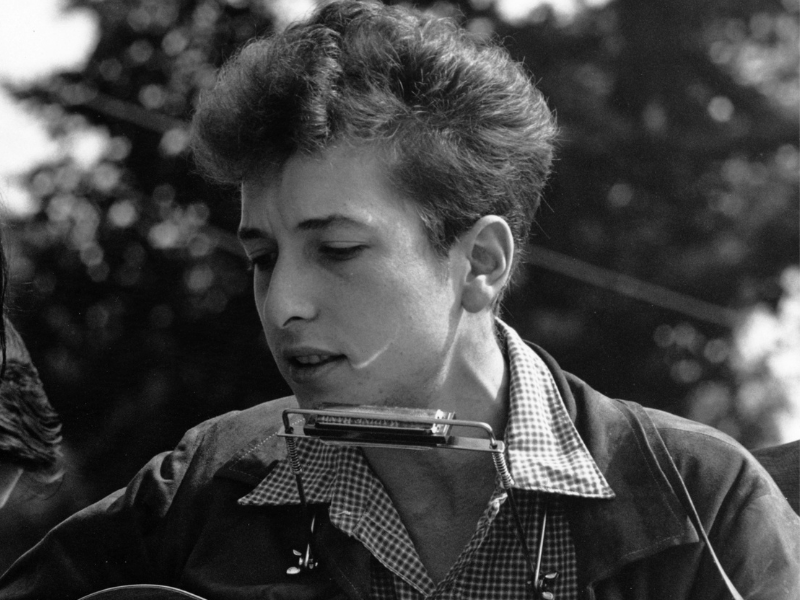
A look back at Bob Dylan’s 80th birthday in 2021, when Robert Golding looked at the career of the Nobel laureate and asked what his life can teach us about making our way in the world
‘Twenty years of schoolin’ and they put you on the day shift.’ So sang Bob Dylan with typical humour and exasperation in his 1965 classic ‘Subterranean Homesick Blues’. It is a line that may resonate with many young people beginning their working life in the Covid-19 era.
Since arriving on the scene in Greenwich Village in 1962, the Nobel Laureate, who turns 80 today, has attracted continual reassessment. The brilliant opaque words, combined with a sense that in Dylan words matter to an unusual degree, have caused an immense critical literature to grow up. It’s difficult to think of a living figure more discussed.
Commentary has tended to focus on Dylan’s extraordinariness, and one can see why: he has achieved remarkable things, all while retaining his aloofness. When I asked singer-songwriter Emma Swift, who recently recorded an album of Dylan covers Blonde on the Tracks (2020), whether Dylan had been in touch about her album, she said: ‘I’m often asked that. But Dylan is to me a mythical figure. I’d be just as surprised if Samuel Taylor Coleridge called.’
Too often then, Dylan is treated as prophet and sage, and not as someone who hustled his way through the world – as we might do too. Our admiration for him might preclude us from seeing what he can teach.
“Dylan to me is a mythical figure. I’d be just as surprised if Samuel Taylor Coleridge called.”
Emma Swift
Get born, keep warm
It helps to remind ourselves that Dylan’s upbringing was distinctly unpromising – so much so that, even at the time, it seems to have struck him as a cruel joke. Raised in Hibbing, Minnesota – a dead-end mining town – he told Martin Scorsese in the film No Direction Home (2005): ‘I felt like I was born to the wrong parents or something.’ We ought not to draw the conclusion from this that it is wise to be contemptuous of one’s elders; one might instead say that we should have the gumption to imagine our way into the life we want – and be brave enough to take steps to secure it.

It remains difficult to imagine Dylan in Hibbing. His life is a powerful example of a refusal to be defined by where you’re born: our knowledge of his subsequent success makes it vexing to imagine him ever having been there at all. Hibbing consisted of the typical Main Street, dreary parades, small businesses and shops, all bound up in strict mores: a life Dylan must have found predominantly redundant. But thanks to the invention of the gramophone, another world was able to seep through to the young Dylan. This was the astonishing revelation of rock and roll.
Like so many who go onto achieve great things, one can sense the constraints that early life placed on him – and also that those constraints were lifted rather arbitrarily. Rerun the movie with slightly different conditions and you’d have another narrative.
Specifically, Dylan’s life would have been different had he never encountered Little Richard. ‘His was the original spirit that moved me to do everything I would do,’ he would write on May 9th 2020 at the singer’s death. Though Dylan is a hero to many, he is also a man adept at having heroes. He admires people – but only as a way of discovering a way to become himself.
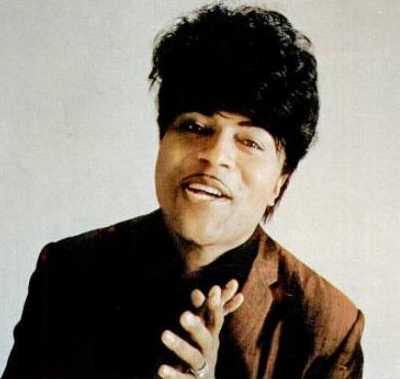
Dylan’s first known performance was in 1958 at the Hibbing High School’s Jacket Jamboree Talent Festival. In Volume 1 of Bob Dylan: Performing Artist Paul Williams, Dylan’s finest biographer, explains how in this performance ‘Dylan followed the rock and roll music to a logical conclusion that was in fact quite alien to the music of the day: play as loud as possible. Not just wild. Not just raucous. Not even just loud, but AS LOUD AS POSSIBLE, preferably in a context that will allow for maximum outrage.’
It is an image of the natural iconoclast. At this young age, Dylan was allied to a true energy; he had made a decision that couldn’t be reversed to devote his life to music, and was already seeking to stand out within his chosen sphere. Soon he would graduate from being the loudest musician to other superlatives: most thoughtful, most literary, most enigmatic, most laurelled.
In the process, he was clearing more obstacles than we perhaps realise, now that we inhabit a world where they were so convincingly traversed. One fact is not the less important for being so widely cited: Bob Dylan wasn’t born Bob Dylan but Robert Zimmerman. Interestingly, a letter recently surfaced where Dylan explains that his decision to change his name was based on fears of anti-Semitism. ‘A lot of people are under the impression that Jews are just money lenders and merchants. A lot of people think that all Jews are like that. Well, they used to be cause that’s all that was open to them. That’s all they were allowed to do.’
“Dylan followed the rock and roll music to a logical conclusion that was in fact quite alien to the music of the day: play as loud as possible.”
Paul Williams
Some, including Joni Mitchell with whom Dylan has had (at least from Mitchell’s side) a somewhat abrasive and competitive relationship, have held up the decision to change his name as a mark of inauthenticity. But the decision might equally remind us of the importance of flexibility and finding a way around obstacles.
Try to be a success
Dylan’s early years exhibit a fearlessness which we might do well to emulate. As a young man, having briefly enrolled in Minnesota University in 1960, he again exhibited that same restlessness which would manifest itself eventually in his celebrated Never Ending Tour.
By this time, he had decided that rock and roll wasn’t enough, and that folk music offered a richer philosophical experience. It was the first of many twists and pivots and reinventions.
In time, he would merge the folk and rock genres – going electric in 1965 to what now looks like a rather quaint indignation from the folk establishment.
For now, seized with the urgency of the eternally confident, Dylan took a train to New York, intent on meeting his hero the folk singer Woody Guthrie. Guthrie was already suffering from Huntingdon’s Disease, which would eventually kill him in 1967. No matter, Dylan sought him out at his sick-bed in a New Jersey hospital and played him his homage ‘Song to Woody’ one of only two original compositions on what would become his debut album Bob Dylan (1962). A torch had been passed.
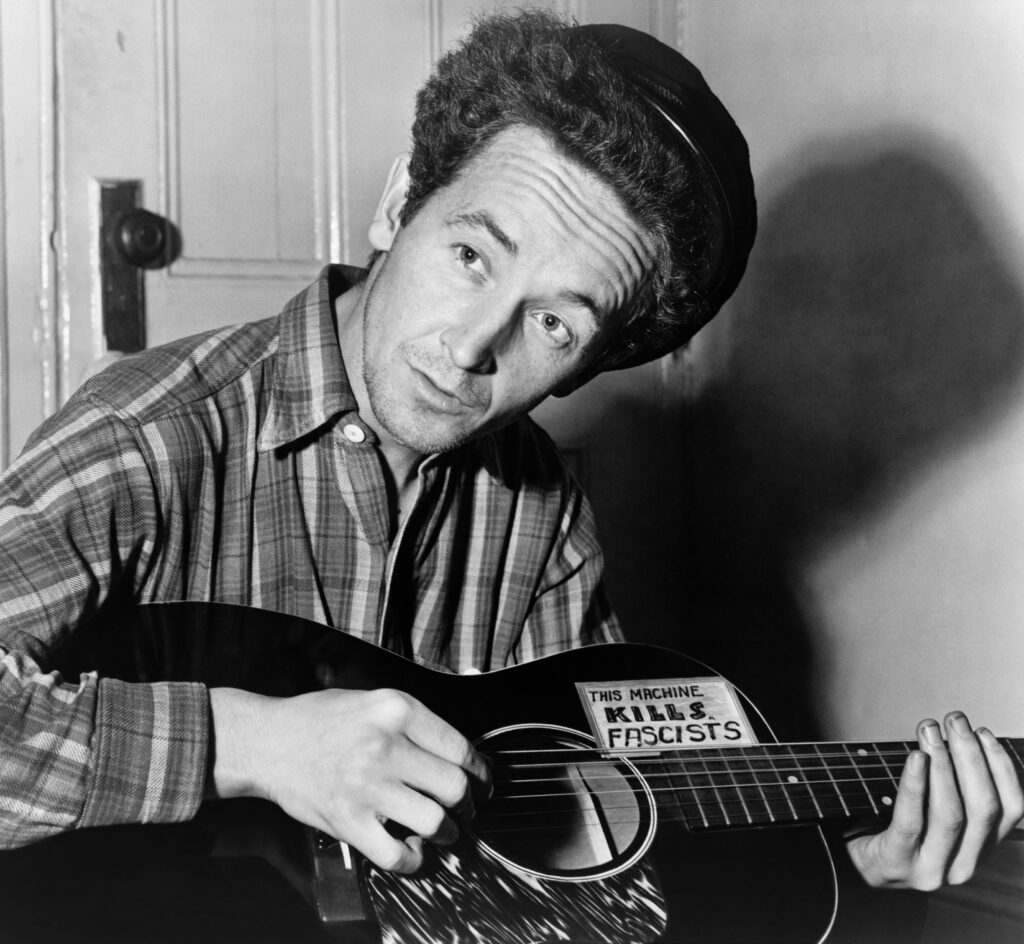
It was a deft negotiation of what has been called ‘the anxiety of influence’. Young people will often underestimate the availability and flesh-and-bloodness of those at the top: fear stymies them from exposure to examples of success. By being in close proximity to our heroes – even if the encounter doesn’t go well, and we betray our nerves – we may usefully humanise them and open up the possibility of the heroic in ourselves.
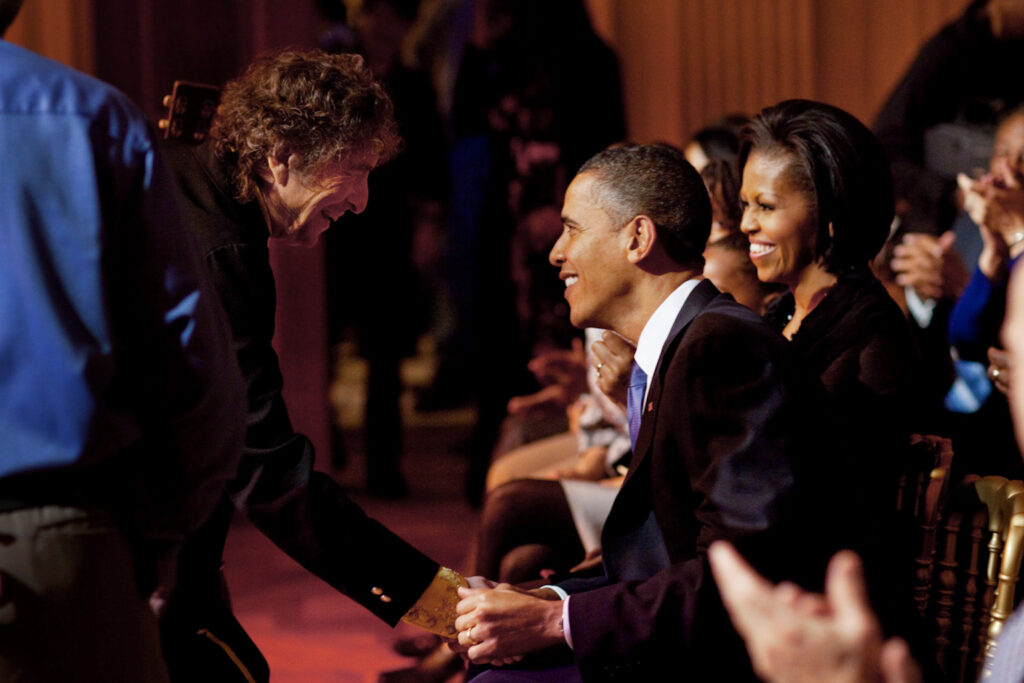
This trait of Dylan’s finds its corollary in a story told by former President Barack Obama in his memoir A Promised Land (2020). When Dylan played at the White House during the Obama administration, at the end of the performance Dylan simply shook the then president’s hand and left, saying nothing. ‘Even the president of the United States sometimes must have to stand naked,’ as he put it in ‘It’s Alright, Ma (I’m Only Bleeding)’. One suspects that Bob Dylan has never been afraid of anyone.
The Guthrie story is a reminder that we tend to get to where we need to be by being out in the world and meeting people; we never achieve in a vacuum but by the dint and say-so of others. Music journalist Tom Moon tells me that today ‘the Bob sphere is weird even in “normal” times’ but at the outset of Dylan’s career, when it mattered, the young singer made all the right moves, charming the crowds in Greenwich Village, signing with Columbia Records, and submitting to the aegis of manager Albert Grossman.
“The Bob sphere is weird even in ‘normal’ times”
Rock critic, Tom Moon
In time he would assemble a band whom he could trust and who were inspired to get better over time. His 1975 tour the Rolling Thunder Revue was, among many things, a celebration of friendship. And it’s thanks to his capacity as a bandleader we now have that highly underrated achievement the Never Ending Tour, which began on June 7th 1988 and ended – or paused – with the advent of the Covid-19 pandemic in the early part of 2020.
In reference to his longevity, Emma Swift says: ‘There’s a counter-narrative in our culture that says that music is for young people – that if you haven’t made it as a musician by 13 you should just stop. Dylan’s career runs counter to that and though he was working very much as a young man, he’s continued that throughout his entire life. He makes a very persuasive argument that the time for art is always now.’
From the vantage-point of today, Dylan’s career might seem to be to do with longevity – but longevity must be teed up when young, and it helps to have made the right decisions from a young age.

Dylan has never grown bored; his energy remains astonishing. Richard Thomas concurs that Dylan’s career showcases ‘resilience, energy, adaptability, mystique, humour’ – qualities that would not have been sustainable had his original decision in Hibbing to pursue music not been the right one. ‘I’ll know my song well before I start singing,’ as Dylan sings in ‘A Hard Rain’s a-Gonna Fall’ – yes, and to know that singing is what we should be doing in the first place.
In a March 2020 interview, Gina Gershon confirmed Dylan’s boyish love for what he does: “He read me some lyrics he was writing and he was all excited…,” she recalled. “I was thinking, ‘Oh my God, this is so cool.’ You could see why he still loves doing what he does and why he’s excited…”
“He only ever repeats himself valuably, somehow anew, which is not true of the rest of us”
Christopher Ricks, author of Dylan’s Visions of Sin
When I speak to the great Dylan critic, author of Visions of Sin (2004), and former Professor of Poetry at Oxford University Christopher Ricks, he agrees with Swift: ‘He only ever repeats himself valuably, somehow anew, which is not true of the rest of us.’ This remains true in his touring, where Dylan – famously, and sometimes to fans’ perplexity – will never perform a song in the same way twice.
His Back Pages
Throughout this life of performance, of course, Dylan has been compiling the greatest songbook of any American songwriter in the post-war period. It is a vast corpus, where wisdom sits alongside glorious nonsense – and where solemnity and comedy, yearning and rage, all equally have their home.
It must be said that the idea of plucking contemporary jobs tips from the Dylan oeuvre can seem an exceptionally unpromising avenue of enquiry. Dylan himself has sometimes been self-deprecating about the idea of extracting meaning from his songs. As he wrote in ‘Mr. Tambourine Man’, ‘If you hear vague traces of skipping reels of rhyme/it’s just a ragged clown behind.’ Dylan here appears as something like Charlie Chaplin’s Little Tramp: Don’t pay him any mind.
Few have taken him at his word there. More problematically, the songwriter’s reliance on the folk repertoire means that the economy he is describing in his songs tends to predate ours. One might seek in vain in the Dylan canon for direct advice about how to make it in the professions, or hints about how best to make LinkedIn work for you.
But this leaning so heavily on a rich hinterland of American song, might amount to another lesson. His work shows a remarkable respect for the past – as well as a willingness to question the present. Dylan’s second studio album was called The Freewheelin’ Bob Dylan (1963). Paul Williams once said that Dylan’s songs essentially teach us that when a man learns to be free only then can he be in with a shot of happiness.
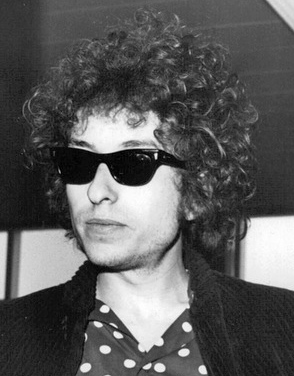
But we can only be free in relation to others. As much as he would distance himself from the label ‘protest singer’ over time, Dylan’s repertoire contains songs of high-minded hatred towards the establishment. ‘Masters of War’, ‘Only a Pawn in Their Game’, ‘Pay in Blood’: these songs warn us off a career bereft of a healthy scepticism about the way things are. Dylan’s songs tell us that to question the status quo is a first step towards our finding a place in it.
This freedom is not only something that Dylan exhibits; it is something he bestows on the characters in his songs. Dylan’s is a world of freely moving drifters (‘The Drifter’s Escape’), wronged boxers hurtling unimpeded towards their fates (‘Hurricane’), mafiosi (‘Joey’), and a whole range of po’ boys and girls, who seem almost liberated by their impoverishment. Everything – everyone – is in continual motion: ‘Only one thing I did wrong/stayed in Mississippi a day too long.’ Even William Zantzinger, the murderer in ‘The Lonesome Death of Hattie Carroll’ is defined by his freedom.
“His actual experience is tempered by what the folk tradition, always where much of his songs go back to, dealt with’
Professor Richard F. Thomas
The Harvard professor and author of Why Dylan Matters Professor Richard F. Thomas explains: ‘‘Workingman’s Blues #2’ is in part about working’ but he agrees the middle class doesn’t feature. ‘His actual experience is tempered by what the folk tradition, always where much of his songs go back to, deals with.’
All I Really Want to Do
And yet there are few, if any moments of sloth in Dylan’s life. ‘Lay Down Your Weary Tune’. ‘Watching the River Flow.’ These are songs about pausing, but they are also moments of expression – of activity – for Dylan himself.
While Dylan turns a sceptical eye on ‘the masters of war’ who too often prosper in the present, he teaches an intense respect for the wisdom contained in the folkloric tradition.
This resonates in other professions. Anyone who has spoken to Sir Martin Sorrell will find him as passionate about advertising as it used to be as much as it is now. Likewise, readers of Andrew Marr’s survey of journalism My Trade (2004), will note that secreted in the BBC man adept in a modern medium, is a historian. Success is to do with a sense of how this moment fits into the preceding and those which will come; this can only be achieved by hard study, and utter commitment.
It is apt that while Dylan’s milieu is the past, he has nevertheless managed to prosper within the contemporary moment, and there is no-one alive today whose works seem more assured of a future audience. This fact was especially brought home in late 2020 when Dylan sold his songbook to Universal for a reported figure in the $300 million range.
This respect for tradition is a lesson he bequeaths to his musicians. As Professor Thomas explains: ‘The musicians he has worked with are in awe of him as a teacher of the musical traditions he wants them to be up on.’ So would Dylan have made a good teacher? Thomas says: ‘While I can’t see him in a classroom (“the mongrel dogs who teach” (‘My Back Pages’), though that’s some time ago), I believe he cares deeply about what matters to him, and that is the first ingredient of a good teacher.’
Fleetingly, and perhaps jokingly, Dylan once imagined in an interview with AARP an alternate route for himself: ‘If I had to do it all over again, I’d be a schoolteacher.’ In what subject? ‘Roman history or theology.’
When I Paint My Masterpiece
It might be hard to imagine the Dylan energy contained in a school. In fact, it isn’t even contained within music.
In recent years, Dylan-watchers have become increasingly aware of the scope of their man’s achievement in the visual arts. A recent episode of the HBO drama Billions shows hedge fund billionaire Bobby Axelrod with some of Dylan’s work in his home. During the COVID-19 pandemic – according to insiders at London’s Halcyon Gallery – Dylan was not only commissioned to produce a metalwork sculpture for Ronald Reagan Airport, but delivered some 20 works to the gallery.

The appreciation of Dylan as artist and as sculptor is still in its infancy.
Emma Swift tells me: ‘Dylan has taught me a lot about the interconnectedness of art forms. I used to think about poetry and music and visual art separately. Now I don’t. All the video clips for my Dylan record are animated, so they’re very much a celebration of the visual to go alongside the music.’ Dylan’s career here again emerges as an exercise in creative freedom – both within his own art form and in an interdisciplinary sense.
I head up to central London, for a behind-the-scenes tour of the Halcyon’s Bob Dylan Editions show. In many of the pictures, the influence of Edward Hopper is paramount. This is an America which has to some extent lapsed. We find motels and diners, parking-lots, cinemas and burger-joints. It is an image of everyday America, which isn’t meant to feel contemporary. Like his music, these are artefacts of collective memory; the paintings feel like acts of nostalgic preservation.
Most marvellous of all are the metal-sculptures. Upstairs, Georgia Hughes, an art consultant at the Halcyon, shows me a blown-up picture of Dylan in his California studio. Wiry and tough-looking even in old age, he stares eagle-like on his metals, the materials of his art. Hughes explains how Dylan rescues the metals from the scrapyards around California. I quote back at her the lines of ‘When I Paint My Masterpiece’: ‘Well, the streets of Rome are filled with rubble.’ She replies: ‘Dylan’s art has to do with finding what lies near to hand and transforming it.’
One I particularly like is a wall-hanging (see opposite), where the pieces of metal, the discarded spanners and wrenches feel somehow like a sea-creature peculiarly adapted to its environment.
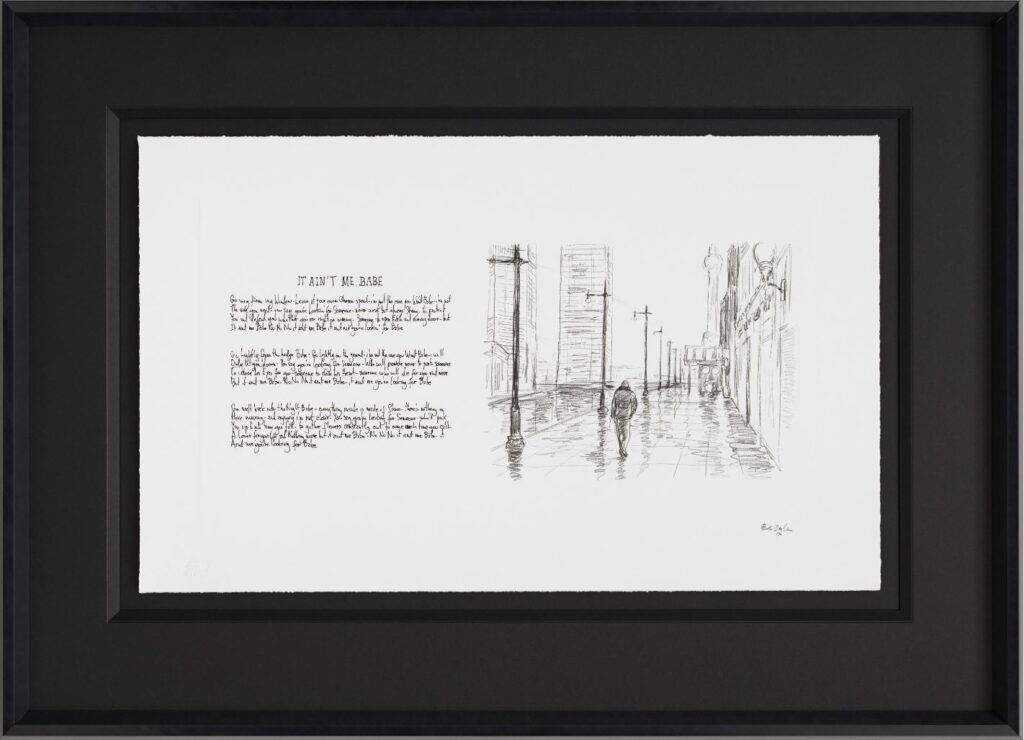
Dylan’s art career shows us that his is a porous existence where all options are on the table. Whenever one thinks of the successful, they always seem free of the doubts which seem to constrict others. If their lives often feel peculiarly uncompartmentalised, then perhaps it is because they proceed in freedom.
“He does all kinds of things that are kind of shocking, and I think it opens it up for everybody else”
Emma Swift
Money doesn’t talk, it swears
Of course, if we wanted direct lessons about our lives from Dylan then his business interests are there for all to see. Put simply, Dylan has not been afraid to monetise himself.
Bobdylan.com, in addition to providing information about tour dates and the artist’s songbook, is primarily a shop, hawking everything from key rings and hip flasks, to tote bags and his new Heaven’s Door whiskey. In the past he has let Apple, Chrysler, Cadillac and Pepsi use his songs.
Emma Swift gives her reaction: ‘He does all kinds of things that are kind of shocking, and I think it opens it up for everybody else. You know, if Dylan puts his song in an ad…okay, I guess it’s fine.’ Again, there is fearlessness here – he is prepared to risk being labelled a sell-out and happy to let the songs speak for themselves in whatever context they happen to be used.
When I ask Thomas what lessons Dylan’s life ultimately has to teach, he replies: ‘Read, listen, read, enquire, don’t be presentist!’
If one were to ask oneself why Dylan’s work is richer than that of his contemporaries then it has something to do with the range of reference brought to bear in a setting where one might not normally expect it. This is the case even when his work is compared to that of literary contemporaries such as Paul Simon and Joni Mitchell, though there will always be some – the late Clive James among them – who would prefer the poetry of Leonard Cohen.
And not being ‘presentist’? On the face of it, this might not seem to fit Dylan. Joni Mitchell had this to say about him: ‘Bob is not authentic at all. He’s a plagiarist, and his name and voice are fake. Everything about Bob is a deception.’
Harsh as this is, it is a frustration Paul Simon has also aired: ‘One of my deficiencies is my voice sounds sincere. I’ve tried to sound ironic. I don’t. I can’t. Dylan, everything he sings has two meanings. He’s telling you the truth and making fun of you at the same time. I sound sincere every time.’
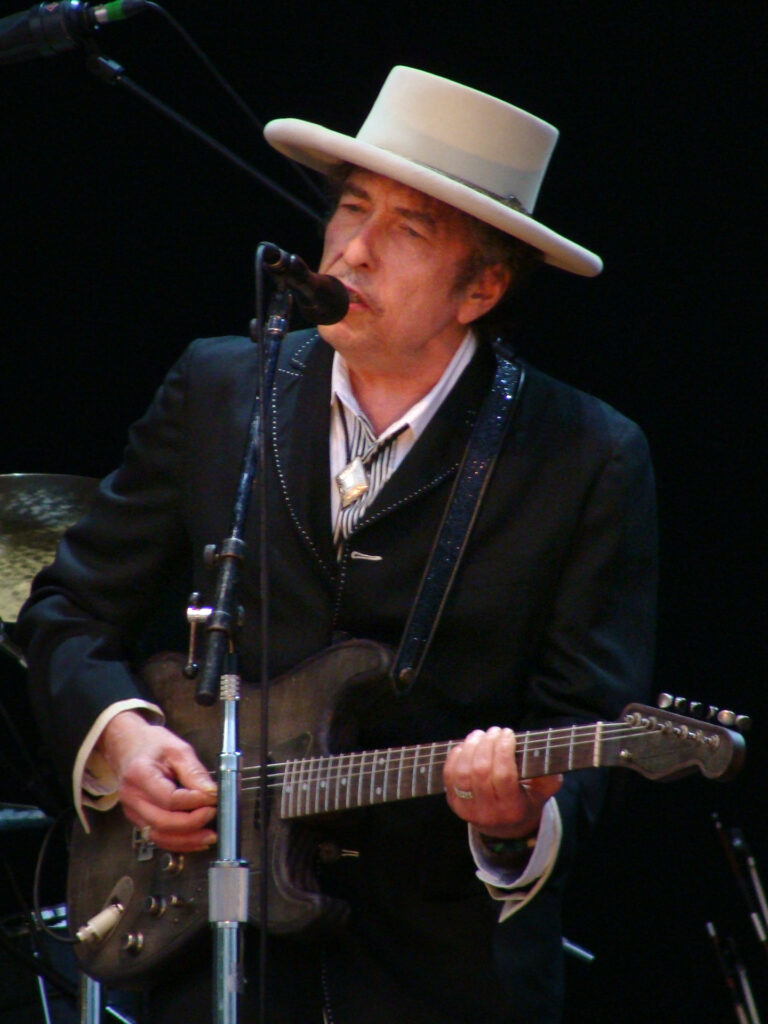
But one suspects that Dylan would have no audience at all, if there wasn’t truth at the core of his work. It is rather that he has been true to his nature by being opaque. He hasn’t let his desire to tell the truth get in the way of being mysterious – and vice versa. At the Halcyon exhibition there is a wall of magazine covers devoted to Dylan. It doesn’t matter how much we photograph or try to know him; his eyes won’t let us in entirely.
Forever Young
As Dylan enters his ninth decade, there is much his career has to teach those who are embarking on their own lives. It’s true that there is dispute in literary circles about the extent of his literary achievement. But Dylan has been plausibly compared to William Shakespeare and to John Keats. We know far more about Dylan’s life than we do about the Elizabethan, and Dylan has lived out his talent far more than Keats, who died at 26.
In spite of the singularity of his achievement, Dylan continues to repay study. Besides, the man who wrote ‘Don’t follow leaders./Watch your parking meters’, isn’t so much telling us what to do, as inviting us in. Once we accept his invitation, we find we become richer, wiser. There is a generosity somewhere near the core of his art. Dylan once said: ‘Every song tails off with “Good Luck, – I hope you make it.”
He never said where – but he didn’t have to. As often with Dylan, we sort of know what he means, but we have to fill in the gaps ourselves.