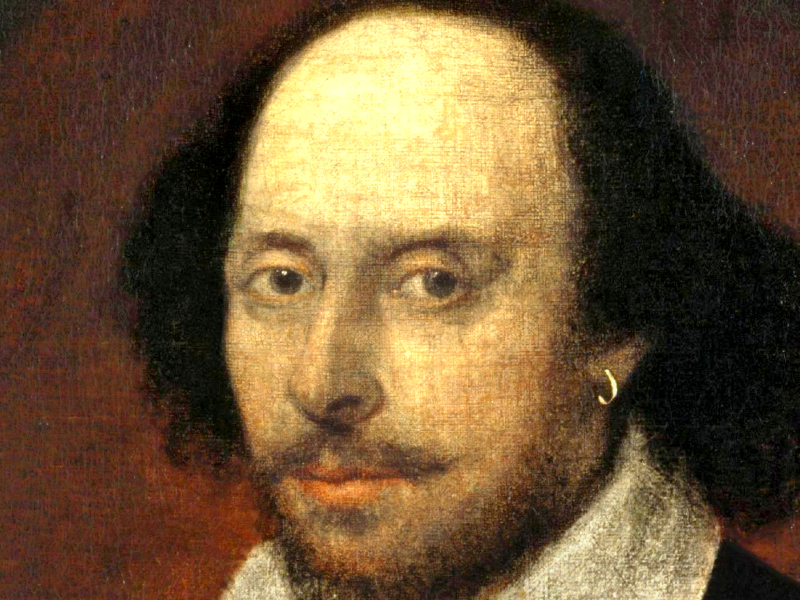
The life of William Shakespeare has lessons for how to make the best of your talents during a time of pandemic, writes Robert Golding
In January 1593, the Privy Council of Elizabeth I issued the following order: ‘Forasmuch as by the certificate of the last week it appeared the infection doth increase…we think it fit that all manner of concourse and public meetings of the people at plays, bear-baiting, bowling’s and other like assemblies for sports be forbidden.’
This was bad news for many, but perhaps especially so for a young playwright who was beginning to come out of the shadow of Christopher Marlowe and forge a place at the forefront of the city’s theatre. At the time of the plague’s outbreak, a certain William Shakespeare had begun to find his voice.
Though plague was a fact of Elizabethan life, it must have come as a setback. His life up until that point had not been without gamble. William – Will, as he appears to have been known to friends – had left his wife and family behind in Stratford-upon-Avon and embarked on a career in the slightly louche world of the contemporary theatre.
The language of the edict with its courtly leisure – ‘it appeared the infection doth increase’ – shouldn’t blind us to the cataclysmic impact on Shakespeare and his contemporaries. Shakespeare’s contemporary John Stow – responsible for so much of our knowledge of Elizabethan London – recorded that 11,000 out of 200,000 died between December 1592 and December 1593.
The Elizabethan plague was, of course, far worse than anything we have experienced in 2020. People died in the street, rendering death an ever-present aspect of daily experience. We might miss, for example, the force of the famous insult in Romeo and Juliet: ‘A plague on both your houses’. What is being wished here is something far more awful than we, even as we live out this unsettling year, can imagine.
It ought to be a certain comfort to us now, to realize that Shakespeare’s life – among the most marvelous that history records – was beset by plague at every turn. And those of us who fear even a vaccine won’t put an end to our woes might remind themselves that plague was both a constant and a mutating reality for Elizabethans.
There was a serious bout of plague in Warwickshire the year of Shakespeare’s birth; the young Will would not have been expected to survive. Whatever talk may have swirled about ‘a merrie meeting’ having precipitated the playwright’s death in 1616 at the age of 52, there is nothing to say it wasn’t the proximate cause of his death. We worry about a second wave of coronavirus – our finest poet existed within an unbaiting wave of mortality.
Yet he continued – and not only that, time and again reinvented himself. The plays and poems which follow on from the big plague years are evidence of a profound pooling of resources and a taking stock. Love’s Labor’s Lost, Midsummer Night’s Dream and Romeo and Juliet follow on from the plague year of 1593. They exhibit a richness, and even an urgency, difficult to discern in the ghoulish Titus Andronicus or the bombastic Henry VI trilogy, written the year before the plague struck.
But William Baker points out in his book William Shakespeare, that between 1603 and 1613, London’s theatre land was closed for 78 months. Though the poet inhabited a society without any social safety net, let alone the largesse of today’s furlough scheme, there are lessons here for today’s young people starting out on their careers.
In 1593, Shakespeare was swift to man oeuvre when the severity of that particular bout of plague became evident. Faced with an income gap due to a sudden pestilence, he was in no different a position to an airline pilot or live events manager today.
So what did he do? He launched himself immediately as a courtly poet. For a country boy, it was an act of tremendous gumption, under the patronage of the Earl of Southampton. We therefore have two epic poems – Venus and Adonis and the Rape of Lucrece – which might be termed plague poems. Each breathes freshness, health and life; they must have been cathartic to those reading them, and indeed these long poems were hits among the student population at the Inns of Court.
For some times, the theory has circulated – and been brilliantly argued on the website The Shakespeare Code – that Shakespeare was using existing connections to forge his career: it is argued that Shakespeare had in fact taught and conducted secretarial work in Titchfield, where the Earls of Southampton lived, prior to the plague. This might have particular resonance for those casting around for contacts during the time of coronavirus: open that contact book. It also shows the willingness of our greatest mind to undertake menial tasks if it meant getting in close proximity to someone with the power to make a difference to his life.
What is clear is that Shakespeare was flexible and imaginative; at the critical point, he was willing to imagine another version of his life. He also remained true to his gifts. There is a strong hint in Sonnet 111 that Shakespeare found playwriting a drudgery: ‘my nature is subsumed/ to what it works in like the dyers hand’. He seems to lament his low birth. But when the moment came, he didn’t attempt the impossible. There is a strong pragmatic streak about Will; he might seem in the stratosphere now but this was no dreamer.
What also might chime with today’s young is that he remained patient and took the long view. He might have been forgiven for thinking in 1593 that the long-term prospects for life in the theatre weren’t good. What was there to stop plague returning and scotching year after year of possible revenue? But he appears to have kept his options open, and retained connections within theatre land even while branching out into poetry. There is a strong hint throughout his career that Shakespeare had a quiet talent both for friendship – contemporaries would refer to him as ‘sweet’ and ‘honey-tongued’ – but also for business relationships. In his last will, he would bequeath memorial rings to the actors John Hemminge’s and Henry Condell; they would repay his memory by editing the First Folio in 1623, seven years after the poet’s death.
This was networking, as it were, from beyond the grave. The hard realities of inhabiting a plague-riddled society appear to have made Shakespeare not just a better poet but a better businessman. This has sometimes been an inconvenient fact to those who would have preferred the Bard to be more Keatsian – more head-in-the-clouds, and klutzy with money. The record shows he was anything but.
Instead, Shakespeare continually found ways to expand not only his poetic capacity and his knowledge of human nature, but also to develop what we now call his career. In 1594, he bought a one of James I would become the King’s Men: Shakespeare saw the main chance and took it. Again, there is a hint – but no real proof – that he was utilizing his connections. It has long been rumored that it was the Earl of Southampton who loaned Shakespeare the capital. If so, we might wonder whether he wisely used his time in lockdown to deepen existing connections.
There is an onwards pressure to Shakespeare’s life which suggests a refusal to become down-hearted from which we might learn. The year’s show him steadily more active both as a property owner in London and Stratford, as a shareholder in his theatre company, and as someone with small businesses on the side in malt dealing, in lending, even going so far as to turn a property he owned in Henley Street into a pub.
As for the plays, it’s true that they don’t always exist within a milieu of work which we recognize, unless that milieu is the court. But once you look past that you find a good deal is implied about loyalty and about the dignity of work, and indeed a certain amount about the kind of adaptability which we can vaguely detect in Shakespeare’s own life.
It has been said that the characters Shakespeare most admires are Horatio in Hamlet, Kent in King Lear; Cassio in Othello, and Enobarbus in Anthony and Cleopatra. These are the characters still standing at the end in the tragedies; those who will be charged with rebuilding the state. This a recurring type: the hard-working, flexible, loyal aide who becomes clearer in his moral purpose as difficulty mounts.
These are plays written by a man thrown back continually on his own resources, and who time again rose to that situation. William Shakespeare found new things within himself – new forms of language, yes, but also new forms of life. His relevance ought not to be surprising. Every period of history has found in Shakespeare a friend and teacher – but it’s fascinating during these unsettling times to see how much his life, and not just his poetry, has to teach us.
There’s nothing quite like a global pandemic to make people across society rethink their priorities writesGeorge Achebe
Simon Ferrar knows exactly where he’ll be buried: he’s ear-marked a plot worth £4,500 under some rather splendid blackberry bushes in Surrey Hills. ‘As in life, it’s location, location, location,’ he jokes, looking at one of the premier positions in the cemetery.
Except this is no conventional cemetery, and Ferrar will also die knowing that he has been responsible for the burial circumstances of some 28,000 around him. He’s the founder of Clandon Wood, a natural burial ground, and a part shareholder in it as well. ‘I created a nature reserve because we were looking to encourage a huge diversity of wildlife here. We wanted to add another little corner of the natural landscape to the Surrey countryside,’ he says.
The funeral business is, of course, recession-proof and has even been helped by the pandemic. Natural burial involves graves made from biodegradable materials; each plot is three-feet deep and involves no vertical memorial. Ferrar explains another difference: ‘What’s unique is that we set up a trust fund. Every single person who purchases a plot here pays a one-off fee of £250 which goes into the trust. By the time we’ve sold all 28,000 plots, that trust fund will be worth in excess of £7 million.’
We drive out in a golf cart into the plots. Some of the graves look like large scratches in the earth. In other instances, one’s memorial is simply a tree, or some wild grass. He gestures at a plot. ‘Over there, there are buried two twins. One killed himself jumping off a building, and the other couldn’t live with it. Three years later his brother killed himself too.’
But the funeral, he says, was meaningful. ‘The mother said they weren’t meant to live long lives.’ He adds: ‘We care for the living here as well as the dead.’
A Morbid Culture
When the pandemic struck, it found a morbid culture. Ours is an odd, almost sanitized plague, so unlike the Renaissance and medieval counterparts: when the deaths rack up, they do so behind closed doors. We don’t see them for ourselves. And this fact has created communal space with which to discuss another crisis: our mental health.
Ferrar views his business as a ‘throwback to a couple of centuries ago where families can take the coffin on a handcart. We’ve been burying people on this island for about 30,000 years. It’s only in the last few hundred years, we’ve got used to the kind of Victorian funerals, the moralization and the grimness of that.’
At a time when our former structures have been removed, and we experience uncertainty as to whether our life shall return to anything like ‘normal’, Ferrar’s project can teach us perspective. As the world quietens, many have found that they had become disconnected from the real cycle of nature.
The £65K Club
It isn’t difficult to understand why some who have lost their jobs, or who have had their weddings placed on hold, or found themselves subject to domestic abuse, might be struggling at the present time.
It’s harder to explain why mental health has become such a problem for FTSE250 CEOs and the superrich. But according to Marta Ra, the founder of Switzerland based clinic Paracelsus, which also has a UK branch and charges £65,000 a week, that’s exactly what has happened. ‘There’s this unconscious bias that the very wealthy are always happy. But actually, they’re often sadder than people with less financial strain,’ she says.
For some this will be a dubious sob story – and yet it tells us something too about who we are.
‘All individuals have their own private fears and problems,’ Ra explains. ‘Perhaps they worry for their employees, or the fate of their companies. And so they start turning to substance abuse. Or maybe they only did social drinking before, but now they start to drink heavily. And locked down with their spouse and children, they’re just as likely as anyone to think: “Who have I married? I can’t handle this.”’
It would seem that at a certain point the noise of life became so great – and what the Victorians called ‘the Battle of Life’ (the title of a Charles Dickens novella) became more intense. Sometimes one senses that the virus has been specifically designed to make us look again at who we are – at where we’re going.
Ra explains: ‘People who are stuck at home have to face themselves for the first time, and really face themselves.’ She adds: ‘Our society wasn’t functioning to be in the present.’
The depths of the forest
But what about those people who are trying to help us with our mental health? Before the crisis, buzz words like ‘mindfulness’ and ‘wellness’ had become ubiquitous, and when I meet Ferrar, I am struck by his laid-back intelligence. His is the sort of spiritual calm which the frenetic Londoners among us tend to envy.
Across from Clandon Wood, tucked away behind postcard-idyllic Shere, is the Forest Bathing Institute [FBI]. In May 2019 Dame Judi Dench became a patron of the organization, but it’s been more broadly on the rise.
I ask Gary Evans, CEO of FBI to explain its origins: ‘”Forest bathing” is actually a translation from the Japanese shinrin-yoku.’ he explains. ‘In Japan in the 1980s, the Japanese government decided they wanted to get people out of big towns and into nature.’ But this wasn’t some hippie whim: it was driven by hard science.
They were researching the health benefits of nature and woodland. When they looked at blood, they found improvements in the immune system. A prolonged exposure to nature caused blood pressure to come down in people who had high pressure, and caused those with low pressure to experience a normalization.’
Intrigued, I head to Surrey to meet with Kate Robinson who takes me into the woods near Newlands Corner.
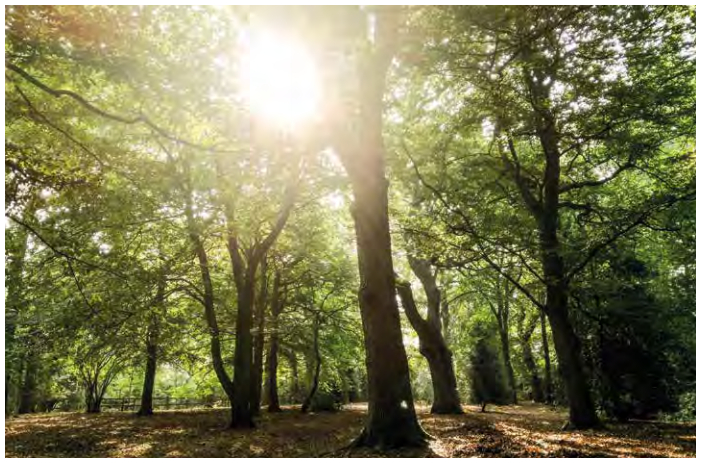
Over the course of a few hours, I am asked to focus on the shapes of the trees, to explore the smells, to play with leaf litter, to share my thoughts of the forest, and to listen closely to the breeze playing in the upper canopies. The session finishes with a meditation. For a few days afterwards, I find that the wood seems to exist alongside me, in a way which it wouldn’t if I had taken a long walk.
I recall the words of Marta Ra: ‘You can be a billionaire at 23 and still feel fear and loneliness – and the uncertainty of the virus only adds to that fear.’
And perhaps there is something especially apt about all this. Coronavirus, after all, took us by surprise out of the wet markets in Wuhan, where to paraphrase Oscar Wilde, the unspeakable went into pursuit of the uneatable – and duly ate them. As Green peer, and former Green Party leader, Natalie Bennett recently told me: ‘The economy is a subset of an environment. There are no jobs on a dead planet.’ Perhaps part of our duty now is to think again about what surrounds us. And it might after all be that the right job revelation lies just as much on a long walk, as it does on LinkedIn.
Drawing Together
And yet, for some, that will seem too solitary. Others have sought their own reckoning by looking in new and exciting ways at community.
Sally Shaw at First Site gallery in Colchester had been busy in the run-up to Covid-19 with, among other things, a landmark exhibition with Anthony Gormley. Once the virus struck, she realized she had to do something to benefit the local community. ‘The NHS approached me during lockdown. They said: “We’re worried about the virus, yes, but the next thing we’re worried about is the mental health fallout for our staff and also those directly affected by Covid-19”.’
But that assessment proved to be the tip of the iceberg. Shaw lists the challenges: ‘Of course, they were also worried about the stress the pandemic will cause through mass unemployment, emotional pressure and not being able to grieve properly.’
Shaw thought of a way to help. The gallery is part of the Arts Council collection, which consists of 7,000 works collected over 75 years; it’s been built up with the national legacy in mind. Shaw continues: ‘We thought what we might do is invite people to interact with that collection and pick works which represent their experiences and, with a light touch, introduce talking therapies to people’s worlds.’
The gallery introduced a private part of the website where NHS staff in the region and care home workers can submit their stories to the portal. Shaw now plans to find ten distinct stories which will comprise a spectrum of experiences to ‘enable us to create a narrative around the different types of effects on people’s lives.’ The goal, she says, is to create a ‘creative conversation which may be an exhibition at some point.’
That sense of community is also evident at Clandon Wood where Ferrar regularly hosts theatrical performances. ‘We have things like Music in the Meadows where I invite local musicians down, and people bring a picnic. We had four Alan Bennett plays last year, and we had Shakespeare in the Meadow too. Then we have meditation mornings plus all the other events that we have to support grieving families.’
The Forest Bathing Institute too is looking at children’s days, in part designed to help take the burden off local parents, and give children experiences valuable to them going forwards.
It is an image of another life – one that would have felt impossible six months ago. We inhabit for the time being a world slower, quieter and in some ways smaller – but also one with the potential to be richer and deeper than what we had before. It’s a world where time and nature feel like more precious commodities than ever before. It’s also a period when money might matter less because our mortality has been vividly illustrated to us: we all lose our possessions in the end. Ferrar explains to me that a team of archaeologists found evidence of Bronze Age occupation at Clandon Wood. ‘We talk of possession, but the land is only ever held in trust,’ he says, as we pass another unmarked grave.
The curious thing is that this fact, which might make us despair, turns out to be a beginning of happiness. Mental health begins in being rooted in the facts. The virus, awful though it has been, has reminded us how transient we are, but in doing so thrust us back on ourselves, and forced us to renew.
Christopher Jackson asks whether it’s now time for a National Education Service and finds a party unsure of the way forward
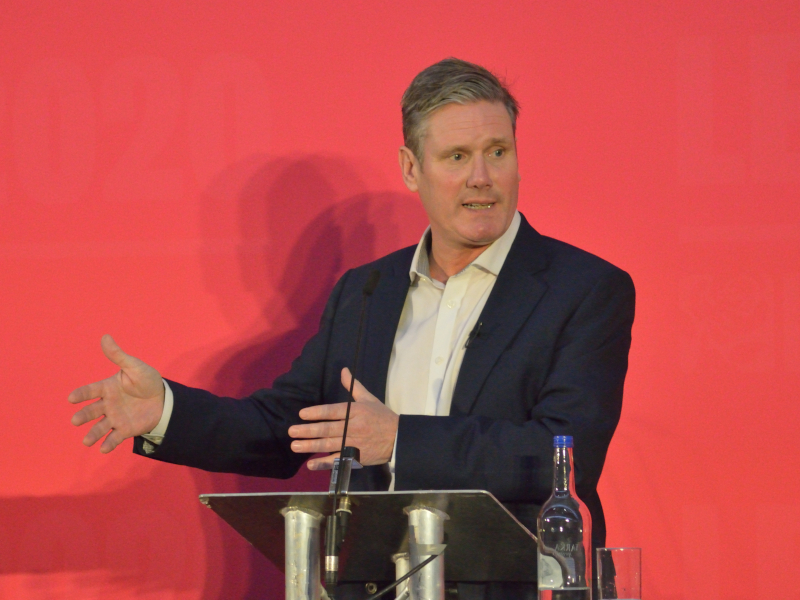
As Sir Keir Starmer takes the reins of the Labor Party, how can the Party seize the narrative on education and finally connect it to employability?
As you walk through Camberwell, every other house has a rainbow, proclaiming not just that household’s gratitude to the NHS, but the presence of home-schooled children within. Education is all around us in virus season: it is on our minds in a way it hasn’t been for years.
But that can sometimes seem the limit of the good news. ‘Education hasn’t had a good crisis,’ as former education secretary Estelle Morris tells us on page 14. Part of this is due to the peculiar nature of the crisis: for the many senior Labor figures we spoke to for this piece, coronavirus was a problem designed to exacerbate existing problems of inequality and, with children taken out of school, always destined to be a different moment than the frontlines camaraderie that has defined the experience of those working in the NHS.
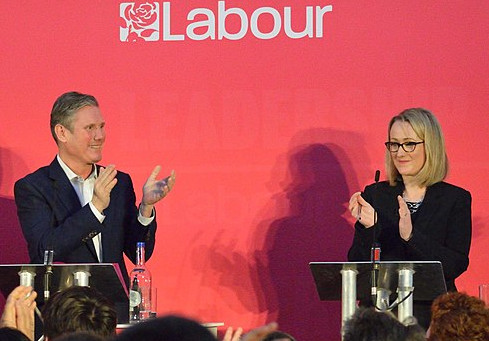
Of those we spoke with, many lamented the lack of leadership from both the government and from the Labor front bench. During the composition of this piece, Rebecca Long-Bailey was demoted from her role as shadow education secretary due to a retweet of problematic remarks by actress Maxine Peake. She was replaced by Kate Green who at time of going to press was still finding her feet in the job.
With the schools not yet back, all this contributed to a moment of pause. Under the empty skies, it felt like an intellectual reckoning was possible. After a decade of Conservative-led rule where should the left be on education?
A Tale of Two Speeches
Two quotes from two speeches, both given by Labor leaders in Black pool.
The first: ‘Just think of it – Britain, the skills superpower of the world. Why not? Why can’t we do it? Achievement, aspiration fulfilled for all our people.’
The second: ‘Tomorrow’s jobs are in green and high-tech industries. We need people to have the skills to take on those jobs, breathing new life into communities.’
On the face of it, it would be difficult to tell apart the words of Tony Blair in 1996 (the first quotation) and the words of Jeremy Corbyn in 2019 (the second). Both open up onto a cherished idea for the Labor Party: that a commitment to education is an integral part of the party’s offer to the electorate.
But scratch the surface, and differences proliferate, which still matter and must be resolved by the still relatively new Labor leader Keir Starmer.
Blair spoke eloquently about investment, and with a can-do spirit about placing education first. But he would likely have seen Jeremy Corbyn’s espousal during the 2019 General Election campaign of a ‘National Education Service (NES)’ which was, like the NHS, ‘free at the point of use’, as a return to the socialist ideas of the past.
As we all know, the Corbyn program was soundly repudiated by the British electorate in December 2019. But looking back at that election, it is startling – and a little depressing – how little education was discussed.
As a result, it would be an exaggeration to say that the public rejected Labor’s education policy. Furthermore, we now inhabit different times where the government – even a Conservative one – has entered our lives in ways which would have seemed fanciful six months ago.
So is the idea still relevant?
And if it isn’t, where should the Labor Party go instead?
Meet the Commission
Among those who advised the government on its life-learning strategy – intended to form part of the NES offer – was the likeable Professor Ewart Keep, who holds a Chair at Oxford University in Education, Training and Skills.
Brought in to assist with the Party’s Lifelong Learning Commission, Keep never felt particularly wedded to the NES idea: ‘Part of the problem was there was a headline slogan that emerged very suddenly and then there was an attempt to put things underneath that heading. We tried to sketch out what adult lifelong learning would look like in the context of an as yet unspecified National Education Service,’ he explains.
There is a degree of comedy here which will feel to some very redolent of Cronyism: the very people brought into produce an enquiry skeptical about its overarching aims.
Internal operatives tell me that things are far slicker under Starmer. Was this an attempt simply to evoke one of Labor’s greatest hits – the NHS – and tether it to an unrelated area? Keep continues: ‘they’re very different activities – particularly when you consider that one of the weaknesses of the NHS is that it doesn’t succeed in preventing illness: you’re treating people who are sick. Education is trying to be a preventative medicine. It felt misleading and not particularly helpful.’
It is this sort of thing which Starmer will need to avoid in order to dodge amused disparagement from the education intelligentsia. When I speak to Phillip Blond, chair of Respublica, he announces cheerfully, ‘I generally regard the left with absolute contempt so you better to talk to Mark.’
This turns out to be Mark Morin, also of Respublica, who has seen the NES idea knocked about for years, ‘and it’s never particularly excited anyone.’ He goes on to point out: ‘On the one hand, you can understand it intuitively with the reference to the NHS and the idea it will kind of bring together all aspects of learning education and skills from cradle to grave – that’s intuitively understood. But when you get past this you’re left with a leftist, statist idea and a big monolithic entity like the NHS.’ For Morin, who points to the poor health outcomes in the UK compared to countries like Germany who have a more localized system, the NHS is not only something the education system couldn’t emulate, such emulation would also not be desirable.
If you talk to Sir Michael Barber (see page 7), Blair’s former chief education advisor, he swiftly disowns himself of anything remotely connected to Cronyism: ‘I would rather just have a conversation about new radical approaches for education.’ For Barber too, the very language of the left opens up onto a grim vista of statism.
A meeting in St James’ Park
When I contact Estelle Morris – now Baroness of Yardley – I am pleased, and a bit surprised, when she says she’d like to meet in person. I take myself up to the ghostly center of town, to St James’ Park on a drizzly July day. We walk along the lake on one of those tentative lockdown days we’ve all had when we’re not sure if our favorite coffee shop will be open. It is, and we sip our coffees, grateful for this minor return to normalcy.
So what exactly is the NES? Like Morin and Barber, Morris is a little baffled. ‘That was my question as well. I thought it was a great idea but there was a real risk it became a slogan and a slogan only. It’s a great concept and I don’t think we filled it out. I’m stuck to have a ten-minute conversation about what we offered about it.’
So is the NES an immediate nonstarter? That’s where Morris differs slightly. For her, everything depends on Labor’s commitment to detail. ‘The NHS represented a radical change and revolution in healthcare. So don’t claim the title unless you’ve done the work. The title doesn’t come before the work.’
It is worth adding that when one reads the speech where Corbyn launched the NES idea, it is noticeably less detailed than a typical pre-power speech by Blair, where the party can sometimes seem to be governing even in opposition. This is a mistake unlikely to be repeated by the more details-oriented Starmer.
So what message does Morris have for Starmer? Now is the time, she says, to launch something truly radical. ‘From 1988 until now, there’s not been a lot of changes in education; the narrative has been the same: national curriculum, national assessment, and external inspection, publication of results, parental choice and focus on standards.’ The tale has been one of back-and-forth between the two major parties and tweaking around the edges. ‘The narrative from 1988 until now has been the same. I don’t think it was wrong to have let that narrative run for as long as we have done. Schools are better now and children get a better deal because of national curriculum accountability. But it’s all come to a natural end.’
But if Morris espouses an end to all this ‘fiddling’, what comes next? ‘We need a debate about the value of art, the value of sports and the value of community service.’
In part, what Morris is espousing is a move away from the so-called character agenda which, though espoused by many Education Secretaries, is now particularly associated with Nicky Morgan, who held the secretary ship at education from 2014 until 2016. Morris wants instead a system which teaches ‘citizenship and wisdom’.
But surely every side of the political spectrum will have a different idea of that? For Boris Johnson, wisdom is Conservatism; for Starmer, it will be socialism. But Morris says this is a debate we urgently need to have. And wisdom she says is difficult to have without some appreciation of the arts.
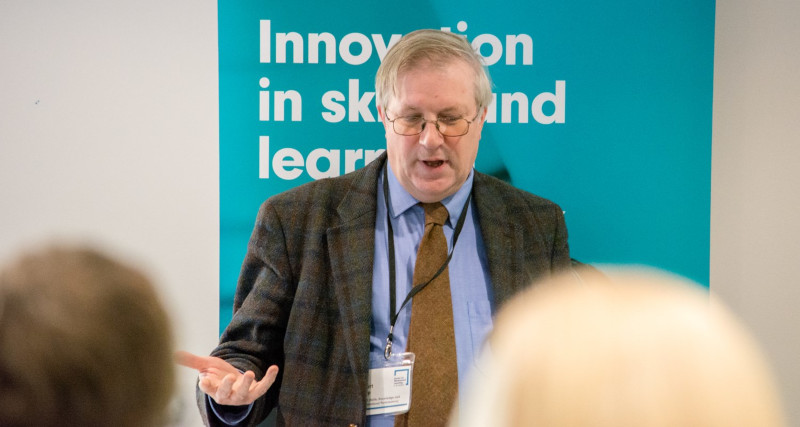
Professor Ewart Keep speaks at PRAXIS 2 in Scotland
Picture Imperfect
Perhaps we need to think more about how we promote things we know to be good. The force behind Lee Elliot Major’s proposal of a National Tutoring Service (see page 15) stemmed from the demonstrable value of the one-to-one tutoring experience.
For Susan Coles, the former president of NSEAD who set up an APPG in Parliament to promote greater coverage of the arts in our education system, the benefits of an arts education are equally clear. She worries that character is talked about as a ‘box you tick’ when, in fact, ‘the arts create resilience’ enabling you to ‘follow your own ideas without being wrong.’
For Coles, and for Sharon Hodgson MP who chairs her All-Party Parliamentary Groups (APPG) (see page 27), what we have now is a ‘production line of high performing schools which is strangling the creative arts.’ Coles puts her views with the kindly persuasiveness of the truly passionate: she is one of those campaigners who is herself an advert for the sort of change she wants to see. ‘We’re coerced into believing the knowledge based curriculum is best, when in fact the arts enable us to make mistakes and experiment,’ she explains.
This was one area where Corbyn wasn’t entirely idle in putting forward the detail behind the NES, stating in his Black pool speech: ‘The best is every child being able to learn musical instruments, drama and dance – the things that bring us joy – through our Arts Pupil Premium.’ For Hodgson and Coles this was an exciting moment, scotched only in December 2019 when Johnson was returned to power so thumping.
So should it be part of the NES? While Coles appreciates the idea, she worries it is too little: ‘The only worry I have is there’s no guarantee it will be in the curriculum.’
This, too, is where the eternal argument regarding free schools comes in. The schools minister Nick Gibbs would remind Coles and Hodgson that art is on the curriculum, but Coles – and the likes of writer Michael Rosen – would retort that it ought to be a core subject. Even if you resolve that part of the debate, you’re still left with the fact that academies are not obliged to teach it, and since 80 percent of secondary schools are academies and so are a large number of primaries, that’s a problem. Furthermore, there is the exclusion of the arts from the uber Gove Ian and, to Labor, loathed ‘EBacc.
’For Coles and Hodgson an opportunity is being missed, and for no decent reason. Coles continues: ‘If you do a teaching qualification, you learn how to teach the arts for around 2-3 hours in a 3-year course. So we have a lot of inexperienced teachers who are struggling to teach the arts curriculum.’
The great irony in all this is that the arts appears to benefit the economy. ‘They’re valued by the Treasury but not by the education department and DCMS,’ says Hodgson.
The Bonfire of the Quangos
This opens up onto another perennial question: that of the structure of the entire system, and indeed the very nature of our civil service and the balance between national and local government.
When I ask Professor Keep where he would begin in terms of fixing the English education system, he says. ‘The problem in England is that it’s very siloes.
Even different bits of DfE don’t talk to one another. In education, central government controls so much. They have to deal with such a level of detail: it’s difficult for them to grasp the big picture.’
So what needs to change? ‘We’ve gradually abolished all the intermediary bodies, which means everything’s an atomized marketplace. This isn’t functional for those who have to run it, and deliver education. I’d want to create relatively independent organizations which can act as a bridge between government and providers and also as a bridge between government and employers.’
Keep is referring to the Learning and Skills Council (abolished in 2015-16) and the UK Commission for Employment and Skills, which was wound down in March 2017. For Keep, the restitution of these would necessarily exist alongside some devolution of power and decision-making to the regions. The overall goal would be ‘bottom up thinking’ and a move away from a system where everything is ‘controlled by the minister.’
Mark Morin partially agrees: ‘We had the bonfire of the quangos under the Coalition. Some were well-deserving of that. The Commission for Employment and Skills was one of the most useless, and survived for a long time.’
Morin argues that any National Education Service would need to be rebranded along devolved lines: ‘It can be packaged in a different way and be marketed in a different way, with devolution at the heart of how this is going to be funded,’ he explains.
The civil service also needs a rethink, according to Keep. ‘Most civil servants do 18 months tops within a role. Every time I go to a meeting on higher education, it’s a totally different room of people. The last lot have all bloody left.’ This is a view echoed by Sir Michael Barber on page seven of this publication.
Universal problems
At the same time, we have a university system that increasingly seems unfit for purpose, and struggling to adapt to the new realities of online learning.
Keep explains: ‘A lot of universities were in big financial trouble before Covid-19 arrived. After 2009, many went and splurged vast amounts of borrowed money on new nice halls of residence, new nice student bars, and gymnasiums – and of course it’s all borrowed from the banks. £8 billion of borrowing has to be repaid, and the interest rate racks up on that.’ So how bad is it? ‘There were strong rumors there were at least 20 universities in England that were likely to get into significant financial difficulties in the next year and you can increase that number very considerably now.’
Morin adds: ‘We’ve created something that is too big to fail. Our universities are in trouble. How do we bail them out? One bad decision has been compounding another. We argued in the report we put out an the end of last year that we needed to stop sending so many people to university.
Does Respublica have any specific proposals? ‘We’ve argued that we need to get rid of tuition fees. It’s a smoke and mirrors thing, it’s just accounting practices: in effect, the government picks up the tab for those who can’t afford it. It’s basically a tax on those who can afford to pay for it because they graduate and earn enough to trigger a repayment. The real issue is we’re sending too many people to university, but to what purpose?’
That’s a view echoed also by Euan Blair, the tech entrepreneur with the famous father whose business White Hat, which he chairs, is unafraid to proclaim university a waste of time. Talking to Blair is a curious education in the Blair genetics and how they have played out in the next generation. It is as if the same incisiveness and ability to explain complex things in simple language which saw his father dominate British politics for a decade has been handed down a generation into a born tech entrepreneur.
For Blair, universities have failed to prepare children properly for an AI-dominated labor market. ‘I think that there will always be and should always be a place for purely academic learning in a university environment,’ he admits. ‘The challenge is that the system has become this monopoly on early careers in a really negative way. That’s made universities complacent and it’s created this lack of equal access to opportunity, particularly around careers.’
Whether Labor chooses to proceed with a National Education Service or with some other label, the Starmer offer will need to address a creaking university system, as well as the question of digital poverty in an age of online learning, and the perennial question of lifelong learning. If this is done meticulously, perhaps something will emerge worthy of the NES brand name
Will You Still Feed Me?
Stephen Evans, the CEO of the Learning and Work Institute, sat on the same commission as Keep in the run-up to the 2019 general election. For him, if the National Education Service is to have any meaning then it needs to solve the problem of keeping adults learning throughout life.
He argues that lifelong learning can come in many forms from an apprenticeship to a change of career, or it can come in the form of informal community classes.
‘We need to build a more coherent system,’ he tells me over Zoom. ‘For me the NES was about this idea that we need to do much more learning throughout life.’ What kind of financial structures is he espousing? ‘Clearly you don’t need government to fund some lifelong learning. But for those people who missed out and struggled at school, they might need to be covered by a National Education Service. The question is: ‘How do we create a culture of learning and get more people wanting to go back into learning?’
So it would be something of a patchwork quilt model? ‘If you’ve already got a degree, you’re more likely to get training at work. And if you’ve got no qualifications, I would say the government should have a role alongside trade unions and others to try and reverse some of those inequalities.’
Keep agrees: ‘Lots of adults receive no training from their employers. A lot of the adult workforce leave school and college, and then don’t get much training. If you’re in a low paid job, the chances of getting trained are very limited. When you look at England and the UK as a whole, we’re a long way behind many developed countries.’ When does the problem date from? ‘In 2010, funding for it got cut, and the adult education budget has declined by more than 45 percent and there’s a lot less money from the government. Employers are doing less and less.’
The Shape of Things to Come
I begin to get a sense of what this might look like. A National Education Service would need to intelligently join up the dots.
It might involve an acceptance of how we are failing to promote the arts, but also make us think in a more joined up way about the digital side, looking to tackle digital poverty (as outlined by Sir Michael Barber on page 7). It might also incorporate some of Lee Elliot Major’s ideas on tutoring, and build on what has already been agreed to by the Johnson administration (see page 15); the NES could potentially expand them into some form of mentoring service. The project might also involve greater investment in apprenticeships (see Robert Halfon on page 13), and a lifelong learning approach, where the state intervenes strategically to satisfy existing gaps. All this might be capped by Estelle Morris’ commitment to the promotion of wisdom and citizenship in place of – or perhaps in addition to – the Conservative years’ emphasis on character-building.
All in all, Starmer’s Labor has a complex inheritance on education. It has produced a reasonably compelling idea too soon, without, as Morris says, having done sufficient work. The spectre of Tony Blair cannot now be entirely dismissed after the 2019 general election defeat, but he remains a figure whose toxicity remains surprisingly persistent
Alongside these internal developments, there is a lot of dissatisfaction with the system and developments under successive Conservative-led governments. If all these points could be joined up, they might make a compelling proposition.
A final complexity is the precise historical circumstances Starmer finds himself in – or ‘events, dear boy, events’ as Harold Macmillan had it. A coherent education policy must be enacted, and priorities established, at a time when the virus, Black Lives Matter (see our leader on page two), climate change, and the new realities of work in the furlough era must also be solved.
Keir’s Choice
The fact remains that Starmer will need to unite the left and the right of his party on one of its core priorities. One way to do this might be to appropriate a slogan from the Corbin era but put some more intricate and thoughtful policies underneath it. Another way would be to admit that the NES is tarnished, and find some new banner under which to build a new platform.
Much will naturally depend on Starmer himself. So what are the new leader’s instincts on education?
There is surprisingly little in the public domain on this, and Labour operatives we spoke to talked of a tight-knit disciplined circle where there are few leaks as to what the leadership is thinking.
Lee Elliot Major recalls meeting the future Labour leader in their shared constituency during the Corbyn years: ‘I met Keir for coffee. He was on top of all the education issues of that day. At that point we were in the world of Corbyn, and at that time you were thinking someone like Starmer wouldn’t get in. Though education wasn’t his brief, he grilled me. He’s not ideologically obsessed: voters will vote for that, generally people like I worry about extremes.’
As often with Starmer, this sounds promising. But it’s early days, and, wherever the party ends up on this, work has to be done – and everybody who contributed to this piece agrees there’s not a moment to lose.
Ian Taylor is a name that may not necessarily be familiar to all Finito World readers, and he would not have minded that. A giant of business and philanthropy, he was nevertheless, for all his success, a quiet and even shy man. Born in Croydon, the son of an Imperial Chemical Industries executive, Taylor would grow up in Manchester. He spent some time as a boy in Tehran where his father conducted some business in Iran before the Ayatollah came to power. This episode of early relocation established one of the leitmotifs of his life: an ease with other cultures, that would put him in good stead in the oil industry.
Taylor’s educational attainments were impressive. He was educated at King’s School Macclesfield from 1968-74 before going on up to Merton College to study Politics, Philosophy and Economics. The politics aspect of his studies prefigured the interest he would take in The Conservative Party later in life; meanwhile, many would later note his philosophical nature.
But it was the economics background which would have an immediate bearing on his life. In 1978, he joined Shell and prospered immediately, exhibiting traits which would be evident throughout his career: an ability to swim within global companies; a tendency to be quietly popular, infectiously kind and accordingly, loved; and a talent for finding oxygen and commercial man oeuvre within vast organizations. All this went hand in hand with an interest in other cultures: this was the man who would later display an expertise in Libyan affairs which would be of help to his future friend David Cameron during his premiership.
Taylor’s success at Shell – he held successful positions in both the Venezuelan and Singaporean arms of the business – was a precursor to his remarkable achievements at Vitol. Taylor was one of those who proceeds steadily into the stratosphere, almost unnoticed – and then doesn’t mind it if he stays that way. In moving to Vitol in 1985, Taylor had happened upon his professional home for the next 33 years.
What followed was a story of continual achievement. Taylor spent seven years in London, but when the firm needed a man to be posted to Singapore as managing director of Vitol Asia, Taylor’s previous experience in the region was decisive. But it was just the beginning: he would go onto set up numerous operations within the company. His rise was built on hard work, good manners, and extensive knowledge of the business.
By 1995, he had risen to become CEO, a position he would hold until 2018. Under his tenure, Vitol had become the world’s biggest independent oil trading company with revenues in 2016 alone of some $152 billion. But as impressive as was his core work for Vitol, the way in which he grew and sustained his outside interests was if anything more so. Taylor became a restaurateur, owning two small restaurants in Wimbledon, and famously shored up Harris Tweed from collapse in 2005. Years later, it is a thriving organization.
One might have said that this gesture was a sign of the philanthropy to come – except that since 2002 Taylor had already been making notable charitable grants through Vitol. By 2006, the company had established the Vitol Foundation, which ‘looks for initiatives with the potential to generate social returns in a sustainable way.’ The effect of that work has been incalculable, with well over 2,000 projects supported – and counting – the charity supported 113 projects in 2019.
These were considerable achievements, but Taylor was only just beginning. In 2007, he established the Taylor Family Foundation, with a specific focus on promoting education and the arts. It is impossible to list the sheer number of projects the foundation has supported but the Royal Opera House, the Tate Foundation, Maggie’s, Great Ormond Street Hospital, Noah’s Ark Children’s Hospice and tens of others would not be in the position they are today but for Taylor’s generosity. Politics continued to be an interest for him, and he became a valued adviser to leaders in both the political and business spheres. He famously turned down a knighthood from David Cameron after the press delved into – and misunderstood – Vitol’s operations in Iraq and Iran. Afterwards, with typical humor, he expressed himself relieved. He had become extraordinary, but the spotlight wasn’t necessary for someone who took meaning from life in proportion to what he could do for others.
But not even the kind and the dedicated escape some form of ending up. Taylor’s battle with cancer was a painful illness which his friends watched unfold with a sadness only mitigated by the fact that Taylor was never seen to complain. Indeed, as the ensuing reminiscences show, he only showed himself a more thoughtful colleague as the disease took hold. It only remains to be said that he is survived by his wife Tina and his four children, and that those we spoke to express the same admiration for them as they did for Ian.
Finito World asked a small selection of friends to recall the man they knew in their own words.
Theresa May, former PM
To me Ian Taylor was primarily a gentleman and a philanthropist. Of course, he was a successful businessman and a political supporter, but what struck me from the first time I met Ian was his deep desire to help others and to improve their lives. He was a passionate believer in the importance of education. He knew that a good education gave young people the best start in life, and he wanted others to be able to be their best, achieve their goals and fulfil their dreams. But perhaps the best example of his concern for others was seen when he received ground-breaking cancer treatment in Switzerland. Being Ian he didn’t just say, “Thank you it’s helped me”. He wanted others to benefit from it as well – hence the money he provided and the work he did to bring the treatment to the UK. He was good company, considerate of others and always a gentleman.
David Cameron, former PM
I first met Ian when I was Conservative Party Leader. He was a brilliant businessman, but also greatly understood politics and political realities. Wise, loyal, discreet; Ian was one of my most valued advisers – and, over the years, we became firm friends. I came to respect Ian’s counsel even more during my time as Prime Minister. Countless times – in particular during the Libyan conflict in 2011 – he acted in a way that helped his country, not his business. Of course, alongside Ian’s business knowledge, was his philanthropy. Since it was set up in 2007, The Taylor Family Foundation has done truly amazing work – supporting vulnerable children and young people, and going a long way to improve Social Inclusion in this country.
Lord Spencer, Founder, NEX Group
Ian Taylor was one of my best friends – a man of humor and generosity and thoughtfulness. But he was far more than that. He was also an ‘achiever’. A prodigious ‘doer’ of things – in business, with the spectacular success of Vitol, the oil trading group he built into a global titan, but also in art, culture and politics. He was a man of real presence who gave so much to his family and friends, his business associates and to politics. Of my contemporaries I hold him in a special place; I have had the greatest respect and admiration for him. It may be a cliché but it is totally true about Ian. He leaves the world a better place but with a great hole behind him. He will be much missed.
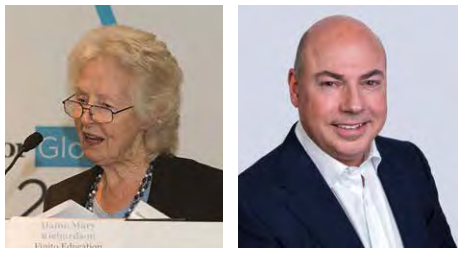
Dame Mary Richardson, Finito Advisory Board
I came into contact with Ian Taylor about 16 years ago when he was setting up the Vitol Foundation. As I was Chief Executive of HSBC’s new Foundation, I was approached informally for advice and was later invited onto his Foundation’s Advisory Board.
I was immediately struck by Ian’s kindness in welcoming me warmly and ensuring that I felt at ease. Throughout the many meetings I attended, which he chose not to chair, he was quiet, attentive, respectful of the views, which were sometimes conflicting, of the advisory board members. There was no dominance. He wanted to learn from any expert advice and his uncomplicated single aim was to do well and improve lives wherever possible, without recognition. His approach was flexible even if this meant funding new projects in challenging areas. Possible failure did not deter him if the need was great. He was brave in his approach in this area of his life as he was in his illness.
I eventually left the Vitol Foundation Advisory board after some years. Ian was already ill but typically he did not miss Foundation meetings. At my last meeting he was clearly unwell and in pain and I wondered if he would remember that I was leaving. It was typical of Ian that he not only remembered but had spent time considering how to thank me. He had arranged a valedictory charitable grant, a considerable sum of money to be donated to whichever charity I chose.
Like all great leaders, Ian enriched lives. He enriched mine.
Jeremy Isaacs CBE, Founding Partner JRJ Group
I got to know Ian over the last six years. He had been unwell to varying degrees over that time which underlines both his physical strength and incredibly positive outlook. I had the privilege to develop what was for me an important relationship. I always learned something new after spending time with Ian. Although we did quite a lot of business together, we rarely spoke about work, our conversations were about life, politics and philanthropy. The combination of his high intellect, remarkable generosity and of course his many unbelievable experiences always left me feeling amazed, optimistic and genuinely happier. He will be greatly missed by me but very fondly remembered.
Lord Fink
A man of many talents, it simply isn’t possible to say it all in a few lines. But if I had to sum Ian up in one word, it would be ‘selfless’. That is how I will remember him. I had the pleasure of meeting Ian Taylor and subsequently Tina at a Conservative Party function when David Cameron was our Prime Minister and I was Party Treasurer. I knew Vitol, the large and successful trading company that Ian led, from my former career at Man Group and knew how successful and large the company was, having had a few friends work there or do business with them. I was surprised when I met Ian, by his quiet unassuming manner, the thoughtful way he approached politics and his devotion to his family. Having headed a FTSE 100 company for quite a few years, I knew how hard it was to balance one’s life between business (which could become all-consuming) and family. I had seen so many cases where a CEO chose business over family life or became rather self-obsessed and frankly a little arrogant. Yet in Ian I saw someone who saw material success as just being part of life that earned him freedoms and one of those freedoms was to support his family and show his intense patriotism for our country through loyal devotion to the Conservative party.
At all the meetings and functions he attended, I never saw any case of him trying to use his really powerful status, role and the wealth that goes with it to try to dominate debate or push any agenda for his company. I just saw this remarkably humble guy talk passionately about his party and family and always ask about others. I saw him deal with the early and ongoing setbacks in his long brave battle. My wife Barbara and I saw him attend functions usually with Tina, who was his rock. At a time when we all realized how awful it must have been to go through the pain, discomfort and partial disfigurement of his various treatments, he kept on attending and supporting the party. They would never let their lives be dictated by this cruel illness, nor did I ever see self-pity or bitterness that this gilded life he had built for his family and the colleagues that adored him had been undermined in his prime. He was always optimistic that the disease was being overcome. Then came coronavirus and lockdown. Most of us spent our time following Government instructions limiting our social lives. Our horizons narrowed to our immediate friends, family and neighbors, and so Barbara and I were so sad when we learned of Ian’s passing. We were also saddened by the fact that we had never had the chance to show our respect, liking and affection for this lovely gentleman. Our thoughts are with Tina and the family. The world was a better place as he’d passed through it.
Andrew Law, CEO Caxton-Associates
Ian was a role model to aspire to. Aside from all his documented huge success in business, and his philanthropy, he was very much a citizen of his country and communities. Supporting struggling historic businesses in line with his Scottish heritage, or being active in his London locality, this was all second nature to Ian. In addition, he had one very special gift above all that, personal generosity. By that I mean generous with his time, the greatest gift one so busy can give. Whether it was supporting Speakers for Schools with his personal appearances at state schools, celebrating friends’ important occasions, or visiting great charitable causes, nothing was ever too much. He had an innate ability to multi-task and see opportunity in even the most basic of interests. As a lifelong supporter of Manchester City Football Club Ian saw the team’s renaissance a decade ago as an opportunity for good. He founded the Blue Moon rising group of London-based lifelong long-suffering City fans. Aside from interesting dinners with the club hierarchy and former players, it was designed to support and drive the initiatives of the club’s charitable foundation – City in the Community. The group has had a tremendous impact around Manchester. Ian’s ability to draw people into his circle and coalesce around common causes was legendary. The diverse group of fans who have participated includes a former World Cup-winning England rugby player, England cricketer, rock star, former head of the FSA and numerous others who all shared a common passion. Everyone aspired to be in his wonderful warm circle. In essence he made helping others fun. Accommodating the demands of work, hobbies, friends and so forth alongside his family must have been a constant struggle. From the friend’s perspective, he was the one making sure that we would be back home to sleep wherever we had been in Europe following the trials and tribulations of his beloved football team. He was the one offering wise life counsel to those younger than himself. Ian was simply the most rounded accomplished individual I have had the pleasure of knowing.
Dominic Johnson, CEO, Somerset Capital
Ian Taylor was a very special man who cared deeply about his country and was a passionate Conservative. He built a hugely significant business in a very complex area where sheer determination and guts are the defining feature of those who are successful. He was always unfailingly polite and interested whenever you met him and retained a strong sense of humble optimism right up until the last time I saw him, only a few months before he died – coming out of his office having done another full day’s work. In all seriousness I thought he was a genuinely great man and he will be missed by everyone who knew him, worked with him or who he supported through his incredible and understated generosity.
Sir Michael Hintz
Ian Taylor was always a man of huge integrity. He also had a wealth of understanding of how to work in our much nuanced world. His depth of understanding of the politics in the emerging world, especially Cuba, made for fascinating and also entertaining insights.
Closer to home he always spent the time to provide good counsel and excellent friendship. He gave selflessly to various charities and endeavors. The Conservative party in times of good and bad were always close to his heart. I will sorely miss his friendship and his insight. The world is poorer for his passing.
Peter Cruddas, Founder and CEO, CMC Markets
Ian was a beacon of light, a great businessman and philanthropist. We both shared a similar passion for helping disadvantaged and disengaged youth. Nothing gave us more pleasure than helping young people to be able to get a better start in life. Ian was a magnificent example to the younger generation.
The Shadow Minister for Veterans Sharon Hodgson explains how a broader arts-based curriculum could transform our economy.
It was Jeremy Corbyn who first came up with the idea of an arts pupil premium that might be used to close the gap for disadvantaged children. Myself and Susan Coles – with whom I set up the All-Party Parliamentary Group on Arts Education – were excited when we heard the announcement. It seemed the right thing to do: if you grow up in households where the arts are appreciated that just happens. Usually it’s poorer households that don’t get that cultural capacity.
School is meant to be a leveler and an equalizer. Lockdown has shown that when you take school out of the equation it really does lay bare not just the inequality in economics but cultural inequality. A whole generation of people are then going to be the best part of a year behind. Some will have had an amazing lockdown education, but overall the cultural gap will have widened.
You hear a lot from the Conservatives about character in education, but it’s my belief that the arts are the best teacher of resilience and confidence: in the arts, you tend to try and fail before you get it right. That’s definitely what you need in an employee when they get into a workplace, no matter what work is conducted in that place. If all you’ve got is someone filled with knowledge and the ability to pass exams, then they’ve got no capacity to think outside the box.
They’ll have no capacity for innovation or freedom of thought; they might only have been told what’s right and what’s wrong. They lack the creative freedom and too often seek instruction from their employer.
That’s why the Chinese have started looking here for our creative education – and the same is true in Singapore and South Korea. Those countries have tended to churn out people who are good at passing exams. The irony is that just as they’re looking to learn creativity off us, we’re leaving creative learning behind in our state sector.
What’s really required is a broad and balanced curriculum. In Wales from September 2020 there’s been a new curriculum with arts and well-being taught as a mandatory part of the curriculum. The same is true in Scotland, where the arts are also valued. What we are aiming for is for the arts to be elevated to that extent in England.
Some people have criticized the idea of the arts pupil premium as being all about ephemeral away days – trips to the theatre and museums, and so on. There’s nothing wrong with away days, but it needn’t be only that. Imaginative teachers could use it for a whole host of things. Under Corbyn, we imagined that if we did have an arts pupil premium we might give guidance to make sure teachers understood the range of things it might be used for: it could be used to buy fantastic art materials, to recruit amazing teacher specialists, or to bring artists into the school setting.
The argument is clear – and if anything, it’s been brought into sharper focus by the pandemic. More and more children under lockdown are having troubles with their mental health – and we know that art is able to help with that. I’m not saying that Math and English don’t give joy, but our spare time as adults is usually spent around the arts but in school that seems to have been left to one side, by people like Nick Gibb especially.
The irony is that the creative industries are valued by the Treasury but not so much by the Department of Education. There’s no joined-up thinking across government. We’ve had five education secretaries in ten years, and unfortunately Nick Gibb has been around for a lot longer than I would have liked. I don’t wish him ill – I just wish him into another job. He doesn’t have a background in anything to do with arts and education. He has fully bought into Michael Gove’s ideological stance.
It’s because of Gove that our APPG was formed. The EBacc has been especially problematic in terms of its unintended consequences for the arts. Gibbs came to our APPG and we told him he needed to acknowledge the effects of the EBacc. We had 80 experts in the room and Gibbs simply stated that he had an ‘alternative set of facts’.
The trouble with academies is that they create a system of ‘postcode luck’ with regards to whether you have access to the arts. Sometimes the free school system allows schools to be innovative but at others they detract from what should be a standard. We may have to look at governance again and consider getting schools back under local authority control.
The tech entrepreneur on White Hat’s new approach to getting young people into work
As a business looking to build an outstanding alternative to university and create a diverse group of future leaders, the coronavirus has made our offer front of mind for schools and companies. The pandemic has shown the need for digital skills accelerate by two to five years over the last few months. Meanwhile, universities have been in a crisis defined by lack of capability and lack of will: they’ve been unable to deal with this new reality. Some are doing remote courses that are not particularly great and with no social experience, which is one of the main reasons why people go to university.
Meanwhile, companies have massively growing digital skills needs and an acceptance that they need to get skills from other sources. Through the work of Black Lives Matter, diversity has become existential for them. What we have is an open discussion about racial inequality and structural barriers in society. CEOs are thinking: “Do I have the skills mix to succeed over the coming years? And how do I make sure I’m doing my part on diversity and inclusion and making my organization accessible to people?” Perhaps the final piece in the puzzle is that employers are asking themselves how they keep employees engaged at home.
All this has made it clear how valuable our apprenticeships program is. We aim to create a frictionless barrier for diverse talent. We’ve been growing really quickly over the past few months. We had to transition everything online almost overnight. There’s a big difference between remote learning, which is taking something you deliver in person and lifting and shifting it online, and actual online learning, which is in a different cadence and requires a different style of instruction. We invested early in making sure our curriculum is suitable for online learning.
I appreciate the government’s sentiment regarding the recent movement on apprenticeships guarantees. It’s top of the agenda for government worldwide. The Singaporean government is subsidizing 80 percent of apprenticeship wages. In the US, the federal government just announced they’re going to ban the use of college degrees for the hiring process and instead hire people based on skills. This is a gradual global groundswell and there’s a lot to be said for making apprenticeships a priority: it lays the gauntlet down to schools and parents to be seriously exploring these alternatives.
Having said that, you can’t do this without employers. And the bigger piece is we need employers to think: “We don’t need a graduate because although they might come with a degree, they don’t come with any of the skills I need and I want someone who has the right mindset to learn.” At White Hat, we also understand that over a 50-year career, a shot of learning at the start isn’t going to be sufficient. You’re going to need to keep learning.
Our programs range across areas. For instance, we did the first ever apprenticeship in legal project management with Clifford Chance. We also do programs with KPMG where we reskill members of their teams in data analytics; this is driven by their clients but also by their internal needs. At Google, they’re training digital marketers and software engineers. We’ve also had a focus on military veterans working with Citi Group and returning to work mothers.
Reskilling is a major area. There are many individuals within organizations with amazing residual knowledge of that organization and deep loyalty to it. They’ve worked somewhere for a significant period of time, but their role is changing. After doing the same job for five to ten years, they want to do something different and take on a new challenge. We’re about giving those people a route.
Companies are very aware that Generation Z have a host of skills that they know they need to address. What they’re increasingly realizing is that there is very little difference between the skill level of a graduate and the skill level of someone they can hire as an apprentice. If you’re relying on elite universities to fulfil your hiring needs, you’re going to get very similar people.
With the virus, all this has become absolutely urgent and critical. As often happens when you have huge shocks to the economy, it brings into sharper focus a lot of things that people had already realized to some extent, but they didn’t necessarily have a burning platform on which to act. Well, now they do.
Euan Blair is CEO and co-founder of White Hat, a tech startup which seeks to democratize access to the best careers.
At the Heatherwick Studio, we’re trying to be growers of more human place making: what’s crucial is the experience dimension of the person using the building. That might sound obvious, but I sensed even as a kid that we’re too often led astray by other forces and not by the needs of the person using a structure.
Some big positives can come out of this strange and tragic situation we’ve all been living through. There’s been a chance to think from new angles. That’s partly because you need to, given the new context. But it’s also welcome: I always thought it would be very hard for me to take a sabbatical, and I envied those around me who could do that. Of course, it was a partial envy – I’m so lucky to have the diverse rollercoaster of impressions I have. My studio is about embracing change and finding ways to adjust. That’s what excites me. The most interesting thing has been reflecting on what the virus means – and how it’s going to change our lives. Before the pandemic, there was more and more sharing – cars, workspaces and living spaces were becoming more efficient because people might live together in different ways. I was saddened at the outset of coronavirus: it felt like a kind of retreat into an understandable self-preservation and selfishness.
Before all this happened, people didn’t think they needed an office in their home – the idea of having a study sounded so Victorian. Throughout lockdown, people have been cowering in their bedrooms and trying to pretend it’s not their bedroom: so people will be making their homes better in advance of a possible second wave, and investing in any eventuality. Post-Covid homes will be better homes.
But public togetherness is what motivates me in the different projects we work on. Take our shopping center Coal Drop’s Yard for example. What motivates me isn’t getting people to shop. What’s exciting is that it’s an excuse at a time when governments don’t invest in public place making to create an interesting space. I wish the government would do more: they had their fingers badly burned in the 1960s and 1970s by terrible architecture, and so they retreated and let the private sector come in.
I’ve always made very tactile buildings and though obviously Covid-19 will change the extent to which we touch things, I think you also touch things with your eyes. The way light falls off a computer screen, for instance, is very dead and simplistic.
But light falling across more complex detail and texture is something that you absorb. If you’re in the mountains you can’t touch them, but you can still feel their form.
We’ve got 200 people here, and I’m thankful for being an older organization. Many of us have worked together for a long time, and we can sustain that over digital communication. There are unexpected benefits. The world’s been conspiring for the last two decades to get us to this point. The digital revolution has been setting us up to do this; it’s astonishing how effective we’ve managed to be at home.
But I don’t think in aggregate its better. There’s no real substitute for being in the studio. Our studio is full of models and memorabilia: it’s our collective memory. It’s important to see your failures, your test pieces, your experiments, and your thought-triggers. We all think we have a flawless memory – but we don’t.
We’re working with one new organization, rethinking large amounts of workspace. I think people are aware this has long ramifications for everybody. It spreads across everything. We just finished a Maggie’s cancer care center in Leeds. It’s a relatively small project but it’s trying to engage with the issues someone with a cancer diagnosis might face. How do you support that health journey? If you look at hospitals today it’s as if the emotional condition doesn’t impact their physical journey.
Looking back at the Garden Bridge, it was a manifestation of this urge to try and make everything connect more to people. A bridge doesn’t just need to be getting from one side to the other: the middle of a bridge is one of the most incredible places you can be. Maybe one day the politics will support our intention to create a new garden for Londoners.
Thomas Heatherwick is the founder of the Heatherwick Studio.
It’s ten years since David Cameron and Nick Clegg stood in the Downing Street Rose Garden at the beginning of the Coalition.
But from the perspective of universities, and our wider education system, it was a man who wasn’t at that press conference who would really go on to change our education system.
Michael Gove arrived in Great Smith Street with a strong agenda. Assisted by Dominic Cummings, he would have an extraordinary impact on how schools conducted themselves: his was a tenure ambitious for all students regardless of background. It’s hard to point to many other education secretaries who have made such a significant difference – Tony Crosland perhaps, who served under Harold Wilson, and launched a campaign for comprehensive schools. Whether he’s at DEFRA or heading up the Cabinet Office as he does today, Gove’s energy remains remarkable: any department that he comes into is very quickly overhauled. In any cabinet, Gove is always one of the most erudite. Peter Mendelsohn held a similar distinction during the Tony Blair years.
As education secretary, Gove accelerated free schools and continued with academic, building on the Andrew Adonis years. Adonis and Gove are comparable: each had the same ambition for schools, and a similar desire to bring in external energy and remove schools from local authority control. But I would say Gove arguably had a clearer agenda around school standards.
Cameron deserves some of the credit for the achievements of those years. Margaret Thatcher was probably the last prime minister who didn’t see education as a major part of her job. All prime ministers since Tony Blair have had a major interest in education, and Cameron was no different, though it’s probably true to say he didn’t involve himself greatly.
One thing Cameron did do was to invite the heads of independent schools into the Cabinet room, and seek to persuade them to start academies. It wasn’t very successful, but he was always supportive of Michael Gove. He knew when to leave someone to it.
A decade later, there are remarkable continuities. In Keir Starmer, we have a leader with deep roots right down to his Christian name in the left movement, as Brown had. And it hardly needs saying that we have an old Estonian in Number 10.
A comparison of Brown and Starmer yields intriguing thoughts: both are very bright people, and both have legalistic minds and a superb grasp of detail. But their disparities may in the end prove crucial. Starmer is untested as a leader. Brown, when he came to become prime minister, had been for ten years the longest serving Chancellor of the Exchequer, and had a formidable knowledge of how government operates. Whereas Starmer today is the younger man on the rise; Brown, in 2007-10 was arguably at the peak, or beyond the peak, of his energy.
As for David Cameron and Boris Johnson, they’re very different. Cameron had a vast appetite for detail, but he was primarily interested in foreign policy, leaving economic and domestic policy to George Osborne. Johnson tends the other way: he’s not interested in foreign policy, but in the domestic side. He has a far shorter attention span, not the same work ethic, and is still relatively new to Westminster politics.
How it plays out remains to be seen, but I certainly wouldn’t give Labor high marks for their handling of coronavirus so far. Starmer didn’t do enough to stand up to the unions, and the party gave the impression that it was far less interested in children – including the socially disadvantaged and those with mental health challenges – than in their own membership. Accordingly, they have lost moral authority, and shown intellectual weakness. They had an opportunity to seize the high ground but they blew it.
The quality of the opposition always matters but especially so now. The next years will see real difficulties for universities. I certainly don’t subscribe to the belief some on the right hold, which is to let the poor universities and those that don’t compete internationally go to the wall.
That position is about as intelligent as saying, ‘Let schools that don’t come top of the league tables collapse.’ In reality, it’s those in the middle and at the bottom that are adding most to the attainment of young people. It’s simply that the quality of the raw material they proceed with is much less high academically. Besides, if you let the universities in the middle or bottom disappear, you will be stripping northern cities, as well as cathedral and rural cities of their economic dynamism and vitality, and doing irreparable damage to the social cohesion of the country.
So ten years on from the outset of the Coalition, some themes are recurring. But as Heraclitus knew, we never step into the same river twice. The success of this administration will be in identifying what a crucial moment this is and not just for universities but for our entire education system.
Sir Anthony Seldon is a historian and biographer who recently stepped down as the vice-chancellor of the University of Buckingham
Never let a casual utterance from a great man go to waste. When Sir David Attenborough expressed an interest in the idea of gardening forming part of the national curriculum, Finito World looked into the matter in more detail
Sir David Attenborough is obviously a man used to uttering qualifiers. When we put it to him in our interview opposite that gardening ought to be on the national curriculum he expressed excited interest, but also stated that he wished to know more.
Obedient as always to the wishes of a great man, we conducted some research for him.
The idea chimed immediately within the gardening profession. Jo Thompson, a former teacher and four-time Gold medal-winner at the RHS Chelsea Flower Show, said: ‘In the past six months, people have started to want to develop their skills again, casting their minds back to retrieve nuggets of information once passed on by parents, grandparents, an enthusiastic teacher, an encouraging neighbor,’ she told us.
So what good could gardening give children? ‘Coming into contact with the soil makes us feel good,’ Thompson replied. ‘Tending plants makes us feel good. Success in growing plants makes us feel good, failures teach us to learn from others what went wrong and to try again. There is a huge resource, the natural world, which surrounds us, and it’s now our absolute duty to teach others how to look after it.’
Soon others in the profession had expressed interest in our campaign, including the legendary Piet Oudolf, who designed the gardens at the High Line in New York. But we felt the need to stress-test the idea with someone from the political classes in order to ascertain how it would be perceived by Whitehall and Westminster. Who better to speak to than the former education secretary Nicky Morgan who held the role of Secretary of State to the Department for Education from 2014 to 2016?
Morgan replied immediately: ‘Interesting point from David Attenborough,’ before admitting: ‘As education secretary, I started keeping a list of all the things people wanted schools to do – on top of teaching the curriculum – and if we’d said yes to all of them – and most were sensible – schools would have to stay open until midnight.’
Even so, Morgan was receptive to the idea and made the following suggestion: ‘My take on it is that there should be time in the school week to have a period when young people do something other than academic work which develops their character and supports their mental health and that could well include gardening – but would include other activities such as volunteering, enterprise etc.’
It is noteworthy that gardening feeds into both the character agenda of the right, and ideas more usually associated with the left. The activity teaches us not only resilience and patience – attributes Morgan deems particularly important – but also a sense of citizenship and wisdom espoused by another former education secretary Estelle Morris on page 14.
And with more teaching going on outside, isn’t this also inevitable? Green party peer Natalie Bennett concurs: ‘I’ve been asking the government questions about taking more education outside and into the natural world. We need not just biological science but contact with nature.’ For her, as for Morgan, it is part of a wider story where we need to teach children to explore ‘their creative side’.
But isn’t there a problem also whereby urban sites will be less able to teach gardening as, say, a typical private school in Surrey?
We put this objection to international plants man Piet Oudolf. He had little time for that reasoning: ‘It’s true that most people in cities have no gardens, but I think even in cities you can learn by what’s going on in your street and in your neighborhood. Street gardens can stimulate children and be interesting.’
Thompson agreed: ‘Even if you haven’t got a garden space, there’s a chance you have a window sill or a front doorstep, and it’s being shown how these spaces can be transformed, bringing not only joy to the person who’s gardening but also to passers-by, engendering conversation and thus combatting loneliness and isolation.’
Having dispensed with the likely objections, we felt we were now armed with enough to take the matter to Robert Halfon MP, a legendary campaigner in his own right, who sits as Chair of the Education Select Committee. We wrote to him, explaining that the gardening agenda would assist him in his own fight for guaranteed apprenticeships, arguing that a change to the curriculum would ‘create children unafraid of work, and able to understand that education must sit within the context of a sense of one’s wider place in the world.’
Our next letter to the education secretary Gavin Williamson’s special advisers makes our case fully, arguing that it is the right moment for the government to signal its understanding of the way in which the world has changed since Covid-19, and also urging the government to accept that gardening is an industry with jobs, at a time when we need to seek every employment avenue available.
Acknowledgements from Mr Halfon’s office, and from the Department for Education were received before we went to press. Mr Halfon wrote: “I really believe that outdoor practical activities are so important. I’d be interested in how it would work in practice.”
Encouraged by this, we will update readers on progress as and when it comes in.
London’s top headhunter and former Times journalist tells Finito World about the gentle art of career leapfrogging
I’d recommend a career in journalism to anyone but it’s not a career many people get to retire in. You do it for a decade – maybe even for two or three – but then you do something else.
At The Times, when I was leaving in the 1980s, there was a retirement notice posted to the door of one of the longest-serving editors. I remember thinking that it was the first time I’d seen someone at the paper reach retirement age. Of course, there is a career path in journalism – from local newspaper to national newspaper, then on to columnist, or into broadcasting and editor. None of those appealed to me. I’d have paid to do my job, and that’s the trouble with those sorts of jobs – as a consequence you tend not to be paid very much doing that kind of work.
But if you work in journalism, you acquire important skills, and then you can progress and earn something a bit more livable-with. As the Times City diarist, I was my own boss. As a representative of an august organization, I had a lot of access. I did about 150 profiles of captains of industry over three or four years. It was hugely demanding physically and emotionally; each was a kind of mini novel. I started to wonder whether I had the energy to go around the block again.
I asked myself what I liked. I liked meeting people, and I knew how the business world interconnected. Then it happened. I had profiled a man in the headhunting world called Roddy Gow. Miles Broadbent – a competitor of his – was incensed that I’d portrayed Gow as being the top of the profession. Miles asked me to come meet him. Even then, I made the effort to meet with people face to face. It’s important to look people in the whites of the eyes.
Three months after our first meeting, he rang me and said, ‘Can you have lunch with me at the Savoy Grill?’ In the 1980s, that was the power-broking dining room. When we sat down, he said right away: ‘When are you going to become a headhunter?’ I replied that it’s not something I’d ever thought of. No-one grows up thinking of becoming a headhunter!
He said, ‘Have a think about it. If I haven’t heard from you in three months, I’ll call and ask you again.’ Afterwards, my then father-in-law said: “Why didn’t you bite his hand off? This is the main chance. You only get two or three. Make the most of it.”
When I began headhunting, I found I’d picked up so many skills at The Times. I’d learned to become self-sufficient, and I’d long since stopped being nervous cold-calling people. When you ring up as a journalist, the person on the other end of the phone can panic; as a headhunter you’re talking about a role and that makes it easier. The wider skillset is also similar to financial journalism. It’s all based on long-term relationships, trust, listening to people, interviewing people, reading between the lines, note-taking – and recording data.
What fascinates me now in my work is the question of what makes people tick. There’s usually something in childhood that gives the successful that extra piece of drive – an insecurity which makes people work harder than those who didn’t have the kinks. Most people who do very well have sacrificed a lot both personally and health-wise. These people will get Alzheimer’s when they’re older – it all comes at a price.
Now, with Covid-19 the world has changed all over again. Video interviewing is pretty good actually – perhaps 90 percent as good as face-to-face. Obviously where you have a FTSE 100 CEO down to the final preferred candidate stage then you’ll want to meet, and the offer is unlikely to be on anything other than a draft basis otherwise. But I’ve seen non-exec roles offered and accepted without the parties having met one another. This time is brutal for people out of work, but actually the businesses which do emerge will be stronger, leaner, and fitter.
To young people looking for a job now I’d say that personal relationships are more important than ever. And I would remember always to be open to new experiences. When I think of my decision to leapfrog careers, I think it came from a confidence given to me by those teachers who believed in me.
There’s something special in all of us, but you don’t have to limit your career to that special quality: it can be a springboard to believing in yourself more generally, and then someone in a position of power will notice it. That can lead you to different spheres – it can make a headhunter out of a journalist.
Carol Leonard is the CEO of the Inzito Partnership, an ex-Times journalist and a visiting fellow of the Said Business School