The Financial Times recently published a list of companies which have prospered during the pandemic. The result is, perhaps unsurprisingly, made up of tech giants, online retailers and pharmaceutical groups; companies for whom transitioning to a remote working environment and the increase of at-home shopping habits have been more than advantageous.
The downside to these stories of good fortune is that many smaller businesses have suffered as a result; in the UK there is a crisis on the High Street with analysts estimating that more than 60 stores closed per day in the first half of 2020. And whilst conglomerate giants sat atop piles of profits (ten of the richest people in the world profited by a total of $400bn because of the pandemic), millions were plunged into unemployment or poverty. As president of Nike Jon Donahoe told analysts in September, “these are times when the strong can get stronger.”
This marked divide highlights the impact of the digital age on the financial welfare of businesses across the world. And the end of the pandemic may not signal a narrowing of that gap, despite pressures to keep tech giants under the same laws and regulations as public services.
Below are the five companies who profited the most out of Covid-19, based on equity gained and with added market cap.
1. Amazon: $401.1bn
Though Amazon’s revenues were propelled to extreme heights as it became the go-to online marketplace for essential goods, the company also reported a 4bn fallout due to the virus checks it had to implement. The giant’s rise to fortune also prompted skeptical responses about its monopolisation of the online shopping market and dire working conditions for workers who had pressured, quick-turnaround environments thrust upon them.
Over 560,000 employees worldwide and 27,500 across the UK; second largest private employer in the US
Sectors influenced by growth: audiobooks, Amazon Publishing imprint, Amazon Studios, Artificial Intelligence, Amazon Air (cargo transportation service), Drone delivery services (Amazon Prime Air), Amazon Logistics (contracts with small businesses to deliver to customers)
2. Microsoft: $269.9bn
The transition to a remote working culture benefited Microsoft as it harnessed the Zoom-equivalent Microsoft Teams, which CEO Satya Nadella reported 75 million people used in a single day in April.
163,000 employees worldwide
Sectors influenced by growth: IT consultancy, Artificial Intelligence, software & hardware engineering, sustainability consultancy
3. Apple: $219.1bn
Online sales kept this giant afloat as hundreds of stores across the world were forced to shut: the company profited from an increase in sales of laptops, iPads and smartwatches. There are, however, significant challenges on the horizon in the form of Chinese rivals, tighter tech regulations and recent criticism over 30% ‘apple tax’ on in-app purchases.
137,000 employees worldwide (Apple claims to ‘support’ over 1.76 million jobs in Europe). In the UK there are 6,459 employees and 291,000 App Store ecosystems jobs
1,500% employment growth since 2000
Sectors influenced by growth: Apps, construction, retail, marketing, engineering
4. Tesla: $108.4b
Founder Elon Musk has recently side-stepped Bill Gates to become the world’s second richest person as shares in Tesla increased rapidly during the pandemic and the electric car firm joined the S&P 500 stock market index. Musk promises a restructuring of the car model with a self-driving ‘robo-taxi’ system which would allow Tesla owners to rent out their cars- that he says will change the face of car ownership.
48,016 employees worldwide
Sectors influenced by growth: car manufacturing, advertising & marketing, spacecraft engineering, Artificial Intelligence, sales
Former Tesla employees told Business Insider that their favourite parts of the job included: seeing customer’s satisfaction with the product, a collaborative culture, employee discounts and the fast-spaced nature of the sector, being able to build things & watch engineers at play
5. Tencent: $93bn
As the first of multiple Chinese companies on this list, Tencent took advantage of the shift towards online gaming during the pandemic. Famous for its hugely popular social media app WeChat, Tencent’s soar in revenues is mostly down to its world-leading position in the gaming world: it saw a 40% increase in online games sales and its online video subscribers grew to 112m.
62,885 employees worldwide
Sectors influenced by growth: games designer, audio engineer, software engineer, animator, sales & marketing, virtual reality
Boris Johnson’s recent announcement that we are again heading into a national lockdown will have far-reaching consequences for the economy, for jobs and, of course, for education.
There has been much talk about the fate of school students and upcoming exams; headteachers have made unprecedented challenges to Johnson’s initial decision to keep schools open and parents have rallied against the government’s handling of school closures.
But what of the millions of students in higher education?
The pandemic is already influencing the choices students are making with regards to university in surprising ways: a recent Guardian article highlighted a greater push towards vocational courses like teaching or nursing, and many students are choosing universities closer to home. More generally, there’s been a widespread impetus to apply to university, especially among students in more deprived areas of the country; UCAS expects a 5% jump in applications this year.
While the long-term effects of the pandemic such as these may be positive, what of the current fee-paying students being forced to stay at home and work remotely? Some universities, like University College London, have advised their students to stay at home past the official government deadline of mid-February. Others have given little to no information on when students can expect to return to normality.
Hugo Rowse, a first year undergraduate at Exeter, says they’ve had hardly any communication from the university at all.
“We had one email before the announcements saying it is ‘recommended’ we don’t come back until the 25th of January. I think they’ve used the word recommended to avoid having to pay us back”, says Rowse, who has spent an average 8 weeks on campus and “cannot believe” that they haven’t been told anything about remunerations since the November lockdown.
“I’m still waiting for some form of contact since the lockdown yesterday”, says Rowse. “Honestly, I don’t know if we’ll ever get any.”
Rowse says that the situation is even worse for those who have returned to Exeter. “The thing which has caused the most anger is that people who have gone back have sent pictures of locks on our doors and balconies to stop us escaping, which is bizarre. A lot of students have emailed and got no response”.
“The prospect of going back to university now and being locked in is my absolute worst nightmare,” says Rowse. “I feel so aloof from my course. I just sit here and they send me 16 lectures a week and I just have to watch them.”
According to Sam Gamblin, charity manager at UMHAN (University Mental Health Advisors Network), there is a big mental-health impact on university students during a national lockdown. “A key issue is the lack of the usual support networks and activities that students might do to keep their mental health at bay,” says Gamblin.
“Although you can still access things like psychiatric appointments and medication, a lot of students had strategies of keeping well and ‘fitting in’ through community groups and societies, and that’s now completely disappeared.”
Gamblin says isolation is the key concern among mental health experts, particularly with new students living in new accommodation with people they don’t know, for those living in hostile home environments or with parents unaware of their mental-health issues.
As Exeter student Hugo Rowse demonstrated, Gamblin says they have concerns about whether students will even want to return to university. “What happens if students want to defer or do something different, or decide that university isn’t for them? This has an impact on their employability further down the line, and there isn’t any advice on what to do if this is the case.”
ROBERT GOLDING LOOKS BACK ON A TOUGH YEAR FOR THE ARTS AND HERITAGE SECTOR BUT DISCOVERS HOPE AHEAD
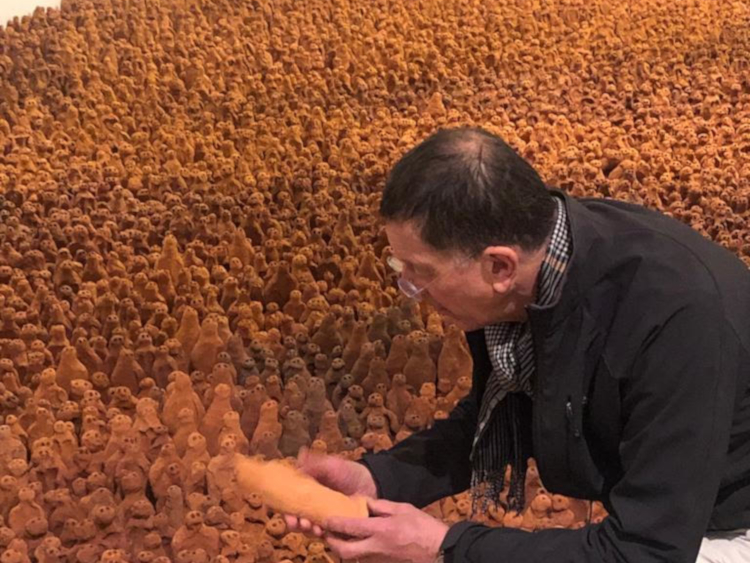
Anthony Gormley stands before a sea of small clay figurines at the First Site gallery in Colchester and poses for photographs. ‘I’m very, very thrilled,’ he says. ‘It’s never been more relevant than now.’ He is referring to his thought-provoking sculpture Field for the British Isles: a sea of faces, all open-mouthed looking eerily back at the viewer. First produced in 1993, it won him the Turner Prize in 1994.
Gormley never looked back, and the work too has shifted, as good art does, with the times. ‘I’m proud to see it here,’ he says. ‘Colchester has a long, proud history of immigration.’ Then pointing to the inspired installation, where the faces amass until they reach a corner and then disappear off unseen, Gormley exhibits a boyish thrill: ‘It’s never been shown ‘on the angle’ as it were, where the first bit of orthogonal architecture promises to dispense with orthogonality.’
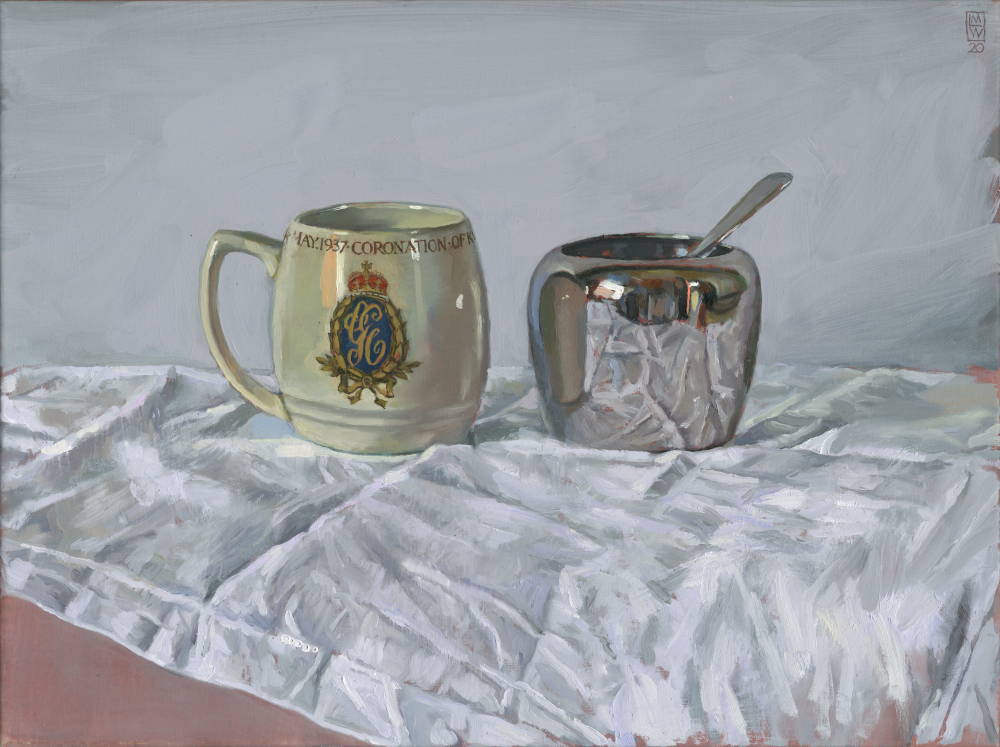
Perfect Tulips Escape Fictional Jug by Lorna May Wadsworth, 2020
All of which would ordinarily be perfectly normal – a famous artist using the word ‘orthogonality’ while journalists and gallery directors nod sagely, enjoying their proximity to greatness, and concealing their bafflement. In the ordinary scheme of things, one might also relate all that the sculptor went on to say about Brexit; how generous he was with his time; and how marvellous it is when an artist plainly enjoys elaborating on their work.
Except that this is not the ordinary scheme of things, as Gormley was speaking on the eve of the coronavirus. The world, without anyone being aware of it, was primed for change.
The Ides of March
2020 was set to be another year of treats: Titian at the National Gallery, Van Eyck at MSK Gent, Cranach at Compton Verney. As the virus proliferated, anxious gallery directors had suddenly to cope with dramatically suspended footfall. They examined not just their balance sheets, but in many cases their raison d’être. Curators turned themselves overnight into online TV presenters, as galleries pivoted to virtual exhibitions, with mixed results.
Still Life by Lorna May Wadsworth, 2020
As with the wider economic story of coronavirus, there was a terrible randomness about 2020: the arbitrariness of the virus ruled all. Survival depended on one’s cash flow going into the crisis, yes, but also on the layout of a site. Did your gallery have monetisable outside space like Hampton Court? If so, you could at least reopen your gardens. But what if your gallery was urban, like, say, the Handel House off New Bond Street, a space where social distancing was impossible? For such sites, a long road lay ahead.
Maev Kennedy, the former arts editor at The Guardian and BBC Radio 4 presenter, had been due to travel to Ghent for the Van Eyck exhibition, but had to cancel. Naturally ebullient, with a warm Irish voice, she seems an unlikely messenger of pessimism, but pessimistic she undoubtedly is. She tells me that the urban sites face ‘a gigantic problem’. The example she gives is Turner’s House, known as Sandycombe Lodge in Twickenham. ‘It’s the only surviving property Turner designed himself. It has a handful of small rooms and one winding staircase. You might be talking admitting five visitors at a time, so how do you make the numbers stack up?’ she asks.
Kennedy is also worried for the National Trust, which announced 1200 job losses in late July. ‘It has a huge advantage of the enormous and incredibly loyal friends base, but the problem will be a demographic one. The volunteer base are overwhelmingly over 60s and that might be being polite.’
Kennedy speaks with great authority, and her pessimism is especially convincing since it plainly comes from a place of longstanding love. Even in September, as many galleries and museums embark on reopening strategies, her voice remains with me, urging caution.
The Pivot to Digital
Not every gallery we spoke to was caught off guard by the pandemic. Compton Verney’s director Julie Finch was well-prepared for the virus thanks to a journey she took to the Far East at the start of the year.
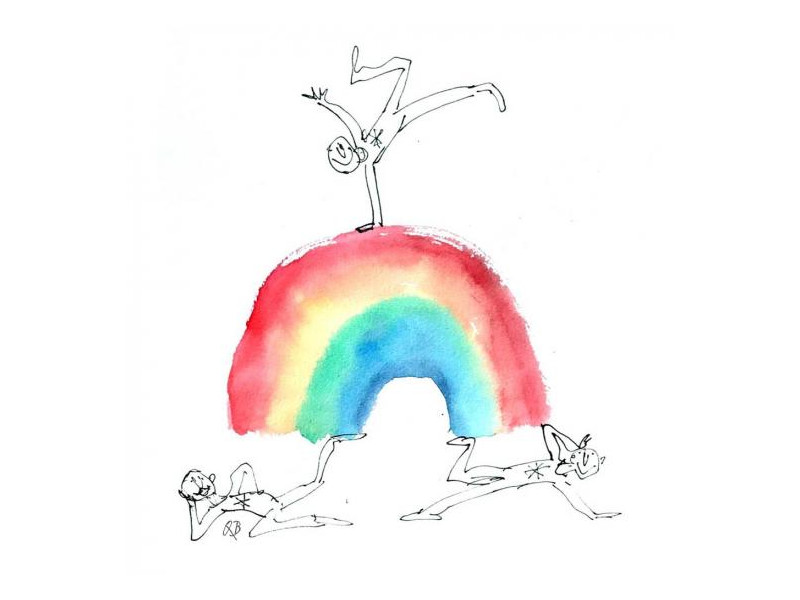
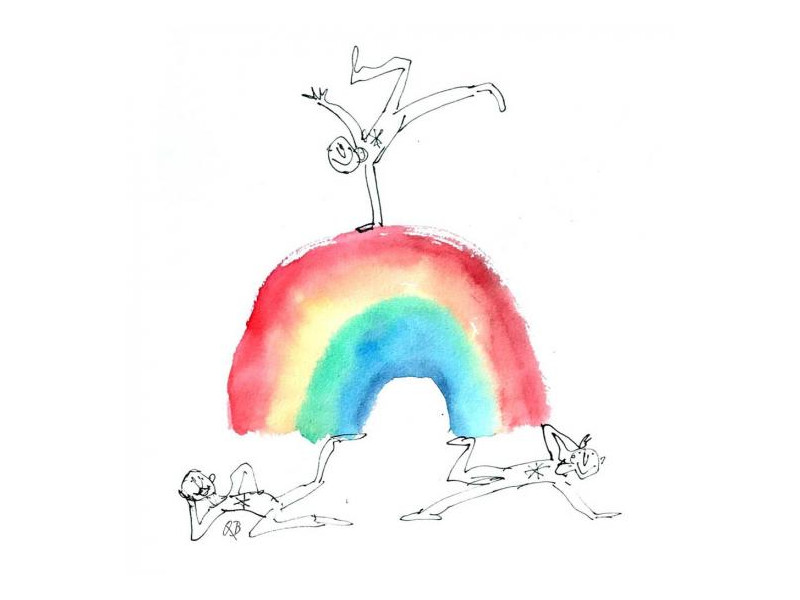
One of Quentin Blake’s ‘portable rainbows
‘I travelled in February through Singapore and so I saw it coming,’ she tells us. ‘As soon as I got back, I set up a Covid-19 team. I was insisting at the end of February that people not sit close together in meetings and everyone thought I was bonkers.’ Finch now realises she was fortunate to be a step ahead: ‘We prepared for a staged closure and had a social distancing policy before lockdown. It was only for a week but people carried on visiting and the feedback was that everyone felt safe. But we ended up locking down the house, and closing the grounds on 20th March.’
So although Finch soon realised that she’d ‘lost a year of income’ – the shortfall stemmed particularly from reorganised weddings – she also realised she had to seek ‘the good will to rebook.’ Finch had also proved to herself and others that she could make the Compton Verney experience viable going forwards.
The great anxiety for the heritage sector is that the cost of opening can sometimes exceed the cost of staying closed. Finch explains: ‘We generate about £1.6 million a year through commercial activity but just to house the collection at Compton Verney costs £300,000 a year. You’re talking security, air handling units, management processes, conservation.’ A museum cannot just sit tight in a way some businesses can.
Galleries were therefore thrown back on their digital smarts – an area which many institutions subsequently realised they’d not been paying sufficient attention to prior to the pandemic. ‘We invented a digital strategy overnight and went live with the Cranach exhibition,’ Finch explains. But this was no silver bullet: ‘The question is: “How can you monetise digital and reach a wider audience going forwards?” In its first week we had 22,000 views and we would never have received that normally. But we had no pay wall.’
Ay, there’s the rub. Finch notes that the virus creates an opportunity to ‘nurture the virtual community,’ but there does seem a lack of detail as to how this will ever make up the shortfalls in revenue.
Maev Kennedy is unconvinced about the proliferation of online content: ‘I don’t think they’re doing much more than reminding people they exist.’
Even so, what would this virtual community entail? According to Finch, you could make exhibitions ‘more of a festival of ideas around our creative content and collections. You can zoom someone in from America to take part, and create new perspectives and intellect.’ But Finch also concedes that ‘you can’t beat the real thing for a minute.’
From Portraits to Still Lives
But art’s perennial strength is its adaptability, and it might be consoling for young people considering careers in the arts to hear that there are signs that artists are beginning to look afresh at the world. Some have even found lockdown enriching, and challenged themselves to find new ways of working, and to discover fresh forms of expression.
Lorna May Wadsworth is a portrait painter, especially noted for her famous Last Supper with a black Christ (a print of which now hangs in St Alban’s cathedral), and for her magnificent portraits of Margaret Thatcher, who sat for Wadsworth five times towards the end of her life when Wadsworth herself was in her 20s.
But her portrait work necessarily dried up at the outset of the virus and she found herself doing still lives in her flat.
Wadsworth is infectious and kind, and you can detect the steel of ambition beneath her warmth: ‘In many ways, for artists themselves the virus is not that big a jump. I spent the whole of last year on lockdown preparing for my retrospective at Sheffield’s Graves Gallery. It was odd to see the world react in horror to your life basically!’ And how has the work been? ‘Lots of artists have said they’ve not been able to work because of the stress and the worry. My reaction was to go gung-ho on these still lives.’
These turn out to be a leap forward for her artistically: Wadsworth has turned her gaze away from people and found a sort of personality in these objects. ‘The tea pots are talking to each other or dancing. They project the need for connection,’ she says. The move towards online has had hopeful ramifications for her: she has sold pictures on Instagram. Even so, there is a limit to her embrace of the digital sphere: ‘We’re so sick of being online,’ she says. ‘I hold a belief: a good painting never reproduces as good in real life, a mediocre painting will reproduce better.’ So caveat emptor.
But there was also good to be done. Wadsworth signed the Artists Support Pledge, meaning that she will buy £200 of art for every £1,000 she sells. She also helped launch the Bourlet Young Masters Art Prize which aimed to get children busy during lockdown while raising money for the Cavell Nurses’ Trust.
This marvellous initiative – as Stephen Fry put it, ‘from the fridge to national recognition’ – chimes with the sense of community which Finch has also tried to promote at Compton Verney. ‘The profession has been massively supportive of one another which is brilliant,’ she says. ‘We’ve been thinking about how Compton Verney can help the local area. One of those is health and well-being and use of the grounds. We have a local pass and have put in a cheap ticket for people to come as many times as they want over a five-week period. We also have special price-ticketing for NHS staff.’
This noble approach was also evident in the delightful series of free rainbow e-cards (see left), produced by Quentin Blake for the House of Illustration which are, he says, ‘for people to send to loved ones they cannot currently see due to the coronavirus lockdown, to show they are thinking of them at this difficult time.’
The generosity seems to connect back to a comment Anthony Gormley made to me regarding Field for the British Isles: ‘‘The idea that my name is on this is rubbish. It is a collective work made by the collective hands of a collective people.
So one’s best version of coronavirus in the arts world would entail precisely this: an arrival at not only new ways of seeing, but a new sense of community. Perhaps it might not be too much to argue that we have moved more quickly than we might otherwise have done towards a kind of collective seeing.
The Outlook for the Young
But is the arts world still worth going into? Julie Finch is optimistic: ‘The sector has to modernise now. Compton Verney will need to prioritise digital audience development, and give the lead for being a more diverse organisation. Since Covid-19 things have moved on exponentially. I think there will be roles coming up, so I wouldn’t discourage people from going down that route.’
Maev Kennedy remains concerned: ‘There’s going to be a flood of good people all released out into a shrunken market at the same time. For younger people, the consequences of this are going to be felt for a very long time.’
Despite this, the contemporary art market has remained vibrant throughout the crisis: the wealthy locked-down have been staring at that blank patch of wall, and wondering what to fill it with.
A well-known London art dealer lists for me the sheer range of opportunities in the arts worlds, from framing to the legal side, to forgery and counterfeiting and academia. She sees a predominantly optimistic landscape: ‘It’s been a difficult time but the world hasn’t stopped.
The US stock market is back to where it was a year ago. We’ve sent things to Australia.’ Then she rattles off other professions which she expects will be resilient: ‘There’s insurance and transportation of art – and then there’s the massive multi-layered business of buying and selling artists, representing artists, not to mention the buying and auction house routes. A lot of this has been hit, but it hasn’t been death blows.’
She adds: ‘What we’ve learned in all sectors is to use digital communication. We’re helped by the fact that the private buyer is now prepared to make more decisions from a screen than they were before.’
Maev Kennedy agrees, but emphasises that it’s just one segment of the art market: ‘Once you go upwards it’s going to be okay. That whole business of bringing in a Russian oligarch to see a Titian with a glass of champagne: that won’t be affected at all.’
But for Kennedy this is cold comfort when we look at the sheer enormity of the ructions for museums and galleries more generally.
A Modest Reopening
All of which sounded grim over the summer, and sounds grim now. But as we moved into July and August, galleries did begin opening again. Dr. Gabriele Finaldi, the director of the National Gallery, had been sending out bulletins about his favourite pictures during lockdown. (‘He seemed a bit like a Renaissance prince alone in his castle, it rather suited him,’ jokes Kennedy).
Covid-proof routes had been designed. It was a cathartic moment for the nation’s oldest institution to be leading the way. But it was still a sign of how much things had changed: a place you used to walk in from off the street was now operating on a still-free but competitive ticket-booking system. This seemed to spell the suspension of the impromptu 20-minute gallery visit at lunchtime.
A few weeks later the Tate Britain opened and felt a fairly eerie experience. The Clore Galleries where the famous collection of J. M. W. Turners’ hang was closed, cordoning off visitor access to the William Blakes’ without explanation. And the gallery was structured according to two routes: the British Art from 1560-1930 route and the contemporary route. It was good to be back but impossible to ignore that the galleries felt somehow sad. I began to find myself in the Kennedy school of pessimism.
This pessimism was to some extent improved by a day in Twickenham in August where I attended Strawberry Hill House, and Turner’s House. In both instances, I book ahead and become part of a small group of three in structured socially distanced tours of small spaces (both houses are structures round vertical staircases where it would be impossible to socially distance).
On the plus side, the new tour group approach makes for a sense of camaraderie among gallery-goers; on each occasion I find I enjoy the company of those I am with. But for me, the experience of museum going is all to do with entering a state of private meditation and communion in a public setting. This has always made me sceptical about audio guides and guided tours. If the world has moved more towards face-to-face interaction while we look at our heritage then that might not always find me in the right mood.
Lucas Cranach, Lot and His Daughters
Back to the Future
Whenever I think back on that day in Colchester with Anthony Gormley it is impossible not to feel grief at what we were so suddenly deprived of in March. In an attempt to correct this, I sometimes find myself groping a bit too obviously after positives.
When I speak to Sally Shaw, the director of First Site and a friend of the sculptor, she says, ‘I’m currently sitting in an empty gallery which is odd.’ It is another sad image.
But she tells me of an optimistic project she embarked upon during lockdown. It occurred to Shaw to start a series of Artist Activity Packs, and the first person she thought to contact was Gormley. ‘We thought it would be brilliant to get people to do something in their homes. I always remember colouring-in as a kid. We’d just done Field for the British Isles with Anthony and so I held my breath and wrote an email and asked him if he wanted to partner with us. Within ten minutes, I got a reply and we were doing it.’
The resulting project, in Shaw’s words, ‘went bonkers. We’ve done three packs and they’ve been distributed to 65,000 households. People were desperate to do something.’
There is something here which is more than just pie-in-the-sky consolation. During this time, the art world has shown tremendous resourcefulness, and an absolute commitment to the transformative power of art at this time.
When I was with Gormley before Field for the British Isles, I asked him how that piece would change if Scotland were to leave the Union. It was a question about the way in which art itself changes, as the world mutates.
On that occasion, Gormley dodged the question, answering that that would be the ‘next chapter in a long national story of unfolding madness.’
But a few months later, the B word has been replaced by the C-word, but looking over my transcripts I realise that not as much changes as we think it does.
At one point, Gormley says in his inimitably digressive way: ‘We’ve got to achieve social justice in a time when goods have absolute free passage globally, and yet somehow people do not. Why are we going backwards in time when we’ve been given all of the tools of the collective mind? The internet is the realisation of the idea of the biosphere circled by mind.’
A biosphere circled by mind’. It would be hard to think of a more apt or prescient description of the times we live in. It took an artist to say it, and it would take an artist to show it.
In Twickenham, it occurs to me that history is full of intended restorations and easy romanticisms which were thwarted in the end by the irreversible nature of time. For Gormley, Brexit was just the most recent of these. In reality we never restore past eras – and we shall not restore the world to March 17th 2020.
What hope might be placed in opposition to this? I find it in Turner’s House. Upstairs, where only three of us are allowed at a time, there’s a telescope which seeks to show the visitor what the view out of the artist’s bedroom would have been in his day. It is an image of an Arcadian landscape unimpinged-upon by the rows of samey semi-detached houses which we experience today. Marble House, occluded now, seemed right before the artist then. The river could be seen, and though you can’t see it now, the museum has rescued for us as an ingenious act of rescuing.
It strikes me that this project to understand the past shall continue, and in doing form our future. This endeavour shall include understanding better the past six months. To do that, you could do a lot worse than start with Lorna May Wadsworth’s exciting and original still lives. And it is a hopeful fact that at Turner’s House, though there is a bottle of hand sanitiser on the table next to it, visitors are still encouraged to touch that telescope.
THE DIRECTOR OF STUDIES AT REGENT GROUP ON CHARACTER
The trouble with education is that it’s full of buzzwords, and too rarely do we pause to think about practical implications.
In the Blair years, citizenship education was a prominent preoccupation of schools and colleges in England and Wales – but the term sometimes lacked definition, and in any case, wasn’t citizenship an implication of the Cameron government’s Big Society agenda? Definitions tend to blur.
With the coalition government – and latterly the single party conservative governments – we have seen a shift in preoccupation, away from citizenship education and towards character education. So how do we avoid falling into generality and making the same mistakes again?
Fostering character sounds well and good – who could seriously object to it – but what does it mean? Simply, character seeks to cultivate resilience, courage, and personal responsibility. It also has intellectual pedigree, dating all the way back to Aristotle. In his Nicomachean Ethics the philosopher argues that character education creates virtuous individuals who live a good and meaningful life, a life full of happiness, purpose and achievement: this he called Eudemonia.
What’s interesting is that in character education these individual traits – resilience, grit, courage and so on – do not exist in isolation. They exist together: you cannot be courageous without being resilient, for example. What we seek to do at Regent College is to develop these psychological states so that students learn to better act, overcome obstacles and embrace challenges.
For Aristotle a person of good character has practical wisdom – phronesis: the ability to act in the right way, with courage, with resilience etc., because they have developed the correct habits. Furthermore, a good character can only be developed by choosing right actions over and over again until that right action becomes a habit. The goal is to repeat certain behaviours associated with the development of a good character, initially under guidance and instruction, until they become embedded as habits.
So does it work? At Regent College, we have founded a framework for character education to be delivered alongside our core curriculum. The project began in May 2019, and we have called it Thinking Into Character.
The programme is designed by Dr. Selva Pankaj and aims to give students a solid foundation in character education. Topics covered by the programme include goal setting, habit formation and the principles of personal leadership. Each lesson is designed to encourage students to take responsibility for their results and to develop the confidence to believe that they can achieve dream goals. Among some of the values and attitudes developed by the programme are personal responsibility, a positive mind set, resilience, grit and self-confidence.
It has had startling results. One example was Abdi Raman Fara, a bus-driver who wants to be a transport manager with his company. He felt he’d been with the company a long time and wasn’t progressing. Under our instruction, he spoke to his manager, who agreed to be his mentor. As a result a career action plan was implemented and he decided to start his own business. ‘My entire life has to be geared towards goals that I am happy to pursue. It’s about achieving your life goals, and not just in the short or medium term,’ he says.
Another case study was Amelia Giurgiu who had been too nervous to start turning her photography in Provence into painting. She was facing what we would call ‘the terror barrier’. For her character education enabled her to ‘take action and to show courage in the face of previously acknowledged fears’.
Meanwhile, Ahasan Habib, the founder and CEO of H&K Associates, found that an immersion in the programme ‘helped my business by showing me where I lacked discipline and holding me responsible for all my results.’
So the effectiveness of this character development programme is measured both objectively and subjectively. The subjective benefits are there for all to see in testimonials like those above. Objectively, we are looking at data such as grade attendance and assignment submission rates as well as external ventures that students have set up following their engagement with the programme. These ventures could be study groups, entrepreneurial businesses or engagement in voluntary programmes.
We still have a way to go and are at the data compilation phase, but the signs are very encouraging. And we hope that our programme will give others the impetus to think hard about the language we use in education theory, and to turn the theoretical into pragmatic and meaningful steps. Aristotle would be proud.
Our Woman in China gives us her take on the nuclear arms race in education between China and the rest of the world
This is going to be quite a year in China. There’s going to be about eight and a half million graduates in China – and that’s a figure which dwarfs any figure you can imagine in the UK. They’ll be graduating into the toughest job market in living memory.
It’s worth considering the history. Before 1990, China’s was essentially a planned economy and everybody had roles given by the state. Since then, the economy has grown by around ten percent a year. Unemployment has been incredibly low. Now lots of factors are happening at once. With Covid-19, there’s speculation that you have 100 million unemployed people in China right now.
Concurrently, you have automation which is happening dramatically in China, with every company becoming leaner. So all these graduates are going to be piling in to this very problematic situation. And there is such faith in education in China. In the 1980s and 90s, if you went abroad and studied, let’s say engineering, and you came back to China, it’s quite likely you’re a millionaire at this point, or senior in the government. Why? Because you brought back information that was incredibly valuable and gave you a massive strategic advantage. Because of that, you now have a generation of parents who believe education is a fast track to employment. That’s heart-breaking as the young today are ill-equipped for the modern world in terms of creativethinking and communication skills.
It’s an incredibly depressing situation. I speak to a lot of students doing undergraduate degrees and they’re looking at the realities of the economy and thinking, ‘Should I go and get a Masters?’ But even that doesn’t guarantee a job now – when for their parents’ generation, it did.
That means there’s a major problem for Chinese students studying in the UK: they’re not getting their return on investment. In China, these young people are called ‘sea turtles’: even after having studied in a good, solid university in the UK, they’re unable to get jobs. All this will be detrimental to the higher education system in the UK. There are 900,000 graduates from UK universities in China, and there could be a big shift where Chinese students start to wonder whether it’s worth studying abroad if you don’t get a job at the end of it.
I don’t think the effects will be felt immediately. Xi Jinping sent his daughter to Harvard. These wealthy people will have better connections, and so they’ll end up with jobs and power, and will end up running the country and the biggest companies. That’s a powerful example; it might take 20 or 30 years for these trends to be felt.
Working against all this is the fact that China is going to go global at some point. So if a young person understands the UK, they are going to be a natural person to go and work in that London office at some point. The historical trends are clear. In the 50s and 60s, China was all about manufacturing; suddenly in the 70s and 80s, we had Sony and all these other companies booming around the world. But global China is in the future. This year’s graduates will fall through the cracks because none of this will have kicked in yet.
As someone who has been here for 15 years, I would say the UK doesn’t understand that China is absolutely zero sum. China doesn’t want its students to go to the UK and spend lots of money. It wants to learn as much as it can from the UK, the US and Australia and then it wants to export its own education. You only need to read the state media to understand the undertones of what they’re really thinking and what they’re really plotting right now. The longerterm goal is that they don’t want to send anyone to the UK. That’s not explicit, but I would guarantee you it’s the case if you speak to the highest levels of government in China. Why would they want to give money to the UK?
I’ve probably become a bit more patriotic since I’ve been here: if I had to back a team, I’d like to back the UK. The UK education system is filled with people for whom education is a vocation. They believe in the system. They’re autonomous, and opinionated: it’s filled with brilliant people. In China, nobody has any autonomy; it is control-based. I don’t want that system to win. China’s version of history is that there is only one version of history. Our discipline of history is that you have analysis and the past is open to interpretation. It’s not a good thing when education is used as a weapon to control a population or to politicise everything. I would love to see the UK compete, but I fear that a lot of UK universities are very slow, siloed and very complacent. China is moving incredibly quickly.
It was Charles Dickens who said of the time of the French revolution that ‘it was the best of times, and the worst of times.’ The same might be said of Covid-19 in the education space.
On the one hand, there was much to celebrate. Some institutions already experienced with digital learning become ‘virtual schools’ within days; others too, prepared for remote learning with mere hours of staff training.
But throughout there was a sense that our educators responded to the learning needs of their pupils during the pandemic with what was available in their schools and colleges and what they felt able to use. The pandemic also laid bare the fact that you can’t afford to neglect infrastructure, teacher training and the provision of devices for our young people. Too many of our schools did not have the platforms, infrastructure and devices for pupils to maximize their use of remote learning.
It was good to see that many schools limited the learning loss as they grew in digital confidence. But on the whole the devolved nations did better than England: Wales, Scotland and Northern Ireland all had an array of content at their disposal as the virus broke.
In England, we had taken too long to publish and get to work on an Edtech strategy – it was only in 2019 due to the determination of Damian Hinds MP when he was serving as Secretary of State for Education, that DfE began to articulate the ‘Edtech Dividend’ for our system.
The point is that education technology doesn’t replace teachers: it supports them. Technology can consolidate knowledge and maximise learning opportunities for pupils. The introduction of the computing curriculum may have developed some specialised skills in some but has it been at the expense of broader digital skills for many?
In my view, it is not a failure for expensive reforms to be corrected before they properly flourish. In 2020, we can’t afford to be ambivalent about digital skills, confidence and digital literacy for our young people. The essential Digital Skills Framework for adults also shows us how much of a national challenge we have.
And as Covid-19 unfolded, these areas of neglect became clearer. I hope this will accelerate the use of Edtech across our education system. I want our government to be a ‘stubborn organiser’ of modern technology infrastructure for our schools, and promote the positives of digital learning. Nor should they shy away from leadership that liberates the talents of and the entrepreneurial flair of our Edtech company founders.
This is a sector deserving of more than an afterthought on an overlong list of ministerial responsibilities. Education technology is not a ‘mobile phones in school’ scare story or a ‘social media end of days’ nightmare but an imaginative set of tools to support and access learning. For many, it’s easier to lump all technology together in some dystopian playbook.
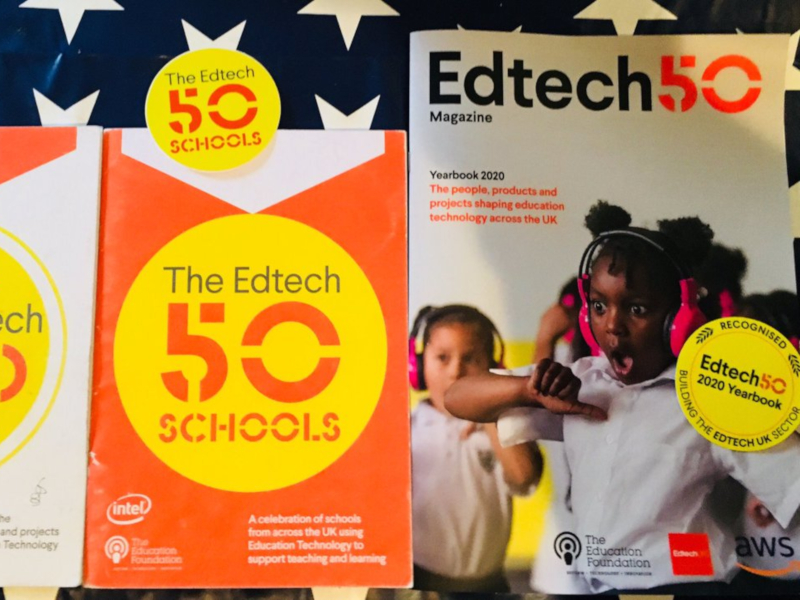
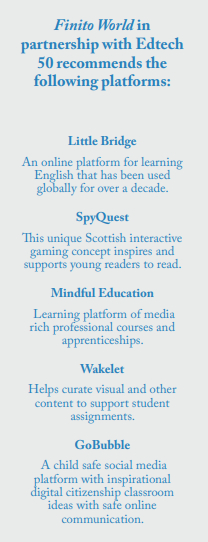
But this a sector that creates jobs, grows our exports for UK plc and attracts muchneeded investment. Our Edtech sector is vibrant (see panel opposite for some recommendations from the Edtech 50), growing and plays its full part in our ‘New Start’ Industrial Strategy. So what do we need to do? For me there are six easy steps.
Firstly, we need to build on the success of the rural broadband introduction with a staged approach to rolling out access to super-fast broadband to our schools.
Secondly, it’s vital that we become more ambitious about devices for pupils. Digital poverty is corrosive and can be ended. Let’s build national delivery of devices for young people – Year 8 is too late.
In the third place, now is the time for more professional development for teachers. I would argue that peer to peer support like the successful Edtech Demonstrator Programme is a model for national action.
Fourthly, we need to see the immediate changes to initial teacher education with training in education technology. This is another long overdue addition.
Fifthly, I believe we need to see priority for Edtech in the Ofsted Inspection Framework. There’s much to share about effective use of technology and much to learn from Wales and Scotland in their approach.
As a final point, we have to learn to appreciate the complexities of organisational change across our school estate. We need to focus on technology support but also ‘system’ support to introduce and embed changes.
If we can do all these things then I believe we can have a truly 21st century education system.
Guy Fowles found the rug swept from beneath his feet when Covid-19 hit. Here’s how he turned it around.
In February this year I was in the fortunate position of weighing up four job offers, all with reputable companies, all in different industries.
The job market was buoyant, particularly within the performance marketing vertical I specialise in, but despite the many opportunities it had still been a long, arduous journey to get to the point of receiving an offer.
There were countless applications, many initial phone calls, multiple faceto-face interviews and a number of psychometric tests and presentations over the course of a few months, not to mention the research, prep, travel, logistics and thought process that goes into each and every interaction with a potential new employer. It was exhausting and stressful, particularly as a new parent.
For one role with an exciting start-up, I’d been through five stages and spent around 40 hours in total preparing, interviewing and presenting to them, only to learn they’d gone for the other candidate after the final stage. I didn’t mind the drawn-out process to decide on the right person, but the lack of constructive feedback afterwards was extremely disappointing given the time I’d invested.
For another final-round interview I was asked to drive to the north-west to the company’s UK headquarters, a 10-hour round trip, for a 60-minute interview, only to be told over a short phone call a few days later that I’d been unsuccessful. There was no offer to cover any travel costs.
My experience within the job market earlier this year equipped me for what happened next.
Within two months of starting a great role at a global events company, who bring people together to create unforgettable experiences, the company made 50 percent of its global workforce redundant, centralising resources back to their HQ in San Francisco. Frustratingly, it was time to climb back into the search saddle.
This time though, things were different. There were still roles available, but already, in May, the number of applicants for jobs advertised on LinkedIn had gone up from around 100 per role to over 250. During a number of conversations I was then told the positions I’d applied for were suddenly put on hold due to Covid-19.
The process itself also changed – initial phone calls turned into Zoom video calls, which I think is a positive step, and subsequent interviews obviously had to be done by video too, which, whilst you lose that physical interaction that meeting in person affords, saved on travel time, which made a big difference when also trying to look after a baby.
Covid-19 changed the location of the jobs I went for. Given the shifting nature of working remotely within a number of industries, I was able to expand my search to outside the confines of the M25. This can only be a good thing for both employers and employees as it enables companies to attract the highest quality workers, unrestricted by geography, and then offer them rewarding benefits such as the ability to work from home or flexible working.
In June I was lucky to come across my dream role heading up the Marketing and Communications team for the National Literacy Trust. The Trust works to improve the reading, writing, speaking and listening skills in the communities that need support, where one in three people have literacy problems.
The interview process was clear and concise, held on three consecutive Fridays to allow both sides time to prepare for the next stage. I researched the role, my interviewers and the Trust itself thoroughly, and as I did so I became more and more impassioned about the job and joining the team. I met a cross section of employees over Zoom, and an external partner, and after a presentation and one final meeting I was absolutely thrilled to be offered the position. All in all it had taken about a month from start to finish.
Searching for a job can be a draining, demoralising process. However, it can also be exhilarating, stimulating and ultimately hugely rewarding. It is most definitely a journey that will propel you through twists and turns, highs and lows, dead ends and suddenly, the right path for you. Treat every conversation as you taking one more step on that journey.
With this in mind be prepared to put yourself out there, tailor your cover letter for each role, put in the time to look into your interviewers, prepare engaging questions that demonstrate you’ve really thought about the role, show your willingness to learn, develop and grow and, once in the role, prove that you will be a valued member of the team through your actions.
The National Literacy Trust helps to transform lives through literacy. Whilst my previous role was cut short due to Covid-19, I can’t think of anything else I’d rather be doing than trying to make a difference to the lives of children, young people and families that need it most. I’ve now been in the role for two months and I couldn’t be happier – it’s a fantastic team to be a part of.
If you have any questions about my job search, or would like advice about your own, please drop me a line at linkedin.com/ in/guyfowles
Heroes only truly reveal themselves when faced with a villain. The world is up against a mighty enemy, Covid-19, and many people have revealed themselves as everyday heroes; from Janet next door making sourdough bread for her shielding neighbour to all the key workers who kept the country running during lockdown. Bill Gates has squared up to coronavirus with huge financial donations. As he has invested more than $350 million to fight COVID-19 will history hail the Microsoft founder as a key heroic figure in the pandemic or is his philanthropy just another sign of a world gone wrong?
Jeremy Hunt, the former secretary of state for Health, says philanthropy should not be met with cynicism: “Philanthropists should be welcomed with open arms and praised to the rafters. I really don’t understand those who criticise the generosity of others.”
While Nick Dearden, director of Global Justice Now, is more sceptical about wealthy individuals being involved in the race for a cure as vaccines should be public goods. “The answer to massive economic, healthcare or environmental problems cannot be left to some of the richest people in the world, as if we were living in the Victorian Age when social harms were seen as matters of charity and benevolence.”
With a net worth of around $120 billion, Gates is only the second richest man in the world. With an estimated net worth of $200 billion, Amazon founder Jeff Bezos comes in at number one. In contrast to Gates, and although he has pledged to invest billions into Covid initiatives, Bezos has been positioned as a coronavirus villain – Super Spreader – after hundreds of Amazon staff took strike action to protest issues around the company’s response to the pandemic, including limited sick pay
In the 1990s, few people would have elevated Gates above Bezos. Gates was fighting a series of legal battles around the monopolistic business practices of Microsoft. Former Microsoft employees described the office as a confrontational environment, with Gates being “demanding”. According to James Wallace’s Hard Drive, more than one “unlucky programmer received an email at 2:00am that began, ‘This is the stupidest piece of code ever written.’”
Then, towards the end of the decade Gates turned his attention to philanthropy. Alongside his wife Melinda, the self-proclaimed “impatient optimists” formed the Bill & Melinda Gates Foundation. It seems he turned over a new leaf but some regard the Foundation as a fig leaf, barely disguising the injustice of Gates earning more in a day than most will earn in a lifetime.
Since its inception the Bill & Melinda Gates Foundation has given more than $50 billion to charities. Its raison d’être is to “reduce inequality” but Gates admitted in an Ask Me Anything Reddit session that he often uses a private jet when reducing inequality. “It does help me do my Foundation work but again it is a very privileged thing to have,” he conceded. But aside from the occasional uncomfortable bit of irony, his philanthropy also gives him an extraordinary amount of power. Put bluntly, Bill Gates chooses who lives and who dies. He influences the success or failure of a vaccine just because people bought his computers.
But Hunt dismissed the idea that positioning philanthropists as heroes risks creating a plutocracy, saying: “A democratic society like ours has sufficient checks and balances to stop undue influence but if someone wants to pledge a fortune or a fiver to make the world a better place they should be thanked and encouraged. I spent a lot of time trying to boost philanthropy to the arts when I was Culture Secretary and was always struck by the difference in attitude between the UK and the US.
“Philanthropists in the US are seen as heroes but here in the UK our first thoughts can be negative. That’s changing but we should do more to embrace the good work that many very generous and inspirational people do.”
Philanthropist and the founder of Addison Lee, John Griffin, shares this sentiment. Finito World can exclusively reveal that Griffin has invested £12 million into building a new wing at Northwick Park hospital to help speed up the race for a cure.
Griffin endowed The Griffin Institute with his £12 million gift to Northwick Park Hospital
Griffin has praise for Bill Gates and his commitment to finding a vaccine. “He’s a good man and he’s the right man to have in charge, he really is, I think that people who manage to achieve success should not ignore that, it’s a gift,” Griffin says.
Indeed, within a few weeks of committing their first $100 million to the fight against Covid-19, the Bill & Melinda Gates Foundation announced a $50 million commitment to fund the new ‘Therapeutics Accelerator’. Alongside MasterCard and the Wellcome Trust they have invested in a variety of treatments, including the University of Oxford and AstraZeneca vaccine which is one of the seven vaccines in the final stage of trials.
Professor Arpana Verma who is a clinical professor of Public Health and Epidemiology at University of Manchester said funding from the Gates Foundation is “key” to finding a vaccine and ensuring it is accessible.
She regards philanthropy as a necessary component in successful public health initiatives. “Public health through the centuries has been based on philanthropists. When we got the industrial revolution, we got the core epidemiologists coming in. In Greater Manchester we had Edwin Chadwick, and in Liverpool we had William Varr, and in London we had John Snow. This was the crux of things happening fast. it gets things moving. Whilst governments and even NGOs might have more of the administrative to get through, philanthropists might not have that burden.
“A lot of philanthropists are well up on the evidence so they know what things to do and can get ahead and do it,” she adds.
The Bill & Melinda Gates Foundation has been focused on combating disease for years and it has made polio eradication one of its top priorities. One of the Foundation’s first big investments was to an organisation called Gavi, the Vaccine Alliance. Since 2000, Gavi and partners have immunised more than 760 million children, saving over 13 million lives.
This knowledge of disease has made Gates a coronavirus Cassandra. In a 2015 Ted Talk he warned: “If anything kills over ten million people in the next few decades, it’s likely to be a highly infectious virus rather than a war. We need preparedness,” he demanded. Clearly, Gates’ value in the fight against Covid is not exclusively due to the amount of money he is throwing into the cause but due to his deep understanding of disease.
Gabi Hakim, founder of VacTrack app
He has inspired other entrepreneurs in the healthcare profession. Gabi Hakim who is the founder of a new VacTrack app which collates vaccine histories and sends reminders for follow up boosters, cites Bill Gates as an influence. “Bill Gates has always stood out as the standard to which we should all aspire. In particular, his work in both biotech and digital health through his Foundation has emphasised the fact that tackling health crises requires intervention at population scale, which aligns with our own mission of accessibility for the masses. I think personally, it’s seeing his ability persist through the bureaucracy and complexities associated with healthcare today that has motivated us.”
WIRED’s editor at large, Steven Levy, who has been conducting interviews with Gates since 1983, points out that Gates has also made a positive impact through his cajoling of other wealthy people.
He says: “I’ve met a lot of billionaires, the field I cover produces billionaires, basically he’s made it a point to stand up and argue for other very wealthy people to devote a huge portion, you know, half or more, of their fortunes to addressing issues like public health. He really is the person who speaks most of it. He’s sort of like a born-again philanthropist.”
Gates may be a born-again philanthropist but he approaches his giving with pragmatic, almost heartless logic. In the documentary, Inside Bill’s Brain: Decoding Bill Gates, Gates recalls the moment he showed his daughter a polio video. “The video ends with the girl who’s got the paralysis limping down the road with a crummy wood crutch. My daughter said to me, ‘well what did you do?’ I said well we’re going to eradicate it. She said, ‘no no, what did you do for her?’”
With a business analogy, he goes on to explain that this emotional attitude is not productive and that he believes in “optimisation”. “The emotional connection is always retail, even though, if you want to make a dent in this thing you better think wholesale, ten to the six, ten to the seven type magnitudes,” he says.
Levy believes that Gates is primarily motivated by the intellectual challenge. “It isn’t ‘I’m doing good for the world’, ‘I’ve got to do good’ it’s like ‘these are fascinating challenges that engage me intellectually and I’ve got something to offer there’. I think he finds a lot of satisfaction in pursuing it and learning about the science and speaking to scientists and adding his brain power to solving this.” In the power, money, knowledge triad, it seems for Gates, knowledge always comes out on top.
In many ways he is the archetypal nerd. He takes ‘think weeks’ where he goes off alone to a cabin in the woods and reads. When he is fascinated about a subject he reads as much as he can about it. His interest in the environment compelled him to read the rather esoteric Japan’s Dietary Transition and Its Impact by Vaclav Smil, for instance.
Levy explains that it was Melinda who forced him to channel his intellectual brilliance into philanthropy. “Really, the big impetus for him getting into philanthropy at that point in his life when he did was his wife. I do feel it was her influence that led him to step back from Microsoft maybe sooner than he thought.” Melinda’s influence has been profound and since the beginning she has inspired Bill to be better and think differently.
Melinda joined Microsoft after graduating with a degree in computer science and economics from Duke University and a master’s in business administration from the Fuqua School of Business. One evening after work, Bill asked her if she wanted to go out for dinner, in two weeks time. She declined telling him she wanted spontaneity and an hour or so later she received a phone call from him asking “is this spontaneous enough for you?”
If Bill is deserving of a hero status, Melinda is too, perhaps even more so. It was Melinda who inspired the Foundation to focus on combating disease when as a new mother she read an article that described how children were still dying from diarrhoea. Now she is using her influence to protect women from the devastation of Covid-19.
But no matter whether Gates’ philanthropy is driven by Melinda or by pure intellectual curiosity, it does not make his actions any less valuable. As Batman says, “It’s not who I am underneath, but what I do that defines me.” Heroes are also defined by their enemies.
Last month, during the week polio was eradicated from Africa, 10,000 conspiracy theorists gathered in Trafalgar Square to protest against lockdowns, masks and vaccinations. In speeches they rallied against Bill Gates.
Of course, unthinking reverence of philanthropists could lead to abuses of power, but as it stands the Foundation is contributing to developing a vaccine that could save the world and we need all the heroes we can get.
The Bill & Melinda Gates Foundation Covid-19 response
The Foundation has committed more than $350 million to support the global response to Covid-19. This includes:
$250 million to improve detection, isolation, and treatment efforts; protect at-risk populations in Africa and South Asia; accelerate the development of vaccines, drugs, and diagnostics; and minimise the social and economic impacts of the pandemic. The Foundation announced $100 million to the global response in February, and then increased this commitment by an additional $150 million in April.
$5 million to support the Covid-19 response in the Greater Seattle Area. This funding supported local public health efforts in Seattle & King County as well as six regional response funds that aim to meet the needs of those disproportionately impacted by Covid-19.
$100 million to Gavi’s new Covid-19 Vaccine Advance Market Commitment, to support its future efforts to deliver Covid-19 vaccines to lower-income countries.
In addition to the more than $350 million committed, the Foundation will also leverage a portion of its Strategic Investment Fund, which addresses market failures and helps make it attractive for private enterprise to develop affordable and accessible health products. For example, the Foundation is collaborating with Gavi and the Serum Institute of India to accelerate the manufacture and delivery of up to 100 million doses of Covid-19 vaccines for low- and middle-income countries. $150 million came from their Strategic Investment Fund.
Will we ever return to our offices? And what will they look like if we do? George Achebe talks to renowned designer Thomas Heatherwick
Journalists I speak to lately have begun to notice a new presence within their recordings of interviews and Zoom call presentations: birdsong. Lockdown coincided with marvellous weather; our offices became our gardens.
And the sky on our road in Islington reverberates with the sound of spanner on metal; our friends over in Muswell Hill have replanted their garden since they spend so much time looking at it; my conveyancing lawyer tells me he may, or may not, return to the office. If so, he says, it will be used primarily as a storage space.
There is, in other words, a unanimity about lockdown: you can be sure that your own experience can be extrapolated into the general. And yet if you ever leave your cosy home and venture to the centre of town, you’ll discover the flipside of all this neighbourliness and quiet domestic improvement.
Soho strikes me as especially melancholy. There’s the sandwich bar I used to frequent now boarded up; a new kind of silence, not so much contemplative as eerily touristless; and with around one in ten businesses open, you have a sense that this place has insufficient residential activity to last in its current form beyond the end of furlough.
Will these businesses return? It is dependent on what decision we make about our office arrangements. This varies from business to business of course. For a more in-depth analysis of the landscape see our exclusive employability survey which begins on page 79. But what are the implications for architects?
Thomas Heatherwick, the famous founder of the Heatherwick Studio, explains that he has seen some positives come out of the coronavirus period: ‘The most interesting thing has been reflecting on what this means and how it’s going to change our lives. I’m wrestling with the sense that [preCovid 19] there was more and more sharing – of cars, workspaces and living spaces. The world was becoming more efficient because people were learning to live together in different ways.’
In Heatherwick’s eyes, the pandemic represented a ‘retreat’ into the private space – a world of Victorian studies, and stockpiled toilet roll. But Heatherwick, who in person is infectiously optimistic and free-wheeling, is already solving the problem the world has set him: ‘The positive side is that people will be spending more time on their homes, and thinking on how their homes work for any situation.’ In the meantime, he says, businessowners have decisions to make about whether to redesign their office space.
We are all aware that this is a sort of drawn-out inflection point, where the human behaviour that will dictate what solution we end up with is latent, and yet to be revealed. Furthermore, it will likely differ from country to country; sector to sector; and CEO to CEO.
When I talk to Alan S – the CEO of a leading boutique creative agency, who also has the sound of birds in his garden – he speaks only on the condition that he remains anonymous. This is because he isn’t quite sure where his business will land and he doesn’t want to give any misleading or worrying information to his workforce.
‘As a small business we have always worked from a fixed office in central London and although we have let employees work from home when required we have never all worked remotely at the same time,’ he explains. ‘We did a trial run before lockdown was announced in order to iron out any issues that might possibly arise, so when lockdown happened we were as ready as possible.’ So how did it pan out? ‘The overriding response was that everyone found it productive, but missed the typical office interactions and camaraderie when seeing each other.’
This will no doubt be a familiar experience for many. What changes has that made to Alan’s view of his existing central London office space? ‘It suddenly became a burden and we were realising that the more we worked from home, the benefits this gave to everyone [would accrue].’ And what are these? ‘Everyone would save on travel expenses and commuting time could be spent with partners and families.’ The perennial bugbear or exorbitant business rates has also been front of mind for the business. ‘The rent, rates and insurance saved by surrendering a central London office will enable us to invest in people, equipment and technology to increase our efficiency and service our clients.’
So Alan S has to some extent made up his mind, and there are plenty of him.
But it is by no means a unanimous view. In fact you’ll find some who argue that an imminent vaccine, most likely arriving in 2021, and distributed towards the end of that year or in 2022, will see a return to a world reminiscent of pre-Covid 19 office-centric life.
Olly Olsen, the CEO of the Office Group, which has over 40 flexible workspaces across the UK, is one of these, although he admits it may be a way off. ‘I spoke to Network Rail, with whom I have a joint venture, and in a number of stations, footfall is down 88 percent. That’s catastrophic,’ he concedes.
In addition, Olsen, whose livelihood is bound up in office life, also makes some admissions about the benefits of working from home. For him, they’re linked to wellness. ‘In the afternoon, I get tired with too much coffee and a big lunch and so I’ll lie down on the sofa for half an hour which is almost socially unacceptable to do in the office.’ Olsen sees it as a positive future driver of business that we’re now finding ourselves more attuned to what he calls ‘wellness fluctuations’ in each other. Workers with children are another example. ‘It used to be that if someone said “Can I make that meeting 11 instead of 10?’, you’d say: “Deal with your kids another time.” Now when a member of staff says, “I’m not feeling myself ”, I say, “Have a rest, there’s no problem. Speak to you later, speak to you next week”.
All this is an indicator of how power has moved rapidly away from the employer towards the employee. For Olsen, it’s not that the office model needs to go; it’s that it needs to change and be adapted to reflect our new reality.
What ramifications will this have for the buildings around us? Thomas Heatherwick agrees with Olsen, but he sees it from an architect’s perspective. For him, there has simply been too much ‘lazy place-making’, and the pre-Covid office was a case of ‘Stockholm syndrome where someone falls in love with their captor. Your employer effectively had you in a headlock.’ The new office space will have to ‘engender real loyalty’ and become a ‘temple of the real values and ethical thrust of an organisation.’
For Heatherwick, the pre-Covid workspace ‘prioritised how [businesses] communicate to the outside world. So if you go to Canary Wharf ’ – an example perhaps of Heatherwick’s ‘lazy placemaking’ – ‘there’s a grand lobby; huge marble floors; pieces of art looking spectacular; a reception desk with great flowers, and lovely-looking people sitting looking great. But if you go inside the elevator you go up to just an ordinary place of work. The show was for the outside.’
All this has to change now that power has moved in the direction of the employee. ‘You need to have them coming in and thinking, “Yes. I need to be here.” So the workspace will become less about being a show for the outside world. It’s about finding your voice as an organisation. The employer has to up their game which the brilliant people were starting to do anyway.’
So how will this look? Heatherwick is a prescient artist who, it could be said, was already beginning to answer some of these questions in his previrus work. His magnificent shopping centre Coal Drop’s Yard in King’s Cross was all about creating a space which people who could internet shop in their bedrooms would still wish to visit.
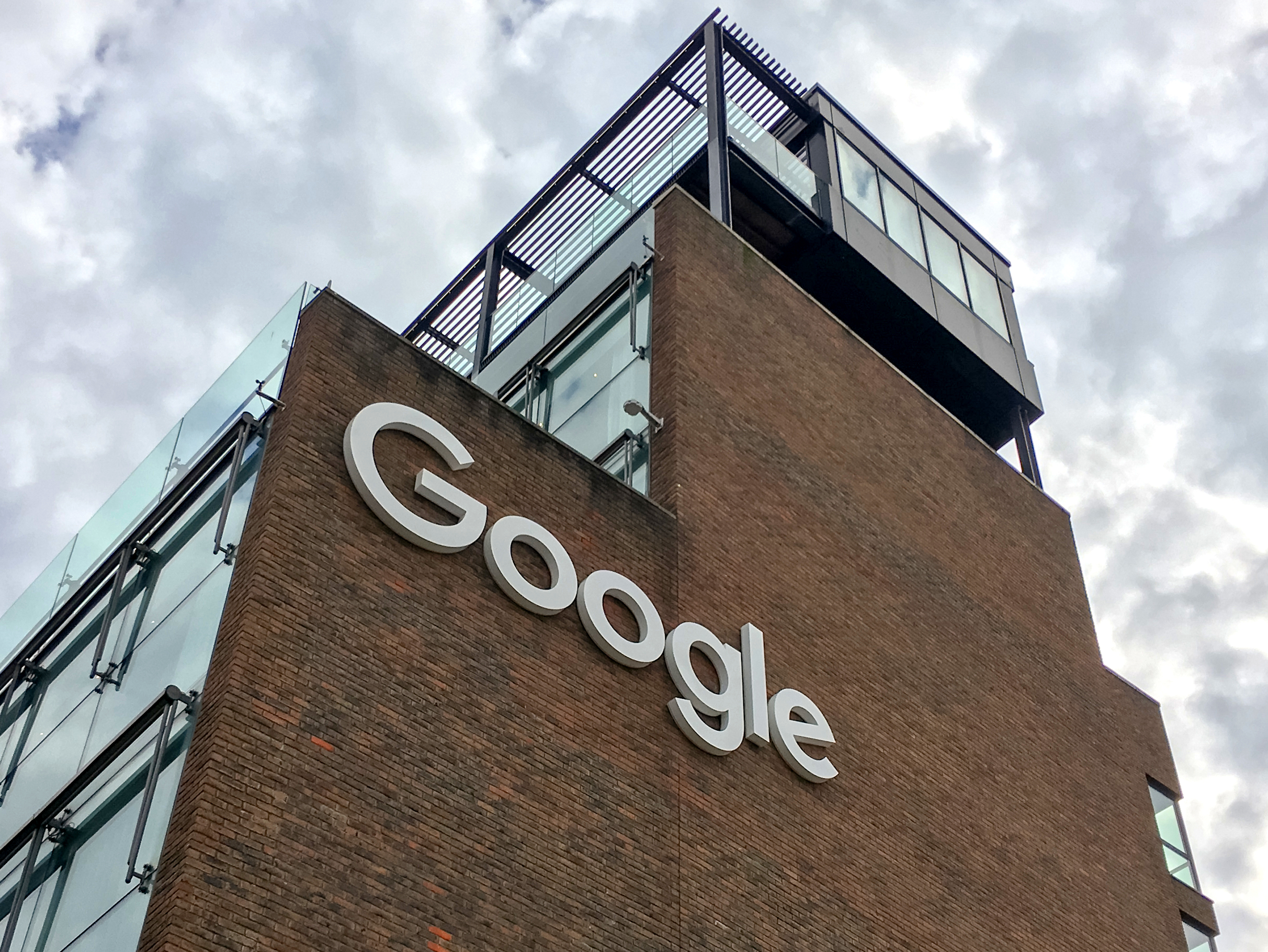
‘Public togetherness is something which motivates me,’ he says with infectious enthusiasm. Heatherwick has always been alive to the fact that change must be built on the back of existing infrastructure: as always, the future will be built on the back of past structures. ‘We’ve got this legacy of Victorian and Georgian warehouses, which are very robust and changeable. Think how many people are living in older industrial buildings. That was the ethos which drove the Google buildings that we’ve worked on.’ Covid-19 might seem to open up onto the future, but it will also be anchored, Heatherwick argues, to what we have already.
The first project the studio worked on for Google was the company’s offices in California. ‘Next-door to the sites we were working on there was this airship hangar – a NASA airbase,’ he recalls. ‘These are amazing spaces which are super-flexible so you can do anything you want. So our proposal to Google suggested we make really flexible space since we’re not sure whether in a decade people sitting at desks will be what we need. We’ll be manufacturing instead.’
So in a sense the post-coronavirus requirement of flexibility might be met by the sorts of structures already around us: there shall be that element of continuity even as we change.
But this isn’t to say Heatherwick lacks a vision of just how extraordinary the shift in architecture shall be. Round the corner from his studio in King’s Cross, Heatherwick is working on Google’s new London base: ‘It’s the biggest use of timber in a central London building. All the façades are wood.’
What is the ethos of that building? ‘One thing we’ve spent time talking about on that is community,’ says the 50-year-old. ‘The idea that here is just a mercenary organisation doing their thing, and the employees come in eat all their food and drink their drinks, sit at their computers, and get well-paid…’
Heatherwick trails off, then refinds his thread. ‘Given what we’re saying about really getting a deeper engagement with an organisation and it’s team: How does that really contribute to the community around? On the ground floor, you don’t just want another shop that sells ties.’
So what would a new communityoriented architecture entail? ‘Close by King’s Cross there’s Somers Town, where there’s great deprivation and low life possibilities in terms of housing and education.’ For Heatherwick the lively pedestrianised ground floor is a way of energising the whole area.
So while our conversation began with fears of a new individualism, perhaps we might after all find a new communitarianism emerge? Heatherwick agrees: ‘If you’re going into work two days a week you may not need to be based in London.
Out of this may come some strong community-making away from conventional urban settings. Energy had seeped away from villages but now you could get super-villages. It’s okay to spend two hours on a train journey if you’re only doing that twice a week. I just hope we will use brownfield sites rather than consuming greenfield sites.’
But again this seems to spell trouble for the City and, though few may lament the fact, the property development sector. Olsen admits: ‘If you ask people where they most prefer working, it’s on their own – it’s at home where it’s quiet. Not an office which is openplan with people talking, and which is smelly and so on.’
So what’s the purpose of going to an office? Olsen is clear: ‘We’re built to connect. I can’t have guests and clients to my house and I can’t bring a team together to my home. If I do that business will fall – as it’s falling now from lack of human interactions.’
So what kind of spaces will we see? In answering this, Olsen sounds a lot like Heatherwick: ‘It’s difficult to forecast what will happen next but I think where you choose to work will be driven by who you are and what you believe. Our places of work will become more of an extension of our social lives.
The overwhelming impression is that we’re in a hiatus – a period of hedging, where people are living in tentative expectation of a vaccine. Olsen agrees (‘we just don’t know) but he has clarity on another point: ‘Before this happened, I would have said that all my buildings were clear, tidy, safe and healthy. Well, they’ll have to be clearer, tidier, safer, and healthier now.’
So it seems likely we’ll be hearing the birds in the garden for a while yet. And when we get back to them, perhaps we’ll hear them in our offices too.
Our eyes on the restaurant industry wonders whether Covid-19 has put an end to a great institution.
Costeau was recently talking to a grand dame of the publishing industry, publicist to a host of well-known names in the publishing world including Julian Barnes and John Banville. She recalled her first week at work in a major publishing house in the 1980s. As she told us, her start seemed to go well, but at the end of it she was summoned to her boss’ office: ‘Yes, you’ve had a good week, but there’s one problem,’ he said. ‘You don’t appear to be having enough boozy lunches with your authors. This week I want you to take yourself down to the Wolseley.’
As much as one appreciates any efforts the publishing industry is making to rekindle that spirit, it hardly needs stating that you’d be unlikely to hear this complaint today. And the part-owner of the Wolseley, Jeremy King, acknowledges precisely a hard truth: post-2020 may well be the era when the sozzled lunch is finally put to bed.
He told Costeau that the trend had been part-driven by America: ‘It had been eroded for a long time. I remember in LA ordering wine at lunchtime and being looked at as if I were a psychopath.’ To some extent he says, the shift was caused by an increase of women in the workplace. ‘It was always the men who would booze the most and do the least. The women were much straighter and to the point: avoid the booze, and reduce the amount of time in a restaurant.’
This decline in wine-addled prandials was caused also by the rise of breakfast. King continues: ‘A while back, we witnessed the growth of the breakfast which was really all about avoiding the boozy lunch. It’s accepted it’s going to be 45 minutes to an hour; it’s a much more efficient way of working. And in some ways it clears space for people who do want to have a social lunch. I think there will be less business lunches in terms of Covid-19, but more boozy social lunches because people will have missed the conviviality.’
And yet when we caught up with Sir Martin Sorrell earlier in the year, he was radiant with the thought that he didn’t need to begin his day in a meeting which he plainly views as time-wasting. ‘I actually find I’m doing more work, as there are no interruptions,’ he explains. ‘No breakfasts; no dinners; no surplus travelling. So, on balance I’m more effective and certainly learning more.’
Of course, your future alcohol intake will depend to some extent on which industry you find yourself in. One friend who runs a recruitment business is dismayed at the thought of forgoing his champagnefuelled lunches in Bob Bob Ricard. ‘We’re still going to do it – we’re doing it now!’ he says. But there is a sense that such spirited folk represent the last bastions of the boozy lunch.
Journalism, of course, is famous for having a few too many, and yet even here there have been some notable setbacks.
The death of that great advocate of the alcoholic meal Christopher Hitchens at 61 to throat cancer in 2011 is set to be recalled in a melancholy memoir-cumnovel Inside Story by his friend Martin Amis, who recently in interview said he stared in the mirror and thought: ‘I look finished.’ AA Gill was another who turned away from booze – but later wished as cancer also claimed him that he had turned away sooner.
That’s the trouble with the boozy lunch: it takes its toll, and the young, who haven’t grown up dreaming of being rock and roll stars, but of designing tech apps, are cannier about their health than their parents’ were.
So is this a morbid culture? Jeremy King thinks so: ‘I think it is a morbid culture, and that’s potentially drained the fun, but I still think we’ll return to an approximation of what we had before.’
It is probably a danger in any case to glamorise the whole thing. When Costeau last saw his publicist friend, the wine did indeed flow. ‘Well, this was just like the 1980s!’ she said at the end, by way of slightly slurred summary. It was, and her saying so expressed surprise as much as pleasure.
I also think it expressed foreboding: and indeed the headache the next day made you wonder even before Covid-19 whether this old institution might after all deserve its place on the scrapheap of history.



 On the one hand, there was much to celebrate. Some institutions already experienced with digital learning become ‘virtual schools’ within days; others too, prepared for remote learning with mere hours of staff training.