Category: Travel

  • Middlethorpe Hall – York’s hidden gem

    Patrick Crowder

    Middlethorpe Hall is a late-17th century country house with 20 acres of parks and gardens just two miles from the centre of York. Built under the reign of William III, Middlethorpe has an exceptionally classic style, and it holds the status of being the only country house hotel in York. As a National Trust property, conservation is at the forefront, so the rooms and gardens are presented with history in mind. The fine folks at Middlethorpe extended a very gracious invitation to both my girlfriend Martyna and I, so we took the train to York for the weekend to check it out.

    Martyna is a high-toned woman with knowledge of the finer things, but this Californian’s experience with elite hotels amounts to a few visits to the Ritz Carlton in Chicago with my parents as a pre-teen. Nonetheless, we felt no need to put on any airs at Middlethorpe, as there was not a hint of snobbery, so we were free to be our own relaxed selves.

    We had the chance to speak with Lionel Chatard, who has been the Director and General Manager at Middlethorpe for over 18 years. He greeted us kindly when we arrived, accompanied by his friendly brown and white cat. He explains that Middlethorpe has worn a variety of hats throughout its 322 years, and how managing the property brings unique opportunities and challenges.

    “Middlethorpe is rather unique in the fact that it is the only country house hotel in York, rescued in the 1980s from when it was a night club with overgrown or non-existent gardens. This Grade II William and Mary house was totally restored to the highest standard reflecting its noble heritage, and the gardens and parkland brought back to bring pleasure to all who wander through them or look out over them,” Chatard says, “The hotel is secluded in 20 acres of manicured gardens and parkland and offers luxury facilities including a boutique spa and a fine dining restaurant. I am proud of my team who make every guest’s experience unique. Also, working at a hotel which was donated to the National Trust is very unique! The motivation for the donation is to ensure that the houses and their land are kept safe forever, protected from inappropriate development, and continue to be maintained to their present high standards.”
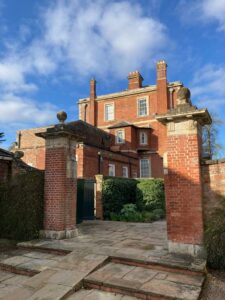


    The historic accommodations at Middlethorpe


    Our accommodation was not so much a room but the entire ground floor of a house, and when we arrived we were stunned by the care taken in its presentation. A bowl of fresh fruit (which contained the best pear I’ve had to date) was set out on an antique coffee table, alongside a selection of meringues. The bedroom and sitting room were both filled with interesting historical paintings, books, and artifacts, including a candleholder crafted from teak taken from the H.M.S. Terrible which served in the Second Boer War. While the furnishings were antique, the bathroom and kitchen had comfortable, modern fixtures, meaning that we wouldn’t be sacrificing water pressure in the name of historical accuracy on this trip.

    In the daytime we strolled around the historic gardens, and we were perplexed by a small cliff in the middle of the massive lawn! We learned that the sitting area, invisible from the main house, is called a “ha-ha”, which was a popular feature in 18th century gardens. We walked towards the walled garden, passing trees transplanted from all over the world, including a Red Oak, Turkey Oak, and a Cedar al Lebanon, until we came across the beautiful Dovecote. The structure has existed on the site since 1681, and now, bereft of doves, is used as a wine cellar.
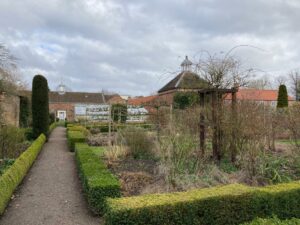


    The gardens at Middlethorpe, with Dovecote in background


    The gardens have been maintained meticulously, and as Chatard explains, it all comes down to the National Trust’s commitment to conservation.

    “The three Historic House Hotels; Bodysgallen Hall & Spa in North Wales, Hartwell House in Buckinghamshire, and Middlethorpe were donated to the National Trust in 2008, with all profits benefiting the charity,” Chatard says, “It is a matter of pride and joy to my fellow Directors and I, to know that we are making a useful contribution to support this formidable charity. It also means that as well as ensuring we run a profitable and successful business as hoteliers, our responsibilities are wider and also involve, to a certain degree, conservation and gardening. The gardens at the three hotels, as the other National Trust parks and gardens, are managed according to a long-term plan for their conservation, taking into account all their history, influences, qualities and contents, together with constraints that affect them.”

    One thing that Martyna and I noticed about the property and its stewards is the incredible attention paid to ensuring that guests have their needs met and, in the case of the slight misunderstanding I am about to recount, anticipated. Approaching the grand front of Middlethorpe, we decided to break out the camera for posterity’s sake. Being fans of Kubrick, we decided to take a few portraits with the camera pointing upwards at the subject, with the magnificent eagle-topped roof of the hall in the background. When we went back inside, the man at the door had called for a bottle of the finest champagne – when I got down on one knee for the picture he had seen it as a marriage proposal, and had prepared accordingly! We laughed about the misunderstanding, only half-joked that we would return for the wedding, and left extremely impressed by his skills of observation.

    The care taken to ensure our comfort did not stop there. When it came time for dinner, we were treated to a three-course meal with a choice of meat, fish, or vegetable for the first two courses, and dessert or cheese for the final course. Martyna, as she will herself admit, is very difficult to cook for due to her many allergies. I would list them here, but this article has to fit on the page you’re reading… you get the picture. Head Chef Ashley Binder had no trouble navigating the culinary minefield that is the woman I love, quickly crafting items with ingredients which were not even on the menu. This was no matter of lazy substitution, these were whole new dishes, created on the fly, for just one of many guests. The food was expertly made and a joy to eat, and we left very satisfied.
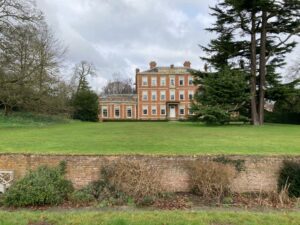


    A view of Middlethorpe showing the ha-ha


    Floored by the service provided, I asked Chatard how he maintains such a high standard at Middlethorpe.

    “I believe I am very lucky to lead a team of committed and passionate individuals, who take pride in their work and really enjoy looking after guests; we all work as one team, and always support each other,” Chatard says, “Good and clear communication and staff training are key to a successful business. We truly value comments from our guests and discuss them constructively with the team for further improvements where necessary. Mystery ‘inspections’ are also helpful to ensure consistency of standards.”

    Middlethorpe offers a luxurious spa, which sports modern accommodations while maintaining an old-world feel. The large pool provides a place to soak off a day walking around the city, while the sauna and steam room give guests a chance to cleanse themselves of the thick London air. They also offer a variety of spa treatments in private rooms, which focus on skincare, health, and beauty therapy.

    Before we knew it, our stay had come to an end, but we took with us a feeling of rejuvenation and calm unrivalled by other holidays we had taken in the past. I highly recommend Middlethorpe to anyone looking to get away from the daily stressors so many of us face. After the last two years, we could all use a bit of pampering, and Middlethorpe Hall is just the place.
     

  • The highest paying travel-based jobs

    Patrick Crowder

    For many people, getting paid to travel is the dream. For many, it also seems unattainable, but that isn’t necessarily the case. While some travel-friendly jobs are quite obvious, others fly under the radar, so we’re taking a look at research from Absolute Digital Media (ADM) which shows top roles for the aspiring jetsetter.

    The highest-paying profession which involves travel is architecture. Architects earn £43,729 per year on average, according to ADM. Not all architecture jobs require or even allow for travel, and many are office based. However, the nature of the profession means that there are roles available in overseas construction monitoring, on-site design, and other overseas roles. While architecture is no guaranteed ticket to travel, the roles are out there if you look for them.

    The nice thing about being a qualified bartender is that, largely, the work doesn’t change no matter where you go. Sure, some countries will have different license requirements and regulations, but at the end of the day it comes down to mixology, people skills, and common sense. Bartenders in Australia make around £31,947 per year, so that is a common destination for qualified mixologists looking to live abroad. In the US, bartenders can make up to $28 per hour. Of course, there are bartending roles in nearly every country, so the options are plenty and the final choice of country will come down to personal preference and experience.

    There are a few obvious choices when it comes to travel jobs, but that does not mean that these options are any less attainable for those looking to escape the desk. One (which is fairly close to home for this writer) is journalism. Journalism, depending on publication and reach, can take you all over the world meeting interesting people and having irreplicable experiences all while getting paid for it. Journalism is by no means an easy job, but whether your expertise is in radio, film, research, or the written word, there are probably travel opportunities in your future. Journalists earn £25,910 per year on average.

    Cruise ship staff, Event Planners, Freelance Travel Photographers, and Flight Attendants also live lives full of travel, and they all make somewhere between £23,000 and £25,000 per year. It all comes down to where an applicant’s strengths lie; Some people are made for freelance work, while others prefer the structure of working for a company. Some people love planning events and networking with people, while others prefer solitary, self-dependant work. Some people are terrified of flying, and even more have rough stomachs on the water. With the wide variety of roles available, the choice is yours, so be aware that getting paid to travel can be much more than a daydream.

    Source: https://absolute.digital

  • The University Arms, Cambridge: “Grand but not oppressive”

    The University Arms, Cambridge: “Grand but not oppressive”

    George Achebe visits the University Arms in Cambridge and finds a hotel ready to thrive post-pandemic

    Whenever I go to Cambridge, I feel as those who didn’t go there tend to do – that I should have done so. The missed privileges amass about ten minutes from the station: here, Watson and Crick cracked DNA; here’s where Milton might have sat, or Marlowe got into a brawl, or Wordsworth had a thought or two; here are the streets where, in his twilight years, Stephen Hawking used to be seen, motoring in his wheelchair, a symbol of what’s possible for the human mind.

    It’s a city of ghosts in other words – but clever and consequential ones. The initial impression is that whatever else might be going on the world, Cambridge will continue on its intellectual way, helping us understand the world better. And it does all that while being beautiful.  

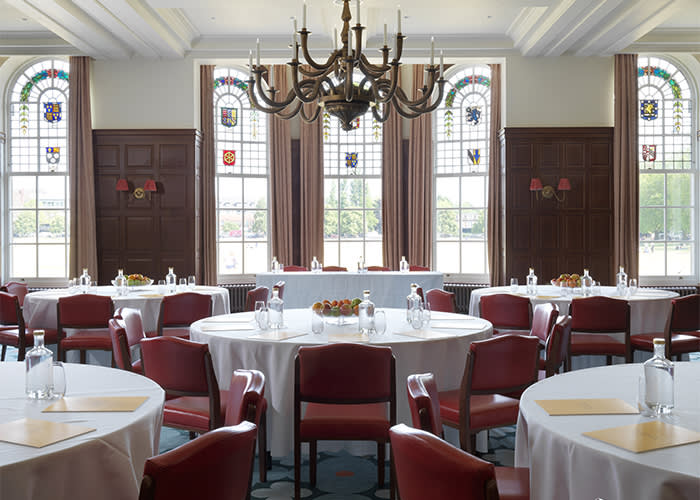
    The ballroom at The University Arms. Now a venue for literary lunches.

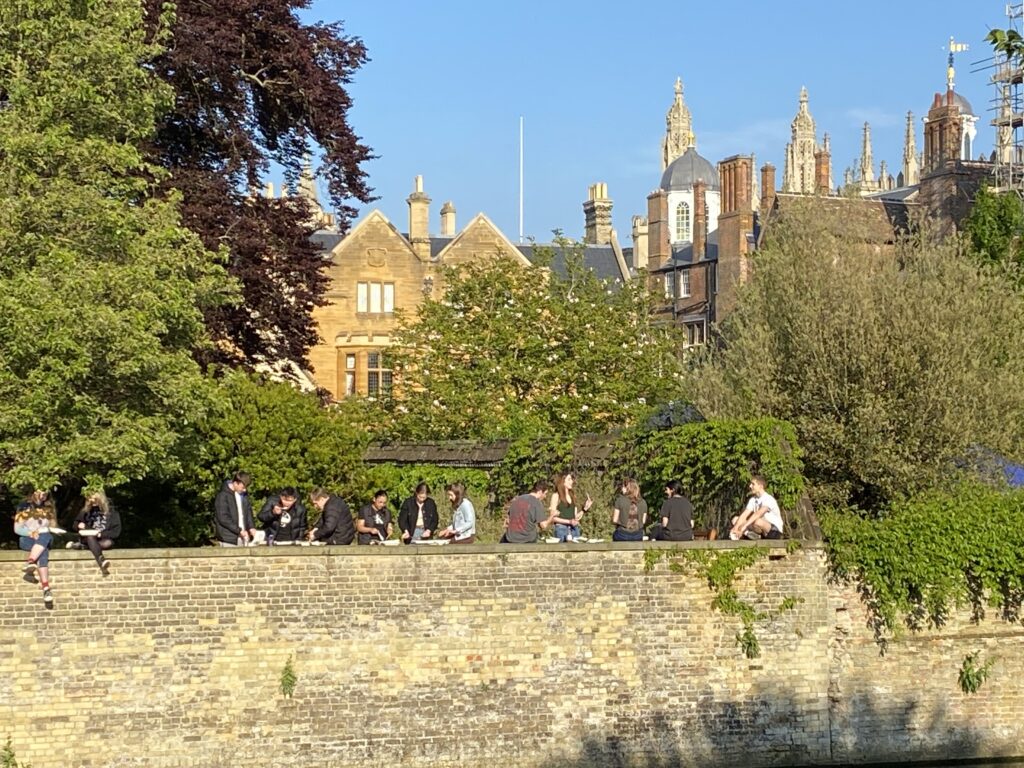
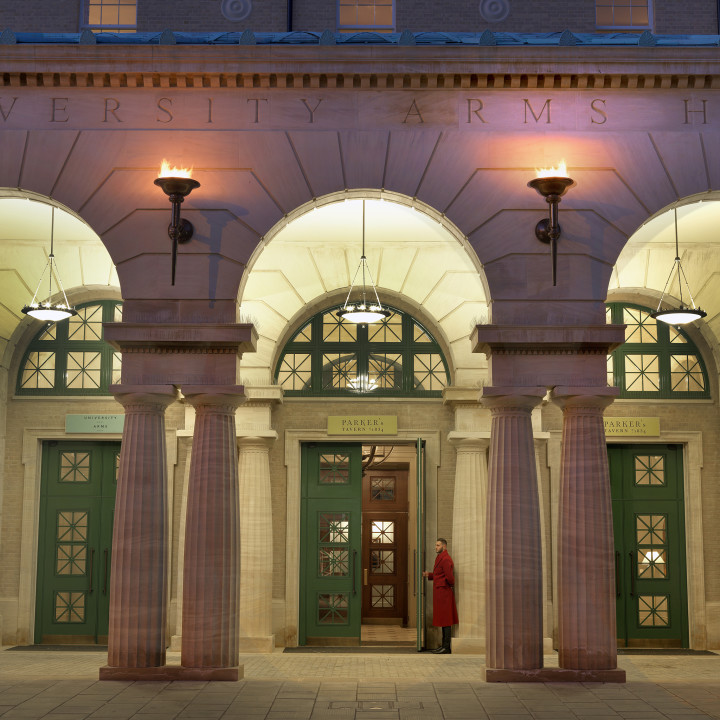
    The University Arms has a good claim to be the best hotel in town – a stone’s throw from the Tudor and medieval architecture, and a short walk from the Cam too, where students still punt the summer afternoons away, as if this were an Evelyn Waugh novel. King’s College, with its marvellous ceiling of perpendicular Gothic, would be worth coming here for, even if there was nothing else to see at all. 

    The hotel has a grand but not oppressive feel. The rooms on the top floor are spacious, and have relevant books by past luminaries. The views over Parker’s Piece show a wedge of grass where students mill and loll, and look reluctant – especially on a gorgeous summer’s day – ever to let any day end. When I return from dinner, I find many hanging on in the dark, peeling away only when the very last light has departed.

    Cambridge has made a supreme contribution to world history – and done so while remaining beautiful.

    Work-wise, Cambridge is already far more than the satellite of London it used to be; in fact it’s regularly found to be the UK’s fastest growing economy, and benefits from industrial parks which house global leaders in wireless technology, display technology, and mobile telecommunications.

    And the city knows it. I attend an interesting dinner and find myself sat next to BBC Cambridge presenter Chris Mann, whose every syllable of talk breathes a love of the area. ‘Everybody here is on TV – a lot of the TV executives either went to the colleges or else they come here in honorary positions of academia,’ he explains.

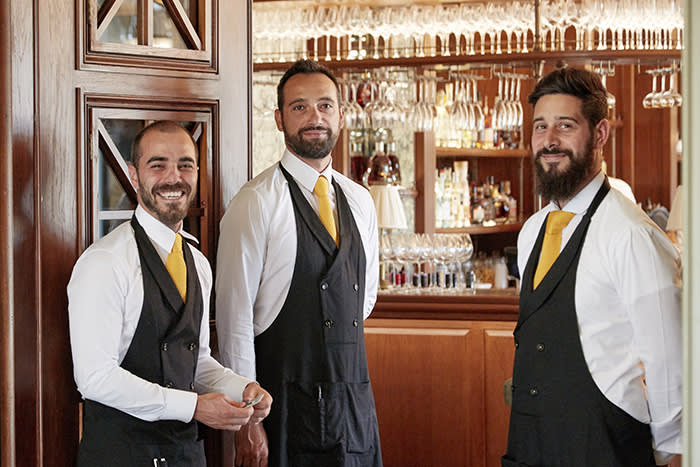
    A case in point is Tristan Welch, who heads the offering at Parker’s Tavern, and who cooks us a mean Spaghetti Bolognese – he is now the beneficiary of various TV deals, although he gives no indication of its having gone to his head. ‘He’s quite famous now, but he’ll be a lot more famous soon when Cooking with the Stars airs,’ Mann explains. 

    The staff at Parker’s Tavern.

    This trend for celebrity continues beyond the walls of the University Arms. When I mention the need to bring home a gift to my family, Mann directs me to Fitzbillies in Cambridge, world famous for its Chelsea buns. Its owners Tim Hayward and Alison Wright are also television personalities. Fitzbillies, founded around 100 years ago, was nearing closure a few years back, when this predicament was tweeted into submission by Stephen Fry, that other Cambridge alumnus. The place stayed open. Today, the buns, soaked in maple syrup, are indeed memorably delicious. 

    But Cambridge isn’t only about the university. The longer you spend there, the more you sense another life – perhaps a truer – weaving in and out of the streets. It might be an intellectual city and one which is experiencing its own tech boom, but there’s also poverty here, and not a single Conservative councillor on the City council. So that as a visitor, there’s the sense that you’re not seeing the whole story. 

    Sometimes in Cambridge the visitor has a sense of being barred from the action

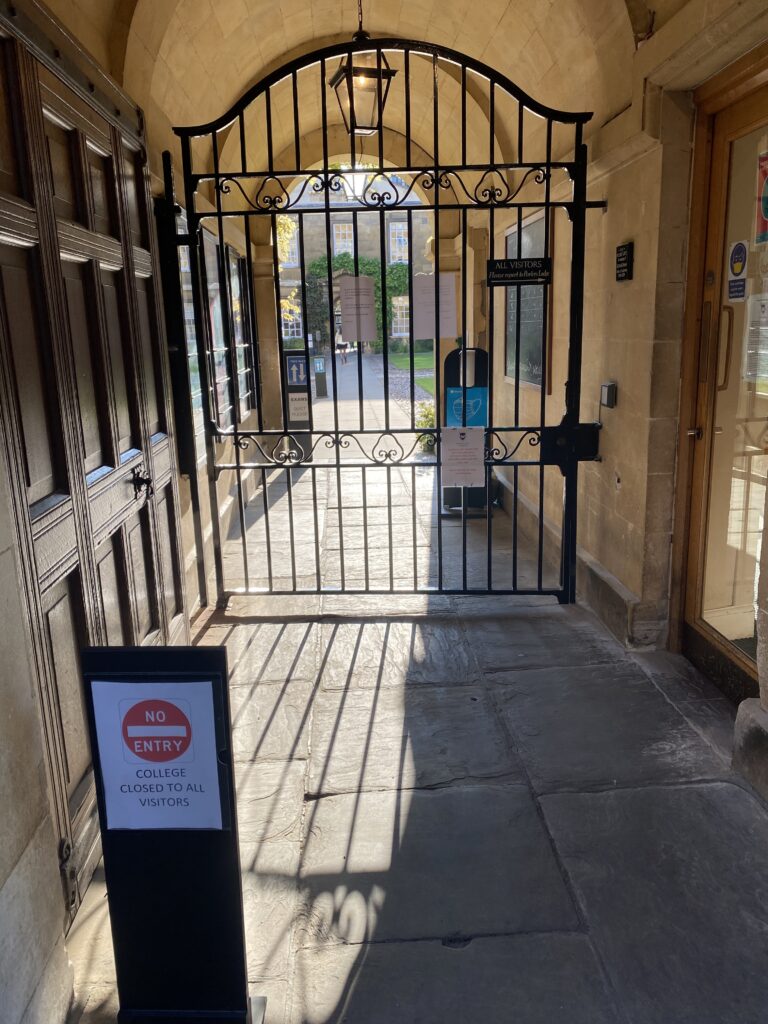
    While the university is there, as an energy to be drawn from, it is also continually shutting you out. There is, for instance, an increased number of Do Not Enter signs barring you from the culture of the place; it used to be easier to walk in and see the splendid gardens behind King’s, or Pembroke, always one of the loveliest colleges. 

    But as a visitor it all feels so forgivable – a feeling which in itself probably perpetuates the inequality. But what Florence is to Italy, Cambridge is to the UK – a place where nostalgia is permitted free rein, and where the mood is aspirational in the highest sense: it makes you want to be a world-historical figure immediately.

    It has an astonishing amount for a little town. The art collections at the Fitzwilliam Museum are richer than one expects one has a right to, even here. There’s a renovation taking place in one of the impressionist rooms but still there’s a superb selection of Renoir, Monet, Degas and Cezanne. The Renaissance rooms house Titian, Brueghel and others. 

    Meanwhile, Kettle’s Yard, the house of Jim Ede, always one of the best art experiences in the world, has renovated itself recently – bringing more jobs with it. 

    So yes, although the visitor will likely think they should have gone to Cambridge for their degree, there’s considerable solace to be found in the next best thing: going there at all. 

    https://universityarms.com/

    https://parkerstavern.com

  • Hospitality feature: The Beautiful South

    Hospitality feature: The Beautiful South

    Iris Spark heads to the south coast with her family – and finds much to enjoy at the Hotel Harbour chain

    The novelist John Updike once described his project as a novelist as being: ‘To give the mundane its beautiful due’. He was saying that it takes a certain skill to see what’s directly in front of you.

    In that sense Covid-19 has made us all novelists. For the Londoner, a trip to Brighton used to be seen as a day affair. You don’t need to be in Brighton long to realise that for many people it still is. The crowds still pour down remorselessly from the station towards the seafront throughout the day, adding an air of excitement – though sometimes of threat – to the town. Graeme Greene opens his novel Brighton Rock with the famous line: “Hale knew, before he had been in Brighton three hours, that they meant to murder him.” London here appears as a kind of bacillus which the rest of the country is subject to.

    But once you’ve been in Brighton for longer, recentred around the necessity of a longer stay, London feels a distant memory. For Brighton residents, of course, London is both a destination – pre-Covid about 25 per cent of its residents commuted to London – and something intentionally escaped. People here have made a decision for a different kind of life.

    That means that something else is one the rise: Brighton’s uniqueness. That’s told partly in politics: Caroline Lucas has been the Member of Parliament here for eleven years. At the time she looked like the first of many MPs from the Green Party. As the years have worn on – even as the issue has deepened in importance –there has been no tsunami to speak of in the wider electorate. This has only served to remind everyone of the quiddity of Brighton. Often Lucas gains the credit, but she’s also the beneficiary of an open-minded electorate, not to mention an enviable on-the-ground operation which continues to bewilder the local Labour Party.

    Brighton’s apartness is also told in the city’s startup culture: there were 2,100 business start-ups here in 2015, and according to a report by Regeneris, Brighton is also home to a greater concentration of homeworkers than any other UK city. In that sense it was always pandemic-ready.

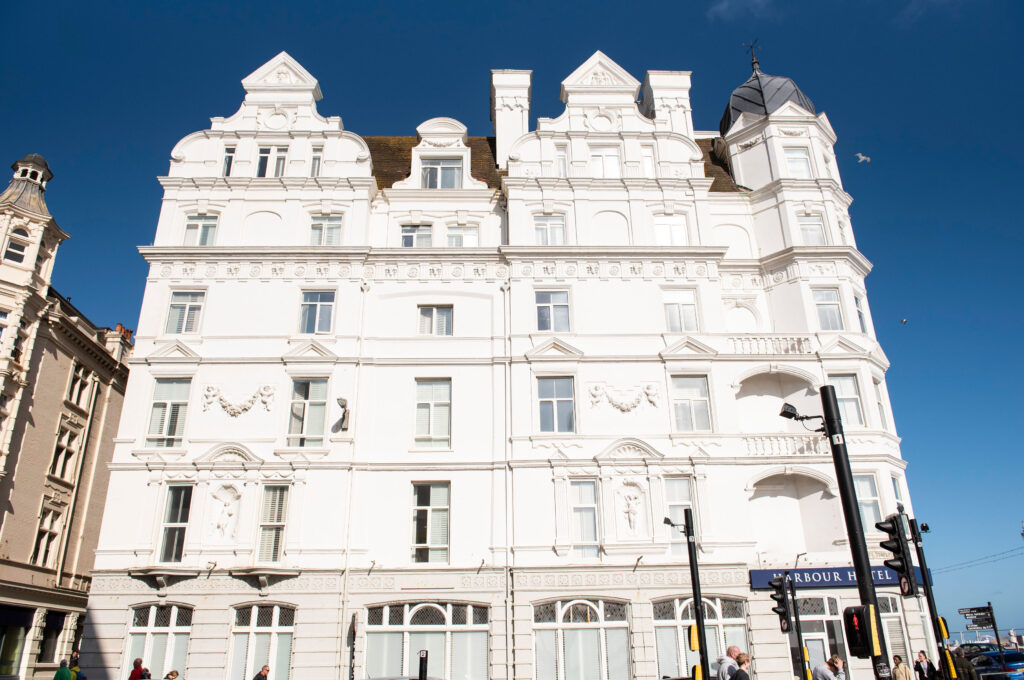
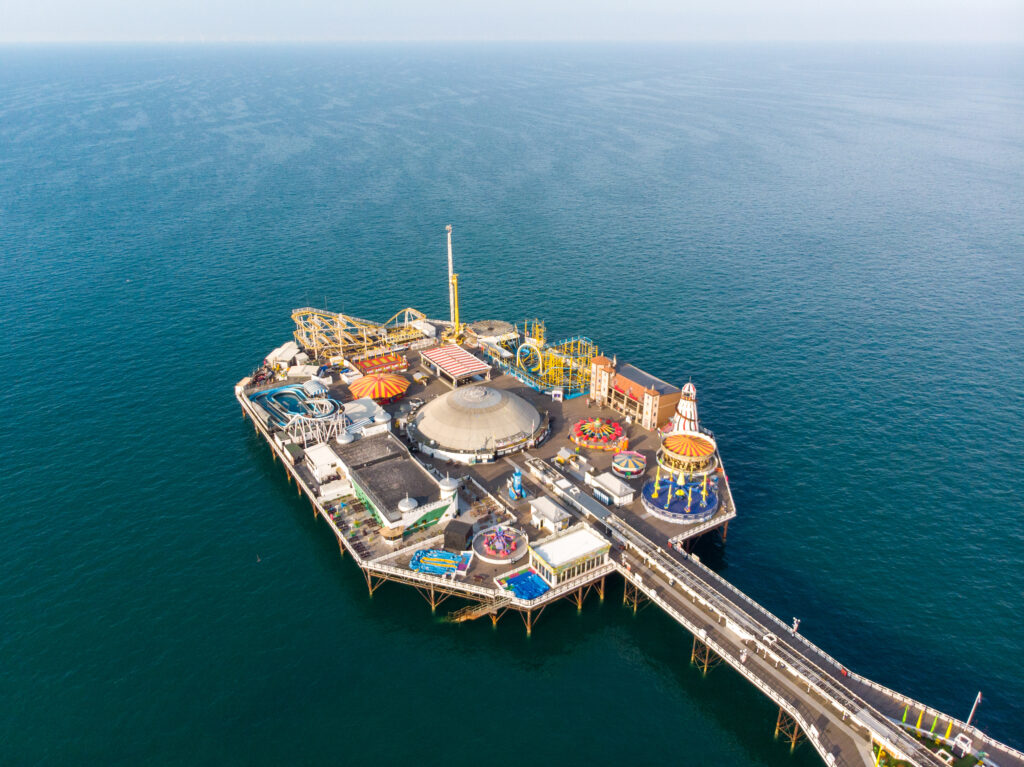
    We check into the Harbour Hotel, a restored Regency building, one of the oldest on the promenade, and are given a sea-view room on the fourth floor. With young children in tow, the lack of a balcony is welcome and the triple-aspect panoramic superb. We gaze at it a while: seen before but never quite like this. There’s the pier to the east, whose night lights are beginning to flash in the gloaming; the distant wind farms look like something Don Quixote might madly tilt towards; and the west pier, burnt to a sculptural cinder after arson in 2003, has a sad romantic air. 

    We ask ourselves what colour the sea is as the evening weaves in – and note a band of white tightens around the horizon, like a tourniquet, and then lapses. Then the dark comes in, and we deposit ourselves in our Egyptian cotton sheets.

    The following morning, I’m given a tour of the hotel. There is a fine entertaining space here which can host up to 160 guests, and opens up onto the seafront – a useful destination to know about for both Brighton and London business owners. 

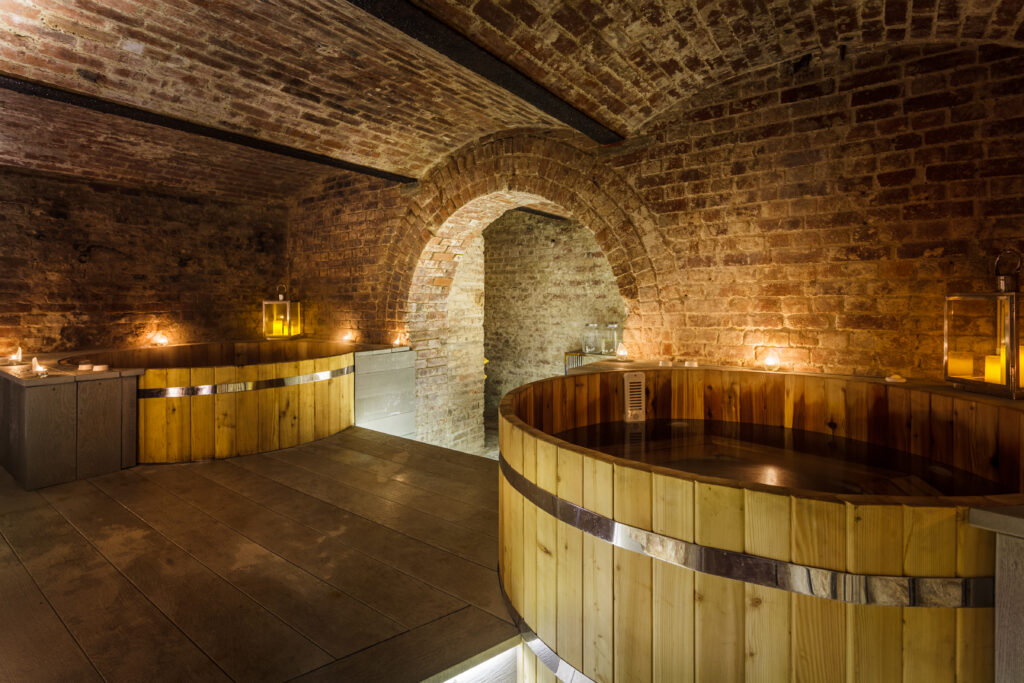
    The spa is in the basement of the hotel, and has specific hours for children’s swimming. There’s warm pool in the first room which you might just about do lengths in; it neighbours another a room with a hot tub. You expect that to be it, but down some stairs, more rooms unfold: another room of hot tubs, a steam room and sauna, and various areas for relaxation. 

    Ahead of you is the frame of an old door, which turns out to be a door to the past: the waterfront used to be lower, and my guide tells me that once-upon-a-time these burrows were used for smuggling. 

    This is a clue to the real character of Brighton – in fact, to the whole of the southern coast. Seaside places tend to have bohemian characters. It was Robert Hughes who observed in relation to Madrid in his Goya biography that tyrants don’t love ports because they are too susceptible to outside influence. The longer you stay in Brighton the more you realise that the city belongs as much to the expansive dreamy views of the sea as to the land: there is something fantastical about it.

    If you want evidence of this, you need only visit Brighton Pavilion, that wonderfully weird palace, built by George IV, and much loathed by that sober monarch Queen Victoria. It shows a man of unlimited wealth indulging a quixotic imagination, and reminds us that Brighton has known, at least for a time, what it is to seem – however illicitly – at the centre of the world. I say ‘illicitly’ because it was here, away from the prying eyes of London, that he could enjoy his liaison with Maria Fitzherbert. 

    The design of the Pavilion itself is by John Nash – who also designed Buckingham Palace and Regent Street – is bizarre, incorporating Indian and Chinese motifs. It is enough in itself to make Brighton feel odd, its centrepiece an escapist extravagance. A few streets away the rambling Steine House has a plaque to Fitzherbert: in its slightly ramschackle appearance it hints at the unhappy end of their affair. 

    A day by the sea at Brighton on a hot day is an intense and crowded experience. George IV came here hoping it would cure his gout, but in the era of Covid-19 one is more likely to be here to combat boredom. Philip Larkin once wrote of the ‘miniature gaiety of seasides’ – but Brighton has been bequeathed a sort of scale by the virus. Visitors shout in the shallows, amazed to be in such proximity to a coastline which they used to take for granted.

    The sea remains the great sight of Brighton. Its slumbering strength is always there as a distraction, or a point of reference, throughout your time there: forever changing and always the same. You begin to feel that you could get used to this – especially at the Harbour Hotel with its white walls and excellent restaurant.

    In fact, the Harbour hotel chain is one of the success stories of the pandemic. With properties in Chichester, Guildford, and Bristol – and two in Cornwall which must especially be the envy of international hoteliers – it has done a good trade throughout 2021 as people have decided against the absurdity of amber lists and 14-day quarantines, and shrugged off the idea of going to Greece if it’s really to be such a faff. Each staff member tells me an optimistic tale of wages topped up after furlough.

    The group happens to be owned by Nicholas Roach, the son of Dennis Roach, who was regarded as the first-ever football agent, having negotiated the first £1 million transfer. Roach Jr. founded the holding company Nicholas James Group in 2000 and keeps a low profile.

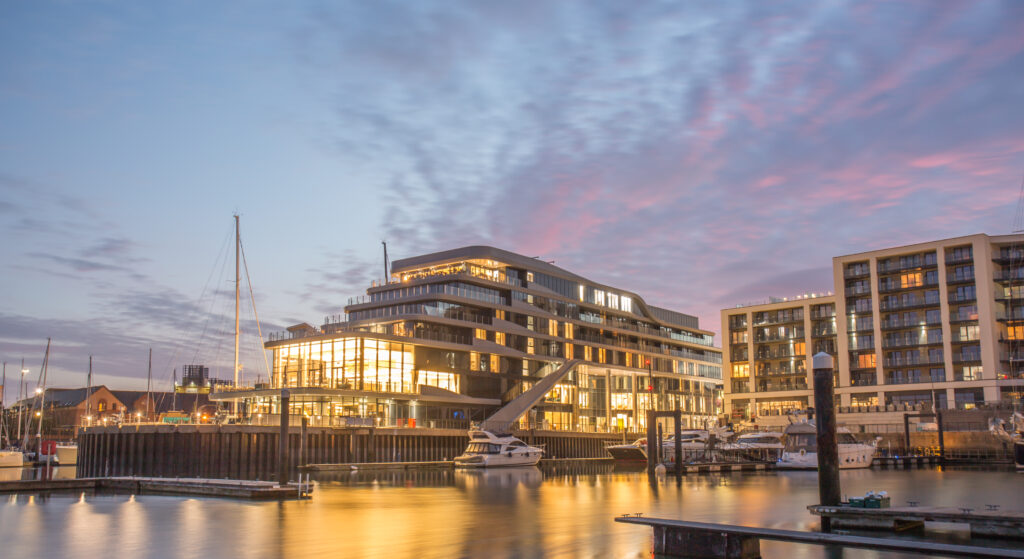
    This is in some contrast to his hotel in Southampton, the chain’s flagship property which dominates the skyline of the relatively new built Ocean Village marina. The property itself resembles a ship and our balcony suite turns out to be at the ship’s prow, opening up onto a view of the skyline. 

    (Incidentally, the Harbour in Southampton should undoubtedly be better known than it is as a conference room option for London businesses. The events space – also in the prow of the ship – swells dramatically towards the marina.)

    The clientele here is drawn by the hotel’s excellent spa offering. Just after breakfast on a sunny day white-towel-robed guests are lined up on loungers overlooking the marina. The hotel also regularly hosts famous sportspeople. Cricketers – including the Indian team – have been known to stay here, taking advantage of its close proximity to the Rose Bowl, as have household name footballers. Hugh Grant is also known to be a regular guest. If he’s coming for the food then he’s a wise man, as the restaurant on the top floor is consistently high quality. 

    Overall Southampton’s economy is larger than you might think – worth around £7.7 billion by most estimates, with some 8,310 businesses active as of March 2020. Most business growth is driven by small businesses, usually in the retail sector. The nearby port provides 8,000 jobs and the scale of activity is something you vaguely sense at the Harbour: a gigantic car park opposite is filled every two days with cars intended for Amsterdam, and reminds of you of the extent of the export market.

    Of course, being coastal has sometimes meant not trade but war, and the more time you spend on the south coast – at Portsmouth and Dunkirk too – you’re conscious of the ships or planes which descended on this island from hostile nations. The sea hasn’t only bought spices and craftspeople – but bows and arrows, and worse. 

    Nearby Arundel remains a highlight: the Collector Earl’s Garden, which used to be a car park, has since 2008 been one of the most beautiful gardens in England. Interestingly, it’s in Chichester cathedral that you find the famous statue about which Philip Larkin wrote his famous poem ‘An Arundel Tomb’ with the famous, oft-quoted ending: ‘What will survive of us is love’. That cathedral also has a glorious window by Marc Chagall. Meanwhile in Portsmouth, the Mary Rose museum remains one of the finest in the land. The New Forest, and the beaches around Dorset complete the picture. 

    You could spend two weeks here and not run out of things to do – a testament to our rich coastal history. It reminds you all over again what it means not to be landlocked. We returned home, refreshed, aware that once you give the mundane its beautiful due, it’s no longer mundane at all. 

  • HS2 cuts cause concern for northern economy

    Patrick Crowder

    A major section of the HS2 railway which would have run from the east midlands to Leeds has been scrapped in a move which has outraged many, including Labour leader Sir Kier Starmer. The railway has always been controversial, and a petition to stop the railway by nature conservationists led to Parliamentary debate this September. Now, the controversy stems from what some are calling broken promises for the levelling up of northern economy.

    The lobbying organisation Construction Alliance North-East (CAN) has predicted that the new Integrated Rail Plan will mean hard times for northern construction firms. CAN Board member Stuart Miller explains the possible consequences, and how this move could not have come at a worse time.

    “The construction industry has suffered greatly over the past 18 months with materials price hikes, availability of key products, and site closures. The government’s cancellation of these projects has added to these issues with the loss of years’ worth of work to the region,” Miller says, adding that “Major infrastructure projects of this nature are the lifeblood of many, and we’re disappointed that, once again, prosperity in the North has been overlooked.”  

    Northern Powerhouse Rail investments have been cut by £24.9bn, and investments in the eastern leg of the line have been cut by £14.2bn, halving the initial investment. This move strikes a nerve as many see it as a rolling back of the Levelling Up agenda, which promises to balance the UK economy and make prosperity in the north and south more equal. Miller believes that this move will have a direct impact on employment in the region and calls for the delivery of government promises.

    “The government’s levelling-up agenda must include a step-change in infrastructure delivery in the north of England, and the decision to scale-back these plans can only hinder its stated intention of delivering a more balanced UK economy in the longer term,” Miller says, “One key section of Northern Powerhouse Rail alone could deliver a £22bn boost to the northern economy by 2060,” citing a report by engineering consultancy Mott McDonald.

    Boris Johnson says that he has not gone back on promises and guaranteed that the improvements will be delivered. In the meantime, he faces backlash from both parties. He has defended the delays, citing concerns over building on virgin countryside and “ploughing through villages”, according to a BBC report. 

    Change may well come as promised, but in the short-term at least, it seems that northern construction contractors will continue to struggle.

    Credit:

    www.constructionalliancenortheast.co.uk

    https://www.bbc.co.uk/news/business-59334043

  • How the travel sector handled Covid-19

    How the travel sector handled Covid-19

    By Lana Woolf

    There is a phenomenon called Stendhalismo named after the French novelist Stendhal, which refers to the act of travelling abroad and then swooning before objects of great beauty. It was in Florence where Stendhal – born Marie-Henri Beyle – first experienced an almost hallucinatory sense of awe at the Italian experience: ‘I was in a sort of ecstasy, from the idea of being in Florence,’ he wrote, ‘close to the great men whose tombs I had seen. Absorbed in the contemplation of sublime beauty.’

    Two hundred years later, we have a new version of this phenomenon – but altered to reflect our new pandemic reality. It might be too flippant to call it Covidismo, but it can entail pausing in our UK homes and suddenly having a flashback as to all the travelling we did, which we now doubt we’ll ever do to the same extent. For those of us who were lucky enough to travel widely, a rhythm we hardly knew we had established has been suddenly suspended. Never again will the airport be quite so routine; nor shall we return home to find ourselves gearing up for the next trip with quite the same regularity.

    Time is now marked in a different way. What else to do then, but sit at home and dream – of Florence, of New York, of Kyoto, of all the places that we have been to and loved. In our best moments we can feel grateful we had what we had; but it is also possible to swoon Stendhalstyle in our kitchens and feel bereft at what have been so arbitrarily deprived of.

    Balearic Blues

    But what if travel is your livelihood? Like a career in aviation it would have seemed at the start of the year the safest of all sectors – and perhaps few countries would be safer to work in than that perennial favourite Mallorca.

    Sometimes during Covid-19 I have thought back to this island of peace and lemony light, where Robert Graves lived out his years, and where Chopin and George Sand visited. It was surreal to imagine a touristless summer there.

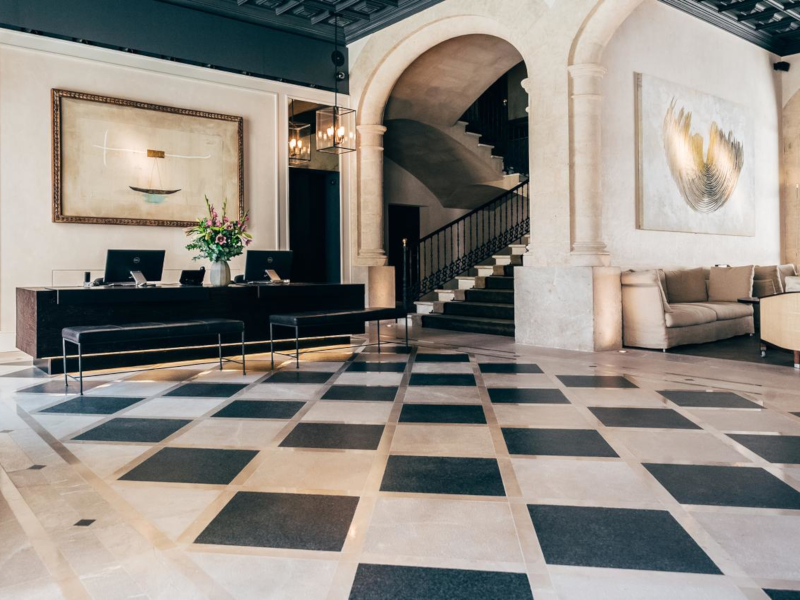
    Miguel Feliz is the general manager of Sant Francesc, a five-star hotel in the centre of Parma. ‘It’s been a tough and challenging year for all of us, especially those in the hospitality industry,’ he explains. ‘We are extremely lucky that Sant Francesc is a well-established, year-round property and Palma is a popular destination even in the cooler months,’ he explains, adding that he ‘remains optimistic that we will begin to see some normality from September onwards, which is just in time for my favourite month in Mallorca.’

    If the guests return – and at time of writing the government’s muchcriticised quarantine policy has made travel an anxious business – then guests will find a subtly altered hotel. ‘We have put extensive new measures in place by following the recommendations and directives from the Spanish National Health Services, as well as the World Health Organisation, in order to ensure the wellbeing of our guests and team members,’ Feliz tells me. ‘These include everything from twice-daily temperature checks for all staff as well as guests on arrival, to mandatory use of masks for our team – and masks and hand sanitizer being readily available to guests at all times. Extensive new cleaning programmes have been put in place for guest rooms and all public areas and social distancing will be encouraged wherever possible.’

    As workable as that sounds, it was also a tough time for the company in another sense when the owners had to address the question of the expected opening of a sister property Can Ferrerata in Santanyí. ‘We decided to postpone until March 2021 and take our time, in order to give it the opening it deserves.’

    This hiatus has been painful – and of course Sant Francesc is just one story among thousands globally where hotels have had to pause, pivot, or just take the financial hit. The effect on the hotel industry has been seismic, as any brief walk through central London immediately attests: one thinks of the empty forecourt of Buckingham Palace, or the nowunphotographed lions of Trafalgar Square.

    But travel is a vast industry with numerous professions attached to it, which  have experienced the knock-on effects of the virus. From aviation, hotel events, to travel PR, and travel journalism, it’s a sector full of economically significant subsets.

    I catch up with Cathy Adams, who is the travel editor at the Independent. She’s on maternity leave at the moment, and says she’s grateful to have a break from breast-feeding to share her thoughts with me. For her, travel journalism was already in a state of ruction pre-Covid. ‘Even before coronavirus swept the globe, travel journalism was changing fast,’ she tells me. ‘We were working to promote underserved destinations rather than those afflicted by overtourism; and the climate crisis had made us rethink how we spoke about travel and holidays to promote more responsible tourism. Then came coronavirus, which in many ways has accelerated the issues many travel journalists have been grappling with in recent years.’

    So is travel journalism still a career you can go into? The answer is yes, but with caveats. ‘Travel journalism, when, like travel itself, it returns to the masses, will continue to become more thoughtful: expect more coverage of British holiday spots as travel restrictions drag on and we want to inject more money into our domestic tourism market. Plus, the coronavirus has highlighted just how risky travel can be – in terms of spreading the virus, and how quickly border closures can stop travel; the world will no longer be seen as a free-for-all, and journalism will take this into account when deciding which destinations to talk about.

    And will hotels still feel able to host significant numbers of journalists in order to make sure they get their copy? Adams explains that ‘editorial will remain an important part of a destination’s marketing plans, but I imagine with the focus on fewer trips and a smaller tourism market generally, they won’t be quite the all-out affairs they once were.’

    How PR went into ER

    Every one of these hotels has its marketing budget and there are many PR firms around the world earning their crust by promoting them. One of the best of these is Perowne International run by the redoubtable Julia Perowne.

    Perowne recalls for me the bizarre events of February 2020: ‘I realised in February that the situation was getting more serious and that its impact would spread outside China. In many ways the hospitality industry was one of the first sectors impacted and sadly will likely be the last.’ It was a fast-moving situation, she says. ‘We have clients all over the world and several beautiful hotels in Italy which was impacted first in Europe. We were shocked by the speed and severity of its development there and could see quickly that this would not be contained to one country. In early March we started to analyse the situation in more detail and prior to lockdown actually went to our clients and offered them significant fee reductions to help them through this tough time.’

    Overnight, the nature of the job changed: ‘The most significant thing has been the emotional support the clients have needed rather than just the practical,’ explains Perowne. ‘This has been a devastating time for the industry – businesses that have worked so hard have been hit badly and there’s definitely been a need to help people emotionally get through this. In addition, we have needed to look ahead to the future and ensure that when we come through this, the clients are looking as desirable and as relevant as ever. The consumer’s values have changed over the last few months and we need to ensure that we are prepared for that.’

    Perowne was forced to take advantage of the furlough scheme (we’re hopefully in the process of reinstating them’), though she would have liked to have seen a different scheme in place. ‘It would have been great if the government could have subsidised salaries and allowed people to still work if they could as they did in Ireland,’ she argues. ‘We desperately needed all-hands-on-deck but simply weren’t getting the fees from the clients so we had to utilise the scheme.’

    Echoing Adams’ observations about journalism, Perowne says that Covid-19 ‘will simply accelerate the changes that were happening,’ adding that ‘we have to be compelling storytellers.’

    Tricky Calculus

    Perowne praises the agility of her clients. One of these is the Cambridge University Arms, where Ian James, the general manager, approached the crisis in a highly community-minded way. Although he closed the hotel on 22nd March ‘with heavy heart’, he explains that ‘it was also important to us to help alleviate the strain on our NHS.’

    As the city’s oldest continually operating hotel, the team was minded to take the long view. ‘The property has truly stood the test of time – living through two world wars, the fight for woman’s rights and in 1665, the University Arms temporary closed its doors due to the Bubonic Plague,’ James explains. ‘Isaac Newton had to work from home and he used this time to develop Calculus and the theory of Gravity. Therefore, we remain positive that we will soon put this latest travail behind us. As Solomon said, “This too shall pass”.

    It’s also a hotel which has been caring toward its staff and the people in the immediate locality. ‘As the hotel closed and we were heading into lock down, our main concern was the wellbeing of our team,’ he explains. ‘Our Chef Director Tristan Welch and his team coordinated care packages to keep everyone going during the difficult times of self-isolation. Our ‘Most Wanted’ packages were filled with essentials including many items that were proving difficult to come by in the supermarkets at the time. These included everything from pasta, flour and toilet paper, to oats, sugar, cereals, stock cubes, tinned goods as well as fresh fruit. In addition to this, the property has donated some key items locally to those in need. These included disposable aprons and gloves to the Papworth Trust as well as eggs, yogurt, vegetables and other food items to Cambridge Cyrenians.

    This is a sector which has experienced the severest setbacks of any. And yet it’s a hopeful sector. James is cautiously optimistic: ‘The desire people have to travel will always prevail and the industry will always need fresh talent.’

    Miguel Feliz echoes those sentiments: ‘The hospitality industry is so versatile and offers the unique opportunity to travel the world and learn about different cultures, so there is always an appetite for travel.

    Nothing will take that away from us.’ Perowne adds in respect of a career path in travel PR: ‘for those who really want to go for it, the opportunities are endless.’

    So in a sense the buoyancy of the sector comes back to Stendhalismo: a French writer broke out into a cold sweat because of the treasures of Florence, and there will always be a part of us that will long to do the same. Far-flung parts and new experiences are things we’ll always be susceptible to, and a virus will not decrease our need for adventure – indeed, in the long run it may only increase it.