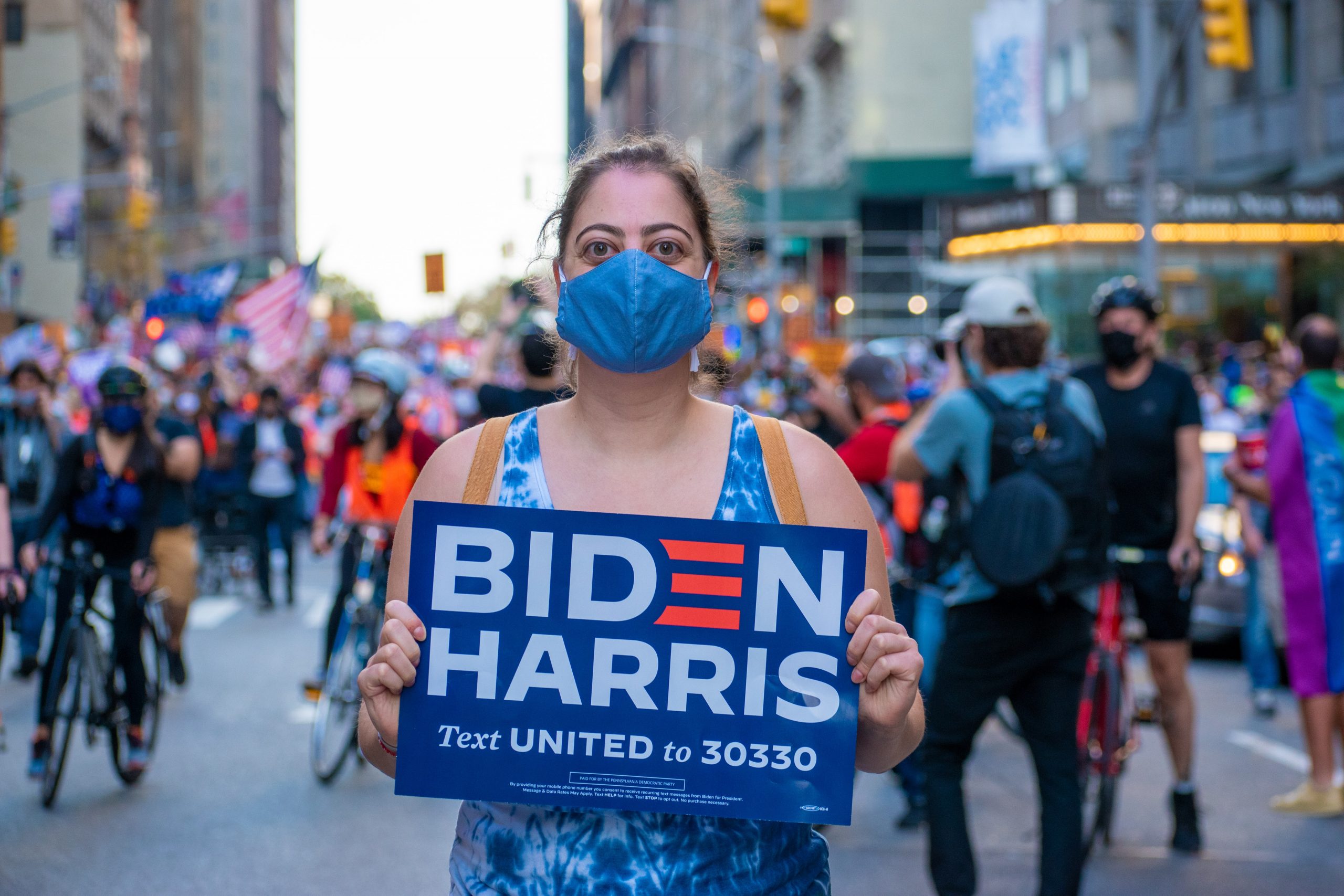
There were two clear issues in the 2024 US election: firstly, as James Carville put it, it’s the economy, stupid. Secondly, it was the immigration question, though there were some signs in the exit polls that the future of democracy was also important.
The Democrats got it wrong – and the pollsters did too. But then I think Trump, for the second time out of three, has conducted really tactically interesting campaigns. In 2016 he used a San Antonio agency called Giles-Parscale which was run by a guy Brad Parscale with only about 100 employees. It was the days of Cambridge Analytica and personalised data: they ran an extremely effective campaign in 2016.
In 2024, the Democrats outspent the Republicans very heavily. In 2016 they had new media; in 2024, they had a “new-new” media. They only had a staff of about four people; the Democrats had about 100. It’s ironic that the Democrats are left with a bill for £20 million for three celebrity concerts which they’re unable to pay for: I think Trump has offered to pay off the debt.
I thought Trump would win until the last few days. Then I thought the issue with the comedian Tony Hinchliffe calling Puerto Rico an ‘island of garbage’ in the warm-up at the Madison Square Garden comment – I thought that wouldn’t go down well. I also wondered whether the comments he made about Liz Cheney would have a negative impact on his prospects.
He was also very disciplined on the advertising. The Democrats used the “new-old” media: Facebook and Instagram and so on.
Nevertheless, it was a surprise that they took the seven swing states, as well as the House and the Senate: it was the scale of the victory more than the victory of itself which came as a mild surprise.
All of this means that Trump is in a very strong position, particularly for the first two years, since there’s usually a reaction in the mid-terms. The stock markets have welcomed the win and Treasury yields have risen slightly and so there are some natural concerns now surrounding inflation. We’ll also see what the impacts of the proposed tariffs are going forwards.
On the Democrat side, I don’t know if it would have made a difference if Biden had pulled out of the race earlier, and if the Democratic Party had had an open convention. I don’t think Tim Walz was a good pick as Vice-President – Pennsylvania governor Josh Shapiro would probably have been better, but perhaps Kamala was worried about the competitive element there. She didn’t want a strong personality.
Going down into the results a little, the Republicans managed to engage with Latinos, with young blacks, and with less college-educated young whites. The other surprise for me was that the Roe v Wade decision and abortion was not as prominent as we expected: women didn’t react as aggressively as we thought they would do.
Of course, Trump’s rallies and speeches were extremely dark. Kamala’s rallies were the opposite, with her smiling a lot – but there was a lack of content. That left a gap for Trump to make some shrewd moves: to take tax off Americans living abroad; and to take corporation tax down from 21 per cent to 15 per cent as well as lowering income tax. All these were far more substantive than anything the Harris campaign said.
I saw a TikTok of a young black woman with a massive apple in her hand. She said to camera: “Do you know how much this apple costs?” It was a massive apple, about the size of a pomegranate. She said: “I thought it was one or two dollars – but it was seven dollars!”
At the end that was the thing which swung it: the economy.
And going forwards? Trump has put into place a Cabinet and advisors who very much represent what he was going to do.
People say he didn’t expect to win in 2016. This time around, it’s not a surprise and he has the four years of experience. He is somewhat controversial, to put it mildly. But he has firm views.
Whatever business said before the election, deep down they wanted Trump because he stands for low tax and low regulation. Overall, Trump is good for business and good for North America.
Dr. Pamela Chrabieh is a Lebanese-Canadian scholar, university professor, visual artist, activist, writer and consultant. Selected as one of the 100 most influential women in Lebanon (Women Leaders Directory 2013, Smart Center and Women in Front, Beirut), and ‘Most Exceptional Teaching Fellow’ in 2008 (University of Montreal)
Dr. Chrabieh won several national and regional prizes in Canada (including Forces Avenir Université de Montréal, Forces Avenir Québec, Prix Lieutenant-Gouverneur du Québec), and her Peace Education ‘Diplomacy of the Dish’ activity was selected as one of the most innovative activities during the Innovation Week of the United Arab Emirates in 2015. Since 2017, Dr. Chrabieh has been the owner and director of Beirut-based SPNC Learning & Communication Expertise, and the Nabad (nabad.art) Program Manager since 2020.
Here, in an important exclusive, she talks to the poet and critic Omar Sabbagh about the current condition of Beirut and Lebanon.
Omar Sabbagh: Whether it may be common knowledge or not, Beirut and Lebanon more generally are currently in a state of crisis. Can you tell us, to start with, what this crisis situation looks like on the ground?
Dr. Pamela Chrabieh: Lebanon has been going through a multiform crisis following the so-called end of the 1970s-1980s wars: social, political, environmental, sanitary, etc. The Beirut port blast on August 4, 2020, was the first straw that broke the camel’s back, and the ongoing acute economic crisis the second straw. As poverty is rising – more than 60% of the local population lives now under the extreme poverty line – people are increasingly desperate. Many (those who were able to do so) left the country, others (those who are staying) are trying to survive the financial meltdown, the aftermath of the Covid-19 pandemic, and the political deadlock.
OS:There are many factors that constitute the fraught modern history of Lebanon. In your view, is the current crisis another version of other crises in the history of modern Lebanon, or is the current situation of a new sort, and why?
PC: In my opinion, the current situation is first the consequence of decades of corruption, physical and psychological wars, state paralysis, nepotism, sectarianism, foreign interferences, and a clash of ignorance. However, and contrary to what we went through during the 1980s – and that I witnessed first hand as being part of the generation of war – what we are going through today is different, as the deterioration of the country is unprecedented.
During the 1980s, we were able to escape bombs and snipers and take refuge in a different city or village, we were still able to find food and work, and we had hope for the future. Whereas today looks and feels like a descent into hell, with most of us who still roam the land are hanging by a thread. The level of despair is immeasurable today, and that is, in my opinion, one main difference between the recent past and our present life.
OS:The economy has suffered tremendously in recent years. Apart from long-standing practices of corruption, there was the revolutionary movement from 2019, and the terrible blast in Summer of 2020. How would you assess or critique the recent fate and current state of materialwell-being in Lebanon and Beirut?
PC: Lebanon is enduring an acute economic depression, inflation reaching triple digits, and the exchange rate keeps losing value. This is still affecting the population, especially the poor and middle class. I agree with the World Bank statement: “The social impact, which is already dire, could become catastrophic”.
I honestly don’t know how long the local population will be able to survive with one of the lowest minimum wages in the world, and when the country’s food prices have become the highest in Southwestern Asia and North Africa. People can’t even find needed medicine or pay a hospital bill. They haven’t been able to access their money in banks since late 2019, and their lights may go off starting May 15 because cash for electricity generation is running out.
OS: How would you assess the prospects for the young, the student body of Lebanon? It’s common knowledge that for decades the pool or fund of human capital, of human talent in Lebanon is a kind of superlative supply for what is a nugatory demand, and that there has been for decades a brain-drain from Lebanon to other places. Are prospects for the young just a continuation of this previous scenario or are there significant differences to the situation now, and how so?
PC: Now more than ever, and given the compounded effect of multiple crises, the Lebanese youth is facing a lack of work opportunities, rising costs of living and unemployment rates, and the absence of any state support. Many are growing disillusioned and desperate, and we are not even at the end of our crises. We should expect worse to come and it is going to be tougher for young people to pursue their higher studies, find a job, or even secure an entry visa elsewhere.
OS:Lebanon is known for its fractious sectarianism. Does this feature of the nation’s political, civil, and denominational make-up affect the young today as much as it may have done in decades past?
PC: Most students of mine and other university students, along with countless academics, activists, and artists who have been part of the October 17 ‘revolutionary movements’, have vehemently criticized sectarianism in all its forms and offered alternative paths, ranging from a complete separation between religion and politics to mediatory approaches. This is not a new phenomenon, as many individuals and organizations stood against sectarianism in the last decades, but we are witnessing change within student bodies, especially with secular groups winning elections in some of the most prestigious universities versus traditional sectarian groups.
OS: You have been involved at a grass-roots with the so-called ‘revolutionary’ upheavals in Lebanon and Beirut since they began in late 2019. How would you characterize the nature of this movement? And what do you think its effects have been and/or will be on Lebanese politics and thus on the prospects of the up-and-coming generation?
PC: I think it is still too soon to assess the October 17 revolutionary movements. I wrote a while ago that there are many ways of approaching the study of revolution in the contemporary world. According to a narrow definition, “revolution is a forcible overthrow of a government or social order, in favor of a new system”.
In that perspective, revolutionary dynamics in Lebanon appear to several observers (whether anti-revolutionary or skeptics) as “minor disturbances”. According to these ‘experts’, as long as the socio-political and economic systems are “unchanged”, the so-called “hirak (movement) is not worthy to be called “revolution”, and “will soon end” or it just “ended”.
However, a different definition of “revolution” – the one I use and develop – makes it appear as an ongoing project of deep confrontation, resistance, deconstruction, reconstruction, and systemic transformation. This project has no start per se, nor a specific end. In other words, Revolution with a big R is a process, and the October 17 revolutionary movements are only but a step towards overturning existing conditions and generating alternative socio-political and economic orders.
As I see it, “revolution” in Lebanon isn’t a static object that can either be a “success” or a “failure”. It consists of several current dimensions and historical layers simultaneously, and when it is not roaring in public spaces, it is boiling in the minds, adapting, learning, and bouncing back.
OS:What’s it like being both a teacher and a business woman in today’s climate? Detail, if you would, how the perspectives of your variegated work-roles have illuminated for you the current state of Lebanon?
PC: I wear several hats: scholar, university professor, visual artist, activist, consultant, program manager, wife, daughter, mother, etc. And these hats have been both challenging and rewarding. Definitely, my studies and work experience have helped me shape my knowledge and critical thinking, but my life experiences, with my family, friends, and colleagues, in Lebanon and abroad, have marked my identity and deeply contributed to what I have become today. Most certainly, I haven’t learned about resistance and resilience in books, but through my art, the arts and culture in my country and the region, and through the many struggles I have been going through, as well as the struggles of others around me.
OS:Given your answers to the questions above, what in your view is in store for Lebanon, and why?
PC: As long as there are inequalities, social injustice, exclusion, oppression, violence, war, etc., and as long as there are possibilities of change, I do not think that revolutionary movements will end. As long as our backs are to the wall and our only way is forward and through our fears, and as long as there are no limitations we choose to impose on our will, imagination, resilience, patience and freedom, we will rise again from under the rubble.
Sitting on this little red patch of dirt in the South Pacific Ocean, I’ve been trying to get some perspective on the craziness that’s upon us.
How to make sense of the craziness in the news? One place to start is the global coal debate. The first thing to understand here is the basic difference between metallurgical (coking) coal for steel-making and other coals for energy production, concrete and paper manufacturing, to name only a few. Without this distinction the climate change discussion risks creating significant dangers, and the conversation around ceasing coal production will have an adverse effect on all of us. That’s because of these two coal sources is crucial to the existence of man kind.
Let’s start with the basic question of where coal comes from. There are many varieties of coal in the world, ranging from brown coal or lignite to anthracite, also known as hard coal. All coal is formed when dead plant matter submerged in swamp environments is subjected to the geological forces of heat and pressure over hundreds of millions of years. Over time, the plant matter transforms from moist, low-carbon peat, to coal, an energy- and carbon-dense black or brownish-black sedimentary rock.
That means there are two broad types of coal. In the first place, thermal coal makes up for about 65 per cent of all global coal production, also known as ‘steaming coal’ or just ‘coal’. This is widely used as the principal means of generating electricity in much of the world. It’s reliable and stable as a base load energy source and forms part of the energy cycle which includes nuclear, hydro, wind and solar energies to name a few. This is the source of much of the debate around finding renewable energy resources.
But thermal coal must be distinguished from coking coal, also known as metallurgical coal. This is used to create coke, one of the two irreplaceable inputs for the production of steel, the other being iron ore. The property which really sets coking coals apart from other coals is its caking ability, which is the specific property required to make coke suitable for steel making.
Now, coke is produced by heating coking coals in a coke oven in a reducing atmosphere. This is known as the caking process. This refined coking coal is then used in blast furnaces along with iron ore as the base minerals to make steel (pig iron).
So, what will happen if those who win the argument and coal mining becomes phased out altogether?
Well, in a world where coal-mining stops altogether, there would be an obvious and undesirable side effect: we would stop steel production. That would mean no more high-rise buildings, football stadiums, bridges, cars (Telsa included), trains, planes, air conditioning, computers, mobile phones, solar panels, wind turbines, power stations, refrigeration, hospitals, ambulances, shipping, recycling – and of course the needle used in the syringe that vaccinated you against the Covid-19 virus. It’s a scary but real prospect.
Humans rely on steel, we have been making it for over 3,000 years. It’s in every facet of our lives and without it we stop. Transportation, communications, food production, economies and modern medicine rely on it. Take away metallurgical coal and you stop steel production.
Here, we take a breath. There are smart minds looking to alternative fossil-free steel-making processes such as hydrogen steel which is gaining traction and significant investment as a future process. But realistically, we’re decades away from producing steel on anything like the scale we do today.
Besides, so long as developing and emerging economies such as China, India and Indonesia are dependent on the production of steel – and so long as steel is heavily reliant on metallurgical coal and iron ore – it would seem the debate about stopping coal mining is in some sense a misguided one.
It seems certain then that coal-mining will remain for some time to some degree. Thermal Coal and most non-renewable energy resources will be slowly phased down as we find and implement renewable alternatives. That’s a good thing, but it will take some time.
If we agree that steel is important and therefore metallurgical coal must remain in our lives, then we have the parameters of a sensible debate. Perhaps we need to also start at the level of language by referring to thermal coal as ‘energy coal’ and ‘metallurgical coal’ as ‘steel coal’.
The writer is the founding Director of AMC Supponor
A look back at Bob Dylan’s 80th birthday in 2021, when Robert Golding looked at the career of the Nobel laureate and asked what his life can teach us about making our way in the world
‘Twenty years of schoolin’ and they put you on the day shift.’ So sang Bob Dylan with typical humour and exasperation in his 1965 classic ‘Subterranean Homesick Blues’. It is a line that may resonate with many young people beginning their working life in the Covid-19 era.
Since arriving on the scene in Greenwich Village in 1962, the Nobel Laureate, who turns 80 today, has attracted continual reassessment. The brilliant opaque words, combined with a sense that in Dylan words matter to an unusual degree, have caused an immense critical literature to grow up. It’s difficult to think of a living figure more discussed.
Commentary has tended to focus on Dylan’s extraordinariness, and one can see why: he has achieved remarkable things, all while retaining his aloofness. When I asked singer-songwriter Emma Swift, who recently recorded an album of Dylan covers Blonde on the Tracks (2020), whether Dylan had been in touch about her album, she said: ‘I’m often asked that. But Dylan is to me a mythical figure. I’d be just as surprised if Samuel Taylor Coleridge called.’
Too often then, Dylan is treated as prophet and sage, and not as someone who hustled his way through the world – as we might do too. Our admiration for him might preclude us from seeing what he can teach.
“Dylan to me is a mythical figure. I’d be just as surprised if Samuel Taylor Coleridge called.”
Emma Swift
Get born, keep warm
It helps to remind ourselves that Dylan’s upbringing was distinctly unpromising – so much so that, even at the time, it seems to have struck him as a cruel joke. Raised in Hibbing, Minnesota – a dead-end mining town – he told Martin Scorsese in the film No Direction Home (2005): ‘I felt like I was born to the wrong parents or something.’ We ought not to draw the conclusion from this that it is wise to be contemptuous of one’s elders; one might instead say that we should have the gumption to imagine our way into the life we want – and be brave enough to take steps to secure it.
The Zimmerman family home in Hibbing, Minnesota. Photo credit: Jonathunder
It remains difficult to imagine Dylan in Hibbing. His life is a powerful example of a refusal to be defined by where you’re born: our knowledge of his subsequent success makes it vexing to imagine him ever having been there at all. Hibbing consisted of the typical Main Street, dreary parades, small businesses and shops, all bound up in strict mores: a life Dylan must have found predominantly redundant. But thanks to the invention of the gramophone, another world was able to seep through to the young Dylan. This was the astonishing revelation of rock and roll.
Like so many who go onto achieve great things, one can sense the constraints that early life placed on him – and also that those constraints were lifted rather arbitrarily. Rerun the movie with slightly different conditions and you’d have another narrative.
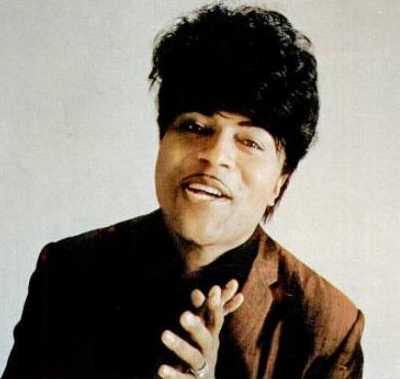
Specifically, Dylan’s life would have been different had he never encountered Little Richard. ‘His was the original spirit that moved me to do everything I would do,’ he would write on May 9th 2020 at the singer’s death. Though Dylan is a hero to many, he is also a man adept at having heroes. He admires people – but only as a way of discovering a way to become himself.
Dylan’s childhood hero Little Richard. “I am so grieved,” Dylan wrote upon the singer’s death on 9th May 2020.
Dylan’s first known performance was in 1958 at the Hibbing High School’s Jacket Jamboree Talent Festival. In Volume 1 of Bob Dylan: Performing Artist Paul Williams, Dylan’s finest biographer, explains how in this performance ‘Dylan followed the rock and roll music to a logical conclusion that was in fact quite alien to the music of the day: play as loud as possible. Not just wild. Not just raucous. Not even just loud, but AS LOUD AS POSSIBLE, preferably in a context that will allow for maximum outrage.’
It is an image of the natural iconoclast. At this young age, Dylan was allied to a true energy; he had made a decision that couldn’t be reversed to devote his life to music, and was already seeking to stand out within his chosen sphere. Soon he would graduate from being the loudest musician to other superlatives: most thoughtful, most literary, most enigmatic, most laurelled.
In the process, he was clearing more obstacles than we perhaps realise, now that we inhabit a world where they were so convincingly traversed. One fact is not the less important for being so widely cited: Bob Dylan wasn’t born Bob Dylan but Robert Zimmerman. Interestingly, a letter recently surfaced where Dylan explains that his decision to change his name was based on fears of anti-Semitism. ‘A lot of people are under the impression that Jews are just money lenders and merchants. A lot of people think that all Jews are like that. Well, they used to be cause that’s all that was open to them. That’s all they were allowed to do.’
“Dylan followed the rock and roll music to a logical conclusion that was in fact quite alien to the music of the day: play as loud as possible.”
Paul Williams
Some, including Joni Mitchell with whom Dylan has had (at least from Mitchell’s side) a somewhat abrasive and competitive relationship, have held up the decision to change his name as a mark of inauthenticity. But the decision might equally remind us of the importance of flexibility and finding a way around obstacles.
Try to be a success
Dylan’s early years exhibit a fearlessness which we might do well to emulate. As a young man, having briefly enrolled in Minnesota University in 1960, he again exhibited that same restlessness which would manifest itself eventually in his celebrated Never Ending Tour.
By this time, he had decided that rock and roll wasn’t enough, and that folk music offered a richer philosophical experience. It was the first of many twists and pivots and reinventions.
In time, he would merge the folk and rock genres – going electric in 1965 to what now looks like a rather quaint indignation from the folk establishment.
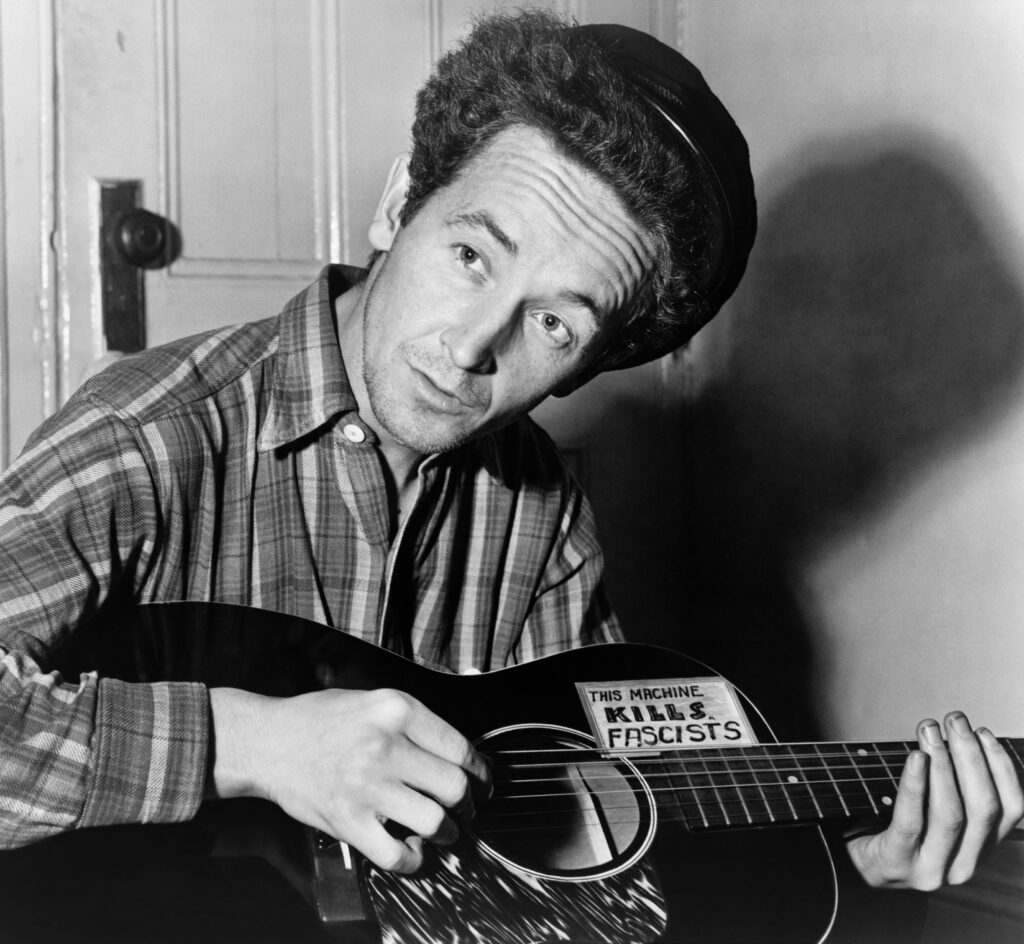
For now, seized with the urgency of the eternally confident, Dylan took a train to New York, intent on meeting his hero the folk singer Woody Guthrie. Guthrie was already suffering from Huntingdon’s Disease, which would eventually kill him in 1967. No matter, Dylan sought him out at his sick-bed in a New Jersey hospital and played him his homage ‘Song to Woody’ one of only two original compositions on what would become his debut album Bob Dylan (1962). A torch had been passed.
Woody Guthrie. Dylan sought his hero at his sick bed in New Jersey. Image credit: United States Library of Congress
It was a deft negotiation of what has been called ‘the anxiety of influence’. Young people will often underestimate the availability and flesh-and-bloodness of those at the top: fear stymies them from exposure to examples of success. By being in close proximity to our heroes – even if the encounter doesn’t go well, and we betray our nerves – we may usefully humanise them and open up the possibility of the heroic in ourselves.
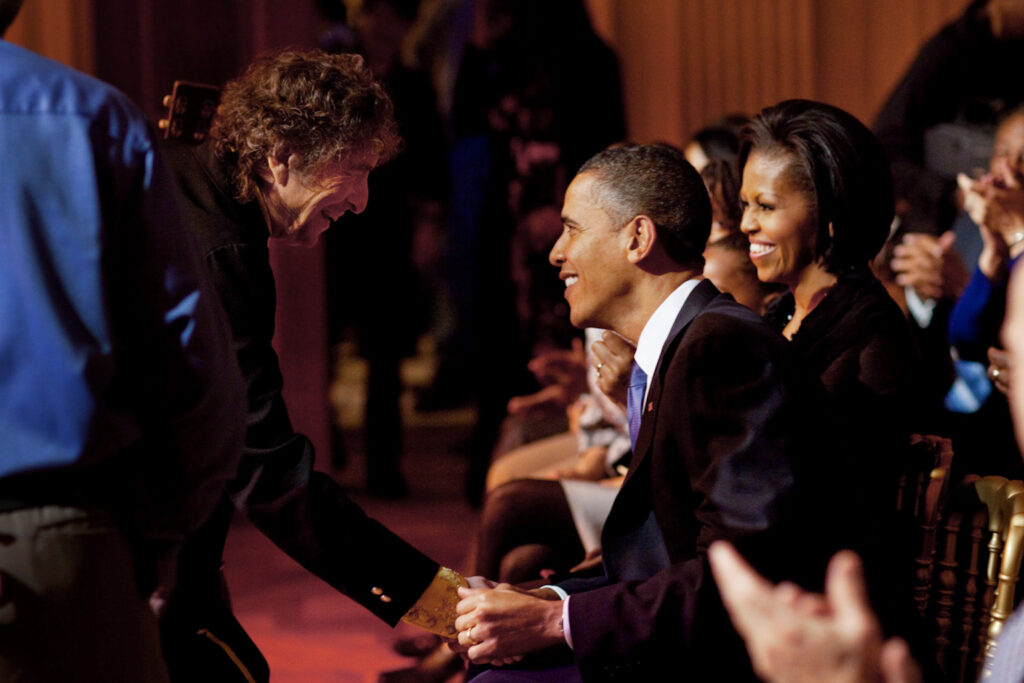
This trait of Dylan’s finds its corollary in a story told by former President Barack Obama in his memoir A Promised Land (2020). When Dylan played at the White House during the Obama administration, at the end of the performance Dylan simply shook the then president’s hand and left, saying nothing. ‘Even the president of the United States sometimes must have to stand naked,’ as he put it in ‘It’s Alright, Ma (I’m Only Bleeding)’. One suspects that Bob Dylan has never been afraid of anyone.
Bob Dylan shakes President Barack Obama’s hand following his performance at the “In Performance At The White House: A Celebration Of Music From The Civil Rights Movement” concert in the East Room of the White House, Feb. 9, 2010. (Official White House Photo by Pete Souza).
The Guthrie story is a reminder that we tend to get to where we need to be by being out in the world and meeting people; we never achieve in a vacuum but by the dint and say-so of others. Music journalist Tom Moon tells me that today ‘the Bob sphere is weird even in “normal” times’ but at the outset of Dylan’s career, when it mattered, the young singer made all the right moves, charming the crowds in Greenwich Village, signing with Columbia Records, and submitting to the aegis of manager Albert Grossman.
“The Bob sphere is weird even in ‘normal’ times”
Rock critic, Tom Moon
In time he would assemble a band whom he could trust and who were inspired to get better over time. His 1975 tour the Rolling Thunder Revue was, among many things, a celebration of friendship. And it’s thanks to his capacity as a bandleader we now have that highly underrated achievement the Never Ending Tour, which began on June 7th 1988 and ended – or paused – with the advent of the Covid-19 pandemic in the early part of 2020.
In reference to his longevity, Emma Swift says: ‘There’s a counter-narrative in our culture that says that music is for young people – that if you haven’t made it as a musician by 13 you should just stop. Dylan’s career runs counter to that and though he was working very much as a young man, he’s continued that throughout his entire life. He makes a very persuasive argument that the time for art is always now.’
From the vantage-point of today, Dylan’s career might seem to be to do with longevity – but longevity must be teed up when young, and it helps to have made the right decisions from a young age.
Emma Swift has recently recorded an album of Dylan covers. “[Dylan] makes a very persuasive argument that the time for art is always now’. Photo: Michael Coghlan
Dylan has never grown bored; his energy remains astonishing. Richard Thomas concurs that Dylan’s career showcases ‘resilience, energy, adaptability, mystique, humour’ – qualities that would not have been sustainable had his original decision in Hibbing to pursue music not been the right one. ‘I’ll know my song well before I start singing,’ as Dylan sings in ‘A Hard Rain’s a-Gonna Fall’ – yes, and to know that singing is what we should be doing in the first place.
In a March 2020 interview, Gina Gershon confirmed Dylan’s boyish love for what he does: “He read me some lyrics he was writing and he was all excited…,” she recalled. “I was thinking, ‘Oh my God, this is so cool.’ You could see why he still loves doing what he does and why he’s excited…”
“He only ever repeats himself valuably, somehow anew, which is not true of the rest of us”
Christopher Ricks, author of Dylan’s Visions of Sin
When I speak to the great Dylan critic, author of Visions of Sin (2004), and former Professor of Poetry at Oxford University Christopher Ricks, he agrees with Swift: ‘He only ever repeats himself valuably, somehow anew, which is not true of the rest of us.’ This remains true in his touring, where Dylan – famously, and sometimes to fans’ perplexity – will never perform a song in the same way twice.
His Back Pages
Throughout this life of performance, of course, Dylan has been compiling the greatest songbook of any American songwriter in the post-war period. It is a vast corpus, where wisdom sits alongside glorious nonsense – and where solemnity and comedy, yearning and rage, all equally have their home.
It must be said that the idea of plucking contemporary jobs tips from the Dylan oeuvre can seem an exceptionally unpromising avenue of enquiry. Dylan himself has sometimes been self-deprecating about the idea of extracting meaning from his songs. As he wrote in ‘Mr. Tambourine Man’, ‘If you hear vague traces of skipping reels of rhyme/it’s just a ragged clown behind.’ Dylan here appears as something like Charlie Chaplin’s Little Tramp: Don’t pay him any mind.
Few have taken him at his word there. More problematically, the songwriter’s reliance on the folk repertoire means that the economy he is describing in his songs tends to predate ours. One might seek in vain in the Dylan canon for direct advice about how to make it in the professions, or hints about how best to make LinkedIn work for you.
But this leaning so heavily on a rich hinterland of American song, might amount to another lesson. His work shows a remarkable respect for the past – as well as a willingness to question the present. Dylan’s second studio album was called The Freewheelin’ Bob Dylan (1963). Paul Williams once said that Dylan’s songs essentially teach us that when a man learns to be free only then can he be in with a shot of happiness.
Dylan in 1966. Dylan’s oeuvre, according to Paul Williams, teach us that only when a man is free can he begin to be happy. Photo credit: image in the public domain.
But we can only be free in relation to others. As much as he would distance himself from the label ‘protest singer’ over time, Dylan’s repertoire contains songs of high-minded hatred towards the establishment. ‘Masters of War’, ‘Only a Pawn in Their Game’, ‘Pay in Blood’: these songs warn us off a career bereft of a healthy scepticism about the way things are. Dylan’s songs tell us that to question the status quo is a first step towards our finding a place in it.
This freedom is not only something that Dylan exhibits; it is something he bestows on the characters in his songs. Dylan’s is a world of freely moving drifters (‘The Drifter’s Escape’), wronged boxers hurtling unimpeded towards their fates (‘Hurricane’), mafiosi (‘Joey’), and a whole range of po’ boys and girls, who seem almost liberated by their impoverishment. Everything – everyone – is in continual motion: ‘Only one thing I did wrong/stayed in Mississippi a day too long.’ Even William Zantzinger, the murderer in ‘The Lonesome Death of Hattie Carroll’ is defined by his freedom.
“His actual experience is tempered by what the folk tradition, always where much of his songs go back to, dealt with’
Professor Richard F. Thomas
The Harvard professor and author of Why Dylan Matters Professor Richard F. Thomas explains: ‘‘Workingman’s Blues #2’ is in part about working’ but he agrees the middle class doesn’t feature. ‘His actual experience is tempered by what the folk tradition, always where much of his songs go back to, deals with.’
All I Really Want to Do
And yet there are few, if any moments of sloth in Dylan’s life. ‘Lay Down Your Weary Tune’. ‘Watching the River Flow.’ These are songs about pausing, but they are also moments of expression – of activity – for Dylan himself.
While Dylan turns a sceptical eye on ‘the masters of war’ who too often prosper in the present, he teaches an intense respect for the wisdom contained in the folkloric tradition.
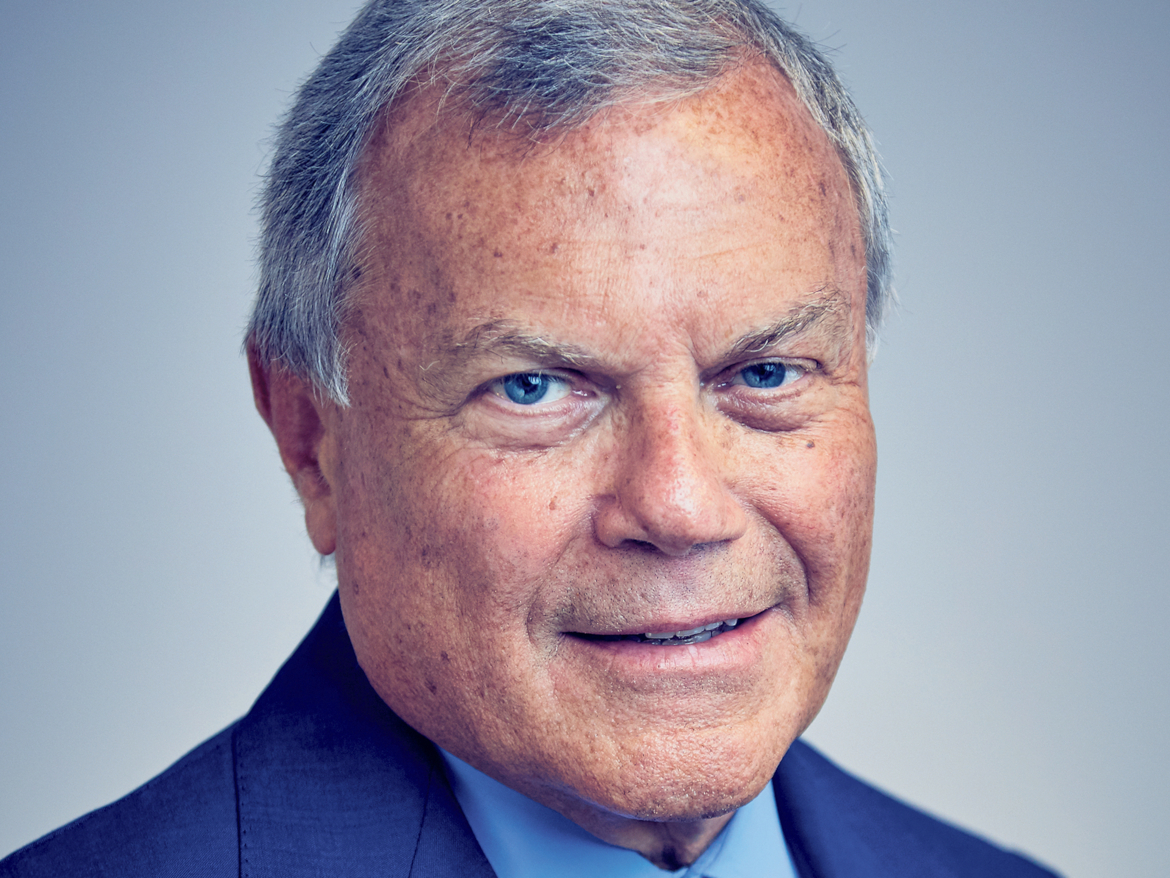
This resonates in other professions. Anyone who has spoken to Sir Martin Sorrell will find him as passionate about advertising as it used to be as much as it is now. Likewise, readers of Andrew Marr’s survey of journalism My Trade (2004), will note that secreted in the BBC man adept in a modern medium, is a historian. Success is to do with a sense of how this moment fits into the preceding and those which will come; this can only be achieved by hard study, and utter commitment.
It is apt that while Dylan’s milieu is the past, he has nevertheless managed to prosper within the contemporary moment, and there is no-one alive today whose works seem more assured of a future audience. This fact was especially brought home in late 2020 when Dylan sold his songbook to Universal for a reported figure in the $300 million range.
This respect for tradition is a lesson he bequeaths to his musicians. As Professor Thomas explains: ‘The musicians he has worked with are in awe of him as a teacher of the musical traditions he wants them to be up on.’ So would Dylan have made a good teacher? Thomas says: ‘While I can’t see him in a classroom (“the mongrel dogs who teach” (‘My Back Pages’), though that’s some time ago), I believe he cares deeply about what matters to him, and that is the first ingredient of a good teacher.’
Fleetingly, and perhaps jokingly, Dylan once imagined in an interview with AARP an alternate route for himself: ‘If I had to do it all over again, I’d be a schoolteacher.’ In what subject? ‘Roman history or theology.’
When I Paint My Masterpiece
It might be hard to imagine the Dylan energy contained in a school. In fact, it isn’t even contained within music.
In recent years, Dylan-watchers have become increasingly aware of the scope of their man’s achievement in the visual arts. A recent episode of the HBO drama Billions shows hedge fund billionaire Bobby Axelrod with some of Dylan’s work in his home. During the COVID-19 pandemic – according to insiders at London’s Halcyon Gallery – Dylan was not only commissioned to produce a metalwork sculpture for Ronald Reagan Airport, but delivered some 20 works to the gallery.
Dylan’s brilliant metal sculptures show another side of Dylan’s creativity
The appreciation of Dylan as artist and as sculptor is still in its infancy.
Emma Swift tells me: ‘Dylan has taught me a lot about the interconnectedness of art forms. I used to think about poetry and music and visual art separately. Now I don’t. All the video clips for my Dylan record are animated, so they’re very much a celebration of the visual to go alongside the music.’ Dylan’s career here again emerges as an exercise in creative freedom – both within his own art form and in an interdisciplinary sense.
I head up to central London, for a behind-the-scenes tour of the Halcyon’s Bob Dylan Editions show. In many of the pictures, the influence of Edward Hopper is paramount. This is an America which has to some extent lapsed. We find motels and diners, parking-lots, cinemas and burger-joints. It is an image of everyday America, which isn’t meant to feel contemporary. Like his music, these are artefacts of collective memory; the paintings feel like acts of nostalgic preservation.
Most marvellous of all are the metal-sculptures. Upstairs, Georgia Hughes, an art consultant at the Halcyon, shows me a blown-up picture of Dylan in his California studio. Wiry and tough-looking even in old age, he stares eagle-like on his metals, the materials of his art. Hughes explains how Dylan rescues the metals from the scrapyards around California. I quote back at her the lines of ‘When I Paint My Masterpiece’: ‘Well, the streets of Rome are filled with rubble.’ She replies: ‘Dylan’s art has to do with finding what lies near to hand and transforming it.’
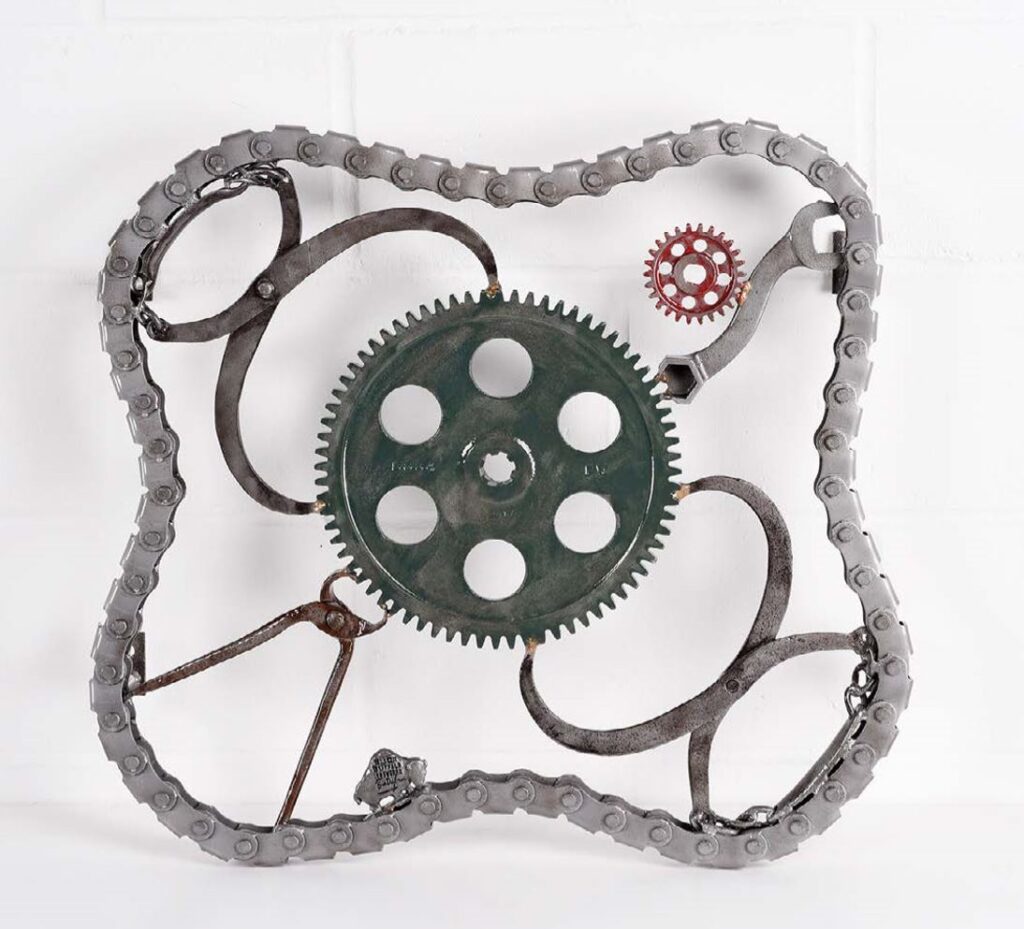
One I particularly like is a wall-hanging (see opposite), where the pieces of metal, the discarded spanners and wrenches feel somehow like a sea-creature peculiarly adapted to its environment.
Dylan’s illustrated lyrics with signature now cost £2,000
Dylan’s art career shows us that his is a porous existence where all options are on the table. Whenever one thinks of the successful, they always seem free of the doubts which seem to constrict others. If their lives often feel peculiarly uncompartmentalised, then perhaps it is because they proceed in freedom.
“He does all kinds of things that are kind of shocking, and I think it opens it up for everybody else”
Emma Swift
Money doesn’t talk, it swears
Of course, if we wanted direct lessons about our lives from Dylan then his business interests are there for all to see. Put simply, Dylan has not been afraid to monetise himself.
Bobdylan.com, in addition to providing information about tour dates and the artist’s songbook, is primarily a shop, hawking everything from key rings and hip flasks, to tote bags and his new Heaven’s Door whiskey. In the past he has let Apple, Chrysler, Cadillac and Pepsi use his songs.
Emma Swift gives her reaction: ‘He does all kinds of things that are kind of shocking, and I think it opens it up for everybody else. You know, if Dylan puts his song in an ad…okay, I guess it’s fine.’ Again, there is fearlessness here – he is prepared to risk being labelled a sell-out and happy to let the songs speak for themselves in whatever context they happen to be used.
When I ask Thomas what lessons Dylan’s life ultimately has to teach, he replies: ‘Read, listen, read, enquire, don’t be presentist!’
If one were to ask oneself why Dylan’s work is richer than that of his contemporaries then it has something to do with the range of reference brought to bear in a setting where one might not normally expect it. This is the case even when his work is compared to that of literary contemporaries such as Paul Simon and Joni Mitchell, though there will always be some – the late Clive James among them – who would prefer the poetry of Leonard Cohen.
And not being ‘presentist’? On the face of it, this might not seem to fit Dylan. Joni Mitchell had this to say about him: ‘Bob is not authentic at all. He’s a plagiarist, and his name and voice are fake. Everything about Bob is a deception.’
Harsh as this is, it is a frustration Paul Simon has also aired: ‘One of my deficiencies is my voice sounds sincere. I’ve tried to sound ironic. I don’t. I can’t. Dylan, everything he sings has two meanings. He’s telling you the truth and making fun of you at the same time. I sound sincere every time.’
But one suspects that Dylan would have no audience at all, if there wasn’t truth at the core of his work. It is rather that he has been true to his nature by being opaque. He hasn’t let his desire to tell the truth get in the way of being mysterious – and vice versa. At the Halcyon exhibition there is a wall of magazine covers devoted to Dylan. It doesn’t matter how much we photograph or try to know him; his eyes won’t let us in entirely.
As Dylan enters his ninth decade, he is among those rare American artists who seems to have fulfilled their talent. Photo credit: By Alberto Cabello from Vitoria Gasteiz – Bob Dylan, CC BY 2.0, https://commons.wikimedia.org/w/index.php?curid=11811170
Forever Young
As Dylan enters his ninth decade, there is much his career has to teach those who are embarking on their own lives. It’s true that there is dispute in literary circles about the extent of his literary achievement. But Dylan has been plausibly compared to William Shakespeare and to John Keats. We know far more about Dylan’s life than we do about the Elizabethan, and Dylan has lived out his talent far more than Keats, who died at 26.
In spite of the singularity of his achievement, Dylan continues to repay study. Besides, the man who wrote ‘Don’t follow leaders./Watch your parking meters’, isn’t so much telling us what to do, as inviting us in. Once we accept his invitation, we find we become richer, wiser. There is a generosity somewhere near the core of his art. Dylan once said: ‘Every song tails off with “Good Luck, – I hope you make it.”
He never said where – but he didn’t have to. As often with Dylan, we sort of know what he means, but we have to fill in the gaps ourselves.
A look back on Sophia Petrides’ exploration of the problems CEOs faced during the pandemic. Originally published June of 2021.
By Sophia Petrides
Over the last three months I have beenspeaking with CEOs, leaders and entrepreneurs about leading through the pandemic and lockdowns of 2020 and 21. It will probably come as no surprise that the results show that the 50 leaders I spoke to all reported new challenges as they explored new ways of working remotely. They had to learn, as if from scratch, how to manage teams, and engage with clients and how to manage the group of CFOs, CTOs and CFOs sometimes know as the C-suite. The leaders I spoke to head up small, mid and large cap organisations across financial services, technology, healthcare, sports, consumer brands and manufacturing. I am grateful that they gave their time during a period when – as you will see – that is a commodity more valuable than ever.
Encouragingly, all of them shared an overwhelmingly positive outlook for their organisations and each expects to see a strong global economic recovery once our vaccination programmes are fully in place. At the same time most of these business leaders acknowledged that we are unlikely to return to pre-Covid-19 workplace norms anytime soon, if ever. All these CEOs took part on the understanding that my findings would be reproduced anonymously.
When it comes to the specifics of how they approached the lockdowns, it is clear that the direction of travel over the last decade towards a more people-centric employee experience, better communication across organisational hierarchies and more inclusive company culture has been greatly accelerated by the pandemic and the needs of working remotely. As one CEO put it, “The pandemic has a silver lining. It’s an opportunity to do things differently, with the time pressure needed to overcome complacency with the current way of doing things.”
Digital headaches
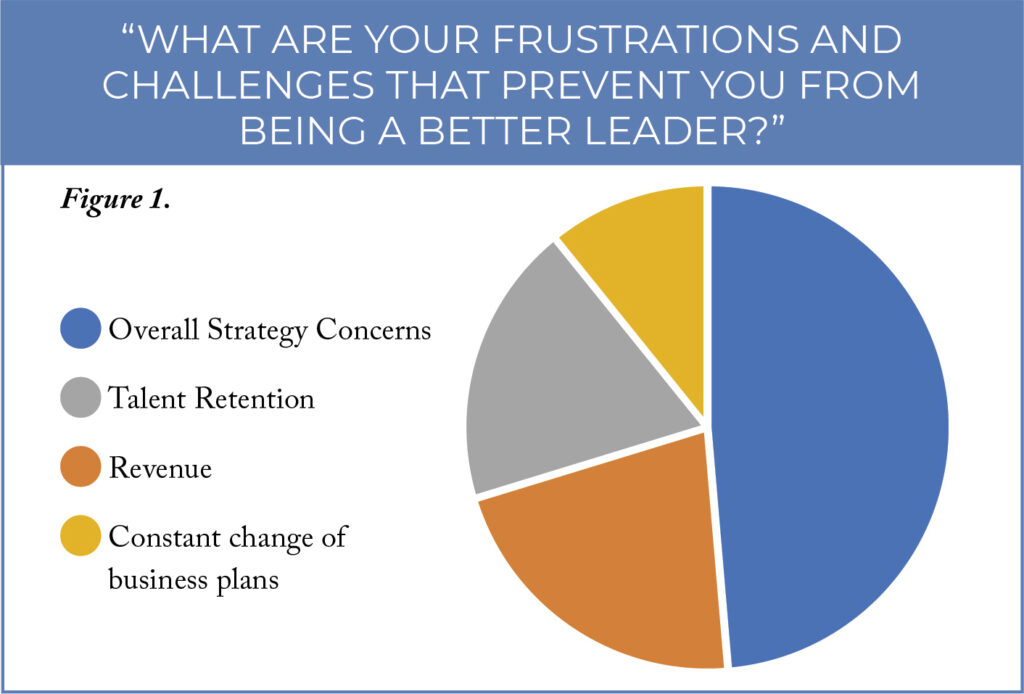
We asked the question: “What are your frustrations and challenges that prevent you from being a better leader?” and it yielded some interesting answers which show the most important friction points during the pandemic. These will likely also affect us all going forwards too. The results can be seen in Fig.1 below.
The fact remains that digital leadership is difficult. A large part of the leadership challenge has always been aligning the company and its stakeholders around a clear vision. However, in the age of virtual meetings such as Google Meet, Zoom, and other online meeting platforms it has become a more significant challenge. In many respects, engaging with teams digitally underpins most of the major frustrations of the CEOs I spoke to – the problem is the loss of those unplanned moments of interaction that are so important to create a sense of momentum and social cohesion behind the leadership team. There’s no office buzz online, and that informal energy is essential to align teams behind the leadership vision.
Another major headache – around 19% of issues – was retaining new talent in an age when many of the new hires hadn’t been able to meet their management and colleagues in person, or participate in any of the usual social, informal onboarding experiences that are a normal expectation of everyday working life. However virtual meetings were noted as providing positive experiences too, in that they also give a safe space where younger professionals can voice their views with confidence.
As one CEO put it, “I miss walking around the floor and connecting with people at all levels. You can’t connect on a human level through virtual meetings, there’s no spontaneity, no chit chat, no watercooler moments. People struggle with burn out, home schooling and not being physically together, you need to find a platform to support innovation because it is lost when people are 100% working from home.”
Also in relation to Figure 1, I found that around 11 per cent of leaders felt that reaction to the pandemic had caused a shift to short-term strategies and away from the big picture plans in place before. There was a sudden need to have a Covid-19 response, and this in turn triggered a slew of new HR policies. 22 per cent blamed the sudden disruption for the loss of normal KPI reporting and measurements, along with the loss of travel and sales activities, for reducing revenues and growth. One leader told me: “You are challenged by balancing staff well-being and HR policies with Return on Investment (ROI) and frustrated because you can’t spend time with clients like you used to.”
NO BOARDROOM BLUES
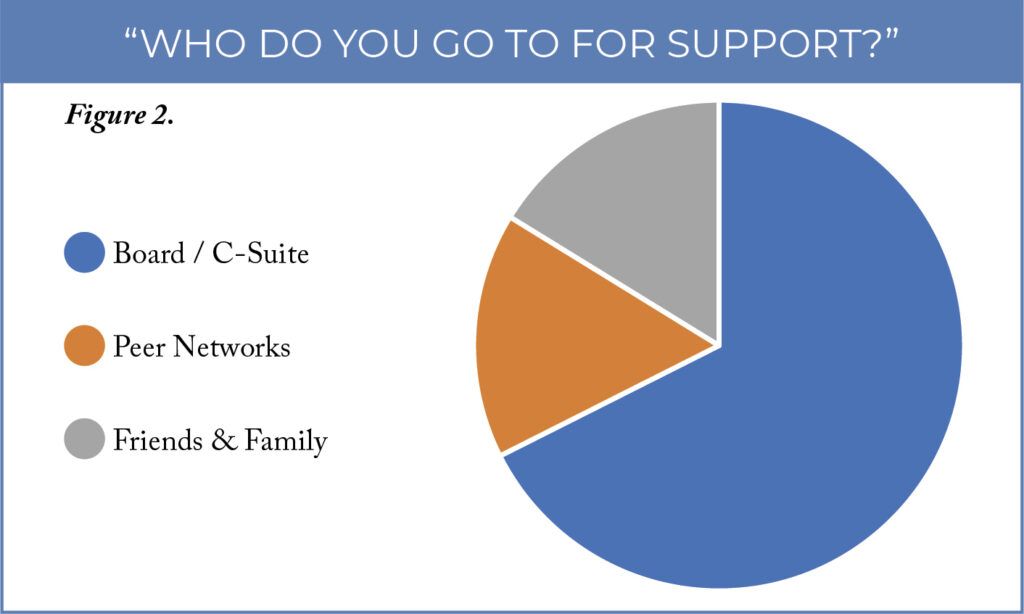
Secondly, I asked CEOs what support mechanisms they had found themselves seeking out during Covid-19. These results are displayed in Figure 2. One interesting – and unexpected – result of the survey was the overwhelmingly positive response to online board meetings. Over 68 per cent of my survey group immediately said their boards, trustees and non-executive directors were providing an extremely high level of support. This was attributable to the pandemic, as another unexpected silver lining, not just in providing support to CEOs, but offering mentorship and support to the organisation at a higher level than ever before. One leader was particularly enthusiastic about the reaction of their board: “Pre-Covid-19, it was challenging to get the board of trustees visible and engaged with the team. Now there’s 100 per cent visibility and presence through online meetings, which means the board has moved closer to employees.”
For those without a traditional board structure to fall back on, there was a fairly even split between two other kinds of support network. Firstly, many leaders sought out colleagues at a similar level who they could talk to about the challenges they were facing off the record. Secondly the role of friends – and in particular, family – in their lives became of increasing importance. In many cases, the opportunity to work from home came hand-in-hand with the chance to make a meaningful change to their work-life balance. Spending more time with the family has proven to be a positive way to recoup lost energy and online meeting fatigue.
The Human Side
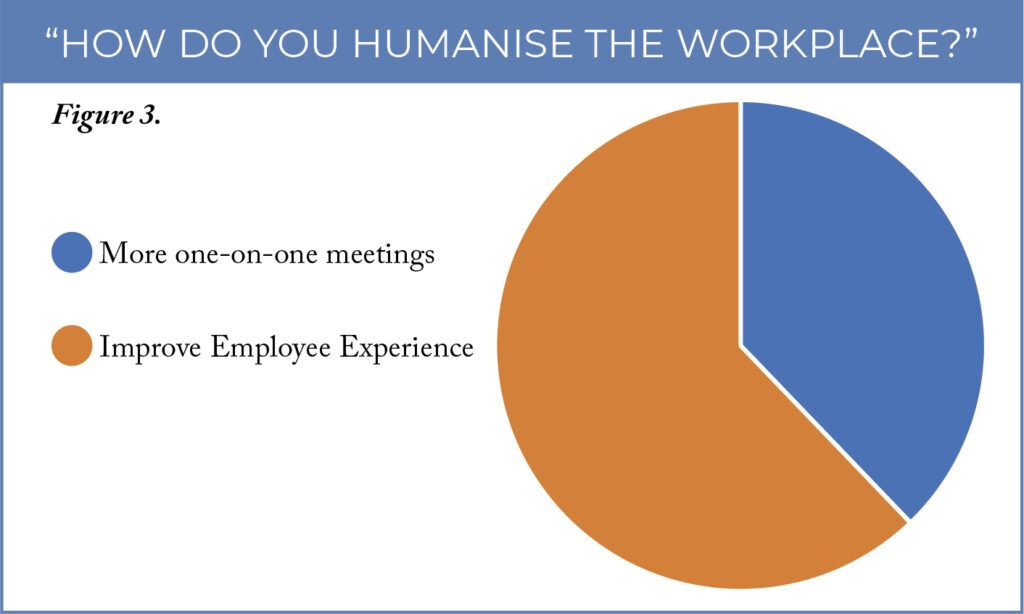
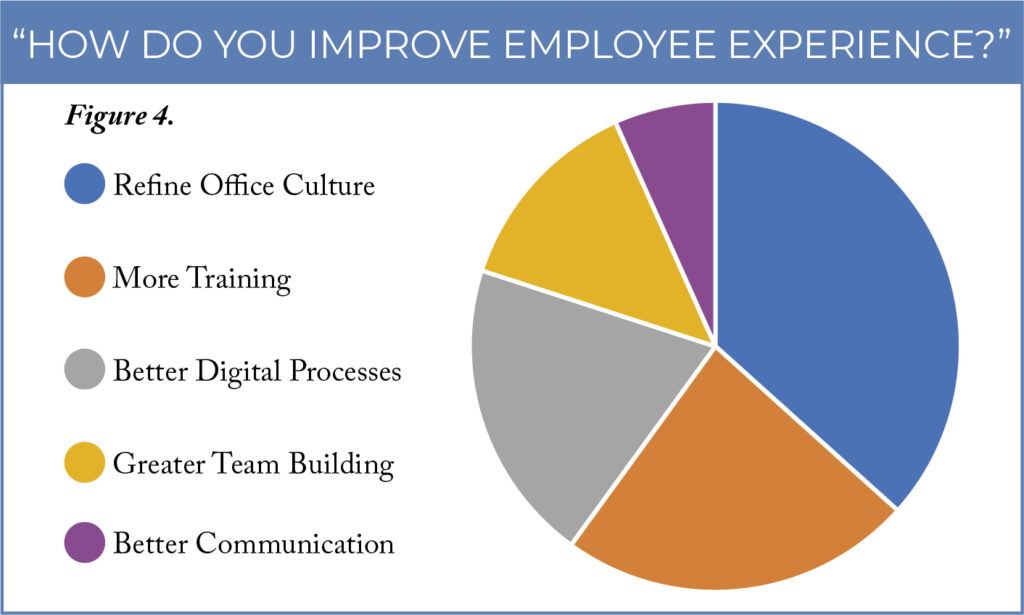
Thirdly I asked what the CEOs in question had done to humanise their workplace. There was a follow-up in the question whereby I also asked what the surveyed individuals had done to improve the employee experience. These results are collected in Figures 3 and 4.
The results were clear. Covid-19 has accelerated the importance of the employee experience. When I asked how to humanise the workplace there was a split between those who felt the emphasis should be on designing a better employee experience (62 per cent) and those who felt that what was required was more effective two-way communication across the traditional company hierarchy (38%).
When I delved into what an elevation of the employee experience might look like to these business leaders, many interesting initiatives were listed. These ranged from holding nutrition and exercise sessions for employees by providing free access to online personal trainers through to ensuring each employee took a scheduled 45-minute mindfulness break daily. A number of workplaces also prioritised in-office working options for people who were feeling lonely or isolated working from home. One CEO confided: “We delivered fresh food hampers, gym kit, games for kids and Amazon vouchers. It was about paying attention to mental and physical needs and connecting with everyone no matter what level.”
Leaders also emphasised the importance of creating a culture of fun within their teams. Many added that this required more organisation in the virtual meeting world, and included everything from introducing fun icebreakers in meetings to organised weekly virtual events. However, the most significant aspect of all the employee experience initiatives was limiting working hours, not sending emails over the weekend and ensuring staff took breaks throughout the day. Another CEO explained: “Burnout is an issue. There’s a temptation to work longer hours, but it’s not all about hours – it’s about your output, and that suffers if you don’t get the balance right.”
In addition, many leaders discussed the importance of making themselves accessible to all levels of staff, including scheduling one-to-one sessions weekly with new recruits to ensure they are settling in. This was especially on the mind of one CEO: “I am very conscious to have regular calls with the team. We have to bring all levels of people closer together and be more approachable and available 24/7.”
The Question of Morale
There are, of course, many different tools available to leaders for improving employee experience. The primary one was focusing on company culture (37 per cent) and trying to build better bonds between team members through the kinds of employee experiences we see outlined above. It is important to note that there are two other broad categories of tool for improving employee experience.
One is Continuing Professional Development (CPD). This is an essential aspect of making sure employees are staying true to their ambitions. This need for training and continuing development for teams represented 23 per cent of answers. As another put it: “Training and development are vital for sustaining a cohesive team and understand how they fit within an organisation.” There is a clear role for training to make employees feel respected and empowered, and many CEOs related this need to team performance. Another said: “Empowered means people who make better decisions more cohesively, without the need for constant supervision.”
In addition, 20 per cent of respondents talked about giving people the space to make their own digital processes, chats, support channels and online activities to boost team morale. 13 per cent suggested that the best employee experience was being on a winning team, and being rewarded as part of a growing business. However, there was a general sense that while digital was essential, automation had a negative effect on team experience because it isolated people during previously social activities like training. Another CEO confided: “We invest billions in making computers more human and making humans more automated. Then we spend billions more trying to humanise humans. Person-to-person contact is impossible to replicate.”
Hinges Off
It is fascinating to look back at the lockdown year and consider how much we have learned about working digitally. It brings new challenges in terms of burnout and a lack of team dynamism. The workplace spark, the spontaneity, the atmosphere of a team environment has not digitised effectively. However, there are clear benefits – and arguably greater long-term gains to come – not least in the way digital working has refocused leaders on authentic communications, a flatter hierarchy and better employee experiences.
It seems fitting to end on a quote from one CEO, who succinctly explained the need for better comms and experiences, as well as the advantages of working together in the same place. These remarks suggesting a new home-work hybrid might offer a renaissance for the modern workplace: “On my first day, I literally took the door to my office off its hinges. I needed to make a statement that everyone is welcome. Everyone deserves time and empathy. It is vital to feel the pulse of the employees, because that’s the pulse of the business.” It is a pleasant thought that, cooped up in our houses as we’ve been, that we might soon inhabit a working world which has become richer as a result of the pandemic.
New research conducted by YouGov Cambridge as part of their Globalism Project reveals the different ways people wish to work after the pandemic. Their survey of 27 countries asks where people would prefer to work if they had the choice – in the home or office – and how often they would like to do so.
Denmark and Japan have the lowest desire to remove the office from work life completely, with only 8% of respondents in both countries stating that they would like to work from home full time. US, South African, and Brazilian workers are the most eager to ditch their commutes, with 27-28% saying that they wouldn’t like to work in an office at all.
In the UK, the most popular option is to work in an office full-time with no work from home element. While 38% of UK workers don’t want to work from home at all, 23% want to work from home “most” of the time, and 21% want to work from home only “some” of the time. This desire for flexibility outweighs the nation’s desire to embrace the home office, with 18% of people saying that they would prefer full-time work in the home.
As we have seen that Japanese workers have little desire to work from home, it stands to reason that Japan also has the highest number of people who want to work in the office full time, at 52%. Italian workers are second on the list for wanting to retain traditional office life at 48%, trailed closely by Spain and Germany which both saw 46% of workers wishing to keep their offices.
Most workers in all of the countries surveyed are willing to work from home at least some of the time, with percentages for that option hovering between 20-40% across the board. Some countries, however, are resistant to working from home for most of the time, including Japan, Denmark, Spain, and France which all saw responses for that category falling below 15%.
Across all of the countries surveyed, working in the office full time was the most popular choice at 32%. While 47% of workers are happy to work from home in some capacity at work (if we combine the respondents who chose to work from home “most of the time” and “some of the time”), only 17% are willing to make working from home their full time job.
However you like to work, it seems that there will always be someone else who would prefer something different – and with a bit of added flexibility and solid organisation, that’s not a problem.
Young people and experts on climate change, diversity and arms sales reveal the significance of the new Biden administration for the UK
Georgia Heneage
There has been much hype around what the new Biden administration signifies for a politically divided country infected with issues of social inequality, racial injustice and a deadly virus which has killed over a million of its people.
In his first month in office, Biden seems to have already conducted (or at least promised) a systemic upheaval of many of the unpopular and controversial policies in place during the Trump administration, such as its sceptical approach to climate change, immigration and foreign policy. With Kamala Harris as the first female vice president of colour, there is a new mood around questions of diversity and inequality which were largely ignored under the Republican regime.
But the impact this seismic shift for America will have on the UK is yet to be seen: will it really be that seismic? And, if it is, will the effects be negative or positive?
The view of those working in these key areas in the UK is that the large scale shake-up which Biden is promising should urge us to follow suit, but the likelihood that it will is less than certain.
‘We want to fight for change’: the view of the young
For 21 year-old Connor Brady, Staffordshire University’s Labour Student’s society manager, the “tone” and “conversation” in the UK changed immediately following Biden’s inauguration.
Though he is unsure that “policy-wise” much will change in America for young people, Brady believes that Biden’s environmental policies will play a large part in emphasising the UK’s thin approach to climate: “His new policies highlight the fact that we’re not really having that discussion in the UK. I don’t think that we are going to make the changes necessary to save the planet, whereas in America the thought process is at least there”.
The fault, says Brady, lies with a media system in the UK much less attuned to climate worries than across the pond, and a political culture “defined by indecision”.
“I’d love it to be the sort of example that we’d follow,” says Brady, “and say that we need to take it seriously because they are. But I don’t think we really have a political class that are ever going to really take notice of the way other countries are doing better: we’ve seen it with Covid.”
Staffordshire’s society’s communications officer Jagdeep Jhamat, 20, said Biden and Harris’ appointment was “a sigh of relief; the moment we found out the results we realised that a saga had just ended in American politics, and it was not a good one”.
For Jhamat, though, the appointment of Kamala Harris does not signal a substantial benefit for people of colour in America or the UK. “Just because she has credentials of being the first woman of colour doesn’t excuse the fact that she was a judge who sentenced people of colour to prison with insufficient evidence. It’s not the best representation of minorities in America.”
And Jhamat sees a parallel in this respect with UK politics: “I have nothing in common with ethnically ‘diverse’ MPs like Rishi Sunak or Priti Patel: all I see is them selling out to the interests of a ruling white international capitalist class.”
Despite this, Connor Brady says the Black Lives Matter protests which started in America last year had a hugely positive affect on young people in the UK who are increasingly “politically disenfranchised”.
“The movements that we’ve seen over the past year have shown that young people are ready for change, and they are going to fight for change,” says Brady. “They aren’t going to wait five or ten years. They are willing to stand up and say no: we need change now, and we’re going to take it. That’s what I’m really excited about.”
His worry, though, is that “if Biden and Kamala don’t follow through on their promises, or if their policies aren’t radical enough, then it’s going to increase the disenfranchisement of young people in the UK who look up to them”.
‘Embarrassment is a useful tool’: Natalie Bennett on environmental policy
One of the areas most transformed by the Biden administration to date is his climate policies. After years of climate denialism and environmental destruction under Trump, the White House has now recognised global warming as an “emergency”: they’ve rejoined the Paris accord, promised new opportunities for clean energies and green technologies, and signed an executive order to freeze new oil and gas leases on public lands and double offshore wind production by 2030.
These are just a few of hundreds of ambitious executive decisions established in an effort to position climate change as an essential part of all American foreign and domestic policy going forward.
Biden’s extensive environmental policies show his awareness that beating climate change requires systemic change; a scooping out and refilling of the American economical and political systems rather than a sprinkling on top.
So where does this all leave the UK?
For Natalie Bennett, former leader of the Green Party from 2012-2016, Biden’s appointment signals a golden age for the global fight against climate change.
More importantly, she says it puts a huge amount of pressure on the UK as the chair of COP and highlights what a mess the UK is in. “Embarrassment can be a very useful tool”, says Bennet. “If a country like the USA, which has so many similar problems to us like poverty, inequality and the dominance of giant multinational companies, are doing better than we are, that makes us look really bad.”
Bennett says the US’ Green New Deal is far more sophisticated than the Ten Point Plan for a Green Industrial Revolution announced by the UK government in November last year.
“The Biden administration has come in with a very clear plan of action on whole areas of key policy, whereas our plan looks like something written down on the back of an envelope then hastily sketched up into something. It’s not long-term thinking,” she said.
Bennett sees these issues with making long-term executive decisions in the UK as part and parcel of a binary, first-past-the-post electoral system which means that “we are terrible at decision-making”, and the “last significant change in Westminster was women getting the vote 100 years ago”.
It’s also down to our deeply centralised political system, where power and resources are concentrated in Westminster and local government’s ability to make independent decisions has been “slashed to ribbons, to the point where most local governments have their hands tied”. Bennett says the rhetoric of the Green New Deal is, by its natural structure, locally based: it’s about doing things in communities, whereas “our industrial strategy is about what the top level decides and what companies invest in.”
Despite the UK government’s promise to create 250,000 jobs in the green sector, Bennett says Biden’s new policies are far more rooted in a recognition that climate change should be rooted in the labour movement, technological progress and job creation. His “just transition” policy “suggests change everywhere”, whereas in the UK there’s a sense that everything needs to level up to the status quo set in London.
“What we are talking about here is business as usual with added technology. Biden is talking about transformation,” says Bennett.
Lee Pinkerton on Kamala Harris and diversity
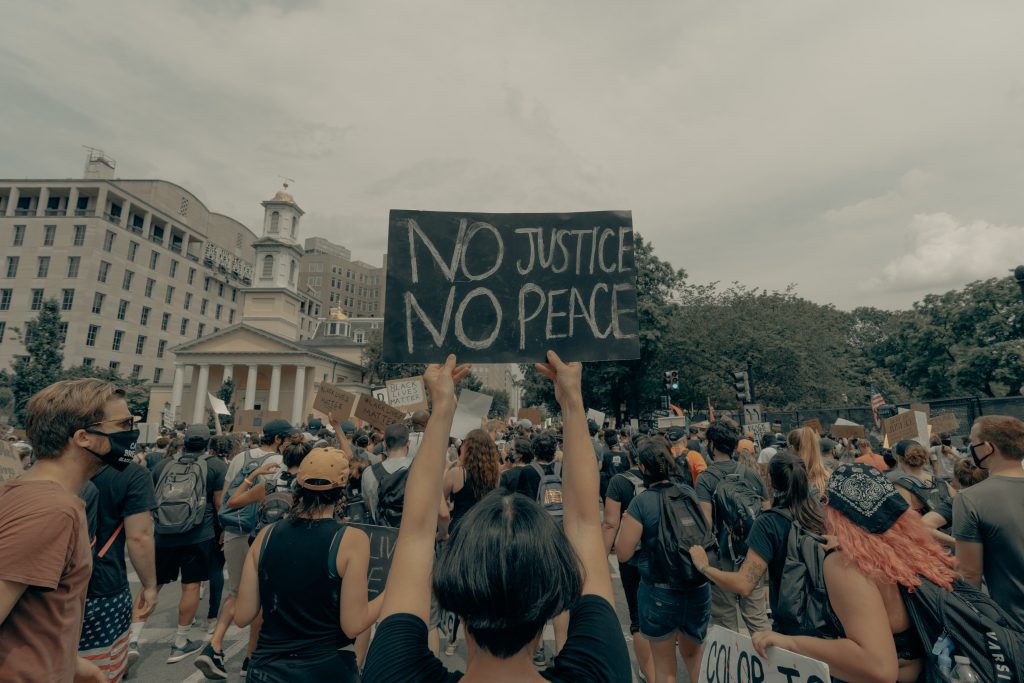
One of the most predominant issues brought to the international stage last year was racial injustice: these were voiced in mass Black Lives Matter protests which started in America, a country for whom racial discrimination is a daily reality for millions and is deeply embedded in the political and justice system.
Biden’s appointment signals a shift in this area, partly because of his pledge to tackle social and racial inequality in America, partly because of the sheer weight lifted by expelling a president who many deem openly racist, and partly because America is now enjoying the first woman of colour as its vice president.
Though some see Kamala Harris as an exciting new change in political black representation for women, Lee Pinkerton, communications officer for ROTA (Race on the Agenda), a leading social mobility think tank, agrees with student Jagdeep Jhamat that Kamala Harris’ appointment will “in truth have very little real effect on people of colour around the world”.
“They had a short feel-good moment, but it will have very little real impact on the quality of black people’s lives in America in terms of things like employment or criminal justice”, says Pinkerton, “especially because Harris wasn’t all that popular among black communities when she was a judge”.
In the UK a similar kind of “superficial” diverse representation can be seen in government. “The Tories are boasting of the most racially diverse cabinet in UK history- which is factually true- but it hasn’t improved things for black people at all. If you look at the back story of MPs like Home Secretary Priti Patel or Chancellor Rishi Sunak, they come from the same privileged, privately-educated backgrounds as their white peers. They are cut from the same cloth, and in terms of diversity of thought- there’s little to none”.
‘Our blind spot’: arms sales to Saudi Arabia
The ethical, political and economic impact of the UKs involvement in the war in Yemen, in part a result of us being the second largest exporter of weapons to Saudi Arabia, has long been a source of controversy.
This week tensions intensified as the new Biden administration announced its intention to freeze all arms sales to Saudi Arabia and work towards a lasting peace agreement to end the war that has now killed around a quarter of a million people and placed at least 4 million on the brink of famine.
When asked its response the day after Biden’s move was announced, the UK government were clear on one thing: they are not going to alter their approach towards selling weapons to Saudis, many of which reportedly end up killing innocent civilians.
The UK’s arms export licensing information reports that licenses worth £5.4 billion for sales to Saudi Arabia have been issued since March 2015, though they also consider this an underestimate. According to the Stockholm International Peace Research Institute, since 2015 Saudi has been the largest importer of arms in the world, with the UK accounting for about 15% of these exports, and the US around 75%. Saudi Arabia represented 40% of the volume of UK arms exports between 2010 and 2019.
So will America’s decision to roll back from its heavy involvement in Yemen have any impact on the UK?
For Dr David Blagden, senior lecturer in International Security and Strategy at the University of Exeter, Biden’s decision will “potentially leave the UKs tacit support in Yemen even less tenable”.
But Blagden says following suit may be unlikely, since the key difference between the UKs involvement and the US’ is that, whilst America “is less and less dependent on gulf hydrocarbons and it doesn’t really need gulf oil anymore,” in the UK we still rely on Middle-Eastern oil and gas and have in fact been “doubling down on gulf commitment over the last few years with the new base in Bahrain and Oman.”
Blagden says the UK previously used the US’ involvement in the Gulf as “cover” and because America was so involved the UK didn’t really stand out. “But the US revising its position on that will, I think, produce some even starker tensions for the UK.”
Blagden suggests that our continued support may be rooted in the fact that the arms sales contributes to so many “highly paid and highly trained jobs” in manufacturing and munitions sales. But according to Oliver Feeley-Sprague, Amnesty International UK’s Military, Security and Police Programme Director “the jobs argument is overstated in terms of the impact. Yes of course big contracts would suffer, but in the overall scale of things, Saudi is only one of many destinations we sell to and we’re not talking about stopping every sale of equipment to the Gulf.”
Feeley-Sprague also doubts the validity of the argument that arms sales contributes so much to our economy: “If you look at the economies of scale, the UK is the second largest arms supplier after the United States. But the US is by far the largest: 75% of all weaponry over last 5 years that Saudi has imported in terms of monetary value has come from the USA.
“Yes we are the second, but the US is by far the largest, so if we flip that argument on its head it’s a much more valuable market for the US than for the UK. If the US have said they’ll stop, that puts the UK in a very isolated position”.
Feeley-Sprague says the biggest impact of the US’ decision for the UK will be felt on individual companies: “In a globalised market the arms trade is intrinsically linked to international supply chains. US restrictions will have practical implications on companies reliant on US defense companies for their own sales.”
This should never be a reason not to take the ethical path, though. “We always say you should never allow strategic, economic, political factors to override the pure principles of international law which is the protection of innocent civilians in armed conflict,” says Feeley-Sprague.
For Paul Tippell, Constituency Coordinator for UNA-UK Yemen, the UKs leading source of analysis on the UN, the biggest issue in the UKs position with regards to Yemen is not arms sales but it’s failure to play a part in the ceasefire of a war which has been called the biggest humanitarian crisis of our time.
“Our job is to set the agenda and come up with resolutions; we have a big responsibility and there’s a real opportunity to work with the new administration in the US to try and secure peace. The UK has been singularly lacking in this respect.”
So why have we been so ‘singularly lacking’? Feeley-Sprague says the UK has had a “blind spot” for Saudi Arabia for decades, and are prepared to tolerate more issues than almost any other “customer”, because they are seen as “a key market for money and a strategic partner in the UK’s foothold into the wider region”.
But Brexit has placed the UK in a precarious position on the international world stage, and we must be careful: “If ever there was a way of announcing on the world stage that we were a major power who considered human rights and the rule of law to be important, now is the time.
“Because the UK hasn’t done that, I think it puts a question mark in the post-Brexit role that the UK wants to play in the world,” says Feeley-Sprague.
Brexit and an indecisive government may place the UK in an isolated or precarious position on the international stage, but the entrance of Biden means the return of America as a neoliberal international economy with one eye always turned outwards. It signals a golden dawn, full of hope, for young people.
Gone are the days of protectionism and reckless international policies which governed America under Trump; the age which a new Biden administration ushers in appears to be one of global consensus, free trade and rigorous attention to the key issues. Let’s hope he achieves what he promises to.
How to Avoid a Climate Disaster: The Solutions We Have and the Breakthroughs We Need by Bill Gates, Penguin, £20.00
A climate disaster is looming and although its impact is mostly invisible in our day-to-day lives, the damage humans have done to the planet already seems dauntingly irreversible. As Bill Gates points out, “fifty-one billion is how many tons of greenhouse gases the world typically adds to the atmosphere every year” and merely aiming to reduce emissions by 2030 is not an adequate target. He explains: “The climate is like a bathtub that’s slowly filling up with water. Even if we slow the flow of water to a trickle, the tub will eventually fill up and water will come spilling out onto the floor. That’s the disaster we have to prevent.” Simply put,“if nothing else changes, the world will keep producing greenhouse gases, climate change will keep getting worse, and the impact on humans will in all likelihood be catastrophic,” Gates says. But How to Avoid a Climate Disaster focuses on the “if” as Gates considers the changes needed and sets out an optimistic road map of how we can divert a climate disaster.
By his own admission, the burger-loving billionaire founder of Microsoft is an unlikely poster boy for saving the environment. “I own big houses and fly in private planes – in fact, I took one to Paris for the climate conference,” he confesses. While Extinction Rebellion seemingly sees anti-capitalism as crucial to the cause of environmentalism with many of its followers protesting by causing disruption in London’s financial district, Bill Gates is proposing a way to reduce greenhouse gases which will be palatable to big businesses. In each chapter he considers the financial implications of his suggestions. He proposes that countries should implement what he calls “green premiums”. He explains: “Most of these zero-carbon solutions are more expensive than their fossil-fuel counterparts. In part, that’s because the prices of fossil fuels don’t reflect the environmental damage they inflict, so they seem cheaper than the alternative.These additional costs are what I call Green Premiums. During every conversation I have about climate change, Green Premiums are in the back of my mind.”
Indeed, Gates is pragmatic in his approach and is constantly aware of the feasibility of his proposals. In the chapter about eating meat for instance, he says although animal consumption causes a lot of environmental damage, it is unrealistic to stop it entirely. He looks at meat alternatives, such as Beyond Meat, a company which he has invested in. He reasons: “Artificial meats come with hefty Green Premiums, however. On average, a ground-beef substitute costs 86 percent more than the real thing. But as sales for these alternatives increase, and as more of them hit the market, I’m optimistic that they’ll eventually be cheaper than animal meat.”
Gate remains optimistic throughout the book and suggests the threat of a climate disaster provides mankind with an opportunity to be innovative. He is always looking for the silver linings. For instance, he says: “I never thought I’d find something to like about malaria. It kills 400,000 people a year, most of them children, and the Gates Foundation is part of a global push to eradicate it. So I was surprised when I learned there is actually one nice thing you can say about malaria: It helped give us air conditioning.” In the most compelling chapter, What each of us can Do, he suggests we should all be hopeful. He says: “It’s easy to feel powerless in the face of a problem as big as climate change. But you’re not powerless. And you don’t have to be a politician or a philanthropist to make a difference.” Of course, we hope he is right. Gates was a coronavirus Cassandra. In a 2015 Ted Talk he warned: “If anything kills over 10 million people in the next few decades, it’s likely to be a highly infectious virus rather than a war.” “We need preparedness,” he demanded. This time, hopefully people will listen.
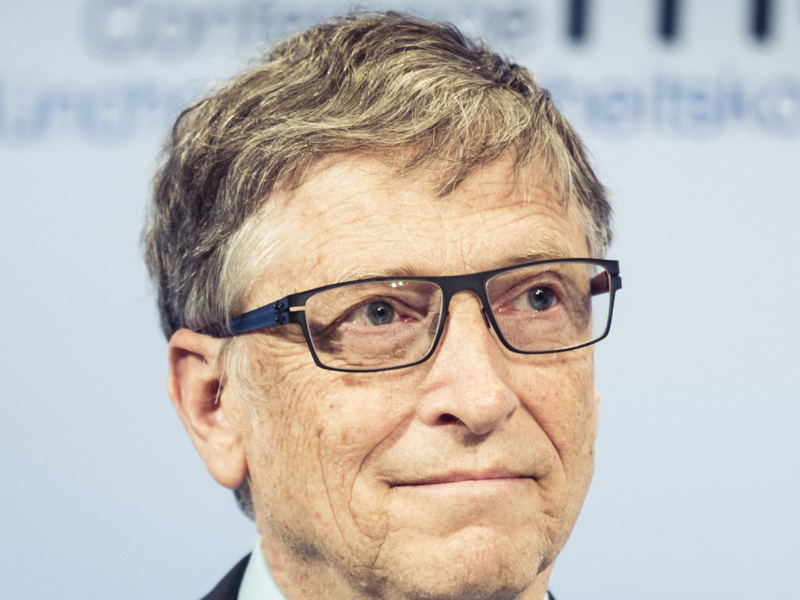
Photo credit: By Kuhlmann /MSC – https://securityconference.org/en/medialibrary/asset/bill-gates-1523-18-02-2017/, CC BY 3.0 de, https://commons.wikimedia.org/w/index.php?curid=100184908
When the new, democratic South Africa was born in 1994 the euphoria and excitement which came with the promise of a better life for all was soon diluted with the realities of the crippling socio-economic legacy of apartheid.
Amongst the many challenges facing the new government was the mammoth, but unequivocal need to turn a deeply unequal education system into something good, one that would reach all South African children, particularly black children who were systematically denied the same advantages and access to education as white children.
Although there have been improvements in the South African education system over the past 27 years, notably government’s acknowledgement and efforts at prioritising early childhood learning, the state of education in South Africa, specifically for children in the poorer areas of the country – effectively the majority of school aged children – was still in a precarious position pre- the onset of Covid-19. There were insufficient numbers of well-educated teachers, insufficient school buildings, a lack of text books, schools with no water, electricity or toilets and the most dire despite a government feeding scheme: thousands of hungry and vulnerable children.
The global pandemic which deepened an already high rate of unemployment and increased poverty has all but sent South African education over the edge, but not quite.
Whilst the systems for primary and secondary education in 1994 were severely flawed, the very foundations of learning – early childhood development (ECD), particularly for children in disadvantaged communities – had fallen almost exclusively to the domain of non-government organisations (NGO), and the communities they worked with.
Although the reach was limited, in the areas where the NGOs worked there was structure: there were recognised training programmes for uneducated women; there was onsite support for teachers in the burgeoning early learning sector; there was often food for the children and there was hope. It was the NGO sector that all but handed a well-functioning early learning system to the new government.
Today the importance of early learning is a recognised level of education in South Africa. An extra year of schooling called Grade R or the Reception year for 5 to 6 year-old children was added to the education system in 2001 (formal schooling starts at 6 to 7 years-old). There is also talk of adding a pre-Grade R year for four year-olds.
There are solid policies for early learning in place. The responsibility for all education in the early years is currently being moved from the Department of Social Development to the Department of Education. The field of early learning is being professionalised with degree courses for Early Learning coming on stream.
This is promising but it is happening against a background of despair in the broader South African field of ECD. The vast majority of ECD centres and playgroups are privately owned and run. Scant salaries come from diminishing fees paid by parents and in some instances subsidies provided by the Department of Social Development. Covid-19 has severely knocked the sector.
Along with the rest of schools in South Africa all early learning centres closed during the most virulent early waves of the pandemic. Thousands of parents lost their jobs and income, parents could not afford the ECD centre fees when they re-opened and as a result many of the centres and non-centre-based playgroups have not re-opened.
South Africans are a hardy people and when all else fails civil society steps in. During the worst of the pandemic NGOs worked hand in hand with private individuals, churches, the corporate sector, private trusts, foundations and government to distribute food through their networks to but a fraction of the thousands of families literally starving because of the economic turmoil and increased unemployment under Covid-enforced lockdowns. Many of the ECD NGOs which are still responsible for much of the vocational training offered to early learning teachers have themselves been hard hit by the redirection of private and corporate sector funds on which they rely for their income. But the NGOs have risen to the challenge.
Training programmes have been digitised. Data for online learning has been made available to trainees in disadvantaged communities. ECD centres have received hands-on help in re-opening and meeting Covid protection requirements.
There are always questions about the long term role of NGOs in the field of early childhood development. But NGOs were there during apartheid and in my opinion, they will continue to serve an essential service to early learning in disadvantaged communities of South Arica for many years to come.
About the author
Jane Evans’s memoir, A Path Unexpected,** tells the real-life story of how she, together with a group of women from a rural South African farming town, helped to make early learning a reality for some of that country’s most isolated and disadvantaged black children.
Jane is the founder of a non-government organisation called Ntataise, a Sotho word meaning “to lead a young child by the hand”. Since inception in 1980, Ntataise pioneered the introduction of early learning for children of farm workers, amongst the poorest members of South African society. It works today – over 40 years later – in seven of South Africa’s nine provinces and has reached hundreds of thousands of women and children across the country.
**A Path Unexpected was published by Jonathan Ball publishers in June 2021.
By David Hawkins, co-founder of Percheron Advisory
What do we mean by the term ‘succession’? The term is most synonymous with the TV series Succession, which centres on the Roy family, the dysfunctional owners of Waystar RoyCo, a global media and hospitality empire, who end-up in a battle royal for control of the family business amid uncertainty about the health of the family’s patriarch, Logan Roy and his plans for the empire’s future. At his 80thbirthday Logan shocks his family – particularly his son Kendall who was primed to take-over the business reigns – with the news that he will not be stepping-down as planned whilst he also throws at his children the news that he is naming his third wife as successor.
Who the Logan family are based upon is an open secret – think of an octogenarian Australian media owner and his warring family – but the issues raised here via satire are key to highlighting real world family, business and wealth survival. What follows during Succession is a series of family and business conflicts, attempted hostile takeovers and family politics that makes Shakespearean narrative seem simple.
Fundamentally, a failure of clear family governance leads to family, business, asset and wealth destruction – that old chestnut “from clogs to clogs”: the first generation earns the family money, the second generation manages it and the third generation loses it. This trend turns out to be universal across cultures – think of the Vanderbilts in the West. In the East this was summed-up by Sheikh Rashid Al Maktoum: “My grandfather rode a camel, my father rode a camel, I drive a Mercedes, my son drives a Land Rover, his son will drive a Land Rover, but his son will ride a camel.”
What are the main risks to a smooth succession and how should the present generation react, respond and accommodate the next generation? How does the next gen become more active in the business and play their role in the family business?
1) A lack of clear governance systems and processes across the family, business and wealth management
Logan Roy’s impromptu tearing up of any coherent succession plan leads to war amongst competing family members, attempts at hostile takeovers, family members resigning and business, regulatory, security and political risks. So having family governance or a family protocol in place which formalises the family’s mission statement, its USP, why the family are in business together and what the long-term objectives are, is as vital for the family as corporate governance is for the business.
This family protocol becomes enshrined as a family constitution from which policies and processes relating to the family, the business and its wealth are then outlined in detail according to the specific family’s requirements and it is discussed, bottomed-up and amended as a dynamic document during regular meetings of a family council – a council which present generation and next generation participate and lead.
This would seem foundational to all families – yet as Smith & Williamson’s Family Business Survey 2020/21 reveals, the percentage of families that have a key piece of family governance – the family constitution – in place, is still only around 38%, of which half thought they would have to review this within two years. The Roys would have found it instructive to have a family constitution and council – and include input from the business units including non-executive directors who could have been involved with the succession discussion so turning a family decision into a corporate one. The next generation would also have had the insight into first generation decision-making and a sense of the direction of travel which would have allowed them to avoid being frozen-out so spectacularly.
Without changing TV genres abruptly, the Game of Thrones analogy symbolises the challenges faced by India’s Ambani family. When the patriarch died in 2002 like many Indian families there was no succession plan and no will. Chaos reigned. Rather than a structured approach as to which assets brothers Mukesh and Anil Ambani would inherit, it was left to their mother to preside over an ‘organised demerger’ in 2005, which gave Mukesh control of oil and gas, petrochemicals, refining and manufacturing while Anil took reign over electricity, telecoms and financial services. As the Economist wrote at the time: “Why do family firms so often fail to make the generational leap? Family firms are frequently more riven with intrigue and visceral hatreds than a medieval court – and for similar reasons.”
2) Conflict and disagreement in the family destabilises the family and the business
The chief wealth destroyer, and one of the main features that family governance should work to reduce, is the exponential damage that conflict and disagreement can do to a family and its business.
When families fight, businesses lose their direction, fail to innovate and are often subsumed by their competition.
Whether it’s the ongoing dispute within the Ambani family – which even after the separation of assets was followed by defamation suits, involvement of the Indian prime minister and even Anil publicly blaming his brother for power-cuts that swept across India in 2009. In Succession, Logan Roy takes his family to the family ranch, Austerlitz, to try to patch things up – yet this sticking plaster is too little, too late.
The core of family governance is trust, communication and the prevention of disputes spiralling out of control. In the Ambani case, a Family Council could have allowed managed conversation and dialogue unifying the family around values and mission but also outlining and preparing the brothers for ownership and management of specific business units. If agreement could not be reached then the brothers could have been bought out. Disagreement would have a forum for debate so issues that do arise can be dealt with via dispute resolution and mediation processes precluding the revelation that the founder has no will, or shock announcements at the patriarch’s birthday party, or even in an interview with Oprah which seems the de rigueur approach these days for airing grievance.
What is instructive is the new family council structure that Mukesh Ambani is working on, whereby his immediate family and three children are granted equal representation to enable succession planning whilst at the same time the children have been taking on increasing responsibility within the family business.
3) The present generation is avoiding – or dreading retirement – or hanging on due to crises such as COVID-19 whilst the next generation wants to get more involved
The endemic issue that the institution of effective family governance and succession runs into is that often the founder doesn’t want to retire or be succeeded. They may resist efforts to outline a clear succession plan – or if one is introduced may impede it: e.g., one American next gen was given 75% of the family business to run. The only issue was that he didn’t know from day-day which 75% it was. Pedestrian issues such as moving into father’s office or clearing out the old retainers caused emotional eruptions from the patriarch.
This issue has been particularly relevant due to the ongoing COVID-19 pandemic. As a Barclays Private Bank family business report on Smarter Succession of October 2020 shows: 57% of the present generation are concerned about trusting the next generation’s ability to manage the business. Drilling into the figures shows a possible reason why: 42% of the over 60s want to preserve the family business across the generations compared to 18% of under 40s. So, there is a clear pretext as to why the present generation might want to stay on.
These figures highlight the lack of family governance. The next gen should be mentored and grown into the business, socialised to understand the family’s source of wealth, the importance of their involvement in the business and how they can begin to play a role in the management or board team looking at questions such as:
• The focus and direction of the business.
• Business transition and the impact of succession planning on the business.
• The corporate governance framework – including appointments to the board or any significant changes to board structure.
• The operational framework.
• The family’s attitude to ethical and moral issues that may arise in connection with business operations.
In conclusion, the message for the existing generation and next gen is: develop family governance, sincerely commit wholeheartedly to the succession plans that are developed and ensure that dispute resolution and conflict-mitigation mechanisms are in place. Sadly Logan Roy did not get the memo.
About Percheron Advisory:
Percheron Advisory works with entrepreneurs, HNW clients and business families with a focus on two key areas:
Building resilient and agile operational business frameworks so removing risks, developing robust and integrated systems and supporting new strategic directions, and;
Where appropriate, developing effective family governance structures which encourage open and transparent communication, reduce conflict and integrate the next generation into the family business.
90% of family businesses fail by the third generation, 60% of family businesses fail because of disagreement and lack of trust in the family.
Regular reviews of the family enterprises, building-up resilience and agility ensuring clear reporting, metrics and efficiencies allows for clear strategic decisions to be taken, whilst looking at family governance – that is a family constitution, family council and conflict resolution, can build a resilient family that helps drive the business and removes threats to the business that can come from conflict and disputes.