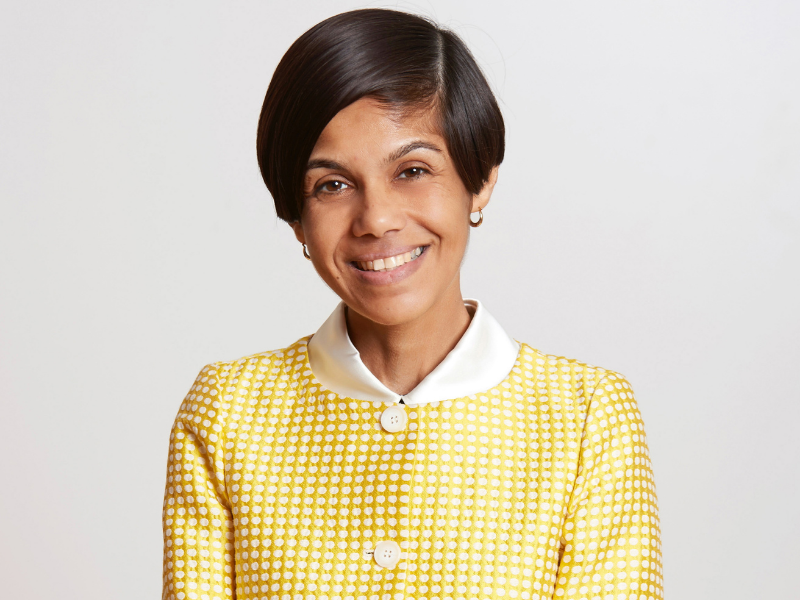
Dr. Pamela Chrabieh is a Lebanese-Canadian scholar, university professor, visual artist, activist, writer and consultant. Selected as one of the 100 most influential women in Lebanon (Women Leaders Directory 2013, Smart Center and Women in Front, Beirut), and ‘Most Exceptional Teaching Fellow’ in 2008 (University of Montreal)
Dr. Chrabieh won several national and regional prizes in Canada (including Forces Avenir Université de Montréal, Forces Avenir Québec, Prix Lieutenant-Gouverneur du Québec), and her Peace Education ‘Diplomacy of the Dish’ activity was selected as one of the most innovative activities during the Innovation Week of the United Arab Emirates in 2015. Since 2017, Dr. Chrabieh has been the owner and director of Beirut-based SPNC Learning & Communication Expertise, and the Nabad (nabad.art) Program Manager since 2020.
Here, in an important exclusive, she talks to the poet and critic Omar Sabbagh about the current condition of Beirut and Lebanon.
Omar Sabbagh: Whether it may be common knowledge or not, Beirut and Lebanon more generally are currently in a state of crisis. Can you tell us, to start with, what this crisis situation looks like on the ground?
Dr. Pamela Chrabieh: Lebanon has been going through a multiform crisis following the so-called end of the 1970s-1980s wars: social, political, environmental, sanitary, etc. The Beirut port blast on August 4, 2020, was the first straw that broke the camel’s back, and the ongoing acute economic crisis the second straw. As poverty is rising – more than 60% of the local population lives now under the extreme poverty line – people are increasingly desperate. Many (those who were able to do so) left the country, others (those who are staying) are trying to survive the financial meltdown, the aftermath of the Covid-19 pandemic, and the political deadlock.
OS:There are many factors that constitute the fraught modern history of Lebanon. In your view, is the current crisis another version of other crises in the history of modern Lebanon, or is the current situation of a new sort, and why?
PC: In my opinion, the current situation is first the consequence of decades of corruption, physical and psychological wars, state paralysis, nepotism, sectarianism, foreign interferences, and a clash of ignorance. However, and contrary to what we went through during the 1980s – and that I witnessed first hand as being part of the generation of war – what we are going through today is different, as the deterioration of the country is unprecedented.
During the 1980s, we were able to escape bombs and snipers and take refuge in a different city or village, we were still able to find food and work, and we had hope for the future. Whereas today looks and feels like a descent into hell, with most of us who still roam the land are hanging by a thread. The level of despair is immeasurable today, and that is, in my opinion, one main difference between the recent past and our present life.
OS:The economy has suffered tremendously in recent years. Apart from long-standing practices of corruption, there was the revolutionary movement from 2019, and the terrible blast in Summer of 2020. How would you assess or critique the recent fate and current state of materialwell-being in Lebanon and Beirut?
PC: Lebanon is enduring an acute economic depression, inflation reaching triple digits, and the exchange rate keeps losing value. This is still affecting the population, especially the poor and middle class. I agree with the World Bank statement: “The social impact, which is already dire, could become catastrophic”.
I honestly don’t know how long the local population will be able to survive with one of the lowest minimum wages in the world, and when the country’s food prices have become the highest in Southwestern Asia and North Africa. People can’t even find needed medicine or pay a hospital bill. They haven’t been able to access their money in banks since late 2019, and their lights may go off starting May 15 because cash for electricity generation is running out.
OS: How would you assess the prospects for the young, the student body of Lebanon? It’s common knowledge that for decades the pool or fund of human capital, of human talent in Lebanon is a kind of superlative supply for what is a nugatory demand, and that there has been for decades a brain-drain from Lebanon to other places. Are prospects for the young just a continuation of this previous scenario or are there significant differences to the situation now, and how so?
PC: Now more than ever, and given the compounded effect of multiple crises, the Lebanese youth is facing a lack of work opportunities, rising costs of living and unemployment rates, and the absence of any state support. Many are growing disillusioned and desperate, and we are not even at the end of our crises. We should expect worse to come and it is going to be tougher for young people to pursue their higher studies, find a job, or even secure an entry visa elsewhere.
OS:Lebanon is known for its fractious sectarianism. Does this feature of the nation’s political, civil, and denominational make-up affect the young today as much as it may have done in decades past?
PC: Most students of mine and other university students, along with countless academics, activists, and artists who have been part of the October 17 ‘revolutionary movements’, have vehemently criticized sectarianism in all its forms and offered alternative paths, ranging from a complete separation between religion and politics to mediatory approaches. This is not a new phenomenon, as many individuals and organizations stood against sectarianism in the last decades, but we are witnessing change within student bodies, especially with secular groups winning elections in some of the most prestigious universities versus traditional sectarian groups.
OS: You have been involved at a grass-roots with the so-called ‘revolutionary’ upheavals in Lebanon and Beirut since they began in late 2019. How would you characterize the nature of this movement? And what do you think its effects have been and/or will be on Lebanese politics and thus on the prospects of the up-and-coming generation?
PC: I think it is still too soon to assess the October 17 revolutionary movements. I wrote a while ago that there are many ways of approaching the study of revolution in the contemporary world. According to a narrow definition, “revolution is a forcible overthrow of a government or social order, in favor of a new system”.
In that perspective, revolutionary dynamics in Lebanon appear to several observers (whether anti-revolutionary or skeptics) as “minor disturbances”. According to these ‘experts’, as long as the socio-political and economic systems are “unchanged”, the so-called “hirak (movement) is not worthy to be called “revolution”, and “will soon end” or it just “ended”.
However, a different definition of “revolution” – the one I use and develop – makes it appear as an ongoing project of deep confrontation, resistance, deconstruction, reconstruction, and systemic transformation. This project has no start per se, nor a specific end. In other words, Revolution with a big R is a process, and the October 17 revolutionary movements are only but a step towards overturning existing conditions and generating alternative socio-political and economic orders.
As I see it, “revolution” in Lebanon isn’t a static object that can either be a “success” or a “failure”. It consists of several current dimensions and historical layers simultaneously, and when it is not roaring in public spaces, it is boiling in the minds, adapting, learning, and bouncing back.
OS:What’s it like being both a teacher and a business woman in today’s climate? Detail, if you would, how the perspectives of your variegated work-roles have illuminated for you the current state of Lebanon?
PC: I wear several hats: scholar, university professor, visual artist, activist, consultant, program manager, wife, daughter, mother, etc. And these hats have been both challenging and rewarding. Definitely, my studies and work experience have helped me shape my knowledge and critical thinking, but my life experiences, with my family, friends, and colleagues, in Lebanon and abroad, have marked my identity and deeply contributed to what I have become today. Most certainly, I haven’t learned about resistance and resilience in books, but through my art, the arts and culture in my country and the region, and through the many struggles I have been going through, as well as the struggles of others around me.
OS:Given your answers to the questions above, what in your view is in store for Lebanon, and why?
PC: As long as there are inequalities, social injustice, exclusion, oppression, violence, war, etc., and as long as there are possibilities of change, I do not think that revolutionary movements will end. As long as our backs are to the wall and our only way is forward and through our fears, and as long as there are no limitations we choose to impose on our will, imagination, resilience, patience and freedom, we will rise again from under the rubble.
When I was at university (Durham 1993-96), the prevailing trend was to apply to accountancy, the law, management consultancy or banking.
Whilst I didn’t immediately enter the world of finance, I am quite unique in the “wealth” and family office space in that I started in politics and government relations, with a sojourn in PR, corporate affairs and private equity before working for a HNW (high-net-worth) family for their philanthropy, reputation and business interests – effectively establishing their family office in London.
I’m not sure what those of us applying for “banking” were really thinking what the career would constitute, investment banking sounded so grown-up, alpha-male, “greed is good” and en vogue (the mid-1990s saw a huge consolidation of investment banks and the end of “merchant” banks).
Private banking and wealth management in contrast seemed distant, purposely opaque and a bit stuffy. It wasn’t an attractive career option because it didn’t really care to explain what it was.
Wealth has to be managed – that is the focus of wealth management – and with this term I mean a form of investment management and financial planning that provides solutions to clients with £1 million plus in assets or ultra-high-net-worth (UHNW) with £30 million plus in assets.
It is a discipline which we can also call private banking and which includes financial planning, investment management, tax planning, luxury assets and some other services such as corporate finance and investment banking. It can also extend to trust companies who hold assets and even the private client law firms who advise, structure and act to protect the wealth of their clients.
So breaking this down, it can offer a career as a financial planner – working with clients on their strategy for wealth preservation and growth: which can include retirement planning, tax, legacy and succession and business planning. Once this wealth strategy has been devised, an investment manager then works day-to-day to deliver returns that the client and their planner has objectified. Tax planning is a third role and is vital as the tax implications for a HNW – whether dividend, CGT, inheritance, corporation tax or cross-border tax – can be huge. As HNW’s purchase luxury assets – houses, jets, yachts, art – these need managing, financing and servicing.
When HNW’s need support in their business ventures, wealth teams often bring in their respective corporate finance teams of their institutions to support clients in corporate objectives – eg financing a new factory or the acquisition of a digital business. A trust company holds assets on behalf of an individual, family or business – generally to minimise tax but also to reduce other risks and acts according to a constitution which has been agreed on behalf of the various beneficiaries.
Changes have come, but a lack of trust in banks and the wealth sector has driven a long-term move amongst the very rich (UHNWs) towards family offices. The ongoing criticism of private banking / wealth management is the high turnover of staff, that the investment manager operates in his (or their) own interests rather than always for the client, and they were increasingly limited by compliance from suggesting entrepreneurial solutions that suit the client. This has been further aggravated by the fact that clients themselves have been changing: the values of the rising next generation in particular have not been mirrored by their advisor, whilst clients want more bespoke products that banks struggled to keep-up with.
All these factors combined have been the catalyst behind the rise of the family office, a privately held company that handles investment management and wealth management for a wealthy family, with the goal being to effectively grow and transfer wealth across generations. They also have impacted the less affluent as we shall see below.
To be an effective single-family office handling your own family’s investment requires a significant sum of cash as staff costs and compliance costs can be very high.
The definition of a family office can differ from one family to another – a family office advisor once wrote that to be a real family office – similar to the archetypal established by John D. Rockefeller – one needs to follow the APPLE model: investment should be Active, Passive, there should be Philanthropy, Legacy-planning and Estates-planning.
Family offices may also handle tasks such as managing household staff, making travel arrangements, property management, day-to-day accounting and payroll activities, management of legal affairs, family management services, family governance, financial and investor education, coordination of philanthropy and private foundations, and succession planning.
Sometimes families combine costs and can be structured as a multi-family office – professional staff representing a number of affluent families and individuals, often creating their own co-investment products.
Given the very discrete nature of family offices, they are very hard to apply for internships or work – however multi-family offices: Stanhope Capital, Schroders Global Family Office Services, Stonehage Fleming are easier to identify and approach for jobs.
One of the key areas affecting recruitment into the wealth sector is the widening gulf in values between the rising next generation of clients and their existing advisors.
Millennials1 and Generation Z2 have a series of values that has fundamentally shifted from the generation above them. They are a more socially-conscious generation which seeks businesses that mirror their values, are digitally enabled and allow for ease of use.
From this arises two distinct problems for the wealth industry. Firstly, the recruitment of the next generation of staff – when most smart graduates would rather go into a tech start-up, the wealth sector is not selling itself effectively. Secondly, how does the wealth sector engage the next generation of HNWs, the clients of tomorrow, when their staff don’t immediately mirror the values and thinking of their clients?
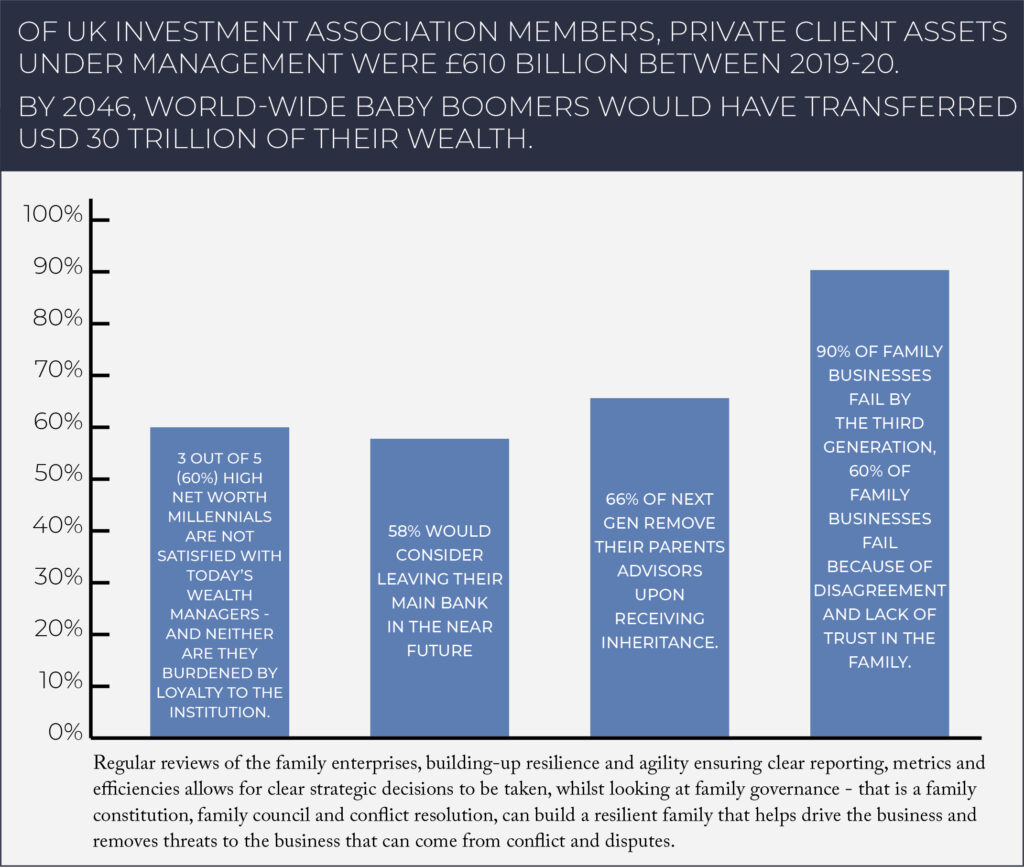
In their study from 2019, pricing consultants Simon Kuchner & Partners surveyed almost 650 high net worth millennials worldwide from six countries (Australia, China, Hong Kong, Singapore, the UK, and the US) to examine their attitude towards private banks and wealth management.
The report found that all of the participants had at least one private banking relationship in the family and/or at least 500,000 US dollars of investable assets in their personal accounts, with a significant portion of the wealth being inherited from the previous generation.
The study also found that 60 percent of millennials were dissatisfied with their present banking and wanted a substantial improvement. The survey found that to attract future customers and build ongoing relationships with millennials, private banks have to comprehensively analyse their processes, assess their current shortcomings and potentially re-build a new bank from the ground up even if this means taking short-term losses for sustainable long-term profits.
There were other findings. Private banks also need a fundamental new brand position – old, male, pale and stale won’t cut it anymore – diversity is key and having staff that reflect the new client is key.
So private banks need to act fast and develop a ‘WOW’ digital ecosystem that highlights self-service capabilities or they risk becoming irrelevant. Millennials want the option of immediate and bespoke banking services – even so far as online bespoke investment and portfolio choice. To attract this generation, banks have to reposition itself as a millennial-centric bank and highlight the values that millennials look for, which according to the Simon Kuchner & Partners survey is quality and brand.
A number of banks have been developing their next gen offering, whilst some of the larger MFOs have been active to. But more needs to be done clearly define why millennials should pay for their financial advisory services. With a clear value proposition outlining what private banks and the wealth sector can offer, millennials are willing to spend more on financial services.
If the wealth industry moves quickly it can meet the challenges outlined above: reduce its opaqueness, become digitally-enabled and truly bespoke and so attract the next generation of clients but also of staff.
____________________
David Hawkins is the Founder of Percheron Advisory, a firm which works with entrepreneurs, HNW clients and business families with a focus on building resilient and agile operational business frameworks and developing effective family governance structures.
The UK is home to a high concentration of world-leading universities. Our venerated institutions offer higher education qualifications from bachelor’s and master’s degrees to PhDs that are designed to equip the country with a skilled workforce as well as produce researchers to contribute to the advancement of academic knowledge and the betterment of society.
Yet the idea that students and staff at these establishments aren’t getting “a fair deal” is never far from the headlines. So when did the pursuit of higher education and academia become part of the industry-speak of cost-benefit analysis, and what might be the long-term ramifications?
On the surface the shift can largely be attributed to the introduction of tuition fees in 1998. Over the next two decades fees snowballed and now top £9,000 a year with maintenance grants largely converted into loans.
One increase after the Browne Review in 2010 led to large scale protests, some of which turned violent. Despite the unpopular nature of tuition fee policy, there are no signs that it will be reversed any time soon.
The commercialisation can be seen in how universities have become increasingly reliant on international students who pay much higher fees than their UK counterparts. In 2017−18, 14.4 per cent of undergraduate students and 35.8 per cent of postgraduate students were from outside the UK, according to a 2019 study from Universities UK.
In 2017−18, the total reported income of UK higher education institutions was £38.2 billion. £21.1 billion of this was related to teaching activities (fees and grants from government). Thus government sees universities as a prudent investment, even though government expects that only 25 per cent of current full-time undergraduates who take out loans will repay them in full, according to the Commons Library. The value of outstanding loans at the end of March 2020 reached £140 billion. The Government forecasts the value of outstanding loans to be around £560 billion by the middle of the century.
Continued government investment is in part down to the fact that the higher education sector has tangible benefits to the economy. In 2014–15, universities across the UK generated £95 billion in gross output for the economy. The UK university sector contributed £21.5 billion to GDP, representing 1.2% of the UK’s GDP. The sector also supported more than 940,000 jobs in the UK.
The pandemic has further brought university finances into mainstream conversations and thrown more attention on the matters affecting their performance for both academics and for their fee-paying students.
The government paid out £2.6 billion in tuition fees early instead of a multi-billion bailout for universities that the institutions requested in May 2020. Then in December 2020 and February 2021 new funding worth £20 million and £50 million respectively was announced. This is expected to indirectly support industry revenue growth in 2020-2021.
Universities pivoted to remote learning as government restrictions were implemented in March 2020. However, whilst there has been consistent coverage of the dissatisfaction of students with remote learning, both student applicant and UCAS acceptance numbers have hit record highs.
Indeed, according to Ibis World “rising unemployment and increased competition in the jobs market in the short term as a result of the economic effects of the COVID-19 (coronavirus) pandemic is expected to drive a higher number of both young and mature applicants to enter higher education.”
The pandemic has brought about serious concerns about mental health on university campuses. In 2017−18, around two-thirds (65.5%) of UK higher education institutions had an annual income of £100 million and yet a lack of funding for services means vulnerable and struggling students are not adequately supported on many campuses. Students feel that their high fees are not being fairly exchanged for academic teaching and students services such as counselling. The pervasive feeling amongst students is that they feel ever-more neglected by the onset of remote learning.
Students are not the only ones, however, that feel disaffected by the increasing commercialisation of higher education. There are around half a million staff employed at UK higher education institutions.
Career trajectories of academics often involve precarious nine-month contracts with staff usually moving around many different institutions in their working life. The University and College’s (UCU) decision to partake in a series of strikes over pensions has left a bitter divide between students paying for teaching they feel they are not receiving, and academics that feel that the commercialisation of institutions has left them short-changed too.
David Mathews outlined in a report for Times Higher Education the issue of academics no longer being able to spend enough time on their research and how this will put the industry in trouble.
Mathews argues that the essence of academia is to be given the time and resources to think deeply about a subject and hopefully as a result contribute to the wealth of recorded knowledge upon it. Yet he states that “progression in academia is often progression away from why you got into it in the first place” as those that climb up the ladder from junior scholars to professors end up doing more admin and management work than actual research or even teaching.
A 2020 report produced by Bethan Cornell at the Higher Education Policy Institute (HEPI) shows that 67 per cent of PhD students want a career in academic research but only 30 per cent stay in academia three years on. Some of the report’s findings support the idea that the long hours dedicated to activities other than research and precarious work contracts are among the factors limiting retention of academics.
Among the PhD students that were interviewed included one quoted as saying that “the requirement to move around in pursuit of short term postdocs is terrible for social and family life”. Another claimed they did not wish to pursue a career in research and teaching as “the academic culture will be detrimental to my mental health.”
Nick Hillman, the Director of HEPI, said that postgraduates are “crucial to the whole country, as postgraduate students provide the pipeline for academic, commercial and charitable research. If we are to cure diseases, improve productivity and improve people’s lives, that is likely to come via original research. So it is vital that, as a society, we look after our researchers”.
As with many industries, the higher education job market has been in flux and left many employees and those trying to break into the sector in an anxious state. However, Professor Charles Stafford, Vice Chair of the Appointments Committee at LSE, argues that although the academic job market has been affected by the pandemic it is important for academics and those looking to enter the field to understand the situation in their own subject area, and not to over generalise the situation.
Stafford also stated that the increase in student numbers may correlate to an increase in teaching based rolls, though it is too early to see any conclusive data confirming that this will be a long term trend.
Whilst the commercialisation and industrialisation of academia has clear drawbacks, there are also arguments for stronger links between industry, universities and government – as the collaboration between pharmaceutical company AstraZeneca, Oxford University and the NHS has shown in the successful roll out of a covid vaccine.
Chief knowledge officer of Times Higher Education, Phil Baty, states in a November 2020 report on university-industry collaboration that universities “cannot fulfil their limitless potential without collaboration – collaboration between institutions, with industry and across borders […] In particular, partnerships between universities and industry will be vital as nations seek to rebuild their economies after the devastation of the pandemic – reskilling the workforce and rebooting the knowledge economy.”
So it’s clear that universities have a role to play – but equally there is an urgent need for these institutions to adapt both to continue to attract students and to make sure that staff are retained. As former Chicago mayor Rahm Emanuel put it: “Never let a crisis go to waste.”
A look back at Bob Dylan’s 80th birthday in 2021, when Robert Golding looked at the career of the Nobel laureate and asked what his life can teach us about making our way in the world
‘Twenty years of schoolin’ and they put you on the day shift.’ So sang Bob Dylan with typical humour and exasperation in his 1965 classic ‘Subterranean Homesick Blues’. It is a line that may resonate with many young people beginning their working life in the Covid-19 era.
Since arriving on the scene in Greenwich Village in 1962, the Nobel Laureate, who turns 80 today, has attracted continual reassessment. The brilliant opaque words, combined with a sense that in Dylan words matter to an unusual degree, have caused an immense critical literature to grow up. It’s difficult to think of a living figure more discussed.
Commentary has tended to focus on Dylan’s extraordinariness, and one can see why: he has achieved remarkable things, all while retaining his aloofness. When I asked singer-songwriter Emma Swift, who recently recorded an album of Dylan covers Blonde on the Tracks (2020), whether Dylan had been in touch about her album, she said: ‘I’m often asked that. But Dylan is to me a mythical figure. I’d be just as surprised if Samuel Taylor Coleridge called.’
Too often then, Dylan is treated as prophet and sage, and not as someone who hustled his way through the world – as we might do too. Our admiration for him might preclude us from seeing what he can teach.
“Dylan to me is a mythical figure. I’d be just as surprised if Samuel Taylor Coleridge called.”
Emma Swift
Get born, keep warm
It helps to remind ourselves that Dylan’s upbringing was distinctly unpromising – so much so that, even at the time, it seems to have struck him as a cruel joke. Raised in Hibbing, Minnesota – a dead-end mining town – he told Martin Scorsese in the film No Direction Home (2005): ‘I felt like I was born to the wrong parents or something.’ We ought not to draw the conclusion from this that it is wise to be contemptuous of one’s elders; one might instead say that we should have the gumption to imagine our way into the life we want – and be brave enough to take steps to secure it.
The Zimmerman family home in Hibbing, Minnesota. Photo credit: Jonathunder
It remains difficult to imagine Dylan in Hibbing. His life is a powerful example of a refusal to be defined by where you’re born: our knowledge of his subsequent success makes it vexing to imagine him ever having been there at all. Hibbing consisted of the typical Main Street, dreary parades, small businesses and shops, all bound up in strict mores: a life Dylan must have found predominantly redundant. But thanks to the invention of the gramophone, another world was able to seep through to the young Dylan. This was the astonishing revelation of rock and roll.
Like so many who go onto achieve great things, one can sense the constraints that early life placed on him – and also that those constraints were lifted rather arbitrarily. Rerun the movie with slightly different conditions and you’d have another narrative.
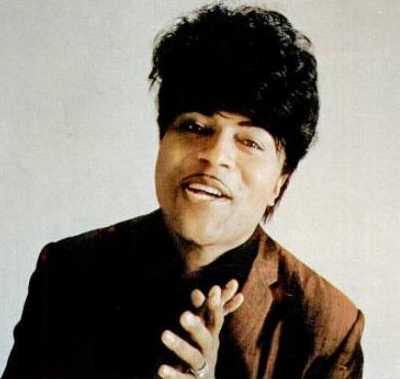
Specifically, Dylan’s life would have been different had he never encountered Little Richard. ‘His was the original spirit that moved me to do everything I would do,’ he would write on May 9th 2020 at the singer’s death. Though Dylan is a hero to many, he is also a man adept at having heroes. He admires people – but only as a way of discovering a way to become himself.
Dylan’s childhood hero Little Richard. “I am so grieved,” Dylan wrote upon the singer’s death on 9th May 2020.
Dylan’s first known performance was in 1958 at the Hibbing High School’s Jacket Jamboree Talent Festival. In Volume 1 of Bob Dylan: Performing Artist Paul Williams, Dylan’s finest biographer, explains how in this performance ‘Dylan followed the rock and roll music to a logical conclusion that was in fact quite alien to the music of the day: play as loud as possible. Not just wild. Not just raucous. Not even just loud, but AS LOUD AS POSSIBLE, preferably in a context that will allow for maximum outrage.’
It is an image of the natural iconoclast. At this young age, Dylan was allied to a true energy; he had made a decision that couldn’t be reversed to devote his life to music, and was already seeking to stand out within his chosen sphere. Soon he would graduate from being the loudest musician to other superlatives: most thoughtful, most literary, most enigmatic, most laurelled.
In the process, he was clearing more obstacles than we perhaps realise, now that we inhabit a world where they were so convincingly traversed. One fact is not the less important for being so widely cited: Bob Dylan wasn’t born Bob Dylan but Robert Zimmerman. Interestingly, a letter recently surfaced where Dylan explains that his decision to change his name was based on fears of anti-Semitism. ‘A lot of people are under the impression that Jews are just money lenders and merchants. A lot of people think that all Jews are like that. Well, they used to be cause that’s all that was open to them. That’s all they were allowed to do.’
“Dylan followed the rock and roll music to a logical conclusion that was in fact quite alien to the music of the day: play as loud as possible.”
Paul Williams
Some, including Joni Mitchell with whom Dylan has had (at least from Mitchell’s side) a somewhat abrasive and competitive relationship, have held up the decision to change his name as a mark of inauthenticity. But the decision might equally remind us of the importance of flexibility and finding a way around obstacles.
Try to be a success
Dylan’s early years exhibit a fearlessness which we might do well to emulate. As a young man, having briefly enrolled in Minnesota University in 1960, he again exhibited that same restlessness which would manifest itself eventually in his celebrated Never Ending Tour.
By this time, he had decided that rock and roll wasn’t enough, and that folk music offered a richer philosophical experience. It was the first of many twists and pivots and reinventions.
In time, he would merge the folk and rock genres – going electric in 1965 to what now looks like a rather quaint indignation from the folk establishment.
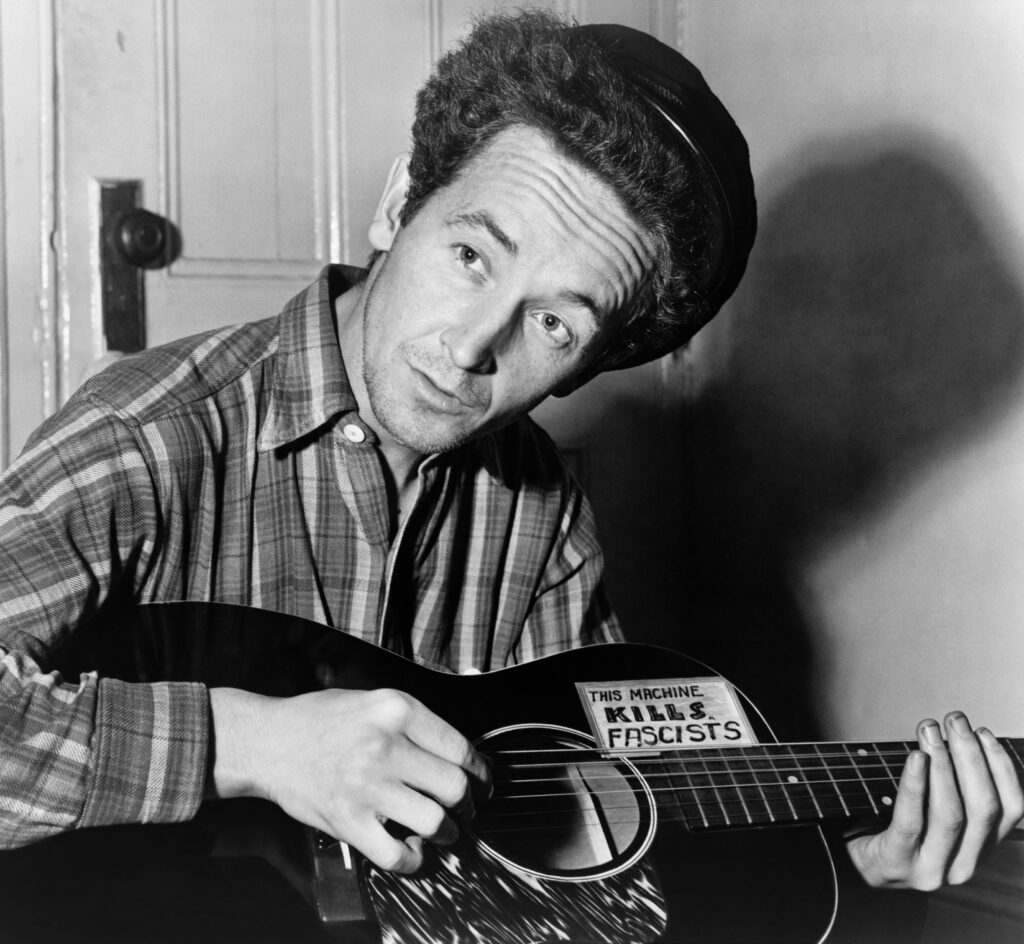
For now, seized with the urgency of the eternally confident, Dylan took a train to New York, intent on meeting his hero the folk singer Woody Guthrie. Guthrie was already suffering from Huntingdon’s Disease, which would eventually kill him in 1967. No matter, Dylan sought him out at his sick-bed in a New Jersey hospital and played him his homage ‘Song to Woody’ one of only two original compositions on what would become his debut album Bob Dylan (1962). A torch had been passed.
Woody Guthrie. Dylan sought his hero at his sick bed in New Jersey. Image credit: United States Library of Congress
It was a deft negotiation of what has been called ‘the anxiety of influence’. Young people will often underestimate the availability and flesh-and-bloodness of those at the top: fear stymies them from exposure to examples of success. By being in close proximity to our heroes – even if the encounter doesn’t go well, and we betray our nerves – we may usefully humanise them and open up the possibility of the heroic in ourselves.
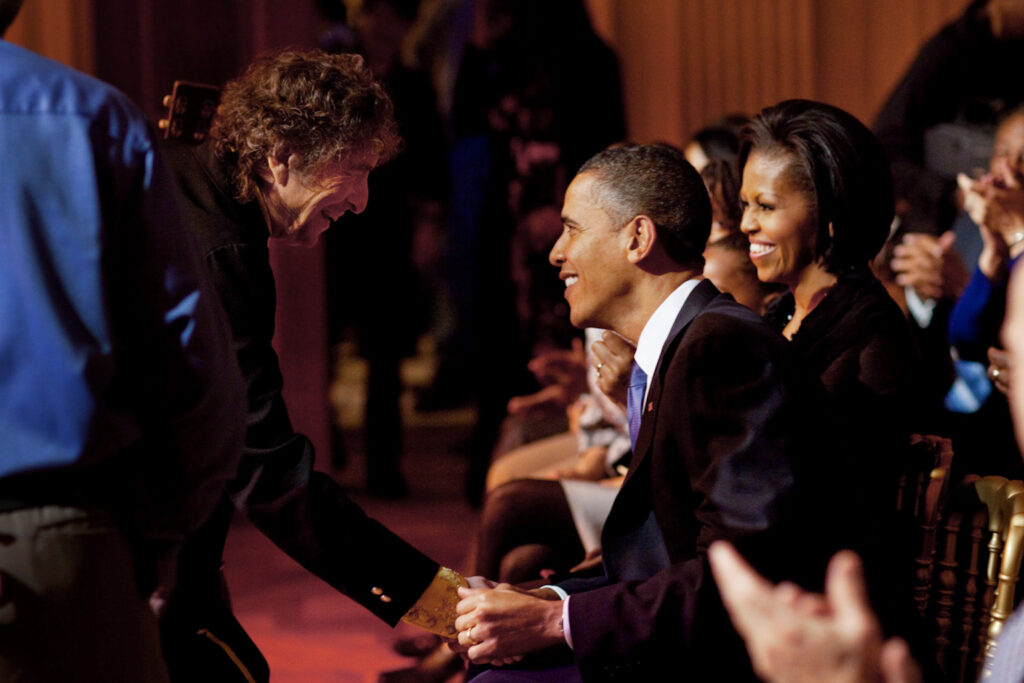
This trait of Dylan’s finds its corollary in a story told by former President Barack Obama in his memoir A Promised Land (2020). When Dylan played at the White House during the Obama administration, at the end of the performance Dylan simply shook the then president’s hand and left, saying nothing. ‘Even the president of the United States sometimes must have to stand naked,’ as he put it in ‘It’s Alright, Ma (I’m Only Bleeding)’. One suspects that Bob Dylan has never been afraid of anyone.
Bob Dylan shakes President Barack Obama’s hand following his performance at the “In Performance At The White House: A Celebration Of Music From The Civil Rights Movement” concert in the East Room of the White House, Feb. 9, 2010. (Official White House Photo by Pete Souza).
The Guthrie story is a reminder that we tend to get to where we need to be by being out in the world and meeting people; we never achieve in a vacuum but by the dint and say-so of others. Music journalist Tom Moon tells me that today ‘the Bob sphere is weird even in “normal” times’ but at the outset of Dylan’s career, when it mattered, the young singer made all the right moves, charming the crowds in Greenwich Village, signing with Columbia Records, and submitting to the aegis of manager Albert Grossman.
“The Bob sphere is weird even in ‘normal’ times”
Rock critic, Tom Moon
In time he would assemble a band whom he could trust and who were inspired to get better over time. His 1975 tour the Rolling Thunder Revue was, among many things, a celebration of friendship. And it’s thanks to his capacity as a bandleader we now have that highly underrated achievement the Never Ending Tour, which began on June 7th 1988 and ended – or paused – with the advent of the Covid-19 pandemic in the early part of 2020.
In reference to his longevity, Emma Swift says: ‘There’s a counter-narrative in our culture that says that music is for young people – that if you haven’t made it as a musician by 13 you should just stop. Dylan’s career runs counter to that and though he was working very much as a young man, he’s continued that throughout his entire life. He makes a very persuasive argument that the time for art is always now.’
From the vantage-point of today, Dylan’s career might seem to be to do with longevity – but longevity must be teed up when young, and it helps to have made the right decisions from a young age.
Emma Swift has recently recorded an album of Dylan covers. “[Dylan] makes a very persuasive argument that the time for art is always now’. Photo: Michael Coghlan
Dylan has never grown bored; his energy remains astonishing. Richard Thomas concurs that Dylan’s career showcases ‘resilience, energy, adaptability, mystique, humour’ – qualities that would not have been sustainable had his original decision in Hibbing to pursue music not been the right one. ‘I’ll know my song well before I start singing,’ as Dylan sings in ‘A Hard Rain’s a-Gonna Fall’ – yes, and to know that singing is what we should be doing in the first place.
In a March 2020 interview, Gina Gershon confirmed Dylan’s boyish love for what he does: “He read me some lyrics he was writing and he was all excited…,” she recalled. “I was thinking, ‘Oh my God, this is so cool.’ You could see why he still loves doing what he does and why he’s excited…”
“He only ever repeats himself valuably, somehow anew, which is not true of the rest of us”
Christopher Ricks, author of Dylan’s Visions of Sin
When I speak to the great Dylan critic, author of Visions of Sin (2004), and former Professor of Poetry at Oxford University Christopher Ricks, he agrees with Swift: ‘He only ever repeats himself valuably, somehow anew, which is not true of the rest of us.’ This remains true in his touring, where Dylan – famously, and sometimes to fans’ perplexity – will never perform a song in the same way twice.
His Back Pages
Throughout this life of performance, of course, Dylan has been compiling the greatest songbook of any American songwriter in the post-war period. It is a vast corpus, where wisdom sits alongside glorious nonsense – and where solemnity and comedy, yearning and rage, all equally have their home.
It must be said that the idea of plucking contemporary jobs tips from the Dylan oeuvre can seem an exceptionally unpromising avenue of enquiry. Dylan himself has sometimes been self-deprecating about the idea of extracting meaning from his songs. As he wrote in ‘Mr. Tambourine Man’, ‘If you hear vague traces of skipping reels of rhyme/it’s just a ragged clown behind.’ Dylan here appears as something like Charlie Chaplin’s Little Tramp: Don’t pay him any mind.
Few have taken him at his word there. More problematically, the songwriter’s reliance on the folk repertoire means that the economy he is describing in his songs tends to predate ours. One might seek in vain in the Dylan canon for direct advice about how to make it in the professions, or hints about how best to make LinkedIn work for you.
But this leaning so heavily on a rich hinterland of American song, might amount to another lesson. His work shows a remarkable respect for the past – as well as a willingness to question the present. Dylan’s second studio album was called The Freewheelin’ Bob Dylan (1963). Paul Williams once said that Dylan’s songs essentially teach us that when a man learns to be free only then can he be in with a shot of happiness.
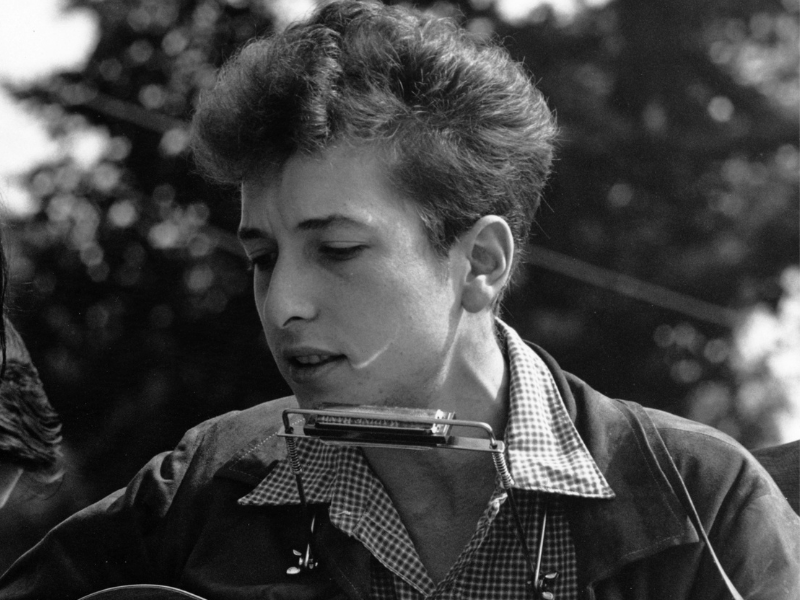
Dylan in 1966. Dylan’s oeuvre, according to Paul Williams, teach us that only when a man is free can he begin to be happy. Photo credit: image in the public domain.
But we can only be free in relation to others. As much as he would distance himself from the label ‘protest singer’ over time, Dylan’s repertoire contains songs of high-minded hatred towards the establishment. ‘Masters of War’, ‘Only a Pawn in Their Game’, ‘Pay in Blood’: these songs warn us off a career bereft of a healthy scepticism about the way things are. Dylan’s songs tell us that to question the status quo is a first step towards our finding a place in it.
This freedom is not only something that Dylan exhibits; it is something he bestows on the characters in his songs. Dylan’s is a world of freely moving drifters (‘The Drifter’s Escape’), wronged boxers hurtling unimpeded towards their fates (‘Hurricane’), mafiosi (‘Joey’), and a whole range of po’ boys and girls, who seem almost liberated by their impoverishment. Everything – everyone – is in continual motion: ‘Only one thing I did wrong/stayed in Mississippi a day too long.’ Even William Zantzinger, the murderer in ‘The Lonesome Death of Hattie Carroll’ is defined by his freedom.
“His actual experience is tempered by what the folk tradition, always where much of his songs go back to, dealt with’
Professor Richard F. Thomas
The Harvard professor and author of Why Dylan Matters Professor Richard F. Thomas explains: ‘‘Workingman’s Blues #2’ is in part about working’ but he agrees the middle class doesn’t feature. ‘His actual experience is tempered by what the folk tradition, always where much of his songs go back to, deals with.’
All I Really Want to Do
And yet there are few, if any moments of sloth in Dylan’s life. ‘Lay Down Your Weary Tune’. ‘Watching the River Flow.’ These are songs about pausing, but they are also moments of expression – of activity – for Dylan himself.
While Dylan turns a sceptical eye on ‘the masters of war’ who too often prosper in the present, he teaches an intense respect for the wisdom contained in the folkloric tradition.
This resonates in other professions. Anyone who has spoken to Sir Martin Sorrell will find him as passionate about advertising as it used to be as much as it is now. Likewise, readers of Andrew Marr’s survey of journalism My Trade (2004), will note that secreted in the BBC man adept in a modern medium, is a historian. Success is to do with a sense of how this moment fits into the preceding and those which will come; this can only be achieved by hard study, and utter commitment.
It is apt that while Dylan’s milieu is the past, he has nevertheless managed to prosper within the contemporary moment, and there is no-one alive today whose works seem more assured of a future audience. This fact was especially brought home in late 2020 when Dylan sold his songbook to Universal for a reported figure in the $300 million range.
This respect for tradition is a lesson he bequeaths to his musicians. As Professor Thomas explains: ‘The musicians he has worked with are in awe of him as a teacher of the musical traditions he wants them to be up on.’ So would Dylan have made a good teacher? Thomas says: ‘While I can’t see him in a classroom (“the mongrel dogs who teach” (‘My Back Pages’), though that’s some time ago), I believe he cares deeply about what matters to him, and that is the first ingredient of a good teacher.’
Fleetingly, and perhaps jokingly, Dylan once imagined in an interview with AARP an alternate route for himself: ‘If I had to do it all over again, I’d be a schoolteacher.’ In what subject? ‘Roman history or theology.’
When I Paint My Masterpiece
It might be hard to imagine the Dylan energy contained in a school. In fact, it isn’t even contained within music.
In recent years, Dylan-watchers have become increasingly aware of the scope of their man’s achievement in the visual arts. A recent episode of the HBO drama Billions shows hedge fund billionaire Bobby Axelrod with some of Dylan’s work in his home. During the COVID-19 pandemic – according to insiders at London’s Halcyon Gallery – Dylan was not only commissioned to produce a metalwork sculpture for Ronald Reagan Airport, but delivered some 20 works to the gallery.
Dylan’s brilliant metal sculptures show another side of Dylan’s creativity
The appreciation of Dylan as artist and as sculptor is still in its infancy.
Emma Swift tells me: ‘Dylan has taught me a lot about the interconnectedness of art forms. I used to think about poetry and music and visual art separately. Now I don’t. All the video clips for my Dylan record are animated, so they’re very much a celebration of the visual to go alongside the music.’ Dylan’s career here again emerges as an exercise in creative freedom – both within his own art form and in an interdisciplinary sense.
I head up to central London, for a behind-the-scenes tour of the Halcyon’s Bob Dylan Editions show. In many of the pictures, the influence of Edward Hopper is paramount. This is an America which has to some extent lapsed. We find motels and diners, parking-lots, cinemas and burger-joints. It is an image of everyday America, which isn’t meant to feel contemporary. Like his music, these are artefacts of collective memory; the paintings feel like acts of nostalgic preservation.
Most marvellous of all are the metal-sculptures. Upstairs, Georgia Hughes, an art consultant at the Halcyon, shows me a blown-up picture of Dylan in his California studio. Wiry and tough-looking even in old age, he stares eagle-like on his metals, the materials of his art. Hughes explains how Dylan rescues the metals from the scrapyards around California. I quote back at her the lines of ‘When I Paint My Masterpiece’: ‘Well, the streets of Rome are filled with rubble.’ She replies: ‘Dylan’s art has to do with finding what lies near to hand and transforming it.’
One I particularly like is a wall-hanging (see opposite), where the pieces of metal, the discarded spanners and wrenches feel somehow like a sea-creature peculiarly adapted to its environment.
Dylan’s illustrated lyrics with signature now cost £2,000
Dylan’s art career shows us that his is a porous existence where all options are on the table. Whenever one thinks of the successful, they always seem free of the doubts which seem to constrict others. If their lives often feel peculiarly uncompartmentalised, then perhaps it is because they proceed in freedom.
“He does all kinds of things that are kind of shocking, and I think it opens it up for everybody else”
Emma Swift
Money doesn’t talk, it swears
Of course, if we wanted direct lessons about our lives from Dylan then his business interests are there for all to see. Put simply, Dylan has not been afraid to monetise himself.
Bobdylan.com, in addition to providing information about tour dates and the artist’s songbook, is primarily a shop, hawking everything from key rings and hip flasks, to tote bags and his new Heaven’s Door whiskey. In the past he has let Apple, Chrysler, Cadillac and Pepsi use his songs.
Emma Swift gives her reaction: ‘He does all kinds of things that are kind of shocking, and I think it opens it up for everybody else. You know, if Dylan puts his song in an ad…okay, I guess it’s fine.’ Again, there is fearlessness here – he is prepared to risk being labelled a sell-out and happy to let the songs speak for themselves in whatever context they happen to be used.
When I ask Thomas what lessons Dylan’s life ultimately has to teach, he replies: ‘Read, listen, read, enquire, don’t be presentist!’
If one were to ask oneself why Dylan’s work is richer than that of his contemporaries then it has something to do with the range of reference brought to bear in a setting where one might not normally expect it. This is the case even when his work is compared to that of literary contemporaries such as Paul Simon and Joni Mitchell, though there will always be some – the late Clive James among them – who would prefer the poetry of Leonard Cohen.
And not being ‘presentist’? On the face of it, this might not seem to fit Dylan. Joni Mitchell had this to say about him: ‘Bob is not authentic at all. He’s a plagiarist, and his name and voice are fake. Everything about Bob is a deception.’
Harsh as this is, it is a frustration Paul Simon has also aired: ‘One of my deficiencies is my voice sounds sincere. I’ve tried to sound ironic. I don’t. I can’t. Dylan, everything he sings has two meanings. He’s telling you the truth and making fun of you at the same time. I sound sincere every time.’
But one suspects that Dylan would have no audience at all, if there wasn’t truth at the core of his work. It is rather that he has been true to his nature by being opaque. He hasn’t let his desire to tell the truth get in the way of being mysterious – and vice versa. At the Halcyon exhibition there is a wall of magazine covers devoted to Dylan. It doesn’t matter how much we photograph or try to know him; his eyes won’t let us in entirely.
As Dylan enters his ninth decade, he is among those rare American artists who seems to have fulfilled their talent. Photo credit: By Alberto Cabello from Vitoria Gasteiz – Bob Dylan, CC BY 2.0, https://commons.wikimedia.org/w/index.php?curid=11811170
Forever Young
As Dylan enters his ninth decade, there is much his career has to teach those who are embarking on their own lives. It’s true that there is dispute in literary circles about the extent of his literary achievement. But Dylan has been plausibly compared to William Shakespeare and to John Keats. We know far more about Dylan’s life than we do about the Elizabethan, and Dylan has lived out his talent far more than Keats, who died at 26.
In spite of the singularity of his achievement, Dylan continues to repay study. Besides, the man who wrote ‘Don’t follow leaders./Watch your parking meters’, isn’t so much telling us what to do, as inviting us in. Once we accept his invitation, we find we become richer, wiser. There is a generosity somewhere near the core of his art. Dylan once said: ‘Every song tails off with “Good Luck, – I hope you make it.”
He never said where – but he didn’t have to. As often with Dylan, we sort of know what he means, but we have to fill in the gaps ourselves.
A look back on Sophia Petrides’ exploration of the problems CEOs faced during the pandemic. Originally published June of 2021.
By Sophia Petrides
Over the last three months I have beenspeaking with CEOs, leaders and entrepreneurs about leading through the pandemic and lockdowns of 2020 and 21. It will probably come as no surprise that the results show that the 50 leaders I spoke to all reported new challenges as they explored new ways of working remotely. They had to learn, as if from scratch, how to manage teams, and engage with clients and how to manage the group of CFOs, CTOs and CFOs sometimes know as the C-suite. The leaders I spoke to head up small, mid and large cap organisations across financial services, technology, healthcare, sports, consumer brands and manufacturing. I am grateful that they gave their time during a period when – as you will see – that is a commodity more valuable than ever.
Encouragingly, all of them shared an overwhelmingly positive outlook for their organisations and each expects to see a strong global economic recovery once our vaccination programmes are fully in place. At the same time most of these business leaders acknowledged that we are unlikely to return to pre-Covid-19 workplace norms anytime soon, if ever. All these CEOs took part on the understanding that my findings would be reproduced anonymously.
When it comes to the specifics of how they approached the lockdowns, it is clear that the direction of travel over the last decade towards a more people-centric employee experience, better communication across organisational hierarchies and more inclusive company culture has been greatly accelerated by the pandemic and the needs of working remotely. As one CEO put it, “The pandemic has a silver lining. It’s an opportunity to do things differently, with the time pressure needed to overcome complacency with the current way of doing things.”
Digital headaches
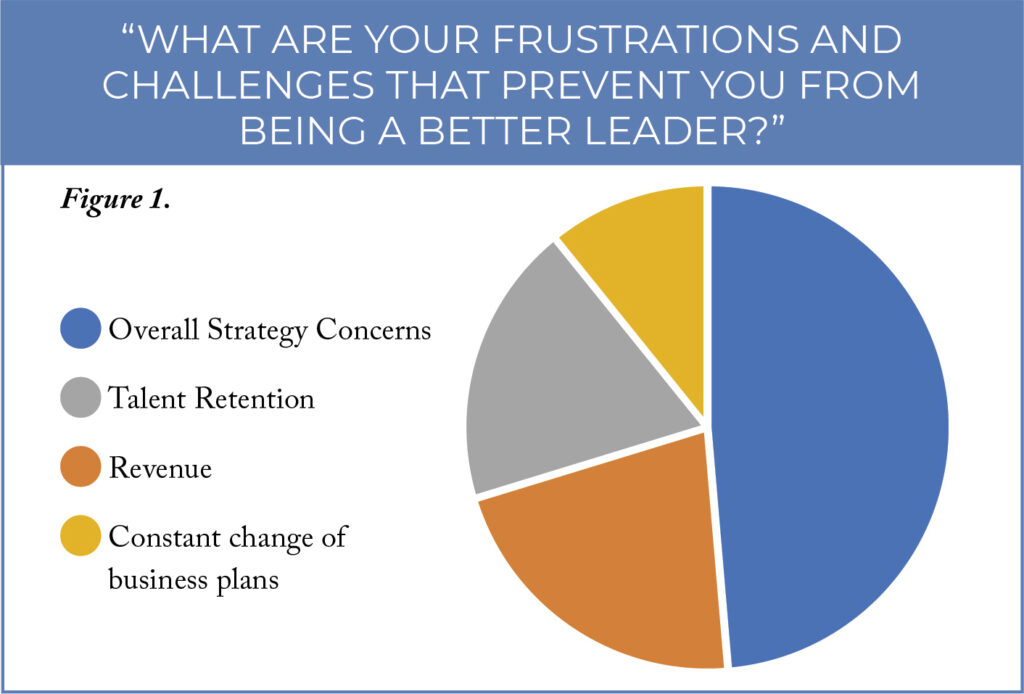
We asked the question: “What are your frustrations and challenges that prevent you from being a better leader?” and it yielded some interesting answers which show the most important friction points during the pandemic. These will likely also affect us all going forwards too. The results can be seen in Fig.1 below.
The fact remains that digital leadership is difficult. A large part of the leadership challenge has always been aligning the company and its stakeholders around a clear vision. However, in the age of virtual meetings such as Google Meet, Zoom, and other online meeting platforms it has become a more significant challenge. In many respects, engaging with teams digitally underpins most of the major frustrations of the CEOs I spoke to – the problem is the loss of those unplanned moments of interaction that are so important to create a sense of momentum and social cohesion behind the leadership team. There’s no office buzz online, and that informal energy is essential to align teams behind the leadership vision.
Another major headache – around 19% of issues – was retaining new talent in an age when many of the new hires hadn’t been able to meet their management and colleagues in person, or participate in any of the usual social, informal onboarding experiences that are a normal expectation of everyday working life. However virtual meetings were noted as providing positive experiences too, in that they also give a safe space where younger professionals can voice their views with confidence.
As one CEO put it, “I miss walking around the floor and connecting with people at all levels. You can’t connect on a human level through virtual meetings, there’s no spontaneity, no chit chat, no watercooler moments. People struggle with burn out, home schooling and not being physically together, you need to find a platform to support innovation because it is lost when people are 100% working from home.”
Also in relation to Figure 1, I found that around 11 per cent of leaders felt that reaction to the pandemic had caused a shift to short-term strategies and away from the big picture plans in place before. There was a sudden need to have a Covid-19 response, and this in turn triggered a slew of new HR policies. 22 per cent blamed the sudden disruption for the loss of normal KPI reporting and measurements, along with the loss of travel and sales activities, for reducing revenues and growth. One leader told me: “You are challenged by balancing staff well-being and HR policies with Return on Investment (ROI) and frustrated because you can’t spend time with clients like you used to.”
NO BOARDROOM BLUES
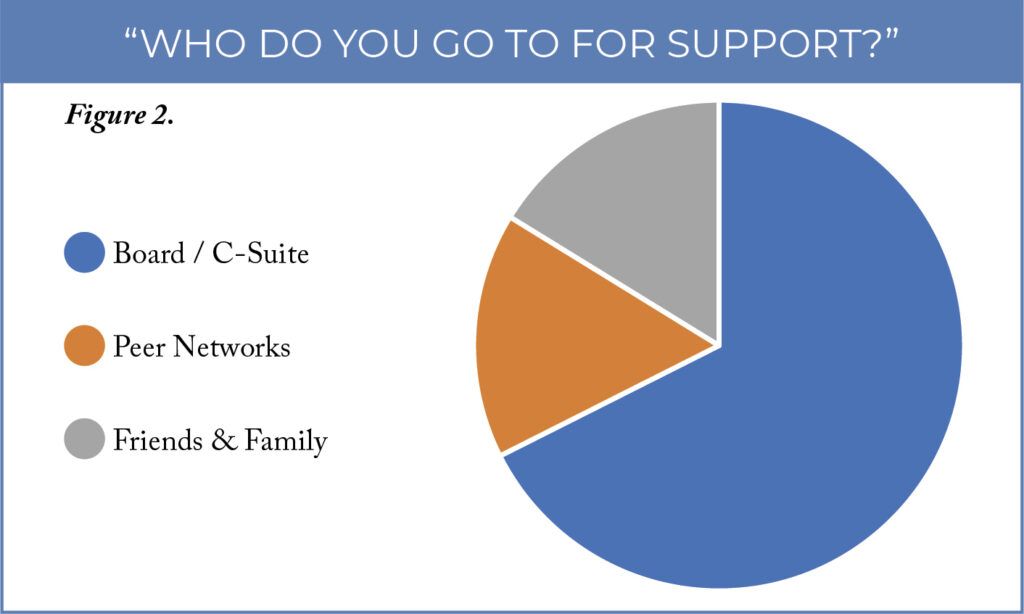
Secondly, I asked CEOs what support mechanisms they had found themselves seeking out during Covid-19. These results are displayed in Figure 2. One interesting – and unexpected – result of the survey was the overwhelmingly positive response to online board meetings. Over 68 per cent of my survey group immediately said their boards, trustees and non-executive directors were providing an extremely high level of support. This was attributable to the pandemic, as another unexpected silver lining, not just in providing support to CEOs, but offering mentorship and support to the organisation at a higher level than ever before. One leader was particularly enthusiastic about the reaction of their board: “Pre-Covid-19, it was challenging to get the board of trustees visible and engaged with the team. Now there’s 100 per cent visibility and presence through online meetings, which means the board has moved closer to employees.”
For those without a traditional board structure to fall back on, there was a fairly even split between two other kinds of support network. Firstly, many leaders sought out colleagues at a similar level who they could talk to about the challenges they were facing off the record. Secondly the role of friends – and in particular, family – in their lives became of increasing importance. In many cases, the opportunity to work from home came hand-in-hand with the chance to make a meaningful change to their work-life balance. Spending more time with the family has proven to be a positive way to recoup lost energy and online meeting fatigue.
The Human Side
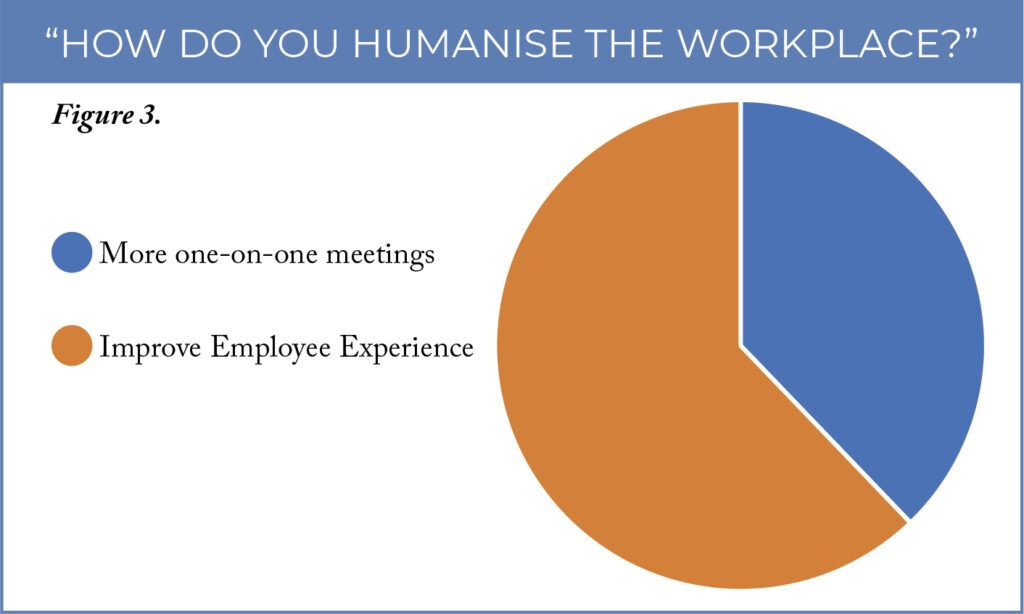
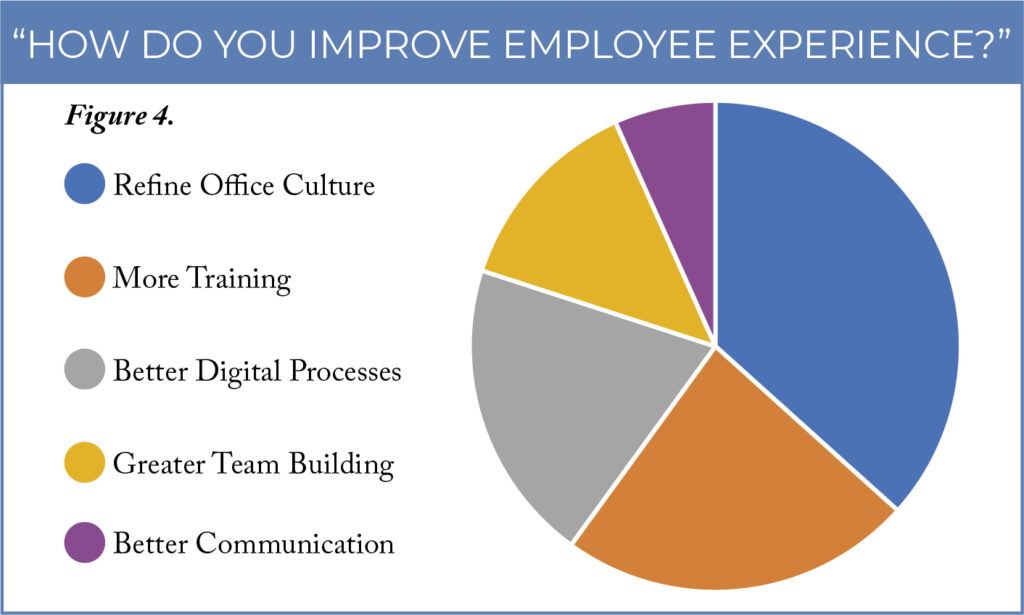
Thirdly I asked what the CEOs in question had done to humanise their workplace. There was a follow-up in the question whereby I also asked what the surveyed individuals had done to improve the employee experience. These results are collected in Figures 3 and 4.
The results were clear. Covid-19 has accelerated the importance of the employee experience. When I asked how to humanise the workplace there was a split between those who felt the emphasis should be on designing a better employee experience (62 per cent) and those who felt that what was required was more effective two-way communication across the traditional company hierarchy (38%).
When I delved into what an elevation of the employee experience might look like to these business leaders, many interesting initiatives were listed. These ranged from holding nutrition and exercise sessions for employees by providing free access to online personal trainers through to ensuring each employee took a scheduled 45-minute mindfulness break daily. A number of workplaces also prioritised in-office working options for people who were feeling lonely or isolated working from home. One CEO confided: “We delivered fresh food hampers, gym kit, games for kids and Amazon vouchers. It was about paying attention to mental and physical needs and connecting with everyone no matter what level.”
Leaders also emphasised the importance of creating a culture of fun within their teams. Many added that this required more organisation in the virtual meeting world, and included everything from introducing fun icebreakers in meetings to organised weekly virtual events. However, the most significant aspect of all the employee experience initiatives was limiting working hours, not sending emails over the weekend and ensuring staff took breaks throughout the day. Another CEO explained: “Burnout is an issue. There’s a temptation to work longer hours, but it’s not all about hours – it’s about your output, and that suffers if you don’t get the balance right.”
In addition, many leaders discussed the importance of making themselves accessible to all levels of staff, including scheduling one-to-one sessions weekly with new recruits to ensure they are settling in. This was especially on the mind of one CEO: “I am very conscious to have regular calls with the team. We have to bring all levels of people closer together and be more approachable and available 24/7.”
The Question of Morale
There are, of course, many different tools available to leaders for improving employee experience. The primary one was focusing on company culture (37 per cent) and trying to build better bonds between team members through the kinds of employee experiences we see outlined above. It is important to note that there are two other broad categories of tool for improving employee experience.
One is Continuing Professional Development (CPD). This is an essential aspect of making sure employees are staying true to their ambitions. This need for training and continuing development for teams represented 23 per cent of answers. As another put it: “Training and development are vital for sustaining a cohesive team and understand how they fit within an organisation.” There is a clear role for training to make employees feel respected and empowered, and many CEOs related this need to team performance. Another said: “Empowered means people who make better decisions more cohesively, without the need for constant supervision.”
In addition, 20 per cent of respondents talked about giving people the space to make their own digital processes, chats, support channels and online activities to boost team morale. 13 per cent suggested that the best employee experience was being on a winning team, and being rewarded as part of a growing business. However, there was a general sense that while digital was essential, automation had a negative effect on team experience because it isolated people during previously social activities like training. Another CEO confided: “We invest billions in making computers more human and making humans more automated. Then we spend billions more trying to humanise humans. Person-to-person contact is impossible to replicate.”
Hinges Off
It is fascinating to look back at the lockdown year and consider how much we have learned about working digitally. It brings new challenges in terms of burnout and a lack of team dynamism. The workplace spark, the spontaneity, the atmosphere of a team environment has not digitised effectively. However, there are clear benefits – and arguably greater long-term gains to come – not least in the way digital working has refocused leaders on authentic communications, a flatter hierarchy and better employee experiences.
It seems fitting to end on a quote from one CEO, who succinctly explained the need for better comms and experiences, as well as the advantages of working together in the same place. These remarks suggesting a new home-work hybrid might offer a renaissance for the modern workplace: “On my first day, I literally took the door to my office off its hinges. I needed to make a statement that everyone is welcome. Everyone deserves time and empathy. It is vital to feel the pulse of the employees, because that’s the pulse of the business.” It is a pleasant thought that, cooped up in our houses as we’ve been, that we might soon inhabit a working world which has become richer as a result of the pandemic.
Todd Swift has spent a lifetime on the front line of literature as a publisher, poet, and writer of film scripts. Here he discusses the future of publishing
If we have learned one thing from the pandemic, it’s that people seek comfort in stories. That these stories are often nowadays told in videogames, or on streaming TV services, or in Tweets and other brief image-based social networks, does not change a fundamental truth – stories arise from story-tellers, and most of those are writers. To extend that logic, most writers ultimately want to see their words published in books. Books, as we know, now evolve into many forms of adapted species, from electronic, to audio, and on to game, film, TV series, meme – and, yes, Halloween costume. JK Rowling may have her detractors, but she still launches a thousand Potters on October 31st.
All these stories, when gathered, and published, one way or the other, are the responsibility of publishers – and publishers need people to work with, and for, them. Apprenticeships, mentorships, and other programmes, are available online and in person, and in the post-vaccine days of the hopefully sunlit uplands to come, the young people of today could well be on the road to a job in publishing in a more socially pleasant future.
This article is meant to be a hopeful, if practical, and very brief guide to what they may face, should expect, and need to do, in order to best prepare for the interview and the potential jobs ahead, from editor, to typesetter, to book designer, to marketing or PR person; and concomitantly, what publishing faces when meeting them.
The only preparation for working in publishing is to read. A recent story in the news about a rock star in his fifties who had never read a book until lockdown, then read dozens, shows it is never too late to acquire the gift of ravenous literacy. But for a young person wanting to work in the book trade, an earlier relationship with them is essential. This may have once sounded elitist; it may well still sound so. But the good news is that libraries and online word hoards like Project Gutenberg make it less difficult for any person to find the great works they need to dive into.
A second skill – and it arises from the art and joy of reading – is writing. No one working in publishing can expect to get far without some ability with gramma and spelling. If you are the sort of GCHQ person who corrects books with a nibbled pencil stub when you read them, you will do well. Again, though, we have moved on from the old days. Enlightened pedagogy means that even people with dyslexia now work in publishing, even in proofreading.
The educational profile for younger people working in publishing has been an issue in the press and wider world of discussion of late. It is probably accurate to say that there was a time when you’d find the Bright Young Things of Bloomsbury beautifully dressed and cleverly down from Oxbridge with a First in Classics.
While this sort of clubbable coterie is ever-present, the truth is that almost all universities in the UK and beyond offer Publishing and Creative Writing degrees, from BAs to PhDs. The best-known course may be UEA in the fens of Norwich, where Ian McEwan famously studied, but it is no longer unique. Further, in the age of LGBTQ, Biden-Harris, BLM and MeToo, publishing houses are in dire need of being yanked, pushed and thrown into the 21st century. While many of the smaller independent presses (like ours) are able to be more flexible, the larger companies, replete with the pale and stale males still wearing their spattered ties from that long Soho lunch with Ian Hamilton in Soho from the 70s, have been less nimble, more oil tankerish. But even they have recently taken on board the calls to arms and hastened to appear desirably open to all.
It may be unfair to characterise young people as being hip to the latest trends, but youth, by definition, can never be late to the party. It should be said that the direction in publishing can only benefit those who have an awareness of TikTok binary identities, ambiguous pronouns, James Baldwin’s resurgence, and Billie Eilish.
On the other hand, we could also do with learning a little wisdom and restraint in publishing. This was seen recently, when junior sub-sub-editors and many up the chain of command refused to work on books by famous actors and writers whose alleged behaviour or opinions differ from their own. To a man in his mid-50s, like myself, freedom of speech means publishing Morrissey, Larkin and Peterson, warts and all, as well as Das Kapital and Mein Kampf. It means having a broad and morally demanding list, capable of accommodating both Richard Dawkins and the latest Archbishop with a laptop and some spare time. Not so for the young of today, the ‘milkshakes’ as I call them. For them, only the just and right-on should be free to speak; the ones who profited from injustice for eons should now step aside.
There is, of course, another curious incident of moral and philosophical disconnection between the generations. That’s the understanding of how capitalism works with regards to literary and commercial enterprises. Since many young people in publishing are left-leaning, their sympathies are not with owners or directors, seeking to maximise profit, though by law, companies in the UK must not intentionally lose money or avoid profit.
The ideal view is that books should be as free from the taint of money as possible – yet the industry they enter is enmeshed in a centuries-old cutthroat market system. Agents and writers seeking sales and royalties complicate the story, for you may often encounter a mild-mannered Marxist poet, or writer’s union official, whose work challenges the structure of Western industry at every stage, yet who demands top dollar for their writing, and wants their books to sell in bookshops and online without discount. Poets, especially, seem torn between wanting readers (and the cheaper the edition, the more readers one gets) versus wanting money.
The fact is the old ways of publishing are being swept away. This is one reason why, despite most bookshops being closed for many months in 2020 and 2021, my smallish press did not collapse at once. Like every other publishing house we have begun already to diversify, and even before the pandemic, were somewhat insulated from the worst of social distancing. Now audiobooks and eBooks represent far more of the sales; print on demand allows for a back list to be digitally available globally without large overhead; and new distribution channels arise to try to compete with Amazon.
It can be tempting to be overly bullish at a time of great depression. False bravado cannot mask the poverty of our cultural moment. As the book becomes a delivery system for preconceived comforting images and tropes, the danger of The Book has been somewhat forgotten. My company supports free speech in the traditional broad church sense. Our motto is: No book is better being burnt than being placed in a library for posterity. Judgement is never really ours; it is temporal. We are dust after we are dancers.
Working at a smaller, independent press has both the disadvantages of working freelance or part-time but also the freedoms and flexibilities that come with it. A quick glance on the Internet will show that even in London the media salary for a junior editor at a large well-known publishing house is often under 22K, and even experienced editors take years to reach above 30K. The financial rewards of a career in publishing are not therefore likely to be magnificent. To work part-time for a small indie press, therefore, means being able to seek other rewards and even study (or train), but it may be nail-biting. But then is not all the world nail-biting, now?
Books have endings. I always advise writers to end their books with an echo of the first sentences of the first chapter. Seamus Heaney would, following Robert Frost, always remove the final poem in a collection, and keep it to start his next. As I write this article, the world is in ferment, but it is potentially transforming itself. Publishing, perhaps, can become enriched by new thinking, new technologies, and new politics. As in so many walks of life, the old will step aside, as the young run past, to see if the bookshop doors are open again, come the end of this pandemic.
Todd Swift is the director of the Black Spring publishing group.
In 2021, I embarked on a study of the perceptions, experiences and viewpoints of UK law students in the time of COVID-19, and would like to share my findings with Finito World readers. Some of the results of the study are not unsurprising and echo findings in other education contexts. The findings are grim in places, and include the impact on student mental health; the perception of 2020/21 being a ‘lost year’ for undergraduates studying at the height of the pandemic; and student dissatisfaction with the reduced socialisation. The role of technology in facilitating learning, brought many benefits but was not without its challenges.
Unsurprisingly, students expressed fears about the infection and its impact on their studies. The fear of illness was interesting as it centred much more on the negative impact of being stuck in a tiny room in isolation than fear of the disease itself, which was logical given the age and risk profile of those students studying at undergraduate level.
No student discounted the significance of the health crisis or said that they did not adhere to the imposed lockdown and social distancing regulations. The impact of the pandemic on mental health was recounted by all students. This is not surprising and consistent with other studies, such as those conducted by Al-Rabiaah in 2020, and Khalid in 2016, which link epidemics with fear and high levels of psychological distress. This pandemic was especially stressful in that it has occurred suddenly and under circumstances where the participants have little control. Here then are some of my findings, with some anonymised quotations from the students themselves, detailing for readers relevant experience.
The study was conducted in March -May 2021 and developed as a pilot to inform more detailed qualitative research, based on ‘free form’ responses to a questionnaire. The questions included: (1) what were students’ expectations of studying before COVID-19; (2) what were students’ experiences of studying through COVID-19; (3) what were students’ concerns about studying through COVID-19; (4) what was students’ use of technology; (5) what were students’ perceptions on the impact on employment and career progression; (6) what were students’ perspectives on how higher education institutions can best support students studying remotely Participants in the study were students studying for a qualification in law (or a subject with a law-related module component) at four higher education institutions in the UK. The institutions reflected a range of organisational formats including traditional campus-based and one which offers exclusively online tuition as well as mixed online and face-to-face courses.
Students have shown admirable resilience
Pandemics tends to present a risk of students withdrawing from their studies altogether. The good news is that there was no overwhelming evidence among the small sample reviewed that students were disengaged with their studies and students showed resilience in dealing with the situation. One student did however note that they had decided to defer – though in this instance, had done so optimistically.
The results also indicate that students are divided on the highs and lows of studying in the pandemic. Accepting the sombre context of the study, students were able to appreciate some positive elements. Some were grateful for their universities providing agile online support, compensatory tuition or additional social activities. Others illustrated an ability to focus on other dimensions of university life particularly peer collegiality, and they focused on fostering a sense of community during a difficult time. Some reflected on greater contact with family; efficiencies from remote studying; and an affirmation that studying in the pandemic was an achievement in itself.
The in-person experience is missed
On the other hand, there were some real lows – most regretted the lack of a full university experience. This was especially acute where students were told by others who had studied in more normalised times that they were missing out. This in turn seemed to occur along two lines – the lack of freshers’ experiences which students had been looking forward to, and the imperfect experience of remote learning. Many of course experienced both of these anxieties simultaneously.
“Online teams meetings work well but there is no substitute for meeting a tutor in person and having a lively discussion.
“I was expecting / hoping to meet more students and tutors face to face in tutorials and be able to have discussions with them in tutorials and outside of tutorials. The pandemic resulted in all contact being either audio only (or in some students’ cases, text only) with no use of the video facility.”
Many students put community before self
Throughout my research, the students’ own value and belief systems were apparent. Many told me that they had engaged in pro bono activities, as part of a recognition of the need to put others before self. I often found myself impressed by their courage.
Remote-learning was largely viewed positively, but not universally and the digital divide is a problem
Technology as a learning tool was largely viewed positively. Students recounted their investments in technology to deal with the pandemic as well as online support from their institutions. This issue in turn raises a question of the digital divide where some students may not have adequate financial resources to access technology. While online learning has developed in ways which may have been scarcely credible pre-pandemic, some students however expressed preference for in-person examinations. The role of technology outside the curriculum was also significant as a partial substitute for student-led initiatives to achieve a sense of community and maintain their social networks.
“While studying through COVID-19 I have been concerned about my mental health while also dealing with the mental fatigue of having to work and study from the same space for long periods of time with limited outdoor access.”
Many students are concerned for their futures
In spite of the point above, many students voiced concerns about the impact of the pandemic on achievement in examinations linked to the online environment. Even so there was a repeatedly expressed silver lining here: many students saw the experience as fostering skills that would be transferable to the workplace. Some felt it would develop resilience, others that it engendered new skills or interests.
Many students are worried about the availability of suitable work experience and opportunities
A recurrent theme was the impact on work experience opportunities caused by limited access to networking opportunities, the reduced benefits of online internships and more general limitations of interacting online. Of course, this was also linked to the impact on students of difficulties in the global economy, leading to a smaller pool of jobs than has been typical. Even so, the experience of post-graduate students was largely neutral on career progression for the simple reason that such students tend to embark on study more for the intellectual content of the course than for purely employability reasons. In such instances, the qualification was an end in itself.
“Further, if this had been my undergraduate degree, when the “experience” was more important to me, I would have been disappointed to have been part of the generation that attended university during the pandemic.”
The quality of institutional response was mixed
Opinions were divided as to how well institutions supported students through the pandemic. Prompt interventions in providing online support and continuity were applauded and students praised their tutors in dealing with the situation and adapting their delivery and materials. Where criticism was voiced, it was more targeted at the faculty or institutional level. This manifested variously as a need for greater sensitivity to mental health concerns and complaints about a lack of effective communication.
Value for money is a primary concern
While most students demonstrated a philosophical approach to the situation one respondent highlighted a concern with the level of university fees. Although this was not addressed directly in the written responses I observe that the issue of paying for rent for unused accommodation has been very galling for many students. There is a belief that students didn’t receive value for money and this imbalance will affect those who are least able to pay:
“While understanding that the costs of running the university largely virtually are high, it is nonetheless frustrating that university fees remain the same/are rising when students are unable to make full use of the facilities and may not even be on campus for much of the time. This will also be the harshest on those who are already suffering more from the pandemic itself.”
There’s a lot we can do to improve the system
As far as I am aware this is the first qualitative study in the time of COVID-19 that has been undertaken involving law students. Throughout the study it became clear to me that while lawyers tend to develop throughout their careers to a remarkable extent, a lot of this resilience is developed in higher education environments. This raises the stakes and makes me surer than ever of what we need to do to protect students and ensure the future health of the next generation of lawyers and our profession, now and for the longer term.
I would like to hope that this modest study may serve as a catalyst to inform research that can contribute to the design of student support strategies and provide a more effective learning environment during and after a time of crisis. To facilitate better understanding to inform evolving strategies, it is important to have a comprehensive insight into students’ dynamic perceptions, feelings and experiences in a crisis. This study could also be an incentive to education institutions and the academic community to undertake further research in this area in the UK and elsewhere.
A series of recommendations, emerging from students’ own responses are outlined in the box opposite.
Box: How to Improve Law Student Experience in a post-COVID World
Provide effective online support
“Replicate what [Institution] is doing, especially with [online] library access.”
“I think it’s best to make sure everything required is online.”
Institutional flexibility in assessment methods
“I think [Institution] was very supportive in providing [assignment] extensions. I never used one but it gave me confidence that it is there if needed.”
“Answer emails quicker, as I missed many assignments and an [examined assessment] due to being overlooked at one of the worst points of my life.”
Support students’ mental health
“Higher education institutions can make it known to students what kind of support is available so that students are aware of the support while they are in difficulty rather than when they are in crisis.”
Greater sensitivity to special needs including disabilities and carer responsibilities
“The only thing I feel is a shame is that the [final examinations] were cancelled. I felt there was no need to do that as we had plenty of time to complete them. I was working from home, trying to home school 3 children, one of whom has special needs and none of whom have English as there first language.”
Assistance with tuition fees that targets genuine need and a long-term view of investment in learning and development
“If possible, financial support for those who require it.”
Greater preventative measures including planning, response strategies and preparedness in relation to health crises
“The uncertainty experienced by students would be well remedied by having events to look forward to: I think the lack of structure and non-academic events to look forward to has been one of the failures of universities generally.”
Consideration of the needs of international students with remote-learning better reflecting disparities caused by time-zones
“Prominent examples [of lows] would be having to return home instead of staying at university accommodation due to governmental regulations.”
Greater opportunities for face-to-face contact where permitted by public health regulations
“Have as much face-to-face time as possible and perhaps once a week drop in sessions where students can talk about things that they need help with rather than having to wait for emails.”
Greater coordination of centralised and decentralised institutional communications
“The best way universities can support remote study is good communication.”
“Communication from “the top” has been poor. It would have been better for those at “the top” to have held a meeting earlier on with students in order to set out their views and thereby help to steer the ship in the right direction, including by preventing any misinformation from spreading.”
Student engagement in decision-making which affects them
“It is also important for HE institutions to regularly check in with students as for many institutions this form of working is new and it is more useful to catch any gaps in their approach early, but it also allows students to feel more in control of their experience as they have a say in next steps.”
If you want to know more about these summary findings, and further research projects in the area, as well as upcoming publications, contact Suzanne Rab (E. srab@serlecourt.co.uk; M. +44(0) 7557 046522).
Professor Suzanne Rabis a barrister at Serle Court Chambers specialising in regulatory and education law. She is Professor of Commercial Law at Brunel University London, a law lecturer at the University of Oxford, and Visiting Professor at Imperial College London. She is an expert panel member of the UK Regulators Network, a member of Council of the Regulatory Policy Institute and a non-executive director of the Legal Aid Agency.
Advances in technology, brought to the fore during and in the wake of COVID-19, have reignited the debate about how such developments may remove barriers connected with access to justice. The rise of artificial intelligence or “AI” promises significant advances for humankind. As both a barrister specialising in human rights and an educator I see the opportunities and the challenges. One area as yet underexplored is whether our humanity is being lost in this process.
The technological advances I observe build on the field of artificial intelligence or “AI” as a discrete phenomenon which has its origins in a workshop organised by John McCarthy held at Dartmouth College in 1956. The aim of the workshop was to explore how machines could be used to simulate human intelligence. Various disciplines contribute to AI including computer science, economics, linguistics, mathematics, statistics, evolutionary biology, neuroscience and psychology. A useful starting point is a definition offered by Russel and Norvig in 2010 where AI is defined as computers or machines that seek to act rationally, think rationally, act like a human, or think like a human (see Box A below).
Artificial Intelligence (AI) is characterised by four features
Acting rationally: AI is designed to achieve goals via perception and taking action as a result
Thinking rationally: AI is designed to logically solve problems, make inferences and optimise outcomes
Acting like a human: This form of intelligence was later popularised as the ‘Turing Test’, which involves a test of natural language processing, knowledge representation, automated reasoning and learning
Thinking like a human: Inspired by cognitive science, Nilsson defined AI as “that activity devoted to making machines intelligent, and intelligence is that quality that enables an entity to function appropriately and with foresight in its environment”
Box A. What exactly is Artificial Intelligence?
So how does the above apply to the law? An effective civil justice system supports and upholds the rule of law where the law must be fair, accessible and enforceable. Yet, as things stand, there are well-documented barriers to accessing justice. In England and Wales the Legal Services Research Centre (LSRC) commissioned a series of surveys between 2001 and 2011 inviting more than 5000 participants to explore whether they had experienced problems in accessing justice. Cost is a major barrier where the LSRC found that less than 30 per cent of individuals who recognised that they had a legal problem sought formal advice (LSRC, 2011). There are other non-financial barriers including mental health problems, immigration status and discrimination.
Technological Breakthroughs
AI and other advances in technology have been used extensively in legal practice and provide opportunities to deliver and access legal services in ways previously unimaginable and represent the nearest that the legal world has come to sci-fi.
Predictive analysis draws on big data to forecast the outcome of a case and advises clients whether to proceed, effectively substituting an individual lawyer’s experience, assessment and intuition. The term ‘Big data’ has been coined for the aggregation, analysis and increasing value of vast exploitable datasets of unstructured and structured digital information. Decisions founded on such tools could result in outcomes which are much cheaper than pursuing cases with limited prospects of success.
However, this is likely not a silver bullet. The use of predictive analysis to access whether an outcome is likely to be successful may be inaccurate because of a number of factors. One problem is that the number of cases decided out of court means that predictive analysis based on reported cases will cover a small subset of actual disputes. The accuracy and value of AI relies on how software is programmed and machines learn bias based on past experience. These examples can distort the data collected. Relying on predictive analysis to advise clients whether to proceed (potentially, saving time and money if a case is unlikely to be successful) may be flawed due to lack of a statistically significant dataset. Secondly, inconsistencies in algorithms could mean that critical data is not being collected. Thirdly, the software may not be able to work out the finer subtleties and variations involved in some cases. In such cases, relying on predictive analysis to advise clients may be flawed because it misses the ‘human factor’.
Virtual solutions do allow cheaper access to ADR and a number of innovations can be observed where online solutions (whether mediations, arbitrations or hybrid early neutral evaluations) are involved. Advances in technology have unleashed automated document generation or information provided via chatbots in order to provide free or cheaper access to legal information.
New means of searching for law are emerging. ROSS intelligence was developed to free up lawyers’ time so they could devote this to other tasks, potentially pro bono. DoNotPay represents another channel for delivery of free legal advice. This chatbot was invented in the UK by Joshua Browder. By March 2017, assisted users had overturned 200,000 parking fines in London and New York. There are however practical limitations of chatbots regarding more complex areas of law. Lawyers may be unable to audit the accuracy of forms submitted online (and update them when required).
New Opportunities
While it may be difficult to contemplate at least at the current times that machines will replace lawyers, developments in technology have the potential of reshaping some parts of legal practice. While this raises a number of legal, moral and ethical issues this phenomenon opens up new vistas and opportunities. For consumers of legal services, these innovations allow greater and more diverse access to legal services.
Given the need to be well versed with technology to engage in effective outcomes, it may be asked whether and to what extent it would be useful in technology-led dispute resolution for members of the judiciary to have legal technology programmes. Related to this is the question of how the judiciary leverages support of law schools to develop such executive learning programmes.
COVID-19 has shown the legal sector lags in terms of digitisation despite its ambition to bring the sector into the digital age. Law schools which have developed online learning will be able to transfer their head-start to support the judiciary but there also needs to be an investment in systems. While that is happening, support can be given in the area of legal technology skills training. This will support at the skills level but also assist with overcoming any technology phobia or reticence. On the whole, in the author’s view, the experience in England and Wales has been positive in terms of the alacrity of the judiciary to embrace technology.
A related issue in terms of capacity-building and skills adoption concerns access to the underlying technology and infrastructure. The ideal of high-speed internet access within and across the jurisdiction is not universal. COVID-19 has revealed the disparities in access to affordable, consistent and reliable internet within and between nations. As the daughter of a diaspora, I do not forget my roots in the Indian sub-continent. Not only the judiciary but most lawyers and clients in India do not have access to high speed internet. Where courts do not have the infrastructure for online hearings this simply means that trials do not take place, adding to backlogs. There are anecdotal examples of cases being filed using WhatsApp. The judiciary and practitioners can perhaps work not just with law schools but engineering and software departments to initiate online filing software pilots and then have relevant executive programmes around this.
Humanising Legal Education and Practice in a World of Hi-Tech
Information and access to information are critical to knowledge acquisition and human education development. Lockdown and social distancing during and in the wake of COVID-19 have meant that information technology devices have taken on a new or increased significance. Computers have kept the wheels of business and social discourse turning, and for many they have been the main or only source of information on everything from the weather to the availability and safety of vaccines.
This umbilical attachment to technology in the quest for knowledge and connection raises questions about the need for a new equilibrium between protecting individual freedoms and wider national interests in the context of the global digital information society. AI is being used in almost every area of life from fintech, to robotics and telecoms (see Box B on AI and Fintech, AI and Box C on Robotics and AI and Telecoms).
AI and Fintech
Box B. AI and financial services
AI and Robotics
Box C. AI and Robotics
AI and Telecoms
Box D. AI and Telecoms
A balance has to be struck with sensitivity to respect for human rights including private and family life, home and correspondence, the peaceful enjoyment of possessions, freedom of thought, conscience and religion, and freedom of expression among other rights. Freedom of expression includes the right to receive and impart information and freedom from discrimination in the exercise of such rights, while recognising that the exercise of these rights carries duties and responsibilities.
The European Convention on Human Rights and other international instruments sets out minimum conditions for the legitimacy of any interference with individual rights. Broadly speaking, any interference with fundamental rights must be prescribed by law and necessary in a democratic society in the interests of national security, public safety, the economic wellbeing of the country, for the prevention of disorder or crime, for the protection of health or morals, or for the protection of the rights and freedoms of others.
It is hard to dispute that there has been a seismic shift in the development of technology prior to and ongoing through COVID-19. This shift has in some respects allowed for mitigation of some of the worst shocks of dealing with the immediate emergency, yet it raises a question as to how, if at all, this has affected our humanity.
December 2018 heralded The transHuman Code in Shenzhen, China. This was described as: “informing and engaging all citizens of the world about the dynamic influences of technology in our personal, communal and professional lives, The TransHuman Code was formed to redefine the hierarchy of our needs and how we will meet them in the future”. Further endorsement followed with the “The TransHuman Code Davos Gathering of Minds” at the World Economic Forum in January 2019. This event introduced the world’s first digital “person” and first digital book signing”. In May 2019, the Organization for Economic Cooperation and Development (OECD) published the first, internationally agreed principles on human-centred, trustworthy AI reflected the democratic values of the OECD members.
Information and knowledge (whether it is formal education or ‘fake news’) built on minimal or cheap labour, where it does not reflect the cherished values of the rule of law and fundamental rights and where it its used for oppression or excessive profit, is a threat to our humanity. While the internet knows no geographic boundaries, human rights protection in this borderless hi-tech world remains largely a matter for individual states and is perhaps the next existential threat beyond COVID-19.
If you want to know more about these summary findings, and further research projects in the area, as well as upcoming publications, contact Suzanne Rab (E. srab@serlecourt.co.uk; M. +44(0) 7557 046522).
Professor Suzanne Rabis a barrister at Serle Court Chambers specialising in regulatory and education law. She is Professor of Commercial Law at Brunel University London, a law lecturer at the University of Oxford, and Visiting Professor at Imperial College London. She is an expert panel member of the UK Regulators Network, a member of Council of the Regulatory Policy Institute and a non-executive director of the Legal Aid Agency.
By David Hawkins, co-founder of Percheron Advisory
What do we mean by the term ‘succession’? The term is most synonymous with the TV series Succession, which centres on the Roy family, the dysfunctional owners of Waystar RoyCo, a global media and hospitality empire, who end-up in a battle royal for control of the family business amid uncertainty about the health of the family’s patriarch, Logan Roy and his plans for the empire’s future. At his 80thbirthday Logan shocks his family – particularly his son Kendall who was primed to take-over the business reigns – with the news that he will not be stepping-down as planned whilst he also throws at his children the news that he is naming his third wife as successor.
Who the Logan family are based upon is an open secret – think of an octogenarian Australian media owner and his warring family – but the issues raised here via satire are key to highlighting real world family, business and wealth survival. What follows during Succession is a series of family and business conflicts, attempted hostile takeovers and family politics that makes Shakespearean narrative seem simple.
Fundamentally, a failure of clear family governance leads to family, business, asset and wealth destruction – that old chestnut “from clogs to clogs”: the first generation earns the family money, the second generation manages it and the third generation loses it. This trend turns out to be universal across cultures – think of the Vanderbilts in the West. In the East this was summed-up by Sheikh Rashid Al Maktoum: “My grandfather rode a camel, my father rode a camel, I drive a Mercedes, my son drives a Land Rover, his son will drive a Land Rover, but his son will ride a camel.”
What are the main risks to a smooth succession and how should the present generation react, respond and accommodate the next generation? How does the next gen become more active in the business and play their role in the family business?
1) A lack of clear governance systems and processes across the family, business and wealth management
Logan Roy’s impromptu tearing up of any coherent succession plan leads to war amongst competing family members, attempts at hostile takeovers, family members resigning and business, regulatory, security and political risks. So having family governance or a family protocol in place which formalises the family’s mission statement, its USP, why the family are in business together and what the long-term objectives are, is as vital for the family as corporate governance is for the business.
This family protocol becomes enshrined as a family constitution from which policies and processes relating to the family, the business and its wealth are then outlined in detail according to the specific family’s requirements and it is discussed, bottomed-up and amended as a dynamic document during regular meetings of a family council – a council which present generation and next generation participate and lead.
This would seem foundational to all families – yet as Smith & Williamson’s Family Business Survey 2020/21 reveals, the percentage of families that have a key piece of family governance – the family constitution – in place, is still only around 38%, of which half thought they would have to review this within two years. The Roys would have found it instructive to have a family constitution and council – and include input from the business units including non-executive directors who could have been involved with the succession discussion so turning a family decision into a corporate one. The next generation would also have had the insight into first generation decision-making and a sense of the direction of travel which would have allowed them to avoid being frozen-out so spectacularly.
Without changing TV genres abruptly, the Game of Thrones analogy symbolises the challenges faced by India’s Ambani family. When the patriarch died in 2002 like many Indian families there was no succession plan and no will. Chaos reigned. Rather than a structured approach as to which assets brothers Mukesh and Anil Ambani would inherit, it was left to their mother to preside over an ‘organised demerger’ in 2005, which gave Mukesh control of oil and gas, petrochemicals, refining and manufacturing while Anil took reign over electricity, telecoms and financial services. As the Economist wrote at the time: “Why do family firms so often fail to make the generational leap? Family firms are frequently more riven with intrigue and visceral hatreds than a medieval court – and for similar reasons.”
2) Conflict and disagreement in the family destabilises the family and the business
The chief wealth destroyer, and one of the main features that family governance should work to reduce, is the exponential damage that conflict and disagreement can do to a family and its business.
When families fight, businesses lose their direction, fail to innovate and are often subsumed by their competition.
Whether it’s the ongoing dispute within the Ambani family – which even after the separation of assets was followed by defamation suits, involvement of the Indian prime minister and even Anil publicly blaming his brother for power-cuts that swept across India in 2009. In Succession, Logan Roy takes his family to the family ranch, Austerlitz, to try to patch things up – yet this sticking plaster is too little, too late.
The core of family governance is trust, communication and the prevention of disputes spiralling out of control. In the Ambani case, a Family Council could have allowed managed conversation and dialogue unifying the family around values and mission but also outlining and preparing the brothers for ownership and management of specific business units. If agreement could not be reached then the brothers could have been bought out. Disagreement would have a forum for debate so issues that do arise can be dealt with via dispute resolution and mediation processes precluding the revelation that the founder has no will, or shock announcements at the patriarch’s birthday party, or even in an interview with Oprah which seems the de rigueur approach these days for airing grievance.
What is instructive is the new family council structure that Mukesh Ambani is working on, whereby his immediate family and three children are granted equal representation to enable succession planning whilst at the same time the children have been taking on increasing responsibility within the family business.
3) The present generation is avoiding – or dreading retirement – or hanging on due to crises such as COVID-19 whilst the next generation wants to get more involved
The endemic issue that the institution of effective family governance and succession runs into is that often the founder doesn’t want to retire or be succeeded. They may resist efforts to outline a clear succession plan – or if one is introduced may impede it: e.g., one American next gen was given 75% of the family business to run. The only issue was that he didn’t know from day-day which 75% it was. Pedestrian issues such as moving into father’s office or clearing out the old retainers caused emotional eruptions from the patriarch.
This issue has been particularly relevant due to the ongoing COVID-19 pandemic. As a Barclays Private Bank family business report on Smarter Succession of October 2020 shows: 57% of the present generation are concerned about trusting the next generation’s ability to manage the business. Drilling into the figures shows a possible reason why: 42% of the over 60s want to preserve the family business across the generations compared to 18% of under 40s. So, there is a clear pretext as to why the present generation might want to stay on.
These figures highlight the lack of family governance. The next gen should be mentored and grown into the business, socialised to understand the family’s source of wealth, the importance of their involvement in the business and how they can begin to play a role in the management or board team looking at questions such as:
• The focus and direction of the business.
• Business transition and the impact of succession planning on the business.
• The corporate governance framework – including appointments to the board or any significant changes to board structure.
• The operational framework.
• The family’s attitude to ethical and moral issues that may arise in connection with business operations.
In conclusion, the message for the existing generation and next gen is: develop family governance, sincerely commit wholeheartedly to the succession plans that are developed and ensure that dispute resolution and conflict-mitigation mechanisms are in place. Sadly Logan Roy did not get the memo.
About Percheron Advisory:
Percheron Advisory works with entrepreneurs, HNW clients and business families with a focus on two key areas:
Building resilient and agile operational business frameworks so removing risks, developing robust and integrated systems and supporting new strategic directions, and;
Where appropriate, developing effective family governance structures which encourage open and transparent communication, reduce conflict and integrate the next generation into the family business.
90% of family businesses fail by the third generation, 60% of family businesses fail because of disagreement and lack of trust in the family.
Regular reviews of the family enterprises, building-up resilience and agility ensuring clear reporting, metrics and efficiencies allows for clear strategic decisions to be taken, whilst looking at family governance – that is a family constitution, family council and conflict resolution, can build a resilient family that helps drive the business and removes threats to the business that can come from conflict and disputes.
To mark Mental Health Week, Melissa Nobile, a Psychologist at The Kusnacht Practice, discusses her experiences of offering care to young people during the pandemic
Mental health has become such a ubiquitous phrase in our society that it is almost verging on cliché – all the more reason, then, to explore in detail what we really mean when discuss it. The best way to do that is to talk with someone who really understands it, and deals with these issues on a daily basis.
Accordingly, I Zoom with Melissa Nobile, a Psychologist at The Kusnacht Practice in Switzerland. Nobile’s academic background is at the University of Geneva and the University of California in Los Angeles; she subsequently acquired additional training and clinical experience in Thailand and Europe.
Nobile’s role at The Kusnacht Practice is particularly relevant for Finito World readers. Nobile is especially engaged in the practice’s Youth Programme, with most of her work conducted with patients between the ages of 13 and 25.
For parents, this has been an anxious time. It is difficult to unpick pandemic-specific behavioural changes from developments that would probably have been scheduled to happen anyway, with or without Covid-19. Does Nobile have any advice on that score? “As a parent, it’s okay to see just a little change in your child – signs might include a bit more frustration,” Nobile explains. “But if you’re getting to the point where there’s a really concerning change, then you should seek help.”
So how do problems tend to manifest themselves? “We look for areas where day-to-day functioning has altered,” Nobile continues. “It could be that the child is suddenly really scared of going to school. At the beginning of the pandemic particularly, children were scared of losing a parent.”
More generally, the pandemic has been an onslaught on our sense of pleasure in the world – that’s true for young people too. The death tolls reported daily on our news sources chip away at our ability to be joyful. Is there a danger that we’ve become a morbid society?
Nobile says that the impact of that is especially significant on those who were already vulnerable: “In those who are predisposed to struggle with anxiety that’s obviously a problem. But it hasn’t been confined to those people: it’s also something we’ve seen in CEOs and high achievers.” That’s partly due to the uncertain time scales which are at the centre of what’s been so challenging about the pandemic: “It’s stressful for everybody. Nobody likes uncertainty for too long, as we have a sense of loss of control if we’re unable to plan for the future. A lot of people end up turning off the TV as they can’t take that morbidity.”
The danger, of course, is that a stressed-out CEO, however wealthy, is not going to be stressed out in a bubble – in the family unit, that stress is likely to be catching and affect younger members of the family. The Kusnacht Practice is careful to see the wider picture of what may be causing strain in a young person. “We’re very focussed on the stresses that CEOs are under. It’s the difficulty of having it all on your shoulders. We have to make sure that what the parents are feeling doesn’t spread into the life of the teenager.”
The Kusnacht Practice is a pioneer in the field of ‘individualised treatment’: “Our approach is tailor-made to each young person coming in,” Nobile explains. “In group settings, the patient comes in and has to adapt to the programme and the setting. It doesn’t work for a lot of people. What we do is listen to the person coming in, and examine their specific problems – whether it be a specific symptom, or pandemic struggles, or something else altogether.”
Crucially, this individualised approach is matched by an equally individualised family programme. “We’ll get as many people as possible on site whenever possible – siblings, parents, grandparents, even nannies. They’re going to go back home, and back into the family system, so changing someone without changing the rest of that family system usually doesn’t work.”
Nobile reports an increase in cases where she’s needed to orchestrate a family therapy approach. “I’m doing more and more sessions where I do parental coaching around a situation. This will sound simple in theory but in truth, it’s quite complicated. In some families it’s about going back to really good communication. Uncertainty will give room for people to imagine the worst. What we need is for parents to explain as much as possible – and in words adapted to a child – what is going on. If you don’t do that, a child may construct more catastrophic scenarios than is actually the case.”
Nobile exhibits a profound understanding of her clients: “Children or teens are antennas,” she says. “Given that, it’s important for parents to say: ‘Listen, this is a difficult time but we’re going to be okay’.”
So what can we all do to improve our domestic lives? Nobile advises focusing on specific family rituals so that no member of the family in question is isolated. “It’s important to have that time where you still cook or go for a walk together. That will always be beneficial. I’ve had a lot of teenagers lately where they’ve found experiences in the pandemic which are very enriching. Some have come out thinking, ‘Even when things seem terrible, I’m able to cope with it and I can talk to someone’. Some have built that vital resilience.”
Even so, the long-term picture remains uncertain, and that creates another layer of problems. “There’ll be a minority group for whom difficulties will persevere,” Nobile says. “There’s the young student who maybe acquired a gaming addiction in lockdown – that will take time to treat. Or else there’s those young people whose parents have lost their jobs at this time. In those instances, we’re discussing a more long-term impact.”
Career issues arise again and again, according to Nobile. “During the pandemic, we had a lot of time on our hands. That creates a lot of existential questioning, perhaps among young people who were already predisposed to that anyhow.”
Fortunately, The Kusnacht Practice has a remarkable range of resources at its disposal. Business coaches and mentors and psychotherapists are on site, and Nobile makes sure her clients are able to explore their interests with a view to shaping their future.
Given The Kusnacht Practice’s rarefied level of treatment, a lot of the young people Nobile sees are dealing with issues related to having successful parents. “If you have a successful parent, what does that mean for you? That’s not always easy to figure out. You might have a lot of resources, and accordingly, a huge number of choices. Paradoxically, that can make you petrified. For every door you’re able to open, you’re going to have to close so many others. That can freeze you in place.”
So how does Nobile manage that? “That’s what psychotherapy is all about, figuring it out in the context of each person’s life story.”
One might think that returning to the family unit after treatment might be difficult. But Nobile gives a nuanced reply. “It’s a minority of the youth we receive who come to us because they want to. Most of the time the parents in question have been very concerned for a while. But by accepting the need to come here, they’re sending a signal: ‘Yes, I have a problem’. And admitting the need for help is incompatible with the normal developmental process of youth who strive for independence. After a few days they however usually realise that this is quite a nice place! They can set goals, work out problems they are facing and learn new skills – and find their voice.”
And returning to the family – is that fraught with danger? Nobile doesn’t see it that way. “We like to see it as an opportunity. Ultimately, life is not with us – it has to be back home. But once clients leave us, we provide daily support with virtual sessions with the main therapist and they can always come back for ‘recharge weeks’.”
It has been a difficult year for many, but it creates optimism to find people like Nobile working on the front lines, committed to the healing which all of us may feel we need after the tribulations of 2020 and 2021.
Nobile was to talking to Christopher Jackson. Go to https://kusnachtpractice.com