Looking back I was prepared to do whatever I could to gain an edge.
First of all, you are what you eat. For me, when I was a competing athlete I was constantly working hard in the gym – three times a day training. I wasn’t that tall: I’m five foot three and most of my competitors were six foot. The important thing was I needed to be sure I was technically very sound.
I realised my diet had to be right – I was losing weight from the training and needed to maintain a certain weight. In the build-up to my being World Champion I was on a diet of about 8,000 calories a day. That’s a huge amount because on average women consume 3000 calories a day – but I was burning it all off. The diet I took was properly designed for me to have lots of iron: so I took in lots of offal, and had a special drink with raw eggs, banana and milk in a blender. I made sure it was all protein-based.
It was basically body-building and sculpting: it was about eating the right kinds of food – and then in training making sure you’re the right shape to maximise performance.
Back then we didn’t have the tools we have now. VHS was the main recorder. I would record everything I saw with regard to technique. I could analyse the footage mechanically and technically as to the different shapes and sizes of the different athletes I was competing against. I could observe their speed and velocity, their leg movement, the position of the hand, and the position javelin. It all varies from athlete to athlete.
For me it was all about learning in that level of detail, and I suppose I was doing it way before my time. I really did my homework. When I’m passionate, I don’t hold back.
I always saw the javelin as a weapon of war: kill or be killed. When you step into the arena, you’re going back to Greek ancient times. The need to step on the runway was about claiming my territory: if I didn’t claim that and own that, then why was I there? The idea was to be able to know everything you needed to know and have a close affinity – a sort of love affair – with your javelin. It was a passion: to become the best in the world, you need to know everything that can be known about javelin-throwing and the disciplines you engage with.
I started as a pentathlete in the early days and trained very hard. I would sprint with Daley Thompson: as a young man, he was incredibly dedicated to his work. My mum was a javelin coach. I also did sprint training with our then golden girl Donna Hartley. It was a fantastic era for track and field, I suppose partly because it was a period when there was a lot of trouble with football and hooliganism. We became the number one sport.
It’s mind over matter. 90 per cent of the mind application is based on preparation and training. As an athlete I understood there are two championships going on: with yourself and in the arena himself. Rory McIlroy at the 2024 US Open when he missed that crucial putt, was battling with himself. I could always sense what was going on in the arena in terms of psychological warfare: I never let that distract me. When you’re doing sport at that level you have to have tunnel vision to keep your focus on what you’re doing.
You’ve got six throws and every throw counts. I taught myself the skill of being able to perform as well on my last throw as on my first: I might often win a championship on my last throw. Anyone can do an amazing throw – and suddenly perform out of your skin.
The press might tell you your number one and should win. But if you think like this, and start to wonder if you’re going to get gold, silver or bronze, you’re in the wrong mindset.
There’s always great expectation – from friends and family, from yourself and from the public. It’s fairly easy at the start of your career when nobody expects anything of you. Then the expectation and the pressure starts to creep in. The only way to cope with that is mind application and doing your preparation and being able to fall upon your experience.
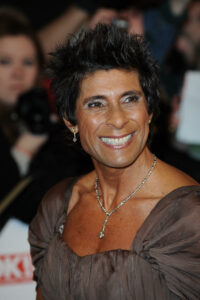
C9MJNM FATIMA WHITBREAD 2012 NATIONAL TELEVISION AWARDS O2 ARENA LONDON ENGLAND 25 January 2012
Finito World takes a look at what employability skills are the most important and how it can improve your career prospects
Employability skills might seem to be a bit of a mouthful. But the world is becoming more competitive. A phrase which takes as long to say as to make a cup of coffee is becoming increasingly important.
Why are employability skills so essential? It’s do first of all with the global economy, an inheritance of the settlement after the end of the Second World War. Borders are becoming more porous and businesses more international. The pool of talent competing for jobs has radically increased.
The only way to meet that reality is to up your game. Gone are the days when you could stroll into Dad’s friend’s bank or law firm without an interview. Now is the time of AI interviews, and fierce competition for every role. Even roles which may not seem all that desirable are competitive.
Tips for career employability
So what’s necessary? First of all you need to work on your communication skills. That will be verbal and in-person, and in written communications.
Sir Winston Churchill famously wrote of the importance of short, sharp memoranda that go to the point. The same is true when we are speaking aloud. Anyone starting out on their career would do well to learn to calibrate what they say. You need to put your hand up, but not seek to dominate.
All that entails good listening skills, and that in turn implies teamwork. How well can you read the emotions of others? Are you able to see your way round corners? When it comes to employability skills which employers need, teamwork is important. We need to make sure we fit in.
Most roles also entail some form of problem-solving. The world very rarely runs smoothly. Employers want to know that employees can engage in critical thinking and analyse situations. They need to work to the advantage of the overall organisation.
Why teamwork matters
One must become adept at not thinking primarily about oneself. You must ask yourself each day what you can do to further the good of a particular organisation.
But no employer expects you to get everything right all the time. Setbacks and disappointments are built into business as they are into life. In a changing, rapid world mistakes happen. Employers want to see that employees have resilience and a willingness to learn.
All of us has capacity for growth: career employability is to do with seeking to foster those capacities. You must not turn your back on any notion of self-improvement at the first crisis or letdown.
If you can do that, you’ll be well on the way to developing leadership skills within yourself: employers often say they’re looking for self-starters. You must demonstrate over a reasonable period of time that you are able to arrive at the answer to difficult questions on your own. Then management will start to consider you for a leadership role.
That will take time – and perhaps that will imply patience. But at the same time, it is to do with work ethic. That is an area where young people can really differentiate themselves. The famous West Coast lawyer John Quinn used to take his cohort of new arrivals down to the lake on his estate. He would say: “Swim to the other side!” The first two to enter the water would get jobs at the end of it.
You need to be the first in that lake to succeed: if you don’t someone else will. It was said of the tennis-player Tim Henman that he wasn’t the best tennis player in his class at Reed’s School. But if the coach said: “Go and hit a ball against the ball for ten hours” would go and do it.
Working hard
Fostering that work ethic can lead you to surprising places. Doing things over and over again might seem boring from the outside, but commitment leads to deeper understanding.
But none of this should be at the cost of the bigger picture. When it comes to career employability, you need to realise you’re in a globalised economy. You must also seek to understand the variety of functions which your organisation carries out.
Above all, career employability is about never stopping learning. It is an avenue to a rich and fulfilling career, and therefore to a productive life. You might find that the employability skills important to an employer are also important to you.
Why is Rafael Nadal so important? As the great tennis-player retires, it is clear he inhabits very rare company, writes Christopher Jackson
It is the humility of Rafael Nadal which is part of what makes him so magnificent. Retiring from professional tennis in mid-November 2024, he described himself as ‘just a kid who followed his dreams’.
He was that, of course. But his great rival Roger Federer came closer to the mark when he wrote in his moving statement marking Nadal’s departure from the sport: “You made Spain proud. You made the whole tennis world proud.”
In fact, Nadal – like Federer himself – comes from a very small group of sportspeople who make the whole world proud. They are a credit to their species. Part of living in an era whose defining obsession is sport is to find a dramatic increase in the type which we might call the elite of the elite of the elite.
The 2008 Wimbledon final. Federer is serving for the third set
The group I am describing is not made up of No.1’s – though all of the people I would put forward for this category have been at one time or another the best in the world at what they do. But being no. 1 in the world doesn’t get automatically get you entry to this club. Being the best in the world here is a mere starting point to being perhaps one day somewhere near this conversation.
Anyhow, you need to be World No. 1 for a long time to qualify. You have to be world no.1 over and over and over – but even that doesn’t get you there. Rory McIlroy has been the no.1 golfer time and again, but he isn’t in this category: he isn’t actually particularly close. The English swing bowler James Anderson is closer, but not quite there either.
To be in the elite of the elite of the elite you need to do things nobody else can do – in fact, you need to perform at a level to which nobody else has ever performed. And you need to do it in a certain way. We can call this genius, or magic.
In the first place, it has partly to do with ease of doing – or apparent ease. When we watch Simone Biles performing her floor routine we can see that she is doing much more than the relatively prosaic thing of winning her gold medal. She is reinventing that sport: she is qualitatively different. The same used to be true of Federer when he would waltz through a Grand Slam without dropping a set. It wasn’t just the ease with which he did this – it was the beauty with which he did it.
Usually the elite of the elite of the elite express themselves in memorable moments – moments where time itself might seem to slow down, to expand, or to become elastic in some way. Furthermore, these moments will usually be tied to some form of necessity: they therefore represent necessity surmounted, or responded to with unusual skill and awareness.
These are the moments which send a shiver. One thinks of Michael Phelps in the Beijing Olympics in the 100m breaststroke. Going for his seventh gold medal – to tie the Michael Spitz record which he subsequently beat – he was looking tired coming down the stretch against Milorad Cavic.
Then something happened. Nearing the finish, Phelps summoned some last ditch strength, and rose out of the water with a sudden show of speed, to tap 0.01 seconds ahead of his rival. He rendered himself above an impossible moment.
Tiger Woods was able to do the same. At the 2005 US Masters, Woods needed a birdie on the famous 16th hole. His drive went left down a precipitous slope. Viewers at home tend not to know how difficult the greens at Augusta National are: it’s like putting on glass.
Woods, as every golf fan knows, lofted the ball up and it ran down the slope. It teetered on the edge of the hole then toppled in. Woods went on to win the tournament. He needed to do something nobody had ever done before and he did.
The presence of someone who is in the elite of the elite of the elite doesn’t always need to come in moments when their backs are to the wall. It can also show itself with a certain ease of doing which can lend itself to a sort of inverse drama: it is the drama of things not being close at all.
In this category one thinks of Usain Bolt at the 2008 Beijing Olympics already celebrating about 80 metres in as he broke the world record by a vast margin. He looked almost as if he was flying. Nobody else has ever looked like that. In Bolt’s case it was tied together with a sense of theatre which in retrospect had to do with an extra awareness about the nature of the occasion: the nature of the occasion being that he was very likely to win and so could afford to lark about a bit.
Michael Jordan is another example. When we watch reels of him hanging in the air before dunking a ball, it really can seem as though he has a different relationship to the essential physical structures of life to everybody around him.
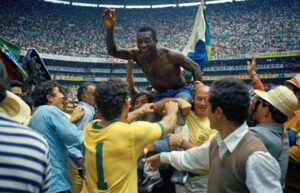
In team sports sometimes we find a certain heightened sense of strategy and inventiveness – the ability to conduct surprising situations with a certain innate virtuosity. In this category we find the great footballer Pele. I have always been fond of the last pass that leads to Carlos Alberto’s goal against Italy in the 1970s World Cup Final.
Pele looks like he’s playing against children. He collects the ball with his left foot, cradles it briefly, and then with a kind of infinite laziness sends it off to Carlos Alberto, who rifles into the net.
Some of my favourite Pele moments have almost a kind of silliness to them. The attempt to score from behind the halfway line against Czechoslovakia in the group stages of the 1970 World Cup. The ball misses, but its sheer audacity opens up onto a whole realm of possibilities about how we might play football.
Similarly, in the same tournament against Uruguay, Pele is running towards the box and the keeper coming towards him, both towards a cross coming from the left wing. Instead of trying to poke it past the keeper, Pele lets the ball go and circles back on himself while the goalkeeper flounders. That he then misses the goal doesn’t matter: he’s shown that there are another set of possibilities for the people to come after him to explore.
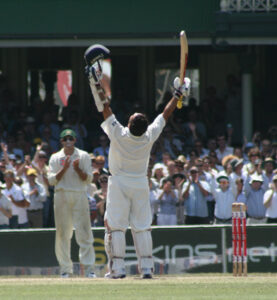
Sometimes the elite of the elite of the elite can create moments which enter national folklore: inherently patriots, they can have a heightened sense of what their country requires of them. In 2008 Sachin Tendulkar, batting against England in the wake of the appalling Mumbai attacks, needed to produce a century to lift his country’s spirits, and he did. There can be something solicitous about the elite of the elite of the elite: they do what we need to them to do on our behalf.
Clive James used to tell a story of Joe DiMaggio towards the end of his career. One of the greats of his sport, he was asked why he was warming up so hard when the game didn’t matter all that much in the context of a hugely successful career. “Because there’s a kind out there who hasn’t seen me play before,” came the reply.
When this top flight of sportspeople are obstinate, their obstinacy can take on infinite proportions. Shane Warne, another member of the elite of the elite of the elite, was once asked who was the best batsman he’d ever bowled against. He replied: “Tendulkar first, then daylight, then Lara.” Asked why, he recalled how during one particular tour Tendulkar had found himself getting out to the cover drive. Unprepared to accept this reality, he simply cut the shot out of his repertoire all day long. Warne was shocked and delighted at the sheer determination of the man.
Warne shows another example of the way this rarefied group can respond to circumstances. In Warne’s case, everything he did was characterised by a certain adventurous humour. During the 2006-7 Ashes, Warne was provoked by Ian Bell’s sledging to produce his highest test score. Bell, who Warne had been calling the Shermanator throughout the series, chose to answer back.
Warne pointed his bat at Bell who was in the slips and said: “You mate, are making me concentrate.” Warne went on to score 71 from 65 balls. The implication is that he was so good he could stand in the great arenas of his sport, and not need to concentrate. But if you ever provoked him to do so, he could be as much a batsman as a bowler.
Nadal reached these heights not because it was easy for him, but because he managed to balance extraordinary effort with profound humility. It was this which made him seem, as commentators frequently said, of another planet.
That perhaps is what really unites these great sportspeople: they feel separate from us – they seem to resemble gifted visitors. One is sometimes left with the impression that the gulf between us and them is too great for it so be possible to learn anything from them.
And yet at other times, it seems as though they have everything to teach. What makes it all a little easier to swallow is that time and again they teach the same sorts of things: hard work, humility, endeavour, a mysterious depth of commitment and even humour. We will need all those things in our own lives: that’s we won’t go far wrong if we make the Nadals and the Federers of this world our mentors.
Last Thursday (7th November) Bridget Phillipson gave her first major speech to the education sector at the Confederation of School Trusts’ annual conference. Her speech was personal, extremely positive and encouraging but also showed hints of naivety and even a lack of realism and understanding of the current situation in schools.
She began, as her predecessor, Gillian Keegan, always did, by talking about her own journey from a disadvantaged background to becoming Secretary of State, something to be applauded and respected. After all, what is the prime purpose of education other than to nurture, develop and to open doors for all, regardless of background and ability? Her recurring theme was “achieve and thrive”.
She highlighted the appalling inequality that still exists in this country and the fact that where you live and where you go to school are still key determinants in your educational outcomes. This is clearly wrong, even immoral, in a modern, advanced nation: every child should be able to access a world class education. Understandably, she enthusiastically listed several decisions made by the Labour government: the fully deserved 5.5% pay rise for teachers and the £2.3 billion increase to the core schools budget (although much will be taken up by the pay rise and the inexplicable hike in employers’ National Insurance contributions).
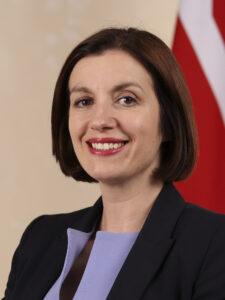
05/07/2024. London, United Kingdom.Secretary of State for Education,Bridget Phillipson poses for a photograph following her appointment to Cabinet by Prime Minister Sir Keir Starmer in 10 Downing Street. Picture by Lauren Hurley / No 10 Downing Street
I also welcome her attitude to the teaching profession, “Teachers are partners not enemies” and the use of experienced professionals, rather than SPADS who have never stood in front of 30 stroppy teenagers on a wet Friday afternoon, to lead on various developments. I should have liked, however, to see a greater involvement of the profession as a whole. In my first, “Better schools, The Future of the Country” report in June 2023, I called for the establishment of a National Schools Council which would regularly and formally bring together ministers, civil servants and elected representatives from all areas of the school system. Real improvement will be dependent on the active involvement of those who successfully do the job, not those who just talk about it.
Phillipson no doubt pleased many by offering to spend more on “crumbling classrooms”, referring to the recent Budget and the long overdue additional £550 million for rebuilding and the extra £330 million to improve the condition of our schools. We should not forget, however, that RAAC and asbestos existed at the time of the previous Labour government but rather than resolving these issues twenty years ago, it decided instead to spend the money on building a limited number of new, architectural masterpieces rather than on resolving underlying issues in all schools. Eye-catching new builds are presumably deemed more helpful at elections than a new roof here or a new staircase there.
Clearly these are early days, but several of Phillipson’s comments do bode well for the future. The curriculum and assessment review may result in a curriculum that is more accessible and which will enable more young people to achieve and to make a positive contribution to the economy and society (but, I hope, without adopting a “prizes for all” mentality). The changes to Ofsted will, with any luck, lead to an inspection system that is far more clinical, accurate and useful to parents, schools and government, although we are yet to see what will take the place of the single, overall inspection grade. Providing early intervention for SEND pupils and of tackling the current atrocious absence rates [one in five children is deemed “persistently absent”] are both areas urgently requiring dramatic intervention.
For all its positivity, however, there are two areas where I feel the Secretary of State’s speech lacked authority or understanding. The first is tackling the absolute crisis in teacher recruitment and retention. She made much of Labour’s manifesto promise to create an additional 6,500 teachers but, despite being an attractive soundbite, the number shows a complete ignorance of the magnitude of the problem. Last academic year, over 40,000 teachers (over 9% of the workforce) quit the profession for reasons other than retirement. In the same timeframe, only one half of initial teacher training places were filled (and only 57% in the previous year).
This is the perfect storm – both retention AND recruitment. With over 20,000 schools in England, this equates to losing almost two teachers for every school; 6,500 new teachers is not even one new teacher between three schools. This is a crisis of extreme proportions and although Phillipson claimed she was not guilty of “a plan for happy ignorance”, much, much more needs to be done. The last administration pointed to the fact that there are in fact currently more teachers than ever before, but this ignores the fact that there are also 74,000 more pupils than in the previous academic year or that many of the additional teachers are either overseas trained (not in itself negative, but it obviously depends where and in what type of system they trained) or unqualified – hardly a recipe for dramatically raising standards. It is great teachers that change young people’s lives: until this crisis is resolved, any talk of curriculum, inclusiveness, standards or, indeed, any education topic, is simply pie in the sky.
The area of Phillipson’s speech which has probably caused the most debate, is where she spoke about standards and the need for young people to be happy in schools. A survey has shown that one in three 15-year-olds “don’t feel happy in school. That’s worse than the average across our OECD neighbours”. Interestingly, this is the only international comparator that she chooses to quote: not the recent international reading and numeracy tests which, under the previous government, saw our comparative position rocket. Her message was clear – schools should not concentrate on academic achievement: “A*s alone do not set young people up for a healthy and happy life……This government will always be strong on standards….[but she warns against falling into] “the trap of chasing a narrow shade of standards, structures-driven rather than child-focused”.
Firstly, the vast majority of schools are not blindly focussed on exam results – to suggest that they are is simply insulting to all of us who have spent our careers committed to pastoral care, extra-curricular activities and to the development of the whole person. But why do some schools prioritise academic achievement? Not only is it the key to unlocking the future for every young person, it is also the metric by which schools are publicly judged – the annual examination performance tables. Phillipson makes no mention of scrapping these and they remain a central tool for how government and parents judge schools. Of course, issues such as “happiness”, ethos, the hidden curriculum and even extra-curricular activities cannot be quantified in the same way that examination results can – and nor should they. Let us understand that what makes a truly great school and gives it that special soul and feel, cannot always be defined in a league table. This is not a call for scrapping league tables, but if you chose to publicly rank schools according to their exam results, do not criticise them for playing the game.
There is a clear criticism of previous governments in much of what the Secretary of State says: “previous governments have had tunnel vision……a sole focus on achievement is doomed to fail”. Anyone who has ever worked in a school, even briefly, knows that education is about so much more than exam results, but what she seems to fail to appreciate is that, sadly, this country is currently facing a genuine issue with academic standards.
In recent years, England has done remarkably well in international league tables [PISA and PIRLS] but we must not confuse comparative ranking with a real improvement in standards. Yes, England has outperformed many competitors, which in itself may mean that our system has been more resilient to COVID and other pressures than that of other countries, but if you read these reports, our real terms performance in certain areas has declined at a frightening rate of knots: some maths performance is the lowest it has been since 2006; less than half of children feel confident in reading (it used to be more than half) and, what I personally find more worrying than anything else, less than one third of children going to secondary school now like reading. [And before anyone says this is the result of social media, our performance in this indicator is twenty points behind the international average.] In addition to making children safe and happy, we also need to raise academic standards as a matter of urgency and ensure that our schools produce youngsters with the knowledge, skills (soft and hard) and understanding necessary for them to contribute actively to society.
Twenty years ago, I attended a conference which looked at the two trending education initiatives of the day, “Every Child Matters” (English) and “No Child Left Behind” (American). Unfortunately, the keynote speaker got tongue tied and called for a system where, “No child matters and every child is left behind”. The accidental slip inadvertently highlighted a very real danger – that political point scoring, that change dictated by those without knowledge or experience and that good, but flawed, intentions can seriously damage the education we provide for our young people. I have never doubted the sincerity and commitment of any Secretary of State or Minister of Education to do their very best for young people, but if the current and future incumbents want to really make a positive difference, they need to understand a few basic truths:
· The very future of this country depends on how well we educate all young people, regardless of their starting point; education is too important to be a political football
· A first-class education system requires significant investment.
· Education is a complex matter: soundbites and a “one size fits all” approach are damaging in the extreme
· The teaching profession is the most important commodity in any school system and makes the greatest difference to young people’s outcomes
· While the role of elected representatives is critical, opportunity must be created to actively and meaningfully engage with those who have experience and proven success in teaching in our schools and of actually working with young people, not with advisors with absolutely no hands-on experience
It is perfectly possible “to achieve and thrive”, but there is clearly much to be done.
I am a war baby, born on 5th of October 1943. Anne Frank probably died on 31st of March 1945. We shared this world for only a few months.
Whilst she was hiding away in an attic with family and friends from the Nazis, while she and they were finally being betrayed and taken away to Bergen Belsen concentration camp to be murdered in the Holocaust like millions of others, I was being looked after in my grandparents’ comfortable house in Radlett, outside London, with a garden, surrounded by family, under threat of the war of course, but I knew nothing of that. I knew nothing of the concentration camps either. I did not know about the evil that men do, that sadly does live after them, if we allow it to.
When Hitler sent over the V2 rockets to do their indiscriminate killing, I was evacuated 300 miles north, well out of range. During my early childhood, the war, the history and the myth of it, was ever present, from the bombsites we played in – playing war games mostly – from the photo of my Uncle Pieter on the mantelpiece who had been killed in the RAF in 1941, aged 21, from the soldier with one leg often begging on the street corner near my school, I thought of war as a sort of killing game.
It took me a while to realise that it wasn’t a game, that war destroyed houses, flesh and uncles. BuI I think I only began to comprehend the depth of the tragedy of it when I saw my mother crying over the death of Uncle Pieter, her beloved brother. I caught her sadness, I think, and came to miss the uncle I never knew, and so began to understand the pity of war very young.
But I must have been eleven or twelve when I first knew anything of Anne Frank or the Holocaust. My family knew about it of course, but never told me. Like millions of my generation and in the generations to follow, I learnt about it through reading Anne Frank’s Diary. Her face was on the opening page looking out at me.
She wrote directly to me, confiding in me, telling me how it was to be her, how she was enduring her imprisonment in her attic in Amsterdam, the tedium, the frustration, the dread, the anger, the memories, the friends and relations, the hope, the longing to be free again, for liberation to come. It was her living testimony. And it lives on today.
Anne Frank’s talent was brutally cut short but she remains famous as a source of inspiration to people everywhere
The last page of her diary is the last we hear of her. She is simply not there any more. We knew before we ever read it that she had died, that these were to be her last words. Once read it is never forgotten.
It was of course not written to be read by others. She did not know that this was to be her testament, the most personal insight into the life of a spirited but ordinary girl whose name and face was one day to be famous all over the world, was to represent for so many all the wickedness and the waste, horror, the tragedy, shame and pity of the Holocaust.
For ever afterwards, her life and her death has given me, us, some way of beginning to understand the Holocaust. She was the one of the 6 million we all came to know. Her short life and death remind us of man’s inhumanity to man, of the depth of cruelty and depravity we are capable of, of the power of prejudice so easily aroused to fuel hate.
But Anne also gives us hope, the hope she had, that all can be well again, if we make it well. Her words, her suffering, her death, give us the determination to right the wrongs of antisemitism and prejudice of all kinds, to create a world where kindness, empathy and understanding rule.
Because of Anne, scribbling away up in her crowded attic room, I have had her story and her fate, and the iniquitous and vile Holocaust in my head for much of my life. It’s no accident then that I have written my own stories about it, stories like The Mozart Question.
This story and so many others were, I feel sure, originally inspired in part by a family friend I had grown up with as a child and known well – Mac, we called him, Ian Mcloed. He was amongst the very first British soldiers in the Royal Army Medical Corps to enter the concentration camp at Bergen Belsen, on the 15th of April 1945, where Ann Frank had died just a week or two before. A young man, a teenager at the time, Mac witnessed the horror of Belsen with his own eyes, and suffered from the effects of that terrible experience all his life.
His life, his being there at the liberation of Bergen Belsen, was the first of many personal connections to the Holocaust that have echoed through my own life, in so many ways.
For instance, growing up I was unaware of the Jewish origins of my step family. My birth name is Bridge, my father an actor, Tony Van Bridge, but my mother left him in 1946, to marry one Jack Morpurgo, from a Jewish family that emigrated to London in the early 20th century. So aged 2, I became a Morpurgo. It is a Jewish name from northern Italy, well respected there. Many many Morpurgos I later discovered had died in the camps.
And there was the violin. Go to the Violins of Hope Museum in Tel Aviv, and you will find amongst all the violins played in the concentration camps, the Morpurgo violin. It belonged to one Galtiero Morpurgo, a survivor of the camps, who was still playing the violin until he died aged 97. His family donated his violin to the museum.
Strangely, I did not know about this Morpurgo violin when, twenty years before I wrote a story of mine I called The Mozart Question. It is to me perhaps my most important book. By this time I had of course read Primo Levi, I had known and become a good friend with Judith Kerr, fellow children’s writer, and author of Hitler Stole Pink Rabbit, based on her family’s escape from Germany in 1933.
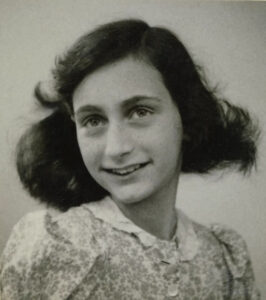
Anne Frank in December 1941
And I had discovered that a great teacher of mine, Paul Pollock, who had taught me classics at school, had been a child on the last train of Jewish children to leave Nazi occupied Prague in 1939, one of hundreds saved from the Holocaust by the wonderful Nicholas Winton. Mr Pollock was a devoted and eccentric teacher known and much respected for his extraordinary intelligence and famous for his withering remarks, his cutting barbs.
His barber was once overheard asking him: “And how would you like your hair cut today, sir?” “In silence,” Mr Pollock replied. He died only six months ago, at over a hundred years old. And we never realised when we were boys what he had been through, how he had no family but us. They’d all gone. He was alone in the world.
I have his story and Mac’s story and others in my mind as I am talking to you today. They connect me to the Holocaust. They all lived on. But Ann Frank was the first and most important of these connections, and she did not survive.
But the diary she wrote hiding away in her attic room in Amsterdam is for so many millions around the world the first and most lasting connection to those times, to those lost millions of the Holocaust, each of whom was a living breathing precious human being, a daughter, a son, a mother, a father.
It is primarily then because of Anne’s enduring story, that I am here, honoured to be be talking to you today. Like her, I’m a storymaker too, a writer – and what books she might have written had she lived, can you imagine? I write under my given name.
I am here in part because of my Morpurgo name. And I am here because of Mac, Ian Mcloed, the medical orderly at Bergen Belsen, whose story I knew growing up; and it is because of the discovery of the story of the Morpurgo violin in Tel Aviv, and of my friendship with Paul Pollock, my teacher, and dear Judith Kerr – two of those who escaped the Holocaust and came to live and do so much good for us in their adopted country. For me all these people and all these circumstances conspired to bring me here today.
It is because of all this, because of them and all they lived through, that I know as we all do that prejudice has to be fought, that prejudice is a disease that can so easily become an epidemic of hate, a pandemic that can overwhelm us, if we ignore it or look the other way. It is a pandemic against which we have to be vigilant, and that has to be confronted. Historical awareness, and stories can help in this struggle.
I’m firmly convinced that unless we know and remain aware of where prejudice can and does lead, unless we know the history of the Holocaust, then it can happen again, again and again. And I’m also convinced that it is stories that can keep us vigilant, that all of us growing up have to be made aware, generation after generation.
That’s why I am with you here today, why I have written my stories of those times, of war and oppression, of occupation, and of the Holocaust in particular in Waiting for Anya and my story of a violin in the concentration camps, The Mozart Question, in which the power and beauty of violin music can and does overcome brutality and evil. We owe it to them, to those who died in the Holocaust, to Anne Frank, and to those who survived, to go on telling the story.
And, we owe it to them surely to do more, to seek peace and reconciliation, to create the kind of world I discovered on my visit to Israel and Gaza, ten or so years ago, with Save the Children. I was taken to a village and to a school called Neve Shalom, Oasis of Peace, Wahat A Salam, the only place, so far as I know, where Jew and Arab go to school together.
We made kites together, flew kites together, made music together. Such a place, such a spirit, such children and families, and teachers will put the world to rights. There was hope there, there was peace there. Hope springs eternal, and hope brings peace.
Let there be peace.
This speech was delivered at the Anne Frank Trust UK annual lunch and is reprinted in full with the kind permission of the trust.
Christopher Jackson asks why Only Murders in the Building is such a hit
In one sense Only Murders in the Building – known to fans as OMITB – is just another TV show. It’s well-made, and moreish. It takes its place among umpteen other binge possibilities on Disney Plus and the other streaming channels.
Yet there’s something so clever about it that makes one want to make claims for it. One wants to call it culturally significant and see if the label fits.
Put simply, why is Only Murders in the Building so good?
All-Star Cast
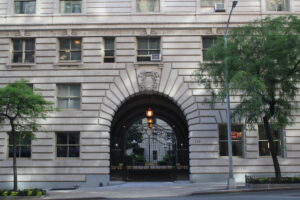
Well, the show stars Steve Martin, Martin Short and star of the moment Selena Gomez, and has just been renewed for its 5th season. The location of the show is The Belnord on West 86th Street, a building whose residents have included Marilyn Monroe and Martha Stewart.
This location is a clever choice since it creates a set of structures – dramatic laws – even which make the sure admirably tight. For instance, a murder has to take place in the building for it to qualify. This means that we get to know its layout, and its regulations and the people who live there. There’s a sort of cosiness to this – something almost familial.
The Belnord is where Only Murders in the Building is set
It’s a good tip for young writers to consider exploring a location as OMITB brilliantly does. A place will engender characters – and sometimes do so better than our imagination. Once you’ve chosen a communal building, then you have the janitor, the receptionist, the chairman of the building board – probably not the other way round.
So who lives in the building where all these murders take place? Steve Martin plays Charles Hayden-Savage, a slightly has-been actor. Hayden-Savage probably has enough money to live there by virtue of having bought his apartment before Manhattan became unaffordable to anyone but the superrich.
Martin’s character is, like so many he has played in the past, eager to please but with a tendency to put his foot in it. He aspires to goodness, but something about that trait means he’s romantically alone, but that unexpected friendship comes to him.
Steve Martin plays Charles Hayden-Savage in Only Murders in the Building
That’s true too of Oliver Putnam, played by Martin Short, a name-dropping Broadway director whose failures – especially his disastrous musical Splash – are far more memorable than his successes. Putnam can begin to grate a little by the fourth season, but he is essentially loveable, a fantasist who thinks the next big thing is round the corner – and also that his past is more illustrious than it was.
He has a sort of Tourette’s when it comes to other people and can be delightfully rude about people to their faces because everybody knows he doesn’t quite mean anything he says.
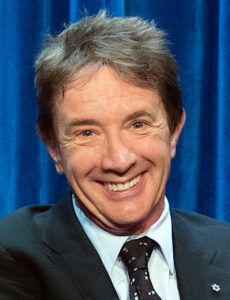
Martin Short plays Oliver Putnam in Only Murders in the Building
Age Gap
Finally, Selena Gomez’s character Mabel Mora is only in the building at all because her aunt lets her live there. It’s this age gap which provides much of the comedy. Mabel isn’t sure who she is yet, but it turns out – as so often – that who she is will be determined by the relationships she makes – in this case, the two older men.
At one point Mabel says: “A murderer probably lives in the building, but I guess old white guys are only afraid of colon cancer and societal change.” At another point, a walk-on character thinks Mabel is Hayden-Savage and Putnam’s carer.
Early on in Season One, Martin hilariously signs off a text to Gomez with ‘Best regards, Charles Hayden-Savage.” Her smile as she reads this is marvellous, full of the knowledge one generation cannot convey to the next. This shows tells us that the world moves fast – but also that on another level, the human heart is a realm of possible stability if we can manage to be open and kind.
In fact, the reason the show works so well is precisely because of the inter-generational nature of the humour – and also because audiences inherently enjoy unlikely friendships.
There is a sense in all of us that only befriending people of our own age narrows us somehow: it is as if, deep down, time doesn’t feel entirely linear and we want to teach it that lesson by striking out in surprising directions.
Clockwork plots
But all this would be incidental if the plots didn’t work. Murder is hard, not because it isn’t inherently interesting. It’s hard, because it’s so interesting it’s been done every which way a million times. When you write a murder mystery you’re up against Edgar Allen Poe, Arthur Conan Doyle, GK Chesterton and Agatha Christie for a start – and they’re just the headliners.
Added to that, because the audience is reliably dedicated, they’ve seen every plot-twist. So you need to be extremely clever to surprise people likely to tune into a murder mystery: you have to secrete your clues carefully, you have to feint to the wrong killers plausibly, and you have to get your pacing right.
OMITB does all these things, and for the most part fabulously. It’s also brought together by acting which it can be easy to underestimate. The best for me is Martin, because you don’t notice he’s acting. But the main three all combine a genuine off-screen friendship with on-screen rapport.
Walk-on Parts
In fact, the first season gives you the best possible measure of that when Sting appears as a cameo playing himself. Sting is a great musician, and an okay actor – but what makes him only okay at the latter is that you can see him trying too hard.
The camera loathes exaggeration – and Sting slightly strains for effect. In his day job, and especially in his heyday, he doesn’t know how to make a clumsy chord change. But this isn’t his day job.
It’s Martin’s though, and you can see that he’s always been much more than just a comedian. Nothing he does draws attention to the fact that he is trying to convey it; he becomes that emotion, that predicament.
This is what lifts OMITB – its ability to keep you engaged in the storyline while providing laughs, and also moments of surreal drift. In the first episode, Putnam tells us that in New York City we sometimes fall down only to bounce back up again.
It’s a metaphor but we end up seeing this enacted, as he falls off some stairs and floats dreamily upwards when something promising happens to him at the end of the episode. The famous White Room episode in Season 3 provides a similar moment for Martin.
In this scene, Martin corpses and enters a strange parallel dimension: a white room where he is walking with a wonderful manic grin on his face. When he wakes, he is without his trousers and everybody is traumatised. It’s the funniest scene in the show.
More than Whimsy
It’s whimsy, yes, but there’s something more solid about OMITB than that. Twin Peaks made a habit of such playfulness, and perhaps in the end didn’t quite know what it was. OMITB has stronger delineation, since everything which happens in some way serves the mystery. To do this while offering up brilliant one-liners is a rare achievement.
The show is a good indicator of where society is now. This is a world dominated by new media – the murders all revolve around a podcast which the three main characters are producing, and which becomes a surprise hit.
But while it has its finger on the pulse, it’s a show that also knows that the latest thing is just the latest thing: the age gap between the main characters shows us how we all react to the modern world at a slightly staggered pace, according to what we wish to assimilate, and we can manage to accept.
Along the way there are nuggets of wisdom. In Season 2, Episode 6, Tina Fey’s recurring character says: “Never become too good at a job you don’t want.” She doesn’t add that if you do that you can wake up halfway through your life with your options narrower than you’d ever thought possible: she doesn’t have to because the dialogue is so taut.
The Here and Now
Ultimately, the show is to do with a sort of light touch unity. Why is Only Murders in the Building so good? Perhaps for the reason that good art always is. It says, cleverly, even tangentially: the world’s like this now.
But it also knows in Martin and Short’s characters that now will soon be then. To say that without being portentous or preachy, and to make you laugh and tell a story at the same time is a rare achievement.
Considering an accountancy career? Successful accountant Grace Hardy gives her advice
Growing up with dyslexia wasn’t easy. School was often a frustrating experience for me. I struggled with reading, writing and spelling, which made traditional learning environments incredibly challenging. I often felt like I couldn’t keep up with my peers, and my confidence took a hit.
The thought of spending another three or four years in a similar environment at university filled me with dread. I couldn’t afford to go to university without getting a job on the side and I was worried that doing a degree wouldn’t set me apart from others when I’d eventually have to find a graduate scheme after.
During this time of uncertainty, my mum introduced me to the world of apprenticeships. I’ll be forever grateful for her suggestion because it opened up a whole new realm of possibilities for me.
The apprenticeship route appealed to me because it offered a different way of learning – one that suited my needs better. It promised hands-on experience, practical skills, and the opportunity of earning money while learning. Plus, the prospect of no student debt was certainly attractive!
I secured an apprenticeship with a Top 10 Accountancy Firm, and it was a game-changer for me. At 18-years-old I was on a £20,000 salary; I was over the moon. This gave me the financial stability I had been craving. From the very first week, I was working on real client projects and given responsibilities that expanded my portfolio and experience. Despite having no prior accounting knowledge, the firm provided comprehensive training and created a nurturing environment for me to learn and grow.
As I progressed through my apprenticeship, I began to see the inner workings of different businesses. This exposure was invaluable and sparked my entrepreneurial spirit. I realised the skills and the knowledge I was gaining could potentially be used to start my own accounting practice one day.
After completing my apprenticeship and gaining my AAT qualification, I decided to take the plunge and start my own firm, Hardy Accounting, at the age of 21. It was a scary but exciting move!
The transition from employee to business owner came with its own set of challenges. Suddenly, I was responsible for everything – from finding clients to managing finances, and from marketing to delivering services. But the foundation I had built during my apprenticeship proved invaluable.
One of the most liberating aspects of starting my own business was the ability to work in a way that suited my neurodiversity. I could structure my work environment and processes in a way that played to my strengths and mitigated the challenges posed by my dyslexia.
For instance, I leveraged technology heavily, using speech-to-text software, dyslexia-friendly fonts, and other tools to help me work more efficiently. I also found that my dyslexia gave me a unique perspective on problem-solving, which often proved beneficial in finding innovative solutions for my clients.
Whilst growing my business I quickly became aware of the fact that a very small number of my clients had any understanding of financial literacy – a key element of running a successful business. This was the seed that later blossomed into a full passion for the topic of financial education.
After looking into how financial education is integrated into the UK curriculum (or how it really isn’t) I quickly realised that the situation was much worse than I originally thought. An inquiry by the All-Party Parliamentary Group on Financial Education for Young People found that over two-fifths of secondary school teachers surveyed did not know that financial education was a curriculum requirement.
In addition to this, only two-in-five (41%) young adult respondents were considered financially literate, showing the impact that a lack of childhood education has down the line. Almost two-thirds (61%) of young adult respondents confirmed they did not recall receiving financial education at school – that math adds up pretty clearly.
Those who were receiving financial education lessons in the UK were taught for an estimated 48 minutes per month on average instead of the recommended 30 hours. These findings made it clear that something needed to happen. In response, I started to lobby the Government for legislative change on financial education. This initiative became a crucial part of my journey, combining my accounting expertise with a mission to improve financial literacy across the board for the better of our communities, economies and people’s every day lives.
In my business my goal was simple: to provide personalised, tech-savvy accounting services to small businesses and startups, helping them navigate their financial journeys with confidence. I wanted to create a firm that wasn’t just about numbers, but about building relationships and helping to educate business owners about finance so they could understand the ins-and-outs of their businesses.
The accounting industry is on the cusp of a major transformation. As we move forward, I see a future where accounting is more than just bookkeeping and tax preparation. It’s about being a strategic partner to businesses and providing insights that drive growth and success. The future accountant will need to be part financial expert, part technology guru, and part business strategist.
Artificial Intelligence is also revolutionising the accounting industry. From automating routine tasks, to providing predictive analytics. In my firm, we’ve embraced AI tools to enhance our efficiency and accuracy. This allows us to focus more on providing valuable insights and strategic advice to our clients.
However, it’s important to note that AI isn’t replacing accountants; it’s augmenting our capabilities. The human touch – our ability to interpret data, understand context, and provide tailored advice – remains crucial. The successful accountants of the future will be those who can effectively leverage AI while maintaining personal connections with clients – allowing it to maximise our talents rather than replace them.
For young people looking to follow a similar path in accounting, there are several key pieces of advice I’d offer. Being yourself is the best thing you can do. There are many business owners and everyone has their own approach, therefore it’s key to find something that makes you unique. What is your unique selling point (USP)? Developing soft skills such as communication, problem-solving, and leadership is equally important as technical accounting knowledge.
Seeking mentorship from experienced professionals can provide valuable insights and guidance in this respect. Being adaptable is vital in the constantly evolving accounting field, ready to learn and adapt to new methodologies and regulations. Lastly, knowing that failure is not something negative is vital. In the entrepreneurial journey, setbacks are not just inevitable; they’re invaluable. Every failure is a stepping stone to success, offering crucial lessons that shape your path forward.
These experiences, though challenging, provide unique insights and foster resilience – essential qualities for any entrepreneur. Embracing failures as opportunities for growth and learning is what often sets successful business leaders apart from the rest.
Being self-employed has opened a realm of possibilities for me. I have since started the Unconventional Podcast and have launched the Unconventional Academy to help other young people start businesses and learn about financial education. In addition to this I am in the midst of my campaign to get legislation passed through Parliament to improve financial education throughout our school system – building for a better future, now.
The road might not always be easy, but with determination, the right support, and a willingness to learn and adapt, you can achieve great things. Your journey is just beginning, and I can’t wait to see where it takes you!
As an MP, over 25 per cent of the people who approach you for surgeries is generally about their children and their children’s education. My mum didn’t have much education – she left school when she was 12 or 13 – she was also a great believer in having a good education, and having me her eldest child going to Harvard Business School and Oxford was a proud thing for her. So the importance of education has been instilled in me from a young age.
While I was an MP, in my second year in Westminster around 2007, I had the opportunity to work on a social action project in Rwanda. This was post-genocide Rwanda when they were still trying to rebuild the country and Claire Short, who had been Blair’s International Development Secretary, donated a huge amount of money for Rwanda. The UK at the time was the largest donor to Rwanda.
Cameron decided this was important, and a trip was organised with eight MPs, and we worked on five different social action projects. I was in charge of a project which involved helping to fix up a small nursery kindergarten in a poor area in Kigali. There were 83 kids. I put in around £5,000 of my own money and we fixed up the school: we got electricity, we had two big water tanks, a lot of rooves and walls had holes in and we fixed that up.
David Cameron then came over for two years to see the projects we were doing. And I remember one of the journalists who was with me came and visited me and he said: “You’re here for a couple of weeks and then leave it. What difference can you possibly make?” I explained that the infrastructure was better and so on.
Back in the UK, six weeks later, I received a phone call saying: “Rwanda Health and Safety want to shut it down”. I said: “What do you mean?” He said: “Well there were 83 kids and now there are 343 children there in these tiny classrooms.” So I flew back and I met with the Minister of Education and I said: “Don’t close the school down. I will rebuild it.” In my head I thought it would cost me £100,000.
I found a new site which I bought about a kilometre away, and spent two years getting planning permission, which I finally secured. We had a foundation laying and the President decided to come and I asked him why he came. He said: “Most people come to me giving advice. You came, saw a problem and put your hand in your pocket to fix it.” He added: “I would like you to do one thing: make sure there are all Rwandan teachers.”
At that time a lot of teachers came from surrounding countries like Uganda, Tanzania and Kenya and so on. So I took that on board and we finally opened the school in January 2012. I then created a charity called a Partner in Education and we went on to build a secondary school. By 2017, we were ranked in the top three in the country, with nearly 100 per cent Rwandan teachers. At that point, I built a teacher training centre too.
When I left Parliament in 2015, my old tutor came to see me and said: “Brooks what are you doing next?” He said: “We’ll figure out what exactly you do.” In 2016, I was sitting next to a Professor in the education department and I was asked to give a talk. I was asked to sit in on his class. I suddenly realised how little I knew about education even though I had this school.
After three classes I asked if I could do his Masters. I passed and got in. I was 60 years old, but I always love learning. It’s never left me. I went back to university at the age of 60 and my dissertation focused on fine motor proficiency of seven year old children as a predictor of academic achievement.
They then said I should stay on and do a doctorate. I decided to look at policy-making in Rwanda. I realised there are a lot of policy ideas which are generated without real focus on outcomes. For instance, they have this thing one laptop per child. But if there isn’t broadband in schools, or the teachers aren’t trained you won’t get satisfactory outcomes. We can’t really think about these things in a linear way.
I decided to look at it through the lens of a systems approach and consider what enables and what constrains policy implementation. For instance, if teachers have only rudimentary understanding of English they can’t overnight suddenly be able to deliver lessons in English to children who themselves don’t speak English. It was understandable why the Rwandan government wanted to bring that in; but this top down approach wasn’t working.
Having been in government myself, I can say with some authority that we have a habit of coming up with great ideas which in principle sound good, but we don’t think enough about who we need to bring on board to implement these things properly.
But things happen in life and get in the way. I started my DPhil and then in 2020 Covid hit, and I couldn’t do my field research. Then, my mum got sick in 2021 and I could see from January she would pass away, which she did in May of that year. Finally I did some research in November 2021, and then suddenly the Ukraine war starts.
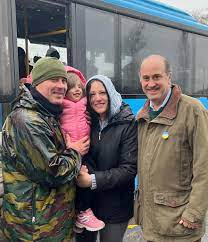
It seems I will continue to find reasons not to work! I saw a friend of mine was on the Polish border moving people along refugee centres into Europe. I messaged him and asked if I could come and join him. Four days became two weeks. Soon, I began bringing buses into Ukraine from Lithuania, moving people from Kviv and Lviv to the Polish borders.
As the war moved to the East, I had hubs across Ukraine, and I spent a lot of time in Kharkiv: we moved 1,000 women and children out of a Russian-controlled area. To do that we had to move 500 metres of anti-tank mines, which was an amazing achievement.
I am torn between doing what I am doing in Ukraine and not wanting to drop the ball on my DPhil. I’m trying to navigate with my supervisors between my work with Ukraine and getting to the next stage of my DPhil.
But the moral of the story is you’re never too old to learn. While my wife does Sudoku as a form of brain gym, I have my doctorate. Having started 40 years ago, I feel much better prepared through having had life experience in business and as an MP.
Brooks Newmark was formerly Minister for Civil Societies
Ever wondered why hybrid working is the future? Finito World looks at a question likely to be of perennial interest well into the future
Hybrid working is proving itself remarkably flexible and popular.
New research from IWG shows that hybrid working has led a boom in ‘active commuting’, with increasing numbers of workers travelling to local flexible workspaces via foot and bike.
That’s good for our health, both physical and mental and is just another reason why employees seem to be voting with their feet nowadays.
The study found that commutes to local workspaces are 38% more likely to be active than commutes to city centre locations. Workers aged 55-64 have reported a 109% increase in active commuting, the most of any age group.
Health benefits
That also has a significant knock-on effect. This follows recent census data which revealed that those who walked or cycled to work face a lower risk of mental or physical ill health, lowering their risk of admission to hospital for any illness by 10-11%.
The increased use of local flexible workspaces by hybrid workers has been central to this shift. Almost two thirds (62%) of commutes to local workspaces are now mostly or entirely active. This is a 38% increase compared to commutes to city centre offices.
The study was conducted by International Workplace Group (IWG), the world’s leading provider hybrid working solutions. It included brands such as Regus and Spaces, and included more than 1,000 hybrid workers. It found that walking (88%), cycling (34%), and running (28%) were the most common forms of active commuting. Workers travel on average 324 km via walking, 366 km via running, and 418 km on bike to a local workspace annually.
The research also revealed some more novel forms of active transport, including travelling to work by scooter (7%), skateboards (6%), and rollerblades (4%), as workers cut long daily commutes by train or car and take advantage of workspaces closer to where they live.
Rise of the “silver strollers”
Hybrid work creates generation of “silver strollers”
The research also reveals that older workers have made the most significant increases to the time they spend exercising as part of their commutes. Those aged between 55 and 64 reported a 109% increase in active commuting when travelling to a local workspace instead of a central office.
Two thirds (67%) said they are more likely to incorporate physical activity into their commute when travelling to a local workspace instead of a city centre location. Meanwhile, more than three quarters (79%) have reported improvements to their physical health as a result.
The most popular form of exercise for this “silver stroller” generation is walking, with workers aged 55-64 travelling an additional 259 km a year on foot by active commuting.
This map shows the percentages of hybrid working by country
A Question of Productivity
Active commuting fuels mental health and productivity gains
Beyond the obvious physical health benefits for all generations, active commuting to local workspaces has improved mental wellbeing, productivity and work/life balance. More than four in five (82%) of those that active commute said that incorporating exercise into their commute improved their mental health, with three in five (60%) reporting increased productivity at work.
This is supported by additional research from International Workplace Group which found that three quarters (75%) of workers experienced a dramatic reduction in burnout symptoms, after transitioning to a hybrid model***.
The improvements to work/life balance have resulted in 85% of hybrid workers saying they are more satisfied in their jobs and 75% reporting higher levels of motivation.
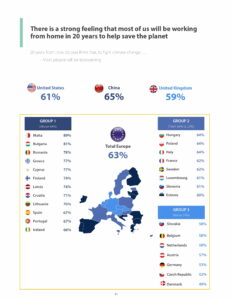
This chart shows strong consensus around the ecological benefits of working from home
Closer to Home
Given the clear health benefits of active commuting, it’s no surprise that nearly three in five (59%) of workers want their employers to provide access to local workspaces closer to home, so they can fit in more exercise – as three quarters (75%) say they are more likely to incorporate physical activity into their commute when using a local workspace.
It appears that business leaders are listening to their employees. Recent research among more than 500 UK CEOs found that three quarters (75%) said that returning their employees to a central office five days a week isn’t a business priority. Two thirds (65%) said they would lose talent if they insisted on their employees being present in a central office every day.
IWG locations in rural, suburban, and commuter areas have seen a surge in foot traffic since the lifting of Covid-19 restrictions. Towns like Uxbridge (up 1839%), High Wycombe (up 1412%) and Maidenhead (up 1186%) experienced significant growth in footfall between June and August compared to the same period in 2021, when Covid-19 restrictions were in place.
Win/Win
To help meet this demand, IWG has opened more than 300 new locations in the first half of 2024, with the majority in rural, suburban and commuter areas closer to where workers live.
Mark Dixon, International Workplace Group CEO stated: “The growing use of workspaces closer to where employees live, allowing them to reduce long daily commutes, is contributing to major improvements in worker’s physical and mental wellbeing.
“This research demonstrates that hybrid working is a win/win for everyone. Business leaders are seeing substantial productivity and financial gains, while employees enjoy a better work/life balance and higher job satisfaction.
Companies are increasingly appreciating that they will not only will they have a happier, healthier workforce when they allow people to work flexibly, but people actually feel more productive and motivated.”
Need mentoring about hybrid working and the future of work? Go to finito.org.uk
Christopher Jackson tours a fine new exhibition at the Sainsbury Centre about the many ways drugs impact our lives
After reading about the death of Liam Payne in Buenos Aries recently, one felt a sense of grim recognition. It was another story of a famous person with a bleak ending up, where the prime mover in the tragedy was drug addiction. This followed on from Matthew Perry‘s sad death the previous year.
But you don’t have to look far in recent history to find others: Amy Winehouse, Jimi Hendrix, Jim Morrison, Michael Hutchence. It is a grim roll call of squandered talent. The trouble with talent is that it all too often distracts you from learning how to live. Know thyself, was the injunction above the entrance to Plato’s Academy.
Drugs certainly can prevent that process, but the Sainsbury Centre has embarked on a larger mission: to consider drugs from many angles and therefore to arrive at a deeper sense of what drugs have meant to the species recreationally, socially, politically, in healthcare, as well as artistically and even spiritually. The results are shown in a series of exhibitions, and also in an accompanying book which is both well-written and beautifully designed.
It was Gore Vidal who, in his usual lordly manner, said he’d tried each drug and rejected them all. He settled in the end on alcohol as his main source of recreation and it didn’t do him a huge amount of good, especially in his old age. But most people in their forties and fifties today will have dabbled in some form of drug, usually when too young to know precisely what kind of self they were supposedly meant to be experimenting with.
This has without question hugely contributed to the mental health crisis which we see all around us. It manifests all too often as an employability problem, but this is ordinarily a symptom of addiction and not a cause.
There is much in this exhibition to warn us off drugs, with heroin singled out as a particular disaster area. This was the tipple of the great Nick Cave, and he got through by the skin of his teeth to his present incarnation as a musical seer and global agony uncle.
Cave always made sure he was at his desk at 9am, and wrote some of the great songs of this or any age while in the clutches of this particularly brutal drug. The section of the exhibition called Heroin Falls makes it clear that the high-functioning heroin addict is likely to be an extremely rare phenomenon.
One such is Graham MacIndoe who chronicles his own addiction in photos of raw power. MacIndoe wasn’t robbed of agency by his addiction – or not entirely – and found that the drug made him focus with considerable obsessiveness on lighting his pictures.
My Addiction, Graham MacIndoe
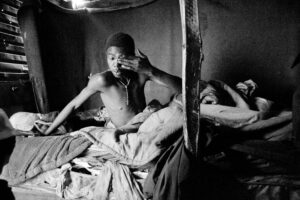
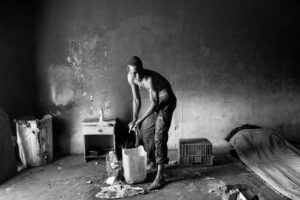
And yet heroin remains a grim topic whatever spin you put on it. That’s even more the case when you consider the current trend in South Africa for Nyaope, known as ‘poor man’s heroin’. This is highly addictive and can contain anything from detergent to rat poison or antiretroviral medications. Anybody who has been to Johannesburg knows that it can be hell on earth: and here’s why.
SOUTH AFRICA. Johannesburg. Thokoza. 2015. Thabang waking up in the early hours of the morning.
SOUTH AFRICA. Johannesburg. Katlehong. 2015. Bathing in Katlehong after a long day.
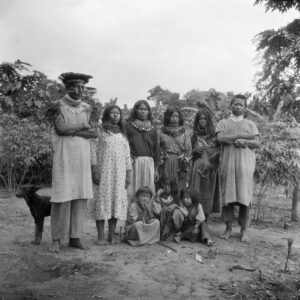
But the Sainsbury Centre frequently points out that drug use hasn’t always been this destructive. The message is that, as with anything in life, it helps to know what you’re doing. There still exist today peoples in South America with a positive relationship to Ayahuasca.
Richard Evans Schultes, The Cofan Family that met Schultes at Canejo, Rio Sucumbios, April 1942
Richard Evans Schultes, Cano Guacaya, Miritiparana, 1962
Richard Evans Scultes, Youth on the Paramo of San Antonio above the Valley of Subondoy, 1941
These pictures show another setting to drug exploration: we are in the great outdoors where drugs really originate. Quite simply, they grow in nature, and it is a relief to the viewer to be out of the urban setting where drug addiction so often goes badly wrong, into landscapes where the existence of drugs has a saner context.
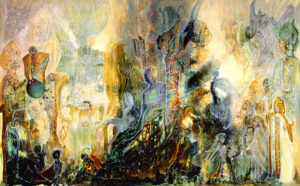
As interesting as they are, they rather pale in comparison to some of the images of visionary art in this exhibition, the best of which is Robert Venosa’s Ayahuasca Dream, 1994.
Robert Venosa, Ayahuasca Dream, 1994
All one can say about this picture is that if this is how the world looks on ayahuasca, you’d be a bit crazy not to want to try some. This is why people take drugs: they sense that the external world might be an end effect of something larger and that drugs might be a way to move towards that cause.
Venosa’s picture, with its sense of a drama we can’t quite grasp conducted involving figures whose identity we only vaguely know will touch a chord with many. It is impossible to look at something of this scale and beauty, and feel that drugs can be of no benefit to humankind.
Most people suspect that their mind is operating at a very low percentage as they conduct the rote tasks which the modern world can sometimes seem to require of them. They know they’re capable of more.
I think it’s more than possible to do all that in a state of sobriety, and that route will be better in the vast majority of cases, simply because so many people lack the willpower not to fall into perennial addiction. Who can sort the real drug mentors in the Amazon jungle from the charlatans?
But the Sainsbury Centre has done a great thing by tackling this subject in such an encyclopaedic fashion to remind us that though we each have our inner Amy Winehouse where everything can go badly wrong, we also potentially have a sort of Sergeant Pepper Lonely Hearts Club Band within as well – a new level to go to, whoever we are.