Category: Opinion

  • Dinesh Dhamija: ‘Raise a Glass to Indian Whiskey’

    Dinesh Dhamija


    Alongside its population and GDP milestones, this year India celebrated another world first: it is now the largest global market for Scotch whisky, its consumers buying 219 million 700ml bottles in 2022 compared with France in second place, at 205 million bottles.

    That in itself is big news. It demonstrates a sharp rise in disposable income among India’s middle class, now able to afford the 150 per cent tariff on imported Scotch.

    What’s astonishing is that India’s huge imports comprise just 2 per cent of the whisky bought in the country each year, a market now worth around $18 billion.

    Seven of the top 10 global whisky brands, by volume, are now Indian. They include Officer’s Choice, Royal Stag and McDowell’s, while premium brands such as Rampur, a single malt distilled in Uttar Pradesh and selling for the equivalent of £62.50 and Amrut’s Single Malt Whisky, distilled in Bangalore and selling for £50.25, are quickly gaining market share.

    Single malts now make up a third of the whisky market in India, more than double the level of 2017. “Until just a couple of decades ago, alcohol was still a taboo subject in India,” says publisher Vikram Achanta. “Indian spirits, and bar culture, has really taken off in the past few years.”

    Gujarat, home state of Prime Minister Narendra Modi (and Mahatma Gandhi) completely forbids the sale of alcohol, as does Bihar, Mizoram and Nagaland in northeast India. In fact illegal alcohol sale risks the death penalty in Gujarat. Other states such as Punjab impose a 25-year minimum age for drinking. Yet overall, drinking culture is becoming more popular.

    Locally distilled spirits have a strong competitive advantage over Scotch, given the high tariffs. They’ve had to overcome initial prejudice among Indian consumers, who felt that imported Scotch was inevitably of a higher quality. That bias is fading fast. “There is a reverse underlying notion of Indian products being at par or even better than global products,” says Vinod Giri, head of the main Indian drinks trade organisation.

    Four or five new single malt distilleries are in development, as companies rush to capitalise on changing tastes. As one Indian whisky connoisseur puts it: “When you get a single malt that’s as good or better [than imported Scotch], at less than half the price, it’s an offer you can’t refuse.”

    A UK-India free trade deal would level the playing field for imported Scotch, potentially denting the upward momentum of local distilleries. But with the astronomical growth in the market and increasing international acceptance of Indian whisky as a premium product, there should be plenty of takers for wee Indian drams.

    Dinesh Dhamija founded, built and sold online travel agency ebookers, before serving as a Member of the European Parliament. His latest book, The Indian Century, will be published in the Autumn.


  • Time Management: The Key to Success or Failure?

    Christopher Jackson


    Recently, Finito Education held a fascinating mentoring roundtable at a major bank in the City. Around the table for the discussion were 20 or so very bright young things, all the children of clients of the firm, as well as former Universities minister Sam Gyimah. It was an impressive discussion where young people aired their dreams and their doubts.

    Afterwards I was approached by a young man who wasn’t sure whether he wished to do postgraduate studies at Edinburgh or to go straight into employment. It was a very interesting conversation, but I could see also that whatever this person decided to do he would likely be successful: this was because he was asking all the right questions, and ready to hoover up any new information I might be able to offer up.

    Soon the conversation turned to my journalism career and the people I have been lucky enough to interview during its course. Due the nature of the roles I’ve been lucky enough to have I’ve interviewed people from the world of business (Sir Martin Sorrell, Sir Richard Branson, Lord Cruddas), sport (Andre Agassi, Jonathan Agnew), entertainment (Sir David Attenborough, Sting, Simon Callow, Guy Ritchie), literature (Sir Tom Stoppard, William Boyd) and across many other sectors.

    This intelligent young man asked me what he felt it was that had united all these people. Once you stripped away the inessential, the question was a very simple one. What causes success?

    I must admit I’d never given the matter huge thought before that moment – except in the general way in which one is always trying to gauge what excellence is on the off-chance of emulating it in one’s own life. Even so I found myself – almost to my own surprise – offering up the unhesitating reply: time management.

    But these two words tend to be bandied about a bit and are arguably bland; accordingly, I found myself enlarging on the point. All these successful people, in their different sectors, show a constant – even obsessive – awareness of the absolute value of time. All of them, even the wealthy ones, value it more than money.

    This awareness takes many forms, but the impression is always of time as being the medium by which – and through which – success is going to happen, a realisation which in these people generates the utmost care when it comes to organising their days. I remember talking once to the financier Andrew Law about an interview we wished to do with him about the late Ian Taylor. He wondered whether a few lines would be suitable, but when I suggested he write a bit more, he said: “I see, so I’m going to have to devote time to this.” I loved the intonation on the word ‘time’: it told you all you needed to know.

    Sometimes of course, it shows itself as impatience for the interview to be over and done with – something which journalists of every stripe must get used to and accept. I remember interviewing Attenborough during the pandemic, and feeling at the other end of the phone the need to get on to the next thing, which, in his case, in his mid-90s and with a planet to save, one could excuse, though I still wish he had been slightly less rude.

    Often though, a successful person has ordered their lives with such impeccable care that they appear to give you their time almost infinitely once it is secured. One such was William Boyd who I spoke to for some three hours in his Chelsea home. He was so convivial and generous that at one point I wondered aloud whether he didn’t want me out of his hair. “It’s okay, Chris,” he said, “I’ve set aside this time.” Again, I was aware of time as a valuable commodity, and one could easily imagine that the morning taken up with me would cede to a productive afternoon of work.

    Organising our time well can often turn out to be in some sense a moral boon for ourselves and others. It was CS Lewis who observed that a true Christian – in our secular world, we might think instead in terms of a highly successful person – will seem to have more time than other people. It is always an impressive thing to hear of those very busy and important people who make time for others – time which, we might have assumed, they didn’t have.

    In fact, we always have it. As we make our choices in our careers, we may face any number of forks in the road, and sometimes we cannot control those outcomes. But here is something we can control – and the sooner we learn to master it the better.

  • Matthew Perry: 1969-2023

    Christopher Jackson

    There is a scene in Matthew Perry’s memoir Friends, Lovers and The Big, Terrible Thing which it is impossible to read without sadness over the past few days.

    In it, Perry recalls the period before the first episode of Friends aired. It was a heady time. The internal data from the television studio showed with certainty that the show would be the gigantic hit which it became. Some sensible producer observed that as a result all six of the main cast – Jennifer Aniston, Courtney Cox, Lisa Kudrow, Matt Le Blanc, David Schwimmer and Perry himself – would soon become very famous indeed. It was therefore suggested that the cast go out for a night out on the tiles – a last stab at the anonymity which they were about to surrender for good.

    What makes the scene interesting is Perry’s evident nostalgia for that time before his name became so known. It was President Obama who during an appearance on Jerry Seinfeld’s Comedians in Cars Getting Coffee opined that he hadn’t considered the value of anonymity before becoming famous. Seinfeld replies: “It wasn’t that great.” Perry would agree with Obama that something almost beyond price is lost at the point of transitioning away from obscurity into its moneyed opposite.

    As the reader, we have mixed feelings reading about this strange night out before gigantic celebrity is bestowed. On the one hand, if Perry’s fame was what it took for us to be able to know Chandler Bing over the ten astonishingly successful seasons of Friends perhaps the pain which came to him as a celebrity was in some way a necessary sacrifice at the altar of light entertainment.

    On the other hand, seeing his evident unhappiness down the years, and his essential inability to function in the spotlight, one wishes him out of it altogether. Perry as a failed actor would surely have been a happier man; one even wonders whether someone else could have played Chandler who might actually have enjoyed the experience and not felt the pressure of it all so acutely.

    But really there never was any need for such dichotomy: there should never have been any either/or about Matthew Perry’s predicament. Was Perry always going to suffer mental health issues or were they a biproduct of fame? It seems likely that the latter had a huge role to play.

    It would be better if we were able to inhabit a society where television is just one of a thousand other professions and not elevated to such a crazy extent by the paraphernalia of stardom. We are a society of the famous and the not-famous-at-all: it quickens the pulse of most people to be see a celebrity in the flesh. Fame messes with the head, as Martin Amis, also famous and also one of those to die in 2023, frankly put it in his own memoir Experience.

    Similarly, Perry’s life reminds us that the discussion around mental health is still very much in its infancy, though it was accelerated hugely during the pandemic when all of us felt alarmed at the unnaturalness of the situation. The options aren’t always sufficient even if you have the money to fight the problem: Perry spent $9 million dollars fighting his afflictions and one sometimes wonders whether even high-end provision in this area is enough to really move the dial if someone has gone far enough down the path of self-destruction.

    Yet despite all this, we have Perry’s work and this reminds us that there was for a while something marvellous about Friends especially in those first few seasons. We have also forgotten at this point – especially since the others went on to have more successful and stable careers than Perry – how much the show really revolved around Chandler/Perry.

    This was because while Ross, played by David Schwimmer, had the funniest slapstick moments, Chandler always had the best lines. It was Seinfeld again who identified that the final stage of comedy is to have people talking like you because it’s so much fun. Perry alone of the Friends cast reached that level: “Could I be wearing any more clothes.”

    That intonation on the word ‘be’ can summon back for me the whole of the 1990s. Chandler’s wit was a way of staving off the eternal anxiety of youth – the sort of anxiety which is meant to have been dispatched by the age Perry was when he was playing the role. This is why the show is so popular among teenagers; at that age we identify with Chandler.

    Sadly in Chandler Perry had left an autobiography of sorts of a perennially nervous man who must joke in order to function. Nietzsche wrote that a joke is an epitaph on the death of a feeling, but these were feelings which could not die with Perry. A sense of inadequacy, perhaps arising out of his parents’ divorce, pursued him and was always going to be more successful in that pursuit once Perry was made vulnerable by fame.

    In one famous scene, Chandler says: “I’m not great at advice. Can I interest you in a sarcastic comment?” He always could interest us in that, but it was his fate to end up dispensing advice: don’t be like me.

    Yet in our world today we all want to emulate the famous if only to have infinite money and opportunity. His death is a moment to mourn the loss of a kind man and magnificent comic talent, but also to consider a fundamental recalibration in our relationship with fame.

  • Dinesh Dhamija on India’s Investment Allure

    Dinesh Dhamija


    As the world polarises further into warring blocs, with Russia, China and Iran on one side and the US and Europe on the other fighting proxy battles in Ukraine and Gaza, India is forging for itself an ‘honest broker’ role.

    Pacifist by nature, India has studiously avoided siding with extremist ideologies or states. During the Cold War, the country kept an open mind to Communism: it was widely tolerated in the south of India, without threatening to dominate.

    In the current climate, Prime Minister Narendra Modi has pulled off the seemingly impossible trick of staying friends with Russia while being courted by US President Joe Biden, British Prime Minister Rishi Sunak and Australia’s Anthony Albanese.

    For the nation’s economy and its future as an investment destination, these are very positive traits. Such is the fear of intensified disruption in the Middle East and Central Asia, with recent mini conflicts breaking out in Azerbaijan, Kazakhstan and Belarus, that a safe space for emerging market investment is at a premium.

    As the Financial Times reported recently, India today is “powerfully appealing” to investors. “Over the past 30, 20, 10 and five years, the Sensex has performed as well or better than the S&P 500, leaving other big markets far behind,” it pointed out the other day. India is now more efficient, thanks to infrastructure development in roads, ports, railways and airports; electrification has reached 90 per cent of households, up from 67 per cent a decade ago. And its huge working age population is expected to rise for years to come, just as most developed economies begin to age.

    Much as we in the West might wish that India put its weight behind us on Ukraine or in the Middle East, its purposeful neutrality may serve it better than any hasty favouritism.

    And as democracy comes under attack in the United States from the increasingly rabid Republican party, or even in Europe with the rise of extremists such as Viktor Orban of Hungary, the world’s largest democracy gains yet more allure.

    As the FT says: “The desire to allocate a meaningful slice of portfolios to the emerging world, as a source of both diversification and growth, remains.”

    India has represented the best destination for this slice for a few years now. The latest eruption of conflict in the Middle East only adds to the logic of investing in the relatively stable, democratic, fast-modernising Indian economy.

    Dinesh Dhamija founded, built and sold online travel agency ebookers, before serving as a Member of the European Parliament. His latest book, The Indian Century, will be published in the Autumn.

  • The Dinosaur’s Last Ride: Paul Joyce on why he’s still a petrolhead in the age of electric cars

    Paul Joyce


    Yes, that’s me, I’m the dinosaur. Surrounded by exhortations and ads for electric vehicles, all at what seem like heavily inflated prices, and unable to even afford to glance at a Lexus, I have to declare that I am an unabashed petrolhead. From the moment I clambered into a £25 pre-war, three forward geared Austin, I was hooked. No matter that when the £1.50 clutch plate failed, the car had to be jacked up and the gearbox removed to replace the thirty-bob part: that was all part and parcel of the fun. But the blindness of even the greatest manufacturers such as Land Rover can lead to extremely costly mistakes. Take my current vehicle which I am about to, reluctantly, part with: a 2010 Range Rover Sport. It boasts a fantastic three-litre diesel engine, capable of driving you to the moon and back with scarcely a drop of additional oil needed.

    But those clever lads at LR did not think about any kind of major engine failure; so they positioned one of the most important aspects, namely the injectors (10 or 12 of them) in a location under the rear bonnet housing which makes them nigh impossible to service, and certainly not replaceable without recourse to heavy plant equipment. Thus, a hundred pound job swiftly morphs into a grand of anyone’s money. Buyer and driver be aware that expensive cars are like, at least as I am informed, all water-going vessels, namely an invitation to open your wallet over the nearest storm drain.

    Clearly in an ideal world we should all be driving Teslas, and probably would be if they cost 15 rather then 50 thousand. But the race to obtain the plug-in option seems to me to be gathering pace at an alarming speed; this combined with an element of panic fuelled by successive government pronouncements about the damage we are all doing, consciously or unconsciously, to our precious environment.

    Contemplating the fag end of a five decade long vehicular list which, amongst others, comprised an original Mini, countless Morris Minors, Ford 5 cwt vans, something before Nissan became Nissan, a Ford Mondeo (rapidly sold due to a child’s upchuck) and pride of place, Stanley Kubrick’s ex -Mercedes S Class, should it be electric, Hybrid, diesel or petrol? Well I think by now you have probably guessed, I am way too old to change and fiddle around in crowded waystations with disconnecting APPS waiting to top up a depleted set of ridiculously cumbersome batteries. For me still the smell of petrol and the inevitable dribble of fuel onto one’s toecap any day!

    So, petrol or diesel is the likeliest option, with a brief flirtation with the notion of a hybrid, but 20k plus soon put that idea firmly to bed. Fortunately, near to where I live in High Wycombe, lies a farmhouse on the edge of town where the outbuildings seem to all be devoted to the dead, dying and damned of generations of Land Rovers: V and G Agricultural.  Standing firmly in charge of this battlefield of ancient armour, reminiscent of Napoleon at Austerlitz, stands James, a man of few well-chosen words, and his partner the loquacious Mick, thus forming a formidable double-act.

    So, with some trepidation I approach James and ask about which vehicle I should consider as my (pen)ultimate vehicle?  “Freelander 2” comes the immediate reply followed by the epithet, “bullet-proof!  That’s the kind of vehicle we like, the ones we rarely see as they are so reliable. Or rather we don’t like as we are in the repair business.”  So I ask him to perhaps look out for a replacement for my Range Rover Sports, one that will not have me tearing my hair out over replacement injector prices, or inconvenient recalls like some I am still waiting on (exploding rear windscreen housings, for example, what the main Land Rover agent says is a four day job, whilst James says “four hours more like”.)  Good enough for me, Freelander it is.

    When I was growing up in a post World War Two south London, I could tell almost every car on the road, domestic or foreign. Now I have absolutely no idea which is what, as they all seem to be following the same pursuit of slitty-eyed SUVs. Not only do they all look alike, they are alike. For example, Volkswagen own Skoda, Seat and Cupra; Suzuki and Toyota are joined at the hip; the latest Rolls Royce and the BMWX8 are basically the same underlying vehicle; Hyundai and Kia are interchangeable and Nissan own Mitsubishi and Renault.

    Once, when out for a drive in my father’s cherished Morris Minor with my childhood friend, Dennis we were overtaken at unnecessary speed by the wholly unremarkable Vauxhall Viva. Dennis quickly quipped “he’s only going that fast to try and prove that he hasn’t actually bought a piece of shit!”. But these days, buying a new vehicle is like engaging in a lucky dip, with decisions based on (probably misplaced ) brand loyalty or marginal difference in price structures. This together with the fact that many are made in China, still the world’s greatest planet polluter.

    I’m only too aware that I represent the past in all this, but I have serious concerns about the impact of digging for precious metals such as lithium on the environment.  Already tracts of Native American territory in Nevada are likely to turn into dustbowls after mighty corporations extract all they can, as soon as they can.  Our Earth can stand a little pollution but not the wholesale extraction of its basic elements. Such philosophy forms the basis of my decision to stay with an old-fashioned but proven technology, allowing me, and it, to gradually fade away in a discreet puff of smoke from a sturdy (bullet-proof) Land Rover.

  • Why India’s Space Programme is Worth Every Rupee

    Dinesh Dhamija


    “Why should Britain send aid to India when it has a space programme?” is a complaint you often hear in the UK.

    Well, here’s my answer.

    First, what some people call ‘aid’ is actually business development. Both the Indian High Commission and the British Foreign, Commonwealth and Development Office (FCDO) insist that aid from the UK to India stopped years ago.

    “Since 2015 the UK has given no financial aid to the government of India,” said the FCDO recently. “Most of our funding now is focused on business investments which help create new markets and jobs for the UK, as well as India.”

    In any case, you could ask the same questions about any country’s space programme. Why does Britain fund a Space Agency when the NHS is in crisis and its schools are collapsing?

    Second, India’s programme is not new, it began in the 1960s, shortly after US President Kennedy challenged his countrymen to land on the moon during that decade. Since then, it has steadily grown, bringing untold benefits to India: satellite technology to monitor crops and survey natural disasters; telemedicine and telecommunication for remote communities; employment for thousands of people; funding for high-tech businesses.

    This all helps India to feed, educate and employ its people. It’s not a vanity scheme, it’s a crucial part of the country’s development story. As Martin Barstow, professor of astrophysics at the University of Leicester points out: “The money you spend in space isn’t really spent in space. It is spent on the ground.”

    When India became the first country to land a spacecraft on the south pole of the moon in August this year, it gave Indians across the nation a tremendous sense of pride. Behind the scenes, it was a triumph on many levels. India spends just $1.3 billion per year on its space programme, compared with NASA’s annual budget of more than $20 billion.

    The contrast of India’s successful landing with Russia’s disastrous mission a few days earlier (supposedly a far richer and more advanced space programme) was stark.

    Business finance in India is part of the soft power the UK employs to further its own goals, including the trade agreement which promises to deliver such dividends to both the UK and India. Withdrawing the yearly £33.4 million that the Foreign Office sends to India would be a false economy, set against the potential rewards of a deal.

    Historically, India was an astronomical pioneer, with roots going back 3500 years to the Vedas of the Indus Valley civilisation. The 6th century work the Aryabhatiya was the pinnacle of astronomical knowledge of its time.

    So it shouldn’t be any surprise that, as India regains its confidence and international prestige, it is once more guiding the world’s understanding of the heavens.

    This is yet another thing to be applauded about modern day India. It will benefit mankind, whether or not the UK withdraws its modest financial contribution.

    Dinesh Dhamija founded, built and sold online travel agency ebookers, before serving as a Member of the European Parliament. His latest book, The Indian Century, will be published in the Autumn.

  • Dinesh Dhamija: Is sport in India about to explode?

    Dinesh Dhamija


    Now that the eyes of the cricket-loving world are turned to the country, as it hosts the World Cup – the biggest event in the sport’s calendar – there’s a new and different story to tell. This tournament is great, but it’s also more of the same. India has co-hosted the Cricket World Cup on three previous occasions (in 1987, 1996 and 2011) and is doing a great job this time around. This weekend India will play Pakistan for the first time on home soil for seven years in front of an estimated TV audience of half a billion people – that’s five times the Super Bowl!


    These are phenomenal figures, but what interests me is the potential for a huge uplift outside cricket. With 1.45 billion people, it’s an anomaly that India produces so few sportspeople. Where are the athletes, the soccer players, the golfers, the swimmers, the cyclists, the boxers and the tennis players? India lacks both the centralised political system that drives millions of Chinese into sport and the wealth of funding available to young sporting Americans and Europeans. Change could be on its way: two pieces of news came to my attention this week that offer hope for the future.

    First, the International Olympic Committee is about to hold a conference in India. The choice of venue is always important: It shows that the IOC is taking India’s bid for the 2036 Olympics seriously. All the other summer games up to 2032 are already taken. If India wins the games, this would be truly transformative. Massive amounts of funding would be channelled into developing India’s sportspeople over the next 13 years, bringing untold opportunities to those hundreds of millions of Indians who adore sport, but have so far lacked facilities and access. Narendra Modi is firmly behind the bid, just as he has supported the rapid and dramatic expansion of cricket in India. He recognises the multiple benefits in terms of health, community cohesion and national pride. I really hope it happens.

    Second, my colleague David Nicholson, who helped research my latest book The Indian Century, competed in a triathlon in Goa last weekend. Triathlon is a relative novelty in India – Ironman 70.3 Goa only began in 2019 – but it attracted more than a thousand athletes. Goan Chief Minister Pramod Sawant sent the competitors on their way at 7am to swim 1.9km in the Arabian Sea, cycle 90km through the Goan countryside then run a half-marathon in the blazing heat next to Miramar beach in the state capital Panjim.

    The race prompted both state and national press coverage, including an article on David and his son Samuel, who also took part, with David winning an award for coming second in his age group. “There was a fantastic buzz about the race,” David tells me from Goa. “The streets were filled with supporters, alongside reporters and press photographers. It was a carnival of sport, with athletes from more than 30 countries competing.”

    I would love to see more events like this, as India takes its place among the world’s great sporting nations.

    Dinesh Dhamija founded, built and sold online travel agency ebookers, before serving as a Member of the European Parliament. His latest book, The Indian Century, will be published in the Autumn.

  • Sarah Cobden-Ramsay on her ground-breaking jewellery charity Rhino Tears

    Sarah Cobden-Ramsay

    It was during a visit to the Kariega Game Reserve in South Africa in 2016 that I encountered a remarkable rhino called Thandi. This was not just a wildlife sighting; for me it was a life-altering event.

    Thandi was a living testament to survival. She had suffered a horrendous poaching attack, her face had been savagely disfigured to extract her horn. Despite the physical trauma, her indomitable spirit shone through. Not only did she survive this gruesome assault, Thandi has become a symbol of resilience, mothering five calves – Thembi, Colin, Mthetho, Siya and Zolani. The horribly scarred, yet serene Thandi, grazing quietly with her first, 18 month year old calf, Thembi, was a turning point for me. I had to contribute, even if in some small way, to help fight this dark canvas of brutal poaching and support the incredible work so many do in rhino conservation.

    I had several years of experience as a jeweller, a skill honed under the tutelage of Jinks McGrath in her Sussex workshop. With Thandi as my inspiration and my passion for jewellery, I embarked on the journey of creating ‘Rhino Tears’, firstly designing a unique piece of jewellery Thandi’s honour and hopefully a way in raising awareness and those all-important anti-poaching funds.

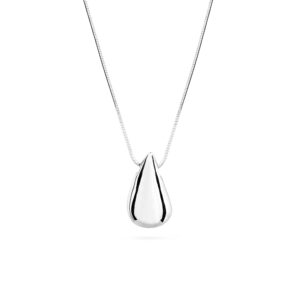
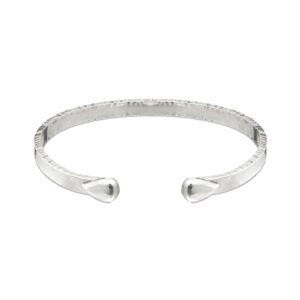
    Each piece is designed as a delicate solid gold, or silver tear, and carries an engraved hallmark on the back – a triangle with a ‘T’, in homage to Thandi. For me, for every sale, it becomes more than just a piece of jewellery; it becomes a tangible symbol of strength, survival, and hope.

    Happily, my charity Rhino Tears, has gone from strength to strength, the product has evolved to include earrings, cuffs and bracelets and particular commissions with diamond inlay in both silver and gold, pendants and earring across the range.

    This has resulted over the years, in considerable donations to a few carefully chosen charities. Importantly for me, these game reserves in South Africa and Kenya are passionate about the conservation of rhinos in their natural habitat, as well as raising awareness and enabling local communities in supporting their heritage for the future.

    The monies raised have gone to help in several areas, primarily anti-poaching units, the purchasing and training of tracking dogs, tracking collars, cameras, the sad but essential de-horning of rhinos and the successful rewilding of orphans. Rhino Tears has also been able to proudly fund eight local interns through a year’s training in wildlife conservation and protection. They are now full- fledged rangers at the Kariega Game Reserve. Although most of my sales are done online, due to popular demand, I have been thrilled to provide Rhino Tears’ jewellery to several outlets, including the Curio Shop at Kariega, Ant’s Nest in the Waterberg and Auckland Zoo.

    My journey from the plains of Kariega Game Reserve and a jewellery workshop in Sussex, I hope will inspire, and show that we can all find a small part to play in preserving our planet’s rich biodiversity and ensure the rhinos may roam freely and safely on the plains of Africa.


    Go to rhinotears.org

  • Omar Sabbagh: An Expat’s Impressions of London

    Omar Sabbagh


    I was born, bred, studied, then studied some more, in London (or thereabouts).  I didn’t have a full-time job until 2011, on completion of (most of) my postgraduate studies; and that first full-time job was in Beirut, Lebanon, at the AUB.  Though I returned to London between 2013 and 2014, to complete yet one more, last round of postgraduate study, from 2014 to the present I have resided and worked in Dubai, at the American University in Dubai (AUD).

    What all this means is that for over a decade, give or take, though a Londoner, growing up in a highly privileged setting, in a kind of mansion in Wimbledon, my working-life has been wholly in the Middle East.  So that, the experience of being back in London, usually over the summer holidays, is a slightly estranged experience – though of course in some ways in continuity with my childhood and youth.  For one thing I’ve a family of my own now; and a young, four-year-old daughter, the light of my life, who was also born in London in the summer of 2019.  And what I think may prove an interesting or compelling way of demonstrating the different experience of London, for me as a kind of expat now, might be to describe that change through the lens of what I observed about my daughter’s experience.  The highlights for her in London are or were the highlights for me, as I suppose they would be for any loving parent; but they also might be a nifty way of highlighting what London feels like when – if not wholly estranged – it is seen and lived anew.

    The first image that occurs, recollecting now, is my daughter jumping in puddles, much like the ‘Peppa Pig’ character she loves so much.  Yes, it wasn’t necessarily a clean-run experience, because my daughter, highly excited by the opportunity to actually jump in puddles, did have to then change her socks and shoes and some of her clothes – which can prove a task for any parent.  However, one of her favorite cartoon characters aside, the image of her jumping in puddles with such newfound glee, did I suppose emphasize in a visceral way, how long it had been since I was truly, fully, in London.  And even if it is a very ‘British’ thing to talk about the weather, it seems to me now like a kind of paradox, that the very thing that first occurs to me from a distance is the same thing landlocked Britishers also seem to be mildly obsessed with.  Indeed, looking at and living London again, but through the eyes of one’s own child, makes one feel both more distant from one’s youth, and I suppose closer, from a different vantage point.  It’s a very composite and layered kind of experience.

    When asked to her face if she ‘liked’ London, my daughter answered in the same way that she had answered at a different, earlier time, about ‘Beirut;’ that she liked it because it was ‘so dirty.’  Living in so svelte a space as Dubai, where nearly every experience is bubbled-up, bubble-wrapped and built-up; where walking down an average street is far less cluttered and far less subject, on the face of things at least, to the impacts of contingency, meant that she noticed in both London and Beirut how the very different, messier topography was in a way, for her young take on things, salubrious.  I enjoyed taking my daughter on planned visits to sites, such as the Aquarium, but the truer impression was not in specially targeted outings, but in the very press and pull and mess of daily, happenstance living.  In fact, that just is the difference, as felt.

    For us in Dubai, each outing as a small nuclear family is, and just has to be (due to the way things are built-up in Dubai, the geography and the resultant topography) choreographed in advance.  This has benefits of course, and one should never underestimate how wonderfully suited to young families Dubai is.  But what my daughter sensed, I must surmise, was the possibility of the adventures of the ‘everyday’ in London – which can seem to be somewhat foreclosed in Dubai.  At least for us.  And I must say that at a personal level, as soon as I land in London, catching a cab from the airport home, I feel a sense of relief at being ‘home.’  I have missed, you see, the ability to be surprised, even to be disappointed, in my day-to-day doings.  There is something so health-giving about the sensed unpredictability of London life.  And through the eyes of my own daughter, the eyes of a neophyte far from accustomed to London, I find myself understanding and experiencing once again the strange homeliness of London for me.  Perhaps a little or a long-borne distance, in time and space, allows one to see all that one knew so well, anew, and thereby return the lived, the youth, back to its older life.

    As for returning to London, after all the above, well, the more official exigencies of London life now seem to proscribe it for my young family and myself.  Indeed, when searching for cognate jobs, as a lecturer in literature and/or creative writing, I notice more than ever now, how inimical life at a basic economic level would be in London.  Even though I do not in any real sense work in the private sector in Dubai, where employees as much as employers can amass burly savings due to the slimness of taxation here, my job as an Associate Professor provides my family and I with a much better life, all-round.  Though the net salaries for two similar jobs, in London as in Dubai, might be relatively close, in London, quite unlike Dubai, one is not blessed as well with all the benefits (of accommodation, health insurance and coverage and/or, say, financial coverage to a certain extent of one’s children’s education) one revels in here.  So, to come full circle: yes, I have been away from London my whole working-life; and yes, I do miss it, the hurly-burly, the brouhaha of it; but in the most basic, real terms, as things stand being in Dubai, or at least, not in London at present, just works better for us.


    Omar Sabbagh is a widely published poet, writer and critic.  His latest books are, Cedar: Scenes from Lebanese Life (Northside House, 2023), and Y KNOTS: Short Fictions (Liquorice Fish Books, Oct. 2023).  His next, forthcoming poetry collection, FOR ECHO will be published with Cinnamon Press in Spring 2024.
  • James Cleverly on India

    Dinesh Dhamija

    I’ve just had the pleasure of meeting the Foreign Secretary James Cleverly, when he generously made time to attend a breakfast with me and a few dozen friends and colleagues, to celebrate the impending publication of my book The Indian Century. He is a very personable man: he laughs easily – often at himself – and has a winning combination of seriousness and relaxed friendliness that few politicians manage. He also combines a background as a British man of mixed heritage (his father is English, his mother comes from Sierra Leone), a military career, experience as a business owner and in local government. Even more unusually, he survived being appointed as Foreign Secretary by Liz Truss and remains in that role today.

    The question of whether we can achieve a trade deal with India is of course on the top of people’s minds. Does Cleverly think it’s achievable?

    “We have been making fantastic ground,” he said. “The EU, for example, have been trying to negotiate a trade deal with India since 2007. I believe we’ve made more progress since our departure from the European Union than I think a lot of our critics would have expected.”
    Admitting that negotiations are likely to last some time further, he is quick to put any policy disagreements into context. “In various ways we have disagreements on policy issues with all our international partners. When I go over to Washington, part of the conversation I have with the US is where we have disagreements on their policy positions.”

    Cleverly is a consensus politician, skilled at listening to what the other side has to say and looking to reach common ground, rather than trying to bulldoze arguments through. Asked whether Britain should be talking to China, when its people are accused of spying, he replies that it’s important to keep diplomatic channels open, and to look for reasonable people with whom to negotiate.

    Equally, from Britain’s self-interest, it is crucially important to develop closer relationships with countries such as India that will be increasingly influential in the future. We should not rely on “the comfort blanket of our nearest neighbours,” says Cleverly.

    The potential rewards of a trade deal between Britain and India, which include an estimated 300,000 new jobs in the UK and as many as a million in India, are among the benefits that he sees from this new focus on trade outside the European Union. Although I am a confirmed Europhile and opposed Brexit, I would love to see these advantages realised, especially relating to India.

    If Indian politicians – and indeed its public – are reluctant to agree to a trade deal with Britain on account of historic grievances, it would be good for them to see more images of James Cleverly and Rishi Sunak together: one of Indian heritage and the other with African roots.

    Whatever Home Secretary Suella Braverman might spout about the failure of multiculturalism, the optics of Sunak and Cleverly as the main negotiating force for Britain in the world are a powerful reminder of progress.

    Dinesh Dhamija founded, built and sold online travel agency ebookers, before serving as a Member of the European Parliament. His latest book, The Indian Century, will be published in the Autumn.