A new study has named the occupations with the largest gender pay gaps in the UK. Barristers and judges have the largest gender pay gap, according to a new study. Financial managers and directors have the second largest gender pay gap.
Personal injury experts at Claims.co.uk examined data from the Office for National Statistics (ONS) to discover which occupations have the largest gender pay gaps. They collected the male and female median hourly earnings and calculated the differences in pay for each occupation, thus determining which ones have the largest gender pay gap percentage.
Barristers and judges are at the top of the ranking, with the largest gap between male and female hourly earnings. Female barristers and judges earn an astonishing £8.31 less an hour than their male counterparts, meaning they are paid 29.1% less than men in this occupation.
Financial managers and directors are close behind in second place, with women being paid approximately £11.56 less an hour than men in the same occupation. This leaves female workers in this occupation being paid a staggering 28.8% less than their male equals.
The occupation with the third largest gender pay gap is web design professionals, where women are paid £6.32 less an hour than men, or 27.7% less than their male counterparts.
Production, factory and assembly supervisors take fourth place, where female workers earn 26% less than male workers, or £4.46 less an hour. Assemblers of vehicles and metal goods are in sixth place. Female assemblers earn £3.74 less an hour, equating to 23.5% less than male assemblers.
Meanwhile, Vehicle technicians, mechanics, and electricians have the sixth largest gender pay gap, with women being paid £3.28 less an hour, or 22.4% less than men. In seventh place is education managers, where women earn 22% less than men, which is equal to £6.03 less an hour.
Similarly, female nursery education teaching professionals also earn less than their male counterparts – 21.2% less to be exact – placing them eighth. That is equal to women earning £5.10 less an hour than men in this occupation.
Production managers and directors in construction are in ninth place, with female workers earning £5.03 less an hour than men – this equates to women being paid 21% less than men in the same occupation.
Tenth place goes to newspaper and periodical journalists and reporters. Female journalists and reporters earn 20.6% less, or £4.32 less an hour than males.
Costeau reports on how the cost of living is affecting one of Mayfair’s oldest institutions: the Private Members’ Club
As Costeau walks into 5 Hertford Street, he receives that jolt of self-importance which he has learned to distrust: there is a sense, which surely must be foolish, that one has somehow arrived. Isn’t that Robin Birley sitting over there? Didn’t that tall chap used to chair the Conservative Party? And I seem to remember that woman has a title which she only uses when she comes in here.
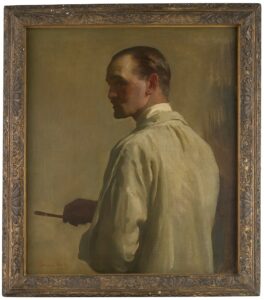
Of course, 5 Hertford Street has an immaculate aesthetic, the bloodline of which one might trace back past Robin Birley, through his father Mark Birley – also the founder of Annabel’s and a myriad others – back to his father Sir Oswald Birley, the middling portrait-painter. Part of its pleasure is the sense of a very plush warren, where some of the most important meetings are taking place in some attic or anteroom whose existence you certainly wouldn’t intuit in the foyer.
Oswald Birley, Self-Portrait
Even so, as nice as it all is, the suspicion remains that people join Private Members’ Clubs not just because they’re convenient, but also to say they’ve joined them. There is perhaps a certain commercial power to saying to a prospective client: “Let’s meet at my club.” This sentence alone suggests the existence of disposable income, and therefore success.
When I speak to an ultra-high-net-worth individual who seems to be a member of almost all the clubs of London, including Alfred’s where the Dover sole is especially to be recommended. “This is my kitchen,” he says, with a gesture at the whole of Mayfair, not referring to one of these clubs, but to all of them.
The job opportunities in these places mirror those in the broader hospitality industry, marrying up the possibilities of working in a Michelin Star dining setting with working in a luxury hotel. One manager tells me candidates wouldn’t stand a chance of success without “discretion, presentability and perhaps a quiet enjoyment of the finer things in life” – even if you are serving people who are experiencing those finer things and not experiencing them yourself.
The expansion in these clubs these past years has meant that it is possible, if you have the income, to be never far from a possible exclusive spot. If you’re somewhat exhausted after a meeting with your banker in the City, then for five years or so it’s been possible to swing by Ten Trinity Square. Here you enter a world of wood-panelled comfort: an experience which ought to rub away at the fact of having spent the morning in a financial institution discussing the interest rate.
While Ten Trinity Square is still relatively new, one of the features of the world of private members’ clubs is to feel a connection with the city’s past – and especially with its aristocratic past. In Home House, there is the magnificent staircase by Robert Adam, spiralling up towards a skylight. The dining room offers expansive views of Portman Square as you eat what may be the best cuisine in the city.
Ten Trinity Square, the go to club for the City
But perhaps there is an increasing sense of disconnect in today’s cost of living crisis. Pampered luxury isn’t always the best look when, a few streets away, others are struggling to make ends meet. If joining one of these clubs is tantamount to admitting to a spare £5,000 a year, one may sometimes wonder if that money might not have been better spent. Many of the members of these clubs publicly remind the outside world that they’re engaged on extensive charitable works after all.
Perhaps this is why I was rather fond of the House of St Barnabas just off Soho Square where the food was so reliably bad as to salve one’s conscience. I say was because news has now reached me that the club has sadly closed, but I think there is much other clubs can learn from the attempt. In the House, the coffee possessed the unmistakeable tang of Nescafé Instant, the pizza – one of the few things on the menu – tended to almost laughably inedible, and even the nibbles could reliably bring on any number of gastric illnesses.
But there was method in this madness, since the place doubled up as a homeless charity. The club’s website tells visitors that the House is on a mission to change the conversation around homelessness, broadening the definition away from rough sleeping to encompass the 104,510 households currently in unsuitable accommodation.
The House of St Barnabas sadly announced its closure in January 2024
Chief Executive Rosie Ferguson explained in the club’s 2023 Impact Report: “Private member’s clubs have existed for centuries. They have often acted as exclusive spaces for the elite, an environment created in order to give wealthy people their own networks and careers, and their exclusivity has been at odds with diversity, inclusion and social progress.” This is an important document – one searches in vain for evidence of 5 Hertford Street’s social impact report. That’s not to say Robin Birley doesn’t do any good – most people do – but The Guardian has reported that staff were lobbying in 2019 for a living wage, with porters paid £8.50 an hour. This report may need to be taken with a pinch of salt, since it was written by that scourge of the right, the left-wing commentator Owen Jones who might be said to have a certain predisposition to paint Birley et al. in a negative light.
But it does make one wonder a bit about the ultimate purpose of these places, even as one always enjoys dining at them. One also can’t help but feel that their original historical intention has been slowly mutated by a failing politics.
These clubs originally emanated out of the coffee shops, and were places of political debate: one has an image of William Pitt the Younger holding court at White’s or Charles James Fox issuing his latest opinions at Brooks’s just down the road. This was not an undebauched time, especially not for Fox who, being the Boris Johnson of his day, was as dedicated a philanderer as he was an orator. But nobody doubts they had concrete matters to discuss.
William Wilberforce, who was in the Pitt set, extricated himself from the club scene after his conversion and the result, after a long period of attrition in Parliament, was the expedition of the abolition of the slave trade. One wonders whether the House of St Barnabas, with its impressive Employment Participation Programme, where 95 per cent of participants have completed the course, might have marked a new seriousness of purpose more suitable for these times. The club had worked with 42 employers, partnering with Bafta 195 and Nimax Theatres. Let’s hope that despite its failure it has some sort of legacy.
Similarly, there has been a marked rise in the women’s only private members’ club, with the Allbright leading the way. This is named after the first female US Secretary of State Madeleine Allbright who once remarked: “There’s a special place in Hell for women who don’t help each other.” Notable members include actress Olivia Wilde, filmmaker Gurinder Chadha, and the business woman Martha Lane-Fox.
All of this shows that the sector is shifting, and that the opportunities for a meaningful career are broadening. This is now an area where you can work in a thoughtful environment as much in the service to ideals, as in the service to ultra-high-net-worth individuals whose opinions you might not agree with. Obviously, if the coffee had been better at the House of St Barnabas that might have helped with the membership numbers; but equally, it might not be an idea for 5 Hertford Street to do a bit of visible giving back to the community.
I have been observing the government’s education priorities, which currently place particular importance on maths. It is important that we focus on this subject, of course, but we shouldn’t do so at the expense of others: most importantly we are almost at the point where we begin to find that history doesn’t matter – and yet, of course, it matters very much.
That’s because you have to know where you have come from, and what has happened in the past. For instance, I have just been reading about and understanding the Churchill family. If you do that you discover that John Churchill, the first Duke of Marlborough, was an extraordinary general – perhaps the most famous in Europe, in the pre-Napoleon era. He was instrumental in winning the Nine Years’ War against King Louis XIV. If you read about Marlborough’s command of his troops, you see an almost exact parallel with his ancestor Sir Winston Churchill who would play such a prominent role as Prime Minister during the Second World War. History is full of such lessons, and we can learn from these links and correspondences.
Our problem appears to be that we don’t take the trouble to learn from history – and especially the past mistakes that have been made. In a society which seems not to place sufficient value on history, we tend to carry on regardless, creating havoc, misery and mayhem in so many parts of the world. Unfortunately, we have arrived at this rather stupid idea that aggression and warfare is going to resolve our problems. It doesn’t resolve our problems; it increases them. When you consider the suffering and disaster that is continually being meted out to millions of people, you realise we need more politicians and people in positions of leadership who have this understanding.
This is not to say that this kind of historical awareness alone will solve matters. It is extremely complicated to know how to deal with international conflict and to know what structures both domestically and internationally might be required. It goes without saying that if we don’t give some thought to that, then we are heading straight into the abyss. By that light, history isn’t just a mere curiosity – it calls to us with urgent importance.
Russia-Ukraine remains a very difficult situation. I think we should be making active attempts to seek a negotiated agreement but it is extremely difficult when you have a person such as Vladimir Putin in charge. The fact is, he has committed himself and if he fails, he may well recognise that he will follow the destiny of previous leaders who overreached. Russia has a history of getting rid of its leaders: if you are a leader in Russia it’s unwise for you to go to the top floor of any apartment and keep well away from the windows.
In a sense it’s not only that Putin is fighting this war, he is also fighting for his life. When someone fights for their life they become desperate and this fact alone will make a negotiated settlement extremely difficult. But this doesn’t mean this goal should not be worked towards. We need the best brains to help resolve this particular issue – not just for humanitarian reasons, but also because of the scale of what might go wrong if we don’t. Of course, for a long time now, there has been the threat of nuclear warfare over our heads and though it would be extremely stupid for that to happen, if we have to admit the possibility then that increases the urgency of the need to find a resolution.
We have a lot facing us in the future. If I might conduct some basic mathematics, since I’m 84, I am old enough now to say I’ve only got a few years left. Much of this will be for future generations to know – and I hope that they will have both maths and history at their disposal in order to meet these many challenges.
Plans are afoot to connect Western and Eastern European with the Black and Caspian Seas via a 1200km-long cable, exporting renewable energy from Azerbaijan, Georgia and Romania.
The ‘Highway of Green Energy’, as Romanian energy boss George Niculescu called it, will cost around €4 billion and deliver 1.3GW of electricity once it launches in the early 2030s. The engineering challenges of the project are daunting: it will be the world’s longest cable of its type, with 700km of the length installed under the seabed. It also depends upon Georgia and Azerbaijan both turbocharging their renewable energy generation and export capacity. There are security challenges, not least from the Russian navy, which could try to sabotage the undersea section. Even finding such a huge amount of High Voltage Direct Current (HVDC) cable is a major undertaking.
On the plus side, the project promises to increase energy security for the whole of Europe at a time of anxiety over Russian energy exports. It adds to the momentum to develop renewable energy resources and to foster cooperation between nations in the region. Azerbaijan sees a huge renewable energy future for itself. President Ilham Aliyev talks of a potential 27GW of onshore wind and solar power and 157GW of offshore wind power in the Caspian Sea. In 2023 Azerbaijan, Georgia, Romania and Hungary signed an agreement to develop the project, with Armenia and Bulgaria later expressing their interest in collaborating. This was a diplomatic breakthrough, since Armenia and Azerbaijan spent 35 years locked in a territorial conflict, which was only resolved in 2023.
The idea of Hungary helping to cut Russia out of European energy markets, given Prime Minister Viktor Orban’s support for Vladimir Putin, is surprising. Turkey could also have a role to play, both as a transit nation for the cable and as an energy market. As so often, the success of such projects is as much to do with politics as economics or energy. The 2023 agreement included a signing ceremony at which European Commission President Ursula von der Leyen and Romanian President Klaus Iohannis stood next to the Azerbaijan President Ilham Aliyev, together with the Georgian, Hungarian and Romanian Prime Ministers.
There were no firm commitments, no fixed budgets or timescales, just a vague plan to explore an idea. But it was a hell of a photo opportunity. What the plan underscores is a determination at the highest level of each country to pursue energy independence from Russia, while building an interconnected regional network and to invest in renewable resources.
These are all laudable aims. Bring on the mega-cable!
Dinesh Dhamija founded, built and sold online travel agency ebookers.com, before serving as a Member of the European Parliament. Since then, he has created the largest solar PV and hydrogen businesses in Romania. Dinesh’s latest book is The Indian Century – buy it from Amazon at https://www.amazon.co.uk/dp/1738441407/
I think it was probably the fun of bursting a balloon full of water over my Dad’s head and filming it in slow motion on my 9th birthday that really got me hooked on film. Or possibly that my Mum let me use my underwater camera to swim after, and film, reef sharks aged 10.
Whatever it was, I have had an obsession with film direction and production for as long as I can remember. I used to spend weekends making films with my friends (hilarious to watch now as the acting skills left a lot to be desired). There was no doubt though that I always knew it was what I wanted to do.
Travel grew my love as I had such wonderful things to record on video. My parents invested heavily in taking me on far-flung trips to remote places like Papua New Guinea, Sulawesi and Ecuador. Places well off the beaten track, full of incredible wildlife, giant clams, pistol shrimps and marine iguanas. It was amazing. By the age of 15, I was heavily into freediving and have since been able to hold my breath underwater for 6 minutes.
This underwater odyssey led to a second hobby of marine fish and coral keeping and it was the reason I started a marine biology degree. There just wasn’t enough camera work in it for me though… so after a year, I switched to film production and the rest is history as they say.
Now I channel my love of film into Boss Content: a content creation company that specialises in brand aware advertising. I love what I do and I love it when I meet like-minded, passionate people who understand the power of video.
As blogger Seth Godin says, “Marketing is no longer about the stuff that you make, but the stories you tell.”
I am a storyteller but I tell stories in short bite-sized clips because that is how the world is today. It’s the new advertising. However, just like the old advertising, it is originality and relevance that count. That is how you differentiate yourself and how people differentiate you.
I go to extremes to get the right shots when I am shooting live. I recently spent about two hours lying on the floor to film an advertisement for Paw Patrol. We had the dogs running round the corner time and time again. It turned out brilliantly though. We even managed to get the main pooch to put his paw on the card swipe machine.
This year I also went to Spain to film a 1000 year old kiln. It was incredible and took 36 hours to fire up. It did mean staying up for 36 hours though but I wouldn’t have missed it for the world.
Most jobs are far more straightforward. I produce content for top restaurants, banks, retail clients and more specialist people such as fine art lighting companies and sculptors. I’ve also been lucky enough to film some interviews with people like Dame Judi Dench and Jeremy Irons and I feel fortunate to have heard some great stories first hand.
Of course, I have to mention the new big word, AI. People keep asking me if AI is going to do me out of job? Honestly, I don’t think we need to fear it. AI doesn’t think like advertising creatives do. It doesn’t dig to find the emotion of what makes consumers’ hearts beat … and then turn it into a campaign or story that connects. It’s not as human. Not yet anyway. AI is amazing though and I use it to enhance production values. Give me your product and I can transport it to sunnier climates or frozen landscapes without ever leaving my office. What AI does do is bring down the cost of business, meaning that medium-sized companies can afford campaigns as good as the corporates. In that way, it’s a game-changer.
How important is video? It’s critical. Done right, as Forbes says, “marketers who use video grow their revenue 49 per cent faster than non-video users”.
Video is memorable and it’s vital for business growth and customer loyalty. How else today do people discover your brand, services and products? It’s the new norm. “86 per cent of businesses use video as a marketing tool.” Whether you are a one-person band, a hairdresser, engineering company or are promoting your personal brand, make sure you are one of them.
A successful content campaign is the result of many inputs, but it is the relationship between client and videographer that can really make the results zing! When I met Ronel, the Chief Executive of Finito Education, it was a meeting of minds.
I love it when I meet like-minded, passionate people who understand the power of video. And how original thinking and creativity combined with quality production can really excite your audience. Originality and relevance is how you differentiate yourself and how people differentiate you.
Finito was fast on the uptake with this, and they are bold with their creative approach, believing fortune favours the brave. And it does.
At Boss Content, we produce short advertising videos that provoke an emotional response because that is what leads to rationale action. We work with both direct clients and agencies – in other words we can create or execute.
We are also always happy to help clients plan. After all social media and content are just buzzwords unless you have a plan of how to use them. We have a deep understanding of social and how to use it. Undoubtedly the more you plan, the more success you will achieve.
The departure of Rob Halfon MP from Parliament at the next election, which was announced yesterday, will leave a huge gap: by turns charismatic and passionate, Halfon has for over a decade been one of the most likeable figures on the political scene.
It has been an extremely impressive career. The outgoing Minister for Skills, Apprenticeships and Higher Education, has served as the MP for Harlow since 2010. But this was the sequel to over a decade on the front lines of the constituency which he has devoted so much of his life to: he was selected as the Conservative Parliamentary Candidate for Harlow in 1999 and subsequently fought two elections, reducing Labour’s majority on both occasions.
Announcing his departure yesterday, Halfon said: “It was a childhood dream to be an MP. It has been the honour of my life to be the longest-serving MP for Harlow – being part of the Harlow Conservatives is like being part of a family. However, after almost three decades as the Parliamentary Candidate and as MP, I feel that it is time for me to step down.”
Halfon will be remembered also for his brilliant chairmanship of the Education Select Committee, a role which he fulfilled with great gusto, always championing the vulnerable.
What Halfon brought to Parliament was, quite simply, a belief that things could be changed. His campaigns as a backbencher included the Petrol Promise and his campaign to scrap hospital car parking charges. His passion for apprenticeships was another thread in his career: he was the first MP to employ an apprentice in his office. There was perhaps an air of throwback about Halfon: during his great tenure of the chairmanship of the Education Select Committee, Halfon proved himself to be in that line of other great parliamentarians which goes all the way back to Joseph Chamberlain and Edmund Burke: those who speak from the back benches with that air of authority which means ministers have to listen.
This is not the place to consider his many achievements – but it is a moment to pause and thank a politician who has vividly fought for many important causes. Above all, what sets Halfon apart is his personal and approachable manner: ever kindly – and from the journalistic perspective, delightfully quotable – Halfon never approached the media with fear but with trust, and so always found a way to get his message out. He also has a passion for literature and journalism, and perhaps he shall have more time for reading now.
As to the future, Halfon has reassured his friends: “Please be assured that I will continue to work hard and do all I can for Harlow until the election, and will continue to champion education, skills and apprenticeships in and out of Parliament.” All this remains to be seen, but there seems little doubt that he will go on to greater and greater things. For now, it feels as though the House of Commons will be an empty place after the next election.
An HUV is a hydrogen utility vehicle – like an SUV but powered by hydrogen. There aren’t many around right now – some in China, plus a few thousand Toyota Mirai models – but soon there could be tens of thousands on our roads.
Morocco? That’s the unlikely manufacturing location for one of the most promising HUV companies. For a deposit of €1,000, you can pre-order a NamX HUV: either the 300 horsepower GT model costing €75,000 or the 500-horsepower GTH costing €95,000, made in Morocco for delivery by the end of 2026.
NamX stands for New Automotive and Mobility Exploration, says its founder, Moroccan entrepreneur Foauzi Annajah, who has French business partners. He hired legendary Italian car designers Pininfarina to create the look.
The project fits well with the EU’s ReFuel programme, which aims to make green hydrogen the cornerstone of Europe’s decarbonisation drive. Morocco, meanwhile, has become a surprise winner in African automotive manufacturing, turning out almost half a million cars per year. Besides NamX, there are plans for Africa’s first EV battery gigafactory in the country, with investment from Chinese-German company Gotion High-Tech.
NamX originally wanted to use fuel cells, like most electric vehicles. But in 2023 it went instead for internal combustion engines, powered by hydrogen.
It blamed the volatility of rare earth metals needed in fuel cells, whereas the “proven and time-tested technology [of combustion engines] has benefited from decades of investment and continuous enhancements,” said the company.
On the other hand, as motoring journalist Leigh Collins pointed out, combustion engines use just 20-40 per cent of the energy in their fuel, compared with 40-60 per cent in fuel cells. So NamX drivers will need to buy more hydrogen per km than those in fuel cell models. That could be a dealbreaker for some. The price of hydrogen has jumped in recent months, meaning that some H2-powered vehicles cost 10 times more to run than a Tesla.
Where NamX has an edge is range and refuelling. Its cars can travel for 800km. Then their hydrogen capsules are slipped out and replaced in seconds. Customers will get new capsules delivered to their homes. It is also super quick (0-60 in four seconds) and a stunningly beautiful design, which you might expect from Pininfarina, the creative team behind So if you want to drive far and fast in a zero-carbon car with the looks of a supermodel, this could be the Moroccan HUV for you.
Dinesh Dhamija founded, built and sold online travel agency ebookers.com, before serving as a Member of the European Parliament. Since then, he has created the largest solar PV and hydrogen businesses in Romania. Dinesh’s latest book is The Indian Century – buy it from Amazon at https://www.amazon.co.uk/dp/1738441407
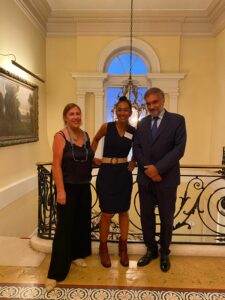
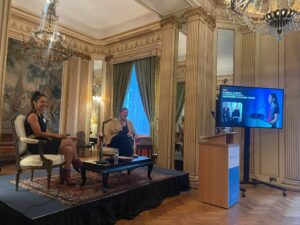
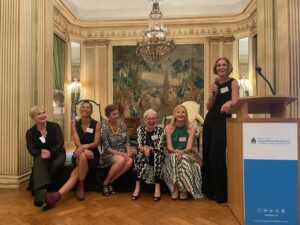
Lumos Education was delighted to be invited to sponsor Women Powering Smart Energy’s conversation event at the Argentine Ambassador’s Residence. The evening, co-ordinated by Steve Gladman of Women Powering Smart Energy, highlighted the relationship between gender and conservation.
The Dalai Lama has said that the western woman will save the world. The women changemakers who spoke at the Ambassador’s Residence in September embody his prediction. Their dynamism and steadfast commitment to preserving the environment and wildlife makes them a true beacon of hope in the sphere of conservation.
Only a Child
The Ambassador for Argentina in the UK, his Excellency Javier Esteban Figueroa, launched the evening. I introduced the film, Only a Child, which was produced by Simone Giampaolo and narrated by the then 12 year old girl, Severn Cullis-Suzuki in 1992. The message, from this young child’s perspective, is that governments and communities need to act now to affect lasting change. Her compelling young voice states eloquently that ‘northern countries will not share with the needy, even when we have more than enough, we are afraid to share, we are afraid to let go of some of our wealth.’ Severn declares: ‘you grown- ups say you love us, but, I challenge you, make your actions reflect your words.’ At the end of the film, Severn, now a Canada- based environmental activist, is pictured, over 30 years after her words, as an adult with her own children. The time that has elapsed between Severn’s childhood and her growing into adulthood and raising her own family, demonstrates powerfully how much-needed changes to halt the environmental breakdown have been slow to manifest.
Dr Micaela Camino
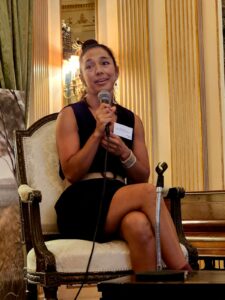
The audience enjoyed the rich conversation between award-winning conservationist, Dr Mica Camino and the Cultural Attaché to the Argentine Embassy in London, Minister Alessandra Viaggiero. Their discussion focused on the importance of engaging with indigenous communities, who live close to nature and depend on the local food, structure and wildlife for their own survival. And for the continued survival of their children. Mica spoke about the importance of understanding that, in conservation, the environment and people can’t be separated. The two are inextricably linked.
Dr Micaela Camino
Mica is a committed conservationist on a mission to empower communities, defend their human rights and to preserve the fragile ecosystem of Argentina’s Dry Chaco. Nestled in Northern Argentina, this expansive forest teams with both indigenous communities and critically endangered species, notably the Chacoan peccary. However, the relentless advance of agricultural development threatens not only the habitat but also the very livelihoods and cultural heritage of the local people. Mica is the recipient of the Whitley Fund for Nature (Green Oscar) 2022 for her research work to defend the Dry Chaco forest. As a Researcher of the National Scientific and Technical Research Council of Argentina at the Conservation Biology Laboratory of Centre for Applied Ecology of the Coast and Founder and Director of Proyecto Quimilero, Mica juggles her career with mothering her young son. Her tireless efforts exemplify the power of grassroots action and the potential for positive change even in the face of daunting challenges.
Mary Rice
Following Mica’s incredible achievements, the audience listened to Mary Rice’s equally impressive contribution to the environment. In conversation with Aisling Ryan, herself a committed conservationist, Mary described her role in bringing about the global ivory ban. She spoke about her negotiations with governments and key players to enforce action or legislative change, often in extremely demanding political and social circumstances. Mary and Aisling reminisced about their attendance at Kenya’s historic ivory burn in Nairobi. Both thinking that they would stay in an hotel but, in reality, Mary camping knee-deep in mud wearing a pair of child’s pink wellies, whilst grappling with streaming the ivory burn live to the international community.
Mary Rice
As Executive Director of the Environmental Investigation Agency (EIA), Mary Rice’s accomplishments are simply colossal. In addition to directing the EIA’s work on the illegal ivory trade and attending major international meetings related to the subject, Mary acts as a spokesperson and presents on the issue. Working with investigative and analytical teams to obtain the data and evidence required to support and facilitate enforcement action or legislative change, she liaises closely with stakeholders worldwide to ensure an innovative and strategic approach to what is a dynamic and global problem.
Trained as a journalist, Mary spent 15 years working in Asia before moving to London. She is also a published author and photographer. “Heat, Dust and Dreams”(Struik), an exploration of people and environment in Namibia’s Kaokoland and Damaraland, was the result of three years of research and photography in what is now known as the Kunene region, home to the last viable population of black rhino outside a protected area. And one of the world’s last great wildernesses.
Aisling Ryan
Leading Conservationist, Climate and Sustainability Leader, Aisling, led the campaign to stop the ivory trade alongside Mary Rice. This campaign resulted in four UN resolutions and bans in China, Hong Kong, the UK, US, Canada and France She has collaborated with the Kenyan government, EIA, WildAid, ZSL and other key NGOs. She also negotiated a pro-bono partnership with WPP to create a mass lobby campaign and with Kantar to deliver pivotal research to prove public support to ban the ivory trade. She has worked with Conservation South Luangwa (CSL) in Zambia since 2014 and continues to serve as Non-Executive Director and Trustee.
Recognised for her contribution to sustainability and ESG, Aisling is a recipient of many awards, including the UN SDG Impact Award, Gold Cannes Lions, D&AD Pencils, the Grand Prix at The Marketing Society Effectiveness and the Campaign Big Awards. She was also acknowledged for her valued contribution to DE&I on the 2019 and 2021 HERoes INvolve Women Role Model Awards Global 100 List of Senior Executives. Aisling pioneered the People’s Seat for the United Nations. She also drove negotiation and partnership between Sir David Attenborough, UNHQ, UNFCCC and Poland and wrote his speech for COP24.
Millie Kerr
Following Aisling’s discussion with Mary, Millie Kerr, US lawyer turned conservationist, author and wildlife photographer, spoke with Aisling Ryan about her distinguished career, marked by a resolute dedication to the cause of environmental preservation.
In conversation with Aisling, Millie explained how her grandparents’ ranch had been a key influence in her childhood and served to cultivate an early love of wildlife and devotion to conservation. Weekends and holidays were spent with the animals on their property, which included scimitar-horned oryx, rheas, zebras and other foreign species which they began introducing in the 1970s.
Millie Kerr
After working for a prominent London international law firm, her career trajectory took an unexpected turn during a sabbatical to Namibia, where she undertook a role at a wildlife conservancy. This experience kindled her passion for documenting and advocating for wildlife and nature conservation. On returning to the United States, a brief stint at the Federal Communications Commission preceded her relocation to New York City, where she continued to write while employed by the Wildlife Conservation Society/Bronx Zoo.
Asked by Aisling how she would advise Londoners looking to make a difference, she suggested a rewilding a small garden, emphasising that even with the shortages of outdoor space in London, this is perfectly possible and incredibly rewarding.
Based in London, Millie is a freelance multimedia journalist. Her writing on travel and wildlife conservation has been featured National Geographic Traveller, The New York Times, and The Wall Street Journal. Millie’s debut nonfiction book, “Wilder: How Rewilding is Transforming Conservation and Changing the World,” published by Bloomsbury in August 2022, enjoys acclaim and endorsement from celebrated conservationist Jane Goodall. This volume, characterised as a fusion of popular science and memoir, surveys rewilding projects worldwide, highlighting the individuals defining the evolution of conservation.
Professor Genoveva Esteban
Distinguished academic, Professor Genoveva Esteban (Bournemouth University, UK), specialises in microorganisms in fresh water and marine environments. Having completed her PhD in Spain, Genoveva came to the UK as a postdoctoral student and has worked here even since. She has juggled her research and conservation work, with her family commitments. During her career, Genoveva has pioneered ground-breaking research into the diversity of free-living microorganisms to help us to better understand ecosystems. She explains how, as some microorganisms eat bacteria, they benefit the environment. And as foundations of the food chain, microorganisms help to conserve the environment, essentially safeguarding bigger animals by protecting the little ones.
Dr Genoveva Esteban
Genoveva agrees that there is a gender imbalance in the way that men seem to be seen as more credible, in the world of conservation, but she says things are starting to change. She is currently looking to develop a project, with fellow academics in the UK and on mainland Europe, to see how the different freshwater environments and habitats can be connected. This project is about habitat connectivity in a fragmented world.
Genoveva has infused the younger generation with her passion and knowledge. Her students around the globe, including in Poland the US and Spain, are continuing Genoveva’s work in their own labs. She says that, in her experience, the younger generation want to use science to help conserve the environment because they know that the planet is under threat. They are interested in understanding how science works and how to use the scientific knowledge they have gleaned encourage conservation. As well as working with students at her university, Genoveva also works with children in her local community to promote STEM subjects. She runs science family days at her local museum to promote science and the importance of cherishing the environment.
As well as encouraging and inspiring the next generation, Genoveva’s has built and nurtured deep and lasting partnerships with colleagues from Government departments, research centres and wildlife trusts. She sends 15 students every year on a work experience placement to work with researchers in those institutions.
The depth and richness of the contribution that these women have made to the environment and conservation is simply extraordinary. In a world that, with the pace of environmental damage, and inability of governments to take urgent action, often seems hopeless, these women offered hope. I know I, and all of my Lumos Education colleagues and partners who attended, poured out into the London evening feeling inspired, humbled and hopeful.
Ronel Lehmann, of Finito Education, recently told me that a many of his young university leavers are keen to follow careers in the fields of conservation and the environment.
Micaela Camino, Mary Rice, Millie Kerr, Aisling Ryan and Genoveva Estaban are blazing a trail for young women- and men- to follow.
Johanna Mitchell is the Founder and Director at Lumos Education
Eileen Gray (1878-1976) was a creative genius and the first woman to conquer the world of architecture at a time when men controlled it all. This new film reflects on Gray’s impressive career and her stunning modernist house on the Cote d’Azur and will appeal to cineastes and lovers of art and design alike.
Unfolding as a stylish hybrid documentary E.1027 is a filmic journey into the emotional world of Eileen Gray, who was born into a large family in County Wexford, Ireland before moving to London where, after being presented as a debutante, she studied Fine Arts at the Slade and was later drawn to furniture design and architecture although her career languished in the shadows at a time when the profession was dominated by men.
In the 1920s women architects found themselves confined to designing interiors and Gray broke the mould by moving to the South of France where she found a plot of land on the water’s edge in Roquebrune – Cap Martin and fulfilled her dream of having a modernist house on the Riviera. A self-confessed bi-sexual she lived there with her younger lover, the editor-in-chief of the journal ‘Architecture Vivante’ Jean Badovici. The two crossed paths with fellow architect Le Corbusier who comes off the worse for wear in Swiss filmmaker Beatrice Minger’s take of events. He is seen an arrogant and rather self-regarding character who muscles into Gray’s world by decorating E.1027 with his own murals.
Eileen Grey – the house at Roquebrune – Cap St Martin
Minger’s film takes us into Gray’s inner circle, a tightly knit coterie of designers that included Fernand Lager, Corbusier and his wife Yvonne. Early on Gray in the film counteracts Corbusier’s theory that a house is ‘a machine for living’ considering it more spiritual than that: ‘A place you surrender to, that swallows you up. A place you belong to”.
Gray and Jean Badovici dedicated themselves to building the E.1027 in the Roquebrune-Cap-Martin location between Monaco and Menton in 1925. Due to its rocky, cliff-hanging location, wheelbarrows had to be used to transport materials on site. Gray named the house: E for Eileen 10 for John Badovici but their idyll came to a close two years later when Gray sensed the winds of change: “I like doing things but I don’t like possessing them”. She had already bought another plot of land inland and her attention moved on to design a place in this even more remote location.
The film then broadens its focus onto ‘Bado’ and Corbusier’s relationship, with the French architect claiming Gray’s scheme for the house was copied from his own pen design. Marking the territory he built his own wooden Cabanon alongside a little bistro near to E.1027. But the Second World War put an end to the rivalry when the German Nazi soldiers occupied the Roquebrune house riddling the walls with bullets.
In the title role Natalie Radmall-Quirke smokes her way through this intimate portrait of the artist who appears both a victim of her deep emotions and the driving force behind her lover Badovici – in one scene a graceful dance is testament to their feelings for each other. After leaving the house Gray was forced to contend with Corbusier’s arrogance, although he appears to redeem himself by trying to find a buyer for the Roquebrune house, eventually it was sold to Swiss artist Marie Louise Shelbert who misguidedly thought Corbusier was the architect. Gray organised a funeral for Badovici but no one came.
Family money and her strong work ethic clearly allowed Gray to remain financially independent all through her life although there is never any mention of commissions outside her own designs: many of her schemes never left the drawing board until later recognition, and although her furniture now sells for astronomical prices: her chrome Adjustable Table. E.1027 is one of the flagships of modern classics in furniture history (www.smow.fr/eileen-gray/adjustable-table-e-1027.html )The famous house had a less illustrious ending. In a final interview Gray finally appears in her nineties, emerging as an appealingly decent woman without a shred of ego.
E1027 – Murals by Corbusier
EILEEN GRAY AND THE HOUSE BY THE SEA which will celebrate its world premiere at CPH:DOX 2024 (March 13-24, 2024) in Copenhagen as part of the INTERNATIONAL COMPETITION programme.
The whole question of AI interviews is a bit like warfare really. Every technological advance on the side of offence is met by technological advance on the side of defence. Similarly, there are now algorithms that prepare candidates how to approach AI interviews.
I suppose in the early stages of the interview process there is something to be said for going down this route, although I must say it is completely against my own instinct. When I was actively running Capital Economics a lot of my time was taken up interviewing people which was one of the most important jobs that a CEO like me could do in a small firm to make sure that the people were really good. In those days, I was aware that what I was looking for wasn’t necessarily straightforward so I would have loathed giving up that initial sifting to AI. For a start you get a bunch of paper CVs in and I could tell very quickly whether a person was plausible or not. I could sift very quickly. When you come to the next stage, and you have got rid of all the implausible applications, you certainly wouldn’t want an AI algorithm at that stage.
Really it goes back to this whole question of being human: although a lot of people will resist this, particularly in small organisations, hirers will be very motivated by whether they think they can get on with this or that person. This is especially important in a small outfit, though I accept things might be different for a bigger company. If you are working at close quarters in a small company and you really don’t like a person, that’s an important negative. How is your algorithm going to pick that up?
It’s quite possible therefore that AI interviews will never really take hold for smaller companies. Whereas with those big companies, where there are hundreds if not thousands of applicants, that basic stage could be very time-consuming so employers might find it efficient to get AI to tackle that. You might miss the occasional good person and let through the occasional duffer but you can sort that out later. In a small company, this sort of thing matters so much more.
For reasons I won’t go into, I happen to own a pet shop and dog grooming salon. It’s a niche business, and so it’s very difficult to recruit staff. We happened to need a new manager, and we advertised for the role. The manager is critical – a good manager will take the burden off me and make the business thrive. It was 2020, and I happened to be in France and I conducted the interview by Zoom. I rejected the candidate who everybody else thought was the best of the bunch, and hired someone over Zoom who turned out to be a disaster. Zoom obviously isn’t AI, but it is similar in that I didn’t have the sort of human contact that I would normally have in an interview process of meeting someone in person.
In a similar vein, there is also a fair amount in my book The AI Economy about education. Some AI enthusiasts say that there aren’t going to be any teachers any more because people can learn remotely from various programmes and so forth. I strongly reject this idea. I would recommend Sir Anthony Seldon’s book The Fourth Education Revolution. According to Seldon, there is scope to use AI a lot in the education process, but the system of the teacher standing up in front of a class of sometimes hundreds of people and the students taking notes is ludicrously antiquated.
Instead, I suspect education will proceed along the lines of the tutorial system whereby we will have more one-on-one sessions which are about discussion and interaction, in addition to seminars where you have got a small number of students discussing and interacting. Under that system the ratio of teachers to pupils or students in aggregate may not change that much but the ratio in individual teaching sessions will change dramatically.
AI won’t change our lives anything like as much as the enthusiasts claim because we’re human beings and we will always crave some degree of human contact across every area of our lives.
The AI Economy by Roger Bootle is published by Hachette UK and priced £20