Category: Opinion

  • 2024 highlights: Vicki Anstey: The Incredible Story From Advertising to Endurance

    Vicki Anstey

    I grew up in North Yorkshire in a tiny village in a fairly remote part of North Yorkshire. I went to Bristol University and really thrived there; I read French and loved it and lived in France for a year as part of that degree. I then went straight into the world of advertising and worked both agency side and then, more latterly, on the client side.

    I spent about a decade in advertising, but got to a point of burnout. I started to neglect myself and invest a bit too heavily in the slightly hedonistic lifestyle that advertising involves. I was leading Ikea’s advertising strategy at the age of 24 and managing multimillion media and production budgets. It was a huge upward learning curve and I thrived on that but it was also a lot of pressure.

    I moved sideways out of advertising for a little while, and joined a social enterprise called We Are What We Do. Their whole ethos was about engaging people in small actions. It was a wonderful organisation and felt so much more fulfilling, but I still hadn’t really found my groove.

    I ended up taking a U-turn and going into the fitness industry largely because I had discovered this incredible method called Barre based on ballet movement which literally transformed me physically. Barre is a strengthening and conditioning component of ballet, and essentially consists of all of the movements that a ballet dancer would do in order to prepare themselves to dance and to develop, build and maintain the right kind of structures and posture in their bodies.

    I stumbled on this methodology and was completely hooked. With my advertising hat on, I realised that more people needed to know about this incredible methodology and if it could change me and my physique then it could also change the lives of other people.
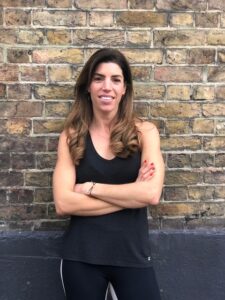
    I therefore took a bit of a gamble on setting up a studio here in London in Richmond and that was the first dedicated Barre studio in the UK. Nobody had ever heard of Barre and I was taking a huge risk. I took on an old office space in Richmond and created a studio that felt like a home from home. People came – and they queued around the corner to be a part of it. I ran that business for 12 years.

    However, over the course of that 12-year period I left a very long term relationship. I had been in that relationship for 20 years, married for 12 and I found the relationship stifling, and more latterly quite coercive. It didn’t enable me to be the best version of myself and it took a really long time for me to get the courage to leave. My childhood had conditioned me for that kind of relationship. I grew up thinking I had to live up to a certain narrative and stay in my lane and live quite a gendered expectation of how I would go on to live my life.

    After I left the relationship, I heard that SAS: Who Dares Wins was inviting women to apply for the programme. I mentioned this to a few people and I was encouraged to apply for it which I did and then I ended up on that programme and really discovering what my capabilities were. It was quite a life-changing experience and I got through to the final stages of the show.

    There was a lot of press surrounding it because it was the first year that women participated so there was a lot of expectation and speculation about how we would be treated and whether it was right or not. Even the team of special forces operatives who run the show weren’t quite sure how it would all work out. I had to face fears I had had throughout my life, such as heights and water. I had to really believe in myself.

    What I realised from doing the show was that embracing vulnerability is a very powerful thing. The idea of facing my fears became quite intoxicating and I entered this phase in my life where I said yes to everything.  I was at a press event for Who Dares Wins and someone asked me if I would like to row an ocean and I just instinctively said yes. I had grown up with this fear of deep open water as I had had a near drowning incident when I was 12 with my sister and just avoided going in deep water my whole life.

    To take on this new task, I ended up doing cognitive behavioural therapy and open water swimming coaching. I had various panic attacks along the way trying to deal with the underlying reason for that fear in the hope that my fear responses wouldn’t threaten my life or the lives of others that I was on the boat with. Then I embarked on this huge campaign to row across the pacific from San Francisco to Hawaii for a distance of 4,000 kilometres. We got the boat ready, and raised £70,000 worth of sponsorship. We packed our boat up with all of the kit and supplies that we needed – and then Covid happened and the race was cancelled.
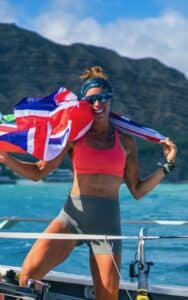
    That was soul-destroying. The two crew mates who I was meant to row with, and who I had known for a significant period of time, didn’t defer their places so they weren’t able to do it at any further point in the future. I had the choice either to walk away from the whole thing or to find new crew mates.  There were too many people involved to let down. It’s not easy to find people with the resources and capabilities and flexibility to do something like that but I did eventually find them. Since we were in lockdown, I didn’t meet one of them until we got to the start line in 2021.

    We had to go through all the processes of taking on skills and assimilating knowledge that you need to do an ocean row through lockdown. The gyms were all closed so we trained in our living rooms. You have to learn chart navigation, you have to master radio communication, you have to do first aid at sea courses. All sorts of courses were required for participation so we did a lot of that on Zoom.

    We set off at the end of May 2021 and we arrived 60 days, 17 hours and 6 minutes later. Sadly, the team dynamic from the start was really problematic. There was some really bad behaviour – a lot of psychological game-playing, stonewalling, and bullying isolation tactics. I found it a very difficult experience. It’s important to remember that in the run up to the row we also hadn’t had the opportunity to spend time together, and therefore to explore our reasons for doing it, and to share our insecurities and fears. It was a really hostile environment.

    I was also seasick for 23 days which was very debilitating. When I was off the oars I felt horrendous. The truth is that you can’t let conflict escalate on a tiny boat in the middle of an ocean so I really had to just tolerate and accept the situation I was in. It wasn’t particularly enjoyable but we did pull together as a team at times and ultimately we got the world record.

    I learned a lot through that process, not least about how to manage your thoughts and emotions and how to tolerate really emotionally challenging situations where there is literally no way out. As a result of my experiences, I have become a stress and resilience coach. I am a qualified coach of a mind-set methodology that was developed for the All Blacks Rugby team back in 2001 when they kept losing at World Cup Finals.

    I have become really fascinated about how our brains work with thought and fear and stress and how we are more in control of that than we think and how important choice and autonomy is. For people in toxic environments it is helpful to be reminded of the fact that we are ultimately in control of our lives however difficult and challenging our situations might be. One thing that we are always in control of is how we think about things and therefore how we influence our emotional responses.

    The thing I try to make really clear is I am not advocating that emotionally challenging workplace situations should be tolerated but if there is a situation that you can’t get out for a period of time – as I couldn’t on that boat – then there are some really useful strategies that you can employ to get on top of your thoughts.

    It’s about understanding how our stress responses work. We can regain perspective, take a step back, and choose what kind of head state we want to be in in a given situation. That’s a skill. You have to practice it. It’s not something that you master and conquer and become an expert in for the rest of your life.

    What makes a difference is having that little bit of biological literacy, and understanding of basic neuroscience. If we don’t do that, we can be really hard on ourselves. These days, we get extremely stressed about things that are not life threatening at all so our stress responses are completely at odds with reality. If we understood that, we would be able to cut ourselves a lot more slack.

    After I did the row I was left with a sense of lost faith in teamwork, and brought the whole campaign to an end. I made myself a promise that I wasn’t going to become this person who had to keep doing more and more crazy things but apparently I have become that person. I just kind of knew that I needed to put some things right.

    So I asked a friend if she would run across the Arctic with me. We did a 250 kilometre footrace carrying everything that we needed to survive and it was an incredible experience in minus 35 degree temperatures. You literally couldn’t stop or you would get hypothermia or frostbite so it was very much about regulating your pace, and not getting too hot, or getting too cold. I have also done another ultra-distance run another 250 kilometres across Kenya – in obviously, completely different conditions.
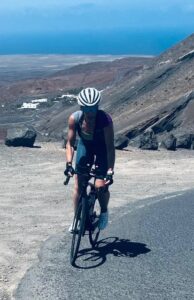
     

    I am now training really hard to do The World’s Toughest Bike Race (The Race Across America) which is a 3000 mile West to East Coast race.  It’s quite established in the US, but not that well-known in the UK. We are a team of four women, and hoping to beat the world record which is 6 days 15 hours.

    That’s fast. We have to do an average of 19.3 miles per hour, so it’s non-stop 24 hours a day, with the four of us on a shift rotation pattern. We will get to sleep a bit but only in vehicles that are constantly moving. I am not a cyclist any more than I was a rower so for me it’s all about showing people that they can do anything and train capabilities that perhaps they didn’t think they had.


    For more information go to http://vickianstey.co.uk 

  • Sir Paul McCartney’s Lyrics: “geniality and humility”

    Christopher Jackson

    I once commissioned Paul Muldoon for a poem for a magazine for which I was editing the poetry section. He was very responsive to the idea that the readers of a high end luxury magazine ought to have some poetry in their life. I made it clear I would pay £100.

    Muldoon sent a poem which was really a song lyric and I still remember it’s refrain: “It’s been an uphill battle to go downhill all the way.”

    Incidentally, when I tried to pay Muldoon he went mysteriously dark, though his home address was on his email. When I was next in New York, I took a hundred dollars down to his apartment on the Upper West Side, and gave it to his wife, Muldoon being out of town in New Jersey.

    I later discovered that he was financially secure many times over. He simply didn’t need the money and wasn’t interested in it.

    In that he was a strange kind of poet. I didn’t know then that this was the same apartment which Paul McCartney had begun occasionally visiting in order to have the conversations which make up this book. Had I known, I might have stayed around a bit.

    This book, writes McCartney in the foreword, was a far more feasible project than a straight autobiography: the songs, in any case, tell the story of his life better than a prose book. The book is the product of a series of enviable conversations between Muldoon and McCartney, but with Muldoon’s contributions elided.

    In some respects, this is a shame as I expect the back and forth would in some ways have been more interesting than what we are presented with here. Muldoon is one of the greatest poets of our time, and would be greater still if he could always bring himself to write comprehensibly. I expect some of what we have here would be more exciting if we could hear the pair of them sparking off each other.


    With the conversations divided into chapters centred around songs, some of them can seem a bit perfunctory – a couple of pages for ‘A Day in the Life’, that remarkable work, about which books could be written. There is much that could be said about McCartney’s contribution in the second part of the song after the titanic crescendo of the orchestra, which isn’t touched on here.


    McCartney has in the past said it was a song he’d had lying around. It would have been interesting to know the process by which the two were yoked together. Though the truth is, for most of the time in songwriting, the songwriter is in receipt of forces he won’t understand and there is a sense in which McCartney can sometimes seem a baffled visitor on his own songwriting past.

    But this is to carp about what we don’t have instead of to celebrate what was actually managed. We should be grateful for this: McCartney is a world-historical figure who is far busier than most, and it’s good that he found the time for us at all.

    Besides there are some moments of real insight. For instance, in ‘All My Loving’, McCartney points out that it is an epistolary love song in the vein of Fats Waller’s ‘I’m Gonna Sit Right Down and Write Myself a Letter’. But it is also to do with being on the road and not being able to see your love. That makes Lennon’s triad chords in the rhythm guitar all the more suitable because it mimics train tracks, and the rickety motion of transport.

    I’ve always liked McCartney. Lennon could be cruel in a way unthinkable for McCartney, and cruel to McCartney too. I think it probably stemmed from work ethic. Lennon had a sort of lazy streak which probably irked McCartney who, born with a gift which often seems to emanate from some other dimension, seems to have been born with a kind of duty to be true to it.

    He’s still hurt, of course. Things turned out better than they might have with Lennon, because at least they weren’t actively warring with each other. Apparently they had a nice conversation on their final meeting about baking bread.

    Strange forces brought these two together. It continues to feel marvellous that in Liverpool at that time, these four boys were permitted to meet, that their music found its audience. They then hit upon, and at the same time had a share in creating, a historical moment which we are only just beginning to understand.

    It was freedom: the freedom to experiment and to find out who and what one loved. And it was love, as McCartney has often pointed out, which underpinned it all. Over eight wonderful years, ‘Love Me Do’ became ‘And in the end/the love you take/is equal to the love you make’.

    After that, McCartney got lucky domestically with Linda Eastman, and here and there the music falls off a bit. That seems to be a law of popular music: the energy of youth can only come once. It is invisible in those simple chord sequences which gave us She Loves You: there is a primal urge driving it forward which could only come once.

    Sometimes a magnificent song would come along: ‘Maybe I’m Amazed’, ‘Band on the Run’, and much later, ‘Beautiful Night’.


    But something went out of McCartney’s life forever when John, with the malicious glee which sometimes characterised him, announced that he was leaving the Beatles. It appealed to John’s wrecking ball nature to destroy the thing he loved.

    It never appealed to McCartney – and still doesn’t. Every time we have a new initiative with the Beatles today – such as the AI project Now and Then, you feel that McCartney is the driving force. He wants to be back in Abbey Road again. Perhaps he wants to be young again.

    Yet this is to paint him as more melancholy than he actually is: optimism has always marked McCartney – a sense that somehow or other everything will be alright. His songs almost always insist on a good outcome, sometimes amidst sadness. Jude will make it right if he lets it be. Even Yesterday, on the face of it a very sad song, seems to resolve that sadness by the end: perhaps yesterday in that song is a place where the singer will one day comfortably reflect. It is a place he will one day revisit.

    That is what this book is, a kind of reckoning. It would have been possible to have done it differently and just published the transcripts as Seamus Heaney did in Stepping Stones and as Nick Cave did with Faith, Hope and Carnage.

    But it’s good to have this book. It doesn’t really alter McCartney’s reputation too much since he was already in the stratosphere anyway: it simply proves that genius can sometimes go hand in hand with geniality and humility. And if that’s the case with McCartney, it certainly had better be the case with us who, whatever our virtues, never had it in us to write ‘’Eleanor Rigby’.

  • The Future of Project Management: The Next Gen’s Guide

    Lysan Drabon, Managing Director – The Project Management Institute

    We live in a world of constant flux, where technology is rapidly advancing, society is shifting, and the climate is changing around us. Both the private and public sector are moving to adapt and react to these evolving trends, by developing new projects across sectors like infrastructure, healthcare, data, security, and utilities, as well as many more.

    Project management provides the tools to bring structure and progress to what can be perceived as chaos and help steer these change-driving projects towards successful outcomes. It is a profession which is dynamic and impactful, giving individuals the opportunity to play a part in facilitating some of the world’s most ambitious changes and shifts. Mastering project management is like gaining a superpower, equipping you with essential skills to navigate complexity, achieve your goals, and shape a better future.

    Project management is defined as “the application of knowledge, skills, tools, and techniques to project activities to meet project requirements.” This might sound formal, but it boils down to getting things done – efficiently and effectively. In a world grappling with climate change, social inequalities, and rapid technological advancements, the need for skilled project managers has never been greater. These skills are essential in virtually every industry, from developing life-saving vaccines to launching innovative tech start-ups.

    The UK, like many nations, faces a critical skills gap. Businesses struggle to find individuals with the project management expertise needed to drive innovation and productivity. This presents a huge opportunity for young people. Graduates equipped with project management skills are highly sought after, possessing the ability to plan, execute, and deliver projects that are successful. This translates into tangible value for organisations and opens doors to a wide range of career opportunities. In a competitive job market, project management skills, even from personal projects or volunteer work, gives you a distinct edge.

    And it’s not just about landing a job; it’s about thriving in your career and navigating the evolving world of work. Project management empowers you to take ownership, manage your time effectively, and achieve your professional goals. It builds confidence, develops leadership skills, and prepares you for the demands of the 21st-century workplace. In today’s digital age, with the rise of remote work and the gig economy, project management skills are even more valuable. They are essential for managing online collaboration, multitasking, and adapting to new technologies.

    The profession is also changing and adapting to a new world. Project managers are at the forefront of AI use, using it to boost productivity, effectiveness, and creativity. AI-powered platforms like Jira Align and Monday.com offer data-driven insights for better planning and resource allocation, while tools like Asana and Trello, integrated with AI, provide real-time progress monitoring and alerts. Furthermore, AI automates routine tasks, freeing project managers to focus on strategic work, and enhances collaboration through tools like Slack, which are particularly beneficial for international teams. AI is no longer a bonus, but a necessity, for a modern project manager.

    It is not only technology which is changing the profession – women are increasingly leading the charge as agents of change within the sector, driving critical initiatives across various sectors, and demonstrating the transformative power of project management. Empowering women in project management is crucial for driving innovation and economic growth. There is ample opportunity for further individuals to make their mark – the Project Management Institute (PMI) projects a need for 25 million new project professionals worldwide by 2030. This presents a significant opportunity for young people, particularly women, to enter a growing field and make a real impact.

    For young people in the UK, facing an uncertain economy and a competitive job market, project management offers a pathway to success. It’s not just about career advancement; it’s about equipping yourselves with the skills to navigate a complex world, drive innovation, and make a real impact on the issues important to you. Project management, powered by AI, is your toolkit for shaping a better future. Embrace it and unlock your full potential.


  • Meredith Taylor reviews A Complete Unknown: “one you won’t want to miss”

    Meredith Taylor


    Dir: James Mangold | Writers: James Mangold, Jay Cocks | Cast: Timothee Chalamet, Elle Fanning, Monica Barbaro, Edward Norton, Scoot McNairy, Boyd Holbrook | US Docudrama 141’


    New York 1961. Against the backdrop of a vibrant music scene and tumultuous cultural upheaval an enigmatic 19-year-old from Hibbing Missouri arrives with his guitar and revolutionary talent destined to change the course of American music, at the same time as the Beatles across the Atlantic in England.


    A Complete Unknown is the 13th movie about the American singer Bob Dylan. James Mangold’s docudrama takes its title from a song from the 1965 album ‘Highway 61 Revisited’. It charts Dylan’s meteoric rise to fame embarking on a journey from Minnesota to New York to meet Woody Guthrie and culminating with his ground-breaking 1965 performance at the Newport Folk Festival when he plugged in an electric guitar to pioneer his transition into rock to the dismay of folk fans. Dylan forges intimate relationships with folk icons of Greenwich Village: Joan Baez, Pete Seeger, and Johnny Cash who were all pivotal in his future success, along with his manager Albert Grossman (Dan Folger). Taking the city by storm Dylan cuts a swathe through the music scene beating his own path from folk singer to rock star with a controversial performance that reverberates worldwide.


    Timothee Chalamet, now a superstar himself, plays Dylan with same gravelly voice and recalcitrant insouciance in an electrifying performance that rocks from the rafters in James Mangold’s docudrama. Chalamet embodies the vulnerability and subversive unruliness of one of music history’s most iconic singer songwriters, still rocking at 83 and in the midst of his three-year world tour.

    According to sources, Dylan was ‘hands-on with the script’ for this rousing epic, and even has an executive producer credit. Edward Norton plays Pete Seeger with empathetic confidence while pioneering his own music as an instrument for social change. Elle Fanning shimmers as Dylan’s stable rock Sylvie Russo (real name Rotolo), a poignant and thoughtful first lover who knows, as a fellow artist, only too well when her time has come to bow out of his life. Monica Barbaro, sparkles as the sultry storied folk singer with an impressive vocal delivery as Joan Baez who shared a tempestuous relationship with Dylan, but also enabled his path to stardom by covering his breakout songs. Boyd Holbrook stirs it all up as Johnny Cash with his assured pizzazz and dashing guitar numbers he believed in Dylan and supported his vision. Mangold’s Johnny Cash biopic Walk The Line won an Oscar. There’s humour too: one scene pictures Dylan and his manager in bed together. This is a film that never takes itself too seriously and one you won’t want to miss, fan or no fan, picturing a celebrated cultural decade, and a living legend with over 40 recorded albums to his 60 year career, and still counting.


    In an interview in ‘Rolling Stone’ magazine James Mangold describes his film as ‘more of an ensemble piece rather than only about Dylan’ who granted the director music rights for his film whose focus is “a very specific moment” in time. Mangold and his co-writer Jay Cocks capture the zeitgeist of a memorable time of flux when significant events coalesce and become seared to the collective consciousness: JFK’s 1963 shooting; the Civil Rights Act, and footage of CBSNews Anchorman Walter Cronkite reporting on the Cuban Missile Crisis as it breaks on Bob’s TV while the singer crafts his own musical bombshell.


    Chalamet, Norton, Barbaro, Holbrook and others sang every song live on set and their performances were extensively used in the final film. Chalamet remained strictly in character during filming, insisting on being referred to as “Bob Dylan” throughout, and learned to play over 30 Bob Dylan songs fluently. Norton and Barbaro trained for many months to learn the banjo and guitar for the film.


    The film opens in the UK on 17th January 2025


    Watch trailer here: https://www.youtube.com/watch?v=FdV-Cs5o8mc&t=3s


  • Opinion: Stuart Thomson on work-life balance

    Stuart Thomson


    Many people come to think about the balance between their personal ‘work life’ and their ‘personal life’ later in a career. That should be a consideration from the start. But it also means appreciating that the two cannot often be neatly divided or evenly balanced.


    The idea of a work-life balance appears to suggest some type of equilibrium between the two. It also often places the burden on the individual to draw the lines between the work and the personal. Actually, most employers rightly recognise the benefits to themselves and the individual if the balance is considered. Personal health and productivity can improve, and the level of job satisfaction increases. If you feel as though you are being looked after, then the longer you may even stay in the role.


    Considerations about a form of balance should not, though, be left until later in a career. It is not just about the ability to spend time with children and families or focusing on leisure pursuits to counteract aging!


    Often the balance can entail quite serious commitments in the personal realm, for instance, those with caring responsibilities. Those responsibilities can impact anyone at any age.

    It is also up to each person what their time looks like outside of the workplace. It cannot, of course, clash with the day job or bring any form of potential reputational damage, but otherwise, the time is yours to do with what you will. That could be study, having a ‘side hustle,’ taking up a hobby, or finishing a box set—whatever works for you.


    That does not mean that a workday can be neatly divided. For many workplaces, especially in a professional setting, there is not really a 9-5. That requires flexibility on both the part of the employee and the employer. It becomes clear that the balance between work and life cannot be neatly divided and compartmentalised. For those with pressing commitments, such as caring, arrangements can be made, but for the majority, sometimes you will work ‘late,’ and there will be periods of intense work and potentially pressure. This cannot be avoided. Whilst employers recognise the need for everyone to think about their relationship between home and work, that does not mean the employee has all the control. There is often a lack of balance, and especially in the early years of a career, it will be weighted in favour of the employer.


    How can each individual think about setting some dividing lines from the outset?


    Boundaries – The UK hasn’t yet gone down the legislative route for a ‘right to switch off,’ but many firms have. There is no harm in having conversations with line managers about such matters.

    Time management – The better organised a person is in the workplace, the better able they are to finish their work on time and move onto the personal.

    Co-existence – There is no reason why some of the personal and professional cannot overlap. If, for instance, a class is during the workday, then as long as the work is done, the class could still be attended. A balance does not mean complete separation.

    Personal health – The critical role of physical and mental health is now largely uncontested in the workplace, so explore the opportunities for these from the outset. Do not leave it until later.

    Timesheet culture – For many organisations, the quality of the work is more important than the time spent at a desk. But for some organisations, particularly in professional services, they can expect both. It may be that this is reflected in the pay packet, but think about what you want from the outset.
    Never fall into the trap of thinking that there is any such thing as a perfect balance between work life and personal life. Especially early on, the boundaries can be extremely unclear. You may socialise with colleagues as well as work alongside them. That is an important part of building a culture—but is that ‘work’ or ‘personal’? It is both.


    It is important to think about what balance in life looks like rather than expecting an equilibrium to be achieved. Never leave that thinking too late.


    Stuart Thomson


    Stuart Thomson’s latest book is The Company and the Activist


  • A Question of Degree: David Landsman on the importance of learning languages for careers

    Are language degrees useful? David Landsman argues that they’re highly underestimated


    In Britain we often like to play down our skills and achievements (except perhaps in sport).   There’s nothing wrong with a bit of modesty.   But I’m not sure we do ourselves – or the next generation – any favours if we end up boasting about how bad we are at something or another.  We rightly admire those who have overcome, say, dyslexia to achieve academic success and a great career.   But it’s decidedly odd how people make light of not being able to do maths (“not really my thing, thank goodness for calculators”).    I’ve never heard anyone in Asia, for example, boasting about being functionally innumerate….

    We’re also a bit too ready to shrug off being monolingual in what is, without doubt, a multilingual world.    Pretty well everywhere you go, you’ll meet people who take speaking multiple languages for granted.    I once visited a village school in Eastern India: the schoolgirls, aged from 8-12, spoke to me in reasonable English, one of the five languages they could communicate in.  In many, people speak one or two “home” languages, but I’m not sure our culture values these skills highly enough.  I remember asking a South African lady how many languages she spoke.  Her initial answer was “just a bit of French from school [in addition to English]”.  After a few more questions, she admitted that she spoke a couple of African languages, but hadn’t thought it worth mentioning…

    My own story with languages, like most, started at school, in my case with French and Latin, followed a year or so later by Ancient Greek.   I recall my teacher saying that the best thing about the ancient languages was that they had no practical use – probably not the best motivational talk for a twelve-year-old boy!

    But what I found exciting about Greek and Latin was their sheer “otherness”: new words, new grammar (and lots of it) and new ways of expressing yourself, for example in Greek you express the idea of “if only…” with a whole new piece of grammar (the optative mode for anyone who’s interested).   The puzzles that you have to solve in order to decipher complex constructions are the classics’ answer to a tough computer game or Sudoku.

    It was, in my case, the language puzzles rather than the ancient history or archaeology that persuaded me to opt for classics at university.   But before starting my degree, I spent a few months in Greece, which without making me change my degree plans, ultimately changed everything.  Within a minute of landing in Athens, I realised that the linguistic skills which had landed me my place at Oxford wouldn’t let me read most of the signs at the airport, still less order a beer.

    That’s when I decided to spend as much as possible of my time in Greece learning the modern language which, apart from being of more use in the bar, also got me fascinated by how the language had evolved.   I took this fascination with me to university where I studied philology (the history of languages) as part of my degree and with that went on to do a Masters and PhD in linguistics (the structure and behaviour of languages), focusing naturally on Modern Greek.

    I can’t say that my languages were an essential part of my path to the Diplomatic Service, but they certainly helped me once there.  The British Foreign Office doesn’t require candidates to speak foreign languages before they arrive, but instead uses a (pretty reliable) language aptitude test to find out who’s best suited to being trained in the most difficult languages.

    In my own case I soon found myself being sent off to fill a gap in the Embassy in Greece, belying the old joke that if you speak Russian, they’ll send you to Brazil.   Later I learned Serbo-Croat and Albanian for postings in Belgrade and Tirana; I also took a course to improve my French which is still a key diplomatic language; and have acquired along the way varying amounts of German, Turkish and Hungarian, though not as much as I would like.

    Today, after over a decade in business, I’m still at it, trying to improve my German (an important wedding to attend next year) and taking an online course in Russian with a brilliant teacher, just because I can. I’m a strong believer in the BOGOF principle of languages: learn one, get another if not actually free, much “cheaper” as every language you learn trains your mind to learn the next one.

    There are so many ways to learn languages, and different things you can be good at.   I’ve got quite a good ear, so sometimes my pronunciation can be deceptive and give the (dangerous) impression I know more than I do.  On the other hand, I’m no artist, which always put me off languages like Chinese and Thai as I’m sure I couldn’t master the elaborate writing systems.   You can learn by reading classic literature if you like, but if you prefer the news, or social media, or films, it’s your choice.  My wife has to put up with me listening to songs in whichever language I’m focusing on at the time.

    But is it really worth learning languages, when “everyone speaks English”?   First, it’s good for you. There’s plenty of evidence that language learning staves off Alzheimer’s because it’s a great form of gymnastics for the mind, which makes sense even if you’re far too young to worry about losing your memory.

    Languages are an excellent way to understand quite how differently it’s possible to think. Take colours, for example: some languages don’t distinguish between “blue” and “green” and have a single word covering both.  On the other hand, Greek and Turkish have completely different words for light and dark blue.  So if you’re speaking one of these languages, you’ll see light and dark blue as differently as we see, say, red and pink.

    This opens up a new world of understanding difference, going well beyond colours to the essence of people and civilisations.   And when you understand better, you can communicate better.   Nelson Mandela might have been talking to diplomats when he said: “If you talk to a man in a language he understands, that goes to his head. If you talk to him in his language, that goes to his heart.”   But it’s not just diplomats who need to communicate.   As former German Chancellor Willy Brandt is reported to have said: “If I’m selling to you, I speak your language. If I’m buying, Dann müssen Sie Deutsch sprechen”.    Prosperity depends on trade, and trade depends on dealing with abroad.  Language learning isn’t just an academic exercise.   I’d like to see more businesspeople, not just teachers, speaking up for language learning.

    If I were back at school today, what would I want to study?  To be honest, I’m not sure it would be classics (maybe my old teacher had a point).   But perhaps it wouldn’t be a pure languages degree either.   I was talking recently to students about languages at a secondary school in London and was struck by how many were thinking about taking a course combining a language with another discipline.   There are many more such courses today and they look to be well worth exploring.   You choose law or business or maths, while getting all the benefits of studying a language at the same time.   You prove that you can acquire a valuable real-world skill while giving your mind two different types of gymnastics at the same time.   And don’t worry if you can’t decide which language to study: once you’ve tried one, there’s always BOGOF.


    David Landsman is a former British Ambassador and senior executive.  He is now Chair of British Expertise International and the author of the Channel your Inner Ambassador podcast.

  • Christophe Jaffrelot on Narendra Modi: “he is a solitary figure”

    In advance of our cover story on Narendra Modi, we spoke with political scientist Christophe Jaffrelot on his book Gujarat Under Modi


    What was it that set you onto this subject matter? It’s a vast book and so an equally vast commitment! I’d love to know the story of your writing the book.

    I have visited Gujarat every year, at least twice, between 2001 and 2020. I saw the traumatic effect of the 2002 anti-muslim pogrom and started to meet and interview survivors, NGO activists, journalists, academics… I had to tell this story and the strategies of Narendra Modi to retain power. I followed the 007 and 2012 election campaigns; i saw the rise to power of Gautam Adani, in the wake of Modi; the ghettoization process of Muslims; the growing inequalities; the capture of institutions, including the police and the judiciary. I had to testify. But I am an academic and, therefore, to write a book was my natural inclination – and to do it with some theoretical framework. This is why I analyse Modi’s Gujarat as an example of ethnicisation of democracy, national populism and electoral authoritarianism – these concepts have been used in other contexts.

    The book manuscript was ready in November 2013. By then, the chances of Modi to win the May 2014 elections were very high and, therefore, the Indian publisher who had bought the rights of the South Asian edition was not prepared to honour our contract. I preferred to wait. It took me ten years, but the book is now out in India thanks to the courage of the Westland/Context people.

    It can be a real headache writing about living people. Can you talk about the challenges of that and how you navigated it?

    It was not an headache at all: I did my job by writing this book as I did with the previous ones. My arguments have been supported empirically by interviews, testimonies, secondary as well as primary sources (including statistical data). Certainly, by contrast with my previous books (for which I had interviews the main actors, Advani, Vajpayee etc.), I did not interview Modi. I did not even try: I knew that I would not learn anything more than what I knew thanks to his speeches, writings, interviews.

    How important do you think previous executive experience is when taking on national leadership? What are the transferable skills from regional leadership to national leadership?

    Narendra Modi is governing India the way he governed Gujarat. This is the main argument of my latest book. Certainly he did not have any previous national executive experience when he became Prime Minister. But he did not have any executive experience at all when he became Chief Minister. He had never been elected. He was an organisation man. Hei has invented a political style as Gujarat Chief Minister, that he has retained when he became Prime Minister.This style relied on four pillars: first, the polarization of the voters along ethno-religious and xenophobic lines, a strategy that culminated in the 2002 pogrom and that hate crimes (including lynchings) and hate speeches routinized subsequently; second, the capture of key institutions, including the police and the judiciary, a process that has been made easier by the ideologisation and the moral as well as material corruption of some policemen as well as lawyers; third, the making of a special kind of political economy implicating a form of populist welfarism relying on growing inequalities and crony capitalism – note here that the number one oligarque who grew in the shadow of Modi in Gujarat – Gautam Adani – has become the richest man of India under Narendra Modi Prime ministership; and fourth, the national populist repertoire of Modi who learned how to saturate the public space in Gujarat by resorting to social media, holograms etc. and who started to adopt a sarcastic, provocative register to cultivate emotions like fear, anger and plebeianism.

    Has your opinion on Modi’s contribution as PM changed at all since you wrote the book?

    There is one thing that I had underestimated till I wrote my two books on Modi – « Modi’s India » and « Gujarat under Modi » : his contribution to the development of infrastructure. He has prioritised the building of roads and energy plants in particular. This is a very revealing choice: in Gujarat, this investment prevailed over education and health. This is revealing of his supply side economic orientation that explains the kind of jobless growth India (and Gujarat in particular) is experiencing. India is not creating enough jobs partly because its entrepreneurs promote highly capitalistic activities and because the manpower is not sufficiently qualified.

    Which figures in history and in his life do you think have most influenced Modi? Can we speak of him as having mentors or being a mentor?

    The mentors Modi mentions occasionally are RSS men and religious figures. Unsurprisingly, as a young volunteer – he joined the RSS when he was a child – he has been influenced by full time cadres of the organisation known as « pracharaks » – before becoming one himself. This influence was particularly strong because he used to live, as a young man, in the RSS office in Ahmedabad. Subsequently, his other mentors came from religious orders, including the Ramakrishna Mission (that he discovered in Belur Math, near Kolkata) and the Swaminarayan movement (a sect of Hinduism based in Gujarat).

    Modi has disciples, but mentoring requires a certain empathy – and is very time consuming. He has always been a solitary figure and, for a long time, an organisation man. His disciples are mostly impressed by his charisma as a national-populist since the 2000s.

    What characteristics does Modi have as a leader which young people might wish to learn from?

    Those who want to become political activists may emulate his discipline – a key characteristic of the RSS – and his capacity to mobilise support: his energy, in this domain, is unbeatable – and his communication acumen inimitable. Modi does not know how to interact with interlocutors (he has not given any proper press conference) but he’s a great orator and resorts to techniques of body language as well. But I do not think his style is taught anywhere yet – certainly not in universities! Incidentally, there is some confusion about his degree: he could never produce his diplomas…
     
    What is Modi’s standing like with the young?

    He relates to the young the way he relates to others to a large extent, by inviting them to celebrate the greatness of the Indian past, culture, achievements, future… However, he speaks also to every category of the Indian society separately. Vis-à-vis the youth, for instance, he will urge them to study and will give them advice before the exams season. He uses his monthly radio program there, Maan ki Baat.

    What has Modi meant for India-UK relations?

    The main difference with his predecessors pertains to the way he has tried to relate to the Indian diaspora, and to its Hindu component in particular. Relying on the groundwork the Hindu Sevak Sangh, the local version of the RSS, the British branch of the ABVP (the students union created by RSS), the VHP-UK and The Friends of BJP, another UK-based organisation related to his party, Narendra Modi has engaged the diaspora by organising mass meetings in iconic places like the Wembley stadium. Cameron and other Conservative leaders who where Indians themselves or of Indian origin (including Priti Patel) have helped him – and been supported by Hindu voters in return. This scenario is not at all specific: the equation between Modi and Trump relied on the same modus operandi. But in the US as well as UK, other diasporas – including the Muslim and Sikh diasporas – are making things more complicated because of tensions between the Modi government and these two communities. To some extent, India has exported in the West some of its domestic conflicts, as evident from the Leicester riots in 2022.

    What chance do you think there is of a comprehensive trade deal between the two nations?

    I would rephrase the question and ask: what will be found in the FTA that both countries are bound to sign – because the stakes are too high for nor reaching some agreement… By the way, the same thing can be said about the EU-India trade negotiations. In both cases, there are big bones of contention, in the context of rising protectionism and xenophobia. The most damaging one may concern visas: India would like the europeans to give visas to many citizens of the country (including IT engineer) but in the West (the US are no exception here), anti-immigration policies are the order of the day, in the context of the rise of the far right. Let’s close on this major paradox: national-populists like Modi and Trump have a lot in common (including their rejection of liberalism), but their want their country to be great again… at the expense of the other, inevitably.

  • AI Can’t Cope with Fuzzy Logic: Roger Bootle on AI’s Limitations

    The Chair of Capital Economics dives deeper into the real implications of Artificial Intelligence

    It seems to me that the impact of Artificial Intelligence (AI) has been exaggerated in a range of ways. When it comes to the future of mentoring, surely the human aspect is what education is really about. I have benefitted from it myself on many occasions during my education and it is just irreplaceable – that certain spark of inspiration which gives you motivation and gets you to understand something.

    In my book The AI Economy, I cite a number of incidents of fuzzy logic which human beings cope with and which, to the best of my knowledge, so far artificial intelligence can’t. I am thinking of instances where something is either logically ambiguous or logically misleading. We have a way of seeing what the meaning is, but even the most sophisticated computers don’t. For instance, in the film Paddington, there’s a wonderful bit where the bear goes on the tube and he starts to get on the escalator.

    He sees a sign that says ‘Dogs Must Be Carried’ – so he races up the escalator in the wrong direction, runs out into the street and steals a dog so that he may comply with the instruction that dogs must be carried. It’s absolutely wonderful.  Human beings look at a sign like that, and they don’t need to wonder for very long about the fuzzy logic. They understand what it means: if you have got a dog it must be carried. I suspect computers are much the same.

    Another one that I like very much is the sign in a lift: “Do not use in case of fire. What it actually means is: if there is a fire do not use this. That’s not what it says. There are a whole series of cases where the human mind is not just a computer that is based on logic – and it’s very difficult to replicate that sort of thing.

    In The AI Economy, I also quote areas where this whole subject spills over into certain sorts of philosophical or even theological topics. These are notoriously difficult to get into. I have got a chapter called ‘Epilogue’ at the end where I touch on issues regarding the nature of the human mind. I refer to this great mathematical physicist who recently got the Nobel Prize Roger Penrose, who is now doing work in this area, even though he is 84. His big contention is that he thinks there is something very special about the way the human mind works which a computer can never replicate.

    Sacredness is a very important word. Penrose says that he has come to think that the universe is like a three-legged stool. One of the legs is physical reality – the sort of stuff the physicists study. The second leg is mathematical logical truths which are eternally just there. But the third leg is consciousness and he says that human beings instinctively know this – but science knows very little about this third leg and is loath to recognise its importance.

    It’s all a big challenge to the AI geeks, as I call them. It’s bad enough what they have to say about economics, but what they say about these philosophical questions is just extraordinary.  On the one hand, the AI geeks, bravely overestimate the bad side of all of this – but they also underestimate the good side for human beings when it comes to what can actually be done.

    For instance, there’s a section in the book about driverless cars. I am a sceptic on this question, but I think there are going to be more and more uses for driverless vehicles: we’ve had driverless shuttles at airports for goodness knows how long. Even so, what I have great difficulty in imagining is driverless cars in city centres without the complete remodelling of the nature of cities, though the real fanatics argue that’s exactly what should happen.

    It should be perfectly feasible to have driverless vehicles – either lorries or cars – working pretty successfully on motorways where effectively the solution might be a bit like railways – where you haven’t got rails guiding them but you have got something else essentially operating according to the same sort of principle.

    The difficulty comes with the unpredictability of what happens in urban centres: a child rushes out in front of the vehicle – a cyclist veers over some sort of dreadful weather which impedes the functioning of the vehicle. I find it very difficult to imagine a driverless vehicle being able to cope with all those things – and, indeed, the tests that have been done so far reveal that result. Given that, it’s extraordinary when you follow the predictions of the AI professionals: that we are all supposed to be driven around in driverless vehicles now for about 10 years at least.

    Of course, it has not happened and all these tests that have taken place have been in places like Arizona with clear bright days, uncrowded roads and not in London in February on a winter afternoon. I see a sort of middle of the road solution to all of this whereby there could be quite a lot of driverless vehicles in certain environments. And where it is possible, the point is that there will be huge benefits.

    Another particular example is agriculture. Where you have got this defined space of huge agricultural fields, there’s no reason why you can’t have driverless tractors and other agricultural vehicles in an area: it seems to me that would be brilliant from all sorts of points of view. In addition, having the tube network run completely without drivers would be a marvellous idea: it would mean big savings there.

    The response of the driverless vehicle enthusiasts to all this is quite interesting. First of all, they say it’s all a matter of time until we develop the software that’s going to deal with all that – and eventually, after so many failings, the current line is that they can cope but that they’ll need to remodel cities. Essentially all city centres will be redesigned so that there aren’t entry points for cyclists and children running out. In other words the roads in cities become the equivalent of the lane motorways I was talking about earlier. This is sheer madness. The whole point of the city is to have interaction between vehicles and cyclists.

    Besides, the enthusiasts underestimate the spiritual and emotional implications for human beings living in those cities when it comes to such a vast restructuring, and they also don’t seem to take into account the economic cost.  Even if all this is technically feasible, it’s beyond billions to refashion cities to make these vehicles function. Aviation is another example where the AI geeks overestimate the likely impact of technology. For example, I don’t think many passengers or would-be passengers would be prepared to get onto a plane which didn’t have a human pilot up front, even as we know most of the flying is done by computer: they will still want to feel that there is a human being there.

    Similarly, there are some examples of captainless, or pilotless boats.  Again one can imagine this working across quite small and narrowly defined stretches of water: a ferry across a fjord in Norway or something like that. I can also imagine quite a few examples of that in Britain, such as the area around Studland in Dorset. That’s had a ferry going across the mouth of Poole Harbour since I don’t know when – and to the best of my knowledge it’s still driven by a human.

    I can imagine that being done by some form of artificial intelligence – but I can’t really imagine ocean-going ships without any human beings on them even though quite a lot of the steering management of the ship is done by computer on the big cargo vessels. I think in truth, human beings will always have a need for other human beings.


  • Baroness D’Souza: seeing education “gladdens my heart”

    Baroness D’Souza

    What one doesn’t realise is how avid girls are for education. What we do at Marefat is to make sure that every now and then we have a Zoom meeting with our pupils in Afghanistan. We run empowerment sessions which are run by Aziz Royesh from Washington and the girls crowd into their rooms.

    Recently we had the girls speak about what a difference being able to access education has made to them. It was emotional and heart-warming. These are girls aged 14 and 15, and they said things like: “We thought our lives were finished and we were going to be married off.” Now they have hope – and they know that hope is tied to education.

    Our goal is to get these girls educated at secondary level and then put them up for scholarships, some of which is funded by Lord Dennis Stevenson. The goal of Marefat is to educate a whole cohort of women so that they can come back and be in the major professions: Afghanistan needs journalists, lawyers and surveyors. In fact, quite a lot of them want to do engineering too.

    Since the Taleban came back we’ve been teaching in cells – or cluster education as it’s called. That’s quite difficult – and it’s especially difficult to teach science. The girls gather at abandoned schools. It’s very cost-effective because we don’t have expensive school buildings to maintain but we do need textbooks and to pay the teachers. Our budget for the four year period is £8 million – and we need to meet salaries for teachers.

    But we keep going because education is the magic bullet of development. If you can educate girls, you get development in terms of later marriage, and fewer children. Wherever you see education beyond the primary school level of girls you see significant change in that society.

    Of course, the events of 2022 were devastating for these girls. But all is not lost. What some of these girls are doing is teaching their parents or their younger siblings how to read. If you educate a child, you educate a village.

    More broadly, if you help someone, you don’t just help that one person: you help that entire ecosystem. We should be enjoining development agencies to support those strategies which people employ in vulnerable societies at times of hardship: these are typically highly intelligent and based on attuned survival instincts.

    Often what we see in these societies is diversification of income. A woman I’m aware of makes beer, grows crops and makes baskets for the market. She sends her children off to work and builds transactional relationships with relatives in nearby towns. This creative thinking and pluckiness serves them in good stead.

    We need to have respect for what works. We understand that it’s very important in these countries to teach the practicalities of life. What first attracted me to Marefat was its vocational training: there has always been this emphasis on mechanics and electrical engineering as there were some who didn’t go onto academic careers.

    It’s important that we learn the lessons domestically. In the wider world, we should all be supportive of apprenticeships. We must ask ourselves what the point is of our children going to a minor university and doing a degree in media studies. The experience of university might be useful, and it may teach you how to think. But it’s so much better to be an apprentice.

    It really gladdens one’s heart to see children being able to take pride in creating things, and making things. We don’t have enough emphasis on this. Fashioning a ceramic pot is useful and non-useful. One thinks of the beauty of some pots – the attention to detail and the way the clay is treated. It is exciting to think about all there is to learn.

    I sometimes think about how we teach beauty. Sometimes you see something and it’s complete and beautiful: everything’s in its right place. The world isn’t like that, as we know – but my passion is to do what I can to make it better.

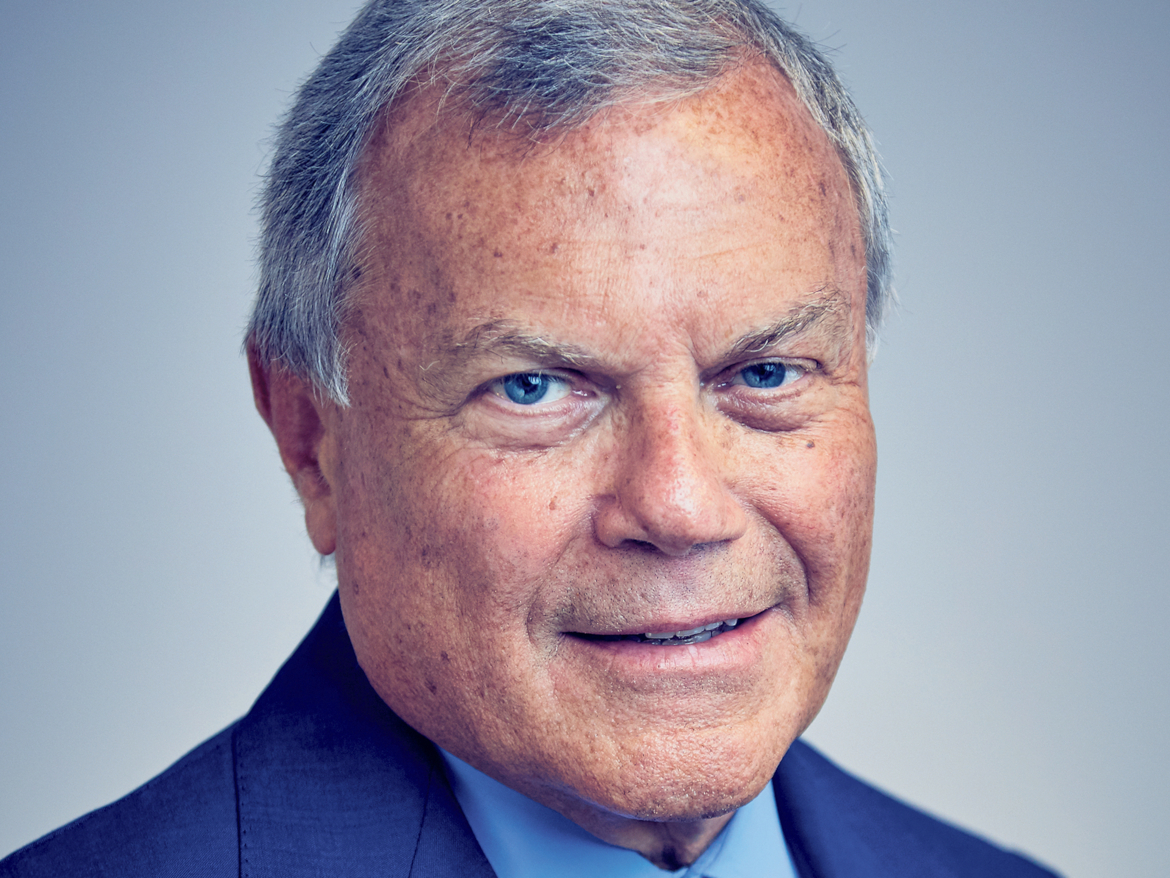
  • “Trump will be good for business”: Sir Martin Sorrell’s take on the 2024 US election

    “Trump will be good for business”: Sir Martin Sorrell’s take on the 2024 US election

    Sir Martin Sorrell

    There were two clear issues in the 2024 US election: firstly, as James Carville put it, it’s the economy, stupid. Secondly, it was the immigration question, though there were some signs in the exit polls that the future of democracy was also important.

    The Democrats got it wrong – and the pollsters did too. But then I think Trump, for the second time out of three, has conducted really tactically interesting campaigns. In 2016 he used a San Antonio agency called Giles-Parscale which was run by a guy Brad Parscale with only about 100 employees. It was the days of Cambridge Analytica and personalised data: they ran an extremely effective campaign in 2016.

    In 2024, the Democrats outspent the Republicans very heavily. In 2016 they had new media; in 2024, they had a “new-new” media. They only had a staff of about four people; the Democrats had about 100. It’s ironic that the Democrats are left with a bill for £20 million for three celebrity concerts which they’re unable to pay for: I think Trump has offered to pay off the debt.

    I thought Trump would win until the last few days. Then I thought the issue with the comedian Tony Hinchliffe calling Puerto Rico an ‘island of garbage’ in the warm-up at the Madison Square Garden comment – I thought that wouldn’t go down well. I also wondered whether the comments he made about Liz Cheney would have a negative impact on his prospects.

    But fundamentally, it doesn’t matter what Trump says. When he once said he could shoot somebody on Fifth Avenue and not lose any votes, he was right. In 2024, he hit the nail on the head over and again and was very disciplined, especially when he repeated the Reagan line: “Are you better off than you were five years ago?”

    He was also very disciplined on the advertising. The Democrats used the “new-old” media: Facebook and Instagram and so on.

    Nevertheless, it was a surprise that they took the seven swing states, as well as the House and the Senate: it was the scale of the victory more than the victory of itself which came as a mild surprise.

    All of this means that Trump is in a very strong position, particularly for the first two years, since there’s usually a reaction in the mid-terms. The stock markets have welcomed the win and Treasury yields have risen slightly and so there are some natural concerns now surrounding inflation. We’ll also see what the impacts of the proposed tariffs are going forwards.

    On the Democrat side, I don’t know if it would have made a difference if Biden had pulled out of the race earlier, and if the Democratic Party had had an open convention. I don’t think Tim Walz was a good pick as Vice-President – Pennsylvania governor Josh Shapiro would probably have been better, but perhaps Kamala was worried about the competitive element there. She didn’t want a strong personality.

    Going down into the results a little, the Republicans managed to engage with Latinos, with young blacks, and with less college-educated young whites. The other surprise for me was that the Roe v Wade decision and abortion was not as prominent as we expected: women didn’t react as aggressively as we thought they would do.

    Of course, Trump’s rallies and speeches were extremely dark. Kamala’s rallies were the opposite, with her smiling a lot – but there was a lack of content. That left a gap for Trump to make some shrewd moves: to take tax off Americans living abroad; and to take corporation tax down from 21 per cent to 15 per cent as well as lowering income tax. All these were far more substantive than anything the Harris campaign said.

    I saw a TikTok of a young black woman with a massive apple in her hand. She said to camera: “Do you know how much this apple costs?” It was a massive apple, about the size of a pomegranate. She said: “I thought it was one or two dollars – but it was seven dollars!”

    At the end that was the thing which swung it: the economy.

    And going forwards? Trump has put into place a Cabinet and advisors who very much represent what he was going to do.

    People say he didn’t expect to win in 2016. This time around, it’s not a surprise and he has the four years of experience. He is somewhat controversial, to put it mildly. But he has firm views.

    Whatever business said before the election, deep down they wanted Trump because he stands for low tax and low regulation. Overall, Trump is good for business and good for North America.


    Sir Martin Sorrell is the chair of S4 Capital.