I recently enjoyed the BBC’s new drama Industry, in which we follow five graduates that vie for a permanent job at the fictional investment bank, Pierpoint. The clashes, the deceit, the egos and the excess draw you into their storm in a teacup. Yet I couldn’t help but notice that none of this rivals the tempest that gathers around graduates trying to break into the world of journalism.
Being one of them myself, and on one of the most competitive and well-respected journalism courses in the country, I can say with confidence that they’re a maverick and driven bunch. Since we spent last semester enjoying in-person teaching but with very little social life outside of the course, the long days, intensity of work and shared dream have led to a sense of village community.
But as with any village, there is also drama and intrigue. There has been suspected ‘ideas stealing’ and the reckonings to follow. Meanwhile, the psychological warfare of group chats reveals how many grad schemes and jobs people have applied for.
Some want to infiltrate, investigate, and expose terrorist organisations, whilst others are fiends at trawling through suspicious MPs’ expense record. Others just want to write about cricket. There is depth and there is range to their pursuit to make a living out of words.
Then there is the world of freelancing – like banking, one with its own quirky words and rules. Freelancing can be very rewarding and is an excellent way to introduce yourself to publications you one day hope to work at full-time. It is also another way of quantifiably comparing yourself to your journalist peers. Some will already be working on documentaries; others are writing features for national outlets; and the relentless Twitter stream can all seem a bit much sometimes.
Investment banking may be competitive, but it’s got nothing on journalism. More graduates than ever are interested in journalism as a career-path, and unfortunately there are fewer jobs waiting for them. The result is a highly competitive but undoubtedly exciting atmosphere.
Robert Golding speaks to the famous hotelier about his opposition to lockdown and what graduates need to know about the hotel industry
For many, it will be outdated to think of Covid-19 as being a Biblical reckoning of sorts, where the last shall be first, and the first last, but there have been some tremendous reversals of fortune.
Hoteliers are up there with airline owners and restauranteurs among those who have most had to duck and weave. And there’s no hotelier more famous than Sir Rocco Forte. To talk to him is to suspect that he is the sort of man in whom stress takes the form of indignation, but we should be open-minded about that: Forte has seen his business upended by the pandemic.
Forte is a lockdown sceptic of the Toby Young and Laurence Fox school, but with the crucial difference that with business interests to protect – and employees to look after – he has attracted less opprobrium. That’s partly because he is talking from a position of commercial pragmatism rather than whimsical philosophical pushback. This is the voice of business and it’s a powerful thing to hear.
He begins our interview by recalling the strains of the first lockdown: “Our German hotels stayed open with greatly reduced staffing levels, as we had long-term customers and under law we couldn’t take advantage of their furlough scheme, if we closed. In Russia the hotels remained open as there was no furlough, and therefore there wasn’t much difference in cost between staying open and closed.”
New opening, Villa Igiea
He sighs pre-emptively at the thought of the ensuing recollections: “The reality is most of my hotels depend principally on international business. The Italian city centre hotels [such as the Hotel Savoy in Florence, and the Hotel de Russie in Rome] have six per cent local business; Brown’s of London has nine per cent UK business. With restrictions on international level, they can’t function on a profitable basis.”
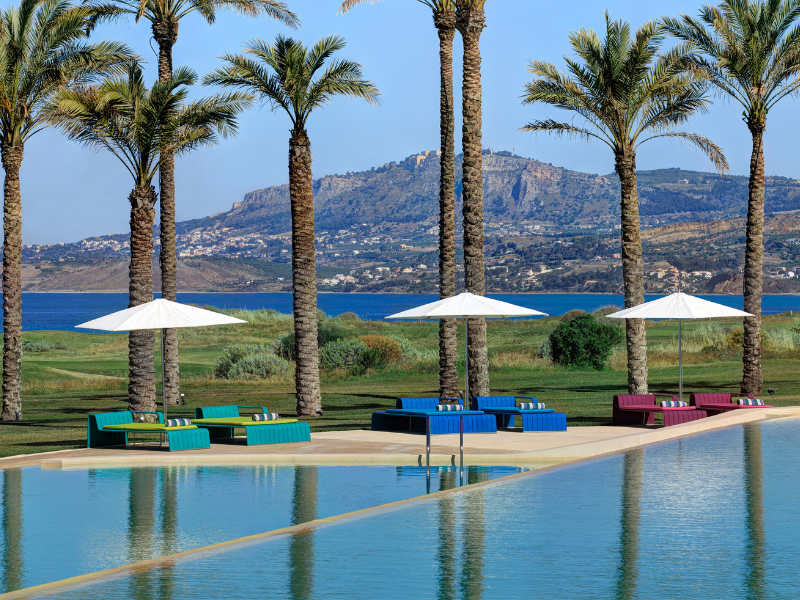
But Forte is in the league of the hugely successful and one can sense beneath the extraordinary difficulty of the situation his resilience. He will not take reversal lightly – and 2020 did see a few successes. “Most of these hotels will continue to limp along. The two exceptions in August, September and October were our 40-bedroom hotel Masseria Torre Maizza in Puglia, and the Verdura Resort in Sicily which had a reasonable August. But it’s a gloomy scenario.”
To put it mildly, Forte is no fan of the Johnson administration, but reserves special ire for government scientists. “The government needs to change its attitude to the pandemic,” he continues. “The very few people who are endangered are old and have underlying health problems. It’s not nice to talk about people dying and it’s sad, but it’s not a disease that affects young people. Scientists you’ve never seen before are now enjoying the limelight: they didn’t have authority before, but can now tell people what to do. Really, we should get back as quickly as possible to a position where we’re all allowed to make up our own minds about the risks we want to take.”
The Verdura Resort in Sicily enjoyed a profitable summer in 2020
Forte was talking before the second wave, and the deaths which followed. When I catch up with him again in late April however he questions the government’s narrative about the spike in deaths: ‘I am also upset about the exaggeration of deaths. The reality is that under the age of 60,10,000 people have died, they’re running the economy. 80,000 of the so-called Covid deaths have been in people over 80 and another 30,000 of people between 70 and 80. It’s not a reason to close the economy. The whole thing is to terrify people into submission. I never knew how totalitarian states cowed people into submission. Now I know how they did it.”
Perhaps it will always be salutary to have someone like Forte arguing during a time like this against the status quo since that asks those in power to check whether the balance is right. “We closed our whole economy and it’s just nonsense, we’ve got to move away from being ultra-cautious and ultra-careful.”
In the event of it, the Johnson administration did listen to some extent and in hindsight we all know, after the Winter of Variants, that so far, there has always been cost attached to the decision to open up. Yet we also know that we can’t go on like this indefinitely, and Forte is among the most compelling voices pointing to the cost to business of not opening up.
Forte, like Goldman Sachs CEO David Solomon, wants his staff back in the office. “I started getting people back in the office in July 2020. Staff were anxious to get back to work. Employers have got to get harder with people. People who have underlying health issues – that’s understandable. It’s the same with the schools: children are not at all at risk of the disease.”
Sir Rocco Forte outside Brown’s as part of its Luxury is Local push. Brown’s footfall pre-pandemic was only 9 per cent domestic
The counter-argument would run that this misses the point and that nobody is particularly arguing that they are: what the government is saying is that they can carry the disease and transmit it to someone who is at risk. Forte pushes back on this: “The government said there would be a spike when the children went back to school in March and there wasn’t.”
Forte is illuminating on the commercial reality: “The economy is talked about in the abstract. It’s about people’s livelihoods and their families. We’re still not open and free to work.” This is plainly true, but there again one might say that it’s precisely in recognition of this fact that we have the furlough scheme.
The suspicion remains that confronted with the pressures of SAGE’s advice, and the public health, Forte might have done the same thing as Johnson and Sunak, although perhaps with even greater reluctance. He rejects this: “I keep thinking, ‘What would Mrs. Thatcher have done?’ For one thing, she’d have known the science herself. And she’d’ve have taken a much more pragmatic approach. And why is the government talking about an early election? Because the government is popular and people are at home, being paid and not having to work. We’re not seeing the eventual effect of all this, which will come two years down the road. Their propaganda has made them popular and they don’t want to see adverse effects. There’s a lot of talk internally within the Party about a new election.”
Forte then is a man at bay, and at odds with the government. If you take the long view, you might say that the brand is strong, and that given his own immense savvy, he will find a way back. But there must be days when it doesn’t feel like that. ‘It’s cost the company around £100 million,’ he tells me in April.
It’s no surprise to hear his opposition to home-working going forwards. Recalling the first lockdown he says: “For the first six weeks, I’ve never worked harder in my life, but after a while the whole thing pales. Being in an office creates discipline. And if not being in an office is demotivating for me, what’s it doing to the rest of my staff?”
And what about the position on tax going forwards? Forte is clear about mooted tax rises: ”We want to get the economy moving, and we’re not going to do that by raising taxes. Servicing the debt will cost half a billion a year which is not significant. Why do we need to start repaying the debt now? We finished off paying our war debt three years ago. We don’t need to rush.”
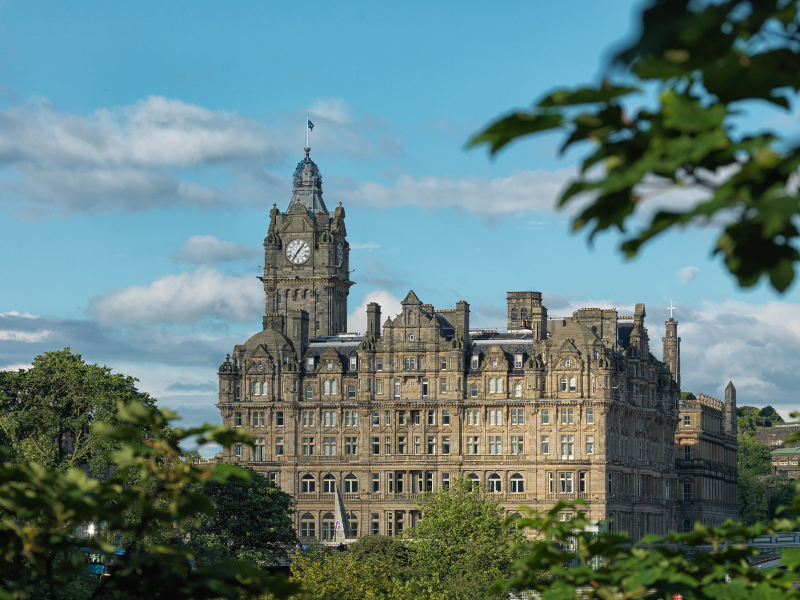
The Balmoral in Edinburgh is another option for the domestic traveller
As a Conservative Party donor, has he spoken to the prime minister about all this? “I’m afraid I’m not in a position to pick up the phone to him to tell him what I think. The best way to influence those in government is to make your views known very publicly. I have appeared on television which is not something I normally do – desperation.”
So will he be looking to hire this year? “Once things normalise, a lot of businesses won’t be around anymore. Ones like mine who can borrow more money will be more indebted with the constraints that puts on business. But we’ll still be looking to hire people.”
So what does he look for in potential employees? “We look for an element of enthusiasm for the industry. I would never advise anyone to come into this industry who didn’t enjoy working in it: you should try and do a holiday job for a few months, and see if you like the feel of working in a hotel and what it entails.” What should they be prepared for? “It’s quite hard work,’ he says. “It involves unsociable hours a lot of the time and people in the business enjoy that. You need to have camaraderie and a sense of belonging. Upwards mobility can be very quick. You can start as a waiter and end up in a management position if you have the right attitude and the abilities to do so and these are recognised. If you’re a shrinking violet it’s not the place for you.”
So, once the pandemic’s over with, what are his plans? “Well, I have big concentration in Italy as we already have a strong position. But I’m not in Milan. Venice is somewhere we should be. I want to do more in the UK. It’s very difficult outside of London to look at smaller hotels in important tourist destinations where a larger hotel won’t work. Where a fifty or sixty bedroom hotel would be quite successful. As a UK-based company it’s a shame we’re not doing more here.”
You get the impression that this is how he’s used to thinking – dynamically and rapidly about future plans. It’s a window into the mindset the pandemic has deprived him of. “Then I’m not in Paris, not in Madrid and Barcelona. I’m in St. Petersburg not Moscow. Then I’d like to be in the States – a big proportion of our business comes from there, so New York and Miami…”
At which his voice trails off, seemingly with the realisation that none of this is possible at the moment. But everything about the man makes you realise it will be again – and perhaps sooner than any of us realises.
As part of our regular series examining the impact of family relationships on careers, we spoke to the La Gavroche chef about keeping the family flame.
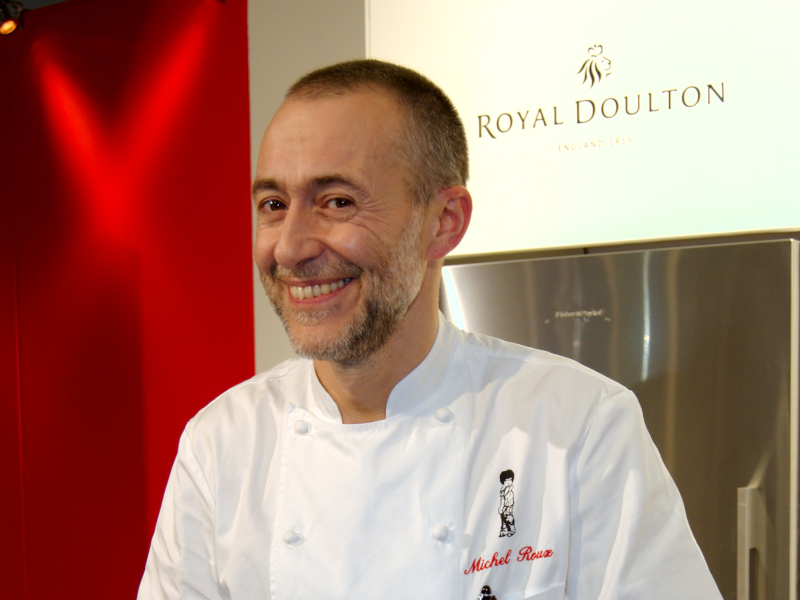
If ever you’re lucky enough to eat at Le Gavroche, your good fortune is likely to be compounded once you’ve had the excellent food. It’s Michel Roux Jr.’s habit to do the rounds after lunch, and perform a friendly tour of the room. Roux will pose for photographs and laugh genially as the complements accrue. ‘I love being able to provide a total experience for our guests,’ he tells us. ‘I love meeting out guests, whether regulars or new.’
As a result of this tactileIf ever you’re lucky enough to eat at Le Gavroche, your good fortune is likely to be compounded once you’ve had your food. approach to the business, you’d think lockdown might have been difficult. Roux strikes a cheerful note. ‘I’ve been incredibly busy during lockdown, not least with the arrival of our first grandchild, which is really wonderful.’
So another Roux enters the world, no doubt stocked with the genes of a master chef. Roux has followed in the footsteps of not just one but two famous relatives. You might think that his father might have been Michel Roux Sr., who died in March of this year, but you’d be wrong: in fact, his father is Albert Roux, and Michel Jr. was named after his uncle. Le Gavroche – which opened in 1967 – was the first UK restaurant to obtain three Michelin stars, and Michel took it over in 1993. How did it feel to be following in the footsteps of famous relatives? Roux recalls: ‘Of course, it was a massive responsibility when I took over the reins at Le Gavroche, nearly 30 years ago now. But if my father hadn’t thought I was ready, he wouldn’t have handed them to me. There is no question I feel a commitment to maintaining the Roux flame, whether in the restaurants or through our Roux Scholarship competition.’
One often feels for the children of famous parents: it must be hard to achieve anything in your own right. Martin Amis frequently complains about the Kingsley comparisons, and Euan Blair cannot discuss his own original (and unBlairite) views on education without having ‘education, education, education’ returned to him.
So did it take a while for Michel Jr. to arrive at his own identity as a chef? Roux explains that he’s moved with the times: ‘Over the years, the food at Le Gavroche has evolved to embrace the requirements of modern diners, so a meal at Le Gavroche will be a lighter one than when the restaurant first opened, but the essence of French classicism is very much there.’
It’s a good point: we might sometimes strive to differentiate ourselves from our parents’ achievements in the workplace, but usually time will do that for us anyway, and ensure that we inhabit a different moment in history. One example where that’s proven the case with Michel Jr. is in his highly visible TV career.
So how does he think shooting will be in the post-lockdown era? ‘I was lucky to be involved in the production of ‘Hitched at Home, Our wedding in Lockdown’ for Channel 4, which was definitely TV for lockdown. It was very different to the usual filming set-up.’ How so? ‘It’s going to be incredibly difficult to make the same sorts of shows as before, even with one meter social distancing.’ But Roux adds that he’s ‘seen a lot of creativity: talking heads, and getting family members to film over longer periods using professional equipment at home.’
Interestingly, the Roux tradition is already being continued in the next generation. Emily Roux and her husband Diego Ferrari have their own restaurant Caractère in Notting Hill. So what would Roux say to young people mulling a hospitality career? ‘Front of house and in the kitchen, hospitality can offer an amazing career. You’re always learning, you have the opportunity to experiment and be creative, and it’s incredibly satisfying to provide good service. But it is hard work, and you need to put in the time to learn the craft.’
And how has lockdown been for Le Gavroche? ‘The most important thing for me is to make sure our staff are doing as well as they can. It was frustrating waiting for the government to come up with their guidelines for the hospitality industry.’
Roux chose not to home deliver (‘Le Gavroche is more than the food’) and instead kept in touch with regulars through newsletters ‘to keep everyone engaged.’
Despite his obvious love of his work, the question persists. One can’t help but wonder whether the family name hampers people like Roux, and whether some other career might have been possible had there not been the need to keep it in the family.
But Roux doesn’t feel this way. ‘I never considered anything else. Food is in my DNA, and I love working in the industry.’ Parfait and bon appetite.
The pensions industry is very similar to the thoroughbred horse breeding industry in that both businesses are long term industries which tie up a lot of long-term capital.
With the thoroughbred horse you breed the best with the best, and hope for the best.
When I started my business life as a trainee inspector (salesman) with Scottish Equitable in 1974, I was hoping for the best. The Edinburgh-based insurer had an excellent pensions pedigree and a long-term goal to breed their own sales force to acquire business levels to support their ambitions to be a major player in the pensions industry.
The Scottish Equitable had developed a structure, a training manual and programme with a training manager in situ to recruit and develop staff replacements for staff who left from a pool of trainees.
Aiden O’Brien operates a similar programme so that when a Galileo son retires to stud, he is replaced by another son of Galileo.
Aiden’s strategy works because looking at past performance Aiden has won eight Derbys and countless numbers of group one races including the Prix de L’arc de Triomphe.
I was recruited with others and sent into training with John M McKay, the Glasgow manager who was an Edinburgh man and like Prince Philip, a Royal Navy man.
McKay treated all his sales staff as officers and for four years guided me through my apprenticeship.
McKay sent me on sorties to friendly insurance brokers to deliver quotations and collect new business for me to see what was involved.
Please remember that senior officials wore bowler hats in these days to appointments and there was no such thing as a dress down Friday. McKay insisted that our appearance was appropriate for the job consisting of a pressed dark suit, shirt and dark tie and black polished shoes.
McKay would tell us all at branch sales meetings to get our hair cut once a week and polish our shoes every day. Shoe polish with a brush and duster was available in the gents’ toilets.
The discipline and organisation of being in the right hotel worked for me just as it does for racehorses. A coordinated training programme works for the young trainee inspector, so this inspector has much to thank his mentor John M McKay for.
Four years in Glasgow under McKay tutelage was essential and rewarding for me and Glasgow was a nursery for the big branches in the South of England and London.
McKay would organise training days on a regular basis and extra days if needed. McKay’s training days were conducted jointly where he would accompany me to see banks, building societies, CAs, lawyers and insurance brokers.
After each call a kerb side sales debriefing would follow, a bit like when a horse trainer speaks to a jockey after a race to establish what can be learned from a race.
My senior colleagues in Glasgow branch thought it was fun because I kept Mr McKay out of the office all day and out of their way.
After leaving Glasgow branch, I was promoted to Liverpool and returned to Edinburgh before joining Scottish Widows as assistant marketing manager for pensions. I left Scottish Widows to set up as an IFA in 1987 just before October ’87 financial collapse when equities fell by around 33%. My timing might have been better.
My IFA business grew using organisational skills and by relying on people and not computers, just as McKay had taught me, to expand the business.
When the business was sold in 2018, funds under management were about £200 million, not bad from a standing start. It is said that this could not be achieved today because of the obstacles to business with Government obstacles imposed on the financial service business.
I do not dress down Fridays when on business because to be part, you must look the part.
Mentors work in all types of business. I was lucky and as my golf partners would say, it is better to be lucky than good and you need to bounce over bankers and not into the sand, and a good pedigree helps.
The publishing industry is crucial to society. It gives us new perspectives, encouraging much-needed understanding of the world around us. The content being published has the power to change perspectives and narratives in real life. However, what the industry publishes is a reflection on who is purchasing that content.
Currently, the core audience for publishers in the UK is white and middle-class. The whole industry is essentially set up to cater to this one particular audience.
Being mixed-raced means subjects or content in contemporary publishing that relate to my own lived experience feel few and far between.
I have always loved books and stories, finding it easy to be whisked away by dragons or follow heroes into battle. However, it has always felt to me like someone else’s adventure, someone else’s journey. To this day the content I consume, though wonderful, has very little to do with me or the cultures I am familiar with.
When I started studying publishing at university, it was originally because I wanted to be the one to discover stories like those I’d loved before first-hand. However, throughout my studies, it became clear that this lack of diversity in both industry staffing and output was an issue – and not just my issue, but an issue for publishing as a whole. How much of an audience is this current industry reaching? I knew I wanted to make a change for others like me.
When I handed in my dissertation and final major project back in May 2020, despite the global pandemic raging on, I entered the real world with a sense of naivete about how easy finding a job would be.
At any given time, it is difficult to get a toe in the door of the publishing industry due to its competitiveness. One role at a Big Five publisher can have over 1,000 applicants. But what made it worse was that during the uncertainty of the pandemic no one was hiring.
I became frantic, spending hours writing and re-writing my CV. Cover letter after cover letter. Adhering to the advice of tutors to just keep on trying… and trying. Tailoring everything for each new role. Endless optimism…only to find hundreds of job rejections in my email.
It is evident that publishing companies have put some useful initiatives in place for potential graduates, however if the industry wants to transform and diversify, it needs to make far greater and more fundamental changes. Putting more support in place for potential graduate employees is a must. Having a BAME internship available is all well and good, but when only 13%[1]of the workforce identifies as minority ethnic, this leaves a lot to be desired. The goal should be recruiting in a balanced way from all backgrounds, reflecting the demographics of real-life, to prevent gatekeeping of our published output becoming the preserve of a privileged few.
More needs to be done by the industry once the pandemic is over to ensure that minority groups have a chance to gain employment and in turn make the change needed for a more diverse workforce. It is our job as the young voice driving the next generation to find these solutions and drive for them to be implemented; I have so many ideas and such a thirst to get going – what a difference we can make for our future. I’m excited to see the view from the other side.
The writer is a graduate, seeking her first job in publishing
Despite being forced to resign, Boris Johnson still enjoys widespread grassroots support among Conservative Party members, a new survey finds. According to a poll conducted by Folkestone and Hythe Conservative Association on the 14th of July, and seen by Finito World, 49.4% of Grassroots Conservative Party Members would support him if he was on the ballot paper.
Boris Johnson will leave office after the summer and has said he is leaving with his ‘head held high’. This assessment appears to be shared by Conservative affiliates. Here are the numbers in full:
Boris Johnson: 49.4%
Penny Mordaunt 24.4%
Rishi Sunak 10.4%
Liz Truss 6.7%
Suella Braverman 3%
Tom Tugendhat 4.3%
Kemi Badenoch 1.8%
The survey consisted of a data pool of 167 verified responses, and reveals fascinating trends, amounting to an intriguing snapshot of the crucial voters beyond the parliamentary party who will ultimately decide who is the next Prime Minister.
Folkestone & Hythe Conservative Association Chairman, Stephen James, said: “Boris Johnson appears to still have wide support amongst my fellow members and some have even called for Boris Johnson to be added as a third name in the leadership contest. It is often said that the ‘Westminster Bubble’ isn’t a true reflection of the wider country, and this poll seems to support that premise.”
Asked what the key issues are for his members, James added: “Brexit, Furlough, Vaccines, and Ukraine are all issues that Boris can be proud of, and I think many will lament his departure. It will be interesting to see if Boris Johnson will use this support to influence the leadership race or if like his hero, Sir Winston Churchill, he will make a comeback… Boris Act II.”
However, the poll was also further good news for Penny Mordaunt, and further unsettling news for the other camps. In a poll without Boris, the results are as follows, with the former Defence Secretary out in front by an eye-popping margin:
Penny Mordaunt 52.7%
Rishi Sunak 13.9%
Liz Truss 13.9%
Suella Braverman 6.1%
Tom Tugendhat 7.9%
Kemi Badenoch 5.5%
Finito World News Director Christopher Jackson said: “Much can happen still in this race, but this latest poll only confirms that all the momentum at the moment is with Penny Mordaunt. It’s clear that in a crowded field she has managed to cut through among Tory grassroots in a way that none of the other candidates has been able to do.”
Penny Mordaunt MP
The Member of Parliament for Folkestone & Hythe, Damian Collins MP added on Twitter: “Penny Mordaunt is a team player and a leader you can trust. She has a track record of service that will make her an outstanding Prime Minister #PM4PM.”
A major section of the HS2 railway which would have run from the east midlands to Leeds has been scrapped in a move which has outraged many, including Labour leader Sir Kier Starmer. The railway has always been controversial, and a petition to stop the railway by nature conservationists led to Parliamentary debate this September. Now, the controversy stems from what some are calling broken promises for the levelling up of northern economy.
The lobbying organisation Construction Alliance North-East (CAN) has predicted that the new Integrated Rail Plan will mean hard times for northern construction firms. CAN Board member Stuart Miller explains the possible consequences, and how this move could not have come at a worse time.
“The construction industry has suffered greatly over the past 18 months with materials price hikes, availability of key products, and site closures. The government’s cancellation of these projects has added to these issues with the loss of years’ worth of work to the region,” Miller says, adding that “Major infrastructure projects of this nature are the lifeblood of many, and we’re disappointed that, once again, prosperity in the North has been overlooked.”
Northern Powerhouse Rail investments have been cut by £24.9bn, and investments in the eastern leg of the line have been cut by £14.2bn, halving the initial investment. This move strikes a nerve as many see it as a rolling back of the Levelling Up agenda, which promises to balance the UK economy and make prosperity in the north and south more equal. Miller believes that this move will have a direct impact on employment in the region and calls for the delivery of government promises.
“The government’s levelling-up agenda must include a step-change in infrastructure delivery in the north of England, and the decision to scale-back these plans can only hinder its stated intention of delivering a more balanced UK economy in the longer term,” Miller says, “One key section of Northern Powerhouse Rail alone could deliver a £22bn boost to the northern economy by 2060,” citing a report by engineering consultancy Mott McDonald.
Boris Johnson says that he has not gone back on promises and guaranteed that the improvements will be delivered. In the meantime, he faces backlash from both parties. He has defended the delays, citing concerns over building on virgin countryside and “ploughing through villages”, according to a BBC report.
Change may well come as promised, but in the short-term at least, it seems that northern construction contractors will continue to struggle.
Imposter syndrome is more than feeling like you don’t quite cut it at work – it is a deep-seated feeling of inadequacy which can affect aspects of life far beyond the office. Research from media outlet UM suggests that 77 per cent of adults in the UK suffer from imposter syndrome, but also that only 15 per cent knew what the syndrome was before they were surveyed.
With so many people feeling this way, it is important to understand what imposter syndrome is, and how to face it. According to a report assembled by Charles Tyrwhitt, the primary signs of imposter syndrome are self-doubt, attributing one’s success to external factors, being overly critical of one’s own performance, and being afraid of disappointing bosses and colleagues.
Research from the University of Nottingham suggests that imposter syndrome can be mitigated by working from home in some cases, away from an overly stressful office environment. They measured a 75 per cent decrease in cases of imposter syndrome from 2019-2020, despite the lockdowns and possibly due to working from home. Dr. Terri Simpkin who is an Associate Professor at the University of Nottingham explained why this can be the case.
“Imposter Phenomenon is related to context,” Simpkin says. “If the context changes, so can experiences of Imposterism. It’s socially constructed, so change the social circumstances and the experience may change too.”
For some, working from home can increase feelings of self-doubt. It depends on if you are someone who needs the community element of office-based work to keep in “the groove” and feel like part of a team, or if you are someone who prefers to avoid the natural comparison between employees which happens in an office setting. Some need the camaraderie, but with it can come competition.
The report suggests that one of the best ways to combat imposter syndrome is to examine your achievements objectively. This means not only recognising the tangible things that you have achieved, but also avoiding qualifying those achievements with mental statements which remove your role in that success. These could come in the form of statements such as, “Yes, I was part of the project, but the others contributed more than I,” or, “It went OK, but I still feel that another employee would have done a more thorough job.”
Imposter syndrome can affect all workers, young and old, new hires and long-time employees. A general rule of thumb is this; If you have a job, they wouldn’t have hired you for that position without reason, so therefore you must have been the best candidate. Sometimes doubting the quality of one’s work can come with a healthy sense of drive to improve, but once it becomes debilitating, it is time to take a step back and address the issue.
Lee Elliot Major’s mid-pandemic plea for a focus on social mobility. Originally published January of 2021.
I was optimistic at the start of Covid-19 that this crisis would somehow affect social mobility in a positive way. But we are still in denial about the long-term economic challenges we face and how these will affect young people’s opportunities: the pandemic has hit the under 25s more than any other group, and this will have far-reaching consequences for social inequality.
Young people are facing an unprecedented decline in social mobility, and are likely to be much worse off than their parents’ generation. That hasn’t happened since the war: relatively speaking, every generation has done slightly better than the last (in terms of wages and housing).
This does, of course, affect those from poorer backgrounds the most. Our research found that during the first lockdown, students from private schools were twice as likely to benefit from a full school day (5 hours of learning) than state school pupils.
My fear is that this will result in a massive gap in school assessment, which means that particularly select universities are going to have to think about how they take context into account. I suspect what it really means is that those from privileged backgrounds will just be better positioned for universities this year.
So what are the other options? In my view, if we are serious about social mobility, we have to think about half of the young who can’t (or don’t want to) go to university.
In fact, if you gave me a choice, I’d say we should work much harder on improving the numbers and qualities of apprenticeships. In terms of the links between education and the workplace, we pale in comparison to most other education systems: Australia has, for instance, developed much stronger vocational options and headteachers celebrate the students who get really good apprenticeships as much as those who go to top universities.
Part of our problem is structural (i.e we don’t have enough apprenticeships in place), but it’s also cultural. Although the government are doing better, we still suffer from a cultural assumption that academic success is somehow the be-all and end-all.
People need to look hard at what that a degree offers them in terms of future life choices, and whether this is ultimately a better option that an apprenticeship. The problem is that students from underprivileged backgrounds have less guidance in this area.
Some universities, like Exeter, are offering degree apprenticeships. I’m really pushing for that; it would be great to be able to build bridges between the workplace and the world of academia, and I don’t think that highly selective universities have worked closely enough with businesses. The other great option is a national tutoring service; something I’ve been campaigning for for a long time. The government has already made good headway in this area, but I think it should be ten times the scale it currently is.
We’ve reached a tipping point in society. Wherever you lean on the political spectrum, my view is that you need to balance the freedom of people to do best for their children (a primal instinct we all have as parents) against the need to ensure that those from disadvantaged backgrounds have a fair chance if they work hard and do well.
However you look at that equation, I think that we’ve now gone past the tipping point. It’s now near-impossible for young people from poorer backgrounds. The Covid crisis has added yet another weight on that imbalance, and it’s become so one-sided now that we’re all recognizing that we need to do something big – like FDR’s “New Deal” which was enforced after the great Depression.
What worries me is that we’ve become so polarised in our political debate- and this is much more extreme in America which has become, in my view, a completely dysfunctional system- that anything the government says, the unions will oppose it- irrespective in a way, of the content. Some things the government does should be welcomed and some things should be challenged, but at the moment I feels like debate is so divisive that whatever the prime minister says, he’ll be castigated.
The trouble is you need some kind of consensus for social mobility to happen. There are some academics who argue that this kind of polarisation of public debate is the inevitable consequence, or end-game, of inequality and capitalism.
On the brighter side, there’s definitely an appetite for bold ideas. I’m always throwing these to the government, but what we really need is for young people to be empowered and informed, so that they can be motivated to get involved in these kinds of debate and influence policies.
At the moment, it doesn’t feel like there’s a call to arms. We’ve seen huge progress with the young’s involvement with BLM and the environment; I’d love to see the same momentum around social injustice and social mobility.
Georgia Heneage examines the direction of office culture following the pandemic
A few terms have been thrown around – hybrid-working, for instance – but one caught my hear in particular. Listening to a BBC podcast on Holacracy and one tech tycoon’s attempt at reimagining the workplace, it occurred to me that systems like these might become more popular in a post-Covid world.
Holacracy is the process of devolving power from central management across the company – a little like a business version of socialism. The term derives from a ‘Holarchy’ – first coined by novelist Arthur Koestler – made up of holons which are autonomous but also integral to the whole.
The radio show in question looked at the story of Tony Hsieh, a Silicon Valley giant whose online shoe retailer Zappos operated (and still operates in large part) on a horizontal-type structure. Hsieh was at pains to cultivate a working culture which would keep his employers happy and create a fun (and “weird”) environment in which to work. A report from the University of Oxford revealed that happy workers are on the whole 13% more productive, so the fact that healthy working environment is conducive to a healthy company was no doubt on his mind.
Zappos famously became harder than Harvard to get into, and Hsieh introduced wacky interview techniques such as asking the interviewee’s taxi driver whether they’d been polite on the way, or offering the successful applicant the choice of taking $2000 to walk away without the job to make sure he only employed people committed to the culture. In an effort to embody his working principles, Hsieh would even help with customer calls during the holiday—puts in 12 hour phone call shifts at a time. The company only ever had five people with the authority to fire someone, and 500 “circles” in the hierarchy of purpose out of 1,600 employees.
Hsieh’s principles of equality and fluidity in the workplace are important ones to consider as we redefine the workplace for young people; they are especially important in Silicon Valley conglomerates, which are too often founded on notions of capitalist competition where power and money floats upstream. This makes Hsieh’s vision all the more interesting and brave.
But, whilst these ideals seemed to work in principle, Hsieh’s vision ultimately failed. With no managers, employees decided which circles to work in, giving everyone opportunities to move around the company but making the working method destabilizing and chaotic and grading pay impossible. Hidden power structures rose up unchecked and became destructive.
Was Hsieh’s vision doomed from the start? Is there any merit in the concept that we might take into our redefined working world?
Lena Weber-Reed is an engagement and brand manager at GrantTree- a business development service which has been operating in a Holacracy since 2016. “Before it was pretty chaotic,” Weber-Reed recalls. “There wasn’t really a top-down hierarchical system; everyone was chipping in and there wasn’t a clear definition of roles and accountabilities.”
Building a Holacracy allowed GrantTree to delineate roles and gave the company “structure”. Weber-Reed says they’ve always been self-managing but the Holacracy “allowed us to keep the more formal, top-down trickle of information and decision- making at bay.”
“We follow the idea of having an open-culture, where all financial information accessible to everyone and we set our own salaries. I don’t think it would be possible to have that openness without a system that is self-managing.”
Weber-Reed, however, makes a clear distinction between self-management and holacracy, the latter being in her opinion less beneficial in the workplace.
“It is our system of self-management that gives me freedom and enables me to work in a way that’s more streamlined and meets my own needs, and therefore the company’s needs better.
“Personally, I’m very critical of Holacracies; it is massively process-focused, but in order to access these processes, it asks people to never think of themselves or bring their own person to the workplace. All the decisions you make you make from a role. How can I ever not be myself? And why would you not want your employees to be themselves?”
From a diversity and inclusion perspective, Weber-Reed says this system can be “dangerous and very short-sighted”. “Can a person with a disability or a minority-ethnic background ever really not bring that into work? And why should they?,” she asks.
Weber-Reed says their Holacratic systems give them a prescriptive set of priorities—like attending meetings before your own work or thinking about other people’s needs before your own- which don’t always resolve their issues. “It’s a system that’s supposed to give me guidance on how to self-manage, but my experience has been that it doesn’t help me at all. The frustrations of self-management- like getting people to collaborate- aren’t resolved with the Holacracy system. In theory it should be, but in practice it isn’t.”
Her story seems a stretch from Hsieh’s utopian vision. And just as Hsieh’s dream ultimately failed, in practice Holacracy appears not to be the definitive answer. Instead, it is the principles of self-management and autonomy (and the prioritizing of the individual) in the workplace which we should take onboard.
“I don’t want top-down management,” says Weber-Reed, “but I’d love to have a different tool which helps me with my self-management- a system which understands the complexities of human interaction. I’m surprised there aren’t more alternative systems in the workplace out there.”
As we begin reimagining and restructure the way we work, let’s hope such competitors rise from the fray.