Category: News

  • Jim O’Neill on the MINTs, Goldman v government, and how countries become successful

    Jim O’Neill on the MINTs, Goldman v government, and how countries become successful

    former Chief Economist at Goldman Sachs and former Commercial Secretary to the Treasury Jim O’Neill

    After my paper published by Goldman Sachs coining the term ‘the BRICs’ – which referred to Brazil, Russia, China and India as crucial emerging markets – I used to engage with other countries’ finance ministers. Occasionally I’d find countries annoyed not to have been included in the acronym.

    In 2013, I coined the term the MINTs, to take into account Mexico, Indonesia, Nigeria and Turkey – all of which seemed to me interesting countries.

    Today, the country that has the biggest viable basis for being irritated that it wasn’t included in the BRICs acronym is Indonesia. It’s a very interesting place – it’s another significant commodities producer, but it has weathered the past decades better than Brazil or Russia. 

    Of course, what makes Indonesia additionally interesting is that it’s a very large Muslim country which practices reasonably openly quite a few aspects of modern capitalism. So it has very positive demographics. 

    In terms of conceptual potential, I’m also very interested in Nigeria – though there you’re talking not in the next 20 years but in the next 40. If that crazy place could have a proper economic policy framework it would become extremely big in the African context as its demographics are just incredible. It’s an extremely young population with great capacity for productivity. 

    This is where economic outcomes come down to political leadership. Brazil, Russia and Nigeria, have all been impacted by poor governance, and we’ve seen that with India this year with the virus. In 2000, I developed the Global Sustainability Growth Index, which included around 190 countries. We statistically examined hundreds of variables, and ended up including about 15 which seem especially important for economic growth. Among the things that really matter is the strength of a country’s institutional framework.

    That index today shows China scoring much higher than any of the other BRIC countries – and interestingly India scores lower than Russia or Brazil in spite of its spectacular demographics. 

    But we have our own inequality and problems here at home – I hope Boris Johnson is genuine about his levelling up agenda. He’s only been in power a relatively short period of time, and because of Covid, we haven’t even had a proper budget or multi-year spending review yet: everything’s been a policy response. Boris seems to struggle with rhetoric and the whole idea that a prime minister should under-promise and over-deliver. He’s raised very big expectations – and these are things which will take a long time to deliver on. So far, there’s very little evidence that he is delivering on it. 

    I retain a close friendship with George Osborne, and with Whitehall officials. When I worked in government, to my pleasant surprise I found the quality of the staff in the Treasury to be just as good as at Goldman Sachs – but with greater public spirit. The hard thing for me was that I wasn’t a member of the Labour Party; I was there to execute a technical role. But I was surrounded by ministers who were obsessed with where they were in terms of political horse-trading. 

    I found their motives troubling. They would decide what to support based on how it would help them in their next job which is extremely different to Goldman Sachs. Even within the same party, competing ideologies were different – often irreconcilably so. In that sense, I witnessed first-hand the ridiculous developments within the Conservative Party: I was shocked as to how crazy it was.

    By comparison, I was lucky at Goldman. They were mad enough to offer me a partnership to join – I was only the fifth. They’d taken on a lot of risk themselves. But I was daunted – then as now, the image of Goldman was intimidating from the outside. It was full of remarkably smart and incredibly driven people. They had 300 people in the place with their own views on the dollar – many of whom were smarter than me. But it really is a meritocracy in there. So long as I delivered the goods, nobody gave a damn about my background.

  • 2022 Highlights: Computer says no – should we welcome AI in recruitment?

    2022 Highlights: Computer says no – should we welcome AI in recruitment?

    Georgia Heneage

    As unemployment soars and the market floods with an excess of applicants applying for a limited number of jobs, the recruitment process has become swamped. Amber Shrimpton, an HR consultant at Centrica energy, says the economic situation has sparked a “loose labour market where there are more people looking for jobs than employers offering them”.

    It seems, then, that the need for technology in the application process may be more important now than ever. The role which Artificial Intelligence plays in recruitment is expanding exponentially; machine learning allows companies to filter a large number of job applicants and vast amounts of data more quickly and efficiently, which is why conglomerate companies like McDonalds, JP Morgan and accountancy firm PWC are jumping on the trend.

    According to recruiters, the most time consuming part of hiring is the initial sifting through hundreds, sometimes thousands, of applicants. This is where AI steps in. Intelligence can sort through CVs, look for the right candidate and conduct first-stage interviews with them; they can perform background research on the candidate such as income, earnings and schooling.

    According to one report, 52% of talent acquisition leaders say the hardest part of recruitment is identifying the right candidates from a large applicant pool, so on the surface AI recruitment seems like an attractive alternative.

    But, like any rapidly growing technological phenomenon, the symptoms are not all positive. A BBC article yesterday revealed the ins and outs of this digitalised process and one jobseeker’s largely negative experience of being interviewed via an algorithm.

    That our future careers may be decided on the algorithmic whim of new AI recruitment software may strike anxious jobseekers as unwelcome: doing well in an interview has traditionally been reliant on human contact, such as a firm handshake or good eye contact, and the automated nature of this process has frightened off even the most tech-savvy of companies- like Amazon, who scrapped their artificial hiring tool back in 2016 because of bias against female candidates.

    But the role that AI plays in the job process doesn’t always have to be so invasive: technology plays a large part in just assisting online job searchers, such as with ‘Chatbots’ or automated replies to applicants inquiring online about a job. Technology can also play an important role in recruiters matching applicants to the right job by using data to match applicants’ skill sets and interests with the right role.

    What’s more, the science has progressed since Amazon’s decision to ditch its hiring tool in 2016: many specialists consider automated recruitment tools to actually be a more diverse approach to hiring than humans, who have unavoidable internal (or external) bias.

    A report from IBM Smarter Workforce Institute showed the impact AI can have on remedying the systemic inequalities in the workplace by diversifying the recruitment process; machine learning can choose the right candidate for the job regardless of sexual orientation, ethnicity or background, and can help to eliminate the massive role which nepotism currently plays in the majority of job applications.

    One report even found that the gendered language of jobs ads can exclude female applicants and “maintain gender inequality in traditionally male-dominated occupations”. So data-driven, standardised language may be crucial in adopting non-partisan advertising language in order to make the job market a more level playing-field for men and women.

  • 2022 Highlights: Sir David Lidington – ‘History trains the imagination’

    2022 Highlights: Sir David Lidington – ‘History trains the imagination’

    Sir David Lidington, the former de facto No. 2 in the May administration, talks about how a history degree has helped him in his political career

    Certain traits define an aptitude for elected politics, and I’ve tended to find they can be aided by a study of history. One useful aptitude would be fascination with human beings – what makes them tick, and how power is exercised. Secondly – regardless of whether you come from the left, right, or center – almost everyone I’ve met in politics starts with a commitment to changing things for the better in their country. To do that, it helps to know what injustices have existed in the past.

    There’s a third thing, and I would say it also separates the natural politician from the civil servant: a certain zest for the theatre. Politics involves a willingness to take risk, and to be prepared to stand on the stage at the end, and not know whether you’ll have a standing ovation or a bag of rotten tomatoes slung at you. The natural civil servants shy away from that but what’s interesting is you sometimes see a politician who’s really a civil servant – and then a mandarin who’s really a politician. The thespian is striving to get out there.

    The wonderful thing about history is that it trains the imagination: when you start to really delve into history – and read deeply as well as widely in a particular era – you find people in the past had various assumptions and moral codes that can be very different from how we operate today. For example, for people living in 1800 or 1850 the idea that there was going to be this industrial revolution, and transformative migration of people to cities, and a growth of urban conurbations – that’s something which some might have predicted, but by no means everyone. Training of the imagination is important.

    History also teaches you how to use and assess evidence. Particularly in postgraduate study, you have to go back to original source material and assess the reliability of it. You look at state papers, which by and large deal with high politics and the people at the top. But if you go to legal records, there you find out about yeomen and merchants – the people who went on Chaucer’s pilgrimage to Canterbury all crop up as plaintiffs or defendants.

    Another applicable aspect of history was borne in on me when I was Europe Minister. I visited about 40 countries from Russia and Turkey, to the South Caucasus and Iceland. If you want to understand today’s political outlook you have to understand what happened in the past. What are the demons they still fear? What are the experiences that have shaped the outlook of a particular society today?

    For instance, I have long felt that the tension that has always existed between the UK and the EU derived in large measure from contrasting experiences and lessons in the mid- 20th century. For most of Europe this was a period of disaster when national institutions all failed in the face of tyranny, invasion and ethnic hatred. From the EU perspective, therefore you have to build up those institutions to stop anything happening again.

    Another example would be China. I remember a few years ago, I met Xi Jinping’s number two, and he started out with this recital about the Opium Wars and how China had been attacked in the 19th century because it was weak and the European powers had exploited her. Hearing that, I began to understand why they see the world as they do today. They feel a need to put right the century of humiliation and to restore China’s place as a global power. One needn’t necessarily agree with that – but you have to understand how the other side thinks.

    So history is a real asset in politics because you learn how human beings interact with each other, how relationships and power is mediated through institutions, and what lies behind the motivation of countries and individuals. How a Tudor court operates is good for understanding all about access in No.10 Downing Street. Now you have your special advisers rather than Grooms of the Stole or royal pages. Think about Elizabeth I. Who was it who could actually get in to see the monarch and be sure you got your bit of paper in front of her? Likewise, today – who can get something in the prime minister’s box? Patterns reproduce.

    One of the most difficult things for government or for the man or woman who’s prime minister is finding time to regenerate yourself and your government while in office. There are always things pressing in. For me the great prime minister of the 19th century was Robert Peel: he was prepared to change his mind when the facts had changed. If you look at how he moved on Catholic Emancipation and on the Corn Laws and trade you can see that he took decisions based on what he thought was right for the country even at the fatal cost to his own political fortunes. Disraeli was vastly entertaining, but Peel was the greater man and the greater prime minister.

     David Lidington was deputy prime minister under Theresa May and is now Knight Commander of the Order of the Bath

    Read Sir David Lidington’s advice on handling the stress of a high-pressure job here

  • Robert Halfon Interview: ‘AI could act like an individual tutor for every child’

    Robert Halfon Interview: ‘AI could act like an individual tutor for every child’


    By Georgia Heneage

    Robert Halfon MP, the Chair of the Education Select Committee, has a long history of championing causes relating to inequality in our society. It’s therefore no surprise when I catch up with him to find him using strong language about the state of our education system during the pandemic. Halfon immediately calls this past year a “national disaster” for education, labelling those who’ve missed out on fundamental learning “the lost generation”.

    Such strong terms are not used to exaggerate for effect. “The coronavirus has been really tough for children from disadvantaged backgrounds,” Halfon explains. “We know that during the last lockdown 2.3 million children did hardly any learning at all; many children just don’t have access to proper laptops, phones or tablets.”

    Despite the government’s vaccination programme, the future hasn’t got brighter in the past week: free school meals have been put on hold during February half-term, and the government’s plan to execute 30-minute tests at schools has been blocked by the MHRA (Medicines and Healthcare products Regulatory Agency) meaning the date when schools may return to normal will be delayed even more.

    For many, the Covid-19 pandemic has amplified inequalities inherent in a system which already benefits children from more privileged backgrounds and areas. The exams fiasco last year was an example of how schooling during the first lockdown had a disproportionate effect on those from lower socio-economic backgrounds, and also how unprepared the government was for such a situation.

    But the most prevalent issue facings millions of remote schoolchildren during this second lockdown is the efficacy of remote learning in a home environment in which parents are either struggling to balance childcare with work, or are key workers having to travel to work every-day.

    “Mental-health issues among young people are on the rise,” Halfon continues, “and part of the reason is because of social isolation and continued school closures.” The Royal College of Pediatrics recently warned that there’s been a rise in eating disorders amongst the young.

    What’s more, organisations such as Safeguarding Alliance are warning that more kids are being coerced to join county line drug gangs, and are being exposed to online harm because of home schooling: the BBC reported in September that there has been a marked increase in images of child abuse on the internet.

    “If parents aren’t there because they have to work, who is supervising the kids? There’s already problems of inequality in education, but this is making it so much worse,” says Halfon.

    The moves the government is making to widen this gap in access is, in Halfon’s opinion, good, but a bit slow. “The government has supplied around 600-700,000 computers already, but it’s taken a very long time”. Part of the reason for this has been that they’ve had to buy thousands of laptops and get them made from scratch, which they say is a “really difficult thing to do”.

    “Personally I would have just given teachers vouchers, or picked Google Chrome books instead of Microsoft computers, which cost less and don’t need special software.”

    But it’s not all about the lack of internet or tech equipment, says Halfon. “You can have all the laptops in the world, but you have to get the pupil to open the laptop.”

    The reality is that many children don’t have parental support when parents have to work, since blue-collar type jobs (such as being a bus driver, key worker or delivery person) sometimes require leaving the house and children unsupervised.

    “I spoke to a nurse from my local constituency surgery this morning; her child has asthma and even though she was entitled to send her kid to school, the child was staying at home. She was really worried about her child not having an interactive education,” says Halfon.

    Another government initiative to combat issues raised by homeschooling, which Boris Johnson mentioned in yesterday’s PM questions from Halfon, is the possibility of one-on-one tutoring. Halfon campaigned for the billion-pound Catch Up tutoring fund which the government announced last summer, part of which has gone to schools to hire catch-up tutors, who will also be able to teach online.

    Will this kind of digital learning become more of a norm once schools return to normal? “I hope so,” says Halfon. “I don’t mean that I want kids to be learning at home, but I hope we start using tech products and look at how Artificial Intelligence can help influence learning.”

    How so? “It may be that AI could act like an individual tutor to every child, so if a child’s in a classroom and, let’s say, they’re not great at maths, it could be that there’s AI software that can adapt to that individual’s learning ability and offer a way forward – like the tech version of set streaming. Or a teaching assistant on the desk of the students.”

  • Exclusive Interview: Sir Martin Sorrell

    Exclusive Interview: Sir Martin Sorrell

    A look back at Finito World’s mid-pandemic talk with Sir Martin Sorrell who offered advice for the days ahead in April of 2020

    Prior to coronavirus, one would have said that Sir Martin Sorrell is a difficult man to imagine confined to his house. With the new normal of global pandemic, we do not have to imagine. 

    A Zoom interview is not quite the levelling experience one might imagine. True, instead of visiting the 75-year-old’s offices in Mayfair, whose shine and power I am now left to imagine, Sorrell logs on from his central London house. But his energy – which seems part Napoleonic, part East End smarts – is a not a thing to be dissipated on a Zoom call. ‘You look about three years old,’ he says, first up, laughing with typical bonhomie. 

    Sorrell has been in Covid-19 quarantine like the rest of us for the last few weeks. ‘The house is okay. There’s a bit of outside space which makes it tolerable,’ he says. 

    Sat in my two-bed flat in Camberwell, his house seems somewhat better than okay. Under a wall of cartoons (‘You can’t see the half of them’) Sorrell will oversee the work of S4 Capital, the digitally-focused firm he founded straight after leaving WPP in 2018, during the indefinite season of lockdown. 

    For Sorrell, the coronavirus situation comes across as just another problem that requires solving: he’s seen plenty of these since the early days of Saatchi & Saatchi, through the years of expansion of WPP, taking in the global financial crisis and numerous other shocks along the way. 

    His bearing is that of a man likely to prosper in this, as in any other era. ‘I actually find I’m doing more work, as there are no interruptions,’ he explains. ‘No breakfasts; no dinners; no surplus travelling. So, on balance I’m more effective and certainly learning more.’

    For some, the idea of a more effective Martin Sorrell will be a fearsome notion. Perhaps one such group might be the leadership team at WPP, which Sorrell left under acrimonious circumstances in 2018. It was obviously an unhappy time, leaving the company he had built from scratch. What is perhaps more noteworthy is the swiftness with which he has moved on to the next thing. During our conversation, he refers occasionally to his time at WPP. But he usually does so as a point of reference regarding what he’s doing now at S4 Capital. And he does so far less frequently than he looks forward.

    Sorrell founded S4 in 2018, with the mission ‘to create a new era, new media solution…for millennial-driven brands.’ In typical Sorrell fashion, the business has moved fast, acquiring MediaMonks for $350 million in July 2018; MightyHive for $150 million in December 2018; and the Melbourne-based BizTech in June 2019. Sorrell’s modus operandi favours almost hyperactive expansion until scale and geographical presence is established. It seems to work. The firm recently published its preliminary 2019 results showing revenues up 292 per cent from £54.8 million to £215.1 million, and gross profit up 361 per cent from £37.2 million to £171.3 million.

    Sorrell cannot prevent noting with a certain glee the morning’s news: ‘I see WPP has suspended its dividend this morning. They were going in the wrong direction before the crisis. But now they have real uncertainty to hide behind.’ How does the present predicament of the firm he founded make him feel? He pauses a moment. ‘How does it make me feel? I think ‘sad’ would be the word.’

    DIGITAL FIGHTBACK

    But I don’t get the impression that Sorrell ever stays sad for long: he is too pragmatic and tough. Instead, throughout our conversation, Sorrell’s mind whirs about this historical plague moment – how best to navigate it, not just on his own behalf but on behalf of the 2,500 people S4 Capital employs. ‘If I’ve got 2,500 people in the business, and on average three in each family, that makes 7,500 dependents. At WPP it was 200,000 including associates – so that was 600,000, and a different scale – but you feel responsible for that.’

    For years now, Sorrell’s mantra has been digitisation. You might say that in his mid-seventies he is an unlikely evangelist for the great tech firms both in the US and China – but then, like Oscar Wilde, Sorrell has never pretended to be ordinary.

    And it’s the digital world which is impressing him during these coronavirus times. ‘The technology is very good,’ he says, bullishly, having been particularly impressed by an online seminar he participated in post-lockdown with Harvard Business School. Sorrell was swift to implement their recommendations. ‘We instituted our crisis group Wednesday last week [the first week of lockdown]. It’s very brief but it meets across the business. Every day we cover San Francisco to Sydney. It might have been more in the beginning but now it’s 15 minutes.’

    Regarding the immediate economic future, Sorrell already has a clear sense of how the virus will play out: ‘I’m of the V-shaped school. You feel it in the markets already. It’s terrible, it’s shocking, it’s catatonic – a lot of companies will go down. We were dramatically underprepared.’ The sentence hangs there as if it might want to turn into an optimism, as indeed it does: ‘Q2 will be horrendous, Q3 will be tough but better, and Q4 will be a recovery,’ he says.

    But it is in the nature of these uncertain times to be continually oscillating from hope to worry. Sorrell is no different, adding: ‘But a lot of companies will have gone to the wall by then. In our industry, a lot of highly-regarded production companies have gone. B-Reel, for instance – very good work, good people. Just gone. I think it’s going to be very difficult. This is a Darwinian culling.’ 

    LIGHT RELIEF

    I assume this refers to the business environment but it might also refer to the wider health story of which we’re all so acutely aware. A passionate Remainer in what we must now think of as the previous era, Sorrell has long since kept a businessman’s critical and bemused eye on politics.

    This time around, he has observed with bafflement the zigzagging government strategy. ‘I do find the government policy a little bit strange,’ he explains. ‘Going into this, they knew the head count – if I can put it like that – could be 300,000. This wasn’t new information. I think at a certain point Dominic Cummings and Boris Johnson changed their minds from an approach which basically entailed culling the herd to create herd immunity, to one of lockdown. They suddenly reversed their approach; I’m not quite sure why.’

    The CEO is also illuminating on the Chancellor Rishi Sunak’s rescue programmes for businesses. ‘They take time to implement,’ Sorrell says. ‘I spoke to someone who’s heading the UK Finance Initiative yesterday: on the loan schemes, you have to give personal guarantees. I have a friend who’s 75: he’s not going to give personal guarantees on a business that could go belly up. A lot of this stuff will be deployed where it is least needed – to large businesses and not to small businesses.’

    And what about Donald Trump’s view that the cure is worse than the disease? ‘I’m not one of those who thinks we should have gone down the herd immunity route. But when you’re in a leadership position, you tend to overegg things. Boris Johnson overeggs it; Dominic Cummings overeggs it; and the media focus magnifies it to such a degree that mistakes are made. People who lead companies and government departments err on the side of caution.’ 

    Sorrell adds: ‘And the enquiries into it will be everlasting and all the civil servants are terrified – and ministers are terrified – of investigative journalists who will be poring over the entrails. That makes people overcautious in the wrong way – as it stops them from making decisions when speed and agility is wanted. You see this in corporations – the lack of agility is huge.’

    FACING THE STRANGE CHANGES

    Beyond the immediate crisis, Sorrell discerns some changes which are likely to remain. ‘It will be an acceleration of what was already there. Consumers were moving online; now they’re going to move faster.’ Sorrell gives an example. ‘Harvard Business School has a virtual classroom. So now, with Zoom, you’re on a screen with me, I’m on a screen with you. Imagine 80 times that with three professors in the pit. You can email in, you can text in, you can raise your hand technologically.’ 

    So the virus will make us think differently about gathering together publicly when we don’t absolutely have to? ‘Before all this happened, you’d have to go to Atlanta or New York for a call like the Harvard one. But we did it in an hour and a half without all the concomitant waste, the travel, climate change.’

    Sorrell also expects there to be other profound structural changes to our leisure. ‘I am on the International Olympic Committee (IOC) commission, and I’ll probably go to Japan next year. But will I go to the Superbowl to see the Patriots with 100,000 people there? Because one thing’s for sure, Covid-19 will re-emerge. We may have a vaccine to deal with it – or it may come back in the cold weather of Q4 this year which will make the recovery more difficult.’ 

    Again, our conversation keeps swapping cautious optimism for melancholy pessimism. Our current condition is to be continually subject to revelations about how the virus will affect some hitherto taken-for-granted aspect of our life. Sorrell, you feel, has done more thinking than most, but he still has some thinking aloud to do. ‘This summer, where will people go for holidays? Very few people can take private planes, and there will be attendant risks to flying. There was a newsreel of the Chinese travelling in China. Everyone’s dressed in these spacesuits. You turn up and you’ve got these face masks. You’re assigned a seat before you get on, distanced from everyone else. Behaviour will change.’ 

    And the wider media landscape? Sorrell is more decided on that one. ‘It will accelerate media owners’ use of digital and also accelerate the decline of linear TV. I was on a call yesterday with a Morgan Stanley analyst. Of course, the tech giants will feel the short-term impact on SMEs, but in the long-term it will result in Google and Facebook having a more dominant position. Imagine the data that Amazon is buying on consumer buying patterns: it will give them a huge data advantage. The same will be true for Tencent, AliBaba and Tik Tok in the east.’ This in turn feeds into Sorrell’s business model at S4: ‘We will benefit as long as we get through the next few quarters’. 

    SCHEMES, STRATAGEMS AND SPOILS

    At other times, one has a sense that the reckoning of Covid-19 has created in Sorrell, as in most of us, a desire to pause and reflect. This sends our conversation – perhaps to our joint relief – away from the present crisis to wider questions of business. 

    So how to be effective in business? First, he says, you have to learn how to manage teams. ‘Even at small scale, you have the same issues around siloes and fiefdoms and people looking with blinkers,’ he explains. ‘When you have two people in a company, you have a cooperation problem. To get 2500 people to think as one, or to leverage whatever knowledge the 2499 have – that’s the game. If you can get people to share knowledge and insight, you have a much more potent organisation.’ 

    Sorrell is in full flow now: you have a sense that these are the issues he has turned over in his mind for 50 years, and he enjoys sharing his knowledge. ‘My favourite question to anyone I’m talking to is: ‘What’s your biggest problem? The answer in most cases is lack of agility.’

    What does he mean by that? ‘The siloes, the empires, and the fiefdoms within big organisations’. Sorrell is often known as a legendarily hands-on CEO, and this is sometimes presented as a flaw. But it might also be an aspect of impatience with barrier and impediment coupled with a strong sense of responsibility towards the workforce and its dependents. 

    Sorrell also recognises that talented people can present problems of their own as much as those who aren’t performing. ‘Good people are by nature not cooperative,’ he explains. ‘There are very few good people who work well in teams – and understandably so. They have good track records, and tend to think they’re right and don’t take advice easily.’

    The job of a CEO is to get everyone facing in the same direction. ‘Implementation is very difficult in large and complex organisations,’ he explains. ‘You’ve got functional matrix; geographical matrix; brand matrix. It’s very difficult.’

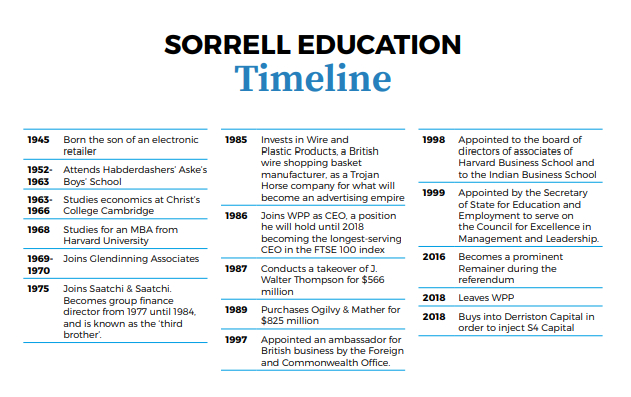
    So how to conduct the orchestra? One part of the answer is incentivisation. ‘At S4, we all own big chunks of the company. The WPP employee ownership schemes probably amounted to about three or four per cent. At S4, we’re smaller obviously, but about 50 or 60 per cent of the company is owned by people who work in it.’ This is an area too, where Sorrell’s education – Sorrell studied economics at Cambridge – has been helpful to him in his career. 

    ‘At Cambridge, there was a book by a left-wing economist called Robin Marris – a left-wing economist – called The Theory of Managerial Capitalism. In the capitalist system, there is a separation between management and control. Managers manage; shareholders control – but there is a split between the two. Out of that, you get the view that all you need is share ownership: if people own shares in the company then their mindset is different.’ Is that his view? ‘Well, it can produce too short-term an attitude but broadly I don’t disagree with that. In WPP, in the early days, I always insisted people put their money where their mouth is. Interestingly, after a couple of plans, the institutions preferred us either to pledge stock we already had or just waived the need to put cash in. That was a terrible mistake. It’s like Warren Buffett’s comment on share options many years ago. You wouldn’t give an institution a call on your stock for 10 years at zero cost so why do you give it to management?’

    HIRING AND FIRING

    The other way to keep a company in shape is to get the hiring right. To those who might be ruminating on a magic hire, Sorrell has this warning: ‘I used to call it the Jesus Christ syndrome. 

    The person running this area of the business is no good. We should get rid of him or her. And I’ve got this fantastic person I want to hire.” Then the person comes in and three months later, Jesus Christ didn’t walk on water!’

    Sorrell also argues that talent departments can get it wrong at both ends of the spectrum. ‘The hiring process is often too cumbersome or else it’s too intuitive,’ he says. ‘You either put somebody through 20 interviews, which anyone who’s good will not tolerate, or you have one interview and that person becomes a hero or heroine – a salvation. Advertising businesses are notoriously bad at hiring. 

    Individual predilections or preferences overcome what you should or shouldn’t do.’ He adds: ‘Another problem is to segment human resources and talent from the rest of the organisation. You shouldn’t rely on your head of HR to hire good people. The head of HR might supplement the list, but you should know who you think would be good to do x, y or z from your knowledge of your industry.’

    Somewhere in here is the key to Sorrell’s success – the need to be hands-on isn’t some bizarre need to micromanage but a sort of prudent due diligence, and a tacit acknowledgement of the complexity of the job. He draws the conclusion: ‘People are an investment not a cost – and we spend so little time maximising that investment. sixty per cent of our net revenues are invested in people. Our revenues are £400 million, and we represent £250 million. At WPP it was £20 billion, so £12 billion went on people. But most people think much more about how we should invest in computers.’

    And this, incidentally, is why government often moves with such little – to deploy one of his favourite words – ‘agility’. ‘In government, you don’t have the commercial levers or incentives: what you get is a splintered mess,’ he says.

    HANG-UPS

    Our time is nearly up. Towards the end, Sorrell strikes another note of cautious optimism: ‘I’m sure there will be a relief rally in the sense that when people are released from all this purgatory, there will be excesses. But I was talking to a client last night and I said, “I’ll call you in Q4 and we’ll say we overegged this.” 

    He continues: ‘I look at in a historical context. HIV has killed 36 million people. The two big flus killed 1 to 2 million. I’ve got a lot of friends in Brazil who are terrified about what the impact of corona is on the ghettos. We’ve lost proportion. That sounds callous, every life is important.’

    Such are the times we so suddenly live in: we wish to retain optimism but we have taken a collective decision to endure economic hurt in order to protect the vulnerable. It is the hardest time the nation has known since World War Two, and yet all our technologies remain intact giving – at least for the time being – an undeniable flavour of technological affluence even to this unprecedented stricture. 

    Deprivation is still allied in a certain sense to plenty: we are in our homes, but many of us still eat, drink and are entertained to standards which would be the envy of a Renaissance king. We retain a sense of our intelligence and scientific skill, and the power of the economy which the likes of Sir Martin Sorrell have been instrumental in building. But we also know all over again the scale of the obstacles – of disease and nature’s indifference – which we had to overcome to build it all in the first place. There are no guarantees of our success; it’s up to us. 

    Perhaps that’s why Sorrell – so self-reliant, and capable – is someone we should especially heed in these times. We need the likes of him as we have never done before. ‘Someone sent me a diary from the great plague,’ he tells me near the end of our call. ‘It was a world of self-isolation; there was the Peak District village of Eyam which cut itself off for a year. This is nothing new.’

    So nothing new – and everyone keep calm. Wisdom, like crisis, can often have an antiquated flavour. And with that, instead of the handshake at the lift, we say our Zoom goodbyes, and Sir Martin disappears out of my computer back into his improbable life. 
     

  • Burnout: what is it, and how can we manage it?

    Patrick Crowder

    We’ve heard a lot about ‘burnout’ recently, but it’s more than just another word for the stress and anxiety which sometimes comes with a job. The World Health Organisation describes burnout as an “occupational phenomenon”, recognising the condition as a diagnosable syndrome since 2019. The NHS distinguishes between stress and burnout, stating that burnout is the feeling “that there is ‘not enough’ time, energy, enthusiasm, and ability” to get through day-to-day life, while stress is the feeling of there being “’too much’ – too many demands, too much to do, too many decisions to make…”

    Burnout cases are on the rise following the pandemic, according to a study by Glassdoor, and many of us will have felt that sense of being mentally and emotionally drained by work and social relationships ourselves. Performance Psychologist Stuart Kelly has been researching the impact and effects of burnout with the leadership development consultancy Impact International.

    “The three things that cause us the most stress are uncertainty, uncontrollability and unknowns,” Kelly explains.“Humans are highly resilient but sometimes the best thing to do is to sit down, put on Netflix, have a takeaway, turn off your phone, and take a deep breath.”

    Taking time to one’s self can help relieve pressure, and it is not something that people should feel guilty about. However, according to Kelly, resorting to full-on escapism is harmful.

    “We should have the ability to take a break before we really need one,” Kelly says. “Sometimes self-care is tough, but it shouldn’t be something we resort to because we are so absolutely exhausted that we need a reprieve from our own relentless internal pressure. It needs to be a habit that we do without thought and effort.”

    The idea is to relieve the pressures of everyday life by living life, not by escaping from it. Empty means of escape such as drink, drugs, overeating, Netflix bingeing, and social media are all harmful in excess, regardless of the way these activities are perceived by society. The best way to avoid going too far, according to Kelly, is to recognise the signs of burnout early.

    “It should never get to the point of wanting to collapse on the couch and escape from reality,” Kelly continues. “Place a frog into boiling water and it will jump straight out, but place a frog into cold water then slowly heat the water to boiling point and the frog will not realise it’s in danger until it’s too late. This can easily happen to us.”

    Handling burnout is something that will vary in difficulty from person to person, but everyone is capable of finding a solution. For some, it could be as simple as reconnecting with a long-forgotten hobby or setting aside more time for meaningful relaxation. Others may feel like they don’t know what they enjoy doing anymore, and that’s okay too.

    The specific situation of someone suffering burnout will determine what course of action they should take, and there is no universal solution. However, burnout is a serious issue, and options such as therapy, taking a leave of absence, or making a big career change should not be discarded as ‘too extreme’.

    Following the pandemic, many people have begun to feel dissatisfaction with their work-life balance and are taking steps to put their wellbeing first, so there is no need to feel alone in taking action.

    Credit: Impact International

  • Entrepreneur Henry White on building the “Netflix of finance”

    Entrepreneur Henry White on building the “Netflix of finance”

    CEO of Finance Unlocked speaks to Georgia Heneage on his career journey, the world of money and the future of FinTech. Originally published in March 2021.

    When Henry White – now a fully-fledged FinTech founder – first entered the thorny world of money as an eager young intern in London, he found the industry to be like a “black box”: opaque and inaccessible.

    Overcoming these barriers was for White a case of “learning on the job”. White began working his way up the London finance ladder with no experience or training. Soon he was working as a successful hedge fund analyst, his job taking him from Greece to New York and Canada.

    But this method of scaling the industry via trial-and-error seemed to be the privilege of a few, and his company Finance Unlocked – a digital educational platform for those in the finance world which completed its second fund raise in January at £1.75 million – was born out of a recognition that for many young people in finance, the “tools available” to them are few and far between.

    The idea was conceived in part when co-founder Robert Ellison’s position on his firm’s Learning and Development Committee opened his eyes to the limited scope of educational resources available. “We realized that either traditional incumbents were producing classroom-based learning- which wasn’t scaleable and was expensive – or there were generic massive online course providers like LinkedIn Learning.”

    Ellison and White identified a gap in educational resources which taught the fundamental skills of finance. “We felt like ultimately the whole learning experience was broken,” says White. “It became commonplace in the workplace that you would have bad training, and people strangely accepted it.”

    During development, Ellison and White’s customer research revealed that people “wanted to be more knowledgeable” and wanted to be “the best possible versions of themselves”, but that “the tools didn’t match up with the demand”. Their research also surfaced a common theme: that people wanted an educational platform that could coincide with their leisure time. “That was a kind of ‘aha!’ moment for us”, says White.

    “We wanted to build a brand that people could emotionally connect with and care about: we wanted it to be as beautiful and tactile as Netflix.” White says that digital content – particularly video – has grown in popularity during the pandemic. And because their audience demanded a premium product, they decided early on to create the content themselves, rather than outsource.

    As well as attempting to “redefine learning for finance professionals”, Finance Unlocked aims to democratise the world of financial learning for young people. They opened up their platform free to universities during the pandemic: “the feedback was phenomenal”, says White. “96% of the student learners felt more confident applying for a career in finance having had access to this content, and it really improved their employability”.

    And what of the future of FinTech? “The FinTech industry is moving at a lightning pace. Its role as an enabler is obvious when it comes to making frictionless payments, exchanging currencies efficiently or democratising the investment space. But the impacts are much broader than that – and that broad impact now includes financial education.”

  • Dinesh Dhamija reacts to Rishi Sunak’s appointment as PM

    Finito World

    Rishi Sunak’s appointment as Prime Minister has focused attention on the rising influence of British Asians.

    Yesterday, British-Indian entrepreneurs were reacting to the news. But on in particular caught our attention: entrepreneur and politician Dinesh Dhamija. Dhamija came to Britain aged 17 in 1968. He founded online travel agency ebookers in 1997, and sold it for £247 million in 2004, before serving as a Lib Dem Member of the European Parliament from 2019 to 2020.

    It’s worth remembering that Dhamija’s autobiography ‘Book It!’ was published earlier this year. Readers might remember that in that brilliant book, he comments on Rishi Sunak’s father-in-law Narayana Murthy. One relevant passage reads:

    “Rishi Sunak’s father-in-law Narayana Murthy stands head and shoulders above other Indian businesspeople in my view,” he continues. “He pioneered the current generation of Indian software companies, taking Infosys to global leadership – it was the first Indian company listed on the Nasdaq – and introducing the Global Delivery Model of software development.”

    Dhamija also puts the magnitude of Murthy’s achievements in context: “Basically, Murthy popularised tech outsourcing from Western economies to India, where he recruited thousands of highly qualified software engineers to work on the problems of American banks and multinational corporations,” he writes.

    For Dhamija, Murthy’s work must be viewed in the round – not just as a money-making enterprise. Another passage reads: “What I most admire about Murthy is that he combines commercial genius with a human regard for employees and a strong customer focus. Infosys isn’t just about making money, but about making the world a better place. These qualities have won him many friends, along with the Legion d’Honneur from France, the Padma Vibhushan from India and countless other awards and honours.”

    Yesterday, Finito World got in touch with Dhamija to get his views on the appointment of Murthy’s son-in-law as the UK’s first Asian Prime Minister. His reaction was typically forthright and illuminating: “I’m very pleased to see Rishi become the first British Prime Minister of Indian heritage. I believe he has many of the qualities needed to rescue the country from its current crises – even if he played a role in getting us here! Among other things, it opens a potential window of opportunity for closer economic ties between the UK and India, something that I’ve urged the government to pursue for many years,” he told us.

    And did Dhamija have any advice for the incoming PM? “The best thing for the UK would be to get 10,000 Indian software engineers to come to Britain, that would be gold for us. If Rishi can face down the anti-immigrant factions in his own party and act in Britain’s best interest, he could achieve something that his recent predecessors have failed to do and create a new era of Anglo-Indian cooperation.”


    For more information about Book It!: How Dinesh Dhamija built and sold online travel agency ebookers for £247 million, go to:


  • Amazon’s next prey: the hairdressing industry

    Amazon’s next prey: the hairdressing industry

    Georgia Heneage

    The ubiquity of the tech giant Amazon has been the melody of the past decade – a thumping tune which industries have had reluctantly to begin playing to. In its infancy, Amazon monopolised the book market, food retailers, clothing stores and homeware shops (or almost anything you can think of which they sell on the website).

    Then the company, founded by Jeff Bezos in 1994, began reaching further afield: by 2005, Amazon Prime has drowned out shipping companies and trodden on Hollywood film studios; meanwhile, Amazon Web Services, founded in the early 2000s, is now used by the likes of Netflix, Slack, Dropbox and Pinterest. The corporation also has its own broadband services, home security and prescription-drug distribution. For good measure, it also designs clothes and manufactures hardware.  

    Amazon has gone far beyond its original vision as an online retailer. It has now become an economic eco-system in its own right, and has in the process made it difficult for smaller companies to have a foothold in their relative markets. It’s a process of business manipulation: independent merchants are forced to sell on Amazon’s platform at competitive prices – competing against Amazon products which are cheap to make and cheap to sell.

    In February, Bezos announced that third-party businesses in the US had sold ¢1bn products through Amazon’s marketplace. They currently have around a 50% share in the US Ecommerce market, 350 million products across its marketplace and an annual net revenue of around $400 billion.

    It’s actually pretty difficult to think of an area which Amazon hasn’t infiltrated. Perhaps it’s those sectors which haven’t yet been touched by the digital world – such as walk-in shops. But even there, Amazon has set its sights in recent months on grocery stores and have opened up a few in London already. Amazon Go convenience stores are the very definition of contactless: the goods you pick from the shelves are billed directly to your Amazon account without even needing to queue for a till.

    But perhaps the most surprising sector which Amazon is edging towards is hairdressing. The tech titan announced the opening of its very first salon in Spitalfields market in east London; at the moment it’s open for use for Amazon employees only, but in the coming weeks customers will be able to enter the tech haven that it promises.

    True to its name and nature, the 1,500 sq ft Amazon Salon is a case in technology experimentation: machine-learning will analyse what products customers would prefer, and augmented reality technology will allow them to see what they would look like with different colours or hair styles before the fatal cut. Sensors on products – “point-and-learn” systems – will be able to detect when someone points at an item, and they’ll show example videos on a screen above the shelf. Like the Amazon Go stores, people will be able to order beauty products via a QR code on their phone. And, during the cut, customers are offered entertainment provided by Amazon Fire tablets. It’s the full Amazon experience, you might say. All that’s missing is an Amazon drone taking birds-eye pictures of your hair-do.

    Amazon Salon strips away the bespoke element of many independent hairdressers:  it’s coupled with Amazon Professional Beauty Store, which gives at “wholesale pricing and invoicing, no minimum order value, fast delivery and more”. Well, we know how that story spins out.

    The amalgamation of technology with hairdressing is a curious mix – but one which was, perhaps, inevitable. Yet hairdressing is one of those industries which thrives off human-to-human contact, and the worry may be that it’s a slippery slope from sensors and screens to fully automated hairdressers, which in turn raises ethical questions over what it will do to the industry and the workers in it at large.

    But taking a few steps back, the current state of play is that Amazon Salon has partnered with a real-life salon and real-life hairdressers, so these fears may be yet misplaced. What do hairdressers on the ground think about these developments?

    Ola Goldsmith, who runs her own salon and hair extension training academy Naked Weave, sees the introduction of the tech giant into the hairdressing space – “which isn’t even their specialist area” – as a “catch-22”.

    “It does feel like they are trying to take over,” says Goldsmith. “The technology is obviously really exciting and we all want the industry to develop, but it would be nice if it developed in a way that was accessible to independent businesses.”

    For Goldsmith the real “worry” would come if Amazon were to open a franchise and swamp smaller salons who can’t afford to get access to the kinds of technology they were adopting.

    Goldsmith is also optimistic, however, that the Amazon Salon won’t spread past being a “tourist attraction” which people visit once (“like the Harry Potter world”) then tick off their bucket-list.

    “Hairdressing is a really personal thing,” says Goldsmith. “It’s all about your relationship with your stylist, not the technology. It feels like Amazon are opening up a museum for hair, and I think people will crave that.”

    Perhaps then, this is the experiment that might finally show Amazon up to be not quite so invincible. But if the past ten years is anything to go by, there are fears that this Covid-wrecked industry is about to be hit again.

  • Mr and Mrs Smith Founder James Lohan: Journal of a Voyage Round My Room

    Mr and Mrs Smith Founder James Lohan: Journal of a Voyage Round My Room

    As the travel industry continues to confront headwinds, James Lohan tells us about what the life of a travel executive is like during a pandemic. First published in February of 2021.

    Monday 1st February

    The overnight dreams that preface my working week are of a world where travel has made a triumphant return (flying, literally) and the pandemic is yesterday’s news. Then I wake, read the actual news on my Kindle, and wish I was still asleep. Turmoil in the US, the NHS at breaking point, flooding across the UK…bleak doesn’t really do it justice. I’ve been lucky enough to have escaped the virus and many of its direst repercussions. But for someone who spends most of his waking (and sleeping) hours either dreaming of or actually in far-off destinations, the enforced domesticity of lockdown is a perverse kind of cruelty.  

    After digesting much of the daily news cycle, I check the company’s daily booking stats. Unfortunately, these usually confirm that I should have opened that article on Brexit – another car crash that would’ve made for happier reading. Then I’m up and out to walk Ziggy, our working Cocker Spaniel, to clear my mind. Or I consider filling it with yet another inspiring podcast to make me feel like I haven’t achieved enough lately. Gunnersbury park is fine but I’m starting to feel like a lion at Longleat: I want some bigger plains to roam.

    After two cups of coffee, a refreshed To-Do list and an inbox clean-up, it’s straight into a “thrilling” ops-board meeting to discuss cancellations, amendments and furlough rotas (again). After that, it’s my direct team catch-up to decide what can get done during their limited flexi furlough hours. Furlough has been a great financial help but it’s hard to run the business when your team is so part-time. Funny how we’ve come to view the scheme: it used to be a dirty word, some colleagues interpreting it like they’d been benched. Others have loved it, seeing it as time to rest and contemplate their futures. By now, though, everyone understands how important it is to help us survive the next few months.

    Tuesday 2nd February

    Tuesday mornings it’s yoga, 8am, to keep my ageing joints moving in the right direction – even if right now the business isn’t. On this particular Tuesday we’re bracing ourselves for another surprise announcement from No.10 Sesame Street, before which we hold our breath and wonder what Big Bird Boris and Kermit Hancock are going to spring on us next. I have no problem with lockdown – an absolute necessity in response to the crisis. What’s so difficult for us is the lastminute.com nature of the decision-making that’s causing chaos for agents like ourselves who have to pull rabbits out of hats as we yet again cancel or amend our members’ holiday plans – with less than 24 hours’ notice. It’s a nightmare, too, for hoteliers who might be rueing that enormous food order and wondering, for instance, what they’re going to do with 200 turkeys. But while it’s soul-sapping for our team, I’m proud of the way we’re doing our very best as a business to keep our members and hoteliers happy.

    Wednesday 3rd February

    The thing I do like about working from home is the commute: very convenient indeed. That said, it’s an odd sensation when the day’s big ‘outing’ is a shopping trip to the local greengrocer and butcher in Chiswick – in a mask and at a safe two-metre distance. But cherished time away from my desk it has most certainly become. Wednesday also means a meeting with my main team to discuss sustainability and what we’re doing to integrate such practices throughout the business. We’ll shortly be announcing our efforts in supporting the Blue Marine Foundation and the World Land Trust, two vital conservation charities with goals to protect the earth’s precious assets on land and sea. And we’re adding a more dedicated sustainability section on each page of our 1,400-strong collection to help our members find and book the planet’s most forward-thinking hotels. I’m certain that an important by-product of the pandemic will be people’s greater awareness of the climate crisis and how our travel choices impact it.  

    Thursday 4th February

    Yoga day two, where I try to pretend I’m on a beach in Bali doing my downward-facing dog, but the rumbling of the E3 bus keeps breaking my shavasana in our front living room where I’m practicing. It’s nearly the weekend, which as a concept begins to mean less and less – just with fewer meetings and emails. What to do with the kids to keep them off their computers is the weekend challenge, and explaining that we can’t see Grandma and no you can’t have a play-date and yes we will be walking the dog again and yes it will be in the same location as yesterday…it’s tough for them. Home-schooling and even just making three meals a day for us all is not an easy gig. I never thought I’d miss my Pret a Manger lunchtime sandwich so much, which was just a few minutes’ walk from our office in Shepherd’s Bush.

    I sit next to my wife (our CEO) in our home office and it’s a constant juggle to agree on who’s speaking or who’s muting during the various online meetings so we don’t create feedback for the other poor Zoomers on our call. We’re both going slightly mad as we’re also forced by proximity to hear each other’s individual calls, and the ‘how’s-Covid-working-out-for-you?’ chat that precursors every conversation nowadays. That said, a couple of very nice new partnership meets means the day has been a success, and all wins – however big or small – are gratefully received right now.

    Friday 5th February

    Thank God: the day of wine. I don’t drink during the week, so Friday has become a celebration of, well, my midweek abstinence. And as I’m drinking a little less, I’m spending a little more on each bottle – and I can’t wait for Friday to come around to pop open my next treat. Work slows on a Friday, too, as so many of the team is on furlough, so it’s a good time to tidy up loose ends so Monday feels a little less daunting. Our flight has just been cancelled for February half term to what would have been our first curation trip / holiday (always mix business with pleasure) in nearly a year. Gutted. It gets to midday and I’m already thinking about cracking open the wine but I still have a couple of meetings left so better hold off. 

    Friday is also when WhatsApp group texts with mates seem to explode into life, gaining more momentum throughout the day as people clock off one-by-one and begin mixing their G&Ts. How strange that socialising has been reduced to this, although the novelty has very much worn off by now. Tentatively, we all discuss getting together for a group holiday in a villa when lockdown ends and I’m quizzed on predictions for travel opening up again and where best to go.  There’s no doubt in my mind that 2021 will eventually end up being a good year; I just wish we could get on with it sooner. Patience has never been the trait of an entrepreneur – so I’ll just have another glass and remind myself: we’ll get there. Cheers.