Category: News

  • Exclusive: Sir David Attenborough interview

    Exclusive: Sir David Attenborough interview

    This week Sir David Attenborough’s new series Asia airs. We look back at Robert Golding’s exclusive interview with the great man at the start of the pandemic


    ‘This is a man who answers his phone,’ a mutual friend has told me, and Sir David Attenborough doesn’t disappoint. He picks up after just one ring.

    The voice at the other end of the phone is the one you know. But it’s gravellier and without quite that voiceover theatricality it carries on Blue Planet. Those are performances; this is real life.

    This is Attenborough on down time, conserving energy for the next program. His work schedule might seem unexpected at his great age. But Attenborough, 94, exhibits more energy in his nineties than many of us do in our forties. ‘I’ve been in lockdown, and it does mean I’ve been a bit behind on things. But I keep myself busy.’

    To interview Attenborough is to come pre-armed with a range of pre-conceived images. Part-benevolent sage, part-prophet of doom, is this not the unimpeachable grandfather of the nation? Perhaps only Nelson Mandela towards the end of his life had comparable standing within his own country.

    In 2016, when the Natural Environment Research Council ran a competition to name a research vessel, a very British fiasco ensued whereby the unfunny name Boaty McBoatFace topped the poll. This was plainly unacceptable, and so in time the competition reverted, with an almost wearisome inevitability, to the RRS David Attenborough.

    Which is to say they played it safe and chose the most popular person in the country. One therefore has some trepidation in saying that these assumptions don’t survive an encounter with the man. It is not that he is rude or unpleasant; it’s just that he’s not as one might have expected.

    ‘Yes, this is David. What would you like to ask me?


    Perfectly Busy


    Though he has agreed to talk to us, the tone is adversarial. But there are strong mitigating circumstances to this. This is a man who is aware of his mortality: our conversation has a not-a-moment-to-lose briskness to it. He could also be forgiven for sounding somewhat tired. He can also be especially forgiven for having long since grown weary of his National Treasuredom. Throughout our call, he will refer to the claims on his time, of which I am one of many. ‘I get around 40 to 50 requests a day,’ he explains, adding that he seeks to hand-write a response to each. ‘I have been shielding during lockdown and am just coming out of that.’

     But there’s another reason he’s busy: habit. The stratospherically successful enjoy a pre-established momentum, and continue to achieve just by keeping up with their commitments. So what has he been up to? ‘I decided to take this as a moment to write a book on ecological matters and I continue to make television programs,’ he says, referring to A Life on Our Planet: My Witness Statement, but not in such a way that makes you think he wishes to elaborate on either. He refers to a ‘stressful deadline’ and when I ask for more information about the book, he shuts it down: ‘Just ecological matters.’ There is a hush down the phone where one might have hoped for elaboration.

    Nevertheless, Perfect Planet, one of his upcoming programs, is being filmed in his Richmond garden, and it has been reported that he is recording the show’s voiceovers from a room he made soundproof by taping a duvet to the walls.

    Generation Game


    In his courteous but clipped tone, he asks about Finito World and I explain that it goes out to 100,000 students. ‘I am often heartened when I meet the younger generation,’ he volunteers. ‘Their attitude to the climate crisis is very responsible.’

    This is the paradox of Attenborough: a man of considerable years who has found himself aligned with the young. He’s that rare thing: an elderly revolutionary.

    Perhaps we underestimate the sheer importance of his presence within the landscape. He is the benevolent sage who its bad form to disagree with, and he’s single-handedly made it harder for anyone in power to pitch the climate change question as a quixotic obsession of the young.

    But he’s a revolutionary only in the face of drastic necessity, and refuses to be drawn on the question of our sometimes underwhelming political class. ‘I wouldn’t necessarily say that: we actually have some very good politicians.’ He declines to mention who these might be – but it suggests that Attenborough doesn’t want to ruffle unnecessary feathers.
    Instead, he wants progress.
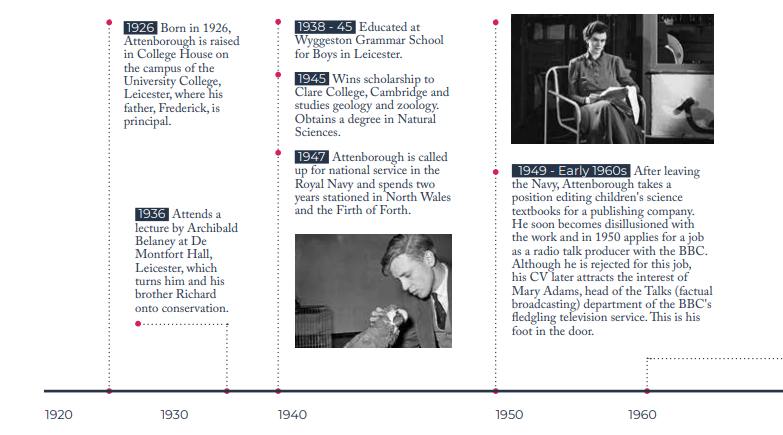
     

    What has Sir David Attenborough done


    Transparent Medium


    ‘The thing about David is he prefers animals to humans,’ says another person who has worked with Attenborough for years. I ask him if the coronavirus situation will accelerate change. Again, he is careful: ‘I don’t know about that. On the one hand, I can see that our skies are emptier now and that’s very welcome. I suppose the extent to which the aviation sector will return will depend on the price points the airlines come up with.’

    I suspect that some of his reluctance to be drawn into detailed discussion is that he doesn’t wish to claim undue expertise on areas outside his competence. There’s an admirable discipline at work, alongside a refusal to please

    Bewilderingly honored – Attenborough has a BAFTA fellowship, a knighthood, a Descartes Prize, among many others – he has learned that the only proper response to fame is self-discipline. At his level of celebrity – up there with prime ministers
    and presidents but with a greater dose of the public’s love than is usually accorded to either – he is continually invited for comment, and has learned when to demur.

    ‘I am sometimes asked about the well-known people I’ve come across in this life – the presidents and the royalty.

    I’ve been lucky enough to meet,’ he says. ‘I say, “Look, if you saw my documentary with Barack Obama then you know him as well as I do.” Television is very intimate like that. My job is to create transparency.’

    So instead of what one half-hopes for – backstage anecdotes at the White House or Buckingham Palace – one returns time and again to the climate crisis. This is the prism through which everything is seen, and our failure to follow his example, he says, shall ultimately be to our shame.

    He will not be drawn into negative comment on Boris Johnson or Donald Trump. Instead, he says: ‘Overall, I’m optimistic. All I can say is we have to encourage our political leaders to do something urgently about the climate situation. We have to all work hard to do something about this.’


    The Fruits of Longevity


    For Attenborough everything has been boiled down to raw essentials. And yet his career exhibits flexibility. His success must be attributed to open-mindedness about a young medium which others might have thought it beneath them. It would be too much to call him a visionary. But he was in the vanguard of those who saw TV’s possibilities.

    Fascinated by wildlife as a child, he rose to become controller at BBC Two and director of programming at the BBC in the 1960s and 70s. ‘Television didn’t exist when I was a young man, and I have spent my life in a medium I couldn’t have imagined. It has been a wonderful experience,’ he says.

    The very successful glimpse the shape of the world to come, seize that possibility and enlarge it into something definite, which they then appropriate and live by. What advice does he have for the young starting out? ‘My working life has taken place in television. I don’t know how we will see that change over the coming years as a result of what’s happened. Communication has proliferated into so many forms. It is very difficult to get the single mass audience, which I had something to do with creating, thirty or forty years ago.’

    There is an element of well-deserved pride about this. Attenborough’s original commissions at BBC2 were wide-ranging. The included everything from Match of the Day to Call My Bluff and Monty Python’s Flying Circus. One can almost convince oneself that he was a BBC man first and an ecologist second. ‘The world has become very divided in a way,’ he continues. ‘We prepare for a world when we’re young that’s gone by the time we arrive in it. To that I say, ‘It depends what your life expectancy is!’

    But all along it was nature that thrilled and animated him. Attenborough is one of those high achievers who compound success with longevity. His is a voice that speaks to us out of superior experience – he has seen more of the planet than any of us. He speaks with a rare authority at the very edge of doom – his own personal decline, as well as the planet’s.

    Urgent Warnings

    He says: ‘Whatever young people choose to do with their life they must remember that they’re a part of life on this planet and we have a responsibility to those who will come after us to take care of it.’

    I ask him what we should be doing to amend our lives and again he offers a simple thought: ‘We’ve all got to look to our consciences. Inevitably, some will do more than others.’

    He sounds at such times very close to washing his hands of the human race. But then everyone in their nineties is inevitably about to do just that.

    What Attenborough has achieved seems so considerable that one wishes to ask him how he has managed it. ‘I am sometimes asked about how I manage to do so much, but I don’t particularly think of it like that. I just reply to the requests that come my way: you can accomplish a lot by just doing one thing after the other.’

    Again, the simplicity of the answer has a certain bare poetry to it: Attenborough is reminding us that life is as simple as we want to make it. Interviewing him at this stage in his life is like reading a novel by Muriel Spark: no adjectives, no frills, just the plain truth.

    In his curtness is a lesson: there is no time for him now for delay, but then nor should there be for us. We must do our bit – and not tomorrow, now.

    He is interested in Finito World and very supportive of our new endeavor: ‘This is a time when the circulations of magazines and newspapers appear to be falling. A lot of newspapers are aware of the climate emergency and the way in which we disseminate ideas has diversified.’

    A thought occurs to me that stems from my lockdown time with my son, where we have been in our gardens like never before. Should gardening take its place on the national curriculum? ‘It’s obviously very important,’ he says, although he also adds – as he does frequently during our conversation – that he knows little about the topic. (Opposite, we have looked into the matter for him.)

    Hello, Goodbye

    I will not forget this interview with a man whose voice will always be with us. Part of Attenborough’s power is that he continues to warn us in spite of ourselves. He deems us sufficiently worthwhile to continually renew his energy on our behalf.

    I mention that we watch his program with our four-year-old in preference to the usual cartoons on Netflix when possible.

    At that point, perhaps due to the mention of my young son, he sounds warm: ‘Thank you very much, sir. It does mean a lot when people say that.’

    It’s a mantra in journalism not to meet your heroes. Attenborough in extreme old age is brisk and sometimes even monosyllabic. This in itself tells you something: the world is full of the canonized but in reality saints are rare. Conversely, I have met those whose reputations were fairly low, but who turned out to be generous beyond expectation. We should never be disappointed when the world isn’t as we’d expected. It is an aspect of the richness of experience to meet continually with surprise.

    But age will come to us all. If it finds me in half as fine fettle as David Attenborough I shall be lucky indeed. Furthermore, if it finds me on a habitable planet at all that shall also something I’ll owe in part to him. ‘Good luck,’ he says as he puts the phone down. This isn’t the man I had expected to meet. But I can persuade myself that he means it.

    ‘David prefers animals to humans’. Afterwards, it occurs to me that he saw me not so much as an individual, but a representative of that foolish ape: man. While Attenborough has been acquiring hundreds of millions of viewers, what he really wanted – and urgently required – was listeners.
     

  • The Poet at Work I: Tishani Doshi

    The Poet at Work I: Tishani Doshi

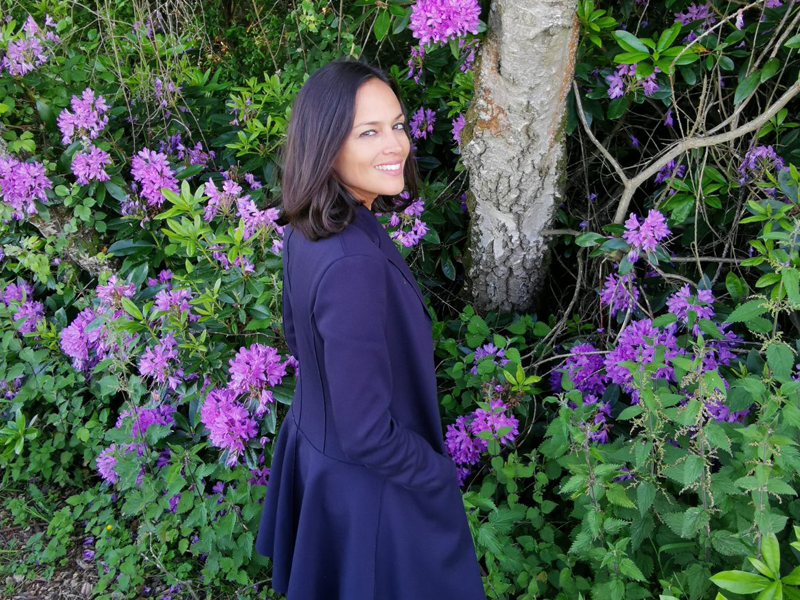
    As the government seemingly reduces the importance of poetry on the national curriculum, by making its study optional at the GCSE level, Finito World is introducing this regular series aimed at illustrating the utility of poetry, and examining the relationship between literature and the workplace. Poets are asked to produce a poem which speaks to what our first featured poet, Tishani Doshi, calls ‘ideas of work, leisure, community, labour, decoration, and poetry and the space we create for it all. ‘ After we produce the poem, we then give the reader a Q & A touching on the life of the poet and their relationship with work.


    Tishani Doshi is a poet and novelist born in what was then Madras in 1975. She has built an international reputation on the back of her poetry and novels – for which she has won many awards, including the Eric Gregory Award and the Forward Prize for Best First Collection. Her novels have also been critically acclaimed. Her most recent Small Days and Nights has been shortlisted for the Tata Best Fiction Award 2019 and the RSL Ondaatje Prize 2020.


    In ‘Postcard from Work’ readers will immediately be relieved by the exotic colours – ‘the yellow trumpet flowers’ and the ‘sunbirds…diving in and out of this den of gold.’ It is a poem which begins in a blaze of light. It is a piece ostensibly about work, but where little work is done – except the perhaps more vital work of paying tribute to the natural world, and mulling our place in it. Sometimes the best we have to offer our masters is to take a mental holiday from the tasks they have set us to do.


    Doshi knows that we were not born only to consider ‘the price of milk’ but to find ways of being which let death know we mean to ‘hold on.’ Work has to be done – and someone has to do it, and that will mean taking a break from dreaming. Doshi zooms out to show us what tasks lie unfinished around the narrator: we might be in a seamstress’ (‘someone else will tend the hem’) or even at a vet (‘someone else will pry open the dog’s jaw’). All our leisure, the moments we snatch, must be supported by drudgery elsewhere. Doshi also makes her living as a dancer, and her poems always have something of dance about them – they are miracles of rhythm and movement, and full of a joy which does what poetry should do: her poems are the antidote we didn’t know we needed until they came our way.


    Postcard from Work 


    Forgive me, I have been busy 

    with the yellow trumpet flowers.

    They dance uselessly, slivers

    of rapture. I know the dishes

    need washing but the sunbirds

    are diving in and out of this den

    of gold. Their dark purple wings

    are soft nets, intimate with the leaves.

    Beaks poised to receive nectar. There are 

    days I neglect my beard. I grow tired 

    of digging. I imagine someone else

    will tend the hem, the torn sleeve.

    Someone else will pry open 

    the dog’s jaw for his evening pill. 

    Our throats are in constant need

    of shelter.


    I’ve sublet a room   

    to a poet who does not know 

    the price of milk but is ready 

    to lay down her spear and surgical

    instruments, to worship the roots

    of this labyrinth. If there is rain

    and soil, onions will grow. After 

    a day in the field, the poet and I 

    sit around a fire to sing. It is a way 

    of letting death know we mean to hold

    on. The threshold stays warm. We flick

    at night with a fly-brush, cheat insects

    of their audience with a chorus 

    resurrected from silence. Think 

    of the performance of this lament

    as our hunger, of the armchair

    in the corner, our repose. 

    Underneath, is a footstool 

    that hides.


    What is the interplay in your life between dance and poetry? Is it an entirely fruitful one or can it be said to be in any way antagonistic?


    Poetry came first, but in a way, poetry only came into being once I had dance. They’ve never been antagonistic, unless you count yearning for one, while you’re engaged in the other? But that feels such a natural way of being in the world. Both require a kind of vulnerability and strength – the making of your own vocabulary. When I’m in a lazy mode, which is my most natural way of being, I wonder at both the worlds of poetry and dance, the capabilities we don’t imagine for ourselves. 


    How do you find the business side of your writing life? Many writers I know struggle with invoices/tax/the admin of it all? But then I think that can also be a cliché and many writers be surprisingly scrappy and hard-headed?


    I studied business administration and communications before ditching it for poetry, so I can get around economics and accountancy alright, but that’s not to say I thrill in it. I move in waves. Sometimes I’m terribly productive about everything – to-do lists and all. Other times I want to be left alone to watch the flowers. 


    The UK government has recently said that poetry should be optional at the GCSE level – a significant demotion in its importance on the curriculum. What is your view on that and what do you feel the impact will be?


    One of my first jobs was to teach an introduction to poetry and fiction class to students at Johns Hopkins University. It was a required class, most of my students were pre-med or engineering. I like to think as a result that in future dentist waiting rooms, there may be a volume of Elizabeth Bishop lying around, or that someone designing a bridge might dip into the poems of Imtiaz Dharker for inspiration. I don’t know what the UK government’s motivations for demoting poetry are, but I hope usefulness was not a factor. Everything is connected. I can’t imagine any kind of life that doesn’t need the intuition and imagination of poetry.


    What sort of role does poetry have in India – does the government encourage it sufficiently or is there tension in your country also on that score?


    Well, our current prime minister unfortunately published a volume of poems, called A Journey.  Historically, tyrants have had a thing for poetry (see Mao, Nero, Stalin, Mussolini Bin Laden), which gives poetry a bad rep. Poetry as I remember it in school was rather fossilized and distant. I think at the college level, there have been serious efforts to rejuvenate and decolonize the syllabus. In schools, I fear they may still be standing up in front of classrooms with hands clasped, reciting “charge of the light brigade.”  


    Was there a particular teacher when you were younger who turned you onto poetry?


    Yes. Her name was Cathy Smith Bowers. I took one of her classes as an undergraduate in college, and it changed my life. 


    What’s your favourite poem about the workplace?


    I read this as a work poem, because I love my work, and my work is poetry.


    Love is a Place by EE Cummings 


    love is a place
    & through this place of
    love move
    (with brightness of peace)
    all places

    yes is a world
    & in this world of
    yes live
    (skilfully curled)
    all worlds

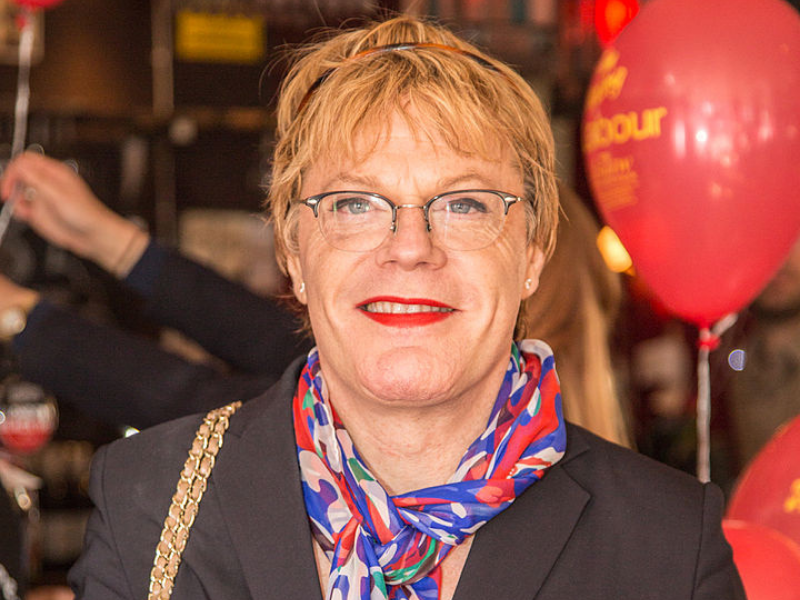
  • Diary: Eddie Izzard on pronouns, working with Judi Dench and the plight of the street performer

    Diary: Eddie Izzard on pronouns, working with Judi Dench and the plight of the street performer

    It all started when I went on Sky’s Portrait Artist of the Year. They said: “What would you like? What pronouns?” So I was there, wearing a dress and makeup and I said: “Well, she/ her.” It was a bit like: ‘Would you like a cup of tea? Coffee? Latte?” It wasn’t set up in a big way. I wasn’t there saying: “Look, it’s in the contract, you’ve got to do this.” So they decided to do that – and when it came out there was quite a firestorm. In Britain and America, in two days everything had changed. Now I’m very happy I’ve been promoted to “she”: it’s a great honour. Some people are grumpy about this but I have given 35 years notice. 

    None of this formed any part of Six Minutes to Midnight, which I filmed with Judi Dench and released earlier this year. That was some time before the pronoun thing kicked off. I feel it’s a tripping hurdle for us, for anyone who’s trans. People get quite militant, maybe on my behalf and I say: “Look, everyone should calm down. People call me ‘he’, people call me ‘she’. It doesn’t really matter because I am gender fluid.” What’s more important is to ask whether my comedy’s good enough? Is my drama good enough? With my marathon running, am I raising enough money? Doing things in French and German, is that inspiring enough? 

    Judi Dench had a sweepstake on set about whether her wobbly tooth would fall out. I did the mathematics involved, but I never gamble because I know what the odds are! Judi doesn’t do ceremony – she’s just another person, chatting with the other girls. She said we treated her well, and it was a wonderful experience. 

    With the whole pronouns thing, at first I thought it might change my acting career. But I’ve just done something for a Netflix show up in Manchester, and there were no problems: some people were calling me ‘he’ on set, others ‘she’. I think if I were a hunk or something like that, it would be a problem, but because I’m hopefully a more versatile, quirky actor I have to create my own area. 

    Going forwards, I want to do as many films as I can. I want to set up my own films, as I did with Six Minutes to Midnight, and keep giving myself a good role, as Clint Eastwood did. I’ve got to pull more stories out of me and direct them as well. But if a by-election comes up that’s a good fit for me – or, failing that, the next election if I get chosen and win it. 

    London has made it very hard for street performers. I came from that – and it’s the reason I can do what I do – and play the Hollywood Bowl and Madison Square Gardens and the other big places. We set up the Street Performers Association in the mid-eighties in order to fight against the rules preventing people from performing. Sadly, organisations tend to look down on street performers. I think they see us as riff-raff but street performers have been doing it for years, way back to Punch and Judy and the time of Samuel Pepys, and beyond that.

    Westminster Council, in particular, is making it very tough. They did this thing where they said, ‘Let’s hear your views’. So we put forward our views and then they just ignored them all and carried on doing what they’re doing. 

    It’s also a question of language. Buskers tend to be musicians with a passing audience – and we’re street performers who actually get an audience, do a show and then the audience dissipates which is a slightly different thing. But really we’re all working together. If something goes slightly wrong, the council seems to be saying: “Well, everyone’s banned from playing here”. Police often end up having to marshal street performers: it’s just the wrong way of doing things. 

    What I find tricky with the Labour Party is when, as people who are like-minded and really on the same team, we all spend a lot of time arguing. It becomes very tiring because we keep going round the houses. Do I want to be prime minister? What I want to do is to get Keir Starmer to be prime minister, or help whoever is the leader of the Labour Party – and I am a good fighter. 

    Six Minutes to Midnight starring Eddie Izzard, Judi Dench, Carla Juri, James D’Arcy and Jim Broadbent is out now

    Photo credit: By Giuseppe Sollazzo – https://www.flickr.com/photos/puntofisso/17123311876/, CC BY-SA 2.0, https://commons.wikimedia.org/w/index.php?curid=40679228

  • Photographer Rankin on how Bjork gave him his start in the industry

    Photographer Rankin on how Bjork gave him his start in the industry

    by Christopher Jackson

    For anyone looking to be famous, one possible route seems to be to truncate your name into a snappy word: the strategy has worked for Beyoncé, Banksy, Madonna and plenty of others. Perhaps in a busy world we don’t have time for multiple syllables anymore. Were Warhol alive today he might just be Andy. 

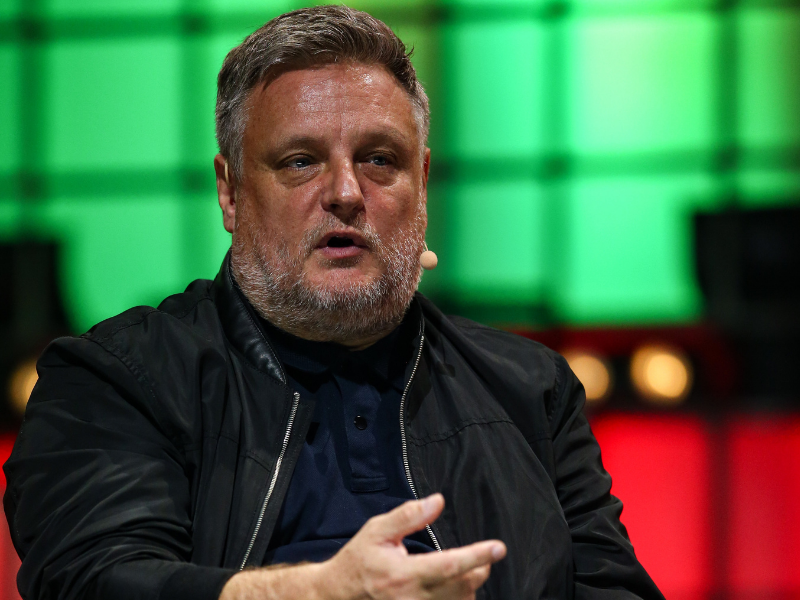
    The photographer Rankin is shorthand for John Rankin Waddell: as the founder of Dazed and Confused the globally distributed magazine, photographer of Kate Moss and Her Majesty Queen Elizabeth II, and with long ties to the music industry, the 54-year-old photographer is now at the summit of his profession. 

    So how did he get started? His early education looks at first inauspicious:  Rankin studied accounting at Brighton Polytechnic, before dropping out in order to study photography at Barnfield college in Luton. He subsequently relocated to the London College of Printing. In time, his reputation as a fashion and music photographer grew. 

    But he really owes his start, he tells us to Icelandic pop star Bjork: ‘Bjork was brilliant. It was literally my first ever shoot for a record label. She’s one of the most era-defining musicians because aesthetically she’s so unique and original, and she’s very in control of her image.”

    What did he learn from her? “What I loved about her was that she just let me do my thing. I have to be honest; there was a moment in the shoot where I was trying to do something that was a bit derivative of another photographer, and she gave me the confidence to just not do it. She was like, ‘You don’t need that shot, stick to what you’re doing’.”

    So did that make a difference in terms of his subsequent career? “She kind of set me up in a way, because very few people have ever surpassed her collaborative approach.” Collaboration is a leitmotif in Rankin’s career. It was only upon meeting Jefferson Hack at London College of Printing that he felt able to launch Dazed and Confusedin 1992. 

    Fast forward to 2021, and Rankin is still productive – and still collaborating. His latest book How to Die Wellis produced in partnership with Royal London, the UK’s largest pensions company. So how does he think this book will help people in these death-conscious times? “Death scares people, and that discomfort is the main barrier to talking about it,” he says. “The hardest part is getting started, but once you push through the fear – those conversations become a lot easier.”

    This tracks with my own encounters with those who’ve been around death a lot – from nurses and doctors to undertakers and funeral directors, they seem not to have the expected heaviness, but instead a certain lightness of being. 

    So has compiling the book helped Rankin face his own mortality, and the mortality of his loved ones? “Making this book has definitely helped me to deal with my own grief, as well as confront the idea of dying,” he admits. “And it’s so important that we do, because having these kinds of discussions means that when the time comes, our loved ones are prepared.”

    It’s been an extraordinary time. For over a year now, we look at our media and see the death toll writ large. 

    Have we become a morbid society? “I’m not sure the pandemic has made us, as a society, any better at having these conversations. The shock and size of the grief has been overwhelming,” Rankin says. “I think it’s going to take a long time for people to process what has happened. But it has certainly presented us with the undeniable reality of death.”

    And yet How to Die Wellisn’t a serious book by any stretch of the imagination – it’s full of anecdotes, lightness of touch, and charm. 

    How did he go about compiling the book? “We interviewed a broad selection of people who shared their experiences of grief – and also told us what they’d like their funeral to look like. There were some absolute corkers. From unusual song choices, to outrageous outfits, to hilarious last words. Death is just like life: there are ups, downs, laughs, lots of crying – and more than a few funny bits.”

  • Jim O’Neill on 9/11, the BRICs, and Biden’s priorities

    Jim O’Neill on 9/11, the BRICs, and Biden’s priorities


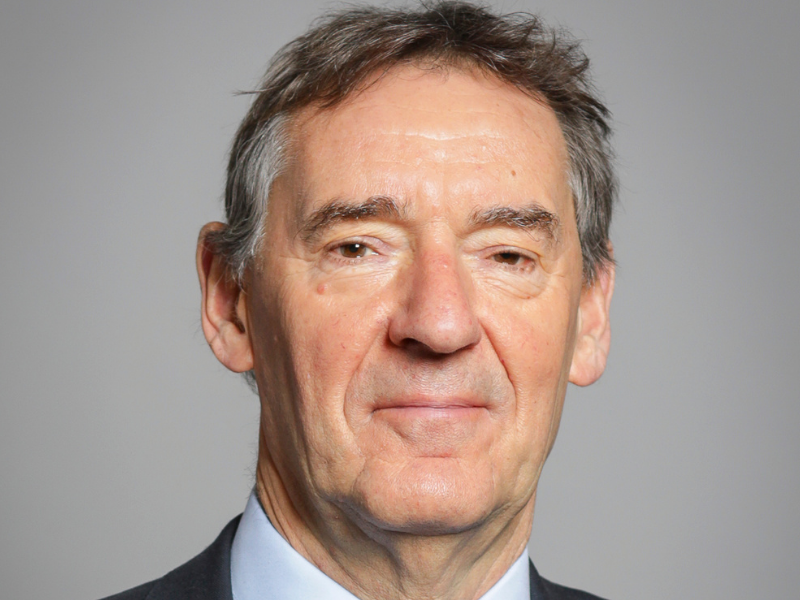
    The former Commercial Secretary to the Treasury and Goldman Sachs chief economist on the 20thanniversary of coining the influential term the BRICs

    In late summer 2001, when I was co-head of economic research at Goldman Sachs with Gavin Davies, it became clear there was a strong probability Gavin would be leaving to become Chairman of the BBC. In Goldman’s inimitable style, their immediate thought was to find another co-head for me.

    And so I became involved in interviewing all sorts of incredibly illustrious economists from around the world – spectacularly well-known names. I had to explore the idea that I would have some credibility as their equal.

    Then, crucially, September 11thhappened. I’d been at the annual Economics Association Conference in the Twin Towers. On the Tuesday, Gavin and I were hosting our monthly video conference with all our MDs around the world. Halfway through, the guys in New York left. We were wrapped up in our little world – we just carried on. Then, around 15 minutes later Gavin left for his final interview for the BBC. He popped back into the room and said: “I think you probably want to be aware that apparently some plane has hit one of the Twin Towers.” My first instinct was to say: “Okay, thanks Gavin. Now, you guys in Asia…”

    But within two days of it happening, I came to the strange conclusion that the underlying message to take away from this tragedy – rightly or wrongly – is that this was the end of American-led globalisation. It was the terrorists lashing out and saying: “We’ve had enough of Americanization.”

    Within six weeks, I published my first piece: ‘The world needs better economic BRICs”. Three things were at the core of it. Firstly, I’d already been mesmerised by China’s role in helping solve the Asian crisis in the late 90s so I was already aware of the relevance of China for the world. Then, of course, we were coming to the end of the first decade of the collapse of the Soviet Union, and the supposed emergence of Russia as some kind of democratic state. The G7 would soon expand to the G8 to accommodate Russia. 

    Thirdly, we’d also seen the launch of the Euro as a single currency. So France, Germany and Italy now shared a single monetary policy, currency and the common framework for fiscal policy, which would still have the same equal representation as all these seeds of global economic governance.

    It was only in 2003 that the acronym became well-known in business, when we published our outline as to what the world could look like by 2050.  We deliberately called that ‘Dreaming with BRICs’. People forget that we wrote about what could happen if ever country fulfilled its potential. Of course, in reality the idea that every country in the world would reach its productivity potential is crazy. The idea that they’d all do it at the same time is completely absurd. 

    In reality, what has happened is that China has become so big that it’s twice the size of the other three put together. So when it comes to discussing the BRICs as an economic or political group, China completely dominates. Because of that, it still means that the various assumptions we made about the BRICS becoming bigger than the G6 in the future, actually could still happen – despite what has been a very disappointing decade for Brazil and Russia. 

    Overall, China and India look as though they’re going along the central path that we assumed. Meanwhile, Brazil and Russia have proved that they suffer from the so-called commodities curse. They can’t seemingly adjust their economies from being excessively dependent on commodity price swings. They keep having these violent economic cycles. In both countries, there’s also significant evidence of misallocation of resources and a lot of blatant corrupt practices that go with these dominant industries. Both countries need to reform and stimulate their private sectors.

    Interestingly, the legal people at Goldman spent a brief amount of time exploring the case for acquiring the rights to the acronym. Whenever anyone mentioned the phrase BRICs, they wanted it to be Goldman Sachs BRICs. I argued against that because then other places wouldn’t have used it. 

    Today I worry that the American democratic system is struggling. The country is having to adjust to the fact that for the past 20 years, US economic growth has been so unequal. There’s been no rise in real wages during that time, which has caused this remarkable split politically. If we don’t see renewed economic growth post-COVID – and alongside it, shared economic growth – then the fragility will only grow more.

  • Model Rosalie Nelson: they wanted me ‘down to the bone’

    Model Rosalie Nelson: they wanted me ‘down to the bone’

    In Australia they have a healthier outlook on how models should look, so I was pretty shocked when I came to the UKIn Australia they have a healthier outlook on how models should look, so I was pretty shocked when I came to the UK, aged 22 and was confronted with an industry which wants their models to appear emaciated and gaunt.

    One agency in the UK said they’d take me on, but that I had to lose weight. I was already a size eight – the standard in the industry was to be around a size 6 – but I decided to give it a go. They didn’t give me any nutritional diet plan, advice or support, but I went off and completely altered my diet on my own: for four months, I was pretty much just eating fish and veg everyday.

    I lost a huge amount of weight and got really close to the measurements they wanted; when I returned they said I was doing really well, but that they wanted me “down to the bone”. The woman even pressed on her hips to suggest she wanted mine to stick out more.

    I decided to take a break from it all, but started to really miss it: I’d made so many good friends modelling and I hadn’t really trained for anything else. So I applied to some more commercial agencies, who encouraged me to be more healthy. The transition made me realise that the fashion industry is uniquely toxic: designers dictate what size they make the catwalk samples – usually a six – and, since fashion week is the pinnacle of the industry, this puts huge pressure on models to be thinner in order to get work.

    By chance, my agent called me up and asked whether I’d be interviewed for a Channel 4 news piece ahead of fashion week. The news team asked me if I was looking forward to the week ahead, and I explained that I was ‘too fat’ to appear on the catwalk. The reporter’s face was completely shocked: he couldn’t believe that I thought I wasn’t thin enough.

    After the news piece, things started happening quite quickly. In August of 2015 I got in contact with Change.org and started a petition to raise awareness around the issues in the industry. I was so excited when we reached 40,000 signatures: people from all over were sending such powerful stories about themselves or family members who suffered from eating disorders or body dysmorphia because of the way fashion projects an image of beauty and being thin. The more I dug, the more I realised my experience was really common.

    Once I reached 100,000 signatures, I went to Downing Street to chat to David Cameron. I presented my petition and we discussed how there were no safeguards for models, no HR and no support for mental-health or physical issues. Unfortunately Brexit was announced five days later, so suddenly everyone I’d been speaking to in the politics world just couldn’t work on it anymore.

    But we’ve recently picked discussions back up in Westminster. There are so many issues in fashion it’s been hard knowing where to start, but one thing I’ve really been campaigning for is bringing into the school system some kind of awareness around body image and how social media has a dangerous impact on this.

    I think part of the reason why there are absolutely no safeguards in the modelling industry is that models are viewed in such a particular light. People think we have it easy; that we get flown around the world, get to wear nice clothes and have our makeup done; that we are so lavishly dipped in money and gold that they don’t need help. There hasn’t needed to be any reason to help models because people think we have everything in the world. We don’t: we are told daily not to smile, not to talk, not to have an opinion to pretty much anything. We are forced to starve ourselves to satisfy the whims of how society views beauty.

    Thankfully, the need for models to look bone-thin has slowly begun to change, and the industry is encouraging more normal sizes to enter the fashion mainstream. But even diversity campaigns can be problematic; when designers demonstrate a shift towards a diversity of skin colours, ages and shapes, they brand it as somehow ‘different’ from the norm, as if being anything other than a white skinny girl is not normal, when in reality that’s what the average girl looks like.

    We need to change our perspective on what ‘beauty’ really means, and we need to encourage people to be comfortable in their skin – whatever colour, shape or size that is.


    Rosalie Nelson was talking to Georgia Heneage

  • Interview with Simon Giddins: ‘the man you go to if you have a problem the police can’t fix’

    Interview with Simon Giddins: ‘the man you go to if you have a problem the police can’t fix’

    Alice Wright meets Simon Giddins – the man you go to if you have a problem the police can’t fix 

    “Imagine, someone has just destroyed your life in an instant, you’ve been scammed of your life savings, you’re sat there looking at the computer screen with your bank statement. All you feel is that nausea, that shock, your skin is prickling with cold sweat, you don’t know what to say. You phone the police, expecting a police car to come roaring down your driveway with blue-lights and people with notebooks. But nobody is coming to help you.”  

    Simon Giddins, a personable but mysterious figure, can only be described as having walked off the set of a TV adaptation of Arthur Conan Doyle’s Sherlock Holmes. However, Giddins sees himself more in J.B Priestley’s Inspector Goole, who he says is  ‘the bastion for those without hope, which very much goes to our core values. We see people from all levels of society and try to help – we provide solutions to situations, and as a company, fight their corner.’ 

    To meet him in person Giddins, who is the Managing Director of Blackstone Consultancy, a private intelligence and security consultancy is an exciting mix of anecdotes and vaulted secrets. His clients number among the richest and most powerful people from around the world; a little black book no one will ever get their hands on. When I name a handful of famous figures from billionaires to well-known politicians he’s prepared to play a long a little. ‘Yeah, most of those,’ he smiles.  

    Giddins holds all the expected credentials, an illustrious career in the armed forces, a degree in Terrorism Studies and a former deputy directorship of special projects for Aegis Defence Services.  

    So how has business been since the world was swallowed by the pandemic? Business is booming, and Blackstone’s agents were given licence to travel since their clients are ‘part of the critical national infrastructure.’ During the lockdown the company has professionally developed now housing two Chartered Security professionals: to put that number into context, there are only 160 such individuals in the world. 

    Even though official crime statistics stopped being published in March, Blackstone’s estimates that crime has gone up by 47% with cybercrime in particular having gone through the roof. ‘At the start of the lockdown we were seeing a lot of cybercrime using NHS messaging, asking people to buy tests or give personal data’ says Tom Tahany, an operations manager at Blackstone, who joins us for the interview. Giddins adds that ‘there has been a lot of sexploitation.’  

    ‘Economically’, Giddins continues, ‘we are about to hit a wall, especially when furlough ends’. ‘As always we are ambivalent on political matters, but when furlough ends we will see an influx of business. Especially with the police’s attention diverted elsewhere in enforcing restrictions. Further to this, the more demonstrations we have – for example, anti-lockdown protests – police resources are diverted and crime then spikes.’  

    I’m interested to know what advice Giddins and Tahany would give to sixth formers or undergraduates that may be interested in a career that does not usually feature at the average university careers fair. Giddins emphasises that the perception is that they would want to recruit big guys with military credentials, but the reality is the needs of the industry and his clients are ‘so vast’ and ‘that’s why organisations like ours look for extra curriculars alongside academic achievement. And ask “how are you adapting those skills?”. Tahany, for example, is a qualified rugby referee, where he learnt to deal with big towering units of men in high intensity situations. While the company is interested in those with academic achievement, the particular field of study is unlikely to be the deciding factor on a candidate’s recruitment.  

    Blackstone’s are also advocates for diversity in the industry, particularly with regards to gender and background. Tahany, who joined as an analyst – but is now an operations manager – is from neither a police nor a military background. Giddins says: ‘For me as the business owner, I don’t subscribe to only recruiting from ex-military or ex-police because then you only have those ex-military or ex-police views.’ ‘The security industry is a bit monolithic,’ he continues ‘populated by fat, old white men who do have gender bias. We, however, don’t gender classify.’  

    Although this may not sound particularly progressive by the standards of some sectors, in this industry it’s a revolutionary approach. ‘Attitudes towards women in society particularly concern me,’ continues Giddins. ‘One in three women are harassed or stalked in their life. They have unwanted attention or are placed in situations where they feel uncomfortable.’  

    And when Giddins discusses diversity it’s more than mere talk. The Company is committed to young individuals seeing this as a viable career option. Giddins himself mentors two young individuals around the ages of 18-20 from underprivileged backgrounds each year.  

    Tahany, a popular figure from Channel 4’s Hunted, has been at Blackstone’s for two and a half years. He credits his practical experience on the show as well as his educational background as having led him to such an exciting profession. Shortly after joining, he found himself running surveillance teams in the Baltic nations. He tells me being an analyst is varied work, including conducting due diligence and background work on an individual globally, conducting data scrapes of an individual’s online footprint and advising them about where they are over-exposed or perhaps looking into the current risk situation of an individual travelling to Singapore or Hong Kong.  

    So it’s varied work? ‘We are involved in everything’, Giddins agrees, ‘from finding very unique items that are taken, such as unique jewels, to cars. Recently we investigated the theft of a £780,000 car – it was recovered. We also help small businesses, entrepreneurs and family-run companies. With these, we’re seeing a growth of ‘insider’ threats, theft from employers, lots of low-level fraud, even disgruntled household staff posting embarrassing images of client homes, causing reputational damage.’   

    The insider threat has increased since the first lockdown, as people have been working from home. People working for large organizations in their remote offices are having their information stolen by competitors. ‘But it goes beyond this,’ Giddins warns, ‘to the national level: rogue nation states, the Russians, the Chinese. It’s in their interest for them to sidle into organisations, and commit commercial espionage.’ This is happening in medical research, pharmaceutical organisations, universities and future tech companies. ‘It’s really exposed out there at the minute, and we’re very vulnerable. We have this view that the government will somehow protect us, but they won’t.’  

    Tahany agrees ‘Everything you’ve ever said, everything you’ve ever done, is becoming more and more exposed.’ The analysts, the more junior members of a team, will explain to second-generation multi-millionaires the risks they take with social media. Although he doesn’t think it’s credible to ask young people to not use social media, he advises that ‘it’s just about being sensible, about being mindful of what you’re posting and where. From a retrospective reputation perspective, but also to protect yourself from malicious actors such as fixated individuals.’    

    So should we be learning more future-facing skills like coding and data scraping rather than Pythagoras? Giddins isn’t about to take a swipe at the education system, ‘I would be very reticent to comment on what people should teach because it’s part of a very established syllabus.’  For Giddins it is about the act of learning itself, and how you apply knowledge.  

    — 

    Simon Giddins is the Managing Director of Blackstone Consultancy, a private intelligence and security consultancy. He read Terrorism Studies at the University of St Andrews, spent 15 years in the British Army and worked as deputy director of special projects for Aegis Defence Services, managing private and government clients internationally. He is a member and advocate of the Security Institute and was awarded the Freedom of the City of London in October 2015.  

    Tom Tahany studied Modern History at UAE before gaining his Masters in Intelligence and International Security from King’s College London. He has a background in private intelligence and investigations as well as featuring on the Channel 4 programme ‘Hunted’. Tom is also a qualified rugby referee, and continues to referee matches for England Rugby.   

  • Professor Andrew Eder on the joys of a career in dentistry

    Professor Andrew Eder on the joys of a career in dentistry

    Professor Andrew Eder

    After 35 years as a dentist in practice and a clinical academic at UCL, Professor Andrew Eder reflects on his personal journey from wanting to be a motorbike policeman to being a dentist and now a Finito mentor

    When reflecting on the Covid-19 experience, it is impossible to do so without saluting all those working in healthcare. Whether clinicians caring for patients on the frontline, public health colleagues determining new pathways or scientists developing vaccines, all have played a key role and we thank each and every one of them for their commitment. Despite the tremendous challenges they may have faced, higher education application data suggests that increasing numbers of young people wish to follow their lead and enter the healthcare professions, with doctors, dentists, nurses and scientists being just some examples of the many career options.

    My journey

    It is at these challenging times that I feel blessed and humbled to have worked alongside so many dedicated colleagues for so many years. Let me briefly share my story. I graduated from King’s College London as a dentist in 1986. I have since worked in NHS, Private and Specialist Practice alongside a parallel career as a clinical academic at the UCL Eastman Dental Institute. 

    But the early journey was bumpy to say the least. At 12 years old, I wanted to be a motorbike policeman – my life was all planned! But by 14, and after two years of pretty intense orthodontic treatment under the care of an inspirational orthodontist, everything changed. I had a complete about-turn and now wanted to be a dentist, this time my life really was sorted and my parents were ecstatic. I had a plan and knew what I needed to do.

    I enjoyed a privileged school education – a preparatory school in North West London followed by a scholarship entry route to St Paul’s. All seemed to be going well with good friends and success at O-levels. However, I soon started to struggle with aspects of the sciences despite working hard. But then, at A-level, my whole world came crashing down. With the simplest of actions, the opening of an envelope, my life-plan seemed to have slipped away with A-levels results far short of my offers for entry to Dental School.

    Off I went with my father to see the Careers Head at St Paul’s to be told that I would never get into Dental School and needed to consider other options. I recall so very clearly my father looking straight into my eyes and asking whether I still wanted to be a dentist. Without hesitation, I responded positively. So, the question was no longer when but how this ambition could be achieved, if at all. 

    My father marched me out of St Paul’s as they could do no more for me and I was enrolled in a crammer sixth form college in Kensington on the very next day. I still wanted to be a dentist and there was no time to lose. I spent a year reinforcing key knowledge and, more importantly, learning how to apply this knowledge by doing hundreds and hundreds of practice questions. Not a fun year by any stretch of the imagination, but a means to an end. A year later, I got three As in my A-levels and even an S-level. My place at Dental School was secured and I have truly enjoyed the past 35 years without ever looking back.

    Careers advice

    The younger generation are our future and I am grateful for the opportunity to give several careers talks each year. It is also a particular pleasure to regularly host work experience students in my practice. My message about dentistry, healthcare, or any other area of career interest for that matter, is simple: explore your interests broadly, always have options, work hard, enjoy life and, most importantly, always live your dream.

    Where now

    As an experienced clinical academic working as a Professor and Consultant at UCL and also as a Specialist in my own practice in central London’s Wimpole Street, my professional life has focused on excellence and innovation in clinical dentistry and dental education. Throughout a career spanning more than three decades, I provide high-quality care for patients with complex oral health needs and contribute to the training of dentists, postgraduates and NHS trainees.

    Working in healthcare

    Working as a clinician is hard but rewarding. And it is not just about the hours or working within a heavily regulated profession but also the emotional drain of clinical situations. But there are so many positives. For me, looking after so many wonderful patients for over three decades has allowed me to see them grow, just as I have grown. Along the way, we may discuss family events and work challenges as well as good and more difficult experiences. If patients are blessed with children and grandchildren, we might share pictures. For some families, I have the pleasure of looking after several generations. 

    Deciding on what to become or what degree course to take, and where, is challenging to say the least. Historically, there were plans to have a single-entry Bachelor of Science degree for medicine, dentistry and veterinary science as one may not always be absolutely certain of a preferred career path, particularly at a young age. After a couple of years at university, and for those who have been the most successful in their studies, a decision on a future direction of travel can be taken. Sadly, this plan never took off and, as a result, teenagers are faced with deciding on a specific professional trajectory at a young age.

    Diversification

    For some, making such a life-determining career decision works well as it did for me. For others, less so and sometimes changes have to be made along the way. However, most interesting is the tremendously broad range of options available within healthcare, even on a part-time basis. For me, I have always enjoyed a parallel clinical and academic career, with each supporting the other. For others, communicating with people may not turn out to be a strength and they may not enjoy patient contact and prefer to be in the laboratory or behind a microscope. Others may enjoy writing and I have found this a superb way to share clinical knowledge and experience with colleagues whilst also being able to educate the general public. 

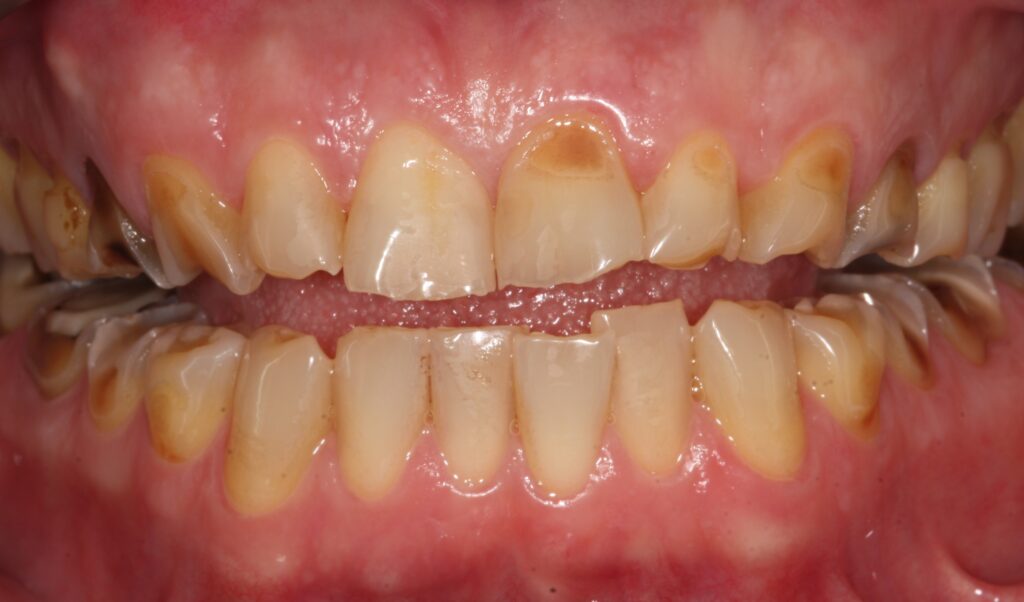
    Tooth wear

    Within a very diversified career, I have developed a particular interest in one aspect of dentistry. As we live longer and keep our teeth for longer as we learn how to manage tooth decay and gum disease, our teeth wear due perhaps to acidic foods and drinks in our diets or from grinding and clenching at night in response to stress (fig. 1). Having reached out to colleagues across Europe, we have written a multi-authored textbook for all members of the dental team, including dental students. The first edition was released in 2000, updated in 2008 and a completely revised edition is in press. I suppose this is my legacy piece to thank my own teachers and my colleagues for their support, to educate younger dentists and to ultimately benefit patient care.

    What next

    My family have always been my priority with my wife, Rosina, being my best friend who is always there to listen and offer sound and practical advice. After 35 years as a dentist working with patients in practice and students in academia, I have made positive decisions about my future career. Health permitting, I intend to continue caring for patients for the foreseeable future. I have, however, recently retired from my academic role but still continue to teach, examine and supervise research as an Emeritus Professor at UCL. This has intentionally freed up some time across a previously very busy week to instead build a part-time portfolio career, one important part of which will be to support and guide future younger colleagues in my role as a Finito mentor, and to spend a little more quality time with my wife, our children and our grandchildren.

    Professor Andrew Eder has been in Private Practice since qualifying from King’s College London in 1986. He is also Emeritus Professor at the UCL Eastman Dental Institute and formerly Consultant at UCLH and Pro-Vice-Provost at UCL.

  • Why lifelong learning should never stop

    Why lifelong learning should never stop

    Stuart Thomson

    Too often when we think about lifelong learning, it applies only to those who have been in the workforce for some time.  The reality is that the learning journey should never stop.

    The apparent confusion about terms is partly a result of ‘lifelong learning’ being misapplied to cover only more established team members who need to update their skills or if someone needs to re-skill after losing their job.  But this is all too little, too late.

    Instead learning needs to become a fundamental part of any role from the very outset, from Day One, not simply ‘added in’ later when gaps start to appear. We must get away from the idea that learning ends, or is at best paused, after sixth form, an apprenticeship or university.  

    New employees are often subject to a world of initial training and induction to ensure that they are up-to-speed in the new role.  But once that initial period comes to an end then there is a danger of learning silence.  That person has had their allocated training and the employer moves onto the next new intake.

    Sometimes new employees are expected to impart their knowledge to more established members as a sort of quid pro quo for learning on the job. There is no doubt that such a practical element is essential but there is no guaranteeing that either party is particularly adept at helping the other.  So, it may be that something more structured and formal is required as well.

    It should not be a case of simply being thankful for whatever support you are given.  Instead, we should all be more demanding about the training options open to us, especially early on.  Problems often arise when there is a gap between an induction and then a return to training.  That gap must be filled.  The bigger the gap, the more there is to fill.

    The gap is what causes problems.  These will vary depending on the role but could include an unfamiliarity with current thinking or new technologies, or lacking the skills necessary to cope with a new challenge.

    Some employers will allocate funding or a learning budget per person but that does not always apply to everyone across an organisation.  Again, there can be an over-emphasis on more established team members.  This lack of equality across an organisation needs to be challenged.  Employers could also have a bigger role in communicating more about the potential options available.  It would make joining them even more attractive.

    But we also have a personal responsibility as well.  Even if funds are available then it is up to us to use them. That means being able to identify where our weaknesses are, what we need to improve and frankly how we can continue to get ahead of others as well (internally as well as externally).  We all need to challenge ourselves and ask how we can be a leader in our chosen field and what training support we need to achieve that.

    Looking at what others are doing and being inspired by them is a good starting point.  But also look through training brochures and check the courses available. Consider what your professional and trade bodies offer.  Maybe try and spend time with other teams in your own organisation as well.  The role of mentors too can be hugely helpful in helping identify what to address.

    There needn’t though always be a cost associated.  Many bodies offer free or low-cost options, especially to existing members.

    It doesn’t need to be all about you either.  If there is a common need across a team then employers could provide you all with something as it may be cost effective for them.  Certainly, that has been my experience when dealing with training on public affairs and reputation management issues.

    Teachers, lecturers, trainers of all types have a role in getting us into good habits focused on ongoing learning.  So too do employers.  But we must take responsibility and hold employers to account on training and remind them of the benefits – not least improved retention and loyalty.

    We need to beware of the emergence of learning gaps and think about lifelong learning as the truly continuous process it should be.

    The writer is Head of Public Affairs at BDB Pitmans

  • That humorous feeling: how much comedy in the workplace is too much?

    That humorous feeling: how much comedy in the workplace is too much?

    The witty can sometimes prosper in the workplace, but take it too far and you may have a problem, writes Lana Woolf

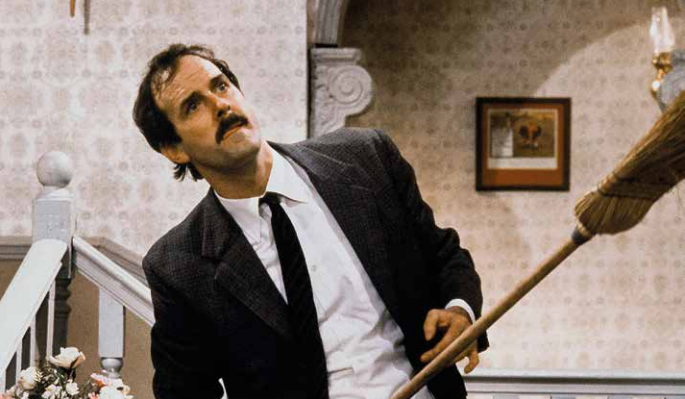
    Stephen Fry once said of the great Peter Cook that he was never unfunny, never ‘off ’. When Finito World caught up with the legendary comedian – and great friend of Cook – John Cleese earlier in the year, we asked him what he thought of Finito, and he showed us that he, too, never turns off the taps.

    When we told him about our mentoring programs, he was immediate: ‘It’s a very decent thing to do. I’ve heard of a finishing school – and I know Finito is Italian for finished because I eat a lot of Italian food – and I finish it all. But I’ve never heard of a finished school.’

    While we were laughing he was continuing, ‘I have heard of Finnish schools but they’re something quite different.’


    The Monty Python and A Fish Called Wanda star went on to share some advice as to how to forge a happy career. He quotes American comedian George Burns as saying: ‘If you do something you love, then you don’t have to do a day’s work for the rest of your life.’

    Wise advice, but our encounter with Cleese also had us thinking about an implied lesson that may be as important: what role does humor play in the workplace?

    Well, success in life can sometimes be attributed to ability to get on with people, and that is always to do an appreciation of nuance, which usually goes hand in hand with an ability to navigate intricate situations. The amusing are often, though not always, empathetic.

    Sometimes this proposition can have vivid illustrations. It was Jerry Seinfeld who observed that in US Presidential races it is an unwritten law of politics that the funnier candidate always wins. Obama was always funnier than Romney or John McCain; George Bush Jr. was funnier than Al Gore or John Kerry; Ronald Reagan was funnier than Jimmy Carter or Walter Mondale. Clinching for the theory, Donald Trump Jr. was demonstrably funnier than Hillary Rodham Clinton.

    But does this translate in the same way in the workplace, which is a less performativity space than electoral politics? Part of the force of a personality like, for instance, Sir Martin Sorrell derives from the sense that he might at any moment bark with delighted laughter even at a difficulty.

    Pat Thompson is the founder and managing director of Thompson Dunn, a central London-based psychologists’ firm. For 30 years Thompson has worked with CEOs on organizational culture and creativity in business: ‘I used to deal with delinquent adolescents and then went onto work for Michael Page selecting senior executives. I was once asked: ‘What’s the difference between a delinquent adolescent and a CEO. I replied: “Pinstriped trousers”.’

    The jury is out on how funny this is, but Thompson is arguing that humor is a way of making a ‘a difficult truth say able’. It is a form of smoothing – of moving the dialogue forwards in a way that we might miss if we proceeded solely in an earnest register. When asked about humor’s wider role, Thompson offers a two-word THAT HUMOROUS FEELING answer which dovetails with my own experience of office life: ‘Stress release.’

    A joke, said Nietzsche, is ‘an epigram on a death of a feeling’: the power of comedy is that it discharges feeling which had been accruing by admitting to that feeling and thereby ousting it.

    However, Thompson has a cautionary word about taking things too far, warning against becoming an office prankster à la David Brent in The Office. She also explains that one’s relationship to humor will depend on the tenor of the organization you work for. This can be challenging for women, she explains, recalling how ‘humor in the City was a darker shade of blue in a male-oriented environment. Women are often the butt of a joke and you have to cope with it. In financial services, you have to develop a thicker skin.’

    Moving on up: can a sense of humor lead to swifter promotion?

    Liam Williams is a professional comedian known for Sheep’s and Lad hood and the now the author of a brilliant debut novel Homes and Experiences. So what led him towards his career? ‘In the workplace, I’ve never known where the line is, and I was drawn to being a professional comedian because you are necessitated to go over that line.’

    Did he enjoy: ‘I found that having a laugh with my colleagues was the only thing that got me through the less fulfilling aspects of the job. Obviously, you don’t want to be like David Brent in The Office and you need to find a happy medium between not being too buttoned-up and boring, and not being the idiot with the Homer Simpson tie.’

    He notes that much humor comes from ‘absurd corporate language. This twee idea of ‘We’re all a family” – of language that comes down from on high and doesn’t mean anything to us. There’s so much euphemism.’

    Employers, then, must be careful not to alienate their employees with language that doesn’t match their real experience. A recent podcast produced by Fair Acre Press called ‘Word Bin’ invited participants to choose their preferred word to bin. A huge number of the choices related to corporate culture: normalcy, incentivize, optimized, moving forward, thinking out of the box, reach out/ reaching out, cascading down, time urgent, upgrade, inputting and solutions.

    Nadia Kingsley, the founder of the podcast, told us: ‘I was surprised at how passionately people wanted to bin some corporate speak. Having never worked in an office myself it was a real eye-opener. Some of the binning’s reveal something more than ridiculous management speak – but the old-fashioned hierarchy. For instance, the phrase ‘cascading down’, refers to minions who aren’t good enough to actually go to the conference but are given a version of it by someone above us.’

    Former deputy prime minister David Ludington makes a useful distinction between humor in the public and private spaces. Recalling life as the de facto no.2 in Theresa May’s 10 Downing Street, he explains: ‘Humor is vitally important in private. In a tense meeting, a well-timed and well-phrased quip can defuse tension. In the same way, if you looked at both Betty Boothroyd and Lindsay Hoyle operate as Speaker of the House, a joke or an aside can ensure that those tensions which had been building up would suddenly lapse.’

    Ludington also points to its impact in a speech: ‘Humor changes the register but also helps the audience to concentrate. A successful joke will make the audience listen as they’ll wonder whether there’ll be another joke coming. And humor that’s well received can get people on your side.’

    But he also has a warning against humor used against a political opponent which may also apply to life in a more ordinary workplace. ‘The risk is you get written off as a comic. You need to show you have the comic and the serious. In Shakespeare’s tragedies – even in Hamlet – you have tragedy and serious side by side.’

    Then Ludington laughs, recalling some of the inevitable ups and downs of government. ‘The truth is it sometimes feels more like a black farce. And black humor can keep you going in the inner team.’ This chimes with Thompson’s remarks: ‘Humor is an aspect of positive psychology. If you face difficulty in an organization, then looking on the bright side includes humor.’

    And if all that doesn’t work, and you find yourself caught in a job you dislike at the age of 40? Then John Cleese has some advice: ‘Don’t just take the money. But if you do and you get to 40, you can always kill yourself, I suppose.’ Black humor indeed.