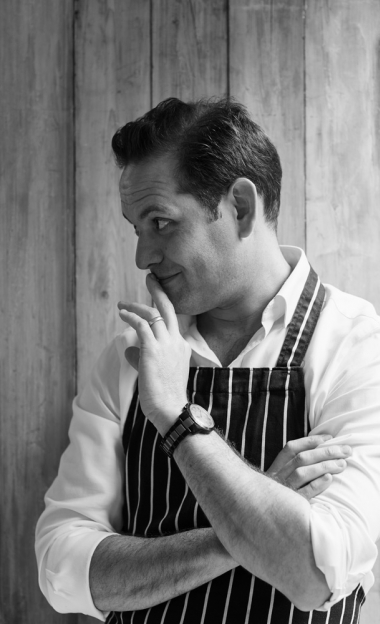
Garrett Withington talks to the co-owner of Parker’s Tavern and host of Cooking with the Stars about life under Gary Rhodes and Gordon Ramsay and how the UK’s attitude to food has changed
GW: How did you get your start in becoming a chef?
TW: I fell in love with cooking from a young age at school during Home Economics. I realised whatever I cooked in the class, it made people happy and I really loved that feeling – that is what a get a kick out of, seeing people enjoying great food.
Favourite Dish?
Lemon sole with nut brown butter, shrimps and samphire. It reminds me of childhood holidays in North Norfolk – where I am taking my family this summer.
You have quite a C.V. including Gary Rhodes and Gordon Ramsey. Were you intimidated working for these big names and are their personalities truly reflected when we see them on T.V?
Working for some of the very best chefs in the world has been an absolutely inspiration to me – we all put on a bit of a pantomime now and again.
Being a Chef often involves unsociable and long hours which can make it unappealing to the youth. What aspects of the job drew you to the kitchen that may inspire the next Tristan Welch?
I think the hustle and bustle of the kitchen really enthused me and drew me in. There is nothing quite like the camaraderie amongst a kitchen team. Some chefs I worked with 10 years ago, when we bump into each other now, we greet each other like great friends – it is relationship-forming.
Famously the kitchen is a stressful environment where much head bashing takes place with expletives thrown at one another, most exemplified by Marco Pierre White and Gordon Ramsey. But with more workplace environments and office spaces adopting a kinder approach, reprimanding and firing those who shout at their subordinates, is this attitude beginning to change in kitchens or does its unique environment separate it from this problem?
Those days are gone. We are at a very interesting point now, that I identified 6 years ago (before we started Parker’s Tavern), the training we had and the style of training is no longer relevant to young talent today and as industry leaders, it is for us to take it seriously and find the solution to guide up and coming talent through and help them flourish in this fantastic industry.
British cuisine has come a long way in a short time, now within the top ten countries with the most Michelin stars. What do you think has changed and is progress likely to continue?
I think the country’s attitude towards food has completely changed. When I was fresh out of college (even before then), my father would drive to France three times a year to stock up ‘on the good stuff’. Even in the early days of my career, I was told I had to live and work in France to really understand food and I did, I spent time there. But nowadays you don’t need to – you don’t have to go more than 300 metres in Cambridge to get to an amazing artisan bakery – we have great food on our doorstep.
What advice would you give to a budding cook and where to start on the career path to become a chef?
Follow the food that you love, have a goal in mind and in the back of your head. Understand that there will be hard days and great days but never lose sight of your goal.
Poor nutrition and obesity appear to be a problem in the UK. Do you think that there is an educational gap in public knowledge?
Yes, I think there is a gap in nutritional knowledge. However my children are being taught about nutrition to the point they are questioning their own school dinners so the future is bright on that one…
At school in Food-Tech I made Coleslaw, Pizza and a Trifle. Hardly set me up to be a great Chef. How would you go about inspiring children to cook and take what they eat seriously?
That doesn’t sound too bad! One of the key things especially for children and young adults is don’t be afraid to experiment. One of the things I do as a parent is give my children the full run of the kitchen. They can mix and make anything – sometimes yes, it may be inedible and sometimes it is great. For me, that is the best way to inspire.
School canteen food has also been the subject for debate by some chefs, expressed most by Jamie Oliver, but how would we go about bringing a Michelin star experience to children?
I think in this question lies the problem, we don’t. Michelin star for kids is the wrong idea – it is about good, wholesome food that is nutrient rich and fresh. I know it is the toughest thing in the world to cook for children all the time but it is certainly something we need more of a focus on. Jamie Oliver did a smashing job however it seems to be slipping back a bit and at a time when we need to focus on our kids more than ever.
Often for those trying to learn the skill of cooking from scratch it can be quite daunting. Thousands of cookbooks, an infinite number of online resources and numerous cuisines. Where would you tell these beginners to start and what path to follow to becoming a professional home Chef?
During my cookalongs at 6pm every Thursday on @Parkers_Tavern on Instagram! If you aren’t joining, that is why you can’t cook!
Famously around the world many countries have a negative perception of traditional British cuisine, how do you feel about this international reputation?
Apparently we have bad teeth too!?
When discussing British Chefs in general, Pierre Koffmann had stated that “Not enough Chefs cook from the heart. There’s a lack of originality, too much copying”. What are your thoughts on this and what advice would you give to aspiring chefs to avoid this problem?
I wouldn’t worry about copying too much, it isn’t something I would advise but I agree with Pierre, cook from the heart, cook what you love. On Cooking With The Stars, we made carbonara, is that considered copying? We made from the heart, it was fantastic and fun.
Does food have to be complicated to truly be good?
No – one of the most amazing salads is just picking tomatoes off the vine and serving with olive oil and a bit of seasoning. Complicated? I think not. Completely delicious? Yes.
After watching your performance on the Great British Menu it must be asked what you think of food critics. Are they viewed much like music and film critics who can judge but not create?
Some restaurant critics are better than others, but to be fair everyones a critic nowadays.
Amee Parekh has had an extremely successful career since she graduated from the University of Mumbai in 2005. She worked at IBM in software engineering roles for three years before attending Cornell, making the switch to HR, and going on to work for Expedia. She is now Head of HR for Uber Freight and Finance. We talked with her to find out her views on the best ways to succeed within the industry, the value of quality HR, and gender equality in the workplace.
“I grew up in India where I did my engineering work, and in India HR is actually an immensely hot function. It’s almost like how software engineering is in the US or how tech is in other countries,” Parekh says, “HR is very precious because a lot of companies over there are very high growth, so they really need HR to supercharge their hiring, train people in new skills, and manage a staff of thousands.”
Parekh was aware of how many opportunities in HR were out there, but she truly became interested in the field while working as a software engineer.
“On one of my first projects I happened to be working with the HR team building an internal portal, and through that I got a close-up look at the amazing job they were doing with hiring and how they were truly driving an impact on the business. That’s what motivated me to seriously consider this as a career.”
Parekh then applied to a wide range of Master’s programmes in the US at top universities, and got accepted to every single one. She chose Cornell University because of their top-ranked HR programme. Much has been written about the best ways to get into top schools – unique experiences, volunteering, sports, etc. – but Parekh took the traditional but difficult approach of pure academic excellence.
“I know universities want all of these extracurricular activities, but I think universities in the US also value academics a lot, so my undergrad was very useful,” she recalls, “My scores were very strong all throughout school. I was very much a geeky or nerdy student growing up, and even in high school I was taking advanced physics and maths.”
But what about outside of education? After graduating from Cornell, she says that finding employment opportunities was not difficult. For many, the guiding hand from study to work may take the form of a mentor who can advise on career opportunities and help people find their way into the corporate world. For Parekh, her career boost came more from the bosses she worked with than from any other source of advice.
“I have been able to grow and succeed in my career because I have had two or three managers who have truly believed in me,” Parekh says, “One manager at Expedia helped me by doing two major things; pushing me into difficult challenges and providing amazing feedback.” She adds, “The kind of feedback I received from him was transformational for me, and I think that can only come from a boss who is much closer to your work than an outside mentor.”
Parekh has succeeded through a lot of hard work and intense study and breaking into the world of top-level HR can often take years. We asked her what traits she thinks are essential in a good HR officer.
“Business acumen is a crucial trait, because there are thousands of HR initiatives and you can be aware of the framework of it, but what makes one HR professional far better than others is an understanding of the business where they can advise the CEO, ‘because of where the business is, we should do X, Y, and Z’. If you can do that as an HR professional, that’s where the magic comes,” Parekh says, “Having a good sense of quantitative abilities is also very useful, because business is all numbers. Even if an HR professional doesn’t come from a data background, I think that is an area which is worth investing in and learning about.”
Gender and racial inequality in the workplace has come a long way in recent years, but it is by no means perfect. Parekh has three children and a top-level position, which shatters what she describes as the typical perception.
“My experience has been very positive, but I cannot say that reflects every woman’s experience. I think it’s come through a lot of hard work – people are aware that I outwork everybody else,” Parekh says, “But if I tell people without any context that I have three kids, there’s an assumption that I won’t be able to put as much time in as other employees. There is an expectation there, and that’s why you have to break it every time.”
In a parting message to the industry, Parekh says, “Try it out. Hire a few female leaders and see how things go. Conversation isn’t enough, you have to actually put women in these roles, then you can see the advantages.”
Karen Barnard has been the Director of the UCL careers service for 17 years, following two years as head of careers at St. Mary’s University. Her experience allows her to help students with motivation, interview skills, and finding the right fit for them after university. She focuses on work experience, which has become difficult to manage during the pandemic.
“We’ve been promoting as much virtual work experience and that sort of thing as we can, which is as good as you can get in that situation, but it’s still really difficult for the students,” Barnard explains.
Without in-office work experience, students miss out on the ‘try before you buy’ aspect of finding a career. This could lead to students not finding the right job to fit their skills and interests, but Barnard says that many graduates are concerned about finding any job in the wake of Covid-19.
“There are the concerns that a student will have, not least of which is living though a global pandemic, which is one thing, but also the recession, their future and what it looks like, and obviously the backlog of graduates we’ll see from 2020 and 2021. Their confidence in the jobs market is low, coupled with the fact that the work experience stuff has not been there either.”
To allow students to gain work experience during the pandemic, Barnard and her team have begun to focus on work-related learning which takes place in the classroom.
“One thing we’re doing to raise the standard is work-related learning. Not internships or learning in the workplace, but work-related learning. For example, we have job taster sessions and scenario activities where employers will bring real-life problems onto campus, and students solve them in groups. They’re working on real-life problems under the pressure of time and they get a feel for it,” Barnard explained. “You can do that reasonably en masse. Rather than one person having an internship, we can have a class of 30-50 in small groups all taking part. I think that’s a way to do things at scale, particularly when there are fewer external experiences available.”
We have established that work experience is becoming increasingly valuable in terms of graduate employment, which brings us back to our previous question; where does the value of a degree actually come from? Karen believes it’s not about any one part, but the experience as a whole.
“The value of a degree in today’s marketplace is about the whole package of being a university student. The research skills and study skills you get from having done a degree are definitely important, but I think the whole package is equally important. Co-curricular offerings from universities include work experience and placements, but they’re also about contact with employers, clubs and societies, volunteering work, ambassadorial roles for the university… that whole package is valuable,” Barnard says. “We know that employers look at experience from students in the broadest sense, rather than just saying ‘great, you’ve got a 2.1’.”
Barnard also warns students on the job search to really consider the roles they apply for, rather than simply ‘ticking boxes’.
“The approach that we encourage students to take is ‘don’t do a job because you can do it, do a job because you want to do it’. They should think about themselves first – what their primary motivators are, what their values are, then rank all of those things. Have that list, look at the job description, and then see if it applies to you.”
At Finito, we continue to believe that effective mentoring is the one thing which can really make a difference to someone’s life chances. One of the joys of the work the organisation does is to receive testimonials after an assignment. In these we see the numerous ways – both big and small – in which one-to-one mentoring can alter lives.
But it’s also an interesting question as to how mentors are made. What is it which inspires people to give back? And how do we at Finito make sure our service adds value to every mentee which comes through our doors?
Georgina Badine has just been appointed Finito’s new Head of Admissions. She will be responsible for recruiting new mentees and guiding them through their journey towards employment and a fulfilling career. She oozes passion about her new role and is passionate about driving up student intake, and helping to manage the journeys of Finito candidates.
Badine has had a fascinating and varied career, with extensive experience in finance at Barclays, and then in business, recently setting up boutique commercial property business Treio, which recently paired with Finito World. Georgina has the knowledge and network to guide Finito mentees to success. But even before assuming the role, she had already proved herself a skilled mentor, having tutored students and adults from all walks of life in both French and English.
Ronel Lehmann, Chief Executive of Finito Education Limited, welcomed the appointment, and referred to Badine’s recent client relationship with the business: “We are fortunate that a former client of Finito was so impressed with the work that we do that she immediately wanted to join us. As with all our student and career change mentoring candidates, we always help to make things happen.”
So how did Badine become interested in mentoring? “My passion for mentorship started when I was in school,” Badine recalls. “I was a member of the National Honor Society and, within that, you would be expected to mentor and tutor other students. I got involved and I saw that I really enjoyed it, and then I started helping my friends and children of friends with different issues.”
It is this passion which marks out a mentor: very often Finito mentors will have been doing their own mentoring, sometimes as a kind of private volunteering, before they join us. Recent testimonials show that Badine’s mentoring can be truly transformative.
One mentee, Matthias Alvarado-Schunemann, tells us: “I have been mentored by Georgina from Finito for about six months now. Having her as a mentor has helped my confidence greatly as I prepare for the next chapter of my education with university. She helped me to write a well-presented personal statement for university as well as practicing my interview skills by doing various mock sessions. Her mentoring helped me decide which course I wanted to study and how to best articulate this to the various universities I decided to apply to.”
Badine’s mentoring also has another focus: “I’m very passionate about helping people who are being bullied either at school or in the workplace, and I feel that nowadays, a lot of people might be afraid to speak up,” she continues.
Some of what drives her, then, is personal experience: “I’ve also experienced quite a lot of adversity myself being a young woman in the finance world, when the treatment of women is often not what you would hope or expect. I know that I would have benefited from having a mentor to support me and stand up for me. I think too often people stay quiet if something is happening in the workplace or at school, and I think more needs to be done to help these people.”
Badine’s new role will also involve public speaking and organising events for Finito mentees. When it comes to bolstering the Finito network and creating opportunities to learn from top-level speakers, Badine’s wheels are already turning.
“I have quite a few ideas,” she says. “For example, I’m looking to organise an event within a restaurant, as I have a few connections in the hospitality space. It’s all about getting the word out about what we’re doing and inviting the right types of people to these events,” Badine continnues. “In addition to that, I am thinking about Geneva and Paris, where I have connections – as well as the US. Finito is a unique and trail-blazing organisation and I feel now is the time, with over 60 business mentors, for it to deepen its global ambition, like its magazine Finito World.”
So what kind of events will Badine be running? “We’ll get engaging speakers to come in, and I’ll speak as well, but I’m also really interested in getting people who are being mentored to come. Candidates who are considering joining Finito will want to hear that side of things. My main plan is to organise events, meet with my network, and find the best way to spread the word about our mentorship.”
Badine is also keen to stress that everybody is welcome in the Finito family. When a candidate comes to Finito for help, often they will have an idea of what it is they would like to do. However, Badine points out that this is also not always the case, and it’s certainly not a prerequisite. “We never turn a candidate away and we never let them go until we succeed,” she says.
She also offers some closing advice for those about to enter the world of work: “It’s important to do various internships in different industries because I know what it’s like; I initially wanted to be a journalist. I was convinced that was what I wanted to do, and I did various internships, but when I found that internship in banking I was surprised by how much I enjoyed it. I saw a different side to it, and had I not done that internship I wouldn’t have realised what that side was,” Badine explains.
Badine, then, brings a profound passion for mentorship, a global outlook, and a unique network to the business. She also illustrates the need for businesses to be dynamic coming into a period which few observers of the global economy expect to be plain sailing.
But perhaps as much as any of these things, she brings compassion and empathy to her role. “It’s very difficult to know what you want to do when you’re 18, so I think getting different experiences is very important,” she explains. “I would also say that it’s not just about the firm you’re going to work for, it’s who you’re going to work for. Look at not just what you want to do, but who you want to learn from. It should be someone who inspires you, because having a good boss is very important.”
There’s a famous quote by Zhou Enlai, who was asked in conversation with Henry Kissinger in the 1970s, what he thought of the French Revolution: “Too soon to say,” was his reply.
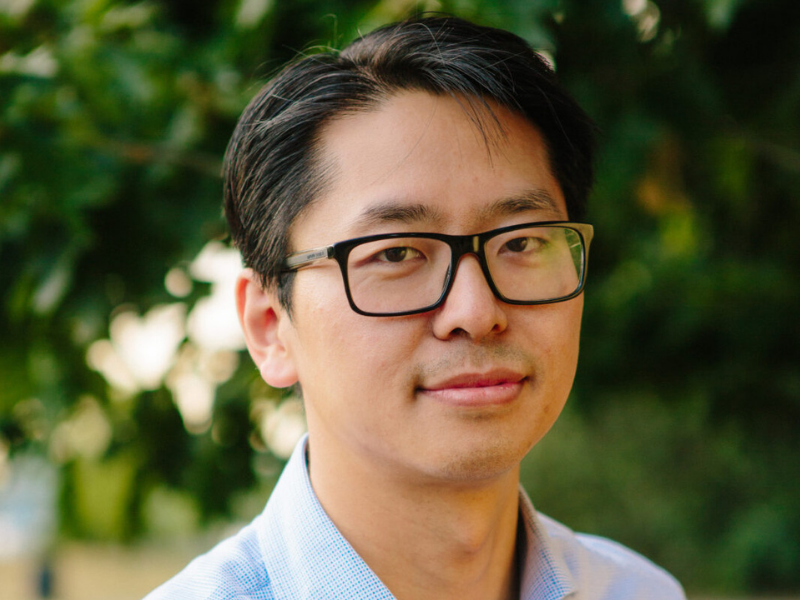
That’s the case with Covid-19 too. We are only just beginning to understand how it may have affected us in a multitude of ways – and most particularly in education. The only way to find out is to talk to people on the front lines. One of those is Ji Li, the likeable and articulate CEO of Plum Innovations, which has been busy throughout the pandemic enhancing its tech offer to its primary school clients.
In conversation, Li is knowledgeable and relaxed, and I can see immediately why schools would find him a helpful support in their busy lives. So what trends is he seeing? Li explains the shift towards flipped learning. “Flipped learning isn’t a new concept,” he says, “it began back in the 1990s. It’s to be contrasted with traditional learning where you go to classrooms; teachers tell you what you need to know, and you memorise that input. Flipped learning makes for a more collegiate approach”
Li’s own education back in China followed this approach: “When I was studying secondary school in China we were writing notes, and memorising everything,” he recalls.
With the increasing prominence of flipped learning, we’ve begun to alter the role of the teacher: the solitary sage at the front of the class has now become a kind of trouble-shooter.
Is there a danger of going too far and having teachers with too little influence? Li is philosophical: “I think there’s a sweet spot. There’s a role for the teacher to lead and to guide – but each pupil should have their own freedom to find the right way too. There are two extremes and we need to be in the middle.”
That might be said to echo Aristotle’s famous notion of the ‘golden mean’ where wisdom is found somewhere in the centre. This common sense approach turns out to be crucial to Li’s philosophy of how technology should be approached in the school setting. “Technology shouldn’t dictate to teachers; instead technology must evolve according to user experience,” he explains. “As a sector, we can’t define how teachers should teach; we need teachers to come up with that. Once that happens, then the tech sector needs to facilitate their approach and make life easier for teachers.”
One leitmotif of our conversation is Ji Li’s love of the sector he works in – and he clearly instinctively understands teachers, and is extremely eager to help.
“We make sure software and technology are being used, and working for teachers,” he says, passionately. “In my role, I see first hand how technology stops working, and how sometimes it works really well.” So how do you introduce new technology to a school and effect change? “A new system will often engender different workflow and have a different user interface. The school staff might find that difficult to get used to – or perhaps they’ll be too busy to obtain the right familiarity with it. If they struggle, they’re perhaps more likely to fall back on how things were before, because they know how to use it,” he adds.
That, of course, is where Plum comes in. Li explains that his work has become more complex since the pandemic with the shift to remote-working. “Before the pandemic everything took place within the building where the school was located. Since the pandemic, with teachers not fully back to school, and with the continued relevance of flexible working, that’s shifted the landscape of IT support –and of edtech in general. So we’re no longer looking at hundreds of computers inside one building, but at diverse settings. That’s a challenge for the sector, and it’s a challenge for Plum.”
Traditionally, of course, flipped learning has been used in higher education and doesn’t apply so much to the primary schools which form the majority of Li’s clients. However, there’s an interesting development at the primary level too. “With the lockdown, we’ve definitely seen an increased involvement from parents,” he tells me. “Teachers want to teach most of the contents of their classes, but at home parents can be very helpful to reinforce learning, and help with certain projects – especially with DT and science projects.”
Home-working means that the sector now needs to deal directly with third parties on behalf of schools. Li explains how this plays out: “You use your home connectivity for work now, and that includes teachers. So far we don’t need to contact the home broadband services not yet, but if there’s an issue with one of our clients we’ll always help them to troubleshoot it if it’s a wifi issue. If they say at home, “Nothing’s working” then that usually tells us it’s a fundamental issue, but we want the best for our clients so we’ll talk to third party vendors – we know the technical terms and so we’re happy to do that.”
There’s another area in which Li is prepared to go the extra mile – in talking to parents on behalf of schools. That issue arose, he says, time again during the pandemic: “We never say, ‘That’s not our issue’. We talked to parents a lot when we implemented Google classrooms. The parents had their accounts; the schools had theirs, and so we helped schools to train parents, in order to smooth that transition.”
Talking to Li, I have sense that he’s good at his job precisely because he respects his clients. He also takes a lively interest in education techniques. He tells me also of the parallel shift towards blended learning – a mix of online and offline – which is also set to have a big impact on the sector. “Before the pandemic, schools did almost everything offline. When lockdown came, we entered the most extreme version of online learning. Blended learning seeks a return to balance. The technologies of the future will evolve based on user requirements. Schools will adjust to what pupils need and we’re able to create a balance.”
Of course, the most important aspect of Li’s work is communicating. Without listening in the first place he wouldn’t be so well-placed to implement relevant technologies, and if he weren’t able to communicate, he wouldn’t be able to fix problems. “Communication is a massive part of it,” he agrees. “We are lucky to work in the education sector, where staff and teachers are eager to learn. In terms of technical language, some staff are tech-savvy and others are less confident are less confident in technology.”
Again, Li reverts naturally to his love of the sector. But beyond his natural empathy with teachers and other education staff, I also detect a passion for education. He takes a keen interest in educational trends, and speaks with real knowledge and insight about them. Further, his knowledge takes on an international dimension, which stems to some extent from his Chinese upbringing.
“The UK is always at the forefront of education technologies,” he says. “The UK has a history of leading the way.”
The transition has also been propelled by the increase in multi-academy trusts these past years, which has created a necessity for cloud-based learning platforms. “When everybody was working at one school that was one thing,” Li recalls. “Now, with many teachers working across many sites, that introduces the importance of the cloud, as it’s the most effective way to work.”
So flipped learning and blended learning turn out to be profoundly interlinked. As Li puts it: “In the future students will have paperwork to complete – handwriting and artworks and so forth. That’s important. But certain work they can produce online, as part of flipped learning. They can use online platforms to do research and then in class the teachers continue the learning journey with them.”
We’re full of buzzwords for the future: AI, drones, all manner of tech. But the future often happens more subtly than that. Talking to Li, you realise that the future is made not by big headlines, but quietly, almost imperceptibly by intelligent, thoughtful people – people, in fact, just like him.
Christopher Jackson is News Director of Finito World
Christopher Jackson interviews the legendary Virgin founder as he navigates the choppy waters of the pandemic
Fame will sometimes have a blurring effect. Public presence sustained over a long period of time can create a confusing image. During a long and varied career, so much is attempted and commented on, it is as if longstanding celebrity contains geological layers. To get to the truth of what made someone famous in the first place is a form of excavation.
At 70, Sir Richard Branson has reached this level of fame. We think we know him, but he has come to mean different things to different people. The range of his businesses interests makes his precise contribution to the world difficult to pin down: from trains, music, journalism, space travel, healthcare and – what has given him many headaches during the pandemic – aviation, there is little he hasn’t attempted.
Indeed the three words ‘Sir Richard Branson’ are themselves a sort of paradox, the first word suggestive of establishment accommodation, and the latter two synonymous with daredevilry, rebellion and harmless fun.
Branson was born in Blackheath, London to soldier and barrister James Branson, and Eve, an entrepreneur. Eve sadly died of Covid-19 in January 2021, aged 96. When we caught up with Branson shortly afterwards, he was happy to engage extensively, and submitted to our questions always in good humour, making sure we had what we wanted.
Virgin Mother
When I offer my condolences, he replies that it’s his mother’s spirit he prefers to recall: “I don’t believe in mourning, I believe in celebrating incredible lives – and my mum really did lead quite a remarkable life,” he explains. “She had such a zest for life – and even at 96-years-old, she had the same energy and wit she had when I was a boy. When I was growing up she was always working on a project; she was inventive, fearless, relentless – an entrepreneur before the word existed.”
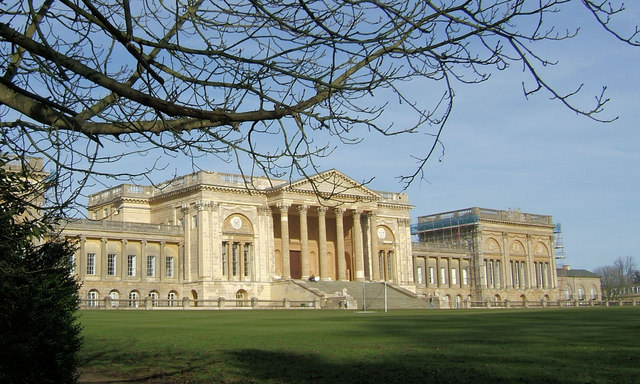
Eve’s example gave the young Branson an ingredient the entrepreneur cannot do without: gumption. Educated at Scaitcliffe School in Egham, and then at Stowe in Buckinghamshire, Branson would give the UK educational system short shrift, famously leaving school at 16. Partly due to his dyslexia, and partly because of inherent restlessness, one gets the sense that he never felt comfortable in educational institutions. With a can-do spirit the world would later come to associate with his companies, he simply set about creating structures better suited to his gifts.
The values that my mum and dad instilled in my siblings and I are lessons that have lasted a lifetime
SIR RICHARD BRANSON ON HIS PARENTS
Parental support empowered him in that decision: “The values that my mum and dad instilled in my siblings and I are lessons that have lasted a lifetime,” he recalls. “They taught us the importance of hard work, of not taking yourself too seriously, of treating people how you wish to be treated, of entrepreneurship, and so much more. They showed us how family is the most important thing in the world and surrounded us with love and encouragement.”
Of course, it was never plain-sailing. Not long before James’s death, Branson mèreand pèregave an interesting interview to the Wall Street Journal where Eve in particular eschews diplomatic language: “Let’s say he [Richard] was unusual at school. We didn’t know whether he was 99 per cent stupid and one per cent rather exceptional. We hung onto that one per cent.”
Eve Branson in 2013. Sir Richard tells us: “I was inspired by how my mum used her entrepreneurial energy to help others.” Photo credit: Foreign and Commonwealth office
This is the sort of joke only an affectionate mother would make and there’s no doubting Branson as he recalls: “I was inspired by how my mum used her entrepreneurial energy to help others. I spend a lot of time now working with the Virgin Group’s foundation Virgin Unite to challenge the unacceptable and to try and find entrepreneurial solutions to some of the world’s biggest problems. My mum is always an inspiration, spurring me on and encouraging me to think bigger.”
School’s Out
At first, thinking big meant leaving school. Many who have been to Stowe school, with its spreading Capability Brown gardens, will feel they could happily walk there forever. It is telling that Branson was immediately restless: even at this distance, knowing what he went on to achieve, you can sense his itchiness to get on.
I’m only where I am today because I’ve failed along the way.
Sir Richard Branson
In 1967, Branson founded Student magazine – a magazine not dissimilar in intention and readership to the one you are reading. It still seems an odd choice of first venture for someone with professed dyslexia. At the time, he thought it would be the making of him. In reality, it turned out to be something as important: his first mistake. “I’m only where I am today because I’ve failed along the way,” he tells me. “That’s a failure which always stands out to me, failing to convince a major publishing house to invest in Studentmagazine. Even as a teenager, I had a huge vision for a whole host of new Student enterprises, from magazines to travel companies to banks. Unsurprisingly, they ran a mile.”
Stowe School which Branson famously left at 16. Photo credit: Kevin Gordon under Commons licence 2.0
Was that beneficial to him in the long run? “I didn’t know it back then, but this was the seed of an idea that grew into becoming the Virgin brand. I carried on building businesses I loved and believed in. Fast-forward half a century and Virgin spans even more sectors than I dreamed of as a teenager.”
You get the sense that these failures give him perspective now during the difficulties of the pandemic. When Branson founded the Virgin record store in Oxford Street in the early 1970s, there was a dicey episode when Branson’s parents had to re-mortgage the family home after Branson ran into difficulty with the tax authorities, having been caught selling discount records for export only. Eve would later tell the Wall Street Journal in her brisk way: “That was pretty horrifying.”
Over time Virgin Records – whose value had been increased by the signing of numerous artists, including Mike Oldfield and his Tubular Bells album – would go global and eventually sell for around £560 million. Even then, Branson wasn’t completely out of the woods. Libel litigation lay ahead between the newly founded Virgin Atlantic and British Airways. Branson won a record payment of $945,000 in damages, famously sharing the award with the employees.
Good Company
As significant as his financial success, Branson had created a style of doing business which caught the public imagination. In time, column inches accrued in a way not wholly dissimilar from the way in which on the other side of the Atlantic they accrued for Donald Trump. Different in numerous other respects, both were perfect magazine fodder for the excesses of the 1980s.
While it’s been the most challenging year for all businesses, what has kept me going is the spirit and resilience from our people across the Virgin Group
Sir Richard Branson
However allegedly shy, Branson was a natural front man for his businesses. Keen to find out more about his business ethos, I ask him how he keeps his staff happy and motivated. “I’ve always said, take care of your employees and they’ll take care of your business,” Branson replies.
And that’s a principle still true in the age of Covid-19? “While it’s been the most challenging year for all businesses, what has kept me going is the spirit and resilience from our people across the Virgin Group. Our people really are the thing that makes our brand different and special, we are lucky to have a brilliant group of people who believe in what they’re trying to do, which is to change business for good.”
Photo credit: Owen Billcliffe
Of course, most businesses will parrot that line. With Branson you sense his sincerity – partly because he was among the first to talk like this. “Over the years we have always tried to give our people the freedom to be themselves and to treat them like adults,” Branson elaborates. What does this mean in day-to-day? “One example is our unlimited holiday policy at Virgin Management. We introduced this a few years ago and the response has been very positive. The assumption behind it is that people will only take leave when they feel comfortable that they and their team are up to date on every project and that their absence won’t damage the business.”
What does he think of keeping regular office hours? “We should focus on what people get done, not on how many hours or days they work. We don’t need a vacation policy,” he says.
The reality of Virgin is pretty close to what you’re seeing or reading. It’s a progressive company that is looking to change the way people work so it becomes more human and less corporate – and at the same time trying to do corporate things.
Oliver Osgood, CEO of Masterplant, and formerly CEO of Virgin Pure
I’m keen to find out if this is corroborated by people who have worked for Branson. Oliver Osgood, formerly CEO of Virgin Pure, and now the CEO of Masterplant, a fast-growing portfolio of cannabis brands and assets, tells me: “The reality of Virgin is pretty close to what you’re seeing or reading. It’s a progressive company that is looking to change the way people work so it becomes more human and less corporate – and at the same time trying to do corporate things. There are companies where the outside is a reflection of the inside and I’d say that’s a fair comment here.”
Osgood is one of many who feel a loyalty towards Branson, having seen his operation from the inside.
With that in mind, I ask Branson about the new trend for flexible working. In fact, Branson was running Virgin like a pandemic-conscious company before anyone had heard of Wuhan or the South African variant: “We’ve offered flexible working at Virgin Management for many years, long before the pandemic,” he explains. “I’ve never worked in an office, or ‘nine to five’ for that matter. Obviously, this doesn’t work for every single role across our businesses, for example a pilot, but we try and encourage it where it’s possible.”
Poolside Tales
With Branson, I keep finding myself reminded of the Noel Coward dictum: ‘The thing about work is, it’s so much more fun than fun.” Branson is sufficiently retiring not to be too garrulous about his lifestyle; on the other hand he’s gregarious enough to own a private island and invite celebrities to it.
Never go round a swimming pool when Richard’s there, you’ll end up in the pool whether you’ve got clothes on or not
Travel consultant, Fred Finn
If you want to know the real stories about Necker, the private island he has owned since 1978, you have to talk to those around him.
In person, Branson is light-hearted, even goofy. Fred Finn, travel consultant and old friend of Branson, warns me: “Never go round a swimming pool when Richard’s there, you’ll end up in the pool whether you’ve got your clothes on or not.”
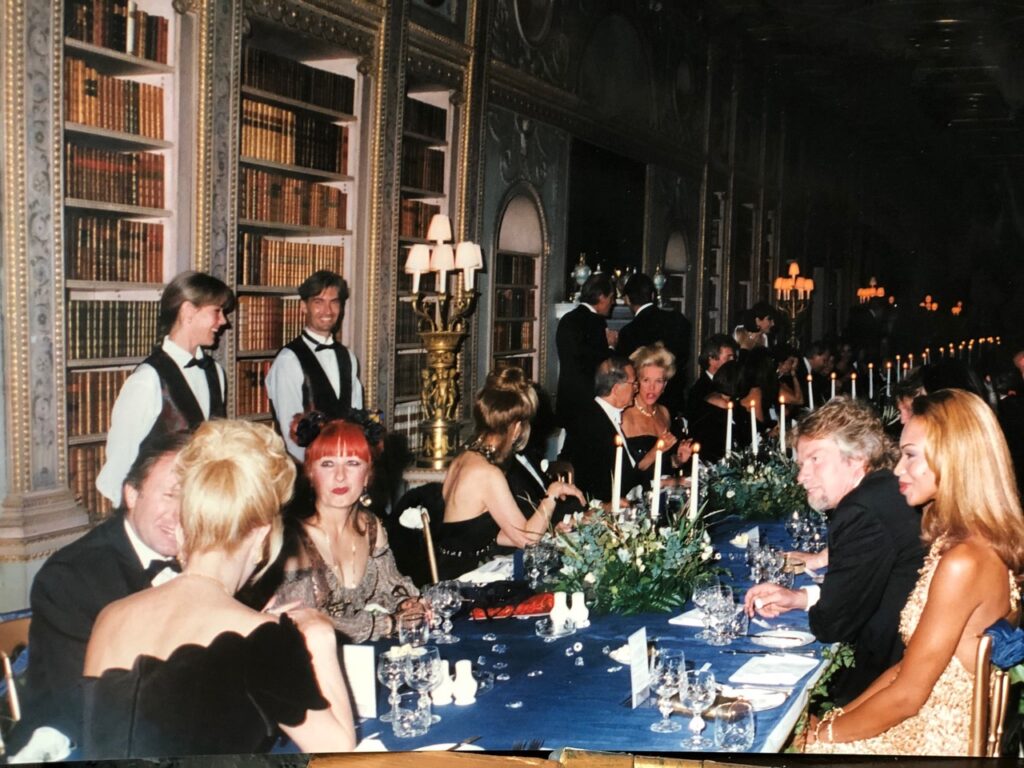
If you were imagining there’s a hierarchy as to who ends up in the pool and who doesn’t, you’d be mistaken. Liz Brewer, the noted impresario, recalls:“I had to heal a rift between Ivana Trump and Richard after he cheekily performed his ‘party trick’ at the Business Traveller of the Year Awards at the Hilton Park Lane, turning her upside-down.” This appears not to have gone down well with Trump wife no.1. To fix the matter, Brewer resorted to shuttle diplomacy conducted through cunning table placement: “I placed him at Ivana’s end of the 120-guest table at the engagement party I arranged at Syon Park before her marriage to her then future husband Riccardo Mazzuchelli. All was healed from then on and Ivana returned to flying Upper Class Virgin.”
Branson has an impish streak. Here reconciled with Ivana Trump after throwing her in the pool. Photo credit: Liz Brewer
I cannot help asking whether the 45thPresident of the United States was there at any of those occasions? “I seem to recollect that Richard had lunch with the Donald once, having been invited by him to his home, when one of Trump’s ventures had gone under,” Brewer replies, adding: “These two in personality were poles apart, both in motive and manner.”
It is difficult even so, not to conjure an image of Trump rotating through the air, an orange whirl of confusion turning into resentment, as a sniggering Branson scutters away. More seriously, it is worth noting that while Trump has his name on many things – sometimes, it seems, on everything– Branson’s publicity is undertaken for Virgin as a brand.
Presidents and Lions
Presidential friendships turn out to be a leitmotif of Branson’s life. In particular, he became friends with former South African President Nelson Mandela.
Branson tells me: “Nelson Mandela remains one of my biggest heroes and a global symbol of liberation, hope and equality.” What memories does he have of the great statesman? “I have many lovely memories of spending time together. From working on human rights issues together to forming The Elders [a group of global leaders working independently for peace], his humour and humility always stood out to me. He redefined what it means to be a great leader and taught us all how powerful forgiveness can be.”
Branson with his great friend Nelson Mandela. “His humour and humility always stood out to me.”
Another figure he got to know well is the 44thPresident of the United States Barack Obama: “I have had the privilege of spending some time with Barack, too,” Branson tells me. “It was a huge honour to be able to invite him and Michelle down to the British Virgin Islands for a break after Barack finished his second term as President and the family left the White House.” So what’s he like? “Barack has an insatiable curiosity for information and is always keen to learn. He also approaches every situation with a natural optimism, humour and warmth. All of these things makes him a great listener and a great leader.”
President Donald J. Trump shakes hands with the 44th President of the United States, Barack H. Obama during the 58th Presidential Inauguration at the U.S. Capitol Building, Washington, D.C., Jan. 20, 2017. Shortly after this photo was taken Obama would head to Necker Island to be with Branson (DoD photo by U.S. Marine Corps Lance Cpl. Cristian L. Ricardo)
In addition to this sociable side, there is also Branson’s much chronicled fearless streak. Fred Finn recalls: “I took him on safari with his kids for two weeks at Ol Pegeta ranch, then owned by Tiny Rowland. There were 18 lions in a three-acre chicken-wire cage. We turned up just as they were about to throw meat towards this rugby lineout of lions. Richard crouched near the fence and took a photograph of one lion. Then another jumped at Richard through the fence, and Richard reeled back, ending on top of the Land Rover. Instead of being frightened, he said, “Put my son on my shoulders, let’s do that again.”
So fearless then? Finn replies: “Either that or publicity! After that he asked Tiny Rowland to buy the place and Tiny said: ‘When you’re good enough in business you can talk to me’.”
Rowland died in 1998, but if he were alive today would he think Branson ‘good enough in business’? The figures don’t look too bad. Branson’s net worth is estimated by Forbes at $6.5 billion. Inevitably for someone of his stature he has had his detractors. In 2019, he attracted criticism for suing the government over Chris Grayling’s decision to disqualify Virgin Trains from tendering for the West Coast route. At issue was the question of whether Branson would take on a significant share of liability for paying out pensions to some 346,000 staff while running the services. The High Court took the government’s side.
Turbulent Skies
When I approached Grayling for a comment, he kindly declined, but added that he is spending his time on the back benches working with the aviation sector to keep it alive during the tribulations of the pandemic. One would assume that Grayling backs the £1.2 billion rescue deal Branson secured on behalf of Virgin Atlantic with the government in June 2020.
Resilience comes from failing and learning from those failures – and learning to still move forward. We all fail. Making mistakes is part of being human.
Sir Richard Branson
That, too, was a difficult time PR-wise. As part of the negotiations, Branson offered to put Necker Island forward as security. At a time when many were struggling with lockdown in small flats, it was irritating for some to be reminded that he had a private island at all.
The resulting deal is a reminder too that the Virgin empire is by no means owned entirely by Branson. 49 per cent of Virgin Atlantic is owned by Delta; Forbes recently reported that Virgin owes the minority shareholder £200 million.
But the fact remains that Branson has done what entrepreneurs do: survived. How has he managed during such a difficult time? “Resilience is a lesson we can all learn every day,” Branson tells me. “Resilience comes from failing and learning from those failures – and learning to still move forward. We all fail. Making mistakes is part of being human. If you can pair your failures with an openness to learn, curiosity and a sense of humour, you’re on your way to discovering resilience.”
This feels like earned wisdom and it’s something he’s keen to pass on. What would he say to the younger generation of entrepreneurs? “I always encourage them to try and find opportunities in challenges and if you get knocked down, to get back up. Over and over again.” There is quite a lot packed into that ‘over and over again’. Branson, I’m reminded, is very seasoned now; his youthful approach almost makes you forget that he has reached his three score and ten.
He continues: “It’s also important to learn to rest when you need to, rather than quit. In the face of great challenges, sometimes you just need some downtime to reassess and look at the problem from a different angle. I often have my best thinking time when I’m doing some exercise that I enjoy, like kitesurfing or cycling. Resilience isn’t a constant show of strength, it’s lots of little steps in the right direction that all eventually add up.”
Social Network
Branson is also enlightening on the question of social media. “It’s changed everything,” he says. “When I first started out in business, things were a lot different – I used to reply to letters and if it was urgent, I’d be on the phone. I enjoy checking on my social media feeds and find it really interesting to see everyone’s views on what’s going on in the world. I often blog and post about the issues I care about, from celebrating achievements in the Virgin family to trying to end the death penalty or working to encourage drug policy reform.”
Resilience isn’t a constant show of strength, it’s lots of little steps in the right direction that all eventually add up.
Sir richard branson
Is there anyone whose social media use he particularly admires? “One of the biggest benefits of social media is brands now have a direct link to their customers and communities. Look at brands like Gymshark; the founder, Ben Francis, has used social media to build the brand from the very beginning. They have a truly digital-first approach, and were ahead of the curve.” Does he feel kinship with Francis? “Ben started the business in 2012, and thanks in part to its rapid growth on social media, it’s recently been valued at £1 billion. Ben started the business when he was 19 from his parents’ garage in Birmingham, while juggling studying at university in Birmingham, and evening shifts delivering pizzas.” That certainly reminds me of a young Branson.
Virgin Limited Edition, Richard Branson, The Great House, Necker Island, 2018
Branson gives no signs of slowing down. How does he see technology fitting into Virgin’s path forward? “We’ve always used technology to elevate the experience for our customers wherever we can. From Virgin Atlantic being the first to offer seatback entertainment in all classes back in the early 90s, to Virgin Money recently launching a digital bank in Australia, or personalising your stay at a Virgin Hotel through its Lucy app, to earning and spending rewards across the Virgin Group with our loyalty programme Virgin Red. The opportunities are endless.”
In the Penalty Box
Of late Branson has become particularly interested in the death penalty. “It’s inhumane and barbaric, fails to deter or reduce crime and is disproportionately used against minorities and other vulnerable and marginalised groups,” he explains. When did he become interested in the issue?” “It was after hearing powerful personal stories of miscarriage of justice, such as Anthony Ray Hinton, who spent 28 years on Alabama’s death row for crimes he couldn’t have committed. Unfortunately, there are many harrowing stories similar to his.”
Branson believes that business doesn’t do enough to rally round on these key issues. What sets his latest endeavour apart is precisely this sense of the powerful joining forces on behalf of the public good. “I’m proud to have joined a global group of executives, supported by the Responsible Business Initiative for Justice, in launching the Business Leaders’ Declaration Against the Death Penalty. Together, we are highlighting the case for abolition and calling on governments to end the practice. If you are a business leader reading this – I would urge you to join our movement.”
So what is Branson’s legacy likely to be? Osgood is particularly insightful on what the group has achieved: “Virgin Galactic is the first time he’s tried to start a new industry. Usually the group targets overweight, inefficient industries.” Osgood starts to list them: “Doing trains better, doing phones better, doing broadband better, doing flights, doing banking better, creating Virgin Money lounges, rather than those horrible branches with people behind glass.” Then he hits on it: “Creating an environment where the customer feels happy. It’s the stewardess who makes you sure you have a comfortable flight and doesn’t bug you about your baggage allowance.”
That seems an impressive contribution in its own right, and you can feel Osgood’s enthusiasm – one of many aspiring CEOs who has learned much from Branson’s approach.
Meanwhile, Liz Brewer recalls a magnetic friend: “Richard is a truly refreshing ‘ideas man’, entrepreneur, humanitarian and someone who always impressed me with his positive attitude and the ability to stay firmly focused.”
So having dug beneath the geological layers of his fame, what is Branson really like? Uniqueness is never far from a discussion of him.
To interview a billionaire can be a mixed experience. I recall the unhappy obsequious acolytes around a certain aviation entrepreneur I once spent several days with, but all of Branson’s people seem happy. I recall the shifty banality of a media mogul of my acquaintance, but the Virgin Group feels transparent, and fundamentally benevolent. Above all, there is sometimes the sense that wealthy individuals aren’t enjoying life in some fundamental way; the opposite must be said about Branson. The only way for a rich man to be saved from the corruption of wealth is for money to be tethered to purpose. Branson’s life isn’t in the end primarily a story about the acquisition of money: it is about doing good, attempting the difficult or even the impossible, and doing it in the sunshine. It is this which makes him a hero to many.
Osgood recalls: “When he’s in the room, everyone’s excited. He claims to be a shy guy but I don’t believe that for a minute. He does get nervous. It’s more the aura, and the way he conducts himself. Lots of people see him cynically. He takes risks, and his intentions are good. But the businesses have a purpose: they’re good for people, and good for planet.”
Good for people, good for planet. That’s not a bad epitaph – and it’s certainly one he’s earned.
A look back at Finito World’s mid-pandemic talk with Sir Martin Sorrell who offered advice for the days ahead in April of 2020
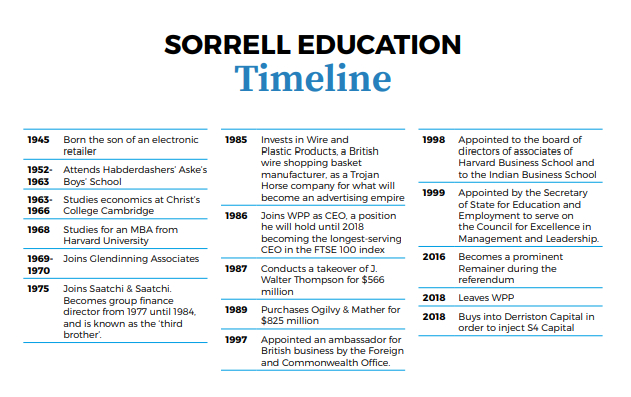
Prior to coronavirus, one would have said that Sir Martin Sorrell is a difficult man to imagine confined to his house. With the new normal of global pandemic, we do not have to imagine.
A Zoom interview is not quite the levelling experience one might imagine. True, instead of visiting the 75-year-old’s offices in Mayfair, whose shine and power I am now left to imagine, Sorrell logs on from his central London house. But his energy – which seems part Napoleonic, part East End smarts – is a not a thing to be dissipated on a Zoom call. ‘You look about three years old,’ he says, first up, laughing with typical bonhomie.
Sorrell has been in Covid-19 quarantine like the rest of us for the last few weeks. ‘The house is okay. There’s a bit of outside space which makes it tolerable,’ he says.
Sat in my two-bed flat in Camberwell, his house seems somewhat better than okay. Under a wall of cartoons (‘You can’t see the half of them’) Sorrell will oversee the work of S4 Capital, the digitally-focused firm he founded straight after leaving WPP in 2018, during the indefinite season of lockdown.
For Sorrell, the coronavirus situation comes across as just another problem that requires solving: he’s seen plenty of these since the early days of Saatchi & Saatchi, through the years of expansion of WPP, taking in the global financial crisis and numerous other shocks along the way.
His bearing is that of a man likely to prosper in this, as in any other era. ‘I actually find I’m doing more work, as there are no interruptions,’ he explains. ‘No breakfasts; no dinners; no surplus travelling. So, on balance I’m more effective and certainly learning more.’
For some, the idea of a more effective Martin Sorrell will be a fearsome notion. Perhaps one such group might be the leadership team at WPP, which Sorrell left under acrimonious circumstances in 2018. It was obviously an unhappy time, leaving the company he had built from scratch. What is perhaps more noteworthy is the swiftness with which he has moved on to the next thing. During our conversation, he refers occasionally to his time at WPP. But he usually does so as a point of reference regarding what he’s doing now at S4 Capital. And he does so far less frequently than he looks forward.
Sorrell founded S4 in 2018, with the mission ‘to create a new era, new media solution…for millennial-driven brands.’ In typical Sorrell fashion, the business has moved fast, acquiring MediaMonks for $350 million in July 2018; MightyHive for $150 million in December 2018; and the Melbourne-based BizTech in June 2019. Sorrell’s modus operandi favours almost hyperactive expansion until scale and geographical presence is established. It seems to work. The firm recently published its preliminary 2019 results showing revenues up 292 per cent from £54.8 million to £215.1 million, and gross profit up 361 per cent from £37.2 million to £171.3 million.
Sorrell cannot prevent noting with a certain glee the morning’s news: ‘I see WPP has suspended its dividend this morning. They were going in the wrong direction before the crisis. But now they have real uncertainty to hide behind.’ How does the present predicament of the firm he founded make him feel? He pauses a moment. ‘How does it make me feel? I think ‘sad’ would be the word.’
DIGITAL FIGHTBACK
But I don’t get the impression that Sorrell ever stays sad for long: he is too pragmatic and tough. Instead, throughout our conversation, Sorrell’s mind whirs about this historical plague moment – how best to navigate it, not just on his own behalf but on behalf of the 2,500 people S4 Capital employs. ‘If I’ve got 2,500 people in the business, and on average three in each family, that makes 7,500 dependents. At WPP it was 200,000 including associates – so that was 600,000, and a different scale – but you feel responsible for that.’
For years now, Sorrell’s mantra has been digitisation. You might say that in his mid-seventies he is an unlikely evangelist for the great tech firms both in the US and China – but then, like Oscar Wilde, Sorrell has never pretended to be ordinary.
And it’s the digital world which is impressing him during these coronavirus times. ‘The technology is very good,’ he says, bullishly, having been particularly impressed by an online seminar he participated in post-lockdown with Harvard Business School. Sorrell was swift to implement their recommendations. ‘We instituted our crisis group Wednesday last week [the first week of lockdown]. It’s very brief but it meets across the business. Every day we cover San Francisco to Sydney. It might have been more in the beginning but now it’s 15 minutes.’
Regarding the immediate economic future, Sorrell already has a clear sense of how the virus will play out: ‘I’m of the V-shaped school. You feel it in the markets already. It’s terrible, it’s shocking, it’s catatonic – a lot of companies will go down. We were dramatically underprepared.’ The sentence hangs there as if it might want to turn into an optimism, as indeed it does: ‘Q2 will be horrendous, Q3 will be tough but better, and Q4 will be a recovery,’ he says.
But it is in the nature of these uncertain times to be continually oscillating from hope to worry. Sorrell is no different, adding: ‘But a lot of companies will have gone to the wall by then. In our industry, a lot of highly-regarded production companies have gone. B-Reel, for instance – very good work, good people. Just gone. I think it’s going to be very difficult. This is a Darwinian culling.’
LIGHT RELIEF
I assume this refers to the business environment but it might also refer to the wider health story of which we’re all so acutely aware. A passionate Remainer in what we must now think of as the previous era, Sorrell has long since kept a businessman’s critical and bemused eye on politics.
This time around, he has observed with bafflement the zigzagging government strategy. ‘I do find the government policy a little bit strange,’ he explains. ‘Going into this, they knew the head count – if I can put it like that – could be 300,000. This wasn’t new information. I think at a certain point Dominic Cummings and Boris Johnson changed their minds from an approach which basically entailed culling the herd to create herd immunity, to one of lockdown. They suddenly reversed their approach; I’m not quite sure why.’
The CEO is also illuminating on the Chancellor Rishi Sunak’s rescue programmes for businesses. ‘They take time to implement,’ Sorrell says. ‘I spoke to someone who’s heading the UK Finance Initiative yesterday: on the loan schemes, you have to give personal guarantees. I have a friend who’s 75: he’s not going to give personal guarantees on a business that could go belly up. A lot of this stuff will be deployed where it is least needed – to large businesses and not to small businesses.’
And what about Donald Trump’s view that the cure is worse than the disease? ‘I’m not one of those who thinks we should have gone down the herd immunity route. But when you’re in a leadership position, you tend to overegg things. Boris Johnson overeggs it; Dominic Cummings overeggs it; and the media focus magnifies it to such a degree that mistakes are made. People who lead companies and government departments err on the side of caution.’
Sorrell adds: ‘And the enquiries into it will be everlasting and all the civil servants are terrified – and ministers are terrified – of investigative journalists who will be poring over the entrails. That makes people overcautious in the wrong way – as it stops them from making decisions when speed and agility is wanted. You see this in corporations – the lack of agility is huge.’
FACING THE STRANGE CHANGES
Beyond the immediate crisis, Sorrell discerns some changes which are likely to remain. ‘It will be an acceleration of what was already there. Consumers were moving online; now they’re going to move faster.’ Sorrell gives an example. ‘Harvard Business School has a virtual classroom. So now, with Zoom, you’re on a screen with me, I’m on a screen with you. Imagine 80 times that with three professors in the pit. You can email in, you can text in, you can raise your hand technologically.’
So the virus will make us think differently about gathering together publicly when we don’t absolutely have to? ‘Before all this happened, you’d have to go to Atlanta or New York for a call like the Harvard one. But we did it in an hour and a half without all the concomitant waste, the travel, climate change.’
Sorrell also expects there to be other profound structural changes to our leisure. ‘I am on the International Olympic Committee (IOC) commission, and I’ll probably go to Japan next year. But will I go to the Superbowl to see the Patriots with 100,000 people there? Because one thing’s for sure, Covid-19 will re-emerge. We may have a vaccine to deal with it – or it may come back in the cold weather of Q4 this year which will make the recovery more difficult.’
Again, our conversation keeps swapping cautious optimism for melancholy pessimism. Our current condition is to be continually subject to revelations about how the virus will affect some hitherto taken-for-granted aspect of our life. Sorrell, you feel, has done more thinking than most, but he still has some thinking aloud to do. ‘This summer, where will people go for holidays? Very few people can take private planes, and there will be attendant risks to flying. There was a newsreel of the Chinese travelling in China. Everyone’s dressed in these spacesuits. You turn up and you’ve got these face masks. You’re assigned a seat before you get on, distanced from everyone else. Behaviour will change.’
And the wider media landscape? Sorrell is more decided on that one. ‘It will accelerate media owners’ use of digital and also accelerate the decline of linear TV. I was on a call yesterday with a Morgan Stanley analyst. Of course, the tech giants will feel the short-term impact on SMEs, but in the long-term it will result in Google and Facebook having a more dominant position. Imagine the data that Amazon is buying on consumer buying patterns: it will give them a huge data advantage. The same will be true for Tencent, AliBaba and Tik Tok in the east.’ This in turn feeds into Sorrell’s business model at S4: ‘We will benefit as long as we get through the next few quarters’.
SCHEMES, STRATAGEMS AND SPOILS
At other times, one has a sense that the reckoning of Covid-19 has created in Sorrell, as in most of us, a desire to pause and reflect. This sends our conversation – perhaps to our joint relief – away from the present crisis to wider questions of business.
So how to be effective in business? First, he says, you have to learn how to manage teams. ‘Even at small scale, you have the same issues around siloes and fiefdoms and people looking with blinkers,’ he explains. ‘When you have two people in a company, you have a cooperation problem. To get 2500 people to think as one, or to leverage whatever knowledge the 2499 have – that’s the game. If you can get people to share knowledge and insight, you have a much more potent organisation.’
Sorrell is in full flow now: you have a sense that these are the issues he has turned over in his mind for 50 years, and he enjoys sharing his knowledge. ‘My favourite question to anyone I’m talking to is: ‘What’s your biggest problem? The answer in most cases is lack of agility.’
What does he mean by that? ‘The siloes, the empires, and the fiefdoms within big organisations’. Sorrell is often known as a legendarily hands-on CEO, and this is sometimes presented as a flaw. But it might also be an aspect of impatience with barrier and impediment coupled with a strong sense of responsibility towards the workforce and its dependents.
Sorrell also recognises that talented people can present problems of their own as much as those who aren’t performing. ‘Good people are by nature not cooperative,’ he explains. ‘There are very few good people who work well in teams – and understandably so. They have good track records, and tend to think they’re right and don’t take advice easily.’
The job of a CEO is to get everyone facing in the same direction. ‘Implementation is very difficult in large and complex organisations,’ he explains. ‘You’ve got functional matrix; geographical matrix; brand matrix. It’s very difficult.’
So how to conduct the orchestra? One part of the answer is incentivisation. ‘At S4, we all own big chunks of the company. The WPP employee ownership schemes probably amounted to about three or four per cent. At S4, we’re smaller obviously, but about 50 or 60 per cent of the company is owned by people who work in it.’ This is an area too, where Sorrell’s education – Sorrell studied economics at Cambridge – has been helpful to him in his career.
‘At Cambridge, there was a book by a left-wing economist called Robin Marris – a left-wing economist – called The Theory of Managerial Capitalism. In the capitalist system, there is a separation between management and control. Managers manage; shareholders control – but there is a split between the two. Out of that, you get the view that all you need is share ownership: if people own shares in the company then their mindset is different.’ Is that his view? ‘Well, it can produce too short-term an attitude but broadly I don’t disagree with that. In WPP, in the early days, I always insisted people put their money where their mouth is. Interestingly, after a couple of plans, the institutions preferred us either to pledge stock we already had or just waived the need to put cash in. That was a terrible mistake. It’s like Warren Buffett’s comment on share options many years ago. You wouldn’t give an institution a call on your stock for 10 years at zero cost so why do you give it to management?’
HIRING AND FIRING
The other way to keep a company in shape is to get the hiring right. To those who might be ruminating on a magic hire, Sorrell has this warning: ‘I used to call it the Jesus Christ syndrome.
The person running this area of the business is no good. We should get rid of him or her. And I’ve got this fantastic person I want to hire.” Then the person comes in and three months later, Jesus Christ didn’t walk on water!’
Sorrell also argues that talent departments can get it wrong at both ends of the spectrum. ‘The hiring process is often too cumbersome or else it’s too intuitive,’ he says. ‘You either put somebody through 20 interviews, which anyone who’s good will not tolerate, or you have one interview and that person becomes a hero or heroine – a salvation. Advertising businesses are notoriously bad at hiring.
Individual predilections or preferences overcome what you should or shouldn’t do.’ He adds: ‘Another problem is to segment human resources and talent from the rest of the organisation. You shouldn’t rely on your head of HR to hire good people. The head of HR might supplement the list, but you should know who you think would be good to do x, y or z from your knowledge of your industry.’
Somewhere in here is the key to Sorrell’s success – the need to be hands-on isn’t some bizarre need to micromanage but a sort of prudent due diligence, and a tacit acknowledgement of the complexity of the job. He draws the conclusion: ‘People are an investment not a cost – and we spend so little time maximising that investment. sixty per cent of our net revenues are invested in people. Our revenues are £400 million, and we represent £250 million. At WPP it was £20 billion, so £12 billion went on people. But most people think much more about how we should invest in computers.’
And this, incidentally, is why government often moves with such little – to deploy one of his favourite words – ‘agility’. ‘In government, you don’t have the commercial levers or incentives: what you get is a splintered mess,’ he says.
HANG-UPS
Our time is nearly up. Towards the end, Sorrell strikes another note of cautious optimism: ‘I’m sure there will be a relief rally in the sense that when people are released from all this purgatory, there will be excesses. But I was talking to a client last night and I said, “I’ll call you in Q4 and we’ll say we overegged this.”
He continues: ‘I look at in a historical context. HIV has killed 36 million people. The two big flus killed 1 to 2 million. I’ve got a lot of friends in Brazil who are terrified about what the impact of corona is on the ghettos. We’ve lost proportion. That sounds callous, every life is important.’
Such are the times we so suddenly live in: we wish to retain optimism but we have taken a collective decision to endure economic hurt in order to protect the vulnerable. It is the hardest time the nation has known since World War Two, and yet all our technologies remain intact giving – at least for the time being – an undeniable flavour of technological affluence even to this unprecedented stricture.
Deprivation is still allied in a certain sense to plenty: we are in our homes, but many of us still eat, drink and are entertained to standards which would be the envy of a Renaissance king. We retain a sense of our intelligence and scientific skill, and the power of the economy which the likes of Sir Martin Sorrell have been instrumental in building. But we also know all over again the scale of the obstacles – of disease and nature’s indifference – which we had to overcome to build it all in the first place. There are no guarantees of our success; it’s up to us.
Perhaps that’s why Sorrell – so self-reliant, and capable – is someone we should especially heed in these times. We need the likes of him as we have never done before. ‘Someone sent me a diary from the great plague,’ he tells me near the end of our call. ‘It was a world of self-isolation; there was the Peak District village of Eyam which cut itself off for a year. This is nothing new.’
So nothing new – and everyone keep calm. Wisdom, like crisis, can often have an antiquated flavour. And with that, instead of the handshake at the lift, we say our Zoom goodbyes, and Sir Martin disappears out of my computer back into his improbable life.
Stuart Johnson has led the careers team at Bristol since 2014. We asked him how his team helps students work towards employment after graduation.
“I don’t think there’s any kind of magic bullet for this. There are a few tricks you can do to try and turn things around quickly, but that doesn’t mean it would be sustainable,” Johnson explains. “We need to work with students’ ambitions and dreams – it’s not about crowbarring students into opportunities to make the numbers look better.”
Motivation to succeed is always a hurdle which must be overcome in university, but Stuart has seen the way that Covid-19 has compounded the issue.
“It’s clearly hit the younger generation disproportionately,” Johnson continues “They’re facing a tough job market and whether students have stayed in their university accommodation or returned to their families, they’re living in less-than-ideal situations. A lot of them haven’t had the vaccine yet, they’re faced with bad news about the labour market, and some of them can just give up.”
Johnson believes that motivation and opportunity both work hand-in-hand to help students get on track. He says that a major part of his work is “about raising ambitions and helping (students) see the breadth of opportunities available to them”. Many students come to university motivated, with a clear plan for their futures.
I ask Johnson how he helps students who aren’t quite there yet.
“One of the things we pride ourselves in is the support we offer to such students,” Johnson replies. “That could be because they come from a disadvantaged background, they could lack the social capital, or they could have just been slow off the mark to think of these things – so as a general principle we try to engage students very early in their university careers.”
According to Johnson motivating and preparing students for the world of work is only half of the job: “At least as important is creating the pull from the other side with employers who are interested in our students,” he explains. “That’s partly the big-name employers, which is why we’re so targeted by The Times’ Top 100, but importantly also with local small to medium sized enterprises. We play an important role in the civic infrastructure of the city and growing the local economy.”
The job market is complex and intimidating, especially now, so Johnson is trying to teach students to understand it and remain flexible in their ambitions.
“We help students understand where the jobs are, because if they think that there aren’t any, that’s where they can quickly give up hope.” And where are those jobs to be found? “They might need to look in a different place or sector than they were originally thinking, then it’s much better to do that than to wait around for the ‘perfect opportunity’.”
Johnson understands the issues which students are currently facing, and he’s worked in the careers service for seven and a half years. In closing, we asked him to give some general advice to a student or fresh graduate reading this now. “Use your networks if you have them and focus your applications,” Johnson says. “I’m always nervous of people saying they’ve applied for 100 jobs and not gotten them – it’s usually better to apply for five really well.”
Professor Chris Brewster, who teaches International Human Resource Management at Henley Business School, believes that there are no universal truths in Human Resources Management, and that one-size-fits-all solutions are often detrimental in the industry. He specialises in the changing world of work and teaches his students to be versatile. We asked him what he thinks about the leading theories in HRM, and what the key is to managing people successfully.
“I have a friend who says that every new idea that’s ever come up about human resources management he can already find on his bookshelves if he looks at Plato or Aristotle or St. Augustine or Machiavelli. Lots of these guys have said a lot of things much better. And there’s a reason for that, which is that basically people haven’t changed over the last several thousand years,” Brewster says. “And it seems to me that basically, if you treat people properly in the way that you think they would like to be treated, you’ll get a better result than if you treat them just as digits or artefacts.”
A variety of factors can affect the strategy which must be taken when managing people – this can have to do with the country you’re working in, the size of the company, and which sector you’re in. Brewster explains the hierarchy of these differences.
“The most important thing is country. No matter which country you’re in, you have to follow the laws and the expectations of that country, and they vary pretty considerably. The second thing is size. Because obviously, if you’re running a small mom and pop corner shop with three people, you don’t manage it in the same way as if you’ve got 3000 people, that would be pretty crazy. So size actually makes a big difference. And that’s very important because most of what we know from the academics and from the consultancies and so on comes from large, well-funded companies with HR departments and things like that,” Brewster says.
So what’s the outlook for those who study HR at university or at a business school? “Most people who are doing HR courses are probably going to end up in fairly small to medium-sized businesses, so they’re not going to be able to do what they’ve been told the big companies are doing.”
Are there any other distinctions? “Thirdly, of course, there is a difference between managing people in the public sector or the private sector. There’s a difference between managing people in, let’s say, an office cleaning business and managing people in a laboratory. For example, there’s a big thing at the moment about big data and using fantastic algorithms to show where your most and least productive people are. If you’re running a small cafe somewhere, that really is not going to be a help to you, is it? So it’s a case, I think, of getting some kind of perspective on these things.”
Many people are under the impression that human resource managers have a lot of power within a company to make changes and to optimise productivity, but Brewster says that the idea of human resource managers as all powerful is a misconception. Oftentimes, decisions about how to manage people will come down to line managers or other officers, so it is important for human resource managers to not overestimate their power and promise undeliverable items.
“I’ve got some good stories where firms got taken over and the HR director was given a series of promises, and in good faith made these promises to the workforce, and then those promises were just blown out of the water after the merger took place. So I think you’ve got to understand the power situation that you’re in. Human Resource Management departments can be influential departments, but they’re never really going to be powerful departments,” Brewster explains. “The powerful departments are going to be the ones that control the money. There’s a task there for us to think about – how do we influence people? How do we understand what our influence and our power position is? How do we influence people to get a bit more power? There’s a lot of sort of loose talk by consultants about making the HR department more powerful and more strategic and so on.”
Oftentimes, human resources officers are seen as unnecessarily bureaucratic, existing only to protect a company from liability and weed out the unproductive. The views that Murray expressed in his Telegraph piece are an example of an opinion which has floated around about HR for decades. We put this opinion to Brewster, who was keen to point out the difference between human resources and human resource management, and also to highlight the fact that just because a job is sometimes unpleasant does not mean that it is unnecessary.
“Human resource management is used in two ways, and we have a problem because people don’t distinguish those two ways. I would argue that all organisations manage their people: you have to do that. It’s one of the things like managing your markets, your money, and your equipment, that all businesses have to do. But that’s not necessarily the same as the human resource management department. And I think a lot of people fairly casually talk about human resource management, when what they’re actually talking about is what the HR department does, rather than how the business manages its people,” Brewster argues. “And I think that’s one of the concerns – we have to be clear about what the HR department does. And at that level, yes, at universities for example HR departments are very concerned with making sure you’ve filled in the forms. I’m going to New York for a conference in May and I’ve got to fill in all sorts of forms about insurance and about health and safety. And only then can I actually book the flight – and I can’t book the flight myself, I have to book it through the HR department’s system. All of this is designed, of course, to make sure nothing bad happens to me. But it does look a lot like cop work, stopping me doing what I want to do until I’ve filled in all the forms. It’s a necessary task, but it’s not an exciting one, you know?”
Despite the view of HR as bureaucratic and dry, there are many people who want to be human resource managers and are genuinely excited about human resources. We asked Brewster why he has a passion for HR. The industry is much more than filling in forms and ticking boxes – and as he explains, even the duller side of the profession is essential to the function of a business.
“Lots and lots of people aspire to be human resource managers, and I think partly that’s because for a lot of individuals dealing with people is a more attractive option than dealing with numbers or dealing with bits of machinery or whatever. It’s a question of weighing these things up. There are parts of the human resource management function which are genuinely gratifying. I mean, I’ve been involved in things like training and so on myself, when you can actually see people grow in front of you, and that’s really good to do. But there’s a lot of other stuff that has to be done as well. I guess that’s the same for pretty much every job, and it’s about being careful not to oversell one thing at the expense of the other. There are good things and bad things about almost every job,” Brewster says. “These people who say, oh, let’s get rid of the HR department, it’s just a drag – you go ‘well, so who’s going to do those things?’ I mean, you can’t just let people do whatever they want. Firms can’t afford to keep breaking the law, for example, or to keep upsetting trade unions,. Somebody needs to look after that kind of stuff. If there are huge problems at work between individuals, it really helps to have somebody neutral who can actually look at that and deal with the problem.”
Above all, Brewster teaches students how to be adaptable, which is an essential trait in HR considering the wide range of differences in the profession we’ve already discussed. We asked him what his number one piece of advice would be for someone looking to break into the world of HR, and more generally, how to succeed in an ever-changing world.
“Look on everything as a learning opportunity,” Brewster says, “Try and learn as much about the business as you can. Try and learn as much about everybody as you can. Try and learn from your colleagues and your friends. There’s lots and lots of learning opportunities in every job, and the more we think of each job, not so much as an end result, or something we’ve got to plough through, but as a learning opportunity, the better. You’ll get better results both now and in the future.”
While perusing the internet or relaxing on the sofa diving into our favourite series, we mentally prepare our scripts for the water-cooler the next day. Cinematography, story, acting, lighting, the good bits, and the bad bits. It’s all there to be dissected. Unfortunately, Hollywood’s younger brother, adverts, do not get the same treatment despite often requiring the same amount of creative ingenuity.
I had the pleasure of speaking with Nathan Haines, managing director of element26.tv, a creative agency specialising in all aspects of short form film making, describing themselves as “on a mission to empower ambitious direct-to-consumer brands”. It is a section of the filmmaking industry that often gets overlooked as it lacks the glamour of its long-form counterpart, instead working silently in the background. Following our conversation however, it is clear that it is something any aspiring filmmaker should consider if they are looking to break into the industry.
Haines makes it clear that the business of short-form filmmaking shares many similarities with its long-form counterpart. e26.tv itself was born out of necessity to distinguish the short-form work of its parent company, Iron Box Films, and establish a medium for those focusing on corporate advertising or post-production.
Many of the elements that are often associated with long-form and feature films are present when making short films, such as the need for clear direction, but there’s one thing above all which unites the genres: the importance of telling a good story. Haines tells me: “For successful filmmaking, it’s vital to understand that it’s a visual medium – so trying to maximise this aspect of filmmaking is essential. With this you can convey a story with emotional attachment which engages with your audience”.
In both forms, the story remains integral but it is audience perception which changes depending on the medium. Haines continues: “In either case, an arc is important because an arc is how a narrative is shaped to create meaning. Ultimately this is usually informed by how long the film is”.
He added that the difference between long-form and short form was that one was a “sit back experience compared to the sit forward experience of our computer screens”. What appears to separate short-form film-making from its long-form counterpart is the restricted time frame of the former. But as the internet and broadcast television continue to converge and overlap, the most successful ads are those that seamlessly transcend the two platforms within these restrictions.
There has become a greater expectation for more professional, polished adverts on the internet, which has in turn required greater investment in their production. The creators of short films must tell their stories under time restrictions, with little dialogue, and make sure their story is relatable to by audiences. “It is a visual art, one that relates more to your subconscious rather than directly telling the viewer as to what is happening,” Haines explains.
But don’t be fooled that a shorter run time means a miniscule production time. Nathan described production at element26.tv, which could last up to four months with script agreement potentially taking up to six weeks.
Here lies element26.tv’s speciality, the creative back-end that shapes the rest of the production. It is the internal team fronted by Tom Lonergan and Louis Tsamadosthat who guide development before hiring the right talent for production. Nathan highlighted the importance of creative development which “has the benefit of aligning everyone to a creative vision”, and laying the groundwork for pre-production with the aim of “marrying the creative with the logistical”.
This does not, however, mean there’s a formula. Each film differs depending on its needs and this is clearly demonstrated in the variety that can be found within their portfolio. For instance the firm specialises in both live film and animation, which Nathan characterises as being like ‘apples and oranges’.
Though there may be a misconception that the filming process of both are similar, stricter structure is needed in the creation of an animation due to its time consuming nature of revisions. Where one can be re-shot immediately, the other requires time to reevaluate and redo. But regardless, it is a demonstration that short-form filmmaking is not a creative pursuit made redundant to only infomercials and informative corporate advertisements. Instead it is a pursuit that allows creativity to flourish.
Take for example the firm’s advert undertaken on behalf of ProCook. The film begins with a shot of a blade made of Damascus steel, the finest of metalwork, effortlessly slicing into a tomato. A chromed sieve shines against a black background then cuts to crisp lettuce being laundered. A sizzling skillet then cooks a chicken breast till golden, an image which is followed by an explosion of fillings.
A light dressing is then drizzled on top, all culminating in a regular Joe gleefully looking upon his creation: a humble sandwich. Everything has suggested that we were in the presence of a professional chef, instead we’re greeted by a regular guy in his kitchen. It has played with our sensibilities and built up our expectations but as the ProCook logo appears the message is clear. Even in making a sandwich you can expect the highest of standards to elevate your meal.
So what would Haines’s advice be to budding filmmakers? Haines is clear: “Be persistent, build a tribe, go create. Do not be discouraged by your lack of equipment, use what is on hand. So long as the story is convincing and the content engaging, you will find an audience. Making something will allow you to demonstrate any talents you do have and prove a dedication to the craft. Go and capture the imagination of your audience and get filming. It is the most beneficial thing you can do to start.”
Element 26 encourages those with an interest in collaboration, business or for guidance to get in touch. Currently element26.tv are working with AdSmart by Sky to bring a number of brands onto the platform. In January element26.tv and Sky will be running an event on the topic of getting brands onto TV, so keep your eyes peeled for updates.
And the future? Haines is excited to put the pandemic in the rearview mirror and firmly and when asked about element26.tv future he said they were, “striving to help more brands to reach their audience across a range of digital channels from TV to online and Out of The Home”.