Category: Interviews

  • Meet the Mentor: Q&A with Finito senior mentor Tom Pauk

    Mentoring is part of what we do at Finito. Kicking off a new series, Tom Pauk answers our questions about mental health, his career, and the mentor-mentee relationship


    Tell us about your career before you joined Finito.


    After studying drama, my efforts to become an actor ended with a whimper rather than a bang, and I retrained as a solicitor. The career that followed was a “game of two halves”, half-time marked by the global financial crisis of 2007-08. In the first half, at City law firm Allen & Overy, then in-house at American bank Citigroup, I’d specialised in large cross-border lending transactions. In the second, I helped restructure loans borrowers had taken out in more prosperous times but were now struggling to repay. After leaving the bank in 2017, I began mentoring young men in prison, returned to Allen & Overy, now in a role mentoring lawyers in the early stages of their careers, and began writing plays. My professional life, it seems, had come full circle!


    Did you feel your education prepared you for the workplace?


    A degree in drama could not have prepared me better for the cut and thrust of commercial law, an above-all collaborative endeavour with a diverse cast list of characters, long “rehearsals” with unfeasible deadlines we somehow always managed to meet. At the conclusion of an especially high-profile deal there was the added satisfaction of reading the “reviews” in the financial press. The practise of law is essentially an exercise in problem-solving. In my case, a love of modern languages and playing the violin had also prepared me for the intellectual rigour of law, and I was even able to use my mother tongue Hungarian in transactions with Hungarian clients. So to anyone reading this wondering whether a knowledge of an obscure language might prove useful one day, the answer is a resounding Yes!


    Did you benefit from mentorship during your career?


    When I’d started out, mentoring was still very much in its infancy. Fortunately, I was able to benefit from the law firm equivalent, the “seat” system, under which trainee solicitors move from one department (or seat) to another every few months to build up expertise in different areas of a firm’s practise. Each seat is supervised by a senior lawyer — part mentor, supervisor and critical friend — overseeing a trainee’s professional development. Over the course of my training contract I was exposed to a variety of mentoring styles, which then shaped my own approach when I assumed the role. But I continue to benefit from ongoing, less formal mentoring in the shape of the extraordinary people I encounter and who inspire me with their wisdom. So in actual fact I’ve never really stopped being mentored.


    What are the most common misconceptions about a career in the law?


    I think there’s a general (mis)perception that law is a dry, bookish occupation, and that lawyers are aloof from the rest of society, be they pin-striped solicitors in their ivory towers or wigged-up barristers bowing obsequiously in courtrooms. In fact lawyers are widely dispersed throughout society, in the public sector (civil service, local authorities, regulatory bodies), in companies and banks, charities and NGOs. If you’re a young person considering a career in law you’ll be able to select from a wide range of specialisations that play to your unique skills and interests.


    Mental health is a particular passion of yours. Can you describe how your interest in that area came about?


    There were occasions, especially early on in my career, when my mental health was impacted under the pressure of work. Symptoms included poor sleep, high anxiety and irritability, and a compulsion for checking work emails 24/7. Back then, there was a stigma around discussing one’s mental health, let alone seeking help when you needed it. Worse, it was regarded as a sign of weakness, possibly even career-limiting, to self-disclose. So one’s natural instinct was simply to keep quiet and soldier on. Thankfully, we’ve evolved to a more enlightened view of wellbeing in the workplace, with a plethora of interventions designed to promote a healthy mind as well as body, including mental health first aiders, mindfulness, and discouraging staff from checking work emails after hours. Eight years ago, the memory of my own experience led me to train as a volunteer at a mental health charity. At The Listening Place I’ve seen vividly for myself how poor mental health can quickly escalate into crisis, and how being truly listened to can be life-saving. Literally.


    Work-life balance is something you’ve been vocal about. What are the most common pitfalls people fall into there?


    Most people understand the importance of achieving a sensible work-life balance, at least intellectually,  And it’s hard to argue against. But here’s the challenge: we’re not necessarily aware of the pendulum as it is swinging in the wrong direction. Whether it’s staying ever-later in the office, checking, or worse, responding to emails at weekends  (“because it’s already tomorrow in Tokyo”), before we know it life is work and work is life. Of course we tell ourselves that it’s only temporary, that as soon as we’ve broken the back of whatever it is we’ll take our foot off the accelerator. But it isn’t that simple, for we may unwittingly have recalibrated our benchmark of what a normal working day is. We’ve trapped ourselves into believing our own indispensability (“If I don’t do it no-one else will). We assume that working harder improves performance, demonstrates commitment to our employer and enhances our prospects for promotion. I’d counsel anyone reading this to challenge these assumptions and to listen out closely for the whirring of your inner pendulum!


    You obviously have a passion for mentoring. What are the most common challenges you’re seeing among your current crop of mentees?


    I’m certainly seeing the longer-term impact of the pandemic. This is the generation whose educations, family and social lives were disrupted by successive lockdowns. And I’m in awe of just how well they’d adapted to remote ways of studying and working. Another challenge is the sheer number of high-calibre applicants vying for limited places on the graduate recruitment schemes of investment banks, accountancy firms and corporations. Training contracts in City law firms are similarly over-subscribed, and with increasing candidates achieving top grades there’s now a far greater reliance on critical reasoning and situational judgement tests, presentations, written assignments and long assessment days. However I’m also sensing some really positive new trends, with mentees less motivated by achieving huge salaries than they are by finding a fulfilling career. And finally, one positive legacy of the pandemic: Finito mentees are often engaged in volunteering activities, whether it’s repurposing old computers and teaching older people how to use them, mentoring disadvantaged kids, or stacking boxes in foodbanks. Something, finally, to celebrate in challenging times.


    Do you vary your process for each mentee, or do you have a particular approach which you use with each candidate?


    Mentoring is a transformative tool for supporting the development of a mentee, and because no two mentees are the same the mentoring process does inevitably vary. Having said that, there are common features in my approach.  In the first place, it’s not about the mentor. Our prime responsibility as mentors is to listen attentively at all times to our mentees. Listening actively (as distinct from merely hearing) is a skill that one develops with practice. And it’s crucial we’re responsive to the stated needs of our mentees rather than clinging stubbornly to our own agendas. One unique aspect of mentoring is our willingness to share our own knowledge and experience to support the development of our mentees. A word of caution however, because this has nothing to do with being directive. What we’re aiming to do is empower our mentees to think and act for themselves. Finally, mentoring is a two-way street. At its most fruitful the relationship between mentor and mentee is one in which sharing and learning opportunities arise for both participants. I’m forever learning from my mentees.


    What do you know now in your career which you wish you’d known at its start?


    Hindsight being a wonderful thing of course, here’s three things I tell my mentees. Firstly, it’s important to pace yourself, especially when starting out in a new role and you’re trying to make a good impression. Keep something of yourself in reserve for when you really need it. Secondly, don’t plot out your entire career from the get-go. Life has a mischievous habit of opening new doors and leading you in new directions. And thirdly, know where you add most value, and focus your energies accordingly.


    Do you have any new challenges on the horizon?


    I’m excited to have just been appointed to the board of the Joseph Rowntree Charitable Trust, whose endowment supports people tackling the root causes of conflict and injustice. Along with my governance responsibilities, I’ll also be involved in grant-making decisions, an area entirely new to me.


  • The Beautiful Charity: an interview with The Twinning Project CEO Hilton Freund

    Twinning Project CEO Hilton Freund is changing the lives of UK prisoners by giving them employability opportunities in football, writes Christopher Jackson


    The great and the good of football are filing into Downing Street: representatives of the charitable foundations of the likes of Manchester United and Arsenal – clubs famous the world over. At Number 10 they’re eager to disabuse you of your mobile phone the moment you arrive but it isn’t personal. Myles Stacey OBE, the special advisor who takes us up to the meeting room, points to a cubby-hole next to the Cabinet room and says: “Ministers have to put their phone in there before a Cabinet meeting so you’re not being singled out!”

    That means the discussion upstairs isn’t recorded, but it’s a remarkable occasion, convened by the likeable Hilton Freund, the Chief Executive of the Twinning Project, an organisation which uses football to help rehabilitate prisoners into jobs.

    Around the table on that day, the possibility of football as a force for good in local communities is repeatedly brought home. The central fixture of your local area used to be your church – now it’s the football stadium. I note time and again in the contributions an admirable sense of responsibility towards those who have been unfortunate enough to choose a life of crime.

    Afterwards, I ask Freund how is involvement in The Twinning Project began. “I have known [Twinning Project founder] David Dein a long time. David was the former vice chairman of Arsenal and he was vice chairman of the FA: he currently still advises FIFA and UEFA on a number of initiatives. After David left Arsenal FC he began public speaking and doing motivational talks. He started primarily in schools and then moved into the prison environment: he just felt that football could do more to create employability opportunities. He reached out to me in 2018 and asked me get involved.”

    Dein’s initial approach to Freund came in early 2018; by October 2018 the Twinning Project had launched. So did Freund come on board as a CEO figure? “Not at first. Once we launched, we quickly recognised that some of the non-premier league clubs would need financial support in order to do this. We knew we had a responsibility to raise funds to help them, so we set up our own charity which was incorporated in mid- 2019: at that point I became the official CEO.”

    Thinking back to the Downing Street event I recall how many of the clubs’ foundation heads complained about the perception that the whole of football is rolling in money. This may be the case when it comes to the eye-popping player salaries we all read about, but it doesn’t mean that the charitable arms of those clubs have ready access to cash. Was all this factored in at the inception of The Twinning Project or did it come as a surprise? “We were acutely aware of it very early on,” explains Freund. “There is a clear division between the club and the community trust or the foundation: the money that swills around the premier league doesn’t become a pot with which to carry out football-based provisions in the community.”

    So how is the Twinning Project funded? “We are a sports-based intervention into criminal justice. We have received little from the Ministry of Justice. We have secured some funding from local police and crime commissioners and from some local charities. But mainly we’ve sought to raise funds through some big events, such as an audience with David Dein and Arsene Wenger. We are a national charity so what we find is we prefer our events to raise unrestricted money and unrestricted funds: these are what helps cover my overheads which are significant.”

    Those overheads tell you about the scale the organisation which Dein and Freund have built in a brief period of time: “I’ve got staff all over the country who are essentially project managers. If you can imagine, I’ve got a guy in Manchester and he looks after 20 clubs and 20 prisons. I’ve got a similar guy in London who looks after 20 clubs and 20 prisons. They all need taking care of.”

    Does Freund have access to the players’ help ? “Access to the players is actually limited,” Freund says. “Access to the club ownership is easier than access to the players.” Why is that? “The players are restricted: they have got a number of initiatives that the clubs have themselves which tend to take priority.  What we don’t want to do is compromise our relationship with our football club partners because it’s putting pressure on them to make players available. To date, although our relationships are rich and very warm with football, we are very careful about how we activate our player engagement.”

    So what exactly does the Twinning Project do? “The idea of football in prison is not new. It’s been happening for years that football clubs go into prisons, but it’s been spasmodic: what we wanted to do is to offer a sustained consistent delivery. What we were seeing was football club representatives going into prison, having a kick around and then leaving and not going back for six months or a year. That’s why we approached The Football Association to create the FA Level 1 coaching qualification which can be delivered in the prison environment.”

    So where can that journey take prisoners? “On completion of the course, prisoners can achieve Level 1 certification which puts them on the ladder to further football-based education should they choose to go that route.  It’s the first step to education, but the important thing is they’re beginning to upskill and engage with a football club at the same time: they are actually on a big interview as well. So when they are released from prison, the football clubs have experience of working with those prisoners, making them that much more employable by those organisations.”

    What’s fascinating is the variety of roles which prisoners end up doing. Freund lists the possibilities and you can see how passionate he is about the potential range of positive outcomes: “I’ve got guys working as coaches – but I’ve also got guys working as stewards on match day, baristas in the coffee bar, as barmen in the club, or in maintenance roles.  70 per cent of prisoners leave prison without a job. It should be no surprise that 65 per cent reoffend in the first year. But if they have got some work and the stability which comes from engagement with a big brand like Everton, Manchester City, Arsenal, Plymouth Argyle, you are less likely to reoffend.”

    For Freund then, employability is the key metric in driving down reoffending. “Those in criminal justice will tell you there is a couple of things that prevent people from reoffending. The first one is their age. For people in their late teens and early twenties, when you are in a gang, going to prison is deemed a badge of honour. The second thing that prevents people going back is a stable relationship: if you have a wife and children, or supportive parents, you’re that much less inclined to want to go back in. Sadly, a lot of people are victims of inter-generational criminal activity.  If your mother or father has been to prison there is a very good chance you are going to prison too. But lack of a job upon release is another – and that’s what we’re committed to tackling.”

    Do any of the prisoners go through Freund’s programme and decide that football isn’t for them, but then go into some other form of business? Freund answers in the affirmative. “I have got a great example of a young man at Lincoln City who wasn’t into football but he was in prison when Lincoln City visited: he is now studying accountancy though the Lincoln City Foundation. We recognise that not everybody loves playing football but everybody understands the power of football brands: we mustn’t lose sight of the fact that this is not just a football-based provision.”

    This makes me wonder whether Freund would consider broadening the Twinning Project to include other sports? “My sweet spot is football,” he replies. “Nigel Wray, the owner of Saracens Rugby Club, sits on my board of trustees – we have entertained the idea of engaging with rugby.” The trouble, he says, is that football is so much more powerful: “Nothing really rivals the level of passion you get with football. When you consider the lack of money with the football club foundations which sit alongside very rich football clubs, the case becomes even harder with other sports. Take cricket as an example. Even at Lords they struggle to make money: to work with other sports codes would increase our funding exposure. It’s a real challenge.”

    The Twinning Project is now impressively expanding its football offering into the US, where soccer is the fastest growing sport. This prompts some interesting reflections on the difference between UK and American prisons. “Let me tell you something: you don’t want to go to prison in the US. Prison for me should be rehabilitative. In the UK, it is:  your punishment is the loss of your liberty, and you are being prepared on day one for the day you get out. In the UK prison system, you can work, you can study, you can do sports-based activities, and you can go to the gym.”

    And in America? “You go to prison in the US and there are 80-90 men in a dormitory three bunks high. There is no privacy. Locking prisoners in a cell for 23 hours a day is not going to rehabilitate anybody – it’s going to make them angry.  We have to work with these individuals to create an environment of nurturing, learning, skilling, and improving these people for when they come out. I was on Rikers Island in New York. You don’t want to go to prison there: it’s another level.”

    And what’s the reception been like in the US? “We work with an organisation called the International Prisons & Corrections Association,” explains Freund. “We have made a presentation to them and, off the back of that, we were given the opportunity to speak to the heads of prisons commissioners and deputy commissioners across the US. There are 50 states, and we have pitched to over 20, and 14 loved the idea.  But you’ve got a federal system: what’s going on in California is very different to what’s going on in New York or Texas. US prison reform is a political hot potato around which elections are won and lost.”

    And where next? Has Freund got a 5-10 year plan? “We are currently in advanced conversations with South Africa; we are in conversation with Roma football club in Italy.  We have been approached by Australia. The only thing holding us back is money: I can’t be in a million places at once but what we have managed to do is come up with a provision in the UK which we can be very proud. There are 92 football clubs in the football league; currently 73 are engaged with the Twinning Project.”

    That’s an incredible achievement and could only have been achieved by passion: “As you can tell, I am hugely passionate about this. I eat, live and breathe it.” He certainly does – and his story is a marker about what can be achieved with that passion – and a window also into the way in which our collective passion for football can be leveraged for good in our communities.

  • An interview with legendary barrister Khawar Qureshi KC

    Christopher Jackson

    Of all the things that can happen to you career-wise, to be born with the suspicion that you’d like to be a lawyer is one of the more benign developments imaginable. Salary expectations are good – and if you’re interested in legal problem-solving the work has the potential to be reliably interesting.

    There are other boons: for instance, there are reliable entry routes thanks to a highly regulated profession; later on there will be clear career progression – whether it be through to QC if you select the barrister route, or through to partner if you opt to be a solicitor.

    But a legal career also . Many students suspect the legal profession might be for them, but can’t initially decide whether they would prefer the essentially theatrical life of a barrister in court, or the weaving behind the scenes which tends to be the lot of the solicitor. Then once you decide that, there’s the further question of which areas to specialise in.

    Kuawar Qureshi is, without doubt, one of the world’s leading advocates, and therefore well-placed to answer questions Finito World readers will have about this area. In person he has a powerful quality – a sense of intellectual strength hits you rightaway – and there is also a sort of physical robustness, a leonine nimbleness, suggestive of someone who has been on their feet for much of their career. In this respect, barristers resemble orchestra conductors.

    The advocate has had a busy year, and now opened the London office of McNair International in Lincoln’s Inn Fields. The launch of this was a fine event, including a lecture by the revered Judge Abdulqawi Yusuf, a Judge of the International Court of Justice and its former President until 2021 on ‘Why International Law Matters’.

    So what does Qureshi most think is required to be a success in court? Qureshi doesn’t miss a beat: “In all walks of life where we assume responsibility for others, there must always be clarity and conviction to do the very best.” And what does this mean when it comes to the reality of being an advocate? “As an advocate this means being able to assimilate information rapidly and assessing how best to convey the same to the specific audience – whether it be the International Court of Justice, millions of people watching a live broadcast of a politically charged case, an arbitral tribunal determining a multi-billion dollar claim by a commercial entity against a State, or a domestic Court dealing with sensitive intelligence information. It has been an honour and privilege for me over the course of my career to undertake hundreds of case for parties all over the world- including these types of matters.”

    So what does Qureshi have to say to young people on the perennial question of solicitor or barrister? “In essence, the Barrister who wishes to excel as an advocate must be highly self-reliant, be prepared to work exceptionally hard, enjoy and be stimulated by the prospect of unravelling complex factual and legal issues, so as to convey a case clearly and persuasively,” explains Qureshi. He adds: “No Barrister can work effectively without an effective team and trust based approach with Solicitors who they work with. Solicitors work in firms and receive salaries, equity partners receiving profits from the firm. Barristers work from case to case.”

    Qureshi’s case load is extraordinary: to talk with him is to be given numerous asides about matters which have just left his desk, or which are currently being dealt with. These matters all have in common, you sense, their enviability if one were a barrister, and their likely bewildering complexity if you’re not. To be in Qureshi’s company is to get a glimpse onto an expertise whose enormity you can’t fathom: it’s like being in the company of a grandmaster chess player.

    So what has he learned from dealing with governments worldwide? “I have acted for the UK Government  on hundreds of complex and sensitive matters as an “A” Panel Treasury Counsel from 1999-2006 before taking Silk. I have also represented the USA, the Russian Federation, India as well as states such as Kazakhstan, Zambia  and been involved in matters for or against around 70 States in total. Advising and representing any Government is a great honour but comes with considerably more responsibility, as there is always a significant political element and the practical litigation insight available to sophisticated commercial parties may not always be present.”

    For someone as gifted as Qureshi one might have assumed that he would consider a judicial career, but in fact he isn’t presently considering it. “I enjoy advocacy in complex and challenging cases first and foremost. I enjoy the diversity of work that I am able to undertake for States and clients from all over the world embracing International Law, Arbitration, Commercial Litigation and Fraud/Regulatory matters. Just recently, I have undertaken a case before the High Court of Kenya for the DPP of Kenya against the Deputy Chief Justice of Kenya – the first time an English Silk was instructed to appear before the Courts of Kenya since independence in 1963. I had previously acted for a foreign investor against Kenya.”

    So what in his opinion makes a good judge? Qureshi says: “A good Judge is open-minded, fair and possessed of sound judgment, expertise, integrity and intellect as required to determine difficult issues – all to ensure that justice is done and the rule of law is always upheld.”

    So what is it ultimately which drives him in his career. Qureshi, who is plainly possessed of an unusually omnivorous intellect, talks about the way in which information’s flow has changed during the course of his  “Whereas when I started, hard copy books were the norm, it is a  rare treat (unfortunately) to visit a law library. There is now so much more information available through high-speed internet. The challenge is to be able to filter what is credible and relevant.”

    In which direction does he think the law is currently headed? “Unfortunately, as legal practice has become more “business-like” due to influences that have seeped in, it is sadly increasingly rare to see “justice” and “the rule of law” as the touchstones for legal work (save, some might say, when lip service is being paid to them or for “optics”). This is a very unfortunate trend which universities, the legal profession, Judges and politicians have a responsibility to address. Legal practice is not a business in the conventional sense which it seems to be increasingly conforming to. Legal practice should always serve to promote human existence and interaction in a manner which protects the weak and vulnerable, not rewarding or being blind to the transgressions of  the strong and powerful. Society at large will be much the worse if this trend is not arrested.”

    It’s impossible not to be inspired by Qureshi’s new venture. So what’s the story behind the new venture? “I strongly believe that International Commercial lawyers who are like minded and share a passion for Law, Justice and enjoy undertaking challenging as well as stimulating work derive greater strength when they come together. McNair International exists to serve that purpose – for individuals from all over the world. I am delighted to have been given the responsibility to continue to take McNair International forward.” And meeting him, you’re left in no doubt that he will.


  • Eduardo Greghi of The Kusnacht Practice: “I never thought of myself as losing money in my business; I was reinvesting”

    Eduardo Greghi of The Kusnacht Practice: “I never thought of myself as losing money in my business; I was reinvesting”

    The remarkable Chairman and CEO of The Kusnacht Practice talks about the pandemic and his business philosophy

    It was the French philosopher Jean-Jacques Rousseau who said that anyone peering into the heart of man would want to travel down in life, not up. In crude terms what he meant was that to be successful you have to make accommodations, and become in some way unpleasant. 

    I’ve often wondered whether he had it exactly wrong. He should, for instance, have talked to the immensely successful CEO and Chairman of The Kusnacht Practice Eduardo Greghi. 

    Brazil-born Greghi is one of those people in life who emanate goodness – and he reminds you that the kind can prosper, and that you don’t have to be Machiavellean to get on in life. He explains right from the outset his admirable business ethos, and is all bonhomie and transparent openness: “I want to display to the world, and to my clients, exactly what they will get. I only ever take money from clients if they’re benefitting from our treatment.”

    The Kusnacht Practice is at the high end, but then for people whose lives have come to a very difficult crossroads, the price tag is definitely worth it. At The Kusnacht Practice, confidentiality is paramount, but Greghi gives me an example: “We had a couple come in. They’d got married and had two children straight away, one after the other. Immediately, everything changed for them. Hormones had changed, they weren’t sleeping and they’d gained weight. And what happens then? Anxiety kicks in, and then depression. As a couple you start to argue and have relationship issues – even if you’re wealthy. They came to me and said: ‘We want to reset. We need help’.”


    At The Kusnacht Practice all needs are met so that clients can focus on their well-meaning

    This makes you realise what’s at stake for the families which The Kusnacht Practice treats: it’s nothing less than your whole life. At that point, the practice brings about a complete change. “They come with the children and the nannies, and we organise everything. They have individual treatments and couple treatments – whatever they need.” 

    When Greghi says everything, he means it: “I reinvest continuously in the quality of the client experience. This year, I’ve added three properties that are on another level. One of them is five times bigger than our largest property before. It’s modern and beautiful and well-located.” 

    You can feel that his enthusiasm isn’t to do with any crass delight in luxury for its own sake: this is all about how a suitably comfortable environment can help the client improve and eventually recover. Greghi continues: “For this latest one, we went with an Art Deco theme, so we have 1920s furniture. We’re not just going to put Ikea furniture in the rooms and hope it’s okay.” 

    Of course, what the luxury environment does is to make room for the client to focus on their treatment. It’s an aspect of what really sets The Kusnacht Practice apart: Greghi’s commitment to helping each individual in a tailored way.

    Prior to the March 2020 global lockdown, Greghi would travel a lot. “I had been in England and then I was coming back to Switzerland. I had plans to go to Russia, Kazakhstan and then several countries in the Middle East. These trips were all cancelled because of Covid.”


    Greghi continues to refine the client experience and makes sure everything is state of the art.

    In this, you glimpse the international nature of the practice – and Greghi, who is multilingual in English, Italian, Brazilian Portuguese, German and Spanish, is the ideal front man for such an organisation. But it also takes you back in time. The Kusnacht Practice has ended up having a good pandemic, but it wasn’t clear in March 2020 how things would pan out.

    Greghi takes me back to the situation, and is obviously moved by the way in which the staff pulled together. “Immediately, I decided that if I wasn’t going to be able to have clients for a few months I wouldn’t think of that as losing money. I would think of it as reinvesting. That’s what I did.” 

    Like many people in his position, he realised that he was responsible for the livelihoods of 100 people and their families. How did react? “My first thought was: ‘Wow, we really had a good thing going here’. I remember that time well. My brother had a business and it had to close down – and some of my entrepreneur friends, their businesses were wiped out completely.”

    The injustice of the situation also hit him: “We’re not in this position out of bad management or because of lack of resilience, love, care, dedication, integrity or competence – just because of this virus.” The situation was complicated by the fact that though the businesses could offer emergency services under the new Covid regulations, a lot of the work which The Kusnacht Practice carries out doesn’t quite fall into that category. As it turned out, the team was able to secure special permissions from the government and conduct quarantined treatment as the pandemic wore on. 

    As things went by, Greghi showed extraordinary leadership skills: “I thought, ‘If we go down, we go down together. I’m the leader of this business, and I was really heartened by the way everybody was cracking positive jokes together – it helped keep people calm.” In addition to thinking of himself as a re-investor in his business at a difficult time, he also began telling his staff: “A good farmer doesn’t eat his seed corns”. 

    Greghi’s emotion is palpable and you realise that his paternalistic approach to his workforce is deeply felt. “Luckily, you know, I saved the seeds. I get emotional about it because I love this team.” 

    One suspects though that luck didn’t have much to do with it: Greghi had worked himself into a strong market position, and like other businesses who have done well during the pandemic, therefore had flexibility to use the time to improve The Kusnacht Practice client experience. “I told everyone that when a tsunami comes, all the plants get affected in the same way, but it’s the ones with strong roots which come back. So I brought forward renovations which we had scheduled for earlier in the year and I continued with the hiring I had planned before the pandemic.”

    It’s this awareness and profound respect for other people which, I suspect, makes Greghi a cut above most business owners. “I’m the leader, you know, but I cannot achieve anything by myself,” he recalls. “But everybody rolled up their sleeves. If they had wanted to kick me, that would have been the moment, but we all stood behind each other.”

    Did this whole experience deepen his connection to the under pressure CEOs who form a part of his customer base? I strongly suspect so, but Greghi gives a different answer: “I come from very humble beginnings. I grew up in a house without windows. I arrived in England in 2002 with £50 in my pocket. My family is very humble, very loving, and very hardworking. As a business-owner and as an entrepreneur, I’m used to holding risk. You have to be fearless but at the same time be loving and caring towards your team. Actually there’s only stress if you care.”

    Of course, CEOs often talk up their team like this – but there can sometimes be a sense that mere lip-service is being paid. Things are different with Greghi. If you speak to some of his employees – whether it be Dean Gustar or Melissa Nobile – they display similar qualities of kindness and commitment to high quality.  They have plainly been inspired by him.

    Greghi, like Gustar and Nobile, exhibits a profound understanding of the condition of the wealthy. “You always have lots of things going on as a business leader,” he tells me. “You always have lots of problems to solve and decisions to make, and that causes insomnia, stress –burnout. Then some people start to self-medicate with drugs, alcohol, prescription drugs, or overeating. Then, you’ll start to have conflicts in your private life with your spouse, or with your relatives and it downward-spirals from there.”

    What Greghi is describing is fast becoming the story of our times. Part of the pleasure of talking to him is to know that somewhere there are people who know how to address problems which are now so rife in our society. 


    Greghi says: “I believe if you keep the highest levels of quality, and the best client experience, people will get value from their treatment.”

    At one point, he tilts his computer to show me the view out of his window, and I see a beautiful vista, including a lake, trees, and attractive houses. It immediately makes me feel calmer, as patients no doubt do when they check in. 

    At the centre of what the clinic offers are The Kusnacht Practice Standards, which have been so successful as to spark imitation from other competitors in the space. One of Greghi’s insights is that group therapy, though it can be successful for some, isn’t sufficiently tailored to the individual’s needs really to work in many instances. Greghi explains: “I believe that if you keep the highest levels of quality, and the best client experience, people will get the value for their treatment and they will come back when they need you or they’ll refer you further. As long as you keep these two things and you keep listening to your client, you find out what they need, and you give it to them.”

    That sounds simple, but it’s hard to deliver – and in any event there’s more to it than that. Discretion is important, as are the facilities on offer, but really everything keeps coming back to his staff. “They’re extremely altruistic. We’ll talk to a client at 1am, or go to their house to help them. It’s not a job – it’s a passion, a mission, a calling.”

    Given this, I’m fascinated to know about Greghi’s hiring processes. Greghi feels like a man who goes with his gut, and I can’t really imagine the sort of AI algorithm-driven processes one sometimes sees on the FTSE 100 at The Kusnacht Practice. 

    That turns out to be the case, and Greghi places great onus on trust, but he also emphasises the professional nature of the HR operation he’s developed, particularly in the last two years. “Nowadays, I don’t interview everybody, thanks to the growth we’ve seen,” he says. “Obviously if you need, let’s say, a chauffeur, he needs to have a driving licence. That’s going to make a lot of sense.  And we have to check their background, as our clients are in sensitive situations and we don’t want anyone who could do harm, or might have a history of doing dishonest things. But beyond that basic criteria what I’m looking for is whether they have the heart, and will fit the culture. The reality is that if somebody comes here with just like a nine-to-five mentality, they will not survive.”

    Greghi’s has been astonishing journey from his humble upbringing in Brazil to where he is today and he brings experience both in the property sectors (‘I love good hospitality and we’ve perfected it here’) and the financial sectors. This second thing obviously helps him, but again he is keen to stress the broader depth of talent at his business: “My finance team are a lot better than me.”

    Greghi is a remarkable man, and for a while I find it difficult to pin down what makes him such an infectious personality. At one point, he says something telling: “If I was asked to clean this table, no matter whether I was being paid or not, I will do the best I can.”

    There are few people I’ve met who deserve their success more. So what’s his advice to those who are struggling in today’s society? His reply has the feel of hard-earned wisdom: “I say to clients: ‘I cannot work with you if you die. You have to use everything in your control to improve. You have to look at your lifestyle. You look at your family life. Your diet’.” Then he pauses, and hits on it: “You know, you should just try and do one thing better today than you did yesterday. And also don’t do anything that will make it worse – that’s the best beginning. Then we try one little thing – maybe it’s only five minutes in a day. And then we go from there.”

    With that, he’s called away. People need him – and they’re lucky to have him.

    Eduardo Greghi was talking to Christopher Jackson. Go to kusnachtpractice.com

    Photo credits: Johann Sauty

  • Cosmo Landesman on making it in journalism and the tragic fate of his son Jack

    Cosmo Landesman


    My parents had a cabaret club in America in the mid-West. They did plays and had performers – people like Woody Allen, and Lenny Bruce – and a then unknown singer called Barbara Streisand. They put on plays by Pinter and Beckett and had a show on Broadway and moved to London in 1964.

    I was too young to remember Woody et al. but I remember going to the club and Albert King – B.B. King’s brother – was there and I went up on stage and did the twist. My Dad went on to do all sorts of things; he was a theatre producer, who put on a play at the Edinburgh Theatre Festival. My mother was a lyricist and wrote jazz songs and became a performing poet.

    I think my Bohemian upbringing gave me a taste and a leaning towards the unconventional. I’ve never followed the traditional path of most of my peers. I didn’t go to university and didn’t go to Oxbridge. I dropped out – and hung out.

    There are disadvantages to that, and I don’t think it makes me superior at all. It gives me a certain unique perspective and that’s good. That Bohemian tradition of which my parents were part of in the 1960s is something I miss. The classic moan is that Soho isn’t what is used to be. But cities have to change. Soho, which was once the Mecca of the Bohemian, has gone.

    But sometimes I look back at people who I thought of as square and conventional, and think of how they have the pensions. When you’re in your twenties, you think: “Pensions be damned!”

    I know quite a lot of people who did law, for example, not out of passion or interest, and regret it. I could never do something like that; I’m too dumb. I went into journalism because I was too stupid for everything else. I always wanted to write and I’m happy with my choices. I know plenty of deluded journalists who think they’ll write the great novel. Robert Harris is the exception everybody names. I realised I had no talent in that area; I abandoned all hope!

    Fleet Street used to be fun. Last time I went to The Sunday Times office it was like going into a library; it was so quiet and calm. Nobody hangs out and has lunch anymore. I meet young journalists who remember The Modern Review and it seems exciting to them. I was invited by Robert Peston to come to his Academy to talk about jobs in journalism. I would say: “Don’t do it – or only do it if you’re driven by a crazed passion that you must.” It’s a bit like becoming an actor – have a reserve job.

    I don’t do the kind of journalism that aims to change the world; I want to make people think, but mainly I want to make them laugh. You just do the best you can do, and pray to God that somebody will be moved. You try to be good and say something original and fresh. 95 per cent of what I read is this sludge of opinion and punditry.

    Book-writing is very unlucrative too. If you look at the statistics of the number of writers who make a living from their writing alone, it’s tiny, especially for a country as cultured and book-oriented as the UK. That’s not to say that you shouldn’t write books. It’s very rewarding.

    My real advice to young people is to try and be different. In this day and age, there’s such conformity – especially in the mainstream. 25 people writing the Harry and Megan article: do something different even if it will be a bit harder. Don’t follow the herd.

    If you devote yourself to journalism and writing, you’ll have what we call cultural capital. Don’t not do it because of fear about your pension.

    The death of my son Jack, who committed suicide after developing a drug problem, isn’t an easy topic – especially if you’re a parent. Who wants to read a book about this? It came out over the Christmas period last year. I hope people will find in the book more than just a sad memoir. I wanted it to be thoughtful and to have something to say about loss; I wanted it to be entertaining. I wanted to think about what it means to be a Dad.

    Parenting is trial and error; you bumble along and try your best. One of the things I write about in the book is that I had this idea of being a great Dad. I realise that I wasn’t being the Dad that my son needed, but I was trying to be the Dad I might have wanted. You don’t have to be a great Dad, you have to be a good enough Dad. You have to show up; you don’t have to be spectacular. It’s not just showing up at the parents’ evening. They’ll remember you sitting you in a chair, and leaning over and smiling at them, and pulling a funny face. It’s those small things: as long as there’s an atmosphere of support, love and care.

    You’re going to make terrible mistakes; being a Dad is about being a flawed human being. You’ll shout and lose your temper and regret it. That’s part of the business; it’s what you have to learn.

    There are days when I think Jack could have had more support for his condition, but I didn’t give him enough support either.

    But I can’t point the finger of blame; these things are complex. You often read that so and so committed suicide because of bullying. I don’t believe that; what drives people to that state of despair is a whole set of complex reasons. It’s not just one thing which does that. We always have these initiatives and drives, but I don’t think there’s a magic wand we can wave. We don’t really know why certain individuals commit suicide. Some will have suicidal thoughts; it’s only a minority will actually go through it.

    We need to give young people more tools when they face adversity and unhappiness. Suicide shouldn’t be an easy option; I sometimes wonder it’s become a sort of lifestyle choice – a human right. It should be understood that it’s a terrible thing to do, not just in relation to oneself, but in relation to others. But sometimes the mind orders its own destruction and that’s a scary thing.

    The trouble is my son had a terrible drug problem. We’re beginning to wake up to the impact of drugs on young people. I grew up in a generation where drugs were considered recreational and even mind-expanding, and people thought that anyone who disagreed with this view was a right-wing lunatic. Well, that’s just not true.

    I don’t think prosecuting people is going to solve the problem. You have to get people to understand what they’re doing. Our drugs problem also enriches the drug dealers, who are the worst in our society.

    People feel embarrassed to say they find my book funny, because it deals with tragic things. But humour is important – it’s perhaps especially important here. You don’t have to have a damaged son to enjoy this book.


    Jack and Me: How NOT to live after loss is published by the Black Spring Press Group

  • Handwriting expert Emma Bache on Shakespeare, Rishi Sunak – and Obama’s unexpected trait

    Christopher Jackson


    Emma Bache is one of the leading graphologists in the UK, but she didn’t have an early interest in handwriting. “I’ll be honest – I’m interested in people and in their personalities. Handwriting is merely a vehicle to find out something about someone you wouldn’t normally know if you met them.”

    So how did she come to make it her profession? “I fell into this by accident. I was working for a financial institution in my very early twenties. A friend of mine said she was going to do a graphology workshop in Wapping. I knew what it was, but I had a very limited amount of knowledge. I went along with her.”

    After that she joined the British Institute of Graphology. “I was married to a photographer at the time who worked with a lot of events agencies so I joined with them and began doing events. In the late eighties, I got picked up and began writing for them and I’ve always worked for banks in terms of recruitment.”

    Bache says that graphology was widely accepted in Europe long before it was accepted in the UK. “The Europeans have always been into graphology – they’re more interested in people and psychology. The Germans, Austrians, Italians and French – even the Americans. We’re sceptical as a nation. We see analysis as criticism.”

    So what role does graphology play in recruitment? “In this era, it’s becoming more and more important to make the right choice, especially in finance and the legal profession. It’s costly to make a mistake. You’ve spent money needlessly and may have to pay money out to get rid of someone. What I do is merely another tool in the toolbox to make sure you make the right decision. It’s not just about employing the right person to do a job, it’s about thinking about the team. Often I’m asked to analyse the whole team; otherwise I’d be analysing individual handwriting when that individual invariably won’t be working alone.”

    Banks remain a core client basis, but Bache also does a lot of forensic work which she didn’t do initially. “That will include analysis in relation to criminality. But I also look at forgeries of signatures where I’m often asked for my professional opinion.”

    Bache’s career has straddled the increased use of laptops, but it hasn’t impacted on her workflow. “Funnily enough, in the younger generation, journaling is very much on the increase. The younger generation are writing more and more. Especially in the creative industries they know the correlation between holding a pen and putting your thoughts on paper. That’s more creative than typing.”

    So how does her workload stack up today? “I’m probably doing some helping with recruitment every day as I’m on retainers with various companies so that’s a certainty. I would also expect to get two or three forensic jobs per week, and then media work whether it’s King Charles or whoever it might be. Events are back on the scene too; Zoom events really didn’t work during the pandemic. It’s a bit quieter now due to the economic issues.”

    Bache is often asked about historical figures or celebrities. “I do a lot of historical documents. A new documentary came out recently called Becoming Ian Brady, and I am in that as he was a prolific letter writer. He committed his murders in the 1960s. We have a preset opinion of what we think he’s like – he’s horrific. I saw the original letters. It was quite chilling. He was highly intelligent and quite philosophical. I saw obsessive-compulsive disorder, and narcissism. I didn’t actually see a psychopath tendency. He was a deeply unpleasant man, who did have empathy for some things in his life.”

    And people in power? “I do prime ministers and presidents all the time. We think of Trump as a psychopath and maybe Boris Johnson; neither are. Trump is a control freak and a narcissist but not a psychopath. Boris Johnson is a more complex character; he’s just careless and spoilt. He also has no filter.”

    Then Bache says something astonishing: “Certainly Obama is a psychopath. That’s not to say he does evil acts, but he has a lack of empathy and a lot of charm. He’s not exactly dangerous but scores highly when it comes to psychopathy.” Bache explains she’s not being anti-Democratic in saying this: “He has an enormous amount of superficial charm, which Trump doesn’t have. If you study Obama talking to people, from a body language point of view he doesn’t go onto his next soundbite without checking that he has won everybody over.”

    This makes me want to know more about historical figures. What about Abraham Lincoln? Bache looks up his handwriting on her phone as she’s talking to me. “A very strong right hand and a lot of charm – a lot of needing to be liked by other people. It’s incredibly regular; the filled-in ovals suggest someone very sensual. Very well-balanced, determined, and ambitious and takes his time over things. All this has to be balanced with the fashions of the time.”

    And what about the current PM, Rishi Sunak? “Bit of a loner, very heavy pressure, gets quite stressed about things, a little bit of a temper there which he probably keeps under control. Not really a team player.”

    I try to press Bache to Shakespeare, who I’ve always been interested in. “Unlike Rishi, all his words are really close together so very much a team-player and so needed the approval and interest of other people, which you’d expect as a playwright. Very long loopy lower zone so very creative but also caring about other people. He’s not very well-organised so I don’t know how practical he would have been.”

    Mention of Shakespeare leads us onto a contemporary equivalent who many find mysterious: Bob Dylan. She looks at some handwritten lyrics written in 1962, when Dylan would have been 22: “He’d be on drugs or alcohol then – which makes it difficult.” But the typical signature on his artworks leads to some interesting reflections: “He has really long ‘y’ stroke, meaning he’s quite aggressive. There’s heavy pressure, but there’s charm there and he’s very stubborn and quite difficult – quite money-oriented.” This last point is interesting. It was recently revealed that Dylan hadn’t in fact personally signed copies of his most recent book The Philosophy of Modern Song, instead getting a machine to do it for him – but still charging loyal fans as if they had been signed.

    Another interesting subject, Bache says, is Rupert Murdoch: “We all think we have a view about Murdoch, whether you like his political views. You have to remember his father was a newspaper magnate as well. Actually he’s a very nice man. Very intelligent an strong-willed but he’s not psychopathic – he has all these failed marriages. It’s interesting that someone so determined and successful falls in love very easily.”


    Reading Between the Lines: What Your Handwriting Says About You is published by Quercus Books, priced £18.99

  • Andrew Lloyd Webber: “If I were in the House of Lords today, I’d resign the Conservative whip”

    Emily Prescott catches up with the impresario at the reopening of the London Palladium after a major renovation, and finds him in bullish mood

    What’s the best night you’ve had in this theatre?

    I’ve never had a show on at the Palladium. It would be nice at one point – it’s one of the few where I haven’t.

    Any shows which you particularly remember when you were growing up?

    When I was a child I saw John Gielgud in The Tempest and I remember it started with a lantern swinging. It was very clever – the magic of that.  That was followed by My Fair Lady. It was a memorable production because John Gielgud on the last night broke Prospero’s staff and said: “This theatre will be lost forever to musicals!”

    And did that prove the case?

    Well, I’m going to prove him wrong. There’s a lot of emphasis on Shakespeare here. He’s in pole position as you come in and you have those really exciting pictures that Maria Crane has done. I just thought: “Wouldn’t it be great to have something modern, something contemporary?”

    It’s also an interesting space. What sort of potential does it have?

    This theatre is very flexible. You don’t have to just play in the conventional shape but in the round, which is very exciting. Architecture is my greatest love, and this is the finest space I now. I just want this to be open and for people to be enjoying it and see this. By the way, despite the fact that this is the biggest restoration of an historic building, there’s no support from anybody in government.

    I’ve heard that you have a photographic memory for music? Is that true.

    Not really no. Though there are certain things in theatre one does remember!

    How do you feel about all the stop-starts to theatre this past year?

    I’m feeling pretty devastated – we’ve had to cancel four weeks of sold out houses for Cinderella. For a Conservative government to ignore this sort of thing and also not to realise the economic importance of theatre is beyond belief. I just don’t think anybody in the Treasury could have really gone through what the figures are.

    Can you talk us through those?

    Well, the most successful movie of all time is Avatar – that’s in pure money terms. It grossed $2.8 billion. But The Lion King – which is the most successful musical of all time – grossed $9.1 billion – and that’s not including the film. The Phantom of the Opera is $8 billion. The combined gross of Cameron Mackintosh’s productions is ten times the gross of Avatar – yet films get insurance and theatre is sometimes considered this bolt-on nice-to-have inessential thing. I might add that The Lion King in the theatre has outgrossed the entire Harry Potter franchise.

    So you’re not thrilled with the government?

    They’re either economically illiterate or Philistines – probably both. I retired three years ago from the House of Lords, but if I were still there I would resign the Conservative whip.

  • The Baroness and the Mujahideen: the remarkable tale of Marefat school in Afghanistan

    Christopher Jackson


    Vladimir Putin’s Russia launched a special operation against Ukraine on 24th February. This episode had the appalling ramifications which we have been seeing all year: appalling casualties, displaced peoples and incalculable economic damage. But it also had another effect. It made us forget the people of Afghanistan.

    Our lives are both cosy and frenetic. These two things can feel interlinked. We note the latest crisis but, too busy with our gym memberships and our latest Netflix addiction, there is the suspicion that we can’t quite enter into the distant misfortunes of others as we should. We are lucky, but luck by definition cannot really comprehend the unfortunate. And so we move swiftly onto the next thing, expressing our heartache for the Ukrainians, but suddenly without room to mind too much about what’s happening in Kabul.

    It goes without saying that this isn’t how it should be. But every now and then, things snap back into place and we understand that history is about nothing if it can’t take into account the long haul.

    Last year I was meeting with Lord Dennis Stevenson, the former chair of HBOS and now a cross-bencher in the House of Lords, who began telling me about a school in Afghanistan which he had been involved in. The school, he said, was called Marefat. I don’t think I caught the name at the time, and wouldn’t learn the word’s meaning until much later: Marefat roughly translates as ‘knowledge’ or ‘wisdom’. It is a kind of sacred word. This is fitting: this is a sacred story.


    To the House of Lords


    Stevenson outlined the story for me. The school, he said, had been the most astonishing success and, during the period of American occupation, provided a beacon for Afghan girls when it came to education. I asked about the prospects of the school now that the Americans had left.

    Stevenson was surprisingly optimistic. “The coverage in the media is appallingly simplistic,” he told me. “The Taleban is deeply divided and we want to see if something can still be salvaged.”

    I asked him if he would wish to talk more deeply about it. “Well, for that you need to talk to Baroness D’Souza. She’s the one who really knows about it.”

    That’s why a few months later I find myself entering the miniature airport security of the House of Lords, to be greeted by Frances D’Souza, who served as Speaker of the House of Lords until August 2016.

    Armed with rather good parliamentary coffee in the House of Lords canteen, we begin talking about Marefat, and how it came to be. “I’ve had a long love affair with Afghanistan,” D’Souza explains. “It’s a very extraordinary country. If you look at the topography, it’s not possible to think of it being controlled by a central government. That was demonstrated amply by the Russian occupation, when the Soviets in all their mighty power had to fight province by province and valley by valley.”

    D’Souza was familiar with the country even before she visited it. She had produced a study in the early 1980s on the threat of famine in Afghanistan. Once the Twin Towers came down on September 11th 2001 – an event which, post-Covid, suddenly seems a long time ago – the country was open to visitors.

    For D’Souza, it wasn’t an opportunity to pass up. Having entered the House of Lords as a Lord Temporal in 2004, she was ideally placed to do so. She recalls: “It was once again considered a safe place to be, and loads of refugees returned from Afghanistan and Iran. I was then a governor of the Westminster Foundation for Democracy, which was an All-Party Parliamentary Group looking at political funding. We went out to Afghanistan to see what we could do.”

    This is how the world changes – by fortunate coincidence, yes, but also because good people also tend to be curious. If you fast forward 20 years it is possible to see thousands of girls who have been transformed by this decision.

    But if Frances D’Souza had simply gone to Afghanistan, the world would not have been nudged so decisively in the direction it was. Instead, she had the good luck to encounter Aziz Royesh. By their ensuing encounter a generation of girls have found their way into that most valuable thing of all: a first-rate education.

    “I was introduced to him in Kabul, in Shahr-e Naw, close to the presidential palace,” D’Souza recalls. I note now a special note in her voice – something encompassing awe, affection and deep respect. I begin to sense I am about to hear about someone I need to hear about – that we all should hear about. “He was an extraordinary man,” D’Souza continues. “About five feet tall but a force of nature. Sometimes you come across people who are born leaders. It was clear to me immediately that he was.”

    So what was Royesh’s story? “He and his few friends and brothers had started some sort of school when they lived as refugees in Pakistan, which had the simple aim to teach children to read and write. But before that Aziz’d been a Mujahid during the Soviet occupation. He had arrived back into Afghanistan, essentially into a desert. It looked like Berlin after the war, and it was completely razed to the ground.”
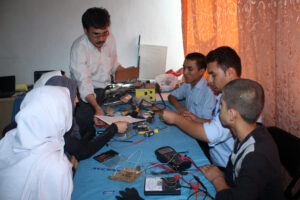
    Aziz’s situation was complicated by the fact that he is a Hazara, meaning that he is part of the Shia minority rather than the Sunni majority. In the complex world of the Middle East this created obstacles for Aziz: “The Hazara affinity is predominantly to Iran, which is a Shiite country. The Taleban war in the 1990s – a really vicious war – ran right through the Hazara area.”

    A Momentous Meeting

    The scene was set for what D’Souza describes as a ‘momentous day’. The pair of them talked all night: “Aziz had taken over one building, and put a tarpaulin over the top in April. It was still very cold, although the snows were beginning to melt. There were no windows and it was a tiny hut divided in two with a sheet.” So how was Aziz structuring the educational process? “He and his colleagues had two classes, and three shifts where they could take 12 students at a time. There was basically no space, no blackboard. But Aziz’s passion in life was to educate girls.”

    Aziz couldn’t have met anyone more likely to appreciate his project than D’Souza. “Having come from a development background, I firmly believe that the magic bullet of development is this: if you educate girls you get development,” D’Souza explains. “He started talking to me, and though his English wasn’t that good, we talked all night – about philosophy and feminism. I was very impressed with him. He had girls who were doing weaving in his rundown flat – that was the only income refugees could earn. So he had little seven-year-old girls doing carpet-weaving. Meanwhile, middle-aged women wanted to learn geometry so they could divide up their land.”

    This was education in a raw and exciting form. In its urgency and its authenticity, it wasn’t the sort of encounter you could push to one aside.
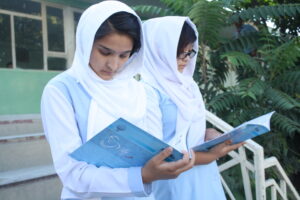
    When D’Souza returned to the UK, she leapt into action. “I thought the best thing I could do was raise money for him – because I trusted him. But I also thought that a lot of money at that time would be the kiss of death so I tried to raise small amounts and see what he did with it. I wrote to 30 friends and colleagues and said: ‘Would you be prepared to give £30 a month for six months?’ People did. Dennis was the only one who came back to me and said, ‘That’s fine, but wouldn’t you like more?’. I said: ‘No’.”

    So what did Royesh do with the money? “He selected one of the larger buildings in this bombed-out patch of land and he put a roof on, windows in – and, really importantly, he put a heater in. That meant that by the time autumn came round, and all the firewood had gone, it was the only place for miles around which had heating. And so everyone came. It was an opportunity for Aziz to explain to mothers and fathers what he was trying to do, educating the girls and persuade them that it was safe.”

    And the notion of education being unsafe was, of course, an inheritance of the Taleban. “When girls went to school they had been whipped in the street by the Taleban. They needed quite a lot of persuading,” D’Souza says.

    But Royesh, it turns out, was persuasive. “Over the years, it grew,” recalls D’Souza. “I started raising money. We had fundraising events, and Aziz set up a model school where teachers and students got training simultaneously. They also had vocational training. They taught mechanics and engineering and tailoring so that those who left at 14 or 15 could go and have jobs.”

    In spite of this, Royesh’s interest remained academic. “Aziz had had a very impoverished background with virtually no education. He’s one of these people who reveres education so he reveres those who have education.” It is a precious insight into how valuable that commodity is. And it was this passion which drove the expansion of Marefat.

    Over the years, D’Souza made repeated visits. “I went to Afghanistan with these brown paper bags. He asked me to bring English copies of Bertrand Russell’s books which I did.” Again, the detail is significant. A true passion for education is often irrationally omnivorous – we feel the doors of the world fling open and want to rush in and grab everything we can, often in no particular order.

    But always it was the girls who Aziz was prioritising. “His focus was on getting the girls into twelfth grade and then onto tertiary education,” says D’Souza. “As an example of what he managed, the school got up to nearly 4,000 students.” As astonishing as this achievement was, what really mattered was the quality of the education. “The Asian University for Women, a renowned university in Bangladesh, offered 15 scholarships every two years and girls applied from India, Bangladesh, Sri Lanka, Pakistan and Nepal. Our girls won 11 of them.”
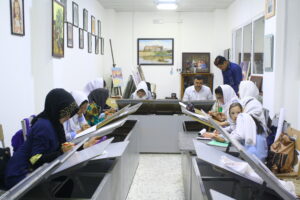
    It seemed that nothing could stop their success. Marefat had become an educational phenomenon: “We went on raising, and Aziz eventually built a whole new building, and an auditorium. To this day, I remain so proud he named that after me. The school became the St Paul’s of Kabul.”

    I am so swept up in the success of the story that for some reason – though I know what happened in 2021 – I am unprepared for D’Souza’s next sentence: “It was a thriving school, and then August 15th came.”


    Force of Nature


    Yes, August 15th – the day of the Americans’ botched withdrawal.

    Aziz was in a very difficult position. He had dedicated his life to a project which had achieved success beyond his wildest imaginings, and yet he was in undeniable danger. D’Souza outlines the severity of Aziz’s predicament: “Aziz, by virtue of the fact that he’s Hazara and educates girls, was particularly vulnerable to the Taleban and had had brushes with them before. He felt he had to get out: he had a son in California. So we got him to America.”

    I realise I need to meet Aziz. A few days later I’m on a Zoom call looking at a kindly man beaming back at me. He explains that it’s his habit to wake at four in the morning – a detail which conveys his separateness from Western rhythms, linking him to the desert somehow. It is a reminder too that you can leave Afghanistan in person but never depart it in spirit.

    Of course, Aziz’s story is like D’Souza’s but seen in reverse perspective – it is like an education version of Kurosawa’s Rashomon, where all the participants remember something different about key events.

    For instance, Royesh gives his version first meeting with D’Souza, and recalls his views on education as they were communicated to her at that time. This time around you can hear the quiet and authentic adamance which swayed Frances all those years ago: “The core of the problem in Afghanistan was this patrimonial vision that you have – of a male-dominated vision of the community. Just educating the male members of the community cannot change everything: there will be a vacuum as you’re missing the vision of half of that community – the female side.”

    Aziz also makes an interesting distinction: “I never felt the need to march on the slogans of woman rights: I just wanted to go with education, because this by itself can bring all these other developments. I think it was that which really sparked Frances’ interest.”

    Royesh also recalls Frances D’Souza entering Marefat for the first time – meaning that I get to see her through his eyes. Even at this distance Royesh is moved by the memory of D’Souza’s first entrance into the life of the school: “One of my first impressions of Frances D’Souza is that she was the first to come in. She entered that murky corridor and in the midst of that darkness, she saw these beautiful well-dressed girls that had blue, you know, shirts and they had white scarves. And they stood to greet her and suddenly she ran out and shouted: “How beautiful they are!”

    It is a moving image – these girls standing there in all their potential, suddenly confronted by the person who really will help them. Perhaps it even has a dreamlike quality.

    Royesh also remembers what it was like when D’Souza’s first money came in – and again there are some telling details: “I received a call from an Afghan friend of mine. This person said that he had come from the UK and he had some gifts for me. I went downtown, and saw that there was an envelope with Frances’ beautiful handwriting. I opened that and there was £2000 which had been raised by her ‘Evening for Marefat’ fundraiser at her home. I remember all those notes, in fives, tens, twenties and hundreds. Next year, she visited again and had brought £6500. She insisted that we should go and buy a plot as she said it would give prestige to the school, and boost its credibility.”

    With that money Aziz was able to afford a site in the desert. It wasn’t immediately promising as a location. But then an amazing thing happened: “We went there and started laying the foundations,” Royesh recalls. “We laid the cornerstone and began building the mud walls. This ignited a kind of interest among the community. Suddenly, people came and kept buying the plots around that and building their houses.”

    I also hadn’t realised until I spoke with Aziz what heights D’Souza’s fundraising eventually obtained. In 2010 alone, D’Souza raised £253,000. Aziz recalls: “She sent that money and we used it for the building, and we established a very big auditorium that later was named after Frances. When she visited the school in 2016-17 she was known to the students as ‘Auntie d’Souza’. “At the beginning, the families, the students, and especially the girls, were in love with her.”

    As it happens I have seen this auditorium in a recording of a Zoom call, which took place earlier this year. It is a large, airy space, and the children are ranged obediently in it. I see kindly teachers compering the call, while D’Souza takes notes in her study, and Aziz stands before a white wall, peering down at his creation – and also in some way at his past.

    Sat here in London, it is difficult to imagine how it would look in its architectural context. But I imagine it must soar and be visible for miles around. It ought to fill the heart of every person in that area with hope. But no doubt, it also infuriates the Taleban.


    Abroad Thoughts from Home


    So what does the astonishing story of Marefat have to tell us about education? Royesh’s methods are, in their essence, simple. This in turn opens up onto the possibility that here in the UK, we have made the simple complicated – to our own detriment. It might be, for instance, that we have prioritised pouring money into the schools system over promoting Marefat-style effective educational methods.

    Royesh tells me: “If you want transformational education, you don’t need many facilities. You just need a good way to talk to the people and to help them perceive something and customize that with their own real life. We didn’t wait for the professional faculty. We didn’t wait for the equipment – and we didn’t wait for the infrastructure. We just started.”

    And if you get that right, the effects can be catching. “For around five years or six years, we were the only private school in Afghanistan mainly with civic and girls-catered education. In 2021, there were more than 163 private schools just in these three districts of Western Kabul. Education had become a norm and communities were changed. There were hundreds of cultural centres, art centres, sports clubs. People embraced the idea, they stepped forward. The children were 95 per cent illiterate in early 2002. By 2021, 95 per cent of the population had become literate. Violence, especially violence against women had eradicated in the entire Hazara community. Street harassment was not seen in the Dashti Barchi area of western Kabul. Furthermore, not a single member of the clergy talked against democracy, human rights or girls’ education. It seemed that an entire community of seven million people had been transformed.”

    This was a mass grassroots movement without parallel. It should give heart to anyone who feels change happens too slowly. Sometimes perhaps we are lobbying for the wrong kind of change, and have forgotten to bring our activism back to first principles, as Aziz did.

    And yet, of course, we cannot avoid the tragic aspects of the story. Aziz tells me that the events of 2021 didn’t come out of the blue. In 2009, Marefat experienced the first backlash from the fanatical clergy. Pupils from Marefat had protested publicly against legislation which had violated numerous women’s rights, and their prominence as protestors led to terrifying scenes at the school. These now seem in retrospect like precursors of the still more tragic events of 2021.
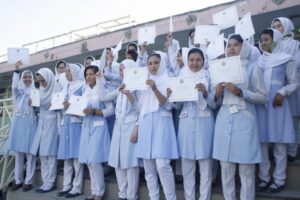
    Royesh recalls: “The clergy attacked; they sent their mob supporters. We had just sat down to class and they stormed the school. They were shouting, and raising slogans against me as a person, saying that they would execute me as an infidel. They said I was preaching Christianity, or that I was preaching secularism and liberalism. They charged the school with being a centre of espionage and prostitution.”

    The school sustained physical damage. “They broke the glass of the school, and they called for its destruction. They called for the execution of the administrators and the faculty and especially myself. That was really a harsh thing.”

    Royesh has a way with understatement. It sounds terrifying beyond contemplation – but then we inhabit cosy lives and Aziz is hardened to the sterner realities of life under the Taleban.

    But in that awful instance again, an astonishing thing happened: “We had just one gate. So the students came and they made a human chain behind it – and they closed the gate, so the mobs couldn’t enter the yard. Thousands of people gathered around the school, most of them the parents of the students who were worried about their children or those who had shown up just to watch.”

    Eventually a special force from the Ministry of Interior relieved them. Royesh continues the story: “The attack was on Wednesday. The school remained closed on Thursday. On Saturday, we reopened the school, just with the hope that if 15 per cent of the students returned it would be a victory for us. But surprisingly, more than 95 per cent of the students returned back hand-in-hand with their parents. That was really a very emotional moment for us. They came, and they showed their support for the school. They were the parents of more than 3,500 students.”

    If anybody doubts that education is a spiritual right which people will defend with their lives, then they need to hear this story.


    2021 and all that


    Sadly, even this superb victory came to have a temporary feel in 2021 when the Americans left, and things really did unravel. D’Souza takes up the story: “It was incredibly difficult for him. If you’re a Hazara and the Taleban are after you…” her voice trails off, as if unable to imagine how that must be.

    She continues: “I don’t blame Aziz for going at all. There are individuals at risk and we shouldn’t discount that. The school closed. My immediate concern then was for my daughter [the journalist Christa D’Souza] to try to evacuate the girls. They got over 200 of them out, and got a deal with the Canadian government. They then got another 207 out who have been waiting in Islamabad since October, languishing in a hostel. We’ve raised enough to get them visas through the government.”

    And Marefat today? “Dennis and I are interested to see what we can do to enable Marefat and its unique educational experience to continue. We think we can’t do that until we go. Once we’ve got most of our girls out, our priority should be to get the school going again.”

    And Aziz? He is currently writing his History of Marefat, and is vague about future plans. D’Souza has her suspicions: “It’s clear to me that Aziz has very high political ambitions, and wants to be the leader of the Hazaras – and maybe of the Afghan people as a previous Hazara man was in times past. He was also extremely close to Ashraf Ghani during the presidential elections, and even wrote Ghani’s manifesto. Ghani, though is a very curious fellow, and once he won the presidency, completely ditched Aziz, he treated him very badly.”

    A Royesh presidency? Every presidency is a long shot before it happens – but just to imagine it is to realise that hope remains.

    But what about the girls? Here D’Souza is understandably emotional: “The brightest and the best have left the country, which is a huge responsibility which we all feel. The only thing which is a mitigating factor is that it’s quite common with Afghans to return to their country, so I think a lot of them will. One thing one shouldn’t underestimate is that for 20 years we had this flawed but democratic process: a huge number of people became accustomed to it. They’re unlikely to give that up in a hurry.”

    If you want a measure of what was achieved at Marefat then you have to hear the girls themselves. Their security is paramount and so we will not be revealing any names or locations. But here are some voices, translated from the Persian by Aziz, of girls talking on a recent Zoom call. This is the authentic sound of education, but also of liberation.

    One girl says: “We study. We continue our education. Because we know that interrupting the course of education means our death and I am not ready to die now.”

    An optimist might say that a girl who has learned to talk like that can never die: it is the voice of irreversible enlightenment. Here is another: “We understand the Taliban. Most of them have not lived in the city and they are not familiar with the characteristics of urban life. I hope they understand us too. We will continue our education and I am sure that we will eventually introduce the Taliban with the urban life and culture too.”

    There is a note of defiance here which is utterly at odds with what we think we know about Afghan women – bowed down by the patriarchy, and almost without agency. It makes us realise that Royesh, D’Souza and Stevenson have created a new kind of educated woman.

    A third girl adds: “We call our resistance a ‘constructive resilience’. We not only resist, but also think about the constructive aspect of our resistance. We think that in ten years or twenty years from now, we will make our culture better and more humane, and our politics better and more democratic. This is the purpose of our education.”

    This is in fact always the purpose of education – and sometimes it takes someone who knows education’s value to tell you that. That will almost always be someone who until recently was deprived of it.

    This, then, is the story of Marefat. There isn’t another story like it, and it’s one we at Finito World will continue to follow. It tells us that education is sacred, and reminds us that it changes lives.


  • Stephen Fry on the need to relax

    Rebecca Walker

    Despite his success, one sometimes feels a little sorry for Stephen Fry: for some, he is the celebrity everybody used to love, his popularity dimmed by Twitter spats and overexposure. Yet if you take his finest achievements: the first seasons of A Bit of Fry and Laurie (1987-1995), his early books The Liar (1991), The Hippopotamus (1994) and his memoir Moab is My Washpot (1997), his brave documentary The Secret Life of The Manic Depressive (2006), as well as his lead role in Wilde (1997), and even alongside his erstwhile colleague Hugh Laurie in TV’s Jeeves and Wooster, it is a body of work remarkable in its brio and its breadth.

    It all serves to prove that few people work harder than Stephen Fry – and not just in the entertainment industry. In fact, his ubiquity amounts almost to absurdity. It sometimes seems that what we’re witnessing is the work ethic of Margaret Thatcher relocated to an apparently more leisurely sector.

    It can seem as if every awards ceremony, supporting role and quiz show on earth seems to be dominated by Fry. His outspokenness on politics, religion and other things isn’t always matched by knowledge: Peter Hitchens famously referred to him as ‘the stupid person’s idea of an intelligent man’.

    But these gaps are offset by the perception that it’s been fun along the way – and so Finito World feels no compunction about asking him about his views on how to relax and wind down. ‘Work is so much more fun than fun,’ as Noel Coward put it. It is a line which might have been Fry’s mantra.

    When we caught up at the sweaty launch of Paul Feig’s Artingstall’s gin, we asked Fry about the need to offset work with relaxation. So, does he drink these days? “Not much, but I love a good cocktail,” came the kindly reply. And what is his favourite cocktail?  “When I’m hot like I am now, I find a John Collins – gin, lemon juice, soda – really refreshing.” And are there any drinks he stays away from? “I’m not a great one for really sweet, sticky drinks. I like them to refresh you. But I do make a good negroni!”

    It’s good to see him out and about. Fry, of course, hasn’t been well having been diagnosed with prostate cancer in 2018; the disease is now thought to be in remission, and he has spoken out publicly at his good fortune at catching the disease early.

    Nevertheless, there has to come a time when everyone slows down and thinks about resting on their laurels. So will we ever see Fry host the BAFTAs again: “Oh, I don’t know. I think twelve is probably enough – it’s a good number and I’m very happy.”

    Our conversation soon turns back to drink and what role it should play in our lives. “Whisky provokes violence more than gin,” says Fry. “Gin provokes tears. If you’ve had a lot of gin you just start crying.”  Here Fry, ever the actor, performed an immense howl. “I’ve had a few friends who had a lot of whisky and it’s really unpleasant.”

    Fry is also illuminating on national differences. “I think we should learn from European Football. Whenever there was a match in Belgium there was violence afterwards, because in Belgium you drink beer and get pissed. Whenever they played in the Netherlands, there was no violence, because they were smoking, because cannabis is legal in the Netherlands, so that’s what we should learn really! We’d be better off, someone should be creating some exquisite hash brownies.”

    Fry is a global citizen though when I ask him about it, I get an interesting response. “This is a very Mayfair event, isn’t it? I feel like an out-of-towner, somehow everybody looks as though they belong here.”

    If even the famous feel perpetually out of place perhaps this give us permission to feel nervous for that first job interview.

    Even so, Fry is an emblem of what can be achieved if you set yourself to work across disciplines and refuse to heed boundaries. You get the impression that Fry knew his gifts from the start but that he has been surprised how far they have taken him.

    Does he have any anonymity in London? “If you walk fast enough and you look as if you’re in a hurry, people are very good, they leave you alone.”

    And with that he’s gone – and probably gone back to work.


  • Diary: Eddie Izzard on pronouns, working with Judi Dench and the plight of the street performer

    Diary: Eddie Izzard on pronouns, working with Judi Dench and the plight of the street performer

    It all started when I went on Sky’s Portrait Artist of the Year. They said: “What would you like? What pronouns?” So I was there, wearing a dress and makeup and I said: “Well, she/ her.” It was a bit like: ‘Would you like a cup of tea? Coffee? Latte?” It wasn’t set up in a big way. I wasn’t there saying: “Look, it’s in the contract, you’ve got to do this.” So they decided to do that – and when it came out there was quite a firestorm. In Britain and America, in two days everything had changed. Now I’m very happy I’ve been promoted to “she”: it’s a great honour. Some people are grumpy about this but I have given 35 years notice. 

    None of this formed any part of Six Minutes to Midnight, which I filmed with Judi Dench and released earlier this year. That was some time before the pronoun thing kicked off. I feel it’s a tripping hurdle for us, for anyone who’s trans. People get quite militant, maybe on my behalf and I say: “Look, everyone should calm down. People call me ‘he’, people call me ‘she’. It doesn’t really matter because I am gender fluid.” What’s more important is to ask whether my comedy’s good enough? Is my drama good enough? With my marathon running, am I raising enough money? Doing things in French and German, is that inspiring enough? 

    Judi Dench had a sweepstake on set about whether her wobbly tooth would fall out. I did the mathematics involved, but I never gamble because I know what the odds are! Judi doesn’t do ceremony – she’s just another person, chatting with the other girls. She said we treated her well, and it was a wonderful experience. 

    With the whole pronouns thing, at first I thought it might change my acting career. But I’ve just done something for a Netflix show up in Manchester, and there were no problems: some people were calling me ‘he’ on set, others ‘she’. I think if I were a hunk or something like that, it would be a problem, but because I’m hopefully a more versatile, quirky actor I have to create my own area. 

    Going forwards, I want to do as many films as I can. I want to set up my own films, as I did with Six Minutes to Midnight, and keep giving myself a good role, as Clint Eastwood did. I’ve got to pull more stories out of me and direct them as well. But if a by-election comes up that’s a good fit for me – or, failing that, the next election if I get chosen and win it. 

    London has made it very hard for street performers. I came from that – and it’s the reason I can do what I do – and play the Hollywood Bowl and Madison Square Gardens and the other big places. We set up the Street Performers Association in the mid-eighties in order to fight against the rules preventing people from performing. Sadly, organisations tend to look down on street performers. I think they see us as riff-raff but street performers have been doing it for years, way back to Punch and Judy and the time of Samuel Pepys, and beyond that.

    Westminster Council, in particular, is making it very tough. They did this thing where they said, ‘Let’s hear your views’. So we put forward our views and then they just ignored them all and carried on doing what they’re doing. 

    It’s also a question of language. Buskers tend to be musicians with a passing audience – and we’re street performers who actually get an audience, do a show and then the audience dissipates which is a slightly different thing. But really we’re all working together. If something goes slightly wrong, the council seems to be saying: “Well, everyone’s banned from playing here”. Police often end up having to marshal street performers: it’s just the wrong way of doing things. 

    What I find tricky with the Labour Party is when, as people who are like-minded and really on the same team, we all spend a lot of time arguing. It becomes very tiring because we keep going round the houses. Do I want to be prime minister? What I want to do is to get Keir Starmer to be prime minister, or help whoever is the leader of the Labour Party – and I am a good fighter. 

    Six Minutes to Midnight starring Eddie Izzard, Judi Dench, Carla Juri, James D’Arcy and Jim Broadbent is out now

    Photo credit: By Giuseppe Sollazzo – https://www.flickr.com/photos/puntofisso/17123311876/, CC BY-SA 2.0, https://commons.wikimedia.org/w/index.php?curid=40679228