Category: Interviews

  • Exclusive: Thom Yorke and Stanley Donwood on their new art show

    Christopher Jackson is impressed with the art of Thom Yorke and Stanley Donwood at Tin Man Art

    The Internet may have wrecked the opportunity for tactile nostalgia. When Radiohead’s OK Computer came out in 1997, I experienced it on CD and part of that experience was to be confronted with the physical object itself in the shape of the artwork. There was nothing quite like the album cover – allusive, weirdly beautiful – to prepare you for the album itself.

    Had the Internet not been invented I’d probably have kept my CDs and be able to find the cover. Now I have to google it. Alternatively, I can look at the new pictures of Stanley Donwood and Thom Yorke, which have been showing at a two part exhibition ‘The Crow Flies’ at Tin Man Art.

    These works have been done in collaboration and are remarkably good. The first picture which catches my eye is ‘Let Us Raise our Glasses To What We Don’t Deserve’ – which sounds perhaps unsurprisingly like a Radiohead song title. This shows what might be a sun dominating the canvas, with tendrils coming out of it. Beneath it, a green world told in oil paint seems to be mapped in some way: patterns recur as if they have been pinned down as having special significance. The effect of the oil is to create the memory of its application: it feels as though we can see its movement into place on the canvas.

    Let Us Raise Our Glasses To What We Don’t Deserve

    “That was what I found incredibly exciting. It just stays active for so long,” says Yorke in the catalogue accompanying the exhibition. He draws a lesson about the similarity between oil painting and music: “I became so conscious of the fact that the two processes are almost exactly the same.”

    The first thing you sense with these works is that a lot of thought has gone into it – that there’s some been some heavy-lifting behind the scenes. Donwood tells me: “Our aim is to make work that functions, that does what it is supposed to do, what we intend it to do. Which is, in essence, to convey meaning. Although what that meaning actually is must remain unclear. It’s necessarily quite vague, otherwise we would just write slogans on billboards and leave it at that.”

    I mention that there is a playfulness to ‘Let us Raise our Glasses…’ and Donwood agrees: “One of the influences in these works was the way that Mediaeval paintings have no sense of perspective – if something is not important, it’s small, if it’s vital and interesting, it’s huge. This idea of representation is kind of funny to us, because we’re used to perspective and photography, so to us it looks playful, but it’s just another way of looking at things. All painting is play to an extent; it’s something all children can do, and some children just don’t stop doing it.”

    These pictures therefore provoke a range of responses – and you know you’re in the presence of exciting art when it’s making you smile at the same time as it’s making you think.

    The large sun in ‘Let us Raise our Glasses’ cannot help but evoke climate change – the psychological nature of a hot day has changed these past years to become a cause for foreboding.

    Would Donwood and Yorke shy away from having these works incorporated into that conversation? “Not for a moment. It’s hard just to get up in the morning without thinking about our rapidly changing climate, and that’s putting it incredibly mildly,” says Donwood. “Everything that we rely on, not just for our amazingly comfortable way of life – clean water, electricity, somewhere to live, safety, freedom from harm – all of these things – everything, absolutely everything is at enormous risk from the breakdown of the patterns of climate that have made civilisation possible. There’s no way anything can happen without the menacing spectre of annihilation looming over us.”

    Yorke is also comfortable with these sorts of interpretations: “I’m completely incapable of creating anything without a kind of narrative.” But he adds a post-modernist twist to this, explaining how narrative is rarely linear – and more than that, that the viewer will make their own narratives independent of the artist’s intention. “I see narrative happening in different kinds of ways. You make associations because you need to make associations,” he says.

    Their art, then, is about freedom – it strikes me as an exciting moment in the history of art where the initiative is seized back from the photograph. Yet there’s a paradox here too, because by working in collaboration each has surrendered what we have come to think of as the freedom of working individually.

    I ask whether there is a competitiveness at work here, but in asking the question realise that I have underestimated the long history of working in bands which Yorke has had, and how genially Donwood has fitted in with that ethic. “Not really,” Donwood explains. “We used to take turns at a canvas until one of us ‘won’ it; which is to say that one of us would have the better way of continuing with whatever was emerging, but for these paintings we’ve worked together on the pictures at the same time, and we realised quite quickly that each of us had ingredients which we were more suited to using, techniques of painting or ways of depicting images, but this time these energies were complimenting rather than battling against each other. Neither one of us could have made these pictures alone.”

    I say that I particularly like the picture ‘Membranes’ where the main portion of the canvas is taken up with what might be intertwining rivers – or alternatively may be, as the title suggests, a landscape plucked out of the land of the very small – the universe of the cell or the subatomic particle.

    Bob Dylan once said that all his songs ultimately meant: “Good luck, I hope you make it.” In these pictures there is a gallant sense of mysteries being mapped. Donwood tells me about its genesis: “These paintings were made in two sessions; the first from some time in 2020 (I forget exactly when, but it was back in that strange lacuna which was entirely coloured by the coronavirus) until early in 2022, and the second from early 2023 until the summer of the same year,” he recalls. “The first series became a sort of collection of navigational aids, a set of maps or diagrams of somewhere that had never existed and never would. The second were, perhaps accidentally, some kind of depiction of what you might find if you followed those maps.”

    Membranes


    So how did’Membranes’ evolve? “It wasn’t planned in any way – none of these paintings were – but it became a sort of deluge, a flooded landscape, a floodscape really, a rushing tumult that was in the process of swallowing everything it could. Or at least, that’s one way of looking at it. At the same time it’s a huge sound, an immense outpouring of volume that drowns out everything else that might be heard.”

    That reminds us that music is never far from the pair’s collaboration: it is inwoven both in the context of their friendship and in their methodology. But Yorke and Donwood differ here too: “Obviously Thom is a musician and perhaps less obviously I am most definitely not. I can’t play music and I don’t begin to understand it, but I can listen to it, and I have always listened to it. It’s always affected how and what I draw and paint.”

    Yorke’s music continues to mature – in 2023, he debuted a new band in collaboration with Johnny Greenwood and Tom Skinner called The Smile. Their debut album is A Light for Attracting Attention. Do they listen to music while they paint? “The results of making art while listening to classical music are completely different to what they would be if you were listening to jazz, or heavy metal, or someone telling you a story. While we were making these pictures we listened to the music that was being made, the music that would be on the record that would be inside the sleeve that had the artwork we were making printed on it – so we heard a lot of The Smile. But it wasn’t finished music because it was being made at the same time as the pictures, so neither were finished but both were on that trajectory. We also listened to quite a lot of techno.”

    For Yorke, something of the process of The Smile has found its way into these paintings: “Because it is a three piece, things would happen extremely fast and you didn’t really know what it was until you came back. It’s very fast. It’s very fluid.”

    One example of this is the magnificent picture ‘Two Moons’, where I find myself particularly drawn to the sparks which fly out of the moons, suggesting some sort of charge or quickening energy. I ask whether Donwood and Yorke painted these works quickly to capture a rapid creativity or whether the process was more careful than it might appear.

    Donwood is enthusiastic: “This, like all of these paintings was one that revealed itself as it came into being. I didn’t know what would happen; I didn’t know there would be sparks, but right at the end of making the picture it was very obvious that it needed that explosive energy – but just enough, not too much. Any more would have ruined it. It was, counter-intuitively, a really careful and considered action, but one that had to look fast and energetic.”

    Two moons

    I suggest to Donwood and Yorke that the hardest thing about abstract art is to know when it’s finished – when you’re in a process of complete invention, there is no natural moment to finish as there is when you’re seeking to render a literal description of the world. “This is something very difficult – or more precisely, very nearly impossible – to explain,” Donwood admits. “Mostly because I don’t understand it myself; I know for sure when a picture isn’t finished, when it needs more, or when it needs change. But I frequently don’t know what that ‘more’ or ‘change’ is, so there’s necessarily a lot of experiment, much trial-and-error. Mostly error. It’s very useful not to work alone because a second opinion is fantastically helpful when you’re a bit lost.”

    This then is another instance where collaboration can free you of the bafflement which accompanies creativity. “I think it’s a question of balance in the picture – I can’t define what that balance is, but it’s probably something like the difference, when you’re out on the world, perhaps away from everything, between a view that excites your senses and a view that means nothing that doesn’t register as ‘a view’.”

    So what has been achieved here? I think it’s the transmutation of the seen world into something which answers to the complexity of our experience. Take for instance ‘Somewhere You’ll Be There’, where we find a sense of the earth’s upwards force and the volcano-like shapes themselves seem to undergo a metamorphosis into figures – ghosts even.

    Donwood explains: “The notion of inanimate objects or landscape features coming to life is something I am fascinated by. Sleeping giants below the hills, being watched by trees, your surroundings reassembling themselves while your back is turned – I love these ideas. The ghostliness of our surroundings, a kind of hauntology of everyday life… In many pictures that we’ve made there are eyes where perhaps they shouldn’t be. It’s also startling how two simple marks can give such a sense of watchfulness and of a kind of life to almost anything.”

    Somewhere You’ll Be There

    This is marvellous – and speaks to a joy in the work which we might not always feel we’re hearing on a Radiohead album. I ask the pair whether they’re happy during and after painting, or should we be thinking more in terms of struggle and surmounting obstacle? “I don’t think anyone should be thinking too much in terms of struggle or of surmounting obstacles! Life is hard enough as it is, no? But as to whether I feel happy, that’s kind of a little too far in the other direction. There’s definitely a form of satisfaction when a picture is finished, and there’s certainly a kind of joy when everything is going well. This is always tempered with the frustration, misery and sometimes acute depression and what feels like depthless melancholy when things are going awry. I guess it’s the same for all work of this type. Swings and roundabouts, hey?”

    Yes, but after all that fluctuation in experience, it seems that, if we’re lucky, the artist gets us to a worthwhile endpoint which is the picture itself. I hope these pictures will continue to attract viewers and critical attention; they certainly deserve to.


    As the Crow Flies: Part II is at Tin Man Art from 6th December to 10th December


  • Enhancing Effective Communication in the Workplace: Insights from Sophia Petrides

    Finito World sat down with Sophia Petrides to talk about how we communicate effectively in workplace settings


    FW: I am fascinated by communication and the workplace – how it works and how is sometimes misfires. What are the factors which sometimes lead to unclear communication?


    SP: Communication is the currency of connection, serving as the essential tool for building and maintaining relationships in all areas of life. It allows for the sharing of ideas, navigating problems, and building trust, all of which are crucial for success in work and personal relationships. Without effective communication, misunderstandings and conflicts become inevitable. By mastering this skill, you unlock the potential for stronger bonds and smoother interactions in everything you do.

    Factors that lead to unclear communication include:

    Cultural Differences: Varying cultural backgrounds can result in different interpretations of the same message. Tailor your message to your audience to ensure clarity.

    Language Barriers: Misunderstandings can occur if the sender and receiver do not share a common language or have different levels of proficiency.

    Assumptions and Biases: Preconceived notions can affect how messages are sent, received, and interpreted.

    Emotional Interference: Emotions like anger and frustration can cloud the clarity of communication. It’s best to respond thoughtfully and review your message to ensure the right tone.

    Complexity of the Message: Overly complex messages can be difficult to understand without proper context. State your message clearly and concisely, avoiding unnecessary technical terms.

    Poor Listening Skills: Ineffective listening can lead to misunderstandings. Confirm your understanding by restating the message in your own words.

    Environmental Factors: Distractions or physical barriers can interfere with message transmission and reception.

    When you’re mentoring, presumably the most important thing is to establish the most effective communication methods with your mentee. I imagine that must vary from one mentee to the next – can you talk a bit about how this plays out?


    When mentoring, it is crucial to establish the most effective ways of conveying information tailored to each mentee’s unique needs and learning styles. This approach requires understanding that each individual processes and retains information differently. Here are some ways to ensure effective communication in mentoring:

    1.     Assess Learning Styles: Determine whether your mentee is a visual, auditory, reading/writing, or kinesthetic learner. Visual learners benefit from diagrams and visual aids, auditory learners from discussions, reading/writing learners from written materials, and kinesthetic learners from hands-on activities.

    2.     Set Clear Goals and Expectations: Establish mutual goals and expectations at the beginning of the mentoring relationship. This clarity helps both parties stay focused and aligned on the desired outcomes. It also teaches mentees to set boundaries in their lives.

    3.     Personalize Communication: Adapt your communication style to match your mentee’s preferences. Some mentees may prefer detailed explanations, while others might benefit from concise, to-the-point information.

    4.     Active Listening: Practice active listening to understand your mentee’s concerns, questions, and feedback. This shows respect and ensures you address their specific needs.

    5.     Provide Constructive Feedback: Offer feedback that is specific, actionable, and encouraging. Focus on areas of improvement while also acknowledging strengths.

    6.     Encourage Questions and Dialogue: Create an open and psychologically safe environment where mentees feel comfortable asking questions and engaging in discussions without judgement. This interactive approach promotes better understanding and retention of information.

    7.     Use Real-Life Examples: Relate concepts to real-life situations or past experiences to make the information more relatable and easier to grasp. Storytelling keeps mentees captivated and focused and helps them see things from a different perspective.

    8.     Regular Check-Ins: Schedule regular check-ins to review progress, address any issues, and adjust the mentoring approach as needed. This ongoing support helps maintain momentum and motivation.

    9.     Empower Self-Directed Learning: Encourage mentees to take initiative and seek out additional resources. This fosters autonomous thinking, taking ownership and accountability, independence, and continuous learning.

    10.  Be Patient and Supportive: Recognise that learning is a process and be patient with your mentee’s pace. Offer support and encouragement throughout the journey.

    By taking these steps, you can effectively convey information and support your mentees in a way that aligns with their individual learning styles and needs, ultimately fostering a productive and positive mentoring relationship.


    One thing I am aware of in bad managers is verbosity, which may perhaps be allied to nerves on the part of the person doing the communicating? Similarly, is an excess of terseness to do with shyness?

    While a manager’s communication style can offer clues about their personality, it can also create challenges. A manager who relies on excessive talking might come across as nervous or lacking confidence, while one who is overly terse could be perceived as cold or dismissive. Both extremes can hinder clear communication and team morale. The key is for managers to find a balance, adapting their style to the situation and their team members.

    In addition to this we have the method of communication – the written word which might be conveyed now by email or WhatsApp; and speech which might be in person, down the phone or over Zoom? I know we have discussed these things a little in the past, but it seems that we are faced all the time with such a variety of options to communicate that we may either choose the wrong one in some fundamental way – or perhaps choose the wrong one for the occasion?

    While a multitude of communication channels can bring versatility to the workplace, it can also create a labyrinth of confusion. Employees can get bogged down by information overload from emails, instant messaging, project management tools, and video conferencing. Without clear guidelines on which channel to use for what purpose, chaos ensues, wasting time and hindering productivity. Conversations scattered across various platforms make it difficult to track discussions and ensure everyone is on the same page.

    Security concerns also surface when sensitive information is inadvertently shared on unsecured platforms. The constant barrage of notifications from different channels can further disrupt focus, making it difficult to delve into tasks requiring deep concentration. In essence, while options are valuable, clear communication strategies and intentional use of channels are essential to avoid getting lost in a maze of information.


    One thing we need to be aware of is mechanical speech – in short, it’s very difficult really to be conscious of what one is saying at any one time. For much of the time we are on autopilot – we babble. Assuming that it is undesirable, what can we do to combat it?

    Mechanical speech, where we speak on autopilot, often leads to ineffective communication and misunderstandings. To address this, practice mindfulness to stay present during conversations and pause to reflect before responding. Focus on active listening and slow down your speech to choose your words more carefully. Practice empathy by considering the listener’s perspective and prepare key points in advance for important discussions. Seek feedback from colleagues to improve, monitor your speech patterns, encourage interactive dialogue, and continually enhance your communication skills through learning. These strategies will help you communicate more intentionally and effectively.


  • Fatima Whitbread: World Champion javelin thrower on her campaign to improve the social care system for children: “We’re all in it together”


    Christopher Jackson


    I meet Fatima Whitbread at a restaurant in Westminster and immediately warm to her kindly down-to-earth manner. Whitbread is one of our best-loved athletes, having won the World Championship in the women’s javelin in 1987, and a former world record-holder in that event.

    We sit in a corner and order our food, which prompts reminiscences about Whitbread’s relationship to diet when she was a top athlete: “You are what you eat – for me, when I was a competing athlete I was constantly working three times a day training. Most of my competitors were six foot and I’m 5 foot 3 so my diet had to be right. I was on a diet of about 8,000 calories a day which is a huge amount, usually women are on 2,500-3000.”


    But Whitbread’s story isn’t an ordinary one. Her childhood is enough to make you fight back tears. She was abandoned as a child and spent her early life in care. “I was left to die,” she recalls. “A neighbour heard a baby cry and called the police. They rammed the door down and rescued the baby. I spent the next seven months in hospital with malnutrition and nappy rash – I’m pleased to say I’ve recovered from that.”


    Whitbread says this matter-of-factly and I find it hard to feel that there is residual trauma: she is serene, and I will come to learn that this has to do with the rare sense of mission she feels about fixing the social care system. “The reason it’s been my ministry is that I was made a Ward of Court by Hackney Borough Council. I spent the next 14 years of my life in children’s homes. These were institutions with large numbers, all run by matrons – and our emotional needs were not really being met.” Whitbread then gives me a heart-breaking detail: “My first five years were spent in Hertfordshire.

    I spent a lot of time in the playing room which faced the car park. I remember whenever I saw anyone come in I’d say: ‘Is that my mummy coming?’ A lot of us children felt that way. Nobody ever really sat me down to discuss things. There was nothing at Christmases – nothing to indicate there was anybody out there for me.”

    One day Whitbread’s mother did turn up, when the future World Champion was five years old, and this led to an unspeakable set of events. “That morning I sat in the foyer. There was an opaque glass window and the matron opened the door and a large lady with curly hair came in –  but she never looked across to me or made eye contact. Then there was a lady with mousy hair, duffel coat on, smiling and engaging and I thought: ‘That must be my mummy’.”

    But of course, her mother was the lady with the curly hair: “In all the journey down to the next home in Hertfordshire, I sat in the car and nobody spoke to me. The biological mother never spoke to me. We got to the next home, a small residential place, and I was told to go through to the garden. There was a little girl of four there, and I started playing with her. I was about to go down a slide, and then I felt a hand on me: “You look after your sister otherwise I will cut your throat.’ Those were the first words my biological mother said to me.”


    what happened to fatima whitbread

    Another appalling episode occurred when Whitbread, aged nine, was taken out of the home and raped “at knifepoint” by her mother’s then boyfriend. There seems to be no other word for this than evil. But incredibly, the story has a happy ending. “Sport was my saviour. I was at a netball match and I saw a javelin on the floor and it seemed interesting to me. Then a voice behind me said: ‘I see you looking at that javelin. Would you like me to teach you to throw it?’ This would turn out to be her surrogate mother. “Through that I discovered the love of the Whitbreads,” she recalls.

    All this amounts to a damning indictment of the social care system as it was in the 1970s, but more worrying than that is that it isn’t necessarily leagues better today. In fact, it seems an issue which governments don’t want to go near. “In many respects it’s the same. I’ve seen governments come and go, and the care system really is broken. It’s not serving the children well.”

    To say that Whitbread is a passionate campaigner is to riot in understatement: throughout our conversation I can sense the intensity with which she used to throw a javelin has been transferred to this admirable mission. She is also, of course, a loving advocate as she knows exactly what she’s talking about – precisely what it feels not to have your needs met as a child. Knowing the terror these children are experiencing, she knows the dimensions of love required to fill these gaps. “I’m a great believer that children are our future, and that what they become will define what our society will become.”

    So what’s the goal of Fatima’s campaign? “I want to build happy lives, better communities, and a better society, and the only way we can do this is with collaborations,” she tells me. “I’ve confirmed a two day summit next year for the 23rd and 24th April at the Guildhall in London. We’re non-political but we do need cross-party support. We want to harness the power of one voice and bring the four nations together. There’s a lot of good work on the ground level but there’s no collaboration.”

    The summit will include young people (‘they’re at the forefront of everything’), as well as decision-makers, charities and donors. What Whitbread is aiming at is nothing less than “the rejuvenation of the system” through strategic partnerships. “I want to bring the private sector in too,” she says with her bright, kindly eyes flashing.

    “We’re looking at employability initiatives for our young people who are between 18 and 25 year olds to help upskill our young people. 27 per cent of our young people suffer from mental health problems too – and affordable housing is another issue which we need to tackle. The people in the system don’t have Mums, Dads, aunts and uncles to advise them and, appallingly, the government wipes its hands of it. In addition to all this, when they leave the system, 33 per cent of them in their first two years end up homeless.”

    But the forces of darkness likely haven’t reckoned on the astonishing energy of Whitbread. “It’s down to me to use my lived experience and Olympic platform to meet people, to get through doors, and get the campaign together.”


    what happened to fatima whitbread

    Fatima’s UK campaign is seeking private funding in order to roll out an ambitious scheme across the country. For only £20 a week – which translates to £1000 a year – individuals or companies can sponsor a child in care to take part in weekly activities around technology, sport or art – according to what the individual’s interests are. “I want to make sure every child has the chance I had to become an Olympic champion.

    I want to put them on a human path to reaching their potential and their goals.  Every child has a right to a safe and happy childhood, but if they do end up in the care system, they need to have a safe, secure pathway to come out of that system, to be educated properly, and to feel secure that there’s a proper foundation for the future. In that way, they can break that cycle and live a proper independent life so that history won’t repeat itself when they have a family. I believe we can manage that: it’s not impossible – in fact it’s very doable.”

    Others agree and have pledged their support – especially those in the new Starmer administration. “We have a charity dinner on the first night where Lord John Bird, the founder of The Big Issue will speak. Sir Keir Starmer has pledged his support as have members of his government such as has Yvette Cooper. The Timpson family do a lot of work in prisons and they are also on board.”

    what happened to fatima whitbread

    Prisons are very important to the campaign. “I do a lot prison visits,” Whitbread says. “I want to engage with young people so they have something to go to. That’s half the problem for young people when they come out: there’s nothing to come to. Then they realise they’ve got a warm cell, food and friends inside and it’s a wasted opportunity for life. We have these collaborators but who don’t talk to each other, which is a shame. We’re all in it together.”

    Whitbread is one of those rare people who has found a second act in life – and she is pursuing it with the same passion that she did the first. There is a possibility that if we heed her call, we can all hand on a better life to the children of the future.


    To learn more go to: fatimascampaign.com


  • An interview with incredible artist Diana Taylor: “Young artists shouldn’t get caught up in trends”


    Diana Taylor graduated with an M.F.A Painting from the Slade School of Fine Art in 2010. She studied B.A (Hons) Fine Art at Bath Spa University College and graduated in 1999. In 2011 she was awarded the Abbey Scholarship in Painting at the British School at Rome. Residencies in 2011 and 2012 include Centre of Contemporary Arts, Andratx, Mallorca and East London Printmakers. A sense of journey, both physically and through memory, and the relation this has with mass-produced images, which travel our own consciousness, are central to her practice. We caught up with her at her new exhibition ‘Borrowed Time’. at Bobinska Brownlee New River


    I really love the new stuff. How did these paintings come about?


    The new paintings began with Gustav Dore’s illustrations of Dante’s Divine Comedy. The illustrations were made in the 19th century as woodblock prints and the Divine Comedy was written in the 14th century. The book I chose the images from was published in the 1970s and my manipulations from analogue to digital were made this year so there’s oscillation between temporalities within my work. I selected small areas of several illustrations and manipulated them within Photoshop by cropping, enlarging and lowering the resolution.

    I also turned the document into bit map format to screen-print them. I always enlarge the images in screen-printing too so the image is reduced in quality even further. So, what was a woodblock print has gone through a digital process into a mechanical method of screen-printing and that’s how the paintings usually begin. There are varying levels of detail and zooming in for those images.


    So there’s a digital element and then you set to work as a painter?


    I then began painting imagery from my various illustrated books of plants and botanical illustrations some of which were important to Morris’s archive- a 16th-century Gerard’s Herbal. From my PhD research on William Morris I’ve become increasingly interested in the botanical illustrations that he was using, but I also have a real love for early print and that’s why I refer to it often within my work. My love of gardening and my interest in plants as therapeutic and medicinal has steered these new works.

    However, there’s also a more serious concern with climate change, and the idea of plants growing and becoming threatened, or in decline, started mirroring my painting process which is one of building up and breaking down the image. These new paintings in my solo show at Bobinska Brownlee gallery, ‘Borrowed Time’, therefore, are about the things that I am thinking about, looking at and doing in my everyday life- which is what my paintings are generally about anyway. The title refers to concerns in a climate crisis and also to my method of appropriation- borrowing images which already exist, to create new works.


    Has your method of composition been relatively fixed and stable over your career, or is that evolving?


    My method of composition tends to change however over the past 10 years I’d say I’ve been very much focused on using a portrait format and working on a similar size and often it’s because I want to have some kind of composition which involves cascading, a kind of cascade down the painting and alludes to the idea something falling and things falling apart. The composition is not fixed. However, I always use fragments within my work and I’m interested in the composition as appearing unfinished.

    There’s something about the tension between something that’s finished and unfinished, that interests me, so the work oscillates between many dichotomies such as fast and slow painting, graphic and gesture, old and new references, art and craft et cetera yet these binaries are always symbiotic which is why I’ve converged them because they need to be together.


    Was it always art for you? Did you ever consider some other path in life?


    Yes, it was always painting for me. My granny was a painter and I always loved drawing and painting there was never any question that I wanted to do something else, although at one stage I wanted to be an air hostess just because I love travelling so much. But I realised I could travel and do my painting and I could be an artist, and make money from selling my work and teaching, which is something I also enjoy.


    Did you have any mentor in art?


    I had several brilliant art teachers throughout my education who have inspired me and taught me so much.  I think that’s why I love teaching so much because I want to be able to give back what I also experienced in my educational journey.


    Who are your heroes in art history who have helped you on your journey?


    I think my heroes in art history include Bernini whose work blew me away in Rome. But, in modern history, I love Sigma Polke, Robert Rauschenberg, Lee Krasner, Eduardo Paolozzi, and many others. Contemporary painters I love are Amy Sillman, (I love her writing too), as well as Michael Williams, Charlene Von Heyl, Christopher Wool amongst a load of others.


    What are your tips for young artists about the business side?


    I’d say for young artists it’s just important to stay focused on being true to yourself and not getting caught up in any trends. You kind of have to be thick-skinned and resilient as an artist and to stay resolute. I find a strong daily meditation practice has helped me to stay resilient and grounded as it can be so difficult to persevere when it seems at times like not much is happening in your career.


    Galleries seem to take large percentages from artists – is that something you think will change over time?


    I don’t think the 50% commission is likely to change although I’ve no idea really on this aspect of the art world- as long as the Gallery can continue to put on ambitious exhibitions and bring their collectors to the shows then it’s a really good way for an artist to get exposure.


    What’s your experience of art fairs?

    As a visitor to art fairs, I find them quite overwhelming as there’s so much work to see but I do visit some of the bigger fairs such as Frieze so they’re understandably overwhelming but it’s a good way to get an idea of what’s going on globally in the art world. That said it’s an odd way of looking at art because you’re hardly even giving the work any time at all. It’s just a glance and then moving on to the next thing.

    Has the conversation around NFTs affected you at all, or do you think that was just a fad?


    I’m not that interested in NFTs. Although I think they could be good for some artists I have zero interest in turning my work into an NFT. I think something is lost in the reproduction of a painting or work that has a haptic quality like my textiles- it’s the aura that Walter Benjamin spoke of, so an NFT for me is kind of dead and it kills the work of the hand. However, I’m sure there’s some really interesting work out there that I haven’t seen so we’ll see how far it goes.


    Borrowed Time ran from 18th April-5th June at Bobinska Brownlee New River. For more information go to: www.dianataylor.co.uk

  • Exclusive interview with Defence Secretary Grant Shapps: ‘Putin absolutely must not win’


    Christopher Jackson interviews one of the most interesting and talented figures in modern politics about Russia-Ukraine, defence spending, and his own career


    Grant Shapps is only 20 minutes late for my interview with him, but is nevertheless apologetic when he comes online. I tell him that, given the range of threats in the world today, I don’t mind at all being kept waiting by the Defence Secretary. He laughs: “At least you know we’re on it.”

    Throughout our interview, the 55-year-old seems boyish and cheerful. Although one hears a lot about how tired this government is meant to be, my experience tends to be somewhat the opposite: in general, we are presided over now by highly experienced Cabinet ministers who enjoy the jobs they’re in, and who have learned to wear power lightly. They are also determined to use this moment to solve the problems the country is facing.

    In the case of Shapps, who has held numerous roles at the top of government, in addition to serving as the MP for Welwyn Hatfield since 2005, the impression is of someone with seasoned nous who knows how to run things.

    Shapps begins by telling me about his day: “It’s been busy. It started with the Yemeni Prime Minister which is always going to be an interesting conversation. ‘So about your country which we’re bombing?’ And later today I have my New Zealand counterpart coming – so it’s another day at the MoD.”

    The Secretary of State is talking to me on the back of a major victory, having last month secured a 2.5 per cent increase for his department from the Treasury – a decision arrived somewhat against the Treasury’s inclinations. The story, as told by departed minister James Heappey, is that Jeremy Hunt initially offered Shapps’ department the same 2.5 per cent increase but that the money would be spread over the course of two parliaments. For Shapps, who understood the urgency of the need, this was unacceptable and he made it clear that he would rather have nothing than accept such an offer. It was a calculated high stakes gamble, and it paid off.

    As a result of this win, Shapps is now in a position to deliver a boost to the economy. The day before I talk with him, he has announced the building of six new amphibious warships in a widely covered speech at the Annual Sea Power conference.


    But this, it will turn out, is just the tip of the iceberg. I ask him if the budget increases represent a chance for small businesses to step up? “Massively so,” he replies. “There are 400,000 people involved in the defence sector, in a range of areas from manufacturing to science. Obviously, you’ve got the so-called primes – the BAEs of this world – but actually there’s an enormous supply chain under that and there’s now more opportunities than ever for SMEs to get involved. That’s partly because a lot of what we need now are not the big things like ships – although we do need those, as you saw yesterday. But we also need clever tech – drones, and all the best kit. The two biggest drone companies were start-ups, although I think a couple have been snapped up by the big boys now.”

    Meanwhile, as the UK makes these internal deliberations, conflict seems to be a more or less constant aspect of life on this planet. The Russia-Ukraine situation continues to drag on with all the appearance of a miserable stalemate. At the same time, the situation in Gaza continues to feel intractable as it has done throughout most of our lifetimes. If that weren’t enough, many predict that the next theatre of conflict will be in the South China Sea and involve China making a claim on Taiwan.

    Shapps has naturally visited all these zones of actual and potential conflict. I ask him what might surprise us if we were to, say, visit Ukraine and see for ourselves. He gives a thoughtful answer. “Last night, I saw the reporting of Jonathan Beale who is the BBC’s Defence Editor. He was wearing a bright jacket next to burned out buildings. He was touring a part of northern Kharkiv. As you look at the ruins on his report, it would be very easy to get the impression that that’s what Ukraine is like.” So it’s different? “In truth, I’ll go to Kiev and it’s a coffee society. You could be in Prague or Paris for the most part, although the scene is regularly dispersed by air raids – but even then, people usually go to the air-raid shelters in not too much of a panic.”


    Image of the Secretary of State for Defence Grant Shapps, seen here visiting a Kibbutz with members of the Israeli Defence Force, which was attacked on October 7th by Hamas.


    Shapps is anxious not to minimise the overall situation, especially in the East of the country. “Obviously, if you go to Odessa near the Crimea, that’s a different story,” he continues. “When I was last there, I had to call off a visit to Odessa. I discovered that President Zelensky had been 300 metres or so from a Russian missile attack, though I think that was by chance. At the same time, I received notice from Defence Intelligence that the Russians knew I was travelling to Odessa and it seemed an unnecessary risk to take. So clearly there are parts of the country you wouldn’t go to. But there are vast parts of this huge country where you wouldn’t see anything unusual at all, and which have had no physical effects arising out of the invasion.”

    This feels an important perspective, and makes one hope that one day the reconstruction of Ukraine won’t be such a daunting project as we sometimes imagine it might be. I also rather like this image of people having coffee in Kiev. Does this make us understand what we might be fighting for? Shapps goes further: “In a sense coffee culture is what we’re fighting for – it’s a way of life. Free peoples in democracies must decide their own futures and not be driven over by terrorists in the case of Palestine – or autocrats in the case of Ukraine.”

    Nevertheless, the battlefield in Ukraine continues to feel frustrating. Brooks Newmark, a former MP and minister, who has been heavily involved in helping refugees in war-torn eastern Ukraine, tells me about the crucial tactical nature of the Kerch Bridge. This has been damaged at intervals during the war but so far always rebuilt by the Russians. But if we were to destroy it, Newmark tells me, we would strike a severe blow since it is Russia’s link to its supply lines. Under circumstances where it was damaged beyond repair, then Putin would be brought to the negotiating table.

    So why haven’t we done that, one wonders? Newmark tells me that there are two missiles which can destroy the bridge: the German Taurus and the MGM-140 ATACMS-38. Our own Storm Shadows are unfortunately not quite so powerful and able to damage the bridge. When I put this to Shapps, he says: “In actual fact, the Taurus is exactly the same as the Storm Shadows, which have been devastating in the Crimea, and we allowed them to be used. The Germans sometimes talk up the Taurus but it has the same potential to cause damage as the Storm Shadows.” So how can we destroy the bridge? “I can’t really go into too much detail for obvious security reasons but the Kerch is a well-protected bridge – in fact, I can confidently say it’s the best protected bridge in the whole world. It’s not quite as simple as it sounds. Obviously Ukraine will be looking at the supply lines into their occupied country all the time, and how they can disrupt them.”

    Newmark is not alone in wondering whether it is time to lay the ghost of Iraq aside and put boots on the ground. Is that something the government would ever consider? Shapps is firm. “Putin absolutely must not win. But we must be crystal clear: we’re not considering putting boots on the ground as that would put NATO at war with Russia which would seem to me to be not a smart move.” He adds, clearly moved by the courage of our ally: “That’s the amazing thing about our brave Ukrainian friends and allies: they’re prepared to do the hard part which is to do the fighting. We need, consistently and reliably, to do whatever Ukraine needs to win this war.”


    Image of the Defence Secretary Grant Shapps, seen here at the Yokosuka Naval Base in Japan today (14/12/2023).
    The UK has signed an international Treaty with Japan and Italy for a future combat air programme that aims to develop an innovative stealth fighter with supersonic capability and equipped with cutting-edge technology.


    Despite this, I can sense that the vacillations by the American Congress who caused significant delays in weapons delivery this year, have been a major frustration, with the war having gone more Putin’s way this year than many would have liked. “Last time I was in Kiev, I was warning that the world has been caught napping: this was two or three months ago during the hiatus over sending weapons,” Shapps recalls. “I saw it as being a real problem. I warned them that we’re sleepwalking into something much worse.” And sadly, much of what Shapps feared has come to pass. “Unfortunately that delay has enabled attacks on Kharkiv which wouldn’t have happened if the package had come sooner. The situation is stretching the Ukrainians but ultimately I’m confident Russia won’t get into Kharkiv in the short run. But it’s an unnecessary distraction and we can’t allow anything like that to happen again. It’s unthinkable for me to have Moscow decide the boundaries and borders of modern European democratic nations.”

    Shapps is also firm on the role which Ukraine’s near neighbours have to play. He continues: “But we don’t want Washington to dictate those borders and boundaries either. We want European countries to step up to the plate, and I think the UK has done this. In terms of our own financing package, we’ve gone from £2.3 billion to £2.5 billion to £3 billion. So we’ve been consistent in our approach while also providing increasing funds.”

    I ask Shapps a question from the philanthropist and businessman Mohamed Amersi, who wonders how prepared the country is for a potential new theatre of conflict over the China-Taiwan issue. Shapps is keen to link the outcome of the Russia-Ukraine conflict with whatever might be simmering in the Far East: “The best way to prevent an autocrat thinking it’s okay to take over some land that’s not theirs is to make sure Putin doesn’t do exactly that in Europe.” But he also has another point to make: “We have hugely invested in the Indo-Pacific region to make sure we can maintain the world order. For example, until recently we didn’t have AUKUS, which sees the UK, the US and Australia working together to provide nuclear-powered submarines. We also have the Global Combat Air Programme, a joint initiative between Britain, Italy and Japan to develop jointly a sixth generation stealth jet fighter. Thirdly, we have a permanent presence in the Indo-Pacific, both in terms of ships constantly in the area, and the Carrier Strike Group is going back next year. Our purpose in being active in the region is to make it clear that freedom of navigation is non-negotiable and that countries shouldn’t be invading non-democratic countries.”

    Carl Hunter, the Chairman of Coltraco Ultrasonics, has observed that the UK’s strategic nuclear deterrent in CASD and its strategic conventional deterrent in UK Carrier & Littoral Strike both depend on SSN submarines, the fleet size of which has been largely configured for the Euro Atlantic. I ask Shapps when the submarine force will be expanded to cater for its equal Euro Atlantic and Indo Pacific commitments and the probability of a maritime war in the South China Sea? Shapps responds: “We don’t comment on our operations there – but I can say that we do operate our subs all around the world. The good news regarding this is that as a result of the announcement of new ships yesterday, we’re increasing that number. But when it comes to our SSN submarines or our Ballistic Missile Submarines (SSBNs), we don’t advertise their locations.”

    Turning to the state of the armed forces, I mention to Shapps that recent reports have highlighted that 54 per cent of potential recruits abandoned the Army recruitment process last year. Given the shrinking size of the armed forces by over 7,000 personnel in the last year, what immediate steps is the Ministry taking to improve recruitment and retention during this period of global uncertainty? Shapps is sympathetic to the question: “Recruitment certainly has been a big problem, and applicants have been far too slow to get through the system. However, for that reason, we’re currently working through the 67 recommendations put forward by the Haythornthwaite Review of Armed Forces Incentivisation. Yesterday, when I was talking about the Navy, I was able to announce that we have the fullest training facilities for eight years. More and more people are coming into the programme. We’ll get that turned around.”

    Part of the poor retention figures may be to do with poor accommodation. In particular, a concerning report from King’s College London recently exposed the substandard conditions of UK armed forces’ accommodation. With many families living in substandard conditions, I ask Shapps what specific initiatives are planned to upgrade urgently these facilities, and how will these improvements be prioritised in the defence budget? “On the accommodation, I completely agree. This 2.5 per cent that I’ve won is enabling us to do lots of things including the £4 billion into our accommodation to make it lot better.”

    These worries also come against a backdrop of worries around pay in the forces, where some argue that pay rises fail to address satisfactorily the scale of current inflation. Again, Shapps is sympathetic but also keen to highlight how much progress has been made: “Inflation has obviously been high, but last year we had the biggest pay rise of anyone in the public service. The lowest paid are getting another 9.7 per cent which is an increase very much designed to recognise that problem. I also think that this is helping to attract more people so we’ve got 10 year highs in terms of our applications for military services.”


    Image of the Secretary of State for Defence, The Rt Hon Grant Shapps MP, seen here meeting recruits at Catterick Garrison, North Yorkshire.


    Stephen Morgan, an ex-serviceman himself, asks about a recent article in The Guardian referring to the UK’s ‘very limited air defence systems’. He asks whether, in an era of complex and emerging global threats, the Ministry is addressing these critical gaps in our national defence capabilities to ensure readiness against potential aerial threats? Shapps replies: “We have more in that respect than people often realise. For instance, we have Rapid Response Defence Systems. We have some missiles from land, and some missiles from our Type-45 destroyers at sea. We also have other measures in place which I can’t go into because they’re secret. But we’re also in NATO so that we have 31 other countries coming to our defence in the event of an attack which is something that countries like Israel don’t enjoy and that makes a huge difference. That said, I’m working with our European partners on a sky shield approach as well so there’s a lot happening across the board on this.”

    That makes me feel safe enough to make the last section of the interview not about the nation’s defence but about him. How is it that he’s managed to hold so many different high-level roles across government? “In my case, I came to Defence via Transport, the Home Office, Business, and Energy so it wasn’t that straightforward,” he laughs, referring to the turbulent transition of power from Boris Johnson via Liz Truss to Rishi Sunak. “But the process of running big things tends to be the same: government departments are all similar. You have a civil service, a permanent secretary and a private office – and then you have mechanisms to get the work through.”

    On a day-to-day level, a Secretary of State is confronted with a huge flow of data and Shapps explains that a successful minister will need to learn how to sift that. “The big question when you come into a department is: ‘How do you get your head around everything and understand the subject in the first place?’ Well, I’m not entirely new to any area of public policy, as I’ve been thinking about politics for a long time, so there is that. But I will confess that it is a hell of a lot of reading. I’ve got better over the years, and I learned to speed-read early in my career.”

    Everything comes down to time management, Shapps explains: “It’s twice as fast to write and read something as to have people tell you it: people speak slower than you can read, and if they write it down they have to think through what they put in.” He attributes his approach to government to his background. “I think some of this – completely counterintuitively – is because I don’t have a degree or even an A-Level to my name, so I slightly self-educated myself in terms of doing things. I hope that makes me less given to groupthink than some other politicians. If you want to stand out in politics or in any other area of life, you have to have a unique approach, and be able to come to conclusions on your own.”

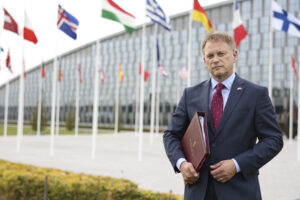
    The Defence Secretary Grant Shapps attends the NATO Ministers of Defence meeting at NATO Headquarters in Brussels.


    Given the murders of Jo Cox and Sir David Amess, I mention that many would-be politicians might worry about the safety of becoming an MP. I ask Shapps if it’s a career path he’d recommend to young people? “Well, it’s very sad that we’re talking on the day when the Slovakian prime minister Robert Fico has been shot. We have had killings of MPs, which have been rare but which are nonetheless concerning. In the role of Defence Secretary you have a different level of protection all the time, but I wouldn’t let it put people off. For the most part, we live in a country where guns aren’t as big a thing as they would be in the US, and so the risks are more moderated. Threats seem to come online by social media and I deal with it largely by not reading it. Do have someone reading it, as these things do need to be reported, but it doesn’t need to be you.”

    With that he has to go and vote, and I have a moment to reflect that Shapps is an extremely impressive minister, whose story ought to inspire many young people to follow him into politics.

  • Stephen McPartland MP: “The UK can become the global superpower for cybersecurity”

    Christopher Jackson

    I meet the likeable MP Stephen McPartland at the House of Commons and immediately warm to his cheerful, optimistic nature. McPartland is one of those MPs who quietly and behind the scenes make the political weather without the general public being aware of it. The 47-year-old is leaving Parliament at the next election, and if I had to select somebody who embodies what will be lost after the next election when so many experienced members will be retiring, I would choose him. Whatever one’s politics, there will be an awful lot less experience of the kind the current MP for Stevenage in Parliament this time next year.

    But before he does leave Westminster, the government has given him an important job to do – a sort of last hurrah. McPartland is leading the independent review into cybersecurity and economic growth.

    The review was announced by the deputy Prime Minister Oliver Dowden in Lancaster House, that impressive venue modelled on the Palace of Versailles. It was an opportunity for the government to announce the Pall Mall Initiative whereby Britain, France and 35 other countries have agreed to increase efforts to stop hackers from targeting companies.

    McPartland recalls the seriousness of the mood: “It was announced as quite a big deal. The idea behind it is that cybersecurity is an incredibly important product which the UK has to offer.  We are seen as one of the world leaders and the government’s ambition is for us to become the cybersecurity superpower around the world so that UK technology and investments are seen as amongst the best.”

    And so what is McPartland’s role in this? “I have been charged with doing an independent report into how we can change the narrative around cybersecurity so that it is seen as an enabler of economic growth as opposed to just purely a defensive measure.” McPartland is keen to emphasise the momentum which the industry has, explaining that in the last seven years the sector has grown from £5 to £10 billion, and currently employs almost 60,000 people in the UK. He says that the industry can grow exponentially to £40 billion over the next seven years: if such growth were achieved, it could create 120,000 jobs.

    McPartland is keen to outline the scale of the opportunities. If we make progress in this area, cybersecurity could become a keystone of our future economy. “We have a greatly skilled workforce,” he tells me. “A lot of our children leaving school and going onto apprenticeships or to university all have technology skills. They have grown up with technology; they understand the importance of security. The younger generation don’t know anything other than technology. So we have a huge advantage there.”

    So how can we win the future? McPartland is optimistic on this point too.  “When you look around the world at our insurance, financial and legal systems, we are really respected and it’s a similar situation when it comes to cybersecurity, whether you think of GCHQ or the National Cybersecurity Centre. In addition to that, British intelligence is seen as very high quality.”

    But in order to realise these opportunities, we also need to rethink the way we view cybersecurity. McPartland explains: “At the moment, cybersecurity is seen as something IT people do – it’s seen as reactive. But what I’ve been thinking about is the question of how you make cybersecurity an enabler of economic growth.”

    To do this McPartland is looking at a range of areas. “One is the question of how you digitise your company faster. In particular, what are the barriers to digitising your company? These could be to do with regulation,” McPartland explains, “or perhaps it might be that there’s some problem in the supply chain.”

    Another area the review will look at is exportability. “We’re looking at the question of how we can ensure that the UK is seen as a technology superpower for cybersecurity. It might be that we could provide some kind of internationally recognised standard – almost like a digital City of London so that it is globally recognised that we are the safest country in the world to do business with, and with the safest products.”

    That leads McPartland into a third area which his review is looking at. “That’s about closing the skills gap and making sure we can work with the education system and employers to make sure that we have the skills we need. We’re also – and this is the fourth area – looking at the question of competitive advantage. Put simply, if you have got the safest product, you can use cybersecurity as a strategic advantage and it will also help you sell your product. That’s because the person buying your product is not only going to be backed up by great insurance, finance and legal skills but it’s also going to be the safest product.”

    I’m interested to delve deeper into the employability issues and ask what kind of changes this deepening understanding of cybersecurity might bring? “There are big changes going on around the world at the moment. Looking at recent legislative trends in Europe and the US, you can actually see that there are going to be some changes at the very top of organisations which are then going to require a whole series of roles from the top down all the way to entry level. Essentially, cybersecurity is going to be very much like health and safety: it is going to be something that is integral to a company’s future. Some of those roles haven’t even been developed yet: this is one of those exciting fields where the solutions are moving at such a pace that it changes what happens behind it.”

    How does all this fit in with the buzz around the AI sector? “I know there are a lot of young people who may be very interested in AI but you can’t really have an AI strategy without a cybersecurity strategy. However AI operates, you need to know that AI is secure and then you need to ensure that if somebody is going to use AI in a negative way that your products are then secure from that kind of use of AI. So the very essence of AI is going to create more need for in-depth and innovative cybersecurity.”

    Much of what McPartland describes seems to open up onto the need to reskill the existing workforce in order to make cybersecurity an effective priority. When I ask him about this, he says: “There are already companies that are providing advice to boards on the type of questions they need to be asking around cybersecurity. A lot of those boards are very comfortable asking questions of auditors around finances and what they need to know – but they are not really sure what questions to ask around cybersecurity.”

    I ask how the situation is for small businesses versus large FTSE 100 companies. McPartland explains: “As part of the review we are doing a call for evidence. Net Zero did 50 odd round tables over a year, and we did 26 of them in eight weeks. These range across the whole of the economic sector in the UK so we have everything from insurance to sports and entertainment. The idea is to get businesses of all different sizes to try and understand what the government can do to help. This is an independent report so although it has been commissioned by government, I can go off and talk to who I need to and then develop the recommendations and then government can respond to them. This is not something the government is telling industry: we are out there asking.”

    And what will all this mean for the apprenticeships agenda? “There is a huge opportunity for apprenticeships. I have been a Member of Parliament for 14 years, and the number of apprenticeships in my constituency is massive. In any growth industry there is always huge opportunity for apprentices but the trick is to ensure you channel that growth so that those companies can then go off and hire those apprentices.”

    All of this is very exciting and you can feel that McPartland’s is a boyish energy unlikely to be checked by the small matter of not being an MP anymore. As we walk off the Terrace at the House of Commons, I tell him he’s too young to retire – and he laughs it off, evidently happy to be in Parliament now, but knowing that for a man of his talents there will be much to do outside Westminster when that time comes. Meanwhile, once McPartland has handed in his report, the government is expected to respond to it in June. We’ll report back on its reception.


  • Meet the Mentor: presentation coach Merrill Powell

    Finito World meets Merrill Powell, who does important work, using her television background to prepare candidates for interview. 


    You’ve had a long and varied career in television. Can you talk a bit about your career, and how you use that experience to help mentees today?


    All the skills I learned in television can be passed onto Finito candidates and, believe it or not, they are absolutely relevant for whatever job a candidate is applying for. The prime one is to be able to make points succinctly so that you say what you want to say, clearly – and, above all, concisely. A couple of minutes of TV time is a long time for the viewer, but not for the speaker! The skill is to hold the attention of the listener and to make the points you need to make in a short time.

    Another important point to understand is that you will never have enough time to say all you want to say, so you must learn to prioritise the important points. It’s a discipline that is particularly useful with so much in the business world happening on Zoom. I should also say that at Finito we work as part of a team, therefore if a candidate needs extra help in a particular area, another mentor will let me know so that I can focus on the weakest areas. That gives comprehensive training and practice. All of which allows the candidates to grow in confidence and self-belief. The most watchable people on television are those who are so experienced that they look relaxed, it isn’t an easy job but they make it look easy. It’s the same with an interview. The better prepared, the greater the chance of not letting nerves overtake you.


    Presentation seems to be partly down to how we dress, and partly to do with our speech and manner. What factors are you especially looking at when a candidate first comes to you for mentorship and advice?

    Zooms can be unforgiving, and people can become very slack about how they present themselves often being at home.   I notice if someone is slouching, chin cupped in hand, too relaxed, or sloppy. All negatives. When I am mentoring I prepare for the Zoom as I hope a candidate will. I look smart, notes ready, background prep done,  proper chair and I sit up. In other words I am ready for business.  One candidate seemed barely awake so I asked if she was alright. “Oh yes, sorry,” came the reply, ‘but I had a glass of wine before we started.”Not a Finito candidate I should say, but it shows how not to treat a Zoom. You can give yourself an edge by making sure you look groomed, are alert and ready to take the meeting/interview very seriously.

    I am very straightforward – and strict – when I’m mentoring. If a candidate has annoying habits such as constantly playing with their hair, chewing a pencil or letting their eyes wander everywhere I say so, because those irritants are highlighted on Zoom. I must say so as it’s part of the preparation, which is to showcase the best of yourself and it often needs a third party to spot improvements which need to be made.

    You have one chance to get it right, so be prepared. I’m there to help you get it right, to showcase your talents, make sure you are on top of the job description and are able to articulate why you are the right person for the position.

    What are the most common mistakes which prospective candidates make when it comes to presenting themselves at interview?

    The most common mistake anyone makes during any kind of interview or presentation is to speak too quickly. Speaking slowly and clearly is essential and very few manage it without training. The brain often works faster than the mouth so the result is a waterfall of words rushing out as speech struggles to keep pace with thought.

    Clarity of communication is essential, particularly in a remote interview.  Most personal touches are absent – handshake, eye contact, body language, natural energy. These are important nuances that create a sense of the person you are speaking to in a physical meeting. Therefore, other ways need to be found to create an authentic and complete portrait of the candidate – that is through words and the skilful use of articulating experiences, ambitions, and understanding.


    Obviously preparation is very important, but how can candidates protect themselves from being overprepared and too robotic during an important interview?

    Preparation is essential. I never worry that someone will be over-prepared. That’s because preparation is necessary to best showcase personal talents, experience and ability in a concise, cogent way. The one way to ensure that the candidate is never robotic is to ban written notes. Reading out prepared answers is a disaster. Bullet point reminders can be useful but each answer should be straight from the head and heart, not learned, which means they are slightly different each time therefore authentic. It’s all about building confidence.


    You’ve been extremely active with Women2Win helping female candidates through the arduous process of winning seats. Can you talk a bit about how the presentational skills required for major roles are changing during the social media age?

    It has been a huge privilege training political candidates standing for public roles such as Police Crime Commissioners, Councillors, MPs. They all begin from the same position: asking people to vote for them. To win that vote, they must have appeal to the electorate. As we would say, it’s about winning hearts and minds. That means asking for trust, having integrity and empathy as well as intelligence and the ability to work extremely hard. If you are asking people to trust you with their future and the future of their families, look as if you deserve and can carry that trust. You must know your area so that the constituents don’t have to, because you are there to serve them.

    The greatest modern change and challenge has of course been social media and I think many of my colleagues would agree that nowadays any public servant can be subject to terrible online trolling. A robust character is therefore probably more essential now than ever before. There are many skills required to take on a public role but again it remains imperative that candidates  present their arguments cogently and persuasively.

    Social media equally offers wonderful, cheap and easy opportunities to connect with all levels of the community. It has transformed communication. Whether it’s about a local area forming a group to complain about potholes or rubbish collection, or Coronation celebrations, everyone can have a voice. The candidate has to be completely conversant with all means of communication. It’s a huge job. I expect to see many Finito students stepping up later in life!


    Zoom interviews are an increasing trend. What are the pitfalls with Zoom, and conversely what are the opportunities?


    During lockdown Zooms took off. I was able to train remotely scores of candidates without any of us leaving home. That also meant that a huge amount of research and mentoring happened without any travel costs incurred. That is a huge consideration for so many where high travel costs can often limit ambitions. It enabled many to be trained online who previously could not have afforded travelling to training centres.

    We all discovered how to communicate easily with the outside world and the benefits were enormous. Our parameters changed for good. But there are also pitfalls to Zoom: there will always be those personal meetings that can only happen in an office where ideas spark because of proximity. We must never underestimate the exponential value of personal interaction. It’s healthy for humans to mix too. The challenge with Zoom is to try to make an impersonal tool personal, to learn to use it to show what kind of human being you are. That’s much harder on Zoom than in person.

    My aim is to build confidence in a candidate so that they feel sure-footed enough in their answers to let their own personality, their own unique selling-point, shine through.


  • The Poet at Work I: Tishani Doshi

    The Poet at Work I: Tishani Doshi

    As the government seemingly reduces the importance of poetry on the national curriculum, by making its study optional at the GCSE level, Finito World is introducing this regular series aimed at illustrating the utility of poetry, and examining the relationship between literature and the workplace. Poets are asked to produce a poem which speaks to what our first featured poet, Tishani Doshi, calls ‘ideas of work, leisure, community, labour, decoration, and poetry and the space we create for it all. ‘ After we produce the poem, we then give the reader a Q & A touching on the life of the poet and their relationship with work.


    Tishani Doshi is a poet and novelist born in what was then Madras in 1975. She has built an international reputation on the back of her poetry and novels – for which she has won many awards, including the Eric Gregory Award and the Forward Prize for Best First Collection. Her novels have also been critically acclaimed. Her most recent Small Days and Nights has been shortlisted for the Tata Best Fiction Award 2019 and the RSL Ondaatje Prize 2020.


    In ‘Postcard from Work’ readers will immediately be relieved by the exotic colours – ‘the yellow trumpet flowers’ and the ‘sunbirds…diving in and out of this den of gold.’ It is a poem which begins in a blaze of light. It is a piece ostensibly about work, but where little work is done – except the perhaps more vital work of paying tribute to the natural world, and mulling our place in it. Sometimes the best we have to offer our masters is to take a mental holiday from the tasks they have set us to do.


    Doshi knows that we were not born only to consider ‘the price of milk’ but to find ways of being which let death know we mean to ‘hold on.’ Work has to be done – and someone has to do it, and that will mean taking a break from dreaming. Doshi zooms out to show us what tasks lie unfinished around the narrator: we might be in a seamstress’ (‘someone else will tend the hem’) or even at a vet (‘someone else will pry open the dog’s jaw’). All our leisure, the moments we snatch, must be supported by drudgery elsewhere. Doshi also makes her living as a dancer, and her poems always have something of dance about them – they are miracles of rhythm and movement, and full of a joy which does what poetry should do: her poems are the antidote we didn’t know we needed until they came our way.


    Postcard from Work 


    Forgive me, I have been busy 

    with the yellow trumpet flowers.

    They dance uselessly, slivers

    of rapture. I know the dishes

    need washing but the sunbirds

    are diving in and out of this den

    of gold. Their dark purple wings

    are soft nets, intimate with the leaves.

    Beaks poised to receive nectar. There are 

    days I neglect my beard. I grow tired 

    of digging. I imagine someone else

    will tend the hem, the torn sleeve.

    Someone else will pry open 

    the dog’s jaw for his evening pill. 

    Our throats are in constant need

    of shelter.


    I’ve sublet a room   

    to a poet who does not know 

    the price of milk but is ready 

    to lay down her spear and surgical

    instruments, to worship the roots

    of this labyrinth. If there is rain

    and soil, onions will grow. After 

    a day in the field, the poet and I 

    sit around a fire to sing. It is a way 

    of letting death know we mean to hold

    on. The threshold stays warm. We flick

    at night with a fly-brush, cheat insects

    of their audience with a chorus 

    resurrected from silence. Think 

    of the performance of this lament

    as our hunger, of the armchair

    in the corner, our repose. 

    Underneath, is a footstool 

    that hides.


    What is the interplay in your life between dance and poetry? Is it an entirely fruitful one or can it be said to be in any way antagonistic?


    Poetry came first, but in a way, poetry only came into being once I had dance. They’ve never been antagonistic, unless you count yearning for one, while you’re engaged in the other? But that feels such a natural way of being in the world. Both require a kind of vulnerability and strength – the making of your own vocabulary. When I’m in a lazy mode, which is my most natural way of being, I wonder at both the worlds of poetry and dance, the capabilities we don’t imagine for ourselves. 


    How do you find the business side of your writing life? Many writers I know struggle with invoices/tax/the admin of it all? But then I think that can also be a cliché and many writers be surprisingly scrappy and hard-headed?


    I studied business administration and communications before ditching it for poetry, so I can get around economics and accountancy alright, but that’s not to say I thrill in it. I move in waves. Sometimes I’m terribly productive about everything – to-do lists and all. Other times I want to be left alone to watch the flowers. 


    The UK government has recently said that poetry should be optional at the GCSE level – a significant demotion in its importance on the curriculum. What is your view on that and what do you feel the impact will be?


    One of my first jobs was to teach an introduction to poetry and fiction class to students at Johns Hopkins University. It was a required class, most of my students were pre-med or engineering. I like to think as a result that in future dentist waiting rooms, there may be a volume of Elizabeth Bishop lying around, or that someone designing a bridge might dip into the poems of Imtiaz Dharker for inspiration. I don’t know what the UK government’s motivations for demoting poetry are, but I hope usefulness was not a factor. Everything is connected. I can’t imagine any kind of life that doesn’t need the intuition and imagination of poetry.


    What sort of role does poetry have in India – does the government encourage it sufficiently or is there tension in your country also on that score?


    Well, our current prime minister unfortunately published a volume of poems, called A Journey.  Historically, tyrants have had a thing for poetry (see Mao, Nero, Stalin, Mussolini Bin Laden), which gives poetry a bad rep. Poetry as I remember it in school was rather fossilized and distant. I think at the college level, there have been serious efforts to rejuvenate and decolonize the syllabus. In schools, I fear they may still be standing up in front of classrooms with hands clasped, reciting “charge of the light brigade.”  


    Was there a particular teacher when you were younger who turned you onto poetry?


    Yes. Her name was Cathy Smith Bowers. I took one of her classes as an undergraduate in college, and it changed my life. 


    What’s your favourite poem about the workplace?


    I read this as a work poem, because I love my work, and my work is poetry.


    Love is a Place by EE Cummings 


    love is a place
    & through this place of
    love move
    (with brightness of peace)
    all places

    yes is a world
    & in this world of
    yes live
    (skilfully curled)
    all worlds

  • Father Ted creator Graham Linehan: “The button has been reset and I’m back to being incredibly frightened”

    George Achebe interviews the sitcom writer and comedian about life on the frontlines of the culture wars

    Graham Linehan is tall enough to be unmissable as he walks into Berners Tavern, a place of almost unbearable trendiness in the London Editions hotel, just off Oxford Street. Having chosen the restaurant, I realise that I have caused him to walk in and around Soho – not necessarily a place likely to be friendly to him given that it’s a wokeness heartland and Linehan, in another lifetime the popular creator of sitcoms such as Father Ted, Black Books and Motherland, has carved out a place in our culture as a critic of wokeness in general and the transgender movement in particular. I have brought him to the lion’s den – but at least he gets to eat a meal by Jason Atherton.

    To put it mildly, Linehan is under fire. Really, he has found himself – partly by volition but with a large measure of accident – at the front lines of the so-called culture wars. “It’s been tough,” he says, looking like he needs a hug.

    How did he get here? For Linehan, it all began when JK Rowling published a blog on her website which seemed to most people relatively anodyne, but which in our current predicament as a polarised society, caused a pantomimic storm on what was then Twitter. It cannot be gone into in serious depth here, except to say that Rowling explained her position as a feminist accused of being a TERF (trans exclusionary radical feminist) at some length and with measured thought. It is probably false to say that she had chosen to oppose the transgender movement; really she had reserved her right to question it.

    Among her five reasons for doing so was this: “I’m concerned about the huge explosion in young women wishing to transition and also about the increasing numbers who seem to be detransitioning (returning to their original sex), because they regret taking steps that have, in some cases, altered their bodies irrevocably, and taken away their fertility.”

    Linehan – who has a daughter – sought to organise support, and circulated a letter which was signed by the likes of Sir Tom Stoppard, Lionel Shriver, and Ian McEwan. “Stoppard was great. He signed the JK Rowling letter. He has never really weighed in on the issue; he has never really spoken about the effect of removing single sex spaces.” So why has Stoppard, as an example, not been singled out? “The better informed you are about the transgender the more trouble you get into,” he says with a sigh. “He’s probably not that well-known among the young and he is quite cerebral. But who wouldn’t sign that letter?”

    I can see that Linehan is vulnerable; his body language is passive and dejected. He has reason to be. In a sense, he has no regrets, but he also, he says, radically underestimated what the reaction would be to a letter he viewed, and still views, as non-controversial. You can see straightaway that, unlike other anti-wokeness campaigners – Dave Chappelle, Ricky Gervais, Rowling herself – Linehan doesn’t quite have the personality for a protracted fight. He is also, of course, much less wealthy than they are, and without the assured income streams that devolve from the Harry Potter franchise, The Office, or Chapelle’s Netflix specials.

    “I am really worried about my security,” says Linehan. “I am very vulnerable financially and desperately hoping the book does well enough to dig me out of a hole.”

    The book he’s referring to is Tough Crowd: How I Made and Lost a Career in Comedy, recently published by Eye Books. It’s an excellent read, beautifully written and extremely affecting. It is a sort of diptych, its first half recalling with charming nostalgia his early career as a rock journalist and then as a writer of beloved sitcoms. It is a book which proclaims the importance of comedy as an art form, and will be of value to anyone considering a career as a TV writer. At one point he imagines himself being hounded by trans activists like ‘an evil Beatles’ and when I quote the line back at him approvingly, he smiles. I can see that he’s pleased. The original intention of his career was to make people laugh, and it’s this really which still animates him. This detour into the culture wars must feel very gravid to someone who cares so much about the mechanics of laughter.

    Tough Crowd is a funny book – but especially, it’s wise about being funny, which is a different thing. So how has he found publishing the book? “I’ve found it unbelievably hard. I am finding it really upsetting. Writing it was very much a release; it was great to get all the stuff down on paper. As I was going along, I weaned myself off the anti-anxiety medication I was on because getting it all down on paper was helping.” However this positive period has ceded to the experience of publication, with Linehan under fire again. “I just feel that the button has been reset and I am back to being incredibly frightened and shell-shocked by the whole thing.”

    The trouble Linehan faces is that while 95 per cent of the country may agree with him, or at least have some sympathy with his views, it’s the five per cent who don’t with whom he needs to work in order to secure an income. He is especially upset that his Father Ted musical, which he regarded as his pension, has been put on hold by Hat Trick Productions, for reasons which seem to be spiteful.

    Linehan explains: “That five per cent is united as casting me as either obsessive or abusive or whatever it happens to be and that five per cent is also hiding my books in bookshops. I have heard multiple reports of that since we snuck onto The Sunday Times Top 10.”

    This is shocking – and obviously upsetting to him. I decide it might be my role to cheer him up and improve his mood, and seek to turn the conversation round to comedy. So how does the writing process work for Linehan? “I just sit down and start typing – but rewriting is my favourite part in sitcoms and in books too. It’s such a pleasure just going over and over something. I heard someone say a writer is a sculptor who makes his own clay – the clay being the first draft. That’s a very good way of looking at it. I used to think of first drafts as if they worked great but if they didn’t that was fine too because it was like an arrow pointing the way, and once I knew what way we should go, everything became much simpler.”

    When he is thinking about these things, you can see what good company he is – how much he has to impart, and that his career has been earned as a result of an enormous amount of hard work. The trouble is the culture wars keep exerting a sort of gravitational pull on him, and we’re continually drawn back to the enormity of what’s happening. At one point, Linehan mentions Christopher Hitchens, and I ask him what he would have thought about the wokeness movement. “It wouldn’t have got as far – I don’t think it would have got as far.” This seems to place a lot of power at Hitchens’ elbow – but it’s plausible.

    The Internet has a particular fascination for Linehan, who tweeted happily under the @Glinner handle – but Twitter eventually came for him and he had his account banned in the pre-Musk era. “I remember in the early days I was such an evangelist for Twitter: everything’s going to be great,” he recalls. “We could connect and we could all share information and ideas. I now realise what an incredible organising tool it is for frightening people.. People have this idea that Jimmy Savile was some sort of creature that could be killed: he’s not. He is still around. He is everywhere. What he did was to make the best of his much more limited opportunities by becoming a DJ by having access to kids charity work all that sort of stuff – but now you don’t need to be a high achiever like Savile to get access to kids. You can just change your pronouns and wander in behind someone in the toilet.”

    I ask him if the gender critical movement could be more united. How often for instance does he talk with JK Rowling? I am surprised by the response: “She has never said a single word to me.” How does he feel about that? “I didn’t do it to get thanks from her. I did it because I think it is right. She is on her own track and is doing great work and I am on mine.”

    Shouldn’t his side of the argument join up more? Linehan sighs: “The whole thing is so fractious. One of the things I remind people sometimes is that I am not a feminist. I am someone who is fighting for my career, fighting for my daughter’s rights. I am not really a feminist. I’m not part of that world and the thing about feminism is it’s incredibly territorial and there are so many wars going on at any one time. The gender critical movement has done really well in staying as united as it has despite all these tensions but it’s tough sometimes.  I try and stay out of it.   I say I’m not part of these discussions. One of the nice things about radical feminism is they say that you cannot be a man and be a feminist. I think that’s a brilliant rule: it means that we can help, and offer observations – but in the end we’re men.”

    Linehan detours into particular example: “At the moment I am defending this lesbian who has been running speed dating nights and recently decided to admit no more trans-identified men: the trans activists went for her. Now when she puts on these nights, they infiltrate them. Now, she is under fire from our own side and being accused of fraud. It’s incredible this vitriol she is being subjected to and it’s based on nothing but on pure rumour.  What happens every so often is this feeding frenzy that goes around aimed at people who are brave enough to stick their head above the parapet.”

    When I speak to a prominent gender critical activist, who asks to go by the pseudonym Jessica Freeman, I find her broadly supportive. “I really appreciate everything Graham’s done.” However, she also draws attention to the differences between Rowling and Linehan. “Rowling is very judicious about who she supports and what she says publicly. I hate to say it but I do understand why she’s not said anything to him or about him as some of the things he’s said on Twitter have been rather rash and extreme. But it may simply be that the opportunity has not arisen yet. She does tend to keep her head down for months on end and then makes a surprise appearance with a few carefully worded tweets. We shall see. I do hope Graham is ok though. It must be hard.”

    I ask what tweets Freeman would single out as having been problematic. “He can be overly aggressive, very defensive (understandably) and I know that calling people ‘groomers’ [this is a putdown Linehan has used on Twitter when dealing with his critics] hasn’t gone down well with some women. And there was an incident a while ago where one of his online pals – Arty Morty – was particularly sexist and Graham defended him. I genuinely think it was an inadvertent slip but lots of women at the time were saying: ‘Oh you’re just another man defending sexist men’. He can’t win.”

    He does seem alone. I ask him briefly if he’s seen Coogan’s superb performance as Savile – he hasn’t – and I then wonder aloud where the people he’s worked with – Coogan and Armando Iannucci – are when he’s being attacked. “It’s partly my fault,” replies Linehan. “I was never very good at tending relationships. I was never particularly close to these people at the best of times – and now these are the worst of times. I just figured they have got their own lives and didn’t need to hear from me. What I find kind of strange is how these extremely political people like Steve, like Iannucci, are just completely ignoring this issue.”

    This is very diplomatic, but Freeman is prepared to be frank. “They’re nowhere to be seen. Did you see the abuse thrown Richard Ayoade’s way for simply endorsing Graham’s book on the front of the cover? Left-wing comedians and writers are too afraid that they will be treated like Graham so they don’t say a word. They’ll say something when it’s not dangerous anymore and everyone agrees that children are being harmed.”

    When I put this viewpoint to Linehan, he says: “I just feel like it wouldn’t take too many voices saying ‘Hang on’. They won’t be able to cancel Armando Iannucci. They won’t be able to cancel Steve Coogan.”

    One star Linehan singles out is the trans comedian and actor Eddie Izzard. “He has been incredibly arrogant and I have never seen such out-of-control ego in a star. I met him a few times, the first time while he was becoming well-known as a cross-dresser and I remember wondering why he kept bringing it up. That is part of his fetish – to put it in your face all the time.”

    Given that Linehan is under considerable pressure, how does he cope? “The way I sometimes reassure myself is to remind myself that this is a historical moment. Sometimes ordinary people get chewed up in it – which is what is happening. All my friends have been cancelled, lost their livelihoods, lost their businesses. It’s just history chewing them up.”

    Still, it probably doesn’t feel great to be chewed up – especially, for his marriage to have fallen apart. I don’t ask him about this – it feels too awful to contemplate and moreover is none of my business. Instead, I ask him about possible revenue streams to tide him over? The income from his sitcoms, he says, has reduced over time, since payments were structured around a tapering fee arrangement. A column in The Mail or The Telegraph? “I’ve been thinking about that. I would like to.” Speaking engagements with businesses? “I haven’t really looked into that. Part of my problem at the moment is that I am really exhausted, and I am kind of on edge at the moment because of the publicity.” Does his standup make any money? “I can’t at the moment. I could possibly do OK if I could get a venue to put me on regularly.”

    All of which feels fairly bleak, but when we return again to a discussion of comedy, and the architecture of a laugh, then things revert. Linehan is also a great anecdotalist. “I have a great story about John Cleese during The Fish Called Wanda phase. Dawn French got a phone call saying: ‘John Cleese wants to meet you for lunch’. And everyone knew at that time that the film was casting so she is beside herself with excitement. The big day comes and she meets him probably somewhere like this and he says: “Let me tell why I’ve got you here today. I have a problem in that I really despise younger comedians and my therapist has told me that I should meet them and tell them how I feel.”  Dawn French goes back home to Lenny Henry who also has a meeting with him coming up. She says: ‘You might not want to take that meeting. He is just going to tell you how much he hates you!’”

    But Linehan is at pains to point at out that as a young journalist he interviewed Cleese and recalls: “He was lovely. I was only 19 years’ old and he answered all my questions and was forgiving when I asked stupid ones.”

    Another positive is Jonathan Ross, who, like Ayoade, has braved opprobrium and endorsed the book. “Jonathan was probably one of the only heroes involved in my story.  He is the only one that reassured me that I was right and he was the only one that tried to help when my marriage was breaking down. He let us use a place of his to stay in for a little holiday: he’s a very kind man. But then he was an early victim of cancellation: I think he saw it coming before anyone else did.”

    All in all, Linehan’s is a fight which keeps opening up onto the absurd. “There is no authority here unless you count Judith Butler,” he says, referring to the waffly academic high priest of gender studies. “Judith Butler is the Charles Darwin of things that don’t exist.”

    Yet for all his anxiety and complexity, I feel a sense of protectiveness towards Linehan. He has strong views of course, but he has hurt nobody, and been terribly abused in return: such people are always on the right side of history. In the end, in the part of us that matters, we all want each other to be okay. For us to function as a society that has to extend to those with whom we have disagreements. Right or wrong or somewhere in between, we’re all vulnerable. To meet Linehan is to think, is to know, that we’ve got to do better than this.

    https://www.eye-books.com/books/tough-crowd

  • Sir Philip Rutnam: ‘The state of our churches is the biggest crisis facing our national heritage – by far’.

    Christopher Jackson

    I have always been very fond of Philip Larkin’s poem ‘Church-Going’, where Larkin stops at a countryside church and takes off his cycle-clips ‘with awkward reverence’, walking around, until he decides ‘the place was not worth stopping for’. He ends up wondering ‘when churches shall fall completely out of use, what we shall turn them into.’ It’s a lovely poem for an England Larkin felt to be vanishing. The only line in the poem I think is definitely false is the line about it not being worth stopping for – not least because it gave him the poem itself.

    I thought of the poem a lot after talking with Sir Philip Rutnam, until recently the permanent secretary at the Home Office, and now the Chairman of the National Churches Trust, a laudable organisation which seeks to help preserve the 39,000 or so places of worship in the United Kingdom.

    So how did Rutnam acquire an interest in our churches and chapels? “My parents weren’t from a church-going family, though there was a lot of emphasis on education. It was a modest household in terms of income but it was a rewarding environment for me,” he tells me. “I was interested in history going as far back as I can remember. And buildings are one of the most tangible and engaging ways of seeing how the past continues to have an effect on us.”

    Rutnam went on to study History at Trinity Hall, Cambridge: “I really loved it because it’s so varied,” he recalls. “You’re looking at everything from the origins of Europe after the fall of the Roman Empire through to neo-contemporary history of the United States with all sorts in between. It was a vast field – not just in terms of subjects but also in terms of ways of thinking about the past.”

    So when did he become interested in churches? “When I became a teenager and had more freedom, I realised I could use that freedom to explore historical buildings. I would cycle off sometimes with friends, taking a copy of Pevsner, through southern England. I spent a long time exploring the churches of Kent, and Buckinghamshire.” It was the discovery of a love which continues to this day: “Just about everywhere one went, one could discover something unexpected, beautiful or extraordinary. It might be an amazing medieval chancel, or a Georgian monument or a Victorian sculpture. Scattered through the countryside and the towns of this country, are extraordinary buildings, and they’re too often underappreciated.”

    St Oswald’s, Cumbria

    “The state of our churches is the biggest problem facing our national heritage – by far.”

    So why are they not better known? “The first thing is that these buildings get taken for granted; they become familiar. And familiarity can lead to lack of inquisitiveness or curiosity,” explains Rutnam. “Secondly, they’re often not well understood. If any one of the 15,000 Listed places of worship in England – and there are thousands more in Scotland, Wales and Northern Ireland – were in America it would be regarded as utterly extraordinary. The abundance of these buildings makes them their own worst enemy.”

    So what can we do to redress that? Rutnam is clear. “We need to help people to recognise how exceptional it is that in this country there’s such an amazing collection of historic churches.”

    Obviously, the challenge is doing this in an era of distraction – of memes and AI and and Taylor Swift and a million other things. But Rutnam is optimistic: “The decline in church-going has had an effect, yes, but actually very often you find that these buildings, even if the number in the congregation is less than it was 50 years ago, the building is still the centre of the community and regarded as such. It typically provides a wide range of activities beyond worship. Our challenge is to jolt people out of this sense of taking these places for granted.”

    And how do you do that? “One thing is to make the buildings more accessible. That might not jolt but it will encourage. If we don’t, some people might hesitate metaphorically at the threshold and not go into the building because it’s unfamiliar and they haven’t been inside before. You need to make sure it’s got wheelchair access, as well as toilets and a kitchen. My church in North London has a nursery in it and holds Alcoholics Anonymous meetings.”

    I think back on the role the church used to play, remembering how in Cartmel Priory in the Lake District, there is a loaf of bread behind one of the pillars, a memorial to the church’s traditional role in feeding the poor. Rutnam explains that this work continues today in ways we might not realise: “Many of our churches are hosts to food banks. There are more food banks hosted than there are branches of Macdonald’s in the country. There’s a modern version of the loaf of bread at Cartmel Priory at the food bank at Blessed Sacrament Church at Copenhagen street in North London, or Maryhill in Glasgow – and thousands of other examples.”

    But we shouldn’t stop at simply making these magnificent buildings more accessible, Rutnam explains. “We also need to bring out the stories, and discover ways in which people can easily engage with the history behind the buildings. For instance, I went to the Parish Church in Ross-on-Wye a few weeks ago and they had a very cool bit of technology, which meant if you downloaded a QR code, and then raised your phone, you could see the medieval rood screen restored. The same thing could be applied in lots of different buildings. It’s to do with bringing up the variety of history there.”

    Has the pandemic improved churches’ technology offering? Rutnam replies: “Covid-19 had a whole range of impacts. It’s now common for services to be online at the same time as they’re happening physically. But more generally technology’s quite a challenge for parishes, as these are by their very nature small organisations. We have 39,000 places of worship open for use, half of them listed buildings, and each one of those is effectively a small organisation – and, as with any small organisation – helping it to have the skills is a big challenge. One of the things organisations like ours could do is provide more of the common resources needed for technology to be adopted.”

    When I think of my own experiences of visiting churches, I find that one reason that I might not stop is because it’s not always clear if the church itself will be open. One fears the rigmarole of parking up, trudging up to the steps and then finding the door locked. Sometimes it’s worth it – the door delightfully gives yielding the inside of the church, and the secrets within – but more often than not it doesn’t and you have to trudge back to the car. Larkin might have thought his church not worth stopping for, but he lived in an era when doors weren’t closed due the perception that otherwise they’d be ransacked by vandals.

    Rutnam strongly agrees: “We would encourage churches to be open to the public regularly and indeed the standard advice from the main insurers for church buildings is to be open to the public regularly – it’s not to be closed, there are other risks to be associated with that. I understand it’s a challenge. Definitely at the minimum churches should advertise the hours they’re open and to be open not just on Sundays but for some point during the week. We run a website which is the largest source on this called Explore Churches.”

    Of course, every church is unique, and each incumbent must choose a strategy. Not all churches can be like, say, St Bride’s off Fleet Street in London which has its famous relationship with the journalism profession. But Rutnam points out that every church has something to offer. “The main identity which churches have is a geographical one,” he says. “Everyone of us lives in a locality, whether we’re there for a month or for 30 years. Churches have an extraordinary role and potential.”

    When it comes to the crucial business of maximising that potential, a lot currently seems to depend on the get-up-and-go of the individual incumbents. I can think of a range from the vigorous Dr. Alison Joyce at St Bride’s to the rather indifferent vicar at my local church in South-East London. Rutnam is sympathetic to the plight of clergy and eager to help: “Clergy are not generally trained as the operators and manager of buildings – understandably. It’s not a standard part of the theological training, but it has ended up being an important part of their job. One of our roles is to support not just clergy but also the small groups of volunteers, the church wardens, the church councils, and the people who end up involved in the running of the buildings, and to support them with easy to use advice and training about how to manage the difficult problems which come up.”

    So how many volunteers are there exactly? “We’ve estimated there are about 400-500,000 volunteers. One of the things we try to do is make sure their role gets recognised. We have awards each year for volunteering. We provide some support and training on how to work with volunteers. You’ve got this incredible network of churches and chapels, and local organisations and what we seek to do is provide the best support we can for them.”


    So there’s a lot of work to do, and I realise afterwards that I’d been talking to Rutnam for nearly an hour, and because of his soft-spoken, knowledgeable and gentle demeanour not really intuited the scale of the crisis. But now it begins to hit home: “We’re a relatively small organisation. We’re a national charity for this extraordinary group of buildings. We have about 5,000 members who support us each year. We also have regular donors, some of whom are individuals who have a strong alignment affinity for the cause, recognise the role churches play and some are from foundations and trusts such as The Pilgrim Trust which has been supporting this cause since we were set up in 1953.”

    But here’s the rub: there’s far more support required than the NCT can currently provide. Rutnam sets it in context: “We’re able to distribute around £2-5 million a year on projects. That’s an appreciable sum but only part of the overall funding of projects which need to take place.”

    So what sort of grants do they give? “We don’t give more than £50,000 to any one project, and in a typical project we fund about 200-300 a year. But each year we’re oversubscribed by a factor of three or four. There’s far more demand for funding to restore these buildings than there is funding available. As a result, the backlog of works is growing, and the threat to keeping these buildings open is also growing.”

    To anyone who loves history – let alone anyone who loves churches – this is a dystopian vision of a country losing its connection to its past – exactly as Larkin feared.

    “It’s very serious,” agrees Rutnam. “We need more donations. This is the single biggest issue by far facing our national heritage. Stately homes were an issue after the Second World War when the families who owned them didn’t have the money to keep them running; now the biggest problem is our churches and chapels. There are buildings which have closed recently because of major repairs which the congregation can’t fund but there are others which are in danger of foreclosure. The National Churches Trust has a role but so does Heritage Lottery Fund – and so, of course, does the government. These are fundamental public buildings which have been here for hundreds of years.”

    So what is the UK government doing? The answer is shocking. ““Apart from being able to reclaim VAT on repair work, there is no regular funding from government. There was some funding during the pandemic as part of the Culture Recovery Fund and that was very quickly used to fund a whole range of major repairs of churches which urgently needed. That too, of course, was massively oversubscribed.

    It’s a hard one to get up the agenda, he explains. “Scotland may provide us with a warning of what could happen in England, Wales and Northern Ireland. The Church of Scotland is going through a process of trying to reduce its church building estate by 40 per cent and a whole range of buildings, some medieval, have been identified for closure. Some are for sale at the moment on the Church of Scotland website.”

    Of course, what happens to those sites will depend on the acquirer. Some will no doubt become housing, others will house retail store.

    So how can the NCT connect with young people? “Sustainability is important and strikes a chord with many young people. As we deal with the huge existential challenge of climate change we have to make better use of our existing stock of buildings. We have to move away from a culture of demolishing buildings when we think they’ve finished one use and building something new – usually out of glass and steel. That’s not going to be sustainable in terms of their impact on the environment. Churches have overwhelmingly been here for hundreds and hundreds of years, and they have a huge amount of life left in them. It’s our duty to make the best of those structures, and adapt them for worship and for serving their communities. It’s eminently possible to do this in a way far more sustainable than the alternatives.”

    Rutnam also makes another point: “The other thing for young people to be aware of  is that there are opportunities – really rewarding opportunities – to work in the field of conservation. There’s a huge shortage of people with the skills needed to look after ancient buildings, working with your hands to carve stone, to repair wood, to the craft skills and there are some really good programmes available for apprenticeships at universities and degree programmes.”

    It’s a remarkably clear case for action, made passionately by someone with a great deal of intelligence and quiet knowledge. Larkin ends that poem with a stanza that must be quoted in full:


    A serious house on serious earth it is,
    In whose blent air all our compulsions meet,
    Are recognised, and robed as destinies.
    And that much never can be obsolete,
    Since someone will forever be surprising
    A hunger in himself to be more serious,
    And gravitating with it to this ground,
    Which, he once heard, was proper to grow wise in,
    If only that so many dead lie round.


    It is that surprise of churches which we must preserve – and preserve it for as many generations as possible.


    To find out more about and support the work of the National Churches Trust, visit nationalchurchestrust.org