Category: Interviews

  • Sheridan Mangal: Inspiring mentorship – a Q & A

    Finito World meets Sheridan Mangal, a mentor with a particular line in career change mentoring


    Can you talk a bit about your upbringing and early career choices and how they shaped your work as a mentor for Finito?

    Born in 1961, I am what many would refer to as a baby-boomer, but also first Uk-born from the ‘Windrush’ generation. Raised in East London, progressing through primary and secondary school was a bumpy ride, but was equally the origin of my developing interests and ambitions. Once I realised that being a striker for Chelsea FC required some football talent, I turned my attention elsewhere…the City.

    So how did you make your way in your chosen field?


    After doing well at Brooke House Secondary, the intent of a temporary summer job prior to sixth form education turned into a permanent career decision. A City opportunity arose and at 16 years wrapped in sharp suit, my 16 year career at the London Stock Exchange began. This presented many challenges regarding steep learning curves, but also the unpleasant social ills of the time that crept into the workplace. After some years and despite the work experience gained, It is here that I always felt few steps behind those entering via the graduate intake.

    Notwithstanding the lack of confidence, I pressed on, supported by great parents. Effectively, they were my first mentors. As my career progressed, the challenges persisted, but maturity, experience and simultaneous education enabled a response mechanism and positioned me as source of advice for others following.

    This triggered my interest in mentoring. After many years of alliances with youth charities, schools and colleges, often deploying self-designed initiatives, my interest has never waned. Hence, my involvement with Finito, where I can draw on many personal and professional experiences that equate with entry-level candidates as they build and apply their career plans.


    Did you have a mentor growing up or early on in your working life?

    Apart from parental guidance, I had no mentor as such. Indeed the concept of mentorship was unfamiliar and unrefined compared to today. I often say my professional navigation of financial markets through the 70s, 80s and 90s was predominantly by combat rather than design: responding to ad-hoc opportunities as opposed to proactively seeking the next logical step.

    Against this backdrop. I can certainly appreciate the benefits of guidance from someone who has already travelled my journey. It would have saved some considerable pain, particularly at the junctures of indecision and plain fear. The anxiety was debilitating. Hence, I am here today with Finito, offering my stories and knowledge that I trust can be useful to those who are apprehensive, lacking direction or facing obstacles that appear insurmountable.


    You’ve worked for a long time in the financial and hedge fund sectors. What is it you think that mentees ought most to know about those sectors?

    Understanding the dynamics of the securities industry is crucial. Heavily regulated and often driven on market sentiment, the financial markets space is broad and deep, with a variety of instruments and strategies for those of low to high risk appetites.

    As an entrant, my advice would be to know the target sector’s current and emerging states and trends. This includes the leaders and their respective strengths, the established and rising boutiques and the general issues the chosen sector is facing.

    This is particularly so with asset management. The adoption of AI and algorithmic strategies is pervasive as is the growth in passive investing. Regarding employment, candidates must be aligned with entry programmes including ‘off-cycle’ routes.

    Mentees should also ensure applications focus on value offered at the earliest opportunity, from the perspective of the employer. Furthermore, the objective shouldn’t be for a particular role, but to just get into the industry or sector and navigate to where your developing strengths are needed.


    It’s astonishing to see your passion for the law come through on your CV. What is it that drives your passion for the law and your desire to keep on learning?

    Further to my active interest in financial markets, I have always held a curiosity for the legal implications and general application of the law.

    Quite late in my career, I decided to take this further and embark on my legal qualifications while working, culminating in my bar exams during Covid. There were several drivers; my increasing interest in commercial law, unpicking an issue with legal reasoning and the gravitas of becoming a lawyer. More importantly, proving to myself that I could actually do it was the strongest motivation.

    The distillation of a problem into a legal case, concurs with my pattern of detailed thinking regarding outcomes, the inherent dependencies and viable strategies. Indeed I am always curious about a variety of subjects, incidents and histories, some exciting and astonishing, many quite dull, but revealing.

    Nonetheless, I have a constant thirst for learning, teaching and testing myself, albeit through new formidable social and business challenges ….or simply the latest FT cryptic crossword while on the 0659 from Eastbourne to Victoria.


    You’ve been doing a lot of mentoring for Finito. What’s the most common mistake you’re seeing when it comes to young people when they choose their career paths and start out on their career journeys?

    I have been mentoring for over 20 years, recently with Finito. Socially, I remain active volunteering within the context of addressing youths within or vulnerable to negative lifestyles.

    Concurrently, due to my varied experience and knowledge areas I am seen as a source for career advice. Within both settings however, there are similarities. Mentees often are unaware of their real value to an employer. Moreover, they know their abilities, but cannot translate them into something compelling for an employer. This shortfall often arises when networking and when writing to recruiters.

    For example, the narrative is often, “I am good at workflow mapping as seen on project x”. This is incomplete. There needs to be the outcome in terms of “and this helped the company to achieve a faster compliance process”. Another mistake is goal-setting that tends to be too narrow.

    Despite the submission of numerous applications, the candidates perceived success is the ideal one or two employers and/or seeking a post that is far too sophisticated for an entry-level candidate. This can dilute the positives and motivation for alternatives.


    Career change mentoring is a huge growth area for Finito at the moment. What’s your sense on why that is, and what sorts of trends are you typically seeing in this area?

    I look at my experience, having traversed financial markets, teaching/lecturing and the law. Also, the voluntary aspects, including mentorship. Many changes in focus, that draw on different skillsets.

    The bridges I have had to cross have not always been a choice, and the mix of excitement and trepidation was often difficult to grasp and manage guidance at these moments is invaluable.

    In my view, career change mentoring is a growing need due to the pace at which industries are changing. This stems from changing work patterns, the abundance of AI architectures and the shift to platform based solutions.

    The heavy reliance on social and professional digital media, with the near constant stream of opportunities being delivered to subscribers, also raises awareness of alternatives outside the current environment.

    Many candidates, young and more experienced are attuned to a better work-life balance and as such, are less hesitant to take a leap of faith and restart with something new. This is especially so for those wanting to start their own enterprise.

    Naturally, we also have to accept, sometimes we make the wrong decision or it just doesn’t work out. Hence, change is necessary.

    Who are your heroes who have most inspired you in your career?

    These come from several perspectives. Generally I would call on historical figures who despite immense social challenges, took the helm and instigated positive change.

    This served as a character building platform for fearlessness and pushing through. Career-wise, there were those with similar backgrounds to mine, that blazed a trail; footballer Viv Anderson playing for England in 1978 (one year after I began my City career), Baroness Patricia Scotland becoming Attorney General in 2007. Also Sir Damon Buffini in the 1990s, as a major force in Private Equity.

    The underlying inspiration from these figures was collectively, their talent, drive and belief in achieving success.

    As a child (when I was allowed to stay up late!), I was amazed by Sir Patrick Moore’s knowledge of the cosmos. He spurred my interest and explained things that were literally ‘out of this world’, many topics of which I have yet to grasp. His ‘Sky at Night’ TV program was my introduction to independent learning i.e. not connected with the school curriculum, where I would read and enquire. Since then I have remained constant learner.

    What single thing do you most wish you’d known at the start of your working life?

    A career does not always progress in an ordered, linear fashion. Hence, I have to refer to my cub scout days here and their mantra of “Be prepared”. This infers the need to plan, become aware, to investigate and know the prevailing narrative.

    Rather than just reacting or more accurately, panicking when opportunities come knocking, concentrate on being ready to act and assist. The journey may start, but know that the destination could change, many times.

    My time at the Stock Exchange entailed a variety of unrelated posts, successful and failed projects, plus the interaction with all types of personalities. Thereafter, more of the same, including redundancy, international assignments and freelance consulting.

    A career-cocktail with no prevailing recipe. If I could speak to my younger self, I may indeed champion many cliches; “Think like there is no box”, “Know your value”, etc. etc.

    Essentially, my advice would be to expect the unexpected from your preferred industry or alternative, but be ready and resilient through preparation. Further. encourage creativity and have the requisite knowledge and skills ready for deployment.


    Enjoyed this article? See our other mentor interviews:


    Meet the Mentor: Rara Plumptre, A Journey of Resilience and Kindness


    Tom Pauk: Meet the Inspirational Mentor


  • Ian Botham’s unbelievable journey: Headingley 1981, Geoffrey Boycott, and transformative philanthropy

    Christopher Jackson


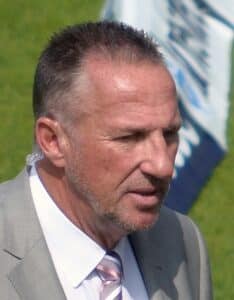
    In person, Ian Botham is utterly solid, calling to mind a rugby prop forward more than England’s greatest cricketing all-rounder. Botham is a famous wine enthusiast, and hunched over his lunch as if he could easily eat one’s own meal as well, it would be a lie to say one can’t see that he’s enjoyed himself from time to time.

    Botham is one of those very few sportsman whose achievements carry across the generations. Sport is really to do with the dramatic maximisation of the present moment: we are rarely quite so conscious of life as when we watch closely to see whether a ball has nicked a bat. Especially because there is so much of it, little sticks in the mind.


    1981 and All That


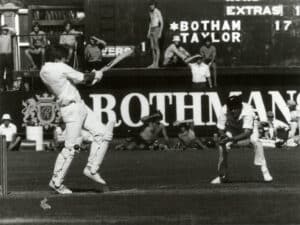
    Something about Botham did: it was to do with the fearlessness with which he played the game, allied always to a certain laddish humour which is still in evidence today. Especially Botham is known for the Ashes in 1981 now forever known as Botham’s Ashes, when Botham’s swashbuckling 149 not out at Headingley began an unlikely set of events. Not until 2005 would cricket come alive in this country to anything like the same extent.

    When we think back on that Test match, It should really be Bob Willis’ test, since it was Willis, who died of cancer in 2019, took 8-43 to bowl out the Australians. Willis hangs over lunch, since Botham is here to raising money for the Bob Willis Fund which raises money for better prostate cancer research.

    Botham tells a wonderful anecdote about that storied day in 1981: “Australia needed a 130 to win. The Australians were 50-1. Bob comes on, and turns to Briers [Mike Brearley, the then England captain] and he said: ‘Any chance I could have a go down the slope with the wind?’ He steamed in and took 8-53.”

    This led to an amusing administrative issue over the unexpected celebrations which Botham, as the world knows, enjoyed more than anyone. “We had this young lad – Ricci Roberts, a 140year-old: he was over from South Africa as a runner. I said to him: “Look we haven’t got any champagne, because obviously thought we weren’t going to win the game.” The Australians thought they would. I said to Ricci: “Go and knock on the Australians door, and be polite and just say: ‘Could the England boys have a couple of bottles of champagne, please?” He did exactly that, but added on the end: ‘Because you won’t be needing them’.”

    The Australians may not have reacted well. Botham continues: “Ricci came through the door horizontal. He had one bottle in each hand and he didn’t spill a drop. Ricky Ricci went on to be Ernie Els’ caddie in all Ernie Els’ major wins. That was down to what we taught him – and how Bob taught him to pour a pint.”


    The Two Geoffreys

    At Lord’s, alongside the extraordinarily likeable Geoff Miller, Botham gave a jovial tour through his career, joking that Geoff Miller was ‘the livelier of the two Geoffreys I played with’ referring to his long-running grudge against Geoffrey Boycott, who Botham famously ran out in Christchurch in 1978. On that famous occasion, Boycott was batting at his usual glacial pace when the situation required runs. Botham picks up the story: “I was asked by Bob, who was then the vice-captain, to run him out and I said: “I’m playing my fourth game and he’s playing his 94th.” Bob replied: “If you don’t do it, you won’t play your fifth.”

    It is impossible to not feel nostalgic about the fun of those times. Botham has come along way. In fact, when Botham recalls his upbringing, as is usually the case with the extraordinarily successful, his story comes into focus in all its glory and improbability: “My father was in the services in the Navy and was serving in Northern Ireland on active duty. When his wife Marie, my Mum, was due to give birth, they sent us over to Heswall in Cheshire.”


    Crunch Time

    The family then moved down to Yeovil and Botham, having shown exceptional sporting prowess, had a difficult decision to make by the age of 15. “I had to make a choice between soccer and cricket. Crystal Palace offered me an apprenticeship. I had just signed at 14 with Somerset – I registered with them and when it came to the decision, I sat down with my dad. He said: “You are by far a better cricketer”. I listened to him – for once.”

    Botham then transferred to Lords for a year and half, before being called back to Somerset at 18. It didn’t work out too badly, did it? Botham smiles: “Not too bad.”

    Botham recalls his first Test match. “The way they did it in those days – well, let’s just say it wouldn’t happen nowadays. You’re driving down a motorway. At three minutes to 12 you turn into a layby and switch the radio on and wait for the 12 O’Clock News. And the England team to play Australia is…And I thought: ‘Yes, I’m in’.”

    That sent Botham up to Trent Bridge, where another lovely anecdote occurs. “We lined up at the start of the game and it was the Queen’s Jubilee. The Queen went down the England line, and wished me luck on my debut. Then she went over to the Australia line, and came to DK Lillee [the great Australian fast-bowler].

    Dennis pulled out of his back-pocket an autograph book. “Ma’m, would you sign this?” She said: “I can’t do that now.” But clearly the Queen had remembered the encounter. Botham continues: “When Lillee got home from the tour six or seven weeks later, through the letterbox there came this envelope with the Royal seal and there was a picture of the Queen. It now sits on his mantelpiece.”


    Merv the Great

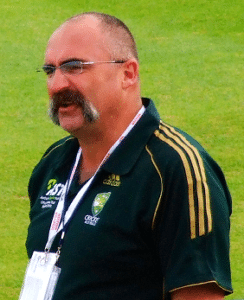
    It’s a lovely story – and the more time you spend in Botham’s spell, the more the stories keep coming. Merv Hughes also gets the Botham treatment. “In 1977-78 we toured Australia, one of my first tours. We were sponsored by a company called JVC Electronics. They decided in their infinite wisdom that on the rest day morning at about 10 o’clock – when most of us had only been in bed 10 minutes – we’d go to a shopping mall in north Melbourne to mingle. None of us were particularly excited about that prospect.”

    So what did Botham do? “I hid behind this tower. This young lad came up in a tracksuit and said: “Good day, Mr Botham. Mate, I want to be a fast bowler have you got any advice for me?” I wasn’t feeling great so I said: “Mate, don’t bother – go and play golf and tennis.”

    Fast forward to 1986: the first test at Brisbane. Botham recalls: “Merv Hughes makes his Ashes debut in that game. In Brisbane, you could see this little black line, that in about 30 minutes became a thunderstorm – hailstones the size of golf balls. Hughes bounces it in, then the gigantic hailstones. Merv wasn’t happy as I’d hit him for 22. We weren’t going to play anymore, the ground was covered with these golf balls.

    One of the lads brought me a beer. Merv comes out and I say: “Congratulations on your first Ashes.” He said: “You know we’ve met before.” I said: “No. Where?” “At the shopping centre in Melbourne.” I was that kid who came running up to you, and you told me not to be a fast-bowler but to play tennis and golf.” He said: “What do you reckon now?” I said: “I was bloody right.”


    Beneath the swagger of the public persona, there is his immense generosity as a philanthropist and his life as a family man. His grandson, James, is following in Botham’s footsteps as a sportsman. Botham speaks with evident pride: “He’s had a couple of years with injuries. His confidence is back – he played very well against South Africa at Twickenham. James was born in Cardiff and said: ‘I’m playing for Wales’. He’s got a task on his hand and we’ll see.”


    A Decisive Difference


    But it’s the philanthropy which really brings a tear to the eye. “I’m very proud of it,” says Botham. “In 1977, I was playing against the Australians and stepped on the ball and broke a couple of bones in my foot. In those days you didn’t stay with the England squad, you got sent back to your mother county. Mine was Somerset.  So I get to Musgrove Park Hospital in Taunton, the club doctor’s waiting for me. To get to the physio department you had to go past the children’s ward.”

    This turned out to be a fateful walk since it would change many peoples’ lives. “You can see children who are obviously ill – tubes sticking out, and their feet up. There were four lads sitting round the table playing on the board games. I said: “Are these guys visiting?” He said: “No, they’re seriously ill.” I said: “But they look fine.” He replied: “You’ve got eight weeks of intensive treatment to get it right for the tour. Those four lads in all probability will not be there when you finish your treatment. True enough at the end, all four of them had passed away.”

    It made a deep impact on Botham who found he couldn’t stand by and do nothing. “What the hospital used to do was give them a party, whether for one of their birthdays or for Christmas. And they were so drugged up with painkillers. As I was leaving the hospital, I said: “Is there anything we can do to help?” He said: “Well, you’ve now seen four parties. We don’t get any funding for those.” I said: “I’ll stick my hand up and pay for the parties.”


    By mid-1984, Botham wanted to do something more substantial. “I was flicking through a magazine which someone had left on the train – a colour supplement. There was an article about a certain Dr Barbara Watson, who lived on the south coast. Every summer she would get on the train and go to the most northerly part of the UK, John O’Groats and meander back. I thought: “Right, I’m going to do a sponsored walk. I’m going to do John o’Groats to Land’s End. My geography wasn’t great. 400 miles to the English border, then 600 miles to the Land’s End.”

    It was a huge learning curve for Botham who had never walked like this before, but he managed to do the walk in 33 days. “You couldn’t do PayPal: you had to physically collect. By the end of the walk we got over £1million. That was used immediately to build a research centre outside Glasgow.” Then the conglomerates came behind us. “When we started the walk, there was a 20 per cent chance of survival for kids with leukaemia – a few years ago we announced it is now 94 per cent.”

    It’s an astonishing story of how something so innocent as being good with a bat and ball and can lead with the right heart and mindset to genuinely consequential change. Botham’s is a reminder to us all to start with what we’re good at – but to keep an eye out for what we might do for others along the way.


    Lord Botham was talking at an event at Lord’s Cricket Ground in aid of https://bobwillisfund.org/


    https://www.beefysfoundation.org


    Like this? See also our other cricket articles:


    Cricket Nostalgia: Henry Blofeld on PG Wodehouse, Ian Fleming and the Remarkable Cricket of the Past

    Culture Essay: What we can all learn from cricket


  • Exclusive: How Stephen Fry went from Comedian to the Nation’s Mentor


    Christopher Jackson


    Growing up is necessarily a provincial experience. It has to be: such a small proportion of the world is presented to us at that time. As a result, something like the following seems to happen: we come into the realisation gradually that our family’s experience of life, while it might be informative in numerous respects, also has to be a sort of red herring: we are not them and are not meant to be. Instead our obligation is to grow in some new direction in order to be ourselves.

    What this all has to do with Stephen Fry I shall come onto in a moment. For now it is enough to say that predicament of youth can engender bafflement, even acute forms of anxiety. It was the novelist Sir Martin Amis who pointed out that nothing is so usual as what your father does for a living. He knew that from rich personal experience, his father being the equally famous novelist Sir Kingsley Amis. But many people have the opposite sense that one’s essential narrative might lie elsewhere. If this is one’s suspicion then what you badly need are clues as to what that might realistically consist of.

    For me, growing up in rural Surrey in a good-natured suburb of lawyers and accountants, the existence of a group of comedians in the 1980s came as thunderbolts. Looking back, I realise they were also signposts. The moment I saw Rowan Atkinson on our TV screens as Mr Bean, and saw my parents crying with laughter, and felt the first true belly laughs I’d known rushing through my being, I felt a new scope rush in.

    This must be a very common experience: here we are in our quotidian home, trying our best and seeking to be good; but out there, on the screen is another kind of life, which seems so hilarious, and so silly – and therefore somehow kind, and decidedly blessed. It is the world of celebrity and laughter. When we are young, it can seem like the most desirable thing in the world – full of high definition colour, and pitch perfect performance, a sort of paradise where outcome is in accordance with aim.

    Of course what happens at that time in our lives is a broad revelation – what Philip Larkin calls ‘the importance of elsewhere’.  It’s only later that you examine its particulars; how the sheer scale of possibilities relates to oneself. When I saw Rowan Atkinson terrified to dive off the top floor of a swimming board, I didn’t, as the world can now see, decide to be a slapstick comedian.

    But I think I did decide around that time not to be an accountant. This decision was further crystallised when I saw John Cleese in Fawlty Towers, the frenetic clockwork pace of that sitcom, causing an escalating delight. It was shored up further by other experiences: French and Saunders, Smith and Jones, and later Harry Enfield.

    But then there was another pair who spoke to me in a different way, and opened up, I now see, far larger possibilities: this was a pair of Cambridge graduates called Stephen Fry and Hugh Laurie. Hugh Laurie seemed to me then – and still does – just about the most gifted person on earth. He is funny. He is a brilliant actor (see especially House). He plays piano, sings, and plays guitar beautifully.

    Almost unnoticed, he is the best comic songwriter of his generation (‘I don’t care if people laugh/I’m in love with Steffi Graff’). His novel The Gun Seller is a delight. He was also responsible for A Bit of Fry and Laurie, my vote for the greatest sketch show of all time.

    It was Laurie who made me pick up guitar and piano, and later write music. But of the two it was Stephen Fry who really interested me, and who pointed a more definite way. In this country, the trajectory is told everywhere from the life of Shakespeare to the novels of Dickens: you’ve got to get from where you are to London. And it’s from London that I write this.

    What was it about Stephen Fry? It was partly because however troubled he was, he was so obviously kind – though over time I would find out that he could be rather hard on himself. But I don’t think it was primarily that. For me, it had all to do with his use of language, which came as the most wonderful and joyous surprise of my life. It seemed astonishing to me that people could speak like this, bequeath you a vocabulary as they made you laugh.

    It was a form of proclaiming of themselves before the world – they could cause laughter in you while making you more intelligent. If you were receptive to it, it had to form you; Fry and Laurie made you want to be them, because it looked like an awful lot of fun. But not just that, it made you feel that if you could enter a little into their world, that you would know some special set of secrets. That way maybe you could build a life – one that was somehow true to a high set of possibilities.

    These sorts of suspicions can only take you so far. Because pretty soon, life happens to you. As Mike Tyson beautifully put it: “Everybody has a plan until someone punches you in the face.” What happens is that life punches you in the face – and anyway, the world our heroes inhabits nowadays has so little to do with the one we end up entering. We specialise in the vanished paradise and the discarded Eden.
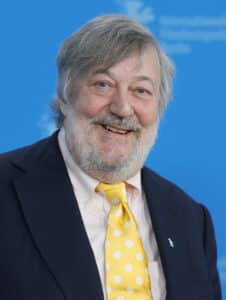
    Nevertheless my preparations for a world which would have gone by the time I got there were unusuall thorough. I think I must have been 11 or 12, when my younger brother Tim – who would have been nine or ten – began learning and performing Fry and Laurie sketches to family and friends and sometimes to perfect strangers in restaurants. One particular sketch which we performed entailed Stephen Fry as a pompous late night talkshow host, talking on and on in the most preposterous way: “Is our language too ironic to sustain Hitlerian styles?

    Would his language simply have run false in our ears?” My younger brother would play a baffled Hugh Laurie, who can’t understand what on earth the Stephen Fry character is saying. Amusingly, as I look back on it now, I had absolutely no idea what the language meant. This created a situation of considerable amusement when I performed before elderly relatives the following:


    Language is my mother, my brother, my father, my whore, my mistress , my niece, my check-out girl. Language is the dew on a fresh apple. Language is a creak on the stair. Language is a ray of light as you pluck from an old bookshelf, a half-forgotten book of erotic memoirs.


    I had no idea what any of it meant but I loved the music of it. It was the idea that language is a kind of music, that we can have fun with it, and play with it – and therefore, I suppose, that it has glorious function. It means that we can burst pomposity in this sketch, but of course, if you accept its use, then you must also admit that it can lead you onto new worlds. It can prise things open.

    As I continued my studies in Stephen Fry, I found in him an educator – indeed, a sort of a remote and unpaid mentor. The power of this mentorship seemed to me no less important simply because he didn’t know who I was, and would almost certainly never know. This didn’t matter one iota so long as I was receptive and so long as Fry continued to build his career around the communication of the things he loved.

    It is this love of things which I think defines Fry; it is a generosity in him which keeps spilling out. As I would go on in life, some people in the public eye would also give me great gifts. Amis, who I mentioned earlier, would give me Saul Bellow and Vladimir Nabokov; Julian Barnes, whose books I could never get on with, offered up Flaubert in almost every interview he gave; Gabriel Garcia Marquez recommended me Virginia Woolf and Juan Rulfo; John Updike showed me Henry Green and so on and so forth.

    It is perhaps the loveliest of all lessons for young people to know that in life, as in literature or art or music, there are a series of invisible threads to be grasped and which lead to pleasures you never could have imagined.

    But Fry, I think, was different to all these people. He loved things loved so much that he had to enact that love. He didn’t just tell you in no uncertain times that he loved PG Wodehouse; he played Jeeves on television. He didn’t just love the novels of Evelyn Waugh, he directed a film of Vile Bodies, replacing it with the far better title Bright Young Things. And then there was Oscar Wilde, who he rather resembles, and who he often seemed to embody in his chat show appearances, and then on film in Wilde, the role which he was born to play, and which he played beautifully.

    The world is a catty place and some would say that Fry has always been in some sense derivative. The argument runs that he has borrowed these personas and that there is accordingly some sort of gap within where the real Stephen Fry ought to be. The somewhat churlish columnist Peter Hitchens has called Fry ‘the stupid person’s idea of an intelligent person’.

    I dislike this remark not just because he repeats it in print regularly with a kind of calculated cruelty, but because it isn’t true. Fry didn’t write The Importance of Being Earnest, it’s true, but he has done more than anyone to proclaim Wilde’s genius at his having done so. I don’t think Fry, clever as he is, has ever made gigantic claims for himself; others have done so, seeing his value. In time, the nation reached something like a consensus around this. They loved to hear him talk – but I think they loved really to hear him talk about his loves.

    These seemed to have no obvious limit: in addition to Wilde, Wodehouse, and Waugh there was cricket, Paddington bear, nature, taxis, Abba, Sherlock Holmes, Ancient Greece, poetry, London, America. Really, we began to realise, he loves, or is capable of loving everything. This spirit, I note, is far closer to the Christian ideal than anything I have seen in the public domain written by Peter Hitchens.
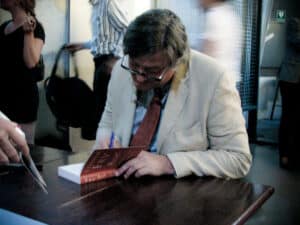
     

    Hitchens’ remark also lacks empathy. We now know what Fry was going through, and that he has suffered all his life with bipolar disorder which can lead him into manic moodswings; he has lived all his life with suicide as a realistic possibility. Here again, he has done more than anyone to raise public awareness about this health condition in his very important documentary The Secret Life of a Manic Depressive which aired in 2016, some four years before the pandemic when mental health really began to top the agenda.

    His condition, which wasn’t widely understood at the time, was most obvious when Fry famously left the cast of the Simon Gray play Cell Mates in 1994. In the days before mobile phones, there was genuine worry about his whereabouts and the fear that something appalling might have happened to him. Gray was upset at the time that his play had been, quite literally, upstaged, and wrote about it at book length in Fat Chance (1995).

    Nowadays, I doubt Fry would get to the end of his street without his whereabouts being broadly known; in those days, when he left the play mid-run, there was a genuine fear among his friends that he had vanished for good. Today, he is one of those people so famous, that he will never again be allowed to go missing.

    If I were to compile a list of Fry’s dislikes, I feel I might reduce it to one thing: cruelty. His friend Christopher Hitchens has sometimes been called the hater par excellence, but I think Fry is a greater purveyor of dismay at human cruelty than Hitchens was, because, on the flipside, I think Fry’s kindness is more active.

    The only kind of successful hate involves consistently pivoting to love, and my sense has always been that Fry is good at this. One early article which influenced me was his great defence of Freddie Mercury which is collected in his 1992 collection of journalism Paperweight, where – I am quoting from memory here since I can’t find the article online – he speaks of Mercury as having entertained with a ‘chutzpah bordering on genius’ and takes to task those who found his lifestyle immoral.

    Its tenor was really ‘judge not less ye be judged’ – and again, one feels that Fry is always actively generous in spirit in way which ties in with the Gospels far more than one might expect from a man who shared the stage in religion debates with Christopher Hitchens.

    His career grew in so many directions that it cannot easily be summarised. It has proceeded along novels (I especially recommend the first two The Liar (1991) and The Hippopotamus (1994), memoir (Moab is My Washpot (1997) may in fact be his best book) broadcasting (his best work here may be his brilliant hosting of the BAFTAS, which he did 12 times, finally giving up in 2018),

    TV shows (Jeeves and Wooster, Kingdom), a marvellous poetry handbook The Ode Less Travelled (2005) which was instrumental in my ever publishing any poetry myself, as well as a host of illuminating TV documentaries, TV interviews, podcasts, blogs, posts, tweets and many other things besides. Fame is difficult to quantify but by any measure Fry is among the most famous people in the UK today.

    My fame however is very easy to quantify: it is nil, and I am currently doing all I can to keep it so. However, just because I have ended up lucky enough to spend a lot of time carrying out interesting journalistic assignments, I must admit that it has involved meeting famous people of many different shapes and sizes all for the purpose of interviewing them. Some of them, from Sting and Andre Agassi to Sir David Attenborough, have been very famous indeed.

    Some like Sir Tom Stoppard, Clive James and Sir Anthony Gormley have a mystique to those who mind about literature or art. Others aren’t famous at all to almost everyone, though they might be revered in their field. Out of all the categories of people I have come to most dread, I would single out those who are just a tiny bit famous as the ones to watch: amid the dim lights of that particular inferno, ego can be at its most pronounced.

    At any rate, as you go through your journalistic career, you realise as you go on in your work that you are starting to meet your heroes. But even then, I never thought I’d meet Stephen Fry.

    What exactly is going on psychologically when we meet our heroes? Dr Paul Hokemeyer, the brilliant author of The Imposter Syndrome, tells me: “Our fascination with and attraction to heroes is primal and hard-wired into our central nervous system. This is because heroes become like celebrities who occupy elevated positions of prestige and power in our society. From an evolutionary standpoint, we are instinctively drawn to people who will take care of us and from whom we can learn vital life lessons to protect us from dangers and advance our station in life. Because this draw is so primal and integrated into our central nervous system it often overrides our critical and rational thinking.”

    In short, when you meet someone well known, we have a tendency to say stupid things. What is happening in the brain at such times? “As this relates to our neuroanatomy, being in the presence of a celebrity floods our central nervous system with a host of intoxicating hormones that override the intellectual reasoning found in our prefrontal cortex. Such disequilibrium causes us to say silly, often nonsensical things which place us further in a subordinate position to the celebrity.”

    And how does this all play out from the point of view of the celebrity. Put simply, it’s not great for them either. “ Too often, however, celebrities become exhausted from the weight of this elevated and never-ending dependency. People become only able to see them as resources to advance their station in life.

    They become like parasites sucking their life force and preventing them from finding any relational nourishment. In this regard, people become a source of danger and cause them a great deal of anxiety. This is one of the reasons why people of wealth, power and celebrity lead such isolated lives. They lack not just a circle of peers but also people who they can look to for nurturance and protection.”
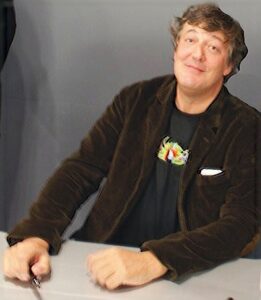
     

    What seems to happen is that a journalist – just by virtue of what he does for a living – comes into in a slightly different position when it comes to the famous. It might be that someone who isn’t battle-hardened when it comes to the sheer oddity of celebrity will meet someone, and the encounter may go badly because they will end up saying something just a bit odd in order to impress, or to draw attention to themselves. They feel the gulf between the famous person’s fame and their own obscurity too keenly and end up drawing attention to it.

    The famous person, who will be by their position, extremely experienced in this sort of mismatched encounter, will sometimes try to amend the awkwardness but at other times they won’t. This might be personal (they’re tired and/or having a bad day) or it may just be that the encounter cannot be rescued. The famous person may then resign themselves to the thought that maybe it’s just easier to spend time with other famous friends. Almost always when someone moans that so-and-so in the public eye isn’t pleasant to meet I suspect that there will be some element of this completely understandable lack of expertise which has intervened on the encounter and spoiled it.

    What’s interesting is that the way to remove the awkwardness of the encounter is not to care at all about fame, but to care about the person in front of you. This is not to say you should pretend they’re not famous as that would be to deny reality, but to treat fame as perhaps the least interesting thing about them.

    Sometimes I have seen, in the middle of an interview with someone known, the person themselves, and there one sees something deeper and truer which has nothing to do with the construct of celebrity, though it will also almost certainly give clues as to why that person was driven to become well-known and also why the public reciprocated that wish. I am not saying that I am a master of this art.

    I would not expect myself to behave with absolute equanimity if Elton John were to knock on my window as I write this, and offer up a private concert in my living-room. But it is what journalism teaches you, and it amounts to something like an inherent lesson of the profession.

    Hokemeyer explains: “What such a person is doing is modelling humanity. By pre-empting the biological calibration that occurs around the power dynamics inherent in a celebrity identity by engaging in your intellect and rational mind, a journalist is levelling the playing field. You pre-empt the hijacking of your intellect by grounding the relationship first in the prefrontal cortex and then allowing your central nervous system to catch up. For most people, the calibration of psyches occurs in reverse. The central nervous system leads. Too often the intellect never catches up and the relationship becomes fuelled by unrealistic fantasies and harmful stereotypes.”

    Quite by chance, on the 27th July 2023, I presented myself at the Oval Cricket Ground at the Micky Stewart Pavilion. I had, to put the matter as politely as possible, more or less had my fill of famous people. I am anxious here not to sound tiresomely world-weary since I have always been mindful of my luck in terms of meeting so many interesting people. However, it would be wrong to omit the fact that the encounter between famous person interviewee and non-famous interviewer is always on some level a sapping one, for the simple reason that by creating fame, and especially televisual fame, we have plainly released a set of completely crazy energies into the world.

    I wave my ticket at the security people, a piece of paper which conveys the unlikely, but true, story that today I happen to be attending the final test of the Ashes courtesy of the Duchy of Cornwall. Instead of the interrogation I half-expect, I am waved through to the Oval, scene of some of the great climaxes in Test Match history. Here in 2005, Kevin Petersen hit his magical 158, with Shane Warne bowling his heart out. It is also a place of significant goodbyes.

    Here it was that Alistair Cook scored 147 during his final innings having been short on form. Here too Don Bradman was famously bowled for a duck, when needing just four runs to end with an average above 4. Unknown to me, in a few days’ time, Stuart Broad will retire from international cricket having hit a six from his last delivery and a wicket with his last ball.

    Inside, all is cricket lore – a lesson in black-and-white pictures and old news clippings about the history of cricket. The Oval is a place where time is prised open a little, and you feel a sense of cricketing history. Perhaps it is more forceful in this respect than Lords, because the so-called Home of Cricket is always cumbrously reminding you of its importance. Here the past seeps in almost casually.

    I walk up the stairs and am asked to find my name on the guest list and sign in. As I scroll down the second page, I glimpse the names on the guest list: Sir John Major; Sir Trevor Macdonald, Chris Tremlett. My name must be on the first page, and there just down from my own, it reads: Stephen Fry.

    I am given a name tag and move through to the bar area. Now, it is important to convey a little about the Micky Stewart Pavilion. As I understand it, one of the most interesting things about becoming the Prince of Wales, and thereby coming into the possessions of the Duchy of Cornwall, is to discover all the things which one suddenly owns. One of these possessions is the Oval Cricket Ground.

    This means that if by some curious chance one is invited to the Micky Stewart Pavilion you are there to some extent because the Prince of Wales doesn’t mind you being there, or hasn’t noticed, or in my case, by a stroke of good fortune. In such places there is curious sense that everybody assumes you have some sort of validity just by being there at all.

    As I walk in Sir John Major walks by and, ever the politician, he reads my name badge and says: “Hello, Chris, it’s good to see you here.” We talk briefly about the great sadness of the weather-affected draw the week before, which certainly have meant we’d be coming into this match with the scores level at 2-2.

    I am always struck by the charm of senior politicians; I wasn’t able to vote in 1997 when Major was last on the ballot, but he has secured my vote retrospectively. We sit down for the opening session, and sit away from the bar in the stands. It only occurs to us once we have sat down that the green seats nearest the bar are for everybody to sit in. We might just as well, had we had the inclination, sat next to Sir John.

    But what is the proximity of an elderly prime minister compared to a good morning’s cricket? Australia chose to put England in, in the justified belief that overcast conditions would make the ball swing. However, England put up a spirited performance, led by a swashbuckling 85 by Harry Brook. As we head inside to the pavilion for lunch, Fry is seated next to the door and smile congenially at us – he looks like someone who, should the moment arise, wouldn’t mind a conversation.

    We head inside and there is a bit of mingling before lunch. Chris Tremlett towers above the company, looking like he could still take a wicket if suddenly summoned down to the pitch. By accident I find myself chatting to Fry, and I mention to him that my grandfather had grown up in the same village as him in Booton, in Norfolk.

    “Booton!” he cries, delightedly. I can see how much he enjoys saying the word – which is, indeed, rather fun to say now I think about it.

    I add that my great-grandfather was the rector of the church there. “Oh, I remember that cold church,” he says. “Were your family the Fishers?”

    I say they were the Jackson.

    “Ah the Jacksons!” he says, cheerfully, though I suspect that he can’t remember them and they may have been before his time.

    After lunch, we head out and find Fry sitting alone on the green seats, and in a moment of curious madness, decide to sit next to him. It is worth saying at the outset that a good place to meet your hero is at the cricket: the rhythm of the match can interweave with your conversation, and it is less adversarial than the typical interview.

    Early in our discussion, we talk a bit about our favourite Australians and I mention Clive James, who Fry knew well, and who I interviewed once towards the end of Clive’s life. I mention that I liked his poetry and that I was due to talk to him about The River In the Sky, one of Clive’s last publications. “Yes, I rather like Clive’s poetry too. He was a very good poet – when he wasn’t reading the whole of Western literature.” I mention that I was invited to Clive’s house for the launch of the book when I had committed to a press trip. Fry sympathetically winces: “That’s unfortunate.”

    We then discuss Sir Tom Stoppard and I mention how kind he had been to me when we interviewed him for this magazine. I say it is often difficult to know how much one should thank someone well-known. “Oh, you always should. Christopher Hitchens always used to say that – thank your heroes.”

    Does he miss Christopher Hitchens? “Hugely.” I ask him if Hitchens would have supported Trump or Clinton in the 2016 General Election. “It’s a well-framed question,” he smiles, “as if there was one thing for sure about Christopher it’s that he absolutely loathed the Clintons. But Trump? I think that would have been a step too far.”

    He then tells me a lovely story about Tom Stoppard at a cricket match which Fry attended. The party were discussing collective nouns – a parliament of birds, a pride of lions and so on – when Harold Pinter and Stoppard walked in. Fry wondered aloud what the collective noun for playwrights would be and Stoppard immediately replied: “A snarl of playwrights.”

    We discuss Leopoldstadt, Stoppard’s most recent play, which Fry has just been to see in New York. He asks if I have seen it and I say I have only read it but that the ending affected me deeply. Fry is wistful, no doubt thinking of the extraordinarily touching end scene, which I shan’t go away here: “Yes, I wonder what it would be like only to have read it.”

    Stoppard, Fry recalls, used to play cricket for Harold Pinter’s XI. “It was called The Gaieties which has to be the worst name for an XI of all time – and not a very Pinteresque name.” I recall to him an essay in Paperweight that he had written an essay on chess and playwrights, and how the story of styles in the 20th century theatre mirrors chess-playing styles around the same period. “Well that’s just the sort of pretentious stuff I would write.”

    I have throughout a sense of Fry which is rather touching. That is, even here, when he doesn’t need to be a performer. One senses the need to be loved, and that he is therefore always moving to make life easy for you in conversation – to make sure you’re at ease.

    Down on the pitch, Stuart Board, I note is trying to anger himself into greater pace, and this prompts a discussion on the importance of anger in fast-bowling. ‘Bob Willis is the great example there – he always bowled better when angry,” says Fry. He also quotes Mike Brearley: “Anger always brings presents.”

    As we talk, Fry explains that he is trying to do more to carve out time for the cricket, and that it was part of his motivation. “I have a lot of difficulty saying no,” he says, “which is why this summer has been so lovely.” It has been a time to pause work and spend some time with friends. “Hugh loves the cricket – he came along for a day,” Fry says.

    Talking of fast-bowling greats turns us inevitably to Shane Warne. I ask him if he’s read Gideon Haigh’s great biography of Warne, and Fry is enthusiastic. Fry has also a kindly way of finishing your sentences for you as a way of making you feel you are being listened to and understand. When I begin to say there have been times when I’ve considered getting a subscription to The Australian only to read Gideon Haigh, I find that Fry has said the last five words on my behalf. Did Fry get to know Warne? “Yes, I did a bit – a lovely man.”

    But of course you realise that however many people you might have met, Fry has known everyone. It comes with his position. Since we are here thanks to the Duchy of Cornwall we briefly discuss the Prince’s disinterest in cricket as opposed to football, Fry frowns in a comic way: “Well, yes, I have known for some time that the Prince is not especially interested in cricket. Prince George though when I saw him last talked of having ‘just been in the nets’ so perhaps things will be somewhat different in the next generation.”

    It is a lovely thing to let the conversation as the cricket changes. At one point, Fry jokes about Todd Murphy, the Australian off-spinner. “Well, he’s got the off break, and then there’s also the off break. And if that doesn’t work, at least he’s got – the off break.”

    At another point, enjoying the batting, I mention John Arlott’s description of Jack Hobbs, as what having made him great was his ‘infallible sympathy with the bowled ball’. Fry repeats it: “Oh Arlott! An infallible sympathy with the bowled ball. Marvellous!”

    There is time also to reminisce. I mention how Fry and Laurie caused me such delight as a young boy, and even tell my story of reciting his work as a boy, and not knowing what the words meant. When he asks which sketches we used to recite, I tell him: “There’s this sketch where you play a pompous interviewee on late night television. “ “Sounds like me,” Fry says swiftly.

    When I recite the sketch for me, I am able after all these years to thank him for it. To my astonishment, I see he is visibly moved to have had this impact. “We didn’t know the effect back then – it was like dropping a coin into a well. Every now and then with Fry and Laurie someone would stop you in the street – but it was very occasional indeed.”

    I had heard a story of Paul McCartney, which I mention to Fry. Apparently, when he seeks to hire someone he always gets his driver to befriend someone lower down in the organisation he wants to hire, so as to be sure that they’re kind to their subordinates. “Did you ever get to know David Tang?” Fry asks and I admit I’ve never heard from him. “I loved him he was an incredibly kind man. But he could be extraordinarily rude to his subordinates. On more than one occasion he was David was so rude to his driver, that I had to get out of the car.”

    As the often continues – and it was one of those rare giddy days in Test match cricket where wickets fall at regular intervals – I also get the opportunity to thank him for The Ode Less Travelled, his poetry handbook, without which I never would have been able to publish my own poetry books. I tell him his, and I also add that the poet Alison Brackenbury is an admirer. He is thrilled by this: “Alison Brackenbury! Well, I love her poetry so that means the world to me.”

    Later I mention this to Alison and she replies: “How wonderful! We never know where our writing goes. I do think Stephen must be fantastically well-read to have found my poems. I have tried hard over the years to scatter them in the most unlikely places, but I doubt if even the amazing Mr Fry ever read the now defunct Tewkesbury Advertiser.”

    I remind Fry that he says he writes poetry in The Ode Less Travelled, and tell him I think he should publish a volume of verse. He says: “Well, I did think during lockdown that I ought to compile that and I began it, but then I stopped.” How long would it be? He smiles: “Well that would depend on triage. Most likely it will probably have to wait for my will and then everybody will say: “What on earth was he thinking?”

    The afternoon drifts on, cricket always intertwining with talk. At one point Fry jokes that we must ‘avoid clichés like the plague.” He talks of his admiration of Rowan Atkinson (‘no one else can convey a line like him’). He spends some time on cricket trivia, reminding me, for instance that Alan Knott wasn’t a wicket keeper at first but a bowler – and that being so good at the latter craft helped him become so brilliant at the former. His beloved Wodehouse gets a mention: “Wodehouse was told that he was most read in hospitals and prisons and first thought it a bad thing but then decided there could be no greater compliment to an author.”

    And now I’m afraid I must go and do a talk in central London. He turns to me and says: “You’ve made an old man very happy.”

    And then he’s off – having made me happy too. But the curious thing is I think he means it – and I wonder about the isolation celebrity must bestow. Hokemeyer tells me: “Occupying a rarefied position in the world is incredibly isolating. There are very few people who can look through the celebrity veneer and see the human being who resides below the power and sparkle that defines a celebrity identity.” Later I think back to the look Fry gave us as we walked past him – it was the look of someone who wanted conversation.

    Do we perhaps all to some extent suffer from Imposter Syndrome? Hokemeyer explains: “Many celebrities, including male celebrities such as Tom Hanks and Ben Affleck have spoken publicly about their struggles with imposter syndrome. This is because attaining the status of celebrity on the scale that they have is akin to winning the lottery. It’s nearly an impossible goal that comes to too few. Being such a rarefied existence, their central nervous system can’t quite integrate it. As such, they live in fear that they will fall from grace and become irrelevant.”

    I don’t think this will happen to Fry, but his charm seemed to be something allied to a sort of need: I don’t think it can be external approval which he is seeking, or external love even, since he has both in such abundance. It is internal, and I think fame and celebrity have a terrible way of wreaking havoc with that. Yet who could be better to watch cricket with? They say don’t meet your heroes. In general, I’d agree with that – unless your hero happens to be Stephen Fry.


    Stephen Fry Education Timeline


    24th August 1957 – Born in Hampstead, but grows up in the village of Booton, Norfolk, having moved at an early age from Chesham, Buckinghamshire, where he had attended Chesham Preparatory School.


    1964 – Attends Uppingham School in Rutland, where he joined Fircroft house and was described as a “near-asthmatic genius”.


    1973 – Expelled from Uppingham half a term into the sixth form, and is moved to Norfolk College of Arts and Technology, where fails his A-Levels, not turning up for his English and French papers.


    1977 – Despite a brief period in Pucklechurch Remand Centre after stealing a credit card from a family friend, he passes the Cambridge entrance exams, and is offered a scholarship to Queens’ College, Cambridge, for matriculation in 1978, briefly teaching at Cundall Manor School.


    1978 – At Cambridge, he joins the Footlights, where he meets Hugh Laurie and Emma Thompson among others.


    1981 – Wins the Edinburgh Perrier Award for the Cambridge Footlights revue Cellar Tapes


    1986 – The BBC commissions a sketch show that was to become A Bit of Fry & Laurie. It runs for 26 episodes across four series between 1989 and 1995. During this time, Fry stars regularly as Melchett in Blackadder.


    1995 – Fry is awarded the honorary degree of Doctor of Laws (LL.D. h.c.) by the University of Dundee.


    1999 – Awarded an Honorary Doctorate in Letters (D.Litt. h.c.) by the University of East Anglia


    2010 – Fry is made an honorary fellow of Cardiff University,[148] and on 28 January 2011, he was made an honorary Doctor of the University(D.Univ. h.c.) by the University of Sussex, in recognition for his work campaigning for people suffering from mental health problems, bipolar disorder and HIV.

    2017 – The bird louse Saepocephalum stephenfryii is named after him, in honour of his contributions to the popularization of science as host of QI.

    2021 – Fry is appointed a Grand Commander of the Order of the Phoenix by Greek president Katerina Sakellaropoulou for his contribution in enhancing knowledge about Greece in the United Kingdom and reinforcing ties between the two countries.


    For more of our cover stories, see these links:


    Exclusive: how Emma Raducanu changed the world of tennis

    Exclusive: how Elon Musk is changing the global economy?
  • Meet the Mentor: Rara Plumptre, A Journey of Resilience and Kindness

    We meet Finito mentor and founder of AECS communications Rara Plumptre


    Tell us a little about your early life and education. Did you have mentors growing up who altered the way you are today?

    I was taken to South Africa on the Union Castle boat to Cape Town in the 50’s at six weeks old by my nanny; my parents were living in Durban. My early life started in a rabbit hutch as I adored animals – and still do. I loved the outside world: sun, sea and sand.

    My education didn’t start until I was five years old, where I went to a convent in Durban. Personally I wasn’t the most conforming of children – to say the least. Ten or so years later, at the age of 16, I ended my schooling with one GCSE: I had climbed out of, or been expelled, from most schools. Thankfully my education finished, much to my delight: the only thing I missed was sport. My mentor was my nanny, who for all my faults loved me and wanted me to achieve in life, and perhaps she found my truancy less troubling than my parents did.

    My first job altered my whole life: at 17 years of age I was taken on as an au pair and cook for an Italian family in Florence, which I stayed in for a year and a bit, having opened the liquidiser on gazpacho soup on my arrival: I was still picking soup off the ceiling when I left! Once I was back in England, I walked into a job with Stephen Marks, founder of French Connection. At 19, I had become a manageress of his first shop in South Molton Street.


    Knowing what you know now, what would say to your younger self about the world of work?

    I would say it’s important to stay true to yourself and to be grateful for every day. I’ve also come to learn that business never goes straight, and that it’s vital to have mentors from an early stage.

    Of course, the world has changed hugely. When I was growing up, we were more outside than in – rain or snow. We were freer and lighter with troubles, and we had less to worry about. We had a choice of one tomato, not 30 when we shopped: you could certainly say that life was much simpler – and perhaps what we need to do is cultivate that simplicity.

    When I first flew to Africa from England you couldn’t fly direct: we had to refuel in Entebbe in Uganda or Kinshasa in the Congo. My father gave us coins to buy stamps since he was a great stamp collector. When we landed in the above, we would buy the stamps we liked, and arrive in Johannesburg with them. He was thrilled to bits possibly not about seeing us – but the stamps he loved! I suppose I have wanted to preserve something of the old way of life in my own career.


    You are obviously extremely passionate about helping the next generation. Can you talk a little about your experiences of working with the young. What’s the best way to help make a difference?


    Life for the young now is very different than it was when I was brought up. We only did face-to-face interviews: nowadays online applications are the norm. I think that can be soul-destroying as often a mass of applications for a job can have not one single reply. In the future, my thinking is that as a society we need to rotate the young with mentors at a young age, bringing them up with two or three people who will help them right through their later stages of school, and build for their careers ahead. If we do that, then they will always have someone watching their back in life.


    For deeply personal reasons, homelessness is obviously of huge importance to you as an issue. Can you talk a bit about this area, and how we can all help to tackle this problem?


    The reason I became homeless was through divorce. I now work pro bono helping in that area. I arrived in London where some wonderful friends took me in. I slept for three days with the emotion of packing up a seven-bedroom house with animals which we had also to find homes for. My CV read that I had only been a mother for 20 plus years – so getting back to work was difficult, especially as I hadn’t lived in London for 28 years.

    I remember I was in Clapham, in a haze, and trying to recover from the grief of being homeless. I walked into a gift shop in Abbeville Road. I liked it there and, on and off, I spent my days in the shop because I felt safe. The owner of the shop eventually said to me: “You seem to be in my shop rather a lot, and never buy anything. Why?”

    I told her my story: I had arrived in London with five pounds in my pocket. She retorted: ‘Do you want a job?’ which I jumped at. So for £100 a weekend, I started to earn again. And the rest is history.

    Issues like homelessness and immigration remind us that the gap between rich and poor keeps getting deeper. This inevitably means that more and more people will be found on the street. Fortunately, there are wonderful charities like Under One Sky, and CEO Sleep Out in England in existence. I am passionate about helping to make a difference in people’s lives and trying to lobby the government to make a bigger difference to housing and the homeless.


    You love to make connections between people. Can you tell us a bit about how personal relationships can transform businesses and individual careers?


    Personal relationships are hugely important in transforming businesses, and networking is key to the future, as technology
    takes over our day-to-day lives. To have personal discussions is vital for the young and old. In that I personally feel that one should never stop working, if one enjoys what one is doing. The old can mentor the young through good times and bad. There is a long time to sleep one day. Why waste time with your feet up?


    I’ve noticed that kindness runs through everything you do. It seems as though success in business can sometimes be about doing the small things well. What tips would you have for young people in relation to this?


    I was taught a long time ago that adversity brings you two things, a lesson and a blessing – and they normally come in that order. Kindness and trust are invaluable: if you have people draining your energy try to ‘realign’ and find ways to create new structures of positivity. When you are drained or low, start the day with three good deeds, and in that, your day will automatically improve. Having been homeless and sofa-surfing ten years ago, my family and my friends have got me to where I am today. But most of all, every single person I have met in those years has got me to where I am today, and for that I am truly grateful.


    For more information about Rara’s work go to: http://aecs-connections.co.ukhttp://underoneskytogether.com, and http://ceosleepout.co.uk


    To learn about other mentors, try these:


    Tom Pauk: Meet the Inspirational Mentor


    Spring Roundtable with LinkedIn expert Amanda Brown


  • Resilience in Crisis: Dr. Pamela Chrabieh on Lebanon’s Struggles and Hopes for the Future

    Resilience in Crisis: Dr. Pamela Chrabieh on Lebanon’s Struggles and Hopes for the Future

    Dr. Pamela Chrabieh is a Lebanese-Canadian scholar, university professor, visual artist, activist, writer and consultant. Selected as one of the 100 most influential women in Lebanon (Women Leaders Directory 2013, Smart Center and Women in Front, Beirut), and ‘Most Exceptional Teaching Fellow’ in 2008 (University of Montreal)

    Dr. Chrabieh won several national and regional prizes in Canada (including Forces Avenir Université de Montréal, Forces Avenir Québec, Prix Lieutenant-Gouverneur du Québec), and her Peace Education ‘Diplomacy of the Dish’ activity was selected as one of the most innovative activities during the Innovation Week of the United Arab Emirates in 2015. Since 2017, Dr. Chrabieh has been the owner and director of Beirut-based SPNC Learning & Communication Expertise, and the Nabad (nabad.art) Program Manager since 2020.

    Here, in an important exclusive, she talks to the poet and critic Omar Sabbagh about the current condition of Beirut and Lebanon.

    Omar Sabbagh: Whether it may be common knowledge or not, Beirut and Lebanon more generally are currently in a state of crisis.  Can you tell us, to start with, what this crisis situation looks like on the ground?  

    Dr. Pamela Chrabieh: Lebanon has been going through a multiform crisis following the so-called end of the 1970s-1980s wars: social, political, environmental, sanitary, etc. The Beirut port blast on August 4, 2020, was the first straw that broke the camel’s back, and the ongoing acute economic crisis the second straw. As poverty is rising – more than 60% of the local population lives now under the extreme poverty line – people are increasingly desperate. Many (those who were able to do so) left the country, others (those who are staying) are trying to survive the financial meltdown, the aftermath of the Covid-19 pandemic, and the political deadlock.

    OS: There are many factors that constitute the fraught modern history of Lebanon.  In your view, is the current crisis another version of other crises in the history of modern Lebanon, or is the current situation of a new sort, and why?

    PC: In my opinion, the current situation is first the consequence of decades of corruption, physical and psychological wars, state paralysis, nepotism, sectarianism, foreign interferences, and a clash of ignorance. However, and contrary to what we went through during the 1980s – and that I witnessed first hand as being part of the generation of war – what we are going through today is different, as the deterioration of the country is unprecedented.

    During the 1980s, we were able to escape bombs and snipers and take refuge in a different city or village, we were still able to find food and work, and we had hope for the future. Whereas today looks and feels like a descent into hell, with most of us who still roam the land are hanging by a thread. The level of despair is immeasurable today, and that is, in my opinion, one main difference between the recent past and our present life.

    OS: The economy has suffered tremendously in recent years.  Apart from long-standing practices of corruption, there was the revolutionary movement from 2019, and the terrible blast in Summer of 2020.  How would you assess or critique the recent fate and current state of materialwell-being in Lebanon and Beirut?

    PC: Lebanon is enduring an acute economic depression, inflation reaching triple digits, and the exchange rate keeps losing value. This is still affecting the population, especially the poor and middle class. I agree with the World Bank statement: “The social impact, which is already dire, could become catastrophic”.

    I honestly don’t know how long the local population will be able to survive with one of the lowest minimum wages in the world, and when the country’s food prices have become the highest in Southwestern Asia and North Africa. People can’t even find needed medicine or pay a hospital bill. They haven’t been able to access their money in banks since late 2019, and their lights may go off starting May 15 because cash for electricity generation is running out. 

    OS: How would you assess the prospects for the young, the student body of Lebanon?  It’s common knowledge that for decades the pool or fund of human capital, of human talent in Lebanon is a kind of superlative supply for what is a nugatory demand, and that there has been for decades a brain-drain from Lebanon to other places.  Are prospects for the young just a continuation of this previous scenario or are there significant differences to the situation now, and how so?

    PC: Now more than ever, and given the compounded effect of multiple crises, the Lebanese youth is facing a lack of work opportunities, rising costs of living and unemployment rates, and the absence of any state support. Many are growing disillusioned and desperate, and we are not even at the end of our crises. We should expect worse to come and it is going to be tougher for young people to pursue their higher studies, find a job, or even secure an entry visa elsewhere. 

    OS: Lebanon is known for its fractious sectarianism.  Does this feature of the nation’s political, civil, and denominational make-up affect the young today as much as it may have done in decades past?

    PC: Most students of mine and other university students, along with countless academics, activists, and artists who have been part of the October 17 ‘revolutionary movements’, have vehemently criticized sectarianism in all its forms and offered alternative paths, ranging from a complete separation between religion and politics to mediatory approaches. This is not a new phenomenon, as many individuals and organizations stood against sectarianism in the last decades, but we are witnessing change within student bodies, especially with secular groups winning elections in some of the most prestigious universities versus traditional sectarian groups.

    OS: You have been involved at a grass-roots with the so-called ‘revolutionary’ upheavals in Lebanon and Beirut since they began in late 2019.  How would you characterize the nature of this movement?  And what do you think its effects have been and/or will be on Lebanese politics and thus on the prospects of the up-and-coming generation?

    PC: I think it is still too soon to assess the October 17 revolutionary movements. I wrote a while ago that there are many ways of approaching the study of revolution in the contemporary world. According to a narrow definition, “revolution is a forcible overthrow of a government or social order, in favor of a new system”.

    In that perspective, revolutionary dynamics in Lebanon appear to several observers (whether anti-revolutionary or skeptics) as “minor disturbances”. According to these ‘experts’, as long as the socio-political and economic systems are “unchanged”, the so-called “hirak (movement) is not worthy to be called “revolution”, and “will soon end” or it just “ended”.

    However, a different definition of “revolution” – the one I use and develop – makes it appear as an ongoing project of deep confrontation, resistance, deconstruction, reconstruction, and systemic transformation. This project has no start per se, nor a specific end. In other words, Revolution with a big R is a process, and the October 17 revolutionary movements are only but a step towards overturning existing conditions and generating alternative socio-political and economic orders.

    As I see it, “revolution” in Lebanon isn’t a static object that can either be a “success” or a “failure”. It consists of several current dimensions and historical layers simultaneously, and when it is not roaring in public spaces, it is boiling in the minds, adapting, learning, and bouncing back.

    OS: What’s it like being both a teacher and a business woman in today’s climate?  Detail, if you would, how the perspectives of your variegated work-roles have illuminated for you the current state of Lebanon?

    PC: I wear several hats: scholar, university professor, visual artist, activist, consultant, program manager, wife, daughter, mother, etc. And these hats have been both challenging and rewarding. Definitely, my studies and work experience have helped me shape my knowledge and critical thinking, but my life experiences, with my family, friends, and colleagues, in Lebanon and abroad, have marked my identity and deeply contributed to what I have become today. Most certainly, I haven’t learned about resistance and resilience in books, but through my art, the arts and culture in my country and the region, and through the many struggles I have been going through, as well as the struggles of others around me.

    OS: Given your answers to the questions above, what in your view is in store for Lebanon, and why?   

    PC: As long as there are inequalities, social injustice, exclusion, oppression, violence, war, etc., and as long as there are possibilities of change, I do not think that revolutionary movements will end. As long as our backs are to the wall and our only way is forward and through our fears, and as long as there are no limitations we choose to impose on our will, imagination, resilience, patience and freedom, we will rise again from under the rubble. 

    Photo credit: the opening image was originally posted to Flickr by jiangkeren at https://www.flickr.com/photos/90475107@N00/5959474239. It was reviewed on 28 October 2011 by FlickreviewR and was confirmed to be licensed under the terms of the cc-by-sa-2.0.

  • Sir Rocco Forte on Mastering a Thriving Family Business

    Sir Rocco Forte on Mastering a Thriving Family Business

    Sir Rocco Forte on running a family business


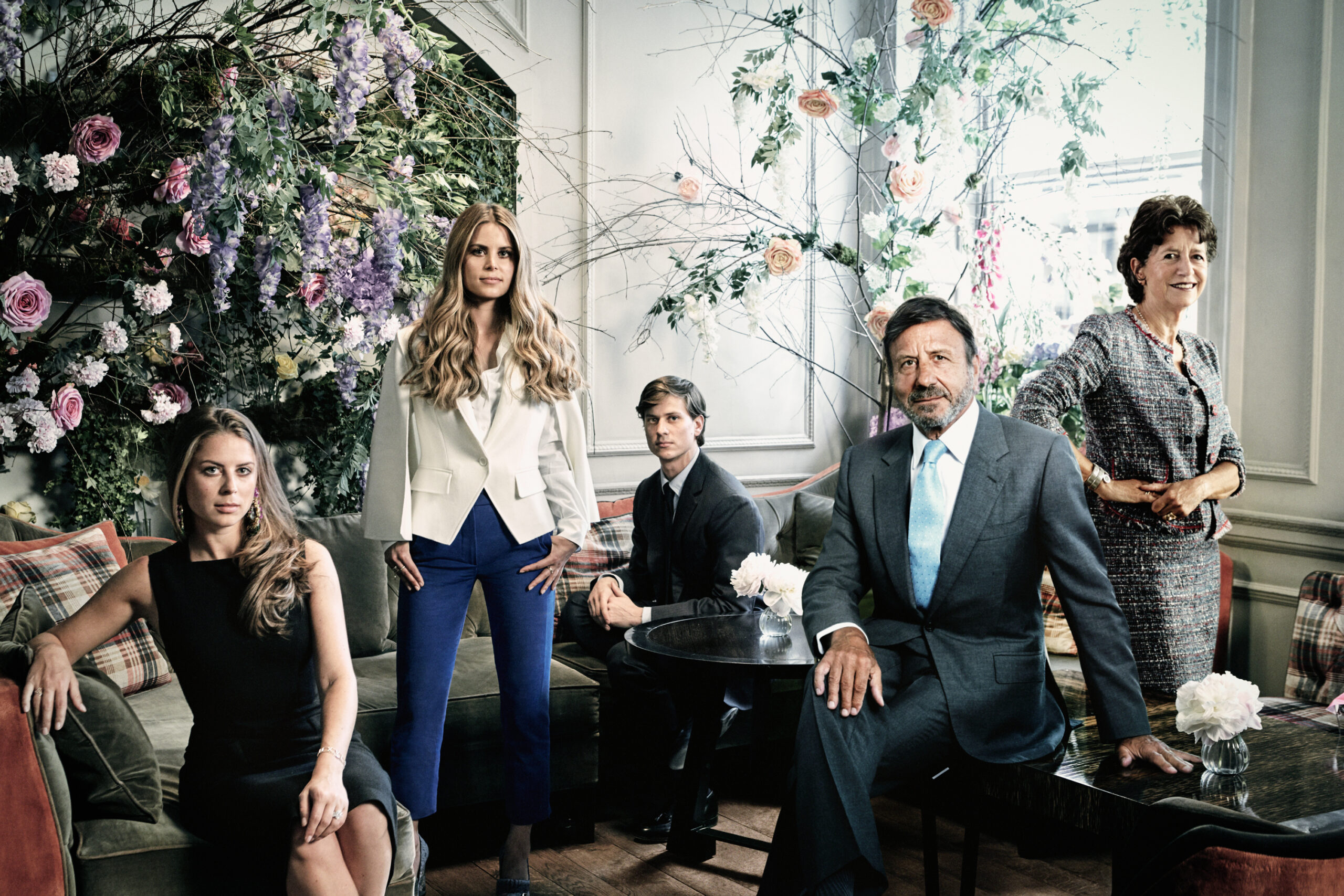
    The attractions of the hotel industry are the same as they were before the pandemic. Young people should know that hotels dependent on a domestic audience are doing better than hotels that had been dependent on an international market. For instance, my sister has two hotels, the Hotel Tresanton in Cornwall and Hotel Endsleigh in Devon. They have been doing very well. 

    My father, the late Lord Forte, had an enthusiasm for the hospitality business, and a great sense of dedication to it. He was very disciplined in his approach and a man of huge integrity. His view of business was that it’s important to be fair to people, to one’s partners, one’s customers, staff and suppliers – and to treat everyone with equal respect. He was an intelligent man with great charm and the ability to communicate. 

    Looking back, he created an atmosphere – a culture which was very strong and it all to do with him. I try to do the same in the businesses I’ve created. That’s the thing I’m most proud of. However much money and wealth I’ve created, what pleases me is the sense of culture and continuity which you’ll find across my properties. 

    My hope is that there’s a warmth and welcoming atmosphere in all my Forte hotels which you don’t find in all other properties – I aim for that sense of family, history and continuity and I hope my staff see us as family. My sister Olga, and my children too, are all passionate about what we do and care very much about the results and the quality of the service we give to our customers. We have a professional team of people working for us, very good training programmes, development schemes and so on. 

    As to my children, they all have different roles within the business. My daughter Lydia is responsible for restaurants and bars. She has long experience of working outside the company in restaurants. In fact, after her university degree at Oxford, she became a waitress in one of Mark Hix’s restaurants and did a year and a half with him, before being recruited to be assistant manager at the Markham Inn in Chelsea. 

    My second daughter Irene is responsible for the spas, and also worked holiday jobs and spent a year and a half working in Brown’s going through various departments. Having worked on the personal training side and taken special initiatives there, she developed a spa philosophy for us because we’d never had one before she came on board – but then I don’t like them, and don’t use them myself!

    Irene has also developed some organic skincare products off her own bat called Irene Forte, and she’s launching that effectively as a separate business though we’ll continue to have a shareholding in it. My son works on the development side finding new hotels and so on. We’d be especially in moving into America and Paris at some point.

    I’m sometimes asked about the Everyman hardbacks in the rooms. It’s a feature we’ve had in our hotels, but again it’s a family thing. My sister’s really pushed that as part of decoration in the hotels. It’s do with making them feel more homely and more comfortable. The Everyman range has a big cross section of books, and we try and put books relating to the locality of the hotel in the rooms. So for example in the Verdura Resort in Sicily, we have Montalbano novels, as well as Lampedusa’s The Leopard

    I only speak Italian and French. I don’t speak German unfortunately; I’ve been too lazy to learn it. I’ve had a hotel presence there for ten years now and hardly speak a word of it, so I suppose I should be chastised for that. Obviously, if you speak people’s languages you can interact that much better. Although Italy is my second country, my blood is Italian so I have a natural instinct for Italy. I’m thought of as an Italian in Italy, or as a Brit in the UK – or a very strange one! But what makes the hotels work so well is this family culture I’m describing.

  • The civil service is a ‘truly fantastic profession’: Sir Philip Rutnam


    Sir Philip Rutnam


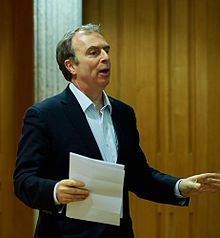
    I worked in the civil service from 1987 until 2020; I began by working in the Treasury and my initial expectation was exceeded in terms of the interest in the work and responsibility that I was given quite early on. There’s this erroneous idea of it being a stuffy place full of hierarchy and restrictions instead I found it was a place where you were given very clear objectives and a lot of responsibility to take them forward.

    The treasury is interesting because it’s right at the centre of government but you also realise that while the Treasury has the power to say no, it doesn’t generally have the power to make things happen: it can could refuse to provide the funding but it can’t actually usually change the system of education or healthcare.

    Did I have mentors in the early days? I had very good people responsible from management giving me direction and mentors who gave me more informal advice. Like any career you do end up having to make your own way but what’s vital is to have exposure to a range of different people who have got advice and give advice and to try to learn the best from each of them.

    When it comes to what the optimal setup is within the civil service, I definitely think you need to have people with a combination of deep specialist expertise with enough capacity as a generalist to get things done within government. In my own career I liked staying in roles for a good few years in order to try to get to grips with what was happening. By the time I was permanent secretary at the transport I feel we got the balance right.  Incidentally, I believe HS2 will get to Euston in the end – and I hope without too much delay.

    The fundamental job of the top of the civil service is to help ministers – and sometimes they will have just arrived in position – to translate their political objectives into practice. It’s a question of helping ministers identify their objectives sufficiently and then work out how they are going to be turned into reality.

    I never found it difficult to be apolitical because that’s a core part of the professional skills set. You are there to serve the democratically elected government so being impartial is a precondition for being there.

    It’s important to understand that there is an enormous variety of different things you can do in the civil service: it has about 500,000 people employed in it.   People tend to think that the civil service is all about working with ministers – somewhere between Yes, Minister and The Thick of It.  There are scientific and technical jobs of huge importance.

    In the Department of Transport working for me, there were people responsible for investigating air accidents or rail accidents; people working in and running really large operational systems like licensing drivers and vehicles at the DVLA – nearly 5000 people the single biggest employer in Swansea.   We also had really large complicated computer systems: so we had IT experts, and experts in programme and project managements.

    In fact, we had everything from policy experts through to statisticians, data scientists, social researchers, economists, lawyers, actuaries, accountants, finance experts, and specialists in estate management. This is a hugely under-appreciated: if we don’t think this message is important we won’t end up with a good civil service.

    There are also lots of different entry routes.   There are apprenticeship entry routes, and other degree entry options.   There is the fast stream with the exam, which is probably one of the smallest entry routes. You can become a specialist in HR, finance, or project and programme management or commercial management.

    The fast steam certainly means that your get more opportunity subject to performance to get promoted earlier: but once you have got to grade 7 there’s no further advantage to being on that track. It is competitive but enormous efforts are made to identity talented people from a wide range of backgrounds. It’s a fantastic profession.


  • Clive James: Interview reflections from his friend Sir Tom Stoppard

    Christopher Jackson hears from the 83-year-old playwright about his old friend Clive James, and finds evidence of a moving friendship

    I’m sometimes surprised by how quickly dead writers recede. It amazes me that John Updike will be 13 years dead in January 2022; Philip Roth departed four years ago. The same with VS Naipaul. Christopher Hitchens has been dead nearly a decade.

    In each instance, you find the writer’s profile declines at their death; for one thing they’re not around to promote their books. Dead poets need advocates. Two year on from Clive James’ departure, it’s very soon to worry about his posthumous reputation – and too soon to reappraise.

    But as these two years have passed, and the world been changed utterly by the pandemic, I’ve found myself thinking about his work. But then that’s no surprise. As readers know, poems like “Japanese Maple”, “Holding Court”, and “Leçons des Ténèbres” have a habit, as Larkin’s did, of loitering in the memory.

    I never met him, though I did get to interview him over e-mail towards the end of his life. What Clive would have thought of the pandemic is anyone’s guess. Housebound in Cambridge for his last decade or so, it seems likely that he would have found the humour in the pandemic just as he did in so much else. But the fact that he never clapped eyes on the words Covid-19 and coronavirus is now the principal distance between us and him. Perhaps it’s the first hurdle his poetry has to traverse: it needs to touch us now.

    The memory of Clive can still stir people into action who don’t usually feel like doing media. One is Sir Tom Stoppard who was friends with Clive. Having been through Hermione Lee’s monumental biography of Stoppard and found little but passing reference to Clive, I decide to see if Stoppard is in the mood to reminisce.

    To my mild surprise, an email comes back. “You’ve sent me back into Clive’s “Collected” for an afternoon,” he says. “I’m grateful because the reading rebuked me for not having read so many of these poems before (and forgetting many I had read).”

    If you want to imagine where Stoppard is writing from, it’s worth watching Alan Yentob’s recent Imagine documentary, which shows the playwright in a country house with enviable gardens, and a number of pet tortoises.

    The Stoppard-James friendship is an intriguing one: of writers working in the late 20th and early 21st century their work seems to me the most likely to last, not just because of the richness of their output, but because of their infectious quotability.

    Here – plucked at random from his oeuvre – is the James voice for those who might have missed it: “Santyana was probably wrong when he said that those who forget the past are condemned to relive it. Those who remember are condemned to relive it too.” On Peter Cook: “He wasn’t just a genius, he had the genius’ impatience with the whole idea of doing something again.”

    And here he is on Stoppard: “The mainspring of Rosencrantz and Guildernstern Are Dead is the perception – surely a compassionate one – that the fact of their deaths mattering so little to Hamlet was something which ought to have mattered to Shakespeare.”

    So how far do they go back? Stoppard says he finds it hard to remember his first associations with Clive. “The past is mostly fog. I can’t remember how I first met Clive. Early on, he took me to join in one of those “famous” literary lunchings (Amis, McEwan et al).”

    I note how from Stoppard’s perspective, these lunches, which sometimes form a slightly obligatory part of our literary lore, have vanished into the ether.

    Clive and Tom have both spoken publicly about the way in which Clive used to send the playwright his poems – but again there is no mention of it in Lee’s book.

    So did Clive send Stoppard his poems? “Yes he did, during his last few years, send me some poems for comment.” And did Stoppard ever offer suggestions, and if so did Clive ever accept them? “He sometimes accepted the point,” Stoppard continues. “But I haven’t kept my letters and remember no instances. I don’t think I sent him my plays.”

    In plays like Arcadia, the action turns on a hapless biographer desperate to get at the truth of the past, only to find that the past hasn’t been properly preserved. It’s interesting to find that the playwright is himself cavalier with preserving communiqués of obvious literary interest. Stoppard has pulled off the trick of making me feel like a Stoppard character.

    But what comes across instead is that Stoppard genuinely admired Clive’s work: “I hugely enjoyed his writing, poems and prose,” he continues. “What I enjoyed, aside from his craft, was the way his store of cultural trivia (about Hollywood, machines, films, sport, etc) was intermixed with the real erudition.”

    But has Clive’s reputation suffered a bit precisely because he could do so much? “I guess that this connects with that: a lowbrow intellectual with a highbrow appreciation of the commonplace.  From Auden to Weissmuller.”

    I have to look up Weissmuller who, though he sounds like he ought to be a philosopher, turns an Olympic swimmer, the subject of a Clive poem ‘Johnny Weissmuller dead in Acapulco’. It’s in the Collected, so no doubt it popped into Tom’s mind because he’d read it that day. It’s a very Clive thing, to visit his poetry then find yourself sent back to your laptop to look up a forgotten athlete. I’m not sure if there’s another writer who so often sends me to Google.

    We tend to punish people sometimes for knowing too much; we suspect the heart is losing out to the head, and sometimes as in poems like ‘Jet lag in Tokyo’ (“Flat feet kept Einstein out of the army”) or Whitman and the Moth (‘Van Wyck Brooks tells us Whitman in old age/ Sat by a pond in nothing but his hat’) it might be that Clive is too concerned to tell you what he knows before he tells you what we really want to know: how he feels.

    But Stoppard, who is known for complexity in the theatre, favours simplicity in poetry, and this is why Clive’s poetry has merit for him: “In addition, he is always an “easy” poet, his poems come across wholly at first reading, everything declares itself in one shot, like an Annie Liebowitz photo (as Clive might say).”

    I ask Stoppard which poems in particular he values. Stoppard gives a thoughtful response. “The last long “The River in the Sky” just flows along, doesn’t it, as though dictated, but how difficult to bring it off.”

    This is assessment reminds me for some reason of what Andrew Marr once told me: “I read that poem, and thought how wonderful that there’s somebody on this earth who’s actually read something.”

    This sense of Clive as keeping the lights on on our behalf is perhaps an underestimated aspect of his achievement: there’s always a sense that he was doing it for us all. We felt included in his project and that’s an integral aspect of the affection in which he continues to be held.

    Stoppard has another important point to make. “There’s an exhibitionist in him, and perhaps exhibitionists aren’t really trusted.

    Clive was as much a fan as a star.  Most stars are careful not to show fandom to too many too often. But Clive couldn’t help himself.  He went overboard for those he loved.  I felt overestimated by him, as many did, I hope and suspect. But his approval mattered to me.”

    Stoppard also has some favourites from James’ vast oeuvre: “Although he wrote bigger, greater poems, I love ‘Living Doll’ a lot. The poem I’ve read aloud most to more people is ‘The Book of My Enemy’.”

    This sends me back to ‘Living Doll’ which I hope everyone who reads this will look at. It shows what James was able to do by the end: poems where the performance has receded before the urgency of what has to be said – and said clearly and musically.

    There remain doubters here and there about Clive’s poetry, but my sense is he got awfully good towards the end in a very short space of time. It was an astonishing, courageous old age.

    Of course, you don’t do that without being pretty good to begin with. My sense is that as the years, and centuries go by, no one will mind whether he did his best work late or not – just as we don’t first read ‘The Tower’ as late Yeats. Buttressed by time from the circumstances of his life and death, we’re more likely to read it as Yeats.

    It’s generous of Stoppard, who is extremely busy, and has also earned a right to some peace and quiet, to answer these questions. But it’s clear that the generosity is towards Clive’s ghost, not me. I don’t delete his email as he apparently deleted Clive’s – but as I finish work that day, it’s a pleasant thought to imagine Tom spending the afternoon with Clive like that. May he spend many more. 

  • Class Dismissed: Richard Desmond

    Richard Desmond, the successful publisher and founder of the Health Lottery on the next generation, the success of OK! magazine – and not switching off


    Tell us a little about your upbringing. What do you think parents would say if they could see your success today?

    Look, I think they’d be incredibly proud. My father was the managing director of a cinema advertising chain Pearl & Dean and he used to take me to meetings. I have been in a lot of interesting meetings since; I can tell you that.


    You left school at 15 and have fought your way to the top. Do you think the university system has become less successful at preparing young people for the workplace?


    Universities are good for some students – but I reckon they’re not always right if you want to start a business. Parents are better off carefully thinking about what kind of offspring they have: don’t just send them to university if they have entrepreneurial flair.


    Did you have a mentor in your early days of business?


    Yes, but I always made my own decisions. I have tried to inspire the next generation and tell them when they are wrong. The main reason people fail in business is just that – lack of clarity of purpose.


    What advice would you give to young people today looking to start their own businesses? 


    It is tough out there and the sooner you realise that the better. You need resilience, the ability to sell and to champion your purpose – I can tell you that business is also a hell of a lot of fun when you win.


    Why do you think OK! ended up surpassing Hello! in the market?


    We were in tune with the markets: people wanted out product and we knew it. That meant that we were able to live and breathe it, knowing that with the right we would be successful. I also think we invested in the right features: never underestimate the value of good editorial – and when you see a good story, put your money behind it.


    How do you feel about Sir Keir Starmer’s administration? 


    He claims to be the party of wealth creation. It is probably better for me not to say anything just yet, although I am known for my expletives. Sometimes the wisest course of action is for me to try and remain silent.


    What did the writing of The Real Deal teach you about yourself and your past career?


    No doubt about it – most absorbing experience of my life. I remember being very busy writing it. It’s a fascinating experience to draw it all together – the threads of your life. Some of my best friends and worst adversaries told me that they couldn’t put it down.


    The Health Lottery is a passion of yours. What community projects are you most proud of having supported because of this initiative?


    I’ve a very simple philosophy on this. Don’t do anything you’re not proud of. I don’t believe in going into any project without believing absolutely in its importance.


    How do you switch off from work? 


    I never switch off – the lights never go out here!


    What is your legacy and how would you like to be remembered? 


    It is far too soon to be thinking about that. However, allow me look back with great pride for my own part in ensuring the Battle of Britain Monument which I helped get built against all the odds!


  • Independent Thought, Have we Lost the Habit: Long Read

    Christopher Jackson looks at the question of whether we inhabit an age of consensus – and asks whether there’s anything we can do about it


    Our cities are so far advanced down a misguided aesthetic that even revolutionary projects must be undertaken in bad architecture. Michaela Community School is located opposite Wembley Park tube station. Adjacent to a ring road, its surroundings feel like a testament to generations of bad urban planning linked to the demands of the car. Despite this you somehow suspect that Michaela Community is revolutionary before you’re even through the gates.

    Even amid the squalor, banners proclaim central Michaela precepts: ‘Work Hard’, ‘Be Kind’, ‘Top of the Pyramid’. It also reminds you of its excellent results: “Ofsted rated Outstanding. Over 75% to Russell Group Universities including Oxbridge, LSE and Imperial.” These messages feel somehow incongruous when set alongside the mess we have made of this part of North London.

    Inside the impression of difference sharpens: you know straightaway this isn’t a normal school. You are greeted by examples of the children’s excellent artwork, including portraits of David Cameron, Queen Elizabeth II and Boris Johnson. Newspaper clippings detail the visits of dignitaries and interviews with Michaela’s Headmistress Katharine Birbalsingh, Britain’s so-called ‘strictest headmistress’. Lauded by the right, and despised by the left, Birbalsingh has done a difficult, almost unprecedented, thing: she has acquired fame as a teacher.

    As I am escorted up to see her, I am aware of a mood in her administrative team which doesn’t usually accompany my visits to schools. It is, in fact, the sort of awe which surrounds rock stars and Cabinet ministers. And yet the respect surrounding the headteacher has a distinctive strain often absent in those other cases: it is genuine love and respect.

    In place of the usual din of schools – places which are usually full of vaguely located cries, as in a shopping centre – at Michaela there is only the hush of concentration. Famously, Birbalsingh has created a regime where there’s no talking in the corridors and students regularly submit to having their mobile phones put in storage to aid their learning.

    As I walk on up to Birbalsingh’s office, I walk past a group of children moving between lessons. They remind me of contented nuns and monks shuffling through a cloisters. One looks up at me and offers a wry smile. In the context, it’s subversive – a moment of independence within a strict regime.

    I will find I like the school a lot. What has been achieved here is beyond doubt. But I think afterwards about that boy with the smile. It feels emblematic of the independent streak.


    Blair and his Heirs


    Independent thought, it might be said, hasn’t had a particularly illustrious 25 years. It is now a quarter of a century since Tony Blair came to office and proclaimed a new dawn. You can look at Blair’s government in a number of ways. It might be considered a ratification of Thatcherism insofar as Labour altered Clause Four, making the party far friendlier to business. It can be remembered for its miserable foreign wars. It can also be seen as a period of devolution away from Westminster, with results which we’re seeing today in Scotland and Northern Ireland.

    But in spite of the controversies, Blair’s electoral success was so great that, in ways we might not appreciate, we still live in the aftermath of that 1997 landslide, and his subsequent victories in 2001 and 2005.

    That’s because large majorities are reflections of consensus. In 2010, David Cameron’s Coalition government adopted a strong dose of Blair’s Europhilia (with a few concessions to his backbenchers), and continued New Labourish policies when it came to the academisation of schools, international aid, civil partnerships, an interventionist foreign policy, and many other areas. The similarity between the two culminated in the spectacle of Blair and Cameron – alongside Blair’s predecessor John Major – campaigning together on the same losing side in the 2016 referendum. Furthermore, the three of them argued for the same Covid restrictions in March 2020.

    This has left a gap into which some conservatives – including the likes of Peter Hitchens, Toby Young and Douglas Murray – have been arguing for things outside the Blairite consensus. For Hitchens, the Conservatives’ failure to promote a return to grammar schools is a particular point of criticism, as is the laxity of the police. For Young, lockdown was an outrage perpetrated against the great tradition of English freedom. For Murray, the Blair-Cameron axis is wrong over immigration, and was deservedly repudiated in 2016. All three of them would argue that there are far too many woke MPs, some of whom nominally belong to the Conservative Party, but who aren’t really conservatives at all.

    Most heretically of all, each of these thinkers would reserve the right to subject the climate change orthodoxy to proper scrutiny, if only because questioning things is in the British political tradition, not to mention the broader scientific tradition. Whether we agree with all this or not, each of these writers reads today bracingly if you grew up under the Blair consensus: they read like people thinking for themselves.


    Past the Age of Consent?


    Consensus is, of course, not a bad thing per se. We have, for instance, been governed by a consensus that murder is a punishable crime for millennia to no-one’s disadvantage but murderers. Likewise, our shared consensus that Shakespeare is a great playwright has preserved Shakespeare, and is another example of what might be called profitable consensus. When Tolstoy cantankerously announced towards the end of his life that Shakespeare was no good, he was thinking independently, but not particularly well. There is a distinction then to be made between useful polemic which ultimately turns out to be true, and wilful contrarianism, which causes a lot of noise and misleads a lot of people.

    But despite these reservations, it must be admitted that consensus sometimes feels flabby. When too many people have arrived at the same conclusions it might be that those conclusions are dated, or have lost some spark.

    So which kind is the the Blairite consensus? There are some warning signs which stretch beyond Tony Blair’s own personal unpopularity. It certainly isn’t quite as popular as its holders would wish, or suppose. This fact was made clear to Remainer voters in the 2016 election: it turned out that a surprising number of people in the country were, while being ostensibly civilised, quietly thinking the unthinkable: that the Blairite worldview might be wrong somewhere at its Europhilic core.

    But what really brought the question of independent thought into sharp focus was the Covid-19 pandemic. Whether lockdown might be deemed an overreaction or a wise necessity, it forced government into our lives like it has never been before and this in turn raised considerable questions around how we receive and sift data, what is true and what is false, and above all, what our personal relationship is with the notion of government interference.

    It brought to the fore the whole question of statistical modelling and for some thinkers has ramifications not just for how we tackle the spread of viral disease, but also for the broader way in which we use scientific data. “The models were completely wrong,” the economist Roger Bootle, another independent thinker of the right, tells me. “And it’s the same in relation to the climate models – although not to quite the same extent, because the most unpredictable thing about the Covid-19 models was human behaviour, and that has slightly less bearing on the climate change models.”

    But the fact remains: by 2022, a generation of professionals in senior positions had come to maturity thinking and feeling roughly the same things about most things. If their worldview is wrong at all, then remarkably few ramifications have come their way: on the contrary, they have usually found their sense of consensus ratified by professional success. Lockdown caused the consensus-bearers no harm since, financially, little can. Lawyers and accountants remained for the most part in spacious housing doing jobs which it is possible, and in many cases enjoyable, to do from home. Doctors were designated key workers and spared the strains of home schooling.

    Even so, there are some warning signs that what the consensus bearers have been thinking and feeling might be wrong after all. If we look at inflation or high energy prices, the dubious tactics of Extinction Rebellion, the increasing extremism of wokeism, the long waiting times on the NHS, the former Chancellor Rishi Sunak’s tax rises to pay for lockdown, and the relatively settled landscape post-Brexit, there is a sense that there might be value in listening to voices, from both left and right, that lie outside the consensus. We might not change our minds on policy but we’ll certainly learn something about how to think.

    The question is not just: “Who is right on these issues?” It is also: “What does independent thought look like in this day and age? And who has a motivation to practice it?”


    An Audience with Katharine the Great


    To promote independent thinking, what kind of education system do we need?

    For the right, Birbalsingh has arrived as a kind of saviour in this realm, seeming to embody some better method. Of course, as the writer of Ecclesiastes understood, there is nothing new under the sun: her new way of doing things is tethered to the old. Put simply, Birbalsingh argues for the importance of promoting knowledge of a shared cultural tradition in order to foster the independence of thought which might ultimately free us of what she views as the groupthink of wokeness.

    When I sit down with Birbalsingh at Michaela Community, I tell her that the place reminds me of grammar schools. She doesn’t find it a helpful comparison. “There are a couple of grammar schools round here,” she admits. “But they take the top slice. Any good teacher knows that it’s really complex when teaching the bottom sets. If you’ve only got the top students, you don’t have to think about learning in the same way. When you have a great cognitive diversity you have to do more.”

    In this sentence, ‘more’ means strictness and standards. I wonder aloud whether there’s any danger about the regime, and whether it might over time create conformity instead of individual inspiration? I tell the story of my old English teacher at Charterhouse, Philip Balkwill, who was famous for his eccentricity. In one English lesson, he came in, played Beethoven’s 9th symphony and then left the room without explanation.

    Birbalsingh is amused, but not especially impressed: “The thing is, you can only do that kind of thing when you’ve got a selective intake. If you do that in an inner-city school, the kids will all just be laughing and jumping around and running out of the lesson. And then you say, “Well, what have you achieved?” You’ve just created chaos. The kids have just lost all respect for you and you will find it very difficult to build up your resilience again.”

    Here then is one obstacle to independent thought: it can’t be something you do overnight. You’ve got to lay the groundwork with discipline first. I mention that Balkwill’s lessons for me operated on a kind of time bomb. I came to realise years later that he was talking about the porousness between disciplines and how music and literature might be interconnected.

    Birbalsingh laughs: “The fact that you only realised that ten years later: that’s ridiculous. Teaching is about making things explicit. He was doing things like that for himself and so that he could say to himself: “I’m the most amazing teacher.” He liked being eccentric. In the end, how much did he really teach?”

    I say that it felt like being bequeathed a certain permission to roam freely across intellectual disciplines. Birbalsingh doesn’t think that approach will generally work: “You need to realise that the kids here have no idea who Beethoven is unless we teach them that. Once I gave an assembly about Beethoven’s Fifth, as I wanted them to at least recognise the tune which you hear all the time. I was talking about how it was difficult for them growing up in a time of grime and drill.

    The worst for me when I was growing up was Kylie Minogue and how everyone was scandalised by her shorts. I put a picture of Beethoven up on the slides. Later when I was having lunch with the kids, I realised they thought Kylie Minogue and Beethoven were contemporaries because I hadn’t made it clear. They don’t know that there’s music from the 16th, 17th, 18th, 19th century and how it’s changed. When they learn music here we start with A, B, C, D.”

    She continues: “What you mightn’t realise is just how impoverished some children are and that’s what an inner city school is. Those antics of your teacher you described are not helpful.” I think again of the boy smiling in the corridor. I agree with Birbalsingh, and yet some small part of me wants to retain the idea of another approach. I find that Mr Balkwill’s lessons can’t be so instantly jettisoned. Something would be lost.


    Uncle Toby


    Sometimes of course having a good education culminating in all the expected excellent results might not be a spur towards independent thinking: in fact, it might lead you up too obvious a career ladder meaning precisely the opposite – that you never have to think for yourself at all. It used to be that a dose of failure did a little good.

    I talk to that noted independent thinker Toby Young – so much a bugbear of the left, that he seems to exist in a permanent ferment of being cancelled and recovering from his latest bout of cancellation. He tells me about his somewhat chequered early education: “I initially failed all my O Levels, and went to two different comprehensives. I retook and got three Cs, which was enough to scrape into the sixth form of William Ellis. I did well enough to apply to Oxford. I didn’t meet the conditional offer, but was sent an acceptance letter by mistake. When that was pointed out to me, they then offered me a place – it was an unconventional route.”

    Young, who would go on to set up The Modern Review, The Spectator Online and, in 2020, The Daily Sceptic, credits the entrepreneurial side to his upbringing. “My father was one of the people behind the Open University. He created over 50 organisations of one kind or another during his life. A couple of those got torched in David Cameron’s Bonfire of the Quangoes. He was a lifelong socialist and one of this country’s first sociologists in addition to running a Research Institute in Bethnal Green, he implemented these institutions. That gave me confidence.”

    Young was then exposed to the left-of-centre culture of Oxford, before relocating to America, and landing among the uber-left campus life at Harvard. This was the era when Alan Bloom published his famous Closing of the American Mind, a sort of prophetic cri de coeur about the encroachment of what we would now call ‘wokeness’ onto campuses.

    Young recalls: “Within my year group at Brasenose [at Oxford] studying PPE, we had the full gamut from a Monday Club tubthumper to a member of the revolutionary Communist party and every shade in between – and there were only ten students.” And in the US? “At Harvard, there was nothing like that range of opinion even in the entire government department, which encompassed hundreds of students. The main debate was between two types of liberalisms – Nozickian and Rawlsian liberalism – that was the extent of the disagreement, and Nozickians were a real minority!”

    This sounds like the sort of landscape which Katharine Birbalsingh, in her different way, is committed to pushing back at. Young agrees: “I’m a big fan of Michaela – it’s incredible. In Michael Gove’s wildest dreams I don’t think he’d’ve anticipated the free schools programme would have given birth to such a perfect embodiment of what he views a school to be.”

    So is the encroachment on independent thinking less to do with some sort of Blairite inheritance, and more to do with groupthink migrating from America to this country? Young replies: “I certainly think that as British universities have admitted more American students and grown in size, they have attracted left-wing academics with a sense of social mission who want to change the world by converting and evangelising. But it’s partly a generational shift; most of these people were radicalised in the 1960s. You gradually see more of a left-wing imbalance in the professoriat.”

    This mindset in turn has infiltrated, or so the argument goes, every strata of society, achieving numerous coups: it captured most of the major cultural institutions; the BBC; and even large swathes of the Conservative Party. In response to the professional calamity which can sometimes assail those who speak up against this consensus, Young founded the Free Speech Union in 2020.

    I ask Young about the future of independent thought and he initially strikes a surprisingly optimistic note: “The curious thing is that even though all our main cultural institutions – the BBC, heritage institutions, performance arts companies, the National Theatre – they’ve all been captured by this rather small-minded illiberal ideological cult, at the same time you’ve had right-of-centre figures winning elections. The professions and the educated elite are beholden to this woke cult, but it hasn’t filtered down to ordinary people.”

    This, in Young’s view, is a sign that most people still retain the habit of thinking independently. “There’s a disconnect,” he explains. “You see that in the way in which the trans lobby has got into trouble by trying to give trans women access to women’s changing rooms in department stores without trying to persuade the public it’s the right thing to do. That’s proved quite unpopular and authoritarian. All is not lost.”

    Even so, he also issues a note of caution. “One of the reasons to be doubtful about how quickly the spirit of liberty can be restored is that it was revealed to be in a very decrepit state during the last two years. It was surprisingly easy for the government and various public health agencies, civil servants and the BBC to persuade people to exchange their liberty for safety and much more so than it would have been in the Asian flu in the 1950s. That was true not just of Britain but of most liberal democracies.”

    Of course, we must be careful here not to attribute all independent thought to lockdown sceptics. For instance, the vaccines – not to mention the inventive way in which those vaccines were rolled out – arguably constitute a greater example of initiative than anything shown by those who stood from the touchlines arguing against lockdown.

    But Young, Murray and Hitchens aren’t arguing against science. What they would say is that science has become dangerously allied to politics, that it is poorly reported leading to a bogus consensus (usually in the direction of the exaggeration of danger), and that an atmosphere of intolerance has grown up around some of the conclusions it has arrived at. Clinchingly, they would simply defend their right to ask questions about it.


    A Question of Method


    So how would Young go about teaching independent thought? “I’ve been wondering whether, under the guise of teaching schoolchildren how to debate, you could teach them some critical thinking skills,” he replies. “It’s extraordinary when you argue with young people how often they fall back on what they think of as the trump card of their own lived experience. It doesn’t matter if you present them with data that contradicts their claim.”

    I ask for examples. “Let’s say you’re arguing with a young black student about whether or not Britain is an institutionally racist country,” Young says. “You could point out, for example, that more black boys go to university from underprivileged backgrounds than do white boys. Or you could cite the fact that Indians on average earn more than white Britons.

    You could also point to the success of boys of African heritage at university and in the professions. There’s actually all sorts of evidence that not being born with a white skin isn’t an insurmountable handicap in this country. You could present that case as reasonably and calmly as possible but they could just say: “That’s not my experience, but you’re a white man and from my point of view, that’s bollocks.” Nearly all children nowadays fall back on this Megan Markle ‘my truth’ trump card.”

    So what do we do? Young has clearly been thinking deeply about this: “It would be really helpful to teach children why that isn’t a knock-down argument, and why it isn’t a trump card. It’s also important for them to know why data is more important than anecdote and how you can merge lots of different people’s lived experience to come up with a more objective balanced view as to what the collective experience is.”

    Does he think the teaching profession will be able to do this? Young isn’t sure. “Teachers these days are shy of challenging emotional impassioned teenagers – particularly if they’re members of disadvantaged groups. In taking that stance, they allow these irrational ideas to flourish.”

    So would that require some kind of shift in the curriculum? “The main thing we need to do is to teach them the rudiments of how to build an argument, recognise a good from a bad argument, and teach what the most common logical fallacies are. Those analytical skills would mean you’d develop a bullshit detector.”


    Avenging Angel


    It’s interesting that Young’s background is predominantly entrepreneurial and I begin to wonder whether I’m really talking to a journalist or to an entrepreneur. Is there something about being an entrepreneur which fosters independent thought? To find out, I talk with James Badgett, the CEO and founder of the enormously successful Angel Investment Network. Badgett, 40, isn’t just a well-known entrepreneur in his own right, but, given the unique nature of his business, also the centrepoint of a vast amount of economic activity.

    So does he feel that as an entrepreneur he’s under greater pressure to think independently? “It’s quite straightforward. When I wake in the morning, first I have to check I’m okay. Then I have to make sure my team is okay. You can’t lie to yourself as a business-owner because you’ll get found out. That means that if the government tells you to work from home, or if The Guardian tells you leaving the European Union is a disaster, or if Greta Thunberg tells you the planet is about to burn – you have a responsibility to go away and check if those things are actually going to happen.”

    Badgett is known for holding unpopular opinions, but he views it as important for his many businesses to make sure he holds firm. “I think I’ve got to the point now where almost any view I hold isn’t held by the majority,” Badgett says. “I’ve grown used to people thinking I have an unusual take but I’m not going to stop saying what I think.”

    Badgett’s success can partly be attributed to an ability to cut through the range of information he receives in order to decide on the right strategy for his businesses. He tells me of his dislike of corporate settings: “You just feel yourself become cretinised when you sit in these big firms.

    You ask for the coffee, and sit back and feel somehow flattered to be in there – and I think that happens to a lot of people who become quite limited in their outlook. They’ve first become too comfortable. But I’ve learned that in business you’ve got to be careful not to fall for all that. You have to remain rooted – and you have to surround yourself with the right people.”

    He is sceptical of anyone too who “suggests strategies which are easier to say than to do” and is always creative in the way he runs his companies. Badgett has a Nepalese office of the Angel Investment Network, and realised before the pandemic that it would be affordable for the company to have a top chef cook for his workforce and that it would also be a great boost for the company. “I went ahead and did it – though I expect the BBC would have told me it was impossible.”

    Like Young, Badgett opposed lockdown in March 2020, and also counts himself a climate change sceptic. “One thing I disagree with in relation to Greta Thunberg is this elevation of the child to the level of sage. She’s still very young and her predictions are likely to be wildly inaccurate just as Dr Niall Ferguson’s were during Covid-19.”

    I ask Badgett whether he thinks we need to do more in education to teach commercial acumen. “The truth is that most people walk into working life absolutely financially illiterate and what you’re seeing today is the effect of a woke university system on the workplace,” he replies. “Basically, people don’t have the skills by which to sift information or to judge what’s true and what’s false – what is theory, and what is fact. What I think does happen though is that people who run businesses become more attuned to that – again, if you don’t your business will go under.”

    Whether one agrees with Badgett or not, he is a reminder that the ability to think independently as a society must be tied to a greater commercial sense.


    Approaching the Source


    If independent thought is under threat then there are a number of clear possible reasons for it. One is the influence of American wokeism on our university system as outlined by Young. Another might be the impact of the Blair-Cameron axis. A lack of commercial acumen is another: some have noted that epidemiologists were more likely to make gloomy predictions about coronavirus since, being in the pay of the government, they didn’t have to live with the commercial ramifications of those predications.

    But most people accept that the media, and the way in which we receive our information, also impacts our ability to make up our own minds effectively on important issues.

    One person well-placed to consider these matters is Sir Bill Wiggin MP, who represents North Herefordshire. He has spent 20 years in Parliament, and has had a front row seat on the way in which reality can be distorted by the media – and how this causes both misery for beleaguered MPs and confusion in the electorate who are often unable to find their way to primary source material.

    After years in the public eye, Wiggin says he’s become acutely aware of what journalism is and how it should be read. “When you read the newspaper, you’ve got to be careful,” he explains. “I’ll read whatever’s lying next to me – but I don’t read it believing it to be the gospel. I’m happy to read The Sun, The Guardian or The China Daily but I’m always reading it in a certain way with the awareness that they will have an agenda.”

    And what, in Wiggin’s opinion, is their agenda? “It’s quite simple really, it’s trying to outrage you or to terrify you.” So what would Wiggin’s advice be to people in respect of reading the mainstream media? “Don’t base your life on a publication: be broader than that. You need to be. And also realise that this sensationalism is driving all aspects of the media. For example, I get The Daily Express online. It has wonderful headlines: “Brexit delivers huge increases in British business.” Two days later it will say: “Brexit cuts British business”. They’re playing us! We’ve got to stop thinking that journalism is a Christian and pure-spirited thing. It’s as commercial as Star Wars.”

    I mention to Wiggin that I value the way in which my history degree gave me a habit of going to the primary source in order to assess the events of the past.

    Wiggin agrees but worries that these skills are being lost in the contemporary media maelstrom: “Today, The Guardian and the BBC are going to the source for you. When you watch the news tonight, you will see Vladimir Zelensky make an announcement about how Russians are losing in Ukraine, and the newsreader will say: “Now, we go to our Ukraine correspondent.” I want to hear from Zelensky not your correspondent! Then you might cut to another correspondent or expert: it was second hand when you got it from the BBC – now it’s third hand.”

    The Mp also points out that we tend to practice critical thinking better in other areas of our lives: “Anyone reading this article will know that if they go to a football match, what they see is different to what they read about it afterwards: but they don’t apply those lessons to their politics. Soak it up but don’t close your mind. When you read that x is wicked or that y is good a little voice in your head should say: “Well, that’s what it says here”. You shouldn’t be prepared to die in a ditch according to what you’ve read.”


    Good Humours


    One notable thing is that some right wing thinkers often seem to injure their case with a certain cantankerousness which somehow makes their case less persuasive. Of course, there might be mitigating circumstances. Most of them haven’t been listened to throughout their professional lives, and must feel a sense of mounting frustration at always feeling in the right and then watching governments continually make catastrophic moves.

    Although Peter Hitchens can be funny, it is probably the case that there has rarely been a less Christian-sounding Christian in the public sphere . There can sometimes be a sense of infinite probity about his public persona which feels somewhat tiring – reading him sometimes, one feels that nobody could manage long in his ideal state. One would want to be free a moment, like that boy in the Michaela Community corridor. There is a frequent note of exasperation – a sense of being almost tired of being so in the right – which makes one want to lodge objections, and which has probably led to his ideas being infrequently taken up by government.

    This brings me to Armando Iannucci and the importance of comedy in the realm of independent thinking. John Cleese recently observed that there is no such thing as a ‘woke joke’, but it seems to me that there are still vestiges on the left which are able to raise that profound laugh which lets you know an independent truth has been arrived at.

    Iannucci has always been able to do this – most notably in The Thick of It and Veep – those superb comedies which could only have been written by a unique cast of mind. Sure enough, Iannucci has been in fine form during the pandemic having penned an epic poetic satire on the first years of the Johnson administration called Pandemonium. We need only read its opening page to know that this is a voice of the left which is hardly caught up in groupthink:


    Tell, Mighty Wit, how the highest in forethought and,
    That tremendous plus, The Science,
    Saw off our panic and Globed vexation
    Until a drape of calmness furled around the earth
    And beckoned a new and greater normal into each life
    For which we give plenty gratitude and pay
    Willingly for the vict’ry triumph
    Merited by these wisest gods.


    It is worth noting how the big laugh comes from the line ‘that tremendous plus, the Science’ – the same Science which is in its way is poked at, and queried, by Young, Hitchens, Badgett and others. Here it is being mocked too. Blairism itself was full of those ‘tremendous pluses’, whose validity we were never meant to query.

    Pandemonium mocks Johnson, Matt Hancock, Tory donors, and Dominic Cummings. It suggests again that this era of consensus needn’t necessarily be worried at in a misanthropic spirit. It might be done with wit and laughter too. It is an enduring fact that many of the great thinkers of the 1930s – one thinks of George Bernard Shaw and Ezra Pound – fell for Stalinism and Nazism respectively. It took Charlie Chaplin and PG Wodehouse to laugh them out of town.

    Iannucci doesn’t extend his mockery to the Labour Party in the poem – and perhaps it would have been a better poem if he had. Bu one leftist intellectual who is prepared to query Starmerism – currently a kind of low energy Blairism – is the philosopher and poet Tariq Ali. Ali has just published – to the right’s dismay – a book attacking the legacy of Winston Churchill called Winston Churchill: His Crimes, His Times.

    For Ali, the habit of consensus thinking began further back in time during the post-War period: “I would refine the analysis slightly,” he says, when I describe the theory of the Blairite consensus. “The post-War consensus which was more or less agreed by Labour and the Tories after the Second World War, was that we have to go down the social democratic route. In Britain, this consensus was implemented and never altered in any meaningful sense, until it was broken definitively by Margaret Thatcher.”

    For Ali this is all bound up in the Churchill cult which began at that time, and has been continued by Johnson. Interestingly, Ali says that he prefers reading thinkers like Peter Hitchens to those on the centre right. “Obviously Peter and I won’t agree on most things but I have some respect for him. There is a degree of honesty and integrity in Peter which I don’t find in liberal writers. Look at the stand he’s taken on Julian Assange. I am amazed he’s still a columnist on The Mail on Sunday: it’s much sharper than things I read in The Guardian.”

    It’s this which often marks out independent thinking: integrity and the desire to conduct our thinking for the right reasons. And what does Peter Hitchens say in return? “I think Tariq Ali is a valuable independent voice because I think freedom dies without dissent. He’s undeniably intelligent, and undeniably thoughtful. I disagree with him profoundly on many things, and have done so publicly on such matters as the nature of Fidel Castro’s Cuba.”

    And what has it been like when they have sparred? “He has responded courteously, as a civilised person should, though he should have a higher opinion of The Mail on Sunday, which has a strong record of independent thinking. I think we both come from an era when an opponent was not necessarily an enemy. I also suspect him of having a sense of humour.  I wouldn’t say this feeling has anything to do with my own Marxist past. Most of my former comrades dislike me personally, though I can’t be bothered to return the compliment.”

    So perhaps the surest route to independent thinking is an education like that offered by Birbalsingh at Michaela Community, but with just that hint of a smile offered by that boy in the corridor, and by Philip Balkwill back at Charterhouse in the 1990s.

    But we also need much more: better commercial education as suggested by the examples of Toby Young and James Badgett; a deeper awareness of the need to go to the primary source as espoused by Wiggin. We also need Tariq Ali’s perspective of the deeper past.

    But it is Armando Iannucci’s ability with a joke which can sometimes seem most pertinent. It is this which verifies where we really stand on an issue, and which clears the decks and allows us to think clearly about problems.

    I didn’t tell Birbalsingh about another one of Philip Balkwill’s lessons. He would show us Beyond the Fringe and the great sketch where Peter Cook plays Arthur Streeb-Greebling who has spent his life ‘underwater teaching ravens to fly’. It was the silliest thing I’d ever heard – and it made me want to watch more. ‘Is it difficult to get ravens to fly underwater?’ asks Dudley Moore. “I think here difficult is a very good word,” Cook replies.

    The same is true in the realm of independent thinking – but as the problems of the world mount, and the implications of groupthink become clearer, this is increasingly a conversation we need to have as a society.