Category: Front Line

  • Opinion: James Cleverly, like Sunak after losing to Truss, will be back

    Christopher Jackson argues that James Cleverly isn’t done yet


    Sometimes it matters hugely how you lose. “We didn’t do it,” said James Cleverly at the low point in his career on Wednesday just after finding out he had failed in his bid to be leader of the Conservative Party.

    I was very struck by the nature of this video. It exuded confidence and, in fact, leadership. How was he able to do this? Although Cleverly admitted that it was disappointing for him personally, one had a sense in his concession video and throughout his leadership campaign that he wasn’t running solely out of personal motivation.

    Speaking to a Finito event last month, he spoke movingly about his love of the Conservative Party, and recalled staying up late as a young man on General Election night, going through the constituency results. His immediate thought after losing this week was to remind the Party that ‘we’re all Conservatives’.


    This was gracious in the same way that Sunak’s concession to Sir Keir Starmer was gracious. It might seem a small thing, but this sort of generosity in defeat is the mark of true leadership.


    There was no hubris involved incidentally in Cleverly’s defeat, contrary to bogus media speculation. Speaking to members of his team, the instructions were quite clear on Wednesday: all the MPs who wanted Cleverly as leader were instructed in no uncertain terms to vote for him.


    With surreptitious stupidity, a handful of MPs took the matter into their own hands, with the consequence that the membership will now not have a centrist candidate to vote for.


    In the pub afterwards, Cleverly was reportedly somewhat subdued following the defeat – as who wouldn’t be. But campaign members said he gave each a big hug – as is his style – and thanked them meaningfully for their work.


    Another campaign staff member recalled: “He is always like this. He always knows what to do – and power never changed him.” To rise so high, and to retain this core decency is a rare achievement – it is, in fact, worth more than the Conservative leadership, since it is to do with the inner being.


    Another recalled starting out as a young political operative. She wrote hundreds of emails to MPs and politicians. Only one replied: James Cleverly.


    I once asked the wonderful former Skills minister Rob Halfon which members of the then Cabinet were nice to their staff. He didn’t miss a beat in naming Cleverly and Mel Stride. It is unfortunate that the Conservative MPs, shark-like as always, failed to represent these two bastions of civility in the last two.


    Sharks, of course, are unable to swim backwards, and I think there is now something of this trait about the Conservatives. They are rushing forwards on one-dimensional momentum, supposedly for a brilliant kill.


    Will they hit the rocks? It seems more than possible. If they do, there seems a real possibility they’ll turn to Cleverly, just as they turned back to Sunak after the Truss fiasco. A list of history’s victors is also a list of those who were at one time or another good losers.


    Either way, my suspicion is that Cleverly’s stature has risen irreversibly as a result of the past few weeks.


    It was Theresa May who spoke of the Conservatives as the Nasty Party, and eventually became Prime Minister. If the British public were to decide that this new Conservative Party is a trifle abnormal, might not even knuckle-headed Conservative MPs revert to the man who told them so memorably to be normal all along?


    Similar articles:


    Last Chance Saloon: Can Rishi Sunak win the next election?

  • Sheridan Mangal: Inspiring mentorship – a Q & A

    Finito World meets Sheridan Mangal, a mentor with a particular line in career change mentoring


    Can you talk a bit about your upbringing and early career choices and how they shaped your work as a mentor for Finito?

    Born in 1961, I am what many would refer to as a baby-boomer, but also first Uk-born from the ‘Windrush’ generation. Raised in East London, progressing through primary and secondary school was a bumpy ride, but was equally the origin of my developing interests and ambitions. Once I realised that being a striker for Chelsea FC required some football talent, I turned my attention elsewhere…the City.

    So how did you make your way in your chosen field?


    After doing well at Brooke House Secondary, the intent of a temporary summer job prior to sixth form education turned into a permanent career decision. A City opportunity arose and at 16 years wrapped in sharp suit, my 16 year career at the London Stock Exchange began. This presented many challenges regarding steep learning curves, but also the unpleasant social ills of the time that crept into the workplace. After some years and despite the work experience gained, It is here that I always felt few steps behind those entering via the graduate intake.

    Notwithstanding the lack of confidence, I pressed on, supported by great parents. Effectively, they were my first mentors. As my career progressed, the challenges persisted, but maturity, experience and simultaneous education enabled a response mechanism and positioned me as source of advice for others following.

    This triggered my interest in mentoring. After many years of alliances with youth charities, schools and colleges, often deploying self-designed initiatives, my interest has never waned. Hence, my involvement with Finito, where I can draw on many personal and professional experiences that equate with entry-level candidates as they build and apply their career plans.


    Did you have a mentor growing up or early on in your working life?

    Apart from parental guidance, I had no mentor as such. Indeed the concept of mentorship was unfamiliar and unrefined compared to today. I often say my professional navigation of financial markets through the 70s, 80s and 90s was predominantly by combat rather than design: responding to ad-hoc opportunities as opposed to proactively seeking the next logical step.

    Against this backdrop. I can certainly appreciate the benefits of guidance from someone who has already travelled my journey. It would have saved some considerable pain, particularly at the junctures of indecision and plain fear. The anxiety was debilitating. Hence, I am here today with Finito, offering my stories and knowledge that I trust can be useful to those who are apprehensive, lacking direction or facing obstacles that appear insurmountable.


    You’ve worked for a long time in the financial and hedge fund sectors. What is it you think that mentees ought most to know about those sectors?

    Understanding the dynamics of the securities industry is crucial. Heavily regulated and often driven on market sentiment, the financial markets space is broad and deep, with a variety of instruments and strategies for those of low to high risk appetites.

    As an entrant, my advice would be to know the target sector’s current and emerging states and trends. This includes the leaders and their respective strengths, the established and rising boutiques and the general issues the chosen sector is facing.

    This is particularly so with asset management. The adoption of AI and algorithmic strategies is pervasive as is the growth in passive investing. Regarding employment, candidates must be aligned with entry programmes including ‘off-cycle’ routes.

    Mentees should also ensure applications focus on value offered at the earliest opportunity, from the perspective of the employer. Furthermore, the objective shouldn’t be for a particular role, but to just get into the industry or sector and navigate to where your developing strengths are needed.


    It’s astonishing to see your passion for the law come through on your CV. What is it that drives your passion for the law and your desire to keep on learning?

    Further to my active interest in financial markets, I have always held a curiosity for the legal implications and general application of the law.

    Quite late in my career, I decided to take this further and embark on my legal qualifications while working, culminating in my bar exams during Covid. There were several drivers; my increasing interest in commercial law, unpicking an issue with legal reasoning and the gravitas of becoming a lawyer. More importantly, proving to myself that I could actually do it was the strongest motivation.

    The distillation of a problem into a legal case, concurs with my pattern of detailed thinking regarding outcomes, the inherent dependencies and viable strategies. Indeed I am always curious about a variety of subjects, incidents and histories, some exciting and astonishing, many quite dull, but revealing.

    Nonetheless, I have a constant thirst for learning, teaching and testing myself, albeit through new formidable social and business challenges ….or simply the latest FT cryptic crossword while on the 0659 from Eastbourne to Victoria.


    You’ve been doing a lot of mentoring for Finito. What’s the most common mistake you’re seeing when it comes to young people when they choose their career paths and start out on their career journeys?

    I have been mentoring for over 20 years, recently with Finito. Socially, I remain active volunteering within the context of addressing youths within or vulnerable to negative lifestyles.

    Concurrently, due to my varied experience and knowledge areas I am seen as a source for career advice. Within both settings however, there are similarities. Mentees often are unaware of their real value to an employer. Moreover, they know their abilities, but cannot translate them into something compelling for an employer. This shortfall often arises when networking and when writing to recruiters.

    For example, the narrative is often, “I am good at workflow mapping as seen on project x”. This is incomplete. There needs to be the outcome in terms of “and this helped the company to achieve a faster compliance process”. Another mistake is goal-setting that tends to be too narrow.

    Despite the submission of numerous applications, the candidates perceived success is the ideal one or two employers and/or seeking a post that is far too sophisticated for an entry-level candidate. This can dilute the positives and motivation for alternatives.


    Career change mentoring is a huge growth area for Finito at the moment. What’s your sense on why that is, and what sorts of trends are you typically seeing in this area?

    I look at my experience, having traversed financial markets, teaching/lecturing and the law. Also, the voluntary aspects, including mentorship. Many changes in focus, that draw on different skillsets.

    The bridges I have had to cross have not always been a choice, and the mix of excitement and trepidation was often difficult to grasp and manage guidance at these moments is invaluable.

    In my view, career change mentoring is a growing need due to the pace at which industries are changing. This stems from changing work patterns, the abundance of AI architectures and the shift to platform based solutions.

    The heavy reliance on social and professional digital media, with the near constant stream of opportunities being delivered to subscribers, also raises awareness of alternatives outside the current environment.

    Many candidates, young and more experienced are attuned to a better work-life balance and as such, are less hesitant to take a leap of faith and restart with something new. This is especially so for those wanting to start their own enterprise.

    Naturally, we also have to accept, sometimes we make the wrong decision or it just doesn’t work out. Hence, change is necessary.

    Who are your heroes who have most inspired you in your career?

    These come from several perspectives. Generally I would call on historical figures who despite immense social challenges, took the helm and instigated positive change.

    This served as a character building platform for fearlessness and pushing through. Career-wise, there were those with similar backgrounds to mine, that blazed a trail; footballer Viv Anderson playing for England in 1978 (one year after I began my City career), Baroness Patricia Scotland becoming Attorney General in 2007. Also Sir Damon Buffini in the 1990s, as a major force in Private Equity.

    The underlying inspiration from these figures was collectively, their talent, drive and belief in achieving success.

    As a child (when I was allowed to stay up late!), I was amazed by Sir Patrick Moore’s knowledge of the cosmos. He spurred my interest and explained things that were literally ‘out of this world’, many topics of which I have yet to grasp. His ‘Sky at Night’ TV program was my introduction to independent learning i.e. not connected with the school curriculum, where I would read and enquire. Since then I have remained constant learner.

    What single thing do you most wish you’d known at the start of your working life?

    A career does not always progress in an ordered, linear fashion. Hence, I have to refer to my cub scout days here and their mantra of “Be prepared”. This infers the need to plan, become aware, to investigate and know the prevailing narrative.

    Rather than just reacting or more accurately, panicking when opportunities come knocking, concentrate on being ready to act and assist. The journey may start, but know that the destination could change, many times.

    My time at the Stock Exchange entailed a variety of unrelated posts, successful and failed projects, plus the interaction with all types of personalities. Thereafter, more of the same, including redundancy, international assignments and freelance consulting.

    A career-cocktail with no prevailing recipe. If I could speak to my younger self, I may indeed champion many cliches; “Think like there is no box”, “Know your value”, etc. etc.

    Essentially, my advice would be to expect the unexpected from your preferred industry or alternative, but be ready and resilient through preparation. Further. encourage creativity and have the requisite knowledge and skills ready for deployment.


    Enjoyed this article? See our other mentor interviews:


    Meet the Mentor: Rara Plumptre, A Journey of Resilience and Kindness


    Tom Pauk: Meet the Inspirational Mentor


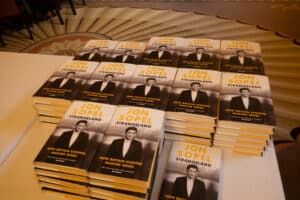
  • Jon Sopel’s fascinating take on January 6th, the Starmer administration – and why he left the BBC

    Jon Sopel


    I am sometimes asked about why I left the BBC. I remember the corporation went through this spasm of asking themselves how to attract the young. If you watch the news, by and large you’re over 60. The same is true of the Today programme.

    The editor of the 6 O’Clock News was thinking about how we get more young people. Do we need younger presenters? Or do we need old people like me talking about young people’s issues? This was at a time when LPs were making a comeback. We sent a young reporter down to Oxford Street, and said to a teenager, holding up an LP: “Hello, I’m from the Six O’Clock News. Do you know what this is?” The teenager replied: “Yes, it’s an LP. What’s the Six O’Clock News?”


    Thinking back to January 2021, I can’t forget the day after the inauguration when Joe Biden was finally President. Washington DC that day was less the elegant neoclassical city that most people remember from the Capitol through to the Supreme Court and the great museums that go to down the Mall. It was a garrison town, the place was absolutely sealed off. There were rolls and rolls of barbed wire because of what had happened on January 6th. I will never forget the shock of that.


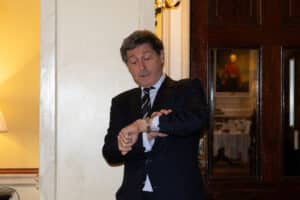
    Jon Sopel book launch in aid of Hospice UK and hosted by Finito at The East India Club, London. 17.9.2024 Photographer Sam Pearce / www.square-image.co.uk


    January 6th is also inscribed on my mind. I’ve been in situations where I’ve faced greater personal danger, when you’re in a warzone and you’ve got a flat-jacket one, and there’s incoming fire. But I’ve never seen a day more shocking than January 6th when the peaceful transfer of power hadn’t happened. I went on the 10 o’clock news and the mob still had control of Congress and Joe Biden’s victory still hadn’t been certified. That’s the starting point for my new book Strangeland: I wonder how safe our democracies are. My experiences in America made me realise that we cannot be complacent in the UK.


    Another thing happened the day after January 6th. The Capitol had been sealed off by razor wire and I went as close as I could, and went live on the 6 O’Clock News. There were lots of Trump supporters around and they heckled me throughout so that the anchor Sophie Raworth had to apologise.

    It soon morphed into a chant: “You lost, go home! You lost, go home!” I was trying to figure out what that meant. At the end of my live broadcast I said to this guy: “What on earth does this mean?” He poked me in the chest and said: “1776.” I thought: ‘Do I explain that my family was in a Polish shtetl at that stage?”


    Peter Hennessey, the great chronicler of government in the UK, talks of the good chap theory of government – you rely on people to do the right thing otherwise the system falls apart. I came back to the UK at the beginning of 2022 after eight years in America. The first election I voted in was 1979. For the next three years I knew three prime ministers: Margaret Thatcher, John Major and Tony Blair. In 2023 we had three in one year – that’s a reminder of the volatility of the times we live in. In many ways in 2016 – with Brexit and with Trump – the world jumped into the unknown.


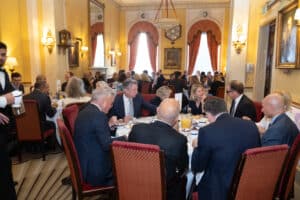
    Jon Sopel book launch in aid of Hospice UK and hosted by Finito at The East India Club, London. 17.9.2024 Photographer Sam Pearce / www.square-image.co.uk


    It’s always seemed to me that the Labour Party finds power a really inconvenient thing to happen. They much prefer it when they’re forming Shadow Cabinets and discussing the National Executive. Then you’d get pesky people like Tony Blair who come along and remind them it is about power. The Conservative Party was always the ruthless machine of government: there is an element in which the Conservative Party is in danger of going down the Labour Party route. It was the Conservative Party membership, for instance, who gave us Liz Truss, the patron saint of our podcast The News Agents. We launched in the week she became Prime Minister – and my God, she was good for business.


    What would Britain look like if there were 10 years of Starmer? He’s done the doom and gloom, and how everything is the Conservatives’ fault. That’s fine – but so far, he’s not set out what the future is going to look like under him. Is it Rachel Reeves’ vision of the growth economy? Or is it Rayner’s vision of increasing workers’ rights. I think Starmer is an incrementalist and simply doesn’t know. If he has any sense at all he will look at the centre of political gravity in the electorate and go for growth because that’s what the country needs.


    Jon Sopel book launch in aid of Hospice UK and hosted by Finito at The East India Club, London. 17.9.2024 Photographer Sam Pearce / www.square-image.co.uk


    Hospice UK do the most amazing work. The book I’ve written Strangeland deals with the challenges facing Britain at the moment. Hospice UK do the most amazing work. Strangeland deals with some of the huge challenges facing the . Hospice care is one area where something urgent needs to be done.


    Jon Sopel was talking at a Finito event given in aid of Hospice UK. To donate, go to this link: https://www.hospiceuk.org/support-us/donate


  • China’s Threat is Real, Warns Former Speaker of the House of Lords, Baroness D’Souza

    Baroness D’Souza on China: “The Threat is Real”


    There are three questions that come to mind in considering post-election Taiwan in a changing world.  These will focus on the People’s Republic of China (PRC) in relation to the Indo Pacific Region but most especially, on Taiwan itself.

    The questions are as follows:

    What does China want?
    How does it aim to achieve its goals?
    Will it succeed?

    As you will all know only too well, the West, by which I mean the UK, US and Europe, have consistently viewed the PRC through the prism of western democratic standards and an internationally accepted rules-based order. I’m not sure this is the most fruitful standard to analyse the PRC and its domestic and foreign policies if we want to understand China’s intentions.

    Looking at the various statements issued by the increasingly powerful President Xi Jinping over the last decade and more, the PRC is almost entirely focused on a Sino-centric approach – meaning that every policy, both domestic and foreign, is designed only to benefit China. Thus, Xi believes that the existing world order is biased against China and would be greatly improved if it evolved to embrace Chinese leadership – which he, and the greater majority of the population, see as an inherent force for good.

    This vision of China goes back to ancient history and aims to see China once again as the centre of civilisation, engaging with the world on its own terms, spreading knowledge and providing material benefit. Xi wishes to recreate the world order thereby righting an historic wrong and putting China’s interests and values above those of the rest of the world. The belief in the supremacy of Chinese systems and thought is in President Xi’s DNA and helps us to understand better, if not condone, some of the more aggressive actions of recent years.

    For example the ‘We Are One People’ mantra justifies the regime’s actions against the Uyghurs – with a complete disregard of the UN’s characterisation of forceful assimilation as a crime against humanity and possibly constituting genocide. This Sino-centric approach is presented to the world as altruistic, moral, and inclusive but is in fact self-centred, hierarchical, illiberal and coercive.

    So, the prevailing philosophy is the great rejuvenation of the Chinese nation and this ‘dream’ Xi has said will be achieved by 2050. Make China Great Again! The overriding condition for this rejuvenation is regime security, which Xi is taking to a new level, in order to formulate, implement and adjust Chinese foreign policy. Addressing new recruits to the People’s Liberation Army Xi has said their principal task is to enable China to ‘reclaim its place in the sun’, and this in turn entails recovering ‘lost territories’, establishing regional hegemony and furthering China’s global ambitions.

    His global ambitions are considerable. Xi argues that all countries must respect different political systems and assert that democracies are not superior to authoritarian regimes and therefore have no right to criticise the latter, especially on human rights and governance. He also aims to deter, or even defeat, the pre-eminent economic position of the USA, which would in Xi’s view substantially alter the global balance of power and establish China’s standing as a superpower. Finally, he wishes to extend the ‘soft power’ of Belt and Road initiatives especially in poorer countries, to gain leverage and control in loan repayments.

    Xi has spelt out and continues to refine an ideology to be accepted by the world. His pronouncements set out China’s direction of travel for the next decade and more, and is having a major impact on the world generally, but the Indo-Pacific region in particular.

    Again, you will be familiar with what China wishes to achieve in the short term: connect more closely with adversarial regimes such as Russia and North Korea and play an increasingly influential leadership roles in multilateral forums such as the UN, CPTTP and ASEAN.

    And then we come to Taiwan: in 2021 Xi said: ‘No one should underestimate the Chinese people’s powerful determination, will and ability to defend state sovereignty and territorial integrity.’ Recovery of Taiwan is vital for China’s geostrategic defence and offence but more than this, it is regarded as sacred territory, and this legitimises all the intimidation to which it is subjected by China.

    Mechanisms include legal, political, and psychological warfare; endless cyber-attacks, military harassment and brinkmanship, aggressive attacks in the South China sea, economic espionage, and regular spreading of disinformation. They also include isolation of Taiwan on the international front, including threatening those countries which have hitherto enjoyed diplomatic relations with Taiwan. The brutal National Security Law now being implemented in Hong Kong together with the astonishing offer of a bounty of $1 million for defectors, or promoters of freedom beyond Hong Kong, is a chilling reminder that the ‘one country, two systems’ promise is truly dead. In all these actions China is continuously testing the readiness of the International Community to hold it accountable to International Standards.

    Given the CCP appears intent on taking over Taiwan, how real is the threat, what is being done, what does the new administration in Taipei have to offer and what must it avoid? Furthermore what is the wider impact in the region and what can be done?

    The threat is real, and we are warned by serious China scholars that we should not take this lightly. Admiral Aquilino, head of the US Indo Pacific Command said at a Congressional hearing that in his view the People’s Liberation Army (PLA) would be able to attack Taiwan in 2027, even by force if necessary.

    China not only has a far-reaching strategy but tactics to which President Xi requires conformity by every citizen. The problem is that neither the US nor the UK appear, as yet, to have a strategy but have instead what some have defined as a muddled and inconsistent approach. The US policy of strategic ambiguity virtually encourages the CPP to test the West’s resolve to strenuously oppose any armed threat aimed at Taiwan. There are very few clear red lines.

    Is the future bleak for Taiwan and indeed for many other countries in the Indo-Pacific region? Would it be a good idea to wait until, as one expert has said, the Chinese Communist Party falls under the weight of its own internal contradictions? Another commentator writes that China faces a near-existential dilemma over its macroeconomic strategy due in large part to its over-reliance on property and infrastructure development.

    The accumulated debt by property developers and local government infrastructure expenditure has reached $2.5 trillion. It could take many decades to eliminate this debt. It is difficult to predict how the economy can improve dramatically in the next decade due to the possible over-production of manufactured electronic items flooding international markets. And, of course, China also faces the looming problem of an ageing population dependent on pensions, with an ever decreasing work-force.

    Let me summarise, China is intent upon usurping the supremacy of the USA and will restructure its economic policies and military strategies to control the international shipping lanes to control, and therefore influence, trade, to their own advantage. It aims to subdue neighbouring states or, as in case of the Hambantota Port in Sri Lanka, secure long leasehold on geostrategic territory.

    The economic about-turn as articulated by Premier Li Qiang focuses on economic growth underpinned by advanced manufacturing. In steering rapidly away from infrastructure development, the President has forbidden any public building in at least ten provinces. This will have consequences – particularly for employment. Let us not forget that the legitimacy and stability of the Chinese Communist Party is almost entirely dependent on a successful and growing economy.

    Given the future dangers the country faces, I have to say that I would not relish being the new President of Taiwan. Nor am I in any position to suggest a way forward. However, I note that President Lai will have greater difficulty in getting innovative laws through the legislative Yuan – given the DPP’s loss of a majority. This will be especially the case for divisive issues such as defence spending and strategy, and likely to be exploited by the PRC.

    I am perhaps better placed to suggest what a new government in the UK could do; in the wake of the Russian attack on Ukraine, we have woken up to the real danger China poses in this region. The task is to make it abundantly clear that we will take action including public and frequent condemnation of ‘grey zone’ attacks, the imposition of Magnitsky sanctions against selected Chinese officials; reducing the number of Chinese students accepted for further study in the UK; strict prohibitions on the importation of any technology capable of surveillance including electronic cars and all cellular IOT modules; establish full diplomatic relations with Taiwan.

    This would undoubtedly provoke retaliatory action from China, but would also signal to the world that the de facto independence of Taiwan must progress toward a de jure state.

    Impose strict criminal sentences on any attempts to kidnap or harm in any way – Chinese citizens, whether from Hong Kong, or defectors. Finally, as we all know that co-ordinated action is more effective and thus the UK, in its international relations, must help to build a body of consensus among nations to resist Chinese encroachment on freedoms. There will be an economic cost to all trading partners but the cost of not taking multilateral action now will be far, far greater.

    The overall message to the PRC must be first, that the world will not allow the Chinese destiny of territorial acquisition, the bullying and flouting of the existing rules-based order to prevail and that the consequences of gross intransigence will be severe. Second, a war between the West and China would be an unmitigated catastrophe affecting China as much as it would affect the entire world. This is the reason why China’s territorial ambitions must be confronted.


    This is an edited version of a talk given at the Graduate Institute of Journalism, Taiwan, Taiwan Foreign Correspondents Club in April 2024


    Go here for more from Baroness D’Souza


    Baroness D’Souza on the encroaching power of the executive

    The Baroness and the Mujahideen: the remarkable tale of Marefat school in Afghanistan

    The Baroness: Frances D’Souza on Sir Keir Starmer, Rishi Sunak and the current deluge of legislation in the House of Lords

  • From Ukraine to London: how the Finito bursary scheme helped Ukrainian refugee Valeria Mitureva

    Christopher Jackson reports on the moving success story of Valeria Mitureva from Ukraine and her experience of the Finito bursary scheme

    Very often mentoring can deal with minutiae – the creation of a LinkedIn profile, the process of CV-writing, and all the small steps which, taken together, move a job hunter into the category of employee. These things are very important, of course, but they can seem to be a long way from the daily drama of news headlines. But everything we do in this life has a historical context; we can’t escape history even if we’d sometimes like to.

    This truth was brought home to us at Finito by the arrival on our bursary scheme of refugee Valeria Mitureva from Ukraine. Valeria grew up in eastern Ukraine and says of her upbringing: “I grew up as a curious child. From early childhood I was interested in books, other countries and cultures. At school everything was interesting, so in my youth I was faced with the fact that it is very difficult to choose one thing and move in that direction.”

    Valeria’s instinct was towards broad enquiry and international travel, and in ways which she couldn’t then predict, these wishes would indeed be granted. But initially, she decided that it would be better to specialise. “I decided to enrol in a technical specialty at the university – technical information security systems,” she recalls. Characteristically, she didn’t leave it there. “I additionally studied French and English in my free time,” she recalls. This latter decision would prove useful, again in ways she couldn’t have imagined at the time.

    So what happened after university? “I accidentally got into IT in the sales field while finishing my bachelor’s degree,” she recalls. “But I was still ready to explore the world and decided to change my career to the design sphere, and I am glad to have been doing it for four years now and I see incredible opportunities for my development,” she says cheerfully.

    All this might have proceeded upon the expected track, and Mitureva would have continued her progress towards a design career within Ukraine. But, as the world knows, Vladimir Putin was gearing up for his 2022 illegal invasion of Ukraine – that appalling violation which would upend so many lives, including Valeria’s.

    Valeria recalls the terrible ructions which took place a year ago. “I did not plan to move: everything happened very tragically and quickly. A full-scale invasion of the Russian Federation into the territory of Ukraine began in February 2022. We call it full-scale, because in 2014 the Russian Federation already occupied part of the Eastern region of Ukraine, where I grew up, and where my home is.
    Therefore, for my family, this is already the second war.”

    Valeria was proactive during that terrible spring. “I read about the Homes for Ukraine program and decided to apply. I contacted my future sponsors (my British family!), packed my suitcase and all that was left of my courage and landed in Heathrow on April 30th.”

    It is impossible to imagine her emotions on being forced to leave her homeland and making the leap into the unknown. So what were Valeria’s initial impressions of the UK? “It felt as if it was my second home. The culture is familiar through books, films, music. It’s also a very friendly and open people, with incredible stories – and, of course, I was shocked in a good way by the incredible support of the British people. You have a beautiful country and incredible people.”

    When Valeria refers to her British family, she is referring to the family of Amy le Coz, the founder of Digital Media Services, who immediately took to Valeria’s infectious and optimistic spirit. “In those first few weeks when she lived with us, my husband and I were immediately very impressed and delighted with her work ethic and proactive attitude both for her job for her Ukrainian employer, as well as around the house,” Le Coz recalls. “We were both also profoundly moved by all that she had had to endure and at such a young age.”

    By good fortune, Le Coz met Finito Education Chief Executive Ronel Lehmann at The Spring Lunch which raises money for Conservative Marginal Seats and Women2Win soon after Valeria’s arrival in the country. Valeria recalls: “My sponsor met Ronel at the event, who explained to him that they were hosting a Ukrainian woman and he immediately offered his help. I was impressed with the approach, professionalism and, most importantly, the structure of the organisation. Finito has a huge team of mentors with a wide variety of expertise. It was indeed like a guiding light for me at that time.”

    Le Coz recalls that Valeria was “buzzing with excitement” upon hearing of the opportunity – and it was certainly one which she took with both hands.
    Valeria worked mainly with three mentors: “I worked with Robin Rose, Claire Messer, and Kate King. I’m grateful for their support, ideas and that they let me work it out myself, rather than tell me exactly what to do. Sometimes we would discuss my hobbies – so, for example, Robin gave me links to music events, which was helpful for a person who had just moved to a new country.”
    Mentorship is sometimes really a kind of friendship. But the pair also got down to work.

    Initially, Rose held two Zoom meetings in order to get himself up-to-speed on Valeria’s situation, and began to carve out a plan. “We needed a workable strategy to find her a role in web or graphic design at a level which matched her experience and which would provide sufficient income for her to fund an independent lifestyle,” he recalls.

    But there were initial headwinds, partly due to the uniqueness of Valeria’s situation. “Valeria had had a good education and relevant training throughout her career in Ukraine. She is personable and speaks good English,” Rose continues. “However, recruiters and HR people were unlikely properly to appreciate her potential from just seeing her CV when evaluating her documentation against other candidates particularly at junior or entry level. She had sent off over 50 applications and had had just one video interview.”

    Rose looked hard at the situation, and made the following assessment: “This shotgun approach was unlikely to return any result for the time invested and continuous rejection was likely to sap her confidence even further.” Rose saw that the starter salary jobs in the sector – typically around £20,000 per annum weren’t a fair reflection of Valeria’s experience in Ukraine: “I felt that Valeria was, in reality, better experienced and should have been competing for jobs in the £30-40K bracket. She had, however, an understandable confidence issue with this approach.”

    This meant that Valeria needed confidence training: “She needed to re-establish her belief in her own abilities. We needed to set up exploratory meetings with people working in the industry so that she could see how she would be of value. I thought that this activity in itself might lead to opportunities.” Rose also suggested that the pair conduct web research to identify at least four organisations she’d like to work with.

    In time, Rose worked closely with Valeria to make more targeted approaches, and provided her with a list of London-based creative agencies. Meanwhile, Valeria was also paired with another Finito mentor Claire Messer, who worked with her in August 2022, casting an experienced eye over her CV.

    Messer says: “I explained to Valeria that recruiters look at CVs for an average of six seconds, and so it was important to make sure we had complete clarification over what kind of visa Valeria had obtained, right down to the number of hours a week which she was able to work. I also worked on clarifying the CV, and making sure that her work experience was tailored to the companies she was applying to.”

    Valeria was beginning to realise that she didn’t want to work for a large company but for a smaller graphic design or creative agency. Claire explained to Valeria the valued of LinkedIn Premium, and showed her mentee how direct messaging of creative agency owners might be to her advantage: “I suggested that messaging owners and CEOs might have traction,” Messer recalls. “This is because some smaller agencies tend not to use recruitment companies as the fees are too high for them. I told Valeria they tend to work by word-of-mouth referrals.”

    In time, Valeria was put in contact with another Finito mentor Kate King, and this led to her first interview. “She felt that the interview went well but that the actual role was outside her technical skill,” King recalls: “It was a great practice interview and helped her to increase her confidence.”

    Her confidence had in fact been transformed and Valeria was then well-prepared when she had the interview with the design studio where she now works, as she had hoped she would: “I’m currently working as a graphic designer at a company called Spark,” she tells us. “I mostly do packaging design but also I do some motion graphics and am learning to use new software as well.”

    Most of all, she feels part of a team. “I am participating in design studio brainstorms and I learn from my experienced colleagues how to deal with nontypical issues. I am happy to have the opportunity to be involved in most of the projects the studio creates. I simply love what I’m doing now as there are a lot of training and a lot of challenges.”

    So how does Valeria see her future now? “The main task is to keep enjoying my job and do everything possible for it. I want to be a worthy professional and to be proud of my projects. For now I’m concentrating on feeling more confident in my role in the UK, studying the culture, the people and concentrating on developing as a designer.”

    For Ronel Lehmann, Chief Executive of Finito Education, this has been an important mandate: “I myself finally got to meet Valeria in person at a Women2Win Business Club dinner in Fenwick of Bond Street. The guest speakers were Gillian Keegan MP, who was at the time Minister for Care and Mental Health and Virginia Crosbie MP. It was particularly apt to be able to listen to two Parliamentarians speak about overcoming adversity. I felt that it resonated with Valeria who is simply inspirational”.

    The support which our bursary scheme has given to Valeria would have been impossible without the generosity of one donor in particular.

    We would therefore like to thank Dr Selva Pankaj, the CEO of Regent Group, who says: “As CEO of a UK education group, I fully appreciate how difficult it can be to take those first steps onto the career ladder, especially in the volatile landscape during and after the pandemic. Hopefully, by supporting this initiative, we can help more individuals find the path that is right for them.”
    That’s certainly the case with Valeria, who now has a bright future ahead of her. We will continue to help her in her career journey and report back in these pages on any developments.


    Interested in our bursary? See these other stories:


    2022 Highlights: How the Finito Bursary scheme changed my life

    Finito Bursary Candidate Nick Hennigan: “I Want to Do My Family Proud”

  • Micro expressions tell all, so learn to master them

    Mastering Micro Expressions, by Patrick Crowder


    The online casino company Jeffbet has taken their expertise in the gaming industry and applied it to the workplace. Poker is an oft-used allegory for business meetings and negotiations, and for good reason. In both scenarios, the ability to read the micro expressions of your interlocutor is essential to success.

    “Alongside poker, where it’s common for a player to deliberately hide their facial expressions, it also happens in many other scenarios, including in job interviews or business meetings. However, there is one way to read a poker face that many people aren’t aware of. The key is to look out for micro expressions, which arise subconsciously and cannot be deliberately evoked or suppressed. Micro expressions can be quite difficult to detect, as they last for just 0.5 seconds, however with some practice, you can learn how to spot them,” according to Jeffbet.

    Jeffbet lists seven of these micro expressions and their qualities: Surprise, fear, disgust, anger, happiness, sadness, and contempt.

    Surprise is characterised by the classic raising of the eyebrows, but it will not be the exaggerated look you might be used to seeing in movies. Look for subtle wrinkles on the forehead and see if their irises are fully surrounded by the whites of their eyes. Sometimes, when surprised, the jaw can open slightly.

    When someone is afraid, their eyebrows often raise and come together slightly. Do not confuse this for surprise. Here the forehead wrinkles will appear more central on the forehead, above the bridge of the nose.

    True disgust is difficult to hide, so picking up on it is fairly simple. Look for a slight narrowing of the eyes and a wrinkling of the nose. If a person is not hiding disgust well, you may also see their top lip tighten showing a small portion of their upper teeth.

    Anger can often be determined by tone and context, however you can also read someone’s face if they are attempting to conceal their rage. The eyebrows tend to move downwards and close together, leaving vertical lines above the bridge of the nose. In the upper face, anger presents as the opposite of fear. The lips may also tighten and trend downwards.

    The trick to spotting fake happiness is all in the eyes. Anyone can put on a big smile, but look for the natural wrinkling of the “crow’s feet” and the subtle ways the eyelids contract to see if the expression is genuine.

    Sadness is difficult to detect if a person is attempting to conceal it, however the lips can be an indicator. You may notice a slight frown, and the lower lip may even come out slightly in a pout. The eyes can often be a giveaway, but you will usually pick up these more subtle cues subconsciously.

    Contempt is the only asymmetrical micro expression – if one side of the mouth raises, there is a good change that the person you are talking to dislikes you or disagrees with your opinion.

    All of these tips on spotting microexpressions are a great jumping off point, but at the end of the day it comes down to feel. The human mind is great at subconsciously picking out expressions and verbal cues, so you most likely have a sense of how people feel naturally. If you would like to improve these skills, the only way to get better is to practice.


    Looking for a mentor? Scroll through our expert business mentors here and easily book a consultation today:


    Mentors


  • Meet the Mentor: Rara Plumptre, A Journey of Resilience and Kindness

    We meet Finito mentor and founder of AECS communications Rara Plumptre


    Tell us a little about your early life and education. Did you have mentors growing up who altered the way you are today?

    I was taken to South Africa on the Union Castle boat to Cape Town in the 50’s at six weeks old by my nanny; my parents were living in Durban. My early life started in a rabbit hutch as I adored animals – and still do. I loved the outside world: sun, sea and sand.

    My education didn’t start until I was five years old, where I went to a convent in Durban. Personally I wasn’t the most conforming of children – to say the least. Ten or so years later, at the age of 16, I ended my schooling with one GCSE: I had climbed out of, or been expelled, from most schools. Thankfully my education finished, much to my delight: the only thing I missed was sport. My mentor was my nanny, who for all my faults loved me and wanted me to achieve in life, and perhaps she found my truancy less troubling than my parents did.

    My first job altered my whole life: at 17 years of age I was taken on as an au pair and cook for an Italian family in Florence, which I stayed in for a year and a bit, having opened the liquidiser on gazpacho soup on my arrival: I was still picking soup off the ceiling when I left! Once I was back in England, I walked into a job with Stephen Marks, founder of French Connection. At 19, I had become a manageress of his first shop in South Molton Street.


    Knowing what you know now, what would say to your younger self about the world of work?

    I would say it’s important to stay true to yourself and to be grateful for every day. I’ve also come to learn that business never goes straight, and that it’s vital to have mentors from an early stage.

    Of course, the world has changed hugely. When I was growing up, we were more outside than in – rain or snow. We were freer and lighter with troubles, and we had less to worry about. We had a choice of one tomato, not 30 when we shopped: you could certainly say that life was much simpler – and perhaps what we need to do is cultivate that simplicity.

    When I first flew to Africa from England you couldn’t fly direct: we had to refuel in Entebbe in Uganda or Kinshasa in the Congo. My father gave us coins to buy stamps since he was a great stamp collector. When we landed in the above, we would buy the stamps we liked, and arrive in Johannesburg with them. He was thrilled to bits possibly not about seeing us – but the stamps he loved! I suppose I have wanted to preserve something of the old way of life in my own career.


    You are obviously extremely passionate about helping the next generation. Can you talk a little about your experiences of working with the young. What’s the best way to help make a difference?


    Life for the young now is very different than it was when I was brought up. We only did face-to-face interviews: nowadays online applications are the norm. I think that can be soul-destroying as often a mass of applications for a job can have not one single reply. In the future, my thinking is that as a society we need to rotate the young with mentors at a young age, bringing them up with two or three people who will help them right through their later stages of school, and build for their careers ahead. If we do that, then they will always have someone watching their back in life.


    For deeply personal reasons, homelessness is obviously of huge importance to you as an issue. Can you talk a bit about this area, and how we can all help to tackle this problem?


    The reason I became homeless was through divorce. I now work pro bono helping in that area. I arrived in London where some wonderful friends took me in. I slept for three days with the emotion of packing up a seven-bedroom house with animals which we had also to find homes for. My CV read that I had only been a mother for 20 plus years – so getting back to work was difficult, especially as I hadn’t lived in London for 28 years.

    I remember I was in Clapham, in a haze, and trying to recover from the grief of being homeless. I walked into a gift shop in Abbeville Road. I liked it there and, on and off, I spent my days in the shop because I felt safe. The owner of the shop eventually said to me: “You seem to be in my shop rather a lot, and never buy anything. Why?”

    I told her my story: I had arrived in London with five pounds in my pocket. She retorted: ‘Do you want a job?’ which I jumped at. So for £100 a weekend, I started to earn again. And the rest is history.

    Issues like homelessness and immigration remind us that the gap between rich and poor keeps getting deeper. This inevitably means that more and more people will be found on the street. Fortunately, there are wonderful charities like Under One Sky, and CEO Sleep Out in England in existence. I am passionate about helping to make a difference in people’s lives and trying to lobby the government to make a bigger difference to housing and the homeless.


    You love to make connections between people. Can you tell us a bit about how personal relationships can transform businesses and individual careers?


    Personal relationships are hugely important in transforming businesses, and networking is key to the future, as technology
    takes over our day-to-day lives. To have personal discussions is vital for the young and old. In that I personally feel that one should never stop working, if one enjoys what one is doing. The old can mentor the young through good times and bad. There is a long time to sleep one day. Why waste time with your feet up?


    I’ve noticed that kindness runs through everything you do. It seems as though success in business can sometimes be about doing the small things well. What tips would you have for young people in relation to this?


    I was taught a long time ago that adversity brings you two things, a lesson and a blessing – and they normally come in that order. Kindness and trust are invaluable: if you have people draining your energy try to ‘realign’ and find ways to create new structures of positivity. When you are drained or low, start the day with three good deeds, and in that, your day will automatically improve. Having been homeless and sofa-surfing ten years ago, my family and my friends have got me to where I am today. But most of all, every single person I have met in those years has got me to where I am today, and for that I am truly grateful.


    For more information about Rara’s work go to: http://aecs-connections.co.ukhttp://underoneskytogether.com, and http://ceosleepout.co.uk


    To learn about other mentors, try these:


    Tom Pauk: Meet the Inspirational Mentor
     

    Spring Roundtable with LinkedIn expert Amanda Brown


  • Floating Solar – Coming Soon

    Dinesh Dhamija


    From Dutch lakes to African reservoirs, from hydropower stations to ocean bays… floating solar power installations are among the stars of future energy generation.


    A new study estimates that power from floating solar will reach 6GW within the next seven years, up from the present 3GW in Asia-Pacific alone. Researchers at Lancaster and Bangor University found that if the UK capitalised on its floating PV potential, it could produce as much as 2.7TW of electricity every year. A European Commission project, meanwhile, estimated that using just 2.3 per cent of the continent’s hydropower reservoirs for floating installations could generate an annual 42.3TWh.

    The benefits of using hydropower reservoirs include existing power transmission infrastructure, bodies of water that are suitable for PV installations, limitation of water loss from evaporation and reduction of damaging algal blooms in reservoirs. The cooling effect of water also helps to maximise PV productivity, since solar panels can lose generating power if they over-heat.

    A study conducted in 2021 on floating solar panels on a reservoir in Jordan found that they reduced evaporation by 42 per cent, while producing 425 MWh of electricity per year. In the UK alone there are around 570 reservoirs, meaning there could be a great future for the sector. “The potential gain in energy generation from FPV [Floating Photovoltaic] is clear, so we need to put research in place so this technology can be safely adopted,” said Dr Iestyn Woolway of Bangor University, who authored the report.


    This research must understand what possible negative effects could stem from FPV installations, such as reducing aquatic life in the water due to lack of sunlight. The market for solar energy is expected to grow by 43 per cent each year, to reach $24.5 billion by 2031, according to a report from the BBC. It could help developing countries to meet their entire electricity needs: the Bangor/Lancaster University report cites Papua New Guinea, Ethiopia, Rwanda, Benin and Kiribati as examples. Others could generate much of their power through FPV.

    “Solar installations are going to increase much more on water than land,” said Antonio Duarte, technical engineer at SolarisFloat, which is developing a series of projects. “Why? Because land is becoming a very precious asset.”

    Countries such as Japan and Singapore are now investing heavily in floating solar installations, in response to the rising economic benefits of the technology combined with limited land availability.

    Expect to see floating solar projects on water near you in the years to come.


    Read more by Dinesh Dhamija:


    Hard Truths About Fossil Fuels: Dinesh Dhamija’s Call to Action


    Dinesh Dhamija founded, built and sold online travel agency ebookers.com, before serving as a Member of the European Parliament. Since then, he has created the largest solar PV and hydrogen businesses in Romania. Dinesh’s latest book is The Indian Century – buy it from Amazon at https://www.amazon.co.uk/dp/1738441407/


  • Diary: Anushka Sharma on founding the London Space Network and the future of amazing careers in space

    Anushka Sharma


    I left politics in 2012 to work in the Olympics, and that was the start of my self-employment journey. Many years before, I’d done a computing degree. 2012 was the year the UK agency was formed and that began my passion for space. In 2014, I applied for NASA Social, and took myself over to America for two weeks in January 2015.

    Here were everyday people who were passionate about space, and able to engage in it. My core skill is bringing people together and that’s why five years ago I set up the London Space Network, which brings together people from every walk of life to discuss space. We now have 1500 members on our list, and events sell out within 48 hours.


    When we think about humans and navigation, and travel on earth, we’ve always used the stars to navigate but the opportunity of building a human presence on Mars and icy moons is a different thing altogether. It presents the possibility of the foundation of our human future. At the moment, only nation states through their agencies have managed to land on the surface of the moon: Japan, India, China, Soviet Union, America, and attempts from Israel and which failed. But that’s all changing and it’s now important for us to raise awareness about careers in the space sector.


    The growth of the private space sector means that a barrier has been removed and space agencies can now focus on the science. As our presence in space grows, tourism, trips to the moon, and trips round the orbit of the moon and back, will become the norm. As the cost comes down it will open up huge markets of growth. Who doesn’t want to wear a pair of trainers that have been in space or products which have orbited the moon?


    I think our space journey will be part of a much broader narrative of innovation which our children will benefit from. Take water processing as an example. If we can solve the question of clean water on earth, then why can’t we have it on the surface of the moon. The opportunities have never been more wonderful. You could do a Master’s degree in AI History of Art on galleries on the surface of the moon in 100 years’ time. This will impact every career. Human beings are curious by nature. We would be so bored if we didn’t think beyond our planet.


    As we look ahead in this sector, it’s important to fight for everyone and make sure it’s as inclusive and open for everyone as possible. Currently there’s this duality whereby the rich can access those trips to Mars. It could create planetary political differences between those who chose to go to Mars and those who stayed on Earth. These ethical implications are the reason the space community needs to be as open as possible and engage with people from every background.

    Looking ahead, I think we’ll see a lot of international collaboration deals between America, India, Japan and the European agencies. By 2040, we’ll have more of a human presence on the moon, but more of a robot presence too. We’ll also have a UK astronaut in orbit in the next ten. We’ll also make headway in going to the icy moons of Europa. In the next 100 years, we’ll certainly have a presence on the moon and on Mars and will be acquiring rare earth minerals in an asteroid mining process.


    I’d like to see a United states of Space. We already have the United Nations Office for Outer Space Affairs.. We’ll only do well if we work together. If we don’t we’ll just be transferring conflict into space. Let’s not forget that space has been used for warfare during the Russia-Ukraine conflict.  We have to think ethically about our access to space.

  • Opinion: On the Workers’ Rights Bill, it all comes down to the detail

    Workers’ Rights Bill, it all comes down to the detail. Finito World


    As the new government takes shape, we are beginning to get a sense of the direction and possible meaning of the government. One of the themes that’s already emerging is a split between Rachel Reeves‘ careful approach at the Treasury, and the more gung-ho language coming out of the Deputy PM Angela Rayner’s office.

    Once again, a General Election has proven to be of limited utility when it comes to the crucial question of what an incoming government will actually do. This is certainly the case on the mooted Workers’ Rights Bill.

    For a start, there is little clear language on the flexible working position, and much of the public discourse falsely implies that employees can’t already request flexible working. They can. In addition, employers already have several possible reasons under law to reject the request – this fact also gets very little airtime.

    So what did the Labour Manifesto say? It said that any Starmer administration would look at the possibility of enshrining in law the notion of employees being able to ask for flexible working from day one. So far, there is no indication that the Government will change the position to a four-day working week being the norm or that the reasons to refuse a request will change.  That hasn’t stopped much hyperbole around the four-day working week.


    As usual, it will all come down to the detail, and sources say that it is likely that Reeves will get her way, and that little will be done to agitate business. But in the event that the four-day week did happen, there are a range of issues which will need to be looked at including: ensuring adequate client service, adequate staff supervision, ensuring the health and safety and preventing burn out, reducing errors and managing asynchronised working.


    Where the government looks set to be more radical is on the question of unfair dismissal. If it becomes possible to claim this much earlier during the cycle of employment, then businesses may have a genuine headache when it comes to avoiding claims. It will certainly increase the pressure on businesses to have a fair reason and follow a fair process to dismiss employees. The likely result is cost to business – again, something which Reeves’ language would suggest she wouldn’t like to see.


    Melanie Stancliffe of Cripps tells us: “We expect an explosion of claims – the previous increase in the qualifying period for unfair dismissal claims shrank claims (and raised access to justice issues).” That sounds like something which may alienate the City.


    This brings us to another likely result of the legislation. “Companies need change contracts and policies when the detail is known. They will need to implement the policies, train on them, anticipate and manage claims effectively, change business practices.”


    It is early days and the detail on Workers’ Rights policy may change things. But what won’t change is that Labour is already at loggerheads as to precisely the sort of government it wants to be.