Like many kids born in the 60s, my cousin and I were sent by our mothers for an IQ test. I remember my aunt telling me I had scored particularly high. This revelation only came twenty years later, the night before I was heading to Hong Kong. Please excuse the pun, but whether this might have changed any of my life decisions is purely academic.
This is not an argument against undergraduate studies but my story of how I managed without, along with some of the tips and skills I learned along the way. I live in awe of my two children, who achieved Firsts in their respective degrees and are, to date, doing well. My son, admittedly, got started with Finito‘s help. Do I wish I had studied the classics? Yes, I do. Am I qualified to take on the role of a barrister? Definitely not. What I can do is provide them with the benefit of my experience and expert knowledge to help them uncover the truth.
By this time, I had made my decision to pursue a vocational education rather than study for a degree. In my case, it was the right decision. At the time, the avuncular advice I got was that university would help me think differently. With the benefit of hindsight, continued learning throughout my career has given me so many opportunities to improve myself. I am now mentoring graduates and non-graduates alike as they navigate their careers.
Fast-forward to August 2024. I have just turned sixty and celebrated the first forty years of my financial services career. My career has so far given me the privilege to work in London, Hong Kong, New York, and, more recently, Edinburgh. Most importantly, as a Head of Trading, I continue to enjoy taking on the challenges of enhancing what we do, at both a company and an industry level, for the benefit of the end investor.
I started my career as an assistant to partners on the private client side of a pre-Big Bang stockbroker. I was fortunate to benefit early on from on-the-job training and coaching. As part of this training, I went to spend two weeks sitting with the firm’s trading team on the floor of the London Stock Exchange and never came back.
The “floor” was a tough apprenticeship. It toughened me both physically and mentally. I am not sure it would necessarily stand the test of time, but it undoubtedly shaped who I am today. The motto of the London Stock Exchange, ‘Dictum Meum Pactum” (which roughly translates as ‘My word is my bond’), taught me respect, trust and the importance of best practice. Billions of pounds a day of transactions were executed by voice – and honoured. There was the LSE Code of Conduct, a collective desire to live by it, and, in instances where there was doubt, a disciplinary committee on the 23rd floor. To avoid doubt, this was something I had never had reason to attend!
As an unauthorised dealing clerk (“Blue Button”), my daily tasks ranged from collating prices as a service to our sales desk, to getting the teas and doughnuts (and woe betides anyone who got that order wrong). There was no sense of entitlement. I knew everyone had started that way. Some years later, I remember being scoffed at on a busy day by a graduate trainee when I asked if he could get me a sandwich. I maintain that I am the better educated. “Nous” (Ancient Greek) can be learned, but not from a book.
My career has progressed, and my horizons have broadened. I lead a diverse team of investment professionals, and since 2020, we have set up trading desks in Asia and the US. Imagine my surprise when I realised I needed to take more exams in my fifties! Within the firm, I chair our Regulatory Engagement Group, and externally, I am the chair of the Investment Association’s Equity Trading Committee.
I often speak with regulators, politicians, and market authorities globally. I enjoy being a freethinker with a pet theme of challenging processes and procedures, especially when ‘they have always been done that way’. I am proud to be a chartered fellow of the Chartered Institute of Securities and Investment. And recently, I was delighted to be granted membership in the US-based National Organization of Investment Professionals (NOIP).
The secret sauce of my career is the desire for continued learning. This continues to the current day. I enjoy reading this column in previous editions of the magazine, to understand different points of view. It is so important to move forward and keep building one’s knowledge – asking questions, acknowledging mistakes, learning from them and persevering. It is as much about developing networks and maintaining them, broadening one’s mindset and developing wisdom as it is about having knowledge. Philosophising certainly has its place, but a strategic leader also needs the ability to be practical and come to conclusions, not just to theorise.
A cynic might dismiss truisms as cheesy, but who wants to be a miserable cynic, devoid of their own ideas and left to knock others? Certain phrases stick with me, such as “People want to live in a world they help build”, and two of Wayne Gretzky’s famous quotes, “Skate to where the puck is going to be, not where it has been” and “You miss 100% of the shots you don’t take”. Others keep me grounded. The cruellest, simply because it is so true, is probably, “If you want to make God laugh, show him your plans”. All we really know is that things will change. A more recent addition to my repertoire is “While AI may not take your job, someone who knows how to leverage it might”.
Even though I started work as a school leaver, it has in no way stopped me from enjoying the wisdom of some of our finest academic institutions. Cambridge Judge Business School gave me some great opportunities (and the scarf I wear to prove it). Oddly, for someone with a trading background, its “Negotiations Lab” taught me some excellent new skills. A classic ‘you are never too old to learn’ scenario. A growth mindset, empathy, and other forms of EQ, as well as networking and influencing skills, can all be developed on the job without being influenced by so-called progressive campus politics.
Although my story is from a different era, I still have a lot to offer. I am sure I’m not the only person who wonders if they set out today, would they even be considered for the job they do? That said, it is exciting to see more options for school leavers who, for one reason or another, do not go to university. My employer has opened its doors to “Modern Apprenticeships”, and I enjoy their enthusiasm, grounded ambition, and hard graft.
There is much written about it, but my take on leadership is not about trying to make everybody happy. It’s about when you see something that you don’t feel is right, and then stand up against it because it’s the best thing for the group. My philosophy is to lead by intent rather than instruction. There is a great YouTube link titled “Leadership on a Submarine,” adapted from a talk by Captain David Marquet, that I wholeheartedly recommend watching.
There are always ways to improve and expand one’s knowledge and wisdom. I believe in the value of our personal brand. Everything we say and do either enhances or negates it, and this drives me to stay at the top of my game. Undoubtedly, I will stumble, but I will always learn and carry on. I will continue with my on-the-job training, mentoring, and coaching. I enjoy leading our team and watching them flourish.
So, what comes next for me? Looking further ahead, I want to continue using my experience and industry knowledge to ensure the industry continues to adhere to best practices. With sound experience of good market practice coupled with my global technical knowledge, I see the role of an expert witness as an ideal way for me to continue to protect the end investor.
Christopher Jackson reviews Bodysgallen Hall and enjoys every minute of it
It is always a curious thing to arrive somewhere at night: we experience a world without contours and landmarks – a dense dark which really could be anywhere, and yet we also know we are entering somewhere new.
We arrived in northern Wales just in time for a storm to lambast Conwy, just as storms have been doing for millions of years: Wales always feels like ancient history.
My main memory is of watching the windscreen wipers rushing back and forth in increasing desperation to rid the windscreen of rain, as if seeking some slightly higher setting than the maximum.
We negotiated a long winding drive, unimpressed sheep crossing the pathway in their own time to move out of the way of our car. As we emerged from our vehicle, our bags immediately weeping with rain, we scaled some steps and the door peeled back magically: this was the greeting of the avuncular night porter Marion.
First impressions
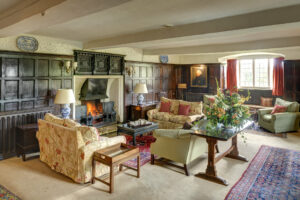
As I glanced at the décor of Bodysgallen Hall – the fireplace, the 17th century panelling, the venerable portraiture – I thought: “Well, this is a whole better than the M6.” Better than the M6, and indeed better than more or less any hotel I’ve stayed at, as it would turn out.
Reception, Bodysgallen Hall
We were shown upstairs to a warm upper room, and learned from Marion that the building was initially constructed as a tower house at some unspecified point in the Middle Ages. Its meaning was to serve as support for Conwy Castle, that marvellously preserved stronghold overlooking the bay: from Bodysgallen you can replay how a signalling system might have worked between this place and Conwy. One imagines Irish ships, a flame of warning, and then the bustle of preparation for whatever came next.
What came next is what always comes: invasion, conquest, resistance, peace – the known variations of human life. It is, in fact, a marvellous place for a spa, as the history here is so rich you know precisely what it is you’re seeking to get away from.
I had just enough time before I drifted into sleep to learn that Bodysgallen had once been a place where Cadwallon Lawhir, King of Gwynedd – the name means ‘long-fingered’ – had lived, when a luxurious peace enveloped me, which probably had something to do with not being on the M6 but also something to do with excellent bedding.
Into Enchantment
The following morning, the first amazing thing I did in what was to be an entirely enchanted day, was to open the curtains. This isn’t normally a particularly marvellous aspect of life in London: my curtains usually reveal Southwark Council branded bins and houses opposite which look identical to the house I have just woken in.
At Bodysgallen Hall, the experience is very different: you look out onto an unbroken glory of horticulture, leading onto a still more beautiful and dreamy landscape: that masterpiece of nature which is Wales’ northern coastline.
It must be admitted that Wales probably gets about three days of delightful sunshine per year: we got one of them, and in late October. The trees everywhere were having their annual rethink, deciding on russets and umbers. Their dying can sometimes seem peculiarly optimistic.
Our first move was to eat a breakfast of champions in the tall-windowed breakfast room: a full English exactly as it should be done – heartily, and without any unnecessary complications. The food in the restaurant is Michelin standard.
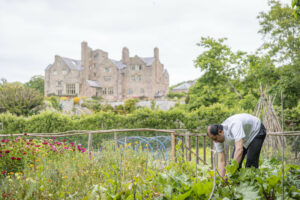
Kitchen Garden at Bodysgallen Hall
The views from the gardens are not to be forgotten. It was a day of bronze and misty light: Conwy seemed in shadow. The medieval folly can be seen in the distance, and it’s possible to walk up there for a better view of the coastline beyond the Orme and Little Orme headlands.
The garden has a remarkable history. The original garden design dates from 1678 and is credited to Robert Wynn, son of Hugh Wynn, who was the first of that family to come into ownership of the Hall. A sundial bears that same date 1678. In that year Bunyan published the first part of The Pilgrim’s Progress, and the Battle of Saint-Denis was conducted between the French and the Dutch, with the verdict disputed by both sides, though its result all too clear to the 5,000 or so soldiers who lost their lives.
In those days, everything was in the Dutch fashion: with high walls which make you want to know what lies beyond them. There is also a topiary maze, and a rose-garden which was still giving out a beautiful scent even in mid-October. The herb garden produces herbs and vegetables which form part of the menu in the first-class restaurant.
Everywhere you go is beauty – and this was an unusually beautiful day. One could really spend a week walking these grounds, and not be near the end of it, but our time was more limited.
The Spa
Bodysgallen Hall is known also as a spa, and so we went there during children’s hour. Newspapers I would not have time to read were laid out in civilised fashion in the reception area.
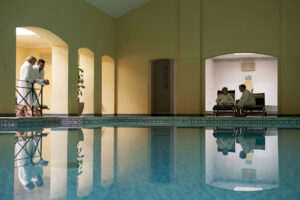
The spa itself consists of a warm swimming pool, a jacuzzi, steam room and sauna. My eight year old boy splashed around in children’s hour, which wasn’t quite long enough for him, and one sometimes wishes there weren’t such severe regulations around jacuzzi use when it comes to children.
Spa at Bodysgallen Hall
After that we walked again up to the obelisk, which was built in 1993 and a landmark visible from all around. It is, like Kafka’s castle, a thing which one nears but never quite gets to. But the trying to get there yields acres of mushroomy woodland, and a sense of blessing at trying to get there at all.
Lunch consisted of sandwiches taken in the crocodile alcove. Bodysgallen Hall is a place of little nooks and surprises. It is also a place of superb beef sandwiches. My son and I agreed we could quite easily have eaten 400 of them, but had to settle for eight.
The Land Beyond
As the afternoon began I sensed Conwy calling. We had been in the castle before on a previous visit: it is an extraordinary place which the first-time visitor will need to do. But the joy of second-time visits is to strike out in surprising directions, and so we decided instead on two churches.
The first is Llangelynnin Old Church, which is to be found a 20 minute drive out of Conwy up a winding slope. It isn’t where you’d expect to find a church, amid the beginnings of the Welsh hills. We didn’t expect it to be open, but the door had an obliging give when we tried it: inside the side walls date from the 13th century and the impression is of a peace which is worth climbing up here for.
Round the corner is St Mary’s church which is on the site of Aberconwy Abbey which was founded in 1172. Here, you begin to get to the nub of the matter: two yew trees older than Chaucer preside over the church, and there is information inside establishing the ancient nature of this site, where the Romans also had an outpost. Both these churches are supported by the National Churches Trust.
This is the infinite nature of Wales: its wonder is to do with deep time, and the many layers it contains. Bodysgallen is the way to explore it and also to experience a luxury which is both classy and not too ostentatious. It is an additional pleasure that to come here is also to support the National Trust, which in addition to maintaining our nation’s heritage, also clearly knows how to run a hotel. A special mention must also go to the magnificent receptionists Catherine and Hayley who were helpful and kind throughout our all-too-brief stay.
In our second swimming session, my son Beau, determined now and fortified by a fine day in Wales, swam his first length – a cunningly constructed amalgamation of front crawl and breaststroke. We might have arrived at night – but we left sensing a sort of dawn in ourselves.
Whether Donald Trump wins the next US election or not, his recent podcast tour illustrates beyond reasonable doubt that the legacy media is on the way out.
This week Trump sat down for a three hour talk with Joe Rogan, and it ought to be a clear signal to all young people thinking of working in the media not to fill out the arduous applications to CNN, Fox or the BBC, but to consider how they might be a part of a new kind of conversation.
The conversation itself will surprise anyone who thinks they know Trump from his appearances on the mainstream media. It was the question of ‘fake news’ which defined Trump’s first run in 2016. At times, during that presidential cycle, Trump found that he was able to say outrageous things and then gaslight the media and the world that he hadn’t said them.
But we have tended to know Trump predominantly in a network setting: we witness him in clips and the nature of a clip is to cut out other context. His speech in a short format often comes across as rambling and bizarre and there are many indefensible things that he has said and done. But many voters in 2016 were so tired of canned speech and soundbites that they saw his energy as holding a kind of promise, regardless of what he said.
2024 seems to be a continuation of that development, but there is also an undeniably different feel to it all. This is partly due to the assassination attempts. In the first of which, Trump showed undeniable physical courage in getting up so soon after being shot.
Something about that occasion made Rogan want to know more about him. I think it may have been a simple question of admiring his indefatigability and resilience. Rogan, like so many, was appalled by Trump’s refusal to accept defeat in 2020 – but equally appalled at the idea of his murder in broad daylight.
Whatever one thinks of Trump, there is the possibility that we will all be enriched by these developments. The conversation between Rogan and Trump was three hours long and completely different to the typical edited 10 minutes we might get on CNN.
The pair of them discussed everything from wrestling to energy and foreign policy, what it was like to arrive in the White House. to Vice-President Kamala Harris. This followed on from another recent conversation with Theo Von in which he movingly discussed his elder brother Fred’s alcoholism.
The point here is not whether you like or dislike Trump. The point is whether, in advance of being asked to vote for him, you actually want to get to know him. It is to his credit that Trump chose to do these podcasts, and to Harris’ discredit that she has so far been unable to submit herself to this format.
What we learn in such things is telling in a way the stilted mainstream interviews aren’t. For instance, we could notice that though Rogan swears regularly, Trump was always polite, but never followed him into expletives. He isn’t a people-pleaser like that.
There was also a quick aside early on about how he felt seeing the Lincoln bedroom on his first night of his presidency – it was a big deal, Trump said, ‘if you love your country’. It was the sort of glancing aside which has to be authentic because of the format.
Over on CNN, Harris bungled an answer on 60 minutes about Benjamin Netanyahu only for the clip to be substituted by a slightly better answer. What appears to have happened is that the first incomprehensible answer, all too typical of Harris, was accidentally put out to promote the interview, only for it to substituted by the network when the interview aired. Trump is wrong on many things, but he is right to say that this indicates media bias.
Viewers are moving across to the independent platforms. This is welcome if we want to get to know our politicians and it is relevant to Britain too. What occurs in the US usually migrates over to the UK. This follows on from a mind-numbingly dull election in 2024 in the UK, where Sir Keir Starmer and Rishi Sunak battled it out over who could give the best 45 second answer over the future of the nation’s entire tax policy.
The result has been a government whose plans were held to no scrutiny whatsoever with the result that months in to the administration, we have tax rises on the horizon which many would rather not have, but which probably would have been more broadly understood if our election had been fought over longer format interviews.
It is a reminder that media careers are changing rapidly, and that Trump knows this. They are headed in the direction of authenticity and individuality against banality and the pre-prepared. If starting out in a media career today, there are vast opportunities for unique voices.
Of course it’s competitive, because everybody can get to market – but it is a fair and sane competitiveness distinct from the competitiveness one sees in corporations: 20,000 AI-sifted applications for even menial roles.
Things are changing: it is as if everybody is being asked to look inwards. This is a huge shift in a world where status itself had become all too dull and staid. Trump is sometimes an unlikely vehicle for these sorts of realisations: he remains boastful, egoistic and at times a bit mad. But he knows things his opponent doesn’t – and much of what he knows has to do with the future and not the past.
Finito World interviews Katia Luna Benaï on her Amazigh heritage, her design vision and her plans for the future
Your grandmother was clearly a very important figure for you – can you talk about your upbringing? Was it an aesthetic culture which laid the groundwork for your future career?
My upbringing in Algeria, deeply rooted in my Amazigh heritage, was where my journey as an artist truly began. Living with my grandmother and aunts, I was surrounded by a world where every element of life was infused with vibrant colours, patterns, and stories—each one shaping my essence as an artist. The silver jewellery we crafted was more than just adornment; it was history gleaming in every piece, with stones whispering tales of identity. Our tattoos, symbols etched into flesh, represented a tradition now fading, yet they carried deep significance, a connection to our past. Even I carry one of those tattoos, symbolizing five generations of women.
The architecture of our region, shaped by influences from the Roman and Ottoman Empires, was another source of inspiration, with arches that seemed to embrace the sky and courtyards that echoed with communal songs. Music, dance, and the act of sharing within the community were integral to our way of life, bonding my soul to the instruments of time and land.
As I travelled later in life with my father, experiencing different cultures and their unique traditions, this early immersion in my heritage continued to influence me. It deepened my fascination with the arts and stories that connect us all as humans. These experiences laid the foundation for my work with Luna Benaï, where I strive to create artefacts that not only capture beauty but also tell multi-layered stories rooted in cultural and historical research.
Through Luna Benaï, each piece I create is a tribute to the communities and traditions that inspire it. I am deeply committed to ensuring that our work gives back to these local communities, preserving the very cultures that have shaped my identity and continue to inspire my creative vision.
Your father was a diplomat – has growing up in lots of different places deepened your sense of commitment to the Amazigh culture?
My father was a man of the people, a true polyglot who spoke eight different languages and was an intellectual deeply respected in Algeria. His work with the UN took our family to many places, and each new city or country we visited was embraced with enthusiasm and a deep commitment to understanding the local culture. This passion for learning and cultural exchange was a fundamental part of our family life.
The Amazigh people have historically been diplomatic and open-minded, known for their ability to share cultures and live harmoniously with others throughout the centuries. Although not widely recognized, the Amazigh are indigenous to the Mediterranean region and have played a significant role in history, mythology, and culture, with connections that trace back to ancient Egypt and continue to the present day.
Growing up in diverse environments only deepened my commitment to the Amazigh culture. I see it as part of my mission to represent their essence through the arts, bringing their rich heritage to the forefront and ensuring that their stories and traditions are not forgotten but celebrated and shared with the world.
Were there creative challenges to be surmounted when it came to negotiating any feelings of rootlessness growing up which diplomats’ children often have?
It’s a bittersweet symphony, indeed. Growing up as a diplomat’s child often brings a sense of rootlessness, but with that comes a profound thirst for understanding and a deep compassion for the world around you. The feeling of being displaced at times fuels a desire to connect with others on a more meaningful level, to truly understand the nuances of different cultures and perspectives.
For me, this has been both a challenge and a gift. Art and creativity have become my signature tools for navigating these feelings, allowing me to express the complexities of my experiences and communicate across cultural boundaries. This ever-evolving journey has enriched my work, infusing it with a depth and authenticity that comes from a life lived between worlds.
Have you had a mentor who gave you the confidence to create?
Pursuing my postgraduate studies at the Royal College of Art was a transformative experience that truly pushed my boundaries. The philosophy there of deconstructing everything and then rebuilding it, blending academia, research, and art practice, gave me a profound new perspective on identity and communication. Being at one of the finest art institutions in the world, I found a space where intellectual freedom was not just encouraged but expected. This environment allowed me to explore and redefine my creative voice, giving me the confidence to push the limits of my artistry and to trust in my vision.
I’m fascinated by your process. You have said that you want to think about creating things which stand the test of time. How do you go about sifting your inspirations to make sure that it is likely to produce work which has that sort of longevity?
At Luna Benaï, we take a vertical approach to creation, guided by the belief that “every object has a story,” and those stories must endure through time. To ensure that our work stands the test of time, I collaborate closely with museums, scholars, and architects from the initial concept to the final creation, always prioritizing absolute authenticity.
My process involves immersing myself in artefacts that are often 2,000 to 4,000 years old. I fall in love with these pieces and bring them back to life, blending their ancient essence with modern mediums and technology. Through masterful artisanal craftsmanship, honed by decades of experience, we create objects that not only resonate with historical depth but are also built to endure.
By taking history and completing a full circle—much like our Luna Benaï logo—I strive to ensure that each piece we produce is timeless, capable of supporting its own story across generations.
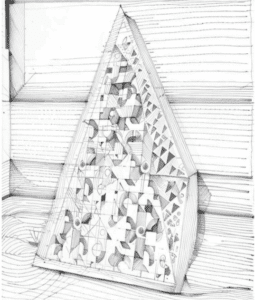
Your collaboration with Sotheby’s was obviously a wonderful moment in your career. How did you come to think in terms of the rhombicuboctahedron and what does that particular shape mean to you?
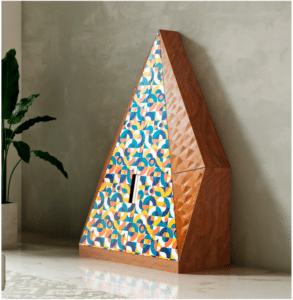
Geometry is the visible manifestation of math, embodying themes of continuation and infinity. When I was commissioned by Tiffany Dubin, a curator at Sotheby’s, to create a bespoke jewellery box for the “Art as Jewellery as Art” exhibition in New York, I wanted to design something that embodied these timeless concepts. The exhibition aimed to reintroduce jewellery and accessories by famed masters of the 20th century and beyond, placing them in a unique juxtaposition with contemporary visionaries and modern artists.
The specific shape of the Atlas Box, a rhombicuboctahedron, was chosen for its symbolic resonance. The rhombicuboctahedron, with its harmonious blend of triangles and squares, represents balance and unity—qualities that are deeply connected to the myth of Atlas, the Titan who bore the weight of the heavens. Just as Atlas symbolizes strength and endurance, the shape reflects the idea of holding together different forces in perfect harmony.
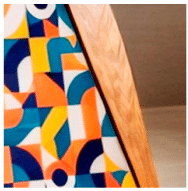
The carvings and metalwork on the Atlas Box are traditional Amazigh designs, merging ancient craftsmanship with a contemporary vision. This fusion of geometry, mythology, and cultural heritage makes the Atlas Box not only a functional object but a piece that tells a story of harmony and timelessness.
I think it’s wonderful that you give 15 per cent of your earnings to charitable projects. Was that something that you resolved to do from the beginning? How do you go about choosing the causes that you give to?
Creating synergy with the local community has always been a core value for me, and it’s something I resolved to do from the very beginning. When we embark on a project, we actively engage with the local communities, seeking out grassroots causes that create visible, tangible impact. It is important to us that these initiatives are ones we can track, interact with, and even participate in directly.
For instance, with our Sotheby’s piece, we chose to support the UK-based charity Hannan School, which has a genuine and significant impact on improving education for remote communities in the Atlas Mountains. This hands-on approach ensures that our contributions not only make a difference but also align closely with the values and needs of the communities we aim to uplift.
What would you say to young people looking to work in the luxury sector? What do you look for in a hire?
Look beyond superficiality. If you pursue what you truly love, you will excel, and don’t be afraid to make mistakes—they are an essential part of the learning process. For young people choosing a career path in the luxury sector, I would advise prioritizing knowledge and experience over superficial gains. Think long-term and focus on building a solid foundation of skills and understanding across different sectors.
If you eventually decide to embark on your own entrepreneurial journey, believe in your vision and stay committed to it. Your vision will be tested repeatedly, but perseverance is key. Over time, you’ll start to see the building blocks come together, and that’s when your dedication will truly pay off.
Luna Benaï are entering the Middle Eastern market. Can you describe that journey and tell us more about the thinking behind it?
The Middle Eastern market is currently undergoing a significant transformation, with new initiatives aimed at diversifying tourism, enhancing arts and culture, and promoting their rich and vibrant heritage. I find this cultural renaissance absolutely captivating, and it’s a landscape I can easily immerse myself in.
As a British, French-Algerian artist, I have a deep understanding of both Western and Middle Eastern worlds, which has uniquely positioned me to contribute to this evolving market. This strategic expansion is an exciting chapter for Luna Benaï, and I’m thrilled to be embarking on this journey with my business partner, Denise Ricci. Denise is my right-hand woman—a former Goldman Sachs professional with an incredible background rooted in Italian culture and the film industry. She’s a polyglot and a true powerhouse, bringing her diverse expertise to our team.
This cultural renaissance in the Middle East aligns perfectly with our vision as a woman-led team, allowing us to make a powerful impact. Together, Denise and I are committed to deepening our engagement with the region through bespoke cultural and artistic commissions. This expansion represents not just a business opportunity, but a chance to bridge cultures and celebrate the region’s rich heritage through the arts.
Which cultural figures most inform your aesthetic? Do you find inspiration in other art forms, whether it be literature, film, music or the visual arts?
I’m a bit of an eccentric, and there isn’t just one figure that drives my inspiration. My aesthetic is informed by a diverse range of cultural figures across history. The artistic legacy of ancient Greek sculptors and the intricate mosaics of Byzantine artisans have always captivated me. In the modern realm, Zaha Hadid’s groundbreaking architectural designs, which challenge conventional forms and spaces, serve as a major inspiration.
I’m also deeply influenced by the Bauhaus movement, which revolutionized design with its emphasis on functionality and simplicity, merging art with everyday life. Sonia Delaunay’s bold use of color and geometric abstraction, Hilma af Klint’s exploration of spiritual abstraction, and Dana Awartani’s meticulous blending of cultural traditions with contemporary expression all resonate deeply with me. These varied influences, spanning ancient to contemporary, each contribute to the unique narrative I aim to express through my work.
What are you working on at the moment?
We’re entering an incredibly exciting phase at Luna Benaï as we expand into a full-fledged atelier and bespoke design studio. We’ve joined forces with our esteemed Italian partners, who bring over four decades of master artisanal experience. This collaboration enhances our ability to work across various mediums, all while preserving the integrity and creative DNA that defines Luna Benaï.
Our first atelier collection, Tessellation, is set to launch this winter. This 11-piece, post-modern inspired collection draws from the rich aesthetics of Middle Eastern and North African design, reimagined through a contemporary monumental lens. Each piece in the collection marries fine art and architecture, making a distinctive statement in the world of interior design and bespoke furniture. Made-to-order, Tessellation seamlessly blends timeless cultural influences with modern innovation. We’re thrilled to introduce this next chapter in our journey, where tradition and cutting-edge design converge.
I was brought up with a really strong food ethic. My mum always worked in food, and understood its importance even before organic became trendy. She always discussed its importance for health. By my 20s, like most people, I thought I was invincible. I was working long hours in TV, often into the small hours.
I ended up getting an autoimmune disease called Graves’ disease. With this disease, your immune system produces antibodies which attack the thyroid gland, a hugely important gland that effects practically all cells in the body. The symptoms include a very high heart rate – sometimes as high as 200 – leading to weight loss and anxiety. Sometimes my hand would shake so much I wouldn’t be able to put the phone on the receiver on my desk. I remember fearing anyone that wanted to discuss a project with me at my desk because I couldn’t point to anything on my computer screen because my hand was shaking so much.
I didn’t understand what was going on and it was affecting my eyes – one of them was closing and the other one was open wider than it should be. I ended up getting diagnosed via an ophthalmologist at Moorfields. I then went on the medication which suppresses you thyroid gland but obviously it doesn’t do anything to your immune system which is where the problem is. Over time I got my thyroid levels under control.
I was feeling a lot better but always knew deep down that this was masking the actual problem. I had to re-evaluate things, and look at lifestyle. I went on sick leave, and looked into diet. I thought I knew a lot about food because of my mum, but I realised that I didn’t and there is so much science in it as well.
My degree had been in English literature and I always thought that was how my brain worked. I didn’t think I was science-y at all. There was so much information online with all these different people telling you what to do. It was confusing so I signed up to study nutritional therapy for three and half years, which included a year of Biomedicine and clinical training. I now see clients on a 1:1 consultation basis online.
This is a different area to being a nutritionist. In a nutshell, a nutritionist works in public health. You have dieticians who work in hospitals and for conditions such as kidney disease where patients are on dialysis or with acute cases in intensive care. I went to the College of Naturopathic Medicine. There were some amazing lecturers who were very evidence-based; as I was studying I became more and more committed to a science-based approach, which my clinical approach is informed by.
There are a bewildering array of media stories out there surrounding food. As a general rule, if anyone is talking in a reductionist way or very explicitly about things, it’s best to be cautious about that report. The dose makes the poison with any food. For example, we know that processed meat and red meat is associated with an increased risk of colon cancer and cardiovascular disease but that doesn’t mean you can’t include them as part of a wider dietary pattern. Often the headlines will grab parts of the study: they will cherry pick something but they won’t look at the finer details of the study.
Through diet, I managed to put Graves’ disease into remission but what I really noticed was that it’s not just about food. Your overall lifestyle is so important too, and to do with sleep, stress levels, and physical activity. These other pillars are really important alongside nutrition and are integral to nutritional therapy.
In terms of the work landscape, once you leave you’re on your own. I am registered with BANT which is the British Association for Nutrition and Lifestyle Medicine and I am registered with CNHC – Complementary and Natural Healthcare Council. BANT are doing lots of work with NHS doctors, pharmacists and other health practitioners to get our names out there. I think it is being more and more recognised that there does need to be more of a dialogue between nutritional therapy and the mainstream.
My practice focuses on cardiovascular health and women’s health. Sometimes men can have a more transactional relationship with food than men. If you grew up in the 90s, you had Kate Moss heroin chic. If you look back on the models they are very underweight and that is all we saw. I think a lot of women are not nourishing their bodies the way they should do because of how society views the shape of a woman’s body should be.
Even before the 90s, you had Twiggy and Jean Shrimpton. It’s so damaging to the body, as well as to reproductive health and to bone health. Then they think they should look a certain way and in terms of exercise its cardio because they think that will burn the most calories and there is nothing about health and nourishing the body which would be resistance training.
I knew I had to be entrepreneurial, so I began doing corporate talks for banks and law firms as well as 1:1 consultations. It’s been a steep learning curve in marketing.
I have provided corporate talks on the relationship between diet and mental health, specifically the gut-brain connection. Deloitte estimates that poor mental health is costing employers £56 billion annually. Meanwhile, 48 per cent of workers say their workplace hasn’t checked on their mental health in 2022. It’s a very complex area and the research is really scratching at the surface of the gut microbiome but we now know there is a bi-directional relationship between the gut and the brain.
Our guts contain trillions of bacteria and broadly speaking, high numbers of favourable or “good” bacteria and lower numbers of less favourable bacteria have been associated with healthy individuals. When we eat fibrous foods such as wholegrains, pulses and veg, we are essentially feeding our commensal gut bacteria as they ferment these fibre and as a result produce bi-products that are known as short chain fatty acids. These fatty acids are intrinsic to the health of our colons but also have far-reaching beneficial effects of our bodies, including our hormones, skin, immune system, cardiovascular system and mental health.
Science is constantly evolving, and we are now at the point where we can make a real difference towards our health and prevent many chronic diseases with the right dietary patterns. We need to think about what it could do for ourselves, the NHS and our economy if we were to pay more attention to diet.
More and more of us trust influencers and content creators than corporate giants. Influencer marketing is now a multi-billion dollar business as more brands invest in this media to get their message across. Even celebrities understand the importance of influence and fan base engagement
Taylor Swift realised this at a very early age. In fact she supported fans for 13 hours at one meet and greet event. Even though she met 3,000 fans she realised what great brand advocates they could be. Taylor Swift has over 280 million followers on Instagram alone. So if you do the numbers, if each of those fans shared a photo on their social media, the average Instagram account user has approximately 335 friends so you can see the potential exposure is to over 1 million. And look at her now the youngest billionaire and her Swiftie fan base have helped her become that.
Around the world in China we have other examples of amazing influence. Becky Li sold 100 Mini Cooper cars in under 5 minutes. She is known to have a phenomenal level of influence over her followers shopping habits.
In fact in China, livestream influencer lead shopping is huge and its why e-commerce platforms like Alibaba and Amazon have highly successful influencer and affiliate marketing programs. Many of these influencers act like personal shoppers and guide us through these products and benefits in a way that most other media cannot match
Influencers are able to articulate their brand story and everyday life in such a way it resonates very well with their audience. We have also seen niche communities develop on the back of it. Even video creator @francois_bourgeois43 became famous for his amazing train spotting experiences. He now has over 2.4m followers on Instagram
Everyday folk can literally become famous overnight by creating entertaining content online from chefs to bricklayers and so many more.
One of the key components of influence is trust and authenticity and that’s what some of the best creators exude. Great content needs to be inspiring, entertaining or educational. That’s not to say that some content can’t be negative and deliberately provocative.
To be a successful creator or influencer you need to
1. Be super clear on your niche and what type of content you will specialise on
2. Be consistent in posting online at least daily sometimes even more in today’s competitive landscape
3. Research and use content that engages your audience by strong hooks that are focused on value outcomes.
4. Engage with audience by liking and responding to their comments.
5. Tag brands that you want to work with and therefore showcasing what you can do for them
6. Be patient it takes time to build an audience – test and measure to drive greater content performance.
7. Use a limited number of relevant hashtags with a view to appearing on the Explore page
Stuart Thomson looks at the growing trend of the gig economy
There can often be an emphasis, especially at the start of a career, on getting a job. That role is seen as a foundation stone for building networks and experience. But is that right for everyone? Is there an alternative? Is a more flexible, freelance approach something to think about?
My own experience is of having worked for large legal and PR consultancies for my entire career until a few years back when I was made redundant. I am not the first and certainly not the last to find the whole experience shocking and, at times, distressing. It does lead to a period of reflection.
The obvious choice would be to simply look for a new role but there are alternatives. I chose to consider those in more detail. Choices about potential next steps do not exist in a vacuum. There are always financial requirements to consider potentially alongside caring responsibilities and other commitments. Those could be to spend time traveling or exercising, issues much more focused on personal needs. There are no right or wrong approaches. It is all down to the individual, but it is always considering what your priorities are.
I already had a company set-up for the communications training I deliver so I chose to go down a freelance and consultancy route. The aim is not to build a business and employ people but instead to engage in challenging projects and work with people I like. That means my ‘gig’ approach is a mix of short-term projects, longer-term consultancy, and membership of an in-house team. Alongside this I also hold voluntary positions for a Board and delivering mentoring which is very important to me.
This could be considered a ‘portfolio’ approach with a range of different projects on the go. That is not without its complications. Balancing the needs of clients and projects means that there is no typical working day and there are no fixed hours.
If you are considering making a similar career move, based on my two years as a freelancer, I would suggest the following:
1) Talk to others who have already made the move to freelancing and chat to them about their experiences. Otherwise, it will always seem like a hugely daunting prospect. People are always willing to chat because they remember what it was like for them.
3) Spend time getting your ‘credentials’ in place – it might be easy to try and crack on with reaching out to connections for work, but do you know what you are really saying to them? What is it that makes you different from others?
4) Materials – another important foundation would be to get a website up and running and for it to feature those clear ‘credentials’. Employers, customers etc need to see that you are serious.
5) Join networks – there are professional and work-related networks to join across sectors, nationally and internationally. Being a freelancer isn’t just about generating your own work, it can also mean working in partnership with others to deliver for a client or project. Those opportunities often come through networks.
The danger with being a freelancer is that you can sometimes feel quite isolated. When you engage with your network do not think of it as solely being about trying to generate new work, but also as time chat and not think about work. That is valuable time.
Being part of the great gig economy is not a panacea and it is not for everyone, but it is an option and maybe provides the flexibility that many are looking for. Think about the option.
World-renowned fashion designer Jimmy Choo came to London in the late eighties from his home in Malaysia. From his first workshop in the East End, Choo created a shoe brand which would be worn by countless celebrities including Princess Diana. Now, he has shifted focus to the next generation of fashion designers through his JCA London Fashion Academy in Hackney. There, students learn the ins and outs of the fashion world with a heavy emphasis on entrepreneurship. He now shares his journey with Finito World readers.
How did you get your start in fashion?
I guess it was meant to be I was born into a shoe-maker family, and that influenced my career path: I decided to follow in Since I was young, I knew I wanted to be a designer, so I moved to London to study at the Cordwainers Technical College and three years later, in the early 80s, I opened my first shop.
Do you have a favourite design?
I feel especially fond of the ‘Fetto’, which is a classic sling-back style that Princess Diana wore in the 90s. She wore her first pair to a performance of Swan Lake at the Royal Albert Hall in June 1997, just a few months before her death.
What was Diana like to work with?
She was always very kind to me – she cared so much about other people. That’s the sign of an admirable person – when they’re good to people when you don’t have to be.
How did your father help start your journey with shoes?
I was immersed in the shoe-making process from a young age, and it came naturally to me to take up my father’s passion. He taught me how to make a shoe and guided me to create my first pair when I was 11, which I know seems young but I was impatient to get started well before then. You have to remember that this was before Internet and mobile phones. We did everything with our hands. I’ve been doing it one way or another ever since. Now at the JCA London Fashion Academy, I want to give back a little of what I’ve learned.
Have you had any other mentors?
My father was my most important mentor, although I have been able to work with some incredible designers over the years who have supported me, and back in the 80s, I was awarded a grant and mentorship from the Prince’s Trust which was very valuable to me – and that’s why I’ve decided to return now to mentoring. I know its value, because I’ve experienced it for myself.
What advice would you give to a young person looking to enter the fashion world today?
My biggest piece of advice would be to never give up: you’ve got to learn how to tackle adversity because that’s definitely coming to you. We all have so much potential to create something extraordinary with our talents – and it’s that knowledge which should
So the future’s bright?
It is if you decide to pursue your vision. If you do that, then there will always be a great future ahead: but you have to take the plunge and decide to be true to yourself, and find the ideas that really belong to you.
In a special Finito World interview, the 2024 Masterchef champion Brin Pirathapan and Fortnum & Mason CEO Tom Athron are brought together on the third floor at the famous Piccadilly store
The real joy of networking isn’t to meet people for oneself: it’s introducing people to one another. When the opportunity came up to interview Brin Pirathapan, the brilliant Tamil Sri Lankan winner of 2024’s MasterChef, we put heads together at Finito, with help from Janine Stow at The Quorum Network, to decide what to do about it.
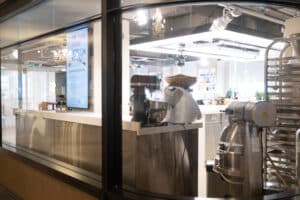
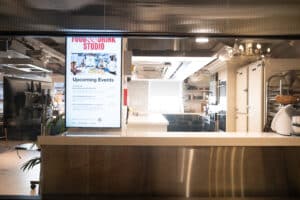
The answer came in a flash of inspiration: Fortnum & Mason is being altered by its brilliant CEO Tom Athron, and the third floor, formerly the menswear floor, is now set up for food experiences. There is a gin bar, and a cooking area where the store hosts masterclasses, as well as the beautiful Fortnum & Mason culinary products.
Once we’d decided that might be a good idea, we thought we’d go one further and interview Brin and Tom together and see whether anything came of it.
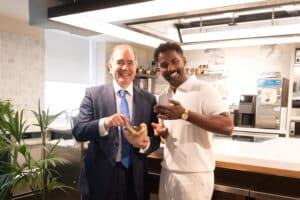
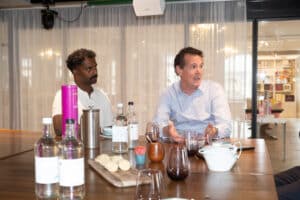
Brin Pirathapan, Masterchef winner, and Tom Athron, CEO of Fortnum & Mason interviewed by Chris Jackson, editor of Finito World in the Food & Drink Studio, Fortnum & Mason.. 19.6.2024 Photographer Sam Pearce
Brin is there as I arrive, looking resplendent in the sort of outfit which Federer used to wear at Wimbledon in his pomp. So I ask Brin if it was always food for him? “I have always loved food. I almost took it for granted because my parents always cooked so well. The table was always full of delicious Tamil Sri Lankan food.”
Perhaps unknowingly a standard had been set. “When I went to university,” Pirathapan continues, “there wasn’t really a conscious decision that I was going to learn to cook: it was just a thing that happened. I wasn’t willing to eat the same bland meal plan every day. But I didn’t have the funding or the finances to be going out for food all the time or to be buying the most expensive ingredients. That situation created the chef that I am today.”
Let’s be clear what this wasn’t: it wasn’t a decision not to have that Deliveroo. It was more financially constrained than that. “I never had to refuse to lazy route. I would cook instead of having a takeaway just because I had to: it was either that or cook boring meals. I never leant towards takeaways. I thought: ‘I can probably do it as nice or nicer myself and learn a new skill’.”
At that time, Brin can have had no way of knowing where it would lead. “Really, I like to eat!” he says simply. “I like nice food and I wanted to do it myself. It was essentially self-reliance and learning a skill. I started cooking for friends, when they came over for dinner. And they’d compliment me. I’d want to do more because it was nice when people said I’d done a good job.”
Brin Pirathapan, Masterchef winner, and Tom Athron, CEO of Fortnum & Mason interviewed by Chris Jackson, editor of Finito World in the Food & Drink Studio, Fortnum & Mason.. 19.6.2024 Photographer Sam Pearce
It seems as though we all need to find that thing in life where we feel there’s no particular ceiling: that we can continue to develop across the whole course of a life. “Something about food makes me want to learn more and more about it. You’d watch people on television or online and the chef has these intricate skills. And I wanted to know how to do that: I was so invested in it. So it probably comes back to just it being a pure passion that I wanted to be good at.”
But even here – he didn’t know how far it would take him; but he had found his passion. “I’d been a veterinary surgeon for a good few years, and I didn’t necessarily think food was ever going to give me a new career. But I think I knew that if I didn’t give MasterChef a go, I would never be able to make it a reality.”
It’s as if you find a thread in life – and it’s not that you’re pulling it, but it pulls on you and leads you on. “It seemed a bit unsafe. I’d been planning on working in veterinary. When you do that, at least by the age of 15 you’re already committing time; you’re committing your holidays to work experience you’re committing your evenings to studying. It’s quite hard when you are within those walls of a structured education and a structured career to dream outside, because it seems really unsafe. And let’s be honest, the food industry isn’t exactly the safest industry to be in. It’s tough – but MasterChef has given me the platform now.”
Brin Pirathapan, Masterchef winner, and Tom Athron, CEO of Fortnum & Mason interviewed by Chris Jackson, editor of Finito World in the Food & Drink Studio, Fortnum & Mason.. 19.6.2024 Photographer Sam Pearce
Brin has long been a fan of MasterChef so it was a huge thing to apply for the show. “I’ve watched it since I was a young age, and it’s made me the chef I am today. When I started the show, I was so worried about being knocked out in the first round. But my fiancé was very firm – she’d seen me moaning about my normal job.”
I say I find it hard to imagine being able to focus on cooking when the cameras are rolling. “It would have been impossible to play to the camera,” he says.
“Every dish I created I pushed myself to the absolute max – so timings were incredibly tight. Obviously within each cook, you need to have an interview with the judges too – other than that, there was no room for error, and I got used to the cameras being there. I needn’t to know there was no time left over for each cook – that there was physically and mentally nothing more that I could have done.”
Reminding myself of the formidable MasterChef judges John Torode and Gregg Wallace, I ask whether their verdict ever affected his concentration. “It’s hard – especially at the start. When they come round, all you’re thinking is: “Do they think I’m doing this wrong?” You start questioning yourself. But as you get to know them, they’re actually very good at calming you down and making sure you’re relaxed.”
I find it hard to imagine Torode or Wallace in calming mode. What stays with Brin is the long silence when the judges give their verdict. “From the first cook to the last, that silence when they are eating, to when they say their first words – that will haunt me. It was an eternity, and it never got easier.” It all came down to the last cook, and I think the way in which Brin approached the most important moment of his life speaks volumes about his character.
“I’d felt so proud to have just gotten to the final and I felt that no matter what, I now had a platform to make a new career in something I love. I wanted to show the judges what my journey in that competition had been – and what the competition had given me. So within every course, you could see multiple elements that reflected a certain dish or a certain opportunity we were given, or a restaurant we went into.”
It is that humility, combined with a willingness to learn which seems to mark out Brin: these traits, when they are combined, place no limits on a person’s potential development. There is throughout our conversation a sheer fascination with cooking – the timings, the sourcing, the service – everything. When we come onto Brin’s famous octopus dish, he is fascinating about the complexities of making the dish work.
“It’s a difficult meat to cook actually. It’s really easy to make an octopus tough and you want a good couple of hours, but in the MasterChef kitchen you only have an hour and a half. So, then you also add in the difficulty of cooking it within a pressure cooker, which can change its texture – and the thing about that is that it’s blind – you can’t see what’s going on inside.” I could listen for hours to anybody talking with passion about the detail of what makes them love it.
Brin continues: “Five extra minutes in a pressure cooker is probably the equivalent of a half an hour of standard cooking. So there’s a lot of margin for error and the texture is one of the main aspects in an octopus. It’s a little bit like a scallop. It’s really easy to get that texture wrong.” You can see why someone who can talk like this will have a long and exciting career: because they’re interested in the task itself, independent of any reward it may bring.
As Brin went through the competition, he kept his head down, until he found himself caught up in that iconic moment when the winner is about to be announced. “Throughout the entire process, I didn’t allow myself to look too far ahead. When I look back, I think one of the reasons [KL6] I did well was because I didn’t give myself the pressure of dreaming about winning. I was simply thinking of the need to execute everything to the best of my ability. So when they did call my name, it was more of a shock than I can ever imagine.”
And, of course, in that moment – even longer in reality than it looks on television, according to Brin – he was crossing over from one world into another, one of considerable opportunity.
Surveying the landscape of options now, Brin is characteristically level-headed and sensible: “I don’t think you have to win MasterChef and open a restaurant immediately. The food industry in 2024 is so much broader than what it was probably 20 years ago, which is so exciting for me because I think in my life I need variety anyway, to keep interested.
Private dining and supper clubs are really interesting to me. They’re the areas where I can show off and kind of going back to when my friends used to come to dinner. I’ve loved all the services that I’ve done throughout the show and any private dining I’ve done afterwards. So I want private dining to be a decent portion of what I do, and I’d also love to write a book.”
There is a sense then in which Brin is going full circle – or rather, moving forwards without forgetting where he came from. “The reason I want to write a book is because, going back to how I started cooking, you can cook amazing food without having to stretch your budget. And it can be very cost-effective. We’re at a time now where people are struggling, because ingredients are so expensive.
I want to bring that through in a book but also, I want to give that to people online because that’s how I learned. I would see these incredible chefs doing amazing dishes – all these techniques I’ve never seen and then I’d go read about it and work it out myself. So if that’s the way I learned I’d like other people to learn that way too. So creating that content online that’s going to be really accessible for people to go and do that themselves is going to have to be a large part of what I do as well.”
Brin Pirathapan, Masterchef winner, and Tom Athron, CEO of Fortnum & Mason interviewed by Chris Jackson, editor of Finito World in the Food & Drink Studio, Fortnum & Mason.. 19.6.2024 Photographer Sam Pearce
By this point Tom Athron has joined, and there is a period where the pair of them are introduced, and huddle together. I have a moment to consider the pair: the latest star in the world of cooking, and the CEO of a business which began in 1707. But I find that the two of them seem to fit in some way: that’s because Brin clearly has such respect for people and is so hungry to learn – and because Athron, as I shall discover when he sits down, is bent on driving Fortnum & Mason forwards towards the future.
Athron is immediately kind about Brin – and explains how right it is that they should be sitting next to one another. “When I joined – and my predecessor actually did the same thing – we’d been asking ourselves as a business some existential questions about what we want to be, what we want to stand for, and who we are. Over the last ten years or so, we’ve become less of a department store, and more of a business which sells extraordinary food and drink.”
For Athron, having Brin here is a moment to reflect on that journey: “Ten years ago, no one would have thought to bring a MasterChef winner into Fortnum’s. And yet now it seems an obvious place to spend a bit of time – whether it’s cooking in the food and drinks studio, or having lunch in our boardroom.” He gestures at the surrounding floor, as if to gauge the extent of the change.
“This whole floor used to be menswear,” Athron says. “But in our quest to become a food business, and to become famous for extraordinary food and drink, our thinking was that that menswear was probably a category of products as a retailer that’s too far out from that particular core. So it’s not that I want everything here to be food, but it needs to be sort of connected within concentric circles. And it just felt to me that menswear was a sort of a circle too far out.”
Once this decision was taken, Athron had 1000 square feet to play with, and had to decide what to do with it. “We had to think not so much as a retailer, but more as a brand-owner and content producer. We needed a space that was going to allow us to showcase our talents – and the talents of chefs around the country. We have 100 chefs who work in this building – but they’re all secreted away behind the walls in the kitchens, and nobody sees the mastery and the craftmanship which goes into making the food.”
So Athron is a MasterChef fan? “It is such a watchable, brilliant show,” he enthuses. “That’s because what you’re seeing is what used to happen behind closed doors. You never really saw the skill that goes into it. So what we wanted to do was create a space that allowed us to show off our mastery a bit and show off our craftsmanship. So again, I was just talking to Brin saying that, that this food and drink studio is glassed off, and that counter over there behind the pillar is actually a chilled top, which is brilliant for pastry work.
The idea is that if you’re a customer walking around in the morning, you probably will see chefs from the tea salon prepping food for that day on that counter. They might be making Scotch eggs or macaroons – and just showing customers a bit of the work that goes on here. a lot of the food that they buy here is actually made in Piccadilly – it’s not just brought in.”
The rise of online shopping, and of Amazon in particular, has taught many shops that they need to be offering experiences which sets them apart. “Our customers are looking for a bit of theatre,” Athron says. “Retailers don’t just exist to sell product. They exist to provide experiences. In here, we have our “Conversations With” series, and we’ll have 50 or so people in here in conversation about, say, Borough Market, and why that started and why tinned fish is the most incredible products that we should be all eating more of. We can do book launches, masterclasses, supper clubs, all sorts of things. It’s just brought the whole floor to life.”
Fortnum & Mason was founded in 1707 when Queen Anne was on the throne – and I wonder what it is she’d recognise about the business if she were permitted to walk through London today? “William Fortnum was a footman to the Queen, and he asked for permission to take the candles that had been melted down in St. James’s Palace, and took the wax away to reconstitute them as new candles – and he sold them on this very spot. And so we still sell candles to this day, largely as a nod to that, even though candles are probably a step away from food although I can actually make quite a strong connection to it.”
I ask Athron about this and he says: “One of the things that we do in the Food and Drinks studio, for example, is a masterclass on how to dress a table for Christmas. I’m interested in those concentric circles that sit around food. We want to make Fortnum’s joyous and I think food really lends itself to that. We are a luxury business, and aim to be at the pinnacle of food and drink – but I don’t think of luxury in the same way as Bond Street thinks about luxury.
We’re not exclusive: we’re warm and welcoming and friendly and inclusive. Quite soon after I joined, we had a chef down from Cumbria whose first course was this chicken wing. And it was a Korean chicken wing, and we had 100 people on the ground floor all eating chicken with their fingers – it was the world’s best chicken wing, but it was also just a chicken wing.”
Many customers at Fortnum & Mason love the packaging but Athron realises that what the packaging contains must make good on the promise of how the brand’s produce is presented: “We’re not a packaging business. We’re a food business and the most important thing to me is that the food justifies the label. And I would never want us to get into a situation where the label justifies the food.
When I joined, we brought in a new commercial director who’s responsible for all our buying and merchandising. I sent him a hamper to say: ‘Welcome to the job’. I thought I was going to get a thank you letter but actually he wrote to me to say the shortbread was overbaked. I remember thinking: ‘That’s exactly why you’re coming’. The food has to stand up to scrutiny.”
This new attitude to the business has enabled Athron to think creatively about where the brand is seen. We’ve got three shops in London in addition to the Piccadilly store: there’s one at Terminal Five at Heathrow, one of St Pancras and one at the Royal Exchange in the city. But we want to give people access to the Fortnum’s brand outside London. The online business is one way of doing that: another way of doing it is to show up in slightly unexpected places. So you might think that you know we should be at Glyndebourne or Ascot – and actually we are at Ascot. But we also like turning up at Glastonbury.”
Last summer, Fortnum & Mason did a pop-up in Watergate Bay in Cornwall. “We had this beautiful beach house, beautifully decked out with lots of things that you can buy – picnic equipment and rugs and all sorts of accessories. But in August, there was a storm and in conjunction with the high tide, it all got washed away.
We thought: ‘What are we going to do? Maybe we should just come back to London?’ But then we thought: ‘No. This is what a British beach holiday is like. What you do is you rebuild and then you sit there in the rain’. And we did. And actually, the weather was so good in September and October that we ended up extending the season. It was the best thing we ever did.”
During Athron’s tenure, the business has pivoted towards 70 per cent on the domestic side – a trend which, Athron says, was already in evidence before he came into the job. “Ten years ago, it was about 70 per cent international customers and 30 per cent domestic, although it depends a bit on the time of year: in the summer we tend to be much more international because it’s a big tourist influx into London, but at Christmas we’re much more domestic.
But we need to appeal to a domestic audience and if you do that, the international customers will come anyway. If I position to foreigners as a tourist brand, no one from Britain will ever want to come here; I want it to be the other way around.”
Brin Pirathapan, Masterchef winner, and Tom Athron, CEO of Fortnum & Mason interviewed by Chris Jackson, editor of Finito World in the Food & Drink Studio, Fortnum & Mason.. 19.6.2024 Photographer Sam Pearce
So what are the career paths for young people, looking to work at Fortnum’s? “You can you start in one of our restaurants or one of our shops. In fact, most people do that. My view is that the very best retailers in the country are typically those people who started stacking shelves. Providing careers to those sorts of people is hugely important. So you can start in the shop, or you can start in our cocktail bar.”
But there are office jobs as well. “There are lots of ways into the industry: buying and merchandising is a really good way and we have a lot of young people who want to get into social media marketing and actually we tend to find young people to do that for us because they are much more savvy about what works and what doesn’t work.”
Athron enjoys walking through the store in order to see how things are working: “We’re a small business and so we’re lucky in that respect. So you can definitely spot talent, and you can sort of move them through move them through the business. There’s a lot of what my dad used to call management by wandering about: in retailing and in restaurants you have to do that. If you do that, you spot mirrors that aren’t straight or shelves that are empty.”
So how does Athron manage his time as CEO? “It’s a constant juggle,” he says. “This is my first role as a CEO though I’ve been on an interim basis before but previously I’ve been a finance director. I was the CFO at Waitrose for many years and, and I knew what I needed to do and what I needed to spend my time on: it was quite defined.
Even though, as a CFO, you have a view across the whole business, my output was defined. The great thing about finance is that it works in a set rhythm, and you know what you need to be doing at any particular time of the year. With the CEO role, it’s different because you can apply yourself in any area, and so I have to make sure I’m giving equal airtime to the whole business, and not just gravitating towards the sparkly fun bits.”
It sounds rather similar to what one sees in politics when the Chancellor of the Exchequer becomes Prime Minister. “I do find that I go from a budget meeting into a meeting about what the summer campaign is going to look like, and into an ice cream tasting. And then back to what we’re going to do with the apprenticeship levy: each day is incredibly varied.”
Coming from the CFO side also means that Athron has to, in his own words, not to be too technocratic: “I’m married to an artist, who is creative and chaotic. So I spend quite a lot of time thinking about not trying to tidy everything up, but trying to give room for people to express themselves: that’s incredibly important in a business like this.”
Would Athron ever participate in MasterChef? “I wouldn’t! I watch it and of course I do what everyone does, which is to become an armchair expert, and say: ‘Well that’s never going to work, is it? Ultimately what Brin does is a creative endeavour, I think. When I cook, I follow a recipe and it’s a logical endeavour. And what will the future hold for Brin? “I’m self-taught and so I’ve still got gaps in my knowledge. I just want to continue to learn in years to come.
I need to make sure I’m I’ve learned enough and mature enough. If I start a restaurant, I want it to be the best. Now’s not the right time.” But happily, it is the right time for lunch – and I am pleased to see Tom and Brin head off for discussions which I suspect will prove fruitful for both of them. They certainly look like they have much to discuss – and more than that perhaps, work to do together.
I believe this will be an Indian century and if the UK is going to seize the opportunities that presents, we need to step up our engagement with India.
In my former role as MP for Barnet, I was privileged to represent a significant British Indian community. This has left me with an enduring enthusiasm for India.
The country has made phenomenal economic progress over recent years, with growth accelerated by reforms delivered by the Prime Minister Modi’s Government. It is already an economic superpower. It recently became the fifth largest economy in the world, and analysts predict it could overtake Germany and Japan to hit the third place spot by 2027.
India is well-positioned to take advantage of the growing realisation in the West that over-dependence on China poses serious risks our prosperity and security. The Covid pandemic starkly demonstrated the pressing need to diversify global supply chains and reduce reliance on China. That makes India a more important partner than ever before.
Our two countries clearly have much in common. English continues to be one of India’s most important official languages. The principle of rule of law is accepted, and the common law system in operation when India gained its independence remains in use.
Despite these positive legacies of empire, we should not be naïve about the colonial era. In their near 200 year involvement with India, the British authorities frequently adopted approaches which would be unacceptable in the modern era. Tragedies such as the 1919 killings at Jallianwala Bagh, when soldiers opened fire on a crowd of unarmed protesters, still cause pain and grievance even today.
But 77 years on from the departure of the British from India, the contested aspects of our shared past should not prevent us from capitalising on the huge amount that we have in common.
We should also remember that influence has never been a one way street between our two countries. We may have left India a rail network and a legal system, but they gave us the numerals we use today, including the crucial concept of zero.
Without Indian maths we might never have emerged from the Middle Ages in Europe. India’s massive cultural, mathematic and scientific influence on the world dates from as far back as the Greek and Roman era. There should be a much greater awareness of this, and I welcome William Dalrymple’s effort to put that right in his recent book “The Golden Road”.
A great asset in enabling us to connect with the subcontinent is the Indian diaspora community. Often described as our ‘living bridge’, this community is one of the most successful minorities in Britain. Numbering just under two million according to the 2021 Census, it has strikingly high rates of professional qualifications and employment, and has made a huge contribution to the UK’s culture, economy and public services. Not only did the community give us our first non-white Prime Minister, the NHS would probably collapse without its British Indian doctors.
British Indians have achieved an exemplary balance of integrating enthusiastically into UK society, whilst retaining a vibrant cultural and religious identity. This achievement is too often under-rated and overlooked.
There are risks to be managed and hurdles to surmount when doing business in India. Despite the improvements delivered by “Modinomics”, bureaucratic processes can still be cumbersome.
Even so, India-UK bilateral trade stood at £36.3 billion during the year 2022/23, an increase of 34.2% or £9.2 billion compared the previous year. Moreover, our universities have benefited from a rapid increase in overseas students from India.
A striking example of the two countries working together successfully was the partnership between Oxford University, AstraZeneca, and Serum Institute of India, which delivered a Covid vaccine in record time.
In conclusion, in a world which is becoming increasingly polarized and insecure, strengthening our ties with the planet’s biggest democracy should be a top foreign and trade policy priority.
If the UK wants to benefit from Indian prospects and potential over the coming years we need our Government to devote real effort to this. If we don’t put in that work, other western countries will be only too happy to get ahead of us in the queue.
We should deploy the networks of our Indian diaspora community as part of our outreach. We also need a pragmatic approach to visas, so our world class universities can continue to recruit talented Indian students.
And we should actively promote India’s place at the top table of world affairs. Chairing the G20 summit in 2023 was a pivotal moment when India stepped up and assumed a new leadership role in relation to the Global South. As a democratic country that shares so many of our values, far better that India, not China, takes on that mantle.