Category: Front Line

  • Professor Suzanne Rab on how AI is changing justice and the workplace – and why it threatens humanity

    Professor Suzanne Rab on how AI is changing justice and the workplace – and why it threatens humanity

    Advances in technology, brought to the fore during and in the wake of COVID-19, have reignited the debate about how such developments may remove barriers connected with access to justice.  The rise of artificial intelligence or “AI” promises significant advances for humankind. As both a barrister specialising in human rights and an educator I see the opportunities and the challenges.  One area as yet underexplored is whether our humanity is being lost in this process.

    The technological advances I observe build on the field of artificial intelligence or “AI” as a discrete phenomenon which has its origins in a workshop organised by John McCarthy held at Dartmouth College in 1956.  The aim of the workshop was to explore how machines could be used to simulate human intelligence.  Various disciplines contribute to AI including computer science, economics, linguistics, mathematics, statistics, evolutionary biology, neuroscience and psychology.  A useful starting point is a definition offered by Russel and Norvig in 2010 where AI is defined as computers or machines that seek to act rationally, think rationally, act like a human, or think like a human (see Box A below).

    Artificial Intelligence (AI) is characterised by four features

    Acting rationally: AI is designed to achieve goals via perception and taking action as a result

    Thinking rationally: AI is designed to logically solve problems, make inferences and optimise outcomes

    Acting like a human: This form of intelligence was later popularised as the ‘Turing Test’, which involves a test of natural language processing, knowledge representation, automated reasoning and learning

    Thinking like a human: Inspired by cognitive science, Nilsson defined AI as “that activity devoted to making machines intelligent, and intelligence is that quality that enables an entity to function appropriately and with foresight in its environment”  
    Box A. What exactly is Artificial Intelligence?

    So how does the above apply to the law? An effective civil justice system supports and upholds the rule of law where the law must be fair, accessible and enforceable. Yet, as things stand, there are well-documented barriers to accessing justice. In England and Wales the Legal Services Research Centre (LSRC) commissioned a series of surveys between 2001 and 2011 inviting more than 5000 participants to explore whether they had experienced problems in accessing justice. Cost is a major barrier where the LSRC found that less than 30 per cent of individuals who recognised that they had a legal problem sought formal advice (LSRC, 2011). There are other non-financial barriers including mental health problems, immigration status and discrimination.

    Technological Breakthroughs

    AI and other advances in technology have been used extensively in legal practice and provide opportunities to deliver and access legal services in ways previously unimaginable and represent the nearest that the legal world has come to sci-fi. 

    Predictive analysis draws on big data to forecast the outcome of a case and advises clients whether to proceed, effectively substituting an individual lawyer’s experience, assessment and intuition.  The term ‘Big data’ has been coined for the aggregation, analysis and increasing value of vast exploitable datasets of unstructured and structured digital information.  Decisions founded on such tools could result in outcomes which are much cheaper than pursuing cases with limited prospects of success.  

    However, this is likely not a silver bullet. The use of predictive analysis to access whether an outcome is likely to be successful may be inaccurate because of a number of factors. One problem is that the number of cases decided out of court means that predictive analysis based on reported cases will cover a small subset of actual disputes.  The accuracy and value of AI relies on how software is programmed and machines learn bias based on past experience.  These examples can distort the data collected.  Relying on predictive analysis to advise clients whether to proceed (potentially, saving time and money if a case is unlikely to be successful) may be flawed due to lack of a statistically significant dataset. Secondly, inconsistencies in algorithms could mean that critical data is not being collected.  Thirdly, the software may not be able to work out the finer subtleties and variations involved in some cases. In such cases, relying on predictive analysis to advise clients may be flawed because it misses the ‘human factor’.  

    Virtual solutions do allow cheaper access to ADR and a number of innovations can be observed where online solutions (whether mediations, arbitrations or hybrid early neutral evaluations) are involved.  Advances in technology have unleashed automated document generation or information provided via chatbots in order to provide free or cheaper access to legal information.  

    New means of searching for law are emerging. ROSS intelligence was developed to free up lawyers’ time so they could devote this to other tasks, potentially pro bono.  DoNotPay represents another channel for delivery of free legal advice.  This chatbot was invented in the UK by Joshua Browder. By March 2017, assisted users had overturned 200,000 parking fines in London and New York.  There are however practical limitations of chatbots regarding more complex areas of law. Lawyers may be unable to audit the accuracy of forms submitted online (and update them when required).  

    New Opportunities

    While it may be difficult to contemplate at least at the current times that machines will replace lawyers, developments in technology have the potential of reshaping some parts of legal practice. While this raises a number of legal, moral and ethical issues this phenomenon opens up new vistas and opportunities.  For consumers of legal services, these innovations allow greater and more diverse access to legal services.

    Given the need to be well versed with technology to engage in effective outcomes, it may be asked whether and to what extent it would be useful in technology-led dispute resolution for members of the judiciary to have legal technology programmes. Related to this is the question of how the judiciary leverages support of law schools to develop such executive learning programmes.

    COVID-19 has shown the legal sector lags in terms of digitisation despite its ambition to bring the sector into the digital age. Law schools which have developed online learning will be able to transfer their head-start to support the judiciary but there also needs to be an investment in systems.  While that is happening, support can be given in the area of legal technology skills training.  This will support at the skills level but also assist with overcoming any technology phobia or reticence. On the whole, in the author’s view, the experience in England and Wales has been positive in terms of the alacrity of the judiciary to embrace technology.  

    A related issue in terms of capacity-building and skills adoption concerns access to the underlying technology and infrastructure.  The ideal of high-speed internet access within and across the jurisdiction is not universal.  COVID-19 has revealed the disparities in access to affordable, consistent and reliable internet within and between nations.  As the daughter of a diaspora, I do not forget my roots in the Indian sub-continent.  Not only the judiciary but most lawyers and clients in India do not have access to high speed internet.  Where courts do not have the infrastructure for online hearings this simply means that trials do not take place, adding to backlogs.  There are anecdotal examples of cases being filed using WhatsApp.  The judiciary and practitioners can perhaps work not just with law schools but engineering and software departments to initiate online filing software pilots and then have relevant executive programmes around this.

    Humanising Legal Education and Practice in a World of Hi-Tech

    Information and access to information are critical to knowledge acquisition and human education development.  Lockdown and social distancing during and in the wake of COVID-19 have meant that information technology devices have taken on a new or increased significance.  Computers have kept the wheels of business and social discourse turning, and for many they have been the main or only source of information on everything from the weather to the availability and safety of vaccines.  

    This umbilical attachment to technology in the quest for knowledge and connection raises questions about the need for a new equilibrium between protecting individual freedoms and wider national interests in the context of the global digital information society.  AI is being used in almost every area of life from fintech, to robotics and telecoms (see Box B on AI and Fintech, AI and Box C on Robotics and AI and Telecoms).

    AI and Fintech

    Box B. AI and financial services

    AI and Robotics

    Box C. AI and Robotics

    AI and Telecoms

    Box D. AI and Telecoms

    A balance has to be struck with sensitivity to respect for human rights including private and family life, home and correspondence, the peaceful enjoyment of possessions, freedom of thought, conscience and religion, and freedom of expression among other rights.  Freedom of expression includes the right to receive and impart information and freedom from discrimination in the exercise of such rights, while recognising that the exercise of these rights carries duties and responsibilities.

    The European Convention on Human Rights and other international instruments sets out minimum conditions for the legitimacy of any interference with individual rights.  Broadly speaking, any interference with fundamental rights must be prescribed by law and necessary in a democratic society in the interests of national security, public safety, the economic wellbeing of the country, for the prevention of disorder or crime, for the protection of health or morals, or for the protection of the rights and freedoms of others.

    It is hard to dispute that there has been a seismic shift in the development of technology prior to and ongoing through COVID-19.  This shift has in some respects allowed for mitigation of some of the worst shocks of dealing with the immediate emergency, yet it raises a question as to how, if at all, this has affected our humanity.

    December 2018 heralded The transHuman Code in Shenzhen, China.  This was described as: “informing and engaging all citizens of the world about the dynamic influences of technology in our personal, communal and professional lives, The TransHuman Code was formed to redefine the hierarchy of our needs and how we will meet them in the future”.  Further endorsement followed with the “The TransHuman Code Davos Gathering of Minds” at the World Economic Forum in January 2019.  This event introduced the world’s first digital “person” and first digital book signing”.  In May 2019, the Organization for Economic Cooperation and Development (OECD) published the first, internationally agreed principles on human-centred, trustworthy AI reflected the democratic values of the OECD members.

    Information and knowledge (whether it is formal education or ‘fake news’) built on minimal or cheap labour, where it does not reflect the cherished values of the rule of law and fundamental rights and where it its used for oppression or excessive profit, is a threat to our humanity. While the internet knows no geographic boundaries, human rights protection in this borderless hi-tech world remains largely a matter for individual states and is perhaps the next existential threat beyond COVID-19.

    If you want to know more about these summary findings, and further research projects in the area, as well as upcoming publications, contact Suzanne Rab (E. srab@serlecourt.co.uk; M. +44(0) 7557 046522).

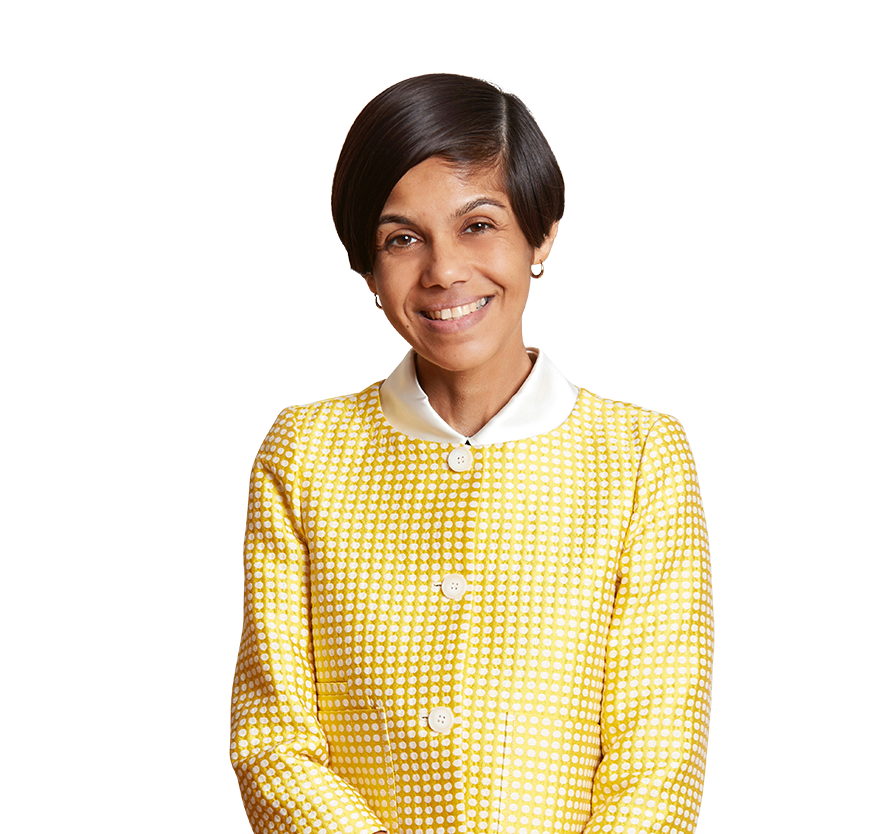
    Professor Suzanne Rabis a barrister at Serle Court Chambers specialising in regulatory and education law. She is Professor of Commercial Law at Brunel University London, a law lecturer at the University of Oxford, and Visiting Professor at Imperial College London.  She is an expert panel member of the UK Regulators Network, a member of Council of the Regulatory Policy Institute and a non-executive director of the Legal Aid Agency.

  • Finito Course Director Derek Walker on how to ace a job interview

    Finito Course Director Derek Walker on how to ace a job interview

    Despite developments in technology over the last two decades, interviews remain a critical part of almost all selection processes for graduate-level jobs. The pandemic has accelerated the trend away from in-person interviewing with the result that in some cases all stages of the selection process are held virtually. 

    Since 2008, I’ve provided guidance to hundreds of students on preparing for interviews with leading graduate employers. In this article, I wish to share insights and conclusions from this experience, which I hope will help students prepare for any interview, whether in-person or virtual.

    There are many different types of interview, but essentially all selection processes will combine three elements, which combine like the three legs of a stool. In the first place, employers want to know whether the candidate has the required level of technical experience, knowledge or aptitude required to do the job. Secondly, employers need to be sure candidates have the right level of motivation. They need to understand why the candidate wants to do this job and why they wish to work for this particular employer. Finally there’s the question of whether the candidate will be a good “fit”. Will the candidate be able to work effectively within the organisation, and be an amenable colleague who existing employees enjoy working with?

    In my experience, if the employer has any doubts about any of the three legs of this stool, then it can’t stand and a job offer won’t be made.  

    So how can candidates prepare?  In my view, the easiest way to structure any interview preparation is the same way as for a major exam.  That said, students generally have far more time to prepare for exams – frequently they receive less than a week’s notice for some interviews.  

    So, even before a candidate submits an application, they need to think about what the interview process involves in order to ensure they have time to prepare. In my opinion, many candidates fail because they leave the preparation too late, meaning they don’t perform to their potential, even though they might have been a great candidate with sufficient preparation.  The irony is that most students put in weeks of work for an exam, which, if they fail, they can usually resit.  For an interview, which has a binary outcome (and no resit!), many candidates prepare for a few hours at most, often leading to under-performance and failure, which has arguably a much greater impact on the student’s future career.

    So early preparation is key.  When preparing for an exam, students frequently seek out previous exam papers to ensure they can answer sufficient questions to the required standard.  They spend weeks revising their course material and refining their exam responses.  The same approach to interviews is also likely to lead to success. Students cannot assume that they know their CV better than anyone and that they can blag their way through an interview without preparation.  

    So, how to prepare?  Think of 10-15 questions you’re likely to be asked.  Why this job/firm?  How are you qualified?  What are the likely developments in our industry in the next five years?  Etc etc.  Use websites such as Glassdoor and Wikijob, as well as classmates and university careers services to build up an understanding of the typical interview questions and other parts of the selection process.  Begin by jotting down the key points you’d wish to make to respond in the interview.  Ensure you read quality relevant business press – The Financial Times, The Economist, Marketing Week, any relevant trade journals, and websites.  

    After this, practice delivering your responses out loud. Record yourself on your phone and watch it back – you will find this excruciating at first but you will get a great impression of how you look and sound. Don’t try to memorise long responses – you will sound stilted and mechanical.  Work with friends to help each other – you will gain confidence as well as tips that you can use. Most importantly, find seasoned professionals to provide mock interview practice – these can be university careers professionals, or practitioners from your target industry.  Above all, make sure the first time you try to answer an interview question isn’t in the real interview – it’s almost inevitable that you’ll fail.  However, if you’ve practiced responding to 15-20 different questions confidently, you’re more likely to be able to produce a good response if an interviewer asks you something you haven’t specifically prepared for.  

    Virtuoso musicians and elite sportsmen practice daily for several hours for something at which they are already a world leader.  They wouldn’t dream of walking onto the stage at the Royal Albert Hall or Centre Court at Wimbledon without hours of preparation, including some on the day.  The same approach usually pays dividends for most interview candidates.  

  • Zavfit founder Anna Freeman on why we need a new approach to spending

    Zavfit founder Anna Freeman on why we need a new approach to spending

    By Patrick Crowder

    Zavfit is a new tool that is designed to help you spend your money in more productive ways. Unlike other money-saving apps, Zavfit is designed not only to discourage excess spending, but to encourage you to reinvest that money in other more beneficial areas. 

    The full version of the app securely connects to your bank with view-only permission in order to monitor spending. Then, the app will ask you to rate your happiness with each purchase on a sliding scale of satisfaction. This data is used to track your wellbeing as well as to set spending and saving targets based on areas which need improvement.

    It’s all the brainchild of founder and CEO Anna Freeman. Through her background in finance, tech, and sport, Freeman found strong links between financial stability and mental and physical wellbeing.

    “I grew up competing in sport, so I’ve always had a passion for health, wellbeing, and fitness which has only grown over the years,” Freeman says. “What I hadn’t realised when I was in the tech and finance industry was that worrying about money is the global leading cause of mental health issues.”

    As mental health awareness increases, largely due to the pandemic, the finance industry has begun to take financial wellbeing into consideration. While this is an improvement, Anna believes that it needs to go a step further.

    “Most of the solutions in place are focused on the wellbeing of your finances, as opposed to actually addressing that stress and anxiety that people feel with their money,” Freeman continues. “I knew that we needed to create a health tool.”

    Zavfit offers a free “MoneyFitness” quiz, which asks the user how happy they are with various aspects of their day-to-day spending. This includes questions about post-purchase regret, satisfaction in work, social spending, charity, and physical fitness. I took the quiz myself and despite my mediocre score, the questions got me thinking about how I prioritise different aspects of my spending and how to reinvest that money on better things.

    “The stereotype of being good with money is ‘saving is good and spending is bad’, but ‘save, save, save’ doesn’t really recognise the present and taking care of yourself,” Freeman adds.

    In my case, I found that I am probably spending a bit too much on nights out and not paying good enough attention to my physical health. Rather than simply staying in and saving cash, the philosophy behind Zavfit would suggest that I invest the money saved on a fitness class.

    Freeman believes that focusing spending on healthy, fulfilling hobbies and interests can have a big impact on both financial and mental wellbeing. Freeman’s outlets are singing and sport, so she decided to put her resources into those areas.

    “I remember walking down the road in the sunshine one day and thinking, ‘I have stopped spending on anything else’,” Anna said, “and that’s because I had found those things which really took me out of my head and lifted me up.”

    The pandemic has given many people a chance to think about their wellbeing and break the cycle of habit. Freeman sees this as an opportunity to step back and make important changes moving forward. “There’s been a massive reset on everything, particularly on spending. There’s an opportunity here to think about things differently and to think ‘Okay, I’ve set out what’s important to me, I’m aware of my mental health and that it needs looking after’.”

    As the link between health and finance continues to be explored, new ideas like ZavFit can help push the conversation forward to find fresh approaches to the age-old problems of money stress and non-beneficial spending. Breaking bad habits is never easy, but ZavFit proves that this is both achievable and essential to personal wellbeing.

  • The Puppeteer’s Tale: Little Angel Theatre head Peta Swindall on a difficult pandemic

    The Puppeteer’s Tale: Little Angel Theatre head Peta Swindall on a difficult pandemic

    It’s been a difficult year in the arts with some having fallen through the cracks of government help. Finito World talked to Peta Swindall about her experiences running London’s premier puppet theatre during the pandemic.

    Finito World: Tell us a little about how you got into puppetry – when did you know this was what you wanted to do?

    Peta Swindall: My background isn’t in puppetry, although I did put on puppet shows to my friends when I was a child with my hand puppet skunk ‘Stinky’! I began working in arts administration at the Barbican Centre finance department when I first left university and was finding my feet. The opportunity to work at the Little Angel Theatre was wonderful timing, getting back into work with a young daughter at home, and I am passionate about theatre for young people, particularly as theatre as a creative outlet had a very strong positive effect on me as a child. Since working at Little Angel though, I have developed a real appreciation for puppetry, it’s a beautiful, magical craft, accessible to so many people – a really powerful tool to boost wellbeing and inspire creativity.   

    FW: What did you study at school and university and how have those experiences impacted on your approach to what you do?

    PS: I was into Maths and Science when I was younger, took Engineering at University, then qualified as an accountant (whilst working at the Barbican Centre). But most days after lessons and lectures you would find me backstage painting a set, sewing a costume or calling a show as a DSM (deputy stage manager). I’ve found the perfect combination of those skills and interests now in the Executive Director role, able to be hands on in a theatre, whilst also using my business and strategy skills to ensure the organisations’ sustainability and resilience.

    FW: You seem a very community-minded theatre and you’ve obviously stepped up during the pandemic – tell us about how you’ve approached this difficult time?

    PS: Since the start of the pandemic in March we have been delivering our digital output ‘Watch, Make, Share’, providing a creative outlet for as many children as possible, as well as supporting teachers and parents juggling jobs, home-schooling and potentially facing financial hardship. Our local community has one of the highest instances of child poverty in the UK, and we have continued to work with our partner schools throughout the pandemic, as well as our wider local schools network. We have also adapted our community programme to connect with our most local community digitally, and whenever we are able to in person (socially distanced of course), aware of the constraints of digital poverty on some families – leading craft sessions and facilitating community connections.

    FW: How many people do you employ?

    PS: 18 people, including 2 design interns. We are committed to develop the current pool of puppeteers and puppetry makers, particularly from under-represented groups

    FW: Did you take advantage of the government furlough scheme? 

    PS: Yes, we have where possible, we went down to 6 staff working in the 1st lockdown. This time round we have used the flexible element of the scheme to bring more people back, but on a reduced hours basis while our activity is restricted.

    FW: Is the government approach satisfactory? I’m worried that puppeteering may have fallen through the cracks somewhat, particularly when it comes to the DCMS monies?

    PS: It has been a challenging time, particularly for freelance workers, and puppetry is no exception. Where possible we have tried to support our freelance family, with well over 100 employment opportunities and paid representation on the industry wide Freelance Taskforce, but the scale of the work has been much reduced, with many of those we work with losing their whole roster of work overnight. We are aware of people contemplating a move away from the industry, which would be incredibly damaging for such a specialist skill, and will impede the recovery of the wider industry. It takes time and experience to train as a puppeteer and puppet maker – and so if highly experienced makers and puppeteers leave the industry, it will struggle to get back on its feet. 

    FW: Has your audience become more global during the pandemic as a result of the online work you do?

    PS: Yes! Our digital content, broadcast on our YouTube channel, has been viewed in 89 countries – we have just achieved the incredible milestone of one million views online. Our digital shows have been reviewed in the New York Times and our professional development courses are being attended by people across the world.

    FW: Have you been to the theatre much? How has your immediate locality changed?

    PS: We have been to the building regularly, initially to check the site, but more recently we have created a covid-safe environment to design and make our digital shows. Over the summer we delivered an outdoor festival for families – Puppet Picnic, which was very well received and we are hoping to build on this in 2021. Our location is remarkably tucked away for a London venue, so in some ways there has been little change, although the theatre itself is missing its young audiences. Heading more towards the high street, we were already seeing the impact of the decline of the traditional retail sector before the pandemic hit, and this crisis has added huge pressures to the situation, with many shops now vacant.

    FW: Are you worried about the mental health of people in the arts? 


    PS: This pandemic has turned this industry on its head and many freelancers have slipped through the net in terms of any government support. We know that freelancers are connecting via informal networks, social media and the freelance task force was a huge help – and we are trying as much as possible to continue to connect with our freelancers – but what we really need is to be able to give them the level of work they and stability they had pre-pandemic. This concern extends to our staff and audiences, particularly the impact of this situation on young people, and the importance of creative outlets in supporting well-being and learning.

    FW: What does the future of puppeteering look like? 

    PS: We are working really hard to ensure that this wonderful, adaptive artform is able to thrive as we emerge from this crisis. We have been able to reach so many people during this time, and shown what a valuable and accessible artform it can be. There are so many exciting artists out there experimenting with the form – and we  intend to continue to support and showcase this great work. 

  • Finito mentor Pervin Shaikh gives her advice to international students coming to the UK

    Finito mentor Pervin Shaikh gives her advice to international students coming to the UK

    Finito mentor Pervin Shaikh gives her tips to international students studying in the UK

    Armed with grand ambitions and hopes of new opportunities and success, studying abroad can be a life-changing experience – and for many, this may well be their first time away from home too. However, the reality hits home very quickly, especially during the first month of arrival—many experience a culture shock as they adjust to a new way of living and studying. Over the last four years, I gained many insights whilst working with hundreds of Chinese students who came over to the UK to study. My hope in writing this article is that these insights may be useful to any international student.

    The first thing to say is that cross-cultural communication is a vital thing to learn. Stronger professional and personal bonds get built when there is clear communication between different people from different backgrounds and cultures. Learning to communicate with peers and seniors takes a bit of effort, especially if you’re not confident in speaking with others proactively. It’s ok to disagree, but what’s important is communicating your ideas and thoughts clearly, succinctly and respectfully. 

    It’s also worth noting that many international students are surprised as to how open their UK peers are and can discuss various topics. However, it is important to respect boundaries. Colleagues may not become your friend, and not everyone will be willing to talk openly about their personal lives, so be mindful. That should go hand in hand with adopting a ‘can-do’ attitude. In the UK, it’s essential to proactively find solutions to problems and then communicate the answers to the different stakeholders. It’s also acceptable to reach out to the stakeholders to share your ideas too. This way, you build your team’s trust and become a ‘go to’ person for others as you share your knowledge and expertise.

    In the UK, it’s especially vital to develop a network, both online and offline. My experiences have taught me, for instance, that the Chinese still have a hierarchical culture, and juniors do not approach seniors directly. However, networking in the U.K. is encouraged because it leads to learning, growth and development – but it does need to be be done respectfully and without high expectations. One word of advice when reaching out to people is to be mindful of their time. Remember, the person you’re trying to connect with has different time pressures to you and may not respond immediately – and that’s been especially the case during the Covid-19 pandemic where people are often stretched in ways it might be hard to imagine as you send your email.

    I’d also advise never to underestimate the power of LinkedIn. People are far more likely to read the message if it’s well written, with the proper salutation and tone; otherwise, the message will get ignored 99% of the time. However tempting it might feel to ‘click & connect’, don’t do it. It suggests you couldn’t be bothered to approach properly. I would recommend putting yourself in their shoes and asking yourself: “Why should they even bother to give me their attention in the first place?” But better still, ask yourself what value you can offer them.

    Meanwhile, when it comes to applying for jobs, don’t be put off applying to jobs because you don’t think you’re good enough or don’t think your English is fluent. With practice, you’ll learn to master the technique, especially when working with others online or when faced with video job interviews. You’ll have access to additional support and resources, but it’s your responsibility to organise yourself and figure the best support for you. For example, if you don’t feel confident in public speaking, join a public speaking group. If you have a job interview coming up, try practising on your own or with a group of friends or peers. 

    It’s easy to stay with people you know or in your safe experience zone. However, that’s not where learning takes place. To broaden your knowledge and confidence, try volunteering or participating in extracurricular activities. When you immerse yourself into the British way of life, you’ll better understand the cultural understanding, plus you’ll have something to talk about when you meet new people. This way, you’ll learn to communicate with different people, solve problems, and develop new ways of doing things. It becomes a win/win. 

    All in all, studying and working abroad can be an exciting time for many international students. It’s also an excellent opportunity to build confidence, a global mindset and life long friends and experiences. However, it requires a shift in attitude, effort and determination to make the experience work best for you. You owe it to yourself to use your time well. 

  • How the charitable sector stepped up during Covid-19

    How the charitable sector stepped up during Covid-19

    If you happened to be in Essex on a summer’s day in 1995, watching Maldon Cricket Club’s 10 wicket win against Bury St Edmunds, you could be forgiven for thinking that you were watching not one but two future England cricket captains opening the batting for Maldon. These were Alastair Cook (known to friends as Ali) and David Randall (known as Arkle).  

    Both were gifted batsmen; each possessed musical ability (Ali on clarinet; Arkle as a future founder member of Maldon band Soul Attraction) and Cook would later recall of his friend: ‘I will never be embarrassed to say he was the better player.’ 

    But in reality you would have been right about only one of them. Sir Alistair Cook, as the world knows, would go on to captain England, and score more runs (12,472) than any other England player. Arkle developed cancer and died in July 2012 at the age of 27.  

    His death wasn’t the end of his story. Throughout his illness he never complained and continued to do the things he loved. Sue Randall, David’s inspirational mother, picks up the story of David’s last week: ‘David’s big wish was to go to Wimbledon. All the MacMillan Nurses and District Nurses kept telling us that it would not be safe for David to go here and there. But the lovely Willow Foundation had got him tickets.’  

    Sir Alastair Cook is one of many patrons who came to the aid of his charities during Covid-19. Photo credit: By Harrias – Own work, CC BY-SA 3.0, https://commons.wikimedia.org/w/index.php?curid=10180837

    How did Sue react? ‘That was the only time I got angry with anyone. When David was out with his girlfriend, I phoned the nurses and told them that if David did not go to Wimbledon, he would die disappointed and I thought that we should do everything possible to get him there. Worst-case scenario was he died on the way, but at least he would have known he had tried to get there. By that time, he only had weeks to live at best. It was a saga! But he got to Wimbledon, taken by his brother. He went on the Tuesday, was admitted to the hospice on Wed and died on the Friday.’ 

    It’s a story which takes us to the heart of life’s cruelty. Yet at its centre is something that seems to work against all hardship: David’s optimism, and intense love of life.  

    Sue remembered the lesson his boy had taught her, and started the David Randall Foundation which aims to keep his spirit alive. The charity organises Great Days for those with life-limiting conditions. Sir Alastair is its patron. This is a charity with a message for our times that will resonate: as the world seems always to become more morbid, we need the spirit of David Randall like never before. 

    An Uncharitable Virus 

    We also need the charity sector like never before. Young people might perhaps wonder whether it’s a vulnerable sector, and even whether it’s as worth going into as it was pre-Covid. While it’s true that many charities find themselves financially vulnerable, and have been hastily furloughing like everyone else, in researching this piece we also had a sense of a sector determined to be upbeat where possible. 

    Many, of course, were feeling acute financial pressures and it was not uncommon to find confessions that the person who would usually handle our query had just been furloughed. But for those who were still active, Finito World witnessed in some instances an admirable heightening of purpose.  

    Variety – the Children’s Charity works predominantly with children with special education needs and disabilities by supplying medical equipment ranging from diabetes monitors to wheelchairs and specialist car seats.  

    Captain Sir Tom Moore became the face of charitable endeavour during the Covid-19 pandemic

    Dave King, the charity’s CEO, admits that events in early 2020 caught him by surprise: ‘By the time we became aware of the level of impact it would have, the virus was escalating quickly. This left us little time to get things in place before lockdown began. It was a period of confusion.’ Uncertainty is often a greater strain on a business than definitely dire circumstances. ‘Once the school enclosure had been announced,’ King continues, ‘we found ourselves in a better position. We were able to become more effective in our response once we had clear direction from government about the impact on children’s lives.’ 

    Variety began refashioning its processes. ‘One of our programmes involves grant-giving for specialist equipment for schools, and equipment for children,’ explains King. ‘We’ve managed to keep that running in spite of supply chains closing down and being temporarily suspended.’ 

    This is a major achievement especially as it was delivered at a time when the organisation’s income generation fell dramatically, primarily due to the loss of events revenue. ‘You can’t have a gala dinner with just a few people in the room. The atmosphere will be flat and it won’t be worth the outlay,’ King says. 

    In sustaining itself, the charity was helped by its active golf society and golf memberships. These benefitted from that sport’s ability to be carried on while social distancing. ‘We’re looking at how we can maximise the use of our golf team and our society and to generate income.’ 

    As difficult as these times are for generating revenue, there is something that can still pull in the money even over Zoom: stardom. 

    Stars in their Eyes 

    Variety has been fortunate in its celebrity ambassadors, with Len Goodman and Mark Ramprakash singled out by King for lending particular support to the charity.  

    This opens up onto the wider question of celebrity involvement in charities. Dan Corry, the CEO of Think NPC – a charity which supports other charities – argues that while having a well-known patron doesn’t always make a difference ‘it can definitely help. Anything you can do to put yourself in the limelight, and get people to open that email, or look at that tweet.’  

    Within the sector, there’s some debate over whether celebrity involvement increases the amount of money going to charities as a whole. Cory asks: ‘Does having a good celebrity or fundraising campaign raise money for your charity instead of one they would have given to? Does it just spread the money differently?’ A relevant example here would be Captain Tom Moore, who walked around his garden for NHS Charities Together. Cory says: ‘Some in the sector felt that people who would have given to a medical health charity gave to that. In aggregate, it’s hard to tell.  Is it the right charity just because there’s a star celeb? It might be a rubbish charity.’  

    Even so, the charities Finito World spoke with are deeply grateful for the assistance well-known names had given to their charities.  

    Sue Randall says that Alastair Cook always comes through with ‘two tickets for the best seats’ at Lord’s for Great Dayers, adding that he ‘has never let us down.’ She adds: ‘Andy Murray also came up trumps for us last year. We had got a lady with cancer, some tickets for Wimbledon and on the day she was too ill to go. One of our ambassadors got in touch with Sir Andy and he sent her a personal note saying how sad he was she hadn’t been well enough to go, alongside a signed shirt. So he is now a hero to me!’ 

    Meanwhile, Ed Holloway, Executive Director of Digital and Services at the MS Society, recalls how the charity was able to pivot quickly during coronavirus thanks to celebrity generosity: ‘One of the first virtual fundraisers we did [after the virus hit] was the MS Society Pub Quiz, with the support of our ambassador and BBC Radio 1 DJ Scott Mills, who hosted a virtual pub quiz every Wednesday night, live from his living room. It was an incredible way to bring the community together at what was a very difficult time. Not only did we have thousands of people all playing along for a great cause, we had a lot of fun doing it, Together, we managed to raise an incredible £55,000.’ 

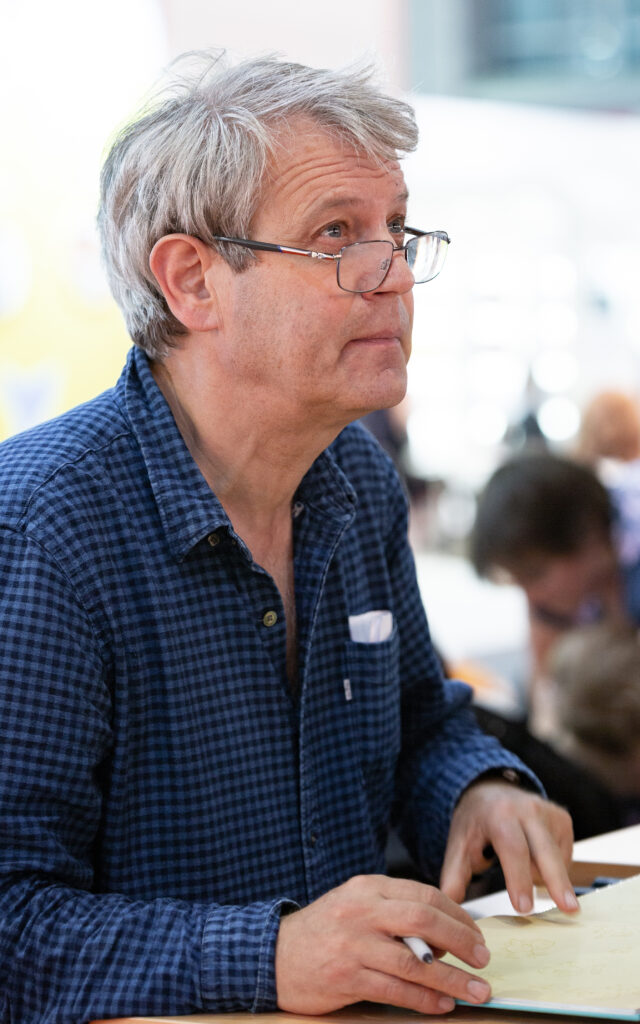
    In July, I zoom with Gruffalo and Zog illustrator Axel Scheffler who has had longstanding involvement with the National Literacy Trust (NLT), an independent charity committed to improving literacy among disadvantaged groups. When the pandemic came along, he was happy to help.  

    He talks to me in his studio, with books ranged behind him, which themselves cede to a bright skylight. Softly spoken and matter-of-fact, it is clear that his charitable work is conducted out of a quiet and laudable sense of duty. ‘I have said yes to almost 95 per cent of what I’ve been asked to do,’ he says, in his careful German accent. ‘There was one job where a big airline company wanted me to design some airline masks and I said no to that one. Overall, it’s a difficult situation and we do what we can. I can afford to do it, and so I do it.’ 

    Axel Scheffler has been highly active for the National Literacy Trust during the pandemic.

    Early on in the pandemic, Scheffler was asked by the NLT to provide illustrations to an online book Coronavirus intended to educate 5-11 year-olds about the new disease. Published by Nosy Crow, and narrated online by Hugh Bonneville, it was publisher Kate Wilson who persuaded Scheffler to make time for a breakneck production schedule. ‘Her argument was that many children are familiar with my style and work, and that was why I said, “Yes, I’ll do it.” Nosy Crow completed the project from start to finish in 10 days: it was really, really fast.’ 

    Scheffler explains his motivation: ‘I’ve supported the NLT for a long time, and it’s brilliant what they’re doing. I think it’s sad that a nation like Britain has to have a charity to deal with these matters. It should really be up to schools to get children reading and it’s sad the government is failing the education of children in so many ways.’ It’s hard to disagree but it’s also surely this which makes the charitable sector so exciting. 

    ‘Nobody’s poor relation’ 

    The CEO of the NLT Jonathan Douglas argues that there’s never been a better time to go into the charitable sector: ‘Its vibrancy and its entrepreneurial ability comes from the fact that its funding base is always tenuous.’  

    Paradoxically, Douglas explains, it’s been a good time for the sector, in spite of the challenges: ‘The most heartening thing without a doubt has been the organisations that have come through to support shielded people, support children continue learning, and to support the victims of domestic abuse. All those social needs have been met by the charity sector. I don’t think the charity sector could ever have been written off as inconsequential – but after the way it has stepped up in the past three months it’s proved its mettle. We’re no longer anyone’s poor relations.’  

    Over at the MS Society, Ed Holloway continues to feel the sector is attractive: ‘Like many charities we are relatively small and we ask a lot of our employees, but this gives them a chance to take on responsibility early in their careers, which stands them in good stead for the rest of their working lives. In return for their hard work and commitment, we work hard to provide a stimulating workplace where everyone can engage with our mission, know their voices are heard, and know they are making a difference to people living with MS.’ 

    Even so, that doesn’t mean that life is always easy. King says: ‘Most charities are operating on the frontline. The more we’ve got in the bank the less we’re helping kids.’ 

    Government response 

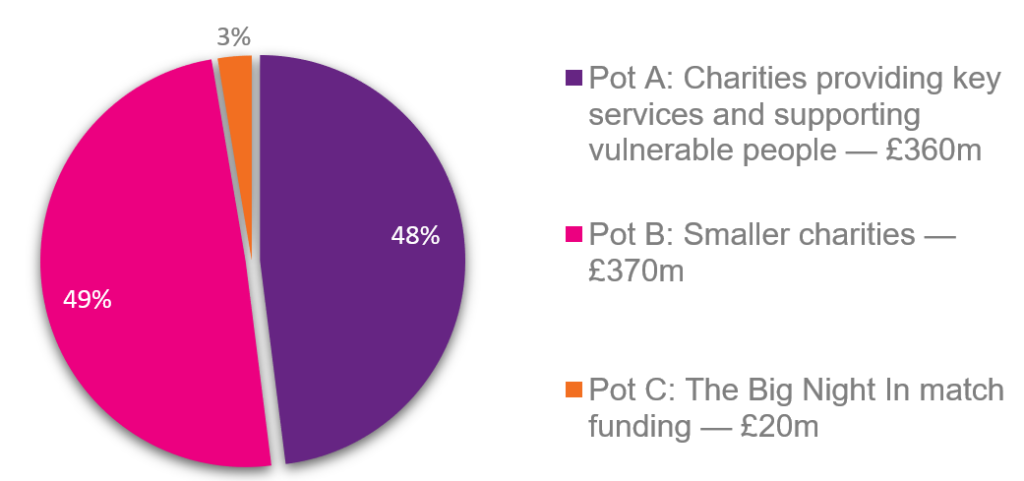
    On April 8th 2020, the Chancellor Rishi Sunak announced a £750 billion package ‘to ensure [charities] can continue their vital work during the coronavirus outbreak’. Figure A shows where the money went. Unfortunately, in many cases it didn’t go far enough.  

    Figure A. Where did the £750 million from DCMS go? Credit: Think NPC

    The picture is complicated by the fact that it is often difficult to tell what sums charities may have received from independent grant-making foundations such as the Esmée Fairburn Foundation and the Lloyds Bank Foundation. In some cases, there will have been overlap, although that can be difficult to unpick. Cory says: ‘When this crisis is over, I hope we realise that we need more data in this sector.’ 

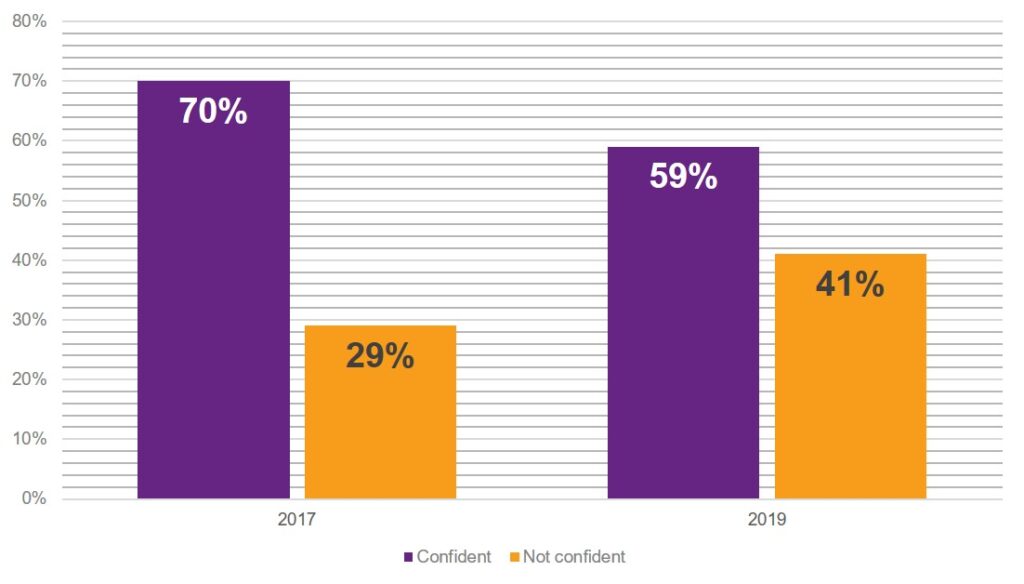
    Here charities were asked whether they were confident they were making the best use of digital. Credit: Think NPC

    King argues that government announcements were ‘targeted at organisations already delivering government services,’ adding, ‘we don’t receive any help whatsoever.’  A few weeks after speaking with King, Finito World heard that he too had been furloughed. 

    Large charities like the Family Fund received large injections of cash; other smaller organisations did not. But even at the top end, there is pain. As Dan Cory says: ‘For the big charities, a lot of funding came from big events like the London marathon. Almost all of that has been kyboshed.’ With furlough now about to wind down, many charities including the National Trust, and Cancer Research UK have already talked about redundancies. In some cases, charities that relied on gift shop income have suffered, Cory explains: ‘They have no income. People aren’t rushing to the shops. They’re usually the kind of shops we like rummaging in, but now you’re not meant to touch product.’ 

    ThinkNPC also argues that the Treasury’s monies – though ‘pretty generous’, according to Cory – even at the high end’ A recent report by the organisation found that 27 of the largest service-delivery charities in the UK faced a ‘£500 million shortfall’. The report also found that ‘charities fulfilling contracts for local and national government are better insulated, whereas charities who rely on public fundraising and charity shop trading are far more exposed to more significant losses.’ 

    Ed Holloway told us about the gravity of the situation regarding MS: ‘The MS Society faces losing nearly a third of our income this year due to Covid-19, and yet we haven’t received any support from the Treasury’s £750 million funding package for charities.’ What matters here is the centrality of the society’s role in the fight against an awful disease: ‘The MS Society is the UK’s leading not-for-profit funder of MS research, and every year we invest millions in new projects – so sadly MS research is one area that has been affected by this shortfall. With researchers redeployed and labs closed due to social distancing, the pandemic had already affected many of the vital projects we fund. Right now, we’re doing everything we can to keep these going, but this significant loss to our income means planned research must be postponed, and we are unable to fund promising new work that is desperately needed.’ 

    When we wrote to the Department for Culture, Digital Services, Media and Sport to ask whether some smaller charities were falling through the cracks, we received no reply. Cory says: ‘My guess is medium-sized charities – in the £1-5 million bracket – have been suffering a lot. For the smaller ones, it’s difficult anyway. Typically, at a small charity you have two and half people with volunteers. Quite a lot aren’t going to survive this but it’s always like this down that end of the scale.’ 

    As grim as this is for many, if one were minded to be optimistic about anything at the moment, it would be about those who work in this difficult but noble sector: Variety which continues to send vital equipment to children; the NLT, which is more committed than ever before to literacy in areas that need it; the MS Society, which is still a beacon of hope for those suffering form an inexplicable diseases; and the David Randall Foundation which remains committed to making people’s last months and weeks memorable. 

    In my most recent email from Sue Randall, she tells me: ‘Things are still very slow with DRF. Understandably the people we organise days out for are vulnerable and nervous about going out, but requests have started to trickle in. The trouble is you just start to think it’s Ok to go out and then the government starts bringing in more restrictions, so I am not surprised at people’s reticence.’ 

    This is a view in miniature of the sector as a whole: a sense of duty overriding anxiety; a sector which has been knocked which remains determined to rebound; and above all an industry with an ethos which values doing things not because they are intrinsically commercial, but because they are inherently important.  

    Will it all come back? Cory is cautiously optimistic: ‘Not in the same configuration. But people’s will to do good and get involve in charities to work for them or volunteer is pretty undiminished.’ In these times, we must take the positives where we find them.  

  • Dean Gustar of The Kusnacht Practice on addiction, the UHNW mindset and why the tone of discussion on alcohol needs to change

    Dean Gustar of The Kusnacht Practice on addiction, the UHNW mindset and why the tone of discussion on alcohol needs to change

    Christopher Jackson talks to the addiction specialist about life in the Swiss clinic – and what it tells us about our times

    Given that The Kusnacht Practice is the leading practice in the world for helping people with addiction issues, you encounter its people armed with pre-conceived notions about them. You try to imagine what the high quality of its many specialists will look like in the flesh. But reality has a way of second-guessing this – and in fact is always more interesting than what we’d pencilled in our minds. 

    Of course, the place is brilliantly staffed and well-resourced – as you might expect. But somehow you’re not quite prepared for Dean Gustar, the organisation’s Head of Clinical Operations, who has an earthy compassion and a depth of knowledge that impresses immediately. The sense is of a man who has lived through many experiences – and indeed he tells me that he has had his own struggles with addiction in the past. 

    The more time you spend with him, the more his presence at the clinic makes sense: this is a smart man, who cares deeply about his patients and understands what people are going through when it comes to addiction of all kinds – everything from gaming and alcohol, to drugs and overeating. 

    “Before I worked at The Kusnacht Practice I’ve never really been around wealth,” Gustar explains. “One of the things I’ve learned is that wealth can be very dangerous. It can be a very lonely place. For instance, it’s very hard for wealthy people to trust other people. And if something doesn’t feel right, they’re used to changing it quickly, with a snap of the fingers. That can make the challenge of behavioural change even more difficult for them.” 

    That feels like earned wisdom. Gustar has that look of unstinting compassion which you sometimes find in the healthcare sector – the look of a man who is somehow never exhausted but instead mysteriously energised by his proximity to suffering. 

    He continues: “And of course, their addiction isn’t really going to impact on them financially so that creates less of an incentive to change. Nobody’s going to come and repossess their house.”

    Gustar lives in Zurich, about 15 minutes from The Kusnacht Practice. Born in the West Country, he also used to live in Peckham, and knows that part of the world well – the sense is of a down-to-earth Englishman somehow deposited in upmarket Switzerland.  “I used to live on the Peckham Estate, and when my friends came over I used to walk them back to the station – they were in fear for their lives,” he tells me. 

    So at what stage do clients normally approach The Kusnacht Practice? “When people come to The Kusnacht Practice, generally the consequences are starting to build – often they may be way over their head with consequences. So it’s a very tough place to be where you begin to realise that one of your behaviours is causing damage to yourself or damage to your family or damage to others.” 

    In addition, patients normally come to Gustar because of a longstanding pattern of behaviour which has itself been of use – or seemed to be of use to you. “The very thing that may be causing the damage, by its nature is going to be very difficult to let go of because maybe it’s been a survival strategy for you to take drugs or drink or overeat or gamble – or whatever it might be.”

    The signs are that during the pandemic these addictions have been increasing as a result of the Covid-19 pandemic: “We’ve seen people whose drinking or drug use has increased as a result of feeling isolated, and not being able to partake in life as they used to,” he explains. And why is that? “Maybe some of the things that help regulate their alcohol use – visiting their parents or going on holiday or feeling productive in their work – have been lost, leading to an increase in other behaviours.”

    And, of course, this is the case even when we have all been less exposed to that dangerous thing, the boozy work lunch. “It’s a good point,” says Gustar. “Some of these boozy lunches, there’s this undercurrent of relationship building, where people are engaged in drinking, and where drinking is a kind of obligation.” 

    But that sense of obligation, especially in beery England, can crop up with great regularity in everyday life. So how do you combat that sense of obligation? “You have to develop your own strategies for dealing with these situations. When it comes to people who care about you or people that love you, if you tell them you’re not drinking and if you feel comfortable telling them why, they should care enough about you just to accept it and support you –and maybe even look out for you in that position.”

    And what about those pressure situations – a wedding, or when we see those friends who expect us to drink with them? “I think in those situations, if you’re starting to feel the pressure or people are applying the pressure. you have to come up with a strategy that can support you in that situation – and that could even be an escape plan.”

    Gustar is aware of the difficulty of the task he faces with those suffering with addiction, and so he is keen to perspectivise what it means to give up an addiction. “It’s very difficult to change any behaviour. So if you do manage to change from a state of dependent drinking, why would you risk it for somebody that’s just a passing acquaintance?”

    I’m reminded of Christopher Hitchens – who died of oesophageal cancer after a lifetime of too much whiskey – who remarked that he might not have drunk so much had he not had a strong constitution. He was able to file his pieces on time, and be successful. Does Gustar see high-functioning alcoholics among his CEO client base? “We do see high-functioning alcoholics and it just makes you wonder how well they would function without alcohol. But they pay a price somewhere, so it could be their relationship or their health – and they’re most likely already paying it in some respects.”

    Sometimes the price can be concealed. “As we get older our ability to sustain it decreases – you can’t easily manage a dependency above the age of 55. Alcohol is just a very dangerous substance for the human body.”

    And yet, if you look at the public discourse, Gustar points out, you wouldn’t think drink especially were particularly dangerous. “I mean – it’s just everywhere,” he says. There’s a kindly anger here – a note which only someone who knows the cost of our exaltation of alcohol could strike. “I’ve watched some of the debates in Parliament, and they’ve had these discussions about “When’s the pub opening? When are we going to get to the pub and drink that pint again?” And if you look at our UHNW clients, there is so much temptation in their lives. If I go to the airport, I mooch around and maybe go to a Starbuck’s.  They go into a business lounge, and there’s a big bar full of free champagnes.”

    To go against these trends and unpick negative behaviours plainly takes willpower – but I suggest to Gustar that willpower isn’t something that’s evenly distributed across the population. Some have it; others don’t. Gustar says: “I think it’s a bit like that Indiana Jones film Raiders of the Lost Arkwhere the sun has to be in place and bounce off here and there and then people change. A lot of things have to be aligned at the right time.” He pauses, then confides: “But you even get people who sit in front of the doctor and the doctor says , ‘If you carry on like this you’ve only got six more months.’. And they carry on doing it. Wealth can be a very lonely place, and the wealthy have a very low tolerance for discomfort.”

    Talking to Gustar is a revelation: here is a man who has taken the decision to work towards helping people. And he reminds us also that addiction is a problem more endemic in our society than we might realise – sometimes as much in the tone of parliamentary debate, and our corporate life, as it is in the pub. 

  • The Succession Question: why family businesses need to plan ahead

    The Succession Question: why family businesses need to plan ahead

    By David Hawkins, co-founder of Percheron Advisory

    What do we mean by the term ‘succession’? The term is most synonymous with the TV series Succession, which centres on the Roy family, the dysfunctional owners of Waystar RoyCo, a global media and hospitality empire, who end-up in a battle royal for control of the family business amid uncertainty about the health of the family’s patriarch, Logan Roy and his plans for the empire’s future. At his 80thbirthday Logan shocks his family – particularly his son Kendall who was primed to take-over the business reigns – with the news that he will not be stepping-down as planned whilst he also throws at his children the news that he is naming his third wife as successor.

    Who the Logan family are based upon is an open secret – think of an octogenarian Australian media owner and his warring family – but the issues raised here via satire are key to highlighting real world family, business and wealth survival.  What follows during Succession is a series of family and business conflicts, attempted hostile takeovers and family politics that makes Shakespearean narrative seem simple.  

    Fundamentally, a failure of clear family governance leads to family, business, asset and wealth destruction – that old chestnut “from clogs to clogs”: the first generation earns the family money, the second generation manages it and the third generation loses it. This trend turns out to be universal across cultures – think of the Vanderbilts in the West. In the East this was summed-up by Sheikh Rashid Al Maktoum: “My grandfather rode a camel, my father rode a camel, I drive a Mercedes, my son drives a Land Rover, his son will drive a Land Rover, but his son will ride a camel.”

    What are the main risks to a smooth succession and how should the present generation react, respond and accommodate the next generation? How does the next gen become more active in the business and play their role in the family business?   

    1) A lack of clear governance systems and processes across the family, business and wealth management

    Logan Roy’s impromptu tearing up of any coherent succession plan leads to war amongst competing family members, attempts at hostile takeovers, family members resigning and business, regulatory, security and political risks. So having family governance or a family protocol in place which formalises the family’s mission statement, its USP, why the family are in business together and what the long-term objectives are, is as vital for the family as corporate governance is for the business.

    This family protocol becomes enshrined as a family constitution from which policies and processes relating to the family, the business and its wealth are then outlined in detail according to the specific family’s requirements and it is discussed, bottomed-up and amended as a dynamic document during regular meetings of a family council – a council which present generation and next generation participate and lead.  

    This would seem foundational to all families – yet as Smith & Williamson’s Family Business Survey 2020/21 reveals, the percentage of families that have a key piece of family governance – the family constitution – in place, is still only around 38%, of which half thought they would have to review this within two years.  The Roys would have found it instructive to have a family constitution and council – and include input from the business units including non-executive directors who could have been involved with the succession discussion so turning a family decision into a corporate one.  The next generation would also have had the insight into first generation decision-making and a sense of the direction of travel which would have allowed them to avoid being frozen-out so spectacularly. 

    Without changing TV genres abruptly, the Game of Thrones analogy symbolises the challenges faced by India’s Ambani family.  When the patriarch died in 2002 like many Indian families there was no succession plan and no will. Chaos reigned.  Rather than a structured approach as to which assets brothers Mukesh and Anil Ambani would inherit, it was left to their mother to preside over an ‘organised demerger’ in 2005, which gave Mukesh control of oil and gas, petrochemicals, refining and manufacturing while Anil took reign over electricity, telecoms and financial services. As the Economist wrote at the time: “Why do family firms so often fail to make the generational leap? Family firms are frequently more riven with intrigue and visceral hatreds than a medieval court – and for similar reasons.”

    2)  Conflict and disagreement in the family destabilises the family and the business 

    The chief wealth destroyer, and one of the main features that family governance should work to reduce, is the exponential damage that conflict and disagreement can do to a family and its business. 

    When families fight, businesses lose their direction, fail to innovate and are often subsumed by their competition. 

    Whether it’s the ongoing dispute within the Ambani family – which even after the separation of assets was followed by defamation suits, involvement of the Indian prime minister and even Anil publicly blaming his brother for power-cuts that swept across India in 2009.  In Succession, Logan Roy takes his family to the family ranch, Austerlitz, to try to patch things up – yet this sticking plaster is too little, too late.  

    The core of family governance is trust, communication and the prevention of disputes spiralling out of control. In the Ambani case, a Family Council could have allowed managed conversation and dialogue unifying the family around values and mission but also outlining and preparing the brothers for ownership and management of specific business units.  If agreement could not be reached then the brothers could have been bought out.  Disagreement would have a forum for debate so issues that do arise can be dealt with via dispute resolution and mediation processes precluding the revelation that the founder has no will, or shock announcements at the patriarch’s birthday party, or even in an interview with Oprah which seems the de rigueur approach these days for airing grievance.  

    What is instructive is the new family council structure that Mukesh Ambani is working on, whereby his immediate family and three children are granted equal representation to enable succession planning whilst at the same time the children have been taking on increasing responsibility within the family business.

    3) The present generation is avoiding – or dreading retirement – or hanging on due to crises such as COVID-19 whilst the next generation wants to get more involved 

    The endemic issue that the institution of effective family governance and succession runs into is that often the founder doesn’t want to retire or be succeeded.  They may resist efforts to outline a clear succession plan – or if one is introduced may impede it: e.g., one American next gen was given 75% of the family business to run. The only issue was that he didn’t know from day-day which 75% it was. Pedestrian issues such as moving into father’s office or clearing out the old retainers caused emotional eruptions from the patriarch. 

    This issue has been particularly relevant due to the ongoing COVID-19 pandemic. As a Barclays Private Bank family business report on Smarter Succession of October 2020 shows: 57% of the present generation are concerned about trusting the next generation’s ability to manage the business. Drilling into the figures shows a possible reason why: 42% of the over 60s want to preserve the family business across the generations compared to 18% of under 40s.  So, there is a clear pretext as to why the present generation might want to stay on. 

    These figures highlight the lack of family governance.  The next gen should be mentored and grown into the business, socialised to understand the family’s source of wealth, the importance of their involvement in the business and how they can begin to play a role in the management or board team looking at questions such as:  

    • The focus and direction of the business.

    • Business transition and the impact of succession planning on the business.

    • The corporate governance framework – including appointments to the board or any significant changes to board structure.

    • The operational framework.

    • The family’s attitude to ethical and moral issues that may arise in connection with business operations.

    In conclusion, the message for the existing generation and next gen is: develop family governance, sincerely commit wholeheartedly to the succession plans that are developed and ensure that dispute resolution and conflict-mitigation mechanisms are in place.  Sadly Logan Roy did not get the memo. 

    About Percheron Advisory:

    Percheron Advisory works with entrepreneurs, HNW clients and business families with a focus on two key areas:

    • Building resilient and agile operational business frameworks so removing risks, developing robust and integrated systems and supporting new strategic directions, and; 
    • Where appropriate, developing effective family governance structures which encourage open and transparent communication, reduce conflict and integrate the next generation into the family business.  

    90% of family businesses fail by the third generation, 60% of family businesses fail because of disagreement and lack of trust in the family. 

    Regular reviews of the family enterprises, building-up resilience and agility ensuring clear reporting, metrics and efficiencies allows for clear strategic decisions to be taken, whilst looking at family governance – that is a family constitution, family council and conflict resolution, can build a resilient family that helps drive the business and removes threats to the business that can come from conflict and disputes.

  • It’s a Kind of Magic: ‘We’re still striving to be taken seriously as an art form’

    It’s a Kind of Magic: ‘We’re still striving to be taken seriously as an art form’

    Georgia Heneage

    Reaching out on Twitter to chat to magicians from across the UK, one magician, Billy Reid, tells me he’s “all ears – or eyes, in this case…”.

    It’s a taster, perhaps, of the secret treasures of virtual magic shows. I indulged in one during the second pandemic for a friend’s birthday, and found it was a great substitute for the pleasures of card-tricking, rabbit-bearing magicians I’d briefly stumbled upon at bars or parties. We sat huddled round a TV, surreptitiously sipping cocktails and clad in unnecessarily fancy dresses, while an on-screen magician beamed virtual mysteries beyond our imagining – guessing a random four-digit code I’d thought up, for instance.

    I was prompted to revisit this chilling memory when I saw that the world’s first state-approved degree in magic had arisen in France a few weeks ago.  Double Fond, a theatre in Paris specialising in magic,  has already awarded 13 degrees over the past year and will offer 15 more in the next month. The degree includes performing before a “jury” and writing papers on the history of magic, “self-promotion” and the magic business. It involves 550 hours of lessons and 2,800 hours of homework. Though in the UK you can take courses in magic, there is no such officially-recognised degree in the dark arts – though Double Fond says they are keen to expand across the pond.

    We’ve all witnessed the glittering splendour of magic through films like Now You See Me, or The Prestige. But the idea of magic as a hard-won career, which involves years of practice and trial-and-error, may be an eye-opener for some (in more ways than one).  Even googling magic as a potential career brings up a first result of ‘jobs in the wizarding world’ from the official Harry Potter fandom page.

    Even so, when I speak to professional magicians across the UK, I gain the strong impression that this is a serious and burgeoning career, and one which – if you play your cards right – is a fun and potentially very lucrative industry. It’s also a world which has been forced to undergo serious transformation during the pandemic. Their stories also reveal how little formal training there is available in this country.

    The state of the magic arts in the UK

    Billy Reid, a professional magician from Glasgow, says magic is “not taken seriously enough” as a career: “you say ‘magician’ and people think of rabbits, top hats and balloons. We’re still striving to be taken seriously as an art form.”

    For this reason, Reid was self-taught: “I used to go to Blackpool with my mum and grandparents and visit this magic shop. I’d just spend hours there watching tricks and learning. My brother would even fall asleep on the floor.”

    After practicing day-in-day-out, Reid went pro. But he says he’d still have welcomed a more formally-structured course and the chance to champion “a known certificate to prove your talent”, aside from being a part of the Magic Circle.

    Richard Parsons, a Gloucestershire-based magician who has been practicing for over ten years and a member of the Magic Circle, also got into magic via unorthodox means.

    Parsons already had a business as a therapist, and at one of his annual conferences, a friend (who was also a therapist) did some magic tricks for him. “I was instantly hooked, even though I wasn’t really into it as a kid,” says Parsons.

    His friend didn’t tell him how the tricks were done, but sent a deck of cards and a book of tricks and said to show him next time they met. “Over the next couple of years,” says Parsons, “I did my job and magic as a hobby. I did tricks for people at parties, then started to get booked up for weddings and corporate events.”

    One thing led to another and Parsons made the “business decision” to become a full-time magician. The volume of work built and, “because it’s one of those industries where the more you work the more work you get”, Parsons quickly climbed the ladder and he was soon auditioning for the elite Magic Circle.

    It’s a lengthy and thorough application process: according to Parsons, you have to be nominated by two existing members, have an interview and an audition where you perform eight minutes of magic in front of three professionals. Once in, cards must be kept excruciatingly close to the chest. You can be reported to the ‘council for the magic circle’ and risk ‘expulsion’ if you break the magic code. “We have to sign a bit of paper saying we’re not going to reveal the tricks to Muggles. I don’t even tell my wife how this stuff is done,” he says.

    Because of this Chinese-whispers process, which Parsons says is the very essence of learning magic, he is reticent that a magic degree would be a good idea. “I think it would have to be very carefully run and you’d have to know a bit of magic beforehand.”

    It would also need to encompass the myriad elements of the magic profession. “You’ve got to have negotiation skills and be really good with people. You’ve also got to know how to perform and learn things like stage presence, controlling the audience, microphone technique, speaking skills and scripting skills.”

    In fact, if Parsons has a golden nugget of advice for budding young magicians, it’s to just do it. “I get emails from teenagers all the time asking how to get into magic. I always say it’s great doing TikTok and YouTube in your bedroom, but if you want to do this job you need to learn how to interact with people, and the only way of doing that is to get out there and actually do it.”

    But Parsons is also a huge advocate for taking the leap. Magic, as we’ve seen, is not always viewed with enough respect as a profession. “My main advice to young people entering careers is: if you’ve got a passion outside the norm, go for it. It’s possible to do something that you absolutely love.”

    The changes: women and the virtual space

    Romany Romany attributes her success as a magician to ‘persistence’.

    The rise in formal training courses for magic is not the only way in which the industry is changing; a profession seemingly reliant on the face-to-face contact (the coin behind the ear, the rabbit out of a hat), the pandemic has had a massive effect on magicians’ craft.

    Richard Parsons says that if performing magic shows over Zoom was at first strange, he and others soon adapted to the virtual medium, realizing that it even broadened the scope of the tricks available to them. “You can do a lot over Zoom and get away with things that you wouldn’t be able to do in real life,” he says. “The pandemic’s enabled us to develop some new material.”

    Another significant change is the introduction of women to the profession: The Magic Circle only allowed female members in the 1980s, and the industry has always been a male-dominated one. Now women are stepping out of the shadows and from the limiting role as the magician’s beautiful sidekick, and into the limelight: more and more are trying their hand at the dark craft, though like many industries we still have a fairly long way to go before the industry is weighted equally between the genders.

    Like many others, Romany Romany became a magician through sheer love of a hobby. She was working for British Telecom at the same time as attending evening magic classes, and decided one day to give up her well-paid corporate job to follow her dream.

    Through seventeen years of sheer “persistence” (a quality I’m told yet again is crucial to success), Romany went to Las Vegas to learn magic, married a German juggler and was soon touring the world with her shows including the prestigious Penn & Teller show in America. She was the only British woman to win the world magic award in Las Vegas and the Magic Circle Magician of the Year.

    She says that though more young female magicians are rising to prominence, it’s still important to work hard to differentiate yourself from the string of male magicians. “There are so many hurdles to achieving as a woman that you have to be different. I think that’s true for almost every industry: if you want to succeed, you always have to be better.”

    When Romany first became a performer, for instance, she copied the male costume – black suit, top hat- the lot. When she was a stilt walker she copied the pin-striped trousers and waistcoat. “But then I thought: actually, I want to be different.” So Romany began wearing jazzy colourful dresses in the manner of a show-girl which, she says, gave her more “creative opportunity” and marked her out from her black-clad male associates.

    Yet challenges still appear in mysterious forms: when Romany began learning tricks from a book she realized that many were based around male clothing. ‘Ten ways to produce an egg out of nowhere’ was based on producing an egg from a (male) breast-pocket of a jacket. And that same special magic pocket is even “tax deductible”. But this, says Romany, forced her to think of alternative methods.

    Magic connects us

    Richard Jones began his magic career by entertaining associates in the army

    Richard Jones is the only magician to have ever won Britain’s Got Talent in 2016- and his journey, like so many others, began in an unusual setting.

    He joined the army, and in the first few years was travelling all over the world, with lots of time to either “sit and read”, or “learn something new.” His army associates, he says, were the “perfect audience” for him to try new tricks on, because they were honest and quick at catching him out. If he did something that didn’t impress they would come right out and say it.

    “I just got more and more fascinated by the art of deception and illusion,” says Jones, “so I started getting better and better and agreeing to do bigger shows, even though I didn’t have any formal training. But I think that’s why I’m where I am today: I learned the hard way from always being under pressure.”

    The pandemic has been somewhat of a spanner in the magic works for Jones – as for most. But, like Richard Parsons, he did what magicians do best: adapted. He invested in a big tech set-up in his house with cameras and lighting and a sound desk and started virtual shows, which have been immensely popular.

    “And actually, I love it. Originally, I didn’t think there’d be much value in it or that people would feel very involved. But I realized it’s the opposite.”

    And Jones says that the pandemic has, in some ways, been the perfect context to bring people to magic. “What I love about magic is that you are witnessing something impossible, and it takes our attention away from anything else going on in our lives. You can’t watch a magic show without smiling.”

    It’s also a great connector: “Before the lockdown I was used to seeing and meeting lots of people. So I definitely felt the effects and felt a bit isolated.” Doing virtual shows was, for Jones, an integral part of staying tethered to others.

    “Magic is a great way of connecting us all,” says Jones. “What I learned from lockdown was that our generation needed to know what to prioritize in life. The pandemic highlighted that what we value most is the connection that we have with people.”

  • Umbra International CEO Kate Bright on her career in the security industry

    Umbra International CEO Kate Bright on her career in the security industry

    Kate Bright, CEO and founder of UMBRA International, spent the first 15 years of her career working in the private office sphere. During this time she worked for three international families, with varying degrees of needs for security. After rising through the ranks she became Chief of Staff in charge of the families’ operational, lifestyle and security functions, from the supply network through to the recruitment of all members of the household and security staff.     

    Bright decided to do her Close Protection bodyguard training in order to understand the role’s function better. Bright found that she stood out, not just as a woman but also because she did not come from a military background. “I then started to look around, network, and connected with other women in the industry, and the seedling of the idea for the business started,” she tells me.  

    Bright launched the business in 2015 with the goal of “focusing on doing security differently, making it more accessible, more lifestyle-oriented, hence our phrase ‘Secure Lifestyle’ was born.” When I ask about the different roles for women in security, she counters with “everyone can do all aspects of security, man or woman. It’s also not the preserve of rich and famous people. We’re trying to make it accessible to all, to create clear pathways to not just protective services, but corporate security and all the different angles, particularly cybersecurity. I advise young women and people from non military backgrounds that want to get into security to get onto a pathway like the government’s new initiative, the UK National Cyber Task Force for example. It would make me very proud for one of my young nieces and their friends to consider this as a legitimate career path in the future.” 

    There is currently more demand for women in security than there is supply. “I’m always trying to encourage particularly my former PA community to do the training because I think it’s really useful and very important for us all to have a sense of safety and security.” It was from directly experiencing individuals from former professional sporting backgrounds such as rugby in her private office career that UMBRA now has partnerships with Saracens and Harlequins and the Welsh Rugby Players Association to encourage ex-elite sports men and women to move into the security industry. “It’s a great transition coming from a teamwork disciplined structure into a similar environment,” Bright explains. “We’ve had a lot of success in particular with women’s rugby, even despite the pandemic.” 

    Bright’s clients come from various parts of the world, are different ages and from different cultures. “What I noticed when I was working operationally was that ‘invisible security’ is supremely useful, and I was asked to do a TEDx talk about it in 2018.” Invisible security is the idea that protection can be discreet and able to maintain a low profile for clients. Some clients may be the super wealthy, but have no public-facing profile and others are instantly recognisable but do not wish to draw attention to themselves. “As my mother used to say: every lid has a pot. Lady Gaga would need a completely different set up, protocol and team composition to go unnoticed compared to somebody who may feature on a Sunday Times Rich List, but who may not be a household name.” 

    Invisible security also encapsulates digital and cyber safety as well. “The invisible threats that you can encounter online are just as important to counter in a very discreet way,” Bright explains. “UMBRA doesn’t just help clients with their physical safety – we’re also taking into consideration the whole lifestyle online and offline, because one risk will affect the other.”

    UMBRA works in partnership with trusts, law firms and fiduciary advisories, to help families to achieve what Bright describes as a ‘secure lifestyle’. “Clients and their advisors come to us either proactively or reactively with problems, increasingly before they happen, or problems as they’re evolving.” This can include everything from home security upgrades through to protective or intelligence-based projects. “There’s a lot of psychology involved. It’s a lot about the feeling of safety. Insecurities, as well as securities, things that are going on in someone’s life, big litigations or disputes. House and family disruptions can cause a lot of security considerations by causing a rupture in the norm.”

    Indeed, UMBRA also helps clients while they navigate difficult situations such as a private or company court hearing that is in the public interest. This can involve working with reputation lawyers and dealing with press intrusion. “The sudden shining of a light on someone is not something that I would wish on my worst enemy, it has implications that are far reaching.” Another area is divorce: “When a family separates, the two different structures that are created as a result is a big area of work,” Bright explains. 

    Another consideration in Bright’s “blended approach” to creating a secure lifestyle is the idea of hyper-personalised security. As clients return to travel again despite the difficulties of the Covid-19 landscape, UMBRA has received a lot of requests for people to be travelling with either someone that’s security-trained, or just someone to provide an extra pair of hands and set of eyes, such as chaperones, particularly for younger family members. Yet Bright emphasises that she wants to avoid “the ‘gilded cage’ where there is too much protection which she believes “ultimately takes away and disempowers the understanding of what it is to be safe.” 

    I’m interested in the technology angle, particularly the role of social media, having read about sensational heists that have taken place after a traceable social media post. Bright answers that she always keeps abreast of crime trends including burglary tourism, where people post where they’re going on holiday then organised crimes gangs easily locate them. 

    “Particularly in the last five years it’s been a very experimental time, a very interesting time for digital and online risk to be emerging. Certainly clients are more interested and more willing to understand how to protect themselves online.” UMBRA’s approach is to always be proactive. “It’s less stressful, it’s less expensive, much more process-driven, and incorporates protocol. It’s a very good approach, particularly for those that are coming to security for the first time, whether they’ve come into a large amount of money suddenly, eg through the sale of a company, or a valuation such as a Unicorn founder, and therefore come into some sort of fame or profile in a relatively short space of time.”

    Bright also holds a number of prestigious non-executive committee roles such as sitting on the board of the Security Industry Authority, the wider security industry regulator, as well as in the charitable sector as a trustee of the Worshipful Company of Security Professional Charitable Trust. She is a keen military charity supporter, as an Ambassador of both Supporting Wounded Veterans and Veterans Aid. Last year she was invited to join the Gender Advisory Council for the British Army.  “It’s actually really parallel, the security industry and the British Army,” Bright explains. “There is 10% representation across both for women and in both you’re looking at ways to create opportunities for women within their roles, and look at issues they face as well as encouraging the next generation and pipeline for the future, to give young women role models and a career path to aspire to.”

    Bright adds that she’s always looking at“how to create safe spaces, particularly for women, who so often are victims of gender-based violence and crime worldwide, so they can feel safe – for example at night or, travelling around.” This has never been so at the forefront, after the tragic case of Sarah Everard’s abduction and murder. “Women have this duality of at once our invisibility being our strength, but also, we need to speak more about where we need to be counted, and that we are not just small men.” 

    “Both myself personally and the UMBRA business are trying to have positive conversations, and realise I’ve got ‘first’ syndrome, in being the first to do, or vocalise new ways of working and approaching big problems. It can sometimes feel like we’re having conversations that we just shouldn’t be having in 2021. But I’m more than happy to keep having them. If I leave behind a slightly more empowered and safer world, that will be a good job done.”