The term ‘social recruitment’ has gradually seeped into business language as recruitment and HR departments take advantage of social media platforms and online forums for sharing career opportunities. According to research from Cybercrew, the average amount of time spent on social media is 102 minutes a day. Sharing job opportunities on platforms where potential candidates are already active makes good business sense.
Recruiting via social media helps reach a younger audience who expect a strong online presence from companies. In addition, a company may attract passive candidates who are not actively seeking new opportunities and also sharing career-related posts helps to improve the reputation a company has as an employer – their employer brand.
In a hard-pressed labour market, with shortages across many sectors, from professional services through to hospitality, employers are keen to use every avenue possible to attract high quality candidates, and social media adds to the mix.
Organic social recruitment
The term ‘organic’ social media refers to the posting of updates to company pages and personal profiles free of charge. Simply post a description of the vacancy, accompanied by an image or video, and a link to the careers page on the website. LinkedIn and Twitter are the platforms of choice for B2B organisations, whereas Facebook pages and groups are invaluable for local jobs, and for the B2C market, Instagram may be the social media site of choice.
These job-related posts can be amplified using social media advocacy whereby current employees reshare them with their own personal, online networks. According to LinkedIn, the network of a company’s workforce is 10 times that of the LinkedIn company page, and some employees may have several thousand connections.
If the manager of the company’s LinkedIn page uses the ‘Notify employees’ function, employees are notified of the post the HR or recruitment department wants to share. Regular communications between the marketing department and those responsible for recruitment will ensure the jobs posts are timely.
Having a current employee record a short video about their experience of working in a company is a very powerful draw for applicants and a cleverly scripted video can be reused in multiple situations.The video taken on a smartphone or, if budget allows, one that is professionally produced.
#Hiring
For active LinkedIn users involved in the recruitment process, adding the #Hiring outer ring to their profile picture is a simple way to indicate that there are career openings.
Adding hashtags to posts is also advisable as candidates frequently use them as search terms when looking for job opportunities. It is therefore worthwhile spending time researching which ones are most popular in specific industry sectors and for different roles.
Paid social recruitment
In addition to sharing posts in the usual way, launching an advertising campaign, where adverts are listed in the news feeds of social media users, is another alternative. Using the targeting and filters available on the social media advertising platforms means that adverts are only shown to highly relevant audiences. ‘Stopping the scroll’ by using eye-catching images or video helps the advert to shine out on the screen.
Another ‘paid-for’ route is LinkedIn’s jobs’ listing function which allows candidates to search for and apply directly on the platform.
In conclusion, whether the organic or paid route is chosen, having up-to-date, enticing company profiles on all social media platforms is an essential part of being a successful social recruiter. Regular posting of content which demonstrates the company values their employees will help attract high-quality candidates, reduce the cost of recruitment and speed up the hiring process.
By the time I talk to Ji Li the pandemic has receded enough that I could probably meet with him face to face, but it’s fitting that I don’t. That’s because our conversation is all about the way in which information technology has changed in schools over the last twenty years or so – and the remarkable ramifications that’s had for education in this country.
Li is the CEO and founder of Plum Innovations which specialises in the provision of education technology to schools, and so is well-placed to give an overview. “It’s a fascinating evolution,” Li says over Zoom. “It helps to look a bit deeper at the statistics to consider the scale of the change. According to the British Education Supplier Association Research, in 1998 there were 820,000 computers in schools in the UK. That amounts to about 31 computers per school.”
It’s worth briefly concentrating on that statistic, and thinking about what it meant. This was a world without that culture we’re familiar with: a laptop for every table – a computer as a kind of accessory of yourself. And of course that had ramifications for schools. “As a result of that,” Li explains, “most of the schools in the UK were serviced by local authority IT technicians.”
But then Li produces the latest statistics: “However, in 2019, before the pandemic, there were over three million computers in schools. And you also have to remember that during the pandemic – because of the way that period went – that number has increased dramatically.”
Those statistics aren’t yet available but are likely to be equally eye-popping when they are released. So what are the ramifications of that seismic change for the IT industry? “The IT landscape has changed absolutely. But what’s most notable is the way in which schools have relatively limited budgets and so technicians have to provide a cost-effective way to manage large quantities of computers – and they have to do that still with very limited time. They might still only visit each school once or twice a week.”
It’s a radical but also exciting change – although, of course, it places stress on teachers, parents, students and the education technology industry alike. But Li also points out that it’s taken place alongside another development which might be deemed to be as significant in its way. “This trend for remote-learning and remote-working has come along at a time when there has also been a dramatic expansion in the number of multi academy trusts,” he says. “Before these came along, most of the computers were located in one premises – and so the technician’s role would be to attend that site, and whatever problem needed solving would be done there, within that boundary.”
That might feel like a simple way of servicing schools, but of course it also places a certain strain on the technician involved. “Not only has the quantity of computers increased but the workload has too, and technicians have had to change their schedules in order to meet other requirements. On top of that,” Li continues, “another issue must be navigated: a good education technology company will also need to service the question of working from home and working at school – and that may even include servicing the parents as well. So I think all this has changed the way in which technicians work with schools, and how they can work more closely with providers. It comes down to a question of there being far more devices in circulation in schools – but a perennially limited budget.”
All that, of course, means that Li, who has a team of four, has to pay extra attention to looking after his staff, as well as making sure that all things run like clockwork in the schools which he services. “The workload my technicians have is something we have to think about – but also we deal with the fact that every day we’re confronting new challenges. That’s part of the joy of working in a changing industry. But it also means that I need to make sure I concentrate on the well-being of my technicians – because that’s important to the schools as well.”
So how does Ji Li cope with all this? This is where it helps to be a small and nimble business, he says: “As Plum, we’re quite small and more flexible than a large company and can adapt to changing situations. When teachers work remotely, we also work remotely so we don’t have to visit all different physical locations.” It’s details like this which make you realise how Li’s success is partly due to an ability to be in lockstep with his schools. Li continues: “We’ve also been very diligent about setting up a proper infrastructure so that when we have more devices we can manage them in a centralised unified platform and that reduces workloads.”
The more time you spend with Li, the more you realise that what sets him apart is his passion for education – and his admiration for the teachers he works with. “We also work with teachers who are tech-savvy,” he explains. “And we work with teachers until they feel they’ve become used to the technology we’re all working with. That way everything goes smoother. It’s a challenge for them sometimes on the IT side – so our job is to reduce this stress wherever we can.”
And how do schools feel about this seismic shift? Li is admiring of the headteachers he works with and their ability to see the bigger picture. “A good leader in schools will know what’s happening in their schools – and the ones I speak to are simply happy that they have more devices to access. The most important thing we can do is create a trusted relationship with schools, and send a positive message about the potential for IT learning.”
And how are teachers handling the shift? Li is very positive about this. “In one of my schools in Kent, one of the teachers was pinged during the pandemic and told he had to work from home. But there weren’t enough supply teachers. Luckily, we had enough laptops for the class. So the teacher in question was able to be at home and do a Zoom call with his teaching assistant to plan the lesson. He was then able to do the whole class on Zoom, and the assistant was able to be present in the classroom. This was a huge reduction in stress for everyone – without that arrangement, the children would have missed the whole day.”
What is enjoyable in this story is the sense we get of how much each day matters in a child’s education. Another positive is that the pandemic has accelerated teachers’ familiarity with technology. “Throughout the past two years, teachers are up to speed now. During lockdown, teachers had to use these platforms,” Li explains.
Talking with Ji Li, I am struck by his passion for education, and his desire to drive things forward: “I’m lucky to work with schools who continue to utilise the equipment they became accustomed to throughout the pandemic. When they can, they want to teach in class, but they also understand the importance of digital skills especially from the top down. Headteachers know that for future generations digital skills are going to be vital.”
All this makes for considerable job satisfaction for Ji Li, and for those working with him. “It’s a great feeling,” he says. “Before the pandemic and during it, we’ve tried to see how we can be ahead of the curve and that’s what we’ve done.” They certainly have.
James Connor isn’t exactly your traditional idea of a footballer – but then he’s not necessarily what you’d expect from a wealth manager either. But great businesses always have a certain generosity about them – whether that be a generosity of spirit or energy or imagination. But in the case of Connor Broadley, one senses a central kindness which comes back, you suspect, to Connor himself.
“I come from a working class family,” he tells us. “Dad ran his own heating business and for most of his career was a one-person firm, with mum as his secretary. If the phone went when we were having dinner, it could be a new client and so you’d have to answer the phone.”
The family business did well enough to send Connor to the Mall in Twickenham. As I get to know Connor I will note how he tends to see the best in situations and in people, and this is the case with his schooling: “I like to think I had the richest upbringing. I did have a really working class family: we used to congregate at my nan’s house every day up until the age of 13, with uncles and aunts and cousins. But Zak Goldsmith was in my class at school, and there were a number of high-profile actresses and actors who had sent their children there. That gave me a sense of self-confidence.”
As it turns out Connor would have plenty of reasons for self-confidence – but I never get a sense while talking to him that he has a shred of arrogance. Early on, he realised he was good at sports, although initially there was scepticism from his teachers as to whether football – which in time, would be his chosen sport – would ever pay. “I remember being told: ‘James, you’re good at sports but it will never be a career for you’. This was the pre-professional era, and money hadn’t come into football then.”
In time, Connor would attend Hampton, a former grammar school, where his passion for football deepened. Initially, after unluckily breaking his arm on the night of Republic of Ireland v Romania during Italia 90, Connor thought he had lost the chance to pursue his dream. “But as luck would have it, my nan had moved to Aldershot – which was 92nd in the football league out of 92 clubs. She heard they were doing a last chance saloon trial day, offering seven apprenticeships at the end of it.” Connor secured one, but decided after breaking his arm to do his A-Levels at the same time. When the club folded, Connor again thought a football career might not happen.
Good fortune struck again however, when his former Aldershot manager called the Connor family while James was interrailing in Europe to say he’d moved to Millwall and he’d like him to join the trial. Connor was on the training pitch 48 hours later. “I saw the career that I could have,” he recalls. “Millwall had one of the best youth academies at the time, and it was well known for building the best youth players and selling them, and there were internationals in the youth team there. That was August. By November I had signed a five year contract, a PFA representative came to see me. Dad encouraged me to buy my first house at 18 which is where my interest in personal finance came from. Only Garth Crooks and Paul Gascoigne at that point in history had been offered a five-year contract.”
Connor was a quiet player, and the only privately educated player on the team. Mick McCarthy was the manager at that time. “We were doing a drill – and Mick was a very strong person, and reminded everyone that I wouldn’t be shouting for the ball,” Connor recalls. In this, he also draws a parallel with his current role in wealth management: “I’m much better operating one to one, since this job is about intimate conversations and relationships: it’s not a job which involves talking to large numbers of people. I like to go about my business discretely and be respected for being good at what I do.”
There were other skills which Connor developed at Millwall F.C. “One of the great things about football at all levels is that it attracts a real social mix. And you just love it and embrace it for what it is. Your team mates are all equals. Similarly, entrepreneurs come from all walks of life.”
These skills meant that Connor was better prepared than he perhaps realised at the time, when his career ended through injury. You sense that this was a challenge even for someone with his innate optimism. “It was the defining point in my life,” he says. “It left me so determined to make it at something else. Football is a brutal industry and there’s no support network for people once you exit the game.”
But again Connor would be fortunate. The then chairman of Millwall was Peter Mead – the Mead in the UK’s then largest advertising agency Abbot Mead Vickers. He took Connor under his wing. “Difficult as it was not doing what I wanted to do at 21, being thrust into the creative advertising scene was an amazing education in itself,” Connor recalls.
Gradually, Connor’s career began to evolve. Everything kept coming back to an interest in personal finance, which had been planted in him by his father. “In my twenties, I found myself going to buy the Sunday newspaper to read the personal finance section. By the age of 27, I realised it would play to my strengths. I took a 90 per cent pay cut then but I knew it would suit me and I was prepared to do it.”
It would turn out to be a masterstroke, and again, Connor draws a comparison with football: “One thing you have to have in sport is a good instinct. I find it eyebrow-raising when I hear people making career moves when they have no natural segue into it.”
At first Connor was, in his own words, “just a bag carrier”. He loved the work and built an impeccable reputation, but when a fraud scandal occurred in the firm, Connor decided that he had to preserve his hard-won reputation. Though the scandal had had nothing to do with him, he started his own firm to avoid being tainted by it. “A number of people said: ‘Don’t be implicated in any way. Go and set up your own company and we’ll come with you.”
Again, Connor’s experience in football was formative. “I’d noted as a footballer that when I was approached by financial professionals there was such a lack of integrity – and there is still is in some quarters. We wanted to be respected from day one. We didn’t try and entice previous connections over; we waited for the phone to ring. Our first client fee was £250 and we felt like we’d won the lottery at that point.”
This commitment to integrity sometimes meant giving advice which was in contradiction of their own personal interests. “Our first enquiry was from a longstanding accountancy connection. She’d lost her husband and there was a tabled investment proposal which she didn’t think was in her interests. We were asked to take a look. We had to explain we were in our first few days of business. I took one look at the lady in question and realised she was in no fit state to make a decision as she’d been through a life-changing event – and I know about life-changing events. We told her to stick the money into a bank account to take stock of her life and to talk to us when things had calmed down. She’s now been a client for 15 years.”
The approach has worked. Connor Broadley now has an AuM of £500 million – with an expected £100 million increase to come this year alone. But Connor insists it’s not about the numbers: “Growth at Connor Broadley should come as a consequence of looking after clients, giving them advice and underpinning it with a personal service: it has to be the right kind of growth. Word is spreading and we continue to grow: we attract nice people – people that appreciate a longer term relationship genuinely.” That word ‘genuine’ is overused but it certainly applies to Connor.
So how do you become a client? “The entry point is £1 million of eligible longer term money if we’re going to commit to providing them with an ongoing service.” The firm has a cautious approach. “The way we invest clients’ money is geared to growing purchasing power of our clients’ money by a specified amount above inflation after fees are taken into account across a number of different risk profiles. We don’t purport to be a wealth manager that’s offering double digit returns from one year to the next. We want to look after the wealth people are dependent on to live comfortable lives.”
This is a firm set to grow in the next years, as it brings – starting at the top – some much-needed integrity into the difficult-to-navigate world of wealth management.
In the opening episode of the new drama Slow Horses, a wrongly disgraced Mi5 officer takes some comfort when he visits his nemesis and, on finding him in a room full of filing cabinets, realises that he is no longer a practicing spy and has been ‘relegated to Human Resources’.
Such depictions in film, TV and written word are not uncommon. A well-known piece by Hammonds in 2005 heralded ‘Why we hate HR’; parodying the function for its technical jargon such as ‘internal action learning’ and arguing that it was not a role for the brightest and best, typically populated by those who were not the ‘sharpest tacks’. More recently Douglas Murray in the Telegraph was indignant at discovering the role of HR manager to be one of the most desirable and highest paid.
Having worked and researched in Human Resource related fields for over 20 years I recognise this as a continuing, and key, debate. With the Masters students I teach at Henley Business School, I make the point that for most organisations people are both the largest single element of operating (variable) costs and the single resource that can generate value from the organisation’s other resources. Managing any organisation cost-effectively therefore requires knowledgeable, careful and skilful human resource management.
Put simply, for the majority of businesses it really is all about the people. The news that HR managers might now be one of the better paid jobs perhaps suggests that organisations are finally putting cash behind the hyperbole that ‘People are our Most Important Asset.’
For the specialists we teach, who choose to go into HRM as a profession, it is important for them to understand the kind of ignorant assumptions that they may face, but it is also important to understand the motivation of these bright and enthusiastic individuals who have chosen to invest their time and money to qualify to work in the HR profession.
A common misbelief is that HRM Is for individuals who like working with people. As many other commentators have pointed out, HRM is not about being nice to people. A former colleague once said to me: ‘I used to think HRM was easy, all about people, but these ‘soft’ things are really hard.’ Done well, HRM is carried out by business-focused individuals who make difficult decisions and lead effective change programmes in ways which don’t attract negative media attention. To take one recent example, a US mortgage company recently sacked 900 staff by Zoom, attracting massive negative publicity and harming the business.
One of the reasons my students cite as a driver for selecting a career in HRM is that they want to make a difference to people’s working lives. This impact might be through the shaping and maintenance of the organisation’s culture, or by responding in a timely fashion to fast-changing needs. Such a fleet-of-foot response is not synonymous with the self-important bureaucrats seen through Murray’s distorting lens. Had HRM generally been populated by such individuals we might still be waiting for the health and well-being programmes that supported so many millions during the COVID-19 pandemic and the subsequent implementation of hybrid working.
Of course, as with all the other functions of any effective business, production, finance, IT or marketing, HRM has a normal range of individuals from those who are naturally brilliant at it and are heavily relied upon members of the top management team, to those who are incompetent drudges.
But for the most part serious organisations, and commentators, recognise HRM as more strategic and deserving of its seat at the table. In the more sophisticated organisations, there is a clear understanding of the transition of HRM away from being a largely administrative function to becoming a more strategic function. Of course, there is still a bureaucracy around hiring, payroll, pensions administration, etc. It is important that these things are handled competently and consistently (if you are not sure about that, think what would happen if people didn’t get paid the right salary at the right time).
But there is much more to the role. To take a crucial example, recruitment is one of the core skill areas within HRM. Get the right people in and many other management problems become much easier to resolve; get the wrong ones and the organisation is building up near and long-term future problems for itself. In organisations of any significant size, recruitment is a holistic resourcing strategy and HRM specialists are expected to manage the flow of resources (people) into, through and eventually out of the organisation.
Human resource planning may be an area which has less of a trendy image than other areas of management – and will be unknown to many casual commentators on HRM. It requires detailed data collection, analysis of changing external circumstances (most recently Covid, of course), understanding the likely availability of internal and external labour markets (think Brexit) and the organisation’s likely future demand for labour. Without effective thinking – consider the travel industry at present – businesses will swerve within weeks from being expensively over-staffed, to being desperately short of appropriately trained employees. Anyone thinking this is a low-value activity should try telling that to the people struggling to get away for their Easter break because of a lack of baggage handlers, or to farmers unable to get their produce picked or hoteliers without chefs or waiting staff.
Depicting the individuals who specialise in order to do this work as presumptuous dullards is perhaps what got us into these situations in the first place. A country should indeed encourage young people to excel and be great at things that are important, and roles in human resource management are high on that list.
The writer is the Programme Director of Henley’s MSc International Human Resource Management.
I was at Oxford University and I didn’t really know what to do with my life – I only knew I wouldn’t really fit in at McKinsey’s and places like that. I was involved in an organisation at that time which was about opening up access to Oxford and Cambridge. They would send black students at Oxford to schools with a diverse intake and say: “I’m there, and I’m doing okay.” I used to go to schools in Birmingham, Manchester and London and I could see children changing their minds in front of me. I thought: “You can really make a difference.” And I’ve never regretted my choice.
Grammar schools aren’t really the gold standard anymore. They take the best and capable kids, but they’re not necessarily the best schools. In fact, I’d argue that grammar schools don’t have to be particularly good at all – precisely because of their intake. The kids will always do well because they’re super bright. At Michaela Community, we don’t have those kids – and it’s really complex teaching your bottom sets. If you only get the top slice you don’t have to think about learning in the same kind of way. If you have a school with real diversity, you have to be doing a great many things to get those kids learning.
If a private school headmaster came to my area, they wouldn’t have a clue. That said, there are ways in which private schools can support state schools, without going in and telling them what to do. They can send some of their students over to do some tutoring of younger children, or they can offer their careers fair to the local state schools can go and join. Or they can send teachers across – these are things they can do without seeming patronising.
All universities are influenced by popular culture. And our culture now is one that’s woke – that’s the problem. Of course, you might say, “Oh, but that isn’t the case everywhere and if you go out somewhere in middle England you can find families who are not thinking that way. Yes, possibly. But the media, the establishment, and all the people who set the tone for the country, are of that mindset. And the universities are also that mindset and perhaps even further along. So it it’s not even as if you can choose: any university you go to, that’s what you’ll come across. Unfortunately, there isn’t anything I can do about that. It’s great that there are people thinking of setting up non-woke universities like Barry Weiss in Texas – but it’s still worrying. Having said that, if our students have spent seven years with us, hopefully we’ll have done a good job of grounding them and giving them certain values.
Often, I think families think that tutors are some kind of magic pill that you take families. And you can tell the tutors come by once a week, they do a bit of teaching in an hour. And it’s something but the habits of learning are created over years on a daily basis. The problem you’ve got is if you aren’t being given the correct work to learn and if you’re not being taught properly in essence, it is hard for a family to support the home with that. I could suggest to you online maths programmes that would be far better than any maths tutor because the maths tutor can only do it once a week.
I have to remind parents: it’s not just the quality of the school, but the quality of the teachers. Within one school, there is more in-house variation in one school in terms of the quality of the learning that takes place than there is between schools. So families often think: “If I just get them into good school, then that’ll be fine”. But within that good school, there will be more variety than there is between the good school and the bad school. So even in the good school, you will have teachers that are not necessarily able to teach your child in a way that helps your child learn. Now what is good is if the good school has good behaviour, then that certainly makes it easier for the for the weaker teachers in the school.
Finito mentor, Amanda Brown, who has expertise in social media aspects of employability, and takes questions from our international readership
I am just out of university and I probably should have done more work experience to date than I have done. I’m concerned that LinkedIn will showcase a thin CV and hurt me in interview. Would you advise I compile more experience before acquiring a significant web presence? Katie, 21, Tunbridge Wells
Katie, your question is one which concerns many graduates who have focused on their education and may have had little time to undertake work experience. However, I would strongly recommend that you do not delay completing your LinkedIn profile and your CV under the guidance of a mentor who will be able to assist you in presenting your skills and experiences in the best possible light.
For example, if you have taken extra-curricular activities in the past, these should be added into the About section of your LinkedIn profile. There is also the opportunity to include any volunteering you may have done.
Work experience comes in different guises from internships through to offering part-time help with a charity. Not-for-profit organisations are frequently looking for an extra pair of hands in many different roles.
Scan the job listings on LinkedIn in fields which interest you, and look for the skills and competencies employers are looking for. If necessary, take online courses and skills tests which you can add to your LinkedIn profile. This demonstrates that you are able to show initiative and determination.
Finally, one of the main benefits of having a LinkedIn profile is the value of building a large network with your contemporaries at school and university, family members and friends, who may be useful connections throughout your career.
There is a company which I really want to work for in the legal industry. I have so far been unsuccessful with getting my foot through the door. Would you advise connecting with relevant people at the company on LinkedIn? What are the benefits and dangers of private messaging? Ian, 34, Florence
In the first instance, Ian, I would do as much research as possible into the people and the company you are interested in. Follow their LinkedIn company page so that you are up-to-date on their news. Where relevant, like and comment on posts where you can add value to the content. Avoid generic comments such as “interesting post” by contributing your own inciteful observation on the topic.
Check to see if they are hiring currently. If there are no job opportunities listed on LinkedIn, create a job alert and then check the careers page on their website. If there are career openings this may be a welcome indication that the company is growing.
When it comes to connecting with relevant people, I would firstly look at their LinkedIn profile and also whether they are active on the platform. What is the style of their posting? Is it formal or informal? Are their posts strictly industry related or do they share more personal insights? Find something in their profile which you can use to start a conversation. Look at where they have worked previously, their education or even volunteering. If you share connections with the people you want to connect with then ask for an introduction or mention someone you know well when you send your invitation to connect.
In my opinion it is unwise to open up immediately that you are seeking an opportunity. Accompany your connection request with a short opening message which expresses your interest in building your network with people in the legal profession. Always thank people who connect in a timely manner and follow up with an open-ended question. Communicating on LinkedIn is similar to meeting people face-to-face; adopt the same rules you would if you met in person.
I am a good writer and had thought about starting a blog on LinkedIn. What are the opportunities and what are the dangers? Yasmin, 28, Paris
Yasmin, there are currently two ways you can publish long-form content, akin to a blog, on LinkedIn; namely, LinkedIn articles and LinkedIn newsletters. All members have the article-publishing function which can be found on your home page under the ‘Start a post’ box.
If you have set your profile to “Creator” mode then you may have the facility to publish a newsletter. This functionality is currently in beta and is being rolled out slowly to members. The advantage of publishing a newsletter is that you gain subscribers and when you publish new content, they receive a notification and, more importantly, LinkedIn sends out an email to every subscriber. This increases the potential consumption of your blog.
Care should be taken when it comes to the selection of your topic. I would advise avoiding content which might damage your career, as once published, shared and read, it is difficult to rescind. On the other hand, content which is too generic or already frequently reported will fail to ignite comments.
Be prepared to commit to regular writing so that you do not disappoint your readers. Ask an expert for help in coming up with a content calendar so that you are preparing in advance which helps to maintain the quality of your articles.
There seems to be a lot of hate online and I am worried about my online presence being somehow a distraction and spoiling my productivity and my mental health. How can I make sure my online presence doesn’t negatively effect the rest of my life? Robert, New York
Robert, I sympathise with your experience and you are not alone. If you are finding yourself drawn to spending hours on social media every day then I would highly recommend that you have a digital detox for a period of time, say a week, or at the very least one day a week – maybe a screen-free Sunday to start with. If you really feel taking time away from social media for a long period of time would be too difficult then try placing your phone in another room while you are working so you are able to hear it ring but are not distracted by any notifications.
I would also recommend reducing the number of different social media platforms you participate in.
Studies show that every time you check email, a social feed, or respond to a notification, your mind requires 23 minutes of re-focus time to get back on task.
Another solution is to delete the social media apps from your smartphone and tablets and to only use the browser version. Alternatively, use productivity software which allows you to block websites which you find distracting for certain periods of the day.
Once you have reduced the number of platforms you use, the time you spend on social media each week, removed apps from your phone and taken control of your internet browsing on your computer you will feel more positive and productive.
Finito mentor Andy Inman explains the birth of new arm of the Finito Bursary scheme
Those who believe in mentoring tend to have a personal story about how they came to understand its importance. That’s certainly the case for me. Born to a loving middle-class family on the island of Jersey, I suspected even then that I was lucky. I just didn’t know how much.
But even these fortunate circumstances weren’t enough to make success certain. When I was young, I dreamed of becoming a helicopter pilot in the army. But there was a problem – and it lay in me. At first, I didn’t find the resolve within myself to work as hard as I should have done at school to make that a reality. I left school at 16, and had to face a harsh truth: my dream was unlikely to be realised.
It was at this point that a family friend took it upon himself to open my eyes to what is possible with direction and application. His mentoring made all the difference to the outcome of my future working career – better than that, his example stuck in my mind.
Looking back over the 37 years that have passed since then, I am incredibly fortunate to have achieved my career dreams and accomplished more professionally than I would have ever thought possible. I couldn’t have done it without mentoring. It’s this experience that has brought me to mentoring in general – and to Finito in particular.
The mentoring and networking we deliver within Finito is tailored to each mentee. What we aim to do is unlock the talent and potential of each person. That means that there are as many different outcomes as there are Finito candidates. Everyone’s different, and as a business, we love celebrating that uniqueness which lies in each of us.
However, there is one common thread for every introduction: all our mentees come from families who care enough to buy into the Finito service. That fact alone got me thinking. Over the course of my first year or two with Finito, I began to see that our work could produce a life-changing difference to talented young people who come from families who can’t afford our fees. I pitched the idea to Ronel Lehmann, the company’s founder and CEO: thankfully, he saw the idea as a credible realistic project. He invited me to make it happen.
Sometimes you have to be careful of what you wish for. As an ex-military pilot now running an international defence training company I found myself in a totally new environment. On the one hand, I had the task of finding talented young people from underprivileged backgrounds, who would be interested in joining a fledgling Bursary program. On the other, I had to drum up interest from fellow mentors who would be willing to volunteer some of their time pro bono to a scheme which had no financial backing – yet.
As it turned out, I needn’t have worried. During my research, the Landau Forte Academy in Derby came onto my radar. The school immediately caught my attention on account of its holistic approach to education, and its academic success in one of the most deprived areas of the country. Significant sums of money donated by Martin Landau and Sir Rocco Forte had produced an educational environment across a number of campuses where young people were being enabled to reach their potential.
I sensed it would be a fit. Finito could take some of the most deserving individuals at the Landau Forte Academy, and work with them as they left their school environment and moved to the next stage of their lives. Whether students might wish to attend university, or secure an apprenticeship or immediate employment, we’d be able to help.
Portraits of Andy Inman, Finito. 15.09.2021 Photographer Sam Pearce
Fortunately, the senior management team at Landau Forte saw the benefits and worked with me to identify our first students. These were then matched with Finito mentors who had offered their time for free to help me start the program.
Six months on and how’s it going? Well, it’s been incredibly exciting. Our students so far have come from a broad spectrum of backgrounds. We’ve also had some notable early successes which motivate me – and everyone at Finito – to expand the program.
When I speak to Sarah Findlay-Cobb, the CEO of the Landau Forte Charitable Trust, I am keen to get her feedback as to how much it’s helped the school. I am touched by how effusive she is: “I can’t get over what an amazing opportunity this is for our students,” she says. “We’ve had some huge successes from people who needed that extra push. It’s made a significant difference to their life chances.”
The successes Sarah mentions are a promise of what’s to come. For instance, one of our mentees has been given significant time and support to move to university and happily settle there. That outcome might sound reasonably normal to most of us but for a number of reasons it was thought unlikely to happen before that young person joined the program.
Another early success involved support through advice and coaching for a young person who had been offered a fantastic apprenticeship, but in a location that the school thought the mentee would decide not to relocate to – again, for several complicated reasons. In that instance, our mentor worked hard to support the individual, giving them contacts and advice as well as talking to agencies on their behalf in the new city.
Again this may sound like no big deal, but the young mentee would have had no help or guidance in making the apprenticeship a reality without the help of the Bursary. In the event of it, the school was both delighted and amazed that the young person in question had decided to take up the position. Findlay-Cobb says: “It was one of those students where we thought it could have gone either way. He’s been utterly changed – and hugely for the better.”
Another Landau Forte Academy mentee, Yassen Ahmad, talks to me about his own quest to be a software engineer, and how Finito has helped with that. He explains what the experience has meant to him: “For me, Finito mentoring has meant a lot more to me than just becoming employable. It is also about both growing and developing myself beyond the confines of my limited perception of the world.”
Had Yassen had prior experience of mentoring? “Previously, before I was being mentored, I had regimented myself to believe that university was the only viable pathway for my chosen career. As a naive young adult there’s only so much experience and knowledge that I have about careers and the world of work.”
So what did Yassen learn from his mentoring? “Flexibility is one of the major lessons I have gained from my sessions. My mentor shone a light from a different perspective and guided me to discover a plethora of alternative routes that I had previously isolated, such as apprenticeships, degree apprenticeships or even entering directly into the workforce with the right company.”
And does Yassen feel ready for the world of work? “The Finito mentors have also allowed me to understand how I can become more of an asset and of value to an employer, knowing what skills they look for within their company. I think these prospects have drastically helped me hone my current skills so I can become a more appealing applicant as well. I firmly believe I would not have so easily understood all these things on my own.”
Yassen’s is a moving story, not least because there are too many young people like him who don’t have access to the sort of opportunities we’re providing – and which the company now aims to expand. Yassen explains: “Coming from a background where finance has been difficult, I am very thankful for the monetary grant provided to me. It has aided in breaking down unnecessary financial barriers that I came across in my journey and exploration of my career. Allowing me to access online courses, books and other resources that were previously restricted to me, these opportunities have been able to maximise my current potential and performance like no other.”
Findlay-Cobb adds: “When you break that cycle of poverty you don’t just help that one person: it affects other family members, and it can last generations.” Yassen seconds that: “This is merely the start of my career journey, the benefits of the long-term investment with my mentor will only grow as time passes. That for me is why I love the mentoring with Finito.”
The notion that mentoring is a gift which grows in time is both an exciting thought intellectually, but also a profound motivation to those of us at Finito who now want to use the coming years to help break that poverty cycle for as many young people as possible.
Our support of Yassen and others shall continue well beyond the present moment. As these young people develop in the marketplace post-education, the Finito network will come into action. We shall introduce all our mentees to key figures in the industry and work arenas in which they seek employment. We shall not rest until they are fulfilled. We are expert at securing work placements, internships and helping prepare for interviews. All candidates who come to Finito have an advantage – that is why the business is successful. But imagine a world where that privilege were extended to those who can’t afford it.
The Bursary is good for the mentees. It also happens to be the case that it’s good for the mentors as well. In fact, one unexpected side effect of the Bursary is to have stretched the Finito mentors, in each instance developing a stronger and more effective mentor for the organisation in general. Most of the Finito mentors are senior individuals in their own profession, from senior bankers and lawyers to high-flying media execs. While experienced in their professional worlds, all our Bursary mentors have reported that some of the social and welfare challenges that they have faced in working with our young Bursary mentees have taken them into new areas and broadened their perspective.
So as with so many good ideas, there turn out to be many hidden benefits to this. That’s why Finito has been seeking Bursary donations – and excitingly, some household names have already come forward to help.
One of those is John Griffin, the founder of Addison Lee, and Chairman of Finito Education who says: “In my long career mentoring young people, it fills me with enormous pride that I created employment for thousands of people at Addison Lee. Finito continues this important work and I am delighted to be a part of their team.”
Meanwhile, the businessman and philanthropist Mohamed Amersi tell us: “After completing their education, many students still flounder trying to secure a meaningful career. As an entrepreneur, philanthropist and thought leader, I have always felt a burden of responsibility to help champion and inspire the next generation. We have long supported young people to increase their employment chances across the world and at this time, we are proud to support Finito for the outstanding work it does in facilitating opportunities for young people.”
Other donors include Dr Selva Pankaj, the CEO of the Regent Group, who hails the scheme as being particularly relevant in the “current volatile landscape of the pandemic”. The famed surgeon Professor Nadey Hakim tells us: “Finito really makes things happen and it is incumbent on me to support you and to encourage others to follow my lead.” Simon Blagden CBE, the Chair of Larkspur International Ltd., adds: “I served the Government’s advisory panel reviewing the future of technical education. During the two year process we met with hundreds of young people all over the country. I am delighted to support the work of Finito. The valuable work which you do strongly resonates with both students and their parents.”
These are marvellous endorsements, and I am confident that there will be many more in the years ahead. It’s almost enough to make me pleased that I needed mentoring at the age of 16. At any rate, our goal now is to move forwards and have as many young people like Yassen benefiting from our services as possible.
For a roll call of honour on those who have donated to the scheme, go to: https://www.finito.org.uk/contact/finito-bursary/
The UK government’s focus on adult lifelong learning is welcome. Everyone should indeed have the opportunity to actualise their potential, their entelechy.
However, having slid from #1 to #30 in global league tables of productivity over the last 40 years, the UK needs to quickly wake up and accept Einstein’s wisdom that ‘doing the same thing, over and over again, expecting a different result’ is the definition of insanity.
The problems of work readiness identified by the CBI are a matter of Character, not skills. Character is the foundation of our success in all areas of life. If we can learn how to be better, we will do better by extension. For that to happen, our innate Character needs to be unlocked.
The barrier to unleashing this potential is a lack of an appropriate structure to aid educationalists. The Entelechy approach, based on years of research, codifies Character, soft skills, and behaviours for the first time. It is a framework of 54 Character Qualities that define what we need to evolve, to become our best self.
Entelechy has codified the 77 soft skills demanded by employers as ‘missing’ and mapped the 54 Character Qualities against them, that underpin their development.
The Entelechy innovation is the teaching of Character Qualities – in their own right.
The Entelechy disruption is to how they are taught. With Character Qualities, such as kind, adaptable, resilient, accountable, and reliable, the Entelechy heutagogy not only assesses that the learner understands what each one means (which is how they are taught and assessed today) but more importantly assesses that the learner ‘becomes’ more kind, adaptable, resilient, accountable, and reliable – and that these new behaviours are validated by two 3rd party qualified and appropriate assessors.
What sets ‘the best’ above ‘the rest’?
Its three simple things:
A Dream – they imagine their future, and make it happen.
Skills – they proactively and consistently take action to improve their skill set
Character – they are self-aware, and consciously choose to evolve who they are as they show up in the world
The capabilities to achieve our entelechy – the best version of ourselves – is a combination of ‘dreams’, ‘skills’ and ‘character’.
Some believe that a skill is something you learn, but your character is something you are born with. Moreover, the character that you are born with will result in it being easier (or harder) to learn skills.
We believe that we all have the same set of innate capabilities to develop ‘skills’ and ‘character’ and its working on both, that sets apart the ‘best’ from ‘the rest’. Character can be learned – just like any skill. Character capability is innate in all of us and it’s easy to unlock and develop.
When people start thinking about the skills they need for the future, they often miss out on thinking about who they are and need to become.
Here are some steps to imagining and becoming your desired FUTURE SELF:
Imagine who you want to be
Journal about who you want to be in 3 years from now and how you want to feel
Decide who you want to be
Enrol people in your dream
Create a daily routine. Activate your future-self mindset
Invest in your future self—courses, skills, mentors, experiences
Change your environment to match your future self—including the information, food, people, and experiences you choose to engage with
Dr. Daniel Gilbert, a Harvard psychologist, found that people don’t do a very good job predicting their future, not because they can’t… but because they don’t! The reason why, from Gilbert’s research, is that very few people spend much time imagining their future selves. They assume that who they are today is who they’ll always be.
If we asked 1m people to comment on the thesis above, that the 3 simple things that are required to achieve success are a) a dream b) skills and c) character I am sure that 90% would agree. Despite agreeing, 90 per cent would normally do nothing about it. We can help the 90% become like the 10% who resonate with the new information and become lifelong learners. To do things to become a better version of themselves. To develop their entelechy through character.
Epidemiologist is one of those words that has unfortunately been thrust into everyday parlance. Along with, ‘furlough’, ‘coronavirus’ and an ‘R number’, in 2019 you would be forgiven for not knowing the respective definitions. Of course, you can’t get away with that now. In fact, many of us have even transformed into epidemiologists from our armchairs. But other than looking concerned on the television, what does being an epidemiologist actually involve and how do actual epidemiologists feel about the public discourse surrounding the virus? We caught up with three epidemiologists – a PhD student, a doctor and a professor – to find out.
Epidemiologists could colloquially be termed ‘disease detectives’ as they investigate public health problems. They will search for the cause of a health issue, identify people who are at risk and then determine how to control the spread or prevent the problem from recurring. But PhD student Florence Walker says that despite the pandemic, many people still don’t understand what an epidemiologist does. “I thought at least now everybody will know what an epidemiologist is and actually it’s still the case that I’ll tell people, ‘Oh I’m an epidemiologist’, thinking they will go ‘oh that’s so cool, that’s amazing,’ and instead I get a ‘What’s one of them then’ or an ‘Oh, I’ve got a problem with my skin, let me tell you about it’.”
After graduating with a Masters in epidemiology from the London School of Hygiene and Tropical medicine, Florence has been looking into the consequences of people not taking medication properly as part of a PhD at the University of Edinburgh. As a student epidemiologist, she admits she finds some of the conversations around lockdowns frustrating. “Some people say the restrictions are ridiculous but you know, we have 75% fewer cases of flu this year which means that the lockdown is working.”
She adds: “It’s been a long time since anybody thought that the miasma theory (the theory that bad air is the main cause of every disease) was correct. We’ve got germ theory. We know that you can’t get infected unless you are able to transfer pathogens.”
Florence Walker: ‘We have 75 per cent fewer cases of flu this year which means lockdown is working’
“People say oh well it’s just like a cold, well it is just like a cold for a lot of people but the problem is the percentage of the population for whom it will not be like a cold, it will be a life threatening if not life taking illness, is enough to overwhelm our national health service. We have to protect the NHS,” she sighs.
Florence herself has had coronavirus and as a consequence, she lost her sense of taste. “I put a spoon into a bottle of Colmans mustard and ate it and it just tasted like powder.” Thankfully it is back now.
For people who are considering getting out of the armchair and doing a PhD in epidemiology, Florence says: “The only bit of advice I could give anybody who wanted to go and do a PhD is “find your supervisor”. “PhDs are really lonely and I know lots of students who speak to their supervisor just twice a year, I have a call with my supervisor three times a week,” she says.
But Florence warns the pandemic has caused a sharp spike in the amount of people looking to do similar PhDs. “When I got mine my supervisor met me at the school and she was just asking everybody ‘do you want to come and do a PhD?’… But this year she advertised for a PhD student and there have been well over 100 applicants. It’s getting fierce.”
Dr Thomas Churcher, who teaches at Imperial College in London, also told us about the spike in interest in studying epidemiology amid the pandemic. “Clearly epidemiology is very fashionable at the moment but that will clearly wane.” He says that an older colleague recalled the wave of interest in epidemiology surrounding the HIV epidemic. “Don’t be attracted to it because you see a lot of epidemiologists on the news. All the hard graft is done between those events,” he says.
Dr Churcher was drawn to epidemiology through an interest in disease after he caught malaria while travelling. He says: “The thing I like about epidemiology is you have to get to a broad understanding of everything that’s going on. It’s the really holistic approach that I find interesting.
Dr. Thomas Churcher explains that epidemiology in involves a holistic approach. “You have more diverse experiences coming in.”
“In the past epidemiologists were very much born from the kind of maths and stats background but as understanding of the discipline has increased you have more diverse experiences coming in which is exactly what it needs. It doesn’t need to be just hardcore mathematicians doing it, it needs to be social scientists, it needs to be everything because it is a society based problem.”
Since the pandemic, Dr Churcher has focussed on the impact COVID is having on malaria, to avoid “a double pandemic”. He says while he is pleased the public has a greater awareness of epidemiology now but is frustrated that there’s still an “awful lot of rubbish being talked by an awful lot of people” when it comes to the virus.
Meanwhile, Professor Sarah Lewis, who is a Professor of Molecular Epidemiology at the University of Bristol, says she worries about the relationship between Twitter and epidemiology.
“I keep getting sucked into Twitter. I should stay away from it really but it’s a very good one for finding out new information because obviously data’s generated so fast at the moment. Normally in epidemiology, it will take us months to write a paper and then it will go out to peer review and that can take several more months and then you’ve got to wait for the publication.
“Because policies are being based on the research, everything is coming out so fast and lots of it hasn’t been peer reviewed and it’s posted up on Twitter and you find the latest information there really or in press releases which is quite different. Some of it has dubious quality but before anyone has had a chance to assess the quality it’s gone round hundreds and thousands of people,” she warns.
Professor Lewis says aside from the obvious frustrations at the moment, working in epidemiology is a very satisfying career path. “If you get involved in epidemiology you can apply the methods across a whole load of different subjects.”
“I normally work on using genes to identify risk factors for cancer but also cleft lip and palate and mental health, as well. So that’s quite diverse already. But then, with the pandemic, a lot of the methods that I’m familiar with apply to analysing data relating to COVID as well,” she explains.
She concludes: ”It’s a fantastic field if you’re broadly interested in health and you want to make a big impact on populations. Obviously a doctor will treat a single patient but an epidemiologist could identify a risk factor which could have an impact on thousands of people.”
Finito World meets the remarkable founder of the brilliant Netherlands treatment centre – and also discovers directly the positive impact it has had on young people
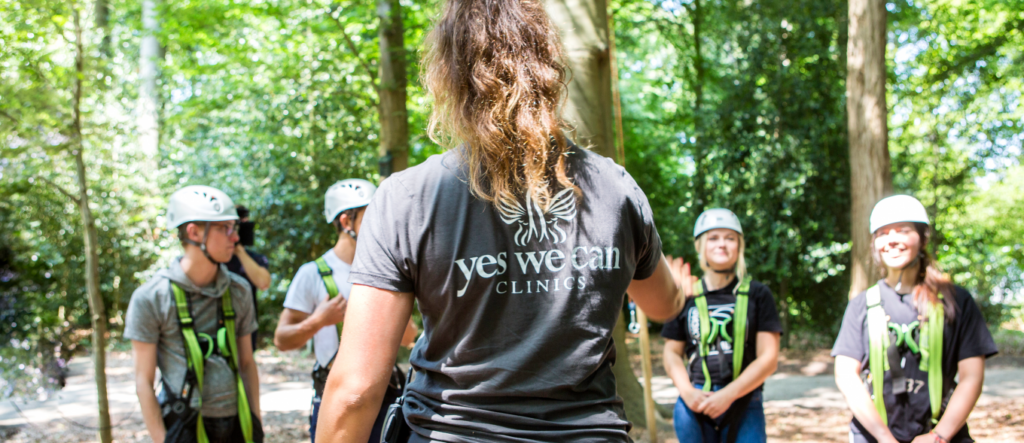
Kindness is an underrated trait in business. I blame Gordon Gecko. Since Wall Street came out in 1987, it posited the notion that to be successful you need to be ruthless. I never thought this needed to be true, and I especially don’t think it’s true after having Zoomed with Jan Willem Poot, the founder of Yes We Can Clinic in Holland.
Zoom journalism can be a tricky business; to gauge the person you’re talking with in 2D is sometimes impossible. The screen throws up too much distance. But with true kindness, the difficulty falls away: that’s because it dissolves all barriers. Generosity of spirit is essentially transparent, because what does it have to hide?
Poot is like this: engaging, thoughtful, eager to tell you his story. He is the polar opposite of arrogant.
But I’ve also noticed that true empathy often has its origins in hard experiences. This is also the case with Poot. He tells me: “To give you the story of the why of Yes We Can, I have to go back a little to my own story. My parents got divorced back when I was four or five. My Dad was happiest when he was around the world; and my mum raised me and I soon realised she was a little different to other mums: she was a heavy drinker – an alcoholic. She also took medication and never learned how to deal with her emotions without it.”
If that sounds hard, it was just the beginning. “My stepfather came to live with us, and he was also an alcoholic. From the age of 12-13, my home was an unsafe environment – a toxic place.”
Poot began spending less time at home, and more time on the street, hanging out with people in similar situations. “We had an unspoken bond. I found marijuana and gambling and became quickly addicted. I realised if I was stoned all day, or at a slot machine, I didn’t have to think or feel. By the age of 18, I was using cocaine and alcohol; by 19, I was using five grams of cocaine and a bottle of vodka just to feel alive.”
Luckily, one day a careworker found him in the street and picked him up and took him to an institution in the Hague. From 19 to 27, Poot moved around and didn’t find the right psychologist during that time. “They were saying the right things theoretically but they couldn’t get into my heart,” he recalls.
At 27, Poot went to Scotland to Castle Craig Hospital in Blyth Bridge, Scotland. “It was a beautiful clinic in the hills of Scotland. They took my hand and said they wouldn’t let me go until I had changed and was in recovery. Somehow, I trusted them.”
Poot is now 17 years without drugs or alcohol: “I am having the most beautiful life I could have.” That’s because he has purpose – perhaps more purpose than I’ve ever encountered in anyone.
Back in the Netherlands, Poot began apologising (“I had 200 people I had to say sorry too”) and also paying back clinics to whom he owed money. He finally made the last payments two years ago. He then joined a sports company, which helped young people and Poot began to feel a burgeoning sense of vocation; he would give back, and help those people similar to the person he had been. “By seeing those kids and working with the kids – and seeing the beauty of that programme – I was fascinated and I could also see the group dynamics and how positive and beautiful it can be,” Poot recalls.
Poot had been there for two years when his boss came to him and asked for him to be his partner. The company grew over the next years, but during that time Poot began to realise that he craved more connection with the children, which formed a smaller part of his role than he felt he needed. These feelings were compounded by the national situation in the Netherlands. “At that moment there were 200,000 kids getting a form of youthcare. They weren’t really getting better – they were just in the system. 20,000 children had been in the system for multiple years. I knew I could start something small to see if I could change, or help. It was a dream I had.”
Poot sold the sports company and started Yes We Can in 2011; almost immediately, he began achieving real results with children. “After two years, the Dutch government, the insurance companies, the councils, they were all coming to us and saying: “Please, grow and make this bigger because we have thousands of kids dying because there isn’t any right care.” In 2011, there were 25 beds; in 2013, they moved to a place with 85 beds; and four or five years ago they moved to a clinic with 160 beds. That means that every year they now treat a thousand young people. It hardly needs saying that this is an astonishing achievement.
Yes We Can is now an international clinic, which makes a real difference to people’s lives all over the world, but I am keen to know more about what that impact looks like in real terms. With this in mind, I Zoom with a fellow of Yes We Can, who understandably asks to remain anonymous. For the purposes of this article, I shall call her Eve.
When I meet Eve, I know I am going to like her, and warm immediately to her candour, gentleness, and intelligence. What I don’t expect is that I will spend a portion of the next hour fighting back tears as I get to know her story.
Eve’s is – at least to some extent – a pandemic story. “In February 2020, I was diagnosed with anorexia nervosa,” she tells me. “I have struggled for my whole life with eating, and my behaviour around eating, but nothing was working. I was very, very stubborn and verbally abusive towards my family and not wanting to change. I became this selfish person completely compelled by my eating disorder.”
Eve entered something like a parallel universe where the good in life seemed to her a thing almost impossible to access; her only reality was her eating disorder. “I would shout that I wanted to die, that I didn’t want to be here, and all that stuff. I completely ruled the house; I was being just disgraceful and making my family cry.”
Curiously, COVID-19 gave her a trigger. “I was so afraid because nobody knew what it was like and I knew I was frail and what COVID could do to people. I didn’t want to die that way.”
This shows, as only a casual remark can, a shocking fact: for Eve, death was very much in the equation at this point. Fortunately, Eve’s mother had heard about Yes We Can. She checked Eve in on 19th May 2020.
I take a moment to imagine how this might have been for Eve’s mother, who joins her daughter on the call. She has one of those kind faces which have also known suffering – but there is also something else written there, the perennial strength of a mother’s duty. It is the look of someone proud to be a mother, and proud to have suffered for love of her daughter, and who would do it again a thousand times. It is in itself, to use one of Poot’s favourite words, ‘beautiful’ to see.
There is always in the stories I have heard of addiction this almost unspoken toll on the nearest and dearest. And as Eve continues her story, my mind reverts back to Jan Willem Poot, who didn’t have a mother like this. Later, I also find myself contemplating the way in which the world gropes its way to good. It seems as if for all the pain that percolates in the world, we sometimes discover a secret remedy being administered. But this too is often an offshoot of suffering. The world has contained many people who hit rock bottom and didn’t survive. But others find that their nadir is the essential ingredient of the spiritual power they will appropriate in life. Yes We Can is an emblem of this.
And so it would prove for Eve. But she is at pains to point out that her life didn’t change rightaway. Slowly, as the weeks passed she began to reconnect with that other self which had seemed to have gone to sleep: the one capable of being happy and taking pleasure in the simple things the world has to offer. In fact, these things had been there, now and then, all along, even during the hardest parts of her struggle. “What I realised when I was actually in my active addiction, and in the clinic – and since I’ve left – is that nature is a massive thing for me – that I love the stars. I love going on walks.”
Even during the low point of her addiction, there were these little signs of another life – a life beyond her current predicament. “One of the things that I did during addiction was to look at the stars. That was one of the things that I did love: before bed, I’d go outside and look up to the stars with my dad. It would be really magical, but then as soon as I went back inside, everything would be rubbish again. When I went to the clinic, it was one of the things that I would do to remember my parents and say goodnight to them. Dad would always say: “If you see the moon, and I see it, we’re looking at each other. To me, that puts everything into perspective and I say it’s part of my higher power which is something that we discover in the clinic.”
So what was it like going into the clinic? “I was just in my own self-pity, crying and constantly homesick,” Eve recalls. “It felt very, very scary. There were people who were in their later weeks and who were in recovery. I was afraid of judgements. But it was different to places I’d been in before. The clinic is there to confront you, but it also has a feeling that this is the right place to be and I knew instinctively it was going to help me.”
Eve’s biggest changes didn’t occur until around Week 5. “I was still in my old behaviour. At other places it would be, “Just eat”. At Yes We Can no one made me eat. I was put on a meal plan, but the clinic understands that you’ve got to want it. I knew before I went that I wanted to change, but it was scary to take that step away from the safety of my addiction into something else. In a way, my anorexia was still a little high which would distract me from my relationships. But at the clinic, I began to understand why I was behaving in the way I did.”
One important moment was when Eve, who was used to being weighed blind, was weighed and showed her weight. “When I saw the results, I swore and cried. I was confused as I felt a hundred times better, but I had lost weight. Then I went to my therapist and cried and then said: “Right, I’m going to do it.” My first meal was unbelievable. I thought: “Wow, this is incredible. How have I been missing this?”
Eve continues to stay in touch with other fellows from Yes We Can, and is now set for a future which is immeasurably brighter than what she faced a year and a half ago. But what does she think would have happened had she not gone to the clinic? “That’s easy,” she says. “I would have died.”
We have heard a lot these past years about mental health, and I have sometimes begun to wonder if it’s an unhelpful buzzword. One reason for this is that our current conversation seems to skim over the life and death aspect of real struggle; it can elevate difficulty to the realm of real suffering which in turn may make us turn a blind eye to those who are really in danger.
Willem simplifies the whole thing for me: “We follow the same mission for all the kids who come here, and say to us: “I’m dying.” The end result is so beautiful. You can change behaviour. You can change thinking. Young people can start to believe in life again. That gets you motivated. This is the thing I want to do for the rest of my life.”
And you can see that he will – that he will never forget the motivation which his own redemptive story has given him. He wants that redemption for other people – and perhaps with a passion so heartfelt and true that one half-suspects him of saintliness – even over Zoom.
Saint of not, it strikes me that the scale of Willem’s achievement is to make his story not just his own – it is also Eve’s story and thousands of others we won’t be able to hear about in this article. But take a moment now to consider all the others, and try to imagine all the good that a person can do if they have the determination and the vision. If the pandemic teaches us nothing else, let it teach us this.
Christopher Jackson is News Director at Finito World