Category: Front Line

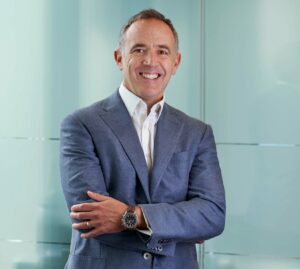
  • Finito Bursary Candidate Nick Hennigan: “I Want to Do My Family Proud”

    Christopher Jackson meets Finito bursary candidate, a young assistant to a private banker, and, explains why he’s destined for great things


    I have sometimes observed that precocity creates its own challenges: being brilliant young creates expectation and pressure. In fact, it turns out that ability without the right temperament places even greater pressure on ability itself. It’s rare for the two to go hand-in-hand because the one can sometimes clash with the other. To be very talented is usually to be told you’re talented: not everyone keeps a level head.

    Nick Hennigan, 23, who recently took part in the Finito bursary scheme, has had by any measure a difficult few years. His father took his own life at the start of the pandemic, leading to unthinkable grief and shock. But to talk to him you wouldn’t know it – and in fact he only mentions it towards the end of our conversation. “As much as it is a completely negative impact on anyone’s life – within my family it was a huge blow to us all – I now see myself as my dad’s legacy. I want to go out there and do him proud and do the rest of my family proud,” he will say.

    What was his early life like? “I was born in Aberdeen and I’m very proud of my Scottish heritage. I went to a state comprehensive and after finishing secondary school, I went to join EY on a business apprenticeship, which allows young school age children to join a Big Four firm, and train up as a chartered accountant.”

    The experience was formative but in ways Hennigan might not have been expecting: it showed him vividly what he didn’t want to do. “I was in the audit division, and I didn’t find it personally or professionally stimulating,” he says simply.

    But from there, Hennigan went on to complete his university degree in international business management at the Aberdeen Business School, before heading off to study in Canada’s Mount Royal University . “That was a fantastic experience,” he tells me. “All of this has helped shape me into looking towards a career within a company that has international presence. I suppose it gave me a deep appreciation for multi-national business. ”

    Hennigan has always had a broad range of interests, and was strong at school across the curriculum. “I always did quite well in maths subjects but then I also did biology and chemistry, as well as English and geography. I like to look at things intellectually and enjoy studying and working towards qualifications.  I would say I am numerate but I am also good with my language and the written word.”

    He says this without any air of boasting – he is stating the facts. Has this range of aptitudes made it harder for him to choose a career path? “That was the observation some of the Finito mentors would actually make once I joined the scheme,” he recalls. “They said because I excelled in different areas of business and subject areas, it was difficult to rule things out.”

    But Hennigan was already standing out from the crowd and an example of this is his excellent thesis ‘Leading into the post-Covid 19 era’. This astonishingly mature piece of work has a foreword by ITV’s Chief Executive Officer Carolyn McCall DBE, who writes in the paper: “Nick’s research is considered and thought-provoking and very much chimes with what I have long believed, that personal values and purpose play a pivotal role in the type of leader an individual will become.”

    This wasn’t the only figure that Hennigan interviewed for the paper: “I would love to one day – hopefully – become a CEO – so that’s why I chose that topic,” Hennigan recalls. “I also interviewed EasyJet’s Johan Lundgren; as well as Simon Roberts of Sainsbury’s, and Paul MacDonald, the CEO of Avon Protection, and Mark Darkworth of Schroders Personal Wealth.”

    I cannot imagine the result was ever in doubt, but Hennigan secured a first for his efforts. It is worth noting that Hennigan achieved all this despite scepticism about the ambition of his approach: “My supervisor said to me it wouldn’t be possible when I proposed it and that the CEOs wouldn’t give me the time of day. This spurred me on to go and prove her wrong: that’s part of my DNA – to overcome challenges.”

    So how did Hennigan come into contact with Finito? “It happened early in 2023,” he recalls. “I have recently joined the shadow board of UMBRA International Group. Through my work there, I got to know the CEO Kate Bright well and she very kindly introduced me to Ronel Lehmann, the CEO of Finito Education.”

    Hennigan’s main point of contact under the Bursary scheme was Claire Messer. “We got on really well, and she was great at preparing me for interviews – as was Merrill Powell who coached me in presentation, and made sure I put each point across succinctly and impactfully. Amanda Brown did my LinkedIn training and Sam Pearce did my headshots. But through all this, I had Ronel who was really my main mentor.”

    So what was Lehmann’s advice? “I had breakfast with him at a time when I had just had a few rejections and close calls, where I had got down to the final stages. Ronel told me I needed to think of three areas. So we narrowed it down to PR and recruitment – but we also spoke about private banking.”

    Hennigan was initially sceptical about this third possibility: “Given my experience with EY, I was wary about going back into finance, but private banking is very different to audit, even though it’s also underpinned by numbers. It also chimed as I have always said I want to be external-facing and deal with clients.”

    Once this strategy was deemed a major possibility, the stars began to align. Hennigan recalls: “Luckily enough, Kate Bright knows the Head of Marketing at a private bank in London and Ronel knew one of the MDs. I was able to meet with both of them on the same day back-to-back.

    The meetings weren’t for a particular role but I was able to explain my situation and set out my stall. They followed up afterwards by saying there was a potential role with us in a different team as an assistant banker. Again, I had no experience in banking and I made them very aware of that but they didn’t seem to think that was a problem: I got the job.”

    Those are the four words we most enjoy hearing at Finito. When I speak to Hennigan, he has only been in position for two and a half weeks, but his early impressions prove to be overwhelmingly positive: “I am enjoying the set-up that I’ve got,” he tells me. “It’s very fast-paced and I have got a lot to learn. It’s going to be a steep but positive learning curve.

    The good thing is I am fully supported by not only the banker that I am assisting but also the team and the other assistants that we have in the bank within the team. I am in the front office and I think it’s an amazing first job. I am not going to take it for granted. I am going to work hard.”

    Of course, it is a tragedy that Hennigan’s father isn’t around to see what a remarkable young man his son is – and is still becoming. His will always be one of those stories which, despite his remarkable nature, will contain the wish that events had been otherwise. Never once in our conversation do I see any trace of the self-pity others might feel and which would be perfectly understandable.

    Hennigan says: “I suppose it’s formed my outlook on life. It’s through adversity that you end up going on and doing great things. Finito opens doors and it encourages you – but it is down to the candidates themselves to do well.  If the candidate doesn’t want to engage in the process then they are not going to get out much. I think there is maybe a misconception with Finito: people say they will just place you into a job. No, they will support you to get yourself into that job.”

    That’s something that mentors observe on a daily basis – it’s not often, however, that a mentee speaks so eloquently about the experience of the mentor. What I think Hennigan has therefore – and I expect it to catapult him in time to the front ranks of British and maybe global business – is imaginative empathy. It is an ability to place himself in the shoes of others, and yet to retain his own remarkable steel and determination at the same time. It is the mark of someone already functioning at an extremely high level. It will do no harm that he is charming, and equally skilled at numerical and linguistic tasks.

    Usually, in an article like this, we like to thank the Bursary supporters who have helped the candidate in question. In this case, the donor has asked to remain anonymous, but has been happy to offer us these thoughts: “All it took was one brief telephone call from Ronel and I felt compelled to help. He was so emphatic in his enthusiasm for a newly presented applicant in whom he saw enormous potential but who had no possibility of funding.

    Ronel gave me the basic details and story, but was careful not to reveal too much. I did not wish for anything in return, simply the expectation of hearing some good news in due course. And indeed there has been. Nick will no doubt have a bright future and successful career, made possible by Finito’s mentoring and guidance. Maybe one serendipitous telephone call really has changed a young life.”

    This generosity is an example to us all, and Hennigan expresses to me the extent of his gratitude: “This person changed my life and I hope one day I get to meet and thank this person.” The donor should also know that to have supported Hennigan is to have backed an obvious winner. I would say: “Watch this space” – but my suspicion is you won’t have to look too hard to see the impact Hennigan will go on to make.


  • Opportunities in the Coffee Sector: An Interview with Dr. Claudia Araujo


    Finito World caught up with Dr. Ana Claudia Araujo of the Natural History Museum to ask her about possible careers in the coffee sector


    I was really surprised when I went to the exhibition last year to see what a big climate impact the coffee sector makes. Can you explain to our young readers why we need to take coffee seriously if we’re serious about climate change and biodiversity?

    I believe the starting point is to understand how plants work and how they interact within the ecosystem (or vegetation) to which they belong and have evolved, alongside other organisms. It is also paramount to bear in mind that living organisms are always evolving!

    Plants interact in many ways with other plants, animals, fungi and bacteria. They exchange favours in order to survive. When we extract portions of a natural ecosystem, we are not only putting at risk the future of the species directly affected, we are jeopardizing the system that they have built over millions of years, which works well because it is balanced.

    At first, we won’t notice the difference much because nature is resilient, it tries to reinvent itself, cure itself, forms a scar.  However, in nature everything is linked, like in an engine, and once we remove one key player the rest may fall apart. Imagine if you built a tower of flats and right in the middle someone decides to make an open space in their flat removing an entire wall? If several people decide to do similar thing then at some point the building will collapse.

    Humans clear vast areas of the planet for crops. In doing so it is eliminating the system that regulates the ecological functions of the area. It is not just the ‘green’ that is disappearing, it is everything else that we cannot name because we don’t see or even know it exists or how it functions and affects our ecological ‘engine’.

    We know plants purify the air while producing ‘sugars’ (energy), capturing carbon dioxide and returning oxygen. Plants also breathe and transpire. In performing these processes of photosynthesis, respiration and transpiration, plants bring water from the soil to the air, which accumulates, travels and falls as rain elsewhere. But water is becoming scarce. Forests are a mass of plants, of different sizes and shapes, each producing a network of roots that act like a sponge when it is the rainy season.

    Branches delay the fall of rain to the soil, roots above the ground trap water and roots below ground help the plant to absorb water efficiently and the excess travels to the water table. Saturated with water, plants transpire and the cycle is maintained. But in the dry season the plants have the reserve of a full water table. In this process plants help regulate the weather over the short term and the climate over the long term. Also important is the nutrient level of the soil, which comes from bark, leaves, flowers and fruits falling to the ground and being decomposed by fungi, worms and bacteria.

    Now, coffee like any other crop needs to have natural vegetation cleared to create the space for it to be grown – that is the first issue. Because it is a small tree, like other trees such as avocados and almond, coffee demands large areas of rich soil and regular rainfall. Here the issue gets worse.

    The biodiverse area that previously had many species was supplanted by a crop that demands too much of what the area can no longer provide. To start with the coffee grows well, but the more coffee we plant, the poorer the soil becomes, and the poorer the soil is, the greater the need to advance into areas where remnants of forest still stand, and thus more forest is felled. Eventually there will be nowhere suitable to plant coffee.

    What are the current obstacles to reform of the coffee sector?

    Coffee is the world’s second largest traded commodity by volume after petroleum. But the plant takes about five years to bear its first full crop of beans and will be productive for only fifteen years. Harvest is picking by hand because this is selective. Between collecting and preparing the ground coffee there is a long process: the wet method requires reliable pulping equipment and adequate supply of clean water – that is another issue; the dry method involves freshly harvested fruits being spread on clean drying yards and ridged once every hour, which takes 12–15 days under bright weather conditions – and the weather pattern is changing.

    So, the nature of this crop makes it an expensive one. It needs financial investment in certain areas to protect the industry. But the fear is that for the industry this investment will be wrongly read as ‘losing’ money, instead of investing. The price of producing coffee would be higher and will be sent straight to consumers instead of the increase being shared between producers, the industry and consumers. So, in my view, the major obstacle is changing perceptions within the industry. I might be wrong; I hope I am and find there is someone out there trying to make the necessary changes.

    What does the coffee sector need to do to change?

    Invest in creating and maintaining prime natural vegetation in an untouched state, particularly where the wild species of the genus Coffea (Rubiaceae) are found. Wild varieties can be a source of new cultivars that can produce crops quicker, demanding less resources. I am not advocating that the industry should own natural vegetation for their own advantage but support the maintenance of existent protected areas and advocate for new ones to be created.

    Support local communities alongside local scientists to supervise the collection of surplus seeds from natural vegetation and try to re-create or boost natural vegetation in areas that have long been deprived of it. Again, I am not suggesting planting coffee trees in forest remnants but rather to let the forest retake the areas of crop and try to keep both at bay.

    Invest in scientific research that focuses on alternatives, and plant conservation work such as the Plants Under Pressure program of the Natural History Museum.

    Can you talk about your research, how it came about and how it’s funded and what you hope the end results to be?

    I am a plant scientist that has dedicated most of my professional life to teaching and researching taxonomy (the science of what things are) and systematics (how they are related to one another).  I worked in universities and organizations keeping an herbarium, so for a long period my taxonomic knowledge was invested curating plants specimens. Currently, I apply this knowledge to identify plants at risk of extinction, where they are, what threatens them and what this means to the vegetation where they are found, to the local community and also the effects of climate change on such losses.

    This is to help policy makers know where, how, and when to act. I work on the Plants Under Pressure program, with a team currently comprising 11 people: four members of staff, four volunteers and three Master’s students. This program runs almost entirely on short-term grants, from research-funding bodies or from charities, and three of our four staff members are temporary researchers, including myself.

    Part of my time is dedicated to finding new funding opportunities to keep the research programme active. I am forever grateful to our volunteers that give part of their time to our research for free because they believe in what we are doing. Of course, it would be far better if we were a bigger team able to employ scientists for much longer and have more time to dedicate entirely to the work we are trying to do!

    The long-term aim of our research is to provide the scientific basis of what plants are more at risk of extinction, where and why, and what can be done to help preserve them. This information helps to inform international agreements such as the UN Convention on Biological Diversity which sets targets to achieve not only a reduction in biodiversity loss but also its restoration, something that also helps society to withstand the impact of future climate change.

    What would you advise young people who are interested in going into the coffee sector but also mindful of the environment?

    Get involved! Have an open mind. Do your research. Maintain a healthy scepticism: don’t take everything at face value. The 21st century gives the young mind the privilege of global communication, so use it wisely. Also, you may be in the crop production industry or hospitality sector or be a farmer and became a volunteer for a scientific group like ours or become a ranger in a protected area or national park that you know of.

    Give yourself the opportunity to hear what the ‘other side’ has to say, try to have empathy, listen to a different opinion – you don’t have to accept it but give yourself the opportunity to improve/boost your knowledge on the subject. Knowledge is power. When you know the different sides of the same truth you are closer to finding a reasonable solution. It is all about knowledge and compromise.


    To visit the Natural History website go to:

    https://www.nhm.ac.uk/our-science/our-work/biodiversity/plants-under-pressure.html


  • Rafael Nadal: a member of “the elite of the elite of the elite”

    Why is Rafael Nadal so important? As the great tennis-player retires, it is clear he inhabits very rare company, writes Christopher Jackson


    It is the humility of Rafael Nadal which is part of what makes him so magnificent. Retiring from professional tennis in mid-November 2024, he described himself as ‘just a kid who followed his dreams’.


    He was that, of course. But his great rival Roger Federer came closer to the mark when he wrote in his moving statement marking Nadal’s departure from the sport: “You made Spain proud. You made the whole tennis world proud.”


    In fact, Nadal – like Federer himself – comes from a very small group of sportspeople who make the whole world proud. They are a credit to their species. Part of living in an era whose defining obsession is sport is to find a dramatic increase in the type which we might call the elite of the elite of the elite.


    Why is Rafael Nadal so important?
    The 2008 Wimbledon final. Federer is serving for the third set


    The group I am describing is not made up of No.1’s – though all of the people I would put forward for this category have been at one time or another the best in the world at what they do. But being no. 1 in the world doesn’t get automatically get you entry to this club. Being the best in the world here is a mere starting point to being perhaps one day somewhere near this conversation.


    Anyhow, you need to be World No. 1 for a long time to qualify. You have to be world no.1 over and over and over – but even that doesn’t get you there. Rory McIlroy has been the no.1 golfer time and again, but he isn’t in this category: he isn’t actually particularly close. The English swing bowler James Anderson is closer, but not quite there either.


    To be in the elite of the elite of the elite you need to do things nobody else can do – in fact, you need to perform at a level to which nobody else has ever performed. And you need to do it in a certain way. We can call this genius, or magic.


    In the first place, it has partly to do with ease of doing – or apparent ease. When we watch Simone Biles performing her floor routine we can see that she is doing much more than the relatively prosaic thing of winning her gold medal. She is reinventing that sport: she is qualitatively different. The same used to be true of Federer when he would waltz through a Grand Slam without dropping a set. It wasn’t just the ease with which he did this – it was the beauty with which he did it.


    Usually the elite of the elite of the elite express themselves in memorable moments – moments where time itself might seem to slow down, to expand, or to become elastic in some way. Furthermore, these moments will usually be tied to some form of necessity: they therefore represent necessity surmounted, or responded to with unusual skill and awareness.


    These are the moments which send a shiver. One thinks of Michael Phelps in the Beijing Olympics in the 100m breaststroke. Going for his seventh gold medal – to tie the Michael Spitz record which he subsequently beat – he was looking tired coming down the stretch against Milorad Cavic.


    Then something happened. Nearing the finish, Phelps summoned some last ditch strength, and rose out of the water with a sudden show of speed, to tap 0.01 seconds ahead of his rival. He rendered himself above an impossible moment.


    Tiger Woods was able to do the same. At the 2005 US Masters, Woods needed a birdie on the famous 16th hole. His drive went left down a precipitous slope. Viewers at home tend not to know how difficult the greens at Augusta National are: it’s like putting on glass.


    Woods, as every golf fan knows, lofted the ball up and it ran down the slope. It teetered on the edge of the hole then toppled in. Woods went on to win the tournament. He needed to do something nobody had ever done before and he did.


    The presence of someone who is in the elite of the elite of the elite doesn’t always need to come in moments when their backs are to the wall. It can also show itself with a certain ease of doing which can lend itself to a sort of inverse drama: it is the drama of things not being close at all.


    In this category one thinks of Usain Bolt at the 2008 Beijing Olympics already celebrating about 80 metres in as he broke the world record by a vast margin. He looked almost as if he was flying. Nobody else has ever looked like that. In Bolt’s case it was tied together with a sense of theatre which in retrospect had to do with an extra awareness about the nature of the occasion: the nature of the occasion being that he was very likely to win and so could afford to lark about a bit.


    Michael Jordan is another example. When we watch reels of him hanging in the air before dunking a ball, it really can seem as though he has a different relationship to the essential physical structures of life to everybody around him.


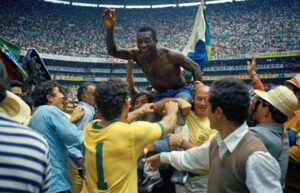
    In team sports sometimes we find a certain heightened sense of strategy and inventiveness – the ability to conduct surprising situations with a certain innate virtuosity. In this category we find the great footballer Pele. I have always been fond of the last pass that leads to Carlos Alberto’s goal against Italy in the 1970s World Cup Final.


    Pele looks like he’s playing against children. He collects the ball with his left foot, cradles it briefly, and then with a kind of infinite laziness sends it off to Carlos Alberto, who rifles into the net.


    Some of my favourite Pele moments have almost a kind of silliness to them. The attempt to score from behind the halfway line against Czechoslovakia in the group stages of the 1970 World Cup. The ball misses, but its sheer audacity opens up onto a whole realm of possibilities about how we might play football.


    Similarly, in the same tournament against Uruguay, Pele is running towards the box and the keeper coming towards him, both towards a cross coming from the left wing. Instead of trying to poke it past the keeper, Pele lets the ball go and circles back on himself while the goalkeeper flounders. That he then misses the goal doesn’t matter: he’s shown that there are another set of possibilities for the people to come after him to explore.


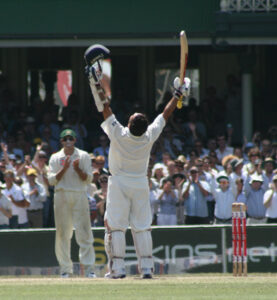
    Sometimes the elite of the elite of the elite can create moments which enter national folklore: inherently patriots, they can have a heightened sense of what their country requires of them. In 2008 Sachin Tendulkar, batting against England in the wake of the appalling Mumbai attacks, needed to produce a century to lift his country’s spirits, and he did. There can be something solicitous about the elite of the elite of the elite: they do what we need to them to do on our behalf.


    Clive James used to tell a story of Joe DiMaggio towards the end of his career. One of the greats of his sport, he was asked why he was warming up so hard when the game didn’t matter all that much in the context of a hugely successful career. “Because there’s a kind out there who hasn’t seen me play before,” came the reply.


    When this top flight of sportspeople are obstinate, their obstinacy can take on infinite proportions. Shane Warne, another member of the elite of the elite of the elite, was once asked who was the best batsman he’d ever bowled against. He replied: “Tendulkar first, then daylight, then Lara.” Asked why, he recalled how during one particular tour Tendulkar had found himself getting out to the cover drive. Unprepared to accept this reality, he simply cut the shot out of his repertoire all day long. Warne was shocked and delighted at the sheer determination of the man.


    Warne shows another example of the way this rarefied group can respond to circumstances. In Warne’s case, everything he did was characterised by a certain adventurous humour. During the 2006-7 Ashes, Warne was provoked by Ian Bell’s sledging to produce his highest test score. Bell, who Warne had been calling the Shermanator throughout the series, chose to answer back.


    Warne pointed his bat at Bell who was in the slips and said: “You mate, are making me concentrate.” Warne went on to score 71 from 65 balls. The implication is that he was so good he could stand in the great arenas of his sport, and not need to concentrate. But if you ever provoked him to do so, he could be as much a batsman as a bowler.


    Nadal reached these heights not because it was easy for him, but because he managed to balance extraordinary effort with profound humility. It was this which made him seem, as commentators frequently said, of another planet.


    That perhaps is what really unites these great sportspeople: they feel separate from us – they seem to resemble gifted visitors. One is sometimes left with the impression that the gulf between us and them is too great for it so be possible to learn anything from them.


    And yet at other times, it seems as though they have everything to teach. What makes it all a little easier to swallow is that time and again they teach the same sorts of things: hard work, humility, endeavour, a mysterious depth of commitment and even humour. We will need all those things in our own lives: that’s we won’t go far wrong if we make the Nadals and the Federers of this world our mentors.


  • Knighthood Inspiration: Sir John Griffin on His Work Ethic, Insightful Reflections, and Future Plans

    Inspiring Reflections: Sir John Griffin on His Knighthood


    FW: At Finito we were so thrilled to hear about your knighthood. Can you talk a little about what it means to you to be honoured in this way?


    JG: It was very moving. I thought of my late father who came from Ireland and worked at Buckingham Palace looking after the guards. When I went to the Palace, it seemed to open up a door to the past: in particular, it meant a lot to me to see the Irish guards and the Royal family too. I felt it as an honour and a privilege – I suppose you could see it capped a lifetime of achievement.


    Did you feel awe?

    I did – I was actually very taken aback. Did you know that as a kid I used to stand outside Buckingham Palace at the railings? Well here I was in the inner sanctum, as it were, kneeling and receiving the sword. I have always been a great supporter of the Royal Family – they do so much for our nation, putting us on the world stage and yielding a massive profit for the Country- and none more so than the King.


    Can you tell us a bit about the day of the investiture itself?

    Going into the Palace is a breath-taking experience. Actually, I’m full of Royal connections because I also live in a house designed by John Nash who also designed Buckingham Palace. But the pomp and the tradition is very humbling. I had been there before for a small dinner when Eric Clapton performed with Stevie Wonder – but on the day of my investiture my main memory of the music was the two trumpeteers who gave a magnificent flourish as we came into a celebration lunch.


    What do you think your mother and father would say if they knew their son had been made a Knight of the Realm?

    They would be so very proud. Other members of my Irish family went to prison. We have got a son at Buckingham Palace!


    The citation for the knighthood shows the sheer variety of what you’ve done. What is it that motivates you and keeps you pushing forwards?

    The main things which motivate me are helping the next generation and helping to save lives. The work we do at Finito is very important and I’m also incredibly proud of donating £12 million towards building The Griffin Institute at Northwick Park Hospital.


    What was the best day’s work you ever did in your life?

    I won a six aside football championship and the British Schoolboy boxing championships – those were proud sporting moments. Professionally, I’m most proud of starting Addison Lee – and especially enticing my two sons and our extended family to join the company. It was a right of passage for family members to find their role.


    What advice would you give to a young entrepreneur starting out today?

    Get up early and work late. Believe in yourself because your best is always enough.


    Where do you get your legendary work ethic from?

    Both my parents were hard-working people, who instinctively understood that things don’t happen overnight. They believed in me, and I think I was always comforted by that. That definitely helped during the hard times – and if you don’t have hard times as an entrepreneur then you’re not taking enough risks!


    How will the knighthood change things for you going forwards? What are your immediate plans?

    It won’t come as a surprise that I am thinking about starting another business, but it will be difficult to beat my proudest record of achievement over 38 years at Addison Lee, no driver was found guilty of any offence against a passenger. I am writing my autobiography.

    When I was 16, I went camping in Devon, milked a cow and drank the milk. As a result, I got brucellosis, bovine tuberculosis. I was in hospital for two years, and I left school without a single exam pass. I was on long term medication. During my treatment, I met a lot of people who later died. I was quite philosophical that I had not and realised that life was a gift.


  • ‘Room for improvement’: Tim Clark reacts to Bridget Phillipson’s first speech to the education sector

    Tim Clark


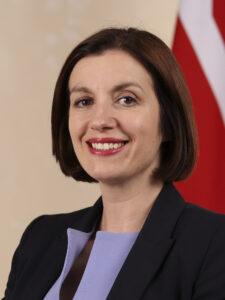
    Last Thursday (7th November) Bridget Phillipson gave her first major speech to the education sector at the Confederation of School Trusts’ annual conference. Her speech was personal, extremely positive and encouraging but also showed hints of naivety and even a lack of realism and understanding of the current situation in schools.

    She began, as her predecessor, Gillian Keegan, always did, by talking about her own journey from a disadvantaged background to becoming Secretary of State, something to be applauded and respected. After all, what is the prime purpose of education other than to nurture, develop and to open doors for all, regardless of background and ability? Her recurring theme was “achieve and thrive”.

    She highlighted the appalling inequality that still exists in this country and the fact that where you live and where you go to school are still key determinants in your educational outcomes. This is clearly wrong, even immoral, in a modern, advanced nation: every child should be able to access a world class education. Understandably, she enthusiastically listed several decisions made by the Labour government: the fully deserved 5.5% pay rise for teachers and the £2.3 billion increase to the core schools budget (although much will be taken up by the pay rise and the inexplicable hike in employers’ National Insurance contributions).


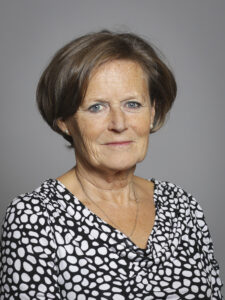
    Bridget Phillipson
    05/07/2024. London, United Kingdom.Secretary of State for Education,Bridget Phillipson poses for a photograph following her appointment to Cabinet by Prime Minister Sir Keir Starmer in 10 Downing Street. Picture by Lauren Hurley / No 10 Downing Street

    I also welcome her attitude to the teaching profession, “Teachers are partners not enemies” and the use of experienced professionals, rather than SPADS who have never stood in front of 30 stroppy teenagers on a wet Friday afternoon, to lead on various developments. I should have liked, however, to see a greater involvement of the profession as a whole. In my first, “Better schools, The Future of the Country” report in June 2023, I called for the establishment of a National Schools Council which would regularly and formally bring together ministers, civil servants and elected representatives from all areas of the school system. Real improvement will be dependent on the active involvement of those who successfully do the job, not those who just talk about it.

    Phillipson no doubt pleased many by offering to spend more on “crumbling classrooms”, referring to the recent Budget and the long overdue additional £550 million for rebuilding and the extra £330 million to improve the condition of our schools. We should not forget, however, that RAAC and asbestos existed at the time of the previous Labour government but rather than resolving these issues twenty years ago, it decided instead to spend the money on building a limited number of new, architectural masterpieces rather than on resolving underlying issues in all schools. Eye-catching new builds are presumably deemed more helpful at elections than a new roof here or a new staircase there.

    Clearly these are early days, but several of Phillipson’s comments do bode well for the future. The curriculum and assessment review may result in a curriculum that is more accessible and which will enable more young people to achieve and to make a positive contribution to the economy and society (but, I hope, without adopting a “prizes for all” mentality). The changes to Ofsted will, with any luck, lead to an inspection system that is far more clinical, accurate and useful to parents, schools and government, although we are yet to see what will take the place of the single, overall inspection grade. Providing early intervention for SEND pupils and of tackling the current atrocious absence rates [one in five children is deemed “persistently absent”] are both areas urgently requiring dramatic intervention.

    For all its positivity, however, there are two areas where I feel the Secretary of State’s speech lacked authority or understanding. The first is tackling the absolute crisis in teacher recruitment and retention. She made much of Labour’s manifesto promise to create an additional 6,500 teachers but, despite being an attractive soundbite, the number shows a complete ignorance of the magnitude of the problem. Last academic year, over 40,000 teachers (over 9% of the workforce) quit the profession for reasons other than retirement. In the same timeframe, only one half of initial teacher training places were filled (and only 57% in the previous year).


    This is the perfect storm – both retention AND recruitment. With over 20,000 schools in England, this equates to losing almost two teachers for every school; 6,500 new teachers is not even one new teacher between three schools. This is a crisis of extreme proportions and although Phillipson claimed she was not guilty of “a plan for happy ignorance”, much, much more needs to be done. The last administration pointed to the fact that there are in fact currently more teachers than ever before, but this ignores the fact that there are also 74,000 more pupils than in the previous academic year or that many of the additional teachers are either overseas trained (not in itself negative, but it obviously depends where and in what type of system they trained) or unqualified – hardly a recipe for dramatically raising standards. It is great teachers that change young people’s lives: until this crisis is resolved, any talk of curriculum, inclusiveness, standards or, indeed, any education topic, is simply pie in the sky.

    The area of Phillipson’s speech which has probably caused the most debate, is where she spoke about standards and the need for young people to be happy in schools. A survey has shown that one in three 15-year-olds “don’t feel happy in school. That’s worse than the average across our OECD neighbours”. Interestingly, this is the only international comparator that she chooses to quote: not the recent international reading and numeracy tests which, under the previous government, saw our comparative position rocket. Her message was clear – schools should not concentrate on academic achievement: “A*s alone do not set young people up for a healthy and happy life……This government will always be strong on standards….[but she warns against falling into]  “the trap of chasing a narrow shade of standards, structures-driven rather than child-focused”.

    Firstly, the vast majority of schools are not blindly focussed on exam results – to suggest that they are is simply insulting to all of us who have spent our careers committed to pastoral care, extra-curricular activities and to the development of the whole person. But why do some schools prioritise academic achievement? Not only is it the key to unlocking the future for every young person, it is also the metric by which schools are publicly judged – the annual examination performance tables. Phillipson makes no mention of scrapping these and they remain a central tool for how government and parents judge schools. Of course, issues such as “happiness”, ethos, the hidden curriculum and even extra-curricular activities cannot be quantified in the same way that examination results can – and nor should they. Let us understand that what makes a truly great school and gives it that special soul and feel, cannot always be defined in a league table. This is not a call for scrapping league tables, but if you chose to publicly rank schools according to their exam results, do not criticise them for playing the game.

    There is a clear criticism of previous governments in much of what the Secretary of State says: “previous governments have had tunnel vision……a sole focus on achievement is doomed to fail”. Anyone who has ever worked in a school, even briefly, knows that education is about so much more than exam results, but what she seems to fail to appreciate is that, sadly, this country is currently facing a genuine issue with academic standards.

    In recent years, England has done remarkably well in international league tables [PISA and PIRLS] but we must not confuse comparative ranking with a real improvement in standards. Yes, England has outperformed many competitors, which in itself may mean that our system has been more resilient to COVID and other pressures than that of other countries, but if you read these reports, our real terms performance in certain areas has declined at a frightening rate of knots: some maths performance is the lowest it has been since 2006; less than half of children feel confident in reading (it used to be more than half) and, what I personally find more worrying than anything else, less than one third of children going to secondary school now like reading. [And before anyone says this is the result of social media, our performance in this indicator is twenty points behind the international average.] In addition to making children safe and happy, we also need to raise academic standards as a matter of urgency and ensure that our schools produce youngsters with the knowledge, skills (soft and hard) and understanding necessary for them to contribute actively to society.

    Twenty years ago, I attended a conference which looked at the two trending education initiatives of the day, “Every Child Matters” (English) and “No Child Left Behind” (American). Unfortunately, the keynote speaker got tongue tied and called for a system where, “No child matters and every child is left behind”. The accidental slip inadvertently highlighted a very real danger – that political point scoring, that change dictated by those without knowledge or experience and that good, but flawed, intentions can seriously damage the education we provide for our young people. I have never doubted the sincerity and commitment of any Secretary of State or Minister of Education to do their very best for young people, but if the current and future incumbents want to really make a positive difference, they need to understand a few basic truths:

    ·       The very future of this country depends on how well we educate all young people, regardless of their starting point; education is too important to be a political football

    ·       A first-class education system requires significant investment.

    ·       Education is a complex matter: soundbites and a “one size fits all” approach are damaging in the extreme

    ·       The teaching profession is the most important commodity in any school system and makes the greatest difference to young people’s outcomes

    ·       While the role of elected representatives is critical, opportunity must be created to actively and meaningfully engage with those who have experience and proven success in teaching in our schools and of actually working with young people, not with advisors with absolutely no hands-on experience


    It is perfectly possible “to achieve and thrive”, but there is clearly much to be done.

  • Grace Hardy on accountancy careers: “Be yourself”

    Considering an accountancy career? Successful accountant Grace Hardy gives her advice


    Growing up with dyslexia wasn’t easy. School was often a frustrating experience for me. I struggled with reading, writing and spelling, which made traditional learning environments incredibly challenging. I often felt like I couldn’t keep up with my peers, and my confidence took a hit.

    The thought of spending another three or four years in a similar environment at university filled me with dread. I couldn’t afford to go to university without getting a job on the side and I was worried that doing a degree wouldn’t set me apart from others when I’d eventually have to find a graduate scheme after.

    During this time of uncertainty, my mum introduced me to the world of apprenticeships. I’ll be forever grateful for her suggestion because it opened up a whole new realm of possibilities for me.

    The apprenticeship route appealed to me because it offered a different way of learning – one that suited my needs better. It promised hands-on experience, practical skills, and the opportunity of earning money while learning. Plus, the prospect of no student debt was certainly attractive!

    I secured an apprenticeship with a Top 10 Accountancy Firm, and it was a game-changer for me. At 18-years-old I was on a £20,000 salary; I was over the moon. This gave me the financial stability I had been craving. From the very first week, I was working on real client projects and given responsibilities that expanded my portfolio and experience. Despite having no prior accounting knowledge, the firm provided comprehensive training and created a nurturing environment for me to learn and grow.

    As I progressed through my apprenticeship, I began to see the inner workings of different businesses. This exposure was invaluable and sparked my entrepreneurial spirit. I realised the skills and the knowledge I was gaining could potentially be used to start my own accounting practice one day.

    After completing my apprenticeship and gaining my AAT qualification, I decided to take the plunge and start my own firm, Hardy Accounting, at the age of 21. It was a scary but exciting move!

    The transition from employee to business owner came with its own set of challenges. Suddenly, I was responsible for everything – from finding clients to managing finances, and from marketing to delivering services. But the foundation I had built during my apprenticeship proved invaluable.

    One of the most liberating aspects of starting my own business was the ability to work in a way that suited my neurodiversity. I could structure my work environment and processes in a way that played to my strengths and mitigated the challenges posed by my dyslexia.

    For instance, I leveraged technology heavily, using speech-to-text software, dyslexia-friendly fonts, and other tools to help me work more efficiently. I also found that my dyslexia gave me a unique perspective on problem-solving, which often proved beneficial in finding innovative solutions for my clients.

    Whilst growing my business I quickly became aware of the fact that a very small number of my clients had any understanding of financial literacy – a key element of running a successful business. This was the seed that later blossomed into a full passion for the topic of financial education.

    After looking into how financial education is integrated into the UK curriculum (or how it really isn’t) I quickly realised that the situation was much worse than I originally thought. An inquiry by the All-Party Parliamentary Group on Financial Education for Young People found that over two-fifths of secondary school teachers surveyed did not know that financial education was a curriculum requirement.

    In addition to this, only two-in-five (41%) young adult respondents were considered financially literate, showing the impact that a lack of childhood education has down the line. Almost two-thirds (61%) of young adult respondents confirmed they did not recall receiving financial education at school – that math adds up pretty clearly.

    Those who were receiving financial education lessons in the UK were taught for an estimated 48 minutes per month on average instead of the recommended 30 hours. These findings made it clear that something needed to happen. In response, I started to lobby the Government for legislative change on financial education. This initiative became a crucial part of my journey, combining my accounting expertise with a mission to improve financial literacy across the board for the better of our communities, economies and people’s every day lives.

    In my business my goal was simple: to provide personalised, tech-savvy accounting services to small businesses and startups, helping them navigate their financial journeys with confidence. I wanted to create a firm that wasn’t just about numbers, but about building relationships and helping to educate business owners about finance so they could understand the ins-and-outs of their businesses.

    The accounting industry is on the cusp of a major transformation. As we move forward, I see a future where accounting is more than just bookkeeping and tax preparation. It’s about being a strategic partner to businesses and providing insights that drive growth and success. The future accountant will need to be part financial expert, part technology guru, and part business strategist.

    Artificial Intelligence is also revolutionising the accounting industry. From automating routine tasks, to providing predictive analytics. In my firm, we’ve embraced AI tools to enhance our efficiency and accuracy. This allows us to focus more on providing valuable insights and strategic advice to our clients.

    However, it’s important to note that AI isn’t replacing accountants; it’s augmenting our capabilities. The human touch – our ability to interpret data, understand context, and provide tailored advice – remains crucial. The successful accountants of the future will be those who can effectively leverage AI while maintaining personal connections with clients – allowing it to maximise our talents rather than replace them.

    For young people looking to follow a similar path in accounting, there are several key pieces of advice I’d offer. Being yourself is the best thing you can do. There are many business owners and everyone has their own approach, therefore it’s key to find something that makes you unique. What is your unique selling point (USP)? Developing soft skills such as communication, problem-solving, and leadership is equally important as technical accounting knowledge.

    Seeking mentorship from experienced professionals can provide valuable insights and guidance in this respect. Being adaptable is vital in the constantly evolving accounting field, ready to learn and adapt to new methodologies and regulations. Lastly, knowing that failure is not something negative is vital. In the entrepreneurial journey, setbacks are not just inevitable; they’re invaluable. Every failure is a stepping stone to success, offering crucial lessons that shape your path forward.

    These experiences, though challenging, provide unique insights and foster resilience – essential qualities for any entrepreneur. Embracing failures as opportunities for growth and learning is what often sets successful business leaders apart from the rest.

    Being self-employed has opened a realm of possibilities for me. I have since started the Unconventional Podcast and have launched the Unconventional Academy to help other young people start businesses and learn about financial education. In addition to this I am in the midst of my campaign to get legislation passed through Parliament to improve financial education throughout our school system – building for a better future, now.

    The road might not always be easy, but with determination, the right support, and a willingness to learn and adapt, you can achieve great things. Your journey is just beginning, and I can’t wait to see where it takes you!

  • Opinion: Why Hybrid Working is the Future

    Ever wondered why hybrid working is the future? Finito World looks at a question likely to be of perennial interest well into the future


    Hybrid working is proving itself remarkably flexible and popular.

    New research from IWG shows that hybrid working has led a boom in ‘active commuting’, with increasing numbers of workers travelling to local flexible workspaces via foot and bike.

    That’s good for our health, both physical and mental and is just another reason why employees seem to be voting with their feet nowadays.

    The study found that commutes to local workspaces are 38% more likely to be active than commutes to city centre locations. Workers aged 55-64 have reported a 109% increase in active commuting, the most of any age group.

    Health benefits


    That also has a significant knock-on effect. This follows recent census data which revealed that those who walked or cycled to work face a lower risk of mental or physical ill health, lowering their risk of admission to hospital for any illness by 10-11%.

    The increased use of local flexible workspaces by hybrid workers has been central to this shift. Almost two thirds (62%) of commutes to local workspaces are now mostly or entirely active. This is a 38% increase compared to commutes to city centre offices.

    The study was conducted by International Workplace Group (IWG), the world’s leading provider hybrid working solutions. It included brands such as Regus and Spaces, and included more than 1,000 hybrid workers. It found that walking (88%), cycling (34%), and running (28%) were the most common forms of active commuting. Workers travel on average 324 km via walking, 366 km via running, and 418 km on bike to a local workspace annually.

    The research also revealed some more novel forms of active transport, including travelling to work by scooter (7%), skateboards (6%), and rollerblades (4%), as workers cut long daily commutes by train or car and take advantage of workspaces closer to where they live.


    Rise of the “silver strollers”

    Hybrid work creates generation of “silver strollers”

    The research also reveals that older workers have made the most significant increases to the time they spend exercising as part of their commutes. Those aged between 55 and 64 reported a 109% increase in active commuting when travelling to a local workspace instead of a central office.

    Two thirds (67%) said they are more likely to incorporate physical activity into their commute when travelling to a local workspace instead of a city centre location. Meanwhile, more than three quarters (79%) have reported improvements to their physical health as a result.

    The most popular form of exercise for this “silver stroller” generation is walking, with workers aged 55-64 travelling an additional 259 km a year on foot by active commuting.


    Why hybrid working is the future
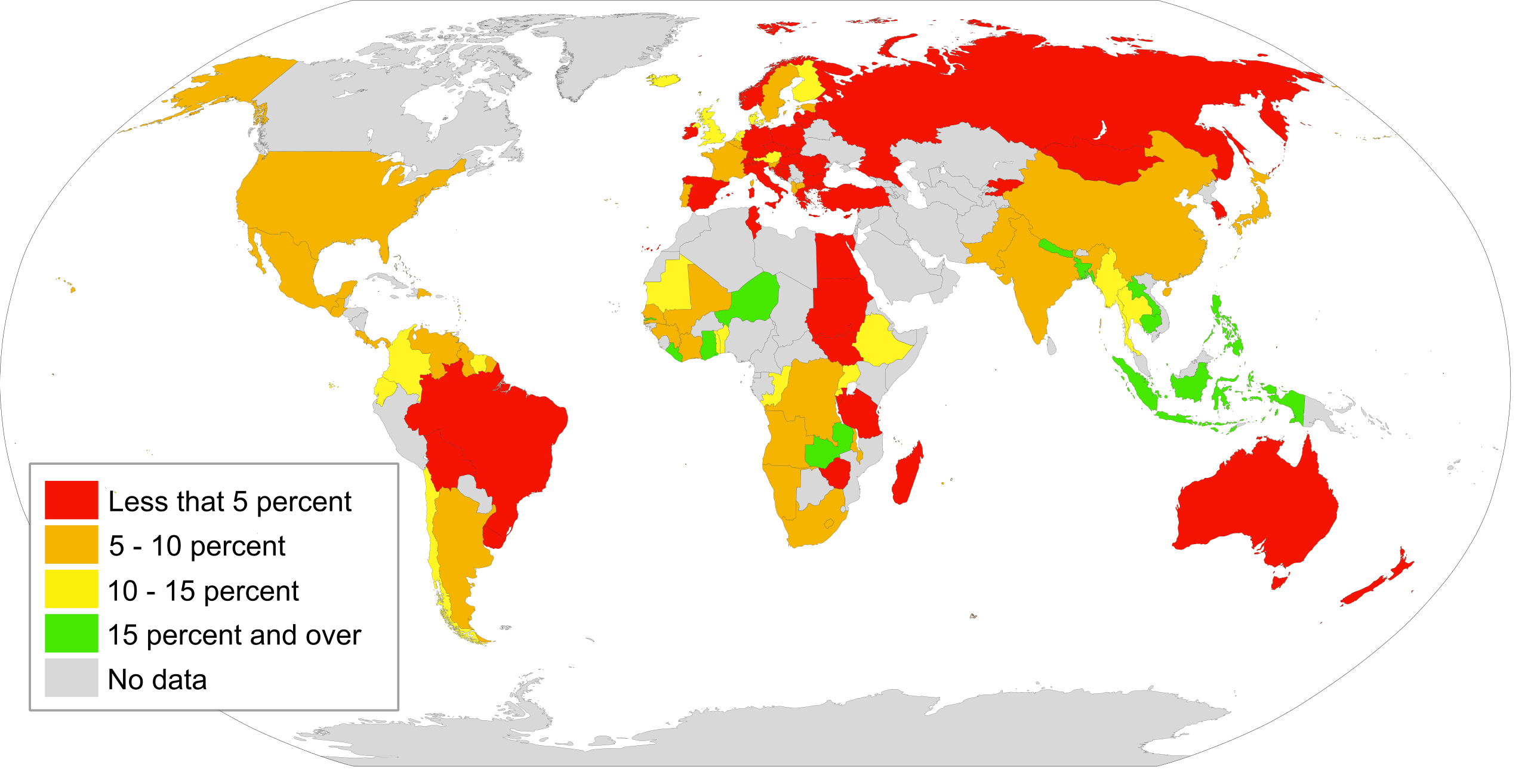
    This map shows the percentages of hybrid working by country


    A Question of Productivity

    Active commuting fuels mental health and productivity gains

    Beyond the obvious physical health benefits for all generations, active commuting to local workspaces has improved mental wellbeing, productivity and work/life balance. More than four in five (82%) of those that active commute said that incorporating exercise into their commute improved their mental health, with three in five (60%) reporting increased productivity at work.


    This is supported by additional research from International Workplace Group which found that three quarters (75%) of workers experienced a dramatic reduction in burnout symptoms, after transitioning to a hybrid model***.

    The improvements to work/life balance have resulted in 85% of hybrid workers saying they are more satisfied in their jobs and 75% reporting higher levels of motivation.


    Why hybrid working is the future
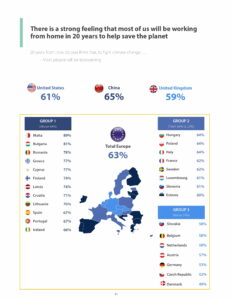
    This chart shows strong consensus around the ecological benefits of working from home


    Closer to Home

    Given the clear health benefits of active commuting, it’s no surprise that nearly three in five (59%) of workers want their employers to provide access to local workspaces closer to home, so they can fit in more exercise – as three quarters (75%) say they are more likely to incorporate physical activity into their commute when using a local workspace.

    It appears that business leaders are listening to their employees. Recent research among more than 500 UK CEOs found that three quarters (75%) said that returning their employees to a central office five days a week isn’t a business priority. Two thirds (65%) said they would lose talent if they insisted on their employees being present in a central office every day.

    IWG locations in rural, suburban, and commuter areas have seen a surge in foot traffic since the lifting of Covid-19 restrictions. Towns like Uxbridge (up 1839%), High Wycombe (up 1412%) and Maidenhead (up 1186%) experienced significant growth in footfall between June and August compared to the same period in 2021, when Covid-19 restrictions were in place.


    Win/Win

    To help meet this demand, IWG has opened more than 300 new locations in the first half of 2024, with the majority in rural, suburban and commuter areas closer to where workers live.

    Mark Dixon, International Workplace Group CEO stated: “The growing use of workspaces closer to where employees live, allowing them to reduce long daily commutes, is contributing to major improvements in worker’s physical and mental wellbeing.

    “This research demonstrates that hybrid working is a win/win for everyone. Business leaders are seeing substantial productivity and financial gains, while employees enjoy a better work/life balance and higher job satisfaction.

    Companies are increasingly appreciating that they will not only will they have a happier, healthier workforce when they allow people to work flexibly, but people actually feel more productive and motivated.”


    Need mentoring about hybrid working and the future of work? Go to finito.org.uk


    See also these artices:


    The Power of Motivation in the Workplace


    An Interview with revered clinical psychotherapist Dr. Paul Hokemeyer about Get Back and workplace toxicity


  • News: Palantir results shows Denver is the place to be

    Finito World looks at Palantir, the Denver-based company which is defining the trend towards AI technologies, and careers in that space

    Palantir’s exceptional growth is dominating business headlines this week as the demand for AI continues. There will be no imminent slowdown in the trend which has defined the past few years.

    Monday’s results were a clear sign of AI’s resilience in general, and Palantir‘s strength in particular. While the naysayers will no doubt continue to urge caution, AI isn’t going away any time soon. These technologies are defining the careers of the future.

    The Denver-based company released its results and revenues were impressive. In the third quarter, its revenue climbed 30 per cent to $725.5m. This was a significant increase on the $703.7m predicted by analysts. Net income accordingly rose to a record $144m.

    Changing times


    This is not the only Denver success story with companies as varied as the Gates Corporation, Accenture, Walmart and IBM having operations there.

    So why is Denver so appealing? There are several reasons why it’s become a hub, and why young people might think of making their base there.

    It didn’t use to be this way. It was the American writer Emma Goldman who wrote: “Denver is not unlike a prison. Its inhabitants, too, have been sent there “to do time.” That which makes the position of the prisoner preferable, is the consolation that the State will feed him and that some day his time will expire.”

    That’s a bleak outlook but things have changed. And as they change, technology careers are on the rise.

    Magnet for business

    First of all, it’s a centralised time location which makes communication and business operations easier. Denver is a good location to do business in both the East and West Coast while managing to keep civilised sleeping hours.

    Added to that it has excellent infrastructure including a major international airport in the shape of Denver International Airport.


    Palantir takes advantage of Denver's excellent transport links to provide excellent technologies careers
    Palantir takes advantage of Denver’s excellent transport links


    Aspect of the Future

    Its sector strengths are varied and include technology, aerospace, telecommunications, energy (particularly renewable energy), healthcare, and financial services. This diversification makes it resilient to economic downturns and attractive to businesses in various sectors.

    It’s also clearly a part of the future with Denver becoming a key tech hub, attracting startups and large tech companies, especially in software development, fintech, and cybersecurity.

    A Question of Tax

    The city has a growing reputation for innovation, bolstered by a strong talent pool and support from venture capital.

    This is in part due to an attractive tax regime. Colorado has a relatively low corporate income tax rate compared to many other states, and local governments in Denver often provide incentives to attract businesses, including tax credits, grants, and job training programs.

    America is moving fast and it’s not just Palantir which is part of that journey: Denver is too.


    Need mentoring on international career moves or technologies careers? Go to
    https://www.finito.org.uk/


  • Photo essay: Why Do We Take Drugs?

    Christopher Jackson tours a fine new exhibition at the Sainsbury Centre about the many ways drugs impact our lives


    After reading about the death of Liam Payne in Buenos Aries recently, one felt a sense of grim recognition. It was another story of a famous person with a bleak ending up, where the prime mover in the tragedy was drug addiction. This followed on from Matthew Perry‘s sad death the previous year.

    But you don’t have to look far in recent history to find others: Amy Winehouse, Jimi Hendrix, Jim Morrison, Michael Hutchence. It is a grim roll call of squandered talent. The trouble with talent is that it all too often distracts you from learning how to live. Know thyself, was the injunction above the entrance to Plato’s Academy.

    Drugs certainly can prevent that process, but the Sainsbury Centre has embarked on a larger mission: to consider drugs from many angles and therefore to arrive at a deeper sense of what drugs have meant to the species recreationally, socially, politically, in healthcare, as well as artistically and even spiritually. The results are shown in a series of exhibitions, and also in an accompanying book which is both well-written and beautifully designed.

    It was Gore Vidal who, in his usual lordly manner, said he’d tried each drug and rejected them all. He settled in the end on alcohol as his main source of recreation and it didn’t do him a huge amount of good, especially in his old age. But most people in their forties and fifties today will have dabbled in some form of drug, usually when too young to know precisely what kind of self they were supposedly meant to be experimenting with.

    This has without question hugely contributed to the mental health crisis which we see all around us. It manifests all too often as an employability problem, but this is ordinarily a symptom of addiction and not a cause.

    There is much in this exhibition to warn us off drugs, with heroin singled out as a particular disaster area. This was the tipple of the great Nick Cave, and he got through by the skin of his teeth to his present incarnation as a musical seer and global agony uncle.

    Cave always made sure he was at his desk at 9am, and wrote some of the great songs of this or any age while in the clutches of this particularly brutal drug. The section of the exhibition called Heroin Falls makes it clear that the high-functioning heroin addict is likely to be an extremely rare phenomenon.

    One such is Graham MacIndoe who chronicles his own addiction in photos of raw power. MacIndoe wasn’t robbed of agency by his addiction – or not entirely – and found that the drug made him focus with considerable obsessiveness on lighting his pictures.


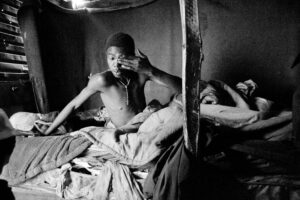
    This image shows the reality of drug addiction
    My Addiction, Graham MacIndoe


    And yet heroin remains a grim topic whatever spin you put on it. That’s even more the case when you consider the current trend in South Africa for Nyaope, known as ‘poor man’s heroin’. This is highly addictive and can contain anything from detergent to rat poison or antiretroviral medications. Anybody who has been to Johannesburg knows that it can be hell on earth: and here’s why.


    SOUTH AFRICA. Johannesburg. Thokoza. 2015. Thabang waking up in the early hours of the morning.


    SOUTH AFRICA. Johannesburg. Katlehong. 2015. Bathing in Katlehong after a long day.


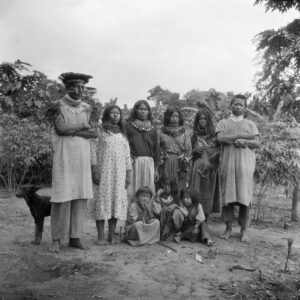
    But the Sainsbury Centre frequently points out that drug use hasn’t always been this destructive. The message is that, as with anything in life, it helps to know what you’re doing. There still exist today peoples in South America with a positive relationship to Ayahuasca.


    Richard Evans Schultes, The Cofan Family that met Schultes at Canejo, Rio Sucumbios, April 1942

    Richard Evans Schultes, Cano Guacaya, Miritiparana, 1962

    Richard Evans Scultes, Youth on the Paramo of San Antonio above the Valley of Subondoy, 1941


    These pictures show another setting to drug exploration: we are in the great outdoors where drugs really originate. Quite simply, they grow in nature, and it is a relief to the viewer to be out of the urban setting where drug addiction so often goes badly wrong, into landscapes where the existence of drugs has a saner context.


    As interesting as they are, they rather pale in comparison to some of the images of visionary art in this exhibition, the best of which is Robert Venosa’s Ayahuasca Dream, 1994.


    Drugs can also provide transcendent experiences
    Robert Venosa, Ayahuasca Dream, 1994


    All one can say about this picture is that if this is how the world looks on ayahuasca, you’d be a bit crazy not to want to try some. This is why people take drugs: they sense that the external world might be an end effect of something larger and that drugs might be a way to move towards that cause.

    Venosa’s picture, with its sense of a drama we can’t quite grasp conducted involving figures whose identity we only vaguely know will touch a chord with many. It is impossible to look at something of this scale and beauty, and feel that drugs can be of no benefit to humankind.

    Most people suspect that their mind is operating at a very low percentage as they conduct the rote tasks which the modern world can sometimes seem to require of them. They know they’re capable of more.

    I think it’s more than possible to do all that in a state of sobriety, and that route will be better in the vast majority of cases, simply because so many people lack the willpower not to fall into perennial addiction. Who can sort the real drug mentors in the Amazon jungle from the charlatans?


    But the Sainsbury Centre has done a great thing by tackling this subject in such an encyclopaedic fashion to remind us that though we each have our inner Amy Winehouse where everything can go badly wrong, we also potentially have a sort of Sergeant Pepper Lonely Hearts Club Band within as well – a new level to go to, whoever we are.


    For more information go to: https://www.sainsburycentre.ac.uk/


  • Leah Houston’s amazing bursary journey

    Christopher Jackson

    One sometimes hears someone called a ‘black sheep’ of a family as a pejorative term. It needn’t be like that. Most people who look inward in any concerted way find some surprising differences between their own hopes and dreams and their outward circumstances. Knowledge of this difference can open surprising inner capacities and point the way to a fruitful life. In the best cases, it is possible to strike out in a different direction from one’s family, and to feel no sense of alienation whatsoever – but instead to feel a sense of loving journey, which ultimately all members of the family will accept and profit from in understanding.

    Something like this appears to be happening to Finito candidate Leah Houston. I ask her about her upbringing: “I’m from very humble beginnings,” she tells me, her accent distinctively Northern Irish. “Education was never pushed for me. It wasn’t the world I was in. I’m the first in my close family to be interested in my studies, and then to want to pursue them, and then to go onto university at the Belfast Bible College in Dunmurry, Belfast.”

    Despite this, Houston is aware of many similarities between herself and her family. “On the other hand, working hard was pushed on me – it was a question of financial necessity. I’ve had a part time job since I was 14. After school you went to work: food had to be placed on the table somehow. In hindsight, I wouldn’t have changed a thing at all.”

    So what did her parents do for a living? “My Dad is typical Northern Irish. He is a part-time farmer and he sells animal feed from a local agricultural shop. My mum worked in office work all her life – then she had me. She felt that to stay at home was her calling, but then she started looking after other peoples’ kids and soon she had her own childminding business.” This seems to amount to a strong entrepreneurial streak in the family. Houston agrees: “You have your hands and you can do something about it – so go work,” she says, simply.

    This innate understanding of business was already becoming apparent in Houston’s choices. “Business makes sense to me,” she explains, “seeing something through from 0 to 100. You’ve got to see what you’re good at and make something of it. I studied Business through to A-Level and initially thought I would study that subject at university as well. But I had a bit of a change of heart.”

    This brings in another side of Leah – her religious belief. “I grew up in a strong Christian household,” she recalls. “It wasn’t pushy but it was fostered. So I studied religion and law at university which was a major change.” Throughout our conversation she will talk about her faith in the relaxed, confident way which people do when their beliefs are deeply embedded.

    I am interested to know how this degree was structured. She explains: “The main aspect of it was theology, but with world studies, policy and law examined. It was all to do with how one’s faith works out in the public sphere. I was focused predominantly on Christianity but I also did world religion modules.”

    This decision garnered a mixed reaction at home. “My extended family – my cousins and so on – weren’t sure. Firstly, because I’m a woman – that didn’t go down well, and led to some opposition. Some also thought I would lose my own faith, and question what I believe.” And has she? “I haven’t. Growing up in a Christian country, Christianity can be ugly because it’s political. There have been civil wars in the name of Christianity in my country. I came out the other end with a wider appreciation of all religions and the part they can play.”

    Houston loved her degree, but like most humanities degree, the gain of doing something one loves had a flipside: such courses don’t lead to such clear destinations as vocational courses. “I didn’t want to go into the Church, so in hindsight it was a much harder option. For the first few years I thought it was all amazing, but I’m not philosophical – I’m much more practical. My interest is in thinking how faith values can be implemented. During the three years of my degree, I did some time with a charity at home called the Evangelical Alliance. That organisation tries to bridge the gap between Church and politics. In hindsight, my time there planted the seed for politics and the public sphere.”

    This seed came to fruition when Houston began working for Baroness Anne Jenkin in the Houses of Parliament. “When I finished university, I thought: ‘What the heck am I going to do next?’ I came across Christian Action Research Education (CARE) a charity which seeks to facilitate getting a job as a Christian in politics in addition to offering training in thinking about politics. Anne Jenkin is extremely kind and said she’d take me for a year.”


    Baroness Anne Jenkin has been a huge help in Leah Houston's career journey

    And what were her impressions of the role? “Anne is so hard-working – no two days are the same for Anne,” Houston recalls, laughing perhaps at the remembered bustle of it all. “I was involved in diary management, speeches and organising meetings she would host. It was general ad hoc stuff and I was an extra pair of hands.” Leah brought a very clear sense of purpose to the role. “I was there to serve Anne – to allow her to do her job better. That could be sending letters, or photocopying, or making a cup of tea. I also became immersed in the question of gender ideology, which is one of the key issues for Anne.”

    And what was the culture like in Parliament? “As a practising Christian myself, I was interested to discover the APPG, Christians in Parliament, that is a cross-party group of Christians. As long as you were a passholder you could be a part of that: MPs, kitchen staffers, it didn’t matter. It brought a sense of community, with weekly services held in the Chapel of St Mary Undercroft. Politics is so polarised and tends to be all or nothing. It is meaningful to have something that unites: at election time we prayed for whoever was in leadership.”

    Through Baroness Jenkin, Leah met Finito Education CEO Ronel who saw Leah’s potential. “Ronel is a great supporter of Anne and he took me under his wing. I was with Finito for half a year and the investment in me was incredible.”

    This is good to hear and I ask her what the impact has been. “Besides all the practical things such as the LinkedIn training, the CV writing and the mentoring, I especially value the confidence that the Finito service gives to someone in my circumstances. It was as if I was being seen for the first time. This was so encouraging for me especially given my upbringing, where my wanting to succeed was perhaps sometimes considered a bit weird. My extended family would wonder why I was in London, and why I’m in the job I’m in. This was an organisation which wanted me to succeed.”

    This process of building confidence in an individual is integral to the mentoring process. It begins from our first encounter with a new student. Houston recalls: “I remember vividly the first meeting with Ronel where I brought him my CV. When I had been in parliament I had co-founded a network for the protection of gender-critical views. I showed my leaflet to Ronel and it was an incredibly important moment, because someone was looking at my work, and taking an interest in me. It brought me an overwhelming sense of pride.”

    Mentoring is to do with becoming reoriented in one’s life by coming into one’s essential self.  Houston recalls that her being photographed by in-house photographer Sam Pearce continued this process. “I spent an afternoon with Sam and I noticed that she took the time to make me feel comfortable. She also took time to ask questions between pictures – it was not a transactional photoshoot, it was more an investment in who I was.”

    Following on from there, Leah had her LinkedIn training with Amanda Brown (‘incredibly helpful’) and then began work with her lead mentor Tom Pauk. “He was so lovely and I was telling my heart and how I feel things deeply. He said: ‘I think you need to go into the charities sphere’. I said: ‘ I think you’re correct.’ And now I’ve landed a job with a charity which is a start-up. Tom was amazing, and gave me contacts.’

    From Pauk’s perspective, Houston made an excellent impression. He recalls: “Leah struck me as a highly intelligent, articulate and values-driven young woman, seeking a position where she can employ her myriad skills to improve the lives of others, especially those of women and children.” Pauk noted early on that her priority was ‘to use her lobbying skills to help bring about changes and social impact,” adding that “she is not driven by earning a high salary, though she’ll need a sustainable one.”

    When the job came along it all happened very quickly ‘in the space of a week’. Houston brings me up to speed: “I now work for a charity called Forum which is based in London and has launched in America too now. Its purpose is to serve leaders and influencers from all sectors of society. It tries to link up like-minded people. I’m a data manager and administrator, which is important for Forum, as someone’s name in the database is like gold to the business. I’m also EA to the founder David Stroud, who is married to Baroness Stroud.”

    So how does she see the future? “I actually don’t know,” she admits. “My life these past few years has been full of uncertainty, but I can see myself settling here for a good while. It’s a start-up with huge potential for growth and now the whole past five years makes sense.”

    At the end of our interview Houston reflects a little on her journey so far. “It’s strange to be in London and not be money-driven. Wealth to me isn’t money. It’s what I had growing up: I had family and friendship and relationships and that to me is wealth. Marriage and education is wealth.” And are her family beginning to understand the nature of her journey now? “My parents have been massively supportive, but we don’t always speak a common language. My cousins have their own convictions and they don’t necessarily agree. But the relationships are there and really there’s so much love and support.”

    One is tempted to call this attitude mature except that many people live their whole lives without realising the importance of things which Leah innately understands. She also has an immense capacity for empathy and understanding. Houston is someone whose narrative is not to be judged by the usual metrics of success: money, or position or anything else – though there’s nothing to stop her acquiring these. But she is in such a strong position because she isn’t a materialist. She is someone who will make her own way – and in fact is already doing so.

    The help which Finito gave to Leah would have been impossible without the generous help of the Stewarts Foundation. The firm’s managing partner Stuart Dench says: “In a perfect world comprehensive career guidance would be available to all regardless of their background. The Stewarts Foundation is delighted to support the important work of Finito via its bursary scheme.”

    Stuart Dench and the Stewarts Foundation has supported Leah Houston's career journey

    When it comes to someone like Leah, the importance is difficult to measure because it has to do with ineffable things like confidence, connectivity, and the unleashing of possibilities within a person who may not yet know how capable they are. In her case, it is also to do with helping someone to arrive at the realisation that the place they’re born in need not be a limiting factor. Ultimately it’s for us to make our own way – though it is right that we do so with the help of others.