I left politics in 2012 to work in the Olympics, and that was the start of my self-employment journey. Many years before, I’d done a computing degree. 2012 was the year the UK agency was formed and that began my passion for space. In 2014, I applied for NASA Social, and took myself over to America for two weeks in January 2015.
Here were everyday people who were passionate about space, and able to engage in it. My core skill is bringing people together and that’s why five years ago I set up the London Space Network, which brings together people from every walk of life to discuss space. We now have 1500 members on our list, and events sell out within 48 hours.
When we think about humans and navigation, and travel on earth, we’ve always used the stars to navigate but the opportunity of building a human presence on Mars and icy moons is a different thing altogether. It presents the possibility of the foundation of our human future. At the moment, only nation states through their agencies have managed to land on the surface of the moon: Japan, India, China, Soviet Union, America, and attempts from Israel and which failed. But that’s all changing and it’s now important for us to raise awareness about careers in the space sector.
The growth of the private space sector means that a barrier has been removed and space agencies can now focus on the science. As our presence in space grows, tourism, trips to the moon, and trips round the orbit of the moon and back, will become the norm. As the cost comes down it will open up huge markets of growth. Who doesn’t want to wear a pair of trainers that have been in space or products which have orbited the moon?
I think our space journey will be part of a much broader narrative of innovation which our children will benefit from. Take water processing as an example. If we can solve the question of clean water on earth, then why can’t we have it on the surface of the moon. The opportunities have never been more wonderful. You could do a Master’s degree in AI History of Art on galleries on the surface of the moon in 100 years’ time. This will impact every career. Human beings are curious by nature. We would be so bored if we didn’t think beyond our planet.
As we look ahead in this sector, it’s important to fight for everyone and make sure it’s as inclusive and open for everyone as possible. Currently there’s this duality whereby the rich can access those trips to Mars. It could create planetary political differences between those who chose to go to Mars and those who stayed on Earth. These ethical implications are the reason the space community needs to be as open as possible and engage with people from every background.
Looking ahead, I think we’ll see a lot of international collaboration deals between America, India, Japan and the European agencies. By 2040, we’ll have more of a human presence on the moon, but more of a robot presence too. We’ll also have a UK astronaut in orbit in the next ten. We’ll also make headway in going to the icy moons of Europa. In the next 100 years, we’ll certainly have a presence on the moon and on Mars and will be acquiring rare earth minerals in an asteroid mining process.
I’d like to see a United states of Space. We already have the United Nations Office for Outer Space Affairs.. We’ll only do well if we work together. If we don’t we’ll just be transferring conflict into space. Let’s not forget that space has been used for warfare during the Russia-Ukraine conflict. We have to think ethically about our access to space.
When you think about Oxbridge education, grime music probably isn’t the first place your mind goes. Nevertheless, world famous rapper Stormzy looks right at home talking to Cambridge students and professors about his scholarship programme for black students. At six-foot-five, the 28-year-old towers over the crowd gathered outside the historic university buildings on a rare sunny day.
“Every time I see Cambridge students I always make it a proper point to let them know ‘you lot are sick!’, but because I’m a rapper, sometimes it can sound corny like ‘read your books guys, it’s cool to stay in school, kids!’ But genuinely, as someone who’s tried to be one of you lot, it’s f**king difficult! It was so difficult, so I know first-hand.”
As Stormzy chats with the students, it becomes clear just how much respect
he has for their achievements and what they represent. In his childhood Stormzy, then known as Michael Omari, was a high flyer in school, winning praise from his teachers and earning impressive marks. However, as he jokingly admits, he was also frequently “the one to throw a sandwich at someone’s head during assembly”.
“I’ve always considered myself to be very smart, not to be arrogant you know,” he explains. “For GCSEs I got all the grades, I got to A-levels and said ‘this is tricky’, got to A2 and it was like, pfft. School was a breeze, I smashed my GCSEs to pieces, loads of A*s, but when I went to college I was like ‘wow, this is what it’s like actually being a student’, and that transition was so difficult.”
Like many students who find school easy at a young age, Stormzy became bored of his education and did not develop proper study habits. He and the people around him always predicted that he would
earn a spot at one of the nation’s top universities, but he blames a lack of focus, complacency, and troublemaking on his failure to get a place.
“Every time I see Cambridge students I always make it a proper point to let them know ‘you lot are sick!’”
“I did quite alright at A-levels, I got A, B, C, D, and at the time I was gutted but now looking back it’s like that’s not too bad. But you’ve got people here who’ve got A*, A*, A*, A*. I think when you get to that stage natural ability becomes second to focus, and commitment, and working hard, which is the difficult bit because you get someone like me who went through school naturally gifted, but then it’s like… that juice just doesn’t work here.”
Stormzy was expelled from Stanley Technical High School when he “put loads of chairs on another student” in what he described as “just banter”. The administration took a different view – and just like that, his shot at going to Cambridge was gone. Stormzy laughs as he explains how his early perceptions of what it takes to get into Cambridge led him to start the Stormzy Scholarship.
“When I was younger, the reason I thought I could come to Cambridge is because I just thought, ‘I’m smart.’ I didn’t think nothing else. Luckily, I wasn’t tainted by what I’d heard from people, like society and that. I didn’t even think about my criminal record!”
The Stormzy Scholarship
Stormzy has an admirable respect for learning – and so, while there’s criticism out there about him, it’s hard to escape this central fact about him. “As much as people think rappers, footballers, and celebrities are glorified, trust me – learning, education, and reading is a much more powerful and beneficial thing,” Stormzy has said.
It is no secret that the Oxbridge experience has traditionally been a white one, and a male one. Together with Stormzy, Cambridge University is trying to change that.
In 2018, Cambridge announced a partnership with Stormzy; the Stormzy Scholarship. In the beginning, the scholarship supported two black students a year, giving them full
tuition and a maintenance grant throughout their time at Cambridge. This year, 13 students have been given that opportunity. The high-profile programme aims to change the perception of Cambridge and make it clear that students from all backgrounds are welcome, and the evidence says that it’s working. Dubbed ‘the Stormzy effect’, Cambridge has seen a massive influx of black students. Between 2017 and 2020, Cambridge saw an over 50 per cent increase in the number of black students admitted to undergraduate courses, and even higher numbers of applications.
“If you’re academically brilliant,
don’t think that because you come from
a certain community that studying
at one of the highest education institutions
in the world isn’t possible.”
Jesse Panda is the President of the African and Caribbean Society (ACS) at Cambridge. He’s a first-year engineering student with some big ideas on how
to improve the black experience at Cambridge. We asked him about the so- called “Stormzy Effect”.
“I think that’s an accurate name. I think the support from someone as prominent
as Stormzy makes black students who want to come to Cambridge feel more welcome,” Panda explains. “They think, ‘Okay, there’s a system for me – maybe I won’t get the scholarship, but I can see that they’re trying to put a system in place to be more welcoming to black students.’”
The numbers show that Cambridge’s efforts to welcome black students seem to be working, but removing a centuries- long stigma is not easy. And, as Panda points out, even with record numbers of black students attending Cambridge, white students still far outnumber them.
“I think the main problem is removing that stigma – the perception that Cambridge is not a place for black students – and, to be frank, it’s still got a long way to go,” Panda continues. “I feel that I’m fortunate, but not as fortunate as I could be, if you see what I mean. I’m lucky to not be one out of 40 black students as it was in the past, but now I’m still only one out of 180 black students, whereas a white student will be one out of 2,000 or so.”
Removing that stigma is exactly what Stormzy has set out to do. “When we first launched the scholarship, I always said that I wanted it to serve as a reminder that the opportunity is there. If you’re academically brilliant, don’t think that because you come from a certain community that studying at one of the highest education institutions in the world isn’t possible,” Stormzy has said.
Jesse Panda and the other members of the ACS are doing their best through events and outreach programmes to show that Cambridge is a place which welcomes black students. However, due to the lack of diversity within both the university and the city itself, Panda says that he understands if some black students decide that it isn’t the place for them.
“We had an offer holiday through the ACS, so future students were able to see what the society was doing. It was more welcoming for them, because they could see that Cambridge is not just a space for white people, it’s also accommodating for black people as well,” Panda explains. “I think we need more opportunities like that because Cambridge is not very diverse. In the media, it is pushed that Cambridge
has no space for black people, when in reality there are spaces – but if someone doesn’t want to come here because of the imbalance, that would make sense to me.”
Despite this, Panda is optimistic about the future of black students at Cambridge, while also realising that there is much work to be done. He is enjoying his first year in the city, and
the ACS has provided a place for him to liaise with other black students and make a lasting change for the future of the university. While Panda’s experience has been a good one overall, the lack of diversity is still a large departure from his life in London.
“I think that’s always going to be there to be honest. As much as Cambridge
is taking steps in the right direction, when you look at Cambridge you still see a white environment. I haven’t been as intimidated as I thought I would be, because there are more black students than I thought there would be. But coming to Cambridge from London is still a big jump in terms of diversity.”
For Stormzy, the scholarship is a symbolic continuation of his own stalled academic journey and a way to provide an opportunity to students which he did not have himself.
“I actually look back at my school years and say that they’re the best years of my life,” Stormzy says. “I was reminded by my teachers that I was destined to study at one of the top universities if
I wanted to go down that path, but I diverted and ended up doing music so
it didn’t happen to me. But I felt like I was a rare case in the sense that I knew it was possible, which I feel like is not always the case. When students are young, academically brilliant, and they are getting the grades, they should know that’s an option.”
Grime and violence
Having secured a place as a music star known partly as a lyricist, Stormzy’s views have often been sought on education. On one occasion he responded to criticism of the message in his music in conversation with Charlamagne Tha God: “You say, ‘Let’s learn about Shakespeare’, but Shakespeare has stories of bloodbaths and murder, so I always say, ‘I am as positive as Shakespeare, I’m as negative as Shakespeare.’ Let’s get out Shakespeare stories right now and go through them one by one.”
Of course, these sort of remarks open Stormzy up to the observation that he has a long way to go before he can be said to display the nuance and poetry of the UK’s most famous writer, and some will raise eyebrows at him even making the comparison.
So that while Stormzy’s charity work is undeniably a force for good, it can be hard to reconcile this positive impact on young people with the negative impact which his lyrics are often said to have. Grime does not shy away from portraying life in underrepresented communities, which can include depictions of crime, violence, and sexism.
Katharine Birbalsingh CBE is an experienced educator who chairs the
Social Mobility Commission. She is also co-founder of Michaela Community School in Wembley, a free school which has been described as the strictest school in Britain. Birbalsingh takes issue with Stormzy’s influence because she sees his lyrics to be glorifying crime and sending young people down a wayward path.
“Yes, some love Stormzy and other drill, grime, rap etc. artists who are misogynistic, glorify violence, wear stab vests etc. They don’t care how it destroys the lives of boys in the inner city. They think it is cool. They even campaign to teach Stormzy over Mozart in schools,” Birbalsingh tweets.
She later posted screenshots of a conversation between herself and a prison officer who was commending her for “exposing Stormzy as a poor role model” and detailing the kinds of destructive media prisoners often identify with. Birbalsingh adds, “Those of you promoting Stormzy have no idea of the damage you do.
“You say, ‘Let’s learn about Shakespeare’,
but Shakespeare has stories of bloodbaths and murder,
so I always say, ‘I am as positive as Shakespeare.
I am as negative as Shakespeare”
It is worth remembering that grime is by no means the first genre of music accused of corrupting the younger generation, and it will not be the last. Even Baroque music was initially seen as an ungodly thing – a passing trend which was sure to die soon.
In the 1930s, the blues was seen as the musical root of corruption. This view of the genre was not helped by the barbaric attitudes towards race in America at the time, and the fact that it was usually performed by black people. Often slammed as needlessly violent, sexual, and profane, blues was “the Devil’s music” of the day. While accepted as a blues classic now, take the example of Robert Johnson’s .32-20 Blues:
‘F I send for my baby, and she don’t come
‘F I send for my baby, man, and she don’t come
All the doctors in Hot Springs sure can’t help her none
And if she gets unruly, thinks she don’t wan’ do
And if she gets unruly and thinks she don’t wan’ do
Take my .32-20, now, and cut her half in two
The .32-20 in question is, in this context, a powerful and then-feared handgun cartridge not dissimilar to today’s .44 magnum. So a song released in 1936 was named after a weapon and went on to describe the murder of a woman whose only crime is disobedience.
Much like in the blues tradition, grime is deeply rooted in the experiences of the artists who perform it. Stormzy has defended the violence of his lyrics on LBC, explaining that the connection between actual crime and speaking about crime is dubious at best.
“The reason why we speak about these things is that these are things which go on in our community. We’re just being social commentators,” Stormzy argues. “But it is such a far-fetched statement to say that grime music is the reason for the country’s knife crime epidemic – that is wild. How do you even get there?”
When asked if he is careful about what he says in his songs because of children listening, Stormzy makes it clear that he is aware and wary of his massive influence.
“Every time I write a lyric or make music, I have the responsibility and the duty to tell my own truths – whether they’re positive or negative,” The artist continues: “Secondly, now that I’ve progressed to a certain stage, I try to be more careful but I’m not going to put some censor on it because everything I talk about is true. It’s things I’ve done in the past, things my friends have done, or stuff that we were immersed in, so I have the responsibility to tell my own truth.”
Stormzy sees presenting a sanitised version of his life experiences bereft of uncomfortable, violent imagery as a dereliction of his duty as an artist. An artist’s duty is to tell the truth in an interesting way, and therefore some art must make the viewer want to look away. However, he now also wrestles with his duty as a public figure. Subjects which he once spoke about only to a relatively small audience of people who mostly shared his life experiences are now being broadcast to the nation. This, Stormzy says, is the root of the issue and could explain the backlash against violence in grime lyrics.
“Things like this are so easy for the public to have an opinion on. Like, ‘Oh my God, Stormzy does grime and he spoke about a gun, he spoke to a murderer!’ but our truth and where we come from is so different. I don’t even expect people to understand,” Stormzy says.
On the topic of sexism, Stormzy is somewhat of a trailblazer in terms of changing the way grime artists talk about women. In 2016, well before his Glastonbury performance, Stormzy held a Q&A at Oxford University. When called out on the genre’s troubling
lyrics about women, he appeared to have an epiphany on stage after initially attempting to defend himself.
“I’m sure a lot of MCs are derogatory towards females but we’re not as bad as the Americans. Me personally, I say the odd b-word or ‘slut’ or ‘sket’ – this sounds so bad man now I’m saying it,” Stormzy says, “I don’t know enough to give a proper comment cos I don’t want to say ‘we’re not that bad’ when we probably are. But, yeah, MCs stop cussing girls. I’ll have a word with the fellow grime massive.”
Stormzy felt great embarrassment when his mother asked him about some of his harsher lyrics towards women, which led him to take a step back and consider the message behind his music. Since he pledged to “have a word” with the grime community about sexism, he has stopped relying on the tired misogynistic tropes once typical of the genre.
Stormzy, by Mark Mattock with art direction by Hales Curtis, 2019
Portrait of the Artist
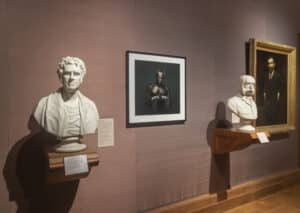
The portrait above of Stormzy gazing reflectively at the Banksy stab vest
which he famously wore at Glastonbury found a place in the Victorian Galleries at the National Portrait Gallery. I sat down with veteran photographer Mark Mattock, who made the image, to find out more about the process and what the piece means to him.
I meet the photographer at a Farringdon pub called The Eagle – “one of the first gastropubs in the 80s” according to Mattock himself. It was a fitting setting: early in his photography career Mattock took commercial photos of the food at that very same pub. Now, he returned to tell me about the difficulties and triumphs which went into creating the famous image. The first hurdle was scheduling, but Mattock says that his experience taught him not to be surprised by Stormzy’s late arrival.
“You have to be prepared for the situation you’re going into,” Mattock explains. “Stormzy was late, which I knew he would be, I knew he would come in at three in the afternoon, not ten o’clock in the morning.”
When Stormzy arrived and they began the photo shoot, realising the vision of the piece did not come easily. It wasn’t until Mattock sat down for a one-on-one with Stormzy that things began to come into focus.
“There were all the ideas that I was told, but I realised that they weren’t really coming from him. I remember on the day I could tell that he wanted to portray something, so it came down to just shooting and photographing him looking down at the stab vest, and I knew that every photo would look very nearly the same, but there was something subliminal he was looking for,” Mattock says. “There came a point where everyone was frustrated that it wasn’t happening. Stormzy and I sat down for a quick chat and he got
a piece of paper, drew a square and a simple illustration of him in that frame, and said ‘I want it to look like that’. Then we added the other elements, the Glastonbury vest, and everything else.”
After settling on a clearer direction, Mattock was able to bring in the elements which make the portrait so potent in its setting. Through classical imagery and elements of British cultural iconography, the portrait was transformed into a piece which almost subliminally causes the viewer to ask questions of history, race, empire, and royalty.
“The idea was that it would feel like a Renaissance painting. It began with having a Tuscan stormy sky in the back, and I worked a lot on that before it became the green background. And it’s almost a British racing green, so there are still subliminal elements to it,” Mattock says, “It looks Renaissance, but it’s also about the British green. The crown was added digitally, and I think it came out really well. It took a lot of tweaking to get all the exaggerations and nuances which make it look like a painting right. It’s not a single image, it’s a combination of five images.”
The final product took incredible skill in composition, vision, and digital manipulation. But for Mattock, the significance comes not from the process or the final image, but from its placement and the context surrounding it.
“I’m proud of it because of the National Portrait Gallery. It’s not about the work, it’s about the social statement being made, and that’s what I’m really proud to take part in. When I went to see it, it just became really obvious what we’d done here. It sits in a wing of the National Portrait Gallery of all the so-called greats of Britain. The only other Black person depicted in that whole wing of supposed British greats is Queen Victoria handing a Bible to a Kenyan noble. And you realise the
potency of the statement made – it wasn’t quite a brick thrown through the window, but it’s the whole language of it, and that’s what was really important.”
Stormzy says that it is “nothing but an honour” to have his portrait hung “in a gallery which exhibits so many incredible portraits of those from British history.” As a champion of black British culture, it should come as no surprise that Stormzy is happy to see the National Portrait Gallery representing a black artist.
“It’s not about the work,
it’s about the social statement being made,
and that’s what I’m really proud
to take part in.”
For the National Portrait Gallery, Stormzy’s portrait represents a shift towards a more contemporary approach to representing major figures in Britain’s history and culture. I spoke to Dr. Sarah Moulden, who is the curator of the Victorian Galleries, to learn more about the reasoning behind the decision.
“We were really interested in representing Stormzy in the gallery after his Glastonbury performance, and right before Heavy is the Head came out. When we were working with Atlantic records, there was a conversation about where it should go in the gallery, and we were quite clear that it should go in a historic gallery,” Moulden says, “We wanted to broker this interesting visual and conceptual conversation between new and old portraits, so we agreed that the most meaningful place to do that was the Victorian Galleries. Particularly, we wanted to place the portrait in the statesman’s gallery, which is mostly populated by white male Victorians. That juxtaposition provided visitors with a place to stop and think about the legacies of empire and colonialism, and the impact of people of colour on UK society.”
Stormzy portrait at the National Portrait Gallery, London
The painting of Queen Victoria and a Kenyan noble which Mattock referred to is titled “The Secret of England’s Greatness”. The now uncomfortable painting is not actually the only depiction of a Black person in the Victorian Galleries, but it is certainly the largest and most prominent. Moulden describes how, during his visit, Stormzy was drawn in by a different portrait of Croydon-born mixed-race composer Samuel Coleridge-Taylor.
“He’s such a humble person – a towering, but very humble person,
and it was so interesting to see him and his team flock to that portrait of Samuel Coleridge-Taylor. It shows that oftentimes it’s about seeing yourself in the galleries. Many visitors come through the door and say ‘I can’t see myself represented here’, and that’s what we’ve taken onboard,” Moulden says. “But seeing Stormzy and his team walk through the gallery and zero in on this one small portrait among a sea of stale, male, dead, white heads is just another example of seeing yourself in the gallery. Yes, we have gaps in our collection and we have to deal with that, but we can be clever about it, we can do interventions, and we can think about using different media as well.”
When the portrait went on display near the end of 2019, people flocked to see the new addition. Unfortunately, the NPG closed for the pandemic and began renovations, but visitors will be able to return in Summer of 2023.
Tear Him for his Bad Verses
Asked if he has a favourite line in his songs Stormzy doesn’t miss a beat when talking to The Fader: “My favourite line is: ‘All my young black kings rise up/ Man this is our year/ And my young black queens right there/ It’s been a long time coming I swear.’ [the lines come from his song ‘Cold’]. I just love the fact that I can say that on the tune, and it can resonate… with that one message it becomes bigger than me.”
An oft-quoted fun fact states that the word “rap” comes from the combination of the words “rhythm” and “poetry”, which is a nice, believable explanation. The actual etymology of the word most likely stems from the word “rapport” or “repartee”, with the “rap” we know today emerging from hip politically active circles in the 1960s, where it originally referred to quick-witted oration rather than music. No matter the term’s actual roots, perhaps “rhythm and poetry” is a good definition of rap, rather than an origin story. Since the earliest rap artists hit the scene, there has been a debate over whether the often witty, well-constructed lyrics can be considered poetry. I put this question to Todd Swift, former writer-in-residence at Pembroke College, Cambridge. His answer? Of course rap is poetry, and the debate should have been settled a long time ago.
“The debate about whether or not song lyrics are ‘literature’ or ‘poetry’ – or not – should have been laid to rest after the Bob Dylan Nobel Prize, if not after the ubiquity of Leonard Cohen’s ‘Hallelujah’, which is sometimes voted the greatest song ever written. Of course, in this age of constant social media unrest, and very divided political and aesthetic sensibilities, such debates continue, though very few but the rudest or most obtuse of critics would now consider denying the power and style of rap lyrics, for instance.”
So will Stormzy be studied in the future? Swift is confident he will be: “By the standards of lyrics/poems currently taught in schools and universities, awarded prizes, published, anthologised, and performed and recorded, Stormzy
is a canonical author. Why wouldn’t he be?”
So there it is. Historical context shows that rap and song lyrics are absolutely poetry – even Shakespeare’s poems were often sung. We’ve established that Stormzy writes poetry, but does Swift think that it’s good poetry? I sent him the lyrics to “Crown” off of Stormzy’s latest album to find out. We’ve reprinted a brief selection here for context.
Amen, in Jesus’ name, oh yes I claim it
Any little bread that I make I have to break it
Bruddas wanna break me down, I can’t take it
I done a scholarship for the kids, they said it’s racist
That’s not anti-white, it’s pro-black
Hang me out to dry, I won’t crack…
Searchin’ every corner of my mind
Lookin’ for the answers I can’t find
I have my reasons and life has its lessons
I tried to be grateful and count all my blessings
But heavy is the head that wears the crown
“In this lyric/poem by Stormzy, a lot is at play – from the mid-line caesura, somewhat Beowulfish, establishing contracts and multiple options (‘any little bread that I make I have to break it’) – with the brilliant bread/break rhyme, and the many types of ambiguity, money, biblical prayer and ritual, comingling in the song’s Christian themes – the poem is a re-enactment of the manna from heaven versus Mammon from the earthly cities conflict which humans encounter. Or, the secular and the divine tussle,” Swift says.
Swift continues: “As he says: ‘two birds with one stone’ – the song will explore the challenges of his business and his spiritual paths, as a successful black man. The poem is rich in irony, actually: ‘Gotta stay around but make a comeback too’ is both a comment on the Jesus of the text, and the business model Stormzy is wrangling with.”
It is worth pointing out that not all scholars of poetry will agree with Swift’s analysis, however he makes it clear that there is a significant amount of substance within these lines. The complex biblical and literary allusions should prove to even the strongest of critics that grime can be about a lot more than drugs and violence. And, as Swift says, in the context of Stormzy’s music such criticism holds little meaning.
“Even Northrop Frye would have to admit, this single song has as many references and allusions as almost any canonical Judaeo-Christian poem by
John Donne, besides which it has the advantage of being post-colonial and post-canonical, re-saying and re-inscribing these images and themes for a contemporary, young, black audience. He is not anti-white, the text says, but ‘pro-black’,” Swift explains. “Of course, this commentary is rendered both archaic and unnecessary on arrival, given the lyrics are well-prepared for any white scholarly guff that may be thrown its way: ‘don’t comment on my culture, you ain’t qualified’. As the poem says: ‘Amen’.”
Stormzy performing on stage
Grime, Live!
For people who don’t follow grime music, Stormzy is perhaps most famous for his appearance on the Pyramid stage at Glastonbury 2019. While he had a significant following before, this was a major turning point in his career, and his performance is widely considered to be Glastonbury history. In hindsight this may seem ridiculous, but at the time Stormzy thought that he had completely blown it. “Onstage it was the worst thing ever. After about 20 minutes my sound blew and I couldn’t hear nothing… I came off stage bawling my eyes out,” Stormzy says on The Jonathan Ross Show. Thankfully, he was convinced by the recording of his performance, saying, “When I watched it I was like ‘Thank God! I can’t believe this actually went well!”
Grime has long been fraught with controversy, both over violence and drug references in lyrics, and over the genre’s potential sticking power. In 2018, the BBC had already published an article asking if grime was dead. For me and 1,999 people at the sold-out O2 Shepherd’s Bush Empire on the 11th of May, grime was alive and well.
I don’t have a background in grime music – in fact, I’m relatively unaware of the modern music scene compared to my friends and colleagues. You’re much more likely to find me at folk gigs and dad rock shows than at any
of the big festivals, but I can enjoy just about any kind of music if I’m exposed to it. That’s why, when researching this piece, I started listening to grime and liking what I heard. In fact, I came to the conclusion one Friday evening that I couldn’t honestly write about a genre without going to a show myself. Luckily, Tottenham-born rapper and grime giant Chip had a show booked for the following week.
“Most working musicians never got the capital
together to buy a house, so they don’t have any security.
That’s kind of the trade-off,
you live hand to mouth.”
The Shepherd’s Bush Empire is an ideal venue for bands and solo artists. It’s large enough to attract big names, but small enough that you don’t need binoculars to keep track of the performers. For Chip’s show, I opted for the standing tickets, which ended up being an excellent call. I must admit that I arrived with a little bit of trepidation. For the past week before the show I had been reading commentary about how violent of a genre grime is and the danger of the imagery, so I had no idea what to expect. I am happy to say that if Katharine Birbalsingh wanted proof that grime is not all about violence, she would have found it at this show.
I walked in at the opening time – 7:30 – in a show of punctuality and complete unawareness. Little did I know that Chip wouldn’t be coming on until 9:30, and the fact that I cruised through the line with ease didn’t tip me off either. However, I’m glad that I arrived early, because it gave me a chance to scope out the venue, take in the opening acts, and meet some fine folks. Contrary to the image which is often portrayed of grime music and its fans, everyone I met was extremely nice even though I looked very out of place. I dress like a 1970s dad who’s taking his kids camping in Yosemite most days, and that day was no exception. If there had been any meanspirited energy in the crowd, I would have been an easy target, but almost immediately I found myself making friends.
While looking around I saw busy lights, modern looking bars, but also charming turn-of-the-century scrollwork which reminded the audience that the place was built in 1903, and large analogue clocks with illuminated signs reading “TRANSMISSION” and “REHEARSAL” harkening back to the days when the venue was still in use as the BBC Television Theatre. But beyond the venue itself, the thing which struck me most was the amount of people required to put on the show. Everyone thinks of the musicians themselves, but becoming an artist is a far less secure way to make a living than the myriad other jobs available in live performance.
Daniel Maitland is a lifelong musician who both writes original music
and teaches students a number of instruments. His career may lead you to believe that he thinks music is a very good choice to make a living, but he takes a more realistic view when it comes to achieving great fame, or even earning decent money in the industry.
“I think there’s a danger. The truth about pursuing music is it will give you a more interesting life, and you’ll have more adventures than you would if you worked in the post office, and you’ll have a vocation which is a comfort when times are hard – but you almost certainly will be poor,” Maitland says, “Most working musicians never got the capital together to buy a house, so they don’t have any security. That’s kind of the trade-off, you live hand to mouth.”
Following one’s dreams is an admirable thing, but as Maitland describes, it is not practical to think that music is a surefire way to make a career, or to get out of poverty. From security and bar staff to lighting designers, sound engineers, and managers, there are many different people who create the atmosphere required for a stellar show. Live sound engineers have the extremely important job of making sure that the performer can actually be heard. They can make up to £40,000 a year with experience, so that’s a solid career choice for those with a passion for music and performance.
Events promoters who take charge of marketing for a gig can make around £30,000 a year, depending on venue, frequency of events, and experience. Booking agents often charge 10-20% commission for an event, so their salary completely depends on how big of a gig they’re booking for. Their job is to find people like DJ Ironik, who warmed up the crowd at Chip’s show.
DJ Ironik’s set got the crowd in a good mood, which didn’t take much considering reasonable drink prices and a strong feeling of anticipation in the air. The tunes were accompanied by a large screen displaying 90s bowling alley style graphics of CRT televisions, tumbling dice, flames, and at one point spinning igloos at a snowy arctic outpost.
When Chip took to the stage, the crowd went crazy – but that cheer was nowhere near as loud as when Chip announced that his parents were in the crowd, with good seats on the second level. He launched into his set, starting with some of his older songs, then moving on to selections from his new album “Snakes and Ladders”. He has an energetic stage presence, assisted by a mastery of the mic and a mix engineer who made it clear there was no lipsyncing going on. This was pure performance, and thanks to the work of everyone involved in the process, we were all loving it. What struck me most was the sense of community – not based on racial or social constructs but based purely on love of the music. Everyone was there to have a good time, and if you were there to have a good time too, then you were part of the furniture.
Stormzy headlines the Pyramid stage at Glastonbury, Julie Edwards.
The Rags to Riches Myth
So how do artists like Chip and Stormzy make it to the top? These stories of rising from hardship to have a following on the world stage are inspiring, but is it practical, or even healthy, to tell young people that the same thing can happen to them?
To find out the connection between music, social mobility, and education, I also spoke with Lee Elliot Major OBE, who is the nation’s first Professor of Social Mobility at the University of Exeter. He is quick to warn that, as a rule, most people don’t ‘make it’ to the same level as people like Stormzy, and he stresses that more help is needed to make the music industry more accessible to people from disadvantaged backgrounds.
“Stormzy is a great exception to the rule, of course, and it’s interesting that he has kind of very publicly – generously, in some ways – committed to help people. It’s interesting that he’s chosen Cambridge for his scholarship. It’s great to try and help kids get into Cambridge, but arguably we need more support for young people to get into the music industry,” Major argues. “One of the dilemmas Stormzy will have, and a lot of artists suffer from this, is that the working-class credentials and background you have which made the songs authentic to begin with gets lost as you become successful. What do
you write about when you are suddenly rich and middle class, to some extent? You see this in many older artists, that’s part of the age, you’re just not as young and maybe in tune with some of the younger generations. But another big part of it is also your class, right? You’re just not experiencing the same real- world experiences that other ‘normal’ people will be experiencing. So it’ll be interesting to see how Stormzy evolves, and whether he retains that authenticity that he currently has.”
As artists gain fame, they often can become detached from their audiences simply because their lives begin to bear no resemblance to the everyday struggles which once provided inspiration.
For Stormzy, fame has shown him a different side of life – a side full of people incredulous at his success due to race. “You can tell they think I’m not supposed to be here,” Stormzy has said, referring to his experiences at high end establishments. “I’m going to live where I live, I’m going to have my hood up, wear all black, and I’m going to be in a first class lounge, or in this mad restaurant, or in this posh hotel and be like, ‘Oh, you didn’t think young black people could be here?’”
Whether Stormzy is going down the path of disconnection with his audience is yet to be seen, but for now, Major argues that he has more influence over young people than top politicians. I showed him these lyrics from the song “Crown” off Stormzy’s album H.I.T.H.
All these fancy ties and gold plaques
Never had no silver spoons in our mouths, we sold (crack),
Don’t comment on my culture, you ain’t qualified
Stab us in the back and then apologise If you knew my story you’d be horrified The irony of trappin’ on a Boris bike
Major replies: “I would argue that one of the main problems with low social mobility is that we have increasingly detached elites, both in the US and the UK. And that’s not a political point. Whoever the political leaders are, because they come from quite
privileged backgrounds, they really
do not understand where some of the young working-class people are coming from, so those sort of lyrics speak to that,” Major continues. “And Stormzy has more power, in many ways, in terms of influencing the young generation than politicians could ever have, because they’re just kind of out of touch with normal people. There’s two dimensions to this – one is that they come from very different social classes, but there’s also a generational divide as well which I think is very strong now.”
“Never had no silver spoons in our mouths,
we sold (crack).”
Young people often take inspiration from celebrities, and that’s not always a bad thing. We frequently hear “follow your dreams” from people who actually mean “follow your dreams but limit your expectations”. The issue is one of scale. Yes, some people will go from disadvantaged backgrounds to becoming superstars, and there’s no reason not to try and make it big. However, programmes designed to increase social mobility must be further reaching than that in order to help a larger number
of people. Major argues that Stormzy represents a type of success which only happens to a select few and offers some alternatives to affect more widespread change.
“The problem with this is that it’s almost the American Dream version of social mobility, which is very powerful, but very dangerous. And the reason for this is that only very few people do make that incredible journey. You get the same thing with elite sports, when we see the premiership players, some of whom come from working class backgrounds, who are earning incredible amounts. Now, that’s a combination of talent,
work, luck, etc. and that certainly is not the case for everyone. So I worry about narratives of social mobility that are very narrow around that kind of rags to riches transition,” Major says. “Cambridge is an incredibly prestigious, elite institution. It’s a wonderful place, but very few people go there, right? If we really want to improve social mobility more generally, then we have to try and help those kids who don’t go to university. So we’re talking about apprenticeships, we’re talking about local jobs, and those sorts of transitions are really important in the social mobility picture.”
Former Secretary of State for Education Nicky Morgan believes that the key to promoting social mobility is starting from a young age. With a focus on a return to pre-pandemic norms in the classroom and an increase of degree-level apprenticeships, Morgan says that social mobility can be greatly increased.
“Education is one of the greatest engines of social mobility and there are still too many students of all ages not getting that opportunity to change their lives through a great education,” Morgan says, “Ensuring that higher education is clearly open to everyone, including broadening the diversity at our top universities is important – but with the growth of apprenticeships this is becoming more finely balanced, and the opportunity to do degree-level apprenticeships needs to be more widely known. Post-pandemic, ensuring that the focus on high standards at schools and face to face teaching at universities are restored as quickly as possible are vital to ensuring greater social mobility.”
The Stormzy Scholarship is certainly seeking to achieve the goal of “ensuring that higher education is clearly open to everyone”, and at Cambridge the scholarship is driving a change. However, the strides being made in educational racial equality by Stormzy’s scholarship are currently only present at the highest level of university education. Based on Morgan and Major’s advice, perhaps the best way for Stormzy to increase social mobility would be to sponsor degree-level apprenticeships and raise money for early education in underfunded schools, alongside his high-profile Cambridge project.
Stormzy at Ronnie Scott’s for the MOBO Awards nominations, 2015
The question of Stormzy is a complex one. On the one hand, there’s no
doubt that in reflecting his own life experiences and those of the people around him Stormzy has produced lyrics which are at times unsettling. For Birbalsingh, the messages found in some of Stormzy’s lyrics are enough to warrant a full condemnation of the artist. But this is more than offset by what he has achieved at Cambridge, as shown by my conversation with Panda. Yes, the Oxbridge experience has a long way to go before it can be hailed as truly all-inclusive, but it is clear that Stormzy is helping to end the stigma surrounding elite higher education institutions by showing black students that there are systems in place to help them in what could be an uncomfortable environment.
Part of what makes the image at the National Portrait Gallery so interesting is that Stormzy isn’t a straightforward figure. His influence on British culture is undeniable, which is why the National Portrait Gallery chose to include Mattock’s striking portrait. Mattock and Moulden’s pride in being a part of the changing direction of the National Portrait Gallery shows that the portrait of Stormzy is not only evidence of his cultural influence but is in fact yet another example of his power to shift longstanding norms.
“It is clear that grime is both art and poetry.”
Todd Swift has assuaged any doubts I may have had about the lyrics. While not everyone will agree with the Shakespeare comparison, it is clear that grime is both art and poetry, both of which have always taken on new forms over the years. But Stormzy’s story also reminds us that we have a long way to go in terms of social mobility in this country, as both Major and Morgan explain. Without programmes which help a wide range of people from disadvantaged backgrounds, social mobility will continue to stagnate, and the rags-to-riches elevation of just a lucky few will not solve the problem. To this writer, Stormzy is an artist who is trying in his own way to use his platform for good. He recognises the weight of his role, he’s attempting to correct past mistakes, and he’s making commitments to help young people for the future. For someone who became a household name at 23, Stormzy is handling the pressures of his success far more gracefully than most.
Nobody should think that a career in music is easily achieved. On the other hand there is no doubt that Stormzy is an example of what is possible with talent, hard work, and yes, a little luck.
Read Stuart Thomson’s take on social mobility in the UK here
What do you need to make a musical career? I’d say it comes down to one thing: a talent for immediacy. If you don’t have it, the chances are you’ll lose out to someone who does. I remember when I first listened to ‘The Sound of Silence’ in that wonderful Dustin Hoffman film The Graduate (1967): I was only 15 and as blank a listening canvas as can be imagined. But the effect was immediate: that day I went down to the old record store in Godalming and bought Simon and Garfunkel’s Greatest Hits.
I’ve been listening to Paul Simon on and off ever since, so much so that it is hard to imagine my life without his consoling voice, his cunning lyrics, and his explorations of international rhythm. Now, with Seven Psalms released in 2023, and the two-part documentary In Restless Dreams released the same year – and updates regarding his Beethoven-esque hearing loss in one ear following in 2024 – we have an opportunity to consider the last act of Simon’s career.
Late works are a subject of perennial interest. Something seems to happen when the grave nears: there can be a sharpening of perception, and a sense even of the material veil about to be lifted. In literature, Shakespeare’s The Tempest (1610-11) with its world of fairies and valedictions is perhaps the most notable example of a viewpoint shifting as this world’s impermanence becomes increasingly evident to the writer. In poetry the famous lines by WB Yeats in the poem ‘Sailing to Byzantium’ might be taken as a sort of mantra for the ageing artist:
An aged man is but a paltry thing,
A tattered coat upon a stick, unless
Soul clap its hands and sing, and louder sing
For every tatter in its mortal dress…
That is what Simon is doing in Seven Psalms – singing for every tatter in his mortal dress. In music, the most obvious touchstone is those great late string quartets by Beethoven, where we feel the composer to be inhabiting a sort of ethereality. What appears to happen as mortality rears up is that the artist feels a heightened sense of the beauty of things and the fragility of the life they are about to leave. At the same time, we sometimes find the shape of intuitions about what may or may not come next, and Seven Psalms is a little like this.
The album comes up on Spotify and Apple Music as one long track 33 minutes long, but it also consists of seven interconnected tracks beginning with ‘The Lord’. Every track feels wispy and valedictory – like someone taking a last look around a house which they have just sold and are about to vacate for the last time.
But throughout, a certain confidence underpins it and somehow or other, as shown by the title of the album, this seems to have to do with some sort of faith. This is a little unexpected since it isn’t something which Simon has spoken about much in his highly secular career, and in fact he has stated in interview that he isn’t religious at all.
All one can say to this is that any cursory listen of this album makes you think he’s doing an excellent impression otherwise. In fact, the powerful nature of the testament Simon is giving us here makes one wonder whether it’s possible to be religious without knowing it – indeed perhaps it’s a far more common condition than we realise. Here’s a sample lyric from the opening track ‘The Lord’:
I’ve been thinking about the great migration Noon and night they leave the flock And I imagine their destination Meadow grass, jagged rock
The Lord is my engineer The Lord is the earth I ride on The Lord is the face in the atmosphere The path I slip and I slide on
This is the language of the metaphysical poets, and is as religious as it gets. Even more interestingly, Simon has stated in interview that the idea for the album came to him in a vivid dream, where he received this clear instruction: “You are writing a piece called Seven Psalms”. Simon woke up in the middle of the night and wrote the title down at a time when he claims he didn’t even know what the word ‘psalms’ meant. This is odd since it’s quite a common word which one might expect an educated octogenarian to know about. Not since Paul McCartney woke up humming ‘Yesterday’ has music emanated so definitely from dream like this.
It sometimes feels as though this album therefore has some sort of special validity; it is certainly quite different from all his other albums. In ‘The Lord’ Simon continues:
And the Lord is a virgin forest The Lord is a forest ranger The Lord is a meal for the poorest A welcome door to the stranger
The Covid virus is the Lord The Lord is the ocean rising The Lord is a terrible swift sword A simple truth surviving
This achieves the sort of compression and reach which isn’t usually to be found in Simon’s songs – nor is it to be found generally in pop songs full stop. Here compression is allied to a sort of visionary certainty about the nature of divinity which may indeed have come through Simon, as an inspiration quite separate from the Paul Simon who presumably goes about his daily life.
But there’s more. It turns out that the whole album was written by dream prompts. In the CBC interview he continues:
Maybe three times a week, I would wake up between the hour of 3 a.m. and 5 a.m. with words coming, and I would just write them down…If I used my experience as a songwriter, it didn’t work. And I just went back into this passive state where I said, well, it’s just one of those things where words [were] flowing through me, and I’m just taking dictation. That’s happened to me in the past, but not to this degree.… I’ve dreamed things in the past — I didn’t necessarily think that they were worth noting. That’s why it’s unusual that I got up and wrote that down.
Simon, then, appears to have entered into some process of communication with the psychological process which makes dreams: since this process also occurs in the wider universe and is impossible to divorce from it, we can say that he was also in some form of cosmological engagement which was wholly unusual for him. It was a reckoning of sorts – and one also that was presumably occurring, since people don’t live much longer than 80, fairly near to death. All in all, one cannot help but feel that this album amounted to a new kind of creative opportunity presented to Simon – and without being morbid, a last ditch one at that.
We can further guess that this new sort of creativity may have been linked to some sense of inadequacy at all that he had achieved up until that point in his career. In the quote above he references how his previous songwriting practice felt irrelevant to this new project: I would guess that this is the manifestation of a certain dissatisfaction with the way in which he has gone about his creative life, no matter how successful and laurelled he is.
Perhaps, despite his enormous achievements, there could even be said to be a certain justice about that verdict which, depending on how we view the meaning of dreams, was coming through him, or from him. As odd an admission as it may be for the person who wrote ‘The Boxer’, Simon has sometimes in interview expressed a sense that he is somehow in the second tier. In particular, he has always come in second to Bob Dylan. In 2011, Simon told Rolling Stone:
I usually come in second to Dylan, and I don’t like coming in second. In the beginning, when we were first signed to Columbia, I really admired Dylan’s work. ‘The Sound of Silence’ wouldn’t have been written if it weren’t for Dylan. But I left that feeling around The Graduate and ‘Mrs Robinson’. They [my songs] weren’t folky any more.
And why was Simon always runner-up like this? Simon continues:
One of my deficiencies is my voice sounds sincere. I’ve tried to sound ironic. I don’t. I can’t. Dylan, everything he sings has two meanings. He’s telling you the truth and making fun of you at the same time. I sound sincere every time.
This is worth unpacking. The truth is that Dylan came to songwriting almost weirdly fully formed. There was a specific reason for this: that he was drawing from the past, and often, frankly, copying it. That’s why there’s no juvenilia by Dylan: he comes straight out of the gate with ‘Blowin’ in the Wind’ and ‘Girl from the North Country’. These songs are sponsored by, it can sometimes seem, a great chorus of American experience.
Well, if you’re travelin’ in the north country fair Where the winds hit heavy on the borderline Remember me to one who lives there She once was a true love of mine
‘Winds hit heavy on the borderline’ is excellent, but the song has both a fresh and ancient sound – and Dylan had the voice to convey those ideas simultaneously. The same was never true of Simon’s early work. We might take ‘Homeward Bound’ as an example:
And all my words come back to me
In shades of mediocrity
Blank emptiness and harmony
I need someone to comfort me.
This amounts to an immature complaint about life on the road which Dylan would never have permitted himself. It is part of that unlovely genre: rich rock stars moaning about having to be away from home a bit to make their money. These deficiencies – though they are offset in ‘Homeward Bound’ by some nice chord changes, particularly in the verses – appear to have stayed with Simon throughout his life.
There is a story of Simon playing a gig in Greenwich Village in the early 1960s, and noticing when up on stage that Dylan was sniggering about his performance with his own future biographer Robert Shelton. I’ve never been sure about the truth of that story, although Dylan could undoubtedly be harsh. Is it not more likely that they were laughing about something else?
In fact, whether it happened precisely that way or not, the story touches on Simon’s insecurity in relation to Dylan: what really matters is that he thought Dylan was laughing at him whether he was or not. Why might Simon feel this way? It’s because he knows his inadequacy in relation to Dylan.
Simon states in the Rolling Stone interview that this inferiority has to do with Dylan’s ability to apply layers of meaning not just in his lyrics, but to his vocal delivery. Simon is being hard on himself – as all artists need to be, provided that self-criticism doesn’t stymie creativity. But there is nevertheless truth to his verdict, and it is useful to have Simon articulate so clearly the central mystery of what makes Dylan uniquely compelling.
How does Dylan achieve it? It is very difficult to say but my own sense is that Dylan’s immersion in the past – and really in life generally – has been so deep that he has come out so entirely soaked in art and experience that his singing is never entirely for himself. His experience is multifarious: he is many. His art can at times seem to have almost nothing to do with him. One never feels that there is any stability in the word ‘I’ in Dylan’s songs: nothing can ever be traced reliably back to him.
The same isn’t true of Simon: in his songs, even the very best of them, there’s always a slight air of solipsism amid all the lovely melodies and the beautiful ideas. He is writing in order to unburden himself; Dylan is doing nothing less than carving out, or reimagining, nationhood in song.
There are many ways in which this smaller tendency can illustrate itself in Simon’s career. The principle one is in being too clever. This exists across his canon. It is there in the Joe DiMaggio line in ‘Mrs Robinson’ which is probably too arbitrary; when Dylan namechecks people it is always as a way of going back to some definite idea, emotion, or set of principles, as in his great song ‘Blind Willie McTell’. Furthermore, this is a deficiency which Simon is aware of. There is also video footage in the 1990s of Paul Simon listening back to his magnificent song ‘Graceland’. He is being filmed listening to the words:
And my travelling companions
Are ghosts and empty sockets
I’m looking at ghosts and empties.
Listening back to this, his facial features twist with regret: “Too many words,” he says, genuinely berating himself. “Too many words”.
He is right. And too many words is always a symptom of trying too hard which in turn is to do with lack of self-confidence. By contrast, we might note how the whole magnificent universe of Dylan’s “Mr Tambourine Man” unfolds effortlessly, without any ambition intervening.
Dylan has superior knowledge about the world, which is really another way of saying that he understands himself better. Incidentally, Simon never wrote a line as good as: “I know that evening’s empire has returned into sand,” which shows a true poet’s innate perception of evenings – not to mention of empires and sand. I’m not sure Simon is ever seeing things so clearly as this; his ego, in the shape of his cleverness, keeps coming in between him and the thing he is trying to describe.
This lack of self-confidence in Simon might have to do with an absence of historical roots. This was, to put it mildly, never the case with Dylan who has travelled the world on his Neverending Tour, but always as an American mining his Americanness. Lack of a real centre meant that Simon went journeying, first to South Africa to record his best solo album Graceland (1986) and then to Brazil to record his second best Rhythm of the Saints (1990).
These albums were made in a completely different way – one might say that they have to do with avoidance regarding the core reasons for a restlessness which Simon has always felt. He recorded the rhythm track first and then recorded the melodies over the top. It was a fascinating exploration of another country, and produced some songs which border on being standards: ‘Boy in the Bubble’, ‘Graceland’ itself, ‘Diamonds on the Soles of Their Shoes’, although it might be that ‘You Can Call Me Al’ is marred by some slightly silly lyrics.
But the only real limit on the Graceland album is tied to its core concept: the lyrics feel like journalism, and make one think of Sir Tom Stoppard’s joke in his 1978 play Night and Day, that a foreign correspondent is “someone who flies around from hotel to hotel and thinks the most interesting thing about any story is the fact that he has arrived to cover it.”
Something like this appears to apply to Graceland and Rhythm of the Saints. There is a shallowness to his observations about poverty in South Africa for the very simple reason that Simon doesn’t live there, and can’t really know what’s going on. Damon Albarn faced a similar problem when he came to make his album of Mali Music.
Surrealism in Simon has its limits too. In Dylan’s surrealism – especially in Blonde on Blonde – we experience the excitement of the poet’s discovery of Baudelaire and Rimbaud. It is probably true to say that Dylan doesn’t always make definite sense, but there is something vast and brave about the exploration being undertaken; and very often one senses a large world of meaning bordering the difficulty of the language – a world of dream-like correspondences. But in Simon surreal language too often goes in the direction of archness.
Lyricists mustn’t let the listener know that they’re clever; what needs to be communicated instead is that they love truth, and then that they love language – and in that order. At the highest peaks of the Dylan songbook these two are in the right order – and of course, married to the music. With Simon, something is ever so slightly out of kilter and I think it must have been, despite his huge achievements, a frustrating career in some ways.
I should say that these deficiencies have been minor, and they make very little dent in most people’s enjoyment of Paul Simon. But they have, it seems, made a dent in Paul Simon’s enjoyment of Paul Simon.
For the rest of us we have a body of work which is full of charm, occasional wisdom – and almost always, a beautiful gift for melody which actually surpasses Dylan, and is probably only dwarfed in post-war song by Paul McCartney. Simon has always had the knack of writing a song which you can grasp on first listen but which you want to listen to again. We are extremely lucky to have a lullaby like ‘St Judy’s Comet’, which can still get my son reliably to sleep as he enters his ninth year; that perfect (except for the last verse) gospel song ‘Bridge Over Troubled Water’; ‘Mrs Robinson’ and many others.
But if we take Paul Simon at his own estimate as in some way second tier, it strikes me to be of enormous interest that Seven Psalms came to him in the way it did – as something gifted through dream.
We cannot say how this may have happened – and it is beyond the scope of this article to consider satisfactorily why we dream, and what dreams may mean. All we know is that dreaming is psychologically necessary. There have been experiments where people have been woken up just before REM – the period twice per night when we dream – and though they have slept, they have been denied dream. Such people have very quickly drifted into psychosis. From this we can realise that dreaming is psychologically necessary – a vital sorting of the day’s information.
But there have long been thinkers, including Carl Jung, who have argued that dream is a form of essential communication, and that this isn’t best understood as a purely internal process. For such thinkers, our mind is open when we dream to the stream of external life, and it is this which constitutes the real necessity about dream.
Be that as it may, we can see in Simon that something utterly essential has happened in Seven Psalms: we can see that his career would simply not have made any sense without it – though we noted no particular gap before. This is the wonderful thing about living a long time. A Paul Simon who had for some reason died in his 70s, without having done this, would be a completely different and inferior Paul Simon. Something similar happened to the Australian poet Clive James: he was a completely different creature at 80 to 70 and even 75.
Seven Psalms then is an album which should give us all hope that if we continue to live we will continue to learn – and perhaps something may just land in our laps which we weren’t expecting. This might not be something as big as Seven Psalms – it doesn’t need to be.
In fact, for all of us, in whatever career or task we’re chiefly working at, life is usually giving us little indications which might be seen as microscopic versions of these larger realisations. The lesson from the life of Paul Simon is to stay alert for the big change in direction, the essential shift in the self. It may just come your way – and if it does, you’ll know how much you needed it.
Dr. Pamela Chrabieh is a Lebanese-Canadian scholar, university professor, visual artist, activist, writer and consultant. Selected as one of the 100 most influential women in Lebanon (Women Leaders Directory 2013, Smart Center and Women in Front, Beirut), and ‘Most Exceptional Teaching Fellow’ in 2008 (University of Montreal)
Dr. Chrabieh won several national and regional prizes in Canada (including Forces Avenir Université de Montréal, Forces Avenir Québec, Prix Lieutenant-Gouverneur du Québec), and her Peace Education ‘Diplomacy of the Dish’ activity was selected as one of the most innovative activities during the Innovation Week of the United Arab Emirates in 2015. Since 2017, Dr. Chrabieh has been the owner and director of Beirut-based SPNC Learning & Communication Expertise, and the Nabad (nabad.art) Program Manager since 2020.
Here, in an important exclusive, she talks to the poet and critic Omar Sabbagh about the current condition of Beirut and Lebanon.
Omar Sabbagh: Whether it may be common knowledge or not, Beirut and Lebanon more generally are currently in a state of crisis. Can you tell us, to start with, what this crisis situation looks like on the ground?
Dr. Pamela Chrabieh: Lebanon has been going through a multiform crisis following the so-called end of the 1970s-1980s wars: social, political, environmental, sanitary, etc. The Beirut port blast on August 4, 2020, was the first straw that broke the camel’s back, and the ongoing acute economic crisis the second straw. As poverty is rising – more than 60% of the local population lives now under the extreme poverty line – people are increasingly desperate. Many (those who were able to do so) left the country, others (those who are staying) are trying to survive the financial meltdown, the aftermath of the Covid-19 pandemic, and the political deadlock.
OS:There are many factors that constitute the fraught modern history of Lebanon. In your view, is the current crisis another version of other crises in the history of modern Lebanon, or is the current situation of a new sort, and why?
PC: In my opinion, the current situation is first the consequence of decades of corruption, physical and psychological wars, state paralysis, nepotism, sectarianism, foreign interferences, and a clash of ignorance. However, and contrary to what we went through during the 1980s – and that I witnessed first hand as being part of the generation of war – what we are going through today is different, as the deterioration of the country is unprecedented.
During the 1980s, we were able to escape bombs and snipers and take refuge in a different city or village, we were still able to find food and work, and we had hope for the future. Whereas today looks and feels like a descent into hell, with most of us who still roam the land are hanging by a thread. The level of despair is immeasurable today, and that is, in my opinion, one main difference between the recent past and our present life.
OS:The economy has suffered tremendously in recent years. Apart from long-standing practices of corruption, there was the revolutionary movement from 2019, and the terrible blast in Summer of 2020. How would you assess or critique the recent fate and current state of materialwell-being in Lebanon and Beirut?
PC: Lebanon is enduring an acute economic depression, inflation reaching triple digits, and the exchange rate keeps losing value. This is still affecting the population, especially the poor and middle class. I agree with the World Bank statement: “The social impact, which is already dire, could become catastrophic”.
I honestly don’t know how long the local population will be able to survive with one of the lowest minimum wages in the world, and when the country’s food prices have become the highest in Southwestern Asia and North Africa. People can’t even find needed medicine or pay a hospital bill. They haven’t been able to access their money in banks since late 2019, and their lights may go off starting May 15 because cash for electricity generation is running out.
OS: How would you assess the prospects for the young, the student body of Lebanon? It’s common knowledge that for decades the pool or fund of human capital, of human talent in Lebanon is a kind of superlative supply for what is a nugatory demand, and that there has been for decades a brain-drain from Lebanon to other places. Are prospects for the young just a continuation of this previous scenario or are there significant differences to the situation now, and how so?
PC: Now more than ever, and given the compounded effect of multiple crises, the Lebanese youth is facing a lack of work opportunities, rising costs of living and unemployment rates, and the absence of any state support. Many are growing disillusioned and desperate, and we are not even at the end of our crises. We should expect worse to come and it is going to be tougher for young people to pursue their higher studies, find a job, or even secure an entry visa elsewhere.
OS:Lebanon is known for its fractious sectarianism. Does this feature of the nation’s political, civil, and denominational make-up affect the young today as much as it may have done in decades past?
PC: Most students of mine and other university students, along with countless academics, activists, and artists who have been part of the October 17 ‘revolutionary movements’, have vehemently criticized sectarianism in all its forms and offered alternative paths, ranging from a complete separation between religion and politics to mediatory approaches. This is not a new phenomenon, as many individuals and organizations stood against sectarianism in the last decades, but we are witnessing change within student bodies, especially with secular groups winning elections in some of the most prestigious universities versus traditional sectarian groups.
OS: You have been involved at a grass-roots with the so-called ‘revolutionary’ upheavals in Lebanon and Beirut since they began in late 2019. How would you characterize the nature of this movement? And what do you think its effects have been and/or will be on Lebanese politics and thus on the prospects of the up-and-coming generation?
PC: I think it is still too soon to assess the October 17 revolutionary movements. I wrote a while ago that there are many ways of approaching the study of revolution in the contemporary world. According to a narrow definition, “revolution is a forcible overthrow of a government or social order, in favor of a new system”.
In that perspective, revolutionary dynamics in Lebanon appear to several observers (whether anti-revolutionary or skeptics) as “minor disturbances”. According to these ‘experts’, as long as the socio-political and economic systems are “unchanged”, the so-called “hirak (movement) is not worthy to be called “revolution”, and “will soon end” or it just “ended”.
However, a different definition of “revolution” – the one I use and develop – makes it appear as an ongoing project of deep confrontation, resistance, deconstruction, reconstruction, and systemic transformation. This project has no start per se, nor a specific end. In other words, Revolution with a big R is a process, and the October 17 revolutionary movements are only but a step towards overturning existing conditions and generating alternative socio-political and economic orders.
As I see it, “revolution” in Lebanon isn’t a static object that can either be a “success” or a “failure”. It consists of several current dimensions and historical layers simultaneously, and when it is not roaring in public spaces, it is boiling in the minds, adapting, learning, and bouncing back.
OS:What’s it like being both a teacher and a business woman in today’s climate? Detail, if you would, how the perspectives of your variegated work-roles have illuminated for you the current state of Lebanon?
PC: I wear several hats: scholar, university professor, visual artist, activist, consultant, program manager, wife, daughter, mother, etc. And these hats have been both challenging and rewarding. Definitely, my studies and work experience have helped me shape my knowledge and critical thinking, but my life experiences, with my family, friends, and colleagues, in Lebanon and abroad, have marked my identity and deeply contributed to what I have become today. Most certainly, I haven’t learned about resistance and resilience in books, but through my art, the arts and culture in my country and the region, and through the many struggles I have been going through, as well as the struggles of others around me.
OS:Given your answers to the questions above, what in your view is in store for Lebanon, and why?
PC: As long as there are inequalities, social injustice, exclusion, oppression, violence, war, etc., and as long as there are possibilities of change, I do not think that revolutionary movements will end. As long as our backs are to the wall and our only way is forward and through our fears, and as long as there are no limitations we choose to impose on our will, imagination, resilience, patience and freedom, we will rise again from under the rubble.
Workers’ Rights Bill, it all comes down to the detail. Finito World
As the new government takes shape, we are beginning to get a sense of the direction and possible meaning of the government. One of the themes that’s already emerging is a split between Rachel Reeves‘ careful approach at the Treasury, and the more gung-ho language coming out of the Deputy PM Angela Rayner’s office.
Once again, a General Election has proven to be of limited utility when it comes to the crucial question of what an incoming government will actually do. This is certainly the case on the mooted Workers’ Rights Bill.
For a start, there is little clear language on the flexible working position, and much of the public discourse falsely implies that employees can’t already request flexible working. They can. In addition, employers already have several possible reasons under law to reject the request – this fact also gets very little airtime.
So what did the Labour Manifesto say? It said that any Starmer administration would look at the possibility of enshrining in law the notion of employees being able to ask for flexible working from day one. So far, there is no indication that the Government will change the position to a four-day working week being the norm or that the reasons to refuse a request will change. That hasn’t stopped much hyperbole around the four-day working week.
As usual, it will all come down to the detail, and sources say that it is likely that Reeves will get her way, and that little will be done to agitate business. But in the event that the four-day week did happen, there are a range of issues which will need to be looked at including: ensuring adequate client service, adequate staff supervision, ensuring the health and safety and preventing burn out, reducing errors and managing asynchronised working.
Where the government looks set to be more radical is on the question of unfair dismissal. If it becomes possible to claim this much earlier during the cycle of employment, then businesses may have a genuine headache when it comes to avoiding claims. It will certainly increase the pressure on businesses to have a fair reason and follow a fair process to dismiss employees. The likely result is cost to business – again, something which Reeves’ language would suggest she wouldn’t like to see.
Melanie Stancliffe of Cripps tells us: “We expect an explosion of claims – the previous increase in the qualifying period for unfair dismissal claims shrank claims (and raised access to justice issues).” That sounds like something which may alienate the City.
This brings us to another likely result of the legislation. “Companies need change contracts and policies when the detail is known. They will need to implement the policies, train on them, anticipate and manage claims effectively, change business practices.”
It is early days and the detail on Workers’ Rights policy may change things. But what won’t change is that Labour is already at loggerheads as to precisely the sort of government it wants to be.
“The centre cannot hold/mere anarchy is loosed upon the world’. So WB Yeats wrote towards the end of his life. It doesn’t feel entirely irrelevant as a description of Starmer’s Britain.
The early months of Labour’s time in government has seen some good ideas, the first signs of governmental infighting, some naivety and some poor decisions too.
None of this ought to come as any surprise – and it would hardly be news at all if there wasn’t a mounting sense that the country needs leadership on a different scale to what we had under the Conservatives. Lord Darzi’s NHS report alone was enough to make people realise the scale of the inheritance Labour has – but that’s not to say there aren’t other problems. From education to housing, to transport and defence, to productivity and growth, the UK’s difficulties appear to be legion.
But if the leadership we need isn’t yet evident in the Starmer government – and yet to materialise from an opposition still bruised by the recent general election’s thumping defeat – where is it to be found?
Despite the fact that he left office nearly 15 years ago, there will be many who are still not ready to listen to the pronouncements of Sir Tony Blair. This is understandable when one considers the legacy of his Middle Eastern Wars, his awkwardly gilded post-premiership, not to mention the quangocracy which was certainly not curtailed by 14 years of Conservative-led government.
And yet in a recent interview with The Observer‘s Andrew Rawnsley, designed to promote On Leadership, he did what Blair has always been good at: making an argument.
Observing that the civil service is essentially unfixable, and that bureaucracy will have an innate tendency towards being bureaucratic, Blair offered the alternative: leadership from the centre.
This is a very different thing to having a centralised system which we have come what may. Blair explained: “…unless you’re driving from the top, it [change] won’t happen. It won’t happen for several reasons. It won’t happen because the system won’t have a clear enough direction if it doesn’t get it from the very top. It won’t happen because too many issues require many departments to work together. And you need the centre to do that.”
This is true, and seems all the more so from watching over a decade of prime ministers who couldn’t control the centre: May was a Remainer asked to enact Brexit; Johnson lacked discipline; Truss was never prime minister material; and Sunak could do the day-to-day, but lacked vision. Starmer is, so far, a sort of blend of May and Sunak.
But if we accept this argument for strong leadership, it needn’t just apply to Westminster where it seems least likely to be successful. It can form a part of all our working life.
It is a remarkable fact how little education there is in our society surrounding leadership. There is very little leadership education during our formative years: indeed, it might be argued that a samey curriculum tends to homogenise students – and this process is the opposite of generating the individuality which we associate with leadership.
Of course, if we accept the need for leadership in our society then we might wonder how best to foster it. As Sir Terry Waite argued in a previous issue of Finito World, the study of history is important, especially if we can look at what made, say, Abraham Lincoln an effective leader and ask students to apply his essential pragmatism and patience to their own lives.
Furthermore, this magazine applauds the work conducted by the Institution for Engineering and Technology in highlighting the importance of engineering on the curriculum; one attractive aspect of such an approach is that it engenders precisely the kind of problem-solving which makes for inventive leadership.
In these pages too, Emma Roche has argued that an understanding of the original practical nature of ancient philosophy is of importance too when it comes to creating a generation which knows how to lead.
But really it’s in mentorship that we are most likely to learn the skills needed: at Finito we believe that mentoring has a unique ability to create the knowledge base for effective leadership.
The country in fact is in such a state that we are not in a position of being able to simply submit to the powers of some great man or woman – were that person to come along, which seems unlikely. In fact, in the shape of Starmer it might be that we have another underperforming PM.
Instead, Blair’s book seems to spark off a series of thoughts which its author may not have anticipated. The new centre can’t be located in 10 Downing Street; it needs to be in each one of us.
Home to an inspiring mix of luxury design houses, independent companies, flagship showrooms and over 600 international brands, Design Centre, Chelsea Harbour is the largest of its kind in Europe. Its unique sense of community, commitment to creative excellence and specialist expertise make it the first port of call for professional designers and architects sourcing for residential and commercial projects, as well as design enthusiasts seeking design and decoration inspiration for their own homes.
The Design Centre hosts two ‘must-attend’ events each year to celebrate the new showroom collections. London Design Week takes in March to showcases spring/summer launches, and Focus is held every September to unveil the latest autumn/winter showstoppers. This year, Focus/24 sees a new approach when the well-established design and decoration show (16 – 20 September), will be augmented by Focus/24: The Longer View (23 September – 11 October). Aimed to coincide to a time when the vibrant London scene is buzzing with art and design, it will bring refreshed creativity to the Design Centre, with opportunities for visitors to see more inspirational exhibitors for a longer period.
Adding another layer to the programme is Future Heritage, an installation showcasing work by contemporary craftmakers. With a track record for spotting the next big thing, curator and design journalist Corinne Julius has carefully selected works from makers including Borja Moranta, Tessa Silva, Nicholas Lees, Ane Christensen, Richard McVetis, Elliott Denny and Esna Su. With interior design placing ever greater value on craftmanship, visitors and collectors can also learn how to commission unique pieces for projects, get the inside track at discussions and demonstrations and discover how materials and finishes have been taken in new, imaginative directions.
Alongside the new launches and a packed programme, visitors look to Focus/24 to keep one step ahead. Following weeks of investigation and sneak peeks of the new fabric, wallpaper, lighting and furniture collections, the Design Centre’s creative director Arabella McNie and wider team identify common threads such as new patterns, motifs, shapes and colour palettes. A voice of authority within the industry, these design directions showcase the latest standout products and the stories behind them, as well as highlight the incredible creativity, expertise and craftsmanship that is fundamental to the Design Centre’s DNA.
In the following round-up, Claire German, CEO of Design Centre, Chelsea Harbour, outlines the design directions for autumn/winter 2024 for finito readers, sharing the narrative of each one through specifics wallcoverings, fabrics and objets. From classic contemporary to cutting-edge; new maximalism to chic simplicity; urbane sophisticate to rural retreat, whatever style you seek, at Focus/24 visitors can expect a bounty of new designs to inspire.
To see these pieces in person, visit Focus/24 between Monday 16 – Friday 20 September where all interior design aficionados are welcome.
Return for more inspiration during Focus/24: The Longer View from Monday 23 September – Friday 11 October.
Pictured: ‘Imari’ plate, Raynaud at SOURCE at Personal Shopping (Second Floor, Design Centre East)
‘Vivacious’ Design Direction
This autumn/winter, design houses are celebrating the artistic, the vibrant and the bold. The aptly titled ‘Vivacious’ design direction is brimming with abstract botanical shapes and lively hues, reminiscent of carnival colours. This is an opportune moment to highlight the ‘Imari’ porcelain plate by Raynaud, available through the Design Centre’s recently launched Source at Personal Shopping service.
In addition to some 40 china and glass brands, it is a veritable treasure trove for tableware, and showcases exquisite creativity, from traditional, ornate and highly coloured patterns through to sleek and bold modern styles. As well as famous heritage brands, such as Herand, Meissen and Royal Crown Derby, we are also proud to introduce newer names who are making waves in the tableware industry, such as ceramicist Deborah Brett. With its elegant interpretation, the ‘Imari’ plate (pictured here) embodies the ‘Vivacious’ design direction.
Pictured: ‘Harlequin with Fiddle’ , Luke Edward Hall x Rubell, Rubelli (Ground Floor, Design Centre East)
‘Hooked on Classics’ Design Direction
Another key design direction for this season is ‘Hooked on Classics’. Theatrical in nature, it is rooted in a classical approach, but there is a modern twist throughout. The colour palette is reminiscent of a country house with an abundance of blues, greens, golds, reds, and pinks. We find a play on the past here, with whimsical upgrades on furniture shapes that still allude to tradition. Rubelli’s upcoming collaboration with English artist and designer Luke Edward Hall really symbolises that.
From the ‘Baroque Fountain’ which depicts a nautical scene with double dolphins and gushing water, to the ‘Harlequin with Fiddle’ wallcovering (pictured here) which shows a circus performer on stage during the improvised theatre of 16th-century Italy. Rubelli, the Venetian family-run company now in its fifth generation, designs and manufactures furnishing fabrics for residential and contract use. Globally distributed, its portfolio includes Rubelli Venezia, Rubelli Casa and Dominique Kieffer by Rubelli.
Pictured: ‘Charlotte’ wallcovering, Claire de Quénetain at August + Co (Second Floor, North Dome)
‘Cactus Flower’ Design Direction
The ‘Cactus Flower’ design direction is aptly named because of its refreshing colour palette, featuring aqua, prickly pear pink, spearmint green and sky blue. Epitomising this perfectly, we have ‘Charlotte’ by Claire de Quénetain at August + Co, available as both a wallcovering and a fabric. Known for her uplifting, stylised patterns, de Quénetain is a French surface designer whose fluid, illustrative aesthetic has seen her work chosen by renowned interior designers such as Laura Gonzalez for collaborations.
She is a perfect brand for August + Co, whose curated space at the Design Centre converges innovation and artistry. From textile artisans to furniture visionaries, the showroom brings together a carefully chosen collective of British and European craftspeople and makers, shaping a dialogue between form and function, beauty and utility.
Pictured: ‘Drawing Room’ painting by Angela Murray at Quote & Curate (First Floor, Design Centre East)
‘Brushstroke’ Design Direction
Artfully inspired, the Design Centre has identified the ‘Brushstroke’ design direction as a dream-like trend featuring ink splots and impressionist dots that evoke misty landscapes. The artist’s palette comfortably mixes dreamy pastels with nighttime tones of teal, indigo and smoke. Here, we must mention the ‘Drawing Room’ painting by artist Angela Murray of Quote & Curate, a new studio, gallery space and art consultancy at the Design Centre. Visitors to Focus/24 will be able to visit Angela’s showroom in Design Centre East, as well as see her work via a pop-up exhibit in the Design Avenue, in situ for the duration of the show.
Pictured: The ‘Avalon’ rug, Jeffrey Alan Marks for The Rug Company (Ground Floor, Design Centre North)
‘Sgraffito’ Design Direction
‘Sgraffito’ is derived from the Italian word ‘to scratch’, so it should be no surprise that the ‘Sgraffito’ design direction is inspired by the technique that involves scratching a motif or image into clay, often revealing a secondary colour below the surface slip. It is a technique that has been around since classical times, with examples adorning walls, ceramics and paintings in grand houses and palaces around the globe from as far back as the 6th century.
This direction is angular and spirited, and features zigzags, chevrons and triangles, often in a simple two-tone colour combination. Starting with a base of warm neutrals and layered in earthy colours, the palette reflects the pigments that have been used for centuries to decorate ceramics. A standout piece for this direction is the ‘Avalon’ rug by Jeffrey Alan Marks for The Rug Company, which embodies the scratchy, free-spirited nature of ‘Sgraffito.’ Since its inception in 1997, The Rug Company has collaborated with the world’s leading creatives across fashion, art and architecture, while a talented in-house studio pioneers each design with unparalleled expertise. They can be found in Design Centre North showcasing rugs of expert craftsmanship and innovative design.
Pictured: ‘Cordes Sensibles’, Foliage collection, Veronique de Soultrait at Elitis (First Floor, North Dome)
‘Elemental’ Design Direction
When it comes to the ‘Elemental’ design direction, we are being transported to a place full of rugged cliffs, stony beaches and hidden lagoons. This look is all about dry textures that are reminiscent of erosion. We can see patterns that evoke memories of the movement of water on sand and rock. Here, we must spotlight a wallcovering from the Foliage collection by Veronique de Soultrait, in collaboration with Elitis. The showroom offers beautiful fabrics, wallcovering and home accessories, as well as high-end interior brands from around the world.
The thrill of discovery is something the Design Centre strives to bring to every visitor, helping people discover great design, and supporting those doing it best. Free to register, secure your place at Focus/24 and see the new collections in-person alongside a packed calendar of workshops, masterclasses and talks:www.dcch.co.uk
The attractions of the hotel industry are the same as they were before the pandemic. Young people should know that hotels dependent on a domestic audience are doing better than hotels that had been dependent on an international market. For instance, my sister has two hotels, the Hotel Tresanton in Cornwall and Hotel Endsleigh in Devon. They have been doing very well.
My father, the late Lord Forte, had an enthusiasm for the hospitality business, and a great sense of dedication to it. He was very disciplined in his approach and a man of huge integrity. His view of business was that it’s important to be fair to people, to one’s partners, one’s customers, staff and suppliers – and to treat everyone with equal respect. He was an intelligent man with great charm and the ability to communicate.
Looking back, he created an atmosphere – a culture which was very strong and it all to do with him. I try to do the same in the businesses I’ve created. That’s the thing I’m most proud of. However much money and wealth I’ve created, what pleases me is the sense of culture and continuity which you’ll find across my properties.
My hope is that there’s a warmth and welcoming atmosphere in all my Forte hotels which you don’t find in all other properties – I aim for that sense of family, history and continuity and I hope my staff see us as family. My sister Olga, and my children too, are all passionate about what we do and care very much about the results and the quality of the service we give to our customers. We have a professional team of people working for us, very good training programmes, development schemes and so on.
As to my children, they all have different roles within the business. My daughter Lydia is responsible for restaurants and bars. She has long experience of working outside the company in restaurants. In fact, after her university degree at Oxford, she became a waitress in one of Mark Hix’s restaurants and did a year and a half with him, before being recruited to be assistant manager at the Markham Inn in Chelsea.
My second daughter Irene is responsible for the spas, and also worked holiday jobs and spent a year and a half working in Brown’s going through various departments. Having worked on the personal training side and taken special initiatives there, she developed a spa philosophy for us because we’d never had one before she came on board – but then I don’t like them, and don’t use them myself!
Irene has also developed some organic skincare products off her own bat called Irene Forte, and she’s launching that effectively as a separate business though we’ll continue to have a shareholding in it. My son works on the development side finding new hotels and so on. We’d be especially in moving into America and Paris at some point.
I’m sometimes asked about the Everyman hardbacks in the rooms. It’s a feature we’ve had in our hotels, but again it’s a family thing. My sister’s really pushed that as part of decoration in the hotels. It’s do with making them feel more homely and more comfortable. The Everyman range has a big cross section of books, and we try and put books relating to the locality of the hotel in the rooms. So for example in the Verdura Resort in Sicily, we have Montalbano novels, as well as Lampedusa’s The Leopard.
I only speak Italian and French. I don’t speak German unfortunately; I’ve been too lazy to learn it. I’ve had a hotel presence there for ten years now and hardly speak a word of it, so I suppose I should be chastised for that. Obviously, if you speak people’s languages you can interact that much better. Although Italy is my second country, my blood is Italian so I have a natural instinct for Italy. I’m thought of as an Italian in Italy, or as a Brit in the UK – or a very strange one! But what makes the hotels work so well is this family culture I’m describing.
I had no idea that I would work as an education consultant, until I was in my mid-30s, running a small school for the Lawn Tennis Association. The education part I got from my father and my sense of optimism from my great aunt, Pat. My own experiences of education made me want to help other children. When parents ask me to find a ‘leading’ school or university for their children, I always ask what they mean. If it doesn’t cater to the specific emotional and social needs of their children, it’s leading them nowhere.
My father was an academic. A North Londoner, he attended Haberdashers, after failing the 11+. Prior to this, he was told by his prep school head that he would amount to nothing. Like many young men, he started to thrive at aged 13-14 and went on to have a career in food technology. He was said to have developed the recipe for Quavers crisps whilst at Unilever.
His colleagues described him as the Patrick Moore of the food science world. He was the archetypal mad professor and was often to be seen on stage, trying in vain to put his hands into the pockets of his inside-out lab coat. His secretary remembers him telephoning her regularly from airports to ask: ‘where am I going?’.
Whilst my father was secular, my Roman Catholic mother was the major force behind my schooling. My father confided that there were two things that filled him most with trepidation: one was the nuns and the second was women, of a certain age, telling Peter Jones’ customer services that they were ‘cross’. The head of my first secondary school, a convent, was the formidable Sister Mary Angela.
At parents’ evenings, she would send my father into a spin. At Sister Mary Raymond’s funeral, an elderly piano-teaching nun with six fingers on one hand, Sister Mary Angela marched to the altar and slammed her coffin lid shut, exclaiming ‘thank God she’s gone!.’ It was pointless getting on the wrong side on Sister Mary Angela.
A gentle soul, who didn’t hold with too much authority, my father sneaked a replacement tape player into my boarding house, right under the housemistress’s nose. My old one had been confiscated for playing Pink Floyd’s The Wall loudly. Later, at another school, I was expelled, with my friend Isobel, for posting questionable photographs on the head’s door in the middle of my night. My father was summoned and when Father President handed him a manila envelope, containing said photographs, my father took them out, examined them and burst into laughter. I loved him for that. Priests didn’t frighten him as much as nuns. I’m not sure why. Perhaps it was the added female dimension. Or the veil.
After this, I had to sit my A levels as an external candidate, at schools which had the same specialist papers. Oakham School were very kind. My father decreed that I would have to self-fund part of my private tuition by working in a launderette and waitressing. I know how to operate a dry-cleaning machine and am a dab hand at silver service. It was a challenging period. Despite being predicted straight As, I lost all my university offers, and had to take up a clearing place. In my work with Lumos Education, I feel an affinity with children who have experienced ruptures in their education.
Post university, I went to live in Paris for a few years, teaching English, working as a fille au pair and doing a postgraduate at the Sorbonne. I wanted to be an academic, like my father – maybe in English or French literature. He himself said he would have liked to have been a Bond hero. Or perhaps, a politician. He saw both as more glamorous. His own father had overseen general election campaigns for Conservative Party central office. So he had some understanding of politics. His one and only student job was delivering Conservative Party campaign leaflets throughout Hampstead and Finchley. No launderettes for him!
Back in London, I joined the civil service. Sir Humphrey stalked the corridors of my first department. I remember one senior civil servant telling me that I could only handle confidential files if I put on the pair of white gloves which were in the cabinet, with said files. I didn’t double check invites that had been printed for the Science Minister inviting his guests to the Zuckerman Science Lecture that year, and afterwards to a buffet supper. The letters went out inviting guests to a ‘buffer supper.’ Although this seemed quite appropriate, given some of the audience, the minister was, understandably, not happy.
In London, I began to spend more time with my great aunt Pat, whom I hadn’t known well as a child. She divided her time between London and Sydney, was from the Irish/Australian branch of the family and a real bon viveur. Unfailingly cheerful, she lunched most days at Frantoio on the Kings Road. Three months pregnant with my youngest daughter, I arrived for a pre-lunch drink and she filled a half pint class with brandy .
When I refused the drink: ‘lily-livered all your generation are! All vegetarian’, she said. Once her back was turned, I tipped the brandy into a pot plant (which was conspicuously absent on my next visit). Both Pat’s sons had pre-deceased her, but she was just incredibly resilient. Her family history was both entrepreneurial and tragic. Her grandfather, my great, great grandfather, was Charles Yelverton O’Connor, the engineer who constructed Freemantle Harbour. He rode into the sea and shot himself after being criticised, for his work, in the Times. There are two statues commemorating him in Freemantle.
Commemorative statue at Freemantle
Charles Yelverton O’Connor
Her aunt, my great, great aunt, was Charles’ daughter, Kathleen O’Connor, the celebrated Australian impressionist artist who defied the patriarchy surrounding women artists of her time, and lived to her 90s. Pat had some of her paintings in her Chelsea home. My husband and my daughters enjoy painting. Pat lived until 100 and, even in her nursing home, she shared a bottle of good red with her fellow residents every night. I learned a lot from her – mainly that your glass should always be half full.
Credit: Richard Woldendorp
Some of my dearest friends today are from the civil service, school and university. Interestingly, in my time there, there were a lot of civil servants who had been raised in the Catholic church. Whether or not you continue the religion into adulthood, it does give you a sense of service. I love helping families to navigate global education systems which can seem incredibly complex. Pastoral care is so much better now and we understand more about the emotional health of the child. There are still key improvements to be made in education, but it’s far cry from my experiences in the 1980s.
My father and aunt Pat were givers. Dad loved to help others, young academics and children whom he tutored in chess. He sponsored a young girl’s education in India and, despite being an incredibly busy man, he wrote to her regularly. He didn’t give a fig for money, rank or power. He always said ‘be kind, for others are fighting a harder battle.’ I didn’t understand exactly what he meant then. I do now. We have a picture of Plato on our kitchen wall, with his quote below. My daughters have stuck a moustache on poor Plato. Having both studied ancient Greek, they should know the importance of this great philosopher.
My father was also a man of his generation, without much freedom to express his emotions. He would have had more emotional freedom now. I remember him crying three times: when his first marriage fell apart, when he watched a programme on Siege of Leningrad and on the day of the Brexit referendum result.
I’ve made so many mistakes and continue to do so. So did my father and my aunt. It’s essential to learn from them. And to hold ourselves accountable when things go wrong. Staying in one’s integrity, and treating people well is not always easy – but it’s the most important thing. My father understood this. With challenge comes growth.
Ancestral lines are not just linear. Their branches grow thick and dense with our colourful ancestors whose loves, hopes and losses were not so very different from ours. When asked, most people can’t remember the names of their great grandparents. How quickly we are forgotten. A reminder to live for now and to do our best work.
I worked in the civil service from 1987 until 2020; I began by working in the Treasury and my initial expectation was exceeded in terms of the interest in the work and responsibility that I was given quite early on. There’s this erroneous idea of it being a stuffy place full of hierarchy and restrictions instead I found it was a place where you were given very clear objectives and a lot of responsibility to take them forward.
The treasury is interesting because it’s right at the centre of government but you also realise that while the Treasury has the power to say no, it doesn’t generally have the power to make things happen: it can could refuse to provide the funding but it can’t actually usually change the system of education or healthcare.
Did I have mentors in the early days? I had very good people responsible from management giving me direction and mentors who gave me more informal advice. Like any career you do end up having to make your own way but what’s vital is to have exposure to a range of different people who have got advice and give advice and to try to learn the best from each of them.
When it comes to what the optimal setup is within the civil service, I definitely think you need to have people with a combination of deep specialist expertise with enough capacity as a generalist to get things done within government. In my own career I liked staying in roles for a good few years in order to try to get to grips with what was happening. By the time I was permanent secretary at the transport I feel we got the balance right. Incidentally, I believe HS2 will get to Euston in the end – and I hope without too much delay.
The fundamental job of the top of the civil service is to help ministers – and sometimes they will have just arrived in position – to translate their political objectives into practice. It’s a question of helping ministers identify their objectives sufficiently and then work out how they are going to be turned into reality.
I never found it difficult to be apolitical because that’s a core part of the professional skills set. You are there to serve the democratically elected government so being impartial is a precondition for being there.
It’s important to understand that there is an enormous variety of different things you can do in the civil service: it has about 500,000 people employed in it. People tend to think that the civil service is all about working with ministers – somewhere between Yes, Minister and The Thick of It. There are scientific and technical jobs of huge importance.
In the Department of Transport working for me, there were people responsible for investigating air accidents or rail accidents; people working in and running really large operational systems like licensing drivers and vehicles at the DVLA – nearly 5000 people the single biggest employer in Swansea. We also had really large complicated computer systems: so we had IT experts, and experts in programme and project managements.
In fact, we had everything from policy experts through to statisticians, data scientists, social researchers, economists, lawyers, actuaries, accountants, finance experts, and specialists in estate management. This is a hugely under-appreciated: if we don’t think this message is important we won’t end up with a good civil service.
There are also lots of different entry routes. There are apprenticeship entry routes, and other degree entry options. There is the fast stream with the exam, which is probably one of the smallest entry routes. You can become a specialist in HR, finance, or project and programme management or commercial management.
The fast steam certainly means that your get more opportunity subject to performance to get promoted earlier: but once you have got to grade 7 there’s no further advantage to being on that track. It is competitive but enormous efforts are made to identity talented people from a wide range of backgrounds. It’s a fantastic profession.