Category: Features

  • David Hockney at the Royal Academy: ‘Get Up and Work Immediately’

    David Hockney at the Royal Academy: ‘Get Up and Work Immediately’

    Robert Golding

    There is a story that David Hockney tells often about being a young film enthusiast in Yorkshire, watching black and white Laurel and Hardy movies. Seeing the long shadows, he realised that Los Angeles, where they were filmed, must experience a lot of sunshine. Accordingly, he resolved to go there. 

    Today, Hockney is still enthralled by light – as you can see in the tree house picture with which this article is illustrated. Here is something like that same light which attracted the young Hockney, still attracting him at the age of 83. But this isn’t Californian light – it’s the light of Normandy, at the house called La Grande Cour, where he has lived in isolation since 2018 with his lucky assistants Jean-Pierre Gonçalves de Lima, known as J-P and Jonathan Wilkinson, together with his dog Ruby. 

    And, of course, unlike the images of California – such as 1967’s A Bigger Splash, for which he is still most famous – Hockney’s new works are not essays in paint but drawn on the free Brushes app on his iPad. The layered nature of paint has been replaced by marks which bear – perhaps a little too obviously – a digital mark: the dots, the pixelly sky. 

    “Ratified by time and the art market, David Hockney has never been one to mind what people say about him.”

    To move forward but to stay the same – as with his hero Picasso, Hockney’s way of seeing is always his, no matter how much his method might be bound up in new technologies, and advances in his own understanding of what makes art. 

    Hockney’s A Bigger Splash remains his most famous picture

    The eye always remains forensic and supremely confident – ratified by time and the art market, David Hockney has never been one to mind what others say about him. Right now that’s probably a good thing as the art world has rounded on him for his Piccadilly Circus tube sign, drawn with a whimsical humour which looked to struggling artists like cosy facetiousness – the ‘s’ in ‘Circus’ dropped off the end, the gag somewhat too easy, like someone used to having his jokes laughed at by acolytes. 
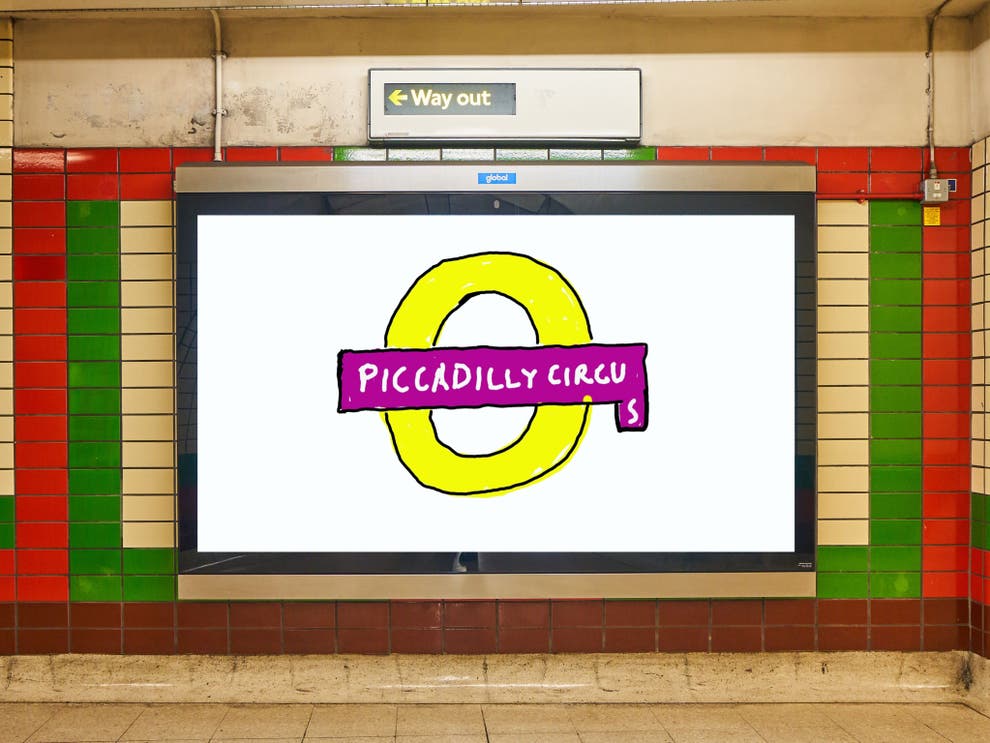
    Hockney’s new work has been much derided on the Internet (GLA)

    The Royal Academy exhibition The Arrival of Spring hasn’t been particularly well-received either. It’s doubtful that the criticism will affect the supremely confident Yorkshireman. A contrarian spirit seems to replicate itself in many successful people. This is so with Hockney, whose love of life appears to begin in a healthy contempt for all do not share it, and who prefer to conform. ‘Boring old England,’ was his famous reasoning for leaving his home country for LA in the 1960s.

    To study Hockney’s life and his art is to get to know the benefits of particular kind of bluff decisiveness. The octogenarian has always known his next move – or found it materialise it before him as a thing to be straightaway acted upon. 

    In Paris in the 1970s, he realised too many people were visiting him and that he wasn’t getting enough work done – keenly alive to the danger to his productivity, he straightaway upped and left. When he stayed on in England after Christmas in 2002, he realised that he had been missing the seasons of his native Yorkshire, and rearranged his life to take advantage of it.

    Here he is describing the move in 2013’s A Bigger Message: “I began to see that that was something you miss in California because you don’t really get spring there. If you know the flowers well, you notice them coming out – but it’s not like northern Europe, where the transition from winter and the arrival of spring is this big dramatic event.”

    “I began to see that that was something you miss in California because you don’t really get spring there.”

    David Hockney

    Then just before lockdown, came another example of the Hockney decisiveness: during a brief visit to Paris, he realised that Normandy attracted him sufficiently to be worth moving to. Here he is telling the story to Martin Gayford in the pair’s excellent collaboration Spring Cannot Be Cancelled: “It happened like this. We travelled to Normandy after the stained-glass window at Westminster Abbey was opened. We went through the Eurotunnel, via Calais. We stayed in this lovely hotel at Honfleur, where we saw this sunset.” In time, J-P was dispatched to an estate agents: “When we came in and saw the higgledy-piggledy building and that it had a tree house in the grounds, I said, ‘Yes, OK – let’s buy it’.” 

    “This house is for David Hockney and he wants to paint the arrival of spring in 2020, not in 2021!”

    Fame had come for Le Grand Cour – destined no doubt to be a tourist attraction to rival Monet’s lily pond at Giverny. Of course, this freedom is partly the freedom of the immensely successful.
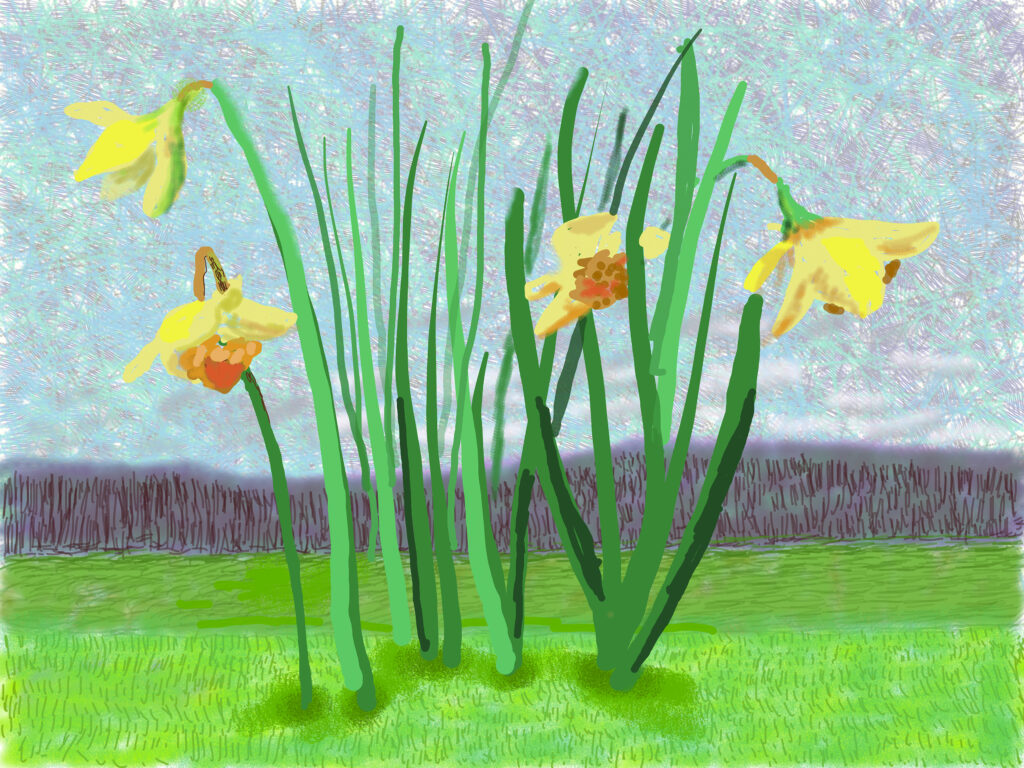
    David Hockney “No. 118”, 16th March 2020 iPad painting © David Hockney

    In Gayford’s telling of the house purchase, the sense of Hockney’s importance is evident when J-P is quoted as saying impatiently to delaying builders: “This house is for David Hockney and he wants to paint the arrival of spring in 2020, not in 2021!” One senses that he has surrounded himself with the right people; Hockney has the gift for friendship and loyalty. This hasn’t necessarily always been to the good: there are signs in The Arrival of Spring that a certain cosiness may finally have seeped into his work to its detriment.

    Certainly the current exhibition which has been widely panned in the media, except by his friend-reviewers such as Jonathan Jones of The Guardian and Martin Gayford at The Spectator

    So are the negative reviews fair? Undoubtedly some of them are written with the pantomimic disdain which journalists sometimes level at people who have become more famous than them. One example would be the overdone headline in City AM: “I hate these paintings in my bones.” If we look at a painting this way, what emotion do we have leftover for atrocities of war?

    David Hockney “No. 316”, 30th April 2020 iPad painting © David Hockney

    Besides, in among the sameiness, there are magnificent images here. I was taken particularly by a sequence of images of the sun rising over the slopes that surround Hockney’s new home. Hockney has rightly objected to the idea that you can’t paint a sunrise or a sunset by pointing out that such things ‘are never clichés in nature’. Here we see the old cliché of the yellow orb with tentacles of yellow seeping out of it rejuvenated to some extent: there is a lovely passage where the tree in the foreground takes the red of the sun, and becomes aflame with red, like something Moses might have seen. 

    There are other such moments – especially where Hockney reminds us that the iPad is especially good at handling complexity of space. One such example is No. 340 (see below) which directly recalls – and in recalling, competes with – Monet.

    It’s worth restating that Hockney is an intensely competitive artist – his career is a reminder that there is nothing wrong with that. Once we have decided what to do, we may as well attempt to do it as well as anyone has ever done it before. The attempt may fall short, but will likely provide us with the energy we need to do our best. 

    An exhibition I attended at the Dulwich Picture Gallery in 2014 called David Hockney, Printmaker, showed him wholly able to assimilate Japanese pictures – Hokusai is another hero of his – and he remains an essentially competitive artist: the 2012 exhibition A Bigger Picture– also at the Royal Academy, was a direct challenge across the centuries to Paul Cezanne. 
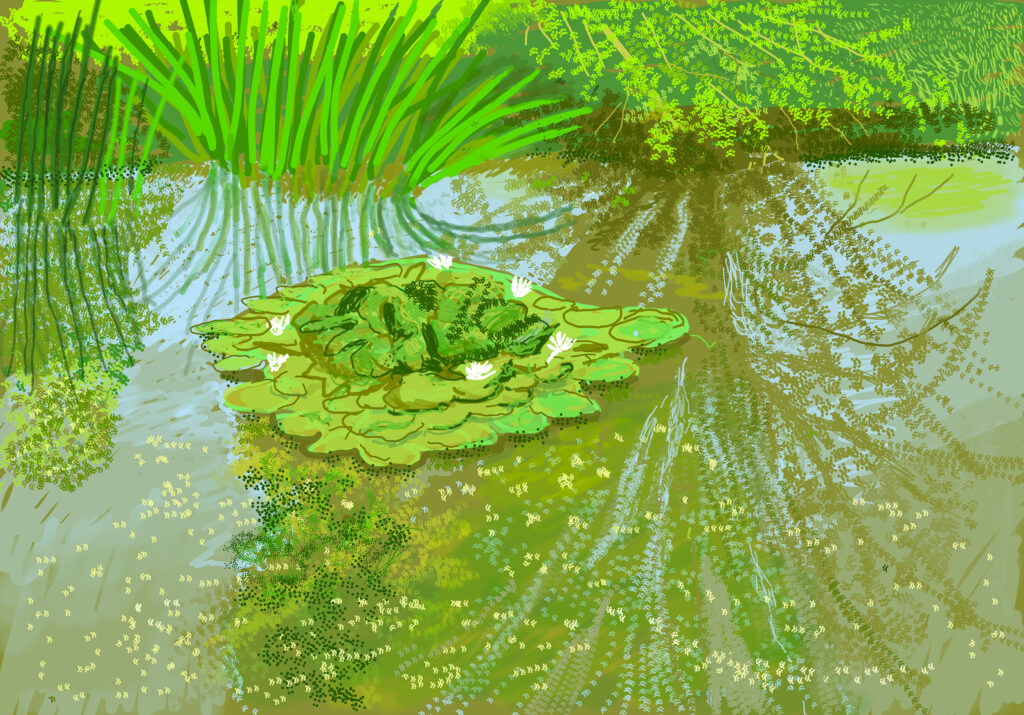
    David Hockney “No. 340”, 21st May 2020 iPad painting © David Hockney

    Besides, in this instance, Hockney doesn’t fall short. The entire picture is sumptuous, an act of deep and respectful noticing – to hate this in one’s bones would be in the regrettable position of hating life to one’s bones. Especially good are the dots in the bottom left, where three or four kinds of reflection are rendered alongside water and things which might be bobbing on the surface. This is done all at once with great joy and even bravery.

    Nobody with any sense would claim that Hockney can’t draw a face…it’s just that here he’s chosen not to

    There are other virtues to this exhibition. The iPad – as Hockney has pointed out – is very good for immediacy. There is no need to set up materials, instead you can simply get drawing – as in No. 370 beneath. This picture has its literary antecedent in Philip Larkin’s poem ‘Sad Steps’:

    Groping back to bed after a piss
    I part thick curtains, and am startled by
    The rapid clouds, the moon’s cleanliness. 

    Here Hockney, doing the same, is equally startled – and again, what’s good is the journey of the moonlight through the clouds onto the edges of the bushes. We are told here that moonlight on a dark bush isn’t moon-coloured – it’s actually a kind of turquoise. We are also shown how moonlight doesn’t quite get in between all the way into the bushes; the image is a precise assessment of moonlight’s force and power. Even the most radiant nights have numerous hiding-places. 
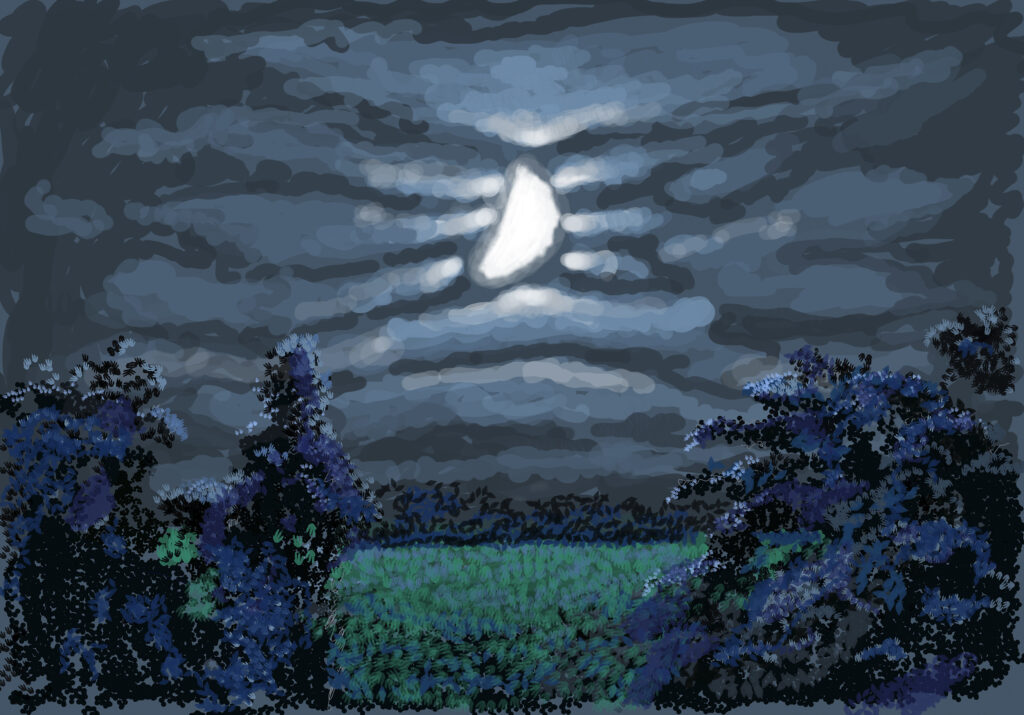
    David Hockney “No. 370”, 2nd May 2020 iPad painting © David Hockney

    But there are problems with the exhibition too which one’s admiration for a lifetime of extraordinary achievement cannot quite oust. Samuel Johnson once wrote that a book that’s fun to write cannot be fun to read. When considering what might be wrong with The Arrival of Spring, Johnson’s remark is a useful place to start. 

    ‘I think I am in a paradise,’ says Hockney to Gayford in Spring Cannot be Cancelled. While these images have rightly been praised for their exuberance, they remind you a little too much that Hockney is happy. The compositions are too often simplistic, and I am a little confused, having loved the accompanying book, that there isn’t greater diversity of subject matter. In the book, we see images of the artist’s foot, and of his iPad which would have made for a less repetitive exhibition.

    Falsity in art can sneak in with terrible proclivity

    Furthermore, the image contains not a single face. This isn’t because Hockney can’t do it – nobody with any sense would claim that Hockney can’t draw a face; in fact he’s probably the best draughtsman alive. It’s just that here he’s chosen not to. It might be that he has decided that spring is his subject – but if so, he needn’t have excluded the rest of life around him. We experience spring in relation to other people – as we’re almost tired of learning, in our little locked down bubbles.

    Perhaps the timing of their composition might also have made them age more. They were no doubt begun in a more contrarian spirit during the beginning of lockdown than we can now recall, full of a defiant desire to show the world that there are worse things than being circumscribed to just one place. 
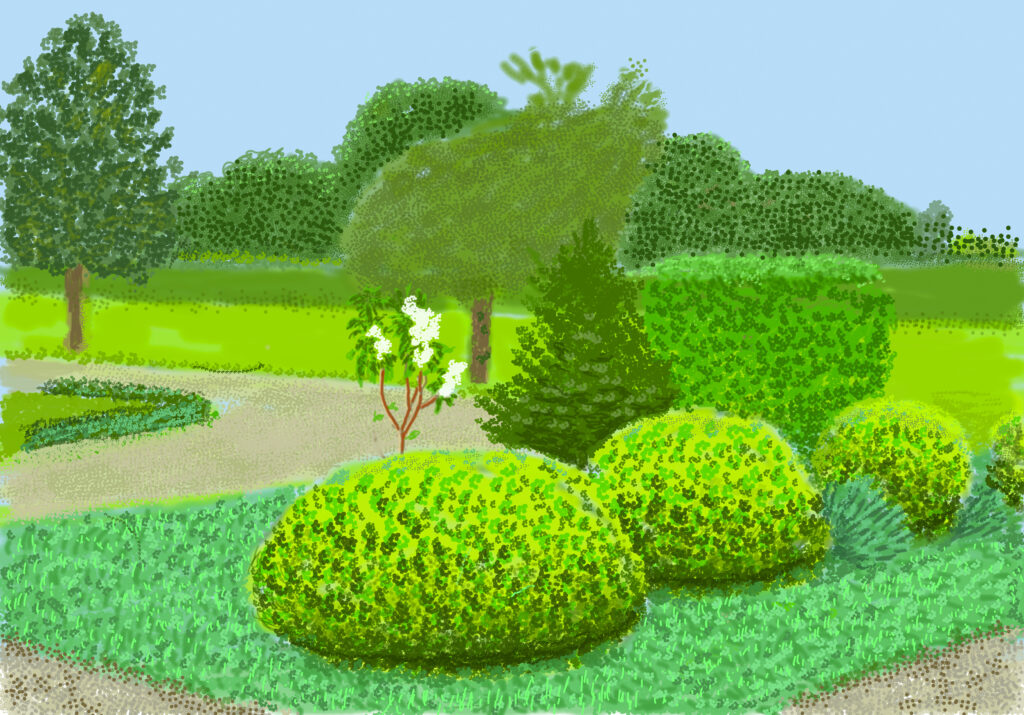
    David Hockney “No. 259”, 24th April 2020 iPad painting © David Hockney

    But falsity in art can sneak in with terrible proclivity. As an example, Larkin’s poem ‘Sad Steps’ spins to a false conclusion, about how youth cannot come again but is ‘for others undiminished somewhere’. It is a crystalline poem of marvellous technical brilliance reaching the wrong idea – because if youth is indeed irreversible then it is diminished for everyone everywhere all the time. The poet isolates himself in a bogus despair.

    Hockney may perhaps be making the opposite mistake – readers of his History of Pictures (also produced with Gayford), may finish the book still in the dark as to why he makes them, besides the pleasure of being good at making them. Certainly, these images sometimes feel ultimately untethered from meaning, or perhaps insufficiently urgent in their pursuit of truth. Look at No. 259, for example, and then look at any Van Gogh – whom Hockney is also ostensibly competing with here.
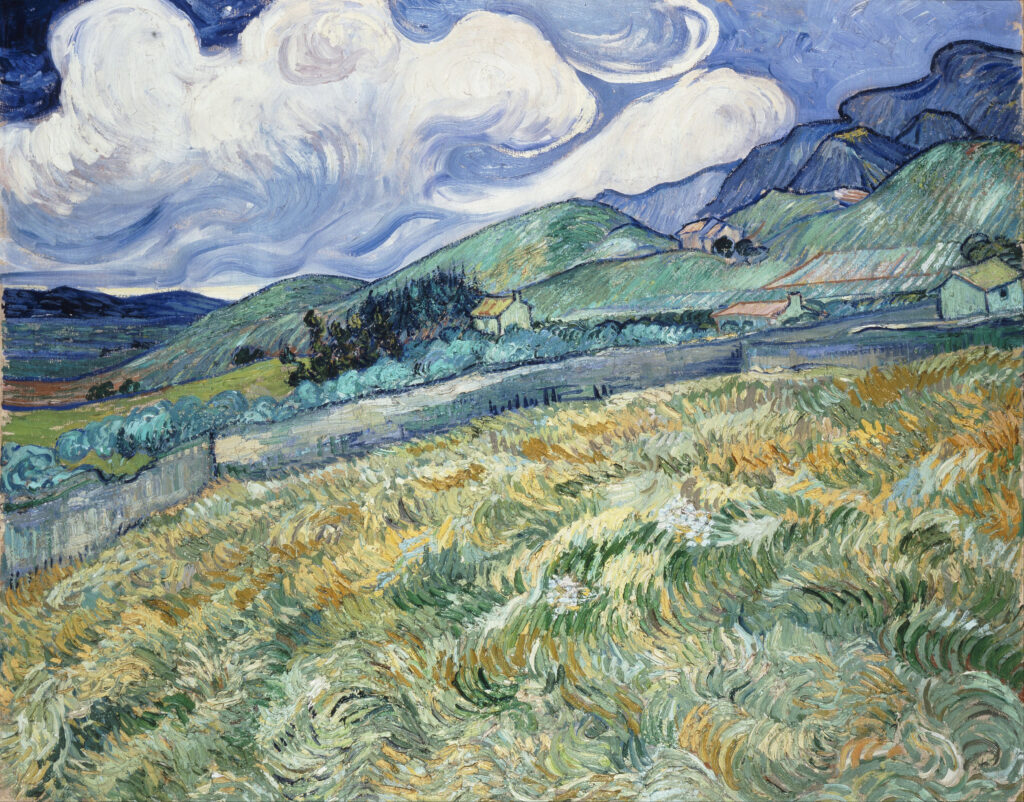
    Van Gogh’s Landscape from Saint-Remy (1889)

    In the Van Gogh you’ll find that things are never quite the colour to Van Gogh as they are to you – and your sense of the world is accordingly changed utterly. In Hockney, except for the few passages of painting I have isolated, they are almost always the colour you expected them to be. They look very very green. Hockney is as exuberant as Van Gogh, but Van Gogh is more alert to what the world actually looks and feels like, and so is the greater artist, and sometimes by a long distance.

    This brings me to a bunch – namely, that there’s a slight sense that Hockney may not have avoided the dangers of sycophancy in those around him. He has always been very good at self-editing but I wonder if this business of sending his drawings out to his friends – among them Martin Kemp, Gayford and Jones – has led to the creation of an echo chamber and a slight diminishing in standard. Gayford is a brilliant critic and writer, but every page he writes with Hockney breathes his excitement at being in the great man’s company. Such people do not tend to tell you when your game has dipped. 

    Exuberance, in short, isn’t enough in itself. You have to have setback, difficulty, and vexation. We might distinguish between intense and casual exuberance, with Van Gogh in the former category, and Hockney – at least in The Arrival of Spring – all too often in the latter.

    And yet this exhibition is still worthwhile in that it shows a worthy intention – to show the spring and to capture its beauty. Hockney’s career is a reminder to all of us as to what can be achieved if we find what we love, and work hard. Back in the 1960s, Hockney had a note next to his bed which read: ‘GET UP AND WORK IMMEDIATELY.’ If nothing else, this exhibition is a reminder of the tremendous grace of hard toil. And if you wish he’d sometimes worked harder to challenge himself then that only reinforces the lesson. 

    David Hockney’s The Arrival of Spring is at The Royal Academy from 23rd May until 26th September

    Spring Cannot be Cancelled by David Hockney and Martin Gayford is published by Thames & Hudson priced £25.

  • How eBay can be more than just a side-hustle

    How eBay can be more than just a side-hustle

    Patrick Crowder

    Many people have started selling items on eBay during the pandemic, offering everything from hand-made crafts to vintage clothing. Statistics from eBay show that the number of self-made millionaires on the platform has risen by 35% over the last year alone.

    For most, eBay is a part time job. For Sam Clifford, it has been his full-time career for five years. 

    Sam began his eBay business when he was 15, selling CDs of tips and tricks for the video game FIFA at £2 each. 

    “I had always done this as a side-hustle, which is the reputation the job has,” Clifford explains. “When I was 23, I got kicked out of my other job and said, ‘Right, I’m going to do this full-time’.”

    From that point on, Sam dedicated his full attention to his online business. He mainly sells smaller wholesale items and bases his product selection on current trends and market research.

    “Ages ago a video of a woman laughing in a carpark wearing a Chewbacca mask went viral. It was just her wearing this kid’s mask, but I knew straight after that everyone would jump on eBay to get that mask,” Clifford continues. “As stupid as it was, I knew there would be a significant, instant demand for it.”

    “I could list my sock on eBay for £30, but that doesn’t mean it’s worth that

    Clifford fluctuates his prices based on demand the same way that airlines change ticket prices. He checks the prices of sold items on eBay to get a basis of what items are selling and what they are selling for. He warns against basing prices on current listings.

    “One mistake people make a lot is they’ll go on eBay and see things listed for higher prices than they’re worth,” Clifford says. “I could list my sock on eBay for £30, but that doesn’t mean it’s worth that.”

    When items are listed on eBay, an algorithm decides which listings will appear first in a search based on the rating of the seller. Clifford says that speed is the key to keeping that rating as close to five stars as possible: “You’ve got to be hot on it. When I first started I was delaying, doing it here and there, and that reflects badly on your account.”

    He also recommends posting items and answering inquiries within a day, as well as offering free first-class postage with every sale.

    Increased demand during the pandemic led to such a surge in new listings that many had to be removed to ensure security and disallow price gouging. Clifford has witnessed these effects of Covid-19 on the market first-hand, but he is not discouraged by the new competition. “The market has gotten a lot bigger, but there are a lot more buyers as well. People are sitting at home bored with nothing to do. There is more competition, but I think there are at least threefold more buyers.”

    “If your mind and your heart are in this job then you’ll succeed

    Making a full-time career through eBay is an attractive prospect, but Sam warns that the dedication it requires is not a good fit for everyone.

    “It’s freelance work. If you haven’t got the drive and motivation to do it, it’ll end up fading out in about six months,” Clifford says. “I’m big on mindset and mentality – the mind controls the body, so if your mind and your heart are in this job then you’ll succeed.”

    Clifford’s success came as a surprise to many people in his life, and he initially faced pushback. He believes that anyone with the right amount of self-motivation and passion can succeed in the job and encourages people to follow their passions.

    “People who get joy out of negativity will put you down and say it’s not a real job, but I’d rather fall on my own sword than anyone else’s,” Clifford says. “People have this stigma that what you enjoy can’t be your career, but that couldn’t be further from the truth.”

    Photo credit – By Cristiano Tomás – Own work, CC BY-SA 4.0, https://commons.wikimedia.org/w/index.php?curid=103669478

  • The inside story on how to be a spy

    The inside story on how to be a spy

    Emily Prescott

    Along the river from Westminster in Thames House more than 4,000 people are working to protect the UK against threats to national security. Members of MI5 must be discreet about their work defending the country from espionage and terrorism but former intelligence officer Annie Machon has given FinitoWorld some insider information about MI5’s recruitment process and what it is like to be a spy. 

    MI5 of course refuse to reveal exactly what goes on behind the austere stone-fronted building but they do tell people what the job does not involve. They warn spy-hopefuls to put down their martini glass and throw away the Aston Martin keys. In reality being a spy isn’t glamorous and the work is often “routine and painstaking (though vitally important),” they say.  

    Intelligence officers will be highly trained in espionage techniques. Sometimes they operate openly, declaring themselves as representatives of foreign intelligence services to their host nation, sometimes they will operate covertly under the cover of other official positions and occasionally they may operate in “deep cover” under false names and nationalities. 

    Machon, a classics graduate from Girton College, Cambridge, applied to the foreign office to become a diplomat in 1990 and then received a mysterious letter from the ministry of defence. It told her there may be other jobs she would find more interesting and it asked her to ring a number.  

    “My first instinctive response, excuse the language, was ‘oh f*** it’s MI5’ I don’t know why but I was actually quite frightened and thought, why would they want me?” She says. But when she received the letter Machon’s father, a spy geek and John LeCarre enthusiast was in the room and he encouraged her to call the number.  

    The recruitment process took ten months and she was quizzed on various matters from her sexuality to her political views. Eventually Machon was given the job and   she began working on countering Irish terrorist threats.

    The way Machon was recruited seems far more professional than the way the former head of MI5 Eliza Manningham-Buller entered MI5 in 1974  after an encounter at a drinks party. Indeed, since Machon’s job offer, MI5 have professionalised their recruitment process even further. It’s far more transparent and people can apply to work for MI5 via its website. People who reach the interview stage will be assessed with competency-based interview questions in which they will be asked for specific examples of past behaviour. If the interview goes well, there is a thorough vetting process and candidates have to complete detailed questionnaires and provide references. 

    During Machon’s final year at MI5 she was trained up as a recruiter. “It was the first year where they put open adverts into newspapers rather than the oblique ones. They had 20,000 applicants most of whom were James Bond wannabes and of course none of them got through and I think out of the 20,000 only 5 were recruited.”

    In summary she says, if you want to work for the organisation “you need good organisation, good judgement, good analysis and good team-building skills.” 

    Ever increasingly, it seems MI5 is looking to diversify its workforce. “In my day it was very white, mostly male and almost certainly Oxbridge. They understood they had this groupthink problem and also Al Qaeda had appeared over the horizon as the new big terrorist threat so they did realise they need people from more ethnically diverse backgrounds as well.”

    At the moment 43% of the workforce are women. Machon said: “In my day it was actually about 50:50 women working there but the bulk of the women who worked in the intelligence agencies at that time were working in the registry or working as secretaries.”

    “I know that over the past 15 years they’ve been targeting women, even using Mumsnet I think to try and recruit more women,” she added. 

    In December 2020 MI5 published a Gender Pay Gap report which shows the mean pay for men is 13% higher than for women.  Director Ken McCallum said: “MI5 is committed to accelerating pace to deliver a diverse and inclusive workplace, harnessing and growing the talents of all sorts of people from all sorts of backgrounds to keep the country safe.”

    Indeed, Machon praised MI5 for receiving awards from the likes of Stonewall for being one of the best LGBT employees.  She said: “This is an amazingly fast advance from my time there because when I joined you were not allowed to be homosexual because it might have been used for blackmail. That only changed in 1994 so to go from that to where we are I think is all credit to them.” 

    She speaks of the culture positively. “It was a very friendly workplace and it became so very quickly because you can’t talk about your life to anyone else so friendships and social groups and everything for very fast on the inside,” she explains. 

    But ultimately, Machon ended up on the run for a year after going to the press to expose alleged criminality within MI5. 

    It was back in August, 1997 that Machon went rogue. She and her fellow whistleblower David Shayler were concerned about how various departments within the intelligence service were operating. The pair took a number of classified documents to The Mail on Sunday. The very first story to be published alleged that the phone of the then New Labour spin doctor Peter Mandelson had been bugged for three years during the early 1970s.

    Of course Machon never returned to the organisation after that. But inspired by her time at MI5, she has been focussing her time on ethical data solutions and she urges people who are interested in protecting the country to do the same. 

    MI5 offers roles for school leavers as well as university graduates and they are interested in a diverse range of people. As Machon’s story shows, joining MI5 is never going to be an easy career path but if you are genuinely interested in keeping the country safe it could be a route to seriously consider.

  • Psychologist Melissa Nobile of The Kusnacht Practice on treating young people during Covid-19

    Psychologist Melissa Nobile of The Kusnacht Practice on treating young people during Covid-19

    To mark Mental Health Week, Melissa Nobile, a Psychologist at The Kusnacht Practice, discusses her experiences of offering care to young people during the pandemic

    Mental health has become such a ubiquitous phrase in our society that it is almost verging on cliché – all the more reason, then, to explore in detail what we really mean when discuss it. The best way to do that is to talk with someone who really understands it, and deals with these issues on a daily basis. 

    Accordingly, I Zoom with Melissa Nobile, a Psychologist at The Kusnacht Practice in Switzerland. Nobile’s academic background is at the University of Geneva and the University of California in Los Angeles; she subsequently acquired additional training and clinical experience in Thailand and Europe.

    Nobile’s role at The Kusnacht Practice is particularly relevant for Finito World readers. Nobile is especially engaged in the practice’s Youth Programme, with most of her work conducted with patients between the ages of 13 and 25. 

    For parents, this has been an anxious time. It is difficult to unpick pandemic-specific behavioural changes from developments that would probably have been scheduled to happen anyway, with or without Covid-19. Does Nobile have any advice on that score? “As a parent, it’s okay to see just a little change in your child – signs might include a bit more frustration,” Nobile explains. “But if you’re getting to the point where there’s a really concerning change, then you should seek help.”

    So how do problems tend to manifest themselves? “We look for areas where day-to-day functioning has altered,” Nobile continues. “It could be that the child is suddenly really scared of going to school. At the beginning of the pandemic particularly, children were scared of losing a parent.”

    More generally, the pandemic has been an onslaught on our sense of pleasure in the world – that’s true for young people too. The death tolls reported daily on our news sources chip away at our ability to be joyful. Is there a danger that we’ve become a morbid society? 

    Nobile says that the impact of that is especially significant on those who were already vulnerable: “In those who are predisposed to struggle with anxiety that’s obviously a problem. But it hasn’t been confined to those people: it’s also something we’ve seen in CEOs and high achievers.” That’s partly due to the uncertain time scales which are at the centre of what’s been so challenging about the pandemic: “It’s stressful for everybody. Nobody likes uncertainty for too long, as we have a sense of loss of control if we’re unable to plan for the future. A lot of people end up turning off the TV as they can’t take that morbidity.”

    The danger, of course, is that a stressed-out CEO, however wealthy, is not going to be stressed out in a bubble – in the family unit, that stress is likely to be catching and affect younger members of the family. The Kusnacht Practice is careful to see the wider picture of what may be causing strain in a young person. “We’re very focussed on the stresses that CEOs are under. It’s the difficulty of having it all on your shoulders. We have to make sure that what the parents are feeling doesn’t spread into the life of the teenager.”

    The Kusnacht Practice is a pioneer in the field of ‘individualised treatment’: “Our approach is tailor-made to each young person coming in,” Nobile explains. “In group settings, the patient comes in and has to adapt to the programme and the setting. It doesn’t work for a lot of people. What we do is listen to the person coming in, and examine their specific problems – whether it be a specific symptom, or pandemic struggles, or something else altogether.”

    Crucially, this individualised approach is matched by an equally individualised family programme. “We’ll get as many people as possible on site whenever possible – siblings, parents, grandparents, even nannies. They’re going to go back home, and back into the family system, so changing someone without changing the rest of that family system usually doesn’t work.”

    Nobile reports an increase in cases where she’s needed to orchestrate a family therapy approach. “I’m doing more and more sessions where I do parental coaching around a situation. This will sound simple in theory but in truth, it’s quite complicated. In some families it’s about going back to really good communication. Uncertainty will give room for people to imagine the worst. What we need is for parents to explain as much as possible – and in words adapted to a child – what is going on. If you don’t do that, a child may construct more catastrophic scenarios than is actually the case.”

    Nobile exhibits a profound understanding of her clients: “Children or teens are antennas,” she says. “Given that, it’s important for parents to say: ‘Listen, this is a difficult time but we’re going to be okay’.”

    So what can we all do to improve our domestic lives? Nobile advises focusing on specific family rituals so that no member of the family in question is isolated. “It’s important to have that time where you still cook or go for a walk together. That will always be beneficial. I’ve had a lot of teenagers lately where they’ve found experiences in the pandemic which are very enriching. Some have come out thinking, ‘Even when things seem terrible, I’m able to cope with it and I can talk to someone’. Some have built that vital resilience.”

    Even so, the long-term picture remains uncertain, and that creates another layer of problems. “There’ll be a minority group for whom difficulties will persevere,” Nobile says. “There’s the young student who maybe acquired a gaming addiction in lockdown – that will take time to treat. Or else there’s those young people whose parents have lost their jobs at this time. In those instances, we’re discussing a more long-term impact.”

    Career issues arise again and again, according to Nobile. “During the pandemic, we had a lot of time on our hands. That creates a lot of existential questioning, perhaps among young people who were already predisposed to that anyhow.”

    Fortunately, The Kusnacht Practice has a remarkable range of resources at its disposal. Business coaches and mentors and psychotherapists are on site, and Nobile makes sure her clients are able to explore their interests with a view to shaping their future. 

    Given The Kusnacht Practice’s rarefied level of treatment, a lot of the young people Nobile sees are dealing with issues related to having successful parents. “If you have a successful parent, what does that mean for you? That’s not always easy to figure out. You might have a lot of resources, and accordingly, a huge number of choices. Paradoxically, that can make you petrified. For every door you’re able to open, you’re going to have to close so many others. That can freeze you in place.”

    So how does Nobile manage that? “That’s what psychotherapy is all about, figuring it out in the context of each person’s life story.”  

    One might think that returning to the family unit after treatment might be difficult. But Nobile gives a nuanced reply. “It’s a minority of the youth we receive who come to us because they want to. Most of the time the parents in question have been very concerned for a while. But by accepting the need to come here, they’re sending a signal: ‘Yes, I have a problem’.  And admitting the need for help is incompatible with the normal developmental process of youth who strive for independence. After a few days they however usually realise that this is quite a nice place! They can set goals, work out problems they are facing and learn new skills – and find their voice.”

    And returning to the family – is that fraught with danger? Nobile doesn’t see it that way. “We like to see it as an opportunity. Ultimately, life is not with us – it has to be back home. But once clients leave us, we provide daily support with virtual sessions with the main therapist and they can always come back for ‘recharge weeks’.”

    It has been a difficult year for many, but it creates optimism to find people like Nobile working on the front lines, committed to the healing which all of us may feel we need after the tribulations of 2020 and 2021. 

    Nobile was to talking to Christopher Jackson. Go to https://kusnachtpractice.com

  • Meggie Foster: “Don’t wait for the phone to ring. Just do it yourself”

    Meggie Foster: “Don’t wait for the phone to ring. Just do it yourself”

    Emily Prescott

    Meggie Foster has had a good pandemic. You may not recognise the name but if you have ever ventured onto Twitter or TikTok, you will know the face.

    When the virus hit, the 27-year-old trained actor was working in an office. She dreamed of performing but because London is so “bliming expensive” and the industry is “crammed full” of talent she was working a 9-5 job hoping a door into the creative industry would somehow open for her.

    Finally, furlough gave her the time to focus on her creative career and she started posting videos online featuring lip-syncs of politicians and celebrities, much to the delight of millions of people in desperate need of some whimsy.  

    One video, which has been viewed more than 1.5 million times, uses the audio clip of the home secretary’s April press briefing announcement, that there had been “300,034,974,000” coronavirus tests on one day. Foster lip-synced Priti Patel’s announcement while swigging from bottles of spirits and smoking throughout, before getting out a roll of clingfilm and attempting to use it as a facemask.  

    In another, which has received nearly 20,000 likes, Meggie lip-syncs an interview between ITV news presenter Tom Bradby and Meghan Markle in which Markle admits she struggles with life as a royal. Meggie’s Bradby plays the violin and Meghan wipes her tears with a £50 note. 

    She is in demand. Foster took a call from Robert Peston’s production company asking if she could come up with a video mocking his biggest blooper. She reenacted the awkward moment Peston appeared to say an expletive when the chancellor asked for his question during a press briefing. 

    Foster playfully presents the ridiculousness of people’s own words with her perfectly timed syncs, exaggerated facial expressions and costumes (which are often borrowed from her Dad’s wardrobe).  

    “I think it’s sort of an eye opener that you can actually do it yourself and not wait for the phone to ring. I was definitely that person to wait and see if anything would happen. I’d never sort of gone out there and done it myself and maybe that was because I was scared, ” Foster tells us.  

    Her apprehension about putting herself online is understandable, but thankfully, she has not encountered too much meanness.

    “I haven’t really got too much negativity. With acting I knew people could be quite vicious about it. Even on your looks and stuff like that, especially for a girl you’ve got a load of pressures on looks and stuff like that. I’m actually really surprised how I haven’t got comments about how I look. I am really shocked about that actually.”

    She speaks with such buoyancy and enthusiasm, it is easy to believe that she would not be too disheartened by a few nasty comments.  

    “I have got quite a thick skin, I’m quite a tough cookie when it comes to stuff like trolls. I think if you don’t want to watch them, if you don’t find them funny then just don’t watch them or don’t follow me, it’s as simple as that. I am not really bothered what people like that think. Obviously if the majority of people were saying that but they’re not. The majority of people have been overwhelmingly positive.” 

    Despite her new-found online stardom, Foster is yet to feel the full force of her fame, she tells us from her family home in Oxfordshire.  

    “A few people sort of recognised me and things like that but because we have been in lockdown I haven’t been out too much and wearing a mask around, no one can see my face anyway.

    “I feel like I am not famous because I have been stuck in my childhood bedroom, with my mum and dad sort of nagging me to pick up my clothes from the floor. So I feel like I’m back at school if anything but we will see. We will see what happens.” 

    When I first reached out to Meggie with an interview request in April, she politely declined. She later said she had taken the advice of her journalist brother and was composing herself before speaking to the media. Since then, the savvy comedian has featured in The Times and on Lorraine. Now she has an agent and is thinking about next steps. 

    “I do worry that it is getting boring. I know lip-syncing is funny but I don’t want to bore people now so I’m trying to spread my wings a bit and see whether there is any more life in other directions. Dreaming big I would love to have the Meggie show.”

    Foster, who is continuing on her upward trajectory, has some advice for budding actors and comedians.  

    “I think my main piece of advice would be: do it yourself. Don’t wait for that phone to ring you know, you can create stuff yourself if the work is not coming to you, especially now when theatres are closed. 

    “If you have got sort of, I don’t want to be cringe, but a dream or a passion or something you want to get to: you can do it. You can create your own luck.” 

  • Racing Ahead: The equestrian industry emerges from lockdown

    Racing Ahead: The equestrian industry emerges from lockdown

    by Alice Wright

    According to the British Horse Council’s Manifesto for the Horse the equestrian industry in the UK provides full-time employment to over 250,000 people and is the second largest rural employer after agriculture. It’s also a growing industry, contributing around £8 billion a year to the economy. Employment opportunities stretch far beyond riding and caring for horses. For example, the industry incorporates marketing, betting, training, retail and veterinary sectors that offer myriad opportunities to work with and for horses.       

    For those acquainted with the equine world this may appear self-evident, but for those with a budding interest or considering a career change the British Horse Society (BHS) helpfully breaks the various sectors down in their ‘career pathways’: Breeding & Stud; Business Management; Coaching; Tourism; Dental; Farriery; Journalism, PR & Photography; Mounted Forces; Nutritionist; Racing; Saddlery; Sales & Marketing; Trainer and Veterinary Medicine. I spoke to some of the various leaders of these sectors to find out more about the opportunities in their professions and where the industry is headed as restrictions are lifted.     

    A spokesperson for the British Horse Society (BHS) told me that “like with all industries affected by the pandemic, it will take time for the equine industry to get back to business as usual. With people having more spare time we saw an uptake in the number of individuals taking part in horse riding, prior to the second lockdown. This, along with people embracing the outdoors and new hobbies, is a positive sign that the industry will continue to thrive.” 

    Saqib Bhatti MBE MP is the Chair of the APPG for the Horse that, according to Bhatti acts as “a voice for the horse riding industry in the United Kingdom” to “give a unified voice to ensure industry concerns are heard in Parliament.” He tells me that recently their work has dealt with issues thrown up by the lockdown such as the operation of riding schools during restrictions and the classification of vets as key workers. 

    Indeed Bhatti’s APPG is now largely focusing on the post-Covid landscape. “We face a myriad of economic challenges and ensuring employment opportunities are available in the equestrian industry will require cooperation between industry and government.” 

    Saqib Bhatti MP chairs the APPG for Horses in Parliament

    Indeed, aspects of the equestrian industry have been hit hard by the pandemic. Last March, the iconic Cheltenham Festival was given the government green light to go ahead despite the escalating coronavirus crisis and has retrospectively been deemed a possible superspreading event. Race meets, sales and other large income generators all over the sector were closed down for months. 

    Yet, Bobby Jackson, marketing executive at Tattersalls sales in Newmarket claims that bloodstock, sales and marketing has remained relatively stable. “As our side of the industry deals directly with racehorses, COVID-19 hasn’t really affected the day-to-day care of them and therefore employment levels have remained fairly steady” he says, adding that “investment levels at the Tattersalls sales have been positive during the pandemic and would infer that employment levels should remain strong in the long term too.” 

    Claire Williams, Executive Director of the British Equestrian Trade Association (BETA) agrees, telling me that “to be honest, the trade and retail has come out of COVID quite strong. Certainly my retailers and manufacturers are coming out probably almost with higher turnovers than they were coming in [to the pandemic]. We’ve seen a real boom and equestrian sales over the last year. BETA is recognised as the official representative body for the trade sector of the equestrian industry, representing over 800 companies in retail, wholesale, manufacturing and other service agents.

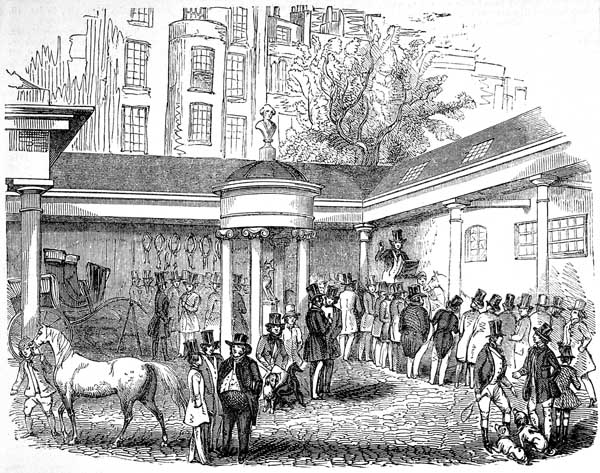
    The Tattersalls sales ring at Newmarket (Edumark)

    Williams is keen to emphasise just how many opportunities there are across the industry, but particularly in the trade sector. “In terms of the trade side, you’ve got everything from saddlers, to photographers, or working for a large manufacturer. You’ve got the range of nutritionists, assisting in the development of feed or to act as advisors to the customers.” Equine nutrition is constantly responding to developing research so there are academic opportunities as well as client-facing roles. 

    “Then you’ve got business management type positions and companies, whether that be product development, market development, marketing and sales,” Williams adds. She is also enthusiastic about the creative opportunities available, such as in product design for both horses and riders, from hat silks to winter rugs.    

    There are also “a lot of PR opportunities” both in-house with large companies and dedicated specialist firms such as Mirror Me PR, as well as “opportunities for more science-oriented people.” The scientific primarily relates to veterinary medicine and pharmaceuticals but Williams also mentions that there are a great deal of R&D (research and development) opportunities with companies, such as those creating supplements.  

    Further to this there is the management and events aspect of the trade which can be a fruitful career for the self-employed as well as those that want to work at events corporations. However, events businesses have been one of the hardest hit by lockdown and restrictions on gatherings. 

    BHS’ spokesperson agrees with Williams about the abundance of employment options surrounding horses, saying that working with horses will provide “a strong foundation of skills and knowledge to support any career, or career change, in the industry. It will provide you with many transferable skills such as communication, assertiveness, organisation, time-keeping, resilience and confidence” adding that, “in any career connected to horses, from journalism and graphic design to saddlery or farriery, a foundation knowledge in complete horsemanship is recognised throughout the world as a huge advantage.” 

    The great AP McCoy riding Straw Bear to victory in 2006. Career opportunities are rife in PR, with dedicated firms such as Mirror Me Pr (Citrus Zest)

    Jackson too expresses the variety of opportunity within the marketing and sales sector of the equestrian industry. “In this side of the industry, if you want a hands-on job with horses you can do it, if you want an office job you can do it, or if you want a job combining outdoors and indoors then you can do it! There are roles for all talents.”  

    Jackson describes how the range of jobs within sales and bloodstock itself is huge. One can work on a stud farm and bring life into the world during the foaling season, or alternatively work at an auction house like Tattersalls and help fulfil people’s dreams when they sell a horse for a life-changing amount of money. “This side of the sport will give you moments that you will never forget,” he tells me.   

    Yet despite the plethora of opportunities the equine industry carries an unfortunate haze of elitism over it as a profession. It is associated with royalty and high-net worth investors, and while both hold essential roles in the sector, this perception can be an initial barrier to people considering a career in the sector. 

    The BHS told me that “there is an inaccurate perception that equestrianism is an expensive industry to get into. While it is true that owning a horse can be expensive, you do not have to own one to be able to start your career.” Jackson agrees: “The ‘sport of kings’ brings with it positive and negative connotations.” He tells me, “some people think that you need to have family in horse-racing in order to get a job in it. Incorrect.” He also stresses that his own family background is not connected to racing.  

    Williams disagrees that the industry is elitist at all. “When we look at our market research, [those with] lower to medium income levels actually comprise over half of the riders in the marketplace. It may be perceived as elitist but really I don’t believe it is otherwise we wouldn’t have 1.8 million regular riders.”    

    The winners’ enclosure at Cheltenham. Is horse-racing an elitist sport? (Winners’ enclosure; Carine 06)

    Jackson also explains that “unlike most industries, travelling the world and doing multiple jobs in your early career in order to get as much experience as possible isn’t seen as a negative in horse racing. So, by working hard, getting your hands dirty and proving your talent anybody can carve a successful career in our industry and absolutely love it.” This is a point of encouragement for those considering a career change or those yet to finalise their career choice after finishing studies.  

    Schools, colleges and further education institutions don’t tend to include opportunities to work with horses in the usual career days advertising medicine, the law and finance. Yet there are initiatives such as Racing to School which aims to educate school children on the activities and business of running racecourses. Jackson argues that such initiatives could be broadened to the bloodstock and sales side of the industry.      

    He adds that at Tattersalls, children from Newmarket Academy make an annual visit to Book 1 of the October Yearling Sale and “it would be wonderful if other schools around the country were able to do similar at stud farms, for example.”  

    An industry with pedigree: Tattersalls was founded in 1766

    Bhatti tells me that he agrees that there are challenges to those starting out in the equestrian industry. “The APPG has found that several employers feel that students coming out of education and moving into the sector lack some practical skills or experience and it is important to encourage as much hands-on experience as possible.” One solution he suggests is “working with schools to ensure placements in riding schools and other industry-related institutions become available for students.” A large part of the APPG’s work is with educational organisations such as the BHS to make people aware of opportunities within the industry.       

    Williams adds that “there are a lot of opportunities for young people such as apprenticeships. For example, we’ve got gateway stages with Kickstarter at the moment. I’ve got something like 40 employers with positions they’re creating specifically for young people.”    

    The equine industry seems to have remained relatively stable during restrictions, and even those elements such as racing and events that have been adversely affected are set to bounce back. Despite an air or exclusivity there is such a range of job opportunities within this industry and as Williams says “to work in the equestrian trade you don’t necessarily have to be horsey. You don’t have to have an equine degree to get a job in the equestrian trade at all. What we’re looking for is people showing that they’re capable, they can write well, they can analyse and they have the business skills that we need for business.”

    The BHS spokesperson offers equal encouragement: “the great news is that you can pick this up at any age or stage in your life – you are never too old to fulfil your passion for horses!” Jackson concludes with enthusiasm “what you will also find is that everyone is doing what they love – something I count myself very lucky to say – and this is a great leveller.”    

  • Desperate measures: how to get noticed in a crowded job market

    Desperate measures: how to get noticed in a crowded job market

    Georgia Heneage 

    If you scour the internet for ways to get yourself noticed, you’ll likely land upon generic advice about pumping up your CV, calling recruiters or improving your skill sets. 

    But the fiercer the competition, the greater the need to stand out. And sometimes, these are just not enough.  

    It turns out that’s especially so during global pandemics. The arrival of coronavirus has caused economic woe such as we’ve not seen since the Great Depression. Increasingly, employers are looking for that bit extra in their candidates. But what’s heartening is that there is an increasing number of instances where employees are providing just that. 

    Trevor Walford, a 63 year-old former butler for the royal family, had been working on a cruise ship when he was let go of following the first lockdown in March. In order to find a new job, he sent out over 700 applications. Having had no luck, he came up with the idea of standing outside the railway station in Leeds with a cardboard placard advertising that he was looking for a job. It worked. He was picked up by the executive of a restaurant group, and is now working as its training and development manager. 

    While the story of Walford is heartwarming, it’s also a sad reminder of just how competitive the job market has become. The explosion of the internet and social media has made it especially hard to stand out, and competition for entry-level jobs in particular has swelled alarmingly.  

    Amber Shrimpton, an HR consultant at Centrica energy, sees the trend of job-seeking stunts as part of a wider socio-economic context. The current economic situation, she explains, has engendered a ‘loose labour market’ where there are more people looking for jobs than employers offering them. She points out that there is a high number of applicants with university and other qualifications, meaning that jobseekers have more need to distinguish themselves. 

    “It’s the jobseekers who needs to make themselves more attractive,” Shrimpton tells Finito World. “My work in talent resourcing has shown that when you have 500 applications which look the same, having something which stands out is probably going to work in your favour.” 

    So is this trend born of desperation? “More and more jobseekers feel they have to do that extra”, continues Shrimpton. “It’s not okay anymore to just have a good degree. There has to be something else, and that’s the impetus behind it.” 

    Like marriage proposals, many eager and frustrated job seekers have resorted to unusual means of public advertisements. Liz Hickok strung up fairy lights to spell out ‘My wish- HR job’ and her LinkedIn handle, which landed her four interviews; Pasha Stocking used a billboard plastered “Hire me!: Unemployed and Seeking Employment” which gained her the media coverage to start her own PR company (which ironically specialised in helping people rent billboards). There was also high-school student Josh Butler who auctioned himself on eBay. His post went viral, landing him several interviews. He is now a successful city broker in London.  

    Even more creative examples might be cited. Lithuanian marketer Luka Yla found a job in his new home of San Francisco by dressing up as a courier to deliver a box of doughnuts to the companies he admired. The boxes carried the following inscription on the inside: “Most resumes end up in the trash. Mine—in your belly.” And, after writing a three-minute music video in place of a CV and cover letter, Alec Biedrzycki got his dream job at a marketing agency. 

    These success stories suggest that unusual methods of jobseeking may be the way forward for the millions currently facing unemployment. It might just be a question of changing one’s attitude towards what has become, in most industries, a deeply standardised and homogeneous application process.  

    When Lucy Martin, a 23 year-old graphic designer from London, first started searching for a job, she fell victim to this relentless process.  

    “I was at a point last summer when I was applying to so many jobs that I was becoming a number in the application process,” she said. “You just see thousands of people who are applying for the same job. I knew I just needed to get noticed in some way.”  

    This desire to stand out led Martin to pull a stunt in her application to the highly competitive advertising firm Saatchi & Saatchi.  

    Having got through to the second round of the application process, Martin was given a brief to come up with a design solution to the slogan “nothing is impossible” and told that she’d be notified if she’d been “picked”. Martin decided to take the second point quite literally. As well as fulfilling the brief, she headed down to her local sweet shop, bought a bag of pick ‘n mix, personalised some love hearts with her name on them, stuck a note inside saying “I hope you pick me”, and sent it on to the CEO of Saatchi. 

    “The concept was that he had no other option than to pick me- there was no one else in the bag apart from me,” says Martin, who got through to the next round and then finally got the job. “They really liked it. They thought it was really awesome” she added. 

    Part of Martin’s creative ingenuity came from her graphic design course at Edinburgh, where her tutors encouraged her to do “ridiculous things” to get noticed, and to “think outside the box”.  

    “I did this art installation where I froze flowers in ice cubes, and my tutor said I should go and give them to every single person I wanted to work for. There’s such a sense of urgency, because you’ve got a melting ice cube in front of you,” says Martin. “With any job, sending something physical is really effective, even if it’s not a creative job.” 

    It might seem like creative industries are better equipped (or more likely to be impressed by) such stunts. But across the job spectrum, people are finding they are having to think creatively when it comes to job applications.  

    Last year, Jack Nugee was working on an application – one of hundreds he’d produced that month – while listening to a cricket podcast. He decided to go off-piste and write his cover letter as a narration of an Ashes innings by Jack Leach innings, which had then acquired a kind of cult status, particularly in the cricketing world. 

    “I thought it would be interesting to try and relate my job experience to cricket, which I’m really interested in,” says Nugee. In an ‘Ode to Jack Leach’ he wrote: ‘I ask you to please engage your imagination as I attempt to equate myself to the English spin bowler Jack Leach’s innings in Headingly, highlighting, through his actions, the skillset at my disposal that align me perfectly for the account executive position.’ 

    In response to the letter, the employer said she wanted to speak to someone “weird enough to write a full page on a cricket innings, even though she’d never watched cricket in her life,” says Nugee. “She said it was the kind of thing they were looking for.” Having had no advertising experience at all, Nugee got to the final two and says “they were going purely off character based on the application.” 

    Though he didn’t get the job, Nugee’s current position was won through writing a similarly off-beat poem which begins; ‘I would like to apply for the role of Account Executive sat in the account management team/ You will find this application has a rhyming theme.’ 

    Though the need to be outlandish is more apparent now than ever, standing out doesn’t have to entail an eccentric application. It can come in the form of being proactive and presenting yourself to the bitter outside world.   

    Tibi Hodgson, a 23 year-old fashion stylist from London, never went to university and the sense that she lacked the right qualifications meant that she lacked confidence when first embarking on her job hunt.  

    Having had no experience in styling and facing rejection after rejection, Hodgson decided to contact someone she admired in the industry directly. “I said I felt an innate connection to her work and I could work for her at the drop of a hat.”  

    Hodgson says she didn’t know any of the “lingo” around styling and was launched straight into the deep end. She learnt the process just through doing it, and was soon styling high-end models like Adowa Aboah and Suki Waterhouse. 

    After her employer left for the US and Hodgson began working in a gallery, she kept an eye on her old job. “I was still being kept on the email loop and I noticed that some dresses and shoes hadn’t been returned properly,” says Hodgson. “So I volunteered to go pick them up myself. After that I just began going to different shops in Mayfair after work and seeing if there were items she needed to return, without her asking me to.” 

    Hodgson says that through doing this she made her own contacts in the industry, and this has led to other jobs. Now a seasoned stylist, Hodgson is a case in point that experience, qualifications and traditional means of job searching aren’t necessarily the be-all and end-all.  

    “I feel like with these unconventional ways it’s all about luck and for luck to happen you need exposure. So the more ways you can expose yourself, the better,” she says.  

    And, of course, the need to be outlandish applies not just to those seeking a job. The emergence of a gig economy and the sheer number of freelancers competing against each other is ensuring that freelance workers need to find alternate means to stand out from the crowd as well. 

    Rahoul Baruah, a freelance software developer from Leeds, was at a meet-up social with some fellow workers when he met a guy called Jamie who was “sort of famous in our world”. 

    Chatting over some beers, Jamie seemed excited because he’d just set up this agency called ‘Made in London’. The next day, “just for a laugh”, Baruah decided to set up a spoof of his website called ‘Maid in London’, featuring a picture of a barmaid with Jamie’s face and a link to the real company’s website. 

    The prank website ended up getting Jamie’s original company loads of business, and three months later Baruah was offered a year-long contract from them. 

    “I basically got a year’s work- which was really good pay- from just putting up a prank website,” says Baruah. “Me and my group of friends have always said that to stand out you’ve got to do stupid stuff.” 

    These stories all show that difficult economic circumstances can be traversed by imagination. You don’t always need to get noticed via outlandish means: it’s about putting yourself out there – whether that’s via personalised love-hearts, a cricket match for a cover letter or, like Baruah, just taking the time to show up. It’s about being bold and fearless in the face of the unknown.  

    “If you want something so badly, you have to make sure you respect it more than the next person,” says Hodgson. “You have to be that person who goes that extra mile.” 

  • Inside NFTs: the concept taking the art world by storm

    Inside NFTs: the concept taking the art world by storm

    Thomas Flynn

    For most people in the UK, the letters NFT used to refer to the National Film Theatre on the South Bank of the Thames. Now they stand for something entirely different — so-called Non-Fungible Tokens.

    If that term means almost nothing to you, don’t worry. You are not alone. However, you may be interested to learn that NFTs are currently taking the art world by storm (as well as the music and sports industries) and are very likely to remain an important concept in the future right across commerce and culture. 

    So let’s try and explain.

    Fungibility is a term from economics, but stay with me for a moment. A five or ten-pound note, or a dollar bill, are fungible. A painting by Banksy is non-fungible. So if I lend you a fiver, when you give it back to me a week later I won’t mind if the five-pound note you give me isn’t the same five-pound note I gave you a week ago. As long as it’s a legitimate five pound note, I’ll be happy.

    However, if I lend you my Banksy painting and a year later you give me back a different Banksy painting, I might not be too happy. That’s because unlike paper money or metal coins, paintings are Non-Fungible. 

    Three or four years ago, the only people who were familiar with Non-Fungible Tokens were people from the tech world of computers and so-called crypto-currencies (digital money). And that’s another concept that’s making a big impact. 

    In essence, a Non-Fungible Token is simply a piece of computer code — a string of alphanumeric symbols (known as a ‘hash’) of the kind that sits invisibly behind a computer image such as a JPEG, a Gif or a TIFF. 

    In the ‘real’ world, if I buy a painting at an auction or from an art gallery, I can walk away with the painting after paying for it. I now own it. Unlike a ten-pound note, that painting is a unique object that belongs to me and to me only, until I decide to sell it. 

    Yet only a few weeks ago, a JPEG of a computerised work of graphic art by an artist who goes by the name of Beeple, was sold for $69.3 million dollars at Christie’s auction house in New York. The person who bought it didn’t buy the graphic art; they bought the algorithmic code that sits behind the image on the computer. That computer code is the NFT. It means that the person who bought the NFT of Beeple’s work of art is the sole owner of it. The NFT guarantees their ownership, now and forever, or until they decide to sell it. 

    The actual computer graphic (or in the case of sports memorabilia, a baseball card, for example) is a separate thing from its NFT. You can find a JPEG of Beeple’s actual work of art on the web right now if you bother to Google it. The work is called Everydays: The First 5,000 Days. You can even download it onto your computer if you wish, but you won’t own it in any meaningful sense. The true owner of it is the person who bought the NFT of it — the computer code, or hash. In the case of the Beeple, that person happens to be Vignesh Sundaresan, a Singapore-based blockchain entrepreneur and investor who goes by the name of Metakovan (pseudonyms are all the rage in the tech world.) As it turned out, he’d been prepared to pay even more than $69.3 million, so that perhaps indicates how seriously he takes this new NFT ‘revolution’ as he calls it. 

    It doesn’t end there. Metakovan’s NFT of Beeple’s Everydays was immediately uploaded onto a computer platform called the Ethereum Blockchain. This is another tech concept that is promising to change commerce and culture in a very significant way. The Blockchain is a decentralised, distributed, peer-to-peer (person-to-person) network, a digital ledger that records transactions. It means that any data (such as NFTs, or cryptocurrencies) can be sent from one individual to anyone else in the network, bypassing intermediaries like banks.  

    Once an NFT is uploaded to the Ethereum Blockchain it cannot be changed. It contains what computer scientists call ‘metadata’ — which means that embedded in the code is everything relating to that object or work of art, including its name, its size, its owner, its ownership history, location, etc. It essentially guarantees the authenticity of the object (and in the case of the Beeple, Metakovan’s ownership of it). This means that nobody can dispute Metakovan’s ownership. If he ever decides to sell it, the new owner’s details will also be uploaded as another block on the Ethereum Blockchain. You can add blocks to the Blockchain but you can’t change blocks that have been previously uploaded. 

    If you’re still with me, let’s touch on one or two other issues here. 

    Ownership history and authenticity are two of the most important concepts in establishing the value of any work of art. The Blockchain promises to make that process easier and more transparent. It means that if an artist creates a digital work of art and ‘mints’ it onto an NFT platform (a site called Nifty Gateway is one of the most popular), it can be bought as an NFT which is then uploaded onto the Blockchain, thereby guaranteeing the work’s authenticity and the buyer’s rightful ownership of it. What’s more, if they wish, the artist can arrange for a so-called ‘smart contract’ to be written into the NFT on the Ethereum Blockchain so that if the work is ever re-sold, the artist will be guaranteed a percentage of any subsequent sale price.  

    Now, there are a few problems here that are yet to be overcome. First of all, we are already hearing of some people ‘minting’ NFTs of works of art they neither created nor own. This is a breach of copyright law. The legal world has not yet caught up with the implications of these new technological innovations. 

    Even more importantly, cryptocurrencies — such as Bitcoin and Ether — that underpin the Blockchain consume a staggering amount of energy. Every Bitcoin has to be ‘mined’ using numerous linked computers slaving away together 24/7 to ‘solve’ a complex computer algorithm. This is called ‘Proof of Work’. The ecological impact of this process is jaw-dropping. For example, according to the Cambridge Centre for Alternative Finance, the amount of electricity consumed by the Bitcoin-mining network in one year could power all the kettles used to boil water in the UK for 29 years, or satisfy the energy needs of the University of Cambridge for 748 years. That surely cannot be acceptable at a moment when global warming is at such a tipping point. 

    The inescapable irony is that many of the young digital artists now exploiting the new NFT craze are of the so-called Generation Z (who constitute a significant percentage of Greta Thunberg’s global following, for example). It’s curious that many of them appear to be turning a blind eye to the catastrophic ecological footprint created by Bitcoin mining.

    Are Non-Fungible Tokens here to stay? The answer is surely yes, in some form or another. What are the barriers to progress? Well, you may have already concluded from the above that these new concepts are a hard thing for those of us unfamiliar with computer science to wrap our brains around. But many people said that about the Internet and the World Wide Web when they emerged in the 1990s. 

    As the late American baseball star Yogi Berra memorably remarked, “Making predictions is tough, particularly about the future.”

    The writer is the co-founder of www.FlynnGiovani.com

  • The Luthier’s Tale: Inside the Guitar Repair Industry

    The Luthier’s Tale: Inside the Guitar Repair Industry

    Veteran guitar tech John Armitage shares his thoughts about life on tour, professionalism, and getting started in the industry

    The music industry conjures up images of spotlights, adoring fans, and late nights on the tour bus, but behind the scenes there is a world of technicians who keep the show running smoothly.

    John Armitage began repairing guitars in 1978. Since then, the job has taken him all over the world with groups such as Iron Maiden, King Crimson, and the Manic Street Preachers. Now he operates Guitar Hospital, which has workshops in London and Whitstable.

    Armitage got his start in guitar repair at 17 when he saw a problem and took the initiative.

    “I started off as a drum tech for bands, then everyone went to America and didn’t take the drum techs,” Armitage says. “I was playing bass in a band by this point and they said, ‘I’ve got a guitar guy who can’t come’. I said, ‘I can do that’.”

    Armitage also recalls a show in New York where the guitar player requested a new nut – a piece of dense material that the strings rest on at the top of the neck. “I didn’t know what a nut was, but I headed down to Sam Ash (music shop) and said, ‘I need a nut for a Fender Strat’.”

    The man behind the counter asked him, “Do you want pre-cut, bone, carbon, brass, graphite, what gauge do you want it cut to?” Thoroughly confused, Armitage told the guitarist that the store had run out of the part he needed.

    Taking this experience as a sign that he needed to learn more, Armitage took a trip to his local library where his excitement led him to some light crime. 

    “There was this big tome of a book with pictures, a real 70s masterpiece, and I wanted it forever,” Armitage recalls. “So I put it in a garbage bag and threw it out the window. It’s my eternal shame, I stole the best book because I was so eager to learn.”

    Thankfully, there are other ways to enter the world of guitar repair. Schools such as Guildhall and the Totnes School of Guitar Making offer months-long traditional classes, while short workshops are a more cost-effective option.

    Armitage advises people who are interested to “do a short course” to “get a taste” of the work, before committing to a more extensive programme. He also pointed out that business sense is every bit as important as technical skill.

    “Knowing how to repair guitars is 50 per cent of it and knowing how to deal with customers and administrate your business is the other 50 per cent of it,” Armitage says. “I did a business studies course when I was younger which really helped me.”

    Talking about the touring life, Armitage says that it is an incredible opportunity, even if it is not for everyone. “It’s about being constantly relocated, waking up never knowing where you are. It’s more of a young person’s game. It’s brilliant if you can get into it and cope with the constant relocation.”

    A touring guitar technician will have their travel and accommodation paid for and can expect to be paid for every day they are away from home. The demanding, exhausting schedule comes with the benefits of free travel and unforgettable experiences.

    “I have lifelong friends who I met in 1980,” Armitage says. “I met my wife on tour. There’s a whole world out there that you can see for free – but it’s not a vacation.”

    According to Armitage, a good guitar tech on tour with an in-demand group can expect to earn £80,000 to £100,000 a year. If the touring life isn’t for you, base pay starts at about £30,000 a year according to Glassdoor. Armitage says that success in the industry is based on time served and word of mouth.

    A touring technician needs to exude a sense of calm, confident control to be successful, and sometimes even take on the role of a counsellor. “I’ve listened to divorce stories, people going off the rails, you kind of have to be a sounding board,” Armitage says. “Nothing can phase you, no matter how weird the request is. They’ve hired you to take away their stress, not add to it, so you can’t buy into panic.” 

    After years on tour, maintaining and repairing guitars for bands on the go, Armitage decided to open his own repair shop. “I started the Guitar Hospital about 10 or 12 years ago. It was a side hustle then, because I was touring a lot more working for big bands. Gradually I knew I couldn’t do that forever.”

    He describes his current day-to-day work in a peaceful way, saying that now, “It’s just me, a cup of tea, a radio, and a pile of guitars that need attention.” 

    Photo credit: Jonny Swales on Unsplash

  • Sadiq Khan exclusive: ‘My focus is on jobs, jobs, jobs’

    Sadiq Khan exclusive: ‘My focus is on jobs, jobs, jobs’

    In the next in our series on the London mayoral election, Emily Prescott interviews the current mayor Sadiq Khan about education, the economy and his regret at trusting Boris Johnson

    Sadiq Khan has a few regrets. For instance, on the London Mayoral campaign trail a few weeks ago he tried to display his skills by performing bunny hops on a bicycle borrowed from a reporter. “The bike’s too heavy, it’s a nonsense bike,” he sighed as he failed to achieve lift-off. “On reflection, it may have been a mistake,” he concedes now.  

    These lighter moments of Boris-esque buffoonery are rare for Khan, and in reality, his regrets are not so quaint — at times he cries and at times he struggles to sleep.  “Every night when I go to bed, I am always reflective on what could have gone better during the day. I don’t ever think I’ve had a perfect day,”  he tells us via email. 

    Khan, who became London’s mayor after a landslide victory over his Conservative opponent Zac Goldsmith in 2016, has had a particularly tough year.  “A big regret I have is trusting the Prime Minister last March when he said he would follow the science in tackling Covid-19. It quite quickly became clear that this was not the case and unfortunately led to many avoidable deaths,” he says. 

    Indeed, more than 14,000 people have died in London hospitals following a positive COVID test. Khan himself has lost friends to the virus, one of whom was just 53 — three years older than the mayor. 

    Throughout the pandemic, Khan has been open about his emotional struggles. He has also openly expressed frustration at being excluded from key decisions by the Government and not being invited to COBRA meetings. His relationship with the prime minister is far from harmonious and we understand he is now off the prime minister’s Christmas list. “This pandemic should have been an opportunity for the Government to see Mayors across the country as its allies rather than adversaries,” he sighs.  

    If only he had more power.  Covid-19 has meant a vast expansion of Government control and cuts to Khan’s budget. “I think Mayors across the country have far too little power compared to our global counterparts,” Khan says, and adds: “For example, the Mayors of New York and Tokyo can spend 50 percent and 70 percent of tax raised in their cities compared with the seven percent I have as Mayor of London.”

    Although London mayors have few formal powers, they have big profiles and large platforms. And Khan is determined to keep whatever power he does have so he is staring down Shaun Bailey, the Tory candidate in what Khan says is a “two-horse race” on May 6.  

    “The Conservative candidate has shown Londoners time and time again that he will not stand up for our city and that he doesn’t share our values when it comes to openness, inclusion and diversity,” he says.  

    “I respect him as an individual,” he insists, but proceeds to say: “He has said terrible things about women, working class communities and multiculturalism… I find his views divisive and offensive.” Even when he’s talking about his rival, Khan has a respectfulness — while his supporters might say this is evidence of his level-headedness, his critics might say it is evidence of his weakness.

    Those who point to Khan’s weaknesses focus on his planned pedestrianisation of Oxford Street, which was vetoed by the Conservative-run Westminster Council, then of course there’s been the severely delayed opening of Crossrail. Meanwhile, his supporters often point to his introduction of the world’s first ultra-low emission zone. A recent report, which does not include falls in pollution after the first Covid-19 lockdown, found there has been a 94 per cent reduction in the number of people living in areas with illegal levels of nitrogen dioxide since Khan became mayor. 

    But if Khan gets elected again, he has a lot to do to revitalise London post-COVID. “I’ll urgently tackle the increase in unemployment with a relentless focus on jobs, revive tourism in central London and support a safe recovery for our hospitality and creative sectors. I am pursuing a vision for a brighter future for London that will make our capital greener, fairer and safer for all, and I will always stand up for our city against the most anti-London government in living memory,” he writes, rather like a press officer.  

    He adds: “I have a plan for supporting more than 170,000 well paid, future-proof jobs in the green economy as well as generating employment by supporting businesses, helping Londoners retrain and banging the drum for investment in our city from around the world.” 

    “My focus is on jobs, jobs, jobs,” he adds, echoing Blair’s infamous “education, education, education” speech. 

    Although running the schools doesn’t fall under the Mayor’s jurisdiction, Khan has been “working hard to close the digital divide across schools in London, allocating £1.5million towards school children accessing the equipment they need to learn throughout the pandemic and beyond.”  

    “I also back making relationships education for primary pupils and relationships and sex education for secondary pupils compulsory to promote learning about positive, healthy relationships of all shapes and sizes and counter unhealthy attitudes and behaviours which can, if left unchecked, evolve into bigotry, discrimination and even violence,” he tells us. 

    While Laurence Fox told FinitoWorld, rather confusingly, that he wanted to “recolonise the curriculum,” Khan is more articulate about how he thinks history classes should deal Britain’s colonial past. He has campaigned for black history to be part of the national curriculum. He explains: “Education has an important role to play in providing a more complete picture of our history and a better understanding of the historic and institutional reasons for racial inequality in Britain.” 

    Khan still lives in Tooting where he grew up on a housing estate. He was the son of a Pakistani immigrant bus driver and a piecework seamstress. He worked as a human rights lawyer before he was elected to parliament in 2005 and became London’s first Muslim MP. He insists he is there to represent all Londoners and to tackle inequality in the capital.

    “If re-elected, I will continue to lobby the government to make these changes to the National Curriculum and give schools the tools and support they need to empower a new generation of Londoners to strive towards a fairer and more equitable city,” he concludes.

    He may have failed to achieve lift-off on the bike on Hackney Marshes, but will his message land with Londoners this time? Almost definitely, but will he be able to work with the Prime Minister and implement the changes he talks about? Now that will be harder to get off the ground.