The pensions industry is very similar to the thoroughbred horse breeding industry in that both businesses are long term industries which tie up a lot of long-term capital.
With the thoroughbred horse you breed the best with the best, and hope for the best.
When I started my business life as a trainee inspector (salesman) with Scottish Equitable in 1974, I was hoping for the best. The Edinburgh-based insurer had an excellent pensions pedigree and a long-term goal to breed their own sales force to acquire business levels to support their ambitions to be a major player in the pensions industry.
The Scottish Equitable had developed a structure, a training manual and programme with a training manager in situ to recruit and develop staff replacements for staff who left from a pool of trainees.
Aiden O’Brien operates a similar programme so that when a Galileo son retires to stud, he is replaced by another son of Galileo.
Aiden’s strategy works because looking at past performance Aiden has won eight Derbys and countless numbers of group one races including the Prix de L’arc de Triomphe.
I was recruited with others and sent into training with John M McKay, the Glasgow manager who was an Edinburgh man and like Prince Philip, a Royal Navy man.
McKay treated all his sales staff as officers and for four years guided me through my apprenticeship.
McKay sent me on sorties to friendly insurance brokers to deliver quotations and collect new business for me to see what was involved.
Please remember that senior officials wore bowler hats in these days to appointments and there was no such thing as a dress down Friday. McKay insisted that our appearance was appropriate for the job consisting of a pressed dark suit, shirt and dark tie and black polished shoes.
McKay would tell us all at branch sales meetings to get our hair cut once a week and polish our shoes every day. Shoe polish with a brush and duster was available in the gents’ toilets.
The discipline and organisation of being in the right hotel worked for me just as it does for racehorses. A coordinated training programme works for the young trainee inspector, so this inspector has much to thank his mentor John M McKay for.
Four years in Glasgow under McKay tutelage was essential and rewarding for me and Glasgow was a nursery for the big branches in the South of England and London.
McKay would organise training days on a regular basis and extra days if needed. McKay’s training days were conducted jointly where he would accompany me to see banks, building societies, CAs, lawyers and insurance brokers.
After each call a kerb side sales debriefing would follow, a bit like when a horse trainer speaks to a jockey after a race to establish what can be learned from a race.
My senior colleagues in Glasgow branch thought it was fun because I kept Mr McKay out of the office all day and out of their way.
After leaving Glasgow branch, I was promoted to Liverpool and returned to Edinburgh before joining Scottish Widows as assistant marketing manager for pensions. I left Scottish Widows to set up as an IFA in 1987 just before October ’87 financial collapse when equities fell by around 33%. My timing might have been better.
My IFA business grew using organisational skills and by relying on people and not computers, just as McKay had taught me, to expand the business.
When the business was sold in 2018, funds under management were about £200 million, not bad from a standing start. It is said that this could not be achieved today because of the obstacles to business with Government obstacles imposed on the financial service business.
I do not dress down Fridays when on business because to be part, you must look the part.
Mentors work in all types of business. I was lucky and as my golf partners would say, it is better to be lucky than good and you need to bounce over bankers and not into the sand, and a good pedigree helps.
Etiquette expert and Ladette to Lady star Liz Brewer talks job interviews, presentation, and how technology is changing the way we communicate.
It’s all about presentation. You have to realise that when you walk in that room, in front of the interviewer or panel of people, they’re going to make an instant decision. They don’t know they’re doing it, but it happens automatically, and it’s all to do with your energy. And so when you walk into a room, you have to take a deep breath and turn your energy from whatever it is, whether you’re frightened, or worried, or having a bad hair day, into positive energy. If you ever been to the east, and you’ve studied Kirlian photography, you know that they can photograph your aura. You have to make that aura – that energy – positive. So you take a deep breath, think positive thoughts, and you go in and your energy will hit them, and they’ll sit up and they’ll say, ‘right, what have we here?’
Kirlian photograph showing Liz Brewer’s aura
The thing about communicating over Zoom is that you never manage to judge energy. The whole idea of meeting with people is eye contact, it’s energy contact, and it’s feeling. We are animals, and although a lot of people don’t understand that, we train ourselves to be able to judge people – to know whether this is someone that I can trust and rely on. A lot of people now judge people’s mannerisms and the way they behave to determine things like whether they’re telling the truth or not. It’s happening more and more, and people who have the ability to do that have either spent time realising that have that ability, or they’ve actually studied people. When I started the first discotheque club in Portugal, for over ten years I had a rule for myself that I never danced. I would watch people and I would watch their behaviour, and I must have automatically picked up the ability to be able to read people. And it’s something that you can train yourself to do. A lot of people are unaware of other people, they’re too busy thinking about themselves or looking at everything around them. But just studying people, how they speak, and how they make eye contact is something that we’re going to have to learn to do better and better as this world becomes even more competitive.
What’s happened in today’s world is, because of technology, everything is speeded up. We can do ten times more nowadays than we could, say, 15-20 years ago. Because of that, we’ve speeded ourselves up, and we overlook things like saying ‘please’, and ‘thank you’, and ‘hello’, and remembering that the person on the till who’s taking our money is a human being. When you’re with another person, that is now precious time, and if you then have your phone out, it’s an interruption. Time is a luxury, and it’s often very special and limited.
Wherever you work, you have to have your own self-esteem. So when people have said, ‘Oh, well I can’t be bothered to dress up, I’m in the back room packing boxes’, I tell them that how you feel about yourself is a reflection of the way you present yourself. If you catch sight of yourself in a window or mirror, and you’re looking dishevelled with your shoulders hunched down, it doesn’t do much for your self-esteem, in which case, it doesn’t do much for you yourself.
Life is for living. You never know what’s going to happen from one second to the next, so the way you dress, how you walk, and how you present yourself makes people immediately think, ‘right, this person has respect for us, and they have respect for themselves’. You have to take pride in what you’re doing. If you don’t bother to make yourself look good in the morning, that’s how you’re going to continue during the day. When they’re training people to be soldiers, it’s very important that your shoes shine, it’s very important how your belt is buckled, and how your suit is presented. It’s a question of not just discipline, but it’s a question of actually giving the best of yourself. That’s what it’s all about.
The publishing industry is crucial to society. It gives us new perspectives, encouraging much-needed understanding of the world around us. The content being published has the power to change perspectives and narratives in real life. However, what the industry publishes is a reflection on who is purchasing that content.
Currently, the core audience for publishers in the UK is white and middle-class. The whole industry is essentially set up to cater to this one particular audience.
Being mixed-raced means subjects or content in contemporary publishing that relate to my own lived experience feel few and far between.
I have always loved books and stories, finding it easy to be whisked away by dragons or follow heroes into battle. However, it has always felt to me like someone else’s adventure, someone else’s journey. To this day the content I consume, though wonderful, has very little to do with me or the cultures I am familiar with.
When I started studying publishing at university, it was originally because I wanted to be the one to discover stories like those I’d loved before first-hand. However, throughout my studies, it became clear that this lack of diversity in both industry staffing and output was an issue – and not just my issue, but an issue for publishing as a whole. How much of an audience is this current industry reaching? I knew I wanted to make a change for others like me.
When I handed in my dissertation and final major project back in May 2020, despite the global pandemic raging on, I entered the real world with a sense of naivete about how easy finding a job would be.
At any given time, it is difficult to get a toe in the door of the publishing industry due to its competitiveness. One role at a Big Five publisher can have over 1,000 applicants. But what made it worse was that during the uncertainty of the pandemic no one was hiring.
I became frantic, spending hours writing and re-writing my CV. Cover letter after cover letter. Adhering to the advice of tutors to just keep on trying… and trying. Tailoring everything for each new role. Endless optimism…only to find hundreds of job rejections in my email.
It is evident that publishing companies have put some useful initiatives in place for potential graduates, however if the industry wants to transform and diversify, it needs to make far greater and more fundamental changes. Putting more support in place for potential graduate employees is a must. Having a BAME internship available is all well and good, but when only 13%[1]of the workforce identifies as minority ethnic, this leaves a lot to be desired. The goal should be recruiting in a balanced way from all backgrounds, reflecting the demographics of real-life, to prevent gatekeeping of our published output becoming the preserve of a privileged few.
More needs to be done by the industry once the pandemic is over to ensure that minority groups have a chance to gain employment and in turn make the change needed for a more diverse workforce. It is our job as the young voice driving the next generation to find these solutions and drive for them to be implemented; I have so many ideas and such a thirst to get going – what a difference we can make for our future. I’m excited to see the view from the other side.
The writer is a graduate, seeking her first job in publishing
A look back on Sophia Petrides’ exploration of the problems CEOs faced during the pandemic. Originally published June of 2021.
By Sophia Petrides
Over the last three months I have beenspeaking with CEOs, leaders and entrepreneurs about leading through the pandemic and lockdowns of 2020 and 21. It will probably come as no surprise that the results show that the 50 leaders I spoke to all reported new challenges as they explored new ways of working remotely. They had to learn, as if from scratch, how to manage teams, and engage with clients and how to manage the group of CFOs, CTOs and CFOs sometimes know as the C-suite. The leaders I spoke to head up small, mid and large cap organisations across financial services, technology, healthcare, sports, consumer brands and manufacturing. I am grateful that they gave their time during a period when – as you will see – that is a commodity more valuable than ever.
Encouragingly, all of them shared an overwhelmingly positive outlook for their organisations and each expects to see a strong global economic recovery once our vaccination programmes are fully in place. At the same time most of these business leaders acknowledged that we are unlikely to return to pre-Covid-19 workplace norms anytime soon, if ever. All these CEOs took part on the understanding that my findings would be reproduced anonymously.
When it comes to the specifics of how they approached the lockdowns, it is clear that the direction of travel over the last decade towards a more people-centric employee experience, better communication across organisational hierarchies and more inclusive company culture has been greatly accelerated by the pandemic and the needs of working remotely. As one CEO put it, “The pandemic has a silver lining. It’s an opportunity to do things differently, with the time pressure needed to overcome complacency with the current way of doing things.”
Digital headaches
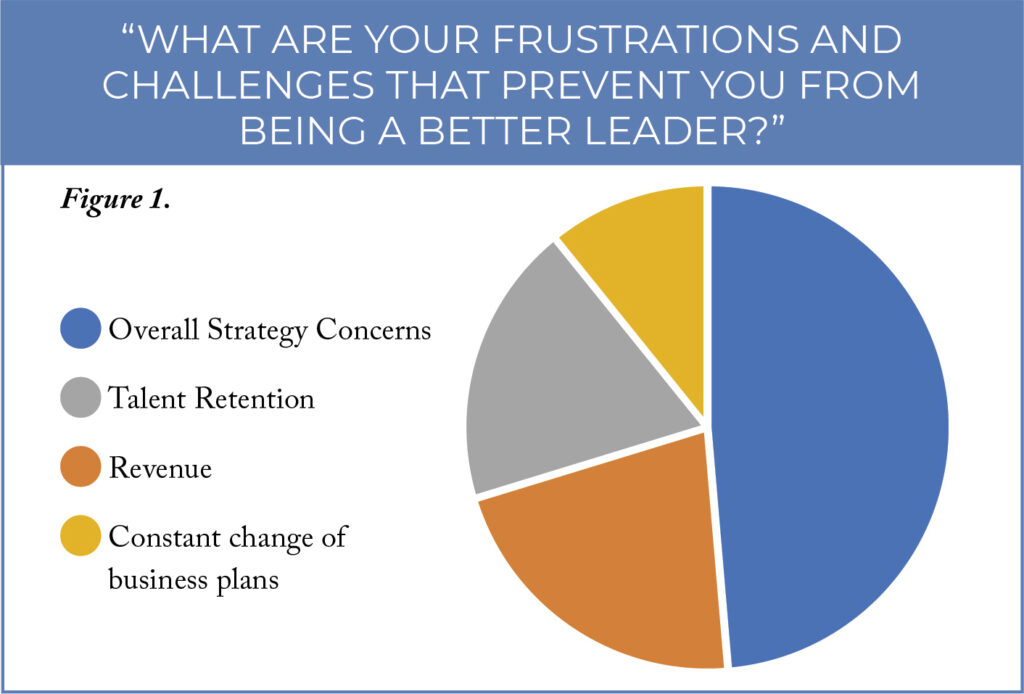
We asked the question: “What are your frustrations and challenges that prevent you from being a better leader?” and it yielded some interesting answers which show the most important friction points during the pandemic. These will likely also affect us all going forwards too. The results can be seen in Fig.1 below.
The fact remains that digital leadership is difficult. A large part of the leadership challenge has always been aligning the company and its stakeholders around a clear vision. However, in the age of virtual meetings such as Google Meet, Zoom, and other online meeting platforms it has become a more significant challenge. In many respects, engaging with teams digitally underpins most of the major frustrations of the CEOs I spoke to – the problem is the loss of those unplanned moments of interaction that are so important to create a sense of momentum and social cohesion behind the leadership team. There’s no office buzz online, and that informal energy is essential to align teams behind the leadership vision.
Another major headache – around 19% of issues – was retaining new talent in an age when many of the new hires hadn’t been able to meet their management and colleagues in person, or participate in any of the usual social, informal onboarding experiences that are a normal expectation of everyday working life. However virtual meetings were noted as providing positive experiences too, in that they also give a safe space where younger professionals can voice their views with confidence.
As one CEO put it, “I miss walking around the floor and connecting with people at all levels. You can’t connect on a human level through virtual meetings, there’s no spontaneity, no chit chat, no watercooler moments. People struggle with burn out, home schooling and not being physically together, you need to find a platform to support innovation because it is lost when people are 100% working from home.”
Also in relation to Figure 1, I found that around 11 per cent of leaders felt that reaction to the pandemic had caused a shift to short-term strategies and away from the big picture plans in place before. There was a sudden need to have a Covid-19 response, and this in turn triggered a slew of new HR policies. 22 per cent blamed the sudden disruption for the loss of normal KPI reporting and measurements, along with the loss of travel and sales activities, for reducing revenues and growth. One leader told me: “You are challenged by balancing staff well-being and HR policies with Return on Investment (ROI) and frustrated because you can’t spend time with clients like you used to.”
NO BOARDROOM BLUES
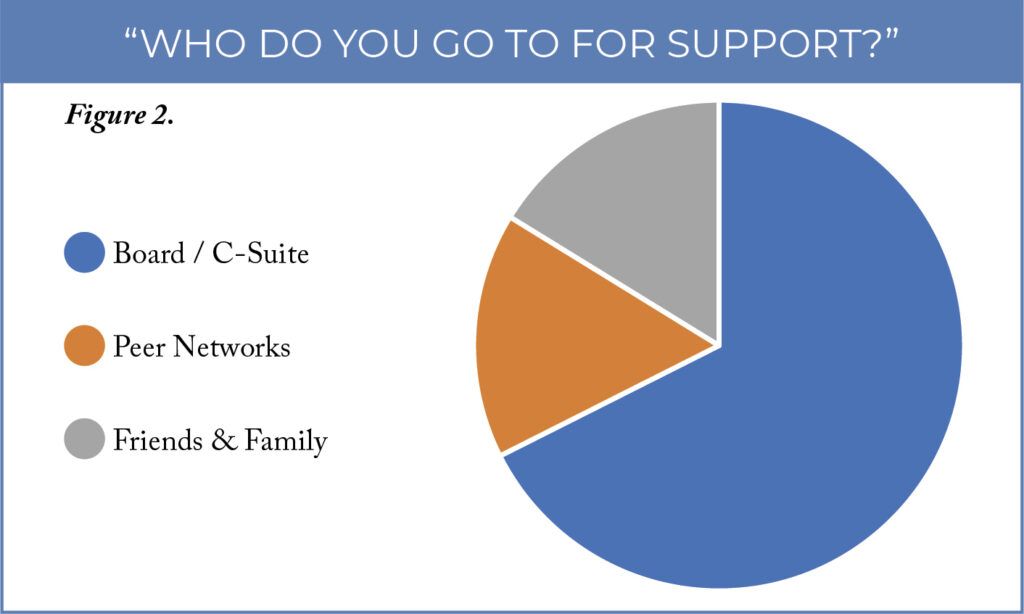
Secondly, I asked CEOs what support mechanisms they had found themselves seeking out during Covid-19. These results are displayed in Figure 2. One interesting – and unexpected – result of the survey was the overwhelmingly positive response to online board meetings. Over 68 per cent of my survey group immediately said their boards, trustees and non-executive directors were providing an extremely high level of support. This was attributable to the pandemic, as another unexpected silver lining, not just in providing support to CEOs, but offering mentorship and support to the organisation at a higher level than ever before. One leader was particularly enthusiastic about the reaction of their board: “Pre-Covid-19, it was challenging to get the board of trustees visible and engaged with the team. Now there’s 100 per cent visibility and presence through online meetings, which means the board has moved closer to employees.”
For those without a traditional board structure to fall back on, there was a fairly even split between two other kinds of support network. Firstly, many leaders sought out colleagues at a similar level who they could talk to about the challenges they were facing off the record. Secondly the role of friends – and in particular, family – in their lives became of increasing importance. In many cases, the opportunity to work from home came hand-in-hand with the chance to make a meaningful change to their work-life balance. Spending more time with the family has proven to be a positive way to recoup lost energy and online meeting fatigue.
The Human Side
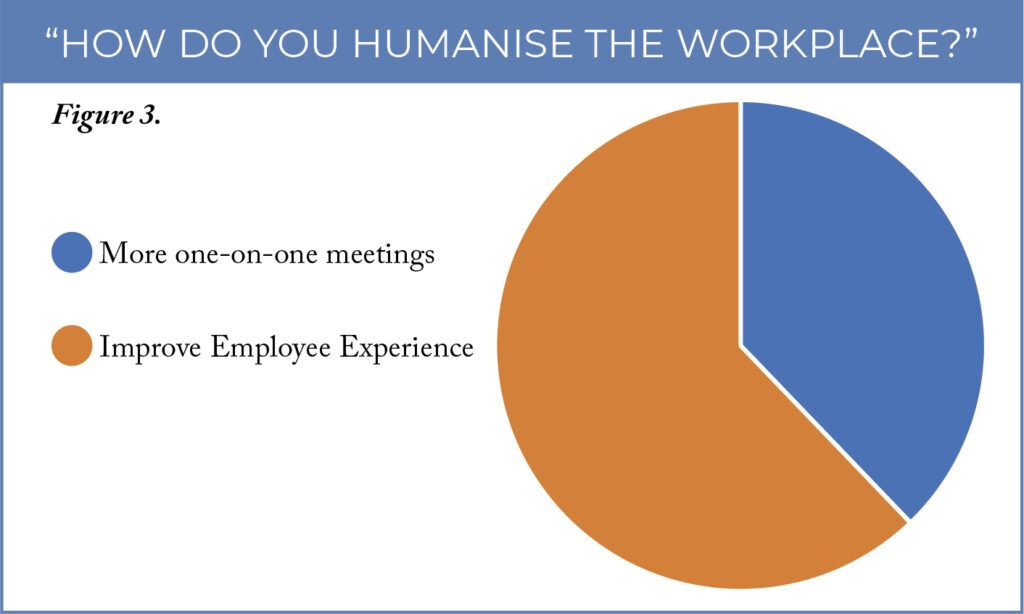
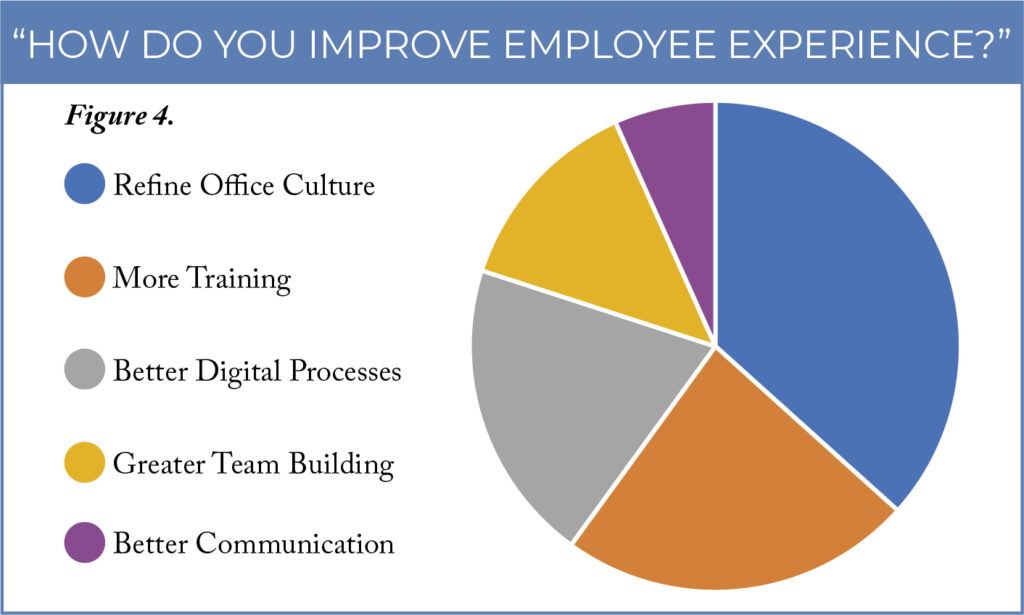
Thirdly I asked what the CEOs in question had done to humanise their workplace. There was a follow-up in the question whereby I also asked what the surveyed individuals had done to improve the employee experience. These results are collected in Figures 3 and 4.
The results were clear. Covid-19 has accelerated the importance of the employee experience. When I asked how to humanise the workplace there was a split between those who felt the emphasis should be on designing a better employee experience (62 per cent) and those who felt that what was required was more effective two-way communication across the traditional company hierarchy (38%).
When I delved into what an elevation of the employee experience might look like to these business leaders, many interesting initiatives were listed. These ranged from holding nutrition and exercise sessions for employees by providing free access to online personal trainers through to ensuring each employee took a scheduled 45-minute mindfulness break daily. A number of workplaces also prioritised in-office working options for people who were feeling lonely or isolated working from home. One CEO confided: “We delivered fresh food hampers, gym kit, games for kids and Amazon vouchers. It was about paying attention to mental and physical needs and connecting with everyone no matter what level.”
Leaders also emphasised the importance of creating a culture of fun within their teams. Many added that this required more organisation in the virtual meeting world, and included everything from introducing fun icebreakers in meetings to organised weekly virtual events. However, the most significant aspect of all the employee experience initiatives was limiting working hours, not sending emails over the weekend and ensuring staff took breaks throughout the day. Another CEO explained: “Burnout is an issue. There’s a temptation to work longer hours, but it’s not all about hours – it’s about your output, and that suffers if you don’t get the balance right.”
In addition, many leaders discussed the importance of making themselves accessible to all levels of staff, including scheduling one-to-one sessions weekly with new recruits to ensure they are settling in. This was especially on the mind of one CEO: “I am very conscious to have regular calls with the team. We have to bring all levels of people closer together and be more approachable and available 24/7.”
The Question of Morale
There are, of course, many different tools available to leaders for improving employee experience. The primary one was focusing on company culture (37 per cent) and trying to build better bonds between team members through the kinds of employee experiences we see outlined above. It is important to note that there are two other broad categories of tool for improving employee experience.
One is Continuing Professional Development (CPD). This is an essential aspect of making sure employees are staying true to their ambitions. This need for training and continuing development for teams represented 23 per cent of answers. As another put it: “Training and development are vital for sustaining a cohesive team and understand how they fit within an organisation.” There is a clear role for training to make employees feel respected and empowered, and many CEOs related this need to team performance. Another said: “Empowered means people who make better decisions more cohesively, without the need for constant supervision.”
In addition, 20 per cent of respondents talked about giving people the space to make their own digital processes, chats, support channels and online activities to boost team morale. 13 per cent suggested that the best employee experience was being on a winning team, and being rewarded as part of a growing business. However, there was a general sense that while digital was essential, automation had a negative effect on team experience because it isolated people during previously social activities like training. Another CEO confided: “We invest billions in making computers more human and making humans more automated. Then we spend billions more trying to humanise humans. Person-to-person contact is impossible to replicate.”
Hinges Off
It is fascinating to look back at the lockdown year and consider how much we have learned about working digitally. It brings new challenges in terms of burnout and a lack of team dynamism. The workplace spark, the spontaneity, the atmosphere of a team environment has not digitised effectively. However, there are clear benefits – and arguably greater long-term gains to come – not least in the way digital working has refocused leaders on authentic communications, a flatter hierarchy and better employee experiences.
It seems fitting to end on a quote from one CEO, who succinctly explained the need for better comms and experiences, as well as the advantages of working together in the same place. These remarks suggesting a new home-work hybrid might offer a renaissance for the modern workplace: “On my first day, I literally took the door to my office off its hinges. I needed to make a statement that everyone is welcome. Everyone deserves time and empathy. It is vital to feel the pulse of the employees, because that’s the pulse of the business.” It is a pleasant thought that, cooped up in our houses as we’ve been, that we might soon inhabit a working world which has become richer as a result of the pandemic.
Todd Swift has spent a lifetime on the front line of literature as a publisher, poet, and writer of film scripts. Here he discusses the future of publishing
If we have learned one thing from the pandemic, it’s that people seek comfort in stories. That these stories are often nowadays told in videogames, or on streaming TV services, or in Tweets and other brief image-based social networks, does not change a fundamental truth – stories arise from story-tellers, and most of those are writers. To extend that logic, most writers ultimately want to see their words published in books. Books, as we know, now evolve into many forms of adapted species, from electronic, to audio, and on to game, film, TV series, meme – and, yes, Halloween costume. JK Rowling may have her detractors, but she still launches a thousand Potters on October 31st.
All these stories, when gathered, and published, one way or the other, are the responsibility of publishers – and publishers need people to work with, and for, them. Apprenticeships, mentorships, and other programmes, are available online and in person, and in the post-vaccine days of the hopefully sunlit uplands to come, the young people of today could well be on the road to a job in publishing in a more socially pleasant future.
This article is meant to be a hopeful, if practical, and very brief guide to what they may face, should expect, and need to do, in order to best prepare for the interview and the potential jobs ahead, from editor, to typesetter, to book designer, to marketing or PR person; and concomitantly, what publishing faces when meeting them.
The only preparation for working in publishing is to read. A recent story in the news about a rock star in his fifties who had never read a book until lockdown, then read dozens, shows it is never too late to acquire the gift of ravenous literacy. But for a young person wanting to work in the book trade, an earlier relationship with them is essential. This may have once sounded elitist; it may well still sound so. But the good news is that libraries and online word hoards like Project Gutenberg make it less difficult for any person to find the great works they need to dive into.
A second skill – and it arises from the art and joy of reading – is writing. No one working in publishing can expect to get far without some ability with gramma and spelling. If you are the sort of GCHQ person who corrects books with a nibbled pencil stub when you read them, you will do well. Again, though, we have moved on from the old days. Enlightened pedagogy means that even people with dyslexia now work in publishing, even in proofreading.
The educational profile for younger people working in publishing has been an issue in the press and wider world of discussion of late. It is probably accurate to say that there was a time when you’d find the Bright Young Things of Bloomsbury beautifully dressed and cleverly down from Oxbridge with a First in Classics.
While this sort of clubbable coterie is ever-present, the truth is that almost all universities in the UK and beyond offer Publishing and Creative Writing degrees, from BAs to PhDs. The best-known course may be UEA in the fens of Norwich, where Ian McEwan famously studied, but it is no longer unique. Further, in the age of LGBTQ, Biden-Harris, BLM and MeToo, publishing houses are in dire need of being yanked, pushed and thrown into the 21st century. While many of the smaller independent presses (like ours) are able to be more flexible, the larger companies, replete with the pale and stale males still wearing their spattered ties from that long Soho lunch with Ian Hamilton in Soho from the 70s, have been less nimble, more oil tankerish. But even they have recently taken on board the calls to arms and hastened to appear desirably open to all.
It may be unfair to characterise young people as being hip to the latest trends, but youth, by definition, can never be late to the party. It should be said that the direction in publishing can only benefit those who have an awareness of TikTok binary identities, ambiguous pronouns, James Baldwin’s resurgence, and Billie Eilish.
On the other hand, we could also do with learning a little wisdom and restraint in publishing. This was seen recently, when junior sub-sub-editors and many up the chain of command refused to work on books by famous actors and writers whose alleged behaviour or opinions differ from their own. To a man in his mid-50s, like myself, freedom of speech means publishing Morrissey, Larkin and Peterson, warts and all, as well as Das Kapital and Mein Kampf. It means having a broad and morally demanding list, capable of accommodating both Richard Dawkins and the latest Archbishop with a laptop and some spare time. Not so for the young of today, the ‘milkshakes’ as I call them. For them, only the just and right-on should be free to speak; the ones who profited from injustice for eons should now step aside.
There is, of course, another curious incident of moral and philosophical disconnection between the generations. That’s the understanding of how capitalism works with regards to literary and commercial enterprises. Since many young people in publishing are left-leaning, their sympathies are not with owners or directors, seeking to maximise profit, though by law, companies in the UK must not intentionally lose money or avoid profit.
The ideal view is that books should be as free from the taint of money as possible – yet the industry they enter is enmeshed in a centuries-old cutthroat market system. Agents and writers seeking sales and royalties complicate the story, for you may often encounter a mild-mannered Marxist poet, or writer’s union official, whose work challenges the structure of Western industry at every stage, yet who demands top dollar for their writing, and wants their books to sell in bookshops and online without discount. Poets, especially, seem torn between wanting readers (and the cheaper the edition, the more readers one gets) versus wanting money.
The fact is the old ways of publishing are being swept away. This is one reason why, despite most bookshops being closed for many months in 2020 and 2021, my smallish press did not collapse at once. Like every other publishing house we have begun already to diversify, and even before the pandemic, were somewhat insulated from the worst of social distancing. Now audiobooks and eBooks represent far more of the sales; print on demand allows for a back list to be digitally available globally without large overhead; and new distribution channels arise to try to compete with Amazon.
It can be tempting to be overly bullish at a time of great depression. False bravado cannot mask the poverty of our cultural moment. As the book becomes a delivery system for preconceived comforting images and tropes, the danger of The Book has been somewhat forgotten. My company supports free speech in the traditional broad church sense. Our motto is: No book is better being burnt than being placed in a library for posterity. Judgement is never really ours; it is temporal. We are dust after we are dancers.
Working at a smaller, independent press has both the disadvantages of working freelance or part-time but also the freedoms and flexibilities that come with it. A quick glance on the Internet will show that even in London the media salary for a junior editor at a large well-known publishing house is often under 22K, and even experienced editors take years to reach above 30K. The financial rewards of a career in publishing are not therefore likely to be magnificent. To work part-time for a small indie press, therefore, means being able to seek other rewards and even study (or train), but it may be nail-biting. But then is not all the world nail-biting, now?
Books have endings. I always advise writers to end their books with an echo of the first sentences of the first chapter. Seamus Heaney would, following Robert Frost, always remove the final poem in a collection, and keep it to start his next. As I write this article, the world is in ferment, but it is potentially transforming itself. Publishing, perhaps, can become enriched by new thinking, new technologies, and new politics. As in so many walks of life, the old will step aside, as the young run past, to see if the bookshop doors are open again, come the end of this pandemic.
Todd Swift is the director of the Black Spring publishing group.
Despite being forced to resign, Boris Johnson still enjoys widespread grassroots support among Conservative Party members, a new survey finds. According to a poll conducted by Folkestone and Hythe Conservative Association on the 14th of July, and seen by Finito World, 49.4% of Grassroots Conservative Party Members would support him if he was on the ballot paper.
Boris Johnson will leave office after the summer and has said he is leaving with his ‘head held high’. This assessment appears to be shared by Conservative affiliates. Here are the numbers in full:
Boris Johnson: 49.4%
Penny Mordaunt 24.4%
Rishi Sunak 10.4%
Liz Truss 6.7%
Suella Braverman 3%
Tom Tugendhat 4.3%
Kemi Badenoch 1.8%
The survey consisted of a data pool of 167 verified responses, and reveals fascinating trends, amounting to an intriguing snapshot of the crucial voters beyond the parliamentary party who will ultimately decide who is the next Prime Minister.
Folkestone & Hythe Conservative Association Chairman, Stephen James, said: “Boris Johnson appears to still have wide support amongst my fellow members and some have even called for Boris Johnson to be added as a third name in the leadership contest. It is often said that the ‘Westminster Bubble’ isn’t a true reflection of the wider country, and this poll seems to support that premise.”
Asked what the key issues are for his members, James added: “Brexit, Furlough, Vaccines, and Ukraine are all issues that Boris can be proud of, and I think many will lament his departure. It will be interesting to see if Boris Johnson will use this support to influence the leadership race or if like his hero, Sir Winston Churchill, he will make a comeback… Boris Act II.”
However, the poll was also further good news for Penny Mordaunt, and further unsettling news for the other camps. In a poll without Boris, the results are as follows, with the former Defence Secretary out in front by an eye-popping margin:
Penny Mordaunt 52.7%
Rishi Sunak 13.9%
Liz Truss 13.9%
Suella Braverman 6.1%
Tom Tugendhat 7.9%
Kemi Badenoch 5.5%
Finito World News Director Christopher Jackson said: “Much can happen still in this race, but this latest poll only confirms that all the momentum at the moment is with Penny Mordaunt. It’s clear that in a crowded field she has managed to cut through among Tory grassroots in a way that none of the other candidates has been able to do.”
Penny Mordaunt MP
The Member of Parliament for Folkestone & Hythe, Damian Collins MP added on Twitter: “Penny Mordaunt is a team player and a leader you can trust. She has a track record of service that will make her an outstanding Prime Minister #PM4PM.”
Due to the lack of digitally skilled employees, the industry is looking for ways to identify candidates who are likely to be good in the tech field. A new study suggests that people with autism, ADHD, and dyslexia are better suited to tech roles than others.
The digital skills company With You With Me (WYWM) conducted a study of 12,000 test results to find out what traits make a person best suited to the tech industry. The study found that people with autism, ADHD, and dyslexia scored 10% higher for tech-based skills than the general population.
WYWM Neurodiversity Lead Jack Desmond explains how this new research could help to solve the digital skills crisis.
“Our research has shown that autistic, dyslexic or ADHD individuals, as well as those with other cognitive differences, can play a key role in solving the digital skills crisis which engulfs the technology industry,” Desmond says, “Neurodivergent individuals are grossly underrepresented when it comes to employment in the UK, and this research shows they possess the necessary aptitude and skills that employers are looking for.”
The research shows that 32% of neurodivergent people scored higher in the spatial awareness category, and 10% scored higher in the digital symbol coding category. Both of these skills translate to engineering, IT, and data analysis careers. Desmond is passionate about the subject, and believes that more must be done to recognise the unique skills of neurodivergent people.
“As an autistic person, I am greatly encouraged to see neurodivergent people recognised for the unique value they bring, but the next step is for widespread training and deployment into key roles within the technology industry where they will make a tangible difference,” Desmond says, “The benefit will be enormous for individuals to be given more opportunities, and for organisations to help solve the digital skills crisis.”
We’re more than halfway through 2022, and the pandemic appears to be behind us. Restrictions have been lifted, and many industries are now getting back on their feet. However, it is clear that there are lingering effects of the pandemic in some sectors, so the training hub School of Marketing set out to find which industries are still struggling.
By analysing ONS data regarding the number of new businesses created and the number of businesses which closed in each sector, both pre and post-pandemic, it is clear that the information and communication industry has taken the biggest hit. Before the pandemic, 92 IT businesses closed for every 100 created. Post-pandemic, 173 IT businesses close for every 100 which open.
This is most likely due to a combination of factors, including the industry’s reliance on overseas consumption, global supply chain disruption, and shipping and delivery bottlenecks.
The second most affected industry is finance and insurance, which saw a 50% increase in the number of businesses closing post-pandemic. Pre-pandemic, about 40 businesses closed for every 100 created. Post-pandemic, that number is up to 72.
CEO of School of Marketing Ritchie Mehta points out that the stagnating number of new businesses makes skilled employees extremely valuable in the post-pandemic market.
“As entrepreneurs look to protect themselves against a harsher business environment, the value of skilled employees has never been higher,” Mehta says, “This data shows how much more difficult it has become to survive as a business since the pandemic. In the two years before the impact of Covid-19 on average more businesses were created than closed each quarter, but now the numbers of company births and deaths are basically equal.”
Across the board, businesses are now closing at a slightly higher rate than they are being created – 101.5 for every 100. Before the pandemic, about 87 businesses closed for every 100 created. It is unknown how long these effects will last, but it is clear that it will take time to reach those much sought after ‘normal’ levels once again.
Patrick Crowder talks to the 21-year-old entrepreneur on how he got his start and what his future holds
Zack Fortag never connected with the traditional education system. He left school at 16 to find his own way in life through entrepreneurial spirit. Now, at 21, he is both a business and charity owner. I spoke with him to find out how he’s made it happen.
“I basically grew up in an entrepreneurial type of family and also an education type of family where some were teachers and some were business people. At around 13-14 years old I started to really dislike school,” Fortag says, “I was always very naughty at school, and I never really got on well with traditional education, so I basically decided to start two different businesses at school.”
One of these businesses was the fairly classic game of selling candy to other students, but the other was much more innovative. The video game FIFA’s online currency, which can be used to buy items in-game, would often fluctuate in price. Fortag saw this opportunity and began selling FIFA coins to other students much in the same way that a stock is traded – buy low, sell high. Fortag says that it wasn’t until he began reading Alan Sugar that he began to branch out into different business ventures which eventually led to the creation of Ahead of Time Academy.
“I did that until about 15 then started reading Alan Sugar’s book, and it basically told me about wholesale goods. I spent 500 pounds on a load of wholesale goods, things from your portable phone chargers, toilet roll, all sorts of different things. I’d wake up at four or 5am doing boot sales all day, and selling door to door at all the big houses. We’d say ‘this is for a school project’ when obviously it wasn’t, which I know is quite bad, but it was just a sales tactic,” Fortag says, “Once I had sold that out, I wanted to help different groups of young people in the education system, so I created a clothing brand called Ahead of Time Academy. We helped over 100 young people get into fashion-based opportunities, and I was the youngest designer to work with ASOS and Pure London Fashion Show.”
Ahead of Time was a way for young people to help develop and sell their business and fashion ideas. Through partnerships with clothing and accessory companies, people whose ideas were not getting seen could be elevated to the big leagues at a young age. It ran for about two and a half years before Fortag had his next big idea; Cozmos hospitality.
“When I was about 17 I wanted to move into the sport space, because I love sport, so I ran a hospitality company, which I still am involved in now. We work with agents all across the world providing sport and travel packages. Now we’ve got over 25 employees and over 500 agents working for us throughout the UK in America,” Fortag says.
During Covid, Ahead of Time Academy led webinars teaching education materials not taught in school, such as entrepreneurship, mental health pathways, and employability. Now Fortag has started a new charity called the Inside Out Clothing Project, which is the UK’s first clothing brand run by ex-offenders. Fortag explains how Alan Sugar led to the connections necessary to make it happen.
“While I was running Ahead of Time I got promoted by Alan Sugar, and through that I got interviews with Forbes, the BBC, and the Guardian. When I got interviewed by BBC, I met a reporter called Greg McKenzie. He was in care growing up, and we discussed ideas, and that’s how we created Inside Out,” Fortag says, “The idea was to get the most vulnerable groups of young people to launch their own businesses. It had never been done before in the UK.”
Now that Inside Out’s eight-week run has come to a close, I asked Fortag about his plans for the future. He answers with quiet, casual confidence.
“Next we’re hopefully going to be moving into another business soon – we’ve just reached 500 agents worldwide working for us which is obviously a massive achievement, probably one of the biggest deals in UK hospitality this year. On the charity side, we’ll just keep progressing. I’ve got some interesting projects coming up.”
Top employment lawyer Louise Lawrence on job contracts
Patrick Crowder
“So you’ve got the job! Congratulations!”
That’s usually where the conversation ends. However, negotiating an employment contract is just as important as nailing the interview, so it’s crucial to know what to look for. Louise Lawrence, who is an employment lawyer at the London-based law firm Winckworth Sherwood LLP, has given some advice on things to watch out for in a new employment contract.
Lawrence says that the first thing to look at is the presence of a probationary period, as the prospect of termination with little notice is something which can jeopardise an employee’s financial security.
“These can have benefits for both parties as if you end up not liking your new role you can move on quickly. However it can also be disenchanting to see that your employment can be terminated on very short notice,” Lawrence says, “Consider asking for the probationary period to be removed or extending the notice period to give you some financial comfort if things do not work out and the business dismisses you during the probationary period.”
Of course, a major concern should be salary. Lawrence says to not be afraid of negotiating a higher number, and to ensure that your salary will be reviewed regularly to combat the rising cost of living.
“Don’t be afraid to ask for more than was originally suggested. With the cost of living going up, also check when your salary will be first reviewed and what the business’s process is in relation to salary reviews,” Lawrence says.
Alongside salary come bonuses, which can take different forms. Sign-on bonuses and performance bonuses should both be examined carefully to find out what exactly the requirements for receiving and keeping them are.
“You may be offered a sign-on bonus as well as performance bonuses. Sign-on bonuses often contain repayment provisions if you leave the business within a certain period so check what these are and whether there is a sliding scale of repayment relating to how long you stay with the business as this would be more reasonable than you having to repay the whole amount no matter how long you have stayed with the business,” Lawrence says, “For performance bonuses find out what criteria you have to meet and obtain as much clarity in writing as possible before you enter into the contract. You may also want to negotiate a guaranteed bonus for the first year while you get up and running at the new business.”
With the talent war raging, benefits are more important than ever, so it is worth knowing what you will be getting in order to make an informed decision about accepting an offer.
“Employers are focussing on what benefits they can offer to employees in the war for talent. Find out what benefits you will be eligible for and in particular whether private medical insurance, critical illness insurance and death-in-service benefits are provided,” Lawrence says.
Flexibility and holiday are two important factors. At the moment, businesses offering remote work may be offering it only temporarily, so this is worth finding out before you sign on. Workers are entitled to 28 days of holiday time, including bank holidays, per year. Any more than that is up to the company, so this is information can be found in your contract. As Lawrence points out, sick pay also has a statutory minimum, so check if your potential employer offers more.
“A number of employers have contractual sick pay arrangements where they agree to pay more than this. Have a think about whether you feel those periods are reasonable and also ideally whether they dovetail with any critical illness cover in case you become ill with a serious condition,” Lawrence says.
If the employment contract mentions other texts, such as a staff handbook or specific policies, you should ask for these documents before you sign. They often cover things like maternity and paternity leave as well as emergency leave policies.
A new job often feels like the beginning of an exciting journey, but most of the time that journey will end at some point, so it is good to be prepared. Lawrence explains the importance of minimum notice periods for both the employer and employee.
“Statutory minimum notice periods are short,” Lawrence says, “These require that after one month’s employment, an employee and employer must give each other one week’s notice. The notice period that an employer has to give then increases by each year of service up to a maximum of 12 weeks’ notice after 12 years’ service. Contracts often include a right for the business to pay a lump sum in lieu of notice. If you feel that the notice provisions are one-sided, ask for them to be made fairer.”
The final point to look out for is any agreement which may limit what you do professionally after leaving the company. If a non-competition agreement is signed without much consideration, it could leave a former employee unable to work in their field if they are fired or choose to leave.
“There could be a non-compete covenant preventing you working from a competitor for a certain period or covenants preventing you from soliciting and dealing with clients for a certain period,” Lawrence says, “There is no requirement in the UK for an employee to have to be paid during the period of the covenants. If you consider the covenants are too onerous, negotiate these covenants before you enter into the contract.”
This may seem like many things to check off the list, but it is important to protect oneself in the world of work. Even though most employers are not likely to have predatory or deceptive conditions in their contracts, it is always worth checking, even if only to see what can be negotiated for. Armed with this knowledge, it is our hope that you will be able to accept job offers with confidence.