Robert Halfonreacts to the government’s decision to make poetry optional at GCSE on the national curriculum
I’ve been asked lately about the Department for Education’s decision to make poetry optional on the national curriculum. I don’t think poetry has as much prominence in parts of our education system as it should – in some ways that’s understandable because of all that’s gone on during Covid-19.
I understand the government’s concerns – that children are being left behind and not learning. I also understand those who worry about the Fourth Industrial Revolution and the predictions that 28 per cent of jobs might be lost to young people by 2030. There’s a natural recognition that the curriculum has to adapt and change.
But what the government doesn’t understand is that poetry and literature are one and the same. In my view, you can’t promote one subject over another: literature is actually just as much about learning poetry as reading books. I hope this is just a temporary thing – though it’s undeniably becoming a more widespread assumption in our society that poetry isn’t seen as important.
“Of course, the Department for Education will say that it’s a temporary measure, and designed to take the strain off pupils, but the danger is that a temporary measure becomes precedent. “
It’s a good time then to remind ourselves of the value of poetry – sometimes it can almost be like a puzzle. You have to think more, and it trains your mind in a very different way. If this changes suddenly became permanent, I think that would be very worrying.
And of course, culture – and I include poetry in this – has an absolutely important role, not just in the economy but in our society. It shapes our lives. It’s not just good for our learning; it’s good for our mental health, and expanding our horizons. We don’t want a society where everyone is Mr Spock.
At the same time I do firmly believe that whatever degree or study people do they should do work experience alongside. If you’re a poet, why wouldn’t you do a placement at the Robert Burns Birthplace Museum? There should be practical work experience alongside the process of expanding your intellect.
The reason I mentioned Robbie Burns is because I had to learn him for a school competition. I have these bad legs and I didn’t lean on anything at that time. I remember standing up and my knee cap would always shake up and down. But I remember learning the first two or three verses of A Red, Red Rose by Robbie Burns – and my kneecaps just shaking in front of the whole school.
I’m sometimes asked if my reading has affected my career in politics. What I read goes into my subconscious. It helps me when I’m writing articles – I may think of things and quote things, or use metaphors. I wouldn’t say it’s necessarily directed me towards change of policy. It infuses my thoughts and permeates like a kind of beautiful stew in cooking for a long time – and it always tastes much nicer on the second or third day of eating it.
But mainly I read to relax – and I’m happy at the moment as I’ve just read some very early stuff from Tolkein – not just TheLord of the Rings and The Hobbit, but also TheUnfinished Tales and The Silmarillion, which his son, Christopher Tolkein gathered together after his father’s death. Tolkein was not just a great author but also a great poet: if you read Beren and Luthien, you’ll see what I mean.
“There’s an unwritten story: the importance of Conservatism in 20th century art”
But if I’m honest I don’t read enough poetry. I tend to read books more than verse. But when I do read it I like it. I particularly like poetry that tells stories and also poetry which rhymes – especially Philip Larkin, though I won’t quote my favourite poem, This Be The Verse, since this is a family publication. He was a Conservative of course, as was my other hero, the painter LS Lowry. That’s an unwritten story – the importance of conservatism in 20th century British art.
And again work was important Lowry actually began doing pictures when he was collecting rents in Manchester. Thinking about it, Lowry and Larkin, working in the library in Hull, might almost be the embodiments of my apprenticeships agenda.
A look back at when Patrick Crowder spoke with Be Military Fit – and even tried a military fitness class himself
To make things clear from the outset, the writer of this article is no paragon of physical fitness. I generally eat what I want, and I spend much more time in the snooker hall than the gym. So when it came to talking to the good people at Be Military Fit, I initially felt intimidated and wondered whether it would be for me.
So first up, what as it? Well, Be Military Fit – or BMF as it’s known – is an outdoor fitness program designed to get people in tip-top shape while building a community of support and encouragement. Two thirds of their fitness instructors are veterans who bring their experience and resilience to the table, encouraging members to push themselves to reach their goals.
It’s also got star power. Survival expert Bear Grylls co-owns BMF, and during the lockdowns he kept the nation moving with livestreamed fitness classes. As a veteran of the SAS, Grylls is proud of the company’s military heritage and regularly engages with members of the BMF community.
Be Military Fit is a success story of the pandemic and now trains around 30,000 members every year
In addition to training around 30,000 members every year, BMF provides training to new army recruits through a partnership with Capita, which handles army recruitment. First, I talk to Ivan Rowlett, who was an officer in the British Army and served in the Parachute Regiment for 12 years before taking his expertise to BMF. He describes for me the way the company’s training programme gives recruits the edge they need to make it through.
“The program we designed for them covers three aspects – mental resilience, performance under pressure, and motivation to train,” he tells me. “The physical component looks at basic conditioning, how to operate via heart rate thresholds, which a lot of these kids aren’t used to, and how to eat to perform.”
Rowlett points out that the mental side of training is just as important as the physical side when dealing with recruits from many different backgrounds: “Often people misunderstand and think the recruits will all be hyper-fit and motivated – but many of them come from tough backgrounds, some from privileged backgrounds, and it’s actually about building that confidence and teaching them how to perform.”
Bear Grylls is proud of the company’s commitment to the welfare of veterans. Photo credit: By Jamie Gray from Englandwww.jamiegrayphotography.co.uk – Bear Grylls, CC BY 2.0, https://commons.wikimedia.org/w/index.php?curid=30276624
This team-building mindset is fostered by the instructors who have formed communities which have been able to survive many obstacles.“We’ve seen very low attrition rates, even throughout Covid, and a lot of that comes from the more intangible qualities the instructors have in terms of how they lead, inspire, and motivate their members. Those human aspects help develop that team ethos which runs through – they don’t just work out together, they socialise together and change their lives,” Rowlett explains.
We’ve seen very low attrition rates, even throughout Covid, and a lot of that comes from the more intangible qualities the instructors have
Ivan rowlett
The success of the programmes has been extraordinary. According to Rowlett, recruits who trained with BMF were 30 per cent more likely to succeed than a control group which did not undergo the training. They perform trial assessments for new recruits and are currently focused on training more women to succeed in army fitness tests.
So how exactly does it work? BMF holds classes in outdoor spaces across the UK, training thousands of people in sometimes adverse conditions – unless it’s a genuine safety concern, they go out no matter the weather. Eager to know more, I talk with Chairman of the company, Chris St. George, who was an officer in the British Army serving with both the Parachute Regiment and the Coldstream Guards. Now he takes his experience to the world of fitness training.
“I think there’s something around the nature of training – it’s around building teams,” St. George says. “When you train together and endure the weather and conditions outdoors, you get something that you don’t get from a conventional gym or fitness business.”
So much of the value of this training comes from the experiences of the instructor. St. George believes that veterans are well-equipped to help others form communities and train to a higher standard: “I believe the veteran skillset is extremely compatible with the workplace,” he continues. “The very dogged mindset, the discipline and training you learn in the military, and also the ability not just to learn but to train and educate others is something which enables former soldiers to be really great employees.”
When you train together and endure the weather and conditions outdoors, you get something that you don’t get from a conventional gym or fitness business.”
CHRIS ST. GEORGE
The company is an impressive employer having secured 3,000 veterans jobs over the years
The scale of the operation is also impressive. BMF has employed over 3,000 veterans over the years, and many of their franchises across the UK are veteran-owned. St. George and Grylls are committed to maintaining a strong military connection with BMF while also recognising the need for expansion.
“BMF is invested into by veterans, owned by veterans, run by veterans, for veterans, so there’s a real community here,” St. George explains. “We have franchisees in the network who’ve done the hard yards in Iraq and Afghanistan, joined us as trainers on a pretty low salary, then a year or two later become managers. A number of them went into franchise, and now you have some members of the network turning over £50,000 a month whereas a year of two ago they were on a salary of £25,000 – £30,000 pounds.”
According to St. George, the key to a successful shift from military life to business is dependent on how veterans are exposed to the intricacies of the industry. “Sometimes the commercial business mindset can be overwhelming for an ex-military guy, but I think if it’s explained in his language and culture by people who understand him he can move very quickly into business.”
You do not have to be a veteran to be a BMF franchise owner or instructor, and they offer training to new instructors to help them understand the firm’s mindset. The company believes that as BMF expands the best results can be achieved by having a healthy mix of veteran and civilian business partners.
The company aims to connect veterans with entrepreneurs and create community spirit
“I’ve been out for just over two and a half years, and I hopefully bring a lot of quality experience to the business, but I’ve still got lots to learn about the commercial world. So I think you want a healthy balance of military and commercial people working together,” St. George adds.
A community mentality is at the centre of BMF’s mission. By using physical fitness as a medium to create strong bonds between members, BMF is much more than just a fitness class. The goal is to improve the lives of members in a holistic way which is not purely physical: “For us, although it is a fitness and training business, the vision was always about improving the lives of the members. The training we do outside is only 50 per cent of it. There’s a huge community where people socialize together, and particularly during Covid, there was an incredible network of support. People would show up online for their fitness sessions to see the same hundred faces they would see in the parks and say ‘Judy, how are you doing?’ ‘John, are you hanging in there?’ so it’s certainly very different to businesses which are only about training. People join BMF as a family.”
BMF has something for everyone. It’s not only for the hardcore, extreme fitness fanatics; it’s a way for people of all fitness levels to come together and improve as a unit. So in spite of my slightly lackadaisical approach to fitness, I couldn’t in good conscience tell readers that anyone can do a BMF fitness class without first trying one for myself.
“Take things at your own pace, stop if you need to,” Graeme said. “We’re not trying to kill you!”
The instructor for the day was Graeme Barr, a funny, charismatic man who immediately put my fears at ease. I introduced myself and told him that I was an absolute beginner.
“Take things at your own pace, stop if you need to,” Graeme said. “We’re not trying to kill you!”
Thankfully I wasn’t the only newcomer there, and the environment was welcoming and encouraging. My breathlessness after the warm-up run, on the other hand, was not so encouraging, but I persevered.
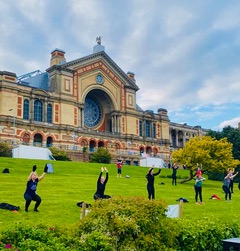
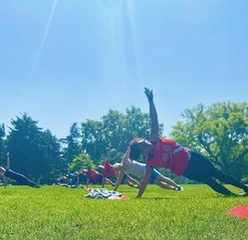
After the first run, we lined up in two files for bodyweight exercises which covered the back, arms, legs, and abs. Graeme demonstrated each exercise clearly – even the ones you might remember from school – and he provided encouragement and advice when we strayed from the path.
To accommodate different levels of fitness, there are three groups: blue, red, and green. We all ran to the same places and performed the same exercises, with more advanced groups having more repetitions or laps to cope with.
Throughout the class, Graeme was conscious of varying abilities, often suggesting substitute exercises when members couldn’t perform a particular one due to previous injuries. He told me of a time when he coached a person with total visual impairment through the same exercise regimen we had just completed, describing each move in detail to accommodate their needs.
During the small amount of down-time between exercises, I had a chance to get to know a few of the members. They were very friendly to us newcomers, and I never detected a hint of ego once during the one-hour session.
Before I knew it, we were doing our cool-down stretches. I had survived. Not only that, but it actually felt good! Granted, some parts were quite difficult, but I never felt that I was being pushed too far outside my comfort zone.
As I nurse my slightly sore legs, I can safely say that anyone who wants to improve their fitness, work on their confidence, or just prove to themselves that they can achieve something should try a trial class with BMF. In fact, I think I’ll go back next week.
Go to www.bemilitaryfit.com.
Check out Patrick Crowder’s piece on the HR industry here
When people hear “pension” it is easy to think immediately of government jobs, however there are a wide range of sectors and positions which can provide financial security in the future.
As the cost of living reaches new heights, many are understandably concerned about planning for the future in a time when it is so difficult to save. Even for young, highly employable people who are many years from retirement, the future can seem daunting, so finding a career which provides employees with a pension is often a high priority. A study conducted by the investing comparison website Investing Reviews has found the best industries to receive a solid pension.
By analysing ONS data, Investing Reviews has found that working in public administration and defence offers the best employer contributions to pensions, with 68% of employers in the sector contributing 20% or more. Education is the second-best sector, with 64% of employers contributing that same amount.
19% of employers in the electricity, gas, steam, and air conditioning supply sector contribute 20% or more to their employees’ pensions, placing this industry third on the list.
Human health and social work are areas which can also lead to a good pension, with 15% of employers contributing 20% or more. Working in water supply is also a good route, with 11% of employers contributing that same amount. Pensions are moving ever higher on the list of employee priorities, and in uncertain times, providing a generous pension is a great way for businesses to attract often scarce talent.
While the arts and entertainment industries are not often thought to come with a pension, 8% of employers in these sectors contribute 20% or more, which is only just below the contributions of the water supply industry.
The study also found that the wholesale and retail trade is the worst industry to work in for a pension, with only 1% of employers offering an at or above 20% contribution.
For people searching for a new job, a pension can be the deciding factor. It is important to remember that solid pensions can be found not only in the first industries that come to mind, but across a wide range of sectors so long as job hunters are willing to seek them out.
The priorities of employees are changing. Find out how you can attract new talent to your business here:
A new study by GoDaddy has revealed that 45% of students leaving school are considering skipping university to become young entrepreneurs.
Why now?
There is no single factor responsible for this shift towards young entrepreneurship. The data shows that it is a combination of rising university fees, higher cost of living, and a desire to find financial freedom following the pandemic which is driving the change.
75% of 16 to 19-year-olds surveyed say that university is too expensive, leading 42% of that group to reconsider higher education. A major factor for 55% of leaving students is financial independence, which is expected following the pandemic which kept many of them at their family homes. The number of small businesses owned by people under 35 has more than doubled since March of 2020.
The Youth Group is an organisation dedicated to helping young people enter the world of work. With 1.7 million members, The Youth Group provides means for businesses and young people to connect with the end goal of employment. CEO Jack Parsons took the path of a young entrepreneur himself, choosing to skip university and start his own business shortly after leaving school. He describes how the rising cost of higher education is leading to more young people choosing to stay out of debt and explore entrepreneurship.
“I work with thousands of young people and am seeing more and more of them choose to start their own business instead of attending university. Starting a business has never been easier, so as higher education becomes more expensive I expect to see this tend continue,” Parsons says, adding that “Running your own business gives you certain skills, such as emotional intelligence, that simply can’t be developed in the same way at university.”
37% of young entrepreneurs not pursuing higher education have already started their own businesses.
Potential challenges
While university is certainly not the guaranteed career path that it used to be, higher education does provide some level of stability. At the very least, it provides young people with something productive to do while they figure out what it is they would like to do in life. Therefore, there will always be some trepidation when considering a different path.
Common concerns for young entrepreneurs are mainly centred around entering their chosen industry rather than long-term issues. 89% cite a perceived lack of experience as a barrier to success. For 48%, fear of failure is what holds them back. As with everything, money is a concern, and 43% believe that lack of capital could mean failure to launch.
Ben Law is the Head of UK and Ireland at GoDaddy. He believes that this shift towards young entrepreneurship shows the next generation’s passion for business and their willingness to explore less traditional routes to success.
“GoDaddy is focused on empowering entrepreneurs and making opportunity more inclusive for all, and it’s inspiring to see a new generation of entrepreneurs explore different routes to success,” Law says, “Gone are the days where a university degree automatically translated to career success and financial independence. Today, young people feel inspired to follow their passion and hone their business skills.”
Need some inspiration? Read the story of young entrepreneur Zack Fortag here:
Over 30 brands have joined the workplace perks platform Lumina Perks, which offers ways for employers to give employees discounts and special offers on sustainable brands.
Amba is the workplace technology provider powering Lumina Perks. CEO Tobin Murphy-Coles explains the variety of perks available through the programme.
“We are thrilled to be welcoming so many exciting, progressive and forward-looking brands to the Lumina Perks marketplace. We’ve signed up sustainable clothing providers, eco-cleaning brands, fitness and nutrition specialists, climate and wellness advocates, pet carers, the list goes on and on,” Murphy-Coles says.
Among other offers, the audio fitness app WithU offers three months free, and 25% off future months for employees with Lumina Perks. Companies from industries such as food, transport, renewable energy, and wellbeing are also onboard.
“Through Lumina Perks, employers of any size can demonstrate their commitment to looking after both their people and the planet in a simple and cost-effective way,” Murphy-Coles says, “The marketplace gives organisations a real recruitment edge in an increasingly crowded job market.”
DAME, which offers sustainable period care products, offers employees 20% off on products through Lumina Perks, continuing their mission to change the female hygienic product industry. Co-founder Alec Mills expresses his excitement about the partnership.
“Amba is a great match for us. We share core values. We are on a mission to make periods positive for people and the planet,” Mills says, “The period industry is full of plastic, chemicals and stigma. It is great to see Amba helping to raise awareness for our cause.”
Sustainability and ethical concerns are becoming increasingly important to employees. In a time when recruitment is difficult at best, platforms like Lumina Perks may give employers the edge they need to attract talent.
Find out more about what employees are looking for from their employers here:
A study conducted by the School of Marketing has analysed ONS data to find the areas of the UK most dominated by a single industry. While it may be easy to assume that more rural areas are entirely dominated by agriculture, for example, the School of Marketing found that even in agriculture-focused areas there are many other jobs available.
Fermanagh and Omagh in Northern Ireland is the district most dominated by a single industry, namely agriculture, fishing, and forestry, however even then only 40% of jobs are in that sector. The Orkney Islands, the Shetland Islands, and Powys are also heavily involved in agriculture, making them the next three locations on the list, though that industry only makes up around 35% of the jobs in those areas. Richie Mehta, CEO of the School of Marketing, commented on the unexpected range of options regardless of where one is located.
“It’s fascinating to see the variety all around in these results, with areas from all around the UK making their way into the list,” Mehta says, “This data shows that some industries really dominate in certain areas of the UK, however that doesn’t mean there’s only one type of job available, as there can be a huge variety of roles within a business sector.”
32% of businesses in Bromsgrove are in business administration and support services, making it fifth on the list. The City of London appears in 9th place, where 31% of business occurs in the professional, scientific, and technical services sector.
Even in the areas with the lowest diversity of roles, one industry never dominates over 40%, leaving many options for job hunters and small business owners alike. Mehta explains how, through the Apprenticeship Levy scheme, the skills gap can be closed and diversity of small business enterprises can be expanded.
“When it comes to skills, there are some common themes that employers are looking for across a range of jobs, however in the current climate, budgets for training are likely to be cut, and the skills gap could widen. SME owners can take advantage of the Apprenticeship Levy scheme to bring in new staff or train current ones in digital and data-led programmes, with the vast majority of the training cost covered by the levy,” Mehta says.
The foreign currency exchange platform Forex Suggest has analysed the senior leadership of the world’s biggest crypto companies to find the most and least gender diverse. Of the 32 top crypto companies, all of the CEOs and founders are men.
The largest crypto company Binance, worth $2 Billion (£1.6 Billion), has a ten member board, three of whom are women. This 30/70 ratio beats the second largest company FTX, which has a board made up of five men and one woman. The third-largest company, NYDIG, has only one woman on an eight-member board.
Forte Labs is the only company with more women on the board than men (five women, four men), followed closely by Chainalysis with six women on a 13-member board.
Of the CEOs and founders, nine were born in the US, and 93% achieved at least a degree
level education. The most common university for top-level crypto CEOs is Harvard with four CEOs, though Oxford and Stanford Universities share second place with three CEOs from each institution.
The most common field of study is, as predicted, economics, with eight CEOs choosing that path. Close behind is computer science, which six CEOs share. In a four-way tie for third, two CEOs studied international business, electrical engineering, physics, or general management.
Research by the Gatsby Foundation shows that 81% of small businesses in England face major recruitment problems. The survey of over 500 small business hiring managers shows that rising costs are the biggest issue for small businesses.
Particularly in industries which require digital skills, talent sourcing is also a problem. 43% believe that sourcing talent is the second biggest problem, behind rising costs, and 55% stated that there is a lack of skilful and knowledgeable candidates.
John Garrido, who serves as Regional Vice President UK for WithYouWithMe, believes upskilling is the answer.
“In the current climate of rising costs and economic instability, the need for digitally proficient people is more urgent than ever to help lead businesses forward,” Garrido says, “The issue does not lie with a lack of available staff, in fact there is a significant untapped pool of skilled individuals who are key to solving the digital skills crisis.”
Training current employees in necessary skills rather than finding new hires can reduce cost and give employees an opportunity to expand their knowledge. Despite this, 86% of SMEs surveyed stated that they are having trouble with upskilling, and that they are failing to attract digital talent.
Jenifer Burden, MBE, who is Director of Programmes at Gatsby, explains that changes in the way skills and education are acquired can make the issue difficult to understand.
“Small businesses are the backbone of our economy and society, but there’s no doubt they’re facing a tough year ahead. As our research shows, one of their major challenges is getting to grips with the education and skills landscape, which has changed and can be complex to understand,” Burden says.
There is evidence to suggest an untapped talent pool in groups which are frequently and unfairly overlooked. WithYouWithMe research suggests that autistic people score around 10% higher than other groups in tech skills. More broadly, 32% of neurodivergent individual score higher in spatial awareness and digital symbol coding which directly translate to careers in tech.
As small businesses struggle to find employees with digital skills, it is now more important than ever to look at training existing employees and hiring people from groups which have historically been overlooked.
Claire Cookson is CEO of the DFN Foundation and DFN Project SEARCH, a charity dedicated to supporting young adults with learning disabilities and autism spectrum condition prepare for the world of work through on-site training.
When I first started my career with special needs, I realised that people are really low aiming for somebody who has a learning disability in terms of their transition to employment. But I was struck by the skills and talents of these young adults, and I just felt really concerned that the world of employment would never know of their skills. For as long as I’ve been doing this, in the UK, the statistics of people with learning disabilities transitioning into paid employment are woeful. Right now, only 5.1% of those with a learning disability or autism who are known to adult services are in paid employment. I was looking at this trajectory for these young children and young adults finishing their time at my school, and I became really concerned about what their adult lives would look like if they were going to live a lifetime on benefits.
When you train to be a teacher there is very little training around supporting people with learning disabilities – it’s a real gap in our training system. So in truth, I didn’t learn a whole lot about how to support people with learning disabilities, or autism spectrum condition. It was actually in a role that I had in a mainstream college, as part of an internal inspection team. I was inspecting a special education department in the area, and just became overwhelmed by the fact that nobody was being hired and nobody was looking at their future, and that’s when I transitioned to work in a special education school. I think that’s where you learn everything about yourself, because suddenly you are working with these people who have faced such unbelievable challenges on a daily basis, more than I’ve ever had to face, yet they still come to school and give you their best day.
The word disability is so negative, and if you look at the skills and qualities of people with autism, for example, often they have really amazing attention to detail and they’re able to follow standard operating procedure to the letter. People with a disability are incredibly solution-focused because they’re constantly finding workarounds. They’re typically in a world that’s not set up for somebody with a learning disability, so they have to find workarounds to fit in. That translates so beautifully into the world of work – where we need to be resilient, and we need to be reactive, and we need to be able to make changes and work with others, and I just became consumed with how incredible they are. When I started partnering with organisations, I realised they were already employing people with different learning styles, with undiagnosed learning disabilities, and undiagnosed autism spectrum condition. It was really enlightening to be able to say to companies, ‘you are already doing this – you are already making great adaptions’.
In terms of value for the businesses who take part, we know that productivity goes up. What we then see is that staff satisfaction goes up. In organisations that partner with us, people feel more proud to work for their organisation. What we also think is that people working within that organisation start to disclose their own hidden disabilities, because suddenly they feel like they work for an organisation that values diversity and that is inclusive, and that wants people to be open and honest and bring their whole self to work. And suddenly, they feel like they’re working for an organisation that demonstrates in real terms, their social values.
Every single young adult who does our programme, they change. They change the way they walk, the way they talk, the way they feel about themselves, and the way they present themselves, because suddenly, some of them for the first time ever, they’re integrated into society, they’re adding real value, they’re developing their skills, and they feel like they’re giving back to their community.
“During my campaign for President I made a commitment that we’d provide student debt relief, and I’m honouring that commitment today,” President Joe Biden announced, in a move which many have waited for since his inauguration day. Alongside the student debt forgiveness, Biden has also extended the pause on federal student loan payments until the end of the year.
Who is eligible?
For a person to qualify for loan forgiveness they must have taken out federal student loans, not private student loans. They must also make under $125,000 (£105,957) per year to qualify for up to $10,000 (£8,476) in student loan forgiveness.
President Biden has made it clear that “No high-income individual or high-income household will benefit from this action. Period.” Despite the restrictions on eligibility, “95% of borrowers can benefit from these actions,” he asserted.
Students from low-income backgrounds who qualified for Federal Pell Grants are eligible to receive up to $20,000 (£16,953) off their student loans.
When Biden talks about receiving “up to” an amount of student loan forgiveness, this does not mean that some students may receive more than others on a case-by-case basis. It simply means that if a student is eligible for the programme but only has, say, $8,000 left to pay off, they will have their loan fully excused and the unused funds ($2,000, or $12,000 in the case of Pell Grant students) will go towards paying off another eligible person’s debt.
What is a Pell Grant?
A Federal Pell Grant is a sum of money offered “only to undergraduate students who display exceptional financial need and have not earned a bachelor’s, graduate, or professional degree” according to the US government’s student aid website. In most cases, unlike loans, Pell Grants never have to be repaid.
The amount of money granted to students in need varies from year to year, but for 2022 through 2023 the maximum award is $6,895 (£5,845).
There are certain circumstances in which Pell Grants must be repaid, which has necessitated the second tier of Biden’s student debt forgiveness plan.
The following circumstances could cause a student to repay all or part of their Pell Grant: If they drop out of the course the grant was awarded for, if their enrolment status has changed (e.g. switching from full to part time), if they receive outside scholarships or grants which are seen to reduce their need, or if they fail to complete the necessary steps to receive a TEACH grant which requires students to maintain academic requirements and serve as a teacher for four years within the eight years following graduation.
Reactions
As expected, some are not happy about the move. Senate Minority Leader Mitch McConnell slammed the programme as “student loan socialism”, calling it “a slap in the face to every family who sacrificed to save for college, every graduate who paid their debt and every American who chose a certain career path or volunteered to serve in our Armed Forces in order to avoid taking on debt”.
Senator Bernie Sanders applauded the move, but wants more steps to be taken in order to ensure that the student debt problem cannot continue. “As someone who’s fought for years to cancel student debt, today’s announcement by the president is an important step forward. But let’s be clear, we’ve got to do more. Education, from pre-school to graduate school, must be a fundamental right for all, not a privilege for the few,” Sanders tweeted.
In a time of rampant inflation, critics are not convinced that the $300 billion plan will earn its money’s worth. Biden pre-empted this criticism in his initial statement.
“When this happens, the whole economy is better off… By resuming student loan payments at the same time as we provide targeted relief, we are taking an economically responsible course. As a consequence, about 50 billion dollars a year will start coming back into the Treasury because of resumption of debt,” Biden said, “Independent experts agree that these actions taken together will provide real benefits for families without meaningful effect on inflation.”