The stature of Kenneth Branagh isn’t in doubt, though I have sometimes heard people prepared to whisper in tiny voices their slight doubts about his acting. For some, this began with his slightly self-indulgent and extraordinarily long turn as Hamlet in 1996. I will always remember his adolescent delivery of the famous line ‘Words, words, words’ with embarrassment.
But Branagh is a particularly complicated figure if you happen to be a fan of David Suchet’s Poirot. It is very hard to think of a better performance in modern television. Given that Suchet only finished the role recently it is evidence of alarming ego that Branagh has recently felt the need to take on the role himself in two bizarre offerings: Murder on the Orient Express (2017) and Death on the Nile (2022). We didn’t need another Poirot at all, but what we got was a bad one to spoil the memory of a marvellous one.
Writer/director Kenneth Branagh on the set of BELFAST, a Focus Features release. Credit: Rob Youngson/Focus Features
Even so, a cultural figure of Branagh’s sway will always attract funding for new films and it must be said it’s very good news that those who provided funding for this didn’t hold his role as the Belgian detective against him. Partly because the film is a tender reckoning with his own past, and partly because he has eschewed vanity by wisely deciding not to be in it, Branagh has rebounded from his Poirot nadir to produce something superb. The film makes you wonder what Branagh might have achieved if he’d only been an author and a director. Perhaps his stature would have been even greater.
All the promotional material for Belfast is in black and white. So it comes as something of a surprise to find that the first shots in the film are in colour.
This is contemporary Belfast, not Belfast as you might have expected from the posters: a collage of shots of a very modern city. These opening scenes are beautifully shot but they make the viewer feel that Belfast today is a city whose optics are like any other. It is a place of neoliberal prosperity, in thrall to the automobile: another weekend destination where might expect our museums and galleries, a zoo, bars and restaurants and so forth. Only once Belfast today is shown, does the film shed colour and then we travel back in time to the August 1969 riots.
It’s a clever but not showy device – a way of establishing at the outset that this isn’t just a story about an Ulster Protestant family – Kenneth Branagh’s family, as it happens – but about a collective people. Belfast aspires to be a tale of historical dimensions. In being a story about a city, it is also a tale about a city’s economy and the way in which our work changes us, and how we change as a community according to economic need.
Caitriona Balfe (left) stars as “Ma” and Jamie Dornan (right) stars as “Pa” in director Sir Kenneth Branagh’s BELFAST, a Focus Features release. Credit : Rob Youngson / Focus Features
Of course, it’s also many things besides. The story is told predominantly through the eyes of Buddy (Jude Hill), whose family includes Ma (Catríona Balfe), Pa (Jamie Dornan), Granny (Judi Dench) and Pop (Ciaran Hinds). The film begins with the harrowing scenes of August 1969: a group of Protestant loyalists attacking the houses of Catholics who live on Buddy’s street.
We are brought straight into the stress and flux of history: this is a film which insists on the instability of life, and celebrates whatever it is we can do to push back against that – primarily, the family and the community. Buddy will grow up then in a world seemingly defined by tribalism, but a world also of incipient globalisation. This is the conflict that makes the film, and with the rise of various nationalism around the world, it is also one of the defining aspects of our current lives. This isn’t one of those films that aspires heavy-handedly to be relevant, but by being true it does speak to the present moment.
The tribal aspect of the Belfast Branagh grew up in is told primarily through the figure of Billy Clanton (Colin Morgan) who turns up menacingly on Buddy’s street to threaten Buddy’s father about his refusal to join in with the persecution of Catholics. “We’re looking to cleanse the community a wee bit,” he says. “You wouldn’t want to be the odd man out in this street. You saw what happened to your neighbours on the other side.” Pa’s refusal to do so is connected to his decency and the sense he has of himself as being a person beyond the clashes of the past. He wishes instead to attach himself to the global economy: he already works in England, but dreams also of far-flung places like Sydney and Vancouver. Ma is a little horrified by this though, and feels she would miss the Belfast they would be leaving behind.
This then is a film about Belfast becoming an unsafe place, one defined by sectarian religious conflict. The story is really a simple one about whether the family should leave or not. As the world knows, Branagh’s destiny was to seek remedy in departure. He became a global star, and I suspect has been to Sydney and Vancouver, and everywhere else many times.
But he is too smart, and has too good a memory of what he left behind, not to leave us with this elegy to the Belfast that was. This Belfast is told primarily through Judi Dench’s wise performance as Granny and Ciaran Hinds’ equally thought-provoking turn as Pop. This was the generation whose destiny it was not to leave the country; it wasn’t always their destiny to go to the cinema in which Branagh would make his career.
The cinema is a repeated theme. Every time a new film arrives in the cinema it is a temptation to give up Belfast and join the future. I suspect the choice of Christian name – Buddy – was chosen as a nod to Buddy Holly, and that whole world of Americana which was already alluring to the Pops of that world.
But what would that globalised world replace, and what did we lose by discarding it? This film tells us, and it can seem like a lot. The Belfast of 1969 was more complicated than ours: the religious conflicts were complex, and still to some extent linked to a far more nuanced reading of the Bible – and of theology and history – than people tend to attempt today. And yet it was also simpler insofar as everybody was closer to nature, and free of the distraction of multiple streaming services and the addiction of the Internet. This in turn meant that an oral family culture was still possible. One day in a street party, Pa shares an Irish joke worth repeating in full:
So the doctor says, “Listen John, I’ve got some bad news and worse.” And John says, “Oh no. What’s the bad news?” And he says, “Well, you’ve only got twenty-four hours to live.” John says: “That’s awful. What could be worse than that?” Doctor says, “Well, I’ve been trying to get hold of you since yesterday.”
It’s a very Irish joke: the sort of thing you hear and repeat, and above all which you hand down to your children for them to tell their children. Our world by comparison looks desperately fragmented and Branagh knows this without wagging his finger at the viewer.
Throughout this film, Dench serves as a disquieting emblem of loss. She silently knits, or watches, or tells the old stories. Her humour feels timeless, tethered to the past. She knows it is her destiny to stay, and also that it is her destiny to be alone.
That’s the case as she is destined to outlive her husband, but also because she must watch the global economy happen to her children and grandchildren without being able to take part in it herself. History is cruel like this.
We never leave the past behind with full confidence and we are never wholly right to do so. We lose something even as we seem to gain so much and it is strongly implied in Branagh’s film that one thing we lose as we enter the modern economy is a true sense of family. The family in the film live on top of one another, always in hearing distance of each other’s doings, and sharing the same outside toilet. This is sort of close family life is no longer likely once wealth has atomised society. And yet in their shared lore, and their links to the deep past, they seem richer somehow.
This richness is shown not only in the film’s depiction of family, but also in what it says about community. Branagh’s Belfast is a more intimate world where children are able to walk around the streets safe in the knowledge that everybody knows who they are. It is a world where surrogate parents who will watch out for the moral condition and the well-being of the children in the neighbourhood. We’re too busy to do that today.
Judi Dench star as “Granny” in director Kenneth Branagh’s BELFAST, a Focus Features release. Credit: Rob Youngson / Focus Features
In such a world, we’re more likely to do what our parents did for a living or what our grandparents did for a living. In our new world, we have more options – in Pa’s words ‘a better chance’ – but we might drift eternally not sure what that ‘better chance’ entails for us. Blessed with talent, Branagh did not experience that, but I think he can see that globalisation was one thing for him and something else for countless others. The decision to leave Belfast wasn’t easy and it still isn’t: in making the film at all, Branagh is no doubt admitting that the past still isn’t clear to him. The film is dedicated to those who left and to those who stayed: Branagh is saying that both decisions are valid.
This is a film which preserves so much that needed to be preserved. I will never forget the wisdom on the face of Judi Dench as she watches the family leave on the bus towards the end, to go to the airport to start their new life.
She knows much about life, but she knows all that from having lived in one street among a small number of people. She will never leave her country. She will not travel all over the world as her grandson will do. She will not win awards, or be feted by crowds. She will not live in large houses with swimming pools. She will not know the inside of an aeroplane. She’ll not log onto a computer. She’ll not have a mobile phone.
She may not do all these things, but she may still be wise. She may be even wiser than we are. That is what this film has to say. It reminds us that shiny newness is often inferior to what we might have come to think of as shabby and outdated. And our choices have a terrible finality about then: we can never go back to what the world was before.
As the film moves towards its head we see again the bright technicolour images of modern Belfast return. We now know that it didn’t have to be this way: but it became this way because millions of people made the same decision as Pa. They wanted a ‘better chance’ for themselves and for their children.
My LinkedIn bio and Masterclass website blurb says…
For 20 years, I have been assisting successful and busy HNW individuals and families as a private assistant.
I represent those who need highly experienced and flexible support – someone to represent them confidently, discretely, and efficiently in all matters relating to their private lives.
To my principal(s), I am a personal Swiss Army knife.
I have been featured in The Financial Times, I am consistently approached for the top PA roles, and I am considered one of the best in the market.
All the while, being part of an industry that is only 4% male.
Sounds pretty good, right? What is doesn’t say it that I fell into the industry by fluke – and that I blagged and bullshitted my way into one of the most high-profile roles in London at one point. It doesn’t say how A/B testing various approaches to things like job applications, CV structure, and interview techniques eventually resulted in success. Nor does it say how personal development and private study led me to some of the winning formulas and ideas that are now part of the one-to-one courses I give to aspiring assistants, 2nd jobbers, and the experienced PA’s and EA’s out there..
Would you like to know how I did it?…. One word: Mindset.
In my first interview as a PA I only asked one question at the end; more for clarity than anything else. “So, you tell me what you want, I go do it, you’re happy and you pay me for doing that. That’s it?!”. It sounded too good to be true. What I didn’t understand back then is that it can be a nightmare on multiple levels for some people. Many people get stuck on the question of: ‘What if’. What if I can do it?! What if I can’t find it?! What if I can’t arrange it?! But to me that was easy-peasy. My mindset was already in a place: I believe there is a way around everything.
In that first job, it was made clear to me by my principal that, “it is not about you, it’s about me”. I made her laugh when I replied, “I grew up in an all-female household, so I’m used to being a second class citizen”. That was partly a joke, but there was also truth to it. I was already accustomed to not being the centre of attention in a house of two older sisters. The mindset was already there. What I had to learn was the actual job.
I should have been fired at least once a month in that job, but I was fortunate that my principal wanted to mould her PA. She wanted it done in her way. Fast forward ten more years and two more principals and I thought I knew it all. I did not. But what I took with me into new roles was the starting point of ‘it’s not about me’. That gave me the chance to study the new Principal and find out how to perform. It wasn’t about my ego and who I was. That would’ve only got in the way. I learned to focus on them and to figure out the rest out as I went.
After 21 years in the sector, I can now be found working for a lovely family and using all of my know-how and every single one of my skills to make sure they have smooth sailing in their lives.
The Job Itself
Wikipedia: A personal assistant, also referred to as personal aide or personal secretary, is a job title describing a person who assists a specific person with their daily business or personal tasks
I agree. That is what a personal assistant does. What it doesn’t tell you is who a personal assistant is, or what makes you succeed or fail as one. It also doesn’t tell you which innate abilities lead to doing the job well, or which character traits translate into being a PA. Finally, it doesn’t tell you what mindset is required to perform at the top level and earn the top money.
What I discovered in just three short phone calls over the course of a weekend at the end of Summer ’21, changed not only my understanding of the sector but what it was most definitely lacking.
ThePAmasterclass.com
I was messaged by three contacts of mine asking for help with various arrangements. These were highly successful people within their respective industries, all with their own assistants. Why on earth did they have to ask me for help? This was especially odd as what they needed in each instance was easily accomplished. Clearly, they didn’t feel their own assistants were capable.
Out of a sense of frustration I jumped onto LinkedIn on the Monday morning and told everyone that I was going to upgrade anyone who wanted it. I would lift the veil, and tell the truth, and hand over all the tips and tricks of my trade, and instil a new way of thinking. I would launch a closed-door Masterclass for 20 people with one of London’s leading personal assistants.
72 hours later I was sold out! This was a surprise. I didn’t have a website, venue, or even talking points. I spent the next week building a shoddy site, putting together a curriculum, and begging for venue space among my contacts.
What I anticipated being a four-hour session turned into eight hours. I thought it would just be listening ears, but the day turned into a deep dive workshop and lengthy Q&A. Each attendee had their own needs and wants. I realised that there was no one-size-fits-all formula for upgrading an executive assistant / personal assistant. That then became the first and last group Masterclass.
I have since moved to one-on-one sessions where I cater to exactly the areas the pupil wishes to focus on or needs the most. I have FaceTime and IRL sessions with self-funding individuals, have been booked by employers wanting a tailor-made session for their existing assistant (minus the ‘job hunting’ part of the curriculum). I have conducted group sessions for a company’s team of assistants with a focus on mindset. I have also become part of an HR onboarding package for new assistants joining the firm; it is a way to iron out any creases and make sure assistants are at their best in their first week.
Whether corporate or private bookings, my intention has stayed the same; to not only provide valuable an abundant content but also the opportunity to benefit from my support and advice after the Masterclass.
The Sector as a Whole
There a two main job titles that ultimately make up the industry.
An Executive Assistant is someone who typically supports in a business capacity in a 9-5 office environment. The role involves diary management, travel arrangements, expense reconciliation, call handling, and some light personal arrangements. It tends to attract those who have an interest in business to some degree and who like structure and a team or office environment.
A Personal Assistant is a broad term but typically revolves around the lifestyle and personal requirements of the principal. No two days are ever the same; just as no two days are ever the same for anyone’s personal life. Social, travel, family, extended family, medical, household, and research and procurement can be just some of the items that feature in the assistant’s day. Those who do well in this role enjoy being of help and have a genuine love of variety.
The support sector is large. According to a longstanding and well-known recruitment agency, 18,000 people are new to the sector each year. The average personal assistant salary in London is £37,134. This is 24.6 per cent more than the average national salary for personal assistant jobs. Personal assistant jobs in London have gone up 37.7 per cent year-on-year as have the job vacancies. As of writing, there are currently 6,236 London personal assistant vacancies.
By comparison, executive assistant salary average is only slightly higher at £38,704. Vacancies in London however have only gone up 1.0 per cent year-on-year. As of writing, there are 1,588 London executive assistant jobs. This would go to suggest that there is a growing demand for personal assistants and that the pandemic affected the number of EA’s required in office spaces. Maybe.
The top executive assistants in London can earn £70,000 pa and a top earning personal assistant can pull £85,000 pa. With longevity and generous employers, these roles can see six-figures when bonuses are factored in.
Who’s Hiring?
With the advent of the remote working Virtual Assistant, even relatively low earners can get business or personal support of some kind. I have seen all walks of life advertise for an assistant. Old money, new money, celebrities (from A-D), foreign wealth, new to London, occasional visitors, relocators, musicians, authors, start-up entrepreneurs, overwhelmed single parents, the list goes on. In general, it is the overwhelmed who seek private support.
The Future of the Sector
10 years ago, before Open Table or Seven Rooms, to get a seat at a top London eatery took connections and savvy. Equally, the reservations desk needed to be diary magicians to fit all the VIPs in. Now, and even more so since the pandemic, these apps are not only the interface for the diner but also for the restaurant. The availability you see, is what they see.
My point? I don’t see a time when the principal will login to something in order to make all the arrangements they need when they can pick up the phone to someone who knows them personally; who knows what they like and how they like it done. Only so much can be done by the principal themselves before the overload happens again.
In short, the assistant isn’t going anywhere. It doesn’t matter who is reading this – if I gave you me for the day, I would be rushed off my feet with all the to-do’s you have in your life. Wealth or success just adds to the list.
What’s next?
I am writing a guidebook based on my sessions of The PA Masterclass. It distils the curriculum into the essential information to help those who are considering the industry or getting back into it after time away. It’s also geared to help the move from 1st to 2nd job.
Unfortunately, I can’t see everyone who requests the Masterclass as I’m in a live role and short on spare time. Also, not everyone can afford the Masterclass but I want to be able to give advice to anyone who needs it in whichever way I can.
Professor Chris Brewster, who teaches International Human Resource Management at Henley Business School, believes that there are no universal truths in Human Resources Management, and that one-size-fits-all solutions are often detrimental in the industry. He specialises in the changing world of work and teaches his students to be versatile. We asked him what he thinks about the leading theories in HRM, and what the key is to managing people successfully.
“I have a friend who says that every new idea that’s ever come up about human resources management he can already find on his bookshelves if he looks at Plato or Aristotle or St. Augustine or Machiavelli. Lots of these guys have said a lot of things much better. And there’s a reason for that, which is that basically people haven’t changed over the last several thousand years,” Brewster says. “And it seems to me that basically, if you treat people properly in the way that you think they would like to be treated, you’ll get a better result than if you treat them just as digits or artefacts.”
A variety of factors can affect the strategy which must be taken when managing people – this can have to do with the country you’re working in, the size of the company, and which sector you’re in. Brewster explains the hierarchy of these differences.
“The most important thing is country. No matter which country you’re in, you have to follow the laws and the expectations of that country, and they vary pretty considerably. The second thing is size. Because obviously, if you’re running a small mom and pop corner shop with three people, you don’t manage it in the same way as if you’ve got 3000 people, that would be pretty crazy. So size actually makes a big difference. And that’s very important because most of what we know from the academics and from the consultancies and so on comes from large, well-funded companies with HR departments and things like that,” Brewster says.
So what’s the outlook for those who study HR at university or at a business school? “Most people who are doing HR courses are probably going to end up in fairly small to medium-sized businesses, so they’re not going to be able to do what they’ve been told the big companies are doing.”
Are there any other distinctions? “Thirdly, of course, there is a difference between managing people in the public sector or the private sector. There’s a difference between managing people in, let’s say, an office cleaning business and managing people in a laboratory. For example, there’s a big thing at the moment about big data and using fantastic algorithms to show where your most and least productive people are. If you’re running a small cafe somewhere, that really is not going to be a help to you, is it? So it’s a case, I think, of getting some kind of perspective on these things.”
Many people are under the impression that human resource managers have a lot of power within a company to make changes and to optimise productivity, but Brewster says that the idea of human resource managers as all powerful is a misconception. Oftentimes, decisions about how to manage people will come down to line managers or other officers, so it is important for human resource managers to not overestimate their power and promise undeliverable items.
“I’ve got some good stories where firms got taken over and the HR director was given a series of promises, and in good faith made these promises to the workforce, and then those promises were just blown out of the water after the merger took place. So I think you’ve got to understand the power situation that you’re in. Human Resource Management departments can be influential departments, but they’re never really going to be powerful departments,” Brewster explains. “The powerful departments are going to be the ones that control the money. There’s a task there for us to think about – how do we influence people? How do we understand what our influence and our power position is? How do we influence people to get a bit more power? There’s a lot of sort of loose talk by consultants about making the HR department more powerful and more strategic and so on.”
Oftentimes, human resources officers are seen as unnecessarily bureaucratic, existing only to protect a company from liability and weed out the unproductive. The views that Murray expressed in his Telegraph piece are an example of an opinion which has floated around about HR for decades. We put this opinion to Brewster, who was keen to point out the difference between human resources and human resource management, and also to highlight the fact that just because a job is sometimes unpleasant does not mean that it is unnecessary.
“Human resource management is used in two ways, and we have a problem because people don’t distinguish those two ways. I would argue that all organisations manage their people: you have to do that. It’s one of the things like managing your markets, your money, and your equipment, that all businesses have to do. But that’s not necessarily the same as the human resource management department. And I think a lot of people fairly casually talk about human resource management, when what they’re actually talking about is what the HR department does, rather than how the business manages its people,” Brewster argues. “And I think that’s one of the concerns – we have to be clear about what the HR department does. And at that level, yes, at universities for example HR departments are very concerned with making sure you’ve filled in the forms. I’m going to New York for a conference in May and I’ve got to fill in all sorts of forms about insurance and about health and safety. And only then can I actually book the flight – and I can’t book the flight myself, I have to book it through the HR department’s system. All of this is designed, of course, to make sure nothing bad happens to me. But it does look a lot like cop work, stopping me doing what I want to do until I’ve filled in all the forms. It’s a necessary task, but it’s not an exciting one, you know?”
Despite the view of HR as bureaucratic and dry, there are many people who want to be human resource managers and are genuinely excited about human resources. We asked Brewster why he has a passion for HR. The industry is much more than filling in forms and ticking boxes – and as he explains, even the duller side of the profession is essential to the function of a business.
“Lots and lots of people aspire to be human resource managers, and I think partly that’s because for a lot of individuals dealing with people is a more attractive option than dealing with numbers or dealing with bits of machinery or whatever. It’s a question of weighing these things up. There are parts of the human resource management function which are genuinely gratifying. I mean, I’ve been involved in things like training and so on myself, when you can actually see people grow in front of you, and that’s really good to do. But there’s a lot of other stuff that has to be done as well. I guess that’s the same for pretty much every job, and it’s about being careful not to oversell one thing at the expense of the other. There are good things and bad things about almost every job,” Brewster says. “These people who say, oh, let’s get rid of the HR department, it’s just a drag – you go ‘well, so who’s going to do those things?’ I mean, you can’t just let people do whatever they want. Firms can’t afford to keep breaking the law, for example, or to keep upsetting trade unions,. Somebody needs to look after that kind of stuff. If there are huge problems at work between individuals, it really helps to have somebody neutral who can actually look at that and deal with the problem.”
Above all, Brewster teaches students how to be adaptable, which is an essential trait in HR considering the wide range of differences in the profession we’ve already discussed. We asked him what his number one piece of advice would be for someone looking to break into the world of HR, and more generally, how to succeed in an ever-changing world.
“Look on everything as a learning opportunity,” Brewster says, “Try and learn as much about the business as you can. Try and learn as much about everybody as you can. Try and learn from your colleagues and your friends. There’s lots and lots of learning opportunities in every job, and the more we think of each job, not so much as an end result, or something we’ve got to plough through, but as a learning opportunity, the better. You’ll get better results both now and in the future.”
George Achebe visits the University Arms in Cambridge and finds a hotel ready to thrive post-pandemic
Whenever I go to Cambridge, I feel as those who didn’t go there tend to do – that I should have done so. The missed privileges amass about ten minutes from the station: here, Watson and Crick cracked DNA; here’s where Milton might have sat, or Marlowe got into a brawl, or Wordsworth had a thought or two; here are the streets where, in his twilight years, Stephen Hawking used to be seen, motoring in his wheelchair, a symbol of what’s possible for the human mind.
It’s a city of ghosts in other words – but clever and consequential ones. The initial impression is that whatever else might be going on the world, Cambridge will continue on its intellectual way, helping us understand the world better. And it does all that while being beautiful.
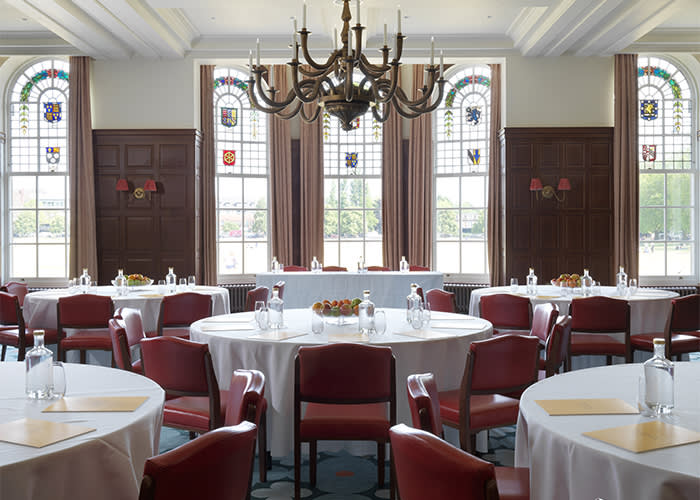
The ballroom at The University Arms. Now a venue for literary lunches.
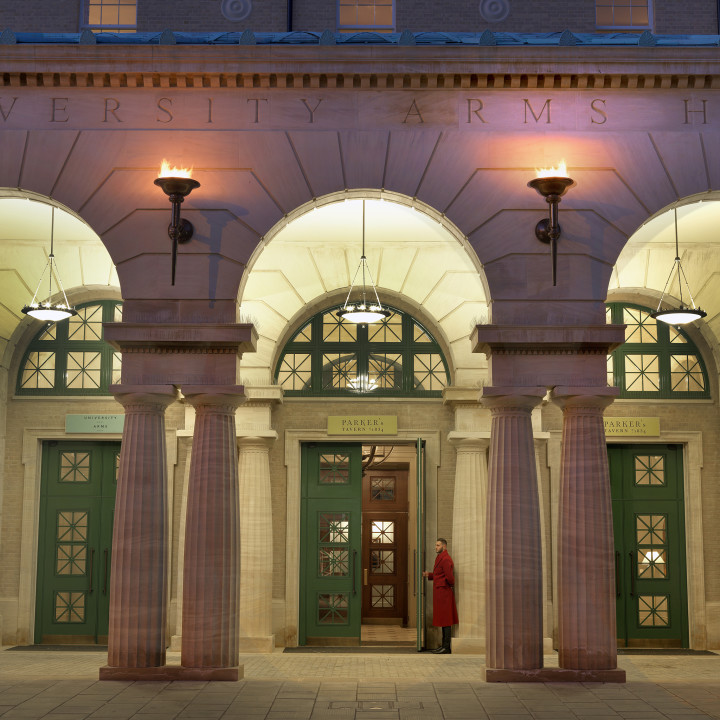
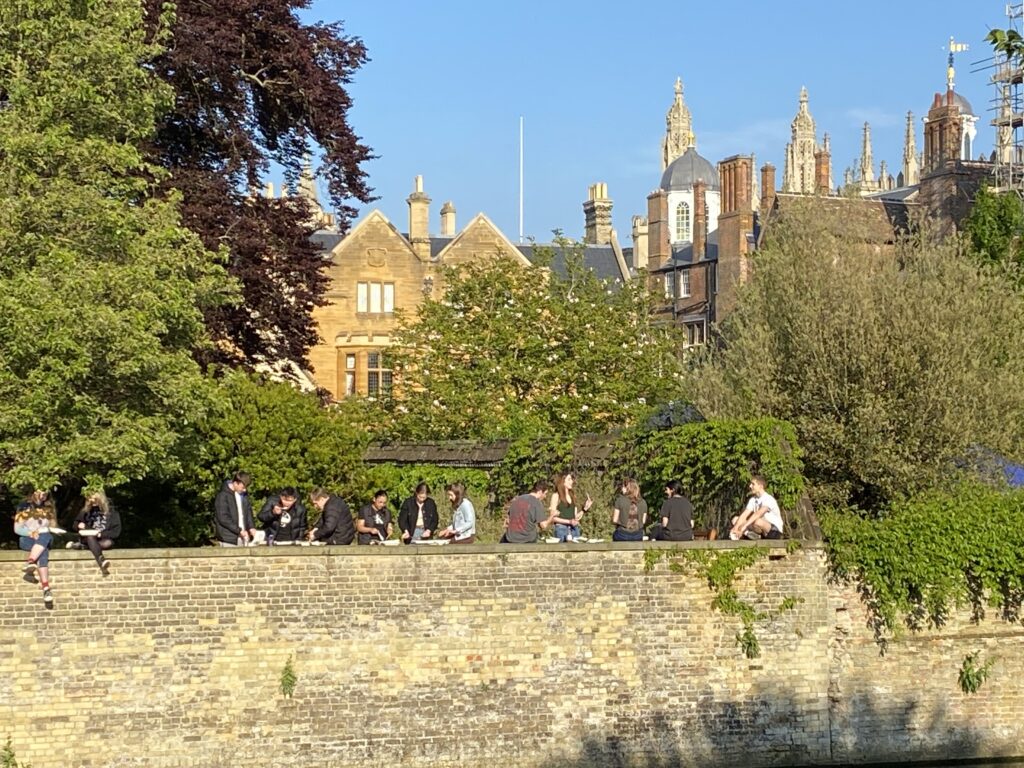
The University Arms has a good claim to be the best hotel in town – a stone’s throw from the Tudor and medieval architecture, and a short walk from the Cam too, where students still punt the summer afternoons away, as if this were an Evelyn Waugh novel. King’s College, with its marvellous ceiling of perpendicular Gothic, would be worth coming here for, even if there was nothing else to see at all.
The hotel has a grand but not oppressive feel. The rooms on the top floor are spacious, and have relevant books by past luminaries. The views over Parker’s Piece show a wedge of grass where students mill and loll, and look reluctant – especially on a gorgeous summer’s day – ever to let any day end. When I return from dinner, I find many hanging on in the dark, peeling away only when the very last light has departed.
Cambridge has made a supreme contribution to world history – and done so while remaining beautiful.
Work-wise, Cambridge is already far more than the satellite of London it used to be; in fact it’s regularly found to be the UK’s fastest growing economy, and benefits from industrial parks which house global leaders in wireless technology, display technology, and mobile telecommunications.
And the city knows it. I attend an interesting dinner and find myself sat next to BBC Cambridge presenter Chris Mann, whose every syllable of talk breathes a love of the area. ‘Everybody here is on TV – a lot of the TV executives either went to the colleges or else they come here in honorary positions of academia,’ he explains.
A case in point is Tristan Welch, who heads the offering at Parker’s Tavern, and who cooks us a mean Spaghetti Bolognese – he is now the beneficiary of various TV deals, although he gives no indication of its having gone to his head. ‘He’s quite famous now, but he’ll be a lot more famous soon when Cooking with the Stars airs,’ Mann explains.
The staff at Parker’s Tavern.
This trend for celebrity continues beyond the walls of the University Arms. When I mention the need to bring home a gift to my family, Mann directs me to Fitzbillies in Cambridge, world famous for its Chelsea buns. Its owners Tim Hayward and Alison Wright are also television personalities. Fitzbillies, founded around 100 years ago, was nearing closure a few years back, when this predicament was tweeted into submission by Stephen Fry, that other Cambridge alumnus. The place stayed open. Today, the buns, soaked in maple syrup, are indeed memorably delicious.
But Cambridge isn’t only about the university. The longer you spend there, the more you sense another life – perhaps a truer – weaving in and out of the streets. It might be an intellectual city and one which is experiencing its own tech boom, but there’s also poverty here, and not a single Conservative councillor on the City council. So that as a visitor, there’s the sense that you’re not seeing the whole story.
Sometimes in Cambridge the visitor has a sense of being barred from the action
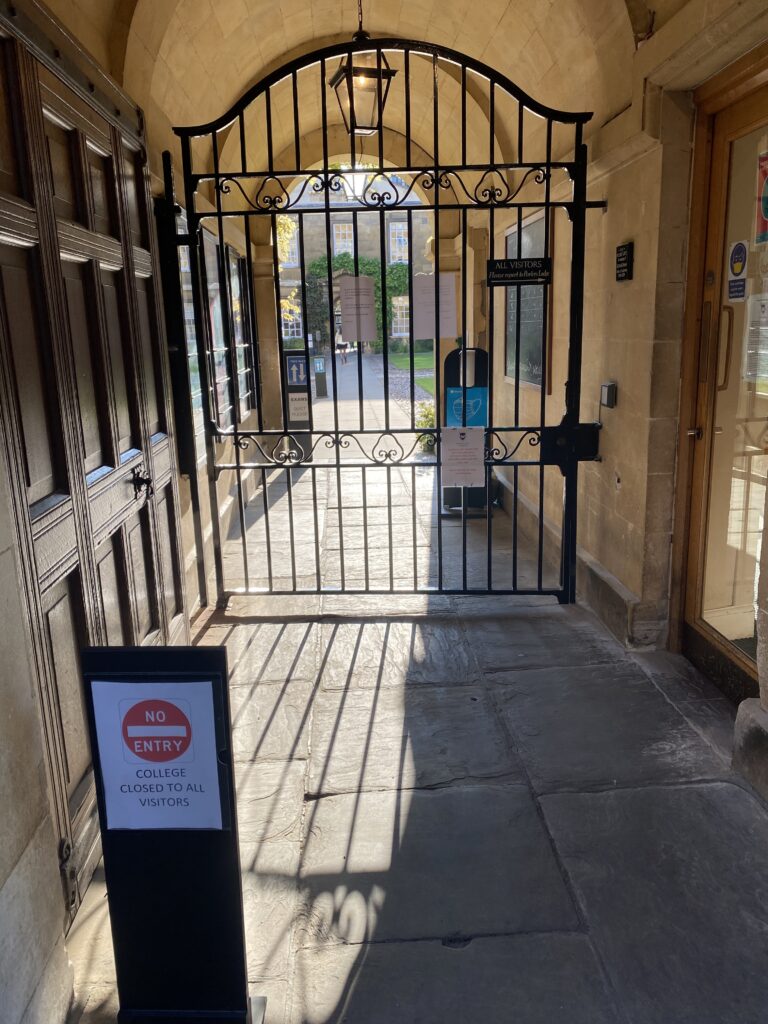
While the university is there, as an energy to be drawn from, it is also continually shutting you out. There is, for instance, an increased number of Do Not Enter signs barring you from the culture of the place; it used to be easier to walk in and see the splendid gardens behind King’s, or Pembroke, always one of the loveliest colleges.
But as a visitor it all feels so forgivable – a feeling which in itself probably perpetuates the inequality. But what Florence is to Italy, Cambridge is to the UK – a place where nostalgia is permitted free rein, and where the mood is aspirational in the highest sense: it makes you want to be a world-historical figure immediately.
It has an astonishing amount for a little town. The art collections at the Fitzwilliam Museum are richer than one expects one has a right to, even here. There’s a renovation taking place in one of the impressionist rooms but still there’s a superb selection of Renoir, Monet, Degas and Cezanne. The Renaissance rooms house Titian, Brueghel and others.
Meanwhile, Kettle’s Yard, the house of Jim Ede, always one of the best art experiences in the world, has renovated itself recently – bringing more jobs with it.
So yes, although the visitor will likely think they should have gone to Cambridge for their degree, there’s considerable solace to be found in the next best thing: going there at all.
I’ve now founded or run seven different companies. Tony Benn called me once his favourite Thatcherite entrepreneur and I’d say to him, “Well, how many Thatcherite entrepreneurs do you know, Tony?” and he said, “Well, you’re the only one.”
I suppose all my companies have worked to one degree or another but I’ve never particularly made any money out of them – but then I never went into them to make money which is maybe a mistake! But then most of them have revolved around books and publishing – and anybody who knows anything about books and publishing knows that it’s not a particularly lucrative area.
But I’ve employed a lot of people over the years. I would like to think that most of them would think I was a good employer, and that I treated people well, and that I paid them decently. You learn a lot from running your own company. I remember when I started the bookshop Politicos in 1996, I don’t think I really comprehended that cash flow is more important than profit at that time. I started off with very little money myself – perhaps around £20,000 to put into from a pay off from a previous company. I raised another £40,000, but it was madness to start a business like that, with essentially no working capital.
I did it for seven years, and it was always on a financial knife edge. I was always thinking about, “Who do I pay now? Who do I put off paying?” There were a couple of times when I nearly came close to not being able to pay the salaries at the end of the month and that really concentrates the mind.
Anybody who employs people knows that you make some wrong decisions. I was saying all this to the managing director of a FTSE 250 company in the late 1990s. I’d just employed somebody as a bookshop manager, and had to get rid of him after about a week because I just knew that he wasn’t up to it and that I’d totally misjudged him from the interviews. He said: “Don’t beat yourself up about it. If I get one in three hires right, then I think I’m doing well.” So that gave me a lot of comfort, actually.
I have had to sack people too. Anybody who thinks that an employer finds that an easy process is deluding themselves. It’s awful. Often it’s happened that I’ve had to get rid of people for different reasons – and it’s probably the main reason I don’t want now to start another company. I don’t want the responsibility of it – and it is a huge responsibility.
When I was running Biteback Publishing, I think at one point we had 20 employees – and that’s the most I’ve ever had at any one time. And I really thought, “If I make one wrong decision here, I put 20 people out of work”. That to me was the biggest responsibility that anyone can have. I left about two and a half years ago now, and I thought I would miss it. In actual fact, I haven’t missed it as much as I thought, and I think I know why. It’s because the responsibility of it all preyed on my mind a lot more than I realised at the time. It’s such a relief not to have to worry about cash flow anymore.
So all in all, I like what I’m doing now, especially the radio broadcasting. I actually don’t enjoy writing; in fact I have a major case of Imposter Syndrome about that. I’ve always been able to talk. If I never appeared on television again, it wouldn’t bother me at all, and as a result I’ve done very few television programmes. Writing for me is really a way of bringing people to the radio programmes. Really I’ve edited about 40 books but only written two. So I’m very lucky to do what I’m doing and I don’t miss my life as a business-owner one bit.
What I remember most is the nerves. These were seasonal and could be reliably prompted by the autumnal drive from Pirbright, where my family lived, to Charterhouse School near Godalming. From the age of 13 to 18, they never fully went away. Even today the September air makes me more alert, even a little nervous.
Boarding school after all is a Darwinian environment, and you never know in any environment whether you’ll sink or swim. And you especially don’t know at a boarding school how things will be for you. This is because you don’t really know who you are yet – and all your contemporaries are trying to find out the same thing.
In education, as we all know, the stakes are perennially high. “It can take a lifetime to climb free of your wrong beginnings,” as the poet Philip Larkin puts it. But these were, to put it mildly, not wrong beginnings: they were very privileged beginnings.
Yet the nerves were there, and I now know they existed for others too. The trepidation natural to youth about going into a potentially hostile situation, was something I shared with the other teenagers who went to Charterhouse, Eton and Harrow and other such places, a wide range of whom I spoke to for this article.
Even if someone found the whole experience utterly traumatic, to an outsider they’d still be privileged and therefore undeserving of the pity they might be due
Even so, there’s a natural sheepishness about the topic. As former Carthusian Charlie Vincent, now a digital planner buyer at Medicacom in Edinburgh, tells me: “In terms of the privilege going hand in hand with the hard times, I feel I can only talk to fellow Carthusians or ex-public school people about it. Even if someone found the whole experience utterly traumatic, to an outsider they’d still be privileged and therefore undeserving of the pity they might be due.”
That Uncertain Feeling
But perhaps this is to race forward and assume that pity should even be in the equation at all.
The fact is that attending a fee-paying school in the UK is tantamount to winning the lottery in terms of your life chances. To confuse our American readers, in the UK, fee-paying schools are confusingly referred to as public schools, though the system is really an aspect of the private market, and not state-funded as the name implies. These schools, though they have scholarship opportunities, are expensive – sometimes beyond contemplation.
The numbers are compelling. Brighton College – an institution noted for its excellent grades and its focus on developing kindness in pupils – is the most expensive at £50,880 a year. This is considerably more than you’d pay at Eton College, which comes in at a comparatively cheap £42,501; Charterhouse, I now discover, is currently a steal at £40,695.
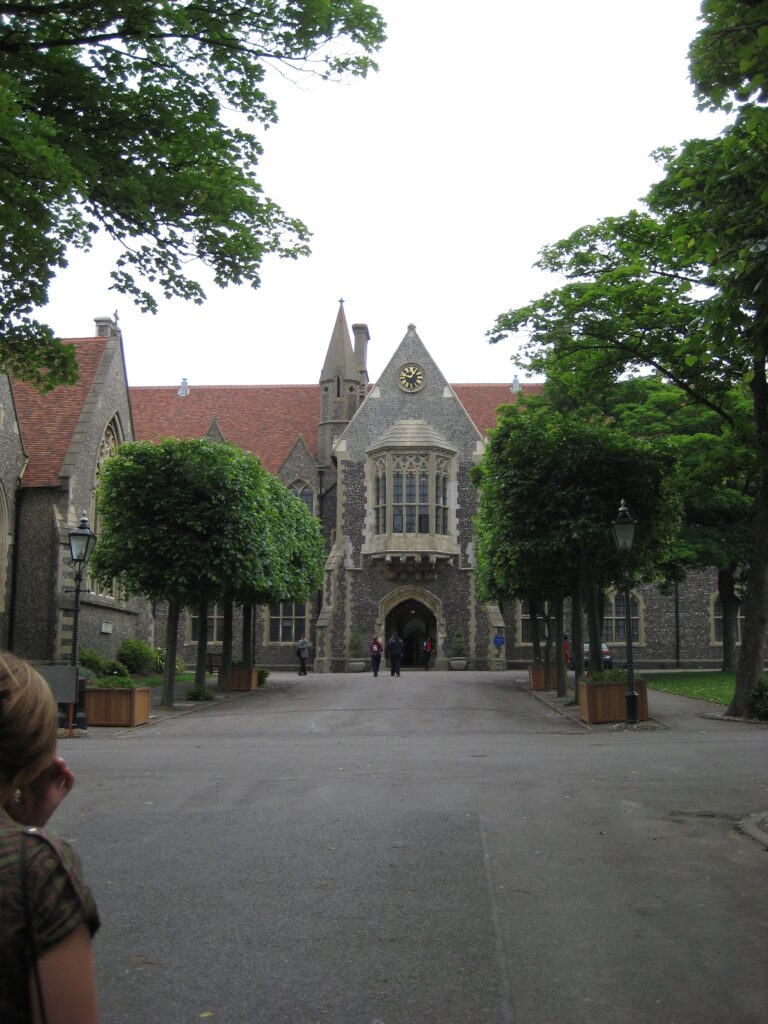
The main building at £50,000 a year Brighton College
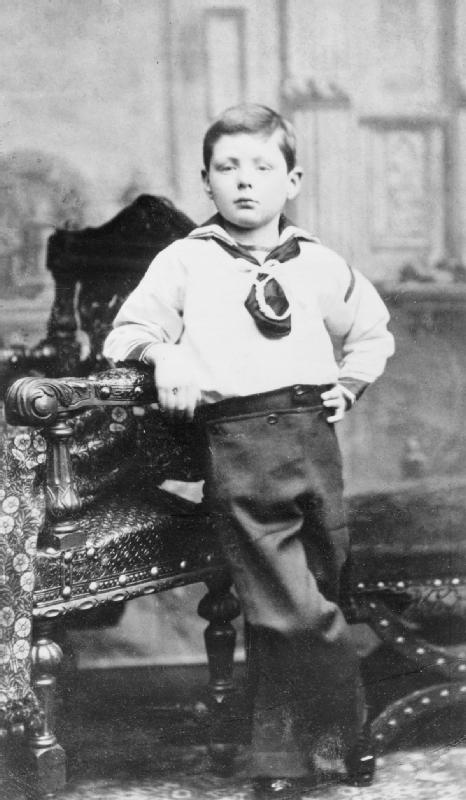
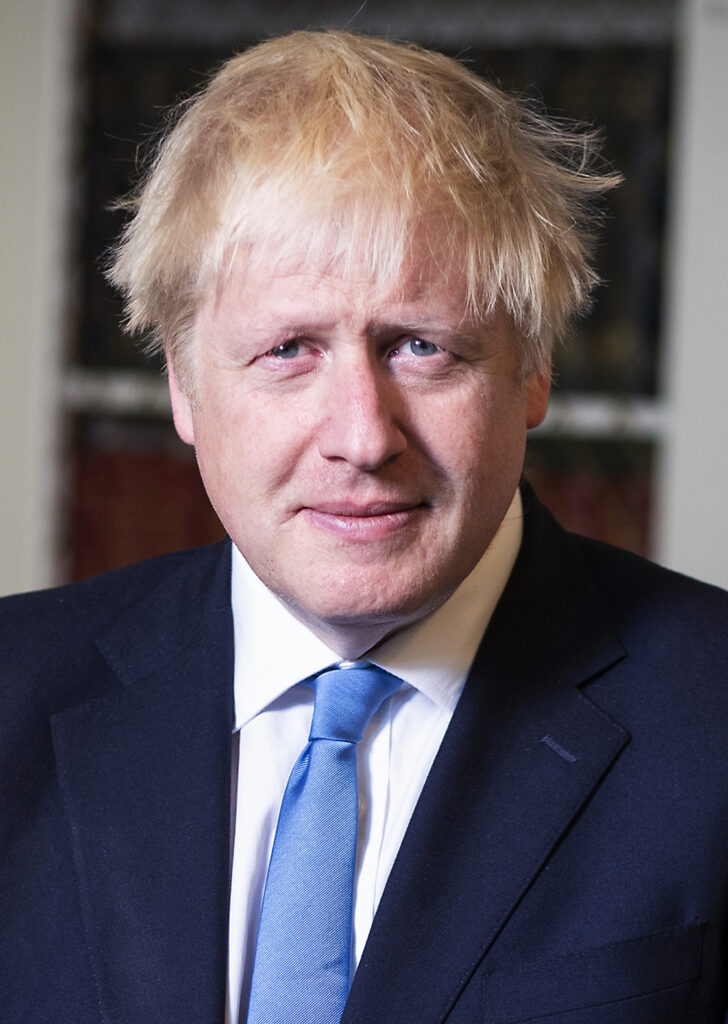
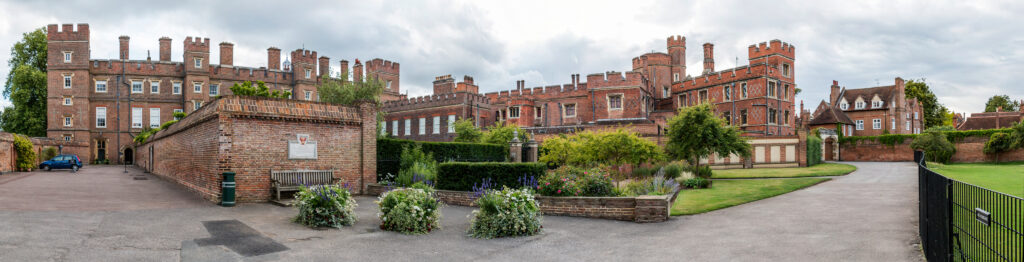
Brighton College has an impressive list of former alumni including Sir John Chilcot, and Academy Award winner Chloé Zhao, but it is Eton and Harrow – and to a lesser extent, Charterhouse – which have tended to produce the names one knows. Eton, of course, produced not only the current prime minister, but 19 others including, Robert Walpole, WE Gladstone and David Cameron. Harrow, as everyone knows, was attended by Sir Winston Churchill. Charterhouse meanwhile produced the Earl of Liverpool, and former Foreign Secretary Jeremy Hunt.
Winston Churchill would attend Harrow SchoolThe Prime Minister Boris Johnson Portrait. Johnson famously attended Eton College. (Photo credit: Ben Shread)
But it wasn’t the names – at least, not at first – which contributed to that anxiety on the road to Godalming. It was instead to do with the look and feel of the place. We stand in the shadows of buildings before we gauge their ghosts.
In Charterhouse’s case, the old Victorian architecture stood at the centre of the school, nestled at the crest of Godalming, like a complex of castles. These old houses had peculiar names such as Gownboys, Saunderites, and Verites and were flanked by sporting fields fit for a Wodehouse Psmith novel. They have proven popular film locations over the years, and featured in The Mystery of Edwin Drood, and even served as the Houses of Parliament in The Bodyguard in 2018. Its effectiveness in that role can be gauged by the fact that I watched the drama series without noticing it was my old school.
To recall those house names gives me a Proustian jolt. It reminds that to attend that school was to be initiated into a private world denoted not only by architecture but also by language. The food shop was the tuck shop – as if henceforth one wouldn’t be eating food but something slightly different, and perhaps more rarefied. The rollcall was called ‘adsum’, suggesting that the school linked itself back beyond its founder Thomas Sutton (1532-1611) to the Roman Empire. And indeed Latin was, in those days, still a staple of the curriculum.
The school was peppered with jargon, which added to one’s sense of the oddity of it all. And it was this sense of the peculiar – something like finding one’s way to Platform 9 ½ at King’s Cross – which gave the experience its validity, but also its capacity to frighten.
It was, above all, a dissonant experience. When I talk to Ned Cazalet, who attended Eton College and left in 1999, he describes the difficulty of his expectations at Eton versus the reality in very strong terms: “The challenge for me was to comprehend, which I never managed quite to do, that this was supposedly a beacon of education, a true world class institution and the fact that there was an astonishing amount of bigotry and parochial thinking. I couldn’t understand how these things could co-exist.”
The Provost’s Garden at Eton College (Photo credit: Martin Kraft)
I wouldn’t say that, arriving at Charterhouse, I was confronted with quite such a black and white scenario – but I know what Cazalet means. Henceforward I had had the best that money could buy and moaning about one’s lot in life would be unseemly. I had become a victor in that most British thing: the class system. But life is such a complicated thing that being a victor in it can itself be complicated – and indeed, perhaps life is at its core so overwhelming that there are really no victors at all.
The Public School ‘Charm’
So what exactly are parents who decide on public school buying – at Eton, Harrow and Charterhouse and a myriad others?
If you look at today’s society, the first thing appears to be: the chance to become prime minister. Or at least, the capacity to run things – to feel that it isn’t incongruous for oneself to be put in charge.
How does this manifest itself? Firstly, in something difficult to define, which might be called bearing or demeanour. This turns out to be different to manners, although it’s true that public schoolboys are often well turned out and, unless they have gone to a strange effort to the contrary, almost always well-spoken.
We all know Boris Johnson’s body language at the despatch box. It seems to say: “I’m not surprised you want me to run the country – the only surprise is you didn’t ask me to do it sooner.” We have seen this before: David Cameron had it; Tony Blair, educated at Fettes, had it too. It is difficult to define, and is in a strange way most understood when it is absent, as it was in the premierships of Theresa May and Gordon Brown. In those instances, when we talk of lack of charisma or star power, it can sometimes seem as if these are euphemisms for not having gone to public school.
And so, of course, if you do go to one of these schools there is an immediate sense of possibility. This was also the case at Charterhouse if you happen to be literary, and know that Robert Graves and William Thackeray attended. But even there, try and write a novel – as many Carthusians do – and you’ll find Graves and Thackeray of little direct assistance.
Charlie Vincent recalls: “None of them meant much to me. I can imagine that I would have felt different going to Eton. So many great actors, so many not-so-great PMs, and a raft of other notables. That would be quite inspiring, I think.”
And indeed over at Eton some former pupils talk of having been inspired. One Etonian I used to know at university, Francis Morris, who has gone on to be a filmmaker, though not a well-known one, always said that having gone to the same school as George Orwell was something he was proud of. This always struck me as slightly incongruous: Orwell, of course, hated his time there.
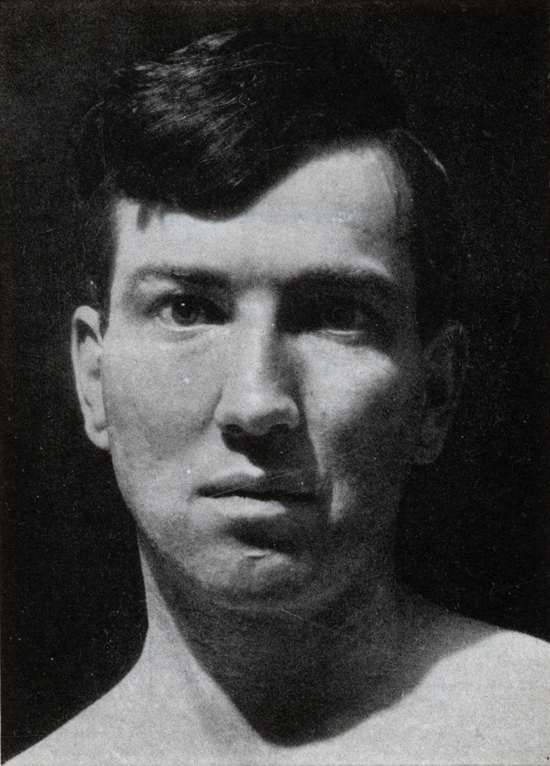
Old Carthusian Robert Graves
Indifference can also crop up on this point. One former pupil, who left Eton in 2003, says: “I have never actually thought about who my favourite Etonian would be….but (after a quick search…) possibly Ranulph Fiennes or Ian Fleming; both creators of fantastic legacies.” Cazalet names Hugh Laurie. Xavier Ballester, who also left in 1998, and is now a Director at the Angel Investment Network, explains that he feels “a mixture of pride and shame. The people running this country are the classic blustering, bluffing Etonian who are so full of confidence rather than talent that they end up screwing up things for everyone. But some Etonians have clearly had an impact on society and the world. Aldous Huxley springs to mind but there are countless others.”
Whether we agree with all this or not, there’s a lot packed in there. There’s this sense of possibility across any discipline you might wish to practice – “countless others” – but also the sense that privilege doesn’t lead to meaning. That you have to find for yourself: and the danger with fee-paying schools is if you ever think that has been paid for in advance. It hasn’t. Life’s burden us still something you have to carry. And if the burden is less than if you’d been less privileged – well, my experience is, try telling that to a 13 year-old.
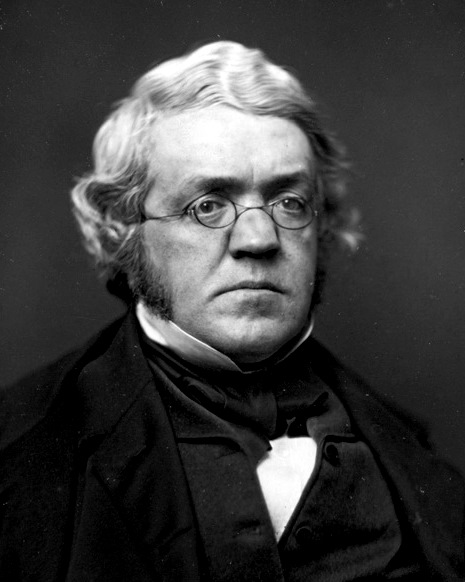
Old Carthusian William Makepeace Thackeray
Absurdity and Tragedy
In retrospect, my time at Charterhouse had a lot to do with real life intruding, sometimes as absurdity, sometimes as tragedy. One episode which qualifies as absurd and in retrospect was handled well by the school involved Paul Rees. Rees was 23 and a modern languages teacher when he came in fourth in 1996 in a now forgotten TV show called Mr Gay UK, and as the tabloids gleefully reported, was patted on the behind by Jason Donovan upon exiting the show.
Once the papers discovered that Rees taught at the “£12,000 a year school” (note the exponential rise in fees these past years) they insisted on his resignation. As I look at the archives, I am heartened by the vigorous reply of the then clerk to the governors, Harry Foot: “Why should he? We employ teachers for their abilities and for their abilities only. What he does in his private life is entirely a matter for him. He is an excellent modern languages teacher and that is all that matters. It wasn’t surprising he was spotted as it was a public TV programme.”
Bravo, Foot. It was an example of how anything that happened at Charterhouse could be deemed to be in the public interest. But then this was just one in a long line of stories. The previous year the married headmaster Peter Hobson had been forced to resign when it emerged that he had been consorting with a 16 year-old call girl who it turned out had gone to the nearby school of Tormead. The incident was discussed on Have I Got News For You. By 2001, when a pleasant physics teacher Nick Tee, announced that he would henceforth be Nicola Tee, and the story was also splashed across the tabloids, it was no longer surprising to find my school in the public domain. Vincent is close to the truth when he says: “Today’s culture wars were playing out at our school in the 1990s.”
Some boys would even leak stories to the papers, hoping to earn a tip fee. There was even a certain pride about knowing that your school was newsworthy – it deepened a sense of being relevant, which a young person might cling to as a bogus source of self-esteem.
But looking back, it was also an aspect of how school doesn’t protect you from reality. Accident, vicissitude, and even death can still intrude. This turned out to be the case in two awful instances, both of which were preventable. One involved a boy in Weekites, Henry Southwell, who was hit by a car crossing the Hurtmore Road on his way back from a game of football at Broom and Lees playing fields; I can find no archives online about this incident, but suspect it occurred in 1996, and recall the driver, an elderly woman, experienced a burst tyre. There is now a bridge named after him, which prevents today’s boys and girls taking the same risk for which he died.
Then in 1998, Nick Stafford, a talented athlete in Daviesites, tragically drowned in the pool during a Navy exercise; he had been trapped under a life raft. It was an unthinkable tragedy, and I have never forgotten the quiet in the chapel at his memorial service when Nick’s parents entered. It was an astonished silence, which told how nobody in that vast, cold chapel would ever satisfactorily compute the absolute nature of grief.
All one wanted to do then – and it is a feeling which hasn’t gone away as the years have amassed – was to reach across to them and undo the event. Ever since I have gone through life – through birthdays, career, friendship, wedding and children – sometimes briefly marking them as things Nick should also have had. But those events have a warning attached to them: never to forget the luck I’ve had. And to remember that Charterhouse was an aspect of that – though that my luck too has been somehow independent of it.
It’s the Facilities, Stupid
For me as a Lockite in one of the rather architecturally unlovely new houses, each day began with a trudge from one side of school to its centre where chapel and lessons would take place.
This meant crossing the green playing-fields to prayer; it was a social occasion, a daily odyssey bound up with the notion of a shared journey.
Since we were the furthest from the centre, as we’d walk along, every fifty or so metres you’d be joined by those who’d have to leave a little later to join you on the walk in. Who you walked in with would shape your day. Some people I bumped into on that walk thirty years ago, I am quite likely to call now if I have a problem, or something to tell.
What was the substance of that friendship? It wasn’t only shared trauma of being away from home so young. It was to do with burgeoning self-confidence, and a sense that we were joined in destiny. There was something else: over time, we got the hang of the place together, learned its mores and how to give them our twist, where rule lay and where it could be stretched, what was mockable and what was sacred, what was true about the place and what was false.
Over time, as friendships accrued, we realised that our homes beyond had similar setups: large gardens if they lived in the countryside; spacious verticality if the background had been urban. One was surrounded by recognisable narratives. My father was a lawyer; and I soon found that other boys often came from professional backgrounds. Nick Bourne, the dentist’s son. Andy Hollingsworth, whose father was a doctor. There was a whiff of the aristocracy, but less so than at Eton. There was Iona Douglas-Home, the granddaughter of a former prime minister, and Richard Dennen, now editor of Tatler, would in time consort with royalty.
Getting to know the place together meant the discovery of humour as a tactic, a mode of survival. One also had to decide on where one sat on the spectrum between lawlessness and obedience. As ever, I pitched myself in the middle, reasoning perhaps that it was the best method of camouflage.
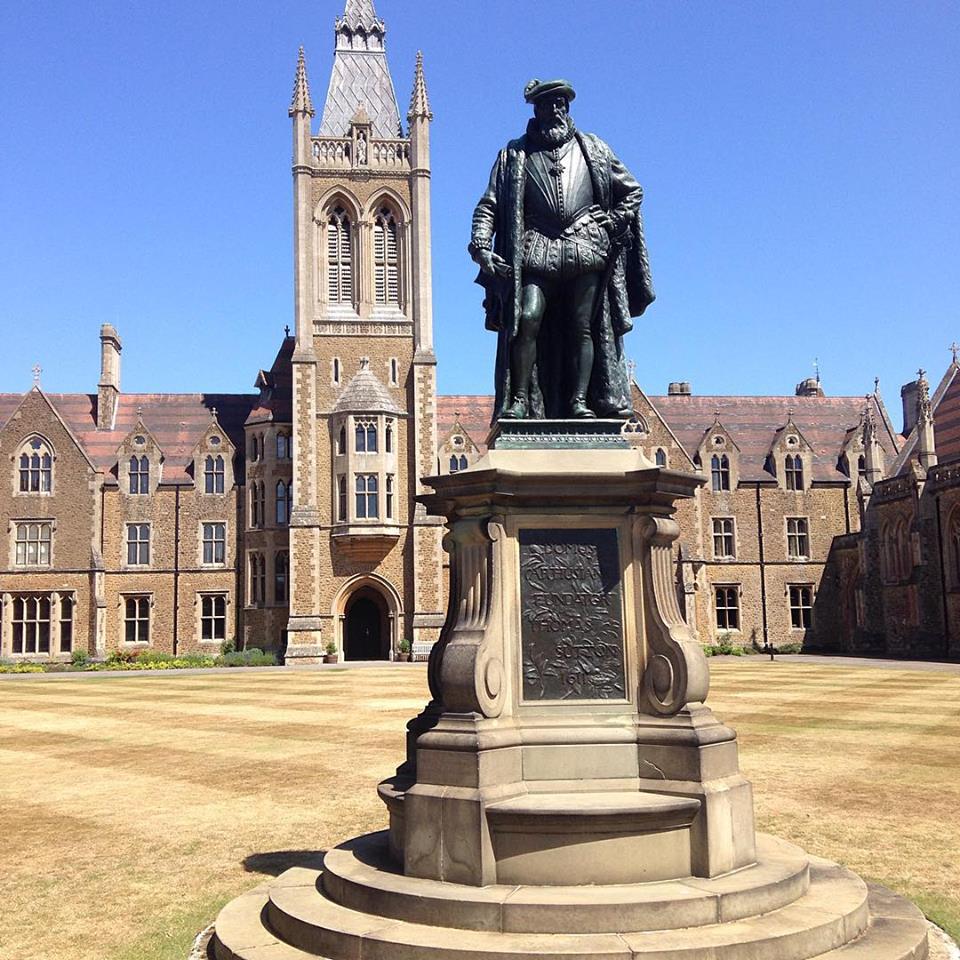
The Thomas Sutton statue at Charterhouse (Photo credit: Grayswood Surrey)
On foggy mornings, we’d run delightedly across the grass, trying to avoid the prefects who were charged with policing an activity which could do no good to the cricket wickets. One of my central memories is the hallooing from other boys within the fog, as your struck for the path, seeking to evade capture and punishment. It strikes me now as a handy metaphor for life at Charterhouse – knowing that there are others with you in the miasma of life, and that life was already enchanted, thrilling, strange, and bit alarming.
A new sports centre opened the year I left, and I remember a favourite pastime was to visit at night and stand illicitly in the cavernous building works: it was an opportunity to wonder at this new development, though we were really too young to consider the privilege, or how it was financed.
There was a certain lilt to the place which didn’t preclude momentum. I don’t think the contingencies of fate – not even Nick Stafford’s terrible death – really made us feel any the less privileged – any the less in charge of our destinies. We had the best that money could buy, and though that couldn’t exclude the complexity of life, it seemed to guard against professional failure, and even against being in some way a person with a limited frame of reference.
Each year, the Ben Travers Theatre would put on plays. A satirical magazine Greyfriars – at one time edited by myself and the excellent and award-winning filmmaker James Kibbey – was tolerated by the school, though its humour could turn towards the acidic, and in retrospect could have done with a severe edit. Rounds of golf would often fill an afternoon, and I remember watching as Andy Hollingsworth, then tipped for greatness as an England cricketer, picked up the game, becoming a scratch golfer in a matter of weeks. Talent was in our midst.
Over at Eton, Ballester confirms the importance of sport: “I was good at sport which helped a lot but some people were sent to Eton and got mercilessly tormented (a northern guy in my year springs to mind).” Another Etonian confirms this: “I was bullied initially until I could hold my own on the sports field and prove my worth so to speak.”
In our own school year, the emphasis on sports meant that some could walk the school corridors as heroes, but to recall them is sometimes to remember F. Scott Fitzgerald’s line in The Great Gatsby that there are no second acts in American lives. Those who prosper at the school – especially at sport – are in reality unlikely to make it into professional sport, and so it’s often the case that the heroes of our youth do not replicate that success in the world at large.
But most of all I recall the humour. Each day dawned and ended with the same goal: to make others laugh. If you did that, you knew you’d be okay. The flipside of this was that if you didn’t, you might not.
How funny we actually were remains open for debate, but life at school could sometimes resemble a Have I Got News For You panel, where your personal prosperity is dependent, even to a tiresome extent, on a quick wit. But this has had its good effects too. Today, my wife tells me she can tell if I receive a text from an old school friend: “You never laugh like that otherwise.”
The Evidence
These are personal reminiscences and though they have been shored up by talking to a range of old school friends, it is important that they be buttressed by evidence as to what a private school education entails in the UK. You can’t just talk to your friends; you need to talk to the professors.
And if you do that the consensus is reasonably clear in spite of the surprisingly limited amount of data: there are certain gains which accrue to your child if you send them to a fee-paying school.
Professor Francis Green is a leading expert on the effect on the labour market of private schools. He explains the scope of his research to me: “The evidence on what private schools do is fairly narrow. Some of the research I’ve done has looked at self-esteem and tracks people who were at school during the 1960s.”
Professor Francis Green is among those arguing for a change to the charitable exemptions enjoyed by fee-paying schools
That means that those who took part in Professor Green’s research are now in their 60s – and of course, public schools have changed a lot during that time. The possibility then is that private schools have prospered precisely because of lack of information about their effectiveness.
But what are the results? Green found that self-esteem was higher in people who went to private schools, but he adds a crucial caveat: “Self-esteem was something they came with. It wasn’t changed by being at these private schools.”
Life’s advantages, then, kick in well before 11-13 when parents first send their children to these schools. Green continues: “Psychologists also talk about something called ‘internal locus of control’. This means the confidence that you’re in control of your life – that the things that happen to you are things you’ve chosen. People with low locus of control assume that everything that happens to them is good or bad luck.”
So when a parent decides to send their child or children to a fee-paying school this is part of what they’re paying for? “If you compare similar people, and one goes to state school and the other private school, you’ll find that private school enhances their locus of control.”
This might seem like a somewhat abstract concept for which to pay £40,000 a year – and sometimes more. But it chimes with me as it’s something which the majority of my Charterhouse friends have.
It also has ramifications in the workplace. Charlie Vincent recalls entering the world of work: “I went into media after plenty of meandering and I was most definitely a minority being a public school person in my first few jobs. It didn’t help me having gone to public school except, maybe, in that my accent and demeanour came across well in meetings and interviews.” In other words, he had internal locus of control. So this was useful? Vincent continues: “I’d say that this could be a benefit… unless you happen across someone who hates public school people, of course. I find that unless you are pompous or arrogant, people don’t hold it against you though. It can work in your favour even with those that might not agree with private education per se, so long as you stick to the good manners and etiquette you picked up.”
Green adds another point: “There are other papers which look at well-being, and by that metric you get a fairly neutral picture. There’s some evidence, for instance, that girls in the 1970s and 80s really suffered but for the most part you don’t find a big difference. The well-being aspect is rather neutral, as far as we know.”
So private schools make you confident but don’t make you happy. This arguably seems to bump up against the scarcity of the available data, in that it’s a pretty safe bet that confident people tend to be happier, as they’re less likely to be knocked by adversity. Green says: “Undoubtedly it is the case that what private schools give you is this locus of control, and it gives you access to networks.”
Social Network
The old boy’s network. This continues to be another argument in favour of sending your child to private school, but equally another hot potato which causes – understandably – a lot of emotion. It is an unthinkable state of affairs, after all, that a small percentage of children should not only be confident enough to succeed, but on top of that access those who have themselves already had those advantages. When you think of it that way, the deck is pretty effectively and anything but enormous success if you have gone to one of these schools, would be deemed a private cataclysm.
But anecdotally, you sometimes here that having gone to a fee-paying school has less benefit than they’d been expecting – and it seems likely that this has to do with the way in which the global economy has changed as a result of the international economy. Certainly, my strongest sense of the world I graduated into in 2001 was of its enormity, and the coolness of its welcome. If I ever thought – and I’m not sure I did – that an old Carthusian would reach down to pluck me from obscurity and install me at the head of something, I was to be in for a shock. The world had changed.
One old Etonian, who left in 2002, feels that having gone to public school has in some ways held him back: “I thought it was a benefit in post University job applications. As I write this today, I am currently out of work and I wonder if the link to school now is a headwind or tailwind as firms are looking to balance out (correctly I might add) the employment roster. I think in certain areas, the school link has been a very strong lever in a career but I would like to think that any good education is rewarded.”
Vincent adds: “I should mention that my career did step up upon meeting another public school guy that hired me. It’s possible though that he would have hired me had I gone to a normal school.”
Xavier Ballester, however, is in no doubt as to the impact: “Getting a scholarship to Eton (a small one – I wasn’t in College with the big scholars I just missed out by a place) had a huge impact. It helped me get into Oxford and with those two on my CV it has given me a lot of confidence although I never pursued a classic city/legal/accounting career so have never really had much use for a CV.”
So paradoxically, while the CV your child gets as a result of a fee-paying education might ideally fit your child for a career in the traditional professions, it also bequeaths the confidence to strike out and be more entrepreneurial.
More Heat than Light
As I write this, I am conscious that I am proceeding with unusual trepidation, aware of the controversial nature of the topic. What gives me constant pause is a thing so bound up in the fabric of this country as to be toxic to discuss: the class system.
And of course, it’s also acquired a new level of controversy after Keir Starmer’s speech on the second day of the Labour Party Conference in October 2021 in which he said: “Labour wants every parent to be able to send their child to a great state school. But improving them to benefit everyone costs money. That’s why we can’t justify continued charitable status for private schools.”
It is a subject which makes many queasy. Lee Elliot Major is the UK’s first social mobility professor and he argues that the debate around private schooling can easily “go round in circles and I’m not sure what impact it can have.” So does he think there is any benefit in closing the tax loopholes which fee-paying schools currently enjoy, as Starmer plans to do if he becomes prime minister? “My view is that we live in a liberal democracy,” he says, “and that you have to allow people freedom to choose. Some of my good friends have chosen to send their children to public school.”
Professor Lee Elliot Major argues that the debate generates ‘more heat than light’
Major is also at pains to point to the complexity of the issue. “If we look at social mobility, the problem is that many people from privileged backgrounds go through the state system and you need to be careful of crude summaries that pit private versus state.”
Major cites the ways in which the social mobility problem of fee-paying schools might be addressed, and discusses Sir Peter Lampl’s idea of an open access scheme, whereby state money is put towards children going to independent schools. “It would be a radical way of reordering education, but I think on balance that it is unlikely to happen politically.” How then do you address the issue of private schools in terms of social mobility?
Major replies: “A more palatable approach is for private schools to form a genuine partnership with the state schools, or lose that charitable tax status.” So what might that entail? Major explains: “It could be things like offering specialist teachers in specialist subjects, or offering your playing fields. Those must be genuine partnerships to warrant charitable tax status.” He pauses. “But I’m being very careful. My worry over these debates is that they generate a lot of heat and very little light.”
Of course, the government is also keen to point out that many independent schools already do have meaningful partnerships with the state sector. A Department for Education spokesperson tells me: “Our world class independent schools’ sector plays a valuable part in our schools’ system and provides economic benefits through the thousands of international students it attracts. The independent sector also plays an important role in state provision with many independent special schools’ places being funded by government.”
The spokesperson continues: “Many charitable independent schools have entered into mutually beneficial partnerships with state-funded schools. The department has a joint understanding with the Independent Schools Council, to encourage the development of partnerships and has funded the Schools Together programme which helps schools from the independent and state-funded sector identify opportunities to work with each other.”
But Major, who is the author of a brilliant book The Good Parent Educator, is particularly keen to point out that if you really want to tackle social mobility you need to acknowledge the complexity of society – even its fluidity. “My view looking purely on the evidence on what works in education in terms of cost effectiveness – to be quite frank, you send them to the good local state school, which presupposes you have a good state school in your neighbourhood and you top it up with good private tutoring on the side.”
Major continues: “But the boundaries aren’t as clear in social mobility terms as people might think. There’s a huge private industry of tutoring. And people forget there’s as much variation in the private schools as in state schools – a point I made to parents in my book. If you’re going to address social mobility issues you have to think about how you level up, though I know that term is bandied about a lot.”
Unsurprisingly, Professor Green disagrees with this – but then his book Engines of Privilege (2019) seems to have been a direct influence on Starmer in bringing up the issue again. “It has had a mixed reaction,” he admits. “The private school sector has been very defensive, and some thought it was fantastic. But most people cannot understand how an institution for the largely rich should have charitable status.”
However, even Green admits that the policy has its limits. “In terms of the numbers, it has to be said it wouldn’t make an enormous amount of difference. There are probably about 550,000 children in private schools in Britain. My best estimate is that if you took away the tax advantages you’d lose about 30 or 40,000 or those as the fees would go up a little bit.”
I say I feel sorry for those hypothetical 30 or 40,000. He replies: “They wold have to go into the state sector, and the government would have to educate those people. As a result some schools would close, and the private schools would scream about it, and it wouldn’t change the system on its own. On the other hand, you’d have a slightly fairer education system as there wouldn’t be so many people in that privileged position.”
Ending Up
So what did it all amount to – being in that privileged position? Well, there appears to be – so far, at least – little fame in my year at school. Clement Power, who had won a scholarship, had significant success as a musician, becoming assistant conductor in Paris to Ensemble Intercontemporain; Richard Dennen would go on to edit Tatler.
A random google assures me that others have won top positions at law firms and accountancy firms, ensuring that they have no financial worries I can imagine, especially after having come from families wealthy enough to have been able to afford Charterhouse in the first place.
But for the most part me and my friends have had normal lives – with all the small blessings and frustrations which one associates with that. Careers haven’t fallen out of the skies readymade, they’ve had to be worked for. In my own instance, no book has written itself, each had to be toiled over, written and rewritten, without any help from the ghost of Thackeray. I don’t particularly ascribe my failures or my successes to Charterhouse, though that can’t be quite right because life would surely have been different in a myriad ways had I not gone there. Again, there is insufficient data on the whole question: the confusions of my own life, its causes and effects, are probably a microcosm of the strangeness of the whole debate.
On the other hand, a room has never been a particularly stressful thing to enter, and I suppose if I’m honest I never entered any of them with a chip on my shoulder about having gone to public school or having not done so. The question was removed, and perhaps was removed quietly during all those anxious drives from Pirbright to Godalming all those years ago.
A friend of mine, who can afford to send his kids to private school says: “The reason I’d send my son to private school is because he’ll have a chip on his shoulder if I don’t.”
There’s truth in that, but it’s not the whole truth. As the state sector improves – and it has undoubtedly done so – then there is the increasing realisation that there’s no reason why self-confidence – or internal locus of control, if you prefer – should be something you can only have if you went to public school. Major says: “I still think there will be very self-confident people that come through leading state schools who have also come from a supportive or elite background.”
Major’s point is that society is not straightforward, and getting less and less so. The problem with this whole debate – and with Starmer’s wading into it – is that it can sometimes make it seem as though it is.
Even now, the fact is that many state school people have confidence, and go on to great things; many public school people end up having sad lives, and they are not less sad because they began in privilege. The danger with this debate is that it removes our empathy – and it does it towards the young who really do deserve that.
Youth and adolescence are very hard. The world will remain strange to us until the day we die, but it is never more frightening than when our personalities aren’t fixed, our skins not yet thick, our stance on the earth as yet unestablished.
The world is changing fast – that fee increase from £12,000 to £40,000 means that the middle class are often priced out of private education, and that those who can afford it are likely to attend the playing-fields of Eton alongside a new international elite. So in the end it wasn’t any Starmer-esque shifts to tax policy that changed things, it was really the international economy, whereby the global superrich, hearing that the English education system was the best in the world, came here, ousting some of the middle classes – perhaps my children among them.
My sense is that that will probably do no real harm to the private school system, although it may make them a less uniquely English experience. If the aristocracy can afford these places, their children will be playing lacrosse at Marlborough or Fives at Eton alongside the children of Chinese and Indian billionaires. Perhaps they’ll be the better for it.
And I don’t think it’ll necessarily bad for the state system either, if children whose parents have had the benefits of fee-paying schools create a more layered and complex society – that is, one without such a clear class divide.
To finish, there is a story of an old contemporary of mine who after leaving school secured a job in the banking sector, which he attended for a while during which time he was living at home with his parents. He began suffering mental health problems. He lost his job. He couldn’t bring himself to tell anyone – least of all his parents. Out of pride, he kept getting up in the morning and going into the City just as if he had never lost his job. He did this for years.
It is, on the one hand, a very public story. Other families would notice the lack of money; perhaps other parents would guess at a problem in their son and investigate. There is a preoccupation, even a coldness, which is specific to a certain kind of wealthy English family.
But it is also a human story, even in its skeleton form as I have told it, full of an individuality which gives it such a specific tragicomedy. It reminds me what is missing in this debate: that sense that every child matters, because every child has a role to play in the future – or should have. It is only by talking about these anxieties and these structural injustices from every angle that we move forward – that we climb free, as Larkin has it, of those wrong beginnings which in some measure we all share.
While perusing the internet or relaxing on the sofa diving into our favourite series, we mentally prepare our scripts for the water-cooler the next day. Cinematography, story, acting, lighting, the good bits, and the bad bits. It’s all there to be dissected. Unfortunately, Hollywood’s younger brother, adverts, do not get the same treatment despite often requiring the same amount of creative ingenuity.
I had the pleasure of speaking with Nathan Haines, managing director of element26.tv, a creative agency specialising in all aspects of short form film making, describing themselves as “on a mission to empower ambitious direct-to-consumer brands”. It is a section of the filmmaking industry that often gets overlooked as it lacks the glamour of its long-form counterpart, instead working silently in the background. Following our conversation however, it is clear that it is something any aspiring filmmaker should consider if they are looking to break into the industry.
Haines makes it clear that the business of short-form filmmaking shares many similarities with its long-form counterpart. e26.tv itself was born out of necessity to distinguish the short-form work of its parent company, Iron Box Films, and establish a medium for those focusing on corporate advertising or post-production.
Many of the elements that are often associated with long-form and feature films are present when making short films, such as the need for clear direction, but there’s one thing above all which unites the genres: the importance of telling a good story. Haines tells me: “For successful filmmaking, it’s vital to understand that it’s a visual medium – so trying to maximise this aspect of filmmaking is essential. With this you can convey a story with emotional attachment which engages with your audience”.
In both forms, the story remains integral but it is audience perception which changes depending on the medium. Haines continues: “In either case, an arc is important because an arc is how a narrative is shaped to create meaning. Ultimately this is usually informed by how long the film is”.
He added that the difference between long-form and short form was that one was a “sit back experience compared to the sit forward experience of our computer screens”. What appears to separate short-form film-making from its long-form counterpart is the restricted time frame of the former. But as the internet and broadcast television continue to converge and overlap, the most successful ads are those that seamlessly transcend the two platforms within these restrictions.
There has become a greater expectation for more professional, polished adverts on the internet, which has in turn required greater investment in their production. The creators of short films must tell their stories under time restrictions, with little dialogue, and make sure their story is relatable to by audiences. “It is a visual art, one that relates more to your subconscious rather than directly telling the viewer as to what is happening,” Haines explains.
But don’t be fooled that a shorter run time means a miniscule production time. Nathan described production at element26.tv, which could last up to four months with script agreement potentially taking up to six weeks.
Here lies element26.tv’s speciality, the creative back-end that shapes the rest of the production. It is the internal team fronted by Tom Lonergan and Louis Tsamadosthat who guide development before hiring the right talent for production. Nathan highlighted the importance of creative development which “has the benefit of aligning everyone to a creative vision”, and laying the groundwork for pre-production with the aim of “marrying the creative with the logistical”.
This does not, however, mean there’s a formula. Each film differs depending on its needs and this is clearly demonstrated in the variety that can be found within their portfolio. For instance the firm specialises in both live film and animation, which Nathan characterises as being like ‘apples and oranges’.
Though there may be a misconception that the filming process of both are similar, stricter structure is needed in the creation of an animation due to its time consuming nature of revisions. Where one can be re-shot immediately, the other requires time to reevaluate and redo. But regardless, it is a demonstration that short-form filmmaking is not a creative pursuit made redundant to only infomercials and informative corporate advertisements. Instead it is a pursuit that allows creativity to flourish.
Take for example the firm’s advert undertaken on behalf of ProCook. The film begins with a shot of a blade made of Damascus steel, the finest of metalwork, effortlessly slicing into a tomato. A chromed sieve shines against a black background then cuts to crisp lettuce being laundered. A sizzling skillet then cooks a chicken breast till golden, an image which is followed by an explosion of fillings.
A light dressing is then drizzled on top, all culminating in a regular Joe gleefully looking upon his creation: a humble sandwich. Everything has suggested that we were in the presence of a professional chef, instead we’re greeted by a regular guy in his kitchen. It has played with our sensibilities and built up our expectations but as the ProCook logo appears the message is clear. Even in making a sandwich you can expect the highest of standards to elevate your meal.
So what would Haines’s advice be to budding filmmakers? Haines is clear: “Be persistent, build a tribe, go create. Do not be discouraged by your lack of equipment, use what is on hand. So long as the story is convincing and the content engaging, you will find an audience. Making something will allow you to demonstrate any talents you do have and prove a dedication to the craft. Go and capture the imagination of your audience and get filming. It is the most beneficial thing you can do to start.”
Element 26 encourages those with an interest in collaboration, business or for guidance to get in touch. Currently element26.tv are working with AdSmart by Sky to bring a number of brands onto the platform. In January element26.tv and Sky will be running an event on the topic of getting brands onto TV, so keep your eyes peeled for updates.
And the future? Haines is excited to put the pandemic in the rearview mirror and firmly and when asked about element26.tv future he said they were, “striving to help more brands to reach their audience across a range of digital channels from TV to online and Out of The Home”.
“I’ve always tried to move on when I feel like either I’m not growing and developing, or the environment or culture is not right – rather than waiting so long that I get frustrated and angry with the business that I work for and potentially make the wrong decision”.
These are words from the mouth of Joe Hildebrand, European Leadership & Culture Lead at Accenture. These words tend to characterise a person who has what one might call a “model career” with an impressive flow of creating impact across organisations. I wanted to find out the secret of Hildebrand’s “early career” success in consultancy and leadership and he kindly agreed to engage me from his home in North London. As a modest and quietly-spoken individual, his comments were all well-considered and purposeful, and full of common sense.
Hildebrand graduated from the University of Leeds in 2005, established his career at Accenture and Deloitte, then moved client side to BT, where he eventually became a department head. He then joined “?What If!” Innovation becoming a Director, seeing it grow in stature sufficient to become the attractive proposition which Accenture wanted to (and did indeed) buy.
So to what does Hildebrand attribute his success to date? He states that the thread throughout his career was having “real clarity on the type of work I want to do, the expertise that I wanted to build and develop, and the kind of things that I wanted to do day to day with clients”.
Hildebrand knew early on that the leadership culture and organisational psychology space was a fascination for him and that he “not once regretted a move that I’ve made from one organisation to another”. He believes that he had always made the right decision at the right time. Indeed, all of his roles have offered him “something different and better at that time”. His first job as a graduate was, “a challenging job, which really helped build the foundation”. His time at BT after that, “gave me a view of what it’s like to work client side rather than consulting. It helped me see the other side of the coin and recognise what’s important for the people that I like to live up to in my consulting role.” However, the most pivotal point in his career was his move to ?What If! as it “helped me shift from being a bog-standard delivery consultant to being a provocative thought leader and partner to senior clients”.
What did Hildebrand see as the main attraction which drove Accenture to purchasing ?What If! This was not so much about what they do, but “more importantly, how we do it. Organisations including Accenture are recognising that they need to offer more innovative products and services to their clients. An organisation with 624,000 people like Accenture recognises that they can’t make that shift organically”. Although he saw ?What If!’s methods and products not being a million times different from everyone else’s, it was “how we use them and partner with clients in a fresh and different way. We show up with the playfulness that we inject into our work, the humility and provocation. I would suggest that Accenture aspires to the culture, and that was part of the rationale for that acquisition, although culturally they were very different organisations”.
As a thought leader, Organisational Transformation is often top of Hildebrand’s mind. For big companies growing and transforming their organisations, he believes that “change management is not the solution. It’s outdated and outmoded. It serves to mitigate risk, rather than help people thrive. If organizations want to grow, they need to focus on attracting the best talent and pay much more attention to their people, their behaviours, their decision making, their empowerment, as they do on the systems and processes that they are much more comfortable spending time on”.
Although in a very strategic role, Data and Analytics has always been important to him and he sees the Cloud as a really big agenda in the world of data. “How do we make data analytics be seen not just as the preserve of the IT organisation, but actually something that benefits every individual and business regardless of the role they play?” Hildebrand fully recognises the importance of bringing it closer to what is done in terms of leadership and culture. It is “how we make sure that we’re doing the right thing in the right way at the right time then tracking impact, and then pivoting when those analytics show us that we have made a mistake.”
Although companies are spending more of their money on analytics than they have done in the past, the question for him has always been “in service of what?” He believes that companies “in most cases are looking for efficiency and productivity, they’re looking to make their lives easier”. This is very different to using analytics “to help identify the best and most impactful ways of working, with behavioural science at the core”; which is equally as important, but “regrettably not often seen that way”.
Hildebrand likes to see how analytics can accelerate cultural shifts and growth of benefits to organisations. However, he warns that it is very easy for analysts “to fall in love with the products and not the problem. There are circumstances where, had we spent more time really understanding the problem, we would have come up with something that is more usable and useful”. Re-inventing the wheel can be an issue too. “There’s different people and groups creating new things that solve the same problem, and so I find it quite difficult sometimes to know which is the best one and which I want to deploy – to the extent where I get frustrated and just don’t deploy.”
That said, what he is starting to see in limited places and hopefully more in the future, is “the ability of analytics experts to bring both sides of their brain to the conversation; not just the analytical side, but the creative side as well and to use analytics in support of a human dynamic, as opposed to a tool that someone in the back office played with”.
Coming back to Hildebrand’s career, “I have found one or two individuals in each and every job that I have aspired to become and wanted to learn from. I would rarely look at world famous thought leaders such as Simon Sinek or whoever and say: ‘That’s who I wanted to become’ – I don’t know that person.” He highlights the importance of being authentic to himself and not changing his character and the way that he shows up in order to be like that, but simply taking the best of what he sees people offer.
For people coming up through the ranks, Hildebrand is primarily impressed by attitude. “Do they come across as a decent human being who cares and wants to do a good job? And do I feel like I can build a really solid human relationship where they don’t only learn from me but I learn from them?” Hard work, grit and determination are important too, but not at the expense of recovery, sanity or family life. “When they set their mind to something, they’ll ask when they need help, but they’ll crack on and do their very best job”, coupled with “the confidence to provoke; not just to be a ‘yes-man’ or ‘yes-woman’ but provoke in the right way, even if it’s based upon gut instinct rather than data.”
When asked whether there was any particularly important piece of advice that Hildebrand had been given which he still carries with him today, it is that “You have a choice. You can either be a victim or a leader. That doesn’t have to be a leader with a capital L, where you’re managing people, but it’s a mindset shift. Did you lead yourself with support, outside difficult circumstances, rather than feeling like the victim and get into your downward spiral of difficult thoughts?”
So for Hildebrand, it appears that there is no magic formula to the success of his career to date. It is the ability to give your best, understand the bigger picture and what purpose Analytics is serving, that “data is a means to an end rather than an end in itself” and the flexibility to move on when things are looking likely to stagnate. It is about keeping positive, being a “leader” and injecting a good dose of playfulness and provocation into your work.
For Max Verstappen, racing is in the blood. The Belgian-Dutch driver was introduced to the sport by his Dutch father and former Formula One driver, Jos Verstappen. His Belgian mother had also competed in karting before having Max.
So what first sparked his interest in the sport? “When I grew up, my dad had a go-kart team at the time, and he raced in F1. I always had that around me. At the same time, my mum also raced in go-karting until she had me.”
Did that confer a sense of obligation, that this was the path his life had to take? “It doesn’t mean that you have to do it. Besides, my parents never pushed me into driving. It was entirely my decision.” When did he first know this was what he wanted to do? “I remember after I went to the go-kart track and I saw a younger kid driving, I called my dad, who was away in Canada with Formula One, and told him I wanted to drive as well. Initially, he said no.” Why was that? “He wanted me to wait two more years, but I started in go-karts six months later, when I was four and a half.”
It started a lifelong commitment to the sport. Verstappen continues: “Since then, I have enjoyed the ride, especially when you start winning races. It all starts to become more and more professional as you progress, but it was never really my intention at that time to become a Formula One driver.” It was always more basic than that, he tells us. “Back then I just saw four wheels and a go-kart and I wanted to get involved and have fun because I like driving. Then, step by step, my interest in Formula One grew and grew.”
Of course, starting early is common in racing circles, with drivers starting out in junior karts before progressing to national and international tournaments.
Did he benefit from his father’s reputation? “It was a little easier for me to get going as my dad had his own team already,” Verstappen recalls. “When I was three years old, I was already driving on quad bikes on our land, so I had some experience before I started go-karting. I was already competitive at that age. It’s something you’re born with.”
Over the years, Verstappen progressed through the karting ranks, stepping up to international competitions in 2010. Three years later, he got his first taste of formula racing before he graduated to the Formula Three championship, where he finished the season third.
That result was enough for him to gain the attention of Formula One teams. Soon he landed a place with the Red Bull Junior Team. His trajectory since then has been rapid. In 2014, Verstappen lined up for the first free practice at the 2014 Japanese Grand Prix; he was the youngest driver to take part in a Grand Prix weekend. It was part of his preparation for a full-time place with Scuderia Toro Rosso in 2015.
At the 2015 Australian Grand Prix, he became the youngest driver to compete in Formula One. He was 17 at the time.
The following year, now 18, he won the 2016 Spanish Grand Prix on his debut for Red Bull Racing – the youngest driver to win a Formula One Grand Prix.
“I didn’t think about my age when I started in Formula One,” Verstappen recalls. “I usually drove in categories where I was one of the youngest and I was always racing against guys who were two to three years older, or even more. In my final year in go-karting, I was 16 and I was even racing against 35-year-old guys.”
So I didn’t feel intimidated? “I didn’t feel out of my comfort zone. I was used to it. I was just very happy to be there and to try to get the best results. I was very inexperienced but I felt ready.”
So to young people out there, what advice does the driver have about being ready for the big stage? “When you’re 17, you have to make mistakes in order to learn. It’s fine because, I started at Toro Rosso, so it wasn’t like I was fighting for the World Championship at the time – it was good to fight in the midfield and really work for it. That way, you learn a lot of things.”
He certainly has – and to talk to him is to realise the value of starting early, and putting the work in.
Iris Spark heads to the south coast with her family – and finds much to enjoy at the Hotel Harbour chain
The novelist John Updike once described his project as a novelist as being: ‘To give the mundane its beautiful due’. He was saying that it takes a certain skill to see what’s directly in front of you.
In that sense Covid-19 has made us all novelists. For the Londoner, a trip to Brighton used to be seen as a day affair. You don’t need to be in Brighton long to realise that for many people it still is. The crowds still pour down remorselessly from the station towards the seafront throughout the day, adding an air of excitement – though sometimes of threat – to the town. Graeme Greene opens his novel Brighton Rock with the famous line: “Hale knew, before he had been in Brighton three hours, that they meant to murder him.” London here appears as a kind of bacillus which the rest of the country is subject to.
But once you’ve been in Brighton for longer, recentred around the necessity of a longer stay, London feels a distant memory. For Brighton residents, of course, London is both a destination – pre-Covid about 25 per cent of its residents commuted to London – and something intentionally escaped. People here have made a decision for a different kind of life.
That means that something else is one the rise: Brighton’s uniqueness. That’s told partly in politics: Caroline Lucas has been the Member of Parliament here for eleven years. At the time she looked like the first of many MPs from the Green Party. As the years have worn on – even as the issue has deepened in importance –there has been no tsunami to speak of in the wider electorate. This has only served to remind everyone of the quiddity of Brighton. Often Lucas gains the credit, but she’s also the beneficiary of an open-minded electorate, not to mention an enviable on-the-ground operation which continues to bewilder the local Labour Party.
Brighton’s apartness is also told in the city’s startup culture: there were 2,100 business start-ups here in 2015, and according to a report by Regeneris, Brighton is also home to a greater concentration of homeworkers than any other UK city. In that sense it was always pandemic-ready.
We check into the Harbour Hotel, a restored Regency building, one of the oldest on the promenade, and are given a sea-view room on the fourth floor. With young children in tow, the lack of a balcony is welcome and the triple-aspect panoramic superb. We gaze at it a while: seen before but never quite like this. There’s the pier to the east, whose night lights are beginning to flash in the gloaming; the distant wind farms look like something Don Quixote might madly tilt towards; and the west pier, burnt to a sculptural cinder after arson in 2003, has a sad romantic air.
We ask ourselves what colour the sea is as the evening weaves in – and note a band of white tightens around the horizon, like a tourniquet, and then lapses. Then the dark comes in, and we deposit ourselves in our Egyptian cotton sheets.
The following morning, I’m given a tour of the hotel. There is a fine entertaining space here which can host up to 160 guests, and opens up onto the seafront – a useful destination to know about for both Brighton and London business owners.
The spa is in the basement of the hotel, and has specific hours for children’s swimming. There’s warm pool in the first room which you might just about do lengths in; it neighbours another a room with a hot tub. You expect that to be it, but down some stairs, more rooms unfold: another room of hot tubs, a steam room and sauna, and various areas for relaxation.
Ahead of you is the frame of an old door, which turns out to be a door to the past: the waterfront used to be lower, and my guide tells me that once-upon-a-time these burrows were used for smuggling.
This is a clue to the real character of Brighton – in fact, to the whole of the southern coast. Seaside places tend to have bohemian characters. It was Robert Hughes who observed in relation to Madrid in his Goya biography that tyrants don’t love ports because they are too susceptible to outside influence. The longer you stay in Brighton the more you realise that the city belongs as much to the expansive dreamy views of the sea as to the land: there is something fantastical about it.
If you want evidence of this, you need only visit Brighton Pavilion, that wonderfully weird palace, built by George IV, and much loathed by that sober monarch Queen Victoria. It shows a man of unlimited wealth indulging a quixotic imagination, and reminds us that Brighton has known, at least for a time, what it is to seem – however illicitly – at the centre of the world. I say ‘illicitly’ because it was here, away from the prying eyes of London, that he could enjoy his liaison with Maria Fitzherbert.
The design of the Pavilion itself is by John Nash – who also designed Buckingham Palace and Regent Street – is bizarre, incorporating Indian and Chinese motifs. It is enough in itself to make Brighton feel odd, its centrepiece an escapist extravagance. A few streets away the rambling Steine House has a plaque to Fitzherbert: in its slightly ramschackle appearance it hints at the unhappy end of their affair.
A day by the sea at Brighton on a hot day is an intense and crowded experience. George IV came here hoping it would cure his gout, but in the era of Covid-19 one is more likely to be here to combat boredom. Philip Larkin once wrote of the ‘miniature gaiety of seasides’ – but Brighton has been bequeathed a sort of scale by the virus. Visitors shout in the shallows, amazed to be in such proximity to a coastline which they used to take for granted.
The sea remains the great sight of Brighton. Its slumbering strength is always there as a distraction, or a point of reference, throughout your time there: forever changing and always the same. You begin to feel that you could get used to this – especially at the Harbour Hotel with its white walls and excellent restaurant.
In fact, the Harbour hotel chain is one of the success stories of the pandemic. With properties in Chichester, Guildford, and Bristol – and two in Cornwall which must especially be the envy of international hoteliers – it has done a good trade throughout 2021 as people have decided against the absurdity of amber lists and 14-day quarantines, and shrugged off the idea of going to Greece if it’s really to be such a faff. Each staff member tells me an optimistic tale of wages topped up after furlough.
The group happens to be owned by Nicholas Roach, the son of Dennis Roach, who was regarded as the first-ever football agent, having negotiated the first £1 million transfer. Roach Jr. founded the holding company Nicholas James Group in 2000 and keeps a low profile.
This is in some contrast to his hotel in Southampton, the chain’s flagship property which dominates the skyline of the relatively new built Ocean Village marina. The property itself resembles a ship and our balcony suite turns out to be at the ship’s prow, opening up onto a view of the skyline.
(Incidentally, the Harbour in Southampton should undoubtedly be better known than it is as a conference room option for London businesses. The events space – also in the prow of the ship – swells dramatically towards the marina.)
The clientele here is drawn by the hotel’s excellent spa offering. Just after breakfast on a sunny day white-towel-robed guests are lined up on loungers overlooking the marina. The hotel also regularly hosts famous sportspeople. Cricketers – including the Indian team – have been known to stay here, taking advantage of its close proximity to the Rose Bowl, as have household name footballers. Hugh Grant is also known to be a regular guest. If he’s coming for the food then he’s a wise man, as the restaurant on the top floor is consistently high quality.
Overall Southampton’s economy is larger than you might think – worth around £7.7 billion by most estimates, with some 8,310 businesses active as of March 2020. Most business growth is driven by small businesses, usually in the retail sector. The nearby port provides 8,000 jobs and the scale of activity is something you vaguely sense at the Harbour: a gigantic car park opposite is filled every two days with cars intended for Amsterdam, and reminds of you of the extent of the export market.
Of course, being coastal has sometimes meant not trade but war, and the more time you spend on the south coast – at Portsmouth and Dunkirk too – you’re conscious of the ships or planes which descended on this island from hostile nations. The sea hasn’t only bought spices and craftspeople – but bows and arrows, and worse.
Nearby Arundel remains a highlight: the Collector Earl’s Garden, which used to be a car park, has since 2008 been one of the most beautiful gardens in England. Interestingly, it’s in Chichester cathedral that you find the famous statue about which Philip Larkin wrote his famous poem ‘An Arundel Tomb’ with the famous, oft-quoted ending: ‘What will survive of us is love’. That cathedral also has a glorious window by Marc Chagall. Meanwhile in Portsmouth, the Mary Rose museum remains one of the finest in the land. The New Forest, and the beaches around Dorset complete the picture.
You could spend two weeks here and not run out of things to do – a testament to our rich coastal history. It reminds you all over again what it means not to be landlocked. We returned home, refreshed, aware that once you give the mundane its beautiful due, it’s no longer mundane at all.