Category: Features

  • Exclusive: Sir David Attenborough interview

    Exclusive: Sir David Attenborough interview

    This week Sir David Attenborough’s new series Asia airs. We look back at Robert Golding’s exclusive interview with the great man at the start of the pandemic


    ‘This is a man who answers his phone,’ a mutual friend has told me, and Sir David Attenborough doesn’t disappoint. He picks up after just one ring.

    The voice at the other end of the phone is the one you know. But it’s gravellier and without quite that voiceover theatricality it carries on Blue Planet. Those are performances; this is real life.

    This is Attenborough on down time, conserving energy for the next program. His work schedule might seem unexpected at his great age. But Attenborough, 94, exhibits more energy in his nineties than many of us do in our forties. ‘I’ve been in lockdown, and it does mean I’ve been a bit behind on things. But I keep myself busy.’

    To interview Attenborough is to come pre-armed with a range of pre-conceived images. Part-benevolent sage, part-prophet of doom, is this not the unimpeachable grandfather of the nation? Perhaps only Nelson Mandela towards the end of his life had comparable standing within his own country.

    In 2016, when the Natural Environment Research Council ran a competition to name a research vessel, a very British fiasco ensued whereby the unfunny name Boaty McBoatFace topped the poll. This was plainly unacceptable, and so in time the competition reverted, with an almost wearisome inevitability, to the RRS David Attenborough.

    Which is to say they played it safe and chose the most popular person in the country. One therefore has some trepidation in saying that these assumptions don’t survive an encounter with the man. It is not that he is rude or unpleasant; it’s just that he’s not as one might have expected.

    ‘Yes, this is David. What would you like to ask me?


    Perfectly Busy


    Though he has agreed to talk to us, the tone is adversarial. But there are strong mitigating circumstances to this. This is a man who is aware of his mortality: our conversation has a not-a-moment-to-lose briskness to it. He could also be forgiven for sounding somewhat tired. He can also be especially forgiven for having long since grown weary of his National Treasuredom. Throughout our call, he will refer to the claims on his time, of which I am one of many. ‘I get around 40 to 50 requests a day,’ he explains, adding that he seeks to hand-write a response to each. ‘I have been shielding during lockdown and am just coming out of that.’

     But there’s another reason he’s busy: habit. The stratospherically successful enjoy a pre-established momentum, and continue to achieve just by keeping up with their commitments. So what has he been up to? ‘I decided to take this as a moment to write a book on ecological matters and I continue to make television programs,’ he says, referring to A Life on Our Planet: My Witness Statement, but not in such a way that makes you think he wishes to elaborate on either. He refers to a ‘stressful deadline’ and when I ask for more information about the book, he shuts it down: ‘Just ecological matters.’ There is a hush down the phone where one might have hoped for elaboration.

    Nevertheless, Perfect Planet, one of his upcoming programs, is being filmed in his Richmond garden, and it has been reported that he is recording the show’s voiceovers from a room he made soundproof by taping a duvet to the walls.

    Generation Game


    In his courteous but clipped tone, he asks about Finito World and I explain that it goes out to 100,000 students. ‘I am often heartened when I meet the younger generation,’ he volunteers. ‘Their attitude to the climate crisis is very responsible.’

    This is the paradox of Attenborough: a man of considerable years who has found himself aligned with the young. He’s that rare thing: an elderly revolutionary.

    Perhaps we underestimate the sheer importance of his presence within the landscape. He is the benevolent sage who its bad form to disagree with, and he’s single-handedly made it harder for anyone in power to pitch the climate change question as a quixotic obsession of the young.

    But he’s a revolutionary only in the face of drastic necessity, and refuses to be drawn on the question of our sometimes underwhelming political class. ‘I wouldn’t necessarily say that: we actually have some very good politicians.’ He declines to mention who these might be – but it suggests that Attenborough doesn’t want to ruffle unnecessary feathers.
    Instead, he wants progress.
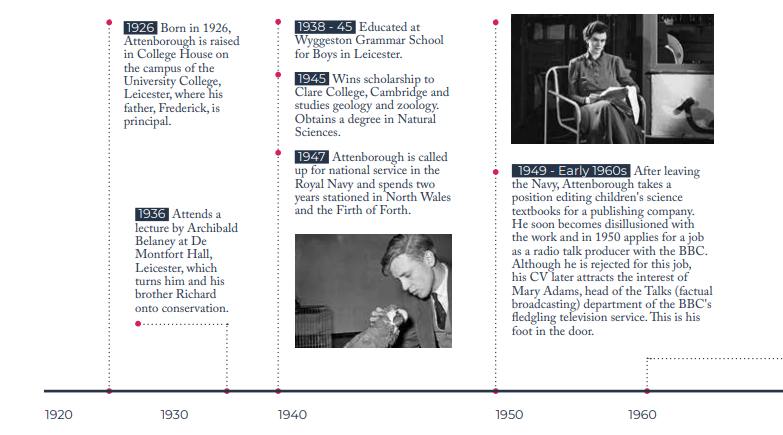
     

    What has Sir David Attenborough done


    Transparent Medium


    ‘The thing about David is he prefers animals to humans,’ says another person who has worked with Attenborough for years. I ask him if the coronavirus situation will accelerate change. Again, he is careful: ‘I don’t know about that. On the one hand, I can see that our skies are emptier now and that’s very welcome. I suppose the extent to which the aviation sector will return will depend on the price points the airlines come up with.’

    I suspect that some of his reluctance to be drawn into detailed discussion is that he doesn’t wish to claim undue expertise on areas outside his competence. There’s an admirable discipline at work, alongside a refusal to please

    Bewilderingly honored – Attenborough has a BAFTA fellowship, a knighthood, a Descartes Prize, among many others – he has learned that the only proper response to fame is self-discipline. At his level of celebrity – up there with prime ministers
    and presidents but with a greater dose of the public’s love than is usually accorded to either – he is continually invited for comment, and has learned when to demur.

    ‘I am sometimes asked about the well-known people I’ve come across in this life – the presidents and the royalty.

    I’ve been lucky enough to meet,’ he says. ‘I say, “Look, if you saw my documentary with Barack Obama then you know him as well as I do.” Television is very intimate like that. My job is to create transparency.’

    So instead of what one half-hopes for – backstage anecdotes at the White House or Buckingham Palace – one returns time and again to the climate crisis. This is the prism through which everything is seen, and our failure to follow his example, he says, shall ultimately be to our shame.

    He will not be drawn into negative comment on Boris Johnson or Donald Trump. Instead, he says: ‘Overall, I’m optimistic. All I can say is we have to encourage our political leaders to do something urgently about the climate situation. We have to all work hard to do something about this.’


    The Fruits of Longevity


    For Attenborough everything has been boiled down to raw essentials. And yet his career exhibits flexibility. His success must be attributed to open-mindedness about a young medium which others might have thought it beneath them. It would be too much to call him a visionary. But he was in the vanguard of those who saw TV’s possibilities.

    Fascinated by wildlife as a child, he rose to become controller at BBC Two and director of programming at the BBC in the 1960s and 70s. ‘Television didn’t exist when I was a young man, and I have spent my life in a medium I couldn’t have imagined. It has been a wonderful experience,’ he says.

    The very successful glimpse the shape of the world to come, seize that possibility and enlarge it into something definite, which they then appropriate and live by. What advice does he have for the young starting out? ‘My working life has taken place in television. I don’t know how we will see that change over the coming years as a result of what’s happened. Communication has proliferated into so many forms. It is very difficult to get the single mass audience, which I had something to do with creating, thirty or forty years ago.’

    There is an element of well-deserved pride about this. Attenborough’s original commissions at BBC2 were wide-ranging. The included everything from Match of the Day to Call My Bluff and Monty Python’s Flying Circus. One can almost convince oneself that he was a BBC man first and an ecologist second. ‘The world has become very divided in a way,’ he continues. ‘We prepare for a world when we’re young that’s gone by the time we arrive in it. To that I say, ‘It depends what your life expectancy is!’

    But all along it was nature that thrilled and animated him. Attenborough is one of those high achievers who compound success with longevity. His is a voice that speaks to us out of superior experience – he has seen more of the planet than any of us. He speaks with a rare authority at the very edge of doom – his own personal decline, as well as the planet’s.

    Urgent Warnings

    He says: ‘Whatever young people choose to do with their life they must remember that they’re a part of life on this planet and we have a responsibility to those who will come after us to take care of it.’

    I ask him what we should be doing to amend our lives and again he offers a simple thought: ‘We’ve all got to look to our consciences. Inevitably, some will do more than others.’

    He sounds at such times very close to washing his hands of the human race. But then everyone in their nineties is inevitably about to do just that.

    What Attenborough has achieved seems so considerable that one wishes to ask him how he has managed it. ‘I am sometimes asked about how I manage to do so much, but I don’t particularly think of it like that. I just reply to the requests that come my way: you can accomplish a lot by just doing one thing after the other.’

    Again, the simplicity of the answer has a certain bare poetry to it: Attenborough is reminding us that life is as simple as we want to make it. Interviewing him at this stage in his life is like reading a novel by Muriel Spark: no adjectives, no frills, just the plain truth.

    In his curtness is a lesson: there is no time for him now for delay, but then nor should there be for us. We must do our bit – and not tomorrow, now.

    He is interested in Finito World and very supportive of our new endeavor: ‘This is a time when the circulations of magazines and newspapers appear to be falling. A lot of newspapers are aware of the climate emergency and the way in which we disseminate ideas has diversified.’

    A thought occurs to me that stems from my lockdown time with my son, where we have been in our gardens like never before. Should gardening take its place on the national curriculum? ‘It’s obviously very important,’ he says, although he also adds – as he does frequently during our conversation – that he knows little about the topic. (Opposite, we have looked into the matter for him.)

    Hello, Goodbye

    I will not forget this interview with a man whose voice will always be with us. Part of Attenborough’s power is that he continues to warn us in spite of ourselves. He deems us sufficiently worthwhile to continually renew his energy on our behalf.

    I mention that we watch his program with our four-year-old in preference to the usual cartoons on Netflix when possible.

    At that point, perhaps due to the mention of my young son, he sounds warm: ‘Thank you very much, sir. It does mean a lot when people say that.’

    It’s a mantra in journalism not to meet your heroes. Attenborough in extreme old age is brisk and sometimes even monosyllabic. This in itself tells you something: the world is full of the canonized but in reality saints are rare. Conversely, I have met those whose reputations were fairly low, but who turned out to be generous beyond expectation. We should never be disappointed when the world isn’t as we’d expected. It is an aspect of the richness of experience to meet continually with surprise.

    But age will come to us all. If it finds me in half as fine fettle as David Attenborough I shall be lucky indeed. Furthermore, if it finds me on a habitable planet at all that shall also something I’ll owe in part to him. ‘Good luck,’ he says as he puts the phone down. This isn’t the man I had expected to meet. But I can persuade myself that he means it.

    ‘David prefers animals to humans’. Afterwards, it occurs to me that he saw me not so much as an individual, but a representative of that foolish ape: man. While Attenborough has been acquiring hundreds of millions of viewers, what he really wanted – and urgently required – was listeners.

     

  • Photo essay: Why Do We Take Drugs?

    Christopher Jackson tours a fine new exhibition at the Sainsbury Centre about the many ways drugs impact our lives


    After reading about the death of Liam Payne in Buenos Aries recently, one felt a sense of grim recognition. It was another story of a famous person with a bleak ending up, where the prime mover in the tragedy was drug addiction. This followed on from Matthew Perry‘s sad death the previous year.

    But you don’t have to look far in recent history to find others: Amy Winehouse, Jimi Hendrix, Jim Morrison, Michael Hutchence. It is a grim roll call of squandered talent. The trouble with talent is that it all too often distracts you from learning how to live. Know thyself, was the injunction above the entrance to Plato’s Academy.

    Drugs certainly can prevent that process, but the Sainsbury Centre has embarked on a larger mission: to consider drugs from many angles and therefore to arrive at a deeper sense of what drugs have meant to the species recreationally, socially, politically, in healthcare, as well as artistically and even spiritually. The results are shown in a series of exhibitions, and also in an accompanying book which is both well-written and beautifully designed.

    It was Gore Vidal who, in his usual lordly manner, said he’d tried each drug and rejected them all. He settled in the end on alcohol as his main source of recreation and it didn’t do him a huge amount of good, especially in his old age. But most people in their forties and fifties today will have dabbled in some form of drug, usually when too young to know precisely what kind of self they were supposedly meant to be experimenting with.

    This has without question hugely contributed to the mental health crisis which we see all around us. It manifests all too often as an employability problem, but this is ordinarily a symptom of addiction and not a cause.

    There is much in this exhibition to warn us off drugs, with heroin singled out as a particular disaster area. This was the tipple of the great Nick Cave, and he got through by the skin of his teeth to his present incarnation as a musical seer and global agony uncle.

    Cave always made sure he was at his desk at 9am, and wrote some of the great songs of this or any age while in the clutches of this particularly brutal drug. The section of the exhibition called Heroin Falls makes it clear that the high-functioning heroin addict is likely to be an extremely rare phenomenon.

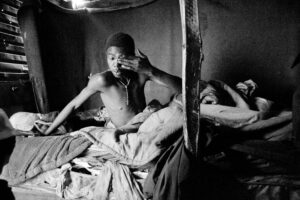
    One such is Graham MacIndoe who chronicles his own addiction in photos of raw power. MacIndoe wasn’t robbed of agency by his addiction – or not entirely – and found that the drug made him focus with considerable obsessiveness on lighting his pictures.


    This image shows the reality of drug addiction
    My Addiction, Graham MacIndoe


    And yet heroin remains a grim topic whatever spin you put on it. That’s even more the case when you consider the current trend in South Africa for Nyaope, known as ‘poor man’s heroin’. This is highly addictive and can contain anything from detergent to rat poison or antiretroviral medications. Anybody who has been to Johannesburg knows that it can be hell on earth: and here’s why.


    SOUTH AFRICA. Johannesburg. Thokoza. 2015. Thabang waking up in the early hours of the morning.


    SOUTH AFRICA. Johannesburg. Katlehong. 2015. Bathing in Katlehong after a long day.


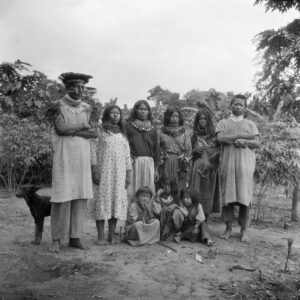
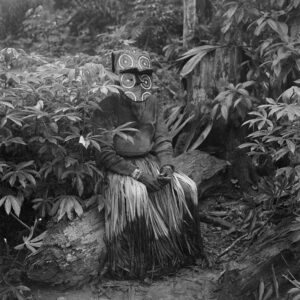
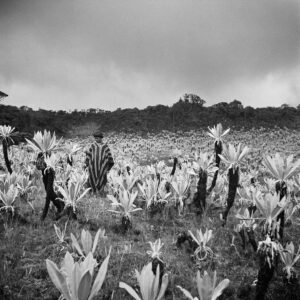
    But the Sainsbury Centre frequently points out that drug use hasn’t always been this destructive. The message is that, as with anything in life, it helps to know what you’re doing. There still exist today peoples in South America with a positive relationship to Ayahuasca.


    Richard Evans Schultes, The Cofan Family that met Schultes at Canejo, Rio Sucumbios, April 1942

    Richard Evans Schultes, Cano Guacaya, Miritiparana, 1962

    Richard Evans Scultes, Youth on the Paramo of San Antonio above the Valley of Subondoy, 1941


    These pictures show another setting to drug exploration: we are in the great outdoors where drugs really originate. Quite simply, they grow in nature, and it is a relief to the viewer to be out of the urban setting where drug addiction so often goes badly wrong, into landscapes where the existence of drugs has a saner context.


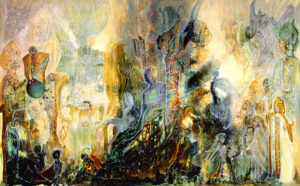
    As interesting as they are, they rather pale in comparison to some of the images of visionary art in this exhibition, the best of which is Robert Venosa’s Ayahuasca Dream, 1994.


    Drugs can also provide transcendent experiences
    Robert Venosa, Ayahuasca Dream, 1994


    All one can say about this picture is that if this is how the world looks on ayahuasca, you’d be a bit crazy not to want to try some. This is why people take drugs: they sense that the external world might be an end effect of something larger and that drugs might be a way to move towards that cause.

    Venosa’s picture, with its sense of a drama we can’t quite grasp conducted involving figures whose identity we only vaguely know will touch a chord with many. It is impossible to look at something of this scale and beauty, and feel that drugs can be of no benefit to humankind.

    Most people suspect that their mind is operating at a very low percentage as they conduct the rote tasks which the modern world can sometimes seem to require of them. They know they’re capable of more.

    I think it’s more than possible to do all that in a state of sobriety, and that route will be better in the vast majority of cases, simply because so many people lack the willpower not to fall into perennial addiction. Who can sort the real drug mentors in the Amazon jungle from the charlatans?


    But the Sainsbury Centre has done a great thing by tackling this subject in such an encyclopaedic fashion to remind us that though we each have our inner Amy Winehouse where everything can go badly wrong, we also potentially have a sort of Sergeant Pepper Lonely Hearts Club Band within as well – a new level to go to, whoever we are.


    For more information go to: https://www.sainsburycentre.ac.uk/


  • Leah Houston’s amazing bursary journey

    Christopher Jackson

    One sometimes hears someone called a ‘black sheep’ of a family as a pejorative term. It needn’t be like that. Most people who look inward in any concerted way find some surprising differences between their own hopes and dreams and their outward circumstances. Knowledge of this difference can open surprising inner capacities and point the way to a fruitful life. In the best cases, it is possible to strike out in a different direction from one’s family, and to feel no sense of alienation whatsoever – but instead to feel a sense of loving journey, which ultimately all members of the family will accept and profit from in understanding.

    Something like this appears to be happening to Finito candidate Leah Houston. I ask her about her upbringing: “I’m from very humble beginnings,” she tells me, her accent distinctively Northern Irish. “Education was never pushed for me. It wasn’t the world I was in. I’m the first in my close family to be interested in my studies, and then to want to pursue them, and then to go onto university at the Belfast Bible College in Dunmurry, Belfast.”

    Despite this, Houston is aware of many similarities between herself and her family. “On the other hand, working hard was pushed on me – it was a question of financial necessity. I’ve had a part time job since I was 14. After school you went to work: food had to be placed on the table somehow. In hindsight, I wouldn’t have changed a thing at all.”

    So what did her parents do for a living? “My Dad is typical Northern Irish. He is a part-time farmer and he sells animal feed from a local agricultural shop. My mum worked in office work all her life – then she had me. She felt that to stay at home was her calling, but then she started looking after other peoples’ kids and soon she had her own childminding business.” This seems to amount to a strong entrepreneurial streak in the family. Houston agrees: “You have your hands and you can do something about it – so go work,” she says, simply.

    This innate understanding of business was already becoming apparent in Houston’s choices. “Business makes sense to me,” she explains, “seeing something through from 0 to 100. You’ve got to see what you’re good at and make something of it. I studied Business through to A-Level and initially thought I would study that subject at university as well. But I had a bit of a change of heart.”

    This brings in another side of Leah – her religious belief. “I grew up in a strong Christian household,” she recalls. “It wasn’t pushy but it was fostered. So I studied religion and law at university which was a major change.” Throughout our conversation she will talk about her faith in the relaxed, confident way which people do when their beliefs are deeply embedded.

    I am interested to know how this degree was structured. She explains: “The main aspect of it was theology, but with world studies, policy and law examined. It was all to do with how one’s faith works out in the public sphere. I was focused predominantly on Christianity but I also did world religion modules.”

    This decision garnered a mixed reaction at home. “My extended family – my cousins and so on – weren’t sure. Firstly, because I’m a woman – that didn’t go down well, and led to some opposition. Some also thought I would lose my own faith, and question what I believe.” And has she? “I haven’t. Growing up in a Christian country, Christianity can be ugly because it’s political. There have been civil wars in the name of Christianity in my country. I came out the other end with a wider appreciation of all religions and the part they can play.”

    Houston loved her degree, but like most humanities degree, the gain of doing something one loves had a flipside: such courses don’t lead to such clear destinations as vocational courses. “I didn’t want to go into the Church, so in hindsight it was a much harder option. For the first few years I thought it was all amazing, but I’m not philosophical – I’m much more practical. My interest is in thinking how faith values can be implemented. During the three years of my degree, I did some time with a charity at home called the Evangelical Alliance. That organisation tries to bridge the gap between Church and politics. In hindsight, my time there planted the seed for politics and the public sphere.”

    This seed came to fruition when Houston began working for Baroness Anne Jenkin in the Houses of Parliament. “When I finished university, I thought: ‘What the heck am I going to do next?’ I came across Christian Action Research Education (CARE) a charity which seeks to facilitate getting a job as a Christian in politics in addition to offering training in thinking about politics. Anne Jenkin is extremely kind and said she’d take me for a year.”


    Baroness Anne Jenkin has been a huge help in Leah Houston's career journey

    And what were her impressions of the role? “Anne is so hard-working – no two days are the same for Anne,” Houston recalls, laughing perhaps at the remembered bustle of it all. “I was involved in diary management, speeches and organising meetings she would host. It was general ad hoc stuff and I was an extra pair of hands.” Leah brought a very clear sense of purpose to the role. “I was there to serve Anne – to allow her to do her job better. That could be sending letters, or photocopying, or making a cup of tea. I also became immersed in the question of gender ideology, which is one of the key issues for Anne.”

    And what was the culture like in Parliament? “As a practising Christian myself, I was interested to discover the APPG, Christians in Parliament, that is a cross-party group of Christians. As long as you were a passholder you could be a part of that: MPs, kitchen staffers, it didn’t matter. It brought a sense of community, with weekly services held in the Chapel of St Mary Undercroft. Politics is so polarised and tends to be all or nothing. It is meaningful to have something that unites: at election time we prayed for whoever was in leadership.”

    Through Baroness Jenkin, Leah met Finito Education CEO Ronel who saw Leah’s potential. “Ronel is a great supporter of Anne and he took me under his wing. I was with Finito for half a year and the investment in me was incredible.”

    This is good to hear and I ask her what the impact has been. “Besides all the practical things such as the LinkedIn training, the CV writing and the mentoring, I especially value the confidence that the Finito service gives to someone in my circumstances. It was as if I was being seen for the first time. This was so encouraging for me especially given my upbringing, where my wanting to succeed was perhaps sometimes considered a bit weird. My extended family would wonder why I was in London, and why I’m in the job I’m in. This was an organisation which wanted me to succeed.”

    This process of building confidence in an individual is integral to the mentoring process. It begins from our first encounter with a new student. Houston recalls: “I remember vividly the first meeting with Ronel where I brought him my CV. When I had been in parliament I had co-founded a network for the protection of gender-critical views. I showed my leaflet to Ronel and it was an incredibly important moment, because someone was looking at my work, and taking an interest in me. It brought me an overwhelming sense of pride.”

    Mentoring is to do with becoming reoriented in one’s life by coming into one’s essential self.  Houston recalls that her being photographed by in-house photographer Sam Pearce continued this process. “I spent an afternoon with Sam and I noticed that she took the time to make me feel comfortable. She also took time to ask questions between pictures – it was not a transactional photoshoot, it was more an investment in who I was.”

    Following on from there, Leah had her LinkedIn training with Amanda Brown (‘incredibly helpful’) and then began work with her lead mentor Tom Pauk. “He was so lovely and I was telling my heart and how I feel things deeply. He said: ‘I think you need to go into the charities sphere’. I said: ‘ I think you’re correct.’ And now I’ve landed a job with a charity which is a start-up. Tom was amazing, and gave me contacts.’

    From Pauk’s perspective, Houston made an excellent impression. He recalls: “Leah struck me as a highly intelligent, articulate and values-driven young woman, seeking a position where she can employ her myriad skills to improve the lives of others, especially those of women and children.” Pauk noted early on that her priority was ‘to use her lobbying skills to help bring about changes and social impact,” adding that “she is not driven by earning a high salary, though she’ll need a sustainable one.”

    When the job came along it all happened very quickly ‘in the space of a week’. Houston brings me up to speed: “I now work for a charity called Forum which is based in London and has launched in America too now. Its purpose is to serve leaders and influencers from all sectors of society. It tries to link up like-minded people. I’m a data manager and administrator, which is important for Forum, as someone’s name in the database is like gold to the business. I’m also EA to the founder David Stroud, who is married to Baroness Stroud.”

    So how does she see the future? “I actually don’t know,” she admits. “My life these past few years has been full of uncertainty, but I can see myself settling here for a good while. It’s a start-up with huge potential for growth and now the whole past five years makes sense.”

    At the end of our interview Houston reflects a little on her journey so far. “It’s strange to be in London and not be money-driven. Wealth to me isn’t money. It’s what I had growing up: I had family and friendship and relationships and that to me is wealth. Marriage and education is wealth.” And are her family beginning to understand the nature of her journey now? “My parents have been massively supportive, but we don’t always speak a common language. My cousins have their own convictions and they don’t necessarily agree. But the relationships are there and really there’s so much love and support.”

    One is tempted to call this attitude mature except that many people live their whole lives without realising the importance of things which Leah innately understands. She also has an immense capacity for empathy and understanding. Houston is someone whose narrative is not to be judged by the usual metrics of success: money, or position or anything else – though there’s nothing to stop her acquiring these. But she is in such a strong position because she isn’t a materialist. She is someone who will make her own way – and in fact is already doing so.

    The help which Finito gave to Leah would have been impossible without the generous help of the Stewarts Foundation. The firm’s managing partner Stuart Dench says: “In a perfect world comprehensive career guidance would be available to all regardless of their background. The Stewarts Foundation is delighted to support the important work of Finito via its bursary scheme.”

    Stuart Dench and the Stewarts Foundation has supported Leah Houston's career journey

    When it comes to someone like Leah, the importance is difficult to measure because it has to do with ineffable things like confidence, connectivity, and the unleashing of possibilities within a person who may not yet know how capable they are. In her case, it is also to do with helping someone to arrive at the realisation that the place they’re born in need not be a limiting factor. Ultimately it’s for us to make our own way – though it is right that we do so with the help of others.

  • A Question of Degree: Adam Conn

    Adam Conn


    Like many kids born in the 60s, my cousin and I were sent by our mothers for an IQ test. I remember my aunt telling me I had scored particularly high. This revelation only came twenty years later, the night before I was heading to Hong Kong. Please excuse the pun, but whether this might have changed any of my life decisions is purely academic.

    This is not an argument against undergraduate studies but my story of how I managed without, along with some of the tips and skills I learned along the way. I live in awe of my two children, who achieved Firsts in their respective degrees and are, to date, doing well. My son, admittedly, got started with Finito‘s help. Do I wish I had studied the classics? Yes, I do. Am I qualified to take on the role of a barrister? Definitely not. What I can do is provide them with the benefit of my experience and expert knowledge to help them uncover the truth.

    By this time, I had made my decision to pursue a vocational education rather than study for a degree. In my case, it was the right decision. At the time, the avuncular advice I got was that university would help me think differently. With the benefit of hindsight, continued learning throughout my career has given me so many opportunities to improve myself. I am now mentoring graduates and non-graduates alike as they navigate their careers.

    Fast-forward to August 2024. I have just turned sixty and celebrated the first forty years of my financial services career. My career has so far given me the privilege to work in London, Hong Kong, New York, and, more recently, Edinburgh. Most importantly, as a Head of Trading, I continue to enjoy taking on the challenges of enhancing what we do, at both a company and an industry level, for the benefit of the end investor.

    I started my career as an assistant to partners on the private client side of a pre-Big Bang stockbroker. I was fortunate to benefit early on from on-the-job training and coaching. As part of this training, I went to spend two weeks sitting with the firm’s trading team on the floor of the London Stock Exchange and never came back.

    The “floor” was a tough apprenticeship. It toughened me both physically and mentally. I am not sure it would necessarily stand the test of time, but it undoubtedly shaped who I am today. The motto of the London Stock Exchange, ‘Dictum Meum Pactum” (which roughly translates as ‘My word is my bond’), taught me respect, trust and the importance of best practice. Billions of pounds a day of transactions were executed by voice – and honoured. There was the LSE Code of Conduct, a collective desire to live by it, and, in instances where there was doubt, a disciplinary committee on the 23rd floor. To avoid doubt, this was something I had never had reason to attend!

    As an unauthorised dealing clerk (“Blue Button”), my daily tasks ranged from collating prices as a service to our sales desk, to getting the teas and doughnuts (and woe betides anyone who got that order wrong). There was no sense of entitlement. I knew everyone had started that way. Some years later, I remember being scoffed at on a busy day by a graduate trainee when I asked if he could get me a sandwich. I maintain that I am the better educated. “Nous” (Ancient Greek) can be learned, but not from a book.

    My career has progressed, and my horizons have broadened. I lead a diverse team of investment professionals, and since 2020, we have set up trading desks in Asia and the US. Imagine my surprise when I realised I needed to take more exams in my fifties! Within the firm, I chair our Regulatory Engagement Group, and externally, I am the chair of the Investment Association’s Equity Trading Committee.

    I often speak with regulators, politicians, and market authorities globally. I enjoy being a freethinker with a pet theme of challenging processes and procedures, especially when ‘they have always been done that way’. I am proud to be a chartered fellow of the Chartered Institute of Securities and Investment. And recently, I was delighted to be granted membership in the US-based National Organization of Investment Professionals (NOIP).

    The secret sauce of my career is the desire for continued learning. This continues to the current day. I enjoy reading this column in previous editions of the magazine, to understand different points of view. It is so important to move forward and keep building one’s knowledge – asking questions, acknowledging mistakes, learning from them and persevering. It is as much about developing networks and maintaining them, broadening one’s mindset and developing wisdom as it is about having knowledge. Philosophising certainly has its place, but a strategic leader also needs the ability to be practical and come to conclusions, not just to theorise.

    A cynic might dismiss truisms as cheesy, but who wants to be a miserable cynic, devoid of their own ideas and left to knock others? Certain phrases stick with me, such as “People want to live in a world they help build”, and two of Wayne Gretzky’s famous quotes, “Skate to where the puck is going to be, not where it has been” and “You miss 100% of the shots you don’t take”. Others keep me grounded. The cruellest, simply because it is so true, is probably, “If you want to make God laugh, show him your plans”. All we really know is that things will change. A more recent addition to my repertoire is “While AI may not take your job, someone who knows how to leverage it might”.

    Even though I started work as a school leaver, it has in no way stopped me from enjoying the wisdom of some of our finest academic institutions. Cambridge Judge Business School gave me some great opportunities (and the scarf I wear to prove it). Oddly, for someone with a trading background, its “Negotiations Lab” taught me some excellent new skills. A classic ‘you are never too old to learn’ scenario. A growth mindset, empathy, and other forms of EQ, as well as networking and influencing skills, can all be developed on the job without being influenced by so-called progressive campus politics.

    Although my story is from a different era, I still have a lot to offer. I am sure I’m not the only person who wonders if they set out today, would they even be considered for the job they do? That said, it is exciting to see more options for school leavers who, for one reason or another, do not go to university. My employer has opened its doors to “Modern Apprenticeships”, and I enjoy their enthusiasm, grounded ambition, and hard graft.

    There is much written about it, but my take on leadership is not about trying to make everybody happy. It’s about when you see something that you don’t feel is right, and then stand up against it because it’s the best thing for the group. My philosophy is to lead by intent rather than instruction. There is a great YouTube link titled “Leadership on a Submarine,” adapted from a talk by Captain David Marquet, that I wholeheartedly recommend watching.

    There are always ways to improve and expand one’s knowledge and wisdom. I believe in the value of our personal brand. Everything we say and do either enhances or negates it, and this drives me to stay at the top of my game. Undoubtedly, I will stumble, but I will always learn and carry on. I will continue with my on-the-job training, mentoring, and coaching. I enjoy leading our team and watching them flourish.

    So, what comes next for me? Looking further ahead, I want to continue using my experience and industry knowledge to ensure the industry continues to adhere to best practices. With sound experience of good market practice coupled with my global technical knowledge, I see the role of an expert witness as an ideal way for me to continue to protect the end investor.

  • Review: Bodysgallen Hall in Wales: ‘luxurious peace’

    Christopher Jackson reviews Bodysgallen Hall and enjoys every minute of it


    It is always a curious thing to arrive somewhere at night: we experience a world without contours and landmarks – a dense dark which really could be anywhere, and yet we also know we are entering somewhere new.

    We arrived in northern Wales just in time for a storm to lambast Conwy, just as storms have been doing for millions of years: Wales always feels like ancient history.

    My main memory is of watching the windscreen wipers rushing back and forth in increasing desperation to rid the windscreen of rain, as if seeking some slightly higher setting than the maximum.

    We negotiated a long winding drive, unimpressed sheep crossing the pathway in their own time to move out of the way of our car. As we emerged from our vehicle, our bags immediately weeping with rain, we scaled some steps and the door peeled back magically: this was the greeting of the avuncular night porter Marion.


    First impressions


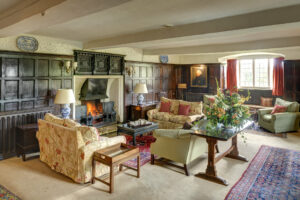
    As I glanced at the décor of Bodysgallen Hall – the fireplace, the 17th century panelling, the venerable portraiture – I thought: “Well, this is a whole better than the M6.” Better than the M6, and indeed better than more or less any hotel I’ve stayed at, as it would turn out.


    Reception, Bodysgallen Hall
    Reception, Bodysgallen Hall

    We were shown upstairs to a warm upper room, and learned from Marion that the building was initially constructed as a tower house at some unspecified point in the Middle Ages. Its meaning was to serve as support for Conwy Castle, that marvellously preserved stronghold overlooking the bay: from Bodysgallen you can replay how a signalling system might have worked between this place and Conwy. One imagines Irish ships, a flame of warning, and then the bustle of preparation for whatever came next.

    What came next is what always comes: invasion, conquest, resistance, peace – the known variations of human life. It is, in fact, a marvellous place for a spa, as the history here is so rich you know precisely what it is you’re seeking to get away from.

    I had just enough time before I drifted into sleep to learn that Bodysgallen had once been a place where Cadwallon Lawhir, King of Gwynedd – the name means ‘long-fingered’ – had lived, when a luxurious peace enveloped me, which probably had something to do with not being on the M6 but also something to do with excellent bedding.

    Into Enchantment


    The following morning, the first amazing thing I did in what was to be an entirely enchanted day, was to open the curtains. This isn’t normally a particularly marvellous aspect of life in London: my curtains usually reveal Southwark Council branded bins and houses opposite which look identical to the house I have just woken in.


    At Bodysgallen Hall, the experience is very different: you look out onto an unbroken glory of horticulture, leading onto a still more beautiful and dreamy landscape: that masterpiece of nature which is Wales’ northern coastline.

    It must be admitted that Wales probably gets about three days of delightful sunshine per year: we got one of them, and in late October. The trees everywhere were having their annual rethink, deciding on russets and umbers. Their dying can sometimes seem peculiarly optimistic.

    Our first move was to eat a breakfast of champions in the tall-windowed breakfast room: a full English exactly as it should be done – heartily, and without any unnecessary complications. The food in the restaurant is Michelin standard.

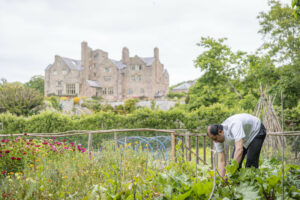
    Kitchen garden at Bodsygallen Hall
    Kitchen Garden at Bodysgallen Hall

    The views from the gardens are not to be forgotten. It was a day of bronze and misty light: Conwy seemed in shadow. The medieval folly can be seen in the distance, and it’s possible to walk up there for a better view of the coastline beyond the Orme and Little Orme headlands.

    The garden has a remarkable history. The original garden design dates from 1678 and is credited to Robert Wynn, son of Hugh Wynn, who was the first of that family to come into ownership of the Hall. A sundial bears that same date 1678. In that year Bunyan published the first part of The Pilgrim’s Progress, and the Battle of Saint-Denis was conducted between the French and the Dutch, with the verdict disputed by both sides, though its result all too clear to the 5,000 or so soldiers who lost their lives.

    In those days, everything was in the Dutch fashion: with high walls which make you want to know what lies beyond them. There is also a topiary maze, and a rose-garden which was still giving out a beautiful scent even in mid-October. The herb garden produces herbs and vegetables which form part of the menu in the first-class restaurant.

    Everywhere you go is beauty – and this was an unusually beautiful day. One could really spend a week walking these grounds, and not be near the end of it, but our time was more limited.

    The Spa

    Bodysgallen Hall is known also as a spa, and so we went there during children’s hour. Newspapers I would not have time to read were laid out in civilised fashion in the reception area.

    The spa itself consists of a warm swimming pool, a jacuzzi, steam room and sauna. My eight year old boy splashed around in children’s hour, which wasn’t quite long enough for him, and one sometimes wishes there weren’t such severe regulations around jacuzzi use when it comes to children.


    Spat at Bodysgallen Hall
    Spa at Bodysgallen Hall


    After that we walked again up to the obelisk, which was built in 1993 and a landmark visible from all around. It is, like Kafka’s castle, a thing which one nears but never quite gets to. But the trying to get there yields acres of mushroomy woodland, and a sense of blessing at trying to get there at all.

    Lunch consisted of sandwiches taken in the crocodile alcove. Bodysgallen Hall is a place of little nooks and surprises. It is also a place of superb beef sandwiches. My son and I agreed we could quite easily have eaten 400 of them, but had to settle for eight.


    The Land Beyond


    As the afternoon began I sensed Conwy calling. We had been in the castle before on a previous visit: it is an extraordinary place which the first-time visitor will need to do. But the joy of second-time visits is to strike out in surprising directions, and so we decided instead on two churches.

    The first is Llangelynnin Old Church, which is to be found a 20 minute drive out of Conwy up a winding slope. It isn’t where you’d expect to find a church, amid the beginnings of the Welsh hills. We didn’t expect it to be open, but the door had an obliging give when we tried it: inside the side walls date from the 13th century and the impression is of a peace which is worth climbing up here for.

    Round the corner is St Mary’s church which is on the site of Aberconwy Abbey which was founded in 1172. Here, you begin to get to the nub of the matter: two yew trees older than Chaucer preside over the church, and there is information inside establishing the ancient nature of this site, where the Romans also had an outpost. Both these churches are supported by the National Churches Trust.


    This is the infinite nature of Wales: its wonder is to do with deep time, and the many layers it contains. Bodysgallen is the way to explore it and also to experience a luxury which is both classy and not too ostentatious. It is an additional pleasure that to come here is also to support the National Trust, which in addition to maintaining our nation’s heritage, also clearly knows how to run a hotel. A special mention must also go to the magnificent receptionists Catherine and Hayley who were helpful and kind throughout our all-too-brief stay.

    In our second swimming session, my son Beau, determined now and fortified by a fine day in Wales, swam his first length – a cunningly constructed amalgamation of front crawl and breaststroke. We might have arrived at night – but we left sensing a sort of dawn in ourselves.


  • Donald Trump and the death of the legacy media

    Finito World


    Whether Donald Trump wins the next US election or not, his recent podcast tour illustrates beyond reasonable doubt that the legacy media is on the way out.


    This week Trump sat down for a three hour talk with Joe Rogan, and it ought to be a clear signal to all young people thinking of working in the media not to fill out the arduous applications to CNN, Fox or the BBC, but to consider how they might be a part of a new kind of conversation.


    The conversation itself will surprise anyone who thinks they know Trump from his appearances on the mainstream media. It was the question of ‘fake news’ which defined Trump’s first run in 2016. At times, during that presidential cycle, Trump found that he was able to say outrageous things and then gaslight the media and the world that he hadn’t said them.


    But we have tended to know Trump predominantly in a network setting: we witness him in clips and the nature of a clip is to cut out other context. His speech in a short format often comes across as rambling and bizarre and there are many indefensible things that he has said and done. But many voters in 2016 were so tired of canned speech and soundbites that they saw his energy as holding a kind of promise, regardless of what he said.


    2024 seems to be a continuation of that development, but there is also an undeniably different feel to it all. This is partly due to the assassination attempts. In the first of which, Trump showed undeniable physical courage in getting up so soon after being shot.


    Something about that occasion made Rogan want to know more about him. I think it may have been a simple question of admiring his indefatigability and resilience. Rogan, like so many, was appalled by Trump’s refusal to accept defeat in 2020 – but equally appalled at the idea of his murder in broad daylight.


    Whatever one thinks of Trump, there is the possibility that we will all be enriched by these developments. The conversation between Rogan and Trump was three hours long and completely different to the typical edited 10 minutes we might get on CNN.


    The pair of them discussed everything from wrestling to energy and foreign policy, what it was like to arrive in the White House. to Vice-President Kamala Harris. This followed on from another recent conversation with Theo Von in which he movingly discussed his elder brother Fred’s alcoholism.


    The point here is not whether you like or dislike Trump. The point is whether, in advance of being asked to vote for him, you actually want to get to know him. It is to his credit that Trump chose to do these podcasts, and to Harris’ discredit that she has so far been unable to submit herself to this format.


    What we learn in such things is telling in a way the stilted mainstream interviews aren’t. For instance, we could notice that though Rogan swears regularly, Trump was always polite, but never followed him into expletives. He isn’t a people-pleaser like that.

    There was also a quick aside early on about how he felt seeing the Lincoln bedroom on his first night of his presidency – it was a big deal, Trump said, ‘if you love your country’. It was the sort of glancing aside which has to be authentic because of the format.


    Over on CNN, Harris bungled an answer on 60 minutes about Benjamin Netanyahu only for the clip to be substituted by a slightly better answer. What appears to have happened is that the first incomprehensible answer, all too typical of Harris, was accidentally put out to promote the interview, only for it to substituted by the network when the interview aired. Trump is wrong on many things, but he is right to say that this indicates media bias.


    Viewers are moving across to the independent platforms. This is welcome if we want to get to know our politicians and it is relevant to Britain too. What occurs in the US usually migrates over to the UK. This follows on from a mind-numbingly dull election in 2024 in the UK, where Sir Keir Starmer and Rishi Sunak battled it out over who could give the best 45 second answer over the future of the nation’s entire tax policy.


    The result has been a government whose plans were held to no scrutiny whatsoever with the result that months in to the administration, we have tax rises on the horizon which many would rather not have, but which probably would have been more broadly understood if our election had been fought over longer format interviews.


    It is a reminder that media careers are changing rapidly, and that Trump knows this. They are headed in the direction of authenticity and individuality against banality and the pre-prepared. If starting out in a media career today, there are vast opportunities for unique voices.


    Of course it’s competitive, because everybody can get to market – but it is a fair and sane competitiveness distinct from the competitiveness one sees in corporations: 20,000 AI-sifted applications for even menial roles.


    Things are changing: it is as if everybody is being asked to look inwards. This is a huge shift in a world where status itself had become all too dull and staid. Trump is sometimes an unlikely vehicle for these sorts of realisations: he remains boastful, egoistic and at times a bit mad. But he knows things his opponent doesn’t – and much of what he knows has to do with the future and not the past.


  • Inspiring Q&A: CEO Katia Luna Benai on her unique journey in design

    Finito World interviews Katia Luna Benaï on her Amazigh heritage, her design vision and her plans for the future


    Your grandmother was clearly a very important figure for you – can you talk about your upbringing? Was it an aesthetic culture which laid the groundwork for your future career?

    My upbringing in Algeria, deeply rooted in my Amazigh heritage, was where my journey as an artist truly began. Living with my grandmother and aunts, I was surrounded by a world where every element of life was infused with vibrant colours, patterns, and stories—each one shaping my essence as an artist. The silver jewellery we crafted was more than just adornment; it was history gleaming in every piece, with stones whispering tales of identity. Our tattoos, symbols etched into flesh, represented a tradition now fading, yet they carried deep significance, a connection to our past. Even I carry one of those tattoos, symbolizing five generations of women.

    The architecture of our region, shaped by influences from the Roman and Ottoman Empires, was another source of inspiration, with arches that seemed to embrace the sky and courtyards that echoed with communal songs. Music, dance, and the act of sharing within the community were integral to our way of life, bonding my soul to the instruments of time and land.

    As I travelled later in life with my father, experiencing different cultures and their unique traditions, this early immersion in my heritage continued to influence me. It deepened my fascination with the arts and stories that connect us all as humans. These experiences laid the foundation for my work with Luna Benaï, where I strive to create artefacts that not only capture beauty but also tell multi-layered stories rooted in cultural and historical research.

    Through Luna Benaï, each piece I create is a tribute to the communities and traditions that inspire it. I am deeply committed to ensuring that our work gives back to these local communities, preserving the very cultures that have shaped my identity and continue to inspire my creative vision.


    Your father was a diplomat – has growing up in lots of different places deepened your sense of commitment to the Amazigh culture?

    My father was a man of the people, a true polyglot who spoke eight different languages and was an intellectual deeply respected in Algeria. His work with the UN took our family to many places, and each new city or country we visited was embraced with enthusiasm and a deep commitment to understanding the local culture. This passion for learning and cultural exchange was a fundamental part of our family life.

    The Amazigh people have historically been diplomatic and open-minded, known for their ability to share cultures and live harmoniously with others throughout the centuries. Although not widely recognized, the Amazigh are indigenous to the Mediterranean region and have played a significant role in history, mythology, and culture, with connections that trace back to ancient Egypt and continue to the present day.

    Growing up in diverse environments only deepened my commitment to the Amazigh culture. I see it as part of my mission to represent their essence through the arts, bringing their rich heritage to the forefront and ensuring that their stories and traditions are not forgotten but celebrated and shared with the world.


    Were there creative challenges to be surmounted when it came to negotiating any feelings of rootlessness growing up which diplomats’ children often have?

    It’s a bittersweet symphony, indeed. Growing up as a diplomat’s child often brings a sense of rootlessness, but with that comes a profound thirst for understanding and a deep compassion for the world around you. The feeling of being displaced at times fuels a desire to connect with others on a more meaningful level, to truly understand the nuances of different cultures and perspectives.

    For me, this has been both a challenge and a gift. Art and creativity have become my signature tools for navigating these feelings, allowing me to express the complexities of my experiences and communicate across cultural boundaries. This ever-evolving journey has enriched my work, infusing it with a depth and authenticity that comes from a life lived between worlds.


    Have you had a mentor who gave you the confidence to create?

    Pursuing my postgraduate studies at the Royal College of Art was a transformative experience that truly pushed my boundaries. The philosophy there of deconstructing everything and then rebuilding it, blending academia, research, and art practice, gave me a profound new perspective on identity and communication. Being at one of the finest art institutions in the world, I found a space where intellectual freedom was not just encouraged but expected. This environment allowed me to explore and redefine my creative voice, giving me the confidence to push the limits of my artistry and to trust in my vision.


    I’m fascinated by your process. You have said that you want to think about creating things which stand the test of time. How do you go about sifting your inspirations to make sure that it is likely to produce work which has that sort of longevity?

    At Luna Benaï, we take a vertical approach to creation, guided by the belief that “every object has a story,” and those stories must endure through time. To ensure that our work stands the test of time, I collaborate closely with museums, scholars, and architects from the initial concept to the final creation, always prioritizing absolute authenticity.

    My process involves immersing myself in artefacts that are often 2,000 to 4,000 years old. I fall in love with these pieces and bring them back to life, blending their ancient essence with modern mediums and technology. Through masterful artisanal craftsmanship, honed by decades of experience, we create objects that not only resonate with historical depth but are also built to endure.

    By taking history and completing a full circle—much like our Luna Benaï logo—I strive to ensure that each piece we produce is timeless, capable of supporting its own story across generations.


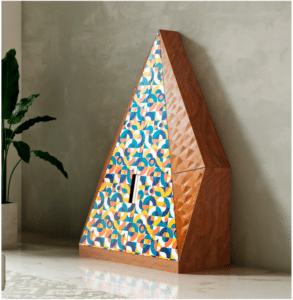
    Your collaboration with Sotheby’s was obviously a wonderful moment in your career. How did you come to think in terms of the rhombicuboctahedron and what does that particular shape mean to you?

    Geometry is the visible manifestation of math, embodying themes of continuation and infinity. When I was commissioned by Tiffany Dubin, a curator at Sotheby’s, to create a bespoke jewellery box for the “Art as Jewellery as Art” exhibition in New York, I wanted to design something that embodied these timeless concepts. The exhibition aimed to reintroduce jewellery and accessories by famed masters of the 20th century and beyond, placing them in a unique juxtaposition with contemporary visionaries and modern artists.

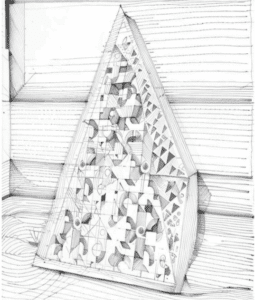
    The specific shape of the Atlas Box, a rhombicuboctahedron, was chosen for its symbolic resonance. The rhombicuboctahedron, with its harmonious blend of triangles and squares, represents balance and unity—qualities that are deeply connected to the myth of Atlas, the Titan who bore the weight of the heavens. Just as Atlas symbolizes strength and endurance, the shape reflects the idea of holding together different forces in perfect harmony.

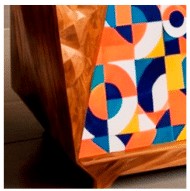
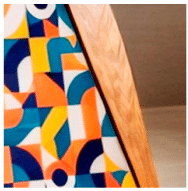
    The carvings and metalwork on the Atlas Box are traditional Amazigh designs, merging ancient craftsmanship with a contemporary vision. This fusion of geometry, mythology, and cultural heritage makes the Atlas Box not only a functional object but a piece that tells a story of harmony and timelessness.

    I think it’s wonderful that you give 15 per cent of your earnings to charitable projects. Was that something that you resolved to do from the beginning? How do you go about choosing the causes that you give to?

    Creating synergy with the local community has always been a core value for me, and it’s something I resolved to do from the very beginning. When we embark on a project, we actively engage with the local communities, seeking out grassroots causes that create visible, tangible impact. It is important to us that these initiatives are ones we can track, interact with, and even participate in directly.

    For instance, with our Sotheby’s piece, we chose to support the UK-based charity Hannan School, which has a genuine and significant impact on improving education for remote communities in the Atlas Mountains. This hands-on approach ensures that our contributions not only make a difference but also align closely with the values and needs of the communities we aim to uplift.


    What would you say to young people looking to work in the luxury sector? What do you look for in a hire?

    Look beyond superficiality. If you pursue what you truly love, you will excel, and don’t be afraid to make mistakes—they are an essential part of the learning process. For young people choosing a career path in the luxury sector, I would advise prioritizing knowledge and experience over superficial gains. Think long-term and focus on building a solid foundation of skills and understanding across different sectors.

    If you eventually decide to embark on your own entrepreneurial journey, believe in your vision and stay committed to it. Your vision will be tested repeatedly, but perseverance is key. Over time, you’ll start to see the building blocks come together, and that’s when your dedication will truly pay off.

    Luna Benaï are entering the Middle Eastern market. Can you describe that journey and tell us more about the thinking behind it?

    The Middle Eastern market is currently undergoing a significant transformation, with new initiatives aimed at diversifying tourism, enhancing arts and culture, and promoting their rich and vibrant heritage. I find this cultural renaissance absolutely captivating, and it’s a landscape I can easily immerse myself in.

    As a British, French-Algerian artist, I have a deep understanding of both Western and Middle Eastern worlds, which has uniquely positioned me to contribute to this evolving market. This strategic expansion is an exciting chapter for Luna Benaï, and I’m thrilled to be embarking on this journey with my business partner, Denise Ricci. Denise is my right-hand woman—a former Goldman Sachs professional with an incredible background rooted in Italian culture and the film industry. She’s a polyglot and a true powerhouse, bringing her diverse expertise to our team.

    This cultural renaissance in the Middle East aligns perfectly with our vision as a woman-led team, allowing us to make a powerful impact. Together, Denise and I are committed to deepening our engagement with the region through bespoke cultural and artistic commissions. This expansion represents not just a business opportunity, but a chance to bridge cultures and celebrate the region’s rich heritage through the arts.


    Which cultural figures most inform your aesthetic? Do you find inspiration in other art forms, whether it be literature, film, music or the visual arts?

    I’m a bit of an eccentric, and there isn’t just one figure that drives my inspiration. My aesthetic is informed by a diverse range of cultural figures across history. The artistic legacy of ancient Greek sculptors and the intricate mosaics of Byzantine artisans have always captivated me. In the modern realm, Zaha Hadid’s groundbreaking architectural designs, which challenge conventional forms and spaces, serve as a major inspiration.

    I’m also deeply influenced by the Bauhaus movement, which revolutionized design with its emphasis on functionality and simplicity, merging art with everyday life. Sonia Delaunay’s bold use of color and geometric abstraction, Hilma af Klint’s exploration of spiritual abstraction, and Dana Awartani’s meticulous blending of cultural traditions with contemporary expression all resonate deeply with me. These varied influences, spanning ancient to contemporary, each contribute to the unique narrative I aim to express through my work.


    What are you working on at the moment?

    We’re entering an incredibly exciting phase at Luna Benaï as we expand into a full-fledged atelier and bespoke design studio. We’ve joined forces with our esteemed Italian partners, who bring over four decades of master artisanal experience. This collaboration enhances our ability to work across various mediums, all while preserving the integrity and creative DNA that defines Luna Benaï.

    Our first atelier collection, Tessellation, is set to launch this winter. This 11-piece, post-modern inspired collection draws from the rich aesthetics of Middle Eastern and North African design, reimagined through a contemporary monumental lens. Each piece in the collection marries fine art and architecture, making a distinctive statement in the world of interior design and bespoke furniture. Made-to-order, Tessellation seamlessly blends timeless cultural influences with modern innovation. We’re thrilled to introduce this next chapter in our journey, where tradition and cutting-edge design converge.


    For more information go to: http://lunabenai.com

  • Interview: Roger Federer’s favourite artist Nadeem Chughtai: “I’m blown away by the positive reaction.”

    Christopher Jackson


    There used to be a dead tree in Ruskin Park in South-East London, which always struck me as somehow sculptural. The other day I saw that it had fallen. I had grown so fond of this particular tree, it’s optimistic reach towards the skies, that I was bereft when I saw it had collapsed.


    But this probably minor development in the history of my local parklands makes me all the more delighted that this same tree is still standing in the work of a remarkable artist Nadeem Chughtai. Chughtai’s recent exhibition A Liminal State has people talking in Peckham, which as everybody knows is also the artistic centre of the universe. Chughtai used the tree as a basis for his picture There’s This Place On The Edge of Town (2020).


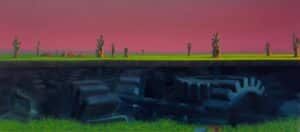
    There’s This Place on the Edge of Town


    One of the most basic requirements of an artist is power: Chughtai’s images always have an immediacy which nevertheless lets you know that your first impression is only the first part of your journey with that work of art. In this picture we see how we have become mechanised in ourselves, and how this can only lead to stunted growth. But the beauty of the tree, which looks like it almost wants to be an upwards staircase, suggests potential.


    It’s a brilliant conception, like all Chughtai’s pictures. So was it always art for him, or did he toy with other careers? “It really was art all the way for me,” Chughtai tells me. “Ever since I was very young I’d draw. Encouraged by my mum and influenced by a beautiful framed pencil drawing my dad made of my mum in the 1960’s. However, I did loads of jobs before going full time with an art publishing contract which set me on my way. Before that I always kept myself in the minimum wage positions for fear of committing myself further down other career paths.”


    Chughtai has had some major successes, with some celebrity clients including Roger Federer who chanced upon his work in Wimbledon village one year. Chughtai is particularly well-known for Nowhere Man, his character which he gave up at the start of the pandemic. These pictures, taken together, amount to a vast dystopian opus which tell the viewer unequivocally what we all sense: we are not headed in the right direction as a species.


    We never see Nowhere Man’s face. Sometimes there’s more than one of him. It is also possible to say that Nowhere Man is always in a negative setting, beset by the circumstances of modern life: alarming architecture, the trippiness of drug culture, the terrifying ramifications of contemporary uniformity.


    I Dream of a World That the Capitalist Philosophy Will Never Make Possible. Oil on three canvases (2017)

    I also note that they’re always dramatic force in these pictures, and I related this to the career Chughtai had on film sets, with his work including the Bourne series and Love Actually. Did that experience impact the way he paints now? “Yes, I always mention my scenic art days. I call it my apprenticeship. It was absolutely magical to be working on those film sets at Pinewood and Shepperton Studios,” Chughtai recalls. “I originally went there to try and make films after losing my way with drawing and painting after college, but as soon as I saw the huge painted scenery backdrops surrounding the sets I was sucked back in.

    I had hands on experience of painting pictures on giant canvases, off scissor lifts using strings, hooks and chalk to draw our lines. I learnt about so many aspects of painting as well as the cameras eye. The big one was perspective. Learning about that was enlightening for me.”


    I ask Chughtai if he has had any artistic mentors, and his answer also dates to this time: “Well, I always mention Steve Mitchell,  the scenic artist who I assisted over a five year period from 1999- 2004. He’s still doing it at 70 and we’re still in touch. He’s one of the world’s top scenics. I can’t tell you what I learnt over those scenic years and how it got me back into the art of painting.”

    I can tell how passionate Chughtai is about his calling, but the melancholy of these pictures is always there. It seems to cry out for some kind of remedy. Is Chughtai pessimistic about the human race and its future? “I believe we are not only on the path to a dystopian future but within it now. Just look at all the horrific and unnecessary human suffering going on all over the world and right down to our own neighbourhoods. However, I remain an eternal optimist and have every faith that the human race will unite to overcome this and bring about the necessary change required.”


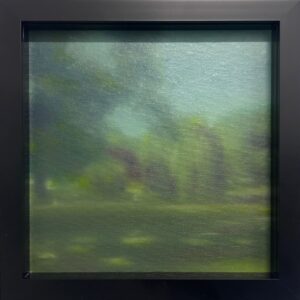
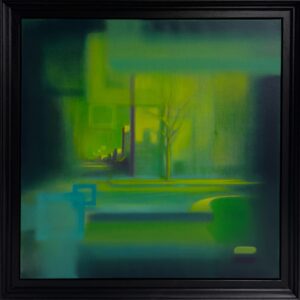
    The new pictures, with their liminal greens, seem to be the start of some new potential. Here we see Green Park as it might be seen in a dream, or in the hypnagogic state between sleep and waking. The journey to the centre of town to make these pictures is perhaps indicative of an interior shift in Chughtai. The new pictures also mark a big change away from character towards some other kind of painting which feels like it is yearning for mysticism – maybe even a metanoia away from despair.


    Was it hard to give up Nowhere Man? Might he ever experiment with another character? “It was very hard to shed the Nowhere Man. I doubt there would ever be another character. For me it represented humanity. If I ever need a central character again I’m pretty sure I’d call him up.”


    Humanity then is for Chughtai somehow passive and faceless – asleep perhaps. This makes the notion of an exploration of the liminal all the more important; it is to do with exploring what Seamus Heaney called ‘the limen world’, that curious borderland of the unconscious. I have a sense that these recent works are a necessary transition period and that it may in time lead to some sort of reconciliation between Chughtai and the damage of the world – a more optimistic vision perhaps.

    How did these new paintings come about? “The works exhibited recently at the Liminal State exhibition are exactly that; Liminal, as in kind of between or on the threshold. For me personally, up until just before lockdown in 2020 I was creating paintings with a central anonymous figure – the Nowhere Man. 16 years through the eyes of this character, so, shedding that to allow the next body of work to arrive has taken these last four years, and counting… The title, A Liminal State can also have numerous interpretations and could additionally refer to many other aspects; mentally,, physically, technically, artistically, societally… liminal.”


    These then are between states, and that means flux – in Chughtai’s art certainly, and therefore, since artists are their art, in his life. I ask Chughtai about his method of composition. Is it evolving? “It’s evolving and continuing its journey. I’ve changed the approach, technique, materials used and so much more since 2020. In fact, almost everything – but still the work has naturally evolved through different states to where it is now.

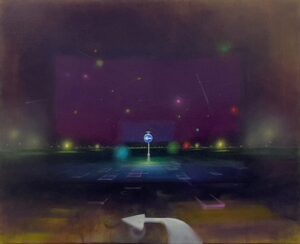
    It’s a continual fluid journey. I have also been developing an artistic theory and putting that into practice. It involves perspective and the way the eyes see and the brain interprets an image. It’s great testing a science based theory on my artistic practice… and it actually works. My most recent painting entitled, Turn Left. (2024) shows the theory in practice in its most developed stage to date, and I was blown away by the positive reaction it got when exhibited for the first time at the show.


    Turn Left, 2024


    This again, seems to me like a dream where the dreamer is sometimes given clear but mysterious indications of what to do – strange snatches of disembodied advice. To look at these pictures after immersing oneself in the Nowhere Man corpus is to see a kind of hope peeping through, because the world seems to be acquiring a kind of charge, groping towards some form of meaning. My sense is that this makes the next few years of decisive importance for Chughtai’s art. If we follow that sign, where does it lead?

    This new work has also sent Chughtai on a rewarding course of study. “Over the last four years I have really delved deep into studying and expanding my artistic learning. Visiting the London galleries on a weekly basis and getting to understand the philosophies of some of the great painters, while also educating myself about the amazing artists from around the world and their histories.”


    So who are his heroes? “I have to mention Van Gogh, I just love. His pencil drawings, they make me wanna scream. I would say that more recently I have been appreciating 20th century Western heavyweights such as Bacon, Klee, and Rothko who’s section 3 of the Seagram murals brought me to tears on more than one occasion. It was during a particularly emotional time for me personally whilst simultaneously looking to move my work along an different path. That painting allowed me to see within it what I wanted to do with my own work.”


    Chughtai has been going strong for a long time. So what are his tips for young artists about the business side? “Well, yes, it is a business – if you do it full time for your living. So if you don’t have the luxury of financial security, you will need to sell your work.

    This predicament will most likely influence the type of work you produce and therefore could involve compromise. That’s the tightrope. It can work in your favour but can also be a hindrance if not deterrent, which is a real shame because then we miss out on hearing and experiencing the voices from within those walks of life. So, believe in what you’re doing, put the time in and keep on making your art.”


    Maxted Morning, 2024


    And would Chughtai recommend the art fair route? “I love going to art fairs. It’s where it all started for me. Like our society, the art world is very hierarchical, but whether you’re at the bottom rung or at the very top, when all is said and done they’re markets with their stalls out. It’s great because people can stand in front of the work in the flesh, which is how I feel art works are best experienced… and there is so much under one roof. Art fairs are a great way to spend an afternoon… if you can afford the entrance fee, of course.”


    That’s often the problem for young artists at all. Has the conversation around NFTs affected him at all? “I did look into NFT’s a little some years ago but it seems to have gone quiet on that front so am unaware of where it currently stands. The whole digital thing is obviously a direction the art world is going down and there are many possibilities to explore. However, my focus and studies are with oil paint and a canvas because there’s so much more to come from there and that will always be ahead of any artificial intelligence.”


    Chughtai is an artist of rare talent, who is doing something very valuable: he is pursuing his vision where it leads. It takes courage to do that. Every artist can learn from somebody who has chosen his path so decisively then pursued his craft with such passion.


    For more information go to nadeemart.com 

  • Leading nutritionist Lucy Epps: ‘We need to think about what diet can do for ourselves, the NHS, and the economy’

    Lucy Epps


    I was brought up with a really strong food ethic. My mum always worked in food, and understood its importance even before organic became trendy. She always discussed its importance for health. By my 20s, like most people, I thought I was invincible. I was working long hours in TV, often into the small hours.

    I ended up getting an autoimmune disease called Graves’ disease. With this disease, your immune system produces antibodies which attack the thyroid gland, a hugely important gland that effects practically all cells in the body. The symptoms include a very high heart rate – sometimes as high as 200 – leading to weight loss and anxiety. Sometimes my hand would shake so much I wouldn’t be able to put the phone on the receiver on my desk. I remember fearing anyone that wanted to discuss a project with me at my desk because I couldn’t point to anything on my computer screen because my hand was shaking so much.

    I didn’t understand what was going on and it was affecting my eyes –  one of them was closing and the other one was open wider than it should be. I ended up getting diagnosed via an ophthalmologist at Moorfields. I then went on the medication which suppresses you thyroid gland but obviously it doesn’t do anything to your immune system which is where the problem is. Over time I got my thyroid levels under control.

    I was feeling a lot better but always knew deep down that this was masking the actual problem. I had to re-evaluate things, and look at lifestyle. I went on sick leave, and looked into diet. I thought I knew a lot about food because of my mum, but I realised that I didn’t and there is so much science in it as well.

    My degree had been in English literature and I always thought that was how my brain worked. I didn’t think I was science-y at all. There was so much information online with all these different people telling you what to do. It was confusing so I signed up to study nutritional therapy for three and half years, which included a year of Biomedicine and clinical training. I now see clients on a 1:1 consultation basis online.

    This is a different area to being a nutritionist. In a nutshell, a nutritionist works in public health. You have dieticians who work in hospitals and for conditions such as kidney disease where patients are on dialysis or with acute cases in intensive care. I went to the College of Naturopathic Medicine. There were some amazing lecturers who were very evidence-based; as I was studying I became more and more committed to a science-based approach, which my clinical approach is informed by.

    There are a bewildering array of media stories out there surrounding food. As a general rule, if anyone is talking in a reductionist way or very explicitly about things, it’s best to be cautious about that report. The dose makes the poison with any food. For example, we know that processed meat and red meat is associated with an increased risk of colon cancer and cardiovascular disease but that doesn’t mean you can’t include them as part of a wider dietary pattern. Often the headlines will grab parts of the study: they will cherry pick something but they won’t look at the finer details of the study.

    Through diet, I managed to put Graves’ disease into remission but what I really noticed was that it’s not just about food. Your overall lifestyle is so important too, and to do with sleep, stress levels, and physical activity. These other pillars are really important alongside nutrition and are integral to nutritional therapy.

    In terms of the work landscape, once you leave you’re on your own. I am registered with BANT which is the British Association for Nutrition and Lifestyle Medicine and I am registered with CNHC – Complementary and Natural Healthcare Council. BANT are doing lots of work with NHS doctors, pharmacists and other health practitioners to get our names out there. I think it is being more and more recognised that there does need to be more of a dialogue between nutritional therapy and the mainstream.

    My practice focuses on cardiovascular health and women’s health. Sometimes men can have a more transactional relationship with food than men. If you grew up in the 90s, you had Kate Moss heroin chic. If you look back on the models they are very underweight and that is all we saw. I think a lot of women are not nourishing their bodies the way they should do because of how society views the shape of a woman’s body should be.

    Even before the 90s, you had Twiggy and Jean Shrimpton. It’s so damaging to the body, as well as to reproductive health and to bone health. Then they think they should look a certain way and in terms of exercise its cardio because they think that will burn the most calories and there is nothing about health and nourishing the body which would be resistance training.

    I knew I had to be entrepreneurial, so I began doing corporate talks for banks and law firms as well as 1:1 consultations. It’s been a steep learning curve in marketing.

    I have provided corporate talks on the relationship between diet and mental health, specifically the gut-brain connection. Deloitte estimates that poor mental health is costing employers £56 billion annually. Meanwhile, 48 per cent of workers say their workplace hasn’t checked on their mental health in 2022. It’s a very complex area and the research is really scratching at the surface of the gut microbiome but we now know there is a bi-directional relationship between the gut and the brain.

    Our guts contain trillions of bacteria and broadly speaking, high numbers of favourable or “good” bacteria and lower numbers of less favourable bacteria have been associated with healthy individuals.  When we eat fibrous foods such as wholegrains, pulses and veg, we are essentially feeding our commensal gut bacteria as they ferment these fibre and as a result produce bi-products that are known as short chain fatty acids. These fatty acids are intrinsic to the health of our colons but also have far-reaching beneficial effects of our bodies, including our hormones, skin, immune system, cardiovascular system and mental health.

    Science is constantly evolving, and we are now at the point where we can make a real difference towards our health and prevent many chronic diseases with the right dietary patterns.  We need to think about what it could do for ourselves, the NHS and our economy if we were to pay more attention to diet.


    To book a consultation with Lucy go to lucyeppsnutrition.co.uk


  • Influencer marketing: Gordon Glenister’s concise beginner’s guide

    Gordon Glenister


    More and more of us trust influencers and content creators than corporate giants. Influencer marketing is now a multi-billion dollar business as more brands invest in this media to get their message across. Even celebrities understand the importance of influence and fan base engagement


    Taylor Swift realised this at a very early age. In fact she supported fans for 13 hours at one meet and greet event. Even though she met 3,000 fans she realised what great brand advocates they could be. Taylor Swift has over 280 million followers on Instagram alone.  So if you do the numbers, if each of those fans shared a photo on their social media, the average Instagram account user has approximately 335 friends so you can see the potential exposure is to over 1 million. And look at her now the youngest billionaire and her Swiftie fan base have helped her become that.


    Around the world in China we have other examples of amazing influence. Becky Li sold 100 Mini Cooper cars in under 5 minutes. She is known to have a phenomenal level of influence over her followers shopping habits.

    In fact in China, livestream influencer lead shopping is huge and its why e-commerce platforms like Alibaba and Amazon have highly successful influencer and affiliate marketing programs.  Many of these influencers act like personal shoppers and guide us through these products and benefits in a way that most other media cannot match


    Influencers are able to articulate their brand story and everyday life in such a way it resonates very well with their audience. We have also seen niche communities develop on the back of it.  Even video creator @francois_bourgeois43 became famous for his amazing train spotting experiences. He now has over 2.4m followers on Instagram


    Everyday folk can literally become famous overnight by creating entertaining content online from chefs to bricklayers and so many more.

    One of the key components of influence is trust and authenticity and that’s what some of the best creators exude. Great content needs to be inspiring, entertaining or educational. That’s not to say that some content can’t be negative and deliberately provocative.


    To be a successful creator or influencer you need to


    1.  Be super clear on your niche and what type of content you will specialise on

    2.  Be consistent in posting online at least daily sometimes even more in today’s competitive landscape

    3.  Research and use content that engages your audience by strong hooks that are focused on value outcomes.

    4.  Engage with audience by liking and responding to their comments.

    5.  Tag brands that you want to work with and therefore showcasing what you can do for them

    6.  Be patient it takes time to build an audience – test and measure to drive greater content performance.

    7.  Use a limited number of relevant hashtags with a view to appearing on the Explore page


    Gordon Glenister is an international speaker and author of best selling book Influencer Marketing Strategy. Gordon also hosts the Influence Global Podcast