Why do we find ourselves so interested in Presidents? For many people the interest is really in the drama of their rise and fall. Enoch Powell’s line that all politicians end in failure remains true: every president arrives in office with such high hopes and the world remains just as fallen at the outset of their presidencies as it does at their beginnings.
That’s always been true but it feels a more and more urgent fact – and you can trace that urgency in Iain Dale’s book The Presidents: 250 Years of American Political Leadership, which is his follow up to a similar volume of British Prime Ministers. (Dale tells us that a third book on Kings and Queens is scheduled for 2023.) As you go through this book you feel that each president is becoming more contentious as our frustration grows at the gap between what they promised and what they actually achieved.
The idea is that each President, no matter how well-known or obscure, is the subject of an essay of around 5-10 pages. Highlights for me include George Osborne displaying a real fascination with Lyndon Johnson; an excellent – and very balanced – essay by Justin Webb about Donald J. Trump which must surely have been the hardest assignment in here; and a brilliant introduction by Mitchell Reiss on the first president George Washington, about whom I have always wanted to know more.
In general, the essays keep an academic or journalistic distance from their subject – sometimes, as in the case of Osborne, shading into fandom. One wouldn’t want to be without Osborne’s excellent essay, not just for what it tells us about Johnson but for what it tells us about Osborne. Another standout is a highly personal account by former British ambassador to the United States Christopher Meyer about George W. Bush’s presidency. When I spoke with Dale recently he explained that it was different to the others and that as an editor he faced a decision as to whether to do anything with it to bring it in line with the rest of the book. He made the right decision.
In this essay, we meet George W. face-to-face. Meyer writes: “He was friendly, open and unpretentious. He was smart.” Anyone who lived through the Bush years with its near-constant refrain that the President of the United States was stupid will hear the weight of that last word. This essay, and Osborne’s, will both be of assistance to future historians.
This book can be read sequentially, of course, but many readers will find the temptation to dip in and out too much to resist. It isn’t necessarily the case that when you’ve finished reading about John Adams you immediately want to read about Thomas Jefferson; why not fast forward and get a blast of Ronald Reagan, then swoop back, having basked in Reagan’s success, to get a sense of the disastrous regime of James Buchanan.
None of these presidents is really without relevance today – and some remain points of live controversy. Thomas Jefferson’s ownership of slaves continues to vex us, especially as he seems to have such a contemporary intelligence. Lincoln’s position as one of the greatest leaders in history is evermore assured with each passing year.
One interesting experiment is to begin at the end and travel away from the present. In one sitting I read the following essays in this order: Biden, Trump, Obama, George W. Bush, Bill Clinton, George H.W. Bush, and Ronald Regan fetching up a few hours later at Jimmy Carter. If you travel that trajectory you can see the world regaining its innocence, and partisanship receding.
It is a perennial fact of commentary today that presidents are always compared to their predecessors. Biden, the current incumbent, has been compared to many of these presidents at one time or other. When he was strong-arming the Senate into his infrastructure plan he was today’s Johnson; when he was doing Covid relief in his first 100 days he was FDR; and when he pulled out of Afghanistan he became Carter, whose company he has generally been keeping ever since.
Trump meanwhile was sometimes a sort of turbo-charged Reagan to his admirers, or Andrew Johnson to his detractors. Obama meanwhile compared himself to Kennedy or Lincoln – but sometimes he also had a kind word to say about George H.W. Bush. His detractors meanwhile compared him to Carter when they weren’t comparing him to Hitler.
And so on and so forth. So what does it all amount to? A book like this has its Shakespearean side – we see the quiddity of human material facing up to the currents of history and either succeeding or failing.
For the most part the historians in question, as they did in the previous volume, refrain from making any real judgements as to whether their subject was actually good for the country. They instead consider whether they met their objectives without us knowing if what they actually did was really beneficial.
This is to some extent made up for by an essay at the end of the book by Alvin S. Felzenberg called Ranking the Presidents. This, as always, turns out to be an exercise both too subjective and too objective. The criteria historians tend to select tend to be sufficiently banal so that one cannot easily object: Character, Vision, Competence, Economic Policy, Preserving and Expanding Liberty and so forth. Once you have created such broad categories your judgement is necessarily very subjective.
For instance, in the Liberty category, Obama has a score of ‘4’, and Trump a score of ‘1’. What does Obama’s 4 refer to? It is difficult to say since certainly from 2011 onwards after losing the Senate, Obama felt obliged to rule by executive fiat which cannot really be claimed to have expanded liberty. Is his score more to do with his personal achievement of being the first black President? That was a magnificent achievement, but it is difficult to be sure what the score is referring to.
Similarly, in respect of Trump, while his score of 1 in the same category is surely meant to (rightly) rebuke him for his role in the Capitol Riots in early 2021, the score makes me want to be pedantic and point out that lowering the corporation tax burden might also be taken as an increase in liberty if you view the previous level – 35 per cent – as having been onerous for small businesses.
So a book like this will more often lead to entertainment rather than depth. Narrative arc tends to be incidental and 40 or so writers writing independently won’t create a compelling argument – as, for instance, Gore Vidal does in his Narratives of Empire novels – where we see both a story told and an argument emerging.
But that doesn’t mean there isn’t a lot of fine writing here. There’s no use complaining that a book isn’t for sequential reading but for dipping into: the thing to do is to dip into it.
former Chief Economist at Goldman Sachs and former Commercial Secretary to the Treasury Jim O’Neill
After my paper published by Goldman Sachs coining the term ‘the BRICs’ – which referred to Brazil, Russia, China and India as crucial emerging markets – I used to engage with other countries’ finance ministers. Occasionally I’d find countries annoyed not to have been included in the acronym.
In 2013, I coined the term the MINTs, to take into account Mexico, Indonesia, Nigeria and Turkey – all of which seemed to me interesting countries.
Today, the country that has the biggest viable basis for being irritated that it wasn’t included in the BRICs acronym is Indonesia. It’s a very interesting place – it’s another significant commodities producer, but it has weathered the past decades better than Brazil or Russia.
Of course, what makes Indonesia additionally interesting is that it’s a very large Muslim country which practices reasonably openly quite a few aspects of modern capitalism. So it has very positive demographics.
In terms of conceptual potential, I’m also very interested in Nigeria – though there you’re talking not in the next 20 years but in the next 40. If that crazy place could have a proper economic policy framework it would become extremely big in the African context as its demographics are just incredible. It’s an extremely young population with great capacity for productivity.
This is where economic outcomes come down to political leadership. Brazil, Russia and Nigeria, have all been impacted by poor governance, and we’ve seen that with India this year with the virus. In 2000, I developed the Global Sustainability Growth Index, which included around 190 countries. We statistically examined hundreds of variables, and ended up including about 15 which seem especially important for economic growth. Among the things that really matter is the strength of a country’s institutional framework.
That index today shows China scoring much higher than any of the other BRIC countries – and interestingly India scores lower than Russia or Brazil in spite of its spectacular demographics.
But we have our own inequality and problems here at home – I hope Boris Johnson is genuine about his levelling up agenda. He’s only been in power a relatively short period of time, and because of Covid, we haven’t even had a proper budget or multi-year spending review yet: everything’s been a policy response. Boris seems to struggle with rhetoric and the whole idea that a prime minister should under-promise and over-deliver. He’s raised very big expectations – and these are things which will take a long time to deliver on. So far, there’s very little evidence that he is delivering on it.
I retain a close friendship with George Osborne, and with Whitehall officials. When I worked in government, to my pleasant surprise I found the quality of the staff in the Treasury to be just as good as at Goldman Sachs – but with greater public spirit. The hard thing for me was that I wasn’t a member of the Labour Party; I was there to execute a technical role. But I was surrounded by ministers who were obsessed with where they were in terms of political horse-trading.
I found their motives troubling. They would decide what to support based on how it would help them in their next job which is extremely different to Goldman Sachs. Even within the same party, competing ideologies were different – often irreconcilably so. In that sense, I witnessed first-hand the ridiculous developments within the Conservative Party: I was shocked as to how crazy it was.
By comparison, I was lucky at Goldman. They were mad enough to offer me a partnership to join – I was only the fifth. They’d taken on a lot of risk themselves. But I was daunted – then as now, the image of Goldman was intimidating from the outside. It was full of remarkably smart and incredibly driven people. They had 300 people in the place with their own views on the dollar – many of whom were smarter than me. But it really is a meritocracy in there. So long as I delivered the goods, nobody gave a damn about my background.
Karen Barnard has been the Director of the UCL careers service for 17 years, following two years as head of careers at St. Mary’s University. Her experience allows her to help students with motivation, interview skills, and finding the right fit for them after university. She focuses on work experience, which has become difficult to manage during the pandemic.
“We’ve been promoting as much virtual work experience and that sort of thing as we can, which is as good as you can get in that situation, but it’s still really difficult for the students,” Barnard explains.
Without in-office work experience, students miss out on the ‘try before you buy’ aspect of finding a career. This could lead to students not finding the right job to fit their skills and interests, but Barnard says that many graduates are concerned about finding any job in the wake of Covid-19.
“There are the concerns that a student will have, not least of which is living though a global pandemic, which is one thing, but also the recession, their future and what it looks like, and obviously the backlog of graduates we’ll see from 2020 and 2021. Their confidence in the jobs market is low, coupled with the fact that the work experience stuff has not been there either.”
To allow students to gain work experience during the pandemic, Barnard and her team have begun to focus on work-related learning which takes place in the classroom.
“One thing we’re doing to raise the standard is work-related learning. Not internships or learning in the workplace, but work-related learning. For example, we have job taster sessions and scenario activities where employers will bring real-life problems onto campus, and students solve them in groups. They’re working on real-life problems under the pressure of time and they get a feel for it,” Barnard explained. “You can do that reasonably en masse. Rather than one person having an internship, we can have a class of 30-50 in small groups all taking part. I think that’s a way to do things at scale, particularly when there are fewer external experiences available.”
We have established that work experience is becoming increasingly valuable in terms of graduate employment, which brings us back to our previous question; where does the value of a degree actually come from? Karen believes it’s not about any one part, but the experience as a whole.
“The value of a degree in today’s marketplace is about the whole package of being a university student. The research skills and study skills you get from having done a degree are definitely important, but I think the whole package is equally important. Co-curricular offerings from universities include work experience and placements, but they’re also about contact with employers, clubs and societies, volunteering work, ambassadorial roles for the university… that whole package is valuable,” Barnard says. “We know that employers look at experience from students in the broadest sense, rather than just saying ‘great, you’ve got a 2.1’.”
Barnard also warns students on the job search to really consider the roles they apply for, rather than simply ‘ticking boxes’.
“The approach that we encourage students to take is ‘don’t do a job because you can do it, do a job because you want to do it’. They should think about themselves first – what their primary motivators are, what their values are, then rank all of those things. Have that list, look at the job description, and then see if it applies to you.”
Iris Spark on gatekeeping in the business of journalism, originally published on January 19th, 2022
I was once in a position when I had to interview the rock star Sting and his wife Trudi Styler for a political magazine. I remember the evening vividly; it was snowing outside, one of those February days which serves up snow, but a snow you don’t really want, accompanied by winds which somehow get through your coat and down your neck.
Sting lives on the 16th floor of an apartment block in Battersea, and I arrived amid a strange hush. There were two private chefs preparing Sting’s dinner; and someone with a clipboard milling around. I waited in the kitchen for several minutes in silence, before a fourth person ushered me through.
And there they were: the famous couple, casually enthroned at a table the size of my living room. Westminster was their backing. I will not relitigate the interview, which went smoothly enough. What I remember is afterwards walking with Sting towards a balcony, and seeing the gym bike which presided over the River Thames. You’d feel you were a creature of the skies if you lived up so high.
As we parted company, I had an insight which cured me in one fell swoop of our modern curse: the fascination of celebrity. I realised that we were embarked on two different trajectories: I was about to tell everyone I’d ever met I’d just met Sting. Conversely, Sting was on the cusp of forgetting I ever existed.
As I returned into the snow, I realised too late that there was no tube station for a few miles around. It has sometimes occurred to me afterwards that Sting – or one of his gatekeepers – might on such a filthy night have offered me a car. Or perhaps that if I was in Sting’s position, I’d hope to think of that.
A Question of Fame
But then I think the whole story had its unreality not really because of the man himself – who was friendly, and as down-to-earth as I imagine it’s possible to be while being internationally famous and worth around £400 million.
In retrospect, what made the scene unreal and intimidating was the presence of the silent efficiency of the gatekeepers. It occurs to me now that the miracle of interviewing anyone famous is not that the famous person has let you in; it’s that you got past the gatekeepers.
A friend of mine who once filmed with Robbie Williams once told me: “The trouble with meeting Robbie is he’s always flanked by seven people – you have to take a moment to figure out not just which one he is, but who all these other people are.”
Of course, these visuals also impact on the nature of the conversation that’s possible around a well-known person. But the truth is that nowadays many people don’t get past the gatekeepers.
But why does this matter? It’s because celebrity has become an unavoidable aspect of our lives. Each day, when we wake and check our media, part of what we seek to do is to discover what well-known people are saying about the world. There might even be a sense in which we peer upwards towards the successful, and take our cues from them.
But as a journalist for the majority of my working life, I’ve come to question the process by which this occurs. In researching this article, I’ve found that other journalists are disquieted by the way in which we come to hear what the renowned have to say. This isn’t some gripe specific to journalists – although it is something which many do complain about. In fact, what we hear from well-known people – and how we come to hear it – opens up inexorably onto the wider question of the authenticity of our public conversation.
This in turn impacts on our ability to communicate with one another as a society, and also to solve societal problems.
A Pressing Problem
I was first alerted to the problem of gatekeepers when I first began attending press trips – gatherings of journalists usually organised by the communications or PR team of a venue, business or brand. Just as lawyers might moan about the glacial court system when they gather, or bankers complain about the FCA, when journalists meet they bemoan the difficulty of being able to talk to famous or relevant people.
Put simply, there have been two developments over the past years, both of them detrimental – and even catastrophic – for journalists. The first is a shift away from accessibility; the second is the blandification of what is said when communication is obtained.
The first tendency has been noted by many – not least by former Chancellor of the Exchequer Kenneth Clarke who once told me how it used to be de rigeur in the 1980s for ministers to finish their day’s work then make themselves instantly available for television. As an elected official, it was what you were meant to do. By the time he conducted his last ministerial job in the Cameron administration, that was no longer the case.
Of course, this particular development isn’t just confined to politicians. Most successful people will have someone somewhere controlling their diary – most will have a PR team on top of that.
To talk to that person therefore, you have to go through ‘a gatekeeper’, or, more often than not, ‘gatekeepers’, who will shape the way in which your request is considered by the person you want to talk to. Journalists spend a lot of time talking to gatekeepers.
Some of these, it should be said, are brilliant at their jobs, understand the media, and are journalism-friendly.
One such is James Chapman, former Daily Mail political editor and former director of communications at HM Treasury. Chapman is now a partner at J&H Communications, and explains the gatekeeper aspect of his role: “There is definitely a gatekeeper role to effective PR, though some clients will want more of it than others. As a rule, we encourage clients to engage openly and constructively with the media, even when they’re being criticised. But most will want and expect our advice on which journalists and outlets they should engage with, and the most effective ways of doing so.”
In Chapman’s remarks, the media appears as a fact of life – one which it is better to engage with than not.
So what sort of attitudes does Chapman encounter among his client base? “Some clients have long experience of the media and are confident in managing relationships and media opportunities such as interviews on their own,” Chapman explains. “Others, who have done less, want us to hold their hands more throughout the process. Even the most seasoned client can occasionally get it wrong, and we tell anyone we work with that we will always give them unvarnished advice without fear or favour.”
Chapman has worked for some of the most influential people in the country. He recalls: “When I worked for George Osborne, I was always very clear with him that I would give it to him straight, and he accepted that, though ultimately he was the boss and it was up to him whether or not he accepted my advice. That’s the basis on which I’ve worked with clients ever since.”
The Politics of No
That all sounds sensible – and one can’t at all begrudge busy or successful people going to J+H Communications. Having a team to advise on the stress and complexity which emanates out of the modern media will be vital for those who have reached a certain level. When we interviewed Sir David Attenborough last year, he told us that he gets between 40 and 60 pieces of post a day. He is unusual in choosing to answer those himself; most people in a similar situation choose to delegate.
But not all PR firms, and certainly not all celebrities, are relaxed about the media, and this can lead to a number of problems. The first – and most likely – is that the shutters come down, and that the interviewee fears all the bad that can come out of the encounter, and resorts to a no when the interview in question might have been good for them.
Sometimes this can be perfectly understandable. When we catch up with Sir Tom Stoppard, he is frank about his own needs: peace and quiet. “I can’t keep up, and so I just keep my head down,” he jokes. When he makes an exception for Finito World, it is a very rare one.
Stoppard’s remarks are a reminder that, as Chapman says, each client has their own needs vis-à-vis the media. Stoppard has been a household name for 60 years and, now in his-mid-eighties, needs nothing from anybody. Why talk to the media then? Besides, he knows that if he wants to say something, any newspaper would jump at the opportunity to publish almost anything he says.
There is no shame, then, in a no from Stoppard. But there are different kinds of nos. Often you write to an agent or publicist, right hand or executive assistant, and you don’t hear back from there. You are left to wonder if the response was even read – and if so, whether a different response might have come your way had there been a different gatekeeper in position.
Maev Kennedy, who worked for many years as Arts editor at The Guardian, once told me of her tribulations in talking to the novelist Sebastian Faulks when at a gathering. She was asked to approach him through a publicist. “The PR or publicist said they’d have to check his availability. And I said: “Or I could just go up and talk to him – he’s a perfectly friendly guy!”
This reminds me of a conversation I once had with a senior editor early in my career about the arduousness of pitching for interview. The editor – a well-connected man – said: “What’s the matter with you? Just call them up!”
But that same editor has occasionally got hold of me and asked how to contact people in the time since. For a journalist then, this all becomes precious information. Who is the gatekeeper? Does he or she answer emails? In short, how can I get a conversation?
Often, what journalists really want is a private phone number, and journalists when they’re in a room together occasionally swap this information. This can lead sometimes to a useful lead, and to a well-known person being interviewed without their PR team being aware of it. If this seems like subterfuge then many journalists consider it a necessary one – because the alternative is either that we don’t talk to them, or that we get a sanitised conversation of little interest to anyone.
The Sin of Bland
Good PR turns out to be rarer than one would hope. Clients of PR firms wish to have media engagement, otherwise they wouldn’t have hired the firm in the first place. But the structures around them can lead to another set of sins: the provision of unusable copy.
Damien Gabet, formerly editor of Square Meal a freelance writer for GQ, City AM, and others, explains: “If getting an interview in person was difficult before Covid, it’s now “new-normal” impossible. But what’s interesting is that even speaking to the interviewee on the phone is becoming progressively less likely.”
Gabet explains the process: “The classic line is, “X doesn’t have time to speak over the phone, but will happily answer any questions you have via email.” Of course, this can’t be true: writing them down takes much longer. And because there’s no human interaction, they’re much less interesting.”
In such instances, everything depends on whether the person in question is a good writer: Clive James was noted for his love of the written interview, and Finito World has also conducted an emailed interview with Stoppard. From the interviewee’s perspective, an email exchange can seem like a safe space. They can mind their language and be reasonably sure they’re not taken out of context – thus avoiding the gaffe which has ruined so many a career during this era of ‘cancel culture’.
Chapman wisely points out that the fear of engaging with journalists today is much more to do with fear of the Twitter mob than anything the PR industry is doing: “Politicians are encouraged into instant, snap verdicts, rather than taking a more measured view as they would have in the past. Social media also encourages echo chambers rather than broad discourse. Most alarmingly, facts and truths seem to count for less in today’s public square, and that can be blamed firmly on social media.”
But often, as Gabet continues, the situation is more hopeless still for the journalist: “Sometimes they don’t even write. What you get is written – or at least, edited, by a third-party media sentinel who is trained to be commercially sensitive to the interviewee’s own brand or his/her sponsors.”
This is a far more common scenario than many might realise – the copy that comes back shorn of all personality, which doesn’t seem to have anything individual about it. In such instances, there are three options: to say no; to ask for something more interesting; or, most deadly of all, to run bland copy, safe in the knowledge that people will read it as having been written by someone famous – and therefore give it the benefit of the doubt, and decide to find it interesting, even if objectively, it couldn’t be more boring.
And what’s the result of this? Gabet is frank: “What remains of our contaminated cultural perspective has been squeezed by the gatekeeper’s fear that the interviewee will say something that is at odds with contemporary mores on sensitive subjects – typically identity – which then results in them being “cancelled”.
Brexit and the Gate
For Emily Hill, formerly commissioning editor of The Spectator, and now starting her own publishing house the Woolf Press, the whole thing comes back to politics. Hill explains: “Journalism is in crisis because we are no longer allowed to ask questions. There are two ways of stopping us: declining to answer overtly like the President of the United States – who cuts his press briefings off after he’s made only the points he wants to make – or cutting off access obscurely through gatekeepers who will only grant access to those who know where their crumpet is buttered and won’t risk a fire in the kitchen by toasting it.”
So she views this as serious? Hill couldn’t be clearer: “The whole situation is alienating the general public and pretty damned dangerous for democracy.”
In Hill’s view, Biden is culpable of damaging democracy by refusing to engage with contrary points of view. In the UK, both Boris Johnson and Theresa May in the last two general elections showed a disinclination to do appearances – May refused to debate Jeremy Corbyn, and Johnson would not be interviewed by the BBC’s best interviewer Andrew Neil.
But according to Kate Bright, the CEO of UMBRA International, a security firm which specialises in protecting the wealthy, some well-known people are afraid of what awaits them in the public arena. Bright explains: “In today’s world, security for private clients as well as household names is not only the physical, but also the digital and reputational. Today’s high profile or even the most private client has a dilemma – particularly if the profile they have attained is through opinion voiced both in a professional and personal capacity – to curate and create barriers, or live with the risks that accessibility now presents.”
Like Chapman, Bright thinks that social media has played a major role in inhibiting the public discourse. “The multiple channels for individual expression through social media gives at once huge opportunity for messages to be spread, but also increases the scrutiny, at best, and a focus for criminal activity, at worst. Those that get it right can not only excel in their chosen profession, have a private life and mitigate risk, but it is a 24/7 operation, with digital risks ever omnipresent.”
It might be then that when a journalist is failing to get in contact with someone that that person is simply tweeting over their heads. This is an aspect of modern life, and surely to be accepted and worked with, rather than lamented.
But in Bright’s remarks we also see how far the notion of ‘cancel culture’ has gone to make us feel that notions of ‘safety’ are at issue during discourse – not so much in the conversation itself, but in terms of what may happen afterwards in the so-called Twittersphere.
I have often felt this as an unspoken part of my conversations with the well-known. During that interview with Sting, he said something negative about the then President Trump during the interview, and afterwards, when the tape was off, he confided: “I think I may have got myself in trouble there.”
His tone was of someone who knew there was nothing to do – that he had gone ‘on the record’ and that he had to play by the rules of the game.
I also remember one TV star saying to me: “Off the record – that was off the record” very deliberately into the tape after saying something disobliging about a prime minister. Personally, I’ve sometimes tried to protect people from coming across badly in my pieces, leaving out remarks which I suspected were said in ill temper. But then, other journalists will happily make their subject look bad, if it means that it’s more likely the interview will be reproduced more widely upon publication.
The Burden of Proof
This seems to make PR more necessary than ever. It might be then that what we need isn’t so much any grand reform of the PR industry, but simply better PR.
Chapman explains how it’s important for clients to be open even in crisis situations. “Even where mistakes have been made, it’s better to be upfront and explain how you intend to put things right.”
Chapman admits that there is a wide variety of attitudes out there to the media experience:“Many people fear saying the wrong thing at the wrong time, getting their facts wrong, having their words twisted or taken out of context. Others worry they will come across as overly confident or even arrogant, just because they’re trying to communicate that they’re on top of their game, while others worry about seeming shy or inarticulate.”
But Emily Hill is still critical of many people who want to have their cake and eat it: “Most of it is done under the guise of privacy but no detail is too intimate if it suits the image the rich and powerful want to project. Gatekeeping is ultimately aimed at controlling what people think – and the harder they try to do it the more people will conclude the news is fake and draw their own conclusions about what they’re not being told.”
The question of gatekeepers therefore is at its heart a question of trust about how we treat one another. But this trust works in many different directions: between PR person and client; between PR person and journalist; between reader and writer; and ultimately between all of us. At a time when the issues from the pandemic to climate change, terrorism and identity, couldn’t be more important, it’s more imperative than ever that we make room to address the way in which we discuss them.
The Big Four accounting firms are the largest networks providing professional services worldwide. Ernst & Young (EY), Klynveld Peat Marwick Goerdeler (KPMG), PricewaterhouseCoopers (PwC), and Deloitte have dominated the market since the fall of Arthur Andersen due to the Enron scandal, so it’s no wonder that many dream of working for one of these powerhouse firms.
The online trading and brokerage platform CMC Markets has analysed LinkedIn data to see where employees of the top firms attended university. Naturally, larger universities would have an advantage if number of current employed alumni was the only factor, so CMC Markets has instead based the rankings on the percentage of a university’s total population employed by the Big Four.
The London School of Economics (LSE) is at the top of the list. Each of the four firms employs more LSE alumni than those from other universities, despite only having 13,455 students. 5,776 LSE alumni are currently employed by the Big Four, which is 43% of their total enrolment size.
Since 1895, LSE has been a prestigious institution attended by some of the biggest names in business, art, and politics including David Rockefeller, Lord Attlee, Maureen Colquhoun, and George Bernard Shaw. LSE’s worldwide renown and high standard of education makes it a natural choice for those looking to enter the world of top-level accountancy.
It will come as no surprise that many Cambridge graduates have gone on to secure top roles at the Big Four. Ranking second on the list, 2,401 Cambridge alumni are currently employed by one of the top firms, and it is the second most popular university for employees of Deloitte and EY.
The University of Cambridge has provided top-level education for 813 years, making it the third-oldest surviving university in the world. Offering postgraduate programmes in both accounting and finance, Cambridge is ideal for those who wish to enter the highest levels of business through a traditional scholarly path. With an enrolment size of 22,155 students, 15% are currently employed by one of the top firms.
Oxford Brookes University is a respected modern university which took its present form in 1992. Currently, 2,355 Oxford Brookes alumni are employed by the big four, which is impressive considering their population of 17,795 students. As a comparative newcomer, Oxford Brookes has become a popular institution for the Big Four rather quickly, with each firm employing between 400 and 800 alumni.
Durham University places fourth, with 2,702 alumni at one of the Big Four. Despite having more alumni in Big Four roles than Oxford Brookes, Durham’s higher population of 20,645 students means that the ratio of students to Big Four-employed graduates is lower. However, the numbers are comparable – 13.1% of Durham’s population have found roles at the top firms, compared to Oxford Brookes’ 13.2%. A decision between these two fine institutions will come down to personal preference and the specific courses offered.
The four top firms employ 9.9% of the University of Lancaster’s total population of 17,470. EY is the most likely firm to employ a University of Lancaster graduate, and there are 497 alumni currently working for the company. In total, 1,732 alumni are employed by the Big Four.
In terms of sheer numbers, LSE is still the winner by far with 5,776 graduates working at the Big Four, but after that, things change. The University of Manchester’s 3,487 Big Four alumni makes the institution second on the list, and Cambridge’s 3,401 Big Four alumni win them the number three spot.
Interestingly, none of the CEOs from Deloitte, EY, PwC, or KMPG attended universities which score highly on either list. Bill Thomas of KMPG International attended the University of British Columbia to earn a BSc. in Chemistry. EY’s Carmine di Sibio attended Colgate University, New York University, and the NYU Stern School of Business. PwC’s Robert E Moritz holds a bachelor’s degree from New York State University, and Punit Renjen of Deloitte attended Willamette University in Salem Oregon.
Check out Finito World’s ranking of University careers services here
At Finito, we continue to believe that effective mentoring is the one thing which can really make a difference to someone’s life chances. One of the joys of the work the organisation does is to receive testimonials after an assignment. In these we see the numerous ways – both big and small – in which one-to-one mentoring can alter lives.
But it’s also an interesting question as to how mentors are made. What is it which inspires people to give back? And how do we at Finito make sure our service adds value to every mentee which comes through our doors?
Georgina Badine has just been appointed Finito’s new Head of Admissions. She will be responsible for recruiting new mentees and guiding them through their journey towards employment and a fulfilling career. She oozes passion about her new role and is passionate about driving up student intake, and helping to manage the journeys of Finito candidates.
Badine has had a fascinating and varied career, with extensive experience in finance at Barclays, and then in business, recently setting up boutique commercial property business Treio, which recently paired with Finito World. Georgina has the knowledge and network to guide Finito mentees to success. But even before assuming the role, she had already proved herself a skilled mentor, having tutored students and adults from all walks of life in both French and English.
Ronel Lehmann, Chief Executive of Finito Education Limited, welcomed the appointment, and referred to Badine’s recent client relationship with the business: “We are fortunate that a former client of Finito was so impressed with the work that we do that she immediately wanted to join us. As with all our student and career change mentoring candidates, we always help to make things happen.”
So how did Badine become interested in mentoring? “My passion for mentorship started when I was in school,” Badine recalls. “I was a member of the National Honor Society and, within that, you would be expected to mentor and tutor other students. I got involved and I saw that I really enjoyed it, and then I started helping my friends and children of friends with different issues.”
It is this passion which marks out a mentor: very often Finito mentors will have been doing their own mentoring, sometimes as a kind of private volunteering, before they join us. Recent testimonials show that Badine’s mentoring can be truly transformative.
One mentee, Matthias Alvarado-Schunemann, tells us: “I have been mentored by Georgina from Finito for about six months now. Having her as a mentor has helped my confidence greatly as I prepare for the next chapter of my education with university. She helped me to write a well-presented personal statement for university as well as practicing my interview skills by doing various mock sessions. Her mentoring helped me decide which course I wanted to study and how to best articulate this to the various universities I decided to apply to.”
Badine’s mentoring also has another focus: “I’m very passionate about helping people who are being bullied either at school or in the workplace, and I feel that nowadays, a lot of people might be afraid to speak up,” she continues.
Some of what drives her, then, is personal experience: “I’ve also experienced quite a lot of adversity myself being a young woman in the finance world, when the treatment of women is often not what you would hope or expect. I know that I would have benefited from having a mentor to support me and stand up for me. I think too often people stay quiet if something is happening in the workplace or at school, and I think more needs to be done to help these people.”
Badine’s new role will also involve public speaking and organising events for Finito mentees. When it comes to bolstering the Finito network and creating opportunities to learn from top-level speakers, Badine’s wheels are already turning.
“I have quite a few ideas,” she says. “For example, I’m looking to organise an event within a restaurant, as I have a few connections in the hospitality space. It’s all about getting the word out about what we’re doing and inviting the right types of people to these events,” Badine continnues. “In addition to that, I am thinking about Geneva and Paris, where I have connections – as well as the US. Finito is a unique and trail-blazing organisation and I feel now is the time, with over 60 business mentors, for it to deepen its global ambition, like its magazine Finito World.”
So what kind of events will Badine be running? “We’ll get engaging speakers to come in, and I’ll speak as well, but I’m also really interested in getting people who are being mentored to come. Candidates who are considering joining Finito will want to hear that side of things. My main plan is to organise events, meet with my network, and find the best way to spread the word about our mentorship.”
Badine is also keen to stress that everybody is welcome in the Finito family. When a candidate comes to Finito for help, often they will have an idea of what it is they would like to do. However, Badine points out that this is also not always the case, and it’s certainly not a prerequisite. “We never turn a candidate away and we never let them go until we succeed,” she says.
She also offers some closing advice for those about to enter the world of work: “It’s important to do various internships in different industries because I know what it’s like; I initially wanted to be a journalist. I was convinced that was what I wanted to do, and I did various internships, but when I found that internship in banking I was surprised by how much I enjoyed it. I saw a different side to it, and had I not done that internship I wouldn’t have realised what that side was,” Badine explains.
Badine, then, brings a profound passion for mentorship, a global outlook, and a unique network to the business. She also illustrates the need for businesses to be dynamic coming into a period which few observers of the global economy expect to be plain sailing.
But perhaps as much as any of these things, she brings compassion and empathy to her role. “It’s very difficult to know what you want to do when you’re 18, so I think getting different experiences is very important,” she explains. “I would also say that it’s not just about the firm you’re going to work for, it’s who you’re going to work for. Look at not just what you want to do, but who you want to learn from. It should be someone who inspires you, because having a good boss is very important.”
As unemployment soars and the market floods with an excess of applicants applying for a limited number of jobs, the recruitment process has become swamped. Amber Shrimpton, an HR consultant at Centrica energy, says the economic situation has sparked a “loose labour market where there are more people looking for jobs than employers offering them”.
It seems, then, that the need for technology in the application process may be more important now than ever. The role which Artificial Intelligence plays in recruitment is expanding exponentially; machine learning allows companies to filter a large number of job applicants and vast amounts of data more quickly and efficiently, which is why conglomerate companies like McDonalds, JP Morgan and accountancy firm PWC are jumping on the trend.
According to recruiters, the most time consuming part of hiring is the initial sifting through hundreds, sometimes thousands, of applicants. This is where AI steps in. Intelligence can sort through CVs, look for the right candidate and conduct first-stage interviews with them; they can perform background research on the candidate such as income, earnings and schooling.
According to one report, 52% of talent acquisition leaders say the hardest part of recruitment is identifying the right candidates from a large applicant pool, so on the surface AI recruitment seems like an attractive alternative.
But, like any rapidly growing technological phenomenon, the symptoms are not all positive. A BBC article yesterday revealed the ins and outs of this digitalised process and one jobseeker’s largely negative experience of being interviewed via an algorithm.
That our future careers may be decided on the algorithmic whim of new AI recruitment software may strike anxious jobseekers as unwelcome: doing well in an interview has traditionally been reliant on human contact, such as a firm handshake or good eye contact, and the automated nature of this process has frightened off even the most tech-savvy of companies- like Amazon, who scrapped their artificial hiring tool back in 2016 because of bias against female candidates.
But the role that AI plays in the job process doesn’t always have to be so invasive: technology plays a large part in just assisting online job searchers, such as with ‘Chatbots’ or automated replies to applicants inquiring online about a job. Technology can also play an important role in recruiters matching applicants to the right job by using data to match applicants’ skill sets and interests with the right role.
What’s more, the science has progressed since Amazon’s decision to ditch its hiring tool in 2016: many specialists consider automated recruitment tools to actually be a more diverse approach to hiring than humans, who have unavoidable internal (or external) bias.
A report from IBM Smarter Workforce Institute showed the impact AI can have on remedying the systemic inequalities in the workplace by diversifying the recruitment process; machine learning can choose the right candidate for the job regardless of sexual orientation, ethnicity or background, and can help to eliminate the massive role which nepotism currently plays in the majority of job applications.
One report even found that the gendered language of jobs ads can exclude female applicants and “maintain gender inequality in traditionally male-dominated occupations”. So data-driven, standardised language may be crucial in adopting non-partisan advertising language in order to make the job market a more level playing-field for men and women.
Julius Ibrahim, founder of Second Shot Coffee, discusses homelessness, leadership, and finding solutions.
When I was 16, before I started university, I was part of a leadership academy which included a two-day residential course where you learn all about problem solving techniques, local group exercises, trust exercises, and team building – it was amazing. One day I was sitting down at breakfast with a mentor, who was from Future Foundations, and he told me about the amazing things that he was doing at Enactus KCL to tackle knife crime in London. That talk left me so inspired, and it sent me on this journey.
When I joined my Enactus team it was day one of freshers so I was super excited, and I was lucky enough to join immediately as a project leader of a consultancy project where we were helping a local community centre restructure to enable them to become financially resilient and continue all of the amazing things that they were doing. Thankfully, within a few months, we were able to turn them around. Straight away from there, I became team president. In that role I was facilitating impact, so I was advising team leaders, and doing that kind of work more than being actively involved in the day to day running of the projects. Sometimes I found it super frustrating because I wasn’t involved in the actual day to day activities, and we had so many projects that I wanted to have a handle on, but I wasn’t quite able to. For me, it was always a priority for myself and my team to have an impact within homelessness. We had a few projects that didn’t quite reach our desired impact level, so I decided to take it upon myself to see what kind of solution I could come up with.
I am of the belief that whatever solution you’re coming up with, whatever social enterprise you want to launch, you personally have to be able to execute it. It doesn’t matter how innovative or revolutionary it is if you can’t personally put it up, so place your strengths. For me, I’ve always loved hospitality. I worked in restaurants from the ages of 12 to 17, and I was that kid at school who would bake cookies and brownies to sell. I was also the head chef at a street food place when I was at university, so I felt comfortable that I could launch something in the hospitality space and make it successful. While going through the planning process, I realised that I could open a coffee shop which retrained and employed people affected by homelessness, and that idea became Second Shot Coffee.
There is no such thing as a homeless person, only people who are experiencing homelessness, and it can happen to so many of us at different points in our lives. Victor was 51 years old when, five days after moving to London, he found himself alone sleeping on the street. He didn’t have great English skills, and he was one of those people stuck in that unenviable position of isolation. He was homeless. But what Victor did have was an unrelenting belief that he could really improve his life, and that he deserved better than what life had given him so far. Victor was someone with an incredible work ethic, a super warm personality, determination, and perseverance. He was able to find temporary housing, and then he found Second Shot. When he started working with us, he stopped being all these negative things in other people’s eyes. He became a barista. He became a hub of his community, a person that people could look forward to seeing and sharing a conversation with every single morning.
Our concept, and the concept of our logo is that we’re trying to help people who are on one path get to a higher, more prosperous path. But there’s always this overlap between when one journey ends and another begins. It’s up to you to decide how you want the next phase of that journey to kind of pan out. Whether you’re working on projects now, thinking about launching a social enterprise, or working in an industry, you must know how to place your strengths, trust the process, show your resilience, and know that you can create amazing things and create an amazing impact.
Julius Ibrahim speaking to Enactus students at the ExCel Centre, London
The much-loved Conservative MP discussed the issues facing education in the country covering everything from the legacy of Covid to the skills deficit
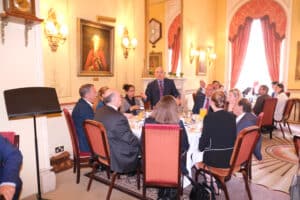
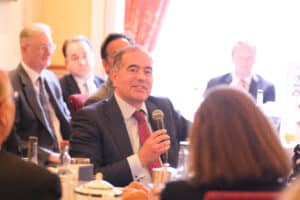
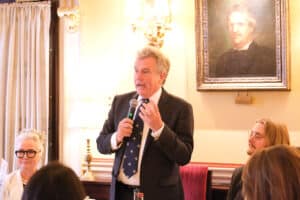
Finito friends and mentors were treated to breakfast at the East India Club and a morning talk by Conservative MP for Harlow, Robert Halfon. As the current Chair of the Education Select Committee, Halfon is always in a perfect position to discuss the best way to help young people looking forward. He has so far used his role to promote the importance of apprenticeships, and has often had some frank criticisms of Russell Group universities.
The finely decorated room made a suitable place for discussion, with its intricate moulding which frames ceiling and floor, and historic portraits dating back to the club’s foundation in 1849. Those in attendance included Finito CEO Ronel Lehmann, Baron Gold of Westcliff-on-Sea, Myles Stacey, the Special Advisor to the Prime Minister, Professor of Social Mobility at Exeter University Lee Elliot-Major, Chair of Capital Economics Roger Bootle, and numerous other high-profile business and thought leaders.
Finito Education welcome Robert Halfon, MP, Chair of the Education Select Committee, as a special guest of honour at a Finito business breakfast at The East India Club, St James, London. 29.6.2022 Photographer Sam Pearce
Amidst a turbulent time for national politics, Halfon accepted the gravity of the cost of living crisis affecting so many across the country. “One of the reasons why there’s so much anger is because of the cost of living,” Halfon explained. “The Chancellor of the Exchequer [at the time of the event the position was held by Rishi Sunak] has just spent £37 billion in terms of energy rebates and is providing up to £1,200 to 8 million vulnerable families. But the fact is people are struggling to afford to pay £2000 to £3000 on energy, even with the rebates. They can’t afford to drive to work. And that is the reality for millions of our countrymen and women.
Halfon was speaking not just as Chair of the Education Select Committee, but also as the popular MP for Harlow, and he repeatedly turned the conversation back to the issues facing his constituents. Though Halfon has often been tipped for frontline politics, and has launched numerous successful campaigns during his time in Westminster, the prevailing sense was of a man who has never forgotten the constituents and their concerns.
Halfon continued: “The second issue we face is that there is a view that government isn’t working. I mean you try to get a GP appointment, it’s virtually impossible. You try and get a passport. A constituent of mine paid £150 for a fast-track passport. They were told on the day before that they couldn’t get it, and they were told to refresh the website all the time as if they were trying to book an Ed Sheeran concert.”
Halfon spoke here not so much as a critic of the government but as a supportive voice who realises that all administrations are incomplete and that there is always more to do to support people who need that help. It was in this spirit that he raised an issue which has been close to his heart throughout his parliamentary career: “The fourth and final thing is social justice. Now I’m a conservative, I believe in the free market – and, of course, I believe in capitalism. But we haven’t mentioned the term ‘social justice’ as a party for quite a long time.”
Again, Halfon’s remarks were measured and he took the opportunity to give balance to his remarks: “The government does some very important things, most of which the public don’t know about, such as individual measures to help with domestic violence and to help troubled families – but we need to put forward a coherent narrative.”
Halfon argued that a major part of the social justice issue begins with education, and he continues to argue that Covid has damaged education at all levels greatly. He spoke movingly too about the role of chairing the Education Select Committee, one which he obviously relishes. “This is the best job I’ve ever had because I am privileged to hold a platform where I can effect real change for our children ,” he explained.
So what does he think needs to happen to ensure our young people are work-ready when the time comes? “We have three problems facing our education system. We’ve got the COVID deficit. I was passionately against school closures, and I campaigned against them from the beginning, day and night. I thought that it would destroy our children’s life chances, their mental health, their educational attainment, and create safeguarding hazards and that’s exactly what’s happened.”
Halfon is an important voice partly because he has such integrity: he is always a considered and passionate voice. He continued: “And with the social justice deficit, disadvantaged groups are just not doing well in the education system, and we have this perennial problem of education-based skills deficits. To be fair to the government, they have been doing a lot of good things in terms of the lifetime skills guarantee, the reforms to the Covid Catch-Up programme (based upon the Education Committee’s report), but I think we need a real debate on our national curriculum and whether it is fit for purpose in preparing students for the future world of work and the fourth industrial revolution.”
So what do we need to do? Halfon was clear: “It’s all about knowledge, knowledge, knowledge, and it should be about knowledge and skills. Why don’t we have a wider curriculum where we do a mixture of skills, knowledge, vocational and technical education all the way through, rather than just having the dividing line that we do at the moment? We’re doing an inquiry on that. So the Covid deficit, the skills deficit, and the social justice deficit. I would argue that those are real challenges facing education.”
There followed a lively and passionate Q&A. Neil Carmichael, who sits on the Finito advisory board, and previously held Halfon’s post, congratulated his successor on the work he is doing as Chair of the Education Select Committee. Carmichael agreed that the issues set out by Halfon all exist but questioned why economic productivity was left off the list.
Halfon responded: “The productivity answer for me is skills. And my first ever speech was about apprenticeships in the House of Commons in 2010. We need to do more – there are nine million adults in our country who are innumerate or illiterate. I mean, that is incredible. 6 million adults are not even qualified to level two. I do believe in the new Post-16 and Skills Act that has just passed, but we must change our curriculum, promote skills, and get more young people doing apprenticeships.”
There was an audible intake of breath when Sarah Findlay-Cobb, the CEO of the Landau Forte Academy, mentioned that her heatings bills for her schools had rocketed from £150,000 to over £1 million in the past year. It was a vivid indicator of the seriousness of the cost of living crisis and Halfon movingly expressed his sympathies.
This was a remarkable event which showed what can be achieved by a good-hearted man in Westminster. As Myles Stacey returned to Downing Street for his daily meeting with the then Prime Minister Boris Johnson he had much to relay.
Read MP Robert Halfon’s take on poetry in the national curriculum here
As I sat in the carriage of the train watching the Midlands countryside go by, I couldn’t believe how excited I was about my future. I had just spent the day having lunch as the guest of Finito Education in a private members’ club in London. Only a few months before, I could remember being anxious and worried about how my future would turn out.
A year or so earlier I had been working hard at school. My A-levels of Biology, Physics and Chemistry were aimed at getting me into a career in medicine, but for numerous reasons that turned out not to be the case. As a student at the Landau Forte College in Derby I, along with a small handful of other Upper Sixth Form students, were asked to attend a briefing on Finito Education. It was there I met Andy Inman, one of the mentors from Finito. He was there to describe the service that they give in mentoring and networking on behalf of their clients and mentees. Normal clients of Finito have to pay for this significant advantage in life, and here we were in an inner-city school in central Derby being offered the opportunity to become the first bursary mentees of Finito.
Knowing that it would be daft not to take the opportunity, I volunteered along with a number of my school friends and was later introduced to my first business mentor Robin Rose. He had been mentoring for many years, and he was very patient and kind while taking me through regular Zoom video call sessions explaining how recruitment would work as I left education. Robin set up a number of opportunities for me. However, because of distractions that I was facing at home I didn’t make the most of them. Sadly, one of my A-level grades meant that my aspirations for a career in Medicine were not going to happen, and floundering around a little I grasped the idea of becoming a pilot.
Finito works with a broad network of mentors, and because of my pilot career suggestion I was handed back to Andy Inman who had briefed me and several of my school friends a few months beforehand. He had 30 years’ experience as a military pilot, and over the course of several Zoom sessions he opened my eyes to the possibilities of becoming a pilot while also being realistic about the harsh realities involved in getting there, both financially and in how long it would need my concerted effort. He introduced me to several people, from the Senior Instructor at a local airfield to newly qualified pilots working towards airline jobs. He also put me in touch with the head of the Royal Air Force pilot training system at RAF Brize Norton. I was amazed at the breadth of the network that Finito was able to introduce me to, and even more so by the time and effort that those I was introduced to were willing to spend on helping me.
“Finito took time to work out what was making me tick.”
It was at this point that I really started to lose hope about what the future might hold for me. A serious medical condition as well as family disruption at home meant that I dropped out and stopped returning the calls from Andy. I remember the last message from him via WhatsApp saying he would give me some space for now, but the door would always remain open for getting back into the mentor scheme.
After a few months my home life became more stable and I decided it was important to re-engage with Finito, so I contacted Andy and asked if it would be possible to start afresh. It was clear from his response that he was delighted I was coming back to the fold, and we started regular chats about how to progress things while I was applying to go to Nottingham University later in the coming year.
Finito took time to work out what was making me tick. It was clear that I had an entrepreneurial spirit – a couple of years earlier I had made a successful business from selling sneakers online. I had a strong work ethic and Andy dug down into what I enjoyed, where my skills lay, and how that would fit into a future working career. I was shown how to craft emails to companies, how to conduct myself in an interview and how to best come across in a telephone call.
At the same time, the wider Finito system kicked into action. I was introduced to a professional CV writer who helped me craft the most amazing CV, and I was invited to London to have my photo taken by a professional photographer to put on that CV, all as part of the bursary scheme.
As part of that visit I was invited to lunch with Christopher Jackson, News Director at Finito, at the House of St Barnabas. The private members’ club is invested in creating a fair and equal society, but I was still nervous as I arrived. I remember looking at the door and thinking it was like something from Harry Potter. The interior certainly was; there were so many rooms it was like a maze, all with separate personalities and themes. I met Christopher in a lounge room near the garden. My hands were sweating, knowing this was another massive opportunity to gain knowledge and experience. We chose to start with lunch but only after he showed me around some of the different rooms.
I remember walking into a room that looked like a church hall, another that was warm with colours and paintings, and the corridors were narrow and brimming with art.
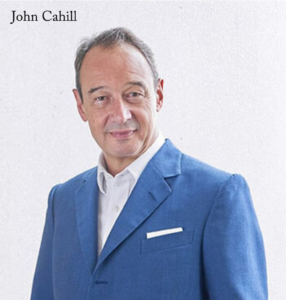
“I will be forever grateful to The Stewarts Foundation, and in particular its Chairman John Cahill.”
Everything was out of my norm – a peaceful professional environment that was not like anything I had experienced in my normal life in Derby. We arrived at the restaurant, a hall again adorned with art with polite guests and staff. Christopher asked me about my interests and where I see myself going with Finito. I was interested in his story too, and I learned about his experiences and work. After lunch Christopher walked me through the bustling streets of Central London back to the station. The weather was perfect, and as we walked and discussed more deeply each other’s stories, Christopher was drafting ideas in his head for experience placements for me. That day was more than just a trip to take photos. I was generously given the chance to see London, learn so many new things and create contacts with two lovely people at no personal expense – something that would never be possible without Finito.
It was from that meeting that Christopher approached a contact within his network, Daniel Whomes, the Chairman of the Oyster Partnership, who organised an interview for me to join the company for some work experience in the Summer. Recruitment wasn’t a career that I knew anything about, but it was the experience
and wider knowledge of the Finito mentors that married my salesmanship, entrepreneurial desires and my hard work ethic to the idea of becoming a recruitment consultant. Having just had the interview I’m delighted to report that I will be spending time with that company soon. The opportunities that I know this work experience will bring would not have been available to me without the help of the Finito Bursary scheme, and I will be forever grateful to The Stewarts Foundation, and in particular its Chairman John Cahill, for their financial contribution towards my work journey. I’m excited for what the future holds for me and will always know, wherever life takes me, that I received a life-changing opportunity just when I most needed it.