Category: Features

  • Why lifelong learning should never stop

    Why lifelong learning should never stop

    Stuart Thomson

    Too often when we think about lifelong learning, it applies only to those who have been in the workforce for some time.  The reality is that the learning journey should never stop.

    The apparent confusion about terms is partly a result of ‘lifelong learning’ being misapplied to cover only more established team members who need to update their skills or if someone needs to re-skill after losing their job.  But this is all too little, too late.

    Instead learning needs to become a fundamental part of any role from the very outset, from Day One, not simply ‘added in’ later when gaps start to appear. We must get away from the idea that learning ends, or is at best paused, after sixth form, an apprenticeship or university.  

    New employees are often subject to a world of initial training and induction to ensure that they are up-to-speed in the new role.  But once that initial period comes to an end then there is a danger of learning silence.  That person has had their allocated training and the employer moves onto the next new intake.

    Sometimes new employees are expected to impart their knowledge to more established members as a sort of quid pro quo for learning on the job. There is no doubt that such a practical element is essential but there is no guaranteeing that either party is particularly adept at helping the other.  So, it may be that something more structured and formal is required as well.

    It should not be a case of simply being thankful for whatever support you are given.  Instead, we should all be more demanding about the training options open to us, especially early on.  Problems often arise when there is a gap between an induction and then a return to training.  That gap must be filled.  The bigger the gap, the more there is to fill.

    The gap is what causes problems.  These will vary depending on the role but could include an unfamiliarity with current thinking or new technologies, or lacking the skills necessary to cope with a new challenge.

    Some employers will allocate funding or a learning budget per person but that does not always apply to everyone across an organisation.  Again, there can be an over-emphasis on more established team members.  This lack of equality across an organisation needs to be challenged.  Employers could also have a bigger role in communicating more about the potential options available.  It would make joining them even more attractive.

    But we also have a personal responsibility as well.  Even if funds are available then it is up to us to use them. That means being able to identify where our weaknesses are, what we need to improve and frankly how we can continue to get ahead of others as well (internally as well as externally).  We all need to challenge ourselves and ask how we can be a leader in our chosen field and what training support we need to achieve that.

    Looking at what others are doing and being inspired by them is a good starting point.  But also look through training brochures and check the courses available. Consider what your professional and trade bodies offer.  Maybe try and spend time with other teams in your own organisation as well.  The role of mentors too can be hugely helpful in helping identify what to address.

    There needn’t though always be a cost associated.  Many bodies offer free or low-cost options, especially to existing members.

    It doesn’t need to be all about you either.  If there is a common need across a team then employers could provide you all with something as it may be cost effective for them.  Certainly, that has been my experience when dealing with training on public affairs and reputation management issues.

    Teachers, lecturers, trainers of all types have a role in getting us into good habits focused on ongoing learning.  So too do employers.  But we must take responsibility and hold employers to account on training and remind them of the benefits – not least improved retention and loyalty.

    We need to beware of the emergence of learning gaps and think about lifelong learning as the truly continuous process it should be.

    The writer is Head of Public Affairs at BDB Pitmans

  • How to manage your budget when working abroad

    Patrick Crowder

    The lifestyle of the ‘digital nomad’ has become much more popular following the pandemic. Increased work from home infrastructure allows many to live a lifestyle that some see as idyllic – as digital nomads, many are working abroad anywhere with an internet connection, travel frequently, and often set your own hours, all while getting paid.

    Even for those lucky enough to be living out their travel-fuelled dreams, cost of living is hitting hard. William Russell, which provides insurance to people working abroad, has offered a few points of advice to stay afloat during difficult times.

    As inflation rises, many employers are becoming less generous with raises and benefits, so it may be worth considering taking other jobs on the side. If you work at a company which allows you to do so, freelancing and consultancy are great ways to diversify your income streams while still staying on the move. Freelance writing, for example, can be done from anywhere, and even things like teaching singing lessons can be achieved through Zoom meetings.

    Properly managing investments is also paramount to financial stability in uncertain times. Money kept in cash or savings accounts will not keep up with inflation, so smart investing is a good way to ensure that your money does not diminish in value, although with all investing there is risk involved.
    It is a good idea to reduce your cost of living. Obviously, extravagant spending should be avoided, but there are also less obvious ways to save. If you are spending in a foreign currency, make sure that you truly understand the value of that currency, and look out for fees attached to money transfers and everyday transactions. Around the house is also a great place to save, so cut down on energy usage and heating costs if possible.

    There are also a few other ways to protect yourself from unforeseen issues while abroad. International health insurance is a well-known way to help you avoid massive medical costs should something go wrong while you’re away from your home country, but it might be worth looking at your plan again to ensure that you are getting a good deal.

    William Cooper, Marketing Director at William Russell emphasises the importance of international health insurance when working abroad.

    “Starting a new life overseas can be deeply rewarding but is not without its challenges,” Cooper says, “If you don’t have the right health insurance abroad, the cost of medical treatment abroad can be enormously expensive: for example, according to the Association of British Insurers, you could face a US$124,000 bill for treating a fractured spine in Thailand or US$74,000 for a hospital stay following a road accident in Spain.”

    In a time when many people are living paycheque to paycheque, it is important to be prepared in the case that your income streams are interrupted. Global income protection can pay up to 80% of your salary if a medical situation arises which renders you unable to work while abroad, however you must sure that the protection you would receive is worth the cost.


    Read our report on how work is changing and moving away from the office here

  • Dream jobs around the world

    Patrick Crowder

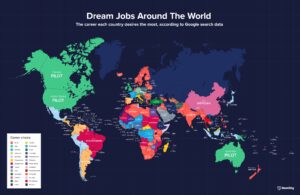
    What’s your dream job? It’s a question asked of most everyone, and often from a very young age. An individual’s goals and aspirations often change over time, so it is always important to keep one’s mind and options open. However, if you have a dream, there is nothing stopping you from finding out if it’s truly the right choice for you. A study from Remitly, which provides financial services for immigrants, has revealed the jobs held in highest regard by people around the world. With almost 1 million Google searches per year, becoming a pilot is the world’s top dream job.

    In most English-speaking countries, the top listed dream career is to become a pilot. By analysing Google search data, Remitly found that people in the UK, the US, Canada, Ireland and Australia are most curious about the difficult, rewarding, and highly regarded professions in the aviation sector. 20 additional countries are also interested in taking to the sky, including Cyprus, Moldova, Papua New Guinea, and Montenegro. High pay and frequent travel are likely factors driving this interest, not to mention the fact that pilots often receive generous pensions and benefits.

    Dream Job Map

    Image from Remitly

    The second most desired job worldwide is that of a writer. In general, a career in the arts is a popular dream job choice, with dancing and acting also ranking highly on the list. All of the Nordic countries show the most interest in writing for a living, as do Estonia, Latvia, and Lithuania. India, Pakistan, Myanmar, Bhutan, and Bangladesh all list writing as their top dream job, and a number of African countries including Kenya, Tanzania, and South Africa did the same. The freedom which a career in writing offers is unparalleled as it is often a career which can be built from home. Following the pandemic, we have seen an increased emphasis on job enjoyment, flexibility, and creativity, and a career in writing holds the unique position of offering all three.

    In addition to the more traditional creative careers, the new-age offerings of youtuber, influencer, and programmer were also represented. Mexico, Peru, Bolivia, Uruguay, and Chile place YouTube as their top dream career choice, as do Slovakia, Indonesia, and the Czech Republic. Columbia, Venezuela, Argentina, and the Dominican Republic are among the countries who chose the more general career of influencer, reflecting the growing number of non-YouTube platforms rising to prominence, including Twitch and TikTok.

    Jago McKenzie, Business Management Director at Remitly, says that the trends reflected by the study are consistent with his expectations.

    “People are getting used to the idea of changing careers at least once in their lifetime as the flexibility to work online and retrain increases. Some of the main reasons people seek a career move are for better work-life balance, higher pay and a more meaningful and fulfilling career. With that in mind, I wasn’t surprised to see so many people around the world showing clear search intent for a change,” McKenzie says, “We can see a huge range of different professions featuring prominently, including many that can be done solely online, from anywhere in the world. It’s clear that our desire for travel and exploration has not been dimmed by the past couple of years and, despite it being a tough time for the aviation industry, becoming a pilot remains a much sought-after lifestyle.”

    Whatever your dream may be, all is achievable with the right amount of dedication and tenacity. Of course, having a network of people to help you along the way is also a major boon to success, so always be on the lookout for mentors. Finito World wishes you the best of luck on your journey.

  • An Inside Look at the Changing Chess Industry

    In this special report, Finito World’s Patrick Crowder examines the post-pandemic chess world, from local clubs to the world’s largest chess website.

    Like many, I started playing chess during the lockdowns to break the monotony of endless media consumption and to give my brain something to do other than worry and slowly rot away. Here at Finito World, we believe that important lessons can often come from unlikely sources. Chess isn’t only something to learn, it is something to learn from. Chess teaches to deal with and learn from failure, to teach compassionately, and trains concentration. It is also a rapidly expanding industry which is brimming with possibility for those who decide to take the plunge.

    Lately, chess has gone out of the chess pages into the entertainment and even the front pages. Of course, there was the Queen’s Gambit which brought the sport – if in fact it could be called a sport – onto people’s radar, and then there was the cheating scandal which led to the lawsuit between Magnus Carlsen and Hans Niemann. This is all very interesting, but the bigger question is “Can chess be a career?” World famous chess player Hikaru Nakamura would certainly say yes, as he makes a very good living not only by playing in tournaments but also by streaming chess-related content on Twitch. For truly great players, there is quite a bit of money to be made from tournaments alone. Chess.com awards $20,000 in prizes every weekend, $1M in the global championship, and every Tuesday sees $5,000 in total prizes as part of the Titled Tuesdays event. In-person events such as the Sinquefield Cup also have prizes in the high six-digit range. Chess is often seen as one of those routes in life which you find yourself in because the game came unusually naturally from a young age. However, there are now more jobs out there than you might think, and you don’t need to be a grandmaster to get in on the action.

    Battersea Chess Club

    chess

    Magnus Carlsen and Hikaru Nakamura, Maria Emelianova/Chess.com

    Other than a few games with friends I had never played over the board, so I was eager to see what attending an actual chess club was all about. I am not a very good player (about 900 ELO if anyone’s curious) and I feared that the environment may be unwelcoming, but after a Tuesday evening at Battersea Chess Club, I realised my worries were misplaced.

    Leon Watson is fully immersed in both the online and in person, or over-the-board (OTB) chess worlds. He serves both as Secretary of the Battersea Chess Club and as Head of PR for world champion Magnus Carlsen’s online chess teaching venture Play Magnus Group.

    “We are one of the biggest chess clubs in London, and one of the oldest chess clubs in London. We formed in 1885, and we’ve been a fixture in the community for all that time. We’ve survived two World Wars, a World Cup, and we continue going to this day. Even through the World Wars we carried on playing,” Watson says, “We cater to everyone from casual players to very serious players, from beginners to grandmasters. We’ve got members ranging from age seven to 92, and these people are all from different backgrounds. Some members are really struggling in life, and others are high-flying city bankers. That’s what’s great about chess; It doesn’t matter what age you are, your background or your gender, it’s a game where you can come in, sit down, have a pint or an orange juice, and just have some fun or take it seriously. It’s up to you,” Watson says.

    Both myself and my opponents that evening took the “just have some fun” approach, and there was never a hint of pretension or ego. I relate this experience not for the purposes of self-insertion, but to describe the great benefits of trying new things which require concentration in unfamiliar environments. The confidence required to walk in cold to a chess club surely exercises the same parts of the brain as a job interview, and the carefully considered strategy required to play the game itself represents a meditative disconnection from the outside world that is becoming ever harder to find in our busy lives. Watson too has seen the benefits that chess can bring, both to himself and his family.

    “There are lots of benefits to chess. Of course there is the social aspect, but there are also claims that chess is very good for educational reasons. I’m not an educational specialist, but I personally find it very helpful for learning to focus and concentrate on things, and that helps me in life. I also have a seven-year-old son who’s learning chess, and I feel like it is helping him focus… hopefully on his schoolwork! A grandmaster has lost more games of chess than I’ll ever play in my life, but the thing about chess is that you can take a game that you’ve lost, analyse it, look at your mistakes and make sure you don’t make them again. I think that’s a great lesson for life, and as a dad I hope that I can impress that upon my kids,” Watson says.

    Helping people make the transition from playing online to over-the-board is something that the kind folks at Battersea Chess Club excel at. Though new OTB players must learn how a chess clock works and remember not to touch a piece unless they plan to move it, the game itself is of course unchanged. The experience, however, changes greatly. You can play slow, contemplative chess online, but it is much easier to do so if your opponent is in front of you and your environment is free from distraction. Online games are excellent for practicing faster time controls, and online game analysis is an indispensable tool for improvement, but the social and mental benefits of OTB chess are far more applicable to daily life, from the experience of this author.

    The Online Effect

    Chess, Hikaru Nakamura

    Hikaru Nakamura, Maria Emelianova/Chess.com

    Since the dawn of the internet, people have wanted to play chess online. There have been many interesting offerings which provide this service, including caissa.com, chess24, the fully free site Lichess, and play-by-email options dating back to the 1970s. Now, Chess.com is the most popular chess website in the world.

    Chess.com has been instrumental in the growth of chess. The website, which first started in 2005, is now a massive business which holds the title of the largest chess website. International Master Danny Rensch helped found Chess.com. As someone with experience both playing and teaching chess, he realised the potential for a website which combined chess training, casual play, and tournaments which would attract the strongest players from around the world.

    “I learned to play when I was 10 and I was quickly made aware that I had a knack for the game, and I got good very quickly. Knowing what I know now about the levels of chess, it’s not necessarily fair to say I was some sort of child prodigy, but I was definitely one of the best players in the US at one point,” Rensch says, “At around the age of 19 I had some health problems and was kind of forced to stop playing and travelling, which turned out to be a really important, pivotal crossroads in my life. I jumped all-in to running a chess teaching business in Arizona where I’m from, which was an after school scholastic enrichment programme. It was sort of the traditional professional chess player’s gambit at the time.”

    Teaching chess is an extremely common way for professional chess players to monetise their talents, and now online teaching has become the norm. With the Queen’s Gambit came millions of people new to the game who were eager to improve. Rensch has found that the best teachers seek to understand how their students think rather than focusing solely on accuracy and rote memorisation.

    “I think honesty without tact can at times be cruel or disingenuous, and then at the same time explanation without understanding of whether someone can digest the information is also not useful. You have to have an appreciation for what the next steps are for someone’s learning process rather than just saying the answer, because anyone can understand the answer to an algebraic or calculus equation in the back of the book, but your ability to solve it is a muscle that you build along the way. I think you have to focus on it more as a language than simply a problem that you expect someone to solve. You don’t expect someone to read before they understand how to sound out letters and syllables and vowels and put them together, right? People always approach chess as a thing for people with brilliant IQs as if it’s an unsolvable problem, which it is, in many ways, but the core of being a good chess player is about pattern recognition. You can’t expect people to see patterns that are complex before they see basic patterns. I think a good teacher appreciates the need to reach someone at their level of understanding and cares more about them taking the next step in their learning process than they do about whether they’re ultimately right,” Rensch says.

    This understanding of what it takes to teach effectively can be translated to life outside of chess, of course. Compassion and understanding are hallmark traits of a good educator in any field, and Rensch realised in the relatively early days of the internet that this teaching style could be delivered to a far wider audience online than in person. Rensch’s vision led him to look into online options, and through a chance encounter, to the very start of Chess.com.

    “I was running this chess teaching business and putting most of my energy into that rather than travelling due to my health problems, but then the internet happened. The world was changing rapidly before our eyes, and I think I quickly saw the internet in terms of what it could be for chess in a non-traditional sense. I was immediately looking to build an online chess business, so having learned about SEO and keyword optimisation I went to get the domain name ‘Chess.com’. And there, like ships in the night, I found that my eventual business partners and co-founders Erik and Jay had just acquired the domain name out of bankruptcy in the Bay Area,” Rensch says, “Their vision for chess.com was to be the MySpace of chess, and my vision was for it to be a place for professionals to coach and to teach, as well as a place for tournaments. When I came on board, within about a year after launching I was always pushing things in this direction, and that’s why when Erik, Jay and I talk about it I’m considered an honorary co-founder.”

    Now, Chess.com is a platform which allows people to play, teach, communicate, and entertain. Before platforms like it existed, the only way to enter the chess world was to attend a chess club or read chess publications to improve your game. Without a large emphasis on chess in the US, Bobby Fischer’s rise to fame and eventually the World Champion title was unprecedented. It also came at a time when chess was highly politicised. The 1972 World Chess Championship wasn’t merely a game between two men, Bobby Fischer and Boris Spassky, it was a battle between the US and the Soviet Union. Fischer’s success was attributed to the mind of a prodigy, a rare chess genius who was born in America, but intelligence and prodigy are spread across all nations. Now, the accessibility of the chess world is beginning to allow these prodigies who would otherwise be unknown to reach their full potential.

    “Traditionally, before online chess existed, if you didn’t have a very rich chess culture in your backyard, you had no chance of developing into a world’s top player. Even Bobby Fischer was in New York – Greenwich Village and the Marshall Chess Club were a block away from where he lived – and so he grew up around the best of chess in the US at the time. There’s a reason that all of history has seen dominance by Soviet chess players. And I say Soviet because it’s not just Russia, it’s all former Soviet states. At the peak of the regime chess was a state sponsored sport throughout all of these countries, which is why until Bobby Fischer you saw only Soviet world champions. Since Bobby Fischer we had Kasparov and Karpov, and they were great players, but since then we’ve had Viswanathan Anandfrom India, we’ve had Magnus Carlsen from Norway, and I would say that we are on the verge of potentially having a Chinese World Champion in Ding Liren. But regardless of the label of world champion, what we have are prodigies rising from all over the world because of their access to the best chess players. What’s happening online is actually changing the game,” Rensch says.

    Chess coaching was, and still is, a major way for players to earn enough money to compete, but now online tournaments also offer that chance. As we will explore later, this has led to some significant challenges in terms of ensuring fairness. Rensch is confident in Chess.com’s robust anti-cheat methods and explains how the good that these tournaments bring outweighs the risk of misconduct.

    “Just to talk directly about the elephant in the room in terms of anti-cheating and the scandals that currently face the chess world, people don’t know that we’ve been dealing with scandals effectively and appropriately,” Rensch says, “It has allowed us to continue to invest and increase the money that’s in the game, and therefore the opportunities for professionals and therefore the livelihood of coaches, and who knows what trickle effect that’s having downstream on the next generation.”

    The Rise of Chess Entertainment

    Chess, Danny Rensch

    Daniel Rensch, Daniel Rensch’s personal collection

    The sudden, massive interest in chess following the Queen’s Gambit formed an unlikely link between the worlds of chess and e-sports, and the pandemic ensured a captive audience. Now, chess streaming is a multi-million-pound industry which is only growing. Grandmaster Hikaru Nakamura, who is one of the best players in the world, streams on Twitch, interacting with fans and providing funny, insightful commentary. International Master Levy Rozman, who goes by GothamChess online, has provided countless free lessons on YouTube and frequently streams games, and reviews the games of his followers. The Botez sisters, IM Eric Rosen, and many more have become stars of the chess world, both for their skill on the chessboard and through their engaging personalities. Not only is online streaming a way for people to interact with top chess players like never before, it is also yet another way to make money in a field where it was once so difficult. Danny Rensch believes chess streaming’s influence goes beyond mere entertainment.

    “I think chess players are approaching the game in a much more social way, not just online but because the community has grown,” Rensch says, “I would say that’s another reason why technology has been so good for chess, because it’s brought these communities together. Chess has merged communities that existed locally in pockets all around the world. You had the Detroit chess community and the Moscow chess community. Well, guess what? Now you can actually see them online together at the same time, sometimes on camera with a grandmaster from Michigan playing against a grandmaster from Russia. And there’s something really cool and unique and challenging about that, and it’s pushing people’s stereotypes of chess players.”

    At first glance, there is something slightly surreal about seeing the Twitch stream format applied to chess. Watching streamers yell into their microphones, fully hyped up about what many consider to be a quiet, dignified game has an element of the absurd to it, but on closer examination, it’s really not that strange. Twitch streaming is one of the main forms of next-generation content taking hold today, and many young people are interested in chess, so the marriage of the two is simply a natural progression. What is unique about streaming chess is that you don’t have to be a master at the game. It certainly helps, but there are plenty of streamers who have a relatively low rating – it’s their personality and ability to entertain which keeps people watching, not their skill. For the first time ever there is a way to make money and gain popularity from chess without teaching lessons or playing major tournaments, and it is a new industry begging for further exploration.

    The Prodigy’s Gambit

    If you’ve seen chess in the headlines recently, that’s probably the doing of Grandmaster Hans Niemann. In what has become the biggest story to hit the chess world in many years, the major cheating scandal involving a $100m lawsuit against top players and Chess.com has taken many turns and is at the time of writing unresolved.

    Hans Niemann is a 19-year-old chess player who has shown unrivalled skill and progression. He achieved the title of Grandmaster at only 17, and he has since gone on to perform well in top-level competitions against other extremely highly rated players. The scandal began when Niemann beat current World Champion Magnus Carlsen in the prestigious Sinquefield Cup tournament, breaking Carlsen’s 53-game winning streak. Even more remarkably, Niemann beat Carlsen while playing with the black pieces, putting him at a disadvantage as the player with the white pieces makes the first move. During Niemann and Carlsen’s matchup the next day, Carlsen made one move against Niemann then resigned and withdrew from the tournament. This led to wild speculation online and prompted Carlsen to author a Tweet which implied he was in “big trouble” if he spoke out.

    Niemann admitted to cheating in his chess career while playing online, once when he was 12 and multiple times when he was 16 to grow his online streaming career, but he insists that he has never cheated in an OTB game, and that he does not cheat now. This was already known at the time of the Niemann-Magnus scandal, but it prompted a further review by Chess.com, analysing Niemann’s games on the website for signs of irregularity. Niemann’s Chess.com account was closed, and he was banned from competing in the upcoming Chess.com Global Championship before the release of a damning report which asserted that he had cheated over 100 times on the website. The alleged online cheating occurred in games against other top players, while Niemann was streaming his games, and in events with large prizes attached to them. The report was careful to point out that Chess.com had no concrete evidence of any cheating OTB at the Sinquefield Cup, and stressed that Carlsen’s team had not pressured them to take action against Niemann.

    On October 20th, 2022, Niemann filed a $100m defamation lawsuit against Magnus Carlsen, Chess.com, and Magnus Carlsen. Describing “devastating damages that Defendants have inflicted upon his reputation, career, and life by egregiously defaming him and unlawfully colluding to blacklist him from the profession to which he has dedicated his life,” Niemann seeks damages and vindication for what he sees as a massive attack on his livelihood. It is unclear what will be proven should the case go to court, but top players have predicted that finding evidence of cheating will be extremely difficult.
    Many media outlets have reported that cheating represents an existential threat to chess, but chess experts insist that cheating is not as prevalent as reported. Large-scale cheating would threaten the sport, however online cheating is already fairly easy to detect, so it is far more likely that we will see higher security measures and new methods of cheat detection at OTB tournaments. These could include a time-delay between live play and broadcast, which would make it difficult to run chess positions through an engine in real time, and it is also possible that players could compete in a Faraday cage which eliminates cellular and radio frequencies.

    Despite the drama, it is clear that chess is here to stay. The game which has fascinated mankind for over 1500 years continues to do so today, and there is clearly a reason why people keep playing. The mental and social benefits of chess cannot be ignored, and as an industry it shows massive room for growth. The new horizons of online streaming, teaching, and playing allows the game to be accessible to anyone with an internet connection, and chess entertainment has proved to be an excellent way to monetise a love of chess and the talent of charismatic presentation. The world of chess is very much worth diving into, and the breadth of opportunities available is surprising, so if you think chess could be for you or you think you might want to return to the game after many years away, there’s only one thing to say: your move.

  • Report shows best way to approach mentorship, and why it is crucial to success

    Patrick Crowder

    Mentorship is a practice which dates back to the beginning of human relationships, and it is an intrinsic part of how people learn, make connections, and thrive in the workplace. However, mentoring is often overlooked as a ‘tick-box’ exercise with no real value. A new report from the HR tech company MyKindaFuture shows the state of mentoring, and proves its importance, especially in the current job market.

    This is a time of major change for many workers, with a large amount of people leaving their current companies following the pandemic. The report shows that under one third of UK employees feel that they fully belong at their current company, and of those who feel they don’t fit, 80% are considering resigning to pursue a different role within the next year.

    Large career shifts which can affect your work-life balance, stress levels and ultimately your livelihood are often scary, but with the help of a trusted mentor who has been through the process before many of these fears can be alleviated. Will Akerman, who founded MyKindaFuture, explains the issue with current mentoring practices.

    “Although many mentoring programmes exist, the majority remain ineffective, undervalued and underrepresented,” Akerman says, “When implemented properly and with purpose, mentoring is a crucial tool in boosting employee engagement, progression, and retention.”

    Despite mentoring’s clear contributions towards success, only 37% of UK professionals have a mentor. The younger generation understands the importance of effective mentoring, with 79% of Millennials surveyed stating that mentorship is ‘crucial to success’. And they’re right – people with mentors are five times more likely to be promoted than those without a mentor.

    It is known and accepted that mentoring is an extremely valuable tool, but how can it be done effectively within a business? The report outlines a few key points to take into account when considering mentorship. Setting clear objectives and expectations surrounding communication, matching mentors to mentees with shared values, and measuring the outcomes of a mentoring programme are all ways to improve the effectiveness of mentorship.

    The report also suggests that mentoring programmes most often fail due to lack of clarity, poor matching of mentor and mentee, lack of personal choice in the mentorship process, and the use of a mentoring scheme to reinforce company culture with no room for flexibility. Many mentorship programmes are effective, but Akerman believes that more employers must start taking mentoring seriously.

    “Employers cannot continue to view mentoring as a simple tick-box exercise,” Ackerman says, adding that, if done well, mentoring “can directly benefit a business’ bottom line.”

    Credit: https://www.mykindafuture.com

  • The highest paying travel-based jobs

    Patrick Crowder

    For many people, getting paid to travel is the dream. For many, it also seems unattainable, but that isn’t necessarily the case. While some travel-friendly jobs are quite obvious, others fly under the radar, so we’re taking a look at research from Absolute Digital Media (ADM) which shows top roles for the aspiring jetsetter.

    The highest-paying profession which involves travel is architecture. Architects earn £43,729 per year on average, according to ADM. Not all architecture jobs require or even allow for travel, and many are office based. However, the nature of the profession means that there are roles available in overseas construction monitoring, on-site design, and other overseas roles. While architecture is no guaranteed ticket to travel, the roles are out there if you look for them.

    The nice thing about being a qualified bartender is that, largely, the work doesn’t change no matter where you go. Sure, some countries will have different license requirements and regulations, but at the end of the day it comes down to mixology, people skills, and common sense. Bartenders in Australia make around £31,947 per year, so that is a common destination for qualified mixologists looking to live abroad. In the US, bartenders can make up to $28 per hour. Of course, there are bartending roles in nearly every country, so the options are plenty and the final choice of country will come down to personal preference and experience.

    There are a few obvious choices when it comes to travel jobs, but that does not mean that these options are any less attainable for those looking to escape the desk. One (which is fairly close to home for this writer) is journalism. Journalism, depending on publication and reach, can take you all over the world meeting interesting people and having irreplicable experiences all while getting paid for it. Journalism is by no means an easy job, but whether your expertise is in radio, film, research, or the written word, there are probably travel opportunities in your future. Journalists earn £25,910 per year on average.

    Cruise ship staff, Event Planners, Freelance Travel Photographers, and Flight Attendants also live lives full of travel, and they all make somewhere between £23,000 and £25,000 per year. It all comes down to where an applicant’s strengths lie; Some people are made for freelance work, while others prefer the structure of working for a company. Some people love planning events and networking with people, while others prefer solitary, self-dependant work. Some people are terrified of flying, and even more have rough stomachs on the water. With the wide variety of roles available, the choice is yours, so be aware that getting paid to travel can be much more than a daydream.

    Source: https://absolute.digital

  • HR advice from Uber’s Amee Parekh

    Patrick Crowder

    Amee Parekh has had an extremely successful career since she graduated from the University of Mumbai in 2005. She worked at IBM in software engineering roles for three years before attending Cornell, making the switch to HR, and going on to work for Expedia. She is now Head of HR for Uber Freight and Finance. We talked with her to find out her views on the best ways to succeed within the industry, the value of quality HR, and gender equality in the workplace.

    “I grew up in India where I did my engineering work, and in India HR is actually an immensely hot function. It’s almost like how software engineering is in the US or how tech is in other countries,” Parekh says, “HR is very precious because a lot of companies over there are very high growth, so they really need HR to supercharge their hiring, train people in new skills, and manage a staff of thousands.”

    Parekh was aware of how many opportunities in HR were out there, but she truly became interested in the field while working as a software engineer.

    “On one of my first projects I happened to be working with the HR team building an internal portal, and through that I got a close-up look at the amazing job they were doing with hiring and how they were truly driving an impact on the business. That’s what motivated me to seriously consider this as a career.”

    Parekh then applied to a wide range of Master’s programmes in the US at top universities, and got accepted to every single one. She chose Cornell University because of their top-ranked HR programme. Much has been written about the best ways to get into top schools – unique experiences, volunteering, sports, etc. – but Parekh took the traditional but difficult approach of pure academic excellence.

    “I know universities want all of these extracurricular activities, but I think universities in the US also value academics a lot, so my undergrad was very useful,” she recalls, “My scores were very strong all throughout school. I was very much a geeky or nerdy student growing up, and even in high school I was taking advanced physics and maths.”

    But what about outside of education? After graduating from Cornell, she says that finding employment opportunities was not difficult. For many, the guiding hand from study to work may take the form of a mentor who can advise on career opportunities and help people find their way into the corporate world. For Parekh, her career boost came more from the bosses she worked with than from any other source of advice.

    “I have been able to grow and succeed in my career because I have had two or three managers who have truly believed in me,” Parekh says, “One manager at Expedia helped me by doing two major things; pushing me into difficult challenges and providing amazing feedback.” She adds, “The kind of feedback I received from him was transformational for me, and I think that can only come from a boss who is much closer to your work than an outside mentor.”

    Parekh has succeeded through a lot of hard work and intense study and breaking into the world of top-level HR can often take years. We asked her what traits she thinks are essential in a good HR officer.

    “Business acumen is a crucial trait, because there are thousands of HR initiatives and you can be aware of the framework of it, but what makes one HR professional far better than others is an understanding of the business where they can advise the CEO, ‘because of where the business is, we should do X, Y, and Z’. If you can do that as an HR professional, that’s where the magic comes,” Parekh says, “Having a good sense of quantitative abilities is also very useful, because business is all numbers. Even if an HR professional doesn’t come from a data background, I think that is an area which is worth investing in and learning about.”

    Gender and racial inequality in the workplace has come a long way in recent years, but it is by no means perfect. Parekh has three children and a top-level position, which shatters what she describes as the typical perception.

    “My experience has been very positive, but I cannot say that reflects every woman’s experience. I think it’s come through a lot of hard work – people are aware that I outwork everybody else,” Parekh says, “But if I tell people without any context that I have three kids, there’s an assumption that I won’t be able to put as much time in as other employees. There is an expectation there, and that’s why you have to break it every time.”

    In a parting message to the industry, Parekh says, “Try it out. Hire a few female leaders and see how things go. Conversation isn’t enough, you have to actually put women in these roles, then you can see the advantages.”

  • Victoria Bream: Maternal anxiety, mental health, and the economy

    VIctoria Bream 

    Victoria Bream, alongside Catherine Green and Fiona Challacombe, have authored “Break free from maternal anxiety: A Self-Help Guide for Pregnancy, Birth and the First Postnatal Year”. Bream is an experienced psychotherapist, and here she shares her thoughts on maternal anxiety, effective treatment, and why supporting mental health is good for the economy.

    Cognitive behavioural therapy is the form of psychotherapy I’m an expert in, and CBT is very popular these days. It’s based on a scientific understanding of how things like anxiety and depression work. It is about using evidence-based techniques and models to help work with people, as opposed to some of the other forms of psychotherapy that are more reflective, or more about the relationship between the therapist and their patient. It’s very problem focused, and it’s short term as well; you don’t usually do CBT for years, you do it for weeks with defined problems and goals.

    The three of us who are the authors of the book have worked with people using CBT to treat anxiety disorders for quite a long time now. What we’ve all seen over the years is that people in the perinatal period (whilst pregnant and within the first year of that infant’s life) can be quite often affected by the enormous ups and downs of the processes of pregnancy, birth, and raising an infant. Whilst there’s really good recognition and treatment of postnatal depression, anxiety disorders are more common, and people aren’t always receiving the treatment that they need. There are very effective treatments that can work quite quickly and can be quite focused, but it’s sometimes difficult for people to access these treatments or for these treatments to be delivered effectively in that perinatal period.

    Maternal anxiety can manifest in a number of ways. It can mean people being very preoccupied about their health or the health of the baby, which is obviously understandable. Everyone’s somewhat preoccupied with that, but those with maternal anxiety are really preoccupied with that, and they’ll take lots and lots of precautions to try and avoid anything that might pose any potential danger. Whilst it’s obviously typical, understandable, and definitely not preventable to feel anxious and worried at some point in pregnancy and around the time of birth, maternal anxiety is when it actually becomes a distressing, time consuming problem where the person is feeling anxious, worried, or frightened a lot of the time.

    Some women have more specific problems than that, such as a blood injury phobia. They’re very worried about needles and blood tests which can sometimes prevent them from accessing the antenatal care that they need, because they’re so terrified of having blood tests that they might even try and avoid them which can obviously have an impact on their own well-being and cause difficulties. Some women might have had a very traumatic birth with a previous pregnancy and then have PTSD related to that birth, and that can then be retriggered by being pregnant and the prospect of giving birth again. The specific symptoms or phobias can be any number of different things.

    We know that if people are experiencing anxiety disorders then it can lead to unemployment, or not being able to go back into retraining, and we know that for women the process of pregnancy can be a discontinuity in one’s career. Also, if employers aren’t supportive, or the organisation isn’t set up to accommodate more flexible working or make provisions for childcare, then for a lot of people it’s both economically and emotionally unacceptable to return to work. About 15 years ago Lord Layard wrote The Layard Report which revolutionised mental health services because it was an economic argument. If you get more people effective mental health treatment you get people back into employment and you stop people from losing their jobs. An investment in mental health services pays off for everybody in terms of emotional well-being and reduction of suicide and awful things like that, but also people being able to continue with their paid employment. That report led to the improvement of access to psychological therapies and a mental health revolution in this country. Since then, we’ve seen a lot more people trained in CBT and it is now something that a lot of people can access, both in the perinatal period but also just across the lifespan. It is remarkable to be able to have mental health services that are accessible to so many people and use evidence-based techniques.

    We must continue to invest in accessible mental health services for everyone. For any parent who is suffering from anxiety or depression we have really effective, powerful treatments that are available through the NHS – we just need to make sure they are available to everybody when they need them so that people aren’t stuck on waiting lists or living in an area where the services aren’t quite up to strength. It is vital in our universal health care system that everybody can access mental health services when they need them.

  • That humorous feeling: how much comedy in the workplace is too much?

    That humorous feeling: how much comedy in the workplace is too much?

    The witty can sometimes prosper in the workplace, but take it too far and you may have a problem, writes Lana Woolf

    Stephen Fry once said of the great Peter Cook that he was never unfunny, never ‘off ’. When Finito World caught up with the legendary comedian – and great friend of Cook – John Cleese earlier in the year, we asked him what he thought of Finito, and he showed us that he, too, never turns off the taps.

    When we told him about our mentoring programs, he was immediate: ‘It’s a very decent thing to do. I’ve heard of a finishing school – and I know Finito is Italian for finished because I eat a lot of Italian food – and I finish it all. But I’ve never heard of a finished school.’

    While we were laughing he was continuing, ‘I have heard of Finnish schools but they’re something quite different.’


    The Monty Python and A Fish Called Wanda star went on to share some advice as to how to forge a happy career. He quotes American comedian George Burns as saying: ‘If you do something you love, then you don’t have to do a day’s work for the rest of your life.’

    Wise advice, but our encounter with Cleese also had us thinking about an implied lesson that may be as important: what role does humor play in the workplace?

    Well, success in life can sometimes be attributed to ability to get on with people, and that is always to do an appreciation of nuance, which usually goes hand in hand with an ability to navigate intricate situations. The amusing are often, though not always, empathetic.

    Sometimes this proposition can have vivid illustrations. It was Jerry Seinfeld who observed that in US Presidential races it is an unwritten law of politics that the funnier candidate always wins. Obama was always funnier than Romney or John McCain; George Bush Jr. was funnier than Al Gore or John Kerry; Ronald Reagan was funnier than Jimmy Carter or Walter Mondale. Clinching for the theory, Donald Trump Jr. was demonstrably funnier than Hillary Rodham Clinton.

    But does this translate in the same way in the workplace, which is a less performativity space than electoral politics? Part of the force of a personality like, for instance, Sir Martin Sorrell derives from the sense that he might at any moment bark with delighted laughter even at a difficulty.

    Pat Thompson is the founder and managing director of Thompson Dunn, a central London-based psychologists’ firm. For 30 years Thompson has worked with CEOs on organizational culture and creativity in business: ‘I used to deal with delinquent adolescents and then went onto work for Michael Page selecting senior executives. I was once asked: ‘What’s the difference between a delinquent adolescent and a CEO. I replied: “Pinstriped trousers”.’

    The jury is out on how funny this is, but Thompson is arguing that humor is a way of making a ‘a difficult truth say able’. It is a form of smoothing – of moving the dialogue forwards in a way that we might miss if we proceeded solely in an earnest register. When asked about humor’s wider role, Thompson offers a two-word THAT HUMOROUS FEELING answer which dovetails with my own experience of office life: ‘Stress release.’

    A joke, said Nietzsche, is ‘an epigram on a death of a feeling’: the power of comedy is that it discharges feeling which had been accruing by admitting to that feeling and thereby ousting it.

    However, Thompson has a cautionary word about taking things too far, warning against becoming an office prankster à la David Brent in The Office. She also explains that one’s relationship to humor will depend on the tenor of the organization you work for. This can be challenging for women, she explains, recalling how ‘humor in the City was a darker shade of blue in a male-oriented environment. Women are often the butt of a joke and you have to cope with it. In financial services, you have to develop a thicker skin.’

    Moving on up: can a sense of humor lead to swifter promotion?

    Liam Williams is a professional comedian known for Sheep’s and Lad hood and the now the author of a brilliant debut novel Homes and Experiences. So what led him towards his career? ‘In the workplace, I’ve never known where the line is, and I was drawn to being a professional comedian because you are necessitated to go over that line.’

    Did he enjoy: ‘I found that having a laugh with my colleagues was the only thing that got me through the less fulfilling aspects of the job. Obviously, you don’t want to be like David Brent in The Office and you need to find a happy medium between not being too buttoned-up and boring, and not being the idiot with the Homer Simpson tie.’

    He notes that much humor comes from ‘absurd corporate language. This twee idea of ‘We’re all a family” – of language that comes down from on high and doesn’t mean anything to us. There’s so much euphemism.’

    Employers, then, must be careful not to alienate their employees with language that doesn’t match their real experience. A recent podcast produced by Fair Acre Press called ‘Word Bin’ invited participants to choose their preferred word to bin. A huge number of the choices related to corporate culture: normalcy, incentivize, optimized, moving forward, thinking out of the box, reach out/ reaching out, cascading down, time urgent, upgrade, inputting and solutions.

    Nadia Kingsley, the founder of the podcast, told us: ‘I was surprised at how passionately people wanted to bin some corporate speak. Having never worked in an office myself it was a real eye-opener. Some of the binning’s reveal something more than ridiculous management speak – but the old-fashioned hierarchy. For instance, the phrase ‘cascading down’, refers to minions who aren’t good enough to actually go to the conference but are given a version of it by someone above us.’

    Former deputy prime minister David Ludington makes a useful distinction between humor in the public and private spaces. Recalling life as the de facto no.2 in Theresa May’s 10 Downing Street, he explains: ‘Humor is vitally important in private. In a tense meeting, a well-timed and well-phrased quip can defuse tension. In the same way, if you looked at both Betty Boothroyd and Lindsay Hoyle operate as Speaker of the House, a joke or an aside can ensure that those tensions which had been building up would suddenly lapse.’

    Ludington also points to its impact in a speech: ‘Humor changes the register but also helps the audience to concentrate. A successful joke will make the audience listen as they’ll wonder whether there’ll be another joke coming. And humor that’s well received can get people on your side.’

    But he also has a warning against humor used against a political opponent which may also apply to life in a more ordinary workplace. ‘The risk is you get written off as a comic. You need to show you have the comic and the serious. In Shakespeare’s tragedies – even in Hamlet – you have tragedy and serious side by side.’

    Then Ludington laughs, recalling some of the inevitable ups and downs of government. ‘The truth is it sometimes feels more like a black farce. And black humor can keep you going in the inner team.’ This chimes with Thompson’s remarks: ‘Humor is an aspect of positive psychology. If you face difficulty in an organization, then looking on the bright side includes humor.’

    And if all that doesn’t work, and you find yourself caught in a job you dislike at the age of 40? Then John Cleese has some advice: ‘Don’t just take the money. But if you do and you get to 40, you can always kill yourself, I suppose.’ Black humor indeed.


  • The English Teacher: A poem about mentorship by Diego Murillo


    The English Teacher


    There is always one latent in your life,

    who will shape you to your own advantage.

    Mine was Balkwill. Chaucer-fat. Quotation-rife.

    Flushed with good booze, and dying in a rage.


    Rushing to complete his time, he came in

    for the lesson, ranted in despair about his death.

    The next day he swept through, played Beethoven –

    the Ninth – from start to finish. Nodded – left.


    In those days, it meant little. How could we see

    past youth to bear witness to him dying in such glory?

    We told ourselves it was how the world was framed:

    to the wise came decay; to the brilliant, shame.


    Yet to suspect all this – the passion he held

    in that last summer of his, though dissolving in his palm,

    was to long to join him in whatever he loved,

    and do it ongoingly. This is how we all link arms:


    When he died we knew that we’d been chosen.

    In his each and every fantastic literary whim –

    Hardy, Shakespeare, Coleridge, Wilde, Owen –

    he’d lived. We would too – and if we could, live like him.


    Diego Murillo