Category: Features

  • Sir Bill Wiggin on a career in politics: “Don’t do it thinking you’ll come out looking like a hero.”

    Sir Bill Wiggin


    People often ask me about a career in politics. The way I describe it to people is: “Do you remember that scene in Notting Hill (1999) when Rhys Ifans opens the door in his underpants and there they all are taking his picture?” The reality is just like that, when you’re in trouble in British politics – and it’s not nice.

    That’s why British journalists are different to everybody else in the world, because they create this very difficult atmosphere for those who want to serve the British people.

    It doesn’t happen in other countries. For example, Macron refused to allow pictures of him on a jet-ski in a shop opposite his residence. That level of interference is something that we don’t have here. We don’t have a proper regulator either, and it’s really important that people know that if they’re going to get into politics.

    Of course, freedom of the press is a good thing, but you’ve got to remember that bad news is what sells. Therefore, you will not get good coverage if you’re a politician. Anyone who thinks going into politics is going to make them look like a hero is just wrong – and the higher you go up the greasy pole, the worse that becomes.

    When I was first elected, Tony Blair was Prime Minister. Blair was an extremely competent performer in the House of Commons: he didn’t always tell the truth exactly as I saw it, putting it gently. When I challenged people about it, they said, “Yeah, but everyone knew he’d just made it up, and they still voted for it.” Since then he has been vilified, and when he was knighted, it all came out again.

    But his crime seems to have been to make the Labour Party electable, which they don’t really like. After Blair, Gordon Brown came in and threw his telephones around and was also vilified. And then David Cameron won the election, and thanks to Greensill he has been vilified. Theresa May is next – so far, so good for her – although her Brexit experience was pretty ghastly. Then Boris was put through the mangle for his ‘partygate’ stuff. This was a prime minister who was dealing with a global pandemic, the departure of Britain from the European Union, and Ukraine. These were some really enormous political challenges, and he was attacked for whether or not he attended a party that Dominic Cummings put in his diary as a staff meeting. If people want a career in politics after seeing that, I think they believe it won’t happen to them. And my experience is, they’re wrong. It will.

    Every time there’s a general election, there’s a new entry of young or certainly new MPs. One by one they are picked off, and it can be something they didn’t do. It doesn’t have to be true and it doesn’t have to be fair: none of that matters. Once you’re in politics, you are not only fair game, but you’re not even protected by the truth. Your weapon is your ability to speak in the House of Commons, without fear or favour, and you cannot be sued. You can genuinely tell the truth as you see it, and there’s nothing rich people can do to stop you. That is a really powerful weapon in the fight for freedom and truth, which in the 21st century, with the extraordinary ability we have to communicate with one another, should be the highest principle.

    What you read on the internet should be telling you the truth, or it should be couched in a way that you can discount it. That’s what I think young people today should be pushing for. At the moment, we’re all trapped in the idea that if it’s on the internet, then it must be true. I tested this at a school I spoke to recently where they said I was anti-gay marriage. And I’m not! And when I told them that, their faces all seemed to say, “What? But I read it!” That is what you are up against when you put yourself forward for a career in politics.


    Sir Bill Wiggin is the MP for North Herefordshire
     

  • Review: WOW!house at the Design Centre Chelsea Harbour

    Christopher Jackson

    Sometimes your job as a writer is to critique, or nitpick – or at least to recommend improvements. At other times – and this should be done with a sigh after much internal questioning – it is to upbraid.

    Very rarely, your only duty is to praise and recommend – to add footfall and eyeballs if you can. At such times, the role is evangelical: to shout above all the crosswinds of bad news, in order to trumpet the good.

    WOW!house, currently showing at the Design Centre Chelsea Harbour, puts me happily in the third category. I won’t say it’s unmissable – a word whose etymology feels unsound, because it can obviously be missed. But you shouldn’t miss it.

    It turns out to be the work of a restless visionary – a visionary caught up in a pandemic. Claire German, the business’ superb CEO, dreamed up the scheme during lockdown: it starts from the premise that designers are too often snookered into fulfilling a client brief. Instead she has asked the question: What would happen if 18 world-class designers were to give free vent to their inspiration in the same space? Having asked the question nobody else had asked, she then did what nobody else could do: she made it reality.

    Iksel Entrance Foyer by Mark D. Sykes

    Iksel Entrance Foyer by Mark D. Sykes


    To discover how it all looks, you have to visit the place itself: the reality is so comprehensively visual that language is inadequate. It turns out to be not so much a house but a sort of Wow!apartment located all on one level of the company’s vast space near Imperial Wharf. (Could the 2024 iteration somehow take us upstairs?). 2023’s version features an entrance foyer, various reception rooms, bedrooms, bathrooms, studios, a kitchen, and much else besides.

    I can imagine Bertie Wooster living here, though he would perhaps be baffled by what he would deem various futuristic touches: the soundscape in each room, the TVs, the modern appliances. It could also house an artistically-minded billionaire like a latter day Sir John Soane, or the 13th Duke of Devonshire on the back of a spree. It is as if all the most tasteful and aesthetically ambitious Rothschilds had convened, decided to pool their resources, and hi-fived all round.

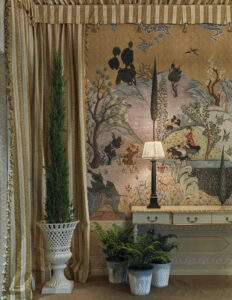
    The Iksel Entrance Foyer sets the tone. This is the work of Mark D. Sikes who is quoted as saying with considerable understatement: “We’re doing something quite different that I think will be a surprise.”

    Living up to this billing, Sikes turns out to be a man of boundless imagination who sets the tone for the installation: the wallpaper, inspired by Chinese scroll painting, took 18 people nine months to paint. Plants and fronds are beautifully spaced, and elegantly tented fabrics flare out at you and overhang you. It’s a beautiful space: the fact that Sikes is now designing a room at the White House makes you tempted to announce your candidacy for the presidency, just on the off chance.

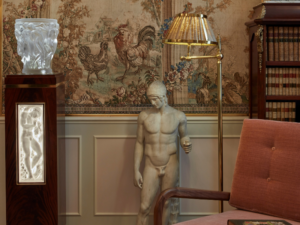
    The next room is by the deservedly famous Nicky Haslam and is called the Legend Room. Haslam says: “This room is a prelude to the many rooms to come. It has no dedicated role, but it needs to have diverse activities…reading, studying, gaming, eating, chatting.” Not for the first time, as it will turn out, I’m struck by how much can be achieved at the level of detail in design when you’ve made sure underlying symmetries are in play: in Haslam’s room, the supporting pillars are cunningly spaced, and even the positioning of the chairs suggests a certain cunning which enables him to meld different eras elsewhere.

    Nicky Haslam, Legend Room

    In fact, it turns out that playing with time is a theme: most of the rooms overlap one era with another, almost always successfully, and always interestingly. In something this vast, I doubt everybody will like every design decision here: but there’s so many to see that only the terminally incurious could come away uninspired.

    My favourite rooms are Tim Gosling’s library, full of a light but deeply felt nostalgia, and a French chateau feel. Gosling explains in the Wow! wonderbook: “Libraries are rooms that you amass emotional objects for, creating links to things and people that span thousands of years of human knowledge and skill. It’s the room in your house that you would save if there’s a fire.” It’s a gorgeous achievement, and probably the most unified aesthetic in the house.

    Tim Gosling, Library


    Another favourite was the kitchen by Henry Prideaux Interior Design. This is a confident space, reminding me of Voltaire’s dictum that great works of art need quiet patches. I loved the stretch of richly coloured marble, and the careful way in which details accumulate – the desk to one side, the interior of the cupboards roofed with gold. ‘A well-imagined interior should make its inhabitants feel good. Your emotions should be satisfied by the space.” Mine were, and I also now know I need a new kitchen. Specifically, this kitchen.


    Kitchen, Henry Prideaux Design

    The room I could most imagine hosting in was Joy Moyler’s dining room, with its little curtain-surrounded nook – a tribute to Christian Dior, who apparently liked to have a niche to withdraw into specifically to gossip. Moyler is another stratospheric achiever whose clients include Leonardo DiCaprio and if you want to know what the view is like from his house, then you can find out by visiting this room. The strong suspicion is that DiCaprio has a nice house – and not least because some of it has been designed by Moyler.

    Joy Moyler


    But does he have a Wow!house? Very possibly: not quite. Only the visitor to the Design Centre Chelsea Harbour has that. In the Wow! Wonderbook, Moyler explains her ethos: “Every room should include people who are wonderful, who you want to spend time with, and comfortable furniture, which will create an environment for people to linger.”

    She’s right of course and it makes you think. We all sometimes play that game of constructing our ideal dinner party: Oscar Wilde tipping his head back in astonished laugher at your latest witticism, while a hand reaches across to enfold yours – a hand which turns out to belong to Marilyn Monroe. Shakespeare comes up and asks if you’re free for his latest leading role; but sadly you’re unavailable because you’ve just agreed to be Roger Federer’s doubles partner at Wimbledon. Leonardo, from a corner, nods approvingly and quietly decides to make you the centrepiece of the picture he’s painting.

    The thing about Wow!house is it makes you feel better about yourself just by being there: you begin to detect possibilities within which, you fondly think, might just make the world go ‘wow!’ yet.

    Wow!house runs at the Design Centre Chelsea Harbour until 6th July 2023 

  • Film editor Meredith Taylor on Dan Rather

    Meredith Taylor 

    The draw of a career in broadcasting necessitates watching this new documentary which offers a straightforward snapshot of Texan journalist, news anchor and commentator Dan Rather who became a revered household name with his spirited and engaging presence on American TV networks during the turbulent years of the 1960’s and beyond.

    Daniel Irvin Rather (1931-) has covered virtually every major event in the world for the past 60 years but is also known for ushering in the era of fake news that led to his downfall at the respected CBS network. Rather is also credited at being the first journalist to announce the news of John F Kennedy’s death in 1963 by running with the rumour, ‘based on his instincts’ before it was fully confirmed.

    Amongst many other achievements Rather stood out with his impactful style of reporting that bridged the gap between what was really happening on the ground during the Vietnam war, and the sentiment presented back home. The film outlines his fall from grace for airing documents, during a CBS broadcast in the run up to the 2004 presidential election, suggesting that George W Bush had a sketchy military record during the 1970s. The issue is still mired in controversy to this day.

    Coming across as a serious man of integrity as he faces the camera, at 91,  an engaging raconteur without guile or glibness, the film pictures him from all perspectives: dutiful son, dogged marine recruit, devoted husband, deeply religious Texan. And this rounded impression is echoed by his daughter Robin who offers her admiration for a loving father deeply committed to his cause. Talking heads-wise we also hear from Susan Zirinsky, his longtime colleague at CBS News, who sees him from a career angle, and not always in glowing terms.


    Brimming with spectacular archive footage, news bulletins and interviews, the film darts around chronologically charting a career that began on Texas radio and graduated to TV News slots, where Rather made a name for himself covering Hurricane Carla, the Civil Rights Movement, the J F Kennedy Assassination, Watergate and the fall of the Berlin Wall. The wars in Vietnam, the Gulf and Afghanistan saw him on the battlefield dodging the bullets, and sending serial postcards back home to his family with the simple, repetitive message: “War is Hell”. At CBS on the 60 Minutes programme he was a steady but spirited anchor and is now prolific on Twitter appealing to a younger generation with his recalcitrant outbursts and on his own website News and Guts.

    “Can you still make a difference as a journalist” Rather said at the Texas-based Moody College of Communication in 2009. “Yes, if you don’t quit”. This is a clear-eyed, informative film that refuses to dig the dirt on Dan. That’s for another documentary.


    TRIBECA FILM FESTIVAL | NEW YORK 7-18 JUNE 2023

    Dir: Frank Marshall | US Doc 96 minutes

  • Thinking Big: Dinesh Dhamija on Modi’s visit to the US

    Dinesh Dhamija

    Many state visits are just window-dressing. Politicians make vague promises of lasting friendship, business leaders discuss investment opportunities, and the media queries the visiting leader’s human rights record.

    There is something about Narendra Modi’s visit to the United States this week which feels different. It’s not just the lavish welcome that he’s receiving: a full State visit, reserved for only a small handful of world leaders; not just the size of the trade, technology, military, energy and political cooperation that could result; not even the explicit treatment of India as a bulwark against Chinese aggression.

    What feels different is India’s status.

    Americans love big things. They love being the world’s biggest economy, with the biggest companies, cars, planes. So, when India announced earlier this year that it is now the world’s most populous country, Americans paid attention. They also discovered that India had overtaken Great Britain as the world’s fifth largest economy.

    Big news! Suddenly, Americans engaged with the Indian story in lots of different ways. In April 2023, the Harvard Business Review published a feature entitled “The US-India Relationship is Key to the Future of Tech” which laid out the potential benefits of a US-India corridor of investment, in which India would supplant China as a partner in supply chains, innovation hubs and joint ventures. “This makes it the most important geo-economic partner for the United States today as it ‘re-globalises’ with greater concern for national security and resilience,” wrote the author.

    Already, these connections are growing stronger. In January 2023, India and America’s National Security Advisors Ajit Doval and Jake Sullivan launched the United States-India initiative on Critical and Emerging Technologies. New collaborations on artificial intelligence, healthcare and education can place India at the centre of future value chains, building on its well-established role as the world’s back office.

    In 2047, India is likely to have 1.5 billion internet users, half a billion electric vehicles, and a financial system processing 300 billion transactions annually. This week Jake Sullivan described the India-United States relationship as “one of the defining partnerships of our age.”

    In all kinds of ways, India has become an innovator and pacesetter. Its Aadhaar programme is “the world’s largest and most sophisticated biometric identification system,” according to the Harvard Business Review, making the US social security ID system look dated and inefficient.

    Instead of seeing India as a source of cheap labour, US businesses “should view India has been a genuine hub of innovation,” announced the Harvard Business Review. And in a 2023 report, PricewaterhouseCoopers claimed that India is beginning to rival China and the United States in its tech development, “with tech companies equal in their sophistication and prominence to international counterparts.” It forecasts that India’s economy will be the world’s third largest by 2030 and that its GDP could overtake that of the US by 2060.

    Just one generation away from becoming the world’s largest economy?

    That’s even bigger news.


    Dinesh Dhamija founded, built and sold online travel agency ebookers, before serving as a Member of the European Parliament. His latest book, The Indian Century, will be published later this year.

  • Letter from Amsterdam

    Lana Woolf


    After Brexit there was a certain amount of talk of a number of cities taking London’s crown as Europe’s financial centre. Several runners and riders stepped forwards, but the results sometimes seemed underwhelming. JP Morgan sent its backroom staff to Dublin; a Goldman Sachs banking chief waxed lyrical about Luxembourg; and even Paris, that city so addicted to every kind of tax, but perhaps still nursing disappointment over the location of the 2012 Olympics, saw an opportunity.

    But I remember thinking Amsterdam was quite a plausible competitor. Its mercantile past stares back at us in a hundred Rembrandts. Here, after all, is where banking found its rhythm after its initial invention in Florence in the Renaissance. This is a city with form when it comes to doing its sums – except when it comes to the question of the value of tulips where they may have erred from time to time.

    In fact, some of the prophecy came true. Amsterdam has seen a marked post-Brexit uptick in fintech companies: TradeWeb, MarketAxess, Klana, Azimo and CurrencyCloud all entered the market here over the past five years, or else increased their presence. Of the 200,000 people who work in finance now, around a tenth work for a fintech company. AI, tech, and life sciences are also all growing sectors in this city. Of course it helps that Amsterdam has one of the biggest airports in the world, as well as proximity to one of the world’s largest ports in the shape of Rotterdam. Dutch people are also excellent English speakers.

    It turns out that Amsterdam is eager to have our wealth management clients here, but increasingly less delighted to host our stag-dos. A recent campaign by the city, warning off the Brits, was a reminder that Amsterdam doesn’t necessarily want to be a place of infinite licence after all.

    In confirmation of this, the Wallen Watch now patrols the streets at night, and though it’s possible for other nationalities to misbehave here, it has long been suspected that nobody does hooliganism quite like the Brits. On the way from the Eurostar to your hotel, it is indeed a miserable sight to see the windows of – often trafficked – women; the hash bars, wreathed in smoke; and the occasional poor behaviour of tourists in the Red Light District.

    It is a tonic however to observe, rising out of all the evidence of human beings in decline, the gorgeous Oude Kerk, that medieval glory dreaming on another morality than the one which has long since overtaken Amsterdam.

    It’s the anything goes morality of the 1960s, of course, and it’s probably time that went into retreat. But there are signs that Amsterdam has always craved freedom. In this city, unlike in many others in Europe, there are no Roman ruins for the tourists to tick off on their itineraries, though a few artefacts have been found here and there. Like the area around Westminster, Amsterdam was always marshy terrain, and therefore an incredibly unpromising place to build a major city. The Romans understood this and the world wasn’t yet thinking in terms of canal systems.

    I sometimes think that the relative absence of the ghosts of Rome has meant for a city less tethered to the deep past, which may possibly account for its undeniable mercantile and hedonistic streak. Of course, it’s possible to take these sorts of ruminations too far: the presence of a Mithraeum doesn’t quash one’s delight in the present, just as the absence of one doesn’t excuse you from Gibbon.

    While the Romans didn’t take much notice of here, the Nazis did. The Anne Frank Museum has to be visited if only to see what it means to fight for a freedom we might subsequently lament for the excesses it can bring. Here you wind up narrow staircases into the very rooms where the famous diary was written. What cannot be understood is how somebody could kill a girl with a smile like hers. To consider her fate, and to know that if one had the power to do so one would reverse it in an instant, is to doubt the wisdom of a non-interventionist God. But perhaps all the intervening is done elsewhere than earth. It certainly wasn’t done in Amsterdam.

    Moving here has one considerable boon secreted amid all the admin: the Netherlands boasts one of the world’s finest healthcare systems. In 2016, the country topped the Euro Health Consumer Index. The system is based on a mandatory health insurance scheme (called the basisverekering), covering everything from GP consultations, hospital care, medicine prescriptions, maternity care and ambulance services: starting at around $95 a month, it’s affordable too.

    And the city itself, especially if one has experienced the eye-watering prices of Oslo and such places, has an affordable feel too: beers come in at EUR4.50; a monthly transport pass at around EUR 90; monthly gym subscription at around EUR 36. The city doesn’t seem to want to take you money quite like other less exciting places.

    And if you take the plunge and come here, you’ll be connected to some of the finest museums in the world. The Rijksmuseum boasts the famous Night Watch, a picture I sometime find it hard to get too excited about – partly because it’s surrounded by so much I think better: not just the other Rembrandts, but the Vermeers and the Franz Hals. Sometimes when we try to paint our masterpiece we merely produce something gigantic; when we’re off our guard and looking at a goldfinch with unusual attention, that’s when greatness can come our way.

    Of course, for a while, a little known and superficially uncharming fellow called Vincent Van Gogh lived in the general vicinity. He painted supreme pictures to everybody’s equally supreme indifference. Now, he’s booked out months in advance and if you listen hard in the Van Gogh Museum, I sometimes think you can hear his kindly laughter at what posterity has given him. It’s the sort of turnaround only human ignorance, and its eventual corrective, herd praise could have produced. But there’s no begrudging Vincent, who deserves every paragraph of praise he’s ever received, including this one.

    I sometimes worry we think too much in terms of capital cities: Amsterdam is a portal just like every other major urban centre. Over the years, I’ve enjoyed a peaceful walk around Delft, whose essential peace feels unchanged since the time of Vermeer. It was once said that a great artist is news who stays news. But another possible explanation is that there is really no news: human beings continue on their endeavours just as the earth is on its ellipse.

    Elsewhere there’s also the Hague, which is a good option for relocation too, with a strong political scene both domestically and internationally.

    Amsterdam is beautiful and thriving. Its excesses are really a wager it has made with the desire to be exciting. The good news is that it reliably is: the occasional whiff of hash is more than offset by the wholesome scent of a thousand bakeries and the ministrations of the stroopwafel. And that you really must try, whether you decide to live and work here or not.

  • Henry Blofeld on his father, his education and the great cricketers of the past

    Henry Blofeld

    When I think back at my education, it’s important that my father was a great reader aloud which is something which happens less today. He not only had a beautiful voice, but was extremely articulate and was really an academic I suppose. Wodehouse was one of those authors he introduced me to between the ages of 10 and 16. Of course, those books have dated a bit but they’re very funny indeed.

    What was the particular impact of Wodehouse on me? There’s a book by Wodehouse Psmith in the City – you need to read the first word without the ‘P’ because as Wodehouse says, ‘the P is silent’ – which describes an extraordinarily similar path to my early career. Wodehouse was in the City, and so was I; both of us were rather out of place and rather eager to leave. Perhaps that’s part of my kinship with him.

    Nowadays a lot of my memories of cricket might be described as somewhat ancient. I see myself as a historian, reminding fans of today about the past. as the Ashes roll round again, I think of the great jousts of the past.

    One mentor for me was the great writer John Arlott, who adored Hobbs – and Jack Hobbs could be said to be the greatest batsman ever produced. He played his first test match in Melbourne in 1907. And played his last test in 1930 – he and Sutcliffe together were the most extraordinary pair, and particularly noted for the runs they made in old-fashioned sticky wickets in Australia. He must have been the most supreme technician and was every bit as good in defence as Geoffrey Boycott but in attack lived in another world.

    I hope that this Ashes series will be played in the right spirit. WG Grace was another amazing cricketer – he was one of the greats, but not a great man. In fact, he comes quite badly out of the chapter in my book. For example, in the match in 1882, when Grace ran out Jones – that was entirely reprehensible and an appalling thing to do. It’s worth remembering that it was more appalling in 1882, than it was in 1982.

    In that year, as many cricket fans know, Botham ran Boycott out at Christchurch – but that was done deliberately as he was sent in to run him out. It took him two balls, and was one of the funniest things I’ve ever seen. Boycott pushed the deliver to the offside, and  there there ensued a lot of sashaying up the pitch – and then the whole rigmarole of: “Yes,  no – wait!” Once he was out, Boycott said: “Do you know what I’ve done? And Botham said: “I’ve run you out, you –—“.  I can’t remember precisely what word he used, but it was something very flowery. On that occasion, Boycott withdrew in a sulk.

    Of course, they say the game has changed and become punchier. That might be true but it can also be done. Sometimes I hear people reminiscing about sedate appeals in the interwar years. But if you look at photographs of cricket in the old days, they all go up like mad. Perhaps distance has leant a certain enchantment. Do you think there was an age in life when bowlers were uncorrupted? All that we know about human nature makes that seem unlikely.

    I am often asked about my famous surname. I knew Ian Fleming a bit, but I didn’t exactly think much of him – and I don’t go to the Bond films to see my family name written in lights. Fleming and I were elected to Boodle’s on the same day. I got to know Ian quite well, which is why I had dinner with him and my first wife in Jamaica, when I was 22. I was quite young to be meeting such well-known people. I suppose that did make me more confident later on.

    Journalism has changed too. In the early days of broadcasting, I would do reports of county matches, stopwatch in hand. It was a very, very hairy business and to do that one had to have a certain confidence. For instance, I can remember sitting on a sack of sawdust in the groundsman’s office at Sydney at the back of the Noble stand without any windows at all, doing a report for Sport on Four. I remember other extraordinary situations. I can remember doing reporting on a total eclipse of the sun from Bombay, and describing the riots in Lahore during the 1977 Test Match.

    I shall enjoy the Ashes but am never so excited by the one-dayers. I can see the point of One Day Cricket in the same way I can see the point of instant coffee – which I find quite undrinkable. One Day Cricket was introduced as a financial palliative, and it’s not ideal in my view. Perhaps one day we’ll have the ultimate cricket match where each side will have one ball, bowled in front of 100,000 people.


    Henry Blofeld’s new book is Ten to Win…and the Last Man In is out now

  • Meraki: A Delightful Dining Experience

    Gift of the Gab, Meraki Review, Ronel Lehmann


    Planning to visit a restaurant is a bit like being on a conveyor belt. Firstly, you phone to make a reservation. Bubula, known for its middle eastern feasts doesn’t have a phone number for bookings. So, you then resort to sending an email, which results in an out of office reply and then you decide to take your chance for a walk-in table. It seems that everyone else did the same, and the next table was not going to be free for 90 minutes.

    We were patient but not as patient as the welcome and decided to continue up Great Titchfield Street to that famous trattoria, Sergio’s. Despite a warmer welcome than Bubula, they too were fully booked. And so, we stumbled into Meraki. Meraki is a name that indicates a gift of gab – the ability to persuade others effortlessly.

    The good news was that they had a table. The unwelcome news was that we had to endure being told that we had only ninety minutes to enjoy dinner. Then there was passport control. Our name and telephone number were requested so presumably they could capture all our details and market their restaurant to us in future. Or perhaps it was in case there was a fire in the kitchen, and they needed to be sure that we were accounted for during an exit.


    Seated at a table for two, the menus arrived. I dispensed with these, saying that the menu needed explaining to us: fortunately the waiter turned out to be more than proficient and courteous. I was still smarting from being cross-examined by reception. Tap water was provided, my guest had a cranberry juice, and I ordered an ice cold Keo, from Cyprus. I always like a light straw-coloured lager and this was no exception.

    The last time we booked a Greek restaurant in Camden, I booked Alexander The Great. It was during the meal I looked out the window to my left and saw the fluorescent sign. We had sat down in Andromeda which was directly opposite and found ourselves in the middle of the meal before noticing. I then had to telephone Alexander The Great from a Greek restaurant opposite to apologise that we were not going to make it. You will appreciate I did not want to look out of the window of Meraki in case border control was searching for me.

    It was time to order. I never like to dwell too much over the menus and don’t like drinking on an empty stomach. Quick choices were made including Aubergine Melitzanosalata, smoked aubergine. parsley, florina pepper; a bread basket containing pita, ladopita, focaccia, sourdough, olive; Mykonian Salad, tomato, ‘kritamo’, cucumber, olive, feta; Taramasalata, white cod roe emulsion, smoked herring caviar, bottarga; Tzatziki, Greek yogurt, garlic, mint, courgette; Hummus, Crispy chickpea, toasted buckwheat seed; before we drew breath. I myself don’t particularly like Taramasalata, however, this tasted unlike any that I have tried before.

    The waiter returned and after topping up our drinks, invited us to try the chicken and lamb kebabs. Two small skewers arrived for each, the chicken was so tender, beautifully marinated with basil and yoghurt. The lamb was served with florina pepper, hummus, parsley. We could have gone on with another round but saved some space for pudding.

    We shared a plate of Saragli, rolled baklava, caramelised nuts and vanilla ice cream.

    On the way out, I remarked to my guest whether we could remember the names of the twelve Greek Gods. They are of course, Zeus, Poseidon, Hera, Hestia, Demeter, Hades, Apollo, Artemis, Hermes, Athena, Hephaestus, Aphrodite and Ares.

    Meraki is right up there.


    Ronel Lehmann is Chief Executive of Finito Education

  • Opinion: Why Rishi Sunak needs to think beyond STEM

    Finito World


    We know that Rishi Sunak thinks about mathematics a lot because he has told us this is the case. This is a prime minister who, as the almost clicheic saying goes, ‘inherited a mess’, and is now beginning to think about what his priorities going forward might be.

    He has sorted out that mess to some extent. Certainly, he has shown he can handle the work – a low bar perhaps, but one which his predecessor Liz Truss never managed to clear. He also has some victories to his name: the Windsor Accords should in time spark a return to power-sharing in Northern Ireland; the AUKUS submarine deal shows he is capable of operating on the world stage; and most importantly, he has begun to get control of the public finances, though inflation remains stubbornly high and his decision to promise to cut it in half was an own goal: in politics, never promise something which isn’t in your control to deliver.

    None of his achievement are showy, and all of his progress is incremental. All is not lost: due to a low energy opponent in the shape of Sir Keir Starmer it may enough to put the Conservatives in touching distance of a 1992-style election victory in next year’s General Election, though that remains a long shot. What’s needed to pull off victory is leadership, and direction. So far, we have the ‘maths to 18’ policy, stipulating that all students should have some maths education right up until the end of secondary school.

    It is well-intentioned, and the prime minister has a point. Many young people do indeed, as the prime minister said in his speech at the start of the year, leave university without a basic understanding of finances, and experience difficulty when it comes to negotiating their mortgage deals.

    But in framing the question of mathematics in such limited terms he has made the matter seem dull, thereby making it hard to bring people along, and earning derision in some quarters for a ‘cookie cutter’ approach. A tax return is a good thing to have sent in on time, but it doesn’t speak to the human heart. It was Albert Einstein who said: “Imagination is more important than knowledge. Knowledge is limited. Imagination encircles the world.”

    In politics it is best never to express an intention aloud without having fleshed out the consequences of choosing to pursue it. In rushing into the debate without a full appreciation of how more maths teachers will be delivered – and doing so during such a febrile atmosphere of teachers’ strikes – Sunak has raised more questions than he has answered, leading to a series of jokes about not having done his sums.

    This isn’t to say the policy is dead. It simply needs to be recalibrated and, of great importance to this magazine, tethered properly to the realities of the jobs market. Sunak would do well to read the Institute of Engineering and Technology’s report Engineering Kids Futures. This highlights a shortfall of 173,000 workers in the so-called STEM (science, technology, engineering and mathematics) sectors. The cost to the UK economy of this shortfall is projected at £1.5 billion.

    It might be that the economic cost is the least of it. Children need wonderment and inspiration; they need to feel early in life the joy of creating things – and also to learn from the experience of wrestling with the difficulty of making things work.

    Of course, mathematics isn’t separate from the importance of engineering; an engineer who can’t count won’t get very far. But maths isn’t a siloed subject – quite the opposite. Sunak now has an opportunity to reimagine ‘Maths to 18’, by tethering it to employability. How might it transform our children’s careers outlook?

    While he’s about that he might go further. A glance at the sector output of the UK economy, ought to persuade the prime minister to think not just in terms of STEM but also STEAM.

    The ‘A’ stands for art, of course, a word which can still seem wishy-washy to the conservative mentality – so perhaps we might be thinking in terms of STEMCI – where the CI stands for Creative Industries.

    That ought to get recalcitrant Conservative minds to pay attention: the creative sector is big business. Year on year, the sector continues to boom – and that’s in spite of the restrictions placed on many businesses during the Covid-19 pandemic. For instance, according to the Department for Culture, Media and Sport, the creative industries grew by 6.9 per cent in September 2022 compared with the same month in 2021. Growth across the UK economy as a whole was 1.2% over the same period.

    Perhaps we need to think not just of Einstein’s contributions to maths and science, but to remember his violin-playing. A new generation of renaissance men and women is possible if Sunak gets this right.

    It also happens to tally with what he needs to do politically. He has made a good start and is probably the best-suited to the role of any of the occupants of 10 Downing Street since David Cameron. But he is yet to make anything approaching a powerful speech. And if he can’t make one about maths, he needs to think again.


  • Letter from Venice: ‘a relocation might be for you’

    Christopher Jackson


    Many a city which we call beautiful is by any objective measure not beautiful at all. Very often, as with London or New York, they’re simply gigantic and dynamic enough to admit opposites. Others are dystopias which we’ve trained ourselves to manage in by assigning them labels – enchanting, lovely, beautiful – which don’t apply.

    You realise this when you come to Venice: the City of Water is a separate case altogether. Any survey or poll taken regarding the question of The World’s Most Beautiful City, which didn’t show Venice the winner by a comfortable margin would be immediately suspect and void. No other city does terracotta reflected in the water and Gothic windows like this. But it’s also the place of the chance discovery: the Madonna above the doorway; the disappearing spire; the gondola yard; the washing on the balcony.

    It hits you rightaway. As you cross from Marco Polo airport towards the lagoon, a new standard presents itself. We can call it beauty, but it’s also to do with an unusual degree of respect for the past. The past, you continually reflect, as you tour Venice’s bridged intricacies and tucked-away glories, may simply have been better aesthetically. The difference between Venice and elsewhere is that Venice has kept its commitment to the past as close to absolute as a city can, while everywhere else has made significant accommodations.

    I recall coming here in the aftermath of the financial crisis in 2008. It occurred to me then that the very last city on earth to know that there was a recession on would be Venice – and the last person on earth, a Venetian hotelier. It comes as no surprise to learn that tourism is by far the biggest sector in Venice, though the region still has a lively shipbuilding sector, in addition to being the largest exporter of Italian luxury goods.

    Unemployment here remains high, meaning securing jobs is competitive. I recall another visit here in 2006, and on nights in the piazzas found the common thread among the young was their tendency to be living with their parents with no serious prospect of employment any time soon. Occasionally one wonders what happened to that generation: perhaps they had to go abroad; maybe they become part of the radicalisation of Italian politics either nationally or as part of the Venetian nationalist movement; or perhaps they inherited their parents homes, and still hear their footsteps echoing as they leave the bars of the Piazzale Michelangelo, now thirtysomethings their static lives having been spent taking all this for granted.

    For non-Italians who happen to be mobile, and perhaps looking to run their businesses from abroad, the property market is rather inflated in Venice itself compared to properties nearby in Padova and Vicenza. Everything’s Giotto in the first city, and Palladio in the second – and both are in easy reach of Venice.

    But relocating to Venice is not impossible, and there’s more life than you might imagine. Readers of Donna Leon’s excellent Commodore Brunetti series will know that the idea of Venice as mere museum and cultural fossil has tended to be exaggerated. In those books, we find a vivid, almost Dickensian cast of characters: the detached aristocrat, somehow managing to afford the upkeep of the palazzo; the shadowy criminals moving their money around; the owners of the gondola companies; the close-knit community which keeps La Fenice running.

    But Brunetti’s mysteries often take him beyond Venice itself onto the mainland, as if only there might the real network of relationships which lead to an intriguing crime be found. You sense that if Leon didn’t do this, too many of her stories would be centred on hotels, restaurants, or gelaterias.

    For those looking to relocate, I can recommend the Lido. Every night, the vaporetto from the mainland disgorges true Venetians from their day jobs in hospitality onto a sleepy promenade whose veneer is touristy, but which the longer your stay feels lived-in and viable as a home. Accordingly, the place has a sense of community which you only occasionally glimpse on the lagoon. Housing here is affordable – for the Londoner, almost laughably so – and so the international entrepreneur is in theory only a Visa application away from an affordable lifestyle with Venice on their doorstep.

    And what does it mean to have Venice on your doorstep? It’s to be among the very wonders of the world. Almost every church has at least something by Titian, Carpaccio, or Veronese and most have at least two of them. Then there are the big-hitters such as the Scuola Grande which is known as the Sistine of Venice, with its grand dramatic ceilings painted by that scrappy hustler Tintoretto. We don’t always like to hear it, but it was the product of a worldly ruse. When the possibility of the commission came up, there were four other artists in contention, including Tintoretto. When Tintoretto displayed his submission, he took the opportunity to announce that it was a donation, knowing full well that the regulations stipulated that all gifts had to be accepted: he went on to do 60 paintings, a large proportion of them deathless masterpieces.

    You could spend your life only looking at those – and scores of lifetimes inspecting all the glories elsewhere in the city. If you stand very still on the Ca d’Oro and pay proper attention, you can feel it moving slightly. Look down at the floor at the Basilica di San Marco, and you’ll notice that the stones are uneven and therefore hand-cut – nothing is ever completely even in the Venetian aesthetic, it always admits room for growth. In this beautiful untidiness, it mimics the laws of the universe itself.

    Of course, there is another side to Venice, which you can glimpse in the Doge Palace itself. Here you meet the truth that there’s such a thing as a painting which is too large – Tintoretto’s gigantic Last Judgement seems as though it must forever draw attention to its size, and therefore to the ambition of the painter. To paint on that scale you need a better reason than that you’d like to be considered great (and be paid in the process).

    Here too are some of the more forbidding prisons imaginable, reminding you that to fall foul of the Doge was never a particularly good idea. The famous Bridge of Sighs is named not, as many think, after the delighted exhalations of lovers seeing the possibilities of La Serenissima. Instead it refers to the regret of prisoners who saw this view on their way to their executions, to when all those possibilities had been closed.

    But perhaps there’s a lesson there. If Venice is infinite and we are not, then it’s always to some extent a mystery to anyone mortal. A relocation might be for you if you’ve come to the conclusion that the occasional scratching of the surface isn’t enough.


  • Tuesday Poem: Omar Sabbagh’s ‘After Van Gogh’

    The poet Omar Sabbagh gives us a meditation on the work ethic of the great painter.


    After Van Gogh


    Think of a man gone past like this:

    unschooled by any length of scholarship,

    but still seeing a path through and by

    the brimming cup and rip of his seeping madness,

    a way of doing things with paint

    and an eye, a wholly newly naked way

    of haggling with the daylight and the night,

    and then to let all the others see the whip-

    like pictures built from a mind’s priest-less cathedral.

    He made his mark on history, fusing to a trouble

    time’s wide white canvas, mimicking the rain,

    the fearsome hail-stroke of living.  What was natural

    to him, his early death, was the very letter of that

    early death spelt in the desperate, breathless color

    and might that crowned him with their feats

    and with the more halcyon golden bells of hindsight.

    He died penniless, disregarded, going under

    the earth alone; but he’d made, the while, color wonder,

    and light made to sunder the gift of light.