Category: Features

  • Novelist Tim Robinson on his previous career in TV

    Tim Robinson


    As a former director/producer of what were once pompously dubbed ‘high end’ documentaries and drama-docs, I struggle these days to recommend a TV career to young people. An inveterate Alf Garnett of the media world, I now sincerely believe that they don’t make ‘em like that anymore. Quality stuff, I mean. And even when they do, the pay is so poor and the contracts so short that without a rich daddy or mummy behind you, you condemn yourself to a life of penury and insecurity. But hey, it wasn’t all bad, and, for those intent on ignoring my advice, I will say that meeting famous people was a big part of the fun, as I did making BBC2’s Reading the Eighties, a greatest hits of 1980s bestsellers. What I discovered then is, with age, perhaps unsurprising: that those who wrote funny, popular books without any literary pretensions were invariably better company those who thought they were the next Joyce, Proust or Virginian Woolf.

    Sue Townsend of Adrian Mole fame was perhaps the most amiable, although she couldn’t stand Beryl Reid who played Adrian’s grandmother in the TV adaptation. ‘She was a mad pain in the neck,’ said Sue, ‘who, unable to get the Leicester accent, did an awful Brummie caricature instead and then tried to force the rest of the cast to imitate her.’ I confessed to her my intense fear of aging and losing my looks, and she, who was close to death, replied, laughing: ‘Because of my diabetes, I’m completely blind and can’t see you at all, but I’ll tell you how lovely you look if that helps.’

    Stephen Hawking wasn’t noticeably more agile than Sue, but still manfully plugging ‘A Brief History of Time’ which had sold in huge numbers  – although, it has been scandalously suggested, a smaller percentage than usual for bestsellers ever reached the end. I was allowed only one unprepared question and as we were featuring ‘The Hitchhiker’s Guide to the Galaxy’, asked him about Douglas Adams. For twenty minutes the camera ran while he dutifully programmed his gizmo, and I crossed and uncrossed my legs. But it was well worth the wait as finally everybody’s favourite household dalek began speaking: ‘I once met Douglas Adams in Los Angeles for lunch where he told me about working on scripts for Doctor Who.’ The silence that followed told me the anecdote was complete, so I jumped up, shouting out: ‘Marvellous, Professor Hawking, but that’s simply marvellous!’ Still, it made it to the final cut.

    Jeffrey Archer was up for an interview, but Her Majesty’s Spoilsport Prisons, then hosting him after a petty-minded perjury conviction, refused me entry. So I had to make do with his fragrant spouse, Mary – who I interviewed in their luxury Milbank Tower penthouse flat replete with Monets, Warhols and some wonderfully immodest mock-Pharaonic furniture seemingly copied from the Tutankhamun collection. She and Jilly Cooper – who I interviewed in her lovely Rutshire farmhouse – were both charming, even if the pair unified over their cordial loathing of Edwina Currie. It was without surprise that shortly after broadcast, when John Major’s affair with Currie became known, that I heard Mary’s dulcet tones on the radio: ‘I am less surprised by Edwina’s indiscretion,’ the voice fragrantly intoned, ‘than by John’s lack of …. taste.’ Jilly, who was as hospitable as she was funny, clever and adept at soundbites, confessed her Currie beef (or beef Currie?) to me, all delivered in a rapid fire, staccato whisper punctuated by girlish giggles : ‘You remember when my husband Leo’s affair was in the news? Well, I was in the House of Commons lift when Edwina, standing on the opposite side amongst some MPs I knew, spotted me and shouted: Oh Jilly, I’ve been reading all about Leo’s affair in the newspapers this morning – must be so awful for you.’ Jilly paused and then finished with: ‘You see, Tim, there’s something really wrong with that woman.’

    The dearly missed Clive James gave me perhaps the wittiest answer of the programme when speaking of Jilly Cooper’s hilarious Riders: ‘If Jilly hadn’t existed, someone else would surely have invented her brand – which is, in effect, the tall, handsome horseman advancing towards the blushing heroine with an extended polo mallet.’

    Tom Wolfe, in his all-white tasteful plantation owner’s get up, subjected me to some of the longest, most boring and uninterruptable answers of my noble career, all designed to revive interest in ‘Bonfire of the Vanities’, which he kept modestly comparing to Thackeray’s ‘Vanity Fair’. My day spent chaperoning Jerry Hall aside, I’ve never felt as invisible.

    Salman Rushdie, on the other hand, was surprisingly genial, even if his answers weren’t a lot shorter than Wolfe’s, and, listening, I realised why I had so often struggled with his meisterwerks: he gave you an answer and then repeated it three or four times using different and longer words. He did confess a great love of ‘The Lord of the Rings’, which, after all, is rarely praised for its concision. A sad note though: he turned up with two armed guards, saying to me: ‘I know, ridiculous after all this time, isn’t it? I tell them I don’t need them anymore, but the government insists. Still, at least I’m free in New York.’

    Robinson’s debut novel Hatham Hall is out now from Northside House.
  • James Jensen: A career in tennis

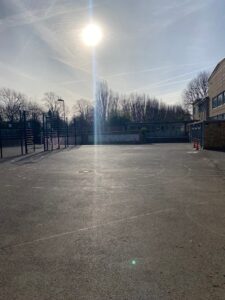
    James Jensen is a renowned tennis coach with years of experience on the court. After competing in the Juniors as well as the professional tour, Jensen began coaching and launched a highly successful series of video tutorials. He is now the in-house coach at Pierpont Racquet Club, located in Ventura, California. He holds the qualification of USTA High Performance Coach and is also a USPTA Certified Elite Professional.

    Tell us about your career?

    I grew up playing tennis. I started when I was eight years old. From there I started playing the junior tennis tournaments. I was trying to play in college, but ended up playing college football instead. And then I played tennis on the pay to play tour. Tennis is really difficult when you get out and try to make it on the tour. You pay your entry fees, and you’ve got a lot of costs involved just to get to a tournament. And then in a lot of the lower-level tournaments, the open tournaments that are money tournaments, you don’t make any money unless it’s the semis or the finals. You go and pay to play a lot, and you sink all the cost into it upfront. I’ve been at this club now for about almost three years. Before that we spent several years over in Hawaii, I was the director of tennis at the Turtle Bay Resort. Before that, I did instructional videos back when it was going from VHS to DVD. So back in the early 2000s. I did two sets, one set of six, and then another set of six under the pro tennis lessons, and they did really well worldwide actually.

    How was the pandemic for tennis?

    It was nice here because everything’s outdoors. The pandemic in general helped tennis because that was one of the few things that people could do. It was said that tennis and golf were the two lowest risk things to do and tennis was even lower than golf. A lot of people came out and tried it during the pandemic, and the club did very well.

    What is the tennis industry like to work in?

    It’s an interesting industry. During college, I was teaching tennis as well making money as I was trying to finish my college up. In the US in order to get into tennis and be a certified professional there are two main certifying bodies. One is the PTR, professional tennis registry. They’re located back East. And then the USPTA, the United States Professional Tennis Association, and that’s the one I’m associated with. They were in Texas, and now they’re kind of between Texas and Florida. In order to be an actual teacher, that’s what you should do is go and get yourself certified. Some people get certified by both, but you really only need one. The other main thing that it does for you is it gives you liability insurance, so if someone gets hurt on your court, you’re covered.

    What is your experience with tennis teaching techniques?

    For the kids, you’re basically trying to teach them proper technique, proper footwork, all that up front. We want to do that with the adults, but a lot of times adults have built in some pretty bad habits. Depending on how far they want to break back down to build them back up, it kind of depends. I teach anywhere from four years old, up to my oldest I have right now 80. She comes out once a week. It’s something you can do your whole life, you just keep doing it. And that’s the main thing is there’s always something going on for all the different levels. That’s what’s nice. Once someone starts playing, I get them into clinics and they start building some abilities up, and then when they’re ready they start playing some USTA league matches and that kind of stuff, just to get used to the competition site and see if they like it. Some people like it, some people don’t want to really compete, they just want to have their little group and play each week and be good with that. So, but then if they do that, then they start seeing the areas that they need to improve and then move on from there.

    What is the pathway to pro for a teenager?

    At 17-18 most likely it’s their parents that are paying for it. It’s somewhat still a rich man’s sport. Because of that, the ones that have the ability to pay for lessons, the ability to pay for travel, pay for tournament entries, have a step up. The tennis industry itself and a lot of non-profits are trying to kind of push money towards helping everyone to have that opportunity. But bottom line is that sometimes this comes down to the fact that you need the opportunities to be put in situations to succeed.

    How can you tell as a young person if it’s realistic to pursue a rise to the level of someone like Raducanu?

    You can tell somewhat based on how they come out and their hand-eye coordination, their athletic abilities. But I mean, Raducanu’s situation was really situational as well. It was during a pandemic, her and Leylah Fernandez, the two that were in the finals that year. They’re still good and up there in the score, but they’re not pushing as far – but that’s part of it too, they got thrown into that fame, Naomi Osaka, same thing. It’s a lot of pressure to put on these young kids. And depending on where they’re from, I mean, they could be the breadwinner for their whole family. And that puts a lot of pressure on the ones that are out there trying to make it as well. So you’re hoping that if they have that ability, that they’re at least tied into the USTA, where they’re helping send out some coaching, helping do some of the different clinics to help them get the ability and get the training that they need, and then give them opportunities, wildcards in the different tournaments. Then it comes down to them making the most of those opportunities. As far as making it as a living, it’s not easy at all. It’s very difficult, the top couple 100 in the world make really good money. Beyond that, you got all these other guys that are out there, just scrimping and scraping and like I said it’s pay to play. It’s not an easy route. But the teaching side of it can be, if you’re not able to make it out there, there’s money to be made in teaching. Plus, it’s very rewarding as well. You’re outside all the time, you’re on the court, you’re outside, you’re not stuck behind a desk, and you build some great relationships. And for kids, you are able to mentor. They look up to you. And so, tennis in general from that standpoint is really good for the kids, because most of the kids that are playing it are from good families, they’re good kids. They’re good in school. So normally grades are real good as well, so  you’re putting your kids around other good kids as well. So from that standpoint, it’s a great sport for that as well because it is something you can do your whole life once you play at a somewhat decent level. And then if you’re playing at a high level, if you’re a former junior player that doesn’t make it on the tour, but still a really good player, how many business deals are made out on a tennis court or on a golf course? When you’re good at something, it just gives you that “wow” factor.

    Tennis does not require that much expensive equipment at the most basic level. Where does the “rich man’s sport” side of things come in?

    The barrier to entry is not much at all. You have a couple balls and a couple rackets, andhere in the US, you have free courts in most cities, so you have an opportunity to get out there, and at least begin. The competition is what requires money, but as far as playing it and enjoying it, my feeling with tennis is that you can find one other person at the same level as you whether you’re just a beginner, or you’re super high level, and you’ll have a great time. It doesn’t have to be that you’re both phenomenal players. You guys can be just starting out but you’re out playing, and we have guys at the club who have just started playing their first club tournaments and they’re hooked. It’s changed their family’s life. The kids now are involved and the parents are both now involved playing tournaments, playing USTA Team Tennis. I’ve watched this one gentleman who has lost 80 plus pounds, just from coming out and playing. Now he’s out hitting on the ball machine all the time, coming to my clinics, he’s out playing with other guys during the week, they play as a family. He’s sent me some texts and things saying “You don’t understand how this sport has changed my family’s life.” So it’s great for that. You really can just grab someone else and get out there and have a great time, hit and giggle.

    What makes a good teacher?

    I try to keep it as simple as possible. I think sometimes we as pros, one, we’ve played it so much that certain things just happen without us thinking it through. So when you take it back… when I did my instructional videos, this producer was about a 3.0-3.5 level tennis player. And he was able to go back and when we’d be explaining something he’d say, “What about this?” And then I would be able to go back into explaining things as simplified as possible. It’s basically the Magnus force. It’s basic physics that we deal with. Once you understand those and understand how certain things happen to the ball, then you can make little adjustments and it doesn’t have to be changed in a million different things. Keep it to one or two things at a time.

    What has tennis done for you?

    Controlling emotions is probably one of the greatest things the sport has done for me. In pressure situations you’re able to learn how to really calm yourself down keep as even keeled and in line as possible when situations get tough, and that does translate over into other parts of your life, for sure.

  • Dinesh Dhamija: India wants its own chips

    Dinesh Dhamija

    Fed up with buying expensive semiconductors from Taiwan, Japan and the United States, the Indian government is luring international chipmakers with a $10 billion subsidy.

    The country’s first semiconductor plant will start construction in August, with US-based Micron Technology due to start production at the $2.75 billion facility by December 2024.

    “This is the fastest for any country to set up a new industry,” said Ashwini Viashnaw, Indian minister of electronics and information technology. He is keen to bring this crucial technology in-house, as India builds up its smartphone and electric vehicle manufacturing base, which both rely heavily upon sophisticated chips.

    The move is part of a larger agenda: “The Government of India aspires to position India among the world’s top five scientific powers,” says the India Brand Equity Foundation (IBEF). “India is aggressively working towards establishing itself as a leader in industrialisation and technological development.”

    Part of the drive is to improve security of supply, to forestall the reliance upon Chinese vendors of parts for solar energy systems, for example, or of superconducting microprocessors and part is to boost employment and the overall economy.

    As Thamashi De Silva at Capital Economics argues, the key to unlocking the India’s demographic potential is to build more factories and to develop a “globally competitive and labor-intensive manufacturing sector.” Yet restrictive labour laws, high import duties and troubling logistics issues have so far dissuaded many potential manufacturers. Countries such as Taiwan and Vietnam have trumped India in recent years, while the country’s logistics costs remain higher than those of China, South Korea, Japan, Malaysia and Thailand, according to figures from the World Bank.

    Morgan Stanley’s 2022 report ‘Investment Opportunities in India’ predicts that global outsourcing spending will rise from $180 billion a year to $500 billion a year by 2030, meaning that India is “poised to become the factory to the world, as corporate tax cuts, investment incentives and infrastructure spending help drive capital investments in manufacturing.”

    “Multinationals are now buoyant about the prospects of investing in India, and the government is helping their cause by investing in infrastructure as well as supplying land for building factories,” said Upasana Chachra, Morgan Stanley’s Chief India Economist. If multinationals respond to these incentives, as the report writers believe they will, manufacturing’s share of India’s GDP could jump from 15 per cent to 21 per cent by 2031, doubling the country’s export market share.

    Electronics manufacture is at the heart of India’s economic ambitions. Invest India predicts that domestic demand for consumer electronics will more than double in four years, from $9.8 billion in 2021 to $21.18 billion in 2025, particularly in the smartphone market, as the country’s 1.3 billion mobile phone subscribers upgrade their handsets. “This presents a huge opportunity for companies and investors looking to tap into the manufacture of smartphones and other electronic devices,” wrote Aditi Singh in an Invest India report.

    If India’s $10 billion chipmaking gamble pays off, it could yield the most extraordinary pay-out, further fuelling the country’s already astonishing economic ascent.

    Dinesh Dhamija founded, built and sold online travel agency ebookers, before serving as a Member of the European Parliament. His latest book, The Indian Century, will be published later this year.

  • Omar Sabbagh’s Letter from Cairo

    Omar Sabbagh


    It’s roughly eight o’clock in the evening and I’m seated on the balcony of my rented suite here in Zamalek, Cairo.  The muezzin in the distance sounds like a radio above the hurly-burly, as the cars rushing past in the farther or nearer distance punctuate the streets, so many commas, so many colons, so many periods.  I’m sipping a whiskey, brought from home, because to purchase glass by glass in any reputable joint would cost an arm and a leg.

    To that extent Cairo mores have more in common with Dubai than they do with that other Middle Eastern metropolis that I know, Beirut.  That said, peering from this balcony, the panning, panoramic sight that meets the eye reminds one gently of Beirut, though on a far grander scale.  The same dollops of gutted housing, the same mixture of boutique shops and those far more sundry, the same muted hysteria, the same due portion of schizophrenia.

    There’s nothing like a Middle Eastern capital for that odd mélange of oddness and the even.  The exception, like the rule, are both: exceptional and to be expected.  And strolling down the street, with a tip from my wife, more conversant with the space, I find a place to be seated for a drink or two, or three.  Without naming names, it’s a joint I find so reminiscent of others in Beirut, before Beirut’s dire downward slump.  The same mix of the swanky and refined with the everyday.  A place neither for elites, necessarily, nor for everyman.  The clientele, as far as I can gather, veering from professional types to university graduates, from the middle-aged and beyond to the nubile and life-ready.  A place, too, I notice, harboring foreigners and tourists like myself, as well as locals to the city, Cairo.  Zamalek, this particular part of Cairo, is an island, cosseted by the Nile.  It is known for its embassies and for its more cosmopolitan airs and graces.  And known, too, for its nightlife; and where I’ve ended up is a case in point.


    I speak to a few locals and the comparison with Beirut seems to be felt as a harbinger.  Though not collapsing like Beirut, the feeling seems to be similar: everyday life too expensive for the living, the local currency suffering before the almighty dollar, among other economic ills.  A young woman I met, aged twenty-four, is unemployed.  Having, with parental help, paid hundreds of thousands of dollars for a top-notch university education in Cairo, she finds herself now without a job in her field, of Marketing and Communications.  She told me that for any young woman who wants to live beyond the threshold of the family-setting, who wants to strike out on her own, the odds are always against her.  If not employed in a foreign or international company of some sort, and if not willing to bide by family-control, her only option is to be either, unemployed, or to work in a sales job at the equivalent of a call-center – something not too palatable to a relatively fresh graduate, expecting far more.


    And yet, I had fun; before me a bottle of ‘Stella,’ a beer so local to the place it harks back to Egyptian independence, standing now as an icon for the same.  The place itself, on enquiry, also dating its existence to the very early 1970’s.  Those were still well-nigh revolutionary days.  It made me think of my father, still at that time, just about, a youngish pan-Arab nationalist, a youngish Nasserite, if based in Lebanon.  And it made me think, too, of one of the lessons he’d learned and relayed to me from those times.  Many if not most of the problems of the Arab world in recent history could be laid at the door of too much hopefulness.  They, young revolutionaries, had aimed to change things root-and-branch.  And when those gambits failed, a vacuum ensued, a wide space beneath those high-billed aims.  Hence, the rise and entrance of tyrannical dictators across the Middle East, men like Saddam Hussein.  Hence, that is to say: the rigmaroles and the quagmires of the modern Arab world, nearly anywhere you look.  Had the aims been lower, had they not gone for wholesale revolution, but for steady-paced reform, my father seemed to think, then the history of our times would have been so much different.


    And yet, to repeat, I’d a very enjoyable evening.  For all its problems, the ambience of a bar or pub in a place like Zamalek, in Cairo, as in Beirut (even to this day) is dynamic.  Perhaps people are just more interesting when they’re troubled?  When all is fine and dandy, very little thinking in any real or impactful sense gets done.  Sadness and sorrow, I believe to this day, are the progenitors of originality.  And there’s something so very, dearly fresh (as well as dilapidated) about the streets of Zamalek, Cairo.


  • News: Finito mentioned in House of Commons skills debate

    Finito World


    We are pleased to say that earlier this week, Finito and its CEO Ronel Lehmann were mentioned in the House of Commons during a debate around employability, work and skills. This is a proud moment.

    It also highlights the important work that the company is doing via its All-Party Parliamentary Group and its bursary scheme to improve social mobility in a country where opportunities are too often limited.

    To watch Siobhan Baillie MP’s excellent speech go here:


    To read Guy Opperman’s response go here:

    https://hansard.parliament.uk/Commons/2023-07-11/debates/A21FE67B-1D3B-495B-9908-3A8F99E646DB/IncreasingEmploymentTraining#contribution-BE468098-32FF-4FDA-B24D-C3E0A1D58892

    This is another landmark moment in the company’s history where the work we do to help young people is definitively highlighted. To learn more about the APPG and how you can be involved go to:

    http://appgfutureofemployability.org


  • Class Dismissed: Raymond Gubbay

    The legendary impresario on his start in the industry, the misguidedness of Nadine Dorries – and his friend Luciano Pavarotti


    FW: So what was it like starting out in the performing arts business?


    RG: I left school three days before my 16th birthday: my father was a chartered accountant, and he was determined that I would be articled to him. Once I got the basic five O-Levels, that was all I needed – but I absolutely hated it. After that, I got a job in newsreels – that was the week after Kennedy had been assassinated. By good luck my father was doing the accounts for theatrical people, and I managed to get a meeting in Notting Hill Gate with Victor Hochhauser.


    And what was that interview like?


    RG: He had three questions. ‘Are you Jewish, boy?’ ‘Where did you go to school?’ ‘Can you start on Monday?’ It suited me to a tee. I worked there for 10 months, 28 days and 12 hours and then bold as brass, started out on my own. In retrospect Viktor was running a sort of finishing school for budding promoters.


    Which people have had the biggest influence on your career?


    It was important when I was introduced to Donald Swann – who was half of Flanders and Swann. The Queen Elizabeth II Theatre gave me dates for an evening of his songs with very little grace, but they gave me the date because Don was involved. We ended up doing over 130 performances a year, and my business just grew and grew.


    Has theatre changed out of all recognition since your heyday?


    I think I had the glory years – because things have changed now as inevitably they do. I suppose every generation is apt to say the same, but I think it’s become much more difficult. It’s tough. Nowadays the kind of parameters that you work within are in many cases rightfully much trickier than they were when I was a young man.


    What would you say to a young writer of musical theatre or opera?


    RG: The basic premise hasn’t changed. If you’ve got ideas and you’re creative, and you want to do something – then you have to find a way through. Can you get through to Cameron Mackintosh first up? I doubt it very much, but you can find someone to workshop it for you. It’s a question of persistence and determination and, of course, talent. And everyone needs a bit of luck somewhere along the line.


    What’s your view of the debate surrounding theatre subsidy?


    RG: The whole point of subsidy is that you enable companies like the Royal Opera House or the Royal Ballet to exist. You certainly couldn’t run these things on a commercial basis. That said, I don’t think they do a very good job of it. I also don’t think Nadine Dorries, when she was Secretary of State, should have interfered with funding allocation. It should be arm’s length from government.


    What’s the best night you’ve had at the theatre?


    RG: Last year the Albert Hall put on a gala concert to celebrate my long association with them and my family came from all over Europe. I loved that – I think it’s the only time they’ve ever done that for a promoter.


    What was Pavarotti like to work with?


    RG: I remember he came in to a masterclass once and afterwards we had a reception. We had an apple crumble and cream dessert. There was this man who saw that Pavarotti and came running up to him with his dessert in his left hand because he wanted to shake Pavarotti’s hand with the other. Pavarotti couldn’t resist taking the dessert off him with his free hand! More generally, he was very generous with his time.


    What have you learned from the greats?


    RG: They’re all different. As a promoter I’ve learned that you have to step back and try not to impinge on celebrities. Don’t get overwhelmed and don’t be too gushy. Just try to be as nice as possible.


    Lowering the Tone and Raising the Roof is published by Quiller and priced at £18.99


  • Scenic Cruises CEO Richard Twynam: “Working in travel is an opportunity to break down prejudice

    Christopher Jackson meets a charismatic MD with a profound love for the life opportunities that come with working in travel


    I must admit that I didn’t know much about cruises until I spoke to Scenic Cruises head Richard Twynam. Twynam is affable and enthusiastic – he strikes me, even at one remove over Zoom, as a man unusually happy in his job: ““I work in travel because I went round the world when I was 18 in 1990,” he recalls. “That was before Internet and mobile phones and I knew within weeks of being in Australia I wanted to spend my career in travel .”

    Over time he would specialise in the sector he has come to love, and in which he is one of the leading figures. “I fell into cruising in 2010 having seen a managing director’s job for a Virgin brand advertised in The Sunday Times and I got the job: I was one of the youngest managing directors at Virgin at the time. In those days cruising wasn’t as mainstream as it is now.” Twynam stayed at Virgin for three years before running a brand for Royal Caribbean, a role which he began in 2013 and which you guess added depth to his experience.

    Of course, in 2020, everyone was about to experience the great shock of the pandemic. But after a few years taking on advisory roles in the industry, Twynam was approached in 2022 for his current role: “It was too good an offer to say no,” he tells me.

    So how does his current role divide up? “I live in Surrey and the office is in Manchester – I’m passionate about that city, it has such great energy. I spend three days a week there, meeting the team, looking at the numbers and being very involved with the operational side.”

    Scenic Cruises is an owner-founder business and so it’s crucial for Twynam to have a good relationship with Glen and Karen Moroney, which he certainly does. “Glen and Karen started the business 36 years ago,” says Twynam, “and they’re rightly very protective and proud of it. If they don’t like something, they’ll tell you – but more generally they’re excited about the benefits of the new yachts.”

    What you most feel when talking to Twynam, is the notion that cruises are an exciting frontier in the world of travel. “Cruising has evolved massively not just in the last decade but over the past 20 years,” he explains. “The great thing is there’s a cruise for every one – for every taste or price point. If you want a low key cruise you can do that, but if you want to go paddle-boarding on a cruises you can do that.” Then comes what will to many be his clinching argument: “You only have to unpack your suitcase once and wake up to a different location each day. That’s why 2023 is likely to be a record year for cruising.”

    It does seem as disaster-proof as a holiday can reasonably get: a mixture of luxury and adventure which will appeal to many. The company has two brands: Scenic Cruises and Emerald Cruises.

    The flagship of the company is Scenic Eclipse. “We call that the world’s first discovery yacht,” says Twynam. “It means you go to the wildest places on earth in complete luxury. For instance, you can go to the heart of Antarctica, and explore all that but then come back at the end of your day to a luxury yacht experience. Above, you have a helicopter and below you have a submarine.”

    The Emerald cruise ships meanwhile are, says Twynam, “slightly smaller, and designed for warmwater coastal cruising. The ships looks like a James Bond villain’s favourite yacht, with beautiful sleek lines. They’re designed for coastal cruising in Croatia and Greece, and can winter in the Caribbean.”

    So what sort of luxury do customers experience on board? “Scenic Eclipse has eight restaurants, a spa, and a watersports platform on the back with all the toys,” explains Twynam. “Emerald has the same. You’ve also got a butler, a whisky bar with over a hundred scotches. We’re reassuringly expensive. Of course you can spend £150,000 by taking the main suite on the Eclipse, but equally Emerald is £3,000 per person for the Grecian cruise.”

    So what is it Twynam loves about cruising? “It’s a gentle way to see the world,” he says without missing a beat. “You’re gliding down the river watching the world go by. It’s not an intensive holiday. We’ve got these big lounges and it’s a marvellous thing to just watch the world go by. The ship is your conveyance to see the land; it always amazes me how as human beings we’re drawn to the water.”

    That this is true is reflected in the demand for the company’s experiences, and therefore the size of the company. Scenic Cruises employs 120 people. “That covers all the facets of running a business: financial, commercial, marketing, digital, reservations, and sales,” Twynam explains. “A high proportion of our workforce is under 30; many are under 25. A lot of them have a passion to work in travel, and many have done degrees or been to college. One of my commercial analysts has got two more degrees than I’ve got. There are lot of opportunities if you want something easy to learn and want to learn quite quickly. But if you have a particular skillset – whether that be in social media, studio or marketing – we have roles there too.”

    And, of course, there’s a whole different set of employment opportunities around the ships themselves. “Working on a ship is a glamorous thing to do. We have a British submarine pilot on Scenic Eclipse. You’ve also got culinary roles, hotel function, guest service, tour leading, and many other things.”

    Of course, all these roles also attract travel perks. “I’m going on one of our yachts tomorrow,” he says, enthusiastically. “We also want out staff to benefit from friends and family offers – we want it to be clear that there are major benefits to working in the travel industry.”

    Twynam adds that there other, deeper benefits to a career in the sector. “A lot of the younger guys who work for us recognise that the more they travel and understand the world, the more it’s an opportunity to break down prejudice and misunderstanding. They’re passionate that if we live on this planet we should understand everyone’s cultures. I’ve worked in the travel industry for 29 years and had some amazing life experiences.”

    And the challenges? Twynam doesn’t mince words. “Of course, travel by its nature is highly operational and you have to deal with that. We all know what can happen: the plane gets delayed or the hotel booking gets cancelled. One of the vagaries of cruising in Europe is that you get high and low water which can be challenging for different reasons. On the high seas, you have the weather to contend with – and that’s before you get to the question of strikes and so on. But in the last years we’ve had the tsunami in Japan, and the ash cloud over Iceland. As a sector we’ve become extremely experienced and dealing with things.”

    And with that he says a genial goodbye, no doubt pleased to be heading on his cruise tomorrow, leaving me to write about him in the cold March weather. I am briefly sure which of the two of us has the better lot in life.


    For more information go to scenic.co.uk

  • Photo essay: The Teachers’ Strikes

    Christopher Jackson


    I’ve often thought that spring has its secret pitfalls, but in 2023, when the season turned, it seemed to have more than usual. Every time the moment of the clocks going forward comes round, I always think, remembering Shakespeare’s Julius Caesar: “Beware the Ides of March.” And it was TS Eliot who wrote of April as ‘the cruellest month’ when the promise of spring cedes instead to rather a different reality.

    So it went in 2023. I woke to Budget Day on the 15th March to what seemed on the surface good news: the government would extend the free 30 hours of childcare to those with children aged one and two. However, given that I have a daughter who has just turned three, this development put me in mind of the Philip Larkin couplet: “Sexual intercourse began in 1963/ (which was rather late for me)”. Many parents woke to news that the money which had essentially constituted a second mortgage was not money they’d have had to spend had they elected to have children a few years later. As Kurt Vonnegut put it: So it goes.

    Even so, the policy won’t come in until 2025. While it’s not immediately clear whether a Keir Starmer administration would keep to a promise made by the other lot, the suspicion remains that he’d be hard-pressed not to. The policy is a generous one, representing a possible alleviation for many households where the incentive to work is dramatically reduced by the cost of nursery fees. When my daughter turned three, I filled out my forms with Southwark Council with the sort of passion and alacrity which, to put it mildly, I never attack my annual tax return.

    I should add that the policy, announced by Jeremy Hunt, also represents a personal triumph for the brilliant MP for Stroud Siobhan Baillie; Baillie was rightly thanked in the Chancellor’s speech.

    But progress is always incremental. While the policy was delayed until 2025, there was another irony in play. The commitment by Chancellor of the Exchequer Jeremy Hunt was aimed at encouraging work, since the 30 free hour entitlement is available only to households where both parents work.

    But on the day of the announcement, the teachers’ strikes meant that for those with children in reception or higher, it was another day – after so many during the pandemic – where work needed to be set aside by at least one parent in order to create a day for a child – or children – not in school.

    And so what do working parents feel about the strikes? It’s possible to imagine a world where there is widespread moaning about the fact that teachers have secure jobs, and that if they have elected to enter the profession then they ought to be there for the children.

    Most people, including the teachers on strike, know that striking is undesirable, even wrong. For many teachers it’s the lesser evil; the greater evil being not to speak up about an intolerable lack of funding in the system. But, in general, when parents give vent to resentment it isn’t aimed at teachers so much as at the situation itself: pandemic parents might rightly feel that they have just had too many bad breaks these past few years.

    But more often than not the mood on the front line is overwhelmingly pro-teacher. Most parents learned when homeschooling during the pandemic that they are useless teachers. It follows from here that teaching, far from being something that anyone can do – as the tone of the public discourse leads you to expect – is, in fact, a highly specialised profession. When you get magnificent teachers – as my children luckily do – everything about your family life is better. These are people whose excellence is told in patience, intellect, decency, and commitment.

    That’s why the parents I speak to worry about the effect on their children’s education of their teachers being in a state of anxiety over wages. At our children’s school in South East London we adore our teachers, and though we sometimes do experience stress because of the strikes, we are also aware of what it’s like when bills go up but wages remain stagnant: there is a helplessness to that situation when you work in the public sector which, in theory at least, you don’t have if you work in the private sector where there is meant to be more elasticity on salary.

    What also doesn’t get reported is that for the teachers strikes were never only about salary – very far from it. In fact, it was to do with disquiet about how the government for much of 2023 expected their own salary rise to be met. The government’s initial position was for those increases to be largely met out of schools budgets, and it was their ceding this point which led to a settlement which might have been there much earlier in the year – at far less cost to education, and less strain to parents and teachers.

    Schools budgets and children’s well-being are essentially synonymous and there’s not a teacher I’ve spoken to who would ever have wanted more money at the expense, say, of after-school club provision. Such provision is the beginning of a child’s encounter with the riches of civilisation: art, music, sport, theatre, dance. No teacher, believing as they do in the development of children, wants extra money to come to their bank accounts at so high a cost to the pupils they care about.

    But of course, the misery of the situation extended beyond the plight of teachers and children. It was also about parents who are on zero hours contracts and so really couldn’t manage a strike day in the same way which many workers, typically those in the middle classes, with understanding bosses could. It’s also about the whole ecosystem of the school which, underfunded as it sometimes is, is still the heart of the life of the community.

    As always when hardship comes along, there are heartening stories. Some parents managed friendship-deepening play dates in central London – but again they were the lucky ones who have flexible jobs, understanding employers, and the funds to do so.


    Near where we live, East Dulwich Picturehouse screened cartoons throughout the strike days on 15th and 16th March at affordable prices. Many parents also became engaged in thinking of creative ways to help their community; whether it be through playdates, fund-raising activities, or just simple words of support to teachers. Many joined them on the picket lines.

    Of course, the private schools remained open throughout this year, and this led to an acute sense of a two-tier system where children from backgrounds who can’t afford it are being left behind unable to learn. Meanwhile, fee-paying schools can be seen continuing as usual: the lines are drawn vividly on strike day between the haves and the have nots. One sometimes wonders if the future is already being won and lost on such days, even if you have very young children, as I do.

    Of course, while there’s life there’s hope, and a strike day can be as good as a school day if you can take your child to a museum, or some other activity.

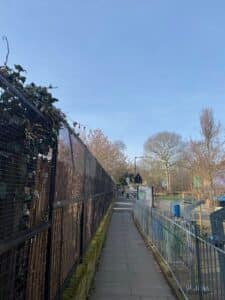
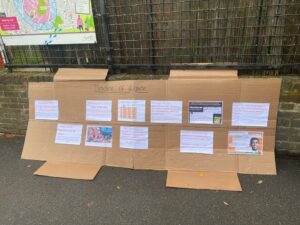
    Even so, all these problems seemed so intractable that they are crying out for the clarity of photography. In the photographs which accompany this essay we hope to cut through the complexity to arrive at images which show the simple truth of our times. We see the empty classrooms where light from a beautiful spring day falls not on the faces of children but on empty furniture; we see the thoroughfares of a local school, usually frantic with parents in the rush for drop-off now vacant, the trees almost seeming to ruminate on an unexpected quiet; we see a lone parent doing nursery drop-off, as testament to the way in which schools and nurseries sometimes feel like separate ecosystems in our society.

    It is an image of a struggling country. Gillian Keegan – a likeable and impressive Education Secretary – deserves credit for the eventual settlement, but it should have come sooner, and some of the fault lines which the strikes showed remain with us today. And with that it isn’t Shakespeare who springs to mind, but Yeats with his line that; “Things fall apart/the centre cannot hold.” This is a country which hasn’t fallen apart, but there is the sense that without smart moves from the Sunak government, it soon could.

  • Patrick Crowder on Finca Cortesin: ‘this hotel reminds us what we’re working towards’

    Patrick Crowder


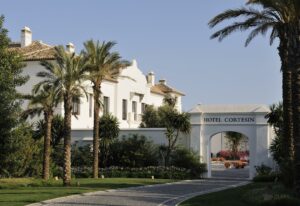
    Finca Cortesin is nestled in the hills of the Andalusian coast, a bastion of luxury on a 215-acre estate. The estate boasts six top-tier restaurants, four swimming pools, full spa facilities, a fitness and racquet club, and a world class 18-hole golf course. It doesn’t end there. As you might expect from an Andalusian resort, the weather is impeccable, and guests are invited to enjoy the crystal-clear Mediterranean Sea at the Finca Cortesin Beach Club, which is situated just under a mile from the hotel.

    In other words it’s paradise – but unlike so many other versions of the ideal, it’s paradise within easy reach. Travel to the resort is simple. The two best options for those coming from abroad are to fly into either the Malaga or Gibraltar airports, which are a 50 or 15 minute car journey away, respectively. We chose Malaga, and a chauffeur from the resort was there to pick us up, peppering us with facts about the area.


    The economic news from Andalusia – and from Spain generally – is reliably mixed. On the one hand, Andalusian exports shot up at the end of 2022 with a near 25 per cent increase – particularly to America and to Asia – partly driven by its powerhouse olive oil industry, but also by its surprise strength in other sectors such as aeronautics. Having said that, these numbers would look better if a great number of people were benefitting from them. Instead, unemployment remains stubbornly high at 19 per cent, though it is falling.

    As a Californian, the landscape looked remarkably familiar, as if I had stepped through a portal to a new version of my home across the ocean.

    We were taken to the Executive Suite, and shown a view which I’ll never forget: it looked out directly over the ocean, with a private terrace from which to enjoy the play of light at every time of day. Each evening, the sky would produce a gratis masterpiece of oxbloods and oranges for anybody who happened to be looking. Our rooms were beautifully laid out and succeeded entirely in soothing us from our flight: fresh fruit, confections, and hand-cut flowers awaited us in the tastefully decorated living room, and the king-sized bed provided a stellar night’s sleep. The high ceilings found in the living room and bedroom also extended to the marble finished bathroom, which had two sinks, a spacious shower, and an even more spacious bathtub.

    We began with a quiet drink at the Blue Bar. The décor inside the bar is classic and welcoming, though during our stay the unblemished weather would send us more often out onto the stillness of the patio with its view of the vast well-manicured lawn of the estate. Tapas is always available: beef carpaccio, complementary dried yucca and plantains, and of course the world-famous Iberian ham.

    The next morning, we wandered the estate, deepening our acquaintance with perfection. Though Finca Cortesin is of recent construction, the attention paid to traditional Andalusian architecture and décor gives it the sense of prestige which often comes with age. The estate forms two massive open-air courtyards which are filled with tropical plants. A fountain provides a centre to the impressive display of foliage, which towers above you, cushioning you from any outside imperfections which might have been wanting to come in. By being here, you come to realise the outside world is a sort of scandal, inferior to the beauty and glory of Finca Cortesin. I became particularly acquainted with a Moroccan-themed lounge, which features traditional tile patterns, cushions, lamps, and cast brass tables.


    Of course, paradise does have a few demands – like, for instance, needing to walk around it. It’s a hard life. Having surveyed the lawn, we moved with a sort of regality bestowed by the place itself to the pool, noting approvingly that it has a good variety of depths to suit your swimming style. Once these details are in your life you start to get used to them. Similarly, the poolside bar offers cocktails as well as food, with a variety of fresh fish kept on ice for you to choose from.


    Due to the desirability of coming here, tourism is big business in Spain, and especially here in the south, meaning there are a lot of careers to choose from. Had you thought of perhaps manning the spa facilities in paradise? Or might you wish to deliver the Thai massage I had on my second day? There, the knots of life outrageously perpetrated on me beyond the kindly walls of Finca Cortesin, were angrily bashed and kneaded, embedding me further in this place, making me more than ever a citizen of Eden.


    There are also a huge number of roles in food. Throughout our stay, this was impeccable. The a la carte breakfast at El Jardin de Lutz consisted of traditional Spanish fare with a modern twist. Alongside the tapas were croaker filets, carpaccio, foie gras, and numerous pastries. In the evening, we dined at Finca Cortesin’s signature restaurant Rei, which offers an ingenious blend of Japanese and Mediterranean culinary traditions.


    But this is also a mecca of golf. The course, blessed with Cabell B. Robinson’s course design and Gerald Huggan’s attractive landscaping, is one of the finest in the world and has played host to both the Volvo World Matchplay and will host the Solheim Cup in September this year. The clubhouse has a pro shop and a restaurant which provides a more laid-back dining and drinking experience, consistent with what one would expect from a world-class “19th hole”.


    It is impossible to leave the estate feeling anything but relaxed, rejuvenated, and satisfied. At Finito World, we’re all about working hard and achieving seemingly impossible goals. Places like Finca Cortesin remind us what we’re working towards.


    http://www.fincacortesin.com

  • Dinesh Dhamija: Investors’ Confidence in India Grows

    Dinesh Dhamija


    This week, one of the world’s foremost economic rating agencies, S&P Global, made a striking prediction.


    Not only will India lead the global growth rankings this year, but for the following two years as well. It predicts a 6.7 per cent uplift in GDP, sustained through to 2026. Only Vietnam and the Philippines, with prospective growth of 6.6 per cent and 6.1 per cent, come close.


    These new figures confirm for many investors what they have suspected for some time. India’s growth story is not a flash in the pan, triggered by a temporary lull in Chinese growth or by a burst of enthusiasm for its tech services. It is a systemic, fully-fledged economic phenomenon which is changing the course of global investment and wealth patterns.


    For financial analyst Hamish McRae, there are “stunning opportunities” to invest in India, due to its rapid economic growth and the huge number of young people joining the technology-driven businesses springing up across the country. “For many professional fund managers, it is now India – not China – that represents one of the world’s most exciting long-term investment opportunities,” says McRae.


    For stock market investors, a key difference is India’s democratic constitution and the rule of law. “This means that its stock market, and the businesses that are listed on it, are not at the mercy of state interference as had happened recently in China. Investing in India is an unencumbered financial bet on the country’s future,” he adds.


    There will be 25 million Indian households earning more than $35,000 per year by 2032, according to a Morgan Stanley report, bringing a host of new products and services into play across the country. Other research papers show idiosyncratic results for economic growth across Indian demographics: Since 2019, for example, growth in internet use in rural India has been much higher than in urban areas, with female internet users growing at almost three times the rate of male users.


    India is looking really good,” says Investment Trust Mobius’s manager Carlos Hardenberg. “It is led by a pro-business government. [Prime Minister Narendra] Modi has stripped away layers of bureaucracy that previously made doing business in India a nightmare. It’s embarked on ambitious digitalisation programmes and helped ensure the population has widespread access to banking.”


    This is a hard-nosed analysis of what makes India a good option, from one of the world’s most successful emerging market investors. There are hundreds of reasons to applaud India’s recent economic ascent, from bringing millions out of poverty to restoring the pride of the nation, but for many outside India, the commercial opportunities are exceptional.


    “Before Modi, India was a dysfunctional economy and heavily based on agriculture,” says fellow emerging markets manager Charles Jillings. “The mix of tax reforms and cuts that he has introduced are feeding through to economic growth.”

    Head of macroeconomic research for Morgan Stanley’s emerging markets equity team Jitania Kandhari explains how the gulf between the opportunities offered by India and China has grown: “The things not working for China today are working for India,” she says. “China is heavily indebted; it is facing deglobalisation as geopolitical tensions rise, and it has a shrinking working age population. Plus, China’s economy has already digitized, with the digital economy accounting for about 40 per cent of GDP, up from 5 per cent in 2005.”


    The difference is stark: in China labour costs up to three times as much as in India. And things are changing rapidly. In February 2021, China made up 40 per cent of the Morgan Stanley Capital International (MSCI) Emerging Markets index. By the end of 2022 it was down to 25 per cent, with India the main beneficiary.


    Now is the time to invest in the growth story of the century.


    Dinesh Dhamija founded, built and sold online travel agency ebookers, before serving as a Member of the European Parliament. His latest book, The Indian Century, will be published later this year.