Category: Features

  • Exclusive: Taylor Swift and the Kindness Revolution


    Christopher Jackson


    The New Yorker once wrote that Taylor Swift has ‘the pretty, but not aggressively sexy, look of a nineteen-thirties movie siren’. But perhaps most notable is how it has changed over the years: to look at her is to try to gauge what the white skin and essentially kind eyes really do look like when set against all the confusions created by her ubiquity.

    To look at her – even on the TV screen – is to look at fame on a scale which is very rarely attained. This is the perennial camouflage of celebrity – all that we think we know about her has come to us second-hand, and it’s misleading because a person is not an aggregation of what has been said about her. A person is an accumulation of raw experience: the camera cannot capture that – it keeps removing us from the lived actual.

    On the other hand, Taylor Swift’s success is partly due her ability to communicate through contemporary media. She has become so well-known really due to the authenticity of joy – or at least the authentic search for it. “Happiness isn’t a constant,” she has said. “You get fleeting glimpses. You have to fight for those moments, but they make it all worth it.” The impression one has of Swift is of someone increasingly adept at that search – precisely because she knows that it isn’t only to do with what one attains for oneself but what one can return back into the world.

    Swift seems to me to represent some new need – or rather a new way in which an old need has been answered when no other public figure, and especially not our politicians, are able to answer it. At her core is a commitment to kindness, and this, through her songs – but at least as importantly by her deeds – has become catching.

    It has created a movement around what some clever people might deride as a cliché. Of course, she swears (“Fuck it, if I can’t have him” she sings on ‘Down Bad’ on her latest album), and issues the occasional diss track – but really her generosity as a performer, as a famous person and as a philanthropist us the leitmotif which runs through all she does.

    This anchors her. How many people are actually good at being famous in the way that Taylor Swift is good at it? Very few can accept it with any degree of balance and humility – and it is vanishingly rare to find a sane identity. It was Marilynne Robinson who observed of her friend Barack Obama – one of the few people, along with the tennis-player Roger Federer to seem as comfortable with fame as Swift is – that he showed ‘tremendous alertness as to what the moment may require of him.”

    As one watches Swift on her Eras Tour, one senses something similar in play – a hypersensitivity to what her audience needs from her, and a willingness and an ability to supply it. It is a question of an optimistic and accommodating attitude on a scale hard to imagine. “My fans don’t feel like I hold anything back from them. They know whatever I’m going through now, they’ll hear about it on a record someday,” she has explained, but it is more than that – she has embarked on a life which is more relentlessly public than anyone I can think of. Her life is the community she has created through her music.

    Consider this quote, in which she shares her experience with her fans: “When I was a little girl I used to read fairy tales. In fairy tales you meet Prince Charming and he’s everything you ever wanted. In fairy tales the bad guy is very easy to spot. The bad guy is always wearing a black cape so you always know who he is. Then you grow up and you realize that Prince Charming is not as easy to find as you thought. You realize the bad guy is not wearing a black cape and he’s not easy to spot; he’s really funny, and he makes you laugh, and he has perfect hair.”

    This is a beautifully articulated observation about the distance between fairytale and life, and I think there’s no doubt why she’s making it: it’s because she doesn’t want others to suffer. She cares.
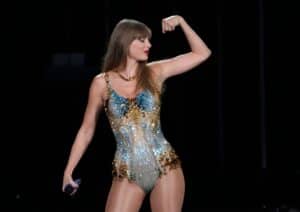
    2TE0DBA File – Taylor Swift performs during “The Eras Tour,” Monday, Aug. 7, 2023, at SoFi Stadium in Los Angeles. Megastar Swift dominated popular culture in 2023, going on the first-ever $1 billion tour and getting named Time magazine’s Person of the Year. (AP Photo/Chris Pizzello, File)


    Her work can be seen as a working through of this difficulty – even its dramatization. We enter a world which feels at first insufficiently signed, and we must learn to discover what things are like: art is a way of coming into knowledge about this. Taylor Swift’s songs are about this journey, and she has described with a mining obsession. She is one of those writers who isn’t content to skim her topic; she delves.

    Even so her fame has made it difficult to discern what drives her as a songwriter. The course convener for the Taylor Swift course at Basel University Dr Andrew Shields says in our Question of Degree in this issue that many people misunderstand the essential genesis of Swift’s work: ”When I stumbled on ‘Blank Space’, I came to understand that she was writing fiction. Even in songs where you think she may have just sat down and versified her biography, even there, there’s still fictionalisation,” he explains.

    Shields argues that we have difficulty in placing Swift, since she comes out of the country milieu but has crossed over into pop. Shields compares her to Adele: “Around the time, I first got into Taylor Swift, I also bought my daughters the albums 21 and 25 by Adele. I took them to the gym and everything about those albums is about excellence. The voice is excellent. The framing of the voice in the mix is superb. Her articulation in the mix is superb. Her articulation is fantastic. She also writes harmonically and melodically richer stuff than Swift does.”

    I feel a ‘but’ coming and indeed it does come. “But the lyrics sound like they’re just scribbled down stuff. Adele is working in studios with some of the best people in the world, and that is what makes her successful along with her incredible voice, but apparently they don’t need to have decent lyrics. ‘Hello’, for example, is an incoherent text.”

    This, says Shields, is what makes Swift so special: “Swift tells stories: she has characters, and she has wit.” For Shields, Folklore, which landed at the start of the pandemic, is the breakthrough album. “Until that album, I’d find listening to more than an album’s worth at a time a little too much, but there’s more room in Folklore.”

     

    E9P0A8 New York, USA. 30th Oct, 2014. Taylor Swift performs in New York City’s Times Square for ” Good Morning America” concert series © Bruce Cotler/Globe Photos/ZUMA Wire/Alamy Live News

    Like Dylan’s ‘Murder Most Foul’, Folklore arrived to console us at a time none of us shall forget: it is part of that historical moment.

    When one sees Paul McCartney at the Eras tour, we are reminded that he likely wouldn’t be there if he didn’t think the performer on stage were a songwriter: and of all people he should know. McCartney’s attendance was especially interesting since he is one of the few people alive today who know what this kind of fame is like.

    As Swift swung through London, emitting minor earthquakes at the biggest venues in the country, her physical presence in one’s general vicinity wasn’t something possible to ignore even if one were inclined to do so.

    The evidence is that Swift is capable of getting to more or less anybody capable of being got to. One is Angelina Giovani, who describes for me the scenes in London at Wembley Stadium. What was it that turned her into a Swiftie? “I am not on original, die hard Swiftie, to be honest,” she replies, though her eyes are shining slightly at the mention of Swift’s name. “I first started paying attention to her when she started re-recording her old albums so she could own them. I thought that was very brave and very smart.

    But what really brought her into my radar was the Eras tour. I remember last year, early in the tour it rained through many of the early performances, and she carried on singing her entire track list completely unbothered by it. She did the same in the Brazil, where the heat was insufferable and she managed to keep performing, while visibly struggling with her breathing between songs. I was very impressed by the endurance and commitment.”

    This is something which one can easily miss: her professionalism, which is such a fait accompli now that one can easily underestimate the effort which went into its acquisition. Up there onstage during the Eras tour, one can see, behind the theatre of it all, the sheer extent of her determination: a work ethic which again is hard to think of having been matched in pop since McCartney.

    We see in the marvellous Peter Jackson film Get Back how for every song that each of the other band members were writing, McCartney was writing ten and it ended up being too much for the rest of the band to cope with. Swift is a little like this, issuing earlier this year not the expected album, but a double album in the shape of The Tortured Poets Department: the impression is of hyperactivity, and an energy going in all directions – into her music videos, and indeed into her every move. She is an advert for superior planning – and for doing things for the right reason.

     

    C672PF Taylor Swift on stage for NBC TODAY Show Concert Series with Taylor Swift, Rockefeller Plaza, New York, NY October 26, 2010. Photo By: Rob Kim/Everett Collection


    But predominantly, nowadays it is going into her Eras show, which treats each of her albums as an epoch to be explored and re-enacted. It was the late great Tony Bennett who said in relation to Amy Winehouse that no jazz singer likes to see 90,000 people staring back at her. Swift doesn’t seem to mind that at all.

    The author of the best book about Swift is The Secret Critic who speaks to me over email in order to retain his or her anonymity. His book Taylor Swift: The Anatomy of Fame is like no other: a tour de force of literary criticism, which addresses the Swift phenomenon in highly original terms.

    The author tells me: “Swift can’t sing like Winehouse – which is no shame, as she was a one-off – but the quote is a reminder that large stadiums are a problem to be solved. The only person really to solve it before Swift was Freddie Mercury – and I occasionally see Swift deploying gestures at the piano which remind me a little of him, tipping her whole body back theatrically. Mercury knew that these arena require exaggerated gestures – and Swift knows this too.”

    For the Secret Critic, it is also a question of intimacy: “Mercury also understood that the only way to make the space smaller is to connect intimately with the people in it as he did with his famous ‘Day-dos!” So how does Swift do it? “What’s unique is that she does it through respect, humility, and an earned familiarity.

    She couldn’t play these venues if she’d ever put a foot wrong in displaying respect towards her audience; the act simply wouldn’t work if she had ever done that. It is this peculiar bond between her and her audience which enables her to handle these enormous audiences. There has never been anything like this – by comparison, Mercury looks remote from his audience. There was no Queen community in quite the same way that there’s a Swift community.”

    For me, the Eras show works partly due to its choreography where Swift accepts a central role while also sharing it with others. Again, in compiling the show she is able to borrow from her own hard work in her music videos, which she has always controlled. Some of these are now on display in the V & A Museum. Kate Bailey, Senior Curator, Theatre & Performance, says: “We are delighted to be able to display a range of iconic looks worn by Taylor Swift at the V&A this summer. Each celebrating a chapter in the artist’s musical journey.”

     

    2T41TF4 OCTOBER 27th 2023: Taylor Swift is officially a billionaire according to multiple published reports which now estimate her net worth at roughly $1.1 billion. – File Photo by: zz/Patricia Schlein/STAR MAX/IPx 2019 8/26/19 Taylor Swift at the 2019 MTV Video Music Awards held on August 26, 2019 at the Prudential Center in Newark, New Jersey, USA.


    And what is the idea behind the show? “Taylor Swift’s songs like objects tell stories, often drawing from art, history and literature. We hope this theatrical trail across the museum will inspire curious visitors to discover more about the performer, her creativity and V&A objects.”

    These outfits, above all, always make one think, for the simple reason that there is never any doubt that a considerable amount of thought has gone into their creation. It is all of a piece with someone who won’t leave anything to chance. The looks that she has produced each speak to a particular mood; her albums represent self-contained aesthetics, which is part of what makes the Eras tour viable at all. Here is Swift, gloriously rainbow-coloured during her Lover era, cabin chic during Folklore, and suitably red during the Red era.

    Angelina Giovani explains that even making her way to the concert was an eye-opening experience: “On my way to the concert I saw how most houses on Wembley Hill had put out signs, renting out their driveways to concert goers so they could park. They were all full, going at about £20 for the afternoon.

    Swift is playing at Wembley Stadium eight times this summer, during which the average family will make £160 per parking spot. It is not ground-breaking, but it is not nothing. Her fans travel around in thousands to see the concert, they eat, drink and sleep locally and as far as fans go – they’re not football fans. Their most threatening weapon is glitter, so they are made very welcome.”

    She is also eloquent about the greatness of Swift as a live performer: “The concert was electric. I have been to many concerts before, primarily rock bands, but this was quite special. I had never seen such a mix of young and old before at Wembley. The youngest concert goer was no more than five years old and the oldest, in their eighties. I found it very heart-warming to find a common source of joy across generations.

    There were 84,449 people on her first day at Wembley, and throughout the 46 song track list that she sings she never sang alone. The people who had purchased seated tickets, did not sit down.” Giovanni brilliantly captures the uniquenesss of live concerts: “There’s something about concerts that makes everyone think they can sing, which is endearing. At times it was hard to distinguish Swift’s voice from the crowd. But you can see her relishing in it. She is so tuned it and plugged into the audience. She kept spotting people who needed help in the standing crowd and pointing them out to the first aid crew.”

    This is an important point. If one looks at Swift’s predecessors in the 60s, whether it be The Beatles or The Rolling Stones, they had become famous in order to put distance between themselves and others; Bob Dylan, meanwhile, has sometimes shown a kind of lofty contempt for his audience.

    The examples of Swift’s good nature are too numerous to have been faked and it is this which causes such widespread happiness: we haven’t been watching a musical phenomenon sweeping through the country so much as a sort of spiritual force. Swift has given huge amounts to charity – and not done it any showy or self-aggrandising way. We can find the friendship bracelets which are handed out at her concerts kitsch if we want, but the moment we think friendship itself is kitsch, we have become cynical, and the joke may have rebounded on us.

    Dr Paul Hokemeyer, an extremely successful psychologist, agrees: ”One of the things I find most valuable about Taylor Swift’s uber celebrity is how it transcends the veneer of social media celebrities such as the Kardashians and rejects the meanness of the Real Housewife franchises. In contrast to these other celebrity phenomena, Taylor Swift sends a message of kindness, inclusion, respect and hope. Her music is uplifting. It celebrates the vulnerability inherent in being human and creates connections through communities of joy and the celebration of love and life.”

     

    C672YY Taylor Swift on stage for NBC TODAY Show Concert Series with Taylor Swift, Rockefeller Plaza, New York, NY October 26, 2010. Photo By: Kristin Callahan/Everett Collection

    This is well-put. As we look at the world of politics at time of writing, the UK for all its problems seems a sort of curious bright spot. We find an unhappy American election where some think a new civil war may be imminent; in France things seem even worse – and, of course, the Russia-Ukraine and Middle East conflicts continue, as do threats to our Western way of life from China, North Korea and Iran. The opportunities for despair appear to be legion.

    But Taylor Swift, whether one likes her music or not, is against all that, says Hokemeyer. “As a mental health professional, I find the hunger for such messages indicative of the pernicious impact our current culture of ideological division, violence, patriarchy and ecological destruction is having on the younger generations of humans. They are looking, like Harry Harlow’s monkeys, for love, nurturance, benevolent leadership and comfort in their lives.

    When Taylor takes the stage, or is heard over earbuds on the tube, she touches her fans on a deeply emotional level. She models power through vulnerability rather than malignant narcissism. She speaks to her tribe in a way that nourishes their hearts, minds and bodies. She makes them feel important, seen, understood and, most of all, valued in ways that our political, religious, corporate and even family leaders have failed them.”

    Giovanni agrees: “You can love or hate Taylor Swift, it doesn’t really matter in the grand scheme of things. Her music is not everyone’s cup of tea and that’s fair enough. But in the past year, Taylor Swift has done more to help with hunger than governments. Measurably so. In every city she plays, she donates to food banks enough money to keep them running for a whole year. Many roll their eyes, it’s all for show, it’s all to paint a certain picture. But does that matter? Not to the people who are getting regular, hot meals.”

    In other words, Swift is now in effect beyond her art – she exists in a realm of willy-nilly cultural significance, exactly as the Beatles did. It was a futile thing to announce that one didn’t much like Sergeant Pepper’s Lonely Hearts Club Band in the 1966, the year of its release. It was what was happening then; it was how the world was. Years, later Sir Martin Amis would write in his 1973 novel The Rachel Papers that: ‘To be against the Beatles is against life.” It is the same with Swift today: she is, whether one likes it or not, part of the life force.

    But how exactly has this force come about and what does it say about us? Just as in old footage one sees young girls in a sort of delighted panic at the sight of the Beatles performing ‘She Loves You’, today we see their progeny experiencing similar emotions with Taylor Swift. This is interesting because in the case of The Beatles one assumed that sex might have had something to do with the extent of the obsession; but that doesn’t seem to be the case when it comes to Swift.

    2BP33RG NEW YORK, NY, USA – MAY 29, 2009: Taylor Swift Performs on NBC’s “Today” Show Concert Series at Rockefeller Plaza.

    So what’s going on here? Hokemeyer tells me: “For time eternal, humans have engaged in celebrity worship and oriented themselves in tribal hierarchies. In the realm of psychology, such patterns of being are known as archetypal. They are accepted as part of the universal human experience and involve behaviours that reoccur consistently over millennia and across cultures.”

    In other words, what we are seeing is only the latest manifestation of a tendency as ancient as the hills. Hokemeyer continues: “But while this overall pattern of being remains constant, over time, the objects of our celebrity worship change to reflect the contemporary zeitgeist. In ancient Greece, humans worshiped celebrities such as Aristotle and Socrates. These men provided clarity and comfort in a dangerous and chaotic world through logic, reason and intelligence. Fast forward to modern times when today’s celebrities are human beings who have attained elevated levels of financial success and captured the world’s attention by features of their beings: their talent, their power, their beauty, their wealth.”

    So we’ve gone away from celebrating intellect towards worshipping money? It isn’t quite as simple as that, says Hokemeyer: “Today’s celebrities such as Taylor Swift, garner and hold society’s projections of superiority over the banality of human existence while providing transcendental experiences to people longing for connection, joy, comfort. She, through her music and charisma, provides a momentary reprieve from what remains a dangerous and chaotic world while allowing us to organize ourselves like honeybees, under a superior other and in colonies of shared purpose and identity.”

    What is remarkable about this is just how universal it appears to be. “What is most interesting about Taylor Swift is how she’s been able to garner uber celebrity amongst a geographically, racially, economically and culturally diverse group of people,” Hokemeyer continues. “In contrast to celebrities of the past whose celebrity has been more limited, Taylor has been able to utilize the power of the internet to unite a humanity suffering from an acute state of division, disconnection, violence and environmental degradation by making her fans feel seen, valued and understood through her music, charisma and the community she’s created.”

    When I put all this over email to the Secret Critic, the mystery author agrees but also has more to say: “I would argue that Swift, though she seems to have arrived out of the milieu of pop, and even of American Idol and so on, in fact has more in common with the Sixties songwriters than we sometimes think, and far more than her detractors realise. She isn’t only a live concert experience; there’s a genuine listening experience to be had as well.”

    Like Shields, The Secret Critic points to Folklore as a period when her songwriting went to a new level where, notwithstanding some dissent over her new album, it has largely stayed. “From Folklore onwards, you’ll find more complex language – a deeper commitment to character. In my book I have an analysis of the Betty trilogy on Folklore and there are some remarkably telling details and some very clever touches in terms of character: she can do the male character voice, and the two very different female characters.

    This is far harder than it looks – and she does it.” These three songs, consisting of ‘Cardigan’, ‘August’ and ‘Betty’ are redolent, says The Secret Critic, of those times. “I think that the pandemic period was an opportunity which she seized in some way. She watched a lot of movies and read a lot of books -and the result was a kind of deepening in her art. I would argue that her best song is ‘Exile’ where there is a depth of feeling about the collaboration with The National which has to do with the odd static urgency of that time. I don’t think we see such depth in her recent collaboration with Post Malone.”

    Swift herself is very interesting about her craft. “Throughout all of the changes that have happened in my life, one of the priorities I’ve had is to never change the way I write songs and the reasons I write songs. I write songs to help me understand life a little more. I write songs to get past things that cause me pain. And I write songs because sometimes life makes more sense to me when it’s being sung in a chorus, and when I can write it in a verse.”

    Love continues to obsess her – relationships are to her, to paraphrase Larkin, what daffodils were to Wordsworth: “I write a lot of songs about love and I think that’s because to me love seems like this huge complicated thing,” she has said. “But it seems like every once in a while, two people get it figured out, two people get it right.

    And so I think the rest of us, we walk around daydreaming about what that might be like. To find that one great love, where all of a sudden everything that seemed to be so complicated, became simple. And everything that used to seem so wrong all of a sudden seemed right because you were with the person who made you feel fearless.”

    But does The Secret Critic see The Tortured Poets Department as a weaker album? “I do think it’s a problem which pop stars face, and it’s to do with musical education. Classical composers tend not to become samey because they just have so many musical resources at their disposal.

    The same just isn’t the case in popular music – even when you look at McCartney who is just this immensely musical guy. Take ‘All Too Well’ as an example. The chord sequence is essentially, C, A minor, F, G – which is broadly the same chord sequence as ‘Let It Be’. But it’s very simple, and the danger is that when you’re writing according to simple structures, you find there are fewer places to go musically.

    As I listen to the latest single ‘Fortnite’ I find myself understanding what The Secret Critic is saying: in ways which are difficult to pinpoint the melody, feels of a piece with Midnights but it lacks the excitement of the inspiration which must have accompanied that album.

    Why is this? “I’m not saying it’s a terrible album. But I do think its weakness has been masked somewhat by the ongoing success of the Eras tour. Why does pop music tend to fall off a little? There are a few reasons. One was described by Stephen Sondheim. He pointed out that after a while, muscle memory means that when a composer approaches their instrument their hands, by habit, gravitate back to the same chords.

    This habitual element to songwriting can be very damaging and create samey work, as I believe it is beginning to do with Swift. John Updike wrote a famous essay called ‘The Writer in Winter’ where he writes of every sentence ‘bumping up against one you wrote 50 years ago’. Updike lived to a fairly decent age, and his prose was rich. Pop tends to stale quicker as the options for creativity appear to be far fewer.”

    But there’s another problem. “The other thing is that pop music is the expression of youth. Now, there are a few exceptions here and there to this – Bob Dylan and Leonard Cohen were still breaking ground into their 80s. But they came from folk music which is a more cerebral form. Swift is interesting because in Folklore and Evermore, she has shown that she’s comfortable with this genre so there are places for her to explore as a songwriter. It’s just that both Midnights – and now The Tortured Poets Department – have shown her moving in a more disco beat direction. I don’t think the quality will be sustainable in that line.”

    Angelina Giovani disagrees: “My favourite album is by far the most recent one The Tortured Poets Department. It’s quite a departure from her usual style of writing, but it is an immersive experience that is very emotionally charged. All feelings come through very clearly, whether it’s heartbreak, pain, anger, relief, reassignment or juvenile joy. My favourite song of the album is ‘The Smallest Man Who Ever Lived’. I can absolutely see it turned into another short film.”

    The Secret Critic responds: “If you listen to that song, even the melody along the line ‘ever lived’ is too similar to the melody to Bad Blood. There’s no way to avoid the fact that she’s likely going to go into an artistic decline, and that once this tour is over, and all the noise has died down, we might well have seen peak Swift.”

    But the Secret Critic also has fascinating things to say about the scale of the Swift phenomenon. In The Anatomy of Fame he cites what he calls The Peyton Predicament, which references a football commentator and Swiftie called Jared Peyton. Peyton found himself as the Kansas City stadium where Swift’s latest boyfriend Travis Kelce was playing. He decided to go and find her and filmed his quest on Twitter.

     

    2J7C92H Taylor Swift live on stage – The 1989 World Tour Live – 2015

    What followed went briefly viral online. Peyton, using his insider’s knowledge of the geography of the stadium managed to get to the end of a tunnel just as Swift went past. “I was fanboying out!” he said on the video he streamed on Twitter, which in itself earned him a certain fleeting celebrity. “The Peyton Predicament speaks to the huge importance in many people’s lives,” says The Secret Critic. “My book seeks to ask the question: Why does he feel the need to do that? What is it about her and what is it about us that means that it has come to this?”

    It would be easy to be cynical about this and to consider Payton little better than insane to place such emphasis on saying hello to a fellow mortal being. But Dr. Paul Hokemeyer takes a somewhat different view: “At the most primal level of our being, we all need to feel seen and validated by a superior other. This need is hard-wired into our central nervous system. We come out of the womb completely dependent on another human being to feed, love and comfort us. Without this love, we, like the monkeys in the famous Harry Harlow study, will suffer from profound states of emotional despair and poor physical health outcomes.”

    By this reckoning then Payton’s behaviour, far from being a bit mad, is in fact deeply human: “When Taylor Swift not just saw, but also gracefully acknowledged Payton’s presence, his central nervous system lit up like Harrods on Christmas Eve and flooded him with a host of endogenous opioids such as dopamine, serotonin and oxytocin. He was elevated to a state of being, ecstasy actually, that might defy logic, but which is consistent with our basic human need to be validated by a superior other. In the experience, Payton transcended his human frailties and became intoxicated with the elixir of celebrity.”

    In The Anatomy of Fame, The Secret Critic goes into the matter in even greater detail and analyses the constituents of this appeal from the philosophical perspective. “I wanted to write a book where at the beginning we see Payton in one way – but by the end we’re brought round to his way of seeing – or at least to understanding it. If someone said to you: ‘Taylor Swift is over there, you might want to go and see her,’ you’d think one set of thoughts. But if I said: ‘Somebody who embodies beauty, creativity, kindness and power’ is over there, you’d say: ‘Well, you should definitely go and talk to her’. But to Peyton that’s exactly what Swift is.”

    The book therefore breaks down Swift’s appeal looking at her songwriting, her beauty, and above all her morality. The effect is very profound. We see how Swift has effectively straddled the songwriting of the 1960s and written songs which are close to being standards, while also becoming the premier live performer of our time. She exhibits beauty but also vulnerability. But above all she joins power with a matter-of-fact kindness which never feels affected.

    I decide I want to test The Secret Critic’s theory on Angelina Giovanni, who enthuses: “I find it rather impressive that people who work with and for her and don’t seem to have a bad word to say and are always raving about her generosity. Everyone on her team from truck drivers, to back up singers have received life changing bonuses, totalling a whopping $55 million dollars. That’s why I’m rooting for her to be even bigger. I love the fact that it is someone of my generation that has made it so big, so young and is on track to breaking so many musical records previously held by music’s biggest names.”

    Of course, there are limits to her power. As the Netflix film Miss Americana shows, her intervention on an abortion referendum in her home state did nothing to sway the result, and there is a sense too that the way in which politicians, especially the Biden administration, fall over her for her endorsement borders on the absurd.

    But her business skills – or her ‘power moves’ as she refers to her own acumen in the song ‘The Man’ – are both considerable, but also very far from being the main reason for her fame. It is a mark of her uniqueness to think that she came up with the line “I swear to be melodramatic and true to my lover”, but also the brilliant savviness of the Taylor’s Versions project, whereby she wrested back control of her back catalogue taking advantage of the fact that she continued to own the copyright of her songs.

    When it comes to the management of her career, one suspects the influence – perhaps both genetic and direct – of her financially savvy father: Swift used to tell her contemporaries at school that she would be a stockbroker when she grew up.

    But there is no doubt that Swift’s principle achievement is to have created by the power of her music and her example, a change of direction away from selfishness towards kindness. Dylan was always acerbic; the Gallagher brothers were demonstrably offensive and the world is full of rock stars who don’t donate to food banks – and likely never consider it something which they might do.

    Taylor Swift does and it is wonderful that she does. It seems to me as though she is an aspect of something which appears to be happening the world over: a realisation that the values of self-interest which arguably date as far back as the Renaissance are insufficient to live by. We vaguely know this – but sometimes it helps if someone sings about it too.


    See our other cover stories:
     

    Exclusive: how Elon Musk is changing the global economy?


    Exclusive: how Emma Raducanu changed the world of tennis


  • ‘Room for improvement’: Tim Clark reacts to Bridget Phillipson’s first speech to the education sector

    Tim Clark


    Last Thursday (7th November) Bridget Phillipson gave her first major speech to the education sector at the Confederation of School Trusts’ annual conference. Her speech was personal, extremely positive and encouraging but also showed hints of naivety and even a lack of realism and understanding of the current situation in schools.

    She began, as her predecessor, Gillian Keegan, always did, by talking about her own journey from a disadvantaged background to becoming Secretary of State, something to be applauded and respected. After all, what is the prime purpose of education other than to nurture, develop and to open doors for all, regardless of background and ability? Her recurring theme was “achieve and thrive”.

    She highlighted the appalling inequality that still exists in this country and the fact that where you live and where you go to school are still key determinants in your educational outcomes. This is clearly wrong, even immoral, in a modern, advanced nation: every child should be able to access a world class education. Understandably, she enthusiastically listed several decisions made by the Labour government: the fully deserved 5.5% pay rise for teachers and the £2.3 billion increase to the core schools budget (although much will be taken up by the pay rise and the inexplicable hike in employers’ National Insurance contributions).


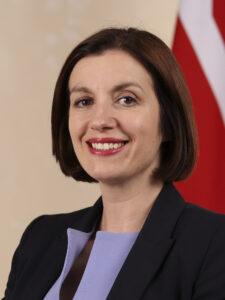
    Bridget Phillipson
    05/07/2024. London, United Kingdom.Secretary of State for Education,Bridget Phillipson poses for a photograph following her appointment to Cabinet by Prime Minister Sir Keir Starmer in 10 Downing Street. Picture by Lauren Hurley / No 10 Downing Street

    I also welcome her attitude to the teaching profession, “Teachers are partners not enemies” and the use of experienced professionals, rather than SPADS who have never stood in front of 30 stroppy teenagers on a wet Friday afternoon, to lead on various developments. I should have liked, however, to see a greater involvement of the profession as a whole. In my first, “Better schools, The Future of the Country” report in June 2023, I called for the establishment of a National Schools Council which would regularly and formally bring together ministers, civil servants and elected representatives from all areas of the school system. Real improvement will be dependent on the active involvement of those who successfully do the job, not those who just talk about it.

    Phillipson no doubt pleased many by offering to spend more on “crumbling classrooms”, referring to the recent Budget and the long overdue additional £550 million for rebuilding and the extra £330 million to improve the condition of our schools. We should not forget, however, that RAAC and asbestos existed at the time of the previous Labour government but rather than resolving these issues twenty years ago, it decided instead to spend the money on building a limited number of new, architectural masterpieces rather than on resolving underlying issues in all schools. Eye-catching new builds are presumably deemed more helpful at elections than a new roof here or a new staircase there.

    Clearly these are early days, but several of Phillipson’s comments do bode well for the future. The curriculum and assessment review may result in a curriculum that is more accessible and which will enable more young people to achieve and to make a positive contribution to the economy and society (but, I hope, without adopting a “prizes for all” mentality). The changes to Ofsted will, with any luck, lead to an inspection system that is far more clinical, accurate and useful to parents, schools and government, although we are yet to see what will take the place of the single, overall inspection grade. Providing early intervention for SEND pupils and of tackling the current atrocious absence rates [one in five children is deemed “persistently absent”] are both areas urgently requiring dramatic intervention.

    For all its positivity, however, there are two areas where I feel the Secretary of State’s speech lacked authority or understanding. The first is tackling the absolute crisis in teacher recruitment and retention. She made much of Labour’s manifesto promise to create an additional 6,500 teachers but, despite being an attractive soundbite, the number shows a complete ignorance of the magnitude of the problem. Last academic year, over 40,000 teachers (over 9% of the workforce) quit the profession for reasons other than retirement. In the same timeframe, only one half of initial teacher training places were filled (and only 57% in the previous year).


    This is the perfect storm – both retention AND recruitment. With over 20,000 schools in England, this equates to losing almost two teachers for every school; 6,500 new teachers is not even one new teacher between three schools. This is a crisis of extreme proportions and although Phillipson claimed she was not guilty of “a plan for happy ignorance”, much, much more needs to be done. The last administration pointed to the fact that there are in fact currently more teachers than ever before, but this ignores the fact that there are also 74,000 more pupils than in the previous academic year or that many of the additional teachers are either overseas trained (not in itself negative, but it obviously depends where and in what type of system they trained) or unqualified – hardly a recipe for dramatically raising standards. It is great teachers that change young people’s lives: until this crisis is resolved, any talk of curriculum, inclusiveness, standards or, indeed, any education topic, is simply pie in the sky.

    The area of Phillipson’s speech which has probably caused the most debate, is where she spoke about standards and the need for young people to be happy in schools. A survey has shown that one in three 15-year-olds “don’t feel happy in school. That’s worse than the average across our OECD neighbours”. Interestingly, this is the only international comparator that she chooses to quote: not the recent international reading and numeracy tests which, under the previous government, saw our comparative position rocket. Her message was clear – schools should not concentrate on academic achievement: “A*s alone do not set young people up for a healthy and happy life……This government will always be strong on standards….[but she warns against falling into]  “the trap of chasing a narrow shade of standards, structures-driven rather than child-focused”.

    Firstly, the vast majority of schools are not blindly focussed on exam results – to suggest that they are is simply insulting to all of us who have spent our careers committed to pastoral care, extra-curricular activities and to the development of the whole person. But why do some schools prioritise academic achievement? Not only is it the key to unlocking the future for every young person, it is also the metric by which schools are publicly judged – the annual examination performance tables. Phillipson makes no mention of scrapping these and they remain a central tool for how government and parents judge schools. Of course, issues such as “happiness”, ethos, the hidden curriculum and even extra-curricular activities cannot be quantified in the same way that examination results can – and nor should they. Let us understand that what makes a truly great school and gives it that special soul and feel, cannot always be defined in a league table. This is not a call for scrapping league tables, but if you chose to publicly rank schools according to their exam results, do not criticise them for playing the game.

    There is a clear criticism of previous governments in much of what the Secretary of State says: “previous governments have had tunnel vision……a sole focus on achievement is doomed to fail”. Anyone who has ever worked in a school, even briefly, knows that education is about so much more than exam results, but what she seems to fail to appreciate is that, sadly, this country is currently facing a genuine issue with academic standards.

    In recent years, England has done remarkably well in international league tables [PISA and PIRLS] but we must not confuse comparative ranking with a real improvement in standards. Yes, England has outperformed many competitors, which in itself may mean that our system has been more resilient to COVID and other pressures than that of other countries, but if you read these reports, our real terms performance in certain areas has declined at a frightening rate of knots: some maths performance is the lowest it has been since 2006; less than half of children feel confident in reading (it used to be more than half) and, what I personally find more worrying than anything else, less than one third of children going to secondary school now like reading. [And before anyone says this is the result of social media, our performance in this indicator is twenty points behind the international average.] In addition to making children safe and happy, we also need to raise academic standards as a matter of urgency and ensure that our schools produce youngsters with the knowledge, skills (soft and hard) and understanding necessary for them to contribute actively to society.

    Twenty years ago, I attended a conference which looked at the two trending education initiatives of the day, “Every Child Matters” (English) and “No Child Left Behind” (American). Unfortunately, the keynote speaker got tongue tied and called for a system where, “No child matters and every child is left behind”. The accidental slip inadvertently highlighted a very real danger – that political point scoring, that change dictated by those without knowledge or experience and that good, but flawed, intentions can seriously damage the education we provide for our young people. I have never doubted the sincerity and commitment of any Secretary of State or Minister of Education to do their very best for young people, but if the current and future incumbents want to really make a positive difference, they need to understand a few basic truths:

    ·       The very future of this country depends on how well we educate all young people, regardless of their starting point; education is too important to be a political football

    ·       A first-class education system requires significant investment.

    ·       Education is a complex matter: soundbites and a “one size fits all” approach are damaging in the extreme

    ·       The teaching profession is the most important commodity in any school system and makes the greatest difference to young people’s outcomes

    ·       While the role of elected representatives is critical, opportunity must be created to actively and meaningfully engage with those who have experience and proven success in teaching in our schools and of actually working with young people, not with advisors with absolutely no hands-on experience


    It is perfectly possible “to achieve and thrive”, but there is clearly much to be done.

  • Sir Michael Morpurgo on Anne Frank’s Diary

    Sir Michael Morpurgo

    I am a war baby, born on 5th of October 1943. Anne Frank probably died on 31st of March 1945. We shared this world for only a few months.

    Whilst she was hiding away in an attic with family and friends from the Nazis, while she and they were finally being betrayed and taken away to Bergen Belsen concentration camp to be murdered in the Holocaust like millions of others, I was being looked after in my grandparents’ comfortable house in Radlett, outside London, with a garden, surrounded by family, under threat of the war of course, but I knew nothing of that. I knew nothing of the concentration camps either. I did not know about the evil that men do, that sadly does live after them, if we allow it to.

    When Hitler sent over the V2 rockets to do their indiscriminate killing, I was evacuated 300 miles north, well out of range. During my early childhood, the war, the history and the myth of it, was ever present, from the bombsites we played in – playing war games mostly – from the photo of my Uncle Pieter on the mantelpiece who had been killed in the RAF in 1941, aged 21, from the soldier with one leg often begging on the street corner near my school, I thought of war as a sort of killing game.

    It took me a while to realise that it wasn’t a game, that war destroyed houses, flesh and uncles. BuI I think I only began to comprehend the depth of the tragedy of it when I saw my mother crying over the death of Uncle Pieter, her beloved brother. I caught her sadness, I think, and came to miss the uncle I never knew, and so began to understand the pity of war very young.

    But I must have been eleven or twelve when I first knew anything of Anne Frank or the Holocaust. My family knew about it of course, but never told me. Like millions of my generation and in the generations to follow, I learnt about it through reading Anne Frank’s Diary. Her face was on the opening page looking out at me.

    She wrote directly to me, confiding in me, telling me how it was to be her, how she was enduring her imprisonment in her attic in Amsterdam, the tedium, the frustration, the dread, the anger, the memories, the friends and relations, the hope, the longing to be free again, for liberation to come. It was her living testimony. And it lives on today.


    why anne frank is so famous
    Anne Frank’s talent was brutally cut short but she remains famous as a source of inspiration to people everywhere

    The last page of her diary is the last we hear of her. She is simply not there any more. We knew before we ever read it that she had died, that these were to be her last words. Once read it is never forgotten.

    It was of course not written to be read by others. She did not know that this was to be her testament, the most personal insight into the life of a spirited but ordinary girl whose name and face was one day to be famous all over the world, was to represent for so many all the wickedness and the waste, horror, the tragedy, shame and pity of the Holocaust.

    For ever afterwards, her life and her death has given me, us, some way of beginning to understand the Holocaust. She was the one of the 6 million we all came to know. Her short life and death remind us of man’s inhumanity to man, of the depth of cruelty and depravity we are capable of, of the power of prejudice so easily aroused to fuel hate.

    But Anne also gives us hope, the hope she had, that all can be well again, if we make it well. Her words, her suffering, her death, give us the determination to right the wrongs of antisemitism and prejudice of all kinds, to create a world where kindness, empathy and understanding rule.

    Because of Anne, scribbling away up in her crowded attic room, I have had her story and her fate, and the iniquitous and vile Holocaust in my head for much of my life. It’s no accident then that I have written my own stories about it, stories like The Mozart Question.

    This story and so many others were, I feel sure, originally inspired in part by a family friend I had grown up with as a child and known well – Mac, we called him, Ian Mcloed. He was amongst the very first British soldiers in the Royal Army Medical Corps to enter the concentration camp at Bergen Belsen, on the 15th of April 1945, where Ann Frank had died just a week or two before. A young man, a teenager at the time, Mac witnessed the horror of Belsen with his own eyes, and suffered from the effects of that terrible experience all his life.

    His life, his being there at the liberation of Bergen Belsen, was the first of many personal connections to the Holocaust that have echoed through my own life, in so many ways.

    For instance, growing up I was unaware of the Jewish origins of my step family. My birth name is Bridge, my father an actor, Tony Van Bridge, but my mother left him in 1946, to marry one Jack Morpurgo, from a Jewish family that emigrated to London in the early 20th century. So aged 2, I became a Morpurgo. It is a Jewish name from northern Italy, well respected there. Many many Morpurgos I later discovered had died in the camps.

    And there was the violin. Go to the Violins of Hope Museum in Tel Aviv, and you will find amongst all the violins played in the concentration camps, the Morpurgo violin. It belonged to one Galtiero Morpurgo, a survivor of the camps, who was still playing the violin until he died aged 97. His family donated his violin to the museum.

    Strangely, I did not know about this Morpurgo violin when, twenty years before I wrote a story of mine I called The Mozart Question. It is to me perhaps my most important book. By this time I had of course read Primo Levi, I had known and become a good friend with Judith Kerr, fellow children’s writer, and author of Hitler Stole Pink Rabbit, based on her family’s escape from Germany in 1933.

    Why Anne Frank is so famous
    Anne Frank in December 1941

    And I had discovered that a great teacher of mine, Paul Pollock, who had taught me classics at school, had been a child on the last train of Jewish children to leave Nazi occupied Prague in 1939, one of hundreds saved from the Holocaust by the wonderful Nicholas Winton. Mr Pollock was a devoted and eccentric teacher known and much respected for his extraordinary intelligence and famous for his withering remarks, his cutting barbs.

    His barber was once overheard asking him: “And how would you like your hair cut today, sir?” “In silence,” Mr Pollock replied. He died only six months ago, at over a hundred years old. And we never realised when we were boys what he had been through, how he had no family but us. They’d all gone. He was alone in the world.

    I have his story and Mac’s story and others in my mind as I am talking to you today. They connect me to the Holocaust. They all lived on. But Ann Frank was the first and most important of these connections, and she did not survive.

    But the diary she wrote hiding away in her attic room in Amsterdam is for so many millions around the world the first and most lasting connection to those times, to those lost millions of the Holocaust, each of whom was a living breathing precious human being, a daughter, a son, a mother, a father.

    It is primarily then because of Anne’s enduring story, that I am here, honoured to be be talking to you today. Like her, I’m a storymaker too, a writer – and what books she might have written had she lived, can you imagine? I write under my given name.

    I am here in part because of my Morpurgo name. And I am here because of Mac, Ian Mcloed, the medical orderly at Bergen Belsen, whose story I knew growing up; and it is because of the discovery of the story of the Morpurgo violin in Tel Aviv, and of my friendship with Paul Pollock, my teacher, and dear Judith Kerr – two of those who escaped the Holocaust and came to live and do so much good for us in their adopted country. For me all these people and all these circumstances conspired to bring me here today.

    It is because of all this, because of them and all they lived through, that I know as we all do that prejudice has to be fought, that prejudice is a disease that can so easily become an epidemic of hate, a pandemic that can overwhelm us, if we ignore it or look the other way. It is a pandemic against which we have to be vigilant, and that has to be confronted. Historical awareness, and stories can help in this struggle.

    I’m firmly convinced that unless we know and remain aware of where prejudice can and does lead, unless we know the history of the Holocaust, then it can happen again, again and again. And I’m also convinced that it is stories that can keep us vigilant, that all of us growing up have to be made aware, generation after generation.

    That’s why I am with you here today, why I have written my stories of those times, of war and oppression, of occupation, and of the Holocaust in particular in Waiting for Anya and my story of a violin in the concentration camps, The Mozart Question, in which the power and beauty of violin music can and does overcome brutality and evil. We owe it to them, to those who died in the Holocaust, to Anne Frank, and to those who survived, to go on telling the story.

    And, we owe it to them surely to do more, to seek peace and reconciliation, to create the kind of world I discovered on my visit to Israel and Gaza, ten or so years ago, with Save the Children. I was taken to a village and to a school called Neve Shalom, Oasis of Peace, Wahat A Salam, the only place, so far as I know, where Jew and Arab go to school together.

    We made kites together, flew kites together, made music together. Such a place, such a spirit, such children and families, and teachers will put the world to rights. There was hope there, there was peace there. Hope springs eternal, and hope brings peace.

    Let there be peace.


    This speech was delivered at the Anne Frank Trust UK annual lunch and is reprinted in full with the kind permission of the trust. 

  • Culture essay: Why is Only Murders in the Building so good?

    Christopher Jackson asks why Only Murders in the Building is such a hit


    In one sense Only Murders in the Building – known to fans as OMITB – is just another TV show. It’s well-made, and moreish. It takes its place among umpteen other binge possibilities on Disney Plus and the other streaming channels.


    Yet there’s something so clever about it that makes one want to make claims for it. One wants to call it culturally significant and see if the label fits.


    Put simply, why is Only Murders in the Building so good?


    All-Star Cast


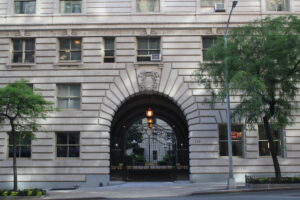
    Well, the show stars Steve Martin, Martin Short and star of the moment Selena Gomez, and has just been renewed for its 5th season. The location of the show is The Belnord on West 86th Street, a building whose residents have included Marilyn Monroe and Martha Stewart.


    This location is a clever choice since it creates a set of structures – dramatic laws – even which make the sure admirably tight. For instance, a murder has to take place in the building for it to qualify. This means that we get to know its layout, and its regulations and the people who live there. There’s a sort of cosiness to this – something almost familial.


    Why is Only Murders in the Building good?
    The Belnord is where Only Murders in the Building is set


    It’s a good tip for young writers to consider exploring a location as OMITB brilliantly does. A place will engender characters – and sometimes do so better than our imagination. Once you’ve chosen a communal building, then you have the janitor, the receptionist, the chairman of the building board – probably not the other way round.


    So who lives in the building where all these murders take place? Steve Martin plays Charles Hayden-Savage, a slightly has-been actor. Hayden-Savage probably has enough money to live there by virtue of having bought his apartment before Manhattan became unaffordable to anyone but the superrich.


    Martin’s character is, like so many he has played in the past, eager to please but with a tendency to put his foot in it. He aspires to goodness, but something about that trait means he’s romantically alone, but that unexpected friendship comes to him.


    Why is Only Murders in the Building good
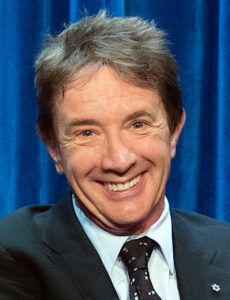
    Steve Martin plays Charles Hayden-Savage in Only Murders in the Building


    That’s true too of Oliver Putnam, played by Martin Short, a name-dropping Broadway director whose failures – especially his disastrous musical Splash – are far more memorable than his successes. Putnam can begin to grate a little by the fourth season, but he is essentially loveable, a fantasist who thinks the next big thing is round the corner – and also that his past is more illustrious than it was.


    He has a sort of Tourette’s when it comes to other people and can be delightfully rude about people to their faces because everybody knows he doesn’t quite mean anything he says.


    Why is Only Murders in the Building good?
    Martin Short plays Oliver Putnam in Only Murders in the Building


    Age Gap


    Finally, Selena Gomez’s character Mabel Mora is only in the building at all because her aunt lets her live there. It’s this age gap which provides much of the comedy. Mabel isn’t sure who she is yet, but it turns out – as so often – that who she is will be determined by the relationships she makes – in this case, the two older men.


    At one point Mabel says: “A murderer probably lives in the building, but I guess old white guys are only afraid of colon cancer and societal change.” At another point, a walk-on character thinks Mabel is Hayden-Savage and Putnam’s carer.


    Early on in Season One, Martin hilariously signs off a text to Gomez with ‘Best regards, Charles Hayden-Savage.” Her smile as she reads this is marvellous, full of the knowledge one generation cannot convey to the next. This shows tells us that the world moves fast – but also that on another level, the human heart is a realm of possible stability if we can manage to be open and kind.


    In fact, the reason the show works so well is precisely because of the inter-generational nature of the humour – and also because audiences inherently enjoy unlikely friendships.


    There is a sense in all of us that only befriending people of our own age narrows us somehow: it is as if, deep down, time doesn’t feel entirely linear and we want to teach it that lesson by striking out in surprising directions.


    Clockwork plots


    But all this would be incidental if the plots didn’t work. Murder is hard, not because it isn’t inherently interesting. It’s hard, because it’s so interesting it’s been done every which way a million times. When you write a murder mystery you’re up against Edgar Allen Poe, Arthur Conan Doyle, GK Chesterton and Agatha Christie for a start – and they’re just the headliners.


    Added to that, because the audience is reliably dedicated, they’ve seen every plot-twist. So you need to be extremely clever to surprise people likely to tune into a murder mystery: you have to secrete your clues carefully, you have to feint to the wrong killers plausibly, and you have to get your pacing right.


    OMITB does all these things, and for the most part fabulously. It’s also brought together by acting which it can be easy to underestimate. The best for me is Martin, because you don’t notice he’s acting. But the main three all combine a genuine off-screen friendship with on-screen rapport.


    Walk-on Parts


    In fact, the first season gives you the best possible measure of that when Sting appears as a cameo playing himself. Sting is a great musician, and an okay actor – but what makes him only okay at the latter is that you can see him trying too hard.


    The camera loathes exaggeration – and Sting slightly strains for effect. In his day job, and especially in his heyday, he doesn’t know how to make a clumsy chord change. But this isn’t his day job.


    It’s Martin’s though, and you can see that he’s always been much more than just a comedian. Nothing he does draws attention to the fact that he is trying to convey it; he becomes that emotion, that predicament.


    This is what lifts OMITB – its ability to keep you engaged in the storyline while providing laughs, and also moments of surreal drift. In the first episode, Putnam tells us that in New York City we sometimes fall down only to bounce back up again.


    It’s a metaphor but we end up seeing this enacted, as he falls off some stairs and floats dreamily upwards when something promising happens to him at the end of the episode. The famous White Room episode in Season 3 provides a similar moment for Martin.


    In this scene, Martin corpses and enters a strange parallel dimension: a white room where he is walking with a wonderful manic grin on his face. When he wakes, he is without his trousers and everybody is traumatised. It’s the funniest scene in the show.


    More than Whimsy


    It’s whimsy, yes, but there’s something more solid about OMITB than that. Twin Peaks made a habit of such playfulness, and perhaps in the end didn’t quite know what it was. OMITB has stronger delineation, since everything which happens in some way serves the mystery. To do this while offering up brilliant one-liners is a rare achievement.


    The show is a good indicator of where society is now. This is a world dominated by new media – the murders all revolve around a podcast which the three main characters are producing, and which becomes a surprise hit.


    But while it has its finger on the pulse, it’s a show that also knows that the latest thing is just the latest thing: the age gap between the main characters shows us how we all react to the modern world at a slightly staggered pace, according to what we wish to assimilate, and we can manage to accept.


    Along the way there are nuggets of wisdom. In Season 2, Episode 6, Tina Fey’s recurring character says: “Never become too good at a job you don’t want.” She doesn’t add that if you do that you can wake up halfway through your life with your options narrower than you’d ever thought possible: she doesn’t have to because the dialogue is so taut.


    The Here and Now


    Ultimately, the show is to do with a sort of light touch unity. Why is Only Murders in the Building so good? Perhaps for the reason that good art always is. It says, cleverly, even tangentially: the world’s like this now.


    But it also knows in Martin and Short’s characters that now will soon be then. To say that without being portentous or preachy, and to make you laugh and tell a story at the same time is a rare achievement.


  • Grace Hardy on accountancy careers: “Be yourself”

    Considering an accountancy career? Successful accountant Grace Hardy gives her advice


    Growing up with dyslexia wasn’t easy. School was often a frustrating experience for me. I struggled with reading, writing and spelling, which made traditional learning environments incredibly challenging. I often felt like I couldn’t keep up with my peers, and my confidence took a hit.

    The thought of spending another three or four years in a similar environment at university filled me with dread. I couldn’t afford to go to university without getting a job on the side and I was worried that doing a degree wouldn’t set me apart from others when I’d eventually have to find a graduate scheme after.

    During this time of uncertainty, my mum introduced me to the world of apprenticeships. I’ll be forever grateful for her suggestion because it opened up a whole new realm of possibilities for me.

    The apprenticeship route appealed to me because it offered a different way of learning – one that suited my needs better. It promised hands-on experience, practical skills, and the opportunity of earning money while learning. Plus, the prospect of no student debt was certainly attractive!

    I secured an apprenticeship with a Top 10 Accountancy Firm, and it was a game-changer for me. At 18-years-old I was on a £20,000 salary; I was over the moon. This gave me the financial stability I had been craving. From the very first week, I was working on real client projects and given responsibilities that expanded my portfolio and experience. Despite having no prior accounting knowledge, the firm provided comprehensive training and created a nurturing environment for me to learn and grow.

    As I progressed through my apprenticeship, I began to see the inner workings of different businesses. This exposure was invaluable and sparked my entrepreneurial spirit. I realised the skills and the knowledge I was gaining could potentially be used to start my own accounting practice one day.

    After completing my apprenticeship and gaining my AAT qualification, I decided to take the plunge and start my own firm, Hardy Accounting, at the age of 21. It was a scary but exciting move!

    The transition from employee to business owner came with its own set of challenges. Suddenly, I was responsible for everything – from finding clients to managing finances, and from marketing to delivering services. But the foundation I had built during my apprenticeship proved invaluable.

    One of the most liberating aspects of starting my own business was the ability to work in a way that suited my neurodiversity. I could structure my work environment and processes in a way that played to my strengths and mitigated the challenges posed by my dyslexia.

    For instance, I leveraged technology heavily, using speech-to-text software, dyslexia-friendly fonts, and other tools to help me work more efficiently. I also found that my dyslexia gave me a unique perspective on problem-solving, which often proved beneficial in finding innovative solutions for my clients.

    Whilst growing my business I quickly became aware of the fact that a very small number of my clients had any understanding of financial literacy – a key element of running a successful business. This was the seed that later blossomed into a full passion for the topic of financial education.

    After looking into how financial education is integrated into the UK curriculum (or how it really isn’t) I quickly realised that the situation was much worse than I originally thought. An inquiry by the All-Party Parliamentary Group on Financial Education for Young People found that over two-fifths of secondary school teachers surveyed did not know that financial education was a curriculum requirement.

    In addition to this, only two-in-five (41%) young adult respondents were considered financially literate, showing the impact that a lack of childhood education has down the line. Almost two-thirds (61%) of young adult respondents confirmed they did not recall receiving financial education at school – that math adds up pretty clearly.

    Those who were receiving financial education lessons in the UK were taught for an estimated 48 minutes per month on average instead of the recommended 30 hours. These findings made it clear that something needed to happen. In response, I started to lobby the Government for legislative change on financial education. This initiative became a crucial part of my journey, combining my accounting expertise with a mission to improve financial literacy across the board for the better of our communities, economies and people’s every day lives.

    In my business my goal was simple: to provide personalised, tech-savvy accounting services to small businesses and startups, helping them navigate their financial journeys with confidence. I wanted to create a firm that wasn’t just about numbers, but about building relationships and helping to educate business owners about finance so they could understand the ins-and-outs of their businesses.

    The accounting industry is on the cusp of a major transformation. As we move forward, I see a future where accounting is more than just bookkeeping and tax preparation. It’s about being a strategic partner to businesses and providing insights that drive growth and success. The future accountant will need to be part financial expert, part technology guru, and part business strategist.

    Artificial Intelligence is also revolutionising the accounting industry. From automating routine tasks, to providing predictive analytics. In my firm, we’ve embraced AI tools to enhance our efficiency and accuracy. This allows us to focus more on providing valuable insights and strategic advice to our clients.

    However, it’s important to note that AI isn’t replacing accountants; it’s augmenting our capabilities. The human touch – our ability to interpret data, understand context, and provide tailored advice – remains crucial. The successful accountants of the future will be those who can effectively leverage AI while maintaining personal connections with clients – allowing it to maximise our talents rather than replace them.

    For young people looking to follow a similar path in accounting, there are several key pieces of advice I’d offer. Being yourself is the best thing you can do. There are many business owners and everyone has their own approach, therefore it’s key to find something that makes you unique. What is your unique selling point (USP)? Developing soft skills such as communication, problem-solving, and leadership is equally important as technical accounting knowledge.

    Seeking mentorship from experienced professionals can provide valuable insights and guidance in this respect. Being adaptable is vital in the constantly evolving accounting field, ready to learn and adapt to new methodologies and regulations. Lastly, knowing that failure is not something negative is vital. In the entrepreneurial journey, setbacks are not just inevitable; they’re invaluable. Every failure is a stepping stone to success, offering crucial lessons that shape your path forward.

    These experiences, though challenging, provide unique insights and foster resilience – essential qualities for any entrepreneur. Embracing failures as opportunities for growth and learning is what often sets successful business leaders apart from the rest.

    Being self-employed has opened a realm of possibilities for me. I have since started the Unconventional Podcast and have launched the Unconventional Academy to help other young people start businesses and learn about financial education. In addition to this I am in the midst of my campaign to get legislation passed through Parliament to improve financial education throughout our school system – building for a better future, now.

    The road might not always be easy, but with determination, the right support, and a willingness to learn and adapt, you can achieve great things. Your journey is just beginning, and I can’t wait to see where it takes you!

  • Frank Auerbach’s Charcoal Heads at the Courtauld Institute: ‘a perfect little exhibition’

    With the sad news of the great artist’s death, we look back at our review of Frank Auerbach’s Charcoal Heads, Iris Spark


    Sometimes I think of those who achieved a lot young: John Keats, assured of immortality by writing a handful of odes, but dead at 26. Then of course we have Schubert, learning counterpoint on his death bed, but surely certain that the music would survive. It is a source of continual amazement that Georges Seurat managed to paint such perfect and revolutionary canvases by the age of 31. In each of these cases we have a navigable oeuvre: Keats’ output, though considerable for his age, can be encountered in a few days. You can make a provisional assessment of Seurat’s pictures online in ten minutes.

    But then there are those at the other end of the longevity spectrum – the fantastically productive and long-lived. In music, Elliott Carter wrote music every morning until his death at 103 and I suspect I’m not the only person who doesn’t know where to begin. In literature, the Greek playwrights were all fantastically long-lived. In retrospect perhaps it’s a blessing that we have only seven plays by Sophocles, who lived to be 90; he wrote 120. Art, as David Hockney pointed out, seems to be good for life expectancy. Picasso, Monet, Renoir – not to mention Hockney himself – are all long-livers.

    Which brings us to Frank Auerbach, already 93 and counting. It is fascinating, if you go to the Courtauld Institute, to be confronted with a little corner of his oeuvre across two rooms in that lovely gallery on the top floor.

    These are the magnificent charcoal drawings which Auerbach made just after the Second World War on his way to becoming, with Francis Bacon and Lucien Freud, one of the three most important artists of the so-called School of London. The Courtauld introduces the drawings with the following claim: “Auerbach’s charcoal heads – heavily worked and scarred but enduring and vital – connect us to the tenor of the post-war years.” Just when you think that the gallery may even be underselling Auerbach’s achievements, the next part of the placard expands on that thought: “Made over long periods of time, the drawings offer us experiences of what it feels like to engage deeply with another person.”

    This rings true. For a long-lived artist, Auerbach is in fact relatively easy to place. He is not, like Picasso or Hockney, continually moving onto the next thing. This is, in fact, to put the matter rather mildly. He still works today out of the same Camden Town studio that he worked in in the days which this exhibition charts over half a century ago.

    Auerbach seems to be a creature of stasis and even of obsession. Just as Degas had his ballet-dancers and his women at their toilette, so Auerbach has his heads, and a bit of Mornington Crescent. We might say that he is a vertical and not a horizontal artist. To gauge his obsessions we must consider all that he doesn’t paint: hills, trees, fruit, any buildings not on Mornington Crescent, and any people apart from his small circle of friends who interest him. Even in respect of the last category, he tends to paint their heads and not the rest of their bodies.

    Auerbach then seeks to understand the world by excluding all that doesn’t interest him, but this is not a problem. What I think he is proclaiming is his love for the things that he does paint. It was John Donne who spoke in his great love poem The Good Morrow of ‘one little room an everywhere’. Something similar is happening in Auerbach: he proclaims in paint that all the universe might be found in a face, or in a section of street.

    He is helped enormously in this endeavour by the fact that he is so obviously correct, as these marvellous pictures prove time again. An Auerbach head is a document of the artist’s engagement with the sitter over a long period of time. Each day the sitting would accrue its truth, and often then be scrubbed away at by the artist, sometimes so violently as to tear the paper. This creates a startling effect where creation and destruction are in some way married in one image, as is the case with one of his few living rivals Gerhard Richter.

    The curators explain that these pictures are of historical interest in terms of charting how people looked and what they felt just after the war. This is true. At this safe distance from World War Two, which itself contained not only millions of individual tragedies, but a collective horror at what humankind was now capable of, we might look with a certain historical interest at these people. Of course, there is a limit in our ability to do so since we are still shaped to some extent by it.

    But really this interpretation is limited because it doesn’t take into account the sheer extent of attention which Auerbach gives to his sitters, over 80, 90 or 100 sittings. To engage with a subject at such depth might be to go beyond the historical moment into deeper strata of life which have little to do with the latest circumstances, even those so gigantic as World War II. The effect is almost of creatures swimming up from their depths, eerily exposed.

    The technique here backs up this interpretation. We have, accumulated across so many sittings, an extraordinarily stable architecture when it comes to the features of a face. The lines of the skull – jaw, and eye-sockets, and the shape of the head – are always laid down with a profound confidence. This underlayer allows Auerbach extraordinary freedom in other parts of the drawing, which conveys movement and changes of mood. He shows that the flux of life skims along a certain set of structures.

    Take, for instance, his self-portrait. Nobody can be in any doubt about the shape of the face; but once that is made known to the viewer, Auerbach allows himself a freedom of interpretation which we can wonder at: a rush of charcoal at the forehead perhaps conveying the movement of thought.

    Certain subjects recur and we feel that this was because he loved them. However, all these images are maimed and torn, and remade and it is hard not to feel that this mimics the frustration we feel when we really try to grapple with another person: however much we love them, they are not us, and these large drawings seem to reflect that. Iris Murdoch wrote that in love we get to the end of people; but Auerbach, you feel, only comes to the end of each drawing reluctantly, his feelings unresolved.

    Irresolution though is an excellent basis for a long career; it keeps you at it. I think that Auerbach’s obsessive body of work needs to be distinguished from Degas’ ballet dancers, or from Stubbs’ lifelong need to paint horses. Those obsessions occurred in the open air. There is a feeling of necessary sequestration about Auberbach’s art, a self-sheltering from global currents. This may even amount to a sort of refusal of the outside world.

    And yet this turning away never works: in the end we cannot avoid ourselves. Auerbach knows this – it is the very essence of vertical art to mine downwards, and insodoing, to find a space which other things not of that time and place can enter.

    It all amounts to a perfect little exhibition. Of course, it is a very serious one, and as you walk out into the rooms with all the impressionists in, blazing with so much colour, you might reflect that this sort of picture-making is for a certain mood only. But there’s greatness here – the greatness of a thing done well out of passionate belief in art’s potential, hard work, monomania, and love.

    Frank Auerbach: The Charcoal Heads closes on 27th May, but an online tour will be available thereafter on the Courtauld Institute website.

  • Brooks Newmark on Rwanda, Lifelong Learning, and His Humanitarian Work in Ukraine

    As an MP, over 25 per cent of the people who approach you for surgeries is generally about their children and their children’s education. My mum didn’t have much education – she left school when she was 12 or 13 – she was also a great believer in having a good education, and having me her eldest child going to Harvard Business School and Oxford was a proud thing for her. So the importance of education has been instilled in me from a young age.

    While I was an MP, in my second year in Westminster around 2007, I had the opportunity to work on a social action project in Rwanda. This was post-genocide Rwanda when they were still trying to rebuild the country and Claire Short, who had been Blair’s International Development Secretary, donated a huge amount of money for Rwanda. The UK at the time was the largest donor to Rwanda.

    Cameron decided this was important, and a trip was organised with eight MPs, and we worked on five different social action projects. I was in charge of a project which involved helping to fix up a small nursery kindergarten in a poor area in Kigali. There were 83 kids. I put in around £5,000 of my own money and we fixed up the school: we got electricity, we had two big water tanks, a lot of rooves and walls had holes in and we fixed that up.

    David Cameron then came over for two years to see the projects we were doing. And I remember one of the journalists who was with me came and visited me and he said: “You’re here for a couple of weeks and then leave it. What difference can you possibly make?” I explained that the infrastructure was better and so on.

    Back in the UK, six weeks later, I received a phone call saying: “Rwanda Health and Safety want to shut it down”. I said: “What do you mean?” He said: “Well there were 83 kids and now there are 343 children there in these tiny classrooms.” So I flew back and I met with the Minister of Education and I said: “Don’t close the school down. I will rebuild it.” In my head I thought it would cost me £100,000.

    I found a new site which I bought about a kilometre away, and spent two years getting planning permission, which I finally secured. We had a foundation laying and the President decided to come and I asked him why he came. He said: “Most people come to me giving advice. You came, saw a problem and put your hand in your pocket to fix it.” He added: “I would like you to do one thing: make sure there are all Rwandan teachers.”

    At that time a lot of teachers came from surrounding countries like Uganda, Tanzania and Kenya and so on. So I took that on board and we finally opened the school in January 2012. I then created a charity called a Partner in Education and we went on to build a secondary school. By 2017, we were ranked in the top three in the country, with nearly 100 per cent Rwandan teachers. At that point, I built a teacher training centre too.

    When I left Parliament in 2015, my old tutor came to see me and said: “Brooks what are you doing next?” He said: “We’ll figure out what exactly you do.” In 2016, I was sitting next to a Professor in the education department and I was asked to give a talk. I was asked to sit in on his class. I suddenly realised how little I knew about education even though I had this school.

    After three classes I asked if I could do his Masters. I passed and got in. I was 60 years old, but I always love learning. It’s never left me. I went back to university at the age of 60 and my dissertation focused on fine motor proficiency of seven year old children as a predictor of academic achievement.

    They then said I should stay on and do a doctorate. I decided to look at policy-making in Rwanda. I realised there are a lot of policy ideas which are generated without real focus on outcomes. For instance, they have this thing one laptop per child. But if there isn’t broadband in schools, or the teachers aren’t trained you won’t get satisfactory outcomes. We can’t really think about these things in a linear way.

    I decided to look at it through the lens of a systems approach and consider what enables and what constrains policy implementation. For instance, if teachers have only rudimentary understanding of English they can’t overnight suddenly be able to deliver lessons in English to children who themselves don’t speak English. It was understandable why the Rwandan government wanted to bring that in; but this top down approach wasn’t working.

    Having been in government myself, I can say with some authority that we have a habit of coming up with great ideas which in principle sound good, but we don’t think enough about who we need to bring on board to implement these things properly.

    But things happen in life and get in the way. I started my DPhil and then in 2020 Covid hit, and I couldn’t do my field research. Then, my mum got sick in 2021 and I could see from January she would pass away, which she did in May of that year. Finally I did some research in November 2021, and then suddenly the Ukraine war starts.

    It seems I will continue to find reasons not to work! I saw a friend of mine was on the Polish border moving people along refugee centres into Europe. I messaged him and asked if I could come and join him. Four days became two weeks. Soon, I began bringing buses into Ukraine from Lithuania, moving people from Kviv and Lviv to the Polish borders.

    As the war moved to the East, I had hubs across Ukraine, and I spent a lot of time in Kharkiv: we moved 1,000 women and children out of a Russian-controlled area. To do that we had to move 500 metres of anti-tank mines, which was an amazing achievement.

    I am torn between doing what I am doing in Ukraine and not wanting to drop the ball on my DPhil. I’m trying to navigate with my supervisors between my work with Ukraine and getting to the next stage of my DPhil.

    But the moral of the story is you’re never too old to learn. While my wife does Sudoku as a form of brain gym, I have my doctorate. Having started 40 years ago, I feel much better prepared through having had life experience in business and as an MP.


    Brooks Newmark was formerly Minister for Civil Societies

  • Opinion: Why Hybrid Working is the Future

    Ever wondered why hybrid working is the future? Finito World looks at a question likely to be of perennial interest well into the future


    Hybrid working is proving itself remarkably flexible and popular.

    New research from IWG shows that hybrid working has led a boom in ‘active commuting’, with increasing numbers of workers travelling to local flexible workspaces via foot and bike.

    That’s good for our health, both physical and mental and is just another reason why employees seem to be voting with their feet nowadays.

    The study found that commutes to local workspaces are 38% more likely to be active than commutes to city centre locations. Workers aged 55-64 have reported a 109% increase in active commuting, the most of any age group.

    Health benefits


    That also has a significant knock-on effect. This follows recent census data which revealed that those who walked or cycled to work face a lower risk of mental or physical ill health, lowering their risk of admission to hospital for any illness by 10-11%.

    The increased use of local flexible workspaces by hybrid workers has been central to this shift. Almost two thirds (62%) of commutes to local workspaces are now mostly or entirely active. This is a 38% increase compared to commutes to city centre offices.

    The study was conducted by International Workplace Group (IWG), the world’s leading provider hybrid working solutions. It included brands such as Regus and Spaces, and included more than 1,000 hybrid workers. It found that walking (88%), cycling (34%), and running (28%) were the most common forms of active commuting. Workers travel on average 324 km via walking, 366 km via running, and 418 km on bike to a local workspace annually.

    The research also revealed some more novel forms of active transport, including travelling to work by scooter (7%), skateboards (6%), and rollerblades (4%), as workers cut long daily commutes by train or car and take advantage of workspaces closer to where they live.


    Rise of the “silver strollers”

    Hybrid work creates generation of “silver strollers”

    The research also reveals that older workers have made the most significant increases to the time they spend exercising as part of their commutes. Those aged between 55 and 64 reported a 109% increase in active commuting when travelling to a local workspace instead of a central office.

    Two thirds (67%) said they are more likely to incorporate physical activity into their commute when travelling to a local workspace instead of a city centre location. Meanwhile, more than three quarters (79%) have reported improvements to their physical health as a result.

    The most popular form of exercise for this “silver stroller” generation is walking, with workers aged 55-64 travelling an additional 259 km a year on foot by active commuting.


    Why hybrid working is the future
    This map shows the percentages of hybrid working by country


    A Question of Productivity

    Active commuting fuels mental health and productivity gains

    Beyond the obvious physical health benefits for all generations, active commuting to local workspaces has improved mental wellbeing, productivity and work/life balance. More than four in five (82%) of those that active commute said that incorporating exercise into their commute improved their mental health, with three in five (60%) reporting increased productivity at work.


    This is supported by additional research from International Workplace Group which found that three quarters (75%) of workers experienced a dramatic reduction in burnout symptoms, after transitioning to a hybrid model***.

    The improvements to work/life balance have resulted in 85% of hybrid workers saying they are more satisfied in their jobs and 75% reporting higher levels of motivation.


    Why hybrid working is the future
    This chart shows strong consensus around the ecological benefits of working from home


    Closer to Home

    Given the clear health benefits of active commuting, it’s no surprise that nearly three in five (59%) of workers want their employers to provide access to local workspaces closer to home, so they can fit in more exercise – as three quarters (75%) say they are more likely to incorporate physical activity into their commute when using a local workspace.

    It appears that business leaders are listening to their employees. Recent research among more than 500 UK CEOs found that three quarters (75%) said that returning their employees to a central office five days a week isn’t a business priority. Two thirds (65%) said they would lose talent if they insisted on their employees being present in a central office every day.

    IWG locations in rural, suburban, and commuter areas have seen a surge in foot traffic since the lifting of Covid-19 restrictions. Towns like Uxbridge (up 1839%), High Wycombe (up 1412%) and Maidenhead (up 1186%) experienced significant growth in footfall between June and August compared to the same period in 2021, when Covid-19 restrictions were in place.


    Win/Win

    To help meet this demand, IWG has opened more than 300 new locations in the first half of 2024, with the majority in rural, suburban and commuter areas closer to where workers live.

    Mark Dixon, International Workplace Group CEO stated: “The growing use of workspaces closer to where employees live, allowing them to reduce long daily commutes, is contributing to major improvements in worker’s physical and mental wellbeing.

    “This research demonstrates that hybrid working is a win/win for everyone. Business leaders are seeing substantial productivity and financial gains, while employees enjoy a better work/life balance and higher job satisfaction.

    Companies are increasingly appreciating that they will not only will they have a happier, healthier workforce when they allow people to work flexibly, but people actually feel more productive and motivated.”


    Need mentoring about hybrid working and the future of work? Go to finito.org.uk


    See also these artices:


    The Power of Motivation in the Workplace


    An Interview with revered clinical psychotherapist Dr. Paul Hokemeyer about Get Back and workplace toxicity


  • Exclusive: How Kamala Harris Got Into Politics

    As Kamala Harris loses the 2024 Presidential race, we look back at Christopher Jackson’s cover story about the woman the US has just rejected


    If Kamala Harris’ people are worried about the perception that she has been sidelined in Joe Biden’s White House, then they’ve chosen a curious room in which to conduct an interview.

    It’s a shadowy out-of-the-way chamber which looks like it’s seldom used. Kamala Harris sits on a chair in a maroon pantsuit; beyond her, are two ship models in glass cases which are difficult to make out in the shadows. On the other side of the room, also behind her, is the obligatory but casual display of patriotism: an American flag peeping out of the dark.

    “Everyone has to get vaccinated. The vaccines are free,” she says. “They are safe and they’ll save your life. Get the booster shot. Against Omicron it almost guarantees that you are unlikely to have to go to the hospital much less – God forbid – that you die because of this virus.”

    It’s a sombre setting – appropriate perhaps for what is increasingly proving to be an unhappy historical moment. That’s the case both in respect of the current state of America with its high proportion of unvaccinated peoples and looming inflation, and in relation to Harris’ own approval ratings. At time of writing, according to an average on RealClearPolitics, these stand at 39 per cent, though they have been quite a bit lower than that.

    When Margaret Brennan, the CBS interviewer, asks her about the economy, Harris does a typical politician’s trick and reels off statistics which show the Biden administration to good advantage: “First of all, as an administration, as we look at the end of the year, there are specific facts that we are proud of on the issue of the economy.” And what are those? “We have reduced unemployment down to 4.2 per cent.

    The economists predicted that we wouldn’t get there for another couple of years, but here we are.” And the deficit? “We have reduced that by over $300 billion. We have created over six million jobs, so there are good things that happened – have happened – as it relates to the strength of the economy.”

    The interview continues. Is Senator Joe Manchin, who torpedoed the administration’s $3 trillion Build Back Better Plan, playing fair with Biden and Harris? “This is too big to be about any specific individual.”

    It’s a tense encounter; in everyone’s minds – and especially, you suspect, in Harris’ – is the fact that Harris has been criticised for her media performances, especially on account of her nervous laughter when she gets a difficult question. According to Freddy Gray, writing in The Spectator, “Harris’s laugh, which she deploys a lot, is widely recognised as the most irritating noise in America.”

    2CB8TXK Washinton, United States. 11th Aug, 2020. Democratic presidential candidate Joe Biden announced today that he has chosen Sen. Kamala Harris, D-Calif., as his running mate for the 2020 presidential election, both seen in this file photo during a Democratic presidential primary debate, Tuesday, August 11, 2020. Biden and Harris will face off against President Donald Trump and Vice President Mike Pence. File Photo by Richard Ellis/UPI Credit: UPI/Alamy Live News

    To Harris’ supporters there is a note of misogyny here which is both regrettable and to be expected for a political “trailblazer” who is serving not just as the first female Vice-President, but as the first Asian-American to reach that office. But to her critics, Harris does embody much that is irritating about the left: a self-righteousness allied to a thin understanding of basic economics, and even a certain ‘wokeness’.

    Which is she then? In reality, everything about the interview makes you long for more depth. We want to go back in time to learn more about her, since everything about Harris – telegenic, prepped, responsive to the zeitgeist – is suggestive of meme, a person entirely tethered to the present.

    But also we long to know what really motivates her – who she is, and above all what the administration she serves really signifies for the virus, the economy, for civil rights, and for the US-UK ‘special relationship’. Above all we want to know if we’re looking at the 47th President of the United States. For this cover story, Finito World spoke to everyone from leading opinion formers in the UK, to political insiders, and working Californians, to discover just that.

    Howard’s Way

    Born in Oakland in 1964, Harris was the daughter of Shyamala Gopalan, a biomedical scientist and Donald Harris, an economics professor. Having experienced segregation during her childhood, it was a formative moment to attend Howard University, from which she would graduate in 1986 with a degree in political science and economics. Reading her memoir The Truths We Hold, you sense it gave her confidence.

    Howard University is a historically Black college in Washington D.C. which was founded in 1867 following the American Civil War. Pertinently for Harris, who would seek an initial career in the law, its former alumni include Supreme Court Justice Thurgood Marshall, in addition to Nobel Prize-winning novelist Toni Morrison, civil rights activist Vernon Jordan, and the late actor Chadwick Boseman.

    It would prove a formative experience for the future Vice-President. Harris writes of feeling that she was in heaven when she first walked in there: “Every signal told students that we could be anything – that we were young, gifted, and black, and we shouldn’t let anything get in the way of our success.”

    Mentoring also came into her life at this point, when she took on a role working as a tour guide at the U.S. Bureau of Engraving and Printing. Harris recalls: “Once I emerged from my shift to find Ruby Dee and Ossie Davis [both famous actors] in the main area, waiting for a VIP tour after hours. They projected an aura like the luminaries they were, yet they made a special point of engaging me in conversation and telling me that it made them proud to see me as a young woman working in public service.”

    This is the Harris tone, as agreeable as it is anodyne. We can see immediately that it doesn’t seem particularly likely to bridge the divide in America which has grown over the last decade or so: her language lacks the complexity of Obama’s, the persuasiveness of Bill Clinton’s, the folksiness of George W. Bush and Joe Biden, and the sheer oddity and punch of Donald Trump’s.  

    If you talk to Californians today you’ll find that Harris’ innate assumptions – that Harris’ journey is de facto good and virtuous – are echoed, showing that she at least has some support there. Talk to people in her home state, and sometimes one finds a patriotism on display difficult to distinguish from a certain piety. Kevin Buckby, a partner of Carbon Partners, tells us: “She’s our local lass from Oakland and I live about five miles from there, so I’m happy to see her success. You need a Kamala equivalent over there as an antidote to Boris.” In such remarks, one finds the validity of the Democratic project unquestioned. To her critics, these plaudits will feel all-too-easy and insufficiently earned.

    2F3FXTW 1986 ca , Washington D.C. , USA : The american politician and attorney KAMALA HARRIS ( born 20 october 1964 ) when was a child aged 22 at Howard University in Washington . From 20 january 2021 the Vice President of the United States of Democrate President of United States Joe BIDEN . She is the United States’ first female vice president, the highest-ranking female official in U.S. history, and the first African American and first Asian American vice president . Unknown photographer . – Vice Presidente alla presidenza Presidente STATI UNITI AMERICA – POLITICO – DONNA POLITICA – POLITIC – per

    Amee Parekh has recently been promoted to head of HR for Uber Freight and Finance from her previous role as head of HR for UberEats US. She, too, is not in doubt of the need for Harris, or someone Harris-like at the top of American politics: “Kamala Harris is absolutely leading the change in the political arena, because we haven’t had a female Vice-President or President ever, and she’s the first woman to make it into office.” So she sees Kamala Harris as a role model? Parekh is effusive: “Kamala Harris is a good role model. I think that change absolutely needed to happen. It needed to happen 20 years sooner, but here we are, and we’ll work with that.”

    This might be called the Kamala-Harris-as-role-model narrative. There is something to it. When Barack Obama ran for the presidency in 2008, he noted how much harder the process was for rival Hillary Clinton: “She was doing everything I was doing, but just like Ginger Rogers, it was backwards in heels.”

    The same is true for Harris. What she has achieved has been done to some extent against the grain. Harris, in this telling, is a pioneer. Her admirers would add that she’s a welcome voice calling for social justice, greater help from the federal government, fewer wars in the Middle East of an essentially unwinnable nature, a kindly border policy, and improvement in voting rights for African Americans.

    For such people, Harris comes readymade as both politician and symbol. Dana Williams, Ph.D., dean of the Graduate School at Howard and professor of English says: “It wasn’t just a situation where it’s good to have a Kamala Harris elected; it’s a situation where we absolutely needed a Kamala Harris to be elected.”

    Despite this, even her champions would probably stop short of seriously comparing her to Barack Obama, whose talents under any fair reading seem to outstrip hers. Even so, the argument runs that she is in that mould.

    The trouble is it can seem a fairly short step from there to saying, or implying, that her faults must be overlooked. Her low approval ratings as Vice-President under such a view are either unfair, and a result of sexism or racism, or they might be put down to the inherently tricky nature of the vice-presidency, an office once described by John Nance Garner, FDR’s Vice-President from 1933-1941 as “not worth a bucket of warm piss.”

    For Harris’ critics, it’s not racist to criticise her, it’s racist not to. Besides, her detractors would argue that she raises the question of racism all too readily as a rebuttal to criticism that isn’t racist at all, but entirely justified in a free country.

    A representative statement might be that of former Harris staffer Sean Clegg, as reported by The Washington Post: “I’ve never had an experience in my long history with Kamala, where I felt like she was unfair. Has she called bulls—? Yes. And does that make people uncomfortable sometimes? Yes. But if she were a man with her management style, she would have a TV show called The Apprentice.” Clegg seems to imply that Harris is taking necessary blows for all those African American women who will follow her path.

    2FP00XB United States Vice President Kamala Harris speaks at the Asian Pacific American Heritage Month Unity Summit from White House in Washington, DC on Wednesday, May 19, 2021.Credit: Jemal Countess/Pool via CNP /MediaPunch

    But nobody seriously doubts that Harris is in a difficult and sometimes frustrating job. The LBC radio presenter Iain Dale has just finished editing a marvellous collection of essays The Presidents about each occupant of the White House from Washington to Biden, and has been deeply immersed in the American political system.

    “The office of VP is quite a difficult one,” he tells me. “As most people who have been Vice-President will tell you, it has no power but it has influence, but that influence is entirely at the discretion of the president.”

    Which brings us onto the question of Harris’ relationship with President Joe Biden. Dale notes that Harris and Biden seem rather distant. He deems that a puzzling trend.

    “Some presidents really bring their Veeps in,” Dale explains. “Others seem to ignore them – which is weird when you think of it, because the job of president is all-consuming, and you get to choose your Veep – they’re not elected. You’d think if you get someone you trust you’d want them to take over some of the functions of the presidency. That happens rarely. From Eisenhower onwards, can you find a president who really trusted their Veep?”

    In the Brennan interview there’s an awkward attempt to dispel the feeling that Biden and Harris don’t get on: “In fact, the president and I joke and when I leave one of our meetings to go break a tie, he says, ‘Well, that’s going to be a winning vote.’ Whenever I vote, we win. It’s a – it’s a joke we have, but – the stakes are so high.”

    Quality Street

    For others, she’s just not up to the job. This view is best encapsulated by Dr. Randall Heather, who has been involved in British, American and Canadian politics for over 40 years. He pulls no punches whatsoever.  

    First up, he wants to put Harris’ Vice-Presidency into context for a UK audience: “If you weren’t in America in 2016 during that presidential campaign, you missed two things,” he explains. “One was a matter of intensity rather than knowledge: it was how deeply upset working class white Americans were about everything. And you can’t understand the pull of Trump, unless you understand that intensity. On the other side, it’s hard to gauge how intensely disliked Hillary Clinton was.”

    The implication is that Clinton may have deserved some of this opprobrium – and that Harris does too. This, Heather explains, is something the UK just doesn’t understand. “Brits love Democratic presidents because they don’t have to live with the outcome of the decisions which are made on a lot of domestic issues.”

    But this is only the beginning. Heather continues: “There are two numbers about Kamala Harris. One is one per cent. The other is 28 per cent. The 28 per cent is her current approval rating [Harris’ approval rating has recovered a bit since we spoke with Heather]. One per cent was the support she got running when she launched her 2020 campaign when she was considered one of the top two or three potential people. She ran an awful campaign. Her team was from California, and the thing to know about California is that it’s really a different planet. It was a shambolic campaign and she crashed before she even made the primary.”

    When I ask if Harris has any positive attributes, Heather is frank: “She has none.”

    This has the virtue of clarity, but something in me wants to push against it. It seems inconceivable, even in today’s fractured America, that someone could rise so high without talent or any personal qualities.

    2FP00XB United States Vice President Kamala Harris speaks at the Asian Pacific American Heritage Month Unity Summit from White House in Washington, DC on Wednesday, May 19, 2021.Credit: Jemal Countess/Pool via CNP /MediaPunch

    The harsh assessments you hear about Harris seem to emanate out of an America so bifurcated that no nuance is possible. All the main players – Trump, Biden, Harris, Obama – are either good or evil, geniuses or idiots, heroes or villains. America is a place no longer permitted shades of grey. This seems to go against one’s day-to-day observations of human nature where human complexity comes at us from every quarter; it can’t be, surely, that the United States has successfully disinvented our right to hold more than one opinion about a person.

    This Manichean view of the world also seems unhelpful since the problems which America faces – from Afghanistan to inflation, to infrastructure, voting rights, and urban crime – are complex and probably can’t be solved if the atmosphere in which they’re discussed is reductive, and in some areas of the media, puerile.

    But equally, Heather surely has a point that Harris is struggling hugely in the office.

    Even so, the only way to see past this somewhat Manichean argument is to delve further – and especially into what actually happens when Kamala Harris has been in charge of something.

    Orders from the DA

    By 1989, Harris had graduated from University of California, Hastings College of Law, where she earned her Juris Doctor degree. During that time, the future Vice-President was the President of the Black Law Students Association. Her decision to work in the DA’s office, which by this time she had come to deem her ‘calling’, was met with incredulity by friends and family. “I had to defend my choice as one would a thesis,” she recalls in The Truths We Hold.

    Why might Harris have had such a difficult time in defending her choice of career? She herself gives the answer: “America has a deep and dark history of people using the power of the prosecutor as an instrument of injustice.”

    But Harris had found her metier. In 1990 she began working in the Alameda County District Attorney’s office. She initially specialised in child sexual assault cases, before becoming Deputy District Attorney. Then, she prosecuted various cases including sexual assault, robbery, and homicide.

    At this time, Harris was moving in exalted circles. By 1993, Willie Brown, a noted lawyer and civil rights leader, was the speaker of the California assembly and regarded as one of the State’s most influential legislators. By 1996, he had become Mayor of San Francisco, the first African-American to hold that office. Though he was still married at the time (though separated), he was known to be going out with Harris, which has incurred negative comment in some quarters, with Harris accused of sleeping her way to the top. The accusation may be a sensitive one; Brown isn’t mentioned at all in Harris’ memoir.

    By 2004, Harris was the District Attorney in California, a post she would hold until 2011. In time it would prove a sound basis from which to launch her political career. How did she do?

    Seth Chazin has been a criminal defence lawyer in San Francisco for 35 years and serves on the board of directors of the National Association of Criminal Defence Lawyers. What are his memories of Harris’ stint as DA? “When she was District Attorney, I didn’t find her to be overly progressive in terms of policies towards criminal defendants.

    I didn’t see much change from prior District Attorneys.” In the context of Californian politics then, Harris has always seemed moderate – and it was partly this which informed her struggles in the 2020 primary. “She found it hard to raise money in California – that should tell you something,” says Heather. “It’s the most moneyed state in the country, and she was out-raised by Pete Buttigeig, the Mayor of the fourth largest city in Indiana.”

    So what would Chazin hope Harris could do now? Chazin is unequivocal: “She needs to push for abolition of the death penalty at the Federal level. What happened at the end of the Trump administration was horrific, they were killing one person after another.” Chazin continues: “There is a moratorium on the death penalty in California, but we need abolition. Another governor could come in with a different opinion, and the moratorium could end in a heartbeat.”

    No less a figure than Sir Richard Branson is prepared to agree with Chazin on this: “The death penalty is inhumane and barbaric, fails to deter or reduce crime and is disproportionately used against minorities and other vulnerable and marginalised groups,” he tells Finito World.

    Harris also disappointed Chazin on another front: “In terms of racial disparities, I saw no affirmative effort to handle the disparity in sentencing in drug cases, and I was dealing with a lot of drug cases at the time. Most people being prosecuted for drug offences in San Francisco were black and brown people during her tenure as District Attorney.”

    Dr Randall Heather adds: “Kamala Harris was considered overly authoritarian as Attorney-General, and this upset a lot of people on the more progressive side of the party – the group called The Squad. They do not particularly like Kamala Harris.”

    This is part of the difficulty Harris faces: she has set considerable expectations on account of the ‘historic’ nature of her election, but, like Barack Obama, she must govern – co-govern – in prose. It’s a reminder that the first generation of Black leaders had something profound to convey about equality and racial disparity which will always echo through history, and rightly so.

    After that, it was up to Barack Obama to prove that African-Americans could serve at the top of government. Harris has proven that too. But of course, there are diminishing returns here, as each glass ceiling is broken. It becomes harder to identify a moral imperative of similar force once a gigantic moral ill has been remedied. As a case in point, Kamala Harris’ portfolio of voting rights in the Biden administration has met with the intractable fact that the Democrats have neither the votes for the legislation, nor the votes to remove the Senate filibuster in order to navigate that fact.

    Harris is defiant in interview: “I think we have to continue to elevate the conversation about voting rights,” she tells Brennan. “Given the daily grind that people are facing, this may not feel like an immediate or urgent matter when in fact it is.” And yet, as important as the issue undoubtedly is, barring some sort of carve-out of the filibuster, Harris looks to be struggling to deliver.

    Allied to these problems is the enormous question of whether the fundamental economic principles which Democrats espouse – spending, essentially – really work. This brings us onto the gigantic question of inflation in relation both to the pandemic and to Biden and Harris’s flagship legislation.

    The Economy, Stupid

    Biden and Harris have so far passed two large spending bills. First up was the American Rescue Plan Act, a $1.9 trillion stimulus bill, which saw the government mailing cheques of $1,400 dollars to families affected by the virus. This was followed by the vast Infrastructure and Investment Act which came with a similar price tag of £2 trillion. This development might have been specifically designed to annoy former President Donald Trump who had wanted to sign a similar bill into law but had failed.

    These are big numbers, but the bills found controversy when leading economists, including Larry Summers, the former Secretary of State to the Treasury under Obama, wondered whether such high spending would prove inflationary. In short will this legislation work?

    If you want to know what’s actually going on in the global economy during the Biden-Harris era, you need to talk to one of the masters of it. Formerly of WPP, Sir Martin Sorrell is the longest-serving FTSE 250 CEO. He now heads up S4 Capital, his fast-growing venture which is securing impressive market share, and employs some 5,500 people across 33 countries.

    Sorrell is clear that inflation will be the main discussion in 2022: “It will be big,” he tells us. “Clients will look for price increases to cover commodity increases. But the real question is whether inflation is endemic.” And is it? “We clearly have shortages in the labour supply and supply chain disruption. A lot of companies will be looking to cover that up with price increases, and I expect inflation to be well above trend.”  

    That certainly sounds like more than a bump in the road. So what does Sorrell think will happen in the crucial mid-term elections towards the end of 2022? “Biden and Harris say the mid-terms will go well for Democrats,” says Sorrell. “I don’t think that will happen. We’ll get deadlock after the midterms so all significant legislation will need to have been passed before that point.”

    That doesn’t bode well for serious action in Harris’ portfolio, especially in respect of voting rights, and it’s a reminder that there’s limited time for Biden and Harris to pass their massive spending plan Build Back Better – originally mooted as having an impossible $3 trillion figure attached to it – which so far has been held by up by conservative Democrat Senator Joe Manchin from Virginia.

    Despite the likelihood of a tough road ahead, Sorrell isn’t critical of every move that Biden and Harris have made. “The infrastructure spending was needed,” says Sorrell. “If you look at infrastructure spending as a portion of GDP, the US doesn’t feature well.”

    So does Sorrell think that inflation as a problem is one of the administration’s own creation? “If you look at these bills, they are by their nature inflationary,” Sorrell replies, adding: “Inflation is not transitory. I hesitate to say it’s endemic as that’s a bad analogy with Covid-19, but I don’t think it will soften this year. I just get the feeling from clients that where they can get price increases they will go for it.”

    That doesn’t bode well for the global economy in 2022. In addition, other commentators are prepared to add their voices to the criticisms of Bidenomics. The macroeconomist Robert Barro, the Paul M. Warburg Professor of Economics at Harvard University, is concerned about the trend of governments printing money: “Biden and Harris’ monetary policy is remarkably expansionary.

    It involves short term nominal interest rates of essentially zero, while continuing with the Quantitative Easing (QE) policy of buying $120 billion a month.” So what is the administration buying? “Mostly Treasury securities, but they’ve also bought some mortgage-backed securities. Corresponding to that, they’ve accumulated about $8 trillion dollars on the balance sheet of the Federal Reserve.

    You’re talking about a GDP of $20-21 trillion, so $8 trillion is a serious number, even though we’ve had inflation now for over 12 months they haven’t cut back on this. They should have moved a long time ago towards tapering their purchases and raising interest rates, and of course they haven’t done either of those.”

    For Barro this is out of control stuff: “Basically, the Treasury is issuing bonds to finance a lot of the expenditure – that’s the fiscal deficit part – then the Federal Reserve is turning around and buying a lot of those bonds and accumulating those on its balance sheet.” And on the other side of the Fed’s balance sheet? “That’s where you would find something that looks like money, and that’s a combination of currency and reserves held by financial institutions. So those have correspondingly gone up to close to $8 trillion dollars. It’s classic inflationary finance.”

    By this reading, government policy has created a genuinely inflationary economy that can’t be attributed solely to the circumstances of the pandemic. If you want to curtail that, the only honest response is to raise interests and stop spending – two things the Biden administration seems reluctant to do.

    Vice President Kamala Harris takes her official portrait Thursday, March 4, 2021, in the South Court Auditorium in the Eisenhower Executive Office Building at the White House. (Official White House Photo by Lawrence Jackson)

    All of which makes Joe Manchin’s refusal to commit to Build Back Better look wise. When asked about this, Harris digs in: “Goldman Sachs just today said that actually, we know that Build Back Better will strengthen the economy,” she tells Brennan. “Not only is it morally right to say parents shouldn’t have to struggle to take care of their basic needs like caring for their children and their parents – and their parents and their elder relatives. But it actually makes economic sense to do that and it brings down the cost of living.”

    Yet there are no real signs that Biden or Harris take inflation seriously. Barro is particularly unconvinced by Biden’s decision to reappoint Jay Powell to be Head of the Federal Reserve: “What he really needed was a tough person oriented towards the banking system and to the idea that keeping inflation low is a major mission of the central bank.

    A figure like Jamie Dimon from JP Morgan would have been a remarkable signal that they’re finally getting serious. Even Larry Summers, who I disagree with on many things, we’re in agreement on this inflation problem and how it interacts with the monetary authority, so Larry Summers could have been named head of the Federal Reserve. Something like that could have been a great signal.”

    Dr Randall Heather agrees with all this, pointing out that the Producer Price Index (PPI) is now at a thirty year high. He also notes that in November, the Consumer Price Index (CPI) had risen by 6.8 per cent from the year earlier, the biggest 12-month jump in 39 years. “Despite that, the Biden administration is acting as though Covid is still going full blast and we need trillions more. The infrastructure bill you can get Republicans to support. But Build Back Better is pork-laden. There’s $400 billion for child tax credits which won’t have a lasting impact – it’s money you’ll burn through.”

    For Heather there’s a difference between government spending for a road, and government spending for a child going to nursery for a day: the day will pass; the road, if it’s built well, should still be there for future generations. Likewise, plenty of Covid cheques from both Trump and Biden simply went into people’s savings accounts: the problem is one of corporate and government debt, not personal debt. “The trouble is you can’t deal with inflation too strictly or else you crash the stock market. So they’ll have to let it run,” he explains.

    The Special Relationship

    So what does the situation in the US mean for the UK economy? In the first place, inflation seems to be catching: for instance, some energy economists argue that Biden’s climate change policies are being felt at the pump in prices in the UK.

    But in other respects, the broader outlook is one of continuity when it comes to US-UK relations. Iain Dale says: “If you look at presidencies, there’s a surprising degree of continuity between them. There are a lot of similarities, for instance, between Barack Obama’s foreign policy and Donald Trump’s – and between Donald Trump’s and Biden’s.”

    Duncan Edwards, the CEO of BritishAmerican Business, argues that there’s an inherent stability in the US-UK relationship, which neither a good nor a bad president can easily unpick. “In general, the US-UK relationship is in good shape,” Edwards tells me. “There are always bumps in the road under any administration, but there are things which connect the US and the UK – such as security and intelligence co-operation – and these things underpin the Special Relationship. The Pentagon and the Department for Defence work incredibly closely together.”

    Or as Kamala Harris said in a joint press conference with Prime Minister Boris Johnson on 21st September 2021: “The relationship between our two countries is a long and enduring one, based on shared priorities.” But since the FDR presidency, it would be difficult to find a single president or vice-president who hasn’t felt it necessary to trot out similar platitudes at some point in their tenure.

    Even so, that doesn’t stop Harris’ assessment being true. Edwards also explains the economic ties between the two nations are greater than any presidency. “The economic relationship is very strong because of the sheer scale of the trade in goods and services and, of course, the huge capital that has been committed by American companies in the UK – and UK companies into the US.”

    So far, so good. But not all that’s happened under Biden and Harris has been good for UK business. For instance, Trump’s willingness to strike a trade deal – the 45th President’s Anglophilia has often been underplayed by a critical UK media – has now been replaced by Biden’s reluctance. Edwards explains: “The UK made significant progress on a trade agreement before the 2020 election, but trade agreements are not a priority of this administration, since they’re aiming for a heavy agenda domestically.”

    That’s a major shift. Edwards adds that, living in New York, he’s seen UK ministers come and go during the Biden-Harris administration – and to little avail. “We’ve had Anne-Marie Trevelyan, Penny Mordaunt and Nadine Dorries, and all these visits are about trying to move the ball on trade, and I don’t think they’re going to make much progress.”

    This reminds us of how a simplistic view of Trump – whose Scottish ancestry, and his Scottish golf courses, made him an eager partner with Britain – can lead to a simplistic view of Biden and Harris.

    Edwards continues: “Trump was much more pro-trade than Biden, but unfortunately most of the commentary on this is pretty surface. The reason why Trump was seen as anti-trade was because he condemned the behaviour of China, which doesn’t behave according to the rules – a belief which Biden shares. Trump was also critical of the EU, which is a highly protectionist organisation. If you don’t like Trump for other reasons, that was way too simplistic an analysis.”

    So for all Trump’s talk of Making America Great Again, he was far less protectionist than Biden and Harris. Edwards adds: “One of the first things Biden did was sign an Executive Order, making it difficult for foreign companies to win government contracts in the US. By nature, the left tends to be more protectionist than the right. Their emphasis is on protecting jobs, and that’s why with the Biden administration it’s America first.”

    Madame President?

    None of this is necessarily Kamala Harris’ fault since many have noted her own powerlessness in the Biden administration. As against this, it must be said that Biden’s policies are echoed throughout Harris’ The Truths We Hold so it seems unlikely that economically she’d prove much different from Biden.

    But it will matter hugely to her personally, since by 2024, it’s likely – barring any further ‘variants of concern’ – that the state of the economy will decide her political fate at some stage.

    Some of the people we spoke with held out hope that Harris might improve if she were to make it all the way to 1600 Pennsylvania Avenue: “I don’t have any reason to predict that she would be massively different from Biden in policy,” says Robert Barro. “She hasn’t excelled as Vice-President, but I can’t tell if that’s because she’s been given opportunities and blown them or if she hasn’t been given those opportunities.” That at least seems to give her some wiggle room.

    So how will this all play out? I ask Iain Dale whether he thinks Harris will assume the presidency. “There are three ways this is going to go,” he tells me. “Either she becomes president because Biden dies or is incapacitated in some way which is entirely possible. That’s one possibility. The other is that they make it to 2024 and she runs; and then either she wins or she doesn’t. I cannot conceive Biden can run for a second term. He’d be 82. I just can’t see it.”

    And so she’ll have to fight for the nomination? “There’s no way the Democrats will let her walk into it. I suspect she wouldn’t – which would be a bit of a disaster in terms of people thinking, ‘Ah well, America’s not ready for a woman, and not ready for a black woman’. So she needs to up her game a bit over the next year – well, a lot.”

    For Sir Martin Sorrell, Harris’ weakness and the lack of ready alternatives, is a clear opening for Donald Trump to return: “I think we’ll see a Trump in 2024 – either Trump himself, or personally I wouldn’t underestimate Ivanka. Of course, it’s a puzzle. Things can change. It’s still very early on, Kamala’s ratings can change over time, but people are negative at the moment.”

    As a man who understands the online world extremely well, Sorrell is especially interested in the launch of Trump’s platform Truth Social which is scheduled for 24th February 2022. “It’s interesting what he’s doing – he’s creating an echo chamber. Those who wrote Trump off are going to be surprised. The trouble is we talk to one another in our own echo chamber – people on the East or the West coast.

    But I was talking the other day to a CEO of a leading packages company who’d just gone through the South on his motorbike. He’d been through Alabama, Kentucky and Mississippi, and everywhere there were Trump signs.”   

    Former Minister of State for Universities, Science, Research and Innovation Sam Gyimah puts her chances a little higher: “She’s vice president which means if Biden isn’t running she will seek the nomination. That’s how Hillary ended up being the candidate. She will have a strong claim. But if her poll numbers are bad she might not make it through the primaries.”

    So in a sense, though she mightn’t like it, everything will depend on her own performance as vice-president – her showing, if you will, in the famous bucket of warm piss.

    Dale is among those who argue that Harris needs to grasp the nettle if she’s to stand a chance: “If you judge by the poll ratings so far, she’s performed pretty disastrously. That might be partly her fault; it might be Biden’s fault for not carving out a role for her. But if you’re VP without a job description, it’s up to you to carve out your job description yourself and I’m not sure she’s done a very good job of that.”

    So is her position salvageable? Dale thinks that she must learn not to air grievances that she has been given difficult portfolios especially when compared to Pete Buttigieg – her likely rival in 2024 – who is perceived to be having a better time as Transportation Secretary than Harris is as Veep. “If you’re seen as a whinger that’s not a good place to be,” continues Dale. “You’re there as a politician to solve difficult issues. Pete Buttigieg is the Transportation Secretary and therefore that does come within his remit. What she needs to do is knuckle down to the jobs she has been given because nobody’s going to have any sympathy for him.”

    For Heather, the signs for Harris are bad. He argues that the 44th President Barack Obama still effectively controls the party, since he is by far the best at raising money. He adds that Harris’ difficult portfolio is a reflection of the fact that the powers-that-be – all of them Obama-ites – don’t view her as presidential material. “You have to ask why she was given these things. Immigration is hard – because it’s fricking hard. Voting rights is hard because it’s the states and not the federal government which control the voting rules unless they want to overturn the constitution. She was deliberately given these things – she got two hospital passes they don’t expect her to do well on.”

    On the other hand, there are still plenty of people who wish her well, and not just Californians. A profound patriotism still exists in the American soul. John Updike’s character Rabbit Angstrom in the famous Rabbit tetralogy was always inclined to love the person who happened to be President at whatever time. There are plenty of Americans like that today who would wish Harris well were she to assume office – and would like her to do better now.

    So the stakes are high and the jury’s out. It’s only a year in from her time in the Vice-Presidency, and the clock is already ticking for her to prove she has what it takes to make it all the way to the Oval Office.  

  • News: Palantir results shows Denver is the place to be

    Finito World looks at Palantir, the Denver-based company which is defining the trend towards AI technologies, and careers in that space

    Palantir’s exceptional growth is dominating business headlines this week as the demand for AI continues. There will be no imminent slowdown in the trend which has defined the past few years.

    Monday’s results were a clear sign of AI’s resilience in general, and Palantir‘s strength in particular. While the naysayers will no doubt continue to urge caution, AI isn’t going away any time soon. These technologies are defining the careers of the future.

    The Denver-based company released its results and revenues were impressive. In the third quarter, its revenue climbed 30 per cent to $725.5m. This was a significant increase on the $703.7m predicted by analysts. Net income accordingly rose to a record $144m.

    Changing times


    This is not the only Denver success story with companies as varied as the Gates Corporation, Accenture, Walmart and IBM having operations there.

    So why is Denver so appealing? There are several reasons why it’s become a hub, and why young people might think of making their base there.

    It didn’t use to be this way. It was the American writer Emma Goldman who wrote: “Denver is not unlike a prison. Its inhabitants, too, have been sent there “to do time.” That which makes the position of the prisoner preferable, is the consolation that the State will feed him and that some day his time will expire.”

    That’s a bleak outlook but things have changed. And as they change, technology careers are on the rise.

    Magnet for business

    First of all, it’s a centralised time location which makes communication and business operations easier. Denver is a good location to do business in both the East and West Coast while managing to keep civilised sleeping hours.

    Added to that it has excellent infrastructure including a major international airport in the shape of Denver International Airport.


    Palantir takes advantage of Denver's excellent transport links to provide excellent technologies careers
    Palantir takes advantage of Denver’s excellent transport links


    Aspect of the Future

    Its sector strengths are varied and include technology, aerospace, telecommunications, energy (particularly renewable energy), healthcare, and financial services. This diversification makes it resilient to economic downturns and attractive to businesses in various sectors.

    It’s also clearly a part of the future with Denver becoming a key tech hub, attracting startups and large tech companies, especially in software development, fintech, and cybersecurity.

    A Question of Tax

    The city has a growing reputation for innovation, bolstered by a strong talent pool and support from venture capital.

    This is in part due to an attractive tax regime. Colorado has a relatively low corporate income tax rate compared to many other states, and local governments in Denver often provide incentives to attract businesses, including tax credits, grants, and job training programs.

    America is moving fast and it’s not just Palantir which is part of that journey: Denver is too.


    Need mentoring on international career moves or technologies careers? Go to
    https://www.finito.org.uk/