Category: Features

  • From passion project to profession: the rapidly growing gaming industry

    From passion project to profession: the rapidly growing gaming industry

    Georgia Heneage

    As the world of entertainment unfolds and venues across the world resurrect, in a corner of Tokyo a fledgling new gym is opening its doors for the very first time.

    On 19 May, a new Esports ‘gym’ will offer amateur and professional gamers the chance to up their skills via on-site coaches. Price of membership varies from £36.20 per month, which allows you to use the kit and get help from gaming staff, to £80, which gets you two lessons a month with a professional gamer.

    It’s a hugely lucrative and burgeoning industry: the market value of the gym is predicted to reach $1.9 billion by 2022, and across the globe the gaming world is worth a staggering $154 billion, and in the UK alone £5.3 billion. During the pandemic, the online gaming industry witnessed a huge boom (for fairly self-evident reasons).  According to the industry body UKIE, the market reached a record £7 billion in 2020; the value of the sector soared by nearly 30 per cent and is expected to grow exponentially from here on.

    In the UK, gaming houses have begun centralising the efforts of a growing number of professional gamers. The UK-based organisation Excel Esports opened a facility in Twickenham last year which offers expert gaming hardware, sports psychologists and even on-site chefs to those training for the League of Legends gaming championships. Excel Esports MD Kieran Holmes-Darby said that by building the facility, the company wanted to provide a “clear separation in where the players live and where they work” to maximise the “mentality” of their players and their “well-being”.

    It also signals the fast transition of the gaming world from a nascent hobby at the turn of the century, which existed on the internet’s fringes and played out in the dark depths of boys’ bedrooms, into the fully-fledged, professionalized and competitive world of gaming that exists today.

    Esports (electronic sports) have exploded in popularity: huge tournaments take place all over the world and attract tens of thousands of fans every year. The Olympics committee has even announced that it will begin incorporating online games in its repertoire. The Olympics Virtual Series will “mobilise virtual sports, esports and gaming enthusiasts all around the world in order to reach new Olympics audiences” in line with its new ‘agenda’.

    A whole stream of incredibly skilled gamers are contracted every year and have made careers out of it. Sports clubs are beginning to sponsor esports players, and there’s now a worldwide organisation called World E-Sports Association, which runs a bit like Fifa.

    One such organisation is London Esports which, according to CEO Alfie Wright, already has a number of professional players on their books who take part in competitions with “some of the best teams in the world”, the biggest of which is League of Legends, a kind of fantasy team-based game.

    The industry, he says, is worth almost more than music, TV and film combined. It saw a boom during the pandemic, he explains, because it offered a very real social distraction. “There was no other way to go and speak to friends, and I think people are starting to see that that’s where gaming can be really helpful.”

     

    And alongside the professionalization of a bedroom hobby has come a piqued interest in gaming as a potential career choice for thousands across the UK. Wright says universities across the country are starting to introduce esports courses, and soon they might be an option at secondary school.

    Roehampton university, for instance, offers a full esports scholarship from January this year – including a new Women in Esports scholarship, where students have full access to the university’s esports facilities and the chance to “learn new skills”. Even so, we have some catching up to do: in the US, you can choose from over 10 university courses in the area nation-wide. The real challenge, says Wright, is ensuring that there are enough experienced experts to teach, since it’s such a young industry.

    Despite the positive social and educational implications, the rise in gaming as a digital trend has, of course, had its negatives: many experts believe that the rise in violent games, such as Call of Duty, has had a knock-on effect on violence in the real world, an extreme case being the 2019 mass shooting in New Zealand.

    One article in Wired last year revealed the huge physical and mental toll gaming is taking on professionals, such as 20 year-old gamer Julia Wright – a wizard in the Overwatch League – who developed a serious wrist injury after 16-hour days spent tensely gripping her remote.

    The mental and physical issues facing young competitors range from “hand, neck and back pain that sometimes requires surgery, to poor nutrition, bouts of insomnia and mental health issues including anxiety, depression and burnout.” According to some experts, there’s little information or guidance, given the fact that these are fledgling careers. The help that is available to professional gamers is spread thinly amongst the highest-ranked, and given that this is a career spent in relative solitude, it’s a difficult one to monitor closely.

    Yet this is also a profession which, like other areas of entertainment, almost always begins with genuine passion. Most pro gamers started their journey with a love for a hobby, and turned that into a career. It’s a utopian vision of work that most people strive for.

    This is the feeling I got when I interviewed two pro “sim racing” drivers (virtual motoracing), whose deeply-felt and long-standing fervor for what they do is apparent even over the dark interface of the ‘Discord’ app we speak through (the most common centralised software to chat and game with other players). Both are part of the Zansho Simsport team, started and headed up by Ed Trevelyan-Johnson and co-managed by Mike Yau. The team has already won some £10,000 in prize money and has an ever-growing team of 50 players operating at a very high level.

    Sim racing, says Trevelyan-Johnson, is still a pretty “niche” esport and not as developed as others. But it’s taking shape rapidly, and since the pandemic, the gap between the world of real racing and online racing is narrowing. And though it is still a fledgling esport, Trevelyan-Johnson says sim racing is one of the most hyper-realistic simulations you can get in the world of games. “Unlike football, for instance, you are replicating pretty much everything you get with racing, except for the G force.”

     

    Credit: Lewis McGlade

    This is perhaps why so many Formula 1 pros are flocking to the trend: world-renowned racing car drivers used to use the software to practice ahead of big races, and since the pandemic more are getting a taste for it – including Jenson Button, who has been involved with the Zansho team. “There’s a pretty symbiotic relationship between motor sports and sim racing. When Covid-19 hit they intersected even more because motor sports shut down and Formula 1 drivers bought cock pits for their homes and race organisers did virtual events.”

    At the same time, a host of amateurs have begun using the virtual form to build both a career and nurture a hobby – usually both. According to Trevelyan-Johnson, many players begin their virtual journeys taking part in motor sports in the ‘real world’, but find that it’s not a financially viable option, or that they have a physical impediment to racing.

    Devin Braune is one of the fastest sim drivers on certain cars in the world. He discovered he was too tall for motor sport (being 6’7) and so channeled the love he found for the sport at a young age into sim racing instead.

    “When I was about three,” says Braune, who grew up in Germany, “we got a PlayStation with a Formula 1 game. I loved playing it and eventually I wanted to do it in real life. My parents took me carting, which was quite dangerous at that age, but I got hooked immediately. I then joined a club and did real racing until 2017.”

    But Braune soon found that real racing was “incredibly expensive” and required “a lot of preparation”, which meant that he wasn’t able to get onto the tracks for months on end. “A couple of years after I started carting, I realized that games can simulate the real experience – so I started driving with some equipment I bought and I thought it was just as fun. I never looked back.” He started doing full time competing, won event after event, and then got picked up by various sim racing teams.

    “While it isn’t technically my job, it’s a way to get money. My main job is developing the software players use. On the weekdays I write code for rFactor 2 (a sim racing computer game) and on weekends I race. I’m in quite a unique position, I guess.” Braune currently practices around two or three times a week – five hours at a time – and says that he effectively taught himself.

    For Braune, the possibilities which sim racing opens up are almost endless. “It’s not a replacement for real racing, but it’s about as close to the real sport as any simulated sport can ever get. And if I decide I want to race, I’m on the track in five minutes.”

    Does he think that sim racing, and esports at large, will start to replace traditional sports? “I think they’ll coexist. In the end going to the track and seeing people race has its charm, and I don’t think that’s ever going to disappear,” he says.

    Jarl Teien, a Norweigan professional driver for MB Racing Esport, spends up to six hours training every day. He says he doesn’t like going over that limit because then you “can get easily distracted and doesn’t get any effective training.” Teien has been offered a contract and full yearly salary, and says he’s in discussions about increasing it twofold- which would take it to around £4000 per month. Part of his contract, says Teien, is taking part in lots of competitions worldwide, and even gearing up to potentially represent Norway in the virtual Olympics.

    Does Teien, like Braune, learn from other professionals? It’s a kind of process of osmosis, where he watches replays of other sim drivers from outside the game, or watches their “line” on Discord, and learns from that. But, for the most part, he teaches himself.

    Before getting into sim racing, Teien played other esports competitively, like Counter Strike-a shooting game played on a PC using a mouse. Though he was “borderline semi-pro”, he chose to devote all his time to sim racing because he absolutely loved it.

    “I haven’t gotten a single point where I’ve burnt out, and I think that’s the important thing. I just love the idea of a ton of people spending a lot of time together online, and I love the idea of all those people trying to achieve the same goal, and only one can come on top.”

    Teien says he’d love to drive in real life as well, and that the exhilaration of racing and of winning is the same. “At the sim racing center award, loads of professionals say they’re more nervous for a sim drive than their drive in real life. I would say once you once you get into the car, you feel the same pressure.”

    Other than esports competitors, the ever-evolving world of online gaming is building jobs in other areas, too. Charlie Hoare has built a writing career out of a passion for the virtual format. Alongside opinion pieces, he reviews some of the most popular games from best to worst, and is particularly interested in the artistry – the intricate stories and unique characterisations behind each game. His work is a definitive reminder that gaming is not just a competitive, sporting form – but also an artistic one. And the discussion around gaming, he says, has created a massive online culture quite apart from those who actually engage in the form.

    “I think part of the reason why gaming is such a big industry is that people love to further the conversation,” says Hoare. “Because it’s not just the technology that’s getting better, but it’s also the opportunities to tell better stories.”

    Hoare points out that, unlike other entertainment mediums, games can develop depending on what the consumer wants – so it’s forever evolving. And the connection between what consumers love and what game makers create is extremely close. “I think the best games are just made by people who make something that they know they would enjoy – it’s something personal to them.”

    Like Braun and Teien, Hoare started his career as a “passion project” from his bedroom aged 17, making “YouTube videos” about games he was genuinely fascinated in. This hobby and “fun creative outlet” quickly turned into a proper job, which he absolutely loves.

    And, like other professional esports players, Hoare’s career developed entirely off his own back. “It’s interesting because writing about games was something that I was passionate about, but also something I had no experience in. I was offered a position of writing for this website after somebody saw my video and liked the way I structured my reviews and opinion pieces.”

    The world of gaming seems to offer a unique brand of employability: one which begins, almost exclusively, with a fledgling hobby and unadulterated love for a quickly-developing artistic form, and turns into a career- usually self-taught- with the possibility for huge growth.

    If the past decade has seen a gradual institutionalization of the trend, in the next we are likely to witness an even greater professionalization of the industry – one which filters down to the level of school curriculum right up to the top tier of the virtual Olympics.
  • Stop Rishi-bashing over India trade deal

    Dinesh Dhamija

    Reports that Rishi Sunak ‘faces a new conflict of interest row’ ahead of the G20 summit on the grounds that his wife could benefit from a UK-India trade deal are fuelled – I would say – by the realisation that a major trade win for the Conservative government could dent Labour’s election prospects.

    Much of the noise is coming from the Labour benches, who ostensibly support a trade deal, but would much rather not have Sunak claiming the glory and making an economically struggling nation feel better about itself.

    To me, the issue is too similar to some other ‘rows’ over India, including the BBC documentary on Narendra Modi and Suella Braverman’s remark about Indians outstaying their visas. They ignore Britain’s greater self-interest in reaching a historic deal in favour of petty point-scoring, with a vaguely xenophobic undertone.

    A UK-India trade deal would be absolutely fantastic news for the UK economy, for the Indian economy and for all those of us who have worked tirelessly to promote such a deal for many years.

    As a Member of the European Parliament in 2019 and 2020, closer links with India was one of my principal objectives: I chaired the EU India committee. In this role, I had to counter various MEPs asserting that Europe should not do business with India, on grounds of its supposed intolerance or anti-democratic bias. By marshalling the facts and winning over allies, I managed to convince my fellow MEPs that we should pursue deals rather than shun the world’s largest democracy and fastest-growing major economy.

    Rishi Sunak must now do the same, and not be cowed by those who seek to destabilise negotiations. If Akshata Murthy (aka Mrs Sunak) stands to benefit from a trade deal, good for her! So will hundreds of thousands of British workers, whose jobs will be funded by the additional economic activity.

    If Rishi gains politically, well good for him too! His predecessor but one, Boris Johnson, went out on several limbs to achieve a deal and couldn’t get it over the line. If Rishi succeeds where Boris failed, we should applaud his careful diplomacy, his personable style and wise analysis, rather than nit-picking over his wife’s share portfolio.

    Much as I opposed Brexit and all it stood for, I am equally determined to see Britain thrive in the fast-evolving post-Brexit world, where global powers including US and China have become more isolationist in a backlash against the globalisation of the late 20th and early 21st centuries. An India-UK trade deal would be a welcome signal that new partnerships and trade alliances are still possible, especially between countries with such close historic ties.

    I’m sure Rishi Sunak needs no advice from me, but just in case: stick to your guns, Rishi. There’s no need to ‘recuse’ yourself from the negotiations, as papers such as the Observer ridiculously suggest. Go out and sign the deal. We’ll all thank you in the end.

    Dinesh Dhamija founded, built and sold online travel agency ebookers, before serving as a Member of the European Parliament. His latest book, The Indian Century, will be published in the Autumn.


  • The Baroness and the Mujahideen: the remarkable tale of Marefat school in Afghanistan

    Christopher Jackson


    Vladimir Putin’s Russia launched a special operation against Ukraine on 24th February. This episode had the appalling ramifications which we have been seeing all year: appalling casualties, displaced peoples and incalculable economic damage. But it also had another effect. It made us forget the people of Afghanistan.

    Our lives are both cosy and frenetic. These two things can feel interlinked. We note the latest crisis but, too busy with our gym memberships and our latest Netflix addiction, there is the suspicion that we can’t quite enter into the distant misfortunes of others as we should. We are lucky, but luck by definition cannot really comprehend the unfortunate. And so we move swiftly onto the next thing, expressing our heartache for the Ukrainians, but suddenly without room to mind too much about what’s happening in Kabul.

    It goes without saying that this isn’t how it should be. But every now and then, things snap back into place and we understand that history is about nothing if it can’t take into account the long haul.

    Last year I was meeting with Lord Dennis Stevenson, the former chair of HBOS and now a cross-bencher in the House of Lords, who began telling me about a school in Afghanistan which he had been involved in. The school, he said, was called Marefat. I don’t think I caught the name at the time, and wouldn’t learn the word’s meaning until much later: Marefat roughly translates as ‘knowledge’ or ‘wisdom’. It is a kind of sacred word. This is fitting: this is a sacred story.


    To the House of Lords


    Stevenson outlined the story for me. The school, he said, had been the most astonishing success and, during the period of American occupation, provided a beacon for Afghan girls when it came to education. I asked about the prospects of the school now that the Americans had left.

    Stevenson was surprisingly optimistic. “The coverage in the media is appallingly simplistic,” he told me. “The Taleban is deeply divided and we want to see if something can still be salvaged.”

    I asked him if he would wish to talk more deeply about it. “Well, for that you need to talk to Baroness D’Souza. She’s the one who really knows about it.”

    That’s why a few months later I find myself entering the miniature airport security of the House of Lords, to be greeted by Frances D’Souza, who served as Speaker of the House of Lords until August 2016.

    Armed with rather good parliamentary coffee in the House of Lords canteen, we begin talking about Marefat, and how it came to be. “I’ve had a long love affair with Afghanistan,” D’Souza explains. “It’s a very extraordinary country. If you look at the topography, it’s not possible to think of it being controlled by a central government. That was demonstrated amply by the Russian occupation, when the Soviets in all their mighty power had to fight province by province and valley by valley.”

    D’Souza was familiar with the country even before she visited it. She had produced a study in the early 1980s on the threat of famine in Afghanistan. Once the Twin Towers came down on September 11th 2001 – an event which, post-Covid, suddenly seems a long time ago – the country was open to visitors.

    For D’Souza, it wasn’t an opportunity to pass up. Having entered the House of Lords as a Lord Temporal in 2004, she was ideally placed to do so. She recalls: “It was once again considered a safe place to be, and loads of refugees returned from Afghanistan and Iran. I was then a governor of the Westminster Foundation for Democracy, which was an All-Party Parliamentary Group looking at political funding. We went out to Afghanistan to see what we could do.”

    This is how the world changes – by fortunate coincidence, yes, but also because good people also tend to be curious. If you fast forward 20 years it is possible to see thousands of girls who have been transformed by this decision.

    But if Frances D’Souza had simply gone to Afghanistan, the world would not have been nudged so decisively in the direction it was. Instead, she had the good luck to encounter Aziz Royesh. By their ensuing encounter a generation of girls have found their way into that most valuable thing of all: a first-rate education.

    “I was introduced to him in Kabul, in Shahr-e Naw, close to the presidential palace,” D’Souza recalls. I note now a special note in her voice – something encompassing awe, affection and deep respect. I begin to sense I am about to hear about someone I need to hear about – that we all should hear about. “He was an extraordinary man,” D’Souza continues. “About five feet tall but a force of nature. Sometimes you come across people who are born leaders. It was clear to me immediately that he was.”

    So what was Royesh’s story? “He and his few friends and brothers had started some sort of school when they lived as refugees in Pakistan, which had the simple aim to teach children to read and write. But before that Aziz’d been a Mujahid during the Soviet occupation. He had arrived back into Afghanistan, essentially into a desert. It looked like Berlin after the war, and it was completely razed to the ground.”

    Aziz’s situation was complicated by the fact that he is a Hazara, meaning that he is part of the Shia minority rather than the Sunni majority. In the complex world of the Middle East this created obstacles for Aziz: “The Hazara affinity is predominantly to Iran, which is a Shiite country. The Taleban war in the 1990s – a really vicious war – ran right through the Hazara area.”

    A Momentous Meeting

    The scene was set for what D’Souza describes as a ‘momentous day’. The pair of them talked all night: “Aziz had taken over one building, and put a tarpaulin over the top in April. It was still very cold, although the snows were beginning to melt. There were no windows and it was a tiny hut divided in two with a sheet.” So how was Aziz structuring the educational process? “He and his colleagues had two classes, and three shifts where they could take 12 students at a time. There was basically no space, no blackboard. But Aziz’s passion in life was to educate girls.”

    Aziz couldn’t have met anyone more likely to appreciate his project than D’Souza. “Having come from a development background, I firmly believe that the magic bullet of development is this: if you educate girls you get development,” D’Souza explains. “He started talking to me, and though his English wasn’t that good, we talked all night – about philosophy and feminism. I was very impressed with him. He had girls who were doing weaving in his rundown flat – that was the only income refugees could earn. So he had little seven-year-old girls doing carpet-weaving. Meanwhile, middle-aged women wanted to learn geometry so they could divide up their land.”

    This was education in a raw and exciting form. In its urgency and its authenticity, it wasn’t the sort of encounter you could push to one aside.

    When D’Souza returned to the UK, she leapt into action. “I thought the best thing I could do was raise money for him – because I trusted him. But I also thought that a lot of money at that time would be the kiss of death so I tried to raise small amounts and see what he did with it. I wrote to 30 friends and colleagues and said: ‘Would you be prepared to give £30 a month for six months?’ People did. Dennis was the only one who came back to me and said, ‘That’s fine, but wouldn’t you like more?’. I said: ‘No’.”

    So what did Royesh do with the money? “He selected one of the larger buildings in this bombed-out patch of land and he put a roof on, windows in – and, really importantly, he put a heater in. That meant that by the time autumn came round, and all the firewood had gone, it was the only place for miles around which had heating. And so everyone came. It was an opportunity for Aziz to explain to mothers and fathers what he was trying to do, educating the girls and persuade them that it was safe.”

    And the notion of education being unsafe was, of course, an inheritance of the Taleban. “When girls went to school they had been whipped in the street by the Taleban. They needed quite a lot of persuading,” D’Souza says.

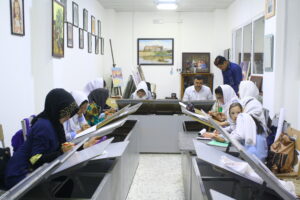
    But Royesh, it turns out, was persuasive. “Over the years, it grew,” recalls D’Souza. “I started raising money. We had fundraising events, and Aziz set up a model school where teachers and students got training simultaneously. They also had vocational training. They taught mechanics and engineering and tailoring so that those who left at 14 or 15 could go and have jobs.”

    In spite of this, Royesh’s interest remained academic. “Aziz had had a very impoverished background with virtually no education. He’s one of these people who reveres education so he reveres those who have education.” It is a precious insight into how valuable that commodity is. And it was this passion which drove the expansion of Marefat.

    Over the years, D’Souza made repeated visits. “I went to Afghanistan with these brown paper bags. He asked me to bring English copies of Bertrand Russell’s books which I did.” Again, the detail is significant. A true passion for education is often irrationally omnivorous – we feel the doors of the world fling open and want to rush in and grab everything we can, often in no particular order.

    But always it was the girls who Aziz was prioritising. “His focus was on getting the girls into twelfth grade and then onto tertiary education,” says D’Souza. “As an example of what he managed, the school got up to nearly 4,000 students.” As astonishing as this achievement was, what really mattered was the quality of the education. “The Asian University for Women, a renowned university in Bangladesh, offered 15 scholarships every two years and girls applied from India, Bangladesh, Sri Lanka, Pakistan and Nepal. Our girls won 11 of them.”

    It seemed that nothing could stop their success. Marefat had become an educational phenomenon: “We went on raising, and Aziz eventually built a whole new building, and an auditorium. To this day, I remain so proud he named that after me. The school became the St Paul’s of Kabul.”

    I am so swept up in the success of the story that for some reason – though I know what happened in 2021 – I am unprepared for D’Souza’s next sentence: “It was a thriving school, and then August 15th came.”


    Force of Nature


    Yes, August 15th – the day of the Americans’ botched withdrawal.

    Aziz was in a very difficult position. He had dedicated his life to a project which had achieved success beyond his wildest imaginings, and yet he was in undeniable danger. D’Souza outlines the severity of Aziz’s predicament: “Aziz, by virtue of the fact that he’s Hazara and educates girls, was particularly vulnerable to the Taleban and had had brushes with them before. He felt he had to get out: he had a son in California. So we got him to America.”

    I realise I need to meet Aziz. A few days later I’m on a Zoom call looking at a kindly man beaming back at me. He explains that it’s his habit to wake at four in the morning – a detail which conveys his separateness from Western rhythms, linking him to the desert somehow. It is a reminder too that you can leave Afghanistan in person but never depart it in spirit.

    Of course, Aziz’s story is like D’Souza’s but seen in reverse perspective – it is like an education version of Kurosawa’s Rashomon, where all the participants remember something different about key events.

    For instance, Royesh gives his version first meeting with D’Souza, and recalls his views on education as they were communicated to her at that time. This time around you can hear the quiet and authentic adamance which swayed Frances all those years ago: “The core of the problem in Afghanistan was this patrimonial vision that you have – of a male-dominated vision of the community. Just educating the male members of the community cannot change everything: there will be a vacuum as you’re missing the vision of half of that community – the female side.”

    Aziz also makes an interesting distinction: “I never felt the need to march on the slogans of woman rights: I just wanted to go with education, because this by itself can bring all these other developments. I think it was that which really sparked Frances’ interest.”

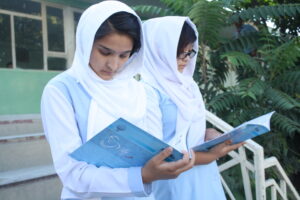
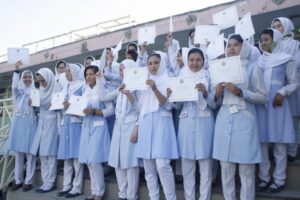
    Royesh also recalls Frances D’Souza entering Marefat for the first time – meaning that I get to see her through his eyes. Even at this distance Royesh is moved by the memory of D’Souza’s first entrance into the life of the school: “One of my first impressions of Frances D’Souza is that she was the first to come in. She entered that murky corridor and in the midst of that darkness, she saw these beautiful well-dressed girls that had blue, you know, shirts and they had white scarves. And they stood to greet her and suddenly she ran out and shouted: “How beautiful they are!”

    It is a moving image – these girls standing there in all their potential, suddenly confronted by the person who really will help them. Perhaps it even has a dreamlike quality.

    Royesh also remembers what it was like when D’Souza’s first money came in – and again there are some telling details: “I received a call from an Afghan friend of mine. This person said that he had come from the UK and he had some gifts for me. I went downtown, and saw that there was an envelope with Frances’ beautiful handwriting. I opened that and there was £2000 which had been raised by her ‘Evening for Marefat’ fundraiser at her home. I remember all those notes, in fives, tens, twenties and hundreds. Next year, she visited again and had brought £6500. She insisted that we should go and buy a plot as she said it would give prestige to the school, and boost its credibility.”

    With that money Aziz was able to afford a site in the desert. It wasn’t immediately promising as a location. But then an amazing thing happened: “We went there and started laying the foundations,” Royesh recalls. “We laid the cornerstone and began building the mud walls. This ignited a kind of interest among the community. Suddenly, people came and kept buying the plots around that and building their houses.”

    I also hadn’t realised until I spoke with Aziz what heights D’Souza’s fundraising eventually obtained. In 2010 alone, D’Souza raised £253,000. Aziz recalls: “She sent that money and we used it for the building, and we established a very big auditorium that later was named after Frances. When she visited the school in 2016-17 she was known to the students as ‘Auntie d’Souza’. “At the beginning, the families, the students, and especially the girls, were in love with her.”

    As it happens I have seen this auditorium in a recording of a Zoom call, which took place earlier this year. It is a large, airy space, and the children are ranged obediently in it. I see kindly teachers compering the call, while D’Souza takes notes in her study, and Aziz stands before a white wall, peering down at his creation – and also in some way at his past.

    Sat here in London, it is difficult to imagine how it would look in its architectural context. But I imagine it must soar and be visible for miles around. It ought to fill the heart of every person in that area with hope. But no doubt, it also infuriates the Taleban.


    Abroad Thoughts from Home


    So what does the astonishing story of Marefat have to tell us about education? Royesh’s methods are, in their essence, simple. This in turn opens up onto the possibility that here in the UK, we have made the simple complicated – to our own detriment. It might be, for instance, that we have prioritised pouring money into the schools system over promoting Marefat-style effective educational methods.

    Royesh tells me: “If you want transformational education, you don’t need many facilities. You just need a good way to talk to the people and to help them perceive something and customize that with their own real life. We didn’t wait for the professional faculty. We didn’t wait for the equipment – and we didn’t wait for the infrastructure. We just started.”

    And if you get that right, the effects can be catching. “For around five years or six years, we were the only private school in Afghanistan mainly with civic and girls-catered education. In 2021, there were more than 163 private schools just in these three districts of Western Kabul. Education had become a norm and communities were changed. There were hundreds of cultural centres, art centres, sports clubs. People embraced the idea, they stepped forward. The children were 95 per cent illiterate in early 2002. By 2021, 95 per cent of the population had become literate. Violence, especially violence against women had eradicated in the entire Hazara community. Street harassment was not seen in the Dashti Barchi area of western Kabul. Furthermore, not a single member of the clergy talked against democracy, human rights or girls’ education. It seemed that an entire community of seven million people had been transformed.”

    This was a mass grassroots movement without parallel. It should give heart to anyone who feels change happens too slowly. Sometimes perhaps we are lobbying for the wrong kind of change, and have forgotten to bring our activism back to first principles, as Aziz did.

    And yet, of course, we cannot avoid the tragic aspects of the story. Aziz tells me that the events of 2021 didn’t come out of the blue. In 2009, Marefat experienced the first backlash from the fanatical clergy. Pupils from Marefat had protested publicly against legislation which had violated numerous women’s rights, and their prominence as protestors led to terrifying scenes at the school. These now seem in retrospect like precursors of the still more tragic events of 2021.

    Royesh recalls: “The clergy attacked; they sent their mob supporters. We had just sat down to class and they stormed the school. They were shouting, and raising slogans against me as a person, saying that they would execute me as an infidel. They said I was preaching Christianity, or that I was preaching secularism and liberalism. They charged the school with being a centre of espionage and prostitution.”

    The school sustained physical damage. “They broke the glass of the school, and they called for its destruction. They called for the execution of the administrators and the faculty and especially myself. That was really a harsh thing.”

    Royesh has a way with understatement. It sounds terrifying beyond contemplation – but then we inhabit cosy lives and Aziz is hardened to the sterner realities of life under the Taleban.

    But in that awful instance again, an astonishing thing happened: “We had just one gate. So the students came and they made a human chain behind it – and they closed the gate, so the mobs couldn’t enter the yard. Thousands of people gathered around the school, most of them the parents of the students who were worried about their children or those who had shown up just to watch.”

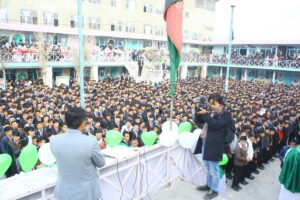
    Eventually a special force from the Ministry of Interior relieved them. Royesh continues the story: “The attack was on Wednesday. The school remained closed on Thursday. On Saturday, we reopened the school, just with the hope that if 15 per cent of the students returned it would be a victory for us. But surprisingly, more than 95 per cent of the students returned back hand-in-hand with their parents. That was really a very emotional moment for us. They came, and they showed their support for the school. They were the parents of more than 3,500 students.”

    If anybody doubts that education is a spiritual right which people will defend with their lives, then they need to hear this story.


    2021 and all that


    Sadly, even this superb victory came to have a temporary feel in 2021 when the Americans left, and things really did unravel. D’Souza takes up the story: “It was incredibly difficult for him. If you’re a Hazara and the Taleban are after you…” her voice trails off, as if unable to imagine how that must be.

    She continues: “I don’t blame Aziz for going at all. There are individuals at risk and we shouldn’t discount that. The school closed. My immediate concern then was for my daughter [the journalist Christa D’Souza] to try to evacuate the girls. They got over 200 of them out, and got a deal with the Canadian government. They then got another 207 out who have been waiting in Islamabad since October, languishing in a hostel. We’ve raised enough to get them visas through the government.”

    And Marefat today? “Dennis and I are interested to see what we can do to enable Marefat and its unique educational experience to continue. We think we can’t do that until we go. Once we’ve got most of our girls out, our priority should be to get the school going again.”

    And Aziz? He is currently writing his History of Marefat, and is vague about future plans. D’Souza has her suspicions: “It’s clear to me that Aziz has very high political ambitions, and wants to be the leader of the Hazaras – and maybe of the Afghan people as a previous Hazara man was in times past. He was also extremely close to Ashraf Ghani during the presidential elections, and even wrote Ghani’s manifesto. Ghani, though is a very curious fellow, and once he won the presidency, completely ditched Aziz, he treated him very badly.”

    A Royesh presidency? Every presidency is a long shot before it happens – but just to imagine it is to realise that hope remains.

    But what about the girls? Here D’Souza is understandably emotional: “The brightest and the best have left the country, which is a huge responsibility which we all feel. The only thing which is a mitigating factor is that it’s quite common with Afghans to return to their country, so I think a lot of them will. One thing one shouldn’t underestimate is that for 20 years we had this flawed but democratic process: a huge number of people became accustomed to it. They’re unlikely to give that up in a hurry.”

    If you want a measure of what was achieved at Marefat then you have to hear the girls themselves. Their security is paramount and so we will not be revealing any names or locations. But here are some voices, translated from the Persian by Aziz, of girls talking on a recent Zoom call. This is the authentic sound of education, but also of liberation.

    One girl says: “We study. We continue our education. Because we know that interrupting the course of education means our death and I am not ready to die now.”

    An optimist might say that a girl who has learned to talk like that can never die: it is the voice of irreversible enlightenment. Here is another: “We understand the Taliban. Most of them have not lived in the city and they are not familiar with the characteristics of urban life. I hope they understand us too. We will continue our education and I am sure that we will eventually introduce the Taliban with the urban life and culture too.”

    There is a note of defiance here which is utterly at odds with what we think we know about Afghan women – bowed down by the patriarchy, and almost without agency. It makes us realise that Royesh, D’Souza and Stevenson have created a new kind of educated woman.

    A third girl adds: “We call our resistance a ‘constructive resilience’. We not only resist, but also think about the constructive aspect of our resistance. We think that in ten years or twenty years from now, we will make our culture better and more humane, and our politics better and more democratic. This is the purpose of our education.”

    This is in fact always the purpose of education – and sometimes it takes someone who knows education’s value to tell you that. That will almost always be someone who until recently was deprived of it.

    This, then, is the story of Marefat. There isn’t another story like it, and it’s one we at Finito World will continue to follow. It tells us that education is sacred, and reminds us that it changes lives.

  • Stephen Fry on the need to relax

    Rebecca Walker

    Despite his success, one sometimes feels a little sorry for Stephen Fry: for some, he is the celebrity everybody used to love, his popularity dimmed by Twitter spats and overexposure. Yet if you take his finest achievements: the first seasons of A Bit of Fry and Laurie (1987-1995), his early books The Liar (1991), The Hippopotamus (1994) and his memoir Moab is My Washpot (1997), his brave documentary The Secret Life of The Manic Depressive (2006), as well as his lead role in Wilde (1997), and even alongside his erstwhile colleague Hugh Laurie in TV’s Jeeves and Wooster, it is a body of work remarkable in its brio and its breadth.

    It all serves to prove that few people work harder than Stephen Fry – and not just in the entertainment industry. In fact, his ubiquity amounts almost to absurdity. It sometimes seems that what we’re witnessing is the work ethic of Margaret Thatcher relocated to an apparently more leisurely sector.

    It can seem as if every awards ceremony, supporting role and quiz show on earth seems to be dominated by Fry. His outspokenness on politics, religion and other things isn’t always matched by knowledge: Peter Hitchens famously referred to him as ‘the stupid person’s idea of an intelligent man’.

    But these gaps are offset by the perception that it’s been fun along the way – and so Finito World feels no compunction about asking him about his views on how to relax and wind down. ‘Work is so much more fun than fun,’ as Noel Coward put it. It is a line which might have been Fry’s mantra.

    When we caught up at the sweaty launch of Paul Feig’s Artingstall’s gin, we asked Fry about the need to offset work with relaxation. So, does he drink these days? “Not much, but I love a good cocktail,” came the kindly reply. And what is his favourite cocktail?  “When I’m hot like I am now, I find a John Collins – gin, lemon juice, soda – really refreshing.” And are there any drinks he stays away from? “I’m not a great one for really sweet, sticky drinks. I like them to refresh you. But I do make a good negroni!”

    It’s good to see him out and about. Fry, of course, hasn’t been well having been diagnosed with prostate cancer in 2018; the disease is now thought to be in remission, and he has spoken out publicly at his good fortune at catching the disease early.

    Nevertheless, there has to come a time when everyone slows down and thinks about resting on their laurels. So will we ever see Fry host the BAFTAs again: “Oh, I don’t know. I think twelve is probably enough – it’s a good number and I’m very happy.”

    Our conversation soon turns back to drink and what role it should play in our lives. “Whisky provokes violence more than gin,” says Fry. “Gin provokes tears. If you’ve had a lot of gin you just start crying.”  Here Fry, ever the actor, performed an immense howl. “I’ve had a few friends who had a lot of whisky and it’s really unpleasant.”

    Fry is also illuminating on national differences. “I think we should learn from European Football. Whenever there was a match in Belgium there was violence afterwards, because in Belgium you drink beer and get pissed. Whenever they played in the Netherlands, there was no violence, because they were smoking, because cannabis is legal in the Netherlands, so that’s what we should learn really! We’d be better off, someone should be creating some exquisite hash brownies.”

    Fry is a global citizen though when I ask him about it, I get an interesting response. “This is a very Mayfair event, isn’t it? I feel like an out-of-towner, somehow everybody looks as though they belong here.”

    If even the famous feel perpetually out of place perhaps this give us permission to feel nervous for that first job interview.

    Even so, Fry is an emblem of what can be achieved if you set yourself to work across disciplines and refuse to heed boundaries. You get the impression that Fry knew his gifts from the start but that he has been surprised how far they have taken him.

    Does he have any anonymity in London? “If you walk fast enough and you look as if you’re in a hurry, people are very good, they leave you alone.”

    And with that he’s gone – and probably gone back to work.


  • Premiere Affaire: a film which shows there are no easy answers when embarking on a legal career

    Meredith Taylor


    A young woman discovers the real world in this erotic legal procedural from French director Victoria Musiedlak.

    Premiere Affaire is one of the juiciest films to hit the Piazza Grande at this year’s Locarno’s 76th edition.

    Sex is variably at centre of any drama where the French are involved and Premiere Affaire has a clever title that cuts both ways: as a first love affair and a debut criminal case in the life of budding lawyer Nora, a mesmerising Noée Abita, who soon discovers that life is not as simple as it first appears. And Musiedlak, in her first feature, doesn’t give her main character a smooth ride in this classically styled ‘school of hard knocks’ outing.

    Fresh out of law school, naive Nora, 26, is working in the Paris cabinet of a suave but sharp as nails commercial advocate when she opts to take on a pro-bono style criminal case, that of a gauche young man Jordan Blesy (Alexis Neises) accused of murdering his sister’s friend. Here, she will learn her first lesson: being a legal practitioner is not about championing right or wrong, but applying the Law in the context of the client’s plea.

    The second lesson here is not to get emotionally involved with your client or your colleagues, for that matter. And Nora makes a faux pas on both accounts. She desperately believes Jordan to be innocent and brings her own feelings into the case instead of remaining detached. She also fails on the second count when she meets the police officer assigned to the case, Alexis (Danielsen Lie). The two eye each other up warily during the police procedural client examination where sparks fly. But while gamine and vulnerable, Nora is not one to be trifled with.

    A feisty onscreen chemistry between Anita and Danielson Lie give these scenes a raunchy, provocative kick. Nora also discusses Jordan’s case privately with Alexis contrary to their professional remit, accepting an ill-considered ride in Alexis’ car which will invariably bring them closer. All credit to Musiedlak puts the accent on flirtation in the subsequent love scenes making them intense and titillating rather than uncomfortable to watch.

    Clearly this is a story fraught with ethical and moral issues – not to mention racial tensions: Nora is of Maghrebi heritage and her mother is sceptical of her daughter’s career, encouraging her to settle down and marry. This family stress piles on the pressure for the young lawyer, adding negative undertones to her domestic life. At work too Nora is struggling to cope, burning the candle at both ends in taking on a case that runs contrary to her official remit in the commercial cabinet, so there’s never a dull moment, and certainly no easy answers when embarking on a legal career.


    LOCARNO FILM FESTIVAL | PIAZZA GRANDE 2023 |

    Dir/Wri: Victoria Musiedlak | Cast: Noée Abita, Anders Danielsen Lie, Alexis Neises, François Morel, Saadia Bentaïeb | France, Drama

  • Dinesh Dhamija: The CBI’s alarming inward turn

    Dinesh Dhamija

    Evidence that Britain will – post-Brexit – become an outward-facing, confident, international trading nation is in short supply.

    The news that the Confederation of British Industry (CBI) is to close three of its overseas offices, in Washington DC, Beijing and Delhi, in order to save costs made me wonder who on earth will deliver this brave new world.

    The CBI was hit by a sexual harassment and drugs scandal in April this year, leading to the sacking of its Chief Executive and a mass desertion of members.

    Doubtless, money must be saved. But closing the Delhi office seems exceptionally short-sighted. What does this decision tell current and future members about the aspirations of the CBI, turning its back on the world’s fastest-growing major economy, one with a huge wealth of historic economic connections to the UK?

    Britain is potentially on the verge of a game-changing trade agreement with India, through which the UK will gain hundreds of thousands of new jobs and India as many as a million. Are the CBI’s members not interested in these rewards? Do its UK-based Indian members feel adequately represented by its London office?

    After rebuffing the EU – its largest and closest market – Britain is now supposedly free to venture further afield, like a Victorian adventurer scything through virgin jungle to reach untold treasures.

    In the real world, the Indian government and its booming corporations may be more interested in concluding deals in the United States, in Australia or with fellow Asian tigers than with their former colonial master, despite the many cultural links. Closing the CBI’s office will only confirm how uninterested British businesses are in engaging with Indian counterparts.

    There has been a sea change in Indian economic fortunes, which British businesspeople are perhaps insufficiently aware of. While researching my latest book The Indian Century, it struck me again and again that India is no longer a supplicant in international trade, it is a pioneer and a leader.

    The Indian space mission, which sent a craft to the moon this week, is one symbol of this new confidence, as is its role in the BRICS conference taking place in South Africa.

    There are a hundred more such examples, from India’s transformative online payment systems to the plethora of international CEOs and political leaders of Indian heritage.

    If the CBI thinks that the marginal savings from closing its Delhi office are justified, against this backdrop of the world’s most vibrant economy, then its leaders really have been taking the wrong drugs.

    Dinesh Dhamija founded, built and sold online travel agency ebookers, before serving as a Member of the European Parliament. His latest book, The Indian Century, will be published later this year.

  • Book Review: Fantasyland: How America Went Haywire: A 500-Year History by Kurt Andersen

    Melanie Trudeau

    In his thought-provoking book Fantasyland: How America Went Haywire, New York Times best-selling author Kurt Andersen connects the dots from America’s Puritan past to today’s fantasyland of fake news, conspiracy theories and alternative facts that gave rise to the Trump presidency. Reading Andersen’s 500-year history crystallises the reasons why we’ve become a country with a partially developed frontal lobe, incapable of fully functional reasoning and rationality, prone to the fantastical.

    While Donald Trump’s victory in the 2016 election shocked America – Andersen suggests it even took Trump by surprise – his rise in politics is proof of America’s ultimate embrace of Fantasyland. Trump’s triumph hinged on his ability to play an impresario who leveraged the fantasy-industrial complex to his advantage like no one had ever done before. He played to conspiracy theories, exploited myths of white racial victimhood, and rode a far-right extremist counterculture that had taken over the American right before his rise to power.

    Founded on an excitable thirst for independence from their European past, Americans always harbored a tendency towards ultra-individualism. The American Revolution and Constitution coincided with the Age of Enlightenment, igniting a national movement that “guaranteed personal liberty above all, where citizens were officially freer than ever before to invent and promote and believe anything”. Americans’ right to bear arms gave rise to a deeply engrained gun culture and religious freedoms evolved into an exceptionally literal and fantastical religiosity. But the nation’s unraveling didn’t just happen overnight. Rather, the route Andersen takes us on traces the common threads of religious zeal, pseudoscience, and conspiracy theories, from the Salem witch trials and occult Freemasonry of the Enlightenment to the Satanic Panic of the 1980s, New Age theology and apocalyptic paranoia.

    As Andersen maps the journey through fantasyland, religion – particularly Christianity – plays a pivotal role in feeding the frenzy. The Puritanical ideology of discipline, austerity and hyperliteracy morphed into The Great Awakening of the 18th century, the formation of Scientology and the Mormon Church, and eventually the contemporary evangelical movement. Charismatic religious leaders like Pat Robertson, Billy Graham, Oral Roberts and Jerry Falwell became charismatic entertainers made famous through television and the Internet.

    The freedom to reinvent oneself within an anything-goes personal belief system gave rise to a collection, writes Andersen, of “fantasists, some religious and some out to get rich quick, all with a freakish appetite for the amazing”. Impresarios and hucksters such as P.T. Barnum and Buffalo Bill preceded Walt Disney, Hollywood and an industrial entertainment industry that blurred the lines between reality and fantasy. Oprah Winfrey brought magical thinking to twelve or thirteen million viewers every day, promoting New Age beliefs, alternative medicine (famously, Dr. Oz), anti-vaccine conspiracies, and imaginary energies. Andersen points to the 1980s as a tipping point for the convergence of entertainment and politics. Ronald Reagan’s rise from Hollywood actor to President of the United States seemed like a perfectly natural progression. Talk radio and TV news shows morphed into “politicised show business”.

    The digital era that began in the 1990s arrived just in time to amplify what Andersen calls the Kids “R” Us Syndrome where American adults began “playing videogames and fantasy sports, dressing like kids … and even getting surgery to look more like kids”. Gaming boomed into a multibillion-dollar industry creating imaginary worlds that felt realistic and offered an immersive experience for adults who wanted to play like children. Andersen points to Trump as having the ultimate case of Kids “R” Us Syndrome: “spoiled, impulsive, moody, a seventy-year-old brat”.

    It didn’t end there. Digital platforms allowed for “even greater immersion in the unreal”. Conspiracy theories and rampant falsehoods that were once on the fringe became mainstream. The mostly unregulated internet and social media platforms became vehicles for spreading fake news and fantastical stories to an audience which had little ability to distinguish between reality and fantasy.

    While Andersen admits that “flecks of fantasy are charming condiments in everyday existence,” he wonders if “it’s only America’s destiny, exceptional as ever, to unravel in the Fantasyland fashion”. His final call to action for Americans is to fight for facts and objective truth, find new protocols for information media hygiene, and regain national balance and composure. America’s ability to accomplish this is yet to be seen.

    Melanie Trudeau is an English major turned digital strategist. As a dual Canadian/American citizen, she splits her time between rural Vermont and Toronto.

  • Essay: Lord Stevenson on the meaning of mental health

    Essay: Lord Stevenson on the meaning of mental health

    By Lord Dennis Stevenson

    As part of our special on the Duke and Duchess of Cambridge, we asked leading thinker Dennis Stevenson to give his view on what is really under discussion

    Mental health has come into the open over the last ten years aided among other forces by some strong royal support.

    But what are we really talking about?  If you get up from wherever you’re reading this and stop the first person you meet in the street and say “How’s your mental health?”, 10-1 that person will think you’re talking about an illness!  If you say “how’s your physical health” they will answer the question as it should be answered.  All of which is to say that we all have mental health.  It can go up and down – and, as with physical health, we need to work out ways of dealing with any problems.

     It is not an exaggeration to say that I didn’t realise properly that I along with every other member of the human race had mental health until I was in my 50s.  It took me some time – and the injection of some mental ill health – to realise that it would be a good idea to learn how to manage my mental health for the better.  And I’m still at it.

    Unfortunately, by then my children had gone out in the world so they, poor things, were not brought up to believe they have mental health as well as physical health. But my grandchildren are being properly brought up.  I very much hope and believe that every single one of them is aware that they have mental health and is learning tricks of the trade to deal with it.

    I was given a cruel awakening on this at around my 50th birthday at a time when everything in my life was wonderful.  I went away to our cottage in the country in the summer and woke up one morning with what I can only describe as a “pain in my tummy”.  That pain became something worse and without boring the reader with the detail I descended into something which would be described as clinical depression for which there was no obvious cause. 

    I came out of it after some months having – wrongly – rejected any help from pills and indeed any other source.  I have been “hit” by it happily not very often but several times over the 25 years since then and on each occasion there has been no obvious reason for it.  And I believe I’ve learnt one or two tricks of the trade of how to deal with it.

     That’s my story. What else have I learnt apart from the fact that I have mental health and I need to pay attention to it?

    First and foremost, the human race is at an early stage of understanding mental health. You might compare it with our understanding of cancer 50 years ago.

    An eminent psychiatrist told me 20 or 30 years ago: “So, Mr Stevenson, you are somewhere on the bipolar spectrum”. The use of “spectrum” is widespread and in most cases a rather dodgy use of English! 

    As it happens I have discovered that I am almost certainly not on the bipolar spectrum whatever that is. I am an extrovert in-your-face sort of human being but not manic. I do, however, have what my excellent GP at the time described as “dips” in mood.  Is that depression?  I don’t know – but then neither does anyone else. 

    Even so, I am very clear that we are getting nearer to being able to define depression, schizophrenia, ADHD, bipolar and all illnesses attributed to mental ill health. A professor at Cambridge, Ed Bullmore, wrote a book a few years ago arguing that depression is a physical illness and related to internal inflammation. The book is very compelling. We’re getting closer to being able to define these illnesses. A lot of research is going on but we’re still some way off.

    How does one cope with mental ill health? The first thing that I have learnt is that as with many illnesses there are ways of dealing with depression that work and we don’t need to understand why they work. Too many of us despair that nothing can be done and suffer needlessly. What is true of many physical illnesses is also true of mental illness: drugs and therapies have developed without a clear understanding of why they work – but if they work, they work. So don’t ever let anyone persuade you that antidepressants don’t work. It’s just not true. 

    It is, however, a good idea to be in the hands of a psychiatrist who has a deep knowledge of antidepressants since there are horses for courses, as in most things. In the same vein “talking therapies” have been one of the major breakthroughs over the last 20 years. For every good therapist, there are several who are well-meaning but hopeless. However, it doesn’t alter the fact that they work. 

    In this context, there’s an absurd fault line in education in the UK.  Psychiatrists who are medically trained, tend to be sceptical of talking therapies – although less so than they used to be. Equally, psychologists and psychotherapists are inclined to be sceptical of drugs, and are not allowed to prescribe them.

    This division is ridiculous. If you go to a cardiologist he or she might have a different diagnosis than another one but they will work from the same toolkit. So a word of advice: if you have mental health problems and you can find a physician who encompasses both medical and psychological approaches, that is the ideal. Happily, there seems to be an increasing number of them.

    The approach to “caring” is also important. If I walk out of my house today and break a leg, I will be in pain and be miserable. With a bit of luck my wife and children will want to make a fuss of me and soothe me!  They won’t diminish the pain but I will feel good about what they say. 

    But the terrible reality is that if I move into what I will call “depression”, their sympathy will mean nothing to me. This is a big subject hardly ever dealt with, but it’s hugely important that carers understand this and are not demotivated by being rejected.

    The last time I had a major “depression”, the symptom was that I felt that my wife was only staying with me because she was a decent person but she didn’t love me. I can remember being in bed and her saying “doesn’t 40 years (our marriage) mean anything to you?” And then at another time saying: “You’re like an extra arm on my body”. These are very wonderful things to say, but she got no reaction out of me at all –

    and I know it was horrid for her. Yet they have stuck with me.

    If you’re a carer for someone who has got mental health please do not be put off if they appear to reject you or take no notice.

    I’ve one other tip that works for me. Particularly if you are an over-achieving type as I am, a natural reaction to a mental health problem is to try to get on top of it, solve it and cure it. My wife said to me years ago: “You should be more accepting.”  It took me about ten years to realise what she meant: I must face up to the fact that as with many physical illnesses, it will never go away entirely but I must learn how to deal with it and expect it to return.

    That is my current position. As it happens, my really bad “depression” has not reoccurred since 2007. I’m clear that it will reappear at some point before I meet my Maker. I am equally clear that the fact that I’ve got a much more accepting relaxed attitude to it is a major reason why it does not reappear more.

  • The Baroness: Frances D’Souza on Sir Keir Starmer, Rishi Sunak and the current deluge of legislation in the House of Lords

    The former Speaker of the House of Lords explains the current deluge of legislation facing a somewhat recalcitrant House of Lords


    I don’t think the next election will be a slam dunk for Sir Keir Starmer. The main reason for that is that I don’t think Starmer is a leader. Of course, Rishi isn’t either, but the Tories won’t do anything about that until the next election, after which they’ll likely get rid of him.

    Having said that, I met Sunak recently, and I found him very nice: he comes across as someone who listens, and he is very smart. He said something which I thought was wonderful: “I believe in doing less but doing it well.” This led onto another conversation about the sheer volume of legislation tumbling down on us. He said: “It was on the books when I came into position.” He was basically saying, “Not my fault, mate.” But it does mean that if Sunak continues – which I doubt he will – he’ll bring in less legislation, which would be a very good thing.

    All in all, it’s been this cataract of legislation. There have been three bills. The Online Safety Legislation Bill has been in the making for about six years, and deals with the uncontroversial idea that there should be some online protection regarding content harmful for children. Molly Russell’s father has been campaigning on this; and Beeban Kidron, a fantastic cross-bencher, has been leading on that, and done a fantastic job.

    I’m always in principle opposed to any legislation which interferes with free speech, because once it’s on the statute books it’s a hostage for fortune. You never know, we might have a fascist government one day; it’s not impossible. It’s a very technical bill, which only a very few people understand. Ultimately, the large companies are going to have to abide by advertising standards, but to get them to do that may require legislation.

    The second bill is the Retained EU Law (Revocation and Reform) Bill whereby the government is seeking to wipe off the statute books around 6000 executive orders which have come from the EU. The minister dealing with that happens to be dealing with that Martin Callanan is quite abrupt and there have been some testy exchanges. That makes life quite interesting – people at least wake up!

    But I’m particularly concerned about the third bill, the Illegal Immigration Bill. This goes against our treaty obligations – as was pointed out in the second reading in the House of Lords.

    As the Bill stands, we have the government-sanctioned entry points, which have special status – essentially if you’re an Afghan or Ukrainian refugee, or if you’re from Hong Kong. But let’s say, for example, that you come from Eritrea: if an asylum application is refused, then you can never return in your lifetime. Furthermore, if you’re an unaccompanied child, you can stay until you’re 18, then you’re sent to Rwanda. It rides roughshod over 1951 Refugee Convention.

    The point the government makes – and it’s clever of them to make it – is that nobody is coming up with an alternate system. What we argue is that if the UK is serious about immigrants and asylum seekers in genuine fear of persecution, then they’ve got to create more safe routes into this country.

    In actual fact, the numbers that comes here are quite low pro rata as compared with Germany, France, Italy, Greece and other European countries. Of course, there is undoubtedly a problem with economic migrants who come here, but there is a mechanism in place to determine people’s claims.

    The question is why does the government not go after the criminal gangs? They’ll never succeed in starving them of revenue with the current proposed legislation. Really they need to infiltrate the criminal gangs. Intelligence ought to know who they are – and if they don’t, they should. It’s certainly worthy of a question in the House. Are the intelligence services on this?

    Incidentally, the current processing of the special programmes is a shambles. The Ukrainian situation has more or less obliterated the work on Afghanistan, due to the melancholy fact that the Foreign Office can’t do two things at the same time. To be registered as a genuine asylum seeker, the offices which issue refugee passes are few and far between, and hugely overburdened with around 350,000 people currently awaiting recognition that their application is bona fide.

    All of which, as Sunak knows, is a lot for the Houe to process. The trouble is we only have about 50 or 60 hard-working peers; they do a fantastic job, but that number is very small – but the question of House of Lords reform is a topic for another article altogether.


  • Diary: Longest-serving foreign secretary of Australia Alexander Downer on Rishi Sunak, Gary Lineker and the hilarity of George W. Bush

    Alexander Downer


    Illegal immigration is an important issue for me. I think there’s a lot of misreporting about Rwanda, and it’s outrageous. How would I describe Kigali, the capital? It’s very tidy – extraordinarily clean city. It has high rates of economic growth, and gives the impression of being a well-run country. In my life, as the longest-serving foreign secretary of Australia, I must have been to over a 100 countries.


    I also like to point out that these asylum seekers are also coming from a country called France, so there’s a choice of France or Rwanda. That’s not inhumane. Gary Lineker is a football ex-player and pundit. I don’t regard him as an expert on immigration issues; he’s reading about people scoring goals and being offside. Of course, it would be inhumane if the policy were to send genuine refugees back to their country, but that’s not the policy. The reality is that people smugglers have found a way to make huge amounts of money, and it’s a racket. It’s also hugely expensive for the government to pick these people up, process and house them.


    Difficult interviews never bothered me. The media’s job is to hold you to account. If you’re powerful and decided on a particular path, you’ve got to be prepared to defend it. The Andrew Neil Show wasn’t a problem for me. I did an interview with Kay Burley on Sky, and she was incredibly against the government’s policy, but that was okay. If you’re so worried about being attacked by journalists, why not put them in charge of the country and see how it goes? Usually, whatever you do is sub-optimal.


    I remember the day I was sworn in in Australia by the Governor-General as a Cabinet Minister. One of my colleagues who’d previously been premier of New South Wales, he was being sworn in as finance minister, and I remember him turning him to me: “This is the best day you’ll have as a minister. I said:  Why’s that? And he said because nobody I left politics in 2008, and still on social media I get attacked for things we did in government and that’s fine.


    Over the years, I’ve met many world leaders. The more conviction they have the better. When John Howard was Prime Minister, we were subject to endless attacks. We used to describe ourselves as the Howard Fascist Dictatorship because they hated us so much. But we knew what we were doing, and felt that what we were doing was for the best. It hurts more when you’re attacked for a slip of the tongue or a gaffe. If you want to be popular, it’s not the job for you. You become famous in your country but at the same time for many people become infamous.


    T
    wenty years on from Iraq, I wonder whether we were right, and I think we were. We didn’t make a huge contribution to the invasion of Iraq, but getting rid of Saddam Hussein was a good thing. However, the Americans handled the post-invasion incredibly badly. We argued with the Americans about that, but it wouldn’t have made any difference if we’d refused to participate. You can’t ask the Americans to underwrite the security of the Indo-Pacific region at huge expense to the American taxpayer, and be a fairweather ally.


    Both Blair and Bush were leaders of conviction. You’d have to say you were impressed by the forcefulness of each. They’re different sorts of people – both very personable. Bush was very funny, full of jokes. The funniest moment relates to my wife, Nicky. It was September 2007, were at the Australian PM’s Sydney residence and at this time he was incredibly unpopular worldwide. Condi Rice was there, and she said to my wife: “Would you like to meet the President?” My wife said: “He’s a bit out of my league. Condi insisted and I don’t know what came over my wife nut my wife said: “Mr. President, what’s it like being the most popular person in the world.” I’m Australia’s leading diplomat and he just laughed and said: “That’s politics. You have to do what you think I’d right. She spoke to him for 15 minutes and came away thinking he was delightful, much underrated by people. He made politically incorrect jokes and at one which I won’t repeat I said: “You mustn’t say that publicly. “No,” he said. “I never would.”