Category: Features

  • Hamish Jenkinson on the Hard Truth About Entrepreneurialism

    Life as an entrepreneur isn’t always straightforward, writes Hamish Jenkinson, the CEO of leading immersive agency The Department


    What does it really mean to be an entrepreneur?

    A question I often ask myself, as I sit in my home office while simultaneously answering calls and tending to my two young kids.

    Maybe it’s being able to wear multiple hats at once? Maybe it’s dealing with chaos on a day-to-day basis? Or maybe it’s what we tend to see on social media: the ultimate escape from a ‘mundane’ lifestyle…

    Every day I meet and connect with fellow entrepreneurs across various platforms, and I see a variety of success stories. But online, you only see 3 narratives: The “nothing to something”, the “how I became rich”, and the “become your own boss”.

    What I see far less of is the story of how they got there – the real truth behind entrepreneurship.

    At just the click of a button we can search, chat, stream, and publish until our fingers turn blue. But are we only sharing the things that we think others want to see?

    I’d like to share my journey in the hope that it will shed some light on what it’s really like to be an entrepreneur.

    They say never go into business with family or friends. Naturally, I didn’t listen to that piece of advice…

    I co-founded my first company, Golden Monkey Productions (GMP) in 2003 with my school friend, Jonny Grant. The same Jonny Grant who co-founded The Department and is now ECD of our latest venture, Dept. Studios. A business partner for over 20 years, it’s safe to say we’re still friends.  (Shout out to Jonny, you’re great).

    Though GMP didn’t turn over any revenue, we did get chased by HMRC for failing to file dormant accounts (more on HMRC later). Those fines were small – but symbolic.

    Lesson 1: There’s a hell of a lot more to starting a business than just winning work and clients, you need to be on top of everything behind the scenes to retain customers and drive quality.

    Luckily, England is one of the easiest places in the world to start a company – pay £200 to Companies House and you’re away…

    And that’s how my career as a Director began. No shareholder’s agreement, no articles of association. The classic case of running before I could walk.

    On the 8th of December 2006, I found myself as the director of MINI Partners ltd. Fast forward 7 years, the directors and I had appointed a voluntary liquidator. Not an easy decision, but the right one. It was profitable and I learned a hell of a lot, but it wasn’t scalable. So, we took the profits and ran.

    Next up: The Old Vic Tunnels. We had 6-figure revenue and it became a cult immersive sensation, just below London Waterloo. The space was just shy of 90,000,000 sq ft of dormant tunnels and we hosted events such as Banksy’s UK Premiere of Exit through the Gift Shop and Bill Clinton’s fundraiser with the Reuben Foundation in May 2012. The next thing we knew, the venue “was not a core focus for the Old Vic Theatre Trust” and that door closed in March 2013.

                                                                  Hamish Jenkins at the Old Vic Tunnels

    It broke my heart, as I quickly realised I’d have to make 18 incredible people redundant in one day. I felt for all of them and watched helplessly as they looked at me in utter disarray. This was the first gut-wrenching process I had to go through as director.  Sadly, it wasn’t the last.

    Lesson 2: Being an entrepreneur means making difficult decisions.

    My next venture Lights of Soho followed a similar trajectory, but not before becoming the most Instagrammable venue in London and even making it onto the front cover of GQ magazine soon after we opened. That grand space was a different kind of cultural highlight for London.

    Like many entrepreneurs, I never received a salary at that time. While we paid the wages of the bar staff and security; our exchange was to come when the venture would expand and, of course, be (successfully) acquired. Our payoff came in the form of unbelievable nights at the venue that made it entirely worth it. But it didn’t last forever, and when the landlords hiked the rent, staying at the Soho venue was impossible. And so again, I had to make some great team members redundant. Followed by an unpaid bill to HMRC and a rap on the knuckles.

    Still reading? Great.

    On 17th May 2013, Jonny and I established our next venture: The Department. We made a strategic hire, Jessica, who quickly proved her worth and became a co-founder and an equal shareholder. For years, The Department grew and grew. Our team of 30 staff gained some amazing opportunities with incredible clients such as FIFA, Toyota, Adidas, Lexus, Asics, and Facebook to name a few.

    Once again, the founders were not the highest-paid – far from it. But we were prepared to pay ourselves in dividends when we would (eventually) gain profit. It was all moving in that direction, but this time it was the pandemic that meant I had to make more tough decisions.

    March 16th, 2020. Ten members of staff were called into the board room together to be told their services could no longer be needed. If the company was going to have any chance of survival, this was an extremely painful, but necessary, step. Furlough was announced about two weeks later and the remaining staff were furloughed while we crunched numbers and counted the days of cash left.

    But it’s not just the hiring and firing decisions that take their toll. Each of these endeavours took years of my life to build. I poured my sweat, blood, and tears into every business, sacrificing time and money as time went on. I’ve lost friends and business partners, but I’ve always tried to focus on the highest quality experience to ensure that what we do inspires people. Yet I’ve still not reached the point of living on ‘passive income’, sipping margaritas all day long – far from it… (if you have any tips let me know).

    Lesson 3: The truth is being an entrepreneur is full of challenges, and more downs than ups.

    It’s so much more than the glimpses we’re shown on the internet. It’s not the easy life people portray it to be and many of us do not accomplish success overnight; I know people who’ve spent over a decade on a business that turns over no more than £50K a year.

    So, if you are to be an entrepreneur, you need to stick it through the good AND the bad. Believe me, without the lows, I would never be where I am today. I’ve learnt (the hard way) that nothing is certain – and you can’t be successful without failure.

    As Arianna Huffington says: “Failure is not the opposite of success, it’s part of it.”

    If you’re going to do it – buckle up, hold on tight but don’t close your eyes – you’re in for a tough ride.

    Go to: https://www.the-department.co.uk/ 

  • Dinesh Dhamija: Is sport in India about to explode?

    Dinesh Dhamija


    Now that the eyes of the cricket-loving world are turned to the country, as it hosts the World Cup – the biggest event in the sport’s calendar – there’s a new and different story to tell. This tournament is great, but it’s also more of the same. India has co-hosted the Cricket World Cup on three previous occasions (in 1987, 1996 and 2011) and is doing a great job this time around. This weekend India will play Pakistan for the first time on home soil for seven years in front of an estimated TV audience of half a billion people – that’s five times the Super Bowl!


    These are phenomenal figures, but what interests me is the potential for a huge uplift outside cricket. With 1.45 billion people, it’s an anomaly that India produces so few sportspeople. Where are the athletes, the soccer players, the golfers, the swimmers, the cyclists, the boxers and the tennis players? India lacks both the centralised political system that drives millions of Chinese into sport and the wealth of funding available to young sporting Americans and Europeans. Change could be on its way: two pieces of news came to my attention this week that offer hope for the future.

    First, the International Olympic Committee is about to hold a conference in India. The choice of venue is always important: It shows that the IOC is taking India’s bid for the 2036 Olympics seriously. All the other summer games up to 2032 are already taken. If India wins the games, this would be truly transformative. Massive amounts of funding would be channelled into developing India’s sportspeople over the next 13 years, bringing untold opportunities to those hundreds of millions of Indians who adore sport, but have so far lacked facilities and access. Narendra Modi is firmly behind the bid, just as he has supported the rapid and dramatic expansion of cricket in India. He recognises the multiple benefits in terms of health, community cohesion and national pride. I really hope it happens.

    Second, my colleague David Nicholson, who helped research my latest book The Indian Century, competed in a triathlon in Goa last weekend. Triathlon is a relative novelty in India – Ironman 70.3 Goa only began in 2019 – but it attracted more than a thousand athletes. Goan Chief Minister Pramod Sawant sent the competitors on their way at 7am to swim 1.9km in the Arabian Sea, cycle 90km through the Goan countryside then run a half-marathon in the blazing heat next to Miramar beach in the state capital Panjim.

    The race prompted both state and national press coverage, including an article on David and his son Samuel, who also took part, with David winning an award for coming second in his age group. “There was a fantastic buzz about the race,” David tells me from Goa. “The streets were filled with supporters, alongside reporters and press photographers. It was a carnival of sport, with athletes from more than 30 countries competing.”

    I would love to see more events like this, as India takes its place among the world’s great sporting nations.

    Dinesh Dhamija founded, built and sold online travel agency ebookers, before serving as a Member of the European Parliament. His latest book, The Indian Century, will be published in the Autumn.

  • Armando Iannucci’s Pandemonium: “quite funny – but only quite”

    Christopher Jackson


    Say, heaving Muse, what catalogue of restraints

    And luckless lockdowns fell upon th’unwilling world

    Accompanied by pain and stifled shouts of family grief

    Till the world’s wisest company of brethren

    In stately halls and candelabra’d chambers flush

    At their desks with freshest data

    Brought an end to that wailing noise

    And comfort to those begging for release.

    So begins Armando Iannucci’s mock-epic poem about the pandemic. This book deserves to be read as a companion piece – or perhaps antidote – to Hancock’s Pandemic Diaries. Iannucci has by this stage of his career earned our attention no matter what he does.

    It might be noted that his satire has always touched on people in jobs when they have no real business being there. From Alan Partridge’s ludicrous claims to television stardom, to the spads who stalk the corridors of Whitehall in The Thick of It and In the Loop, he has always specialised in showing up people who have an unwarranted sense of belonging in roles to which they aren’t suited. The joke about Partridge isn’t just that he’s a bad television presenter; it’s that there’s not decent reason for him to be on television at all. Likewise, Malcom Tucker is a bully in Whitehall, but he would be a bully in a law firm too: his moral being infects everyone around him: he has no business being anywhere near the decision-making process.

    One might say of Iannucci what Hazlitt said of Shakespeare: that in one sense he is no moralist, but that in another sense he is one of the greatest of moralists. He will show you the most disgusting and corrupt people out there – but by showing them to you he’ll convert that disgust to laughter and a better world. Iannucci is one of the most important civilising forces in our world today.

    My sense is that Pandemonium is destined to be a minor work however. You can see from the passage quoted above that while Iannucci is a student of Milton – and throughout this poem shows himself to be familiar with Alexander Pope’s Dunciad – that mock poetry simply isn’t as effective a tool as television as a means of satire.

    This is because the form itself (the poetry) is a distraction from the subject matter (the pandemic). With good television, of course, we hardly consider the medium at all, which is its strength. In Pandemonium, the matter would be helped if the lines were in an even meter but the first line beginning ‘Say, heaving Muse’ is a very ugly alexandrine leading to a tetrameter in line six with ‘At their desks with freshest data’. This last line also happens to be the strongest line in the passage, making me think that a rhyming tetrameter would have been a better choice of form. Coincidentally, this was the meter used by Pushkin in Eugene Onegin – the last poem to really pull this sort of thing off.

    Having said that, over time you get used to Iannucci’s verse and there is a lot to enjoy about the book once you do. We meet a cast of characters every bit as unfit for their role in the political firmament as the cast of The Thick of It. We meet Boris Johnson as ‘Orbis Rex’ (or ‘World King’) – with the poet pointing out that Orbis also happened to be an anagram of ‘Boris’.

    Say how this hero Boris, seeming felled

    By the evil mite, coughed back up

    His gleaming soul renewed and rode out to fight

    Sadness with mirth…


    The idea of Boris Johnson as an immortal being is quite funny – but perhaps only quite. Its limitations come from the fact that the trope comes from ancient poetry and that the joke – like many of the jokes in the book – lack the immediacy of television and so can’t really make us laugh in the same way.

    Compare, for instance, the immortal episode of The Thick of It, about the enquiry into the death of Mr. Tickel. There, at every point, the minutiae of language serves to show the idiocy of many of the characters who made up Blairite Westminster. Then compare it with the scene here where Matt Hancock goes to meet the Circle of Friends, Iannucci’s vivid monster which is intended to mock the class of party donors about whom we heard a lot in relation to PPE and other aspects of policy-making during the pandemic:


    So these Friends coagulated around themselves,

    Each one bait for another, bait upon bait,

    Knowing one another and each one known,

    Till they knew themselves inside out,

    Arses eaten by faces, faeces dropped on eyes,

    Arms reaching into guts, lips retching hands out whole,

    Bodies intimate and knotted like a dungy braid.

    This is meant to be a metaphor for the sort of friendships which happen in and around the donor classes of the Conservative Party. I’m not sure how successful it is. I suspect from Iannucci’s perspective, all these people are drawn to one another since they all hang around power, but without any particular reasons for being there other than the wish to be close to power. If that were the case then their real predicament is not to know each other, except incidentally. My suspicion is that Iannucci isn’t used to building poetic images and so misses the real opportunity to satire.

    The book therefore, though it is written by someone who is an undoubted master in his usual field, has the feel of a first draft at some points. It also contains illustrations which seem to serve the purpose of padding out a short manuscript to book length.

    That said, this is still an enjoyable read, which enlarges your sense of Iannucci as an artist. It feels like a pandemic-specific project – the work of someone severed by Covid from the day job.


    Pandemonium by Armando Iannucci is published by Lighthouse, priced at £9.99

  • Sarah Cobden-Ramsay on her ground-breaking jewellery charity Rhino Tears

    Sarah Cobden-Ramsay

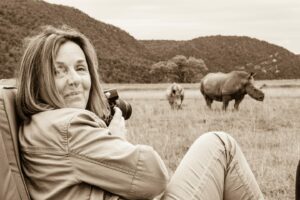
    It was during a visit to the Kariega Game Reserve in South Africa in 2016 that I encountered a remarkable rhino called Thandi. This was not just a wildlife sighting; for me it was a life-altering event.

    Thandi was a living testament to survival. She had suffered a horrendous poaching attack, her face had been savagely disfigured to extract her horn. Despite the physical trauma, her indomitable spirit shone through. Not only did she survive this gruesome assault, Thandi has become a symbol of resilience, mothering five calves – Thembi, Colin, Mthetho, Siya and Zolani. The horribly scarred, yet serene Thandi, grazing quietly with her first, 18 month year old calf, Thembi, was a turning point for me. I had to contribute, even if in some small way, to help fight this dark canvas of brutal poaching and support the incredible work so many do in rhino conservation.

    I had several years of experience as a jeweller, a skill honed under the tutelage of Jinks McGrath in her Sussex workshop. With Thandi as my inspiration and my passion for jewellery, I embarked on the journey of creating ‘Rhino Tears’, firstly designing a unique piece of jewellery Thandi’s honour and hopefully a way in raising awareness and those all-important anti-poaching funds.

    Each piece is designed as a delicate solid gold, or silver tear, and carries an engraved hallmark on the back – a triangle with a ‘T’, in homage to Thandi. For me, for every sale, it becomes more than just a piece of jewellery; it becomes a tangible symbol of strength, survival, and hope.

    Happily, my charity Rhino Tears, has gone from strength to strength, the product has evolved to include earrings, cuffs and bracelets and particular commissions with diamond inlay in both silver and gold, pendants and earring across the range.

    This has resulted over the years, in considerable donations to a few carefully chosen charities. Importantly for me, these game reserves in South Africa and Kenya are passionate about the conservation of rhinos in their natural habitat, as well as raising awareness and enabling local communities in supporting their heritage for the future.

    The monies raised have gone to help in several areas, primarily anti-poaching units, the purchasing and training of tracking dogs, tracking collars, cameras, the sad but essential de-horning of rhinos and the successful rewilding of orphans. Rhino Tears has also been able to proudly fund eight local interns through a year’s training in wildlife conservation and protection. They are now full- fledged rangers at the Kariega Game Reserve. Although most of my sales are done online, due to popular demand, I have been thrilled to provide Rhino Tears’ jewellery to several outlets, including the Curio Shop at Kariega, Ant’s Nest in the Waterberg and Auckland Zoo.

    My journey from the plains of Kariega Game Reserve and a jewellery workshop in Sussex, I hope will inspire, and show that we can all find a small part to play in preserving our planet’s rich biodiversity and ensure the rhinos may roam freely and safely on the plains of Africa.


    Go to rhinotears.org

  • Omar Sabbagh: An Expat’s Impressions of London

    Omar Sabbagh


    I was born, bred, studied, then studied some more, in London (or thereabouts).  I didn’t have a full-time job until 2011, on completion of (most of) my postgraduate studies; and that first full-time job was in Beirut, Lebanon, at the AUB.  Though I returned to London between 2013 and 2014, to complete yet one more, last round of postgraduate study, from 2014 to the present I have resided and worked in Dubai, at the American University in Dubai (AUD).

    What all this means is that for over a decade, give or take, though a Londoner, growing up in a highly privileged setting, in a kind of mansion in Wimbledon, my working-life has been wholly in the Middle East.  So that, the experience of being back in London, usually over the summer holidays, is a slightly estranged experience – though of course in some ways in continuity with my childhood and youth.  For one thing I’ve a family of my own now; and a young, four-year-old daughter, the light of my life, who was also born in London in the summer of 2019.  And what I think may prove an interesting or compelling way of demonstrating the different experience of London, for me as a kind of expat now, might be to describe that change through the lens of what I observed about my daughter’s experience.  The highlights for her in London are or were the highlights for me, as I suppose they would be for any loving parent; but they also might be a nifty way of highlighting what London feels like when – if not wholly estranged – it is seen and lived anew.

    The first image that occurs, recollecting now, is my daughter jumping in puddles, much like the ‘Peppa Pig’ character she loves so much.  Yes, it wasn’t necessarily a clean-run experience, because my daughter, highly excited by the opportunity to actually jump in puddles, did have to then change her socks and shoes and some of her clothes – which can prove a task for any parent.  However, one of her favorite cartoon characters aside, the image of her jumping in puddles with such newfound glee, did I suppose emphasize in a visceral way, how long it had been since I was truly, fully, in London.  And even if it is a very ‘British’ thing to talk about the weather, it seems to me now like a kind of paradox, that the very thing that first occurs to me from a distance is the same thing landlocked Britishers also seem to be mildly obsessed with.  Indeed, looking at and living London again, but through the eyes of one’s own child, makes one feel both more distant from one’s youth, and I suppose closer, from a different vantage point.  It’s a very composite and layered kind of experience.

    When asked to her face if she ‘liked’ London, my daughter answered in the same way that she had answered at a different, earlier time, about ‘Beirut;’ that she liked it because it was ‘so dirty.’  Living in so svelte a space as Dubai, where nearly every experience is bubbled-up, bubble-wrapped and built-up; where walking down an average street is far less cluttered and far less subject, on the face of things at least, to the impacts of contingency, meant that she noticed in both London and Beirut how the very different, messier topography was in a way, for her young take on things, salubrious.  I enjoyed taking my daughter on planned visits to sites, such as the Aquarium, but the truer impression was not in specially targeted outings, but in the very press and pull and mess of daily, happenstance living.  In fact, that just is the difference, as felt.

    For us in Dubai, each outing as a small nuclear family is, and just has to be (due to the way things are built-up in Dubai, the geography and the resultant topography) choreographed in advance.  This has benefits of course, and one should never underestimate how wonderfully suited to young families Dubai is.  But what my daughter sensed, I must surmise, was the possibility of the adventures of the ‘everyday’ in London – which can seem to be somewhat foreclosed in Dubai.  At least for us.  And I must say that at a personal level, as soon as I land in London, catching a cab from the airport home, I feel a sense of relief at being ‘home.’  I have missed, you see, the ability to be surprised, even to be disappointed, in my day-to-day doings.  There is something so health-giving about the sensed unpredictability of London life.  And through the eyes of my own daughter, the eyes of a neophyte far from accustomed to London, I find myself understanding and experiencing once again the strange homeliness of London for me.  Perhaps a little or a long-borne distance, in time and space, allows one to see all that one knew so well, anew, and thereby return the lived, the youth, back to its older life.

    As for returning to London, after all the above, well, the more official exigencies of London life now seem to proscribe it for my young family and myself.  Indeed, when searching for cognate jobs, as a lecturer in literature and/or creative writing, I notice more than ever now, how inimical life at a basic economic level would be in London.  Even though I do not in any real sense work in the private sector in Dubai, where employees as much as employers can amass burly savings due to the slimness of taxation here, my job as an Associate Professor provides my family and I with a much better life, all-round.  Though the net salaries for two similar jobs, in London as in Dubai, might be relatively close, in London, quite unlike Dubai, one is not blessed as well with all the benefits (of accommodation, health insurance and coverage and/or, say, financial coverage to a certain extent of one’s children’s education) one revels in here.  So, to come full circle: yes, I have been away from London my whole working-life; and yes, I do miss it, the hurly-burly, the brouhaha of it; but in the most basic, real terms, as things stand being in Dubai, or at least, not in London at present, just works better for us.


    Omar Sabbagh is a widely published poet, writer and critic.  His latest books are, Cedar: Scenes from Lebanese Life (Northside House, 2023), and Y KNOTS: Short Fictions (Liquorice Fish Books, Oct. 2023).  His next, forthcoming poetry collection, FOR ECHO will be published with Cinnamon Press in Spring 2024.

  • A Novel Way of Working: Tim Robinson on the best books about jobs

    Tim Robinson


    Writing my novel Hatham Hall (Northside House), I realised that characters who support themselves are generally more interesting than those who simply sit on inherited wealth. Yet the world of work, which dominates most real lives, is too rarely the focus of novels – and when it is, often features as a negative, for strivers and servants alike.

    To Strive


    Whilst the pursuit of money has won a thumbs up from some women writers of block/bonkbusters such as Shirley Conran, Jackie Collins and Julie Burchill, who link it to girl power, big beast male ‘literary’ writers seem less sure – if Marin Amis’ Money, Bret Easton Ellis’ American Psycho and Tom Wolfe’s Bonfire of the Vanities are anything to go by. Amis’ John Self and Ellis’ Patrick Bateman both sell their shrivelled souls to a consumerist devil and while Wolfe brings a plague on every house, it is the Wasp ‘Master of the Universe’ bond trader, Sherman McCoy whose hubristic arrogance sets a match to the eponymous bonfire. The love of money, it seems, is the root of all evil. Or sometimes simply personal pain. In Hanya Yanagihara’s wildly successful A Little Life (recently dramatized in the West End, starring James Norton) fame and fortune effortlessly visit her characters only to be accompanied by misery and drug abuse – like Jacqueline Susann’s three heroines in Valley of the Dolls decades earlier.

    To Serve

    If striving is bad, what then of its opposite: serving others? The character of Wilkie Collins’ benign principal narrator in The Moonstone, Gabriel Betteredge – a kind of head butler – is given a sinister twist by Kazuo Ishiguro in The Remains of the Day, where Stevens becomes an unwitting accomplice to the Nazi leanings of his boss, Lord Darlington, who throws out maids simply for being Jewish. Ishiguro repeats this blindly-loyal-servant-as-facilitator-of-evil theme in Never Let Me Go, where genetic clone Kathy H coaches other clones to meekly accept the harvesting of their internal organs. In his latest, Klara and the Sun, the robot Klara’s years of unwavering loyalty are rewarded with a fate similar to Boxer’s in Orwell’s Animal Farm: she is dumped in a scrapyard. In Marilynne Robinson’s Gilead (Barack Obama’s favourite novel), her apparently conscionable narrator Reverend Ames serves his local community only by blinding himself to the racism that drove the African-American community out of town and allowing his jealousy of a troubled young man to taint his pastoral duties. A rare exception is Anne Tyler, who combines melancholy with compassion in Saint Maybe. ‘Clutter Counsellor’, Rita DiCarlo appears towards the end, making a living by helping old people discard objects which have become the burdensome detritus of accumulating years, thus bringing healing. Rita is both entrepreneur and kind servant of her community.

    To create

    Perhaps unsurprisingly, writers often prefer to concentrate on creative jobs. Dickens’ most autobiographical novel, David Copperfield, charts his journey from child factory worker to solicitor’s clerk to successful novelist – but his hideous period as an exploited boy in a bottle factory is far more vivid than the blandly-depicted writing life. Both Evelyn Waugh’s Brideshead Revisited and Virginia’s Woolf’s To the Lighthouse feature painters prominently, but it is unclear if they do it for money and one suspects that Mrs Woolf would have thought it rather vulgar if they did. My favourite novel about creative work – perhaps about any job at all – is Muriel Spark’s A Far Cry From Kensington, which satirises London’s post-war publishing industry. Her heroine, Mrs Hawkins, is employed because she is so fat that aspiring writers feel too guilty to abuse her when she tells them they won’t be published. She demonstrates her integrity, risking her job, by repeatedly telling an intellectual pseud of a writer that he is no more than a ‘pisseur de copie’. If only work was always such fun.

    Tim Robinson’s latest novel is Hatham Hall: northsidehouse.com


  • Stephen James reviews Lord Ashcroft’s In the Shadows: ‘it will leave you wanting more’

    Lord Ashcroft’s book, ‘In The Shadows’ shines a light on the extraordinary world of the Intelligence Corps, writes Stephen James
     

    Lord Ashcroft’s latest book rightly focuses on “the extraordinary men and women of the Intelligence Corps” whose skills and knowledge help inform Commanders where the enemy is, what they are doing, and what they are capable of. Now, at this point, I’d like to declare an interest – I served in the Intelligence Corps throughout the 2000s (deploying on operations to Afghanistan twice). As with any member of the Corps, I’m fiercely proud of my Corps and its history.


    The Intelligence Corps is one of the youngest units in the British Army; it was formally constituted with the consent of King George V on 15 July 1940, with the formation being notified on 19 July 1940 in Army Order 112. The Intelligence Corps played a vital role in World War 2 with its members working for the Special Operations Executive (SOE), the founding of the Special Air Service (SAS), and contributing to deciphering the enigma code. Today, the Corps is one of the smallest Corps in the British Army with approximately 1850 serving Officers and soldiers. However, what the Corps lacks in size, it more than makes up for in impact and influence.


    Unlike other parts of the military which are known for their aggression (Parachute Regiment), equipment (Royal Tank Regiment / Army Air Corps) or drill on parade (Guards) – the Intelligence Corps does not fit into any particular category. The ‘textbook answer’ is it analyses large amounts of data, to produce accurate and timely intelligence that has an impact on the theatre of operations.


    Lord Ashcroft’s book goes further and gives us a fascinating insight into the history of intelligence leading to the establishment of the Intelligence Corps and most importantly, brings the exploits of individual Intelligence Corps soldiers to life!


    The Corps itself brings together a wide range of people; some unconventional but all highly skilled intelligence operatives who were able to use their energies in various trades and specialisms that can be brought to bear on the enemy. During my time in the Corps, I worked alongside the Security Service (MI5), Secret Intelligence Service (MI6) and Government Communications Headquarters (GCHQ), as well as foreign intelligence services – and the ability to be flexible and resilient to unpredictable situations was a key trait amongst Corps soldiers and officers.


    Some of the stories shared by Lord Ashcroft are not ones I had heard before… not because of my own ignorance of Corps history but because we take its role seriously ‘to protect the Military and its secrets’ – after all, loose lips sink ships! The only times I’ve heard of some of these stories of ‘daring do’ are over hushed tones in the quietness of night over a pint in the mess.

    “There is a reason that the Intelligence Corps is the British Army’s most secretive unit and not as well known as SOE, MI5, MI6 or GCHQ… it’s because we prefer to operate in the shadows!”
    Stephen James


    That is not to say that we are not deeply proud of our heroic soldiers who have helped tackle matters of security, terrorism and war, in every conflict since the Second World War but we take seriously, our dedication to service and secrecy. Sadly (or not), it will always be the case that many of the most valiant and brave members of the Intelligence Corps will never have their stories told due to the clandestine nature of their work. That said, this book is packed full of heroic deeds which fill me with pride, and wanting more!


    The story of Paddy Leigh Fermor who was a natural recruit to our ranks is one of particular excitement that was also made into a movie starring Dirk Boregare. Paddy was rebellious, free-spirited sort and found himself gathering intelligence in Nazi-occupied Crete, disguised as a shepherd. as well as training and organising the local resistance fighters. As if that wasn’t dangerous enough, Paddy engineered an ambitious plan: to kidnap a German general and dispatch him to British Army headquarters in Cairo. For his ‘courage and audacity’ in planning and executing the high-stakes mission, he was awarded the Distinguished Service Order.


    The Corps is very good at shaping itself to the current threat, the Cold War and The Troubles in Northern Ireland placed huge demands on the Intelligence Corps and as I joined it was starting to pivot towards Afghanistan. Although NI was a thousand miles away, the lessons we learnt during The Troubles enabled us to draw on the experience of senior soldiers who were used to asymmetric warfare.


    My one critique is not the author’s fault, but more a consequence of writing about such a secretive organisation – because it is inevitable that some extraordinary men and women are missing from this account. Lord Ashcroft could have included them but not without being locked up in the Tower of London for sharing state secrets. For example, The ‘Special Reconnaissance Unit’, also known as the “The Det” was a part of the Corps. It involved plainclothes operations in Northern Ireland from the 1970s onwards where numerous members of the Corps lost their lives. I know several stories about individuals, who, in my opinion, would deserve to be included in this book.


    Overall, In the Shadows will give you an explanation of how the Intelligence Corps recruits the best and the brightest. It is not only for those with linguistic and intelligence skills but also for rogues, rascals and raconteurs – those with the ability to think outside the box. During my intake, we had such a broad range of people who brought different skills to the Corps – and whatever you think an Operator of Military Intelligence is… it isn’t… there is no type. But in my view there are similar employability traits such as attention to detail, a passion for problem solving, excellent communication skills and adaptability to constantly evolving situations. In a world where transferable skills provide you with the best opportunities for success, I am thankful to the Intelligence Corps jobs who have shaped my skill set and Finito who are now also helping me refine further into the corporate world!


    Short of joining yourself, if you want to get an idea of what the extraordinary men and women of the Intelligence Corps really do, this is an enjoyable read that will leave you wanting more.


    Stephen James is a former member of the Intelligence Corps and one of our Finito’s Business Mentors.


    In the Shadows: The extraordinary men and women of the Intelligence Corps is published by Biteback priced £25


  • Singing Canary: how the Wharf has been transformed

    Christopher Jackson


    London is full of fine views; the view from Primrose Hill looking back over the river; the view from the South Bank, where church spires still vie with skyscrapers. But to get the really good views – the ones which can inspire you to the next thing – perhaps you need to go to the skyscrapers themselves. I am standing in one of the top floors of Wardian in a beautiful apartment with triple aspect views.

    It is an image of the enormity of London. As Peter Ackroyd has pointed out, London isn’t always a beautiful city – but it is a grand one, meaning it can be large enough to accommodate opposites. It can be ugly and beautiful; consoling and abrasive; rapid and calm; strange and familiar. It can astonish you just when you thought you were coming to understand it. From up here, you can see the unexpected twists and turns of the river (and I thought I was indecisive) from one side; the marshlands which lead toward the Thames Barrier on the other; and, finally, the hills of Kent rolling down towards the Channel.

    It’s a view you might want to wake up to everyday. Fortunately, that’s possible. Wardian is the work of Ecoworld Ballymore, and it’s a reminder of the possibility of excellent design and imagination to create inspiring living spaces. Eloise Solari, head of sales at Wardian, tells me: “The vision behind Wardian is to create a tranquil haven in the heart of the city – this ethos appeals to buyers of all demographics and walks of life. From students and recent graduates making the first move away from home, to finance professionals and corporates based in Canary Wharf, and business travellers seeking a pied-à-terre, Wardian offers everyone a serene escape from the hustle-and-bustle of life in the capital, and somewhere really special to call home.”

    Canary Wharf itself has its undeniable appeal. In a way, it represented the Manhattanisation of this part of London, and for me, having always loved New York, that’s no bad thing. Emerging out of the Jubilee Line to One Canada Square, I am struck, as so often, by its cleanliness, and by a feeling of safety. “Canary Wharf is actually one of the safest neighbourhoods in London in terms of crime rate,” Solari says. “Wardian residents and locals have often commented on how safe they feel walking around the area, especially at night – and safety is certainly an important factor we all consider when buying a new home.” When I speak to one of the residents, a UHNW who moved here from Dubai, he explains why he loves the area: “I can wear my Rolex here!”

    Of course, to say a place is safe is not to say it’s lifeless – and a distinctive community has grown up around Wardian too. That’s true both within the building and without. Walking the premises, I see a state-of-the-art gym inside Wardian which I imagine must be a good place to network, and a cinema – also within the building – which I’m also told is the beginning of many a friendship. As is widely known, many of the major banks have their offices here – the skyline is a sort of ‘Who’s Who’ of the financial industry, with Citi, HSBC and Lloyd’s all prominent.

    It’s also an ideal location for a young student to live. “Wardian is exceptionally well-connected, with a plethora of leading education establishments within easy reach, including 75 Ofsted-rated outstanding institutions within three miles,” explains Solari. “London has 119 major universities and higher education establishments, with King’s College London Guy’s Campus just a nine-minute tube trip away, London School of Commerce accessible in ten minutes, University of Greenwich in 11 minutes, South Bank and Queen Mary both in 17 minutes, UCL in 23 minutes and LSE in 24 minutes.”

    That makes it especially handy for young people, and Wardian also has bookable meetings rooms for those in need of some quiet time for study. But once you’ve done your work, there’s plenty to do here too. Solari continues: “Canary Wharf’s connectivity makes it easy to get to whichever educational establishment you choose, as well as having its own identity as a vibrant, exciting neighbourhood for the perfect student lifestyle.”

    I’ve always loved the approach to Canary Wharf on the DLR line, and now you can also enjoy the approach on the fabulously state-of-the-art Elizabeth Line too. Arriving from the north-west approach, the bother and complexity of the city seems to recede a little. That complicated old London with its marvellous network of streets according to a Roman plan becomes something altogether different: a vision of the future told in height, squared off green spaces, and desirable malls. As you leave the old part of the city, the spire of the old Hawksmoor church, St Anne’s Limehouse seems to wave the past goodbye, and welcome you to your future.

    But that’s not your only option in terms of getting around. Solari gives a good description of the sheer range of transport options: “We’re seeing many buyers from West and South West London as a result, attracted by easy access to the Jubilee Line (six minutes to London Bridge), as well as the DLR (25 minutes to City Airport), and the arrival of the Elizabeth Line has opened more doors, with Liverpool Street accessible in ten minutes, Paddington in 20 minutes and Heathrow in an hour. And you can even eliminate traffic and busy trains by getting the Uber by Thames Clipper, with regular boats departing from Canary Wharf Pier and offering a serene river cruise experience.”

    Curious to know more about that, I take the Uber by Thames Clipper boat from Canary Wharf back towards the City. I remember meeting once a Baker & McKenzie partner, who lived in Canary Wharf but worked in Blackfriars, and who was plainly delighted by his early morning commute, seeming to glow with good cheer at the fundamental choice he had made: to live in Canary Wharf and to work upriver.

    As the boat pulls out I recall him with a degree of envy. I note the sun large in the sky, and its glorious sparkle on the water. I photograph it and make a mental note to sketch it later.

    The surprise is how swiftly the boat rounds the first corner towards Wapping, and then, how quickly you can be in so many premium locations: London Bridge, Blackfriars, Westminster and beyond. The resident of Wardian could enjoy a night out at the theatre bookended by boat rides.

    This makes me curious about Uber by Thames Clipper, the company which runs the boats. I speak to Sean Collins, the CEO and co-founder of the company, who recalls its founding to me: “The basis of establishing  Uber by Thames Clipper in 1999 was predominantly to provide a link between the north and the south of the river, spanning the west end to Canary Wharf with the redevelopment of Docklands, south and east London districts, due to the limited public transport infrastructure in place at the time.”

    Interestingly, the amount of footfall related to commuting turns out to be less than I might have expected. Collins explains: “The business operates seven days a week, therefore leisure and tourism form a greater proportion of our operating period versus commuting. Post-pandemic commuting represents around 30 per cent of our overall footfall.”

    To whizz round the bends of the Thames from Canary Wharf to central London is also to connect with an important part of London’s history. “The river played a significant part in establishing London and through the centuries it hasn’t been uncommon for the river to peak and dip its uses as evolution of other transport modes and accessibility has developed,” explains Collins. So what is the current trendline in relation to that? “I believe that London is currently going through another significant change in that evolution and that the river will play more of a part in the future for both passenger and light freight logistics.”

    Of course, this has all been an astonishingly quick success story, and part of the pleasure of living at Wardian is to be harnessed to an energy of rapid creativity and success. I speak with Baron Levene of Portsoken, who among many other important roles – in government (as an advisor to Michael Heseltine, and to Prime Minister John Major) and business (as chairman of Lloyd’s of London) – was chief executive of Canary Wharf Ltd.: “I very much had a front row seat on the development of Canary Wharf,” he tells me. “It was a very important development. When I went there, there were about 5,000 people working there, when I left there were about 10,000 people there; today there are 120,000.”

    That’s a rapid expansion indeed. So why are people moving there in such droves? Levene explains: “People like living there as it’s a good area. It’s only ten minutes on the DLR into the City. The retail side of Canary Wharf was just put in as a convenience and has now become a huge part of the value of the development, whereby the rents in some areas are more expensive for shops than for office space.”

    So how did Levene transform the area? “I went round to see the people who ran the businesses there, whether they were in an office or retail environment. I said to them: ‘What’s wrong with this place? Why does everyone hate it?’ They said: ‘It’s because you can’t get here. The transport links don’t work. Docklands Light Railway doesn’t work; the Limehouse link tunnel isn’t open, and there’s nowhere for people to go and do their shopping, and it’s unreliable’.”

    But when Levene looked into the matter, he found that actually things were rather better than people were saying. “I went back to look at it,” he continues. “By then, we’d managed to fix the DLR; the Jubilee line was getting on course; and the shops were starting to fill up. I went back to the people who’d been complaining about the transport links, and I said: ‘When did you last go on a train?’”

    Often, of course, they hadn’t. It’s an image of how rapidly a city can change – and of how things in London are often better than we might imagine.

    What then became important was to communicate the real situation for people who were going there – or thinking of going there. Levene recalls: “So I phoned up the chairmen of large companies and they’d say: “Where is Canary Wharf?” Eventually, I persuaded them. When they arrived, the same thing happened with each person: they’d turn up about half an hour early. I’d say: ‘You’re nice and early’. And they’d reply: “My secretary told me it would take an hour and a half, and actually it took 25 minutes.”

    This in turn led to another realisation: “We realised one of the keys to getting people in there was to get to the secretaries. We then took out advertising space on the side of the tube tunnels, saying: ‘How long will it take for you to get from here to Canary Wharf? How many clothing shops are there? How many restaurants? If you know the answer, fill out this card and if you get it right we’ll give you a voucher’. That was a terrific success.”

    Things were beginning to come good. Then Levene had another idea: “We realised that if people wanted to get down there, it would be by taxi. So we had a huge party for all the taxi drivers. And now, whenever people wanted to go there, the taxi drivers would say: “Oh, Canary Wharf is amazing!”

    It was an astonishing turnaround. Collins recalls the period well – it was an inspiration to him. “Canary Wharf played a significant part as a proof of concept of a derelict brown field site when it came to building Uber by Thames Clipper. Canary Wharf not only provides direct custom to and from the Wharf, but as a result of the residential property demand and the need for people to live within a relatively close proximity of Canary Wharf, there is an indirect benefit as well. I would therefore estimate that Canary Wharf represents around 15 per cent of our custom.”

    That’s a significant number when you think of all the other landmarks at which the boats stop. So how does Collins think Canary Wharf is changing as a destination, and a place of work? “From a workplace perspective, I feel that Canary Wharf has pretty much topped out now, but it is still significantly growing from a residential perspective,” Collins explains. “We therefore continue to see increased footfall and, in fact, a growing demand for leisure at the weekends.”

    All this only increases the desirability of Wardian as a residential option. As I tour round, I note with envy the marvellous playground, which I imagine would have been absolutely indispensable for young families during lockdown.

    Solari explains: “Wardian is home to many families, and our provision of amenities caters for children, students, and professionals – the podium garden offers a safe and secure play area for little ones, and Wardian is pet-friendly too. The jewel in the crown is The Observatory, the 53rd flood sky lounge – residents can use this to work, socialise, entertain and relax, with panoramic views of London as their backdrop. Collectively known as ‘The Wardian Club’, the amenities are exclusive to residents and their guests.”

    Having been here I can testify to the desirability of The Observatory; it must be one of the finest rooms in London, with panoramic and inspiring views of the city, a place as suited to creativity as it is to relaxation. Many will also loe building’s green aesthetic, which is beautifully realised both in the lobby areas, and in the rooms. I note with delight that somebody has managed to source second-hand books with green spines for the show apartments. Solari tells me: “The inspiration behind Wardian is biophilia, and a distinct ethos of bringing the ‘outside-in’ to incorporate nature into living spaces. From the name Wardian, which takes inspiration from Dr Nathaniel Bagshaw who first transported exotic flora across the globe in an innovative ‘Wardian case’, the scheme has been designed to create a tranquil, restorative space where you can escape the urban density of London. Over 100 species of plants, flowers and trees are on display in the various communal spaces, as well as large plant enclosures in the Lobby and Observatory; Wardian responds to the increasingly-recognised mental and physical benefits of incorporating greenery into our homes.”

    Above all, Wardian is a place which is both a home to many, and an architectural masterpiece: from the cathedral-like airiness of the lobbies, to the balconies with their panoramic views, and the attention to design detail throughout, by Amos  & Amos, there is an essentially horticultural beauty wherever you turn. Finally, there can be few more desirable pools than the one on the ground floor, where I have to restrain myself from taking a dip myself.

    And Canary Wharf itself is an astonishing success story, which opens up onto an important chapter in our recent history. But it is also clearly part of our future too – and the ideal place in which to create the next chapter of your own story.


    For more information visit www.wardianlondon.com

  • James Cleverly on India

    Dinesh Dhamija

    I’ve just had the pleasure of meeting the Foreign Secretary James Cleverly, when he generously made time to attend a breakfast with me and a few dozen friends and colleagues, to celebrate the impending publication of my book The Indian Century. He is a very personable man: he laughs easily – often at himself – and has a winning combination of seriousness and relaxed friendliness that few politicians manage. He also combines a background as a British man of mixed heritage (his father is English, his mother comes from Sierra Leone), a military career, experience as a business owner and in local government. Even more unusually, he survived being appointed as Foreign Secretary by Liz Truss and remains in that role today.

    The question of whether we can achieve a trade deal with India is of course on the top of people’s minds. Does Cleverly think it’s achievable?

    “We have been making fantastic ground,” he said. “The EU, for example, have been trying to negotiate a trade deal with India since 2007. I believe we’ve made more progress since our departure from the European Union than I think a lot of our critics would have expected.”
    Admitting that negotiations are likely to last some time further, he is quick to put any policy disagreements into context. “In various ways we have disagreements on policy issues with all our international partners. When I go over to Washington, part of the conversation I have with the US is where we have disagreements on their policy positions.”

    Cleverly is a consensus politician, skilled at listening to what the other side has to say and looking to reach common ground, rather than trying to bulldoze arguments through. Asked whether Britain should be talking to China, when its people are accused of spying, he replies that it’s important to keep diplomatic channels open, and to look for reasonable people with whom to negotiate.

    Equally, from Britain’s self-interest, it is crucially important to develop closer relationships with countries such as India that will be increasingly influential in the future. We should not rely on “the comfort blanket of our nearest neighbours,” says Cleverly.

    The potential rewards of a trade deal between Britain and India, which include an estimated 300,000 new jobs in the UK and as many as a million in India, are among the benefits that he sees from this new focus on trade outside the European Union. Although I am a confirmed Europhile and opposed Brexit, I would love to see these advantages realised, especially relating to India.

    If Indian politicians – and indeed its public – are reluctant to agree to a trade deal with Britain on account of historic grievances, it would be good for them to see more images of James Cleverly and Rishi Sunak together: one of Indian heritage and the other with African roots.

    Whatever Home Secretary Suella Braverman might spout about the failure of multiculturalism, the optics of Sunak and Cleverly as the main negotiating force for Britain in the world are a powerful reminder of progress.

    Dinesh Dhamija founded, built and sold online travel agency ebookers, before serving as a Member of the European Parliament. His latest book, The Indian Century, will be published in the Autumn.

  • Paul Joyce: An Artist’s Memories of Sycamore Gap

    The artist and photographer Paul Joyce considers the death of an iconic tree

    Hadrian’s Wall started construction about AD 122 and took nearly a decade to complete. It was intended to “keep the barbarians at bay” but it certainly failed to do so a couple of nights ago when the most famous tree of this legendary boundary was hacked down.

    At first a 16 year old was suspected, but currently the opinion has grown that the perpetrator was an older professional with a heavy professional chainsaw. This act of wanton destruction has provoked intense reactions not just in the UK but worldwide as at least a million foreign visitors descended on the site every year. Adult locals have been reduced to tears and police have urged people to stay away from the site, even those who genuinely just want to honour the memory of what had become for many an icon of regeneration of the natural world in the force of relentless technological advances.

    The Roman treatment of prisoners does not make for pleasant reading. Any near at hand to The Coliseum would have been tossed into the arena willy-nilly, whist others in foreign climes would have been subject to beatings, amputations, and numerous other indignities up to and including Crucifixion. Many others above and beyond Jesus Christ were accorded that privilege.

    Sycamore Gap, where the tree dominated the landscape for many centuries, has overnight been stripped of both its tangible and intangible magic. It formed a natural end point for many travellers who had just come to see it, and others who passed by as they walked the Wall, stopping to gaze at it in wonder.

    The tree has been in my own consciousness for over half a century, and I remember well visiting it one winter over 40 years ago with the photographer and artist, Chris Wainwright. We were then experimenting with photographic images of ritual fires in the landscape. Around dusk we lit flares which we carried around and across the tree, having set up a large field camera on a tripod to take time exposures. We were in our own way paying homage to ancestors who celebrated key events in their calendar with the use of fire in its various forms.

    We were of course very careful not to do any damage, or leave traces of our presence there. Whoever is responsible for this senseless act deserves, in my opinion at least, to be accorded some of the delights awaiting Roman prisoners of war. At the very least I would force them to walk the length of the wall (without shoes) picking up any litter they might find on the way.

    If I had the talent of say, a David Nash, I would suggest erecting a piece of sculpture in place of the fallen warrior. If initiated quickly, a mound could be cast from the remains of the felled icon and re-erected there as a permanent reminder of one of the most beautiful and well-loved trees in not just the British Isles, but world-wide as well.

    The fact that the totemic Gap Sycamore was felled is probably, at least in part, due to its being used by Kevin Costner in his “Robin Hood” epic and therefore its unavoidable and graphic location received world-wide exposure. As it happens, the painting which accompanies this piece was done some time before this tragic event occurred, as it is a location I always returned to when going anywhere close to the Scottish borders.

    On this particular visit, in the constructed stone circle near the base of the tree, which I took to be the remains of on old sheep pen, was a small tree growing – an almost exact replica of its bigger sister. If only that sapling had been taken care of, it would provide a perfect substitute for its now decapitated parent.

    Great British artists such as Paul Nash and Eric Ravilious would talk openly about “the spirit of a place” which would draw them to, and then in the case of Nash, in one sense through the object to a world beyond – part-mythical, part spiritual. This led them to unique and unforgettable depictions of landscapes part real but almost wholly imagined.

    As some folks would tackle the Munroe Hills or run up as many mountains as possible in 24 hours, so I would seek out these magical places in order to try and follow Nash and his circle towards my own personal Arcadia. This is in part the reason for my series of paintings of “Great British Landscapes” of which this marks the first; to share these crucially important physical touchstones and, so to speak, roll the boulder back from the cave entrance, allowing light in from a more peaceful, better organised and artistically constructed world.