We often hear at first-hand from our mentees about their own journeys and experiences in school and it is for this reason that we have been encouraged to publish a bi-annual report, which makes practical suggestions for improvement. It is not intended to criticise current or previous practices, but to constructively debate the issues.
Tim Clark, an acclaimed Head and author, writes from real-life and wide experience. His whole career has been devoted to supp (more…)
With a UK General Election less than a year away, political minds are focusing on Britain’s many floating voters.
Will they stick with the Brexit-delivering Conservative Party, or move to the “Remain” Liberal Democrats or place their faith in a resurgent Labour Party led by Kier Starmer?
While national polls show that Labour has a significant lead, British Indians are trending in the opposite direction. Since 2010, when almost two-thirds of UK Indians voted Labour, support has halved to around 30 per cent, according to a report in the Guardian.
What accounts for this collapse in support? One factor is economic demography. As the Indian community has grown wealthier, it has become more inclined to move to the Right.
A majority of Hindu voters in the UK – the wealthiest minority in the country – supported the Tories in the 2019 election.
Then there are specific flashpoints. Under Jeremy Corbin’s leadership, Labour advocated an independent Kashmir, something that few British Indians would support. Rishi Sunak’s election as Conservative leader (and therefore Prime Minister) drew many British Indians to his party. It gave the community a sense of pride and belonging at the heart of British democracy. “It’s really good how he’s brought the Indian community into the traditions of 10 Downing Street,” said one British Indian recently.
I felt the same way. As a British Hindu who has spent more than 50 years in this country, there is a palpable sense of political and social acceptance. Having a Hindu Prime Minister has been transformative – how could we face prejudice and discrimination if the man at the top is one of us?
To see Diwali being celebrated in Downing Street, or hearing examples of Sunak’s religious beliefs helps to normalise British Indians’ own experiences.
For Labour, these are concerning times. Indian voters are the UK’s largest minority ethnic group and could determine the fate of several parliamentary seats, especially in some ‘Red Wall’ areas of Northern England. The party is sending two senior shadow ministers – David Lammy and Jonathan Reynolds – to Delhi this weekend to rustle up some good press.
This magnified role in British politics is just one aspect of the Indian diaspora that I explore in my new book The Indian Century. An excerpt looking at the diaspora and its extraordinary impact on global society, business and politics appears in the next edition of Finito World magazine and online. The book itself will be published in the next few weeks.
Dinesh Dhamija founded, built and sold online travel agency ebookers, before serving as a Member of the European Parliament. His latest book, The Indian Century, is published in February.
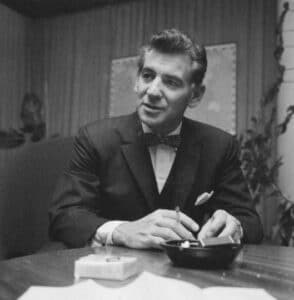
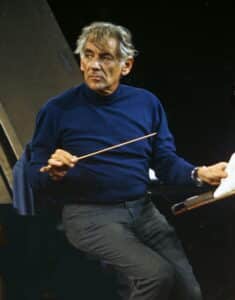
In my decidedly less than humble opinion, the only real reason for “Maestro”, Bradley Cooper’s inconsequential biopic getting close to an awards envelope, is the astonishing power and charisma of his subject’s ability to haunt us from his grave- Leonard “Lenny” Bernstein. Here the quote that immediately comes to mind ends with “…all sound and fury, signifying nothing.” However, I would certainly not go so far as to claim his film, “Maestro”, is told to us, in the words of William Shakespeare, by an idiot, for Cooper is an accomplished actor and at his best a competent director; it’s rather that in taking on both jobs he has diluted his talents so severely as to render the whole enterprise little more than a miserable pastiche.
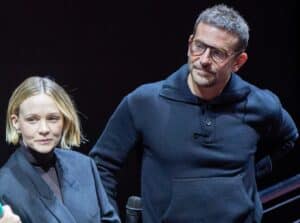
Why am I being so harsh on a film which has some considerable highs alongside the overwhelming lows, included the presence of the magical Carey Mulligan as Bernstein’s all-forgiving wife and some, but by no means all, of Bernstein’s music of genius? Because a) he skirts the core cause and effect of Bernstein’s bisexuality, b) he fails to deal adequately with his Jewishness and c) the best of his wonderful music becomes rather in Cooper’s hands, a failed attempt to create a pied-piper like celebration of his unique scores, ending instead as a merely meandering and eminently forgettable soundtrack to a barely sketched-in life.
It is not a widely known fact that Steven Spielberg was slated to direct the movie, which would have surely involved his experienced hand in the screenplay as well, but he withdrew from the project, I suspect due to the universal chorus of disapproval for his attempt at a musical with “West Side Story”; this thankfully seems to have slipped into the equivalent of Rotten Tomatoes’ infamous tables, or perhaps is already there, as in a real list of worst movies of all time. However, I have no doubt that Spielberg’s involvement would have yielded a far more truthful and controversial film than the one that has finally appeared on our screens. Bradley Cooper is the latest in a long line of actors turned director, the usual advice for which is to let well alone, viz Angelina Jolie, Barbara Streisand and Warren Beatty to name only a few from a capacious and now overflowing pocketful of others.
Before I proceed to the very blood and guts out of this near farrago, I should say, however, it is plain as a pikestaff that Cooper surely has his heart on his sleeve for our Lenny, but unfortunately to the point that his worst characteristics are glossed over or ignored altogether. For me, I sensed deep problems as soon as it was clear that Cooper’s putty-enhanced nose (four hours in make-up alone!). was attracting all the pre-release publicity. When the nose carries the performance before it, like a ship’s figurehead, we know that trouble will follow. Just ask those nose kings, Orson Welles, and Larry Olivier. Jeanne Moreau who starred with Welles in “Chimes at Midnight” said that Welles claimed he had lost his make-up case and was therefore unable to perform, until she found it hidden under his dressing room settee, thus shaming him into appearing with her in a scene on screen at last. Such was Orson’s fear of taking on the role of his life, Falstaff, showing that this mighty man still possessed human fallibilities. No such problems in Cooper’s case, on goes the schnozzle and on it stays. But if we all end up staring at it, what good is that to the movie itself?
Let us now turn to the matter of more serious mistakes, omissions, blunders and directorial blindness that Cooper is prone to and ultimately responsible for. But these crimes and misdemeanours pale in the light of over-weaning vanity which smothers the whole enterprise like a cloak of untreatable plague: Bradley’s performance as Lenny.
When one has to say that his attempt to master the art of chain smoking scored a mere six out of ten, compared to Lenny’s twenty out of ten, one’s heart begins to sink. (In fact a whole fascinating documentary awaits the incautious director who undertakes to tell the story of nicotine addiction amongst creative classes. Cigarette-smoking killed both Lenny and his wife, alongside Humphrey Bogart, Nat King Cole and Robert Taylor together with a slew of stars active in the 30s, 40s and 50s.) Kurt Vonnegut was eloquent in defence of the weed, writing fascinatingly about the power of trading cigarettes for all and any kind of favour in war zones (“Starting when I was only twelve years old, I have never chain-smoked anything but unfiltered Pall Malls. And for many years now, right on the package, Brown & Williamson have promised to kill me. But I am eighty-two. Thanks a lot, you dirty rats.”) Lennie was permitted to smoke anywhere he chose to be, otherwise he would not be there at all. To see him without a cigarette in hand was as if he appeared on the podium in boxer pants. In fact, it occurs to me now that his furious conducting, one place he was disallowed the weed, was an attempt to keep both hands occupied and therefore from reaching for the fag packet and Zippo.
Quite apart from Cooper’s inability to deal with complex and contentious issues head-on, he embraces a dumbfounding decision to leave a crucial chunk of Bernstein’s life and work, from 1951 till the early seventies, entirely blank. These years were amongst Lennie’s most productive and open to proper critical examination, particularly in regard to the various prestigious appointments he received. There is no doubt that Bernstein was a practiced and at the very least slippery operator, playing his 50% straight hand against gay rivals with barely a backwards glance. His shamelessness was cleverly concealed and emerged, if ever at all, to the uninitiated as mere elements of an artistic temperament. With the probable exception of murder (actual or career), as opposed to character assassination, Lenny could surmount almost any obstacle in his path.
Ultimately what Cooper was facing was the almost insurmountable task of making a film about someone heroic, universally admired, praised and very successful – in my view, a certain way to a directorial dusty death. With those flicks that do succeed, such as The Wolf of Wall Street, The Shawshank Redemption and The Aviator, most people would have difficulty in actually naming the protagonist. Who were they actually about? The question is not so much who, but what? And the answer is plain for all to see, the inevitable descent from even modest success to abject failure which cynics would maintain is the story of most if not all of our lives. Don’t almost all of us identify with the flawed hero, for in them we see a reflection of ourselves.? How much less of a challenge to make a film about failure, and here the list is far easier to assemble beginning with the greatest of all, Citizen Kane followed by such as: Once Upon a Time in America, Elmer Gantry, Aguirre, Wrath of God, and almost all of John Ford’s films starring John Wayne (with the possible exception of the earliest, Stagecoach).
Even our greatest comedians were much better practiced in the art of failure than success: Charlie Chaplin, Buster Keaton and the joint kings of Failureland, Laurel and Hardy. In perhaps their greatest short film directed by Leo McCary, L and H only reach their nemesis by the simultaneous destruction of a neighbour’s house at the expense of seeing their new car being gradually but inevitably reduced to metal shards. In another short we see their priceless and failed attempts to get a heavy piano to the top of a steep and apparently endless flight of stairs. Two hugely successful laugh-out-loud movies depicting the paralysing nature of failure. Very well you may ask, trawling around for a film highlighting success, what about Oppenheimer? Here, surely, is a film about one of the greatest successes of all, the making of the first atomic bomb? Gottcha! Well, actually, no, as Oppenheimer thought of himself as an abject failure in preventing the proliferation of his creation almost certainly resulting, sooner or later, in the ending of the world as we know it. Christopher Nolan’s monumental epic is a milestone in the depiction of a man who achieves all he could wish for but ends up as a fragile and intensely vulnerable man riven with doubts and regrets. Much easier than trying to show us the indefinable aspects of genius which are frankly not possible to depict: the art of conducting (impossible); charisma (impossible); the creation of great music (equally impossible). I’m afraid Mr Cooper’s Maestro had the cards stacked against him from the start.
All in all then an entirely hopeless, hapless case resulting in a hopeless and hapless film. But in truth I can’t think of any director with enough musical knowledge to undertake such a challenge. The only way to transmit the essence of Lenny to a contemporary audience would be to embrace a documentary format and trawl disparate materials from at least a hundred or more different archives. This would allow us to see his genius, charm, articulateness, inspirational compositions, concert-grabbing performances as a pianist, and his immense skills as a teacher to audiences of all kinds. Then, from within these interconnecting elements, you would need to put together a patchwork portrait of the man with all his charisma, wit, fire and passion that penetrated and transmitted to us through any camera lens trained upon him. He was, in my opinion, the intellectual and super-articulate equivalent of Marilyn Monroe with all her sensuality and innocent charm. But in terms of sheer sex appeal alone, I would have to declare a dead heat. Mr Cooper, kindly leave the stage!
At the release of Ridley Scott’s new film, Christopher Jackson asks what we can learn from the great general in our working lives
There is a famous line by the 20th century Chinese statesman Zhou Enlai. When asked what he thought of the French revolution, he replied: “Too soon to say.” The same might be said about Napoleon: we’re too near him to know for sure what he means to us.
That doesn’t stop us trying to find out. The recent release of Ridley Scott’s film Napoleon (2023) has proven beyond doubt that Napoleon remains both compelling and controversial – as lively in his importance as many a living figure. By discussing Napoleon, we somehow give an account of ourselves.
Scott’s film establishes itself as a must-watch just by virtue of its title. It isn’t quite the film we want or need, but it is better to have it than not. All Stanley Kubrick fans lament the fact that the great director never finished his own version – and there is much hope surrounding the news that Steven Spielberg is now filming a seven-part series for HBO based on Kubrick’s script. For now, we can make do with this: Joaquin Phoenix as a gruff Napoleon, less intelligent by many magnitudes than the actual Napoleon; brilliantly shot battle scenes; and a film that feels oddly both too short and too long at the same time. What’s good about it will make us want to know more about Napoleon; what’s not so good will ensure that our appetite for stories about Bonaparte will not allay.
After Scott’s film was initially screened, and the reaction came in, one came to realise that however porous the world’s nations have become, they still mean something to most people. That’s because in France, the film has been considered anti-French, a viewpoint which has been much less notable in the English and American coverage. It was as if the Napoleonic Wars had never been away, which in itself brings to mind another quote, this time by the American novelist William Faulkner: “The past isn’t dead. It isn’t even past.”
This quote, whose truth has grown on me over the years, is undeniably the case with Bonaparte. Napoleon, perhaps more than any other historical figure, retains the power to affect us in the here and now, though he has now been dead for over two centuries.
What is it that makes him so powerful and even attractive? His daring, his military competence, and his glamour tend to spark the imagination of successive ages. Nobody is really immune from his dash, his competence, and the outsized nature of his deeds. Readers of Andrew Roberts’ Napoleon the Great will find it striking how much Napoleon wrote, especially in his youth – stories, plays, essays, all of them very bad. But really Bonaparte is the archetypal man of action and our interest in him perhaps speaks to a deficit in us: compared to Napoleon almost everyone else in history is too sedentary. To look on him is to marvel at a different energy altogether, one we can learn from.
But there’s a paradox at work here. Napoleon’s very power to interest us may make us wonder a bit about the validity of the helter-skelter progress we sometimes think we are making. Why, if we’re so content to rush off into a future of general artificial intelligence and drone cars and so forth are we so easily arrested by this man who lived not only before the Internet and air travel, but who lived most of his life without the steam engine having been invented?
One possible answer is that Napoleon, as Scott’s film shows well, remains a fascinating instance of human potential made actual. By any measure, he did amazing things – even though we might not agree with much of what he did. He stalked continents; proved himself one of the best military commanders in history; and created a legal system, the Napoleon Code, which is still in force in some 120 countries. It was the historian Kenneth Clark who said that Napoleon, for all his faults, was a difficult person entirely to discount. “We can’t quite resist the exhilaration of Napoleon’s glory,’ as he said in his landmark TV series Civilisation.
Glory, it must be said, has had a hard time of it in the past two centuries – not least because Napoleon, its principal embodiment, was defeated in the end. The poetry of Wilfred Owen (1893-1918) contains the best descriptions of why glory is at the very least to be distrusted. Put simply, it leads to needless death – Owen’s among them. So Napoleon embodies a discredited notion, but still we find ourselves affected by him.
I think some clue can be found in the etymology of the word ‘glory’ which comes from the Old French ‘gloire’: “the splendor of God or Christ; praise offered to God, worship”, though it also has connotations with the Latin word ‘gloria’ which naturally has pre-Christian associations of ‘fame, renown, great praise, or honour”. This might make us realise that Napoleon, in so embodying glory, is a sort of ladder we might descend into the deep past – almost into another version of human achievement, full of a kind of blazing intensity and adventure.
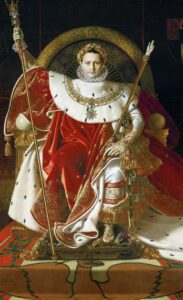
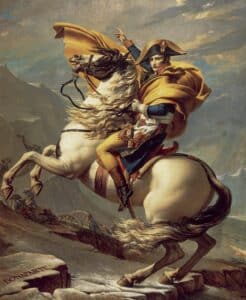
There is evidence that Napoleon knew that he might serve as a powerful, almost Pharaoh-like, symbol for his contemporaries. Take, for, instance, Ingres’ superb portrait which summons to mind Charlemagne: here we see the paraphernalia of immutable power. Napoleon, too fleetingly, understood himself as a force for stability – and, of course, in relation to what had gone before in the shape of the anarchy of the revolution, that wasn’t necessarily difficult.
But he was too complex to be only that – he was also on the move, athirst, full of a certain wild rampancy. He could never be a figure of unity and a figure of conquest at the same time. In his essence he was too questioning for that. This tendency to ask quick volleys of questions was the backbone of his character. Here is Roberts describing an encounter with the prostitute to whom he probably lost his virginity in Paris when a young man:
“He asked her where she was from (Nantes), how she lost her virginity (‘an officer ruined me’), whether she was sorry for it (‘Yes, very’), who she’d got to Paris, and finally, after a further barrage of questions, whether she would go back with him to her rooms…”
And here he is towards the end of his life, as witnessed by William Warden on the Northumblerand in transit to his final ending up in St Helena:
“His conversation, at all times, consisted of questions, which never fail to be put in such a way as to prohibit the return of them. To answer one question by another, which frequently happens in common discourse, was not admissible with him. I can conceive that he was habituated to this kind of colloquy…’
He certainly was habituated to it – it was a lifelong trait, which it would have been good if Scott’s film could have better conveyed. Napoleon’s curiosity was insatiable: given command when very young of the French army in Italy, he threw himself into the history of campaigns there.
But his curiosity also had its limitations. If we ask to what end he was asking questions then the answer is conquest. This was his raison d’être – and territorial conquest is always bound up in space and time, and so can never quite be enough. Perhaps it is never especially sane. Restlessness was the chief characteristic of his time – usually a restlessness combined with a nodding understanding of the centredness of the classical world. This paradox can be seen in figures as various as Byron, Beethoven, and Goethe. Goethe worshipped Palladio but wrote The Sorrows of Young Werther.
Napoleon til Hest fra bogen Kunstnere Z: David, Jacques-Louis 2005 Fotograf:. ACC:. HD Afdeling. Det Kongelige Biblotek.
The boon of this romantic restlessness was that it was exciting; the problem was that nobody particularly knew what they were travelling towards, a characteristic we often seem to have inherited in our own hyperactive inattention. One of Napoleon’s greatest contemporaries William Wilberforce, in his passion to abolish slavery, had a far clearer understanding of what life is than any of those others. This is one of the reasons why, in the end, Britain won the Napoleonic Wars: it was more securely anchored in a sense of identity than revolutionary and Napoleonic France. Napoleon was a far better military leader than any alive – in fact, he was the best military commander of all time. But his brilliant victories were always in service to nebulous aims.
This heady Napoleon – the one who, unlike Ingres’ version, actually existed – can be seen in David’s Napoleon Crossing the Alps: it is a picture full of movement, of appetite for the next thing. It is this need of motion – the lack of a viable centre – which really came to define him, and which brought about his own destruction. Some of the more picturesque scenes in Scott’s movie show the magnitude of Napoleon’s error in marching on Russia in winter.
This then is Napoleon: a new kind of hero, but someone also redolent of the old Christian Kings, and the pre-Christian Emperors. Of course, Napoleon himself isn’t someone we would think of as Christian in any meaningful sense – the body count alone arising out of his campaigns might make us laugh at such a notion. But in our disconnected and inchoate world, there will always be those who look to the strongman for solace, even a dead one. They are markers of what might be possible when we are feeling downtrodden and small. The spread of digitalised democracy hasn’t decreased this hunger; it has augmented it, as the existence of figures as various as Donald Trump and Viktor Orban, Vladimir Putin and Narendra Modi shows. Most of the people alive today who support these people, would have been sure to have supported Napoleon in his own day. The dynamic towards authoritarianism is a recurring one, and it is partly because it must always be fought that we can’t always be sure at any one time about the precise state of Napoleon’s legacy.
Yet our strongmen are neither so clever nor so interesting as Napoleon. Our politics seems full of a sort of pantomime glory which is sometimes called Punch and Judy politics. It is tempting to argue that without Napoleonic conquest the stakes simply aren’t high enough to make genuinely gigantic political figures.
Certainly the idea of glory seems to reach its apotheosis somehow with the conclusion of the Napoleonic wars. A sort of grey filter appears to descend which has to do with the nature of the victors – the dowdy Victorians – and with the absence of Napoleon himself. The wars which occurred during the 19th century lacked the drama of Napoleon’s wars. We don’t really watch films about the Crimean War. In fact, the principal development in war in the 19th century after Napoleon’s death is probably the writing of Tolstoy’s War and Peace, in which the romantic view of Napoleon is admitted into a vast canvas which is also at pains to show the grim reality of war. Tolstoy anticipated the War Poets by around half a century.
Clearly, the Tolstoyan view of war was important and much was gained: a healthy loathing of carnage. Human beings felt able in the wake of Napoleon to think about the individual life which is sacrificed by the Bonapartist need of conquest. We began to loathe, quite rightly, what war actually is. Owen called the idea that it’s sweet to die for your country the old Lie – and every Remembrance Day we come together in full agreement. One of the leitmotifs of my own life has been to visit the sites of atrocities. I have seen Hiroshima, Auschwitz, Anne Frank’s House in Amsterdam, Kilmainham Jail and Robben Island. They all tell the same story of the collateral damage which governments inflict on people when they hope nobody is watching. In one sense, Napoleon is on the side of the governments not the people.
Yet watching Scott’s film, it doesn’t feel quite so simple as that. He was also in another sense of the people, in that he was charged with bringing to some kind of order the unruly energies of the revolution. Napoleon’s Hundred Days would not have occurred without his having secured some powerful connection with the people. The complexity of Napoleon is that he emerged out of a set of forces which we have to some extent accepted. Furthermore, there was always a degree of treachery in Britain about Napoleon. Charles James Fox – essentially the Leader of the Opposition during the lengthy administration of William Pitt the Younger – had three meetings with Napoleon, and lavished Bonaparte with praise, saying that he had “surpassed…Alexander & Caesar, not to mention the great advantage he has over them in the Cause he fights in.” We would be surprised to hear Starmer say something like this about Vladimir Putin – but perhaps it is a measure of Napoleon’s attractiveness that he had supporters even in the House of Commons.
Yet it was also Kenneth Clark who approvingly quoted John Ruskin’s observation: “All the pure and noble arts of peace are founded on war; no great art ever yet rose on earth, but among a nation of soldiers.” Predominantly because of the horrors of the 20th century, and in our era of declining defence budgets, we find it hard to understand how much our forebears accepted soldiery as a pursuit. Much of the admiration towards Napoleon was therefore aimed at his military ability.
It can be possible to admire a thing done well for its show of technical and leadership ability – and few people have done anything as well as Napoleon made war. His strengths included a rapport with his troops, an ability to think tactically around the terrain of a situation, and an ability to ruthlessly seize the opportune moment. It might be added that these traits would be just as useful in the boardroom as on the battlefield: everyone who aspires to leadership will therefore have something to learn from Napoleon. This is categorically not true of Hitler, who people, possibly including Scott, sometimes want to adduce as a comparison to Napoleon.
Where I think Napoleon is deficient is in his sense of himself, and in his worldview. Heroes forget they are human at their peril. Bonaparte once said that if he were to fall off a building, he wouldn’t be scared but would take a last calm look around. This is unlikely – he would be as scared as the rest of us. In forgetting his humanity, he was unable to accept that humanity is wedded in some way to fear since we are in a universe we don’t understand. As a result he miscalculated about the wishes of others, what they would and wouldn’t do: most notably, the whole world was unlikely to want to live under his regime. Other considerations, which he didn’t understand, were in play. This is because his worldview was essentially Voltairean, and I don’t think it occurred to him in the insane rush of his life that the Voltairean view of life might be limited, or wrong, or both. In this he was very much a man of his time, and not, as he wished to be some eternal Caesar who straddles all the ages. The Voltairean view has nowhere to go, since it refuses mystery.
Nevertheless, some of the best scenes in Scott’s movie bring the 19th century battlefield to life: we witness the sheer flurry and insanity of battle, as well as Napoleon’s ability to exist within a complex situation and calmly read it. When asked who was the best general in history, the Duke of Wellington (conveyed here in a hammy performance by Rupert Everett) replied: “In this age, in past ages, in any age, Napoleon.”
Ruskin’s quote about the connection between military ability and literary output is open to the objection that we wouldn’t necessarily call Napoleon’s reign a brilliant time for literature. In fact, his biggest contribution to literature was again probably War and Peace, in which book he appears and which is impossible to imagine having been written without his extraordinary life. It took a writer of the magnitude of Tolstoy to approach Bonaparte.
But Ruskin’s idea cannot nonetheless be easily dismissed. It might be that soldiery and the skill that surrounds it are what’s missing from our society – that we have become too inward, bloated and self-regarding in a time of peace to produce work that is sufficiently vibrant and true to feel great.
In time, the example of Napoleon faded and the only clear historical example of le gloire since his life, is contained in the life of his admirer Sir Winston Churchill, who also depended on a war – albeit one he didn’t start – as the crucible in which to forge his own reputation. The peace of 1945 has broadly lasted until the present day, and it remains the case that wherever we see war we despise it, as in Ukraine or in the Holy Land.
This makes it all the harder to say that something was lost with the demise of Napoleon. But if something was indeed lost then that something was ambition. Most of us today, as we leave university, seek to join society and joining is an inherently unglorious thing to do. To coopt oneself can be to dream small. In his book Bullshit Jobs, the late philosopher David Graeber issued a brilliant takedown of the contemporary economy, which can sometimes seem to specialise in creating roles whose mundanity might be deemed the polar opposite of the glorious. There is something almost preternaturally un-Napoleonic after all about a middle manager.
This is not to say that the Napoleonic spirit is entirely absent in our world. In many ways, his example can most be found in today’s tech giants, especially in the companies of Elon Musk. Musk himself, when we see him at SpaceX or Tesla, in his constant questioning, his invention, and his desire to push frontiers, bears a remarkable resemblance to Napoleon in a battlefield situation.
Did Napoleon’s defeat lead to the banality of the modern world? No, we created that – and in fact, there’s a good case that Napoleon’s ultimate influence is now more to be found in the realm of the imagination than in political reality. Napoleon left remarkably little political legacy. Gore Vidal mischievously jokes in his novel Burr that Thomas Jefferson had a far bigger impact on history than Napoleon: the American revolution actually lasted and is still admired today, though it is also in peril.
Napoleon in fact never could have united Europe, especially without being able to control the seas. George III and his brilliant Prime Minister William Pitt the Younger were not about to agree to it, and he was probably temperamentally ill-suited to the creation of anything lasting. Napoleon’s bout of conquests came in the wake of the French revolution and since we to some extent inhabit the aftermath of those times, we can hardly access now the note of dismay across Europe at the idea of the old medieval order being so absolutely swept away.
Very occasionally, we glimpse what we were fighting for in opposing Napoleon. Napoleon’s greatest contemporaries have all had a subtle but real influence – in fact their comparative gentleness is liable to make us underestimate them. Arguably, the greatest of them was William Pitt the Younger, whose quiet conservatism and remarkable financial competence have had their own legacy. Pitt, like most of his contemporaries, believed in the monarchy, and although the monarchy has been watered down to a considerable extent, we saw in the coronation of Charles III last year how it has continued – and how its symbolism is even in many respects unchanged. Conservatism has had its victories too; we live in the time of Charles III as much as in the era of Rishi Sunak.
Similarly, we can see how the Founding Fathers of the United States, also Napoleon’s contemporaries, remain in the collective consciousness in a more meaningful way. Napoleon is a kind of a blaze, but he never, as Jefferson did, defined a philosophy. Life, liberty and the pursuit of happiness may in some way be a limited goal for a government to espouse – but it has been remarkably durable. Similarly, the financial system created by Alexander Hamilton has endured – and there is now a musical to show for it.
This isn’t to say that Napoleon is without concrete political achievements: in education with the creation of the University of France, and of course in law, he had remarkable impact. His love of books is an appealing thing about him, as is his occasional generosity when in power to those who had helped him on the way up. But Napoleon remains a riddle – since he opens up with startling immediacy onto the riddle of ourselves. If we ask what we really think of him, I suspect Enlai was right. It’s too soon to say.
I don’t think any writer would in their right mind refuse the Nobel Prize for Literature, but there is a lot in this book to make one wonder whether it might be the right course of action should Stockholm call.
However busy Seamus Heaney (1939-2013) – ‘famous Seamus’ as Clive James dubbed him – might have been before he was awarded the prize in 1996, life was a constant deluge of correspondence from that point on. ‘In the last two days I have written 32 letters,’ Heaney writes to the artist Barrie Cooke in 1985, ‘all of them a weight that was lying on my mind even as the accursed envelopes lay week by week on my desk. The trouble is I have 32 more to write…’ Of course, he’s too generous to point out that Cooke is by definition in the second tranche of 32.
All poets must carry out administration, but if every one of those letters could have been a poem, this book measures out a sort of loss – the replacement of the actual work by the business of being, to use Yeats’ phrase, ‘the smiling public man’.
Heaney had a terrific set of cards: supportive parents; warm friends; and above all, an ideal wife in the academic Marie Heaney, who bore him three adored children. Marie was the centre of his existence, but no letters to her are included here, though they certainly exist. She is still alive, and it seems likely that there will be a subsequent volume after she passes to round out the picture.
This is therefore a tale of considerable success which was ordained, one feels, from the first. In poetry, the premier publishing house is probably still Faber and Faber, as it was in Heaney’s lifetime – a legacy of the role TS Eliot played in building up the original poetry list. It has probably gone down a bit since then since independent publishing is on the rise generally, and the books don’t quite have the caché they once did.
In Heaney’s day to be asked to submit to Faber – not to come cap in hand – was rare. This book begins in 1964 with Heaney in his early twenties doing just that. We start then at the crest of a lifelong wave of success: Death of a Naturalist was published in 1966, and has never been off the syllabus since. Famous friendships accrued: Ted Hughes, Czeslaw Milosz, Tom Paulin, Michael Longley and so forth.
It is also a tale of mentorship: Heaney could never resist lending a supportive voice to young poets, perhaps knowing his luck in having been elevated above his peers even from a young age. It was a network of support in relation to the endeavour of an art form which is at once charmed and economically hopeless. Even well-known poets need shoring up. ‘Poetry is small beer,’ as W.H. Auden observed. The readership is always small, and predominantly confined to fellow poets. Even Heaney, who achieved a Tiger Woods level of success, died with an estate matched by many middling solicitors. Tiger Woods himself has a yacht big enough to play golf on.
It was always kind of him to write back to poets who needed it; this book shows us that he made so many peoples’ days. To get a letter from him would, for many poets, have constituted an instant trip to the framers. That he did this is wholly admirable.
And I don’t think his doing it can easily be separated out from the quality of the poems, which emanate out of that same generosity of spirit. There is a kind of glow to Heaney’s poems which is to do with a good heart mining the world for consolation. These letters are like that too – and they show him to be a willing citizen in the republic of letters.
Poetry, and increasingly, literature itself isn’t a career. What is a career is to teach in a university, and publish books on the side which sell to an audience of 200 if you’re lucky. Heaney knew that the ship of his success had created dinghy-loads of unread poets in its wake. Perhaps there was guilt to that – but if so, he converted that guilt into this special book.
Photographer, artist and erstwhile Dr Who director, Paul Joyce, offers an insight into the making of the Time Lord…
One can almost hear the sigh of relief breathed by Idris Elba when at last the young cub was painfully torn from David Tennant’s side in an awkward and over-extended CGI sequence. A nod maybe to the book of Genesis but no mention of additional ribs or, thanks be, even a glance towards the other candidate for Eve’s existence, the baculum. Rather we are presented with an athletic looking young black actor of undoubted Achillean appeal and bizarrely sporting only bone-white underpants for the remainder of the show. For my money quite a lot of fuss over barely spilt milk. Welcome to the world of “Bi-Regeneration” (as opposed to simply ‘bi’) which will allow Tennant whose Hamlet and no doubt Macbeth and Lear will all be overshadowed at least in legacy terms, by his stuttering appearances as The Time Lord. As one horrified fan just wrote: “what the f*** so what now we get 2 doctors flying about ????” It is clear our David will not leave the show lying down.
In a hagiographic follow-up documentary aired immediately after the show’s first airing, an uncomfortable looking presenter, wielding an exaggerated Welsh accent (to remind us of the show’s Celtic credentials,) wandered around the set to demonstrate just how good the CGI is in the transmitted version. His first choice of interviewees included the 2nd assistant director, a Runner and a puppeteer. Oh yes, plus one of the producers who appeared briefly as did the show’s grandmaster, Russell T. Davies. Any documentary worth its salt covering filming of really any kind would usually figure the director at some point as being at least nominally a captain on the ship. But not here, not now, which symbolises for me the vacuum at the heart of Dr Who in its ongoing form since my brief tenure there 40 years ago. The director nowadays can be anyone more or less: in my time that might be a promoted first assistant director or junior producer eager to lap up the BBC philosophy of absolute loyalty to the crown (or in other words TV Centre). For me that view has not shifted much in the last four decades at least.
My quite genuine admiration for the show’s initial 20 minutes or so rested, now I consider my reaction more carefully, on mainly technical excellence; these included stunning views of cities with beautiful futuristic buildings running alongside believable recreations of Soho streets 100 years ago. British TV is attempting and succeeding in matching the mighty Hollywood dollar, aided by our indigenous and unequalled Special Effects facilities. The bolted-on documentary also showed what seemed like an army of Steadicam operators flying hither and thither about the set apparently filming anything that moved. I came from an era where budgets were tiny, special effects barely obtainable, and working conditions today would be truncated overnight by a number of trade unions and government acts.
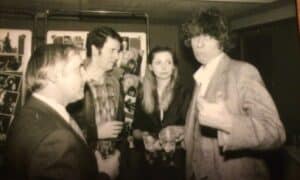
Paul Joyce second from left with Tom Baker
In my day I had to beg, borrow and finally steal the first truly portable camera to enter the BBC’s hallowed walls, called, as I barely can remember, an Ikigami. Added to which I faced a hostile management at the BBC eager to have me fired, and with key elements of my crew resentful of my very presence on set. In retrospect my reputation was probably firmly set on its course towards oblivion long before I took up the reins on “Warriors Gate”.
It is important to mention that there is one crucial difference concerning a director’s authority between my time, and pre-production conditions today, and that is that he or she has no official control over casting, a major contribution to the success of any series. I like to think that my four episodes of “Warriors Gate” where I was totally responsible for casting (Clifford Rose; Kenneth Cope; David Weston, etc.), survives as well as many in those middle years, because of the strength and diversity of the talent I chose to work with. This was aided by basically a stroke of fate which left myself and the script editor, Chris Bidmead, with unworkable scripts which we had to re-write over the course of a week, thus losing valuable rehearsal time which I was not able to recover. Having altered the characterisations in our additions, this meant I had an intimate knowledge of what made my characters tick. So it was important to let my two Laurel and Hardy actors ( Freddie Earle and Harry Waters ) know that their roots had been laid down in the work of many authors such as Samuel Beckett and Tom Stoppard. A middle ranking BBC executive thrust into the role of casting director would have no notion of these, hopefully subtle, nods to familiar characters which can be traced right back to the Bard himself (aka.Rosencrantz and Gildernstern). So one crucial element of constructing a coherent show is cut away at a stroke, like nadgers from a bullock. This change from my days was not a spur of the moment management decision, but one made incrementally over time; one leading to a gradual erosion of the director’s authority, further buttressing those twin pillars of the BBC Establishment, the producer and the writer.
A friend of mine, a well-known presenter and actor, also well informed on the history of Dr Who, said that one director had told him that British TV deliberately places an executive layer in place in order “to protect the audience from the director”. I found this a very intriguing notion and it is certainly true that the BBC keeps directors as blank as the outline posted on eBay or Instagram before you fill in your personal details. Ghostly interchangeable presences flitting from drama to drama, obedient boys and girls wedded to the great corporation and fully plugged-in to its necessary support systems. It was certainly my experience both on “Warriors Gate” and a Play for Today that I wrote and directed in Pebble Mill, that one is expected to work to a rigorous schedule which takes no account of creative differences, matters of interpretation, second thoughts or even the weather. And going over a studio session by a single minute means the plug is literally pulled. Now this practice might have changed by now, and I really hope it has, but the driving force behind BBC programming is to produce saleable product first and foremost. In the past the BBC nurtured towering talents, the likes of Ken Russell, Peter Watkins, Ken Loach and Tony Garnett, but those days are long gone, lost like traces of special-effects gunpowder on the fields of Culloden. All of the above mentioned fled from TV into the alternative minefield of film-making where the stakes are even higher but success comes to those with persistence and talent, finally rewarded by the enviable credit, “A Film by…”
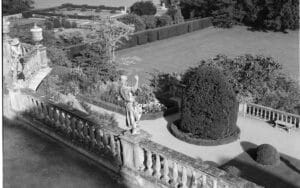
A scouting shot by Paul Joyce for Dr Who at Powys Castle
The recent strike by film and TV writers in the US has reached an uneasy compromise but the threat of AI hangs over all of us. Mozart is already composing his 42nd symphony. But if actors are frightened of being cloned and resurrected from the dead, what about directors? Could we make one like Sam Peckinpah whenever we want a great shoot-out? Or a Spielberg for any Si-fi or underwater picture? Seriously now, I can see a time when a robot could not only organise a script, but create a workable storyboard, issue instructions to actors based on pre-ordained movements (computer checked beforehand) then supervise an individual shot; a robotic decision could then be based on a) if everything in frame was in focus, b) actors delivered their lines without hesitation or repetition c) any special effect proceeded according to plan. Voila! Direction by numbers, but aren’t we almost there already? The days of “Sorry sir, there is a hair in the gate” are well behind us now.
There have undoubtably been fine directors on the series during its unprecedented 60 year run, but for me the problem remains, now as it actually did just as well then, how few have gone on to become true originators and in creative terms, real auteurs. In America’s golden age of live TV, mighty talents like Sidney Lumet and John Frankenheimer, Michael Mann and Robert Altman emerged and then went on to become kings in the kingdom of Hollywood films. It is difficult to come up with a complementary list here in the UK.
I can see why more or less anyone competently trained in state-of-the-art technical capacities, particularly computer graphics and CGI generated images, could command a set of this kind today, and bow to the will of the writer’s vision. In this sense nothing has changed since “Warriors Gate” where I tried to bring at least a hint of the director as auteur to the proceedings. But I was cut off at the knees by the establishment’s twin-peaks, namely the producer and the writer. This has barely changed from the era of the show’s founding producer, Verity Lambert up to and including Russell T. Davies today. So a homogeneous product is born to satisfy the needs of voracious salesmen promoting BBC Worldwide, and where a show is judged by its longevity rather than on its individual and intrinsic merits. Who amongst us older directors can forget that the first episode of the Peter Falk TV series Columbo was directed by a teenage Steven Spielberg?
So here we have it, an all-new, no-expense spared Russell T. Davies extravaganza with bells and whistles (literally), flying galleon ships (straight out of Pirates of the Caribbean) and a baby hungry monster Goblin (or was it Gremlin) looking like a giant overfed cowpat. What more could a child want, I asked myself, settling down on the sofa to watch with my soon-to-be teenaged granddaughter, Zsofia? She took the precaution of supplying us with large fluffy cushions to hide behind during the scary bits. Scary bits? Well, that’s another story…
Of course, we are all watching out for the hugely talented Ncuti Gatwa to don a pair of real trousers after flouncing around in boxer shorts for his prequel introduction. And he gave us that smile as well, countless times, showing a set of teeth well capable of blinding half the audience as well as severing the appendages of any alien previous seen on the series. Looks, charisma, athleticism and even I suspect a good singing voice. What more can one ask for, except perhaps a new companion to bounce off? “Say no more”, mouths Russell T. and with a sweep of his pen, lo and behold, a companion appears as blond as he is black and as straight as he is gay. The whole world in his arms!
So where is the problem? At the very root, I’m afraid, with the very bedrock of the programme, the script itself. Part religious analogy (baby in a manger) part time-travel with missing baby (black or white, both are there, but which is which) and a chorus of singing Gremlins (or maybe they are meant to be Goblins?). It all seemed to hinge on some kind of time warp (but unfortunately not as funny as Rocky Horror) where Ncuti rescues one of the babies who apparently develops rapidly into his next companion, a blond goddess called Ruby (Millie Gibson). All well and good but what about the story line in an episode which must have cost, in my calculation at least, the BBC about 6289 licence fees? Just one word covers that I fear, simply “cobblers”.
After the first 40 minutes or so, when a nest of Goblins/Gremlins formed a chorus line and prepared to belt out something sounding like “Hello Dolly”. I turned to dumb-struck Zsofia and asked if she could make head nor tail of what was going on? She shook her head sadly, cushion still rooted firmly in her lap. “What’s that for then” I asked her. “Oh” she replied, “I was watching an old Matt Smith episode of some dolls in a cupboard. Really scary!” “What about this one, do you think”, I enquired gently. After a momentary pause came back the unequivocal: “Not scary enough!”
Us humans are interesting creatures, aren’t we? On the face of it, one could argue that the changing of a year is merely a second changing on a clock. Yet, for many humans, it signals the opportunity for reflection and change, especially when thinking about our careers.
On New Year’s Eve, I was lucky enough to have a guest pass to photograph London’s ever-impressive firework’s display. Standing opposite this world-renowned landmark, listening to revellers discussing their plans for 2024 and seeing technicians rehearse the countdown, I found myself reflecting on my own achievements, lessons learned, and plans for the future.
Embarking upon a career change can feel a daunting one. Technological leaps, such as AI and a post-Covid work dynamic have resulted in a rapidly changing job landscape. Through Finito’s career change mentoring program, I have gained vital knowledge, skills and insights. For me, their attention to detail, structure and step-by-step approach has been incredibly helpful in preparing me for the next steps. I have also noticed improvements in my personal life too which was an unexpected, but most welcome benefit.
Now, as the festive lights, trees and echoes of Auld Lang Syne disappear and 2024 gets into full swing, my own excitement is building once again to find my next role.
I’ve been really fortunate to have had a number of incredible experiences throughout my career, notably during my time at Google, so I know the importance of a job not feeling like a chore. I very much subscribe to what Mark Twain said; “Find a job you enjoy doing, and you will never have to work a day in your life.” I remember distinctly when working on an exciting role within the Google Earth team that I couldn’t really tell much difference between a Wednesday morning and a Saturday afternoon, because of how much I was enjoying the work. This notion is what I always strive for because it’s a win-win scenario for myself and a company’s progression.
I became aware of Finito through a previous role and had met with Ronel on a couple of occasions. I was really taken by the work of Finito and so when I decided that it was time to undertake the next steps in my career, I knew there was only one place to start.
As mentioned, I found Finito’s step by step approach incredibly beneficial. Time keeps us all marching to a quick step, and having access to the team of experts that Ronel put together really supported me in organising all the pieces of the jigsaw required to begin a career change.
Our starter for ten begins with me meeting Finito mentor, Claire Coe to put together my credentials and design them as a powerful, but succinct summary of my skills and experience. Everybody to whom I have shown this CV has been impressed and commented how much it stands out.
The next stage was to meet up with Finito’s resident photographer, Sam Pearce to have some headshots taken. I had never had headshots done before, so I was a little apprehensive about this. I needn’t have been worried though as Sam did a wonderful job of putting me at ease.
A strong LinkedIn profile is an integral part for anyone looking to network and seek opportunities, and for this part, I met a few times with Amanda Brown, whose insights and attention to detail really helped me to spruce up my LinkedIn profile, and most importantly, make it useful for others.
Working with Finito’s presentation and body language expert, Merrill Powell was an absolutely fascinating journey for me. Whilst I had never found interviews particularly intimidating, I knew there were areas on which I wanted to improve. Merrill’s ability to offer constructive criticism was incredibly helpful and I feel as though I learned so much about myself as a whole.
Establishing a really strong connection with a primary mentor is a key aspect of Finito’s approach, which I have found incredibly useful. I meet regularly with Robin Rose to explore strategy, contacts and how best to position myself. The wealth of insights that Robin has been able to impart really has been priceless.
I met briefly with Angelina Giovani and Mike Donoghue too as Ronel felt that their insights would be beneficial.
This multi-pronged approach has also been an excellent reminder for my own self of how much I have to offer an employer. I’ve always found that combining a career path with a long held passion is key for me. I would love to find a role where there’s a strong visual component, such as the space industry, photography or lighting/art shows.
My plan would be to find a role that had a business development “let’s get stuck in, there’s much to do” theme to it, where I can position myself as someone to really help an organisation achieve and further its goals, and become a leader within that company. I know I’m in a good position to do all this now, thanks to the Finito programme.
From the age of 15, I have been focused on finding work. As a student in North London, I wanted financial freedom and to gain experiences that could benefit me in the future. From turning my passions into businesses, to finding work that builds up experience for my future, the joy these experiences have brought me and the lessons they have taught me have been a pivotal part of my upbringing.
1. Custom Fidget Spinners
Even before I hit my teens, I started an online enterprise. At the age of 12, fidget spinners (a small toy based around three arms that spin from a central ball bearing) became a huge sensation among young people. I too became entirely consumed, so consumed I began to design and sell my own under the name Custom Fidget Spinners. I had spotted a gap in the market for innovative design and colourways. I would bulk buy 30 or so plain spinners, strip them of their ball bearing and dip the outer body into a bath of water and spray paint, a process called hydro-dipping that often resulted in a mesmerising mix of patterns and colours. I sold to school friends, family and even shipped abroad. This also solidified my position as the cool kid for a brief two months.
One of my hyrdo-dipped fidget spinners
2. Landscape gardening
Possibly my favourite of them all – working outside, earning well… what’s not to like?
Again, this all started from a passion as opposed to financial desperation, and for me that is key to enjoyment and success in any work. I developed an interest in landscaping and (mostly) pond-scaping. I went into my back garden, dug a hole, lined it with plastic and I had made my first pond at fourteen. To my horror, two weeks after I had perfected it (with a running waterfall) one of my mates careered into it during his first experience in the world of beer, instantly disabling my precious water feature. Nonetheless, I cracked on with my landscaping and went on to help many of my neighbours, eventually working under a local landscaper. This is an excellent opportunity if you’re partial to a bit of manual labour in exchange for £150 a day. I distinctly remember fuelling my summer travels after a three-day landscaping stint at Corum’s Fields Nursery.
Building my first pond at the age of 14
3. Selling second-hand clothes
Covid struck the world, many worked from home, but hospitality-working teens were left with uncertain finances. I had to find a way. Depop, Vinted and Ebay are all well-known to the vast majority of young people. However, what I found is that the price of an item can be seriously increased by the photography and presentation of your online store. Combine clean aesthetic with car-boot sale prices and your profit margins will lengthen. I would rise early to haggle over the finest worms with the Nag’s Head sellers. Return home with a bumper crop to upload to the shop. This is easy and accessible for teens of all ages. The real trick is to brand scout in the hopes that a seller is slightly removed from the fashion world and is willing to let go of some Carhartt jeans for a quid.
Selling car boot sale jeans on Depop
4. Working as a photographer’s assistant for Next
Year 11 work experience day. I found myself in Acton on what I assumed was a visitors pass to a fashion shoot. I was taken aback by the grandeur of the whole operation, and slightly stumped by some of the dopey, Chelsea boot-wearing staff. However, I tried to seem like I knew what I was on about, cracked a couple of droll jokes with the Chealsea booters – presumably about Hackney and IPA. One week later they called me up and asked me to work on a two-day shoot as a photographer’s assistant. I said yes without hesitation. After the two days I finally dared to ask if I was being paid at all. They said, ‘yes of course, £200 a day is a minimum for this work.’
On shoot for next at Rida Studios, London
5. Bar and waiting shifts for a catering agency
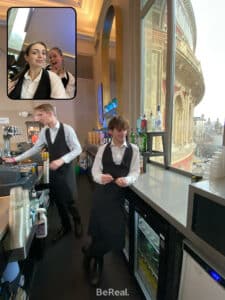
Why would you want to work in a pub and be stuck on a weekend-destroying rota, when you can join a staffing agency and pick your own hours and venue? You do not need substantial experience to join these agencies, so have a look in your local area if you live in or around London – try Host, High Society, Rocket or Splendid. These all regularly staff large events. The pay starts at £13ph and can go up to around £15. Not only will you never have to sacrifice your social life, but you have the chance of working a rage of cool events. I did the BAFTAS as well as King Charles’s Coronation Concert last year, during which I had the opportunity to subtly serve Austin Butler with my best Elvis accent.
Posing at the Royal Albert Hall during a bar shift
6. Tutoring English as part of the National Tutoring Programme
Set up by the government due to the poor post-COVID literacy rates, the National Tutoring Programme sees tutors being employed across UK secondary schools, and sees my bank balance into the friendly figures. Jokes aside, this is an incredibly important role and extremely valuable experience. Not only to the students make me laugh (by asking me how many children I have) but they make me happy when I see them doing well or growing in confidence. So, if you are looking for a job, have a specialist subject you would like to teach, and extraordinarily long and slow burning fuse – this is the one for you.
In conclusion…
Aside from the individual job titles and intricacies of working within each industry, what I really believe is that every teenager should get involved with work. In most circumstances teens will be living at home with no rent to pay and some spare time. This is the greatest opportunity, perhaps of your lifetime, to make money, and every penny you earn is yours to spend. Virtually no tax, no subscriptions, no debt. You can work one shift a week during Sixth Form and before you know it you are booking a holiday.
Applying for a job can often be a case of matching your abilities against a prescribed job specification. But to excel in any role means moving beyond that and shaping a job in your own image.
Job specification documents often hold totemic status. Some use them as a crutch to ‘prove’ themselves; others use them to avoid doing more than they must do. A job specification should instead be used as a starting point. The launching pad for developing the role and a career in your own image.
The more that a role can be personalised, the better. The role will be more satisfying and, come annual reviews, it will be easier to demonstrate the added value you bring. That can mean promotions and additional money. Working to a job specification rule can be dull and repetitive.
What would be the steps towards following a more personalised approach?
1) Self-assessment – consider what you do well and other areas that might need to be addressed. Being able to do the job is not enough. Pushing the boundaries need self-reflection. Set goals so that you can continuously challenge yourself.
2) Role-assessment – consider what the job specification does and not cover once you have been in the role for at least a few months. Actively look for gaps and consider what is possible, impossible and what could be described as aspirational. In essence, you are thinking about where the gaps are that you can push and make a difference at.
3) Training and development – once the self-assessment has been undertaken, think about what support might be needed. This could be training, mentoring, a period of study or other support. Some organisations will provide it but others may need to finance it themselves. Whatever the situation is, there should always a business case made.
4) Be creative – especially in a commercial setting, or one where you are focused on service delivery, any successful and growth-focused organisation want to be challenged. There is nothing that tops not just good ideas but a plan for delivery as well. The two should go hand-in-hand.
5) Find an internal friend – especially in the early days, it is always useful to know how to navigate potential internal discussions and potentially even battles. The more you can discuss this with others, the better. It should be hoped that one such person could be a line manager but some consider themselves first and others later, however disappointing that attitude is.
6) Have a plan of action – bring all this together in one place and be prepared to update it regularly as you develop, receive feedback and learn from the experience of others. Networking always helps as you bring the thoughts and views of others into your plan updates. Keeping good records of training, discussions and achievements should not be underestimated either. It is too easy forget all the hard work and good ideas that you develop.
Personalisation should be about pushing the boundaries rather than waiting for them to be imposed upon you. It is about helping an employer but helping yourself as well. A more personalised role is a more enjoyable role and is ultimately empowering.
Since his election as Indian Prime Minister in 2013, Narendra Modi set out a vision for his country to become a fully developed economy by 2047, the centenary of its foundation.
Could India finally cast off its colonial burdens and achieve its undoubted potential?
We are now a third of the way through the journey from Modi’s arrival until 2047 and the Indian population is about to cast its votes in a General Election.
Here’s how the main economic indicators have shifted during the first decade of his tenure:
From 2014 to 2022, India’s GDP grew by an average of 5.6 per cent in compound annual growth (CAGR) terms, compared with a CAGR of 3.8 per cent on average for 14 other large developing economies such as Brazil and Mexico.
The percentage of Indians living in extreme poverty (earning less than $2.15 per day) has fallen from 18.7 per cent in 2015 to 12 per cent in 2021, across both urban and rural populations. Economic analysts attribute this to welfare schemes and the Aadhaar digital ID system, which has helped to target payments to the needy and cut out middlemen.
Indians now make digital transactions worth Rs3,355 trillion per year, a 70 per cent increase on the Rs1,962 trillion in 2017-2018, much of it conducted via locally made smartphones, which 60 per cent of the population own. India’s digital transformation has helped it become the ‘back office to the world’, particularly centred on the cities of Bengaluru and Hyderabad.
India’s middle class – defined as households with an annual income between
$6,700 and $40,000 – has risen from 300 million in 2014 to 520 million today, while those classed as wealthy, earning above $40,000 pa, now number 90 million, up from 30 million in 2014. These changes have opened up markets for a huge diversity of consumer goods, for national and international travel, for investment and business development. They are an extremely positive sign for the future of the country.
Infrastructure development is another big success story: more than 10,000km of roads have been constructed each year since 2018 and 1.7 per cent of GDP is devoted to transport investment, compared with 0.4 per cent of GDP in 2014. Of course, not everything is perfect. India’s unemployment figures are concerning: they exceeded 10 per cent in October 2023 and are worryingly high among young people and women. Despite government encouragement, the female labour force participation rate fell between 2014 and 2022 from 25 per cent to 24 per cent, lower than Bangladesh, Sri Lanka or Pakistan.
Nevertheless, if the next 20 years see as much progress and economic growth as the past 10, there is every chance that Modi’s vision for the country will be realised.
Dinesh Dhamija founded, built and sold online travel agency ebookers, before serving as a Member of the European Parliament. His latest book, The Indian Century, will be out soon.