Category: Features

  • Heidi Mallace on the potential impact of AI on democracy in 2024

    Heidi Mallace


    2024 is poised to be the largest election year in history. There will be 74 elections and an estimated 4 billion voters globally, half the world’s population. Countries such as the USA, UK, India, Russia, South Africa, and Nigeria are among those involved. With over 25 years in the communications and reputation management industry, I’ve witnessed the crucial role of effective communication in achieving success. Communication not only shapes opinions and reputations but also influences beliefs. This is a pathway to power for political leaders. 2024 marks a pivotal moment where AI generative communications and democracy converge.


    The radical evolution of communications in the 21st century

    Throughout human history, communication has been a remarkable fabric of society. Prehistoric humans relied on verbal means—spoken language, storytelling, and gestures—to share information and coordinate group activities. The development of written language around 3200 BCE marked a significant leap forward in recording and sharing information. Johannes Gutenberg’s invention of the printing press in 1440 enabled the mass production of books and pamphlets, facilitating the widespread dissemination of knowledge and transforming access to information.

    The invention of the Telegraph, over 400 years later, introduced long-distance communication through Morse code. Alexander Graham Bell’s invention of the telephone allowed real-time voice communication over long distances. The 20th century witnessed the rise of electronic communications through radio and television. In 1989, Sir Tim Berners-Lee’s creation of the World Wide Web revolutionised global communications.

    In the past 20 years, social media and smartphones have dominated our communication landscape. According to Kepsios, 61.4% of the world’s population uses social media, with Facebook alone boasting +3 billion users. AI generative models like ChatGPT represent the latest frontier, capable of understanding and generating human-like text, enabling advanced conversational interfaces, content creation, and personalized communication. Upon its launch in November 2022, ChatGPT acquired 1 million users in 5 days. By December 2023, it had 180 million active weekly users, with 1.5 billion website visits in October 2023 alone. The scale and pace of AI development are almost unimaginable. Its impact will potentially influence democracy this year.

    Alerting all communications professionals and voters


    Communication strategists and campaigners are poised to integrate AI like never before. However, a recent report by Golin has analysed the impact of AI tools on crisis management and issues. The research reveals that nearly 60% of communications professionals have yet to adapt their reputation management strategies to account for AI. This poses a concern for prominent figures, businesses and politics.

    Jessica Shelver, Managing Director at Digitalis, a firm specialising in digital risk and online reputation, expressed concern, stating, “There’s a significant risk of miscommunication or misinterpretation. Generative AI might produce responses that are inaccurate or not aligned with the intended messaging, potentially leading to misunderstandings, reputational damage, and privacy breaches.”

    This holds considerable implications for elections. It will be as poignant as Barack Obama’s 2008 presidential campaign, a turning point in leveraging social media for political purposes. James Hann, Managing Director and Head of Risk at Digitalis, whose Government Practice assists governments in understanding and navigating the digital landscape and managing its risks, highlighted, said: “2023 has been characterised by the widespread and accessible use of generative AI tools, especially in the online landscapes surrounding conflicts. These tools bring unique challenges, and with some social media platforms actively cutting back on moderation and safety teams, we are looking ahead to the obstacles we expect clients to face next year.”

    The threat posed by misinformation and disinformation to our societies is now well-acknowledged. Recent geopolitical events have underscored the growing nature of this threat with the use of AI. Hann said, “Mis and disinformation are often used interchangeably, but there’s a subtle difference. Misinformation refers to false or inaccurate information spread unintentionally, whereas disinformation involves deliberately spreading false information to deceive people.” He further expressed concern about the use of deepfakes in the Slovak elections. It illustrated how AI technology can be used to manipulate public opinion and undermine democracy. It’s a worrisome trend in today’s landscape of rapid AI and social media advancements creating fresh challenges for governments.


    Understanding AI’s Perils, Pitfalls, and Potential


    The interplay between human influence and AI technologies has reached a critical juncture. Navigating these AI-driven communications requires a prudent approach. The dynamics between humans and AI in shaping reputations and political landscapes call for careful scrutiny and vigilant oversight.

    As we navigate this terrain, it’s crucial to acknowledge the immediate risks, concealed threats, and opportunities brought forth by AI in communication and democracy.

    Tackling these challenges demands a multifaceted approach involving policy frameworks and media literacy. Strong AI governance, ethical guidelines, and transparent AI-generated content can mitigate misinformation risks and uphold the integrity of democratic processes.

    Despite the risks involved, AI harbours immense potential to enhance human capabilities and drive positive change. Utilising AI for swift and accurate content creation can expand information accessibility. However, in this era of hyperconnectivity, discerning between genuine human-generated content and AI-generated narratives has grown increasingly complex. As we step into this year, we should adhere to three golden rules.

    Perform a Digital Audit: Since ChatGPT gathers information from online sources like Wikipedia, websites, and digital media, consider conducting a digital reputation audit. Companies like Digitalis use proprietary technology to trawl the internet and social media to source information about you or your organisation. This enables you to identify potential threats and inaccuracies, which you can then potentially correct or request to be taken down.

    Be Cautious with Information: Human psychology heavily influences trust in AI-generated content. Trust builds when AI communication aligns with human expectations of authenticity and reliability. Algorithms cater to preferences, so fact-check and don’t blindly trust all information generative AI produces.

    Explore and Learn: Take the time to comprehend how AI can aid effective communication for you or your organisation. Understanding your audience and crafting a compelling narrative is key to utilising AI effectively.
    Knowledge is power, but remember, you control what you see, hear and read. Human brains got us this far. Now, it’s time to use our brains to manage AI tools and our votes wisely.


    Heidi Mallace is the Co-Founder of Curayio, a communications consultancy which advises, coaches and trains individuals, teams and businesses for success.


  • “So, What Do You Do?”: Carter-Ruck lawyer Katherine Hooley on a career in the law

    Katherine Hooley


    “So, what do you do …?” That ubiquitous and seemingly simple question intended to glean insight into one’s life, can carry unexpected weight for a lawyer. We often find ourselves navigating preconceptions about our profession. You might recall Shakespeare’s much-quoted line from Henry VI Part II “let’s kill all the lawyers”, a sentiment amusingly echoed during an encounter with a stranger who inquired if I belonged to the “blood sucking” variety of lawyers!


    As a lawyer, we are bound by professional obligations such as client confidentiality. This restriction can significantly limit our ability to discuss specifics of our day to day work and our clients’ identities, making the answer to “What do you do?” even more complex.


    I am a Senior Associate at the law firm Carter-Ruck and work in the media law team, which specialises in reputation management, involving (among other areas of law) defamation, privacy, data protection, copyright and harassment law.

    We are known for our 40-year history of being at the forefront of the development of law within our practice areas, particularly privacy and reputation, which can be seen with the cases of NT1 & NT2 v Google LLC and a leading Supreme Court decision in PJS v News Group Newspapers Ltd, which, while perhaps not immediately recognisable to laypeople, have been pivotal in shaping privacy law including the ‘Right to be Forgotten’. Only a few weeks ago my colleagues were in the Supreme Court against the Home Office, in what is likely to be a landmark judgment on important issues of defamation law.

    Despite our firm’s association with claimant litigation and advisory services, our practice is multifaceted. We represent both Claimants and Defendants.

    Our clients are global and include governments, heads of state, Members of both Houses of Parliament, multinational companies, corporate and commercial entities, entrepreneurs, shareholders, directors, private family offices, celebrities, sports personalities, private individuals who find themselves temporarily in the public eye, academics and academic institutions. The scope of work is incredibly varied and ranges from litigation to advisory work (including advising on Parliamentary investigations and complaints) across our different practice areas. We also act for global broadcast and media entities, which involves both pre-publication work and dealing with legal and regulatory complaints post publication. Our recognised international law practice spans human rights issues, international arbitration and sanctions work.

    For me, one of the most fulfilling aspects of working at Carter-Ruck is that the client base and work is as broad and diverse as it is interesting and although my mainstay is media law the diversity of our practice presents a variety of opportunities. My recent heavy involvement in a commercial law case centring on an unfair prejudice claim against our client, as well as having the opportunity to work with the International law team on a high-profile international arbitration matter, exemplifies this. Additionally, our internal team structures offer unique benefits when it comes to opportunities for juniors at all levels, even trainees and paralegals, to work closely with Partners, benefitting from their experience and guidance and gaining invaluable experience and responsibility.

    Daily life as a media lawyer requires good time management and communication skills. These are key. Any one Associate will be working across multiple matters, with different partners, balancing client expectations and court deadlines. In litigation, deadlines are mostly set by the court, and although extensions can be obtained in certain situations, often they are immovable. On media matters, at pre-publication stage, my schedule can be dictated to some extent by the media’s publication deadlines, which can be unpredictable. We might get an enquiry on a new matter on a Thursday or Friday to which we need to respond within a short timeframe ahead of a weekend publication deadline.

    As with all law, the media law landscape is an evolving one and so it is also important to keep up to date with case law. The media law blog Inforrm provides great insight and updates on cases and current issues in the field. Barristers’ chambers like 5RB and Matrix, with which we work closely, also publish regular case updates and host conferences and roundtable events which encourage active discussion on case law and developments within our practice areas. These types of events are invaluable for junior lawyers to forge connections within the profession.

    Defamation law cases have traditionally involved individuals challenging print media publications over allegations about them that they contend are untrue, not in the public interest, private and/or confidential and causing harm to their reputation. The legal landscape has had to expand and evolve in response to the internet and the consequential boom of publication of material online (both by traditional media and, increasingly, by the general public). It remains the case (by virtue of them being of interest to the public) that legal complaints often still involve high profile individuals, from celebrities to politicians, about whom something has been published which cases serious harm to their reputation. When these cases go to trial they often attract significant press coverage. The recent “Wagatha Christie” case transcended the media law legal circles and became a topic of national interest and debate. Unusually, I found I was being asked for my professional view by family, friends and even acquaintances on what had by then turned into an almost globally talked about trial. The same was true with the Depp trials.

    Ordinarily when litigation is brought, this means the case and key information about it, including the parties’ names and the basis of the claim and any defence, are put on the court record which means that that information becomes publicly available. Any court hearings and the trial are usually held in public, which is consistent with the “open justice” principles we have in this country. However, some of our cases involve private and confidential information, which can require deviation from the usual open justice principles. This can mean that even the identities of the parties are protected (usually through anonymised ciphers), let alone details of the private information itself, as further dissemination of that information is likely to harm the parties and/or undermine the case. This can be the case even if the matters involve high profile individuals and court hearings, although it is up the court to decide what measures it considers proportionate in the circumstances, which will involve it balancing the competing rights of the parties and also what is in the interests of the public.

    In recent times, social media has become a source of information and news for many of the population in competition with traditional print media. The democratisation of social media allows anyone to become a commentator or ‘citizen journalist’. However, while trained journalists might be expected to take a course in legal issues journalists face, such as defamation and privacy law and data protection, and the steps they need to take to ensure that their work is responsible and legally defensible and avoids infringing other people’s rights, no such tests apply to the populations of Twitter, Instagram, Facebook and TikTok. The recent Online Safety Act tries to grapple with some of these issues in its creation of new communications offences aimed at those sending false or threatening messages online or encouraging self-harm. In addition, case law enables the law to evolve and adapt as society changes.

    AI is the latest frontier, with its impact on various industries, including law, being a topic of much debate. In some industries, the use of generative AI technology looks likely to be game changing, but while its abilities are undoubtedly impressive, it has also already courted controversy. There has been more than one instance where generative AI has won a photography or art prize, which has caused some debate around the threat it poses to those trying to make a livelihood as a creative. As lawyers, in addition to our professional obligations of confidence, we have obligations and duties of honesty. Generative AI’s ability to have “hallucinations” (i.e. create new information that is false, which it can attribute wrongly to a source or insist is correct) makes it necessary to treat the technology with a high degree of caution. I think this is a particular concern for lawyers, where we need to be certain of the veracity of the information we are presenting. There is also the risk that using generative AI could breach duties of confidentiality where the information provided to the platform might be accessible to the platform provider. It raises extremely interesting questions from a media law perspective as well. If hallucinations involve false and defamatory allegations against individuals, which they repeat to multiple users, this raises questions as to whether ChatGPT could be held liable for defamation. One such case has already been brought in Florida by a radio host called Mark Walters whom ChatGPT alleged, falsely, had committed financial crimes. It is very much a case of ‘watch this space’ in the world of ‘AI Law’.

    Looking ahead, the fast-changing world in which we inhabit will require an ever changing and evolving legal system. This shifting legal landscape offers lawyers the opportunity to shape and adapt our legal system to keep pace with societal and technological advancements, which is quite something to be a part of. Perhaps I should lead with that next time I am asked ‘What do you do?”…


  • Book review: Rory Stewart’s Politics on the Edge

    Christopher Jackson


    This is a fabulous book written by a man who thought he might be prime minister but who has instead become Britain’s premier political podcaster. It always used to be said during the Cameron years that Stewart was the easiest man to get an interview with – perhaps he has always been a creature of the media.

    But this book tells us what it’s like to be a person of real interest and imagination caught up in Westminster and ministerial life. “Stop being so interesting,” as Liz Truss, then environment secretary, had said to her junior minister. Skilled at taking her own advice, it was never to be expected that Stewart would be able to follow suit. By the time he arrived in Parliament he had already walked Afghanistan on foot.

    Anybody who can do that might not particularly enjoy being reined in by parliamentary whips. Stewart was always an unlikely MP – and an especially unlikely Conservative MP, not least because he had voted Labour in his teens. He was a man whose life had already attained filmic proportions by the time he was representing the lovely constituency of Penrith and the Border. Brad Pitt had taken an option on one of his books.

    This book, an important work of historical documentation, won’t cause a deluge of applications from would-be candidates to Conservative HQ. Here we meet the lordly and embedded civil servant who thinks he knows better than the prisons minister. We see Theresa May – to whom Stewart would be admirably loyal over the ill-fated Chequers agreement – ‘with some of the monarch’s stiff authority’ – offering him a Cabinet position. Overall he would hold six ministerial roles during that turbulent time.

    Stewart is still by turns baffled and angry at Boris Johnson’s premiership and is especially good at pointing out the absurdity of Johnson as a Foreign Secretary: “A man who enjoyed the improbable, the incongruous and the comically over-stated had been trapped in a department whose religion was tact and caution,” he writes.

    Johnson’s ascendancy would turn out to be far briefer than he expected. Stewart would probably have stood a good chance of becoming leader under different rules; he was certainly the best debater in the field in 2019. It wasn’t to be – in this book Stewart alikens his predicament against the European Research Group as being like a book club at a Millwall Game. He was up against those who had spent a lifetime thinking about the perfidy of Europe – and, in the case of Sir Bill Cash, thinking about nothing else.

    The final verdict is a grim one: “Nine years in politics had been a shocking education in lack of seriousness. I had begun by noticing how grotesquely unqualified so many of us were for the offices we were given,” Stewart writes. This book will also not do the impossible and rehabilitate Britain’s shortest-serving PM: “I had found, working for Liz Truss, a culture that prized campaigning over careful governing, opinion polls over detailed policy debates, announcements over implementation. I felt that we had collectively failed to respond adequately to every major challenge of the past 15 years: the financial crisis, the collapse of the liberal ‘global order’, public despair and the polarisation of Brexit.” So back to the media then – where politicians increasingly seem happier in any case.


  • Chelo Review by Ronel Lehmann: “the welcome doesn’t live up to the quality of the food”

    Chelo Review by Ronel Lehmann

    I was invited to Jin Kichi, a Japanese restaurant in Hampstead. I always like on such occasions to drink hot saké, wine made by fermenting rice which has been polished to remove the bran. During our discussion about the cuisines that we most enjoy, my host mentioned another restaurant which I hadn’t heard of: Chelo, which serves Persian food. I made a note to try it.

    Chelo is based in Maida Vale, it can just about at a squeeze seat 13 people on four tables inside and has a buzzing community which doesn’t seem to mind sitting outside under heaters adjacent to the pavement. I had made a reservation for two and managed to park right outside the restaurant.

    There was only one available table inside and after having confirmed our name, we were seated by the window. Then came a warning that the table was required within 90 minutes which was suddenly discourteously downgraded to one hour and telling us that we had booked outside.

    I explained that we were expecting to be seated inside and wouldn’t be moving from our comfortable chairs. The waiter did apologise for any confusion and the menus were provided somewhat in haste. Looking at the other diners’ table spreads and the continuous barrage of takeaway drivers collecting food, we were clearly in for a freshly prepared treat.

    We ordered Zeytoon, marinated mixed olives and they didn’t disappoint. As soon as these had arrived, our other chosen dishes followed in quick succession, including Mast Khiar, yogurt, cucumber and mint dip, Truffle Olovieh, potato salad with chicken, pickled cucumber and mayonnaise, Shirazi Salad, chopped cucumber, tomato and onion with lemon and oil dressing, hummus, chickpea and tahini dip with extra virgin olive oil, Kashk Bademjian, grilled aubergine, caramelised onion, yoghurt, walnuts and mint, and naan bread.

    I must admit the hummus was delicious, but I found it a bit over drenched in olive oil. No sooner had we finished our starters, Tahchin Morgh was served, a chicken fillet de-skewered with saffron rice. We elected not to have the dish baked and topped with Zereshk, silvered pistachios and almonds.

    There was no room for desserts, in fact we had run out of time. The bustle of collections and new hungry diners queuing outside, meant that we could not really overstay our allotted time slot. This is a wonderful restaurant. The food is prepared with a good deal of care, and I could see why it is so popular. It isn’t a place where you can have a leisurely meal. The accommodation is completely outstripped by demand.

    I think that the staff are under extreme pressure to ensure that as many people can get served as possible. This means that the welcome doesn’t live up to the quality of the food, which is a shame. I couldn’t fault what we ate or the service, but just wish that we hadn’t been so rushed. You couldn’t move away from the front door which reminded you when ajar with a cold draft blowing, that you would soon have to be on your way. As we left, my mind raced back to Jin Kichi and the warmth of the carafe of hot saké.

  • To Read or not to Read: Paul Joyce introduces his new music column

    Paul Joyce


    If I were to introduce myself to you as a gambling man, then I would be willing to bet you a pound to a penny that your reaction to the statement I will shortly make would be one of the following: a) a sharp intake of breath; b) a quick gaze heavenwards; c) a short swearword or lengthy blasphemy d) “You’ve got to be kidding me!” or “thanks for the warning!”.

    So here we go: I am about to present my credentials to you as a reviewer of the latest releases of classical CDs, and I do not read a single note of music. There, and yes that’s indeed what I said, and once the smoke clears I will try and explain why I still feel this is a task I am not only willing to do, but possibly well suited for as well. Oh, and by the by, I worked alongside the wonderful opera director Jonathan Miller (on his mighty BBC Shakespeare series, and as his assistant on his final La Boheme at English National Opera) and he couldn’t make out a single note of music either!

    Despite the fact that my prep school instilled in me a dread of music classes where small groups of children wielded reedy recorders to little visual or certainly audio effect, it was only a little later when I attended Dulwich College that one of those legendary teachers (we can all name one) provided me with a proper introduction to the language of Music.  And here I really do mean Music with a capital “M”, and as to its unique language, for surely it is the only one that speaks without the need to master a foreign tongue (of which there are over 7000, I am reliably informed, spoken and signed.)

    Once played and experienced, its universality becomes immediately understandable, and most significantly, a direct means of communicating all important human emotions: joy, sadness, pain, loss, regret, nostalgia, sentimentality, but above all (and this is why I own three thousand CDs), pleasure. In ideal circumstances a musical fanfare would announce our birth, then marriage, together with many highlights in between, and some previously selected individual track {“My Way”?} would finally see us into the oven or the ground. In other words, although we rarely think of it as such, we spend much of our lives within a musical envelope of some kind. Yes, even in the now infamous lift, so thoroughly despised by composer Peter Maxwell Davies (muzak, that is).

    My job now is to help those of us with a traditional bent towards classical compositions, but who do not have a sea anchor to cling on to, to appreciate the wealth of recording both existing and yet to be laid down, which hopefully will now start arriving on my desk every month. I hope too that you will learn to trust my judgement, at least in part, flawed though it may be considered in certain circles, in at least dividing wheat from chaff.  At the end of the year I will compile, like the venerable “Gramophone” magazine, a list of what I consider to be the finest new (or re-issued) recordings. Believe me there is a deep vein of musical masterpieces waiting to be mined, recorded and re-recorded, and then humbly presented by me for your future enjoyment.

    I am thrilled to be asked to reach out to you every month or so with my strongest and best recommendations, and in return would urge you to communicate your own thoughts and experiences within the contemporary classical music market place back to me; for it is one which has regained its strength, curiously aided by the individual isolation during lockdowns, and is now thriving in a way unseen for some decades. I also have some tips on how to obtain CDs even on a tight budget.  What I will not be able to help with, is the matter of streaming and downloads. I’m afraid I am locked into the notion of physicality of what I own, which is why I quickly abandoned Kindle nonsense and returned with a sigh of relief to my modest library. Who would have thought that expensive reference-quality vinyl  pressings would be walking off the shelves, along with first, HDCD (High Definition Compact Discs) then followed shortly thereafter by SACDs (Super Audio Compact Discs). Sound frequencies are being captured that defy the human ear and only bats in belfries would understand. Enough of these boring technicals, so now, music maestro please!

    David Fray is a comparative youngster (born 1981) at least compared to other older and possibly more easily distinguished pianists. He burst onto the scene in 2008 being named as Newcomer of the Year by BBC Music Magazine, and was immediately snapped up as a potential star by Virgin Classics. (Although Warner Classics now seem to be releasing his recent albums). Already his collaborations have involved many of the most prestigious names in the classical music scene; conductors Marin Alsop, Kurt Masur, Riccado Muti and Christoph Eschenback amongst others. Thus far he has recorded Bach, Mozart and Schubert and it is his interpretation of the latter’s works that I want to comment on today.


    David Fray

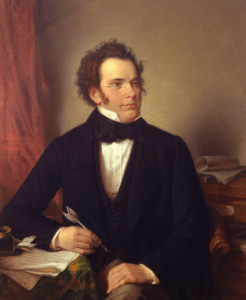
    I will return to Schubert (1797-1828) quite frequently I suspect in this column, as he ranks toward the top of my “favourites” If not actually planting his flag on the summit already.  Other contenders would of course be that legendary lion, Beethoven, carefully guarding the gates to a musical nirvana, with Mozart closely behind and Dvorak managing a spirited sprint towards the finish line. And with dear Franz who died at the frankly ridiculously early age of 31, we encounter, especially in his piano work, a soul-searching and maturity quite belying his few years on earth. It is funny (strange) how, if one survives long enough oneself, that likes and dislikes, passions even, come and go with the passing decade. For instance, when I first read Ernest Hemmingway’s “Across the River and into the Trees” in I guess what might have been my early twenties, I thought it immediately a masterpiece. Returning to it in my forties I considered it to be a cliché-ridden tract of an old man with nothing left to say. Now, as I exceed the age of the dying hero in this wonderful novel, I come back to hailing it as a much underrated masterpiece again. In other words, our own unique experiences in life mounds the way we respond to the world’s ability to wound us or transport us in the most unlikely ways. (Remember it was Hemmingway who said that one becomes strong in the broken places.) So it is with Schubert’s sublime sonatas and moments musicale. These seem to me to be the pinnacle of a genius who understands that ultimate sadness, and feeling of reluctant surrender to the enfolding arms of inescapable loss that we all experience as we trudge towards that inevitable darkness; the big sleep. At a later date, as I say, I will try and summarise my view of the great Schubert pianists, Radu Lupu, Sviatoslav Richter, Wilhelm Kempff, Imogen Cooper, Paul Lewis, Maurizio Pollini, Alfred Brendel, Murray Perahia , Mitsuko Uchida and many more dead and alive. No barrier to age or sex, each brings his or her individual talents to bear on Schubert’s timeless music.


    Franz Schubert

    So now to young (ish) David Fray, and I will discuss and address his two Schubert recordings which I note are about seven years apart (2008-2016). Fray approaches Franz with a deal of caution, which I feel to be only appropriate. Comparing Fray’s interpretations of say the moments musicale 1-6, with one of the piano’s grand masters, Wilhelm Kempff and his recordings stretching as far back as the 1960s, the timings between the two are completely different.  In each case, Fray is drastically slower, in one case up to nearly three minutes behind Kempff, and the longest of moments is only just over seven minutes! Now there are musicians in the past who have seemed to wilfully adopt much slower musical tempi than others (including often the composers themselves) such as Otto Klemperer for example. And it is true that other great conductors, and here I am thinking particularly of Toscanini, have set records in brevity.

    Thus, I am reminded what Sir Thomas Beecham quipped when questioned about the speed he adopted in a final concert piece, so saying “that’ll get the buggers home!” Sometimes speed can generate a direct emotional response in an audience, for example The legendary Hollywood Quartets’ version of Dvorak’s American Quartet, in my view the very best available. Something is clicking in my memory that Bernstein laid down a Mahler symphony where one movement doubled in acknowledged length in his hands.

    But I digress, back to Mr Fray. He clearly divides critical opinion. At a live recital at Wigmore Hall more than a dozen years ago the Guardian critic Andrew Clements wrote: Fray certainly looks the part: bent low over the keyboard as if intent on drawing something personal and highly wrought from the instrument. But the slackness of his playing and its strange discontinuities were far from convincing…..and a little later in summary:  Some fierce, almost brutal octaves in the finale of the Waldstein seemed surreally out of context, like a sudden fit of temper. Perhaps Fray was as disappointed with his performance as some of the audience. Hardly a ringing endorsement.  And here is Hugo Shirley in “The Gramophone”:  Fray’s approach is supremely seductive but it does occasionally sound as though he’s about to nod off… Well I would certainly not go that far but there is a tendency of his, in my view, to over-extend notes and chords to a point where some would find more than a hint of sentimentality emerging.

    However, if I have to deliver a verdict on his Schubert, I think it is masterly, imaginative and the occasionally extended time he takes strikes me as being entirely in concert with the music itself. This to the point that, when I returned to old favourites (as in the list above) some sounded frankly hurried and pedestrian. Although in relation to my own age, many would assume any vote from me would go to Kempff, in fact my own X rests firmly on David Fray’s forehead, surrounded by his beguiling Franz Listian locks.

    I shall be scouring the record label’s catalogues for upcoming new releases from Fray, whose talents at the keyboard stretch over many compositional centuries and musical styles. But I have a feeling that he is far from done with Schubert, and personally I can’t wait to hear his interpretation of the three final sublime works of Schubert’s genius, piano sonatas D958, 959 and 960.


    Paul Joyce is an internationally renowned director, painter, photographer and writer.


  • Dinesh Dhamija: Sunny Side Up

    Dinesh Dhamija


    Ten million Indian households stand to benefit from a new solar power project, announced this week.

    ‘PM Surya Ghar: Muft Bijli Yojana’ – which translates as ‘The PM’s Sun House: Free Electricity Scheme’ – will offer 300 units of electricity per month to households who install solar panels on their rooftops.

    Prime Minister Narendra Modi has pledged Rs 750 billion ($9 billion) to fund the plan, with subsidies going directly to people’s bank accounts. A National Online Portal will administer the scheme, as part of a drive to switch India from hydrocarbons to renewable power.

    Besides the environmental benefits, this move promises to reduce household power bills, increase their income and generate employment. These are all laudable ambitions and very much in line with Modi’s thinking over many years. He was an early pioneer of solar investment when Chief Minister in Gujarat, attracted millions of dollars to new facilities.

    As Prime Minister, he has continued to push for businesses and individuals to opt for solar energy where possible, with novel developments including lakes covered with solar panels, taking advantage of natural cooling properties, and sports stadiums powered by panels on their exteriors. The other great motivator for solar energy is security: both in supply and in geopolitical terms. While India imports 70% of its energy needs, the more that the country can be self-reliant, the better.

    As a leader of the Global South movement, India’s move towards energy independence is a great example. Indeed, as one of the hottest and sunniest countries in the world, it could eventually become an exporter of solar energy, rather than an importer of hydrocarbons. In the medium term, the government has set a target of 500GW of energy generation to come from non-carbon sources, including 450GW from wind and solar, by 2030. Just as the country is massively upgrading its roads, rail, ports and airports, a similar effort is underway to boost its energy infrastructure.

    I would argue that this is just as important, if not more so. You can’t grow an economy if you’re lacking power. And there remain plenty of regions of India where power cuts are a regular part of life. As India’s solar energy proponents might say: “the future’s sunny”.


    Dinesh Dhamija is a solar energy entrepreneur, with a major project in Romania. He founded, built and sold online travel agency ebookers.com, before serving as a Member of the European Parliament. Dinesh’s latest book, The Indian Century, has just been published.


  • Review: Harbour Hotel, Sidmouth: ‘a friendly, relaxing hotel’

    Christopher Jackson


    In early 2024, many parents looked at the calendar with a degree of confusion: the schools were going back on the 9th January, and not – as with the previous year – on the 2nd. The question of what to do with the children for that week, when they were beginning to get claustrophobic from Christmas reared up: it had to be answered one way or another.

    I had a plan up my sleeve. My children have begun to show an interest in fossils and I had read that the fossil-hunting reaches its zenith on the Jurassic Coast in the winter, especially in the aftermath of storms.

    Sidmouth, where the Harbour Hotel is based is an excellent location from which to explore: it is located at the end of a charming town dominated by a relaxing promenade with a sleepy Edwardian feel. It is probably the case that Covid-19 – with the humourlessness which characterised that particular disease – snookered many families into Larkinesque holidays they had mistakenly come to consider beneath them: Greece, Italy and the south of France were traded for Wales, the Lake District, and Cornwall.

    What seems subsequently to have happened is that many families found they disliked airports more than they had realised, and also that Larkin was a grouch who made England sound like a car park. In fact, although it has car parks it is also one of the most beautiful countries in the world. Many families now wonder why they should fly to an inferno in August and have begun to think of the risk of rain in England as being not only worth it, but a benediction of sorts.


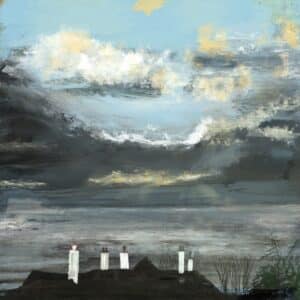
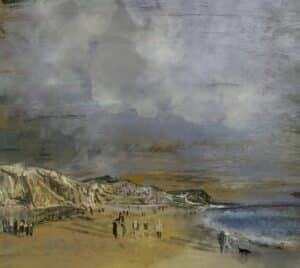
    Charmouth, 2024, iPad sketch by the author


    The Harbour Hotel chain is a good way in which to explore the entire southern coast. It has outposts at Guildford, Brighton, Chichester, and Southampton as well as a hotel in Bristol and three particularly lovely properties in Cornwall. The Sidmouth property is very beautiful: full of nautical decor, and nonchalant luxury.

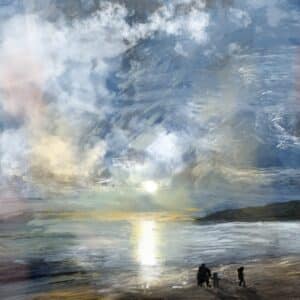
    Our room had a spacious balcony looking out onto the English channel. A few houses poke up towards the horizon, where the sky is continually producing masterpieces aimed at no one in particular: it can be a well-spent hour just to watch the clouds build an empire which they subsequently decide against. I found myself sketching the scene on my iPad throughout my stay, in a constant amazement at the loveliness of this part of the world.


    The view from Room 18, 2024, iPad sketch by the author

    We might think of January in England as a reasonably bitter destiny, but it has its austere beauties. Down at the excellent breakfast (pancakes and a fine full English) on our first morning, the sun kept bursting through the clouds, as if in the throes of its own private epiphanies. Sometimes it can be hard to distinguish sky from sea. In fact, you feel you’re being let in on the secrets of an interconnected system which London keeps from you.

    The beauty of the coastline can also be seen from the breakfast rooms: the first cliffs between Sidmouth and the little village delightfully named Beer recede beyond the High Street, which has an excellent ice cream shop called Taste and lots of boutiques. The Sidmouth coastline is beautiful in itself, but also recedes down towards the additional promise of Lyme Regis, Charmouth, Bridport, and Kimmeridge.

    It is all fossil territory. Apparently, due to a certain hidden toxicity about the waters, none of the creatures who died during the shift in climate following on from that famous asteroid impact some 65 million years ago have since been nibbled away at. As you look out to that glorious sea you are also considering a perfectly preserved time capsule. Sir David Attenborough is only the most famous person to be excited about this lucky anomaly: in fact, you don’t have to delve too much into the Jurassic coast to enter a welcoming community of fossil addicts and dinosaur lovers.

    To fossil-hunt here is to partake in a long story. As you drive down the coast from Sidmouth to Lyme Regis, you are heading in a sense towards the ghost of Mary Anning (1799-1847). Feted and famed, and even subject to the high contemporary accolade of a Little People, Big Dreams book, Anning became famous in the Victorian era due to her discovery of the first correctly identified ichthyosaur skeleton when she was a mere twelve years’ old. She subsequently went on to discover two nearly complete plesiosaur skeletons and the first pterosaur skeleton to be located outside Germany.


    Fossil-hunting, iPad sketch, 2024


    Throughout our first day, a storm raged around us – the sort that wants to take your umbrella with it – as we trudged submissively down to the museum. The museum which bears Anning’s name is also on the site of her house, and contains a treasure trove of fine fossils. It reminds you too of John Fowles’ long tenure in the area, as well as Jane Austen’s decision to locate the pivotal scene of Persuasion (1817) here. It is pointless to deny that the weather was adverse; but in this part of the world, a storm is also an opportunity because it whips up secrets which the sedate tides can’t: it’s possible to make remarkable finds in January on the Jurassic Coast.

    In Charmouth there is a little shop which is testament to this called The Forge Fossils. Run by Chris Moore, it is an unmissable place which we happened on the following day. Moore has recently been seen on television in that wonderful BBC documentary Attenborough and the Giant Sea Monster in his role as a local expert instrumental in extracting a giant skull of a pliosaur from the cliff-face at Kimmeridge. Pliosaurs were extraordinary beasts – the T-Rexes of the seas – who swam round this part of the world in a time when T-Rexes themselves stalked the land. They were devilishly smooth swimmers, and from what I can tell could have bitten a decent chunk out of a football stadium.

    Moore is friends with Attenborough – one lovely thing about the BBC documentary is to see Attenborough’s unfeigned joy at being in the fossil community. Moore’s is one of those enviable careers which are tied to a specific place; they are the chance necessities of a birthright. We saw Moore’s studio, and watched Moore himself examining his fossils, the rest of the world a happy irrelevance to someone as happy in his work as he so obviously is.

    Charmouth turns out to be an especially promising stretch of coastline, as there used to be a Victorian factory nearby, meaning that there is an unusual amount of seaglass to be found. Within half a mile or so, we found several necklaces worth, and lots of ammonites. To say that for a child an ammonite becomes a prized possession is to riot in understatement. I have often wondered at the way in which the simplest thing to a child – a leaf, a stone – immediately becomes treasure. My sense is that it’s the adults who can’t see the excitement in the apparently commonplace who are misguided.

    The cliffs are very beautiful indeed. Anyone who has seen the brilliant crime series Broadchurch which finished after three excellent seasons will know the warm yellows and umbers of the cliffs here (the series was filmed at nearby Bridport). They make even winter feel warm, and I found myself sketching these too.

    The Cliffs of Charmouth, by the author.


    The hotel was a good place to beat a retreat to after fossil-hunting. As I’ve found is the case in the Harbour Hotel chain generally, the service is reliably excellent and warm: these hotels are extremely comfortable but they eschew the sort of grandeur which leads to too much formality. In some hotels, there is the exhausting sense that one is paying to have to be on one’s best behaviour. The Harbour Hotel staff were never less than kind and understanding: from Callum the restaurant manager to Abby the receptionist, Rachel the housekeeping manager, and Jay and Heather in the restaurant. The food was also superb throughout: the chateaubriand comes particularly recommended.

    In time, we came to eye our departure date with a certain contempt, until we decided to extend our stay partly with a view to taking advantage of the indoor swimming pool area. There is an outdoor area too which must be a marvellous place for an afternoon of cocktails in summer.

    On our final day we decided that it would be worth going to see the famous pliosaur itself. This is housed in the Etches Collection down in Kimmeridge, founded by another star of the paleontology world Steve Etches. Etches is another down-to-earth character who has found his calling. We found him cheerfully sweeping the car park area outside his excellent museum. This is rather as if one were visiting Julia Roberts at Paramount Studios and found her doing some light dusting.


    Sundown, Charmouth


    The museum he has founded must be the envy of the Natural History Museum. On a screen above the fossils we see an almost eerie reproduction of the Jurassic seas, where a pliosaur might at any moment descend upon an ichthyosaur. The exhibit in the centre of the main room shows the complicated structures of the brain, and makes one wonder by what curious and secret processes it might have come to be at all.

    As you drive back to London, you can still hear the roar of the shingle and the surf for days afterwards. We had been among beauty and the mystery of evolution for what felt like far longer than a few days. Winter in the UK presents its challenges. It was Margaret Thatcher who said of Lord David Young: “Others bring me problems, David brings me solutions.” I might say the same of the Harbour Hotel.


    To visit the Harbour Hotel, Sidmouth go to: https://www.harbourhotels.co.uk/sidmouth

  • Yalla Yalla Restaurant Review: A Delightful Journey Through Lebanese Cuisine

    Yalla Yalla Review, by Ronel Lehmann


    The name of the restaurant means “Let’s go.” And go we did. In fact, I managed to go there twice. On the first occasion, we booked in Winsley Street, Fitzrovia.  Upon arrival, you could not help but notice the Lebanese art themed interior. We had stepped inside to a place full of character, lanterns and Middle East promise.


    The banquette seating was made more comfortable with decorative pillows and the table was suddenly full of small plates. It seems that we had ordered quickly. The sharing mezze platter for one, was really enough for two and we devoured hommos, baba ghanuj, tabbouleh, falafel, natural labné, cheese samboussek, warm flatbread and pickles. I ordered an additional plate of Falafel as they were delicious. The Menabrea Blonde beer mixed bitter, floral and fruity undertones with a malty, hoppy taste and was served ice cold. It was a perfect accompaniment to the Chicken Kofta grilled ground chicken, herbs, peppers, onion & spices which followed.


    There is something about sharing food which this restaurant encourages so well. At this point we felt quite full but remained eager to try the desserts. After a short interlude, we elected to order mango and vanilla cheesecake topped with a layer of sweet mango, pomegranate seeds and pistachio nuts and baklawa and fresh rose and mint infused tea. A second teacup was proffered without drama.


    Now we really didn’t want to go from the restaurant.

    Until that was a few weeks later when Dr Watson, messaged me to say that he was in London and would I have time to join him for a coffee. No this wasn’t Dr. Watson, the fictional English physician who is Sherlock Holmes’s devoted friend and associate in a series of detective stories and novels by Sir Arthur Conan Doyle.

    Arrangements were made, then postponed, throughout a busy day, until I dropped everything when I heard he was already ensconced in Yalla Yalla, Soho.

    “Let’s go” beckoned again, only to arrive in a much smaller version of the Fitzrovia restaurant with packed tables and to be told that Dr Watson and his friend, who had already eaten, had to vacate the table within ten minutes of my arrival. Not to be disheartened, I decided to order a similar menu to the above, whereas the manager graciously decided to move us to a table of three and afforded me the requisite time to eat my dinner. The beers arrived and then the cheesecake.

    I can honestly say, the second time was as good as the first. There is something about this Lebanese food and preparation which makes me really excited. Whenever I hear the words, Yalla Yalla, I want to go. If you haven’t, I really urge you to. Maybe I will join you.


  • India’s New Wave of IPOs

    Dinesh Dhamija


    From just $17 million raised by Indian IPOs in January 2023, this year they totalled $678 million – a 40-fold increase – according to a report in the Financial Times.

    A further 66 companies are expected to list in the coming months, as India’s Sensex stock index rose 20 per cent in the past 12 months and both domestic and international investors remain hungry for more. Standout companies proposing to list include Ola Electric and fintech group MobiKwik.

    What accounts for this huge increase? It’s partly the ongoing transfer from Chinese markets, as political tensions have risen, and a series of Chinese stocks have crashed – notably the property giant Evergrande. It’s partly a new approach among Indian businesses, to welcome outside investment and to recognise the advantages of listings. But it’s also the mood of growth and possibility in the Indian economy more generally.

    On 1 February, the government announced a new infrastructure investment programme totalling $134 billion to improve India’s railways, airports and road networks, up by 11 per cent on previous spending. Finance minister Nirmala Sitharaman said that the decision would “have a large multiplier impact on growth and investment.”

    This ability to trade more efficiently and quickly, through better transport links, is bound to have a knock-on effect on the wider business environment.

    India’s newfound love of mobile transactions has turned a new generation into potential stock investors, widening participation in the equity markets to 140 million trading accounts. And the sustained repetition of positive economic news about India has woken international fund managers to the country’s potential. Foreign investors bought $20 billion worth of Indian stocks in 2023, versus $8 billion worth of Chinese stocks. The economy as a whole is expected to grow by 7 per cent this year.

    Not everything is rosy. Fintech start-up Paytm, which listed with great fanfare in 2021, has struggled recently after the Reserve Bank of India forbade it from taking deposits and offering banking services. Its shares now trade at 70 per cent below the IPO price. Some experts fear that some Indian stocks are overvalued, after months of bullish markets.

    Doubtless there will be fluctuations and some IPOs will under-perform, but that’s true wherever you go.

    The longer-term story is that India is becoming an investable location, and its companies are rapidly learning what it means to operate in the global financial system. The outlook is overwhelmingly positive.


    Dinesh Dhamija founded, built and sold online travel agency ebookers, before serving as a Member of the European Parliament. His latest book, The Indian Century, is published in February.


  • A Tribute to a Great Career: Paul Joyce remembers Dennis Hopper

    British filmmaker, photographer and painter Paul Joyce first met Dennis Hopper in 1986 while making the documentary Out of the Blue and Into the Black. They became friends and remained so until Hopper’s death in May 2010. This article is Joyce’s personal tribute to Hopper. He shares numerous anecdotes, as well photographs he took of Hopper in his hometown of Venice, California. It is a poignant portrayal of a pioneering Hollywood rebel with a cause who will be remembered as one of the greatest screen icons of our time.

    It was different working in British television back in 1986. They thrust money in your purse and sent you around the world, and even threw in film crews. At that time Jeremy Isaacs (who, as well as setting up Channel 4, acted as godfather to me and my company Lucida Productions) heard me talking about the unique LA based independent production company BBS and how important it was as a trailblazer in the US indie cinema sector (remember that Jeremy had recently incorporated C4 in order to undertake just such a transformation of the UK independent television sector). My business partner at that time, Chris Rodley, fortunately knew one of the key players in the game, Dennis himself, from a previous encounter when he had set up a London screening of The Last Movie. Before we knew it, we were bundled onto a 747 and told to come back with two “riveting” hours of primetime television. What an extraordinary thing that seems now, in an age when the arts documentary has difficulty getting arrested, let alone financed or even (God help us) aired.

    It is curious that BBS was little known then, as indeed it still is now, even though its activities had placed a small but significant time-bomb into Hollywood’s very foundations. Bert Schneider, a legendary producer whose father worked for Columbia, set up BBS and would stamp his indelible mark on Hollywood with a handful of great pictures – Five Easy Pieces (1970), The Last Picture Show (1971), The King of Marvin Gardens (1972), etc. But before BBS emerged (the initials standing for Schneider, director Bob Rafelson and artist’s manager Steve Blauner) came a couple of runaway successful pictures that helped finance the whole operation. One was Head (1968), starring pop phenomenon The Monkees and the other, Easy Rider (1969), which announced the arrival of a very special talent indeed, director Dennis Hopper.

    In order to tell the complete BBS story, we intended to confront the prime progenitor of this tremendous run of American cinema. The problem was, at the very moment our plane began its descent into LAX, Dennis Hopper was being carted off to a clinic with a suspected overdose, the result of severe alcohol and substance abuse. Oh dear, what to tell Jeremy Isaacs back home? Well maybe best to keep schtum. Get on with something else. Perhaps our man may even recover?

    And here Bert Schneider came to the rescue – as he did on a number of occasions in Hopper’s life and career – by visiting Dennis in hospital at his lowest ebb, by gently cajoling and encouraging him to try driving again, going out again, using a camera again. This act of friendship carried Dennis through his worst moments and helped him to emerge, seemingly unscarred, three weeks later into our open, camera extended arms.

    During the three weeks or so that we were waiting for Dennis to recover, I shot more film in a short month than I have before or since. Apart from laying down the two hours of the BBS story (Out of the Blue and into the Black), I did a 90-minute film on Monte Hellman (Plunging on Alone) another on Peter Bogdanovich (Pieces of Time) and ultimately a final one on Dennis himself (Some Kind of Genius). So we were by no means just lounging around hotel pools, as some of the early C4 commissions chose to spend their time, and money, without on occasion even completing the film they were charged to deliver!
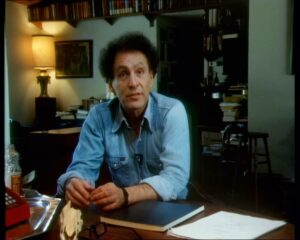
    Monte Hellman, interviewed in Out of the Blue and Into the Black.
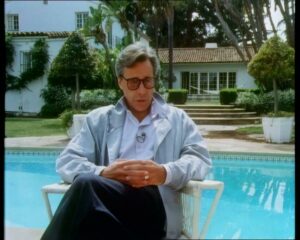


    Peter Bogdanovich, interviewed in Out of the Blue and Into the Black.

    When we finally got the call to say we could now visit, it was with great trepidation that we approached Dennis’ house in Venice, a suburb of LA. But his chosen retreat on Indiana Avenue was not located in the top end of town by any means, but in the decidedly ‘wrong side of the tracks’ area, in what seemed to be a large galvanised shed surrounded by abandoned cars and shopping trolleys. It was here that Dennis would spend over thirty years hunkering down and gradually increasing the perimeter’s fortifications, rather like John Wayne might have done with his garrison in Fort Apache. And I can assure you the natives here were quite as unfriendly as John Ford’s.

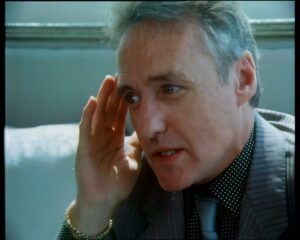
    Gingerly, Chris Rodley edged forward to the door as we hung around the unit vehicles, nervously puffing on Marlboro Lights (as everyone did then). After fiddling with the entry-phone, which was still faulty on every occasion I visited, which must have been thirty times over as many years, Chris disappeared shortly to be followed by his beckoning finger poked round the door indicating it was “all OK”, a signal agreed in advance. In we piled to find a suntanned and very fit looking Dennis, neatly coiffured and dressed like an enormously wealthy investment banker or hedge fund manager: dark grey silk suit with discreet stripes, matching tie and a dark shirt with tiny white polka dots. Clearly master of the situation and the soul of hospitality, he was “off” everything but cigarettes, which he chain-smoked whilst we were there, using the 100mm-sized white tubes as batons to reinforce points during the filmed interviews (he gave up cigarettes shortly after this, and stayed clean until in the last decade of his life when he developed a penchant for Havana cigars).
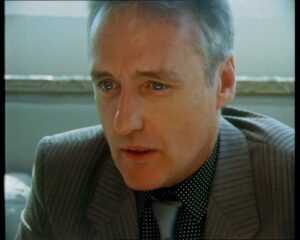
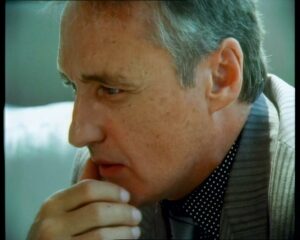
    Dennis Hopper, interviewed in Out of the Blue and Into the Black.

    But first thing’s first…

    Dennis Hopper was born in Dodge City Kansas in 1936 and trained in classic theatre at The Old Globe Theatre in San Diego, before moving to New York to study with Lee Strasberg at The Actor’s Studio. It was at this time that he met James Dean, and they immediately became friends. Dennis not only idolised Dean, he also learnt a huge amount from him, including lessons in acting that would remain within him forever. For example, Dean advised him, when approaching a particular scene, to simply perform an action without contemplating it in advance. “Don’t act drinking from a cup,” Dean said, “just take the drink!” Dennis was convinced that Dean’s ability to perform on-screen action, containing himself when he had to and then exploding into movement, came from his hard work in basic training as a dancer. It gave him a balletic quality that Dennis greatly admired, but was unable fully to emulate. Dean and Dennis worked on two pictures together, Rebel Without a Cause (1955) for Nicholas Ray, and Giant (1956) for George Stevens, the latter of which was merely two weeks away from the end of the shoot when Dean died. From talking with Dennis over the years, it was clear that he would continue to feel the loss of this developing friendship for the rest of his life, and in a sense would never quite recover from this premature bereavement. Dean was the reason Dennis took screen acting so seriously, Dean was why he picked up a stills camera, and Dean it was who also turned him towards the career which would obsess him for the next half century – directing films.

    A few minor television roles led to an offer from Hollywood for Dennis to star in a western to be directed by notorious actor-killer Henry Hathaway. Hathaway was regarded by many as the epitome of the cigar-chomping, whip-cracking old-style director who intimidated actors, particularly inexperienced ones, and this was to be Dennis’ ordeal by fire. The film was a western, From Hell to Texas (1958) and hell indeed it proved to be. The scene was simple, a few lines only, and Hathaway gave Dennis explicit directions as to the gestures and line reading. They began at 8am in the morning and by 6pm Hathaway had rejected 85 takes and Dennis was reduced to a tearful jelly. In the meantime, both the head of Universal and Jack Warner himself had called Hopper saying, “Hey, kid, what are you doing, this is Hathaway you are fucking with here!” Halfway through this farrago, Hathaway took Dennis aside and gestured to the corner of the set. “What are those?” he demanded. “Why,” Dennis replied, “they are film cans.” “That’s right, kid” responded Hathaway, “and I own 40 per cent of this studio and we’ve got enough film to shoot here for months if we need to!” Finally, on take 86 Hopper capitulated and completed the scene as Hathaway had demanded nine hours before. As he stumbled away from the set that day, Dennis also left the business (or rather the business left him) for the rest of that decade.

    Eight years later – with a rapid fade-out followed by an extremely slow fade-in – Hopper is considering 100 different ways of disposing of Hathaway when he takes a call from the man himself. No announcement or even a “How are you?” just, “Hey kid, do you want to be in my next picture?” Apparently, John Wayne (The Duke) and Hathaway have taken pity on Dennis because he is now married to Margaret Sullivan’s daughter Brooke Hayward, who in turn has produced a daughter of their own, Marin Hopper, and the old stagers want to give Dennis a chance to re-enter the ranks of the Hollywood blessed. According to Dennis, he is offered exactly the same part – the weakling son of a crooked father – with the same lines, motivations, western location, everything. So in front of The Duke, Hal Wallis and a line-up of the studio dignitaries on the set of The Sons of Katie Elder (1965), Dennis takes Hathaway’s instructions and line readings to the letter, and delivers the dialogue as instructed in a single take. Hathaway calls “Cut!” and goes to embrace Dennis with tears in his eyes. “That was great, kid, just great!” Dennis looks up at him and says, “You see Mr Hathaway, I’m a much better actor now.” Hathaway drags the cigar out of his mouth and says, “You’re not better kid, you’re just smarter, you’re just smarter.”

    CHATEAU HOLLYWOOD


    Although we had tucked ourselves into what was to become Lucida’s LA outpost for over a quarter of a century, “The Magic Motel” in West Hollywood, we spent a good deal of time at the infamous Chateau Marmont. I had known it since 1978 when I stayed there with my actor friend David Warner (in Hollywood to make Time after Time (1979)), at one of the bungalows around the pool; come to think of it I do believe it was the same one that John Belushi expired in, in 1982. It was a place redolent with history. Looking up at the illuminated façade from outside at night, you fully expected to see the ghost of Jim Morrison hanging precariously from the roof as he tried to swing himself through his bedroom window (God knows why) thereby using up, as he later said, ”one of my eight lives”. And was that Howard Hughes, light gleaming for a moment on his binoculars, as he peered at the girls in the pool from his attic apartment? I did actually see a real-life Leonard Cohen relaxing under a huge sunhat in the garden, but although not an everyday occurrence, such a sight was by no means unusual.

    During the time of Dennis’ 1986 hospitalisation, our film crew were not merely hanging around the Chateau, we were also busy interviewing the victims and benefactors of Dennis’ notorious approach to creativity. We especially wanted to illuminate the time between Easy Rider and the incorporation of BBS, and one who could help us was granite-jawed top studio boss Ned Tanen, then President of Universal Pictures, who had to deal with Hopper in the aftermath of his huge initial success.
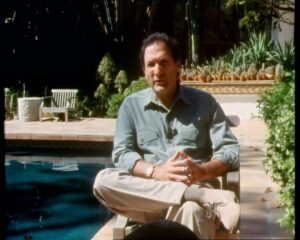
    Ned Tanen, interviewed in Out of the Blue and Into the Black.

    By the time we spoke to him, Ned had been poached to do the same job by Paramount Pictures, so we met him on the famous Paramount lot in an executive bungalow kitted out in Native American and Mexican artefacts. Ned was a no-nonsense guy, but even he was confounded by Hopper’s next project after Easy Rider. The film The Last Movie is about how western “culture” can corrupt a primitive culture almost in a single encounter. It is based on a wonderful premise: when a Hollywood production company shooting in a primitive area (in this case Peru) moves on, the natives continue to make their own “pretend” movie with bamboo cameras and wooden props. The twist is that instead of using blanks for their gun battles, as the film company did, they use real ammunition. The problem for Ned Tanen was that Dennis had been introduced to the films of the nouvelle vague, whose philosophies of film-making were not exactly compatible with Hollywood.

    Tanen found himself commuting between Hollywood and Peru during the shoot, and then on to Taos New Mexico for the editing; both stages were fraught with danger and despair. “People in the crew flew down there, went into the jungles, and simply never came back!” Tanen told us. A mad cocktail of drink, drugs and willing native women overwhelmed many, with Dennis acting as a stoned ringmaster pulling all the strings, but mostly tangling them into a giant Gordian knot. Tanen remembers a visit when he literally encountered a genuine Taos orgy. Not a man to be shocked easily, Ned was aghast, “There were thrusting buttocks and tits everywhere, it was like a cut scene from Caligula but for real!” In a hopeless attempt to conduct the business he had come for, he managed to locate Dennis’ writhing body and lightly tapped him on the shoulder, ”So sorry to interrupt, but may I have a quick word with you about how the edit is coming on?”

    As had happened with Easy Rider, the first edit – a four-hour cut which Dennis refused to trim down – nearly derailed the whole project. Ned’s frequent, if mainly abortive visits to Taos were punctuated by trips to the fleapit cinema that Dennis had set up for the locals. But attempts to introduce films like Jean-Luc Godard’s Les Carabiniers (1963) to them only resulted in a multi-coloured decoration of local fruit and vegetables being hurled at the screen.

    When The Last Movie was finally given a strictly limited US release, this near-impenetrable stream-of-consciousness piece of avant-garde cinema left much of the small audience who bothered to see it confused. This seeming farrago effectively buried Dennis’ directorial career for the rest of his life. But here we are getting ahead of ourselves again, so let us return to the mid-1960s, when youthful enthusiasm and simple pleasures first drove the likes of Hopper, Peter Fonda, Henry Jaglom and Peter Bogdanovitch towards the cinema, and all the promises it seemed to hold for them.

    BREAKING IN


    At that time, Roger Corman – the king of low-budget exploitation movies – had established a market for biker flicks with The Wild Angels (1966) and Devil’s Angels (1967) and hoped to produce Easy Rider with the backing of cigar-chomping lawyer Sam Arkoff. One day Dennis took a call from friend Peter Fonda who was at a film festival in Canada (they had previously agreed never to do another biking picture fearing they would end up branded as latter-day Roy Rogers and Gabby Hayes). Fonda said he was in a meeting with Arkoff and he had pitched him a story “It’s about a couple of dirt bikers who make money in a drug deal in Mexico, buy two new gleaming bikes, head to New Orleans and get stoned, then get shot by a couple of duck hunters. He said you could direct and I can star! What do you think Dennis?” Dennis replied, “Are you sure Arkoff said he has the money?” “Oh yes,” comes back Fonda “he said he’d give us the money alright”. “Well” retorted Dennis “I think it’s a great story!”

    Shortly after at a meeting with Fonda, Corman and Dennis, Arkoff became concerned by the explicit language Dennis was using, and demanded a clause in the contract stating that Dennis could be replaced as director if he fell behind schedule. Hopper’s explosive “Fuck you!” could be heard all over Burbank. Shortly after this abortive meeting, Jack Nicholson moved the whole project to Columbia Pictures. In return for packaging and promoting the project, he took the role of George Hanson, which turned him into a star overnight – a part the unlucky Bruce Dern had previously been earmarked to play.

    At this stage of his career Dennis was basically uncontrollable. He made enemies left, right and centre and cared not a jot about it. For instance, he found himself sitting next to George Cukor, director of The Philadelphia Story (1940) and A Star is Born (1954), at a Hollywood dinner. In horror, fellow guest Peter Bogdanovitch heard him say to Cukor, “You’re old Hollywood and we are going to bury you!”

    The way that Easy Rider was made and finally completed is a tribute to producer Bert Schneider’s ability to hold together a potentially disintegrating project. Drink and drugs fuelled the production with a great deal of testosterone added to the mix. The shoot began with an infamous trip to the Mardi Gras in New Orleans, with Dennis, by all accounts, behaving like Orson Welles on speed – the unit returned with about 20 hours of incomprehensible 16mm footage. Again, it was Bert who had to drag the two antagonists, Dennis and Peter Fonda (who played the lead, Captain America) apart, thereby preventing mutual emasculation.

    Weeks of production activity on the road covered the full gamut of fist fights, orgies, drug binges, drink and rock and roll! After the New Orleans Mardi Gras, Fonda and Dennis’ brother-in-law, Mike Hayward, returned to LA with a stack of on-set tape recordings of Hopper ranting, determined to have him fired from the picture. On one of these tapes, he was heard demanding to know why a particular lighting rig was not in evidence on set. ”Red, blue and green lights making a white light goddamn it!” Schneider conceded that Dennis sounded “a little agitated”, then added, “but if he had asked for a certain red-blue light in advance, and it was not there, then surely he had cause to be upset, didn’t he?” Such a sympathetic view, in the guise of an unanswerable question, was why Schneider was widely regarded as “The Last Tycoon” of his generation.

    According to Henry Jaglom, a fellow veteran of the independent film sector, Easy Rider was shown in its five hour and twenty-minute version to an eminent French film critic who exclaimed, “It’s a masterpiece, don’t cut a single frame!”, which Dennis adopted as his own mantra. Enter Schneider, from camera left, to the rescue once more, setting Jaglom at work at one end of the cut, with Jack Nicholson editing at the other end until they met somewhere in the middle. Dennis always maintained that he was personally responsible for the edit, but my pretty strong guess is that Nicholson and Jaglom helped him a lot, and he ultimately approved their work. Dennis also said, well after the event, that he had intended to win the top award at Cannes, but the fact remains that the Palme d’Or going to Easy Rider was a great surprise, and it heralded a new era of bold, uncompromising truly independent cinema.

    Steve Blauner then took up the story for our programme; he was helping with the advertising and distribution of the film. Bert Schneider’s father was still a senior executive at Columbia Pictures, so he was able to get the film opened at the Beekman Theatre on East Side, New York City rather than at the drive-in market for which it was originally destined. Then something very strange happened, according to Blauner, “That grapevine thing which, if anyone could predict, would make us kings of show business – word just got around before the opening and there were queues around the block, they were sitting in the aisles, hanging from the rafters, it was pandemonium.” Before long the cinema manager had to unscrew the toilet doors to stop the pre-screening pot smoking.

    The massive success of Easy Rider, followed by the equally gargantuan failure of The Last Movie, established a pattern, one that would weave its way, like a poisonous serpent, through Dennis’ subsequent career. After Easy Rider Dennis could have worked with anyone in the world – his acting hero Marlon Brando, for instance – but instead he chose to fire Ben Johnson from the male lead in The Last Movie (an Academy Award winning actor who had once been part of John Ford’s stock company) and put himself in the role. Then he buried himself in the Peruvian jungle for eighteen months.

    Even in the context of the drug-fuelled culture of the late 1960s, his behaviour does seem perverse. Rather than being hailed as an artistic statement in the guise of an unconventional western, the ravaged film that finally emerged as The Last Movie was viewed as a vomitus assault on key Hollywood shibboleths. Dennis thereby rendered himself unemployable as a director to any major studio for the rest of his life.

    MID-CAREER FRUSTRATIONS

    It would be a full decade after shooting The Last Movie before Dennis had an opportunity to get behind a camera again. Made independently on a small budget, Out of the Blue (1980) is a punk-inspired, relentless and hopelessly bleak examination of a dysfunctional family whose father, played by Dennis, wipes out a bus full of school children while driving drunk. The film’s descent of family life into alcoholism and sexual abuse is about as bleak an account of middle America as one could imagine. It’s a brilliant film, but one of such mind-numbing nihilism that paracetamol makes a more suitable foyer-seller at its screenings than popcorn. However, Dennis’ power as an actor and authority as a director was widely acknowledged and the film helped reinforce his reputation as a vastly underrated directorial talent, particularly amongst the European film critics.

    Eight years would unwind before Dennis was again able to direct. Colors (1988) was made for Orion, then a major Hollywood player. He had actors Robert Duvall and Sean Penn at his disposal, and a story of drug-dealing and corrupt police, which he transposed from its original setting of Chicago to his very own doorstep, the downtown ghettos of LA. Although this film had some success commercially and even better critical acclaim, it demonstrated Dennis’ attraction to subjects many in the business would describe as “murky”. In this regard he was his own worst enemy. He was unable or unwilling to compromise. Between 1988 and 2000 there would only be three more director credits for him and all were low-budget, low-life thrillers: Catchfire (1990) – re-edited so damagingly Dennis had it credited the infamous pseudonym “Alan Smithee” – The Hot Spot (1990) and Chasers (1994). The meagreness of this body of work was a matter of great regret to Dennis. In a sense, his mischievous persona, used to such advantage by others in the films he made as an actor, sapped his time and energy. He needed a Bert Schneider there to advise and guide him, but when Bert retired from the business as he always said he would at the age of 50, after completing Terence Mallick’s Days of Heaven in 1978, he lost that elder brother figure he so desperately needed to continue with truly creative work.
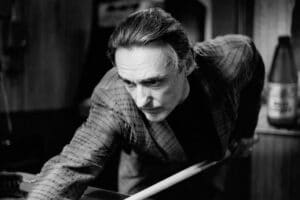
    Paul Joyce. Dennis Hopper, 1986, gelatin silver print.

    The acting role with which, of course, he will always be most identified is Frank Booth, the psychotic gangster in David Lynch’s Blue Velvet (1986). Famously, he pestered Lynch for the role repeatedly saying, “There is no problem for me in playing him, because I am Frank Booth!” Having already carved a niche for himself (in acting terms) as a serial abuser, pornographer, drug user and child maltreater, given to outbursts of contumely at any turn, Dennis delivered his star turn for Lynch. Who can forget his explosive, “Baby wants to fuck, baby wants to fuck Blue Velvet!” But even in this riveting performance as one of the screen’s most unlikeable heavies, Dennis found terrible humour, blacker than the night, in the worst of situations. It was this quality that other filmmakers turned to Dennis to supply, for instance in Speed (1994) and Waterworld (1995). In each case Dennis’ arrival served to boost a story when it was flagging, thereby dividing the audiences’ affections between himself and either the wooden Keanu Reeves, or the preoccupied Kevin Costner. In these films Dennis delivered the best performance on view.

    His other memorable appearances included the crazed photojournalist in Francis Coppola’s Apocalypse Now (1979); an alcoholic father, again for Francis in Rumble Fish (1983); another alcoholic, this time a basketball star well past his sell-by date in Hoosiers (1986) – for which he received an Academy Award nomination – and a memorable scene-stealer opposite Christopher Walken in Tony Scott’s True Romance (1993). His screen performances totalled over 200, against just eight shots as a director. One wonders if his was dissipated in this constant scrambling up a greasy financial pole erected in the cause of alimony and art purchases.

    In the midst of continuing professional crises regarding his directing ambitions, his private life seemed to be weaving an almost parallel course. In 1961 he married Brooke Hayward, the aforementioned daughter of Margaret Sullivan and the infamous Hollywood agent Leland Hayward, a union which lasted eight years. During this time, he began to collect art, almost exclusively American contemporary. He was one of the first people to purchase a Campbell’s soup can by Andy Warhol, for the princely sum of $75. Against a total outlay of just $28,000 he amassed works by Jasper Johns, Roy Lichtenstein and further pieces by Warhol, whom Dennis came to know personally. As part of his divorce settlement with Hayward, he was forced to give up his collection, which she sold for three-quarters of a million dollars (equivalent to over $50 million today). Dennis had to begin collecting again from scratch. He lost his second collection to another former wife, and now his third and final one is the subject of bitter dispute amongst family members even as I write.

    At the height of his alcohol and drug abuses, Dennis married Michelle Phillips of The Mamas and Papas, a union which lasted exactly one week (he is reputed to have said “The first six days were great”). She accused him of “unreasonable sexual demands”. Then came a string of dancers, singers, and singer-dancers ending with Victoria Duffy, who was allegedly recently spotted (while Dennis was in hospital receiving chemotherapy) slipping out of the family house with various pieces of contemporary art. Dennis’ attempt to place a restraining order on her preventing her from coming within ten feet of him was apparently ongoing at the time of his death. Sadly, his final appearances looking like a frail King Lear was probably a role he was actually close to playing in his own disrupted household.

    The work Dennis achieved as a photographer and artist has, in my view, been disgracefully overlooked, especially in Britain. However, in a typically perverse Hopper-type finale, The Hermitage in St. Petersberg gave him a one-man show in 2008. Some of the work there had been on show in LA. Dean Tavoularis (Oscar-winning Production Designer on most of Francis Coppola’s major pictures) and I made a point of dropping by the Ace Gallery on Wilshire Boulevard on a typical day, with only a few spectators present. The most shocking pieces were the enormous monochrome canvasses, some as large as 10’ x 20’, literally eating up vast walls. Knowing Dennis’s photographic work quite well, we realised that they were painted representations from 35mm frames, enlarged vastly and painted on canvas.

    Dean and I looked at each other in disbelief. The scant catalogue and information on the walls seemed to indicate that Dennis had painted them himself. Dean exclaimed, “Dennis would never have had the time or patience to paint all these!” Anyone who knew him well would have known this immediately. So how had the work been achieved? By nosing around the gallery and putting two and two together, it became clear that Dennis had employed other artists to work under his guidance. And who were these artists? Why, those painters of Hollywood signs, like the good old Marlboro Man who used to nestle alongside the Chateau Marmont on Sunset in the 1970s and 80s. Long since made redundant by laser and computer technology, these skilled craftsmen were employed because of their ability to project an image onto an enormous canvas whilst keeping perspective and proportions under control.

    What a great idea, we thought, but rather than trying to hide the work’s gestation, why didn’t Dennis use it as a way to make a virtue out of the concept, and to integrate these pieces, basically of poster art, within the tradition he was celebrating? By so doing, he would surely have appealed to a wider public, and why he didn’t explain the concept and execution of this unique new work more explicitly remains a mystery for Dean and myself to this day. So we left, shrugging our shoulders and muttering, “Well that’s Dennis for you, I guess.”

    Dennis’ involvement in the art world included strong friendships with David Hockney and Andy Warhol, amongst others, and occasional bizarre events such as the incident in a field in Houston, Texas in 1983. Dennis had been to an opening of Out of The Blue and had announced that he wanted to blow himself up. As he started to wave sticks of dynamite around – I can only assume he meant it to be an “art happening” – city officials bundled him into a car and drove him to a field well outside the city’s limits and its fire regulations. Here, with the help of a stunt co-ordinator and various assistants, Dennis entered a flimsy-looking cardboard structure covered in foil to sit himself on a “Russian Dynamite Death Chair” placed over six sticks of dynamite. There was an agonising pause while he failed to ignite three matches. Then a tremendous explosion occurred, followed by plumes of white smoke, through which Dennis emerged unscathed apart from damage to his eardrums. “Wow, man.” He was heard to mutter, “That’s worse than being hit by Mohammad Ali!” His theory was – and who can now dispute it – that the force of the explosion would be outwards, away from him, and the flimsy plywood structure would insure an even dissolution of the shock waves. Well, I guess he proved his point but he couldn’t hear properly for three months, and as far as I know, the event was never included in his canon of art works (although it can be seen in grainy 8mm on YouTube).

    This event occurred not long after reports circulated of Dennis being found wandering in a Mexican jungle, on location for a German film called Euer Weg Führt durch die Hölle — released as Jungle Fever – stark naked, and apparently trying to raise an army for the Third World War. He was detained by local police, declaring himself to be a “prisoner of war” and giving no personal details beyond his social security number. A period of detoxification followed.
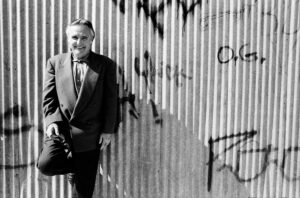
    Paul Joyce. Dennis Hopper, outside “the bunker home”, 1989 – 1990, gelatin silver print.

    VISITING DENNIS


    In the mid-nineties I was collaborating on a book with David Hockney (Hockney on Art, Little, Brown, 2000) and we drove from David’s studio just off Mullholland Drive, down to the coast to Venice for dinner with Dennis, accompanied by Hockney’s two Dachshunds propped up in the back seat. In the meantime, that corrugated fortress of a house, designed now with even more jagged extensions by Frank Gehry, was once more packed full of contemporary art, much of it vast in scale. As the living quarters resembled an aircraft hangar with steel girders and tubular walkways running all around us, this new-ish collection fitted the décor like a glove. There were works by David Sale, Julian Schnabel, Jean-Michel Basquiat, Keith Haring, and an installation by Jenny Holzer which consisted of a running statement in racing neon lights, like illuminated newsflashes in Times Square, reading, “You are so complex, you don’t respond to danger”, or something along these lines. Dinner was great; various personal assistants drifted around and about us, and I really can’t remember which if any current wife was in evidence. Come to think of it they weren’t usually at dinner, which demanded more mental than physical agility of Dennis and his guests. We had a wide-ranging conversation, mainly on art-related subjects, with a few scurrilous stories (decidedly not for publication) about friends and especially rivals. Dennis and David loved gossip, so we had lots of that.
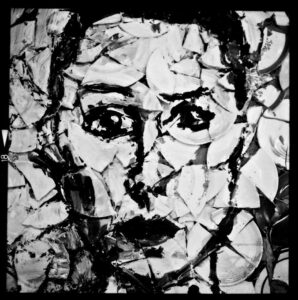
    Paul Joyce. Photograph of Julian Schnabel’s painting of Katherine LaNasa, Hopper’s wife.

    During the meal I noticed what seemed like a portrait of Dennis hanging inconspicuously on the kitchen wall, half hidden by a cupboard. It appeared to be comprised of shattered shards of porcelain. I asked Dennis what it was and who had done it? “Julian Schnabel,” came his reply, “He made it out of the broken crockery on the kitchen floor which my wife threw at me the other day!”

    During dinner we had left David’s dogs downstairs in Dennis’ pride and joy, a newly equipped screening room. On the floor between audience seating and screen was an enormous carpet, consisting of a heavily piled, one-piece, dead-white expanse of alpacka. Perhaps you have by now guessed that during dinner one of the dear little creatures had delivered an enormous dump right in the middle of this priceless virgin white field. As we descended to take our leave, David was suitably horrified, gazing around wildly for some kind of solution: of course there was none, for this was an irreparably stained, once expensive but now decidedly ex-carpet. Dennis, without blinking, continued to show us to the door without even acknowledging the disaster, a gracious and immaculate host till the end. We stumbled out, and as David shooed the yelping offenders into the back of the car, turned to me and said mournfully, “Oh dear, do you think this marks the demise of my social life in Hollywood?”

    FRIENDSHIP

    If Dennis liked you, you were a friend for life. Fortunately, he seemed to like me, as well as my work. For 20 years of us knowing each other, however, he was unaware that I was a painter as well as a photographer and filmmaker (three pillars of our lives which we had in common). During my two or three trips to LA every year, I had been working on paintings of vernacular architecture: diners, motels, “Randy’s Donuts” and the like. Three years ago, I called Dennis and asked if he would like to see them and within an hour he had driven from Venice to my studio in North Hollywood in his Jaguar XJ, Havana cigar in hand. He came in and looked at the paintings for 20 minutes without saying a word. Finally, he said, “You never told me you were a painter”. I wasn’t sure how to reply to this, (“Well you never asked?”) but he hurried on, “They’re great, you should have a show, would you like to have a show here?” Within 48 hours he had introduced me to a top Santa Monica Gallery (Track 16 at Bergamot Station), a show was arranged and he had agreed to personally curate it. That’s the kind of friend Dennis was.

    Paul Joyce. Dennis Hopper, Venice, California, 1986, gelatin silver print.

    So how will history judge this outrider of the avant-garde, our gritty long-haired symbol of simpler times, roaring down highways and lonely deserts, both real and imagined? I would guess that he’ll take his rightful place in the pantheon of late 20th century American auteurs. Floating on the water of memory, long after his dust has settled, will remain a handful of great acting performances, some wonderful films as a director, three or four incredible art collections dissembled by disputing legatees, many loyal and devoted friends, the respect of his luckier colleagues and an unmatched body of work as a photographer.

    My first reaction, after the initial shock of hearing of his death 14 years ago was to feel the irony that it was the old Hollywood he notoriously wanted to bury who ended up burying him. But Dennis, who came to love Hollywood old and new, had the last laugh. He is no longer with those vacillating Beverly Hillsians, for he took his bones to Taos, New Mexico. Spiritual (and physical) home to DH Lawrence, Ansel Adams, and Georgia O’Keefe, what better place is there for an artist to lay himself down? Rest easy, dear rider, for those who love you will surely be visiting again with you one day.
     

    End sequence of Out of the Blue and Into the Black.

    Paul Joyce is a filmmaker, photographer, artist and writer. He is the great-grand-nephew of James Joyce. Dennis Hopper appeared in a total of seven Lucida Productions (the production house set up by Paul Joyce) to the point that he was thought of as the company mascot:

    Some Kind of Genius (1986)
    Out of The Blue and into the Black (two parts) (1986)
    Motion and Emotion: the Films of Wim Wenders (1989)
    Pilgrim: The Life and Work of Kris Kristofferson (1992)
    Dark and Deadly: Hollywood and Film Noir (1994)
    Marlon Brando: Wild One (1996)
    Mantrap: Sam Peckinpah and ‘Straw Dogs’ (2003)