Category: Features

  • Friday poem: ‘Plan of Attack’ by Jude A. Jung

    Plan of Attack


    Best in these short days, where silence is,

    and darkness lasts, to create little beginnings,

    like the rustle of the mouse in the hedges.

    Winter requires circumspection: small songs

    can give immense colour to what has none.

    Your masterpiece, that might be for spring:

    to sketch it now is better than a fast intention

    begun bleakly, which will reek of your rushing,

    and have a sort of odour of winter’s despair,

    a too rapid response to the exhaustion

    which happens when the light isn’t here.

    An auspicious day is coming soon.

    Patience, then. Stretch the canvas, don’t mark it.

    Be alert. This is the world about to undarken.

  • Roger Bootle on AI interviews – and why he prefers interviewing in person

    Roger Bootle


    The whole question of AI interviews is a bit like warfare really. Every technological advance on the side of offence is met by technological advance on the side of defence. Similarly, there are now algorithms that prepare candidates how to approach AI interviews.

    I suppose in the early stages of the interview process there is something to be said for going down this route, although I must say it is completely against my own instinct. When I was actively running Capital Economics a lot of my time was taken up interviewing people which was one of the most important jobs that a CEO like me could do in a small firm to make sure that the people were really good. In those days, I was aware that what I was looking for wasn’t necessarily straightforward so I would have loathed giving up that initial sifting to AI. For a start you get a bunch of paper CVs in and I could tell very quickly whether a person was plausible or not.  I could sift very quickly. When you come to the next stage, and you have got rid of all the implausible applications, you certainly wouldn’t want an AI algorithm at that stage.

    Really it goes back to this whole question of being human: although a lot of people will resist this, particularly in small organisations, hirers will be very motivated by whether they think they can get on with this or that person. This is especially important in a small outfit, though I accept things might be different for a bigger company. If you are working at close quarters in a small company and you really don’t like a person, that’s an important negative. How is your algorithm going to pick that up?

    It’s quite possible therefore that AI interviews will never really take hold for smaller companies. Whereas with those big companies, where there are hundreds if not thousands of applicants, that basic stage could be very time-consuming so employers might find it efficient to get AI to tackle that. You might miss the occasional good person and let through the occasional duffer but you can sort that out later. In a small company, this sort of thing matters so much more.

    For reasons I won’t go into, I happen to own a pet shop and dog grooming salon. It’s a niche business, and so it’s very difficult to recruit staff. We happened to need a new manager,  and we advertised for the role. The manager is critical – a good manager will take the burden off me and make the business thrive. It was 2020, and I happened to be in France and I conducted the interview by Zoom. I rejected the candidate who everybody else thought was the best of the bunch, and hired someone over Zoom who turned out to be a disaster. Zoom obviously isn’t AI, but it is similar in that I didn’t have the sort of human contact that I would normally have in an interview process of meeting someone in person.

    In a similar vein, there is also a fair amount in my book The AI Economy about education. Some AI enthusiasts say that there aren’t going to be any teachers any more because people can learn remotely from various programmes and so forth. I strongly reject this idea. I would recommend Sir Anthony Seldon’s book The Fourth Education Revolution. According to Seldon, there is scope to use AI a lot in the education process, but the system of the teacher standing up in front of a class of sometimes hundreds of people and the students taking notes is ludicrously antiquated.

    Instead, I suspect education will proceed along the lines of the tutorial system whereby we will have more one-on-one sessions which are about discussion and interaction, in addition to seminars where you have got a small number of students discussing and interacting. Under that system the ratio of teachers to pupils or students in aggregate may not change that much but the ratio in individual teaching sessions will change dramatically.

    AI won’t change our lives anything like as much as the enthusiasts claim because we’re human beings and we will always crave some degree of human contact across every area of our lives.


    The AI Economy by Roger Bootle is published by Hachette UK and priced £20


  • Father Ted creator Graham Linehan: “The button has been reset and I’m back to being incredibly frightened”

    George Achebe interviews the sitcom writer and comedian about life on the frontlines of the culture wars

    Graham Linehan is tall enough to be unmissable as he walks into Berners Tavern, a place of almost unbearable trendiness in the London Editions hotel, just off Oxford Street. Having chosen the restaurant, I realise that I have caused him to walk in and around Soho – not necessarily a place likely to be friendly to him given that it’s a wokeness heartland and Linehan, in another lifetime the popular creator of sitcoms such as Father Ted, Black Books and Motherland, has carved out a place in our culture as a critic of wokeness in general and the transgender movement in particular. I have brought him to the lion’s den – but at least he gets to eat a meal by Jason Atherton.

    To put it mildly, Linehan is under fire. Really, he has found himself – partly by volition but with a large measure of accident – at the front lines of the so-called culture wars. “It’s been tough,” he says, looking like he needs a hug.

    How did he get here? For Linehan, it all began when JK Rowling published a blog on her website which seemed to most people relatively anodyne, but which in our current predicament as a polarised society, caused a pantomimic storm on what was then Twitter. It cannot be gone into in serious depth here, except to say that Rowling explained her position as a feminist accused of being a TERF (trans exclusionary radical feminist) at some length and with measured thought. It is probably false to say that she had chosen to oppose the transgender movement; really she had reserved her right to question it.

    Among her five reasons for doing so was this: “I’m concerned about the huge explosion in young women wishing to transition and also about the increasing numbers who seem to be detransitioning (returning to their original sex), because they regret taking steps that have, in some cases, altered their bodies irrevocably, and taken away their fertility.”

    Linehan – who has a daughter – sought to organise support, and circulated a letter which was signed by the likes of Sir Tom Stoppard, Lionel Shriver, and Ian McEwan. “Stoppard was great. He signed the JK Rowling letter. He has never really weighed in on the issue; he has never really spoken about the effect of removing single sex spaces.” So why has Stoppard, as an example, not been singled out? “The better informed you are about the transgender the more trouble you get into,” he says with a sigh. “He’s probably not that well-known among the young and he is quite cerebral. But who wouldn’t sign that letter?”

    I can see that Linehan is vulnerable; his body language is passive and dejected. He has reason to be. In a sense, he has no regrets, but he also, he says, radically underestimated what the reaction would be to a letter he viewed, and still views, as non-controversial. You can see straightaway that, unlike other anti-wokeness campaigners – Dave Chappelle, Ricky Gervais, Rowling herself – Linehan doesn’t quite have the personality for a protracted fight. He is also, of course, much less wealthy than they are, and without the assured income streams that devolve from the Harry Potter franchise, The Office, or Chapelle’s Netflix specials.

    “I am really worried about my security,” says Linehan. “I am very vulnerable financially and desperately hoping the book does well enough to dig me out of a hole.”

    The book he’s referring to is Tough Crowd: How I Made and Lost a Career in Comedy, recently published by Eye Books. It’s an excellent read, beautifully written and extremely affecting. It is a sort of diptych, its first half recalling with charming nostalgia his early career as a rock journalist and then as a writer of beloved sitcoms. It is a book which proclaims the importance of comedy as an art form, and will be of value to anyone considering a career as a TV writer. At one point he imagines himself being hounded by trans activists like ‘an evil Beatles’ and when I quote the line back at him approvingly, he smiles. I can see that he’s pleased. The original intention of his career was to make people laugh, and it’s this really which still animates him. This detour into the culture wars must feel very gravid to someone who cares so much about the mechanics of laughter.

    Tough Crowd is a funny book – but especially, it’s wise about being funny, which is a different thing. So how has he found publishing the book? “I’ve found it unbelievably hard. I am finding it really upsetting. Writing it was very much a release; it was great to get all the stuff down on paper. As I was going along, I weaned myself off the anti-anxiety medication I was on because getting it all down on paper was helping.” However this positive period has ceded to the experience of publication, with Linehan under fire again. “I just feel that the button has been reset and I am back to being incredibly frightened and shell-shocked by the whole thing.”

    The trouble Linehan faces is that while 95 per cent of the country may agree with him, or at least have some sympathy with his views, it’s the five per cent who don’t with whom he needs to work in order to secure an income. He is especially upset that his Father Ted musical, which he regarded as his pension, has been put on hold by Hat Trick Productions, for reasons which seem to be spiteful.

    Linehan explains: “That five per cent is united as casting me as either obsessive or abusive or whatever it happens to be and that five per cent is also hiding my books in bookshops. I have heard multiple reports of that since we snuck onto The Sunday Times Top 10.”

    This is shocking – and obviously upsetting to him. I decide it might be my role to cheer him up and improve his mood, and seek to turn the conversation round to comedy. So how does the writing process work for Linehan? “I just sit down and start typing – but rewriting is my favourite part in sitcoms and in books too. It’s such a pleasure just going over and over something. I heard someone say a writer is a sculptor who makes his own clay – the clay being the first draft. That’s a very good way of looking at it. I used to think of first drafts as if they worked great but if they didn’t that was fine too because it was like an arrow pointing the way, and once I knew what way we should go, everything became much simpler.”

    When he is thinking about these things, you can see what good company he is – how much he has to impart, and that his career has been earned as a result of an enormous amount of hard work. The trouble is the culture wars keep exerting a sort of gravitational pull on him, and we’re continually drawn back to the enormity of what’s happening. At one point, Linehan mentions Christopher Hitchens, and I ask him what he would have thought about the wokeness movement. “It wouldn’t have got as far – I don’t think it would have got as far.” This seems to place a lot of power at Hitchens’ elbow – but it’s plausible.

    The Internet has a particular fascination for Linehan, who tweeted happily under the @Glinner handle – but Twitter eventually came for him and he had his account banned in the pre-Musk era. “I remember in the early days I was such an evangelist for Twitter: everything’s going to be great,” he recalls. “We could connect and we could all share information and ideas. I now realise what an incredible organising tool it is for frightening people.. People have this idea that Jimmy Savile was some sort of creature that could be killed: he’s not. He is still around. He is everywhere. What he did was to make the best of his much more limited opportunities by becoming a DJ by having access to kids charity work all that sort of stuff – but now you don’t need to be a high achiever like Savile to get access to kids. You can just change your pronouns and wander in behind someone in the toilet.”

    I ask him if the gender critical movement could be more united. How often for instance does he talk with JK Rowling? I am surprised by the response: “She has never said a single word to me.” How does he feel about that? “I didn’t do it to get thanks from her. I did it because I think it is right. She is on her own track and is doing great work and I am on mine.”

    Shouldn’t his side of the argument join up more? Linehan sighs: “The whole thing is so fractious. One of the things I remind people sometimes is that I am not a feminist. I am someone who is fighting for my career, fighting for my daughter’s rights. I am not really a feminist. I’m not part of that world and the thing about feminism is it’s incredibly territorial and there are so many wars going on at any one time. The gender critical movement has done really well in staying as united as it has despite all these tensions but it’s tough sometimes.  I try and stay out of it.   I say I’m not part of these discussions. One of the nice things about radical feminism is they say that you cannot be a man and be a feminist. I think that’s a brilliant rule: it means that we can help, and offer observations – but in the end we’re men.”

    Linehan detours into particular example: “At the moment I am defending this lesbian who has been running speed dating nights and recently decided to admit no more trans-identified men: the trans activists went for her. Now when she puts on these nights, they infiltrate them. Now, she is under fire from our own side and being accused of fraud. It’s incredible this vitriol she is being subjected to and it’s based on nothing but on pure rumour.  What happens every so often is this feeding frenzy that goes around aimed at people who are brave enough to stick their head above the parapet.”

    When I speak to a prominent gender critical activist, who asks to go by the pseudonym Jessica Freeman, I find her broadly supportive. “I really appreciate everything Graham’s done.” However, she also draws attention to the differences between Rowling and Linehan. “Rowling is very judicious about who she supports and what she says publicly. I hate to say it but I do understand why she’s not said anything to him or about him as some of the things he’s said on Twitter have been rather rash and extreme. But it may simply be that the opportunity has not arisen yet. She does tend to keep her head down for months on end and then makes a surprise appearance with a few carefully worded tweets. We shall see. I do hope Graham is ok though. It must be hard.”

    I ask what tweets Freeman would single out as having been problematic. “He can be overly aggressive, very defensive (understandably) and I know that calling people ‘groomers’ [this is a putdown Linehan has used on Twitter when dealing with his critics] hasn’t gone down well with some women. And there was an incident a while ago where one of his online pals – Arty Morty – was particularly sexist and Graham defended him. I genuinely think it was an inadvertent slip but lots of women at the time were saying: ‘Oh you’re just another man defending sexist men’. He can’t win.”

    He does seem alone. I ask him briefly if he’s seen Coogan’s superb performance as Savile – he hasn’t – and I then wonder aloud where the people he’s worked with – Coogan and Armando Iannucci – are when he’s being attacked. “It’s partly my fault,” replies Linehan. “I was never very good at tending relationships. I was never particularly close to these people at the best of times – and now these are the worst of times. I just figured they have got their own lives and didn’t need to hear from me. What I find kind of strange is how these extremely political people like Steve, like Iannucci, are just completely ignoring this issue.”

    This is very diplomatic, but Freeman is prepared to be frank. “They’re nowhere to be seen. Did you see the abuse thrown Richard Ayoade’s way for simply endorsing Graham’s book on the front of the cover? Left-wing comedians and writers are too afraid that they will be treated like Graham so they don’t say a word. They’ll say something when it’s not dangerous anymore and everyone agrees that children are being harmed.”

    When I put this viewpoint to Linehan, he says: “I just feel like it wouldn’t take too many voices saying ‘Hang on’. They won’t be able to cancel Armando Iannucci. They won’t be able to cancel Steve Coogan.”

    One star Linehan singles out is the trans comedian and actor Eddie Izzard. “He has been incredibly arrogant and I have never seen such out-of-control ego in a star. I met him a few times, the first time while he was becoming well-known as a cross-dresser and I remember wondering why he kept bringing it up. That is part of his fetish – to put it in your face all the time.”

    Given that Linehan is under considerable pressure, how does he cope? “The way I sometimes reassure myself is to remind myself that this is a historical moment. Sometimes ordinary people get chewed up in it – which is what is happening. All my friends have been cancelled, lost their livelihoods, lost their businesses. It’s just history chewing them up.”

    Still, it probably doesn’t feel great to be chewed up – especially, for his marriage to have fallen apart. I don’t ask him about this – it feels too awful to contemplate and moreover is none of my business. Instead, I ask him about possible revenue streams to tide him over? The income from his sitcoms, he says, has reduced over time, since payments were structured around a tapering fee arrangement. A column in The Mail or The Telegraph? “I’ve been thinking about that. I would like to.” Speaking engagements with businesses? “I haven’t really looked into that. Part of my problem at the moment is that I am really exhausted, and I am kind of on edge at the moment because of the publicity.” Does his standup make any money? “I can’t at the moment. I could possibly do OK if I could get a venue to put me on regularly.”

    All of which feels fairly bleak, but when we return again to a discussion of comedy, and the architecture of a laugh, then things revert. Linehan is also a great anecdotalist. “I have a great story about John Cleese during The Fish Called Wanda phase. Dawn French got a phone call saying: ‘John Cleese wants to meet you for lunch’. And everyone knew at that time that the film was casting so she is beside herself with excitement. The big day comes and she meets him probably somewhere like this and he says: “Let me tell why I’ve got you here today. I have a problem in that I really despise younger comedians and my therapist has told me that I should meet them and tell them how I feel.”  Dawn French goes back home to Lenny Henry who also has a meeting with him coming up. She says: ‘You might not want to take that meeting. He is just going to tell you how much he hates you!’”

    But Linehan is at pains to point at out that as a young journalist he interviewed Cleese and recalls: “He was lovely. I was only 19 years’ old and he answered all my questions and was forgiving when I asked stupid ones.”

    Another positive is Jonathan Ross, who, like Ayoade, has braved opprobrium and endorsed the book. “Jonathan was probably one of the only heroes involved in my story.  He is the only one that reassured me that I was right and he was the only one that tried to help when my marriage was breaking down. He let us use a place of his to stay in for a little holiday: he’s a very kind man. But then he was an early victim of cancellation: I think he saw it coming before anyone else did.”

    All in all, Linehan’s is a fight which keeps opening up onto the absurd. “There is no authority here unless you count Judith Butler,” he says, referring to the waffly academic high priest of gender studies. “Judith Butler is the Charles Darwin of things that don’t exist.”

    Yet for all his anxiety and complexity, I feel a sense of protectiveness towards Linehan. He has strong views of course, but he has hurt nobody, and been terribly abused in return: such people are always on the right side of history. In the end, in the part of us that matters, we all want each other to be okay. For us to function as a society that has to extend to those with whom we have disagreements. Right or wrong or somewhere in between, we’re all vulnerable. To meet Linehan is to think, is to know, that we’ve got to do better than this.

    https://www.eye-books.com/books/tough-crowd

  • Friday poem: Omar Sabbagh’s ‘The Ghost’

    The Ghost


    In the corner of the room

    a cheap white frame; the picture inside

    shows an aged man, minted there

    with a brimming sense of achievement, calmed

    by a certain slow and quiet pride.

    My daughter kisses the picture

    now and then, scurrying to that small corner

    whenever trouble threatens.


    The man there has seen it all before,

    how each one of us holds his own white sky,

    letting it fold upwards into each one of his own dark eyes;

    how each one of us elides the fateful missive sent

    him, an opened secret from above or below;

    how each one of us living speaks

    in stillness to himself as though he were a ghost

    already, a spirit seeking to prick the fabric

    of the world he’s left behind,

    hoping to needle the place it was that long ago

    he’d signed with departure.


    And between the two,

    this framed wiseacre and my daughter,

    I see my life past each day’s silent slaughter

    turn in style between white and grey,

    framed by the two known sides of love.


    Omar Sabbagh


  • Claire German: A Tour of Design Centre Chelsea Harbour in 8 Objects

    Claire German


    Design Centre, Chelsea Harbour is a worldclass example of placemaking, its famous glass domes synonymous with design and decoration. The international design destination in London helps people discover great design and supports those doing it best: from big name brands to emerging makers, as well as highlights the skills they use to make pieces of lasting value. The mission is to champion creativity, entrepreneurship and business, representing the very best that design can offer. Today, the mix of luxury flagships, independent companies and some 600 international brands can be found, all at one address. Now the next chapter of the story is being written and more global names are moving in. Change and growth are a vital part of what the Design Centre stands for – fostering talent, and continually building on its thriving community, are part of its heart and soul.

    The Design Centre hosts two flagship events each year to celebrate the new collections from the showrooms. London Design Week takes place every March to showcase spring summer whilst Focus is held every September to unveil the autumn winter showstoppers from the Design Centre’s roster of international brands. Alongside the new collections, the industry and design enthusiasts alike also look to these shows to understand what the design directions for the seasons ahead will be. Following weeks of investigation and sneak peeks at the new fabric, wallpaper and furniture collections, the Design Centre’s creative director Arabella McNie and wider team identify common threads such as new textures in weaving, new patterns and motifs, and colour palettes, ultimately using these directions to form the creative shoot, the branding and the graphics for the next show.

    The design directions give us a fantastic opportunity to showcase some truly standout collections and products and the stories behind them, which adds another layer of appreciation for the incredible talent and craftsmanship present at the Design Centre. Below, Design Centre, Chelsea Harbour have outlined the directional styles for spring summer 2024, telling the story of each one through a specific wallcovering, fabric, product or objet that really epitomises the look and feel of that trend.

    To see these pieces in person, visit London Design Week 2024 between Monday 11 – Friday 15 March where all interior design aficionados are welcome.


    1.     The Palette of the Season


    ‘Mughal Painting’ rug at Wendy Morrison

    This spring summer, design houses are showcasing decorative and dreamlike fabrics and wallcoverings that are curated for those with the sweetest palettes. From pistachio and sage to lemon to lavender and lilac, these colours set the backdrop to a whimsical season ahead.

    A new launch that we must highlight in line with this pastel moment, is the new ‘Mughal’ Painting Rug from Wendy Morrison, whose brand features maximalist rugs, textiles and wall coverings. Wendy Morrison will be moving to a larger showroom at Design Centre, Chelsea Harbour in the coming months.

    The ‘Mughal’ rug is a wool and silk hand-knotted heritage rug, which celebrates Mughal art and the tradition and joy of visual storytelling.  Inspired by the Mughal miniature paintings of the 16th century, Wendy Morrison was drawn to the bright, pure colour, level of detail, links to the natural world, and storytelling, at the heart of this ancient art.

    One of the most significant colours in the rug – lilac – is the shade associated with the Crown Chakra, the energy centre with a connection to spirituality and enlightenment. This lilac hue is certainly a dominant colour across spring summer 2024 collections and therefore inspired the Design Centre team in choosing the branding for London Design Week 2024 which features both lilac and aqua tones.


    2.     ‘Bloomsbury’ design direction


    ‘Pheasant’ lamp by Bunny Williams x Paolo Moschino at Paolo Moschino


    A key design direction to highlight for SS/24 is ‘Bloomsbury’ which pays homage to the Bloomsbury creatives who lived and worked during the early 20th century. The group believed in creativity, innovation and beauty but it is their sense of fun and freedom that Design Centre showrooms are really celebrating for spring summer 2024.

    Lighthearted rather than studied, there is always a sense that there has been enjoyment in putting a Bloomsbury look together.

    Much like the interior in Charleston Farmhouse itself or the inspiration behind Kit Kemp’s Charlotte Street hotel, this design direction is layered, eclectic and thoroughly charming. It’s about filling your home with beautiful things, seeing furniture as art and painting every available surface!

    Perfectly epitomising this direction, we must mention the ‘Pheasant’ lamp from the new collaboration between Bunny Williams and Paolo Moschino which sees two design titans come together to celebrate their unparalleled expertise in design sophistication.

    Known for balancing refined beauty, welcoming liveable appeal, and attention to detail in their interiors, the evolving collection from Paolo Moschino and Bunny Williams includes furniture, artwork, and accessories geared towards outdoor living and crafted from materials like wicker, teak, metal, and stone.

    See Bunny Williams and Paolo Moschino in conversation with Hatta Byng, the editor of House & Garden, on the mainstage as part of the London Design Week 2024 talks programme.


    3.     ‘Enchanted Isle’ design direction


    ‘Lodhi’ fabric, Byzance collection at Osborne + Little

    It is no surprise that a connection with nature has been a recurring theme in interior design, however, this season, there is a charming twist.  The ‘Enchanted Isle’ design direction takes the eye on a journey to imaginary places.

    Here, we must give special mention to the Byzance collection from Osborne & Little (the ‘Lodhi’ fabric from the collection is pictured above) which feels as if it is setting the scene for a fairytale. Printed and embroidered fabrics in this collection draw inspiration from the decorative cultural arts. Each fabric tells a distinctive story, from ornate patterns reminiscent of Indian artistry to playful motifs capturing the essence of nature.

    A giant in the decorating world, Osborne + Little opened their Design Centre showroom doors at the in the summer of 2023 bringing their classic with a contemporary interpretation design philosophy to the Design Centre.


    4.     ‘Abstraction’ design direction’


    ‘Ori Lake’ by The Rug Company


    The ‘Abstraction’ Design Direction is all about taking the essence of something and really distilling it down to abstract forms. In many instances, with a painterly brush stroke effect.

    A natural extension to the focus that has been on Bahaus design in recent seasons, this design direction celebrates mixing ovals, circles and abstract lines. Much of the furniture in this direction nods to angular edges whilst the wallcoverings and fabrics feature an arbituary arrangement of abstract shapes in a largely neutral and earthy palette, with joyous accents in warm shades – hot yellows, rust and moments of sage, petrol and pale blue.

    The Rug Company’s ‘Ori Lake’ rug, pictured, embodies this design direction with its abstract shapes. Crafted entirely in silk, the ‘Ori Lake’ rug features fan-like forms that showcase traditional hand carving techniques.

    Founded in 1997 with the belief that luxury is determined through respect for craftsmanship, community and innovative design, The Rug Company is one of several exciting new showroom openings at Design Centre, Chelsea Harbour in 2024. With three stacks of rugs showcasing core collections, the new showroom will also be home to a new project studio dedicated to creating bespoke designs.

    5.     ‘Palm Beach’ design direction


    ‘Greek Cane’ rug, mustard, by Salvesen Graham x Jennifer Manners at Jennifer Manners

    Renowned US designer Mark D Sikes describes the Palm Beach aesthetic as ‘classic but with a bit of drama’ and looking ahead to spring summer 2024 and the offering from the Design Centre showrooms, there is an abundance of this style.

    Perhaps best summed up as ‘Old World Charm with a Tropical feel’, think sumptuous interiors with an airy twist – the homes of Estée Lauder and Gloria Guinness spring to mind.

    Playful and fresh, there’s lattice, fretwork, rattan and a sense of indoor/outdoor that suits the glamorous lifestyle of Palm Beach socialites as they entertain on their lawns. This is perfectly embodied in the upcoming Salvesen Graham x Jennifer Manners rug collection, the second collaboration between interior design duo Salvesen Graham and Design Centre showroom Jennifer Manners, following their hugely successful scalloped rug collection in 2018.

    They say ‘great minds think alike’, and the Design Centre certainly has seen a flurry of collaborations in recent years – from fashion houses to interior design stalwarts working alongside established names to create new products. There are plenty of star-powered licensed collections making a splash, but there is also evidence of exciting micro collaborations and one-offs too. London Design Week 2024 will showcase an array of Design Centre showrooms partnering with international tastemakers such Paolo Moschino with Bunny Williams, Arteriors with Laura Kirar, GP & J Baker with Kit Kemp and Sanderson Design Group with Giles Deacon.


    6.     ‘Tesselate’ Design Direction


    ‘Step’ fabric, Kirkby Design at Romo

    This design direction is titled Tessellate and, as the name suggests, it is all about repeated patterns. There is a particular abundance of diamond and triangle shapes. From micromosaic designs to grand scales found in villas and cathedrals, this design direction plays with scale and takes inspiration from all forms of tile inspired motifs.

    Pictured is the ‘Step’ fabric which is from the Kirkby Design brand at Romo which very much plays into geometric, repeating patterns of the direction.

    Situated in one of the Design Centre’s largest showroom spaces, Romo is a British family-run business in its fifth generation. The company has grown to become an international market leader in designer fabrics, wallcoverings and accessories. The Romo Group now has six in-house brands – Romo, Black Edition, Kirkby Design, Mark Alexander, Villa Nova and Zinc Textile – and is renowned for the highest quality of product and design.


    7.     ‘Spice Route’ Design Direction


    The Design Centre have titled the next design direction ‘Spice Route’ as it creates the sense of journeying from east to west to some exciting vistas and far off lands. The palette for this direction ranges from caramel to nutmeg to olive shades.

    ‘Spice Route’ is for the well- travelled individual who has a home that is full of nomadic weaves and treasures they have collected along the way. The ‘Camel Table Lamp’ by Porta Romana is the perfect example of a London Design Week launch that is brimming with character.

    Porta Romana recently celebrated their 25th anniversary and marked the occasion by reissuing some of its most loved designs. With a flagship showroom at Design Centre, Chelsea Harbour, Porta Romana has collaborated with a roster of starry design names over the years, from Kit Kemp, to plaster artist Viola Lanari and Martin Brudnizk.


    8.     Hot Tropics


    ‘Mar Centrepiece’ Arteriors x Laura Kirar at Arteriors

    Much like a crackling fire, the Hot Tropics design direction is bursting with sizzling design and a warm palette. Elaborate and intricate, many of the designs within this direction are reminiscent of basket weaving techniques. This is perfectly embodied in the Laura Kirar x Arteriors collection which features a Mar chandelier, floor lamp, tray and the pictured centrepiece.


    An internationally renowned interior & product designer as well as a sculptor, Kirar joined forces with Arteriors to create a collection that reflects late summers on the mediterranean coast. The collection will be launched at London Design Week 2024 where Kirar will be present to host a special event at Arteriors’ recently expanded and revamped showroom in Design Centre East.


    Free to register, secure your place at London Design Week 2024 and see the new collections in-person alongside a packed calendar of workshops, masterclasses and talks:

    LDW24 Registration

  • Dinesh Dhamija: The Hydrogen Revolution is Here

    Dinesh Dhamija

    Within a few years, the gas that fuels your central heating could have changed to hydrogen, without you even realizing.

    Further into the future, hydrogen could power everything from household electricity to fertilizer and industrial steel production.

    According to a report from the US Geological Survey, there are billions of tonnes of untapped but accessible hydrogen beneath the earth’s surface, enough to supply the world’s needs for hundreds of years.

    “A gold rush for hydrogen is coming,” said Mangli Zhang of the Colorado School of Mines at a conference in February this year. “Geologic hydrogen represents an extraordinary opportunity to produce clean hydrogen in a way that is not only low carbon, but also low land footprint, low water footprint and low energy consumption,” added Paul Harraka at energy start-up Koloma. Geologic hydrogen is simply extracted from the ground, in contrast to ‘blue’ hydrogen, made from natural gas, with carbon emissions captured, ‘grey’ hydrogen, without carbon capture, and ‘green’ hydrogen made from water using electrolysis from renewable energy sources.

    Now that its potential for replacing fossil fuels is becoming clear – and the imperative to decarbonize has increased – hydrogen’s time has come. In a similar way that natural gas was once viewed as a useless byproduct of oil extraction, hydrogen exists in vast quantities, but has largely been ignored so far. In the central African country of Mali, a steady stream of hydrogen has jetted out of the ground in a village called Bourakébougou since 2012, providing their first electricity supply. At a chromite mine in Albania, an estimated 200 tonnes of hydrogen per year , researchers discovered earlier this year.

    In Australia, the government plans its own version of Joe Biden’s clean energy subsidies to stimulate hydrogen production and transform its industrial base. One major energy developer, with backing from Danish and British energy firm, expects to begin commercial hydrogen production in 2025.

    India and China have both announced ambitious hydrogen production developments, partly based – like Australia – on their ready access to solar energy, as a means of creating green hydrogen. In the UK, where sunshine is less abundant, plans for hydrogen plants have flared and dimmed, as doubts over government subsidies and relative costs compared with natural gas power have delayed investment. UK chemicals company Ineos, Indian-owned Essar Group and US company Phillips 66 have all published plans for hydrogen-based facilities but haven’t yet green-lighted them.

    I’d say it’s only a matter of time before this revolution properly kicks in. The economics of creating clean fuel from water and sunlight, or extracting it from the ground, are compelling.

    Dinesh Dhamija founded, built and sold online travel agency ebookers.com, before serving as a Member of the European Parliament. Since then, he created the largest solar PV and hydrogen businesses in Romania. His latest book is The Indian Century.


  • An Indelible Mark: Terence Cole 1933-2022

    Friends and family remember the great and charismatic investor and party guru Terence Cole who touched many lives.

    Ronel Lehmann, CEO, Finito Education

    I often find myself in, and around, Marble Arch for meetings and can be seen bowing my head as a mark of respect to Terence Cole outside his Upper Berkeley Street office. It was there thanks to Liz Brewer’s introduction, that we first met.

    Terence founded MARCOL with Mark Steinberg in 1976 and together they created a multi-billion international investment group. Terence was a true visionary and a creative genius. He was not afraid of sharing his politics and utter disdain for Sadiq Khan, Mayor of London, who he hated with a vengeance for destroying the road infrastructure and transport network. He was a man who understood the importance of retail customers and championed Chelsea Harbour, following its acquisition in 2003.

    I remember our many conversations during the pandemic. He shared our passion for inspiring the next generation and adored our work helping young people to find meaningful careers. He loved this magazine and was responsible for coming up with an improved mentoring business strapline, The Employability Experts, for which we will always be grateful.

    Before he died in December 2022, he told his staff to ensure that his mobile phone was fully charged and buried with him just in case he could make a call from the other side. Whenever I meet his colleagues, we do ask each other, “Have you heard from Terence?” He must have known that he will be remembered by us all with a smile.

    He impacted many lives through his generosity of spirit and leaves an incredible legacy which his family continues, as patrons and benefactors, to many of the charities that he supported.

    Mark Steinberg, co-founder and joint CEO, MARCOL

     

    Terence and I worked together as partners for 46 years from 1976 until he passed away. There was a substantial age difference between us – about 25 years – but that never mattered. It just worked. Having faith in each other and having trust in each other was fundamental to a relationship which lasted over 40 years, longer than most people’s marriages. When a business relationship lasts that long, you know how to finish each other’s sentences, and you know what your partner is thinking. In meetings, you intuit who should take the lead. Our roles were very merged together. I tended to deal with more of the financial side – the fundraising and the debt-raising. But strategically we worked very closely.

    In 1976, we bought a ten-year lease on a property – a stone’s throw from the offices we still have today. That was £10,000 and it was the start of MARCOL: the name was made up of part of my first name and part of his second name. We worked from his dining room table to begin with and then from a basement windowless room in South Audley Street. We had a part-time secretary coming in and working with us and we built the business up, literally from zero, working with The Portman Estate. We had no capital but we were tenacious. Soon we were working with other estates like Cadogan, Eton College and Grosvenor.

    Over 40 plus years, MARCOL grew from nothing into quite a substantial pan-European operation that wasn’t just real estate in the latter years: we went from being a small residential real estate developer to being commercial as well. In time, it grew beyond London across the UK. We went into Europe and invested in Germany, Poland, Romania, France, the Czech Republic, Hungary. Soon we were involved also in operational businesses with real estate foundations such as hotels.

    Terence was intensely private, but charismatic, a maverick, a lateral thinker. He had very strong views about how he saw things. He had very leftfield views that really added a lot of gravy and sauce to what might otherwise would have been quite straightforward. There was nothing linear about him. You’d go into a meeting with him with other people and he would come from a complete tangent, and confuse them to begin with – but by the end of it they had bought into the idea.

    Terence engendered very strong loyalty from people working with him from his staff. One of his PAs worked for him for 60 years. She also passed away last year but she worked for him way before we were together in a previous life and then left him for a few years and then she came back again. He created this very professional business but which had a family kind of atmosphere. Whether it was dealing with people’s health issues or personal issues he would always be the first to say: “We are going to send them away on holiday” or “We are going to pay their medical bills or whatever it might have been.”

    Mentorship was very important to him. Terence was a very good judge of character: when we were interviewing people for roles or looking at businesses, he had a kind of sixth sense about people and was able to take a view on whether we should take somebody on or not.

    Of course we had our ups and downs. We have been through numerous recessions: the late 70s property crash; the 1989 property crash; Lehman Brothers; Covid. He was a real personality – a bear of a man, who loved his food and loved people, loved to entertain, and loved to investigate something new.

    Claire German, CEO, Design Centre Chelsea Harbour

     

    It was almost as if he’d been here before. It’s been strange since Terence died, not having him involved in my life. He played such a huge role ever since I arrived here 13 years ago – and I knew him before. He was this fabulous mixture of incredible business brain and great vision, who seemed able to predict what could happen. For instance, during the pandemic he said: “Darling, this is the easy bit, the pandemic. It will be post-pandemic with everyone trying to return to normal that will be the hard bit.” He was already thinking about getting people back into the office while everyone else was getting used to lockdown.

    Terence had these intense business meetings where he would really put you through your paces. He would not suffer fools gladly: you had to know your stuff – bring in energy and have ideas. He had a twinkle in his eye; this made him quite mischievous. If a situation was getting out of hand, he would immediately see that and disarm it and then bring a lighter tone to it. He had great emotional intelligence.

    Sometimes when Terence went off on a tangent, I would start off by thinking: ‘I’m not quite sure where this is going’. But you always had to believe in the journey because you knew the journey was a very well-thought-through one and you had to trust in that.

    Every day at the Design Centre Chelsea Harbour, I can hear him in my ear. He would say: “We’ve got to stick to the concept”. He would drill that into me. The space would have to feel lively and create reasons for people to come. Right down to the food, the attention to detail was incredible. The Design Centre Chelsea Harbour is the jewel in MARCOL’s crown: they are very proud of what they achieved and rightly so and they had the vision to create this centre. It’s not just a landlord-tenant relationship: it’s bricks and mortar and beyond.

    He was also the party maestro. He wasn’t particularly easy-going about it because he would be very critical if he didn’t like something. He would say that a party had to have the right atmosphere: a heartbeat.

    It doesn’t quite seem real that he is not here. I keep expecting him to burst in at any moment asking for food. Food was always a big thing in the meetings. He would arrive; we would be in a meeting and he would always arrive after everyone else and say: “Darling, can you get me an egg sandwich?” I was learning at the feet of the master.

    Nigel Lax, Director, MARCOL
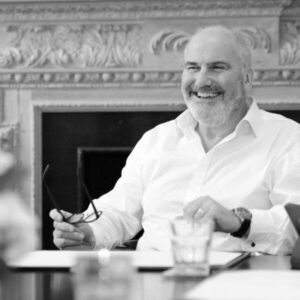
     

    I first met Terence in 1994. I was in my late 30s, and had been through a fairly institutional career.  I qualified as a chartered surveyor, and spent 10 years in private practice post-qualification in various parts of the UK. Then I came down to London to work for a developer in the late 80s. This was an inauspicious time to come to London: the developer I worked with was going down the tubes like a lot of developers at the time. I had a respite at the Halifax Building Society again very traditional financial institution – and then I met Terence.

    He came into my office on the Strand. He was always a larger-than-life character and very self-confident. He said: “I believe you have got an asset in Docklands that you are trying to sell for the Halifax. I would like to buy it.” We weren’t even marketing it at the time. Cutting a very long story short we negotiated a sale of this asset over a period of no more than probably 3 or 4 weeks. I didn’t know MARCOL from a hole in the wall. It was before the internet so you couldn’t check anybody out. There then ensued a long torturous negotiation with Terence in the Churchill Hotel where he would turn up two hours later than scheduled.

    After that he made me a job offer. I realised I didn’t want to spend the rest of my life at the Halifax. 30 years later I am effectively still working for the Cole family office and for Mark’s family office: it’s gone in a flash. Terence took you outside your comfort zone beyond the boundaries that you were comfortable with.

    That’s the best thing you can do in your career: to be tested all the time is to learn all the time. Now, in my late 60s, I am still looking for new intellectual stimulation. I have also developed other interests which I don’t think I would be doing but for Terence: he was so mind-expanding in the way he approached things.

    Nobody was a better litigator than Terence: he loved a fight. If he thought somebody was trying to get one over on him he would be tenacious. I remember we were suing a firm of valuers, a matter which gone on for probably two and a half years before Terence really got involved. We were getting to the final stretch in negotiations with the valuers’ insurers. On a Friday afternoon, we got them up to a plausible number but Terence wasn’t impressed. In meetings, he never had notes. He never wrote anything down. In this one, he got up and walked out and said: “When you see sense come back and talk to us but we are not accepting that offer.” He just walked out and nobody knew what to say. That was the end of the meeting. During the course of the weekend he got them to go up another 10 per cent on where they were on Friday afternoon. He rang me on the Tuesday and asked what I thought. I said: “I’d have been happy to take the number they offered us on Friday but clearly you have done a much better job than I’ve done.”  He replied: “I’m only doing it for you.”

    He also had this extraordinary attention to detail. My wife worked with him on one of his refurbishments which was hugely frustrating for her but she learned a huge amount. Specifically, don’t put up with second best if you know it can be done better: particularly if you are paying for something, criticise it. My wife is very like him now. We are doing a project up in Yorkshire and for the contractors it’s frustrating at first, but if they get it, people can lift their game.

    Parties were Terence’s hobby: that was what he lived for. The Coles always used to throw a party on Boxing Day. On one occasion they took a suite in the Savoy but we turned up at the allotted time and were held on the ground floor in the lobby of the hotel because the room wasn’t ready. We then discovered that 30 minutes before the party was due to start, Terence had decided he didn’t like the layout of the room so he literally got them to take the doors off the hinges so that the space flowed better.

    It was certainly never dull. MARCOL isn’t the same without him. There are youngsters in the office who will never experience that. With Terence there were no airs and graces: no aloofness. He wanted to be looked after and respected by people but at the same time he would give that respect and care back.

    Victoria Boxall-Hunt, Group Operations Director, MARCOL

     

    I shall never forget the first day I met Terence. He made me laugh so much in my interview that I snorted! It makes me go red at the thought even now – 18 years later. On my second interview, he sent his car and driver to collect me and bring me to Upper Berkeley Street to meet him and Mark. This was no ‘normal’ company and so began my journey with MARCOL, a journey that has shaped my life and given me many experiences that I would never have had. It has taught me a huge amount, introduced me to some incredible people and has tested and delighted in equal measure. There is also no doubt that we have laughed a lot and had a lot of fun over the years.

    I genuinely think they broke the mould when they made Terence Cole. He didn’t do things that people expected, in fact quite the opposite. I learned a lot from him, particularly to be patient, stay quiet, listen intently and to stand up for myself and fight my corner. He had an innate understanding of people and a way of asking questions and getting things done that astounded. What seemed utterly preposterous at the beginning of a meeting would seem totally doable (somehow) by the end. He had the most incredible way of talking people into doing things and making people think it was their idea in the first place. He helped me plan my wedding and took great interest in all things. He even said I must have his car and driver to take me to the church and that he would get a taxi.

    I have witnessed so many unbelievably kind and thoughtful gestures over the years that genuinely made a positive impact on peoples’ lives. He was driven by making a difference and an impact, which he did. I think of him often an ask myself regularly: “What would TC have done?”

    Niki Cole, Terence’s wife

    I was married to Terence for 48 years. When I met him, I was a young actress who had just done a movie in LA. I was doing publicity and was asked to go to a fabulous European men’s shop to sign autographs. I saw a big giant limousine pull up outside the shop, and Terence got out with two guys. He looked around and was soon trying on clothes. At the end of that, he said: “I’m going to take all these clothes on the condition that that lady over there delivers them to the Beverly Hills Hotel.”

    When I was informed of this proposal, I said: “I’m not doing that.” But he had this power about him and this presence. I went with the driver there, and said: “The clothes are here” and I was asked in for a drink. I stayed him with a week at which point he said: “If you play your cards right, I’m willing to marry you.”

    Terence knew it all – he had no lack of confidence in what to say or do in any situation. He was very relaxed and brought people down to earth, and attracted them: he brought them along.

    I’ll never forget the party he threw for my son Alex and his wife after they were married. The theme was Hollywood glamour. It was at a venue outside London, with 500 guests. Every single one of them had their own chauffeur and their own car and were taken to the country. The party finished at 5am. There were different-themed rooms and all sorts of music: the Royal Opera; the Black-Eyed Peas, Shirley Bassey. My son and his wife knew nothing about it. There was a Doctor Zhivago-themed room where there were ice sculptures dispensing vodka and Russian soldiers on horseback. There was another room for period films, with ladies dressed in Jane Austen-style costume. We went downstairs and there was a sheet of raining ice, and suddenly everything went ‘Boom!’ and opened like a curtain and Alex and his wife were standing there. Jools Holland sang; José Carreras sang; breakfast was served at five in the morning.

    Perhaps it could be daunting sometimes. If I said, “I’m not doing this,” he’d reply. “We are doing this – I know what’s right.” The secret to staying married to him was to know how to challenge him back.

    When he died – in London at the Cleveland Clinic, I wanted him to be buried in America. It’s the most beautiful place. On one side you have the sea, on the other are mountains. He is buried in his tuxedo jacket, his pink open-neck silk shirt, white trousers and green velvet carpet slippers. My husband danced to his own tune in life.

    Alex Cole, Terence’s son, founder of Elevate Entertainment

    My father was a man who created his own destiny: it was his way or the high way. He was a man who’d built something from the ground up in business, and didn’t apologise for it. Why should he? He could humble any mighty person – no matter how powerful you were, he could always teach you something. He had this way of speaking in a low voice, of taming people, and drawing people into his wisdom. I knew if I went into property development and private investment, I would never get close to what he was doing: I didn’t want to interfere with the master. My path in life was a little to his chagrin: “There’s no money in that,” he’d say.

    So I now produce and develop big TV shows: that’s very different to what my father did. There were things we each had to navigate in relation to each other’s choices. My father wanted me to always admire what he did, but I could never achieve what he had done in business, even though he would have liked that. For me, it would have been disrespectful to step into those shoes.

    I was going to stand on my own two feet. While he was around you knew everything was going to be fine; he was going to see to that. He needed to control the family – and not in a bad way. I felt secure in my family; you knew you could always go to this wise man for help, whether it to be personal or to do with business. If you were under his watch, you were taken care of.

    When he went we all felt lost: me, my mum, Mark. Because my sister had health challenges, I had pressure to keep the legacy of the Cole name going. That created a wonderful bond, but it also created a pressure. When my dad passed away I wanted to keep that security nearby, and have him close to me: I arranged to have him buried about 15 minutes away. He liked the sunshine of America: he liked getting out of England – he found the mentality to be: “You can’t do that”. My father would always say: “Well, I’m doing it anyway.”

    As I proceeded with my career, he really became interested in films. He decided he wanted to tell me how to produce films. He would say I should host a talk show and so on. He was proud: it was a creative job, dealing with celebrity and a bit more glamorous than property – or at least it seems that way until you’re in this world. He would say to me quietly under his breath: “You know, I’m proud of you, right?” When he gave compliments, you knew they were valuable – more so than with people who shower you with affection and praise.

    When it came to the parties, I’ve been to the Oscar’s – and they’re boring compared to what my father could produce. He planned things but never wanted to be the man of the moment when they would happen – his kick was to stand in the corner as people took the journey through the party.

    When it came to work, he never had to behave in a certain way: he was the meeting. Everyone had to pause while he did his things. But the theatrics encouraged people to want to do business with him; he wasn’t conventional. And he loved everyone: the team, the staff, the doorman. If you were part of his group, you were part of his group. It created company morale. He didn’t waste his life in any way. When he died he was 90 years’ old. His mind was strong, that mind could have gone on to 105 in the office. But his body gave up on him which makes the loss of my dad harder to stomach.




  • Saison Review by Ronel Lehmann: “If only our politics could be as sweet as this’

    Saison Restaurant Review, by Ronel Lehmann


    It was absolutely bucketing down. There was only one thing for it. My guest was coming from the Palace of Westminster, and it seemed sensible to book a table with the shortest stroll to the Old War Office. This is one of the great buildings from the Edwardian Age, originally completed in 1906 and recently reincarnated as Raffles, with an eye watering refurbishment.

    Having parted with my umbrella, I arrived a few minutes early in this Mediterranean all-day dining atrium. The waiter was quick and attentive and sparkling mineral water was immediately served. I decided to use the wine list to cover the uplighter spotlight which was beaming from the floor right in between me and my companion.

    The first thing that I noticed after my retina had adjusted was my side plate appeared to be used. On closer inspection, the waiter explained that this was the design of the plate to incorporate the yellow splashings of citrus. After the reassurance that it wasn’t uric acid, I felt able to place my freshly baked focaccia on the plate. The focaccia was so airy and melted in the mouth with a dunking of olive oil.

    Over the years, my surname has been refashioned as lemon, layman, leeman and lenor, and the table theme continued with a fresh lemon and lime decoration in keeping with the celebrated Argentine Chef, Mauro Colagreco’s philosophy, and approach to seasonal cuisine.

    We elected to have a main course only. Parliamentarians are under pressure to be able to vote at short notice and the ravioli dish was hastily ordered. The presentation of the Pumpkin Ravioli was exquisite, small wheels of patterned pasta, roasted chestnut, more lemon confit, and winter black truffle. We were hungry and didn’t notice that parmesan wasn’t offered. The seasonal leaves described as a Crate to Plate Salad with herb vinaigrette was a colourful accompaniment to the ravioli.

    By this time, we had looked at the other tables and had begun to recognise other notable Members of Parliament and strategists deep in conversation.

    Rather than be distracted further, we decided to share the Citrus Tart and lemon leaf ice cream. When it arrived a reduction of fruits and herbs were gently poured over the pudding. I was thinking if only our politics could be as sweet as this, and then why did we share, when overcome by such a rich and divine lemon taste. The espresso cup was served in a cacophony of colours together with a small freshly baked biscotti.


    Before we left the Attrium, there was time for a photograph. This place is Instagram heaven and I suspect that the waiters are getting used to being paparazzi. If there was a criticism after the faultless cuisine and service, the piped music didn’t match the grandeur of the establishment. I am reminded of the famous quote “Winter passes and one remembers one’s perseverance.” It is a bit like that, I might visit Saison again in the Spring.


    To book go to: https://www.raffles.com/london/dining/saison/

  • China’s Looming EV Dominance

    Dinesh Dhamija


    It’s now a decade since Tesla launched its Model S in the UK – the first battery-powered luxury car to reach the market – and there are now just over 1 million all-electric models, of all brands, on British roads. EVs are a common sight.


    What’s coming next? Rather than more Teslas, Nissan Leafs, VW ED-3s and Kia e-Niros, a new wave of cheap, mass-produced Chinese EVs is on its way. The highest number of electric vehicles produced by any company in the world is no longer Tesla, it’s the Chinese manufacturer BYD, which sold three million vehicles in 2023 and already has the capacity to make four million per year. It’s developing a new factory in Hungary to serve the European market, alongside others in Brazil, Thailand and Uzbekistan, with further plans for Mexico (to attack the vulnerable US market) and Indonesia.


    Just a couple of weeks ago, BYD launched a new plug-in hybrid model that had a good all-electric range and costs just £10,000. The company now plans to flood global markets with its vehicles, just as low-cost Chinese toys and electronic goods have proliferated for years. “The price will make petrol car assemblers tremble,” said BYD on the Chinese social media platform Weibo, as it launched its new model.


    It is not just the traditional carmakers that are trembling. Apple just announced this week that it is discontinuing its electric car making efforts, after spending billions on development and promising in 2020 to launch a model in 2024 or 2025. Even Tesla has scaled back its investment, faced with rising interest rates and softening demand. Things are even tougher at the traditional automakers: Ford reportedly lost more than $64,000 on every EV that it sold in 2023 and has delayed opening new battery plants, while GM has also had a troubled EV production history. All the big US manufacturers make their profits from selling pick-up trucks and SUVs. They are desperately trying to create EVs to compete with Tesla and the coming tide of Chinese electric vehicles, but it may already be too late. The same applies in Europe.


    Looking at the big picture, more EVs should be a good thing. They will hasten the spread of charging infrastructure, bring down the overall costs for consumers and make electric transportation available to the general public. But for the next few years, there could be a virtual bloodbath in the auto industry, as conventional market models are turned upside down.


    Dinesh Dhamija is a renewable energy investor and entrepreneur. He owns a solar energy and hydrogen business in Romania. Earlier, he founded, built and sold ebookers.com and served as an MEP. His latest book The Indian Century has just been published.


  • Sir Philip Rutnam: ‘The state of our churches is the biggest crisis facing our national heritage – by far’.

    Christopher Jackson

    I have always been very fond of Philip Larkin’s poem ‘Church-Going’, where Larkin stops at a countryside church and takes off his cycle-clips ‘with awkward reverence’, walking around, until he decides ‘the place was not worth stopping for’. He ends up wondering ‘when churches shall fall completely out of use, what we shall turn them into.’ It’s a lovely poem for an England Larkin felt to be vanishing. The only line in the poem I think is definitely false is the line about it not being worth stopping for – not least because it gave him the poem itself.

    I thought of the poem a lot after talking with Sir Philip Rutnam, until recently the permanent secretary at the Home Office, and now the Chairman of the National Churches Trust, a laudable organisation which seeks to help preserve the 39,000 or so places of worship in the United Kingdom.

    So how did Rutnam acquire an interest in our churches and chapels? “My parents weren’t from a church-going family, though there was a lot of emphasis on education. It was a modest household in terms of income but it was a rewarding environment for me,” he tells me. “I was interested in history going as far back as I can remember. And buildings are one of the most tangible and engaging ways of seeing how the past continues to have an effect on us.”

    Rutnam went on to study History at Trinity Hall, Cambridge: “I really loved it because it’s so varied,” he recalls. “You’re looking at everything from the origins of Europe after the fall of the Roman Empire through to neo-contemporary history of the United States with all sorts in between. It was a vast field – not just in terms of subjects but also in terms of ways of thinking about the past.”

    So when did he become interested in churches? “When I became a teenager and had more freedom, I realised I could use that freedom to explore historical buildings. I would cycle off sometimes with friends, taking a copy of Pevsner, through southern England. I spent a long time exploring the churches of Kent, and Buckinghamshire.” It was the discovery of a love which continues to this day: “Just about everywhere one went, one could discover something unexpected, beautiful or extraordinary. It might be an amazing medieval chancel, or a Georgian monument or a Victorian sculpture. Scattered through the countryside and the towns of this country, are extraordinary buildings, and they’re too often underappreciated.”

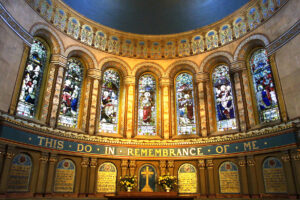
    St Oswald’s, Cumbria

    “The state of our churches is the biggest problem facing our national heritage – by far.”

    So why are they not better known? “The first thing is that these buildings get taken for granted; they become familiar. And familiarity can lead to lack of inquisitiveness or curiosity,” explains Rutnam. “Secondly, they’re often not well understood. If any one of the 15,000 Listed places of worship in England – and there are thousands more in Scotland, Wales and Northern Ireland – were in America it would be regarded as utterly extraordinary. The abundance of these buildings makes them their own worst enemy.”

    So what can we do to redress that? Rutnam is clear. “We need to help people to recognise how exceptional it is that in this country there’s such an amazing collection of historic churches.”

    Obviously, the challenge is doing this in an era of distraction – of memes and AI and and Taylor Swift and a million other things. But Rutnam is optimistic: “The decline in church-going has had an effect, yes, but actually very often you find that these buildings, even if the number in the congregation is less than it was 50 years ago, the building is still the centre of the community and regarded as such. It typically provides a wide range of activities beyond worship. Our challenge is to jolt people out of this sense of taking these places for granted.”

    And how do you do that? “One thing is to make the buildings more accessible. That might not jolt but it will encourage. If we don’t, some people might hesitate metaphorically at the threshold and not go into the building because it’s unfamiliar and they haven’t been inside before. You need to make sure it’s got wheelchair access, as well as toilets and a kitchen. My church in North London has a nursery in it and holds Alcoholics Anonymous meetings.”

    I think back on the role the church used to play, remembering how in Cartmel Priory in the Lake District, there is a loaf of bread behind one of the pillars, a memorial to the church’s traditional role in feeding the poor. Rutnam explains that this work continues today in ways we might not realise: “Many of our churches are hosts to food banks. There are more food banks hosted than there are branches of Macdonald’s in the country. There’s a modern version of the loaf of bread at Cartmel Priory at the food bank at Blessed Sacrament Church at Copenhagen street in North London, or Maryhill in Glasgow – and thousands of other examples.”

    But we shouldn’t stop at simply making these magnificent buildings more accessible, Rutnam explains. “We also need to bring out the stories, and discover ways in which people can easily engage with the history behind the buildings. For instance, I went to the Parish Church in Ross-on-Wye a few weeks ago and they had a very cool bit of technology, which meant if you downloaded a QR code, and then raised your phone, you could see the medieval rood screen restored. The same thing could be applied in lots of different buildings. It’s to do with bringing up the variety of history there.”

    Has the pandemic improved churches’ technology offering? Rutnam replies: “Covid-19 had a whole range of impacts. It’s now common for services to be online at the same time as they’re happening physically. But more generally technology’s quite a challenge for parishes, as these are by their very nature small organisations. We have 39,000 places of worship open for use, half of them listed buildings, and each one of those is effectively a small organisation – and, as with any small organisation – helping it to have the skills is a big challenge. One of the things organisations like ours could do is provide more of the common resources needed for technology to be adopted.”

    When I think of my own experiences of visiting churches, I find that one reason that I might not stop is because it’s not always clear if the church itself will be open. One fears the rigmarole of parking up, trudging up to the steps and then finding the door locked. Sometimes it’s worth it – the door delightfully gives yielding the inside of the church, and the secrets within – but more often than not it doesn’t and you have to trudge back to the car. Larkin might have thought his church not worth stopping for, but he lived in an era when doors weren’t closed due the perception that otherwise they’d be ransacked by vandals.

    Rutnam strongly agrees: “We would encourage churches to be open to the public regularly and indeed the standard advice from the main insurers for church buildings is to be open to the public regularly – it’s not to be closed, there are other risks to be associated with that. I understand it’s a challenge. Definitely at the minimum churches should advertise the hours they’re open and to be open not just on Sundays but for some point during the week. We run a website which is the largest source on this called Explore Churches.”

    Of course, every church is unique, and each incumbent must choose a strategy. Not all churches can be like, say, St Bride’s off Fleet Street in London which has its famous relationship with the journalism profession. But Rutnam points out that every church has something to offer. “The main identity which churches have is a geographical one,” he says. “Everyone of us lives in a locality, whether we’re there for a month or for 30 years. Churches have an extraordinary role and potential.”

    When it comes to the crucial business of maximising that potential, a lot currently seems to depend on the get-up-and-go of the individual incumbents. I can think of a range from the vigorous Dr. Alison Joyce at St Bride’s to the rather indifferent vicar at my local church in South-East London. Rutnam is sympathetic to the plight of clergy and eager to help: “Clergy are not generally trained as the operators and manager of buildings – understandably. It’s not a standard part of the theological training, but it has ended up being an important part of their job. One of our roles is to support not just clergy but also the small groups of volunteers, the church wardens, the church councils, and the people who end up involved in the running of the buildings, and to support them with easy to use advice and training about how to manage the difficult problems which come up.”

    So how many volunteers are there exactly? “We’ve estimated there are about 400-500,000 volunteers. One of the things we try to do is make sure their role gets recognised. We have awards each year for volunteering. We provide some support and training on how to work with volunteers. You’ve got this incredible network of churches and chapels, and local organisations and what we seek to do is provide the best support we can for them.”


    So there’s a lot of work to do, and I realise afterwards that I’d been talking to Rutnam for nearly an hour, and because of his soft-spoken, knowledgeable and gentle demeanour not really intuited the scale of the crisis. But now it begins to hit home: “We’re a relatively small organisation. We’re a national charity for this extraordinary group of buildings. We have about 5,000 members who support us each year. We also have regular donors, some of whom are individuals who have a strong alignment affinity for the cause, recognise the role churches play and some are from foundations and trusts such as The Pilgrim Trust which has been supporting this cause since we were set up in 1953.”

    But here’s the rub: there’s far more support required than the NCT can currently provide. Rutnam sets it in context: “We’re able to distribute around £2-5 million a year on projects. That’s an appreciable sum but only part of the overall funding of projects which need to take place.”

    So what sort of grants do they give? “We don’t give more than £50,000 to any one project, and in a typical project we fund about 200-300 a year. But each year we’re oversubscribed by a factor of three or four. There’s far more demand for funding to restore these buildings than there is funding available. As a result, the backlog of works is growing, and the threat to keeping these buildings open is also growing.”

    To anyone who loves history – let alone anyone who loves churches – this is a dystopian vision of a country losing its connection to its past – exactly as Larkin feared.

    “It’s very serious,” agrees Rutnam. “We need more donations. This is the single biggest issue by far facing our national heritage. Stately homes were an issue after the Second World War when the families who owned them didn’t have the money to keep them running; now the biggest problem is our churches and chapels. There are buildings which have closed recently because of major repairs which the congregation can’t fund but there are others which are in danger of foreclosure. The National Churches Trust has a role but so does Heritage Lottery Fund – and so, of course, does the government. These are fundamental public buildings which have been here for hundreds of years.”

    So what is the UK government doing? The answer is shocking. ““Apart from being able to reclaim VAT on repair work, there is no regular funding from government. There was some funding during the pandemic as part of the Culture Recovery Fund and that was very quickly used to fund a whole range of major repairs of churches which urgently needed. That too, of course, was massively oversubscribed.

    It’s a hard one to get up the agenda, he explains. “Scotland may provide us with a warning of what could happen in England, Wales and Northern Ireland. The Church of Scotland is going through a process of trying to reduce its church building estate by 40 per cent and a whole range of buildings, some medieval, have been identified for closure. Some are for sale at the moment on the Church of Scotland website.”

    Of course, what happens to those sites will depend on the acquirer. Some will no doubt become housing, others will house retail store.

    So how can the NCT connect with young people? “Sustainability is important and strikes a chord with many young people. As we deal with the huge existential challenge of climate change we have to make better use of our existing stock of buildings. We have to move away from a culture of demolishing buildings when we think they’ve finished one use and building something new – usually out of glass and steel. That’s not going to be sustainable in terms of their impact on the environment. Churches have overwhelmingly been here for hundreds and hundreds of years, and they have a huge amount of life left in them. It’s our duty to make the best of those structures, and adapt them for worship and for serving their communities. It’s eminently possible to do this in a way far more sustainable than the alternatives.”

    Rutnam also makes another point: “The other thing for young people to be aware of  is that there are opportunities – really rewarding opportunities – to work in the field of conservation. There’s a huge shortage of people with the skills needed to look after ancient buildings, working with your hands to carve stone, to repair wood, to the craft skills and there are some really good programmes available for apprenticeships at universities and degree programmes.”

    It’s a remarkably clear case for action, made passionately by someone with a great deal of intelligence and quiet knowledge. Larkin ends that poem with a stanza that must be quoted in full:


    A serious house on serious earth it is,
    In whose blent air all our compulsions meet,
    Are recognised, and robed as destinies.
    And that much never can be obsolete,
    Since someone will forever be surprising
    A hunger in himself to be more serious,
    And gravitating with it to this ground,
    Which, he once heard, was proper to grow wise in,
    If only that so many dead lie round.


    It is that surprise of churches which we must preserve – and preserve it for as many generations as possible.


    To find out more about and support the work of the National Churches Trust, visit nationalchurchestrust.org