Category: Features

  • Long Read: Me, Myself and AI

    Christopher Jackson


    When I consider the question of AI as it relates to the matter of myself, I find I have to begin with a board game. After playing chess occasionally in childhood, by 2021 I began playing with bots. My return to low level chess formed a crucial plank in my plan to give up Wordle – that very 2022 fad to which I became pointlessly addicted for a month or so. I decided to swap one addiction for a slightly more meaningful one and became a regular visitor to chess.com.

    I play chess to a level which may almost be deemed infantile, full of incomprehensible failures and idiotic myopia (“Oh, I didn’t realise my Queen was there”) where humiliation constantly vies with a curious sense of pleasure. One feels faintly intellectual just by trying to play chess at all: there is a sense of a brain muscle which needs attention getting a minor massage.

    As many will know, on chess.com, if you want to play humans, you can set yourself up with an ID and then play against another flesh-and-blood person roughly of your level. Interestingly, when you play a fellow human, you can sense their humanity even when there is a computer screen intervening. It was John Arlott who said in relation to the cricketer Jack Hobbs that what made him great was his ‘infallible sympathy for the bowled ball’. In chess.com something similar seems to happen: when you play a human being, each move feels personal in some way – and may even have something to do with a shared humanity. Sometimes a pause will occur and you’ll think: “They’re probably making a cup of tea.” Or when the moves come rapidly, you might think: “I see you’re going out for the night and you need this game finished in the next five minutes.”

    But the problem with playing people is that they’re unreliable: either they’re busy, or else they can be petulant losers. Quite often, you’ll begin a game on chess.com with another human and find that the time between moves can be inexplicably long, and you’re not sure if they’ve left the game and not bothered to resign. Sometimes, you begin to win and your opponent capitulates depriving you of the real pleasure of chess: the unfolding of the logic of victory. In a just chess world, you begin to sense victory long before check mate is confirmed, but it’s part of the sportsmanship of it all to let the drama unfold: the defeated are meant to fight, to let their opponent pin them to the wall. All this means that playing humans on chess.com is something of a lottery. It can be anything from fun to a mild disappointment to a notable waste of time.

    Which is why, one evening, I thought I’d bypass all that nuisance by playing a bot, starting with Coach Danny – named after Danny Rensch, the chief chess officer of chess.com, who has a score of 400, which is to say he’s programmed to be a rank beginner. Victory against this bot comes relatively easily, and as I have gone on I’ve eventually been able to compete with intermediate players.

    But it feels different. There is never a thought-delay between moves, and never any sense of anything shared: there is a gulf between you and your opponent, the gap between robot and human – between AI and me. One feels infinitely separate from one’s AI opponents: they never make a cup of tea while they consider the way in which you cunningly developed your rook. They never expose their queen accidentally because they’re rushing not to be late for the cinema.

    The more I played bots on chess.com the more I came to feel my humanity. I felt how separate the bot was, isolated in its bottishness: a different kind of thing altogether. The division is this: I possess a self – or to use a now antiquated term, a soul – and the bots don’t.

    By 2024, I now know that those matches of chess, pitted against a computer, were harbingers. Now it’s not just my chess ability which is to be matched against AI – but my whole self, my soul: me.


    The Looming Revolution


    I have been reading William Hague’s excellent biography of the great campaigner and statesman William Wilberforce. Since it is a faithful reflection of the great man’s life, the book largely concerns Wilberforce’s extraordinary contribution to the abolition of the slave trade. Wilberforce’s campaigning gathered pace through the 1780s – and Hague brilliantly depicts the way in which momentum was building in 1788. In fact, the reader is left with the distinct impression that in any normal year, the slave trade would have been abolished in 1789. But of course 1789 was by no measure destined to be normal: it was to be the year of the French Revolution. War would have to be prioritised. The abolition of the slave trade would be delayed until 1807.

    In early 2024, we are talking about any number of things: the return of Trump, the the interest rate, migration. But are we doing so in ludicrous ignorance that we are on the cusp of a similarly sweeping force?

    When I meet the Secretary of State for Levelling Up, Housing and Communities Michael Gove, I mention the French Revolution analogy to him in relation to AI. Gove agrees, and explains the enormity of the situation to me: “We’ve had two Cabinet sessions about AI and the point was made at one of them that this was perhaps the most consequential issue with which we have to wrestle. AI has the potential to transform our world to an even greater extent than nuclear power and the hydrogen bomb.”

    So what kind of transformation will this be? Gove isn’t sure. “It is difficult for us to envisage quite the scale of transformation that AI will generate in our societies. At different times, people predict the impact of technology – wiser minds than me will know you overestimate then underestimate what the impact will be. But AI will undoubtedly be impactful. It may further entrench and indeed exaggerate inequalities and of course it has the potential – unless you have proper alignment for catastrophic outcomes.”

    This echoes what we sometimes find in the discourse. All anyone can agree on is the enormity of the oncoming shift. There is a terrible sense of unpreparedness in all of us – because how do you prepare for something when you don’t know what it will be?

    Some of this is to do with the structure of our economy and the question of where wealth, and therefore knowledge, happens to reside. It’s possible to intuit that AI’s true nature is hidden behind the veil of the gigantic and essentially impregnable tech companies where all this will unfold – and to a certain extent has already unfolded.

    Unless you happen to have a management role at Google or Tesla, you are given scraps. In Walter Isaacson’s superb biography Elon Musk there is an astonishing moment when Musk is sensibly arguing with Google co-founder Larry Page that safeguards need to be built into AI. Page accuses Musk of being a ‘specist’ – someone in favour of his own species and goes onto argue that humanity needs to be replaced and ought to accept its own demise. “I fucking like humanity, dude,” comes Musk’s reply. When Page seeks to buy DeepMind, Musk tries to put together financing to block the deal. “The future of AI should not be controlled by Larry,” Musk says, putting it rather mildly, and echoing my own thoughts.

    What Musk ends up touting towards the end of Isaacson’s book is “maximum truth-seeking AI. It would care about understanding the universe, and that would probably lead it to want to preserve humanity, because we are an interesting part of the universe.”

    This is already heady stuff and many people will wonder how, by dint of not being tech billionaires, they have accidentally outsourced their entire future to the likes of Page and Musk.

    Whatever one thinks of the tech barons – and some of them are more likeable than others – it probably is the case that a grounding in history, philosophy and theology isn’t their strong suit. They also, I have decided, don’t particularly mind about the economic future of journalists.


    Journalism v the bots


    Chess turned out to be merely the opening salvo in my experiences with AI. By 2023, with the release of Chat GPT, AI seemed to want to do my job for me – or to help me do my job, depending on which way you looked at it. Writing being so much more central to my life than chess, this in turn seemed to up the stakes between me and AI. It went much nearer the heart of me.

    The self and the soul. These are not necessarily wheelhouse topics for an employability magazine, but since the meaning of this turns out to be decisive for the future of work and therefore of humanity, its discussion can hardly be avoided.

    The argument may be lost on Larry Page – and to a certain extent on Musk – but it runs like this. Human beings have always had something rather unique and mysterious about them. There is a certain bestowed strangeness attached to us, on which basis we’re constructed. This is valuable – even infinitely so. We don’t know where we come from, or where we’re going, but we’re can’t quite escape the nagging suspicion that we matter. This could be called ‘specist’. But it is quite likely to answer to reality too – it is certainly a more respectable opinion than Page realises. I don’t think, for instance, that there is a major figure in history from Shakespeare to Bach and Michelangelo who would seriously dispute it. When one hears Page take the opposite view, one wonders if he seriously thinks the creation of Google entitles him to override the creator of Hamlet.

    This in turn opens up onto the notion of sanctity. To put it mildly, our sense of ourselves has never been as straightforward as we would like. One trouble with human beings is that we tend to note our value when it’s absent – for instance, when there is some terrible atrocity in the context of war. When that happens we think: “Hang on, aren’t we meant to be more than that?” By expressing our dismay at negative development, we are indicating the value we ought to be ascribing to one another. This sense of ourselves is more likely, paradoxically, to be present at the aftermath of a shooting than it is in an AI lab at Google.

    In the ordinary scheme of life, it resides in us quietly. Most of us, when we seek an ideal career, are also seeking to give expression to some sense of destiny burning within us, which we might think of as being an aspect of our self, or soul. We act as though we matter. Page would say we are delusional in this; I would say we are acting on a valid but admittedly mysterious logic which flows out of our existing at all in the first place. Sometimes, in workaholics, it might be that a large part of the self or soul manifests itself through work.

    I’m sure a chess grandmaster feels that way about chess – and perhaps the chess world therefore knew early on – when the first computer beat Kasparov – what I have begun to see in 2023: namely the possibility that a computer can usurp you. Over the past twelve months, AI has begun to sneak nearer to my career – by turns like a sun about to rise, or a storm about to come.

    Writing for writers usually does form a large part of the soul. It tends to manifest as an obsessive condition, and the stories are legion of writers failing to separate out work from their personal lives to the detriment of family.

    The increasing popularity of ChatGPT – the acronym at the end stands with an almost laughable ugliness for Generative Pre-Trained Transformer. Its mounting popularity caused me to wonder how skilled the bot would be at writing a Finito World leader.

    To that end, I issued the command: write me a leader for an employability magazine about the importance of skills in education. It replied:


    Welcome to this edition of our Employability Magazine, where we explore the dynamic intersection of education and skills that propels individuals toward success in the ever-evolving landscape of the professional world. In an era marked by rapid technological advancements and global connectivity, the traditional paradigm of education is undergoing a profound transformation.


    Faced by the ludicrous dullness of this, I experience a rise in self-confidence that the plight of the journalist may not necessarily be an entirely hopeless one at least for the next few years. I might, however, feel differently if I were a copyrighter.

    The situation is the same, if not increased, for songwriting, painting or poetry where the link to the self is greater than in journalism which is in some way to do with the conveying of factual information, and its organisation.

    To take poetry as an example: its creation is much more mysterious than the creation of journalism – it comes from, to use Martin Amis’ notion, the back of the brain. Writing poetry can actually feel like a complete possession of body and soul in a way in which writing journalism does not.

    It is not surprising therefore that AI and the arts have already clashed, most notably in the 2023 Writers Guild of America strike. The moment which most caught my eye occurred in Nick Cave’s indispensable Red Hand Files, in August 2023. As readers may know the singer-songwriter famously takes questions from his fans on any range of matters. ChatGPT has come up a few times.

    Cave takes a very anti-AI view. He views true creativity as being fraught with self-murder and challenge – its difficulty is, according to him, what renders it worthwhile. Art is hard work and meant to be so – it is a sort of voyage along suffering. Cave writes: “ChatGPT rejects any notions of creative struggle, that our endeavours animate and nurture our lives giving them depth and meaning. It rejects that there is a collective, essential and unconscious human spirit underpinning our existence, connecting us all through our mutual striving.” So what, for Cave, does Chat GPT ultimately amount to? “ChatGPT’s intent is to eliminate the process of creation and its attendant challenges, viewing it as nothing more than a time-wasting inconvenience that stands in the way of the commodity itself. Why strive?, it contends. Why bother with the artistic process and its accompanying trials? Why shouldn’t we make it faster and easier?”

    And so what should we do about it? Cave’s response strikes me as very beautiful. “As humans, we so often feel helpless in our own smallness, yet still we find the resilience to do and make beautiful things, and this is where the meaning of life resides. Nature reminds us of this constantly. The world is often cast as a purely malignant place, but still the joy of creation exerts itself, and as the sun rises upon the struggle of the day, the Great Crested Grebe dances upon the water. It is our striving that becomes the very essence of meaning. This impulse – the creative dance – that is now being so cynically undermined, must be defended at all costs, and just as we would fight any existential evil, we should fight it tooth and nail, for we are fighting for the very soul of the world.”

    Therefore, we’re in a mortal fight brought about primarily by economic circumstances. Technological advance throws to the top of the pile people like Page who can precipitate astonishing developments while knowing very little about the broader context of what they’re doing. They are immune to knock-on effects, because they are financially unassailable, and blissfully ignorant of what they’re doing, knowing no history or literature. It’s sometimes the case that to understand the world you have to go to the artists and the philosophers as well as the scientists and the tech entrepreneurs. The worrying thing is that the tech entrepreneurs don’t need to do that. They either want to plough on because they believe in progress for its own sake, or because they want to see the money rolling in – or usually both.

    There are minor silver linings. It seems likely that Musk, the most safety-conscious of the AI moguls – will succeed by dint of owning Twitter with its vast linguistic datasets and Tesla with its visual dataset of driver behaviour in competing with ChatGPT and DeepMind. More experienced with his success at SpaceX and Neuralink at rapidly building competitive engineering companies, there seems a good chance that he will define the AI future to some extent. It may therefore be very fortunate that the most gifted entrepreneur-engineer of our time at least doesn’t take the Larry Page view of life. But it might not be a bad thing too, if he were to listen to Nick Cave.


    The Cry of the Theologians


    He could also do a lot worse than listen to the great humanitarian and religious thinker Sir Terry Waite. Waite begins by explaining to me the irreversible nature of the progress the big tech companies have made. “I don’t think you can ever reverse these trends,” he tells me. “I think there is a trend towards artificial intelligence and that is now moving and it will not be stopped. What can be done is somehow to control it. It has very real dangers, of course, and I don’t fully understand the full implications of what AI is going to be.”

    Waite tells me of a minor AI scrape he’s recently been in. “I have been suffering this morning from the effects of a very minor form of AI – namely, a parcel should have been delivered, it was delivered to the wrong address and every time I get close to speaking to any human being about that I get some automated response which gives me a series of answers to questions I pose which bear no relation to my problem. I need to know where it is and where it’s gone. They tell me it’s been delivered but it hasn’t been delivered here; it’s been delivered somewhere. That’s very minor and it’s not the full use of AI but it’s an indication of what is coming where we do not speak to another human being.”

    In a sense Waite’s worries are rather similar to Cave’s – a world where human closeness, and even meaningful interaction, is radically curtailed. “Maybe this will be different in the future but a machine does not have the human qualities of compassion and love which is central to human existence and central to the teaching of Christ who constantly emphasised the values of compassion and love,” Waite continues.

    Waite also explains how we have tended to express these values throughout history. “You can express compassion in a number of ways but in general it’s expressed with face-to-face meeting. There is a very good book recently written called The Matter of Things by a neuroscientist and writer called Iain McGilchrist. He speaks about the two sides of the brain: the left hemisphere and the right. The left hemisphere is the area of calculation and decision-making.  The right area is the area of imagination and spirituality and all that goes with that. He points out that much of modern society is now concentrated on the left hemisphere, especially in the teaching of mathematics and the teaching of science. These things are important – I don’t deny that – but they’re now being pursued to the detriment of history and the arts. We are being put out of balance.”

    And what are the dangers of that? Waite is unequivocal. “Lack of holistic understanding does not make for rounded human beings.”

    The way society appears to have gone is that left hemisphere-dominant people have created things which the right-hemisphere dominant would never have dreamed of, and monetised these creations aggressively, essentially marooning the right-hemisphere dominant – among which I count myself – in a world they didn’t particularly want or need. Left-hemisphere people tend to make a big impact on reality, and their version of society has a momentum which can’t be realistically reversed. But they are not dreamers – and dreaming is important too.

    The predicament may be more serious still. The right-hemisphere seems to me to link far more reliably to human meaning, and human meaning is probably more important than analysis and measurement (left-hemisphere thinking). It could therefore be that we have created the entire future out of the wrong side of our brain. But a decision-maker like Larry Page, full of self-importance and unlimited money, would likely give short shrift to the notion that their worldview is false: they will not feel it to be so in their gilded boardrooms and, again, have no particular reason to listen to you.

    We therefore face a precarious situation where Waite and Cave are right but that nobody in positions of decision-making power will listen to them. It is this which has led many to argue for government intervention.

    So will AI affect everyone in the world similarly or will there be different outcomes on a country-by-country basis? The answer to that is that while individual governments will harness potential in different ways, the overall impact is likely to be pretty broad. And how is the UK placed? Michael Gove, as might be expected, is optimistic: “As nations go, we’re in a better position than most. But we may well find ourselves in less than a year’s time reframing many of the questions we’re discussing now.” Then he pauses and says, almost defiantly: “But human nature itself won’t change.”

    Yes, but will it be eradicated? Here, the international landscape becomes important and cannot be realistically divorced from geopolitics. And geopolitics, if we’re honest, isn’t in a great place either.


    Cleverly does it


    When one reads the coverage, it can seem as though America is way ahead and without any serious competitors. That’s partly because we’re discussing the brands we all know and bankroll: Amazon, Facebook, Google, Tesla, Twitter, Microsoft.

    But worryingly it has been said sometimes that China is ahead – that’s the view of the philanthropist Mohamed Amersi whose brilliant autobiography Why? has just been published. He tells me that China is in a far more advantageous place in terms of AI technology than many realise. “China is way ahead,” he tells me. “One indication of this is the number of patents filed – if you google patent filing you’ll see that China is way ahead of the US, and perhaps ahead of all other countries combined. It’s worth noting also that China has put together a code for regulating AI. This law which came into force in August 2023 and was internationally ground-breaking. When you put those two things together the consensus is that China is in out in front and by a long way.”

    This seems sufficiently serious to be worth communicating to the then Foreign Secretary James Cleverly. When I ask Cleverly about China’s progress he puts his finger immediately on the key issue. “This is one of these classic foreign affairs quandaries,” he tells me. “China in so many areas is on a completely different page to the UK. This is partly to do with history and culture, but their attitude when it comes to the relationship between the state and the individual is completely different to the UK’s.” For Cleverly, this has clear ramifications: “Therefore, their use of AI, what they might utilise AI for, and what they are fearful about in terms of AI – all these things are likely to be different.”

    But does he know how far advanced China is on its AI development compared to the West? “The truth is, in direct answer to your question, I don’t know whether they are ahead of the UK or ahead of the US or behind us, or both. They are a very closed society but the fact is they’re on the podium. They are one of the top AI countries in the world. They are a Top 10 country and therefore they are inevitably developing AI technology. It almost doesn’t matter exactly what the ordering is, they are – and will continue to be – a very serious global player with a fundamentally different set of values.”

    For Cleverly this opens up onto the question of how global safety agreements should be structured going forwards. “If we try to build some kind of framework for safety and rules-for-the-road limitations, as we do for example with nuclear weapons technology and chemical weapons technology – as we are now beginning to do with the use of space hardware cyber rules – countries are less likely to break the rules if you include them.” Cleverly therefore reasons that China ought to be included in negotiations. “If we don’t include China at all – if we create a western framework and consciously exclude them right at the start of the process – I believe they will feel liberated to do what they want to do and that may well not be in our best interests. We need to at least try to persuade them to sign up to some reasonable pragmatic behaviour around AI safety. There is no guarantee that they will play by the rules, but it gives us a better fighting chance.”


    Seldon Says


    As the AI debate continues, I realise that the effects for me are of less significance than the effects on the lives of my two young children, who are aged seven and three. It was Christopher Hitchens who said that once you have children your heart lies outside you – the self, the soul, appear to extent outwards in time and space beyond one’s own predicament into theirs. In my own case, the older already displays a passion for architecture which strikes his teachers as being outside the norm; he has already been given a prize in respect of this. But when he says: “I’m going to be an architect, Daddy,” I find myself quietly wondering to myself what being an architect will mean, if it means anything, when he’s old enough to make a living doing it.

    For thousands of years, being a father has meant handing on the world reasonably unspoiled to your children. We might try to improve it if we’re lucky, but we have tended to assume that it will have been broadly preserved. My father expected the world to be intact for me – and it was, at least until now. The fact that I am unsure of my ability to replicate what had seemed a fairly basic feat can sometimes cause me disquiet.

    It is therefore probably true to say that I am invested in the idea that AI will actually not be the doom-laden scenario which many predict for it, but instead an unlooked-for boon, where Musk’s vision of human beings existing happily alongside robots is fulfilled – and my son gets to be an architect if he wants to be.

    If I look for these apostles of positivity I find one in Sir Anthony Seldon, who has written a book called The Fourth Education Revolution which paints a rosier picture around AI’s impact on education.

    Seldon was in this conversation pretty early. He tells me: “I started writing that book in 2017, seven years or so before AI was as much talked about as it is now. One of the governors at Wellington College Tim Bunting put me onto it. We talked about how it would change everything about education.”

    So how does Seldon view AI in the education space? “It is the understanding that AI would come along at a time when we still have a fundamentally 19th century model of schools – and to some extent universities – where the lecturer and the teacher’s at the front, students sit passively, and everyone moves at the same speed. That whole image of white boards and so on is hardly different from the whole model which was absurdly redundant by the late 20th century. I felt that AI would be the dynamite that will finally blow it apart.”

    And why is that? “That’s because it compensates for the deficiencies and endemic failures of the third revolution, which is that everyone has to move at the same pace, in every subject, regardless. Everyone has to work at the same time of day in the same fundamental way.”

    For Seldon this flat-footedness has severe ramifications. “It makes social mobility static or declining,” he tells me. “Teacher workload gets worse. But above all the model assumes that the student should produce the right answer at the right time in the right way, and isn’t interested in what the student thinks.” Having two very individual children who don’t fit easily into boxes as I do, this is cheering to hear. The quality I have always most valued is curiosity and if AI can accelerate that, while having built-in safeguards, then I can imagine a very bright future indeed.

    Furthermore, the pre-AI education system has been bad, Seldon says, for our well-being. “Homogenisation is a key contributor of mental unwellness and devotes itself to a very narrow range of human intelligence. As a system, it is very good at helping people pass exams but not at helping them learn how to live, how to lead meaningful lives, be good physicists and good historians, or how to be good MPs, or even good parents.”

    So AI could help with that? Seldon replies: “If it’s harnessed early enough, it can overcome all those things.”

    That sounds promising although there remains the suspicion that Larry Page, in addition to not being a historian, artist or theologian, is also not an educationalist. Again the sense is of unchecked and rampant momentum, and worse, a momentum primarily driven by financial gain. Even so, I am also prepared to admit that Larry Page isn’t all powerful and that there is clear evidence here that good can come of AI too.


    Message in a Bootle


    Seldon’s arguments, if taken to their conclusion in other areas of life, could form the basis of an even sunnier set of predictions. If you want this full-scale optimism then you need to go to Roger Bootle, the economist and chair of Capital Economics, who has authored the excellent study The AI Economy: Work, Wealth and Welfare in the Robot Age (2019).

    I ask him how he came to write the book. “There has been this massive obsession in the media and elsewhere about AI and robots and the conclusion was fundamentally negative,” he tells me. “Most people argued that this great technological advance was going to bring some form of impoverishment because we were all going to lose our jobs. Robots and AI were going to take over and I thought this was a pretty important subject so I got stuck into reading about it. Most of it turns out to have been written by non-economists claiming to be technical experts. I discovered that they’d got their economics upside down and I thought it was time an economist got to grips with the subject, which I did, and my take on it all was fundamentally optimistic – so my book really does stand out from most on the subject.”

    So what are Bootle’s reasons for optimism about AI? “The first thing to appreciate is you have got to start with the history. Technological improvements have been going on for ages. Since the late 18th and mid-19th century, we have had a wave of technological developments and improvements which have knocked out various job skills – and in some cases industries – and others have sprung up to take their place and for me the question was always: ‘Why should this be any different from that?’”

    And what did Bootle discover? “When you got down to the specifics, what the pessimists focused on was the idea that essentially there were going to be no areas where human beings could compete with AI and robots. Therefore, they leapt to the conclusion that this is different. I looked at that and I thought it was bunkum. For a start, the capability of AI and robots is massively exaggerated in the literature put out by the enthusiasts.”

    I ask Bootle for examples. “Every time I go through an airport I am amused by the AI-enabled automatic passport machines which are fine when they work, but beyond them there are rows and rows of border force officials guiding you.  Robots have been working in industry for 40-50 years but the idea of an omni-capable robot is a long way off because they don’t have sufficient manual dexterity. If you have a robot maid, for instance, to your house, they can’t plump the cushions, or tie shoelaces: there are umpteen things they just can’t do.”

    But mightn’t that technology improve? “It might, but I think the most important thing is to realise what human beings are. I quote someone in the book who says that the human brain is a computer that happens to be made of meat. I think it’s fundamentally wrong. There is something about how the human mind works which is very different from the way that a computer works – especially the capability of making jumps which a computer can’t make. But on from that comes the most central thing: human beings are social creatures. They like to relate to other human beings; they are naturally suspicious of machines and sympathetic to humans.”

    In this Bootle echoes Sir Terry Waite and Nick Cave – but his observation is a cause for hope not despair. According to Bootle, there are therefore a whole range of areas where humans, contrary to the horrific predictions, are in fact indispensable. When I ask him to name one, he is swift. “Let’s take medicine, for instance, where not only is there room for greater advances and record-keeping and so on but also diagnosis. But some people have suggested this is going to lead to the redundancy of medical professionals, with surgeons doing robotic surgery. This is complete and utter nonsense. Apart from anything else, human beings need to interact with and trust other human beings and so you are not going to go along with some sort of AI-disembodied voice telling you you’ve got to have your right leg chopped off and say: ‘Okay, fine, I’ll go ahead and do it’. We will need to have human beings intermediating between us and AI. Of course, at the moment, robotic surgery has brought some terrific advances but what it hasn’t done is make surgeons redundant. Instead it has made surgery much more accurate, reliable, quicker and potentially having it done at remote distances.”

    This seems to hold out some hope for me to continue working as a journalist – and more importantly, for my son to one day practice as an architect. It also means that both my children are much less likely to do dull jobs. After naming checkout tills and passport control as jobs we need to get rid of, Bootle lands on translation services as a good example of the rate of progress. “When they first started they were completely useless. They are now not bad. It is still the case it seems to me in the future that there will be professional linguists who are ultra-skilled in the language with its literary flushes and its ambiguities and so on – you will want to employ those for specialist cases but if you just ordinarily want to translate a letter that’s written to you in a foreign language you just plug in translate and most of the time it does a pretty reasonable job and it will be getting better.”

    So it’s those middle jobs which will be under threat? Bootle agrees. “Basic accounting, basic legal services. It is suggested that the development of AI and robots is going to substantially undermine the demand for labour from people at the bottom of the heap. I don’t think that’s right. I think it will undermine the demand for labour of people a bit above the bottom of the heap. A lot of manual tasks I don’t think will be replaced at all. It’s the clerical positions or the lower reaches of the semi-educated middle classes – people doing admin, clerical type jobs. I suspect a lot of those are going to be replaced.”

    So overall, this will be good for productivity? “I see it as fundamentally something that is going to massively increase our productivity over time. Just like all the other things that have occurred since the industrial revolution some people will lose their jobs,” Bootle explains.


    The Great Reskilling


    So what does this mean for people who are now in jobs which are potentially for the scrapheap. Will they need to reskill? “I think that’s right,” Bootle continues. “To some extent it has already been happening. There used to be banks of typists in most firms, but all that’s gone. Your personal assistant or secretary now does other sorts of jobs to what they used to do. They use the technology but they have to develop other skills.”

    So what will the impact be on the working week? Bootle explains: “Well if it is the case – as I argue it is – that this is going to make us a lot more productive then I think this is going to be one of the forces pushing for a shorter working week. In other words, if we are going to become a lot more productive, we can consume and produce a lot more based on an increase in productivity.”

    So what does Bootle think will happen? “I think in general there will be a society wide move towards shorter working hours particularly I suspect a four day week and some individuals may do this more than others but the average will be shorter working hours. If you look at the historical evidence, working hours have fallen dramatically since the industrial revolution but also of course we have become an awful lot better off. We have trod that middle way already.”

    Bootle is also a fan, perhaps not surprisingly, of Seldon. “I think there is scope to use AI a lot in the education process and I personally think the old system of a lecturer standing up in front of a class of 30 or 40 or in some cases hundreds of people and he brings out his notes and they then write them down – that’s absurd.”

    So how does Bootle see the education future? “The way I see education going is essentially along the lines of the tutorial system. You have more one-on-one sessions which are about discussion and interaction and seminars where you have got a small number of students discussing and interacting so that the ratio of teachers to pupils or students may not change that much – but the ratio in individual teaching sessions will change dramatically. There will be a big increase in the ratio of teachers to students but there will be fewer hours doing in-person teaching because the students will be doing their other stuff remotely.”

    This all sounds broadly positive, assuming those people in vulnerable jobs can be effectively reskilled, which arguably suggests a programme of a far greater reach and imagination than what governments tend to be capable of nowadays.

    One can imagine that the modern day equivalent of Roosevelt’s New Deal would need to restructure the economy around the soon-to-be-unemployed clerical classes, and redirect them toward more fulfilling work.


    That Uncertain Feeling


    I am emotionally invested in the idea of AI as a positive – the life we are about to enter would be so much better if that were so. But I find that while I can accept much of what Bootle and Seldon say, I find that I don’t trust the big tech companies, nor do I particularly trust government to regulate AI effectively. Furthermore, I have read compelling evidence that suggests that Bootle may be underestimating the way in which AI technology works: it isn’t something which is programmed, it is something which grows. And if it grows, then we have no more control over how it develops than we do over the direction of the branches of a tree.

    In short, there is something spooky about the technology. I cannot escape the notion that AI will be both good and bad – as the Internet has been. This sentiment is echoed by the great filmmaker Guy Ritchie who tells me: “I think I’ve got a handle on it. It’s going to be brilliant – and in equal measure it’s going to be awful. I don’t think it’s any more complicated than that. In proportion to how brilliant it’s going to be, it’s going to be awful too. There seems to be a consistency to anything that’s great – it’s awful. I can’t see how the equation isn’t going to work like that because all those things do. With communication came great benefits and at the same time great deficits.”

    This feels just, and Ritchie explains how that viewpoint can help anchor us when it comes to the advances coming down the track. ‘Everything is subject to these laws – I’m yet to see anything that isn’t. It’s the only way I can reconcile it. Otherwise it’s just a wild dog and that wild dog will end up consuming you.”

    What Ritchie is saying is that AI, however major its advances, will ultimately have to conform to something like the pattern of good and evil which has been one way or another the basis of all major religions, and many philosophical systems as far back as we trace humanity. This is comforting – and it may well be true. If the universe is in fact forged somehow according to good and evil, then AI, also an aspect of the universe may very likely be subservient to these things. That would mean that our struggle will go on. It is a titanic one, but it at least has the virtue of being somewhat familiar.

    When all anyone can agree on is the enormity of it all, I find myself continually coming back to the question of what life really is. It seems to me pretty certain that it is in some sense sacred, as Cave and Waite say. The cultural conservative in me, who likes old things like cathedrals and poems written hundreds of years, wants to put the brakes on. But what Waite, Ritchie, Seldon and Bootle seem to agree on is this overarching need of the human. This is a good aspect of this debate: it keeps bringing me round to the fragility and generosity of the human experience.

    As I have researched this article, I have been going back and forth to school to drop off and pick up the children. Each day at 9am and 3.30pm I am presented with a sea of humanity: children in their innate optimism; parents looking harassed by the pressure of the work-kids juggle; teachers most of whom emanate a bright sense of vocation. When your daily life entails writing about robots, you see more sharply than before the beauty and the kindness in your fellow people. It might be that we’re on the cusp of some tidal wave, but I have sometimes had the image that we need hold the line, here together, on the shore.

     

  • Electrifying Europe from the Black Sea to Brussels

    Dinesh Dhamija


    Plans are afoot to connect Western and Eastern European with the Black and Caspian Seas via a 1200km-long cable, exporting renewable energy from Azerbaijan, Georgia and Romania.


    The ‘Highway of Green Energy’, as Romanian energy boss George Niculescu called it, will cost around €4 billion and deliver 1.3GW of electricity once it launches in the early 2030s. The engineering challenges of the project are daunting: it will be the world’s longest cable of its type, with 700km of the length installed under the seabed. It also depends upon Georgia and Azerbaijan both turbocharging their renewable energy generation and export capacity. There are security challenges, not least from the Russian navy, which could try to sabotage the undersea section. Even finding such a huge amount of High Voltage Direct Current (HVDC) cable is a major undertaking.


    On the plus side, the project promises to increase energy security for the whole of Europe at a time of anxiety over Russian energy exports. It adds to the momentum to develop renewable energy resources and to foster cooperation between nations in the region. Azerbaijan sees a huge renewable energy future for itself. President Ilham Aliyev talks of a potential 27GW of onshore wind and solar power and 157GW of offshore wind power in the Caspian Sea. In 2023 Azerbaijan, Georgia, Romania and Hungary signed an agreement to develop the project, with Armenia and Bulgaria later expressing their interest in collaborating. This was a diplomatic breakthrough, since Armenia and Azerbaijan spent 35 years locked in a territorial conflict, which was only resolved in 2023.


    The idea of Hungary helping to cut Russia out of European energy markets, given Prime Minister Viktor Orban’s support for Vladimir Putin, is surprising. Turkey could also have a role to play, both as a transit nation for the cable and as an energy market. As so often, the success of such projects is as much to do with politics as economics or energy. The 2023 agreement included a signing ceremony at which European Commission President Ursula von der Leyen and Romanian President Klaus Iohannis stood next to the Azerbaijan President Ilham Aliyev, together with the Georgian, Hungarian and Romanian Prime Ministers.


    There were no firm commitments, no fixed budgets or timescales, just a vague plan to explore an idea. But it was a hell of a photo opportunity. What the plan underscores is a determination at the highest level of each country to pursue energy independence from Russia, while building an interconnected regional network and to invest in renewable resources.


    These are all laudable aims. Bring on the mega-cable!


    Dinesh Dhamija founded, built and sold online travel agency ebookers.com, before serving as a Member of the European Parliament. Since then, he has created the largest solar PV and hydrogen businesses in Romania. Dinesh’s latest book is The Indian Century – buy it from Amazon at https://www.amazon.co.uk/dp/1738441407/


  • Henry Boston Crayfourd on his remarkable journey in film: “I always knew it was what I wanted to do”

    Henry Boston Crayfourd

    I think it was probably the fun of bursting a balloon full of water over my Dad’s head and filming it in slow motion on my 9th birthday that really got me hooked on film. Or possibly that my Mum let me use my underwater camera to swim after, and film, reef sharks aged 10.

    Whatever it was, I have had an obsession with film direction and production for as long as I can remember. I used to spend weekends making films with my friends (hilarious to watch now as the acting skills left a lot to be desired). There was no doubt though that I always knew it was what I wanted to do.

    Travel grew my love as I had such wonderful things to record on video. My parents invested heavily in taking me on far-flung trips to remote places like Papua New Guinea, Sulawesi and Ecuador. Places well off the beaten track, full of incredible wildlife, giant clams, pistol shrimps and marine iguanas. It was amazing. By the age of 15, I was heavily into freediving and have since been able to hold my breath underwater for 6 minutes.

    This underwater odyssey led to a second hobby of marine fish and coral keeping and it was the reason I started a marine biology degree. There just wasn’t enough camera work in it for me though… so after a year, I switched to film production and the rest is history as they say.

    Now I channel my love of film into Boss Content: a content creation company that specialises in brand aware advertising. I love what I do and I love it when I meet like-minded, passionate people who understand the power of video.

    As blogger Seth Godin says, “Marketing is no longer about the stuff that you make, but the stories you tell.”

    I am a storyteller but I tell stories in short bite-sized clips because that is how the world is today. It’s the new advertising. However, just like the old advertising, it is originality and relevance that count. That is how you differentiate yourself and how people differentiate you.

    I go to extremes to get the right shots when I am shooting live. I recently spent about two hours lying on the floor to film an advertisement for Paw Patrol. We had the dogs running round the corner time and time again. It turned out brilliantly though. We even managed to get the main pooch to put his paw on the card swipe machine.

    This year I also went to Spain to film a 1000 year old kiln. It was incredible and took 36 hours to fire up. It did mean staying up for 36 hours though but I wouldn’t have missed it for the world.

    Most jobs are far more straightforward. I produce content for top restaurants, banks, retail clients and more specialist people such as fine art lighting companies and sculptors. I’ve also been lucky enough to film some interviews with people like Dame Judi Dench and Jeremy Irons and I feel fortunate to have heard some great stories first hand.

    Of course, I have to mention the new big word, AI. People keep asking me if AI is going to do me out of job? Honestly, I don’t think we need to fear it. AI doesn’t think like advertising creatives do. It doesn’t dig to find the emotion of what makes consumers’ hearts beat … and then turn it into a campaign or story that connects. It’s not as human. Not yet anyway.  AI is amazing though and I use it to enhance production values. Give me your product and I can transport it to sunnier climates or frozen landscapes without ever leaving my office. What AI does do is bring down the cost of business, meaning that medium-sized companies can afford campaigns as good as the corporates. In that way, it’s a game-changer.

    How important is video? It’s critical. Done right, as Forbes says, “marketers who use video grow their revenue 49 per cent faster than non-video users”.

    Video is memorable and it’s vital for business growth and customer loyalty. How else today do people discover your brand, services and products? It’s the new norm. “86 per cent of businesses use video as a marketing tool.” Whether you are a one-person band, a hairdresser, engineering company or are promoting your personal brand, make sure you are one of them.

    A successful content campaign is the result of many inputs, but it is the relationship between client and videographer that can really make the results zing! When I met Ronel, the Chief Executive of Finito Education, it was a meeting of minds.

    I love it when I meet like-minded, passionate people who understand the power of video. And how original thinking and creativity combined with quality production can really excite your audience. Originality and relevance is how you differentiate yourself and how people differentiate you.

    Finito was fast on the uptake with this, and they are bold with their creative approach, believing fortune favours the brave. And it does.

    At Boss Content, we produce short advertising videos that provoke an emotional response because that is what leads to rationale action. We work with both direct clients and agencies – in other words we can create or execute.

    We are also always happy to help clients plan. After all social media and content are just buzzwords unless you have a plan of how to use them. We have a deep understanding of social and how to use it. Undoubtedly the more you plan, the more success you will achieve.


    For more information go to http://www.bosscontent.co.uk

  • Ronel Lehmann reviews Jeremy King’s new restaurant Arlington: “an inspirational overcoming of adversity.”

    Arlington Restaurant Review: A Delightful Dining Experience with Jeremy King, by Ronel Lehmann


    When Karin Stark, wife of the late Dave Allen, described how life was without her comedian husband, she movingly said: “It’s like being a very long way from home.” Those words always struck a chord with me. To an avid restaurant goer, it felt the same, only this time on a happier occasion to be greeted by Jeremy King in his new abode, Arlington in St James’s.

    I had to research whether there had ever been a battle of Arlington. Indeed, there had, at the time of the American Civil War. The Arlington National Cemetery is also the final resting place for many of the United States’ greatest heroes, including more than 300,000 veterans of every American conflict, from the Revolutionary War to Iraq and Afghanistan.


    The reason for my own sudden conflict was learning that my own Editor had wanted to visit Arlington and write a review, and I had unintentionally usurped him.

    My marketing director guest had arrived just before me, although I wasn’t late, and she was by then well tucked into a small table facing other diners. I had the window outside view, although I was totally focussed on the dazzling finish of the interior, with its new tablecloths, black furniture, polished steel, mirrors, lighting and framed prints.

    The menus arrived and felt immediately comforting. It was a Monday lunch, the start of a new week and we both decided to decline wine. For our starters, we ordered Plum Tomato and Basil Galette and the Spinach and Ricotta Tortelloni. I felt the infusion of wild garlic in the tortelloni which was served warm.

    The main courses of Risotto Nero and Chicken Milanese, Rocket, Parmesan followed suit. My own chicken was beautifully flavoursome. If I am honest, I struggled to finish the huge portion. It was at that moment that I noticed the teeth of my guest opposite. Her mouth had turned completely black. I felt that I needed to do the honourable thing and gently alert her. She was shocked and her white serviette also began to turn black as she delicately wiped her mouth to try and remove traces of the squid ink. At moments like these, we could only laugh together, as I thought that Dracula had arrived.


    After the drama of the risotto, we decided to pass on the puddings but enjoy an expresso coffee with some chocolate truffles. Readers will know that I have a sweet tooth and my big eyes noted the temptations of Cappuccino Crème Brûlée, Mousse aux Deux Chocolats, Hokey Pokey Coupe, Treacle Tart with Cornish Clotted Cream, Scandinavian Iced Berries with White Chocolate Sauce, Tarte Tatin with Cinnamon Ice Cream and Rhubarb Crumble with Custard.

    Leaving the restaurant was a bit like old times. You feel valued and don’t receive such a personal and caring gratitude expressed like it anywhere else. Jeremy and I reminisced about what happened to him before. I told him that he was inspirational overcoming adversity and making such a grand return. His long-standing commitment and service to his diners is legendary.

    As I walked away, I remembered Dave Allen again. He once said “You wake to the clock, you go to work to the clock, you clock-in to the clock, you clock out to the clock, you come home to the clock, you eat to the clock, you drink to the clock, you go to bed to the clock, you get up to the clock, you go back to work to the clock… You do that for forty years of your life and you retire — what do they fucking give you? A clock!”


    I hope the King of Arlington continues to reign over us and never retires.

  • Opinion: Rob Halfon MP is one of the great parliamentarians of our time

    Christopher Jackson

    The departure of Rob Halfon MP from Parliament at the next election, which was announced yesterday, will leave a huge gap: by turns charismatic and passionate, Halfon has for over a decade been one of the most likeable figures on the political scene.

    It has been an extremely impressive career. The outgoing Minister for Skills, Apprenticeships and Higher Education, has served as the MP for Harlow since 2010. But this was the sequel to over a decade on the front lines of the constituency which he has devoted so much of his life to: he was selected as the Conservative Parliamentary Candidate for Harlow in 1999 and subsequently fought two elections, reducing Labour’s majority on both occasions.

    Announcing his departure yesterday, Halfon said: “It was a childhood dream to be an MP. It has been the honour of my life to be the longest-serving MP for Harlow – being part of the Harlow Conservatives is like being part of a family. However, after almost three decades as the Parliamentary Candidate and as MP, I feel that it is time for me to step down.”

    Halfon will be remembered also for his brilliant chairmanship of the Education Select Committee, a role which he fulfilled with great gusto, always championing the vulnerable.

    What Halfon brought to Parliament was, quite simply, a belief that things could be changed. His campaigns as a backbencher included the Petrol Promise and his campaign to scrap hospital car parking charges. His passion for apprenticeships was another thread in his career: he was the first MP to employ an apprentice in his office. There was perhaps an air of throwback about Halfon: during his great tenure of the chairmanship of the Education Select Committee, Halfon proved himself to be in that line of other great parliamentarians which goes all the way back to Joseph Chamberlain and Edmund Burke: those who speak from the back benches with that air of authority which means ministers have to listen.

    This is not the place to consider his many achievements – but it is a moment to pause and thank a politician who has vividly fought for many important causes. Above all, what sets Halfon apart is his personal and approachable manner: ever kindly – and from the journalistic perspective, delightfully quotable – Halfon never approached the media with fear but with trust, and so always found a way to get his message out. He also has a passion for literature and journalism, and perhaps he shall have more time for reading now.

    As to the future, Halfon has reassured his friends: “Please be assured that I will continue to work hard and do all I can for Harlow until the election, and will continue to champion education, skills and apprenticeships in and out of Parliament.” All this remains to be seen, but there seems little doubt that he will go on to greater and greater things. For now, it feels as though the House of Commons will be an empty place after the next election.


  • Dinesh Dhamija: Watch Out for a Moroccan HUV

    Dinesh Dhamija


    Not sure what a Moroccan HUV is? Let me explain.

    An HUV is a hydrogen utility vehicle – like an SUV but powered by hydrogen. There aren’t many around right now – some in China, plus a few thousand Toyota Mirai models – but soon there could be tens of thousands on our roads.

    Morocco? That’s the unlikely manufacturing location for one of the most promising HUV companies. For a deposit of €1,000, you can pre-order a NamX HUV: either the 300 horsepower GT model costing €75,000 or the 500-horsepower GTH costing €95,000, made in Morocco for delivery by the end of 2026.

    NamX stands for New Automotive and Mobility Exploration, says its founder, Moroccan entrepreneur Foauzi Annajah, who has French business partners. He hired legendary Italian car designers Pininfarina to create the look.

    The project fits well with the EU’s ReFuel programme, which aims to make green hydrogen the cornerstone of Europe’s decarbonisation drive. Morocco, meanwhile, has become a surprise winner in African automotive manufacturing, turning out almost half a million cars per year. Besides NamX, there are plans for Africa’s first EV battery gigafactory in the country, with investment from Chinese-German company Gotion High-Tech.

    NamX originally wanted to use fuel cells, like most electric vehicles. But in 2023 it went instead for internal combustion engines, powered by hydrogen.

    It blamed the volatility of rare earth metals needed in fuel cells, whereas the “proven and time-tested technology [of combustion engines] has benefited from decades of investment and continuous enhancements,” said the company.

    On the other hand, as motoring journalist Leigh Collins pointed out, combustion engines use just 20-40 per cent of the energy in their fuel, compared with 40-60 per cent in fuel cells. So NamX drivers will need to buy more hydrogen per km than those in fuel cell models. That could be a dealbreaker for some. The price of hydrogen has jumped in recent months, meaning that some H2-powered vehicles cost 10 times more to run than a Tesla.

    Where NamX has an edge is range and refuelling. Its cars can travel for 800km. Then their hydrogen capsules are slipped out and replaced in seconds. Customers will get new capsules delivered to their homes. It is also super quick (0-60 in four seconds) and a stunningly beautiful design, which you might expect from Pininfarina, the creative team behind So if you want to drive far and fast in a zero-carbon car with the looks of a supermodel, this could be the Moroccan HUV for you.


    Dinesh Dhamija founded, built and sold online travel agency ebookers.com, before serving as a Member of the European Parliament.  Since then, he has created the largest solar PV and hydrogen businesses in Romania. Dinesh’s latest book is The Indian Century – buy it from Amazon at https://www.amazon.co.uk/dp/1738441407


  • Lumos Education CEO Johanna Mitchell on the women changing the face of conservation

    Johanna Mitchell

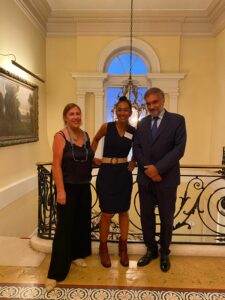
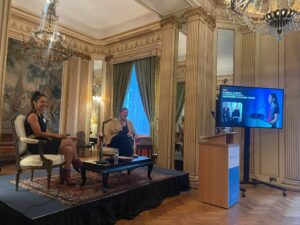
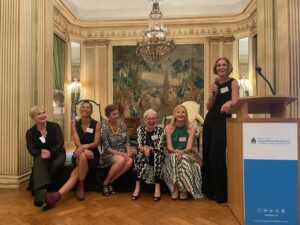
    Lumos Education was delighted to be invited to sponsor Women Powering Smart Energy’s conversation event at the Argentine Ambassador’s Residence. The evening, co-ordinated by Steve Gladman of Women Powering Smart Energy, highlighted the relationship between gender and conservation.

    The Dalai Lama has said that the western woman will save the world.  The women changemakers who spoke at the Ambassador’s Residence in September embody his prediction.  Their dynamism and steadfast commitment to preserving the environment and wildlife makes them a true beacon of hope in the sphere of conservation.


    Only a Child


    The Ambassador for Argentina in the UK, his Excellency Javier Esteban Figueroa, launched the evening.  I introduced the film, Only a Child, which was produced by Simone Giampaolo and narrated by the then 12 year old girl, Severn Cullis-Suzuki in 1992. The message, from this young child’s perspective, is that governments and communities need to act now to affect lasting change. Her compelling young voice states eloquently that ‘northern countries will not share with the needy, even when we have more than enough, we are afraid to share, we are afraid to let go of some of our wealth.’  Severn declares: ‘you grown- ups say you love us, but, I challenge you, make your actions reflect your words.’  At the end of the film, Severn, now a Canada- based environmental activist, is pictured, over 30 years after her words, as an adult with her own children. The time that has elapsed between Severn’s childhood and her growing into adulthood and raising her own family, demonstrates powerfully how much-needed changes to halt the environmental breakdown have been slow to manifest.


    Dr Micaela Camino


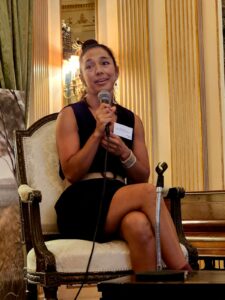
    The audience enjoyed the rich conversation between award-winning conservationist, Dr Mica Camino and the Cultural Attaché to the Argentine Embassy in London, Minister Alessandra Viaggiero.  Their discussion focused on the importance of engaging with indigenous communities, who live close to nature and depend on the local food, structure and wildlife for their own survival.  And for the continued survival of their children.  Mica spoke about the importance of understanding that, in conservation, the environment and people can’t be separated.  The two are inextricably linked.

    Dr Micaela Camino


    Mica is a committed conservationist on a mission to empower communities, defend their human rights and to preserve the fragile ecosystem of Argentina’s Dry Chaco.  Nestled in Northern Argentina, this expansive forest teams with both indigenous communities and critically endangered species, notably the Chacoan peccary.  However, the relentless advance of agricultural development threatens not only the habitat but also the very livelihoods and cultural heritage of the local people.  Mica is the recipient of the Whitley Fund for Nature (Green Oscar) 2022 for her research work to defend the Dry Chaco forest.  As a Researcher of the National Scientific and Technical Research Council of Argentina at the Conservation Biology Laboratory of Centre for Applied Ecology of the Coast and Founder and Director of Proyecto Quimilero, Mica juggles her career with mothering her young son.  Her tireless efforts exemplify the power of grassroots action and the potential for positive change even in the face of daunting challenges.


    Mary Rice 


    Following Mica’s incredible achievements, the audience listened to Mary Rice’s equally impressive contribution to the environment.  In conversation with Aisling Ryan, herself a committed conservationist, Mary described her role in bringing about the global ivory ban.  She spoke about her negotiations with governments and key players to enforce action or legislative change, often in extremely demanding political and social circumstances.  Mary and Aisling reminisced about their attendance at Kenya’s historic ivory burn in Nairobi.  Both thinking that they would stay in an hotel but, in reality, Mary camping knee-deep in mud wearing a pair of child’s pink wellies, whilst grappling with streaming the ivory burn live to the international community.

    Mary Rice


    As Executive Director of the Environmental Investigation Agency (EIA), Mary Rice’s accomplishments are simply colossal.   In addition to directing the EIA’s work on the illegal ivory trade and attending major international meetings related to the subject, Mary acts as a spokesperson and presents on the issue. Working with investigative and analytical teams to obtain the data and evidence required to support and facilitate enforcement action or legislative change, she liaises closely with stakeholders worldwide to ensure an innovative and strategic approach to what is a dynamic and global problem.

    Trained as a journalist, Mary spent 15 years working in Asia before moving to London.  She is also a  published author and photographer. “Heat, Dust and Dreams”(Struik), an exploration of people and environment in Namibia’s Kaokoland and Damaraland, was the result of three years of research and photography in what is now known as the Kunene region, home to the last viable population of black rhino outside a protected area. And one of the world’s last great wildernesses.

    Aisling Ryan


    Leading Conservationist, Climate and Sustainability Leader, Aisling, led the campaign to stop the ivory trade alongside Mary Rice. This campaign resulted in four UN resolutions and bans in China, Hong Kong, the UK, US, Canada and France   She has collaborated with the Kenyan government, EIA, WildAid, ZSL and other key NGOs. She also negotiated a pro-bono partnership with WPP to create a mass lobby campaign and with Kantar to deliver pivotal research to prove public support to ban the ivory trade. She has worked with Conservation South Luangwa (CSL) in Zambia since 2014 and continues to serve as Non-Executive Director and Trustee.

    Recognised for her contribution to sustainability and ESG, Aisling is a recipient of many awards, including the UN SDG Impact Award, Gold Cannes Lions, D&AD Pencils, the Grand Prix at The Marketing Society Effectiveness and the Campaign Big Awards. She was also acknowledged for her valued contribution to DE&I on the 2019 and 2021 HERoes INvolve Women Role Model Awards Global 100 List of Senior Executives.  Aisling pioneered the People’s Seat for the United Nations. She also drove negotiation and partnership between Sir David Attenborough, UNHQ, UNFCCC and Poland and wrote his speech for COP24.


    Millie Kerr


    Following Aisling’s discussion with Mary, Millie Kerr, US lawyer turned conservationist, author and wildlife photographer, spoke with Aisling Ryan about her distinguished career, marked by a resolute dedication to the cause of environmental preservation.

    In conversation with Aisling, Millie explained how her grandparents’ ranch had been a key influence in her childhood and served to cultivate an early love of wildlife and devotion to conservation.  Weekends and holidays were spent with the animals on their property, which included scimitar-horned oryx, rheas, zebras and other foreign species which they began introducing in the 1970s.

    Millie Kerr

    After working for a prominent London international law firm, her career trajectory took an unexpected turn during a sabbatical to Namibia, where she undertook a role at a wildlife conservancy. This experience kindled her passion for documenting and advocating for wildlife and nature conservation. On returning to the United States, a brief stint at the Federal Communications Commission preceded her relocation to New York City, where she continued to write while employed by the Wildlife Conservation Society/Bronx Zoo.

    Asked by Aisling how she would advise Londoners looking to make a difference, she suggested a rewilding a small garden, emphasising that even with the shortages of outdoor space in London, this is perfectly possible and incredibly rewarding.

    Based in London, Millie is a freelance multimedia journalist. Her writing on travel and wildlife conservation has been featured National Geographic Traveller, The New York Times, and The Wall Street Journal.  Millie’s debut nonfiction book, “Wilder: How Rewilding is Transforming Conservation and Changing the World,” published by Bloomsbury in August 2022, enjoys acclaim and endorsement from celebrated conservationist Jane Goodall. This volume, characterised as a fusion of popular science and memoir, surveys rewilding projects worldwide, highlighting the individuals defining the evolution of conservation.

    Professor Genoveva Esteban

    Distinguished academic, Professor Genoveva Esteban (Bournemouth University, UK), specialises in microorganisms in fresh water and marine environments.  Having completed her PhD in Spain, Genoveva came to the UK as a postdoctoral student and has worked here even since.   She has juggled her research and conservation work, with her family commitments.   During her career, Genoveva has pioneered ground-breaking research into the diversity of free-living microorganisms to help us to better understand ecosystems.  She explains how, as some microorganisms eat bacteria, they benefit the environment.  And as foundations of the food chain, microorganisms help to conserve the environment, essentially safeguarding bigger animals by protecting the little ones.

    Dr Genoveva Esteban


    Genoveva agrees that there is a gender imbalance in the way that men seem to be seen as more credible, in the world of conservation, but she says things are starting to change.  She is currently looking to develop a project, with fellow academics in the UK and on mainland Europe, to see how the different freshwater environments and habitats can be connected.  This project is about habitat connectivity in a fragmented world.

    Genoveva has infused the younger generation with her passion and knowledge.  Her students around the globe, including in Poland the US and Spain, are continuing Genoveva’s work in their own labs.  She says that, in her experience, the younger generation want to use science to help conserve the environment because they know that the planet is under threat.  They are interested in understanding how science works and how to use the scientific knowledge they have gleaned encourage conservation.  As well as working with students at her university, Genoveva also works with children in her local community to promote STEM subjects.  She runs science family days at her local museum to promote science and the importance of cherishing the environment.

    As well as encouraging and inspiring the next generation, Genoveva’s has built and nurtured deep and lasting partnerships with colleagues from Government departments, research centres and wildlife trusts.  She sends 15 students every year on a work experience placement to work with researchers in those institutions.

    The depth and richness of the contribution that these women have made to the environment and conservation is simply extraordinary.   In a world that, with the pace of environmental damage, and inability of governments to take urgent action, often seems hopeless, these women offered hope.  I know I, and all of my Lumos Education colleagues and partners who attended, poured out into the London evening feeling inspired, humbled and hopeful.

    Ronel Lehmann, of Finito Education, recently told me that a many of his young university leavers are keen to follow careers in the fields of conservation and the environment.

    Micaela Camino, Mary Rice, Millie Kerr, Aisling Ryan and Genoveva Estaban are blazing a trail for young women- and men- to follow.


    Johanna Mitchell is the Founder and Director at Lumos Education

  • The Poet at Work I: Tishani Doshi

    The Poet at Work I: Tishani Doshi

    As the government seemingly reduces the importance of poetry on the national curriculum, by making its study optional at the GCSE level, Finito World is introducing this regular series aimed at illustrating the utility of poetry, and examining the relationship between literature and the workplace. Poets are asked to produce a poem which speaks to what our first featured poet, Tishani Doshi, calls ‘ideas of work, leisure, community, labour, decoration, and poetry and the space we create for it all. ‘ After we produce the poem, we then give the reader a Q & A touching on the life of the poet and their relationship with work.


    Tishani Doshi is a poet and novelist born in what was then Madras in 1975. She has built an international reputation on the back of her poetry and novels – for which she has won many awards, including the Eric Gregory Award and the Forward Prize for Best First Collection. Her novels have also been critically acclaimed. Her most recent Small Days and Nights has been shortlisted for the Tata Best Fiction Award 2019 and the RSL Ondaatje Prize 2020.


    In ‘Postcard from Work’ readers will immediately be relieved by the exotic colours – ‘the yellow trumpet flowers’ and the ‘sunbirds…diving in and out of this den of gold.’ It is a poem which begins in a blaze of light. It is a piece ostensibly about work, but where little work is done – except the perhaps more vital work of paying tribute to the natural world, and mulling our place in it. Sometimes the best we have to offer our masters is to take a mental holiday from the tasks they have set us to do.


    Doshi knows that we were not born only to consider ‘the price of milk’ but to find ways of being which let death know we mean to ‘hold on.’ Work has to be done – and someone has to do it, and that will mean taking a break from dreaming. Doshi zooms out to show us what tasks lie unfinished around the narrator: we might be in a seamstress’ (‘someone else will tend the hem’) or even at a vet (‘someone else will pry open the dog’s jaw’). All our leisure, the moments we snatch, must be supported by drudgery elsewhere. Doshi also makes her living as a dancer, and her poems always have something of dance about them – they are miracles of rhythm and movement, and full of a joy which does what poetry should do: her poems are the antidote we didn’t know we needed until they came our way.


    Postcard from Work 


    Forgive me, I have been busy 

    with the yellow trumpet flowers.

    They dance uselessly, slivers

    of rapture. I know the dishes

    need washing but the sunbirds

    are diving in and out of this den

    of gold. Their dark purple wings

    are soft nets, intimate with the leaves.

    Beaks poised to receive nectar. There are 

    days I neglect my beard. I grow tired 

    of digging. I imagine someone else

    will tend the hem, the torn sleeve.

    Someone else will pry open 

    the dog’s jaw for his evening pill. 

    Our throats are in constant need

    of shelter.


    I’ve sublet a room   

    to a poet who does not know 

    the price of milk but is ready 

    to lay down her spear and surgical

    instruments, to worship the roots

    of this labyrinth. If there is rain

    and soil, onions will grow. After 

    a day in the field, the poet and I 

    sit around a fire to sing. It is a way 

    of letting death know we mean to hold

    on. The threshold stays warm. We flick

    at night with a fly-brush, cheat insects

    of their audience with a chorus 

    resurrected from silence. Think 

    of the performance of this lament

    as our hunger, of the armchair

    in the corner, our repose. 

    Underneath, is a footstool 

    that hides.


    What is the interplay in your life between dance and poetry? Is it an entirely fruitful one or can it be said to be in any way antagonistic?


    Poetry came first, but in a way, poetry only came into being once I had dance. They’ve never been antagonistic, unless you count yearning for one, while you’re engaged in the other? But that feels such a natural way of being in the world. Both require a kind of vulnerability and strength – the making of your own vocabulary. When I’m in a lazy mode, which is my most natural way of being, I wonder at both the worlds of poetry and dance, the capabilities we don’t imagine for ourselves. 


    How do you find the business side of your writing life? Many writers I know struggle with invoices/tax/the admin of it all? But then I think that can also be a cliché and many writers be surprisingly scrappy and hard-headed?


    I studied business administration and communications before ditching it for poetry, so I can get around economics and accountancy alright, but that’s not to say I thrill in it. I move in waves. Sometimes I’m terribly productive about everything – to-do lists and all. Other times I want to be left alone to watch the flowers. 


    The UK government has recently said that poetry should be optional at the GCSE level – a significant demotion in its importance on the curriculum. What is your view on that and what do you feel the impact will be?


    One of my first jobs was to teach an introduction to poetry and fiction class to students at Johns Hopkins University. It was a required class, most of my students were pre-med or engineering. I like to think as a result that in future dentist waiting rooms, there may be a volume of Elizabeth Bishop lying around, or that someone designing a bridge might dip into the poems of Imtiaz Dharker for inspiration. I don’t know what the UK government’s motivations for demoting poetry are, but I hope usefulness was not a factor. Everything is connected. I can’t imagine any kind of life that doesn’t need the intuition and imagination of poetry.


    What sort of role does poetry have in India – does the government encourage it sufficiently or is there tension in your country also on that score?


    Well, our current prime minister unfortunately published a volume of poems, called A Journey.  Historically, tyrants have had a thing for poetry (see Mao, Nero, Stalin, Mussolini Bin Laden), which gives poetry a bad rep. Poetry as I remember it in school was rather fossilized and distant. I think at the college level, there have been serious efforts to rejuvenate and decolonize the syllabus. In schools, I fear they may still be standing up in front of classrooms with hands clasped, reciting “charge of the light brigade.”  


    Was there a particular teacher when you were younger who turned you onto poetry?


    Yes. Her name was Cathy Smith Bowers. I took one of her classes as an undergraduate in college, and it changed my life. 


    What’s your favourite poem about the workplace?


    I read this as a work poem, because I love my work, and my work is poetry.


    Love is a Place by EE Cummings 


    love is a place
    & through this place of
    love move
    (with brightness of peace)
    all places

    yes is a world
    & in this world of
    yes live
    (skilfully curled)
    all worlds

  • Meredith Taylor reviews E.1027 – Eileen Gray and the House by the Sea

    Meredith Taylor

    Eileen Gray (1878-1976) was a creative genius and the first woman to conquer the world of architecture at a time when men controlled it all. This new film reflects on Gray’s impressive career and her stunning modernist house on the Cote d’Azur and will appeal to cineastes and lovers of art and design alike.

    Unfolding as a stylish hybrid documentary E.1027 is a filmic journey into the emotional world of Eileen Gray, who was born into a large family in County Wexford, Ireland before moving to London where, after being presented as a debutante, she studied Fine Arts at the Slade and was later drawn to furniture design and architecture although her career languished in the shadows at a time when the profession was dominated by men.

    In the 1920s women architects found themselves confined to designing interiors and Gray broke the mould by moving to the South of France where she found a plot of land on the water’s edge in Roquebrune – Cap Martin and fulfilled her dream of having a modernist house on the Riviera.  A self-confessed bi-sexual she lived there with her younger lover, the editor-in-chief of the journal ‘Architecture Vivante’ Jean Badovici. The two crossed paths with fellow architect Le Corbusier who comes off the worse for wear in Swiss filmmaker Beatrice Minger’s take of events. He is seen an arrogant and rather self-regarding character who muscles into Gray’s world by decorating E.1027 with his own murals.

    Eileen Grey – the house at Roquebrune – Cap St Martin

    Minger’s film takes us into Gray’s inner circle, a tightly knit coterie of designers that included Fernand Lager, Corbusier and his wife Yvonne. Early on Gray in the film counteracts Corbusier’s theory that a house is ‘a machine for living’  considering it more spiritual than that: ‘A place you surrender to, that swallows you up. A place you belong to”.

    Gray and Jean Badovici dedicated themselves to building the E.1027 in the Roquebrune-Cap-Martin location between Monaco and Menton in 1925. Due to its rocky, cliff-hanging location, wheelbarrows had to be used to transport materials on site. Gray named the house: E for Eileen 10 for John Badovici but their idyll came to a close two years later when Gray sensed the winds of change: “I like doing things but I don’t like possessing them”. She had already bought another plot of land inland and her attention moved on to design a place in this  even more remote location.

    The film then broadens its focus onto ‘Bado’ and Corbusier’s relationship, with the French architect claiming Gray’s scheme for the house was copied from his own pen design. Marking the territory he built his own wooden Cabanon alongside a little bistro near to E.1027. But the Second World War put an end to the rivalry when the German Nazi soldiers occupied the Roquebrune house riddling the walls with bullets.

    In the title role Natalie Radmall-Quirke smokes her way through this intimate portrait of the artist who appears both a victim of her deep emotions and the driving  force behind her lover Badovici – in one scene a graceful dance is testament to their feelings for each other. After leaving the house Gray was forced to contend with Corbusier’s arrogance, although he appears to redeem himself by trying to find a buyer for the Roquebrune house, eventually it was sold to Swiss artist Marie Louise Shelbert who misguidedly thought Corbusier was the architect. Gray organised a funeral for Badovici but no one came.

    Family money and her strong work ethic clearly allowed Gray to remain financially independent all through her life although there is never any mention of commissions outside her own designs: many of her schemes never left the drawing board until later recognition, and although her furniture now sells for astronomical prices: her chrome Adjustable Table. E.1027 is one of the flagships of modern classics in furniture history (www.smow.fr/eileen-gray/adjustable-table-e-1027.html )The famous house had a less illustrious ending. In a final interview Gray finally appears in her nineties, emerging as an appealingly decent woman without a shred of ego.


    E1027 – Murals by Corbusier


    EILEEN GRAY AND THE HOUSE BY THE SEA which will celebrate its world premiere at CPH:DOX 2024 (March 13-24, 2024) in Copenhagen as part of the INTERNATIONAL COMPETITION programme.


  • Ronel Lehmann on 2Veneti: “right up there with the best”

    Ronel Lehmann on 2Veneti


    As I was making my way to join a senior colleague in this Wigmore Street restaurant, my thoughts abruptly turned to a breaking news alert on my mobile phone that a new satellite is now able to detect emissions of methane, an invisible yet potent gas that is dangerously heating the planet.

    It reminded me that the day before I had succumbed to a Jerusalem Artichoke Velouté at Coq d’Argent, a French restaurant perched high up in the heart of the city. The significant side effects of dietary inulin fibre apparently is a contributory factor and the cause of flatulence.

    To my abject horror, I noticed that my host had one of her two wrists in plaster. The greeting at 2Veneti is “Magna e Tasi, Bevi e godi” which translates to “Eat and shush, drink and enjoy.” Although I was immediately made to feel at home, I was concerned about whether I would be required to cut up her food as clearly operating with one hand in 2Veneti was going to be challenging. There was real trattoria décor and character in the restaurant which filled up quickly with the lunch service.

    Although we were supposed to be working afterwards, the owner charged our two glasses of wine to accompany our meal. My colleague enjoyed a glass of Lugana di Sirmione. Avanzi. 2022 Veneto, Turbiana grape, which she remarked was rounded with a pleasant generous velvety taste. From lake Garda I myself enjoyed the Bardolino Chiaretto. Cavalchina 2022 Veneto which was a Light pink Bardolino, Provence in style, smooth and elegant.

    A bread basket of focaccia was served and it was light, airy and Moorish. My colleague began by ordering Carpaccio di Manzo con maionese al Parmigiano e tartufo nero, beef carpaccio with parmesan mayonnaise and black truffle whereas I chose the vitello tonnato, thinly sliced veal with tuna, capers, mayonnaise and pickled onion. Both starters were delicious and beautifully presented.

    As the plates were cleared, I noticed that my colleague was managing to eat the food very respectfully. I asked the owner about the name 2Veneti. He responded that there were two original partners from Venice, hence 2Veneti. A simple and plausible explanation which made perfect sense.

    The ravioli del plin con fonduta di formaggi arrived. This was baby ravioli filled with beef and cheese fondue. I decided not to have the black truffle sauce and was encouraging the waitress to provide additional aged Parmigiano-Reggiano which she readily obliged.

    My colleague enjoyed a plate of gnocchi di patate fatti in casa con radicchio e formaggio Monte Veronese, a wonderful homemade potato gnocchi with radicchio and Monte Veronese cheese.

    No Italian meal is without a resplendent bowl of zucchini, and we shared a giant helping together. The pudding menus arrived, and we decided to share a pistachio and vanilla ice cream.

    When you think of the great Italian restaurants in London, you might be minded to mention The River Café, Sartoria and Santini. 2Veneti is right up there with the best. The service is welcoming, friendly and efficient. Regulars in Marylebone and Mayfair will tell you it is a best kept secret. I cannot wait to try the other dishes when I return. Hopefully the satellite picked up the heat of our smiling faces as we returned to the office.