Category: Features

  • Renewable Energy Tipping Point – A Powerful Shift in Investment

    Renewable Energy Investment, Dinesh Dhamija

    The world is witnessing a dramatic surge in solar energy generation, driven by falling costs and a newfound enthusiasm for renewables in China. According to the International Energy Agency (IEA), clean energy investment is expected to double that of fossil fuels in 2024. “For every dollar going to fossil fuels today, almost two dollars are invested in clean energy,” says IEA executive director Fatih Birol. The figures are staggering: $1 trillion for fossil fuels compared to $2 trillion in clean energy, which includes renewables, nuclear power, electric vehicles, power grids, energy storage, low-emission fuels, and energy efficiency improvements.

    Solar Energy Growth and the Renewable Energy Tipping Point
    The cost of solar technology has plummeted by 30 percent over the past two years, leading to a rapid expansion of solar farms across China and the United States. In the first four months of 2024 alone, the US saw nearly 8GW of new solar capacity and an additional 1.8GW from wind energy. The Federal Energy Regulatory Commission reports that more than 99 percent of new US generating capacity during this period came from renewable sources. This impressive growth underscores the Renewable Energy Tipping Point, as the global energy market pivots towards cleaner and more sustainable options.

    As renewable energy costs continue to decline, this trend is expected to accelerate. Despite efforts by the oil, gas, and coal industries to influence policymakers and argue for the continued use of hydrocarbons, the economics of power generation increasingly favor renewables. The question arises: why pay more for an energy source that harms both health and the environment?

    Global Investment and the Future of Renewable Energy
    Global investment in low-carbon electricity is forecasted to reach $900 billion in 2024, ten times higher than the investment in gas and coal power generation. In the United States, renewable energy capacity is projected to surpass natural gas by 2027. This shift will highlight whether countries are committed to outdated fossil fuel generation or are embracing more progressive energy policies that benefit their citizens.

    This transition presents a curious challenge for politicians like Donald Trump, who have historically been anti-renewables. If Trump were to be re-elected in November, he would face a burgeoning boom in clean energy generation, potentially challenging his previous stances. The broader question remains: how will political leaders worldwide respond to this unstoppable trend?

    The Irrepressible Shift Towards Renewable Energy
    The IEA notes that investment in fossil fuels remains higher than desired, with oil and gas companies allocating just 4 percent of their investment budgets to clean energy, despite their claims of being part of the solution. The agency urges governments to adhere to its target of tripling renewable energy generation by 2030. This goal, while ambitious, is crucial for mitigating climate change and ensuring a sustainable future.

    While more can always be done, the undeniable and accelerating flow of funds into renewable energy has indeed reached a tipping point. Soon, it will seem absurd to invest in anything else. This shift not only marks a significant economic change but also signals a broader societal transformation towards sustainability.

    Dinesh Dhamija, who founded and sold the online travel agency ebookers.com before serving as a Member of the European Parliament, has since established the largest solar PV and hydrogen businesses in Romania. Dhamija’s career transition from travel to renewable energy underscores the potential for innovative leaders to drive significant change in emerging industries. His latest book, The Indian Century, is now available to buy on Amazon at The Indian Century.


  • Book review: A Chilling Account in “A Very Private School” by Charles Spencer

    Finito World


    Many people who have been to boarding school will recognise the following question and answer. “When you think of the school, what’s the one word that comes to mind?” “Fear”. This establishes the theme of Charles Spencer’s book which raises many questions around privilege and trauma in our society. Spencer’s time at Maidwell Hall, where he boarded for five years in the 1970s, was truly awful, and the writer makes multiple allegations of sexual abuse about the staff there, sometimes naming them. It is extremely brave of him to speak out about his experiences. Spencer also manages to do more than simply to convey them – sometimes he is able to understand them, suggesting that this book has been the product of a considerable amount of painful reflection. “’Her control over mesmerised boys was total, for we were starved of feminine warmth, and desperate for attention and affection,” he writes of one unnamed assistant matron who seems to have treated him especially badly.  Are things any better today? One hopes so, as much of this book is alarming to read. But I don’t think boarding school, since it involves wresting children from their parents at a young age, can ever really take fear out of the equation.


  • Labour Majority in 2024: Lady May Discusses the Uncertainties, “Politics has become much more volatile”

    Labour majority isn’t a foregone conclusion, Lady Theresa May


    I am stepping down at this election and so I now don’t have the letters MP after my name. I do still think there’s a path to victory for the Conservatives for a number of reasons.

    First of all, I was elected in 1997, and so I can say with certainty that Sir Keir Starmer is not Tony Blair: the impact on the doorsteps is simply not the same. That’s the impression I get in my Maidenhead constituency, and that’s what we’re seeing in what will probably be a marginal new constituency near me.

    It’s worth remembering that Labour still has a huge mountain to climb to take the seats they need to take to get a working majority. They have to secure the largest consistent swing across the country in order to get there. In addition to that, I think politics has become more volatile. You do not get consistent swings across the country any longer; you get much more variation between seats. You might get a seat which you think is in the bag, and another which isn’t – and you might lost the first and gain the second.

    The third reason why a Labour victory isn’t certain is that if you look at General Elections in recent years, they’ve tended to be unexpected results. 2010 was unexpected, so was 2015 – 2017 was definitely unexpected, to my own cost. Even in 2019, the size of the majority was unexpected. If you look closely at 2017, the Conservative Party was over 20 points ahead in the polls and look what happened: we didn’t secure our majority.

    It seems a long time ago now, but I would also point out that the local election results earlier in the year weren’t as good for the Labour Party or the Liberal Democrats as they would have wanted them to be: examine closely the gains of the Labour Party in the local elections, and add up gains by the Greens and the independents, they almost equalled the progress made by the Labour Party.

    The social care policy was a factor in that 2017 election. This is a huge issue which the country has to address. I’ve been Conservative all my life. One of the things I’ve been brought up to believe is that when you’re able you should put something aside for a rainy day. The welfare state, when it was created, was there to support people who weren’t able to do that, and to help people at certain challenging points in their life.

    Somewhere along the line, we’ve got to the point of saying nobody should have to sell their house to pay for their care and that, whatever happens, the government will provide. But if someone is sitting on a significant asset why should the young couple down the road struggling on average earnings to keep their head above water pay for that person’s care? Politicians need to have an open and honest conversation with the public about this.

    We live in much more uncertain and unpredictable times. It’s certainly the case that security has gone up the agenda because of our continuing support for Ukraine, but the number one issue in any election is the economy. I think there’s the need in today’s world to think a little more creatively about defence. People think in terms of big bits of kit for the army; but in Ukraine we have seen that drones have been incredibly effective.

    It’s concerning that Labour has not matched the government’s defence spending plans. What happened in Afghanistan has not made life easier as it’s made that country return to its former state as a place where terrorists can be trained. What’s happening in Gaza is potentially another flash point for those who would do us harm.

    I will miss many of my colleagues – and I will remember the strange things. I remember the occasion when I was PM, when I was in Iraq. I was flying back to have dinner in Saudi Arabia and had to change before the dinner. I was being transported in an RAF Hercules, which is a troop carrier. There are no facilities on such aircraft, let alone for a woman. I said I had to change. The RAF put their heads together and took me up into the cockpit and they sat me down between the pilot and the co-pilot. They got a sheet and some gaffer tape and said: “Here you are, PM, you can change there.”


    The former prime minister was talking on 23rd May 2024, the day after the election was called, at a Finito event at the East India Club

  • What the architect Frank Lloyd Wright teaches us about adversity in our careers

    Christopher Jackson


    When we look at the famous or the successful, graciously hosting television cameras in their comfortable homes, it is easy to assume that they have found themselves inoculated from what Hamlet calls ‘the shocks and arrows of outrageous fortune’. There is the sense that all that is difficult or troubling has been brought to heel somehow.

    One early example of this genre concerns the architect Frank Lloyd Wright approached in 1953 with the reverence with which someone in medieval England might approach a King by NBC Chicago’s Hugh Downs. This interview is in many respects a ridiculous affair. Wright is treated – and clearly regards himself – as not just a great artist but a seer and a sage.

    He may well have been all those things, but he is also plainly a self-regarding one. Throughout the interview, he sits with a large book inexplicably on his lap, like some vast Bible, which the viewer is invited to assume must be a compendium of his drawings. His answers are philosophical and one can never be sure if he is definitely looking Downs in the eye – certainly the impression is that Downs has come to Parnassus to address a higher form of life.

    Many will perhaps agree with Frank Lloyd Wright’s estimation of his own abilities while thinking he could have been more modest about them. Wright is one of those few architects who we can certainly say changed architecture, though it could sometimes be a bit tiresome to hear him point this fact out so often. It suggested perhaps that he had something to hide, and I think he did: his moral self, which was, biographers agree, by turns slippery, cunning, abusive, untrustworthy and arrogant.
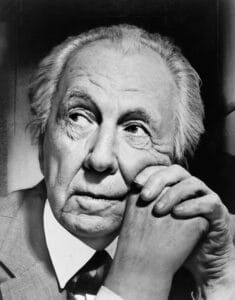
     

    This queasiness one feels about Wright is something we need to get out of the way before we discuss his genius, which is far more interesting and surprising than the news that well-known people often behave badly.

    More interesting – and it is especially worth considering for anyone who happens to YouTube the NBC Chicago interview – is Wright’s vulnerability, arising out of a lifelong familiarity with tragedy. In fact, looked at closely, Wright’s career involved a regular collision with adverse circumstances – some of them fairly typical and at least one of them unthinkable, which we shall come to in a moment. A book published in 1993 The Seven Ages of Frank Lloyd Wright, written by Dennis Hoppen, observed that Lloyd Wright had a remarkable ability to absorb reversals and over time convert them into new periods of creativity.

    It is this which makes Wright worth studying. The patrician who was never short of a word of self-praise ought not detain us. These traits probably had to do with a difficult upbringing: trauma created a sort of outer person which was secondary to the much more interesting inner creative life by which he really lived.

    In interview, we meet this outer self; in his work the far interesting central force. Regardless, his life has a fascinating rhythm to it: Hoppen’s book shows that Wright experienced surges of creativity which were routinely checked by disaster. But these disasters seem to have gone deep into him, and by some mysterious creative process, engendered over time great leaps forward in his art.

    Wright would often state that he didn’t decide to be an architect, his mother made that decision for him. She declared while Frank was still in the womb that he would grow up to create beautiful buildings and was so proactive in what was then a distant likelihood as to adorn his nursery with pictures of the great English cathedrals. Wright would later make it clear that he didn’t think anybody had taught him architecture telling Downs with his usual slightly prim arrogance:


    I’m no teacher. Never wanted to teach and don’t believe in teaching an art. Science yes, business of course..but an art cannot be taught. You can only inculcate it, you can be an exemplar, you can create an atmosphere in which it can grow. Well I suppose I, being an exemplar, could be called a teacher, in spite of myself. So go ahead, call me a teacher.


    Wright’s initial degree was in civil engineering but his ambition was to make it to Chicago; in fact, he left university just before completing his qualification. He may not have felt he needed a teacher. But a mentor, one feels, can be a quite different thing and in Louis Sullivan, of the firm Adler & Sullivan, that is what Wright found in spite of his own irascibility and the perennial failure to get on with people which would often crop up in his career.

    Though Wright would make a habit of disparaging his contemporaries, Sullivan would be remembered fondly by Wright – though by no means so fondly as to make anyone think Wright himself was anything other than number one, or in his own confident estimation, “the greatest architect who ever lived, or will live.”


    The trouble with Wright’s arrogance is that the architecture does tend rather to bear out his own high assessment of himself. Even as a young man he had already by 1900, almost single-handedly, invented prairie architecture, with a series of four houses which showed a completely undaunted sense of the possibility of American architecture, and by association American life. The European ideal, from Wright’s perspective, was all very well, but the greatness of European art had been arrived by being true to the history and values of that continent. Mightn’t something new be possible in this vast country?

    And if something was possible, then what distinguished the American case from the European? The first thing was the sheer size of the country and therefore the space assigned to each individual. Europeans, and especially British people, have long since found themselves living on top of one another. Any visitor to the towns of America feels how different the demographics are: we feel the country’s enormity, its abundance, and tied to these things, the sense that Americans can live differently, which of course means in different buildings. Prairie architecture was Wright’s first attempt to be true to what now seems to us a fairly obvious reality. Many of these houses still stand today as he always said they would.

    The great innovation here is the horizontal line which mirrors the great outstretched nature of America. For Wright, European architecture was pre-democratic or even anti-democratic and characterised by boxed rooms, which are ideal for establishing hierarchical systems. One thinks of the servants’ quarters, or the cut-off luxury of, say, the master bedroom in a typical European castle. Wright’s houses are different: the open floor plan which would go onto dominate, in another setting, office life, is really his invention.

    But these insights were built on a deeper intuition which had to do with the need to respect landscape, making Wright the purveyor of what he called organic architecture. This meant that his architecture was meant to embody the essence of the land. Most famously, he once expounded his views on hilltop or hillside architecture: “No house should ever be on a hill or on anything. It should be of the hill. Belonging to it. Hill and house should live together each the happier for the other.”

    Wright’s architecture belongs to the land – and he accentuated this idea by building often in stone and wood. The prominent central chimneys in these houses are intended to relate to the human heart – and there is perhaps the sense that Wright’s buildings correspond not only to the landscape they’re in but to human beings themselves: they are, perhaps, attempts to create functional counterparts to the American soul.

     

    It all amounted to a great vision of democracy by a man who in his life was actually rather authoritarian. It is possible to find a contradiction in his life between his sense of himself as the isolated Great Man, and his oft-stated belief that American architecture cannot thrive unless it takes into account its founding principle of democracy.

    These promising – indeed, exceptional – beginnings were soon to be upended by unthinkable tragedy. Wright, though married, had conducted a controversial affair with a married woman – and the wife of one of his clients – Mamah Borthwick. The press got wind of it all, and Wright built Taliesin in its the first incarnation in order to shield Borthwick from the press. Then on August 15, 1914, Julian Carlton, a male servant from Barbados, set fire to Taliesin, and then murdered seven people, including Borthwick and her two visiting children. It is hard to imagine what this must have been like for Frank Lloyd Wright, who happened to be away on business. But in time his reaction was remarkable:


    There is release from anguish in action. Anguish would not leave Taliesin until action for renewal began. Again, and at once, all that had been in motion before at the will of the architect was set in motion. Steadily, again, stone by stone, board by board, Taliesin the II began to rise from Taliesin the first.


    It is a splendid lesson about how to deal with setback: creatively. As Taliesin II was rebuilt, Lloyd Wright was working on a new phase in his career, when he accepted a commission to design the Imperial Hotel in Tokyo. This looks so different as to not seem to be from the hand of the same architect, but of course it’s in a different country and Wright was committed to an architecture which, to a near obsessive degree, took into account place.

    Wright had thought through the viability of the structure – although sometimes this has been exaggerated a little. The structure did survive the Great Kantō earthquake of 1st September 1923 which and Baron Kihachiro Okura sent Wright the following telegram:


    Hotel stands undamaged as a monument of your genius hundreds of homeless provided by perfectly maintained service congratulations[.] Congratulations[.]


    Wright being Wright, he wasn’t about to keep this telegram from the press and the story did a fair amount to embellish his legend. In actual fact the central section had fallen through, and several floors bulged. It certainly wasn’t the least damaged building the earthquake.
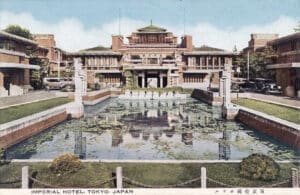
     

    But Wright had moved onto another phase, which is sometimes characterised as ‘monumentality’. His block houses such as Ennis House fall broadly into this category. One wonders whether in their scale and grandeur they reflect a growing awareness of America’s imperial destiny: they feel like houses which belong to a powerful people, and in the wake of the First World War, where American involvement had decisively tipped the scales towards the Allies, America’s self-image had shifted. It would be the world power, and here was the architecture to prove it.

    But further disaster was round the corner, in the shape of another fire at Taliesin. On April 20th 1925, Wright noticed smoke billowing from his bedroom, and though on this occasion he was on site and able to call for help quickly, it was a night of high winds, and Taliesin II was destroyed along with much of the superb art collection which its owner had acquired while working in Japan. But again he was undaunted and took this loss as inspiration for Taliesin III which still stands today:


    And I had faith that I could build another Taliesin! A few days later clearing away the debris to reconstruct I picked up partly calcined marble heads of the Tang-dynasty, fragments of the black basalt of the splendid Wei-stone, Sung soft-clay sculpture and gorgeous Ming pottery turned to the colour of bronze by the intensity of the blaze. The sacrificial offerings to — whatever Gods may be. And I put these fragments aside to weave them into the masonry — the fabric of Taliesin III that now — already in mind—was to stand in place of Taliesin II. And I went to work.


    There is something magnificent about the simplicity of that sentence: “And I went to work”. In its confident forward movement we get very close to the essence of the man. From here, Wright would go on to his so-called ‘desert architecture’ phase – it was a difficult time for Wright personally and financially and he was forced to take on smaller projects such as Ocotilla and San Marcos in the Desert. This must have been relatively humbling, and of course the 1929 Great Depression was round the corner to humble him further.

    By 1929, he could have been forgiven for thinking he’d had a life entirely comprised of setbacks. This huge decline in productivity led to another fallow period and then a period of low cost architecture characterised by his Usonian houses – small houses very private from the front and open at the back usually aimed at the middle class. The first such house is usually considered to be the Herbert and Katherine Jacobs First House.

    Though this house, with its horizontality, and little carport, was perhaps a rather humbling project for a man to undertake who considered himself the equal, and indeed the superior, to the architects who made the Pyramids, Wright couldn’t quite refrain from couching it in the grandest terms possible: “The house of moderate cost is not only America’s major architectural problem, but the problem most difficult for her major architects.

    As for me, I would rather solve it with satisfaction to myself and Usonia than build anything I can think of at the moment.” Usonia, incidentally, was Wright’s somewhat ludicrous term for America, but these houses are extremely beautiful and subtle. They feel as though they contain an earned wisdom. Indeed, perhaps as one looks at the wonderful Usonian houses, one can reflect that humility wasn’t a bad thing for Frank Lloyd Wright to get to know a little.

    But humility wasn’t to be for the architect in the long run. The second half of his life contains fewer setbacks and much of his greatest work, especially the magnificent Fallingwater was still ahead of him, and that superb office space the Johnson Wax Headquarters, with its famous lily pad columns. Wright always said that it increased productivity.

    As impediment fell away, and a greatness exactly like the one imagined for him by his mother was assured, Lloyd Wright settled into the grand and arrogant persona which Hugh Downs would come to visit in 1953, some six years before his death. But what’s more interesting than the man at the summit he became is the way in which he surmounted so many obstacles to get there.


  • Robert Colvile Interview: Insights on Journalism Careers and the Positive Future of Media

    Finito candidate Cameron Kerr sat down with the renowned writer to ask him about his career, why he never expected to run a think tank, and the need for a career backstop for would-be journalists. 


    Cameron Kerr: Was your journalism career a goal you had planned to achieve or a role that you fell into?


    Robert Colvile: It was never something I’d thought about until university, but I volunteered to work on one of the student papers there and absolutely loved it – not just the writing, but every part of putting together a newspaper. I did consider some other options – I applied to the Civil Service, for example – but ultimately it was always the thing I wanted to make a living doing if I could.


    CK: Take us through the early days of your career, from where you first encountered opportunities in journalism, to a point in your journey where you could tell yourself or peers that you worked as a journalist for a living.


    RC: I got started at university, then tried to make as much of that opportunity as possible – for example getting accreditation to the various festivals at Edinburgh over the summer, then covering them for the paper (which also enabled me to build up a stock of interviews with some of the people performing or promoting their films and books). After university I got on to a training scheme at the Observer, so I did work experience there and at the New Statesman, while supporting myself by doing admin work as a temp.

    Then I got some extra work helping produce the paper on Saturday evenings, and uploading the print edition on to the Guardian website, and doing paid supplements on broadband take-up, and just anything I could do to get a foot in the door. But I wasn’t properly, formally a professional journalist until I parlayed all that into a job on the Telegraph’s training scheme, which was looking for sub-editors – the people who sit back in the office editing the articles, checking the facts, putting on the headlines and so on.


    CK: Is the route you took into journalism a pathway which others could follow today, and if not, how does that entry pathway look different in 2024?


    RC: The thing about journalism is that there really aren’t many formal pathways. I was lucky enough to get on to one of the Fleet Street training schemes, but the number of people they take are vanishingly small compared to the size of the sector. One of the big differences today, though, is that there are so many more opportunities to get yourself noticed by writing, tweeting, blogging, starting your own thing and getting noticed. One of the great things about journalism is that ultimately, quality really does shine through – if your writing is good, or you’re a good editor, people absolutely take notice.


    CK: What opportunities in your career do you feel you discovered, pushed for and achieved yourself?


    RC: All of them! Though in retrospect I could have done more to push myself forward while at the Telegraph – I was there for 10 years and ended up in a pretty senior position, but there were quite a few years where I was sitting there quietly chafing, for example at not being able to move full time on to the comment desk. I probably could have been bolder in agitating for a move, or trying to find opportunities elsewhere. But I’m pretty happy with how it turned out.


    CK: What opportunities in your career, if any, do you feel were fortunate enough to be given to you – by bosses, word of mouth, unexpected events of the day to cover etc.


    RC: I’ll always owe a big debt to Liz Hunt, who’s now at the Daily Mail. As Telegraph features editor she plucked me from my sub-editing job and put me in charge of the news review section of the paper – the big, chunky, attention-grabbing Saturday reads – as well as the science page.

    And then I’m pretty grateful to Maurice Saatchi, who was then the chairman of the Centre for Policy Studies, for asking me to be the Director when I was running its CapX website. But the truth about journalism is that few people have a career path plotted out – I certainly didn’t think I was going to end up running a think tank, for example. It’s very organic, about the connections you make and the reputation you build.


    CK: Are there one or two defining moments/opportunities that took your career to a whole new level – they could be expected or a total surprise.


    RC: The move from being a sub-editor to an editor was definitely a step change – after that my career started moving forward much more quickly. Getting to run CapX was similar – I was freelancing as a writer, and had had quite a few discussions with people, but wasn’t really actively looking for a full-time role. And oddly, moving into think tanks really improved my opportunities as a writer – I suddenly had not only a load more relationships in Westminster, but a massive pipeline of policy ideas that I could write about and publicise.


    CK: With all your industry experience and knowledge of the state of journalism today, is it a career you would pursue now if you were starting from scratch?


    RC: Yes, but with the caveat that you really do have to have a backstop these days in a way that you didn’t in the old days. There’s so much competition to get into journalism, and so little profit, that the salaries really aren’t very good, at least not until you get right to the top of it. I’m proud that I never got a penny of support from my parents, and got every single job on merit rather than due to connections.

    But at the same time, I knew that if it didn’t work out, I could always retrain as a lawyer or management consultant or what have you. A lot of people don’t have that safety net. And there are also always people who are prepared to work unpaid until they get hired, which is pretty tough to compete with.


    CK: What does your journalism career look like today? And do you think a regular op-ed in a major newspaper is still the desirable goal to achieve for a journalist looking toward the future of their career… or does it look different now with the presence of social media, podcasts, vlogs and straight-to-web documentaries?


    RC: My main job in journalism is as a political columnist on the Sunday Times – I also oversee the Centre for Policy Studies’ CapX site as editor-in-chief, but that’s a much more limited commitment, as we’ve got a good team who keep it running day-to-day. Having the column is still an incredible platform, and I’m very privileged to have it – but if I didn’t have the day job at the CPS then I would probably doing a lot more on top of that, whether a podcast or a Substack newsletter or what have you. Ultimately, there are all kinds of ways of reaching an audience – you just have to find the one that works for you.


    CK: Looking back at your career, from early steps to the big decisions, is there anything you would have done differently with the gift of hindsight – perhaps even advice you would give to those starting out now?


    RC: There are all kinds of things I should have done differently – mostly having a bit more confidence in myself, and in my value to my employer. But the big things would be things that I hope I got right – always try to do the best possible work, and always try to be someone other people actually want to work with.


    CK: In a world of a multitude of news outlets, podcasts, opinion columns and broadcast shows, how do journalists and the media have to evolve in order to continue their mission to inform the public and hold the powerful accountable?


    RC: In all kinds of ways! It’s pretty obvious that mass market news is breaking down into a host of niches. The audience for the BBC evening news, for example, has fallen off a cliff in the last few years. But the difference between when I was starting out and now is that the shadow of doom has been lifted – we were all convinced that the internet was going to kill newspapers stone dead, whereas today the kind of subscription models that the Times uses, or the revenue people are getting from Substack, shows that there is a future for high-quality journalism. But you always have to keep innovating.


  • Dinesh Dhamija: SunTrain, Innovative Renewable Energy Transport by Rail

    SunTrain: Innovative Renewable Energy, Dinesh Dhamija

    In 2023 Bill Gates mulled the future of renewable energy. One of the problems, he concluded, was transmitting energy from the windswept plains of Iowa, or the sunny deserts of Arizona. “You can’t exactly ship sunlight in a railcar,” he wrote.

    Electrical engineer Christopher Smith had other ideas. Inspired by train wagons full of coal traversing the Alaskan wilderness, he devised a novel business. SunTrain will transport large batteries full of solar-generated electricity on flatbed wagons, moving them from energy rich locations (windy, sunny, or with hydroelectric generation) to energy poor neighbourhoods.

    Smith is now raising finance and signing deals with utility companies, to bring his vision to life. He aims to run trains with 120 wagons, delivering electricity to power hundreds of thousands of homes. A gap in the market has emerged thanks to the glacial pace of planning consent for high voltage transmission lines. One major line in New Mexico took 17 years before it could begin construction last year. Many such lines are in development, but meanwhile, SunTrain could make use of the existing rail infrastructure, to deliver results far sooner. It would also save many hundreds of rail industry jobs.

    Just as pharmaceutical companies, tackling a major health challenge such as HIV, must experiment with multiple strategies before they find a hybrid solution, coming to grips with the climate crisis will take concerted effort along hundreds of different avenues.

    Repurposing railways is just one of the innovations that are now underway, as the world drives down its carbon emissions. A new fleet of ships, chartered by Airbus to transport aircraft parts across the Atlantic from France to Mobile, Alabama, will have a set of sails to complement its engines.

    Deploying an electric-powered suction system which boosts the power of the sails, Airbus will save up to 1,800 tons of CO2 per year compared with the existing sail-less ship. Similarly, agricultural trader Cargill chartered a Mitsubishi-owned ship in 2023 retrofitted with 37.5-metre-high sails to reduce its reliance upon fuel.

    Some will point out that using sails for getting around has been tried before. But when you see the space-age designs for the America’s Cup yachts, with their wings, hydrofoils and aerofoils, you realise that we have come a long way from the Mayflower and the Cutty Sark. For some, a massive breakthrough in nuclear fusion will be the solution to our energy and climate crisis. But this remains many years, if not decades away, according to the latest estimates.

    Shuttling batteries around by train may seem old fashioned, but it’s achievable and cheap.


    Dinesh Dhamija founded, built and sold online travel agency ebookers.com, before serving as a Member of the European Parliament. Since then, he has created the largest solar PV and hydrogen businesses in Romania. Dinesh’s latest book is The Indian Century – buy it from Amazon at https://www.amazon.co.uk/dp/1738441407/


  • CEO of Graduate Coach Chris Davies on How to Secure Graduate Jobs in 2024

    How to Get A Graduate Job, Chris Davies (CEO Graduate Coach)


    If you are looking to secure a graduate job in 2024, you must first be aware of the unique set of challenges the current graduate job market presents and secondly learn how to strategically position yourself to impress graduate recruiters.

    This post shares the latest facts and figures you must understand before you embark on your graduate job search and outlines a step-by-step plan to help you get a graduate job in 2024 despite the odds.

    The oversaturated graduate job market

    It is important to note that there are far more new graduates each year than there are graduate jobs available. This problem is made worse when you add the graduates from the year before who have not yet found a graduate job.

    Approximately 2 million graduates are seeking jobs, whilst Bloomberg quoting from Adzuna stated that new graduate jobs fell by 50% in 2023 to only around 12,500 new graduate roles each month (in 2019 there were 25,000 jobs). This means that there is an oversaturation of the graduate job market, with far too many graduates applying for the same job opening. As a consequence of this, the bar is now much higher to stand out from other applicants.

    A degree from a good university is no longer enough to secure a job after graduation. Employers now want candidates who have both some kind of work experience, as well as several key skills that will let them thrive in a working environment.

    This is something that universities are not communicating to their students as well as they should, meaning that many people are leaving university woefully unprepared for the challenges they must overcome to get employed. Having little to no work experience, no idea of what skills they must demonstrate, and are unable to put together a CV or cover letter that will help them stand out from other candidates.

    The impact of AI

    Graduates must also start to consider the impact of AI on the job market, and if their chosen career path may soon be automated. White collar roles are particularly at risk of this, especially junior ones, as many companies will decide to use AI rather than take a risk on someone who has just graduated and will need time to get used to their working environment.

    There is also a higher demand for grads in digital and tech industries as the world becomes more technologically advanced. Although graduates who studied other areas can still learn these skills, they are at a disadvantage compared to their peers who did.

    Understanding yourself and your skills

    As previously mentioned, graduates need to have several key employability skills, identified by the CBI, to prove to potential employers that they can excel in a workplace environment. These skills are:

    Business Awareness

    This is the ability to know what a business aims to do, how it achieves those aims, and who its competitors are. This is often something interviewers will ask about during interviews, so you should research a company’s competitors and their position in the market beforehand.

    Communication

    Communication is being able to clearly and concisely make your thoughts known to others, either by speaking or writing. This includes both work colleagues and potential clients.

    Entrepreneurship

    This is being able to notice and take advantage of business opportunities. Entrepreneurship is especially useful in senior roles where you must make important decisions instead of simply following instructions from others.

    IT

    IT is using technology in a workplace environment. This includes simple things such as and email and more complex tasks like programming and is required for nearly every job.

    Numeracy

    Numeracy is the ability to do maths to solve problems. This is one skill that is important at a basic level for most jobs you can apply for and one that you will already be familiar with from school.

    Problem-Solving

    The ability to solve problems is using logic to resolve both long and short-term issues. It is something that you will need to use daily in any working environment you apply for.

    Resilience

    Resilience is being able to work under pressure and not having your work’s quality be negatively affected, making it especially useful in jobs with lots of deadlines to meet.

    Self-Management

    Self-management is being able to display the correct attitude in a workplace environment. This includes body language, tone of voice and how smartly you are dressed.

    Teamwork

    This is the ability to work alongside others to achieve the same objective. In a workplace environment, this can include dividing responsibility as well as brainstorming ideas.

    Alongside these skills, you will also need to show that you have skills more specific to the role you are applying for, such as being a skilled coder for a job as a programmer. To figure out which jobs you already have the skills for, you can do a skills audit, comparing a list of your own abilities to the requirements listed in the job descriptions for roles you think would be a good fit for you.

    How to master the Job application process in 2024

    CVs and cover letters

    As well as having the having the key employability skills, you must be able to demonstrate how you have used them, through your CV and cover letter. Tailor your CV and cover letter for the role you are applying for, looking through the job description and ensuring you highlight how you already have the skills they are looking for. This will make you stand out from other applicants who send the same CV and cover letter for every job they apply for.

    You also need to ensure that both your CV and cover letter are tailor-written to get past the ATS (applicant tracking system), which automatically sorts through job applications and only shows the best ones to employers.

    How to look for jobs

    You should be looking for job openings on a regular basis to ensure you don’t miss out on any great opportunities. Expand your search by using as many job boards as possible, such as LinkedIn, Indeed and Google. You should also check websites for companies you want to apply for, as they sometimes post job openings on their own site without posting them on an external job board, meaning only the most dedicated candidates will be likely to apply.

    By doing this, you should be able to send job applications on a regular basis. However, you should avoid a scattergun approach. Focus on the right job titles for you and your skillset, only sending high-quality job applications to maximise your chances of being invited for an interview.

    Networking

    Networking is another important part of increasing your chances of employment. Employers are far more likely to choose someone they have met rather than someone who they only know through a CV or cover letter. Attend networking events and ask friends and family if they have any useful connections.

    You should also optimise your LinkedIn page to be appealing as possible to any employers who check it during the application process. Ensure your profile picture is professional, add all relevant skills and work experience you have, and make sure to add a portfolio if it is relevant to the type of jobs you are applying for.

    How to become interview confident 

    Being prepared for any job interview you do will drastically increase your chances of impressing employers, and therefore improve your chances of progressing to the next stage.

    You can do this by having pre-prepared answers to common questions, such as a self-introduction and questions that ask you to recall a time you displayed a particular skill, also known as competency questions. However, you should avoid memorising an answer word for word, or you will sound inauthentic, decreasing your chances of impressing the interviewer.

    It is also important to use the STAR method while answering competency questions. STAR stands for situation, task, action and result. First, explain the situation you were in, and the challenge you faced. Next, discuss your role in the task needed to resolve the situation. Move on to explain the actions you took to resolve the situation and describe how they had a positive result.

    Another way of preparing for an interview is to re-read your CV and cover letter from your application, and review anything included that you think you will be asked questions about, such as any previous experiences. Recall what you wrote and how it is specific to the specific job and company you are applying for. This is something you should already have done when sending the initial application, but it never hurts to go over it again.

    It is also vital to do research on the company you are applying for. In particular, where they are in the market, their USP and who their competitors are. This is something that commonly comes up during interviews and shows that you have put in the extra effort compared to other applicants, making you stand out and an outstanding candidate.

    Conclusion 

    While it is becoming increasingly difficult to get a graduate job as the market becomes more crowded, there are still steps you can take, to make yourself stand out and greatly increase your chances of getting a graduate job. Showing you have the skills necessary for the role and being well prepared for interviews are all vital, and relatively simple once you get the hang of it.


  • Dinesh Dhamija: Solar Companies Leading Europe’s Growth

    Solar Companies Leading Europe’s Growth by Dinesh Dhamija

    In each of the past few years, Prague-based Raylyst Solar company annual revenue rose by an average of 824 per cent until it topped €111 million – number one amongst the fastest-growing solar companies in Europe in the latest FT 1000 ranking.

    Not far behind, in fourth spot, Germany’s Solar Drektinvest leapt by 385 per cent annually, while fellow German business Pader Solartechnik registered 335 per cent growth.

    So, what lies behind solar’s dominance of the growth charts?

    Partly it’s down to the EU’s Green Deal, a financing initiative to speed the transition from fossil fuels, along with record-high oil and gas prices and European countries’ efforts to diversify from the hydrocarbon market, disrupted by Russia’s invasion of Ukraine. It’s also a reflection of the low cost and high availability of Chinese-made solar panels. In 2018, 21-year-old Jan Kameníček, the company’s founder and chief executive, discovered EU anti-dumping duties on Chinese solar panels had ended. Today he imports container-loads of panels from China to Rotterdam and onwards into the German, Italian and Austrian markets, supplying companies keen to meet climate goals and use a sustainable source of energy.

    It is a classic story of spotting a gap in the market, taking a chance – he borrowed money from his parents to rent a warehouse – and meeting demand for a high-quality product at a discounted price. I applaud his entrepreneurial flair. Europe’s solar panel manufacturers are struggling to compete with Chinese rivals, since there is nothing like the same level of subsidy available over here.

    Kameníček would do business with European companies if their products were affordable, but he warns that anti-Chinese protectionism on security grounds – along the same lines as TikTok or Huawei – would be misplaced. “Modules are not intelligent devices. They cannot be controlled. So, I don’t see any real danger,” he says. For Europeans to compete, they would need massive state subsidies, says Kameníček. “There is no other way they can survive against these gigantic companies in China that mine their own material.”

    Brussels is considering giving subsidies to European solar panel manufacturers, which could assist consumers, by providing them with more choice. What’s clear is that the demand for solar energy is rising faster than ever, as the technology improves, the disadvantages – environmental, geopolitical and financial – of fossil fuels grow ever more obvious and the world grows ever warmer.

    Shrewd businesspeople like Jan Kameníček are making hay while the sun shines.

    Dinesh Dhamija founded, built and sold online travel agency ebookers.com, before serving as a Member of the European Parliament. Since then, he has created the largest solar PV and hydrogen businesses in Romania. Dinesh’s latest book is The Indian Century – buy it from Amazon at https://www.amazon.co.uk/dp/1738441407/


  • Networking for Saudi Students in the UK: Dr. Najah Alotaimi

    Dr. Najah Alotaimi


    When I speak at conferences, I often receive follow-up emails from Saudi students asking me how they can participate in similar events and establish a presence in institutions across the United Kingdom. My response is simple: cultivate a passion for networking.

    International students, especially Saudi students, often overlook the importance of forming connections while they are studying abroad. This may be due to navigating an unfamiliar environment, but it is an essential component of making the most of their educational journey and maximising the impact they can have within their communities when they return home.

    Currently, there are approximately 14,070 Saudi students enrolled in the UK higher education. Among them, 11,850 are studying in UK Universities, 2,000 are pursuing distance or online learning. The majority, about 12,025, are pursuing undergraduate degrees. Universities such as Imperial College London, King’s College London and the University of Manchester boast some of the highest numbers of Saudi students.

    These students are part of a longstanding cultural diplomacy that’s linked to century-long relations between the two countries. They benefit from a prestigious educational programme which provides financial support for their education and living expenses. This enables them to pursue bachelor’s, master’s and doctoral degrees in the UK. This initiative aims to create a pool of highly skilled individuals who can contribute to their country’s development upon their return home.

    Saudi Arabia is undergoing a period of transformative economic and social change. This has been partially fuelled by Crown Prince Mohammed bin Salman’s Vision 2030, which was launched almost a decade ago. This strategic plan aims to diversify the economy and reduce the country’s dependence on oil. Achieving these goals requires international expertise, innovative ideas and knowledge transfer.  This is a major reason why Saudi students in the UK should see their time abroad as being about more than simply earning a degree. Saudi students should instead embrace the opportunity to expand their horizons by engaging with influential figures and thought leaders whilst they are studying in the UK, ultimately bringing these insights back to their homeland.

    The UK can be a powerful ally when it comes to bringing this Saudi vision to life. As a global hub for accomplished professionals, influential individuals and creatives, the UK gives students the chance to connect with various experts in their fields. This exposure can open doors to internships, job prospects and academic advancement. When students have the chance to gain insights from industry leaders, this can expand their perspectives substantially.

    The UK is also a vibrant environment with endless events and initiatives that students can engage in to enrich both their creativity and learning. When students participate in these activities, they can gather valuable insights and ideas outside of academia, which can later translate into entrepreneurial ventures and projects back home. This knowledge transfer can have an incredibly positive impact on communities, create employment opportunities and support the growth of the private sector.

    Investing in networking can lead to fruitful collaborations that benefit Saudi society and business. Building connections with UK start-ups, entrepreneurs and local businesses can pave the way for long-term global engagement and intercultural understanding.

    Networking begins with a good story that makes one stand out. Saudi students have unique stories to share, especially around how their country transformed from resource scarcity to a leading economic player. My own experience studying in the UK as a Saudi woman has profoundly impacted my life, and I often share this story with others.

    While earning a recognised degree from the UK is invaluable, the true potential of studying abroad lies in establishing a network of peers, experts and professionals who can offer guidance, mentorship and collaboration opportunities. These connections not only close geographical gaps but also encourage a diverse exchange of ideas and perspectives.

    For Saudi students, gathering the will and effort to engage in networking is crucial. Joining clubs, associations and groups related to their field can accelerate both professional and personal growth. Actively participating in events, workshops and seminars sustains and nurtures these connections. In today’s digital world, an online presence is essential when it comes to expressing one’s personality, interests and aspirations to their network. Making the most of social media platforms can facilitate networking and global connections.

    By immersing themselves in the rich opportunities available to them, Saudi students in the UK can build the right foundations to become invaluable assets to their communities and make a significant contribution to the ongoing transformation of their country.

  • Introducing Tim Clark’s new education report ‘Better Schools: the Future of the Country’

    Tim Clark’s new education report in England: Addressing the teacher recruitment and retention crisis, Ronel Lehmann


    “The number of empty teaching posts in England has more than doubled in the past three years”

    (BBC 6th June 2024)

    A stark headline, following the publication of the latest DfE figures, published last Thursday. Figures reveal that the government has missed its target for recruiting trainee teachers “for nine of the past ten years”. What makes this “the perfect storm”, however, is that the retention of existing teachers, as well as the recruitment of new ones, is also in crisis. The figures show that the number of teachers leaving the profession is the highest since 2010 with almost 9% quitting for reasons other than death or retirement.

    Over the past twelve months, two reports written by Tim Clark, “Better Schools: The Future of the Country”, have focussed primarily on how we can improve our schools at little or no cost. All his recommendations stem from a lifetime in state education and two phenomenally successful headships; the epithet, “a Titan in education” is well deserved.

    We all recognise that money is finite and that the public purse is not bottomless, but positive change and development does not always have to have a large price tag. Of course, our teachers must be well paid, as befits an essential and crucially important profession, but remember that more than one half of teachers did not even vote in last year’s strike ballots.

    Most teachers quitting the profession early [one third of new recruits quit within five years] do not quote pay as the key determinant: more frequently the reasons include workload, poor pupil behaviour (adding to workload), weak leadership (failing to deal with behaviour and workload), Ofsted and a lack of respect for the profession. As our reports demonstrate, with the right approach and policies, all of the above can be tackled quickly, effectively and at little expense.

    Unlike the previous two reports, which discuss a variety of topics, Tim’s latest report looks solely at one specific area of education: SEND. Almost 20% of children are recognised as having a disability or as requiring some level of additional support. SEND provision is complex, expensive and challenging. Some topics, such as the exclusion of SEND pupils or the role of special schools, are controversial.

    With his usually clarity, Tim clearly explains the background to the current approach to SEND and explains the difficulties surrounding such issues as identification and funding. As with previous reports, Tim Clark’s new education report ends with a list of practical recommendations. Some of these will require additional funding but, as he convincingly argues, better early diagnosis of need and relevant intervention could save money in the long run.

    Ultimately, the first essential requisite for catering for SEND pupils is precisely the same as that for providing for pupils without additional needs – a full complement of experienced, well trained and highly motivated classroom teachers. Only when the current teacher recruitment and retention crisis is resolved will we be able to look forward to a truly world class school system which benefits every young person and, indeed, the country as a whole.


    Read Tim Clark’s latest bi-annual June report here: